

Toyotomi Exhibition in Tokyo: A Visitor's Review of Brothers in Arms
The Tokyo leg of the NHK Taiga drama special exhibition on Toyotomi Hideyoshi and his younger brother Hidenaga (English title: BROTHERS IN ARMS). I visited on 19 September 2026. Here is what to look for, which objects change mid-run, how long it takes, how much English you can expect, and how to get there from Ryogoku Station.
- Is it worth visiting? Dates, tickets, photography
- First half vs second half (selected objects)
- Time needed, entry and English support
- Getting there from Ryogoku Station
- Who were the Toyotomi brothers?
- Letters / Folding screens and tiles / Armor / Tea utensils and Noh
- Objects behind Hyouge Mono and Touken Ranbu
- Drama display, shop, themed lunch, Ieyasu statue
- FAQ
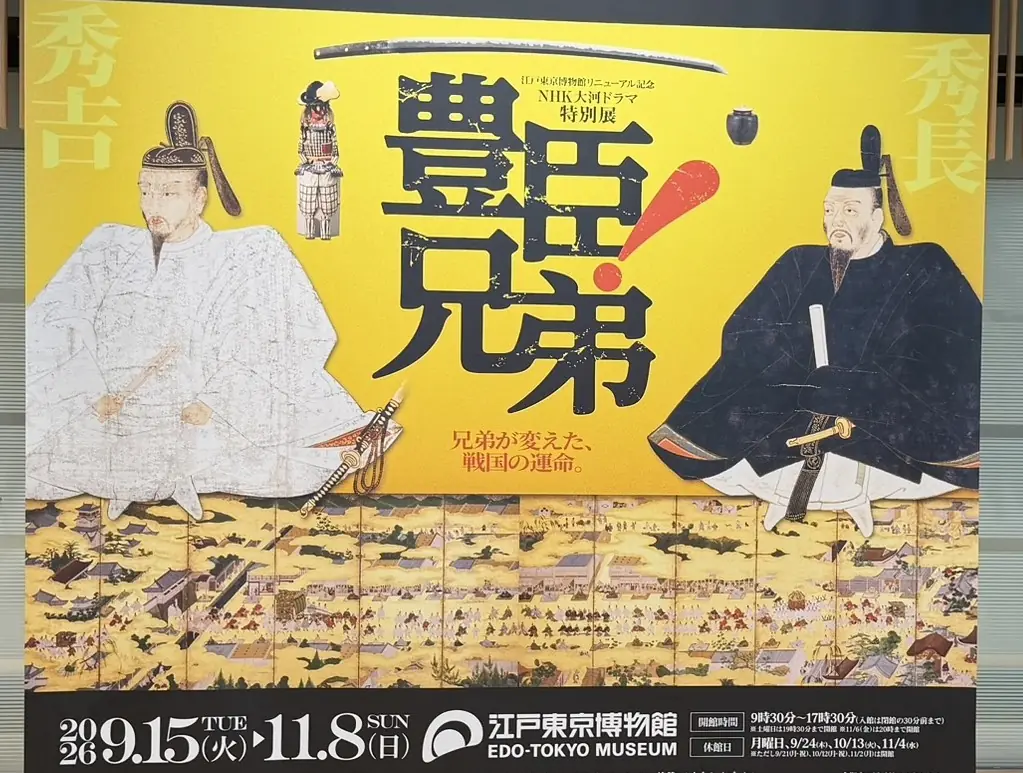
The Edo-Tokyo Museum in Ryogoku is hosting the Tokyo venue of the NHK Taiga drama special exhibition Toyotomi Kyodai! ("The Toyotomi Brothers!"), timed to the 2026 historical drama of the same name. The drama follows Toyotomi Hidenaga, the younger brother who helped Toyotomi Hideyoshi rise from humble origins to rule Japan in the late 16th century. The exhibition brings together letters, folding screens, armor, tea utensils and swords lent by museums, temples and collections across Japan.
I went in at around 10:00 on a Saturday and spent about 2 hours 20 minutes in the special exhibition alone, taking notes as I went. This guide is for anyone planning a visit during a Tokyo trip, whether you follow the drama, know the Sengoku (Warring States) period well, or simply want to see some of the most famous objects of the Toyotomi era in one place.
Is it worth visiting? Dates, tickets and photography
In my view, yes, if you have any interest in samurai history. Objects that normally sit in different museums across Japan are shown together, and some are real highlights: a suit of armor used by Hideyoshi that is shown only at the Tokyo venue on this tour, Hideyoshi's handwritten draft will, and famous tea wares that still carry the names of the warlords who owned them. Considering the effort of visiting each lender separately, I felt the ¥2,100 ticket was good value. The main caveat for international visitors is language: most of the object labels I saw were in Japanese (see English support below).
| Dates | Tuesday 15 September – Sunday 8 November 2026 |
|---|---|
| Venue | Edo-Tokyo Museum, 1st-floor Special Exhibition Gallery (1-4-1 Yokoami, Sumida-ku, Tokyo) |
| Hours | 9:30–17:30; Saturdays until 19:30; 6 November until 20:00. Last entry 30 minutes before closing |
| Closed | Mondays (but open 21 September, 12 October and 2 November), plus 24 September, 13 October and 4 November |
| Tickets (on the day) | Adults ¥2,100; 65 and over ¥1,600; university and vocational students ¥1,300; free for high school students and younger, and for holders of Japanese disability certificates plus up to two companions |
| Combined ticket | Special exhibition + permanent exhibition: ¥2,740 for adults, sold only at the museum and on its own online ticket site — ¥160 less than buying the special exhibition (¥2,100) and the permanent exhibition (¥800 on its own) separately. The ¥2,100 ticket does not include the permanent galleries |
| Reservations | Not required, but you may have to wait to enter when it is busy. Online tickets can be bought through the official ticket page (several vendors to choose from) |
| Photography | Not allowed in the galleries with the historical objects on the day I visited |
Checked on 20 September 2026 against the official Japanese pages. The English exhibition page listed some dates differently (for example, a later closing time on 6 November), so the details above follow the museum's Japanese information. Please check the museum website before you go.
Discount tickets: as of 20 September 2026, the only discounts I could find were through specific membership or employee-benefit schemes in Japan, such as CO-OP Deli, Benefit One and Yutori Chiyoda. I did not find anywhere selling cheaper tickets to the general public. If you work for a Japanese company, it may be worth checking whether your employee benefits cover the exhibition.
Show your "Toyotomi Brothers" ticket stub or your online ticket screen at the special-exhibition ticket counter of the Tokyo National Museum, and you can get a discount on the special exhibition "Daitoku-ji: 700 Years of Rinzai Zen" (14 October 2026 - 6 December 2026), held to mark the temple's 700th anniversary. The discount is valid from 14 October to 6 December 2026 and cannot be combined with other discounts.
| Adults | ¥2,300 → ¥2,200 (tax included) |
|---|---|
| University students | ¥1,300 → ¥1,200 (tax included) |
| High school students | ¥900 → ¥800 (tax included) |
First half vs second half: which objects are on when
The Tokyo show is split into a first half (15 September – 12 October) and a second half (14 October – 8 November), and some objects have their own display dates. The catalogue numbers below are the museum's list numbers, not the order of the galleries. See the full object list (PDF, Japanese) for every entry, or use my work list in English, where you can filter all 130 works by half and by venue.
This table is only a selection: it lists some of the objects covered in this guide. Many more objects are shown in the first half, the second half and the whole run. For the full, up-to-date object list, open the museum's exhibition page and click "展示リスト" (object list) to download the PDF, or go directly to the object list (PDF). It is in Japanese; my searchable work list covers the same 130 works in English.
| First half only (15 Sep – 12 Oct), e.g. | No. 122 armor used by Hideyoshi; No. 230 Hideyoshi's handwritten draft will; No. 2 portrait of Hideyoshi (Zenrin-ji temple, Kyoto) |
|---|---|
| 15 Sep – 4 Oct only | No. 41 Hideyoshi's written instructions to Hidenaga (Mino-no-kami) |
| Second half only (14 Oct – 8 Nov), e.g. | No. 216 the sword Nansen Ichimonji; No. 200 record of a tea gathering at Arima hot spring |
| Battle of Nagakute screens | No. 54 (Toyota Municipal Museum) 15 Sep – 25 Oct, replaced by No. 56 (Tokugawa Art Museum) 27 Oct – 8 Nov |
| Whole run, e.g. | No. 38 Battle of Shizugatake screens; No. 101 Jurakudai procession screens; No. 190 Araki tea bowl; No. 195 Yakushiin tea caddy; No. 204 Yabure-bukuro water jar; No. 232 the short sword Namazuo Toshiro; and more |
A selection from the object list checked on 20 September 2026. Display dates may change, so check the latest list before you go.
I visited in the first half. Go by 12 October for the armor and the draft will; go from 14 October for the Nansen Ichimonji sword.
Time needed, getting in, and English support
- Special exhibition: about 2 hours 20 minutes for me, reading closely and taking notes, including the short film in the galleries.
- Exhibition shop: allow 10–15 minutes if you like to browse; there is a lot of merchandise.
- Permanent exhibition: split into Edo and modern Tokyo zones. To see it properly I would allow another 2–3 hours. I only had time for the Edo zone.
On my Saturday morning visit there was a long queue at the ticket counter, so I skipped it by buying an online ticket on my phone on the spot. When I bought my ticket in person on site on 19 September 2026, the QR code gave an error as soon as I scanned it at the entrance, and staff asked me to wait a little; I was let in after about 3–5 minutes, though I could not confirm what caused the error. In my experience, buying your ticket before you arrive at least means you are not doing the purchase itself at the door. Online tickets are available through the official ticket page.
On my visit around 10:00 on Saturday 19 September 2026, the galleries were busy throughout. Following the route strictly from the start meant waiting in front of some cases, so it helped to look at quieter displays first, within the museum's guidance.
English support: the entrance area had English. For the individual object labels, my impression is that some had English and others did not, but I cannot say how much of the exhibition is covered. The official audio guide is in Japanese only. If you do not read Japanese, the object notes in this guide are a good way to prepare before you go.
For Japanese speakers, the official audio guide is available as a ¥700 rental at the venue or through the "Kiku Bijutsu" app (¥800, available until 8 November 2026). It is narrated by Taiga Nakano, who plays Hidenaga in the drama. I had bought the app version at the Nagoya venue, and in my case the updated Tokyo audio was available at no extra charge. It has 17 sections, and even in the first half I could listen to commentary on second-half objects, which helped me decide whether to return. The app version also works outside the museum, so you can listen again at home. If you plan to come back in the second half and want the audio guide again, the app version is the one to buy. More detail on the "Kiku Bijutsu" app itself is on the official site of its operator, Acoustiguide Japan (Japanese only). Listening to it before your visit could also work as a way to prepare. Check the official information for availability and conditions.
Getting there from Ryogoku Station
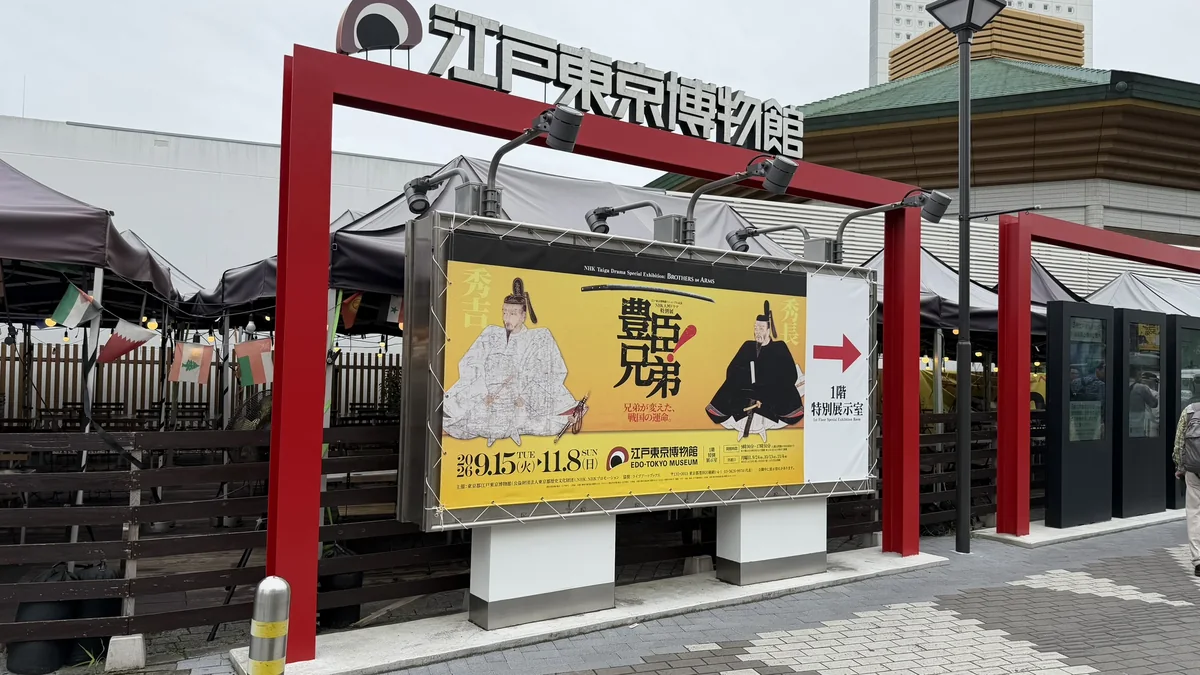
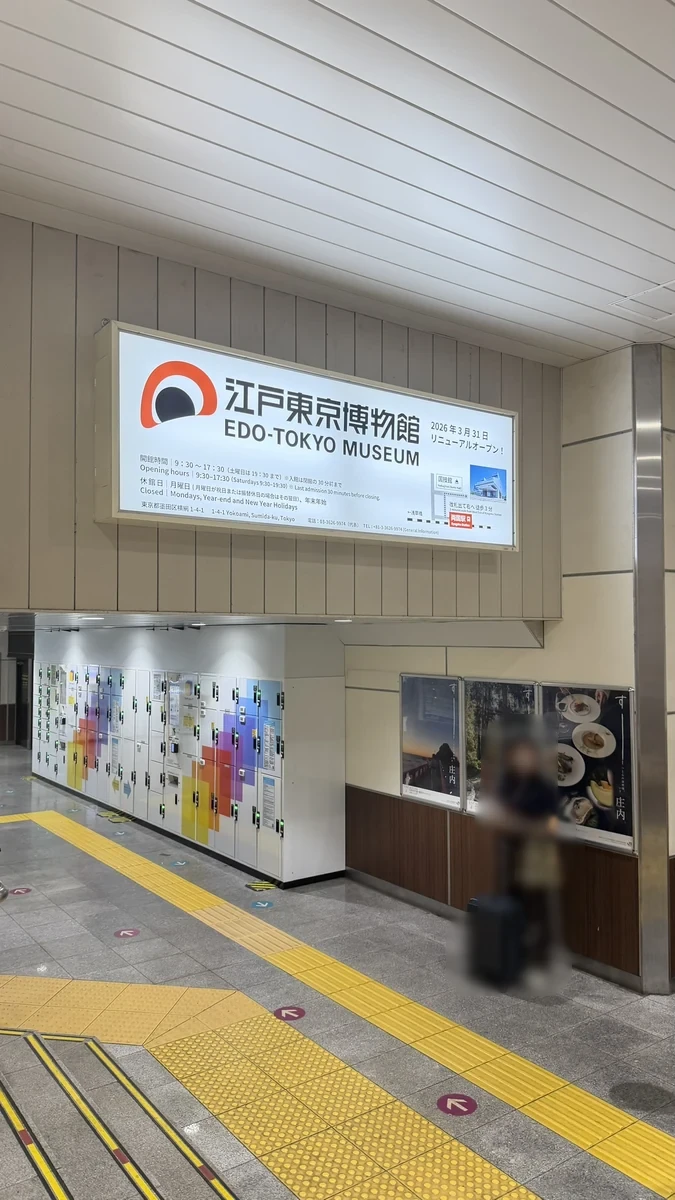
The museum is next to Ryogoku Station, which is served by the JR Sobu Line (station number JB21) and the Toei Oedo subway line. I left JR Ryogoku Station by the West Exit, on its north side (the side with a 7-Eleven), and walked about 300 m to the museum entrance. Large exhibition posters outside the station also point towards the museum. On the route I walked on 19 September 2026, part of the walk was uncovered, so bring an umbrella if rain is forecast.
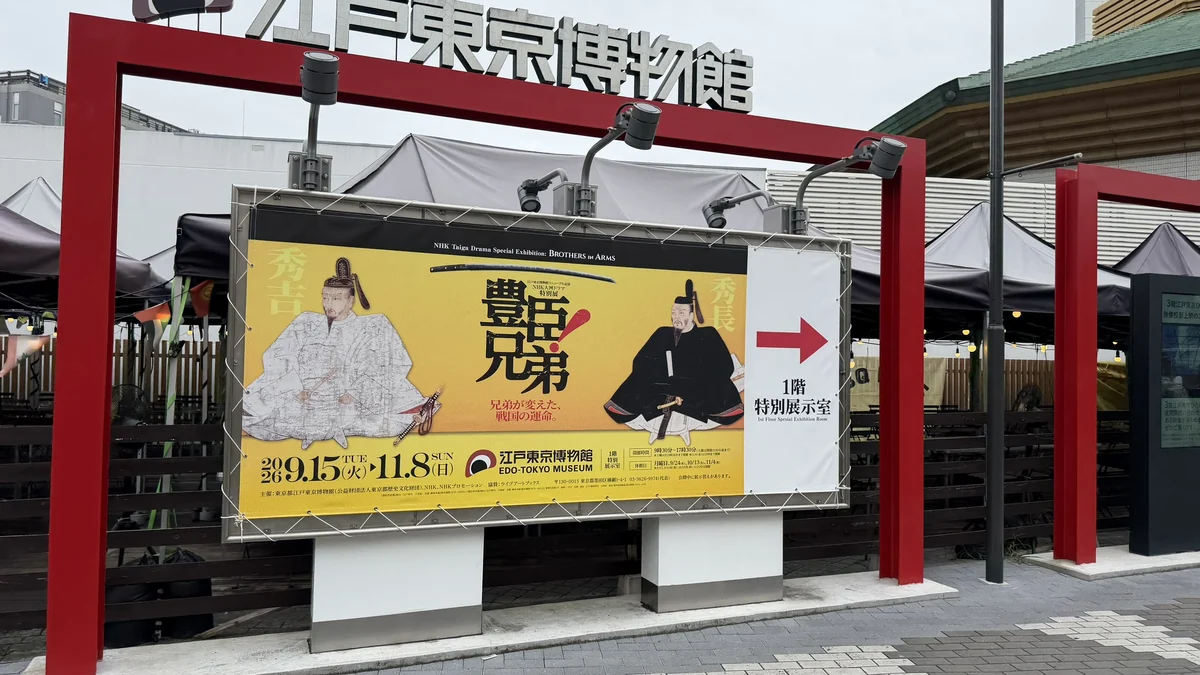
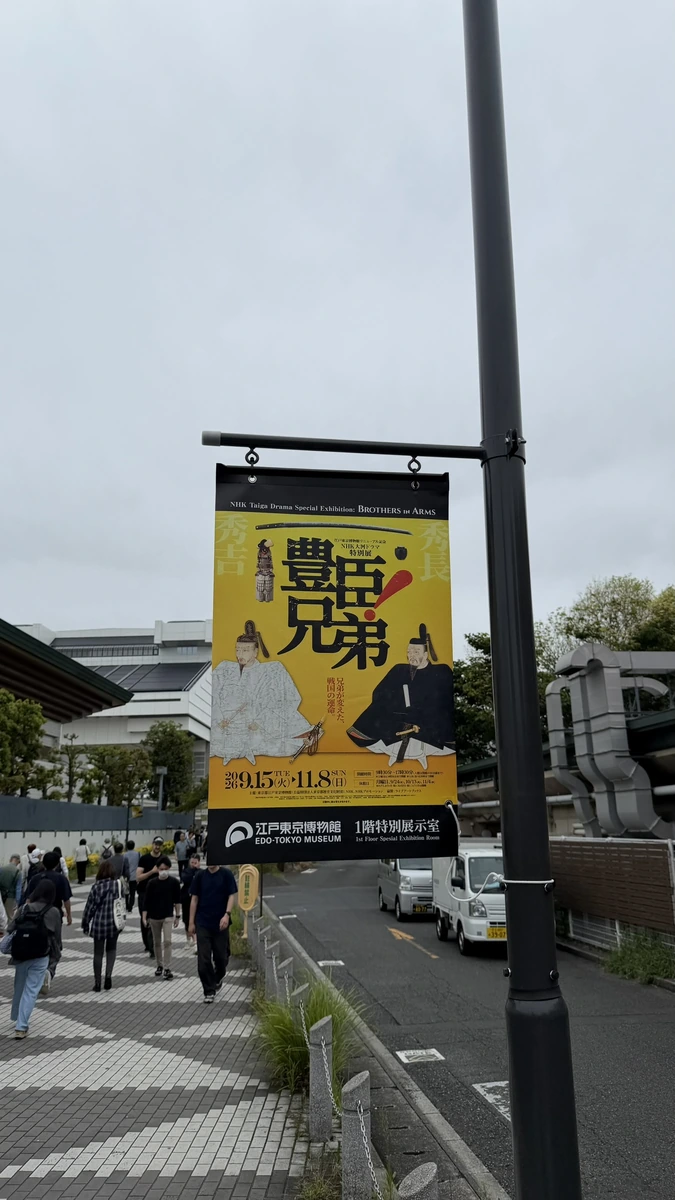
Tap to enlarge
The route I walked from the north side of JR Ryogoku West Exit to the museum
Coming from Shinagawa or Tokyo Station, if you don't know the area
Route planners will sometimes suggest taking the Yokosuka Line from Shinagawa Station (JO17) or Tokyo Station (JO19) to Kinshicho Station (JO22), then one stop back on the Chuo-Sobu Local Line to Ryogoku (JB21), rather than changing onto the Sobu/Chuo Line. The fastest route and journey time depend on when you travel, so check a route planner on the day. The map below shows an example route from Shinagawa Station to Ryogoku Station.
| Tokyo Station | Yamanote Line JY01 (three-letter code: TYO) / Keihin-Tohoku Line JK26 / Chuo Rapid Line JC01 / Sobu Rapid Line JO19 / Tokaido Line JT01 |
|---|---|
| Shinagawa Station | Yamanote Line JY25 / Keihin-Tohoku Line JK20 / Tokaido Line JT03 / Yokosuka Line JO17 |
| Kinshicho Station | JR Chuo-Sobu Local Line JB22 / Sobu Rapid Line JO22 |
| Ryogoku Station | JR Chuo-Sobu Local Line JB21 |
Station numbers for the stations mentioned above, for reference.
Example route from Shinagawa Station to Ryogoku Station (Yokosuka Line to Kinshicho, then one stop back)
About the Edo-Tokyo Museum
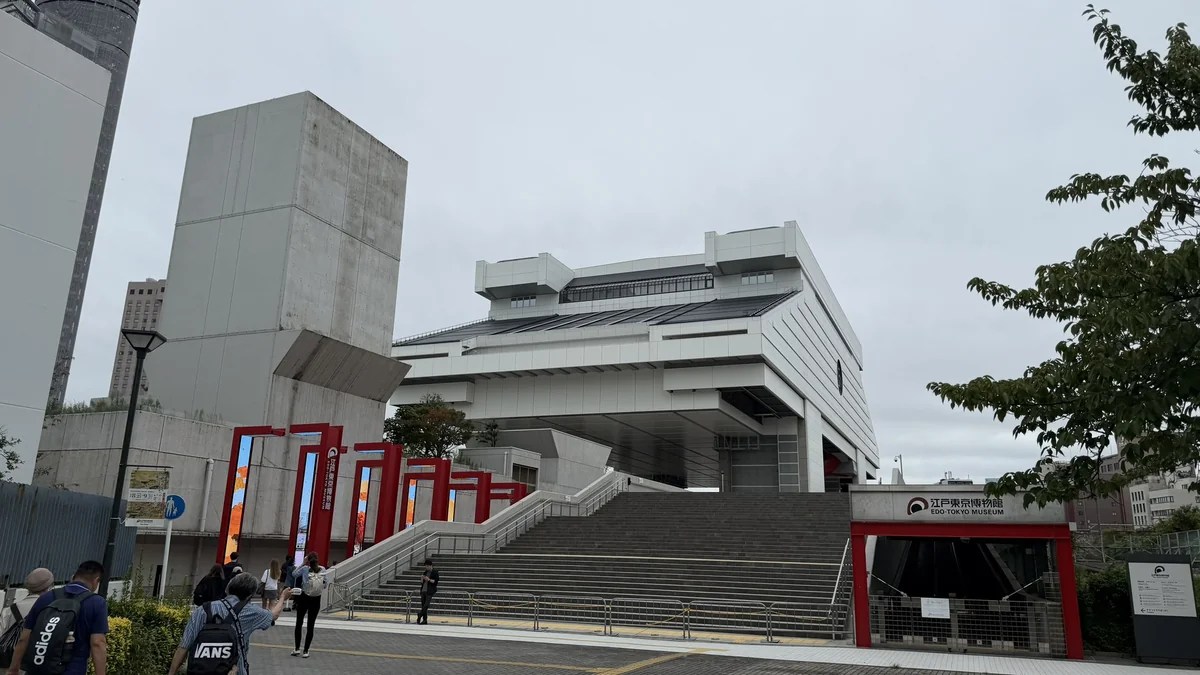
The Edo-Tokyo Museum is Tokyo's city history museum, first opened in 1993. After its first major renovation in about 30 years, it reopened on 31 March 2026, and the Toyotomi Brothers show is one of its reopening special exhibitions. The exhibition is in the 1st-floor Special Exhibition Gallery, separate from the permanent galleries on the history of Edo and Tokyo. If you want to see both, buy the combined ticket.
| Address | Edo-Tokyo Museum, 1-4-1 Yokoami, Sumida-ku, Tokyo |
|---|---|
| JR Sobu Line, Ryogoku Sta. (JB21) | 3 min walk from the West Exit, 7 min from the East Exit (museum's estimate) |
| Toei Oedo Line, Ryogoku Sta. | 1 min walk from Exits A3/A4 (museum's estimate) |
| The way I walked | From the north side of the JR West Exit (7-Eleven side), about 300 m; partly uncovered |
| Gallery | 1st-floor Special Exhibition Gallery, separate from the permanent galleries |
Walking times are the museum's own estimates (checked 20 September 2026). The 300 m figure is my rough estimate, not a measured distance.
Who were the Toyotomi brothers?
Toyotomi Hideyoshi rose from a commoner family in Owari Province (around today's Nagoya) to become a leading general under the warlord Oda Nobunaga, and after Nobunaga's death in 1582 he brought the whole of Japan under his rule. His younger brother Hidenaga fought alongside him for years and became a major lord in his own right, ruling Yamato Province (today's Nara Prefecture) from Koriyama Castle. The exhibition's official commentary highlights his work there, such as bringing merchants to settle and reorganizing the castle town.
Hidenaga died in 1591 and Hideyoshi in 1598. The exhibition runs from a prologue through five chapters to an epilogue, following the brothers' careers and the culture of the Toyotomi regime through real objects. The Taiga drama is a work of fiction based on history, so it is worth keeping the drama's version of events separate from what the objects themselves show.
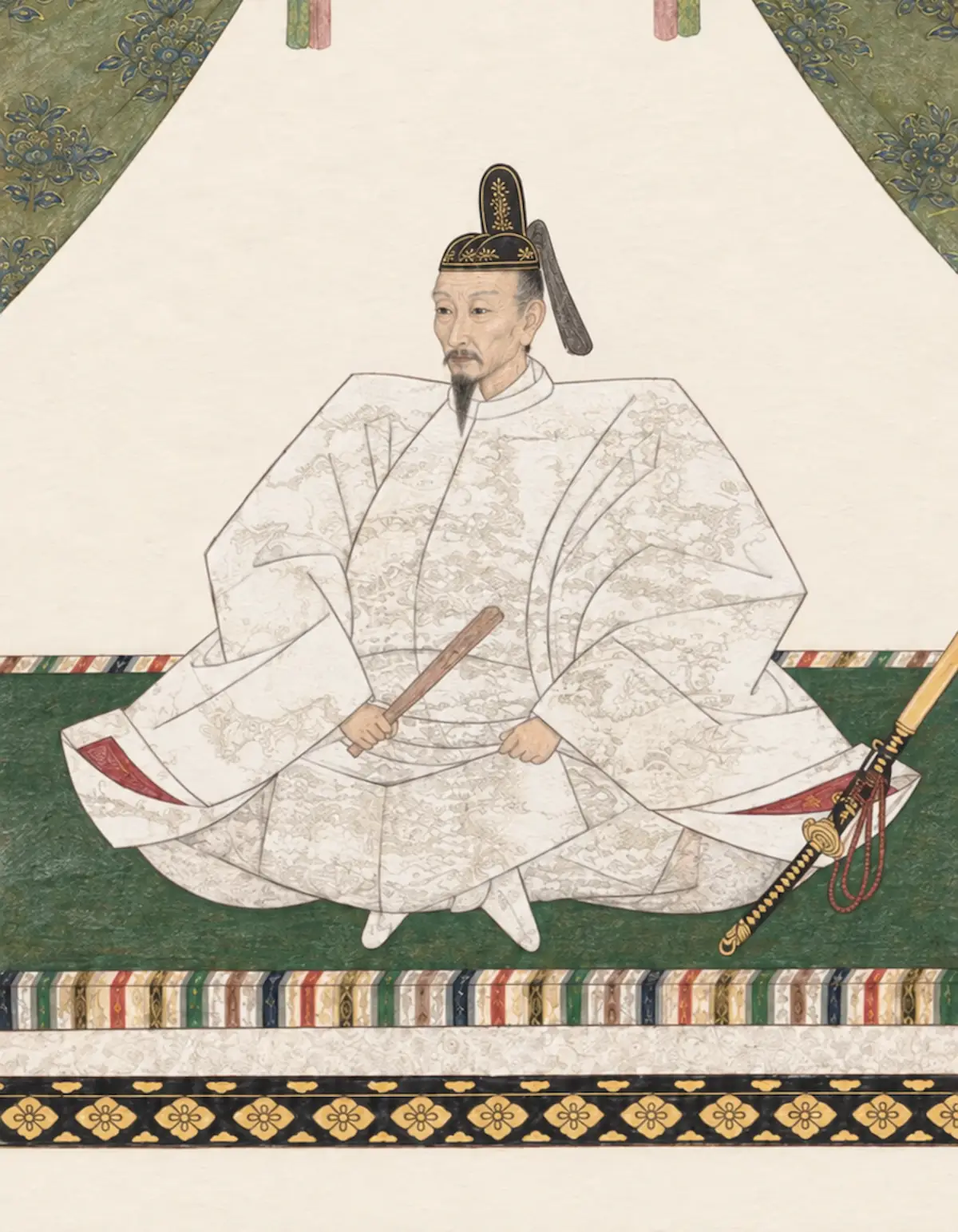
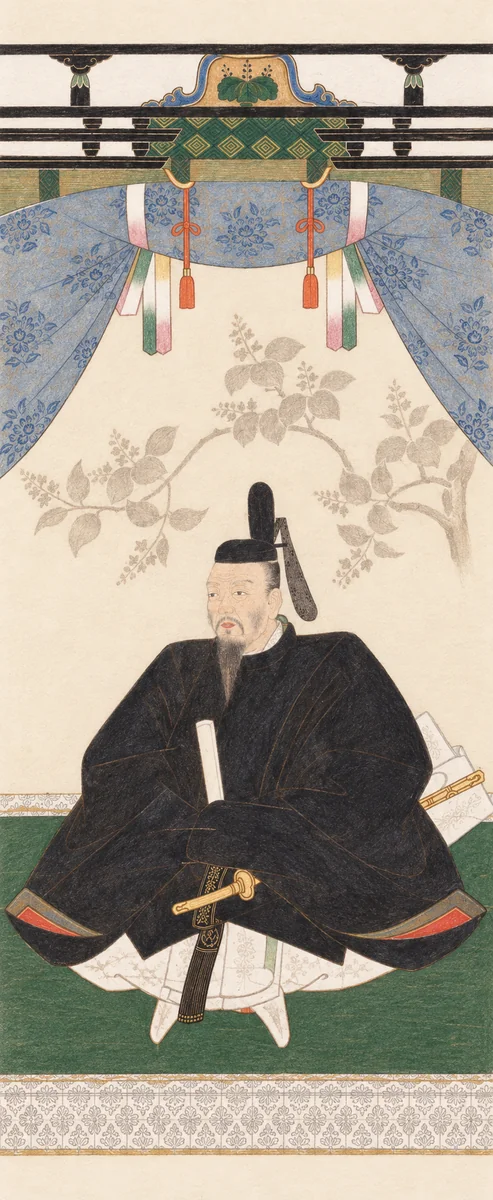
Both portraits below are AI-generated images based on material held by Zenrin-ji temple in Kyoto.
Tap to enlarge
On the left, exhibit No. 2, the portrait of Toyotomi Hideyoshi (Zenrin-ji temple, Kyoto; shown in Tokyo in the first half); on the right, an AI-generated image of Hidenaga based on material from the same temple (it does not correspond to a specific exhibit number). Both are AI-generated images, not photographs of the actual objects or accurate reconstructions. The figure in the portrait looks to be roughly 40 x 40 cm by eye.
The gallery film on Hidenaga
A film in the galleries introduces Hidenaga: his careful letters of thanks, a relationship in which his brother trusted him with decisions, his government of his domain, including his dealings with temples and shrines, and how local communities remembered him long after his death. It is in Japanese, but watching it before or after the objects helps put a face to the less famous brother.
Hidenaga in brief: what to know before you go
Hidenaga is far less known than his brother, even in Japan. These points link his career to the objects on show.
- A different name at first: he first used the name Nagahide and changed it to Hidenaga in 1584, after Nobunaga's death.
- Standing in for his brother: in 1574, while Hideyoshi was tied down facing the Ikko-ikki in Echizen, Hidenaga led troops in his place against the Ikko-ikki uprising at Nagashima in Ise.
- The negotiator: during the Komaki-Nagakute campaign he negotiated peace with Oda Nobukatsu as Hideyoshi's representative, and in the Kyushu campaign the Shimazu side came to him to make peace. When the Kyushu lord Otomo Sorin visited Osaka in 1586, he wrote that private matters went through Sen no Rikyu and official matters through Hidenaga.
- Ruling Yamato (Nara): from Koriyama Castle he ruled Yamato, Kii and other provinces. The exhibition's official site highlights how he brought in merchants and reorganized the castle town. The hanging lantern from Hasedera temple (No. 125) was donated by his daughter in 1588.
- His death: he died at Koriyama Castle on the 22nd day of the 1st month of 1591, at 52 by the traditional count.
What to look for: four groups of objects
There are far too many objects to cover here, so I have grouped the ones I spent the most time with into four themes: letters, folding screens and excavated roof tiles, armor, and tea utensils with Noh costumes. Because photography was not allowed, some objects are shown with AI-generated images that are clearly labelled.
1. Letters and portraits: the brothers and Hideyoshi's draft will
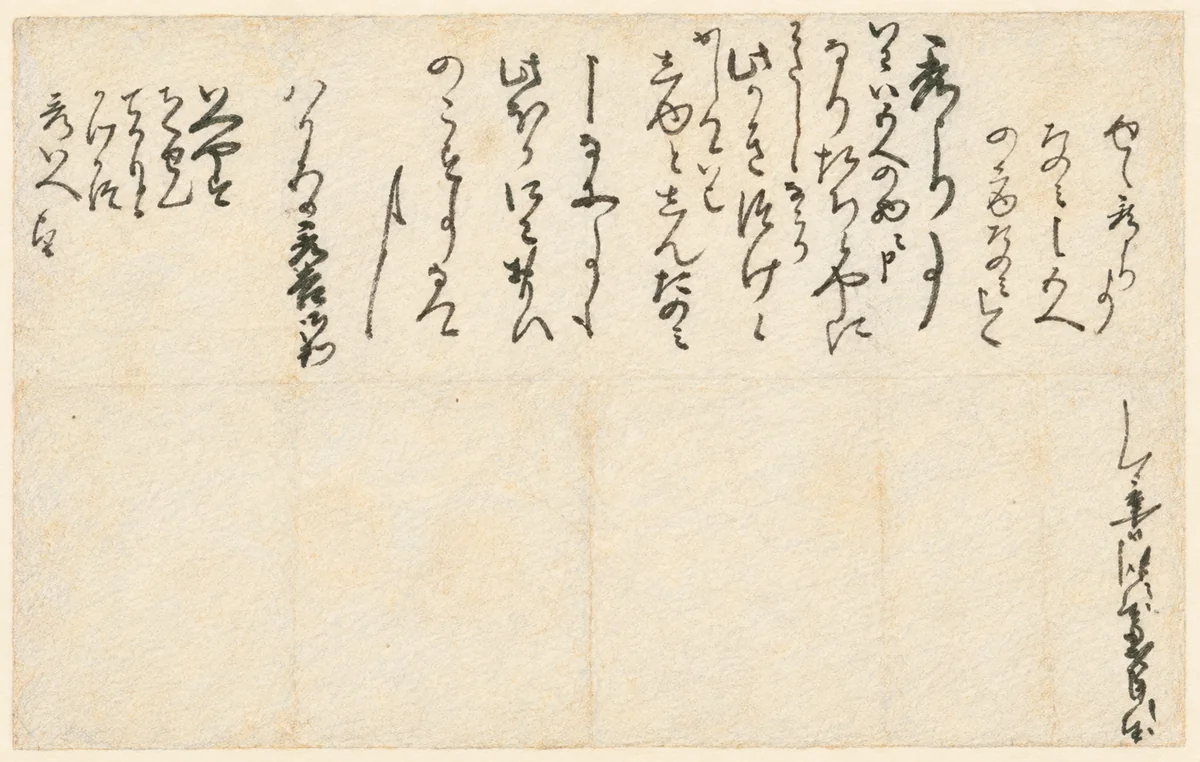
A first-half highlight is No. 230, Toyotomi Hideyoshi's handwritten draft will addressed to Tokugawa Ieyasu and others, an Important Cultural Property owned by the Mori Museum in Yamaguchi. It is dated the 5th day of the 8th month of 1598, shortly before Hideyoshi's death, and it is a draft rather than the final document. In person, what struck me first was how much of it is written in hiragana, the simpler phonetic script, rather than in dense Chinese characters. It left me with the sense of a man leaning on the people he was entrusting with his legacy. By eye, the document itself looked to be roughly 60 x 40 cm.
For the relationship between the brothers, look for two documents addressed to Hidenaga, who held the title Mino-no-kami: No. 41, written instructions, and No. 64, a letter.
- The script of the draft will: notice the amount of hiragana, and keep in mind that this is a draft (案) rather than the final document that would have been sent.
- Two documents to Hidenaga: No. 41 and No. 64 are different kinds of document, so you can compare how Hideyoshi addressed his brother.
- Portrait: in the first half, the portrait of Hideyoshi from Zenrin-ji temple in Kyoto (No. 2) is also on show.
- Date of No. 64: the letter is dated the 18th day of the 6th month of 1584, while the Komaki-Nagakute campaign was still under way.
| No. 230 draft will | First half (15 Sep – 12 Oct); Important Cultural Property; Mori Museum |
|---|---|
| No. 41 instructions | 15 Sep – 4 Oct; Nagahama Castle Historical Museum |
| No. 64 letter | Whole run; Tanaka Honke Museum |
2. Folding screens and excavated tiles: battles, castles and Jurakudai
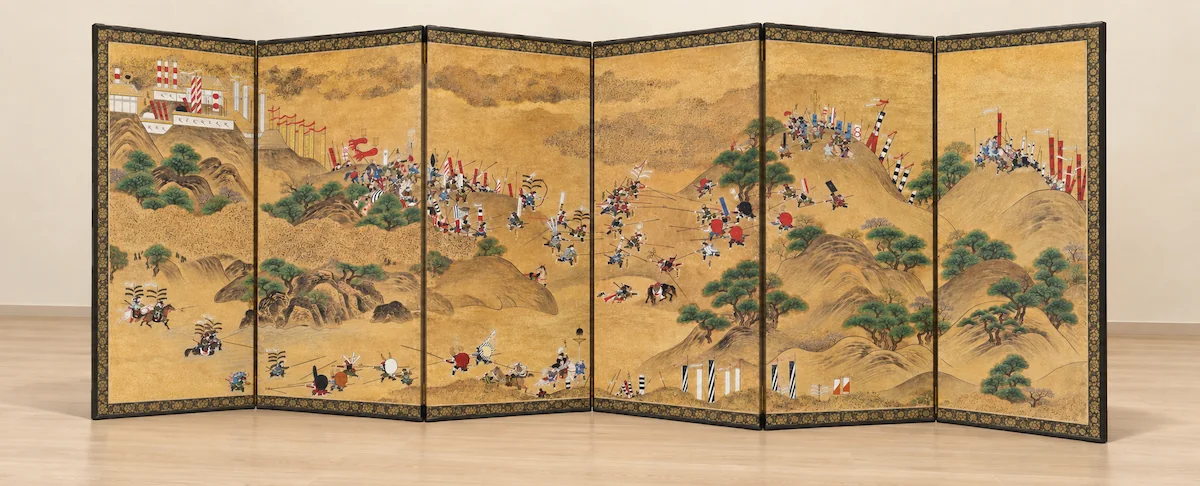
Tap to enlarge
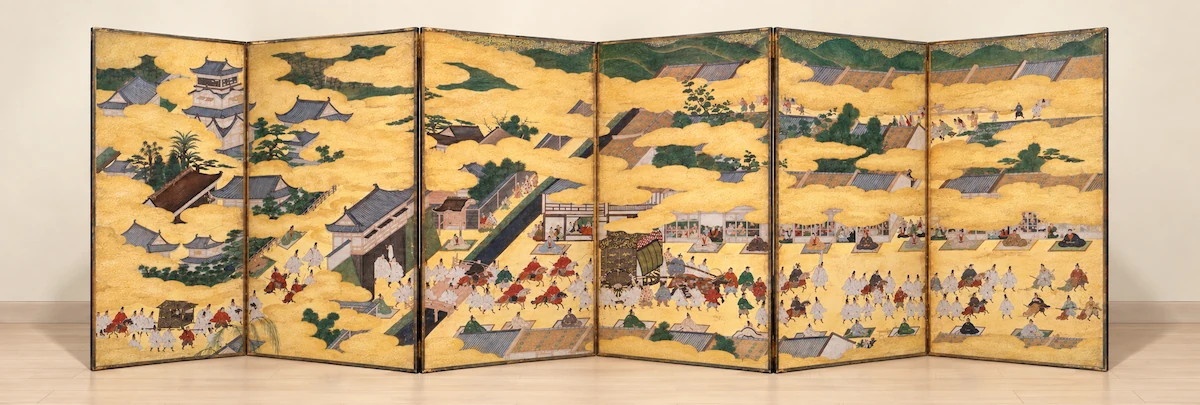
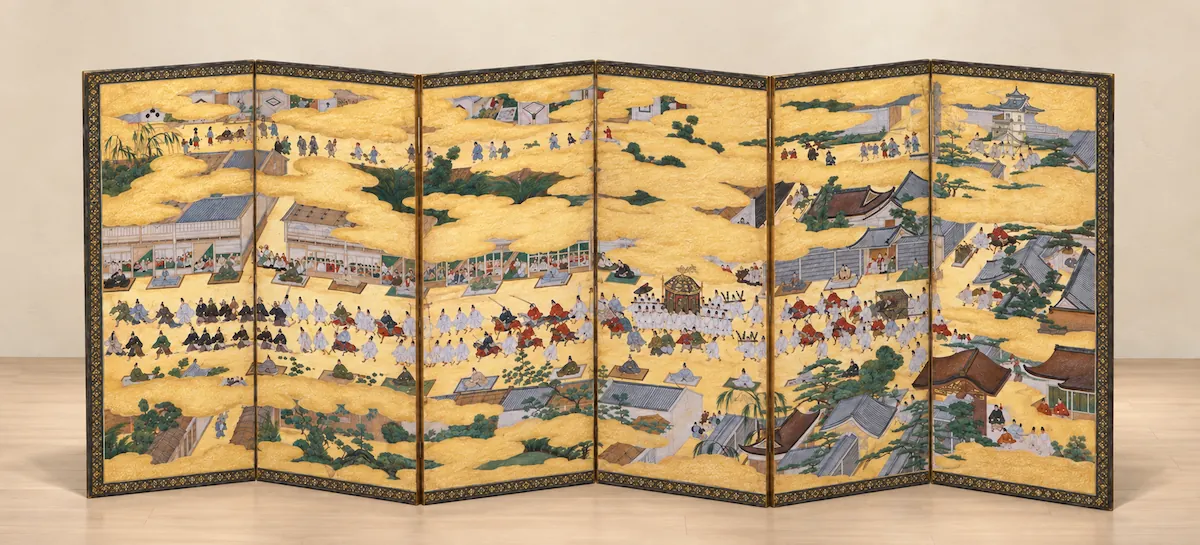
The three images above are AI-generated renderings based on exhibit No. 101 (the screens of the imperial visit to Jurakudai) and No. 38 (the Battle of Shizugatake screens). They are not photographs of the actual objects or accurate reconstructions.
Folding screens (byobu) are large painted panels that fold like a room divider, and several here depict Toyotomi-era events. On No. 38, the Battle of Shizugatake screens (whole run), I noticed how the forts are drawn: the fort on Mt. Tagami, held by Hidenaga, looks small, while the fort on Shizugatake looks far grander. The size on the screen says nothing about the real forts, but it made me want to visit the sites themselves. By eye, the screen looked to be roughly 350 x 170 cm, an impressively large piece.
On No. 101, the screens of the imperial visit to the Palace and Jurakudai (whole run), look beyond the buildings at the people. One figure seems to wear something like a tiger skin at the waist, and the costume patterns are painted in fine detail. This screen is also roughly 350 x 170 cm by eye, another impressively large piece. Both screens were made in the Edo period, after the events, so they are later interpretations rather than eyewitness records.
- Gold-leaf roof tiles: tiles associated with Osaka Castle (Nos. 47–50), tiles excavated from the sites of lords' residences around Jurakudai (No. 100), and tiles from Koriyama and Osaka (Nos. 128–130). Each comes from a different site, so check the label to see how far the Toyotomi building programme reached.
- Shizugatake screens: the Battle of Shizugatake (1583) was fought between Hideyoshi and Shibata Katsuie for control after Nobunaga's death. The young warriors who fought hardest on Hideyoshi's side became famous as the "Seven Spears of Shizugatake".
- Jurakudai screens: in 1588 Emperor Go-Yozei visited Hideyoshi's Jurakudai palace in Kyoto. The visit lasted five days and included a poetry gathering, a public show of Hideyoshi's power.
- Where the gold tiles come from: gold-leaf tiles have been found not only at Osaka Castle but also at Hidenaga's Koriyama Castle and elsewhere, a nice way to compare the brothers' castles.
- Osaka Castle plan: Hideyoshi's Osaka Castle burned in the Summer Siege of 1615. The walls and moats you see today were rebuilt by the Tokugawa, and the Toyotomi castle lies buried beneath them.
- Battle of Nagakute screens: No. 54 (Toyota Municipal Museum) is shown 15 Sep – 25 Oct and No. 56 (Tokugawa Art Museum) 27 Oct – 8 Nov, on a different schedule from the main first and second halves.
To walk the places on the screens, see my guides to the Tagami fort site, held by Hidenaga; Shizugatake, the actual battlefield; the site of Jurakudai in Kyoto, seen in the procession screens; Hidenaga's Yamato-Koriyama; and the Toyotomi Stone Wall Museum at Osaka Castle, where you can see Toyotomi-era walls below ground.
To see more excavated gold-leaf tiles in person, my guide to the Kyoto Municipal Archaeological Museum covers its exhibits on Hideyoshi's reconstruction of Kyoto, including images of the gold-leaf and decorative tiles excavated from Jurakudai and Fushimi Castle.
3. Armor: Hideyoshi's armor, shown only in Tokyo
No. 122 is a suit of armor laced with white silk and covered in silver-coloured scales, used by Toyotomi Hideyoshi and now an Important Cultural Property in the Sendai City Museum. The exhibition materials describe it as a gift from Hideyoshi to the northern lord Date Masamune, and say that on this touring exhibition it is shown only at the Tokyo venue. It is on display in the first half only (until 12 October).
Take the time to look from top to bottom rather than just at the overall effect. What stayed with me were the fabric at the feet, a part of the helmet that looks like animal hair, and a golden fan-shaped ornament.
- Lavish finish: small scales covered in silver leaf are laced with white silk, and the metal fittings carry chrysanthemum and paulownia crests in gold lacquer.
- Bear-hair helmet: the part I thought looked like animal hair is bear hair, a bold Momoyama-period touch.
- The golden fans: the gold fan-shaped ornaments front and back stand out in person.
- Background: tradition says Hideyoshi gave it to Date Masamune in 1590, the year he defeated the Hojo at Odawara.
4. Tea utensils and Noh costumes: Araki, Yabure-bukuro and Yakushiin
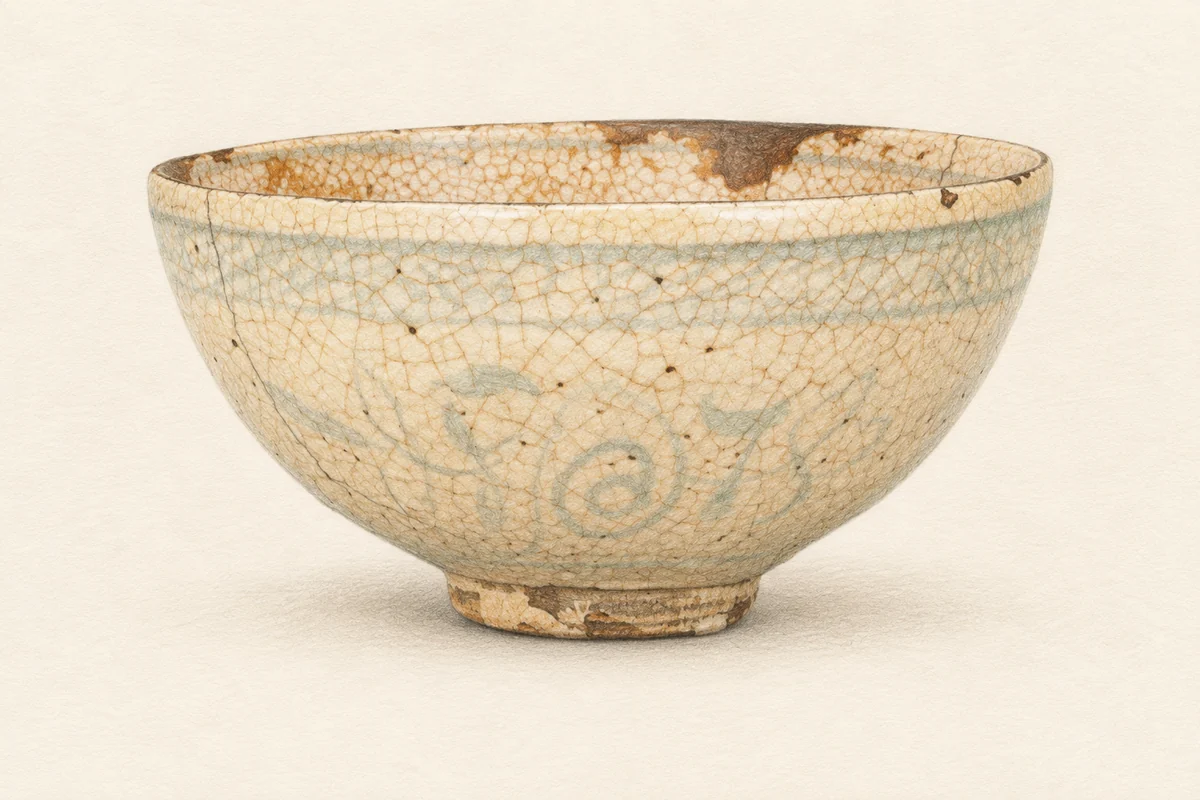
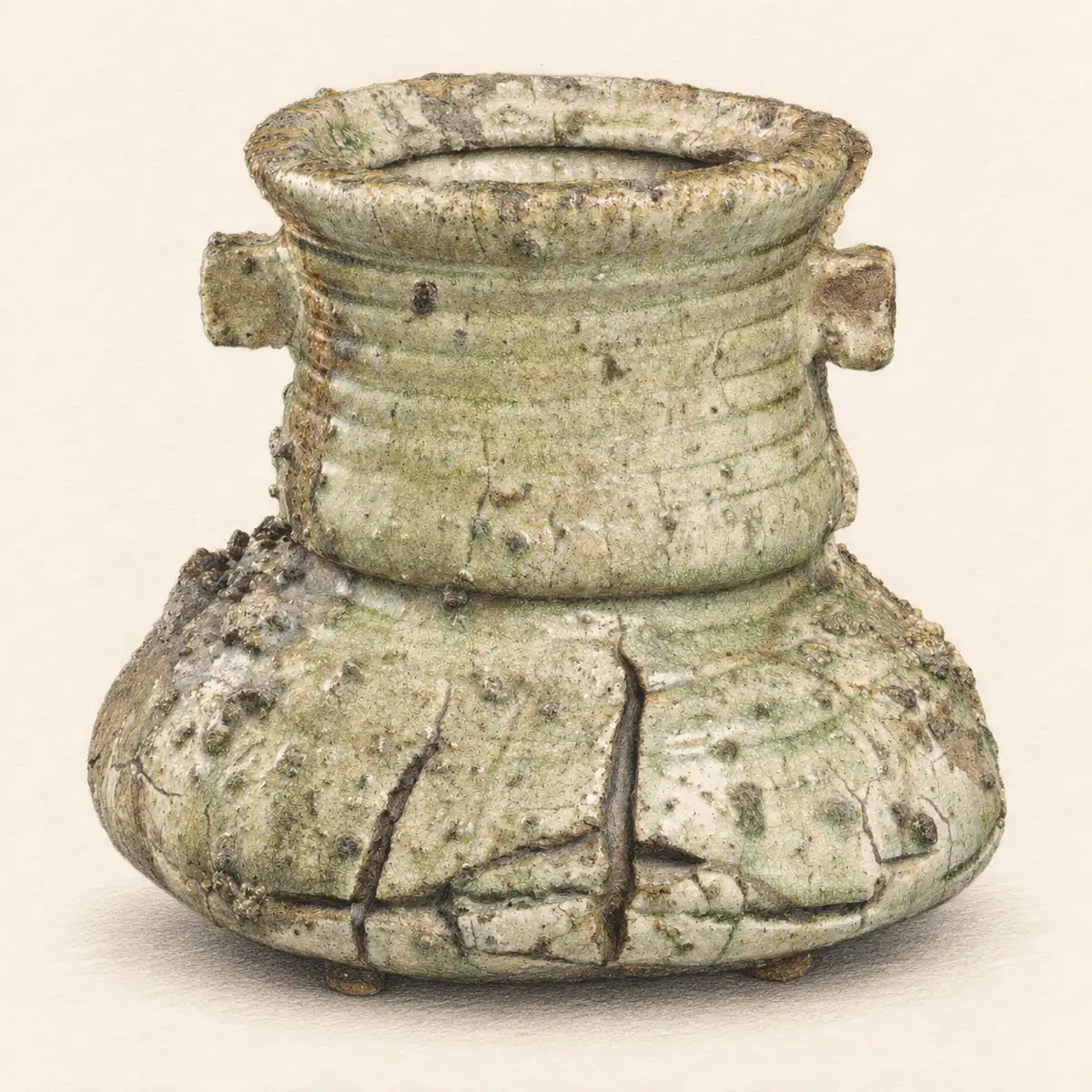
Tap to enlarge
On the left, exhibit No. 190, the tea bowl named Araki; on the right, exhibit No. 204, the water jar named Yabure-bukuro. Both are AI-generated images, not photographs of the actual objects or accurate reconstructions.
In the world of the tea ceremony, prized utensils were given names and passed between warlords like treasures. The object I stood in front of longest was No. 190, the blue-and-white tea bowl named "Araki" (Tokugawa Art Museum, Nagoya; whole run). It was made in Ming-dynasty China in the 16th century. According to the museum, it is said to have belonged to the warlord Araki Murashige and later passed to Tokugawa Ieyasu and the Owari Tokugawa family. By eye, it measured roughly 18 x 8 cm, about the size of an ordinary tea bowl.
Do not stop at the outside. Beyond the band at the top, the painting below and the crackle-like pattern, you can see lines inside the bowl and a painting on the inside base. Today we can pick up a bowl like this almost anywhere, and standing there I found myself imagining why people of the time treasured this one so much.
A mizusashi is the jar that holds fresh water during a tea ceremony. This one, in Iga ware and owned by the Gotoh Museum in Tokyo, stands 21.4 cm tall with a body 23.7 cm across. The museum explains that its thick green glaze formed from ash melting in the kiln, that the back fired to a deep red, and that the base slumped into the kiln stand during firing. The tea master Furuta Oribe is said to have written that nothing like it would ever appear again. The name means "torn bag". In person it looked closer to 30 x 35 cm by eye, larger than I had pictured.
In person, the uneven lower half, the torn-looking shapes, the small handles and the horizontal lines stand out. Walk slowly around the case instead of viewing it only from the front: its shape changes a great deal with the angle.
Also worth finding- No. 195, the tea caddy "Yakushiin" (Kosetsu Museum of Art, whole run): said to be the only tea utensil known for certain to have belonged to Hidenaga. He used it at a tea gathering in the 1st month of 1587, where he made the tea himself. A direct link to the drama's main character.
- Sen no Rikyu and Hidenaga: as Otomo Sorin's comment shows, the two acted as go-betweens for the regime. Rikyu was ordered to commit ritual suicide the month after Hidenaga died.
- No. 185, the tea-leaf jar "Shoka" (Important Cultural Property, Tokugawa Art Museum, whole run): a large Chinese jar from the tea culture of the powerful.
- Noh costumes: Nos. 164 and 169 in the first half, Nos. 165 and 167 in the second, showing the brothers' links to Noh theatre.
- Tea records: No. 203, a tea manual associated with Furuta Oribe, in the first half; No. 200, a record of a tea gathering at Arima hot spring, in the second.
See the real objects behind Hyouge Mono and Touken Ranbu
If you know the Sengoku tea world from the manga and anime Hyouge Mono, whose hero is Furuta Oribe, two pieces here are a must: "Araki" (No. 190), the tea bowl said to have belonged to Araki Murashige, and "Yabure-bukuro" (No. 204), the water jar Oribe is said to have praised so highly. The story's version and the objects' documented history are different things, so read the museum labels alongside what you remember from the series. Both are on show for the whole run.
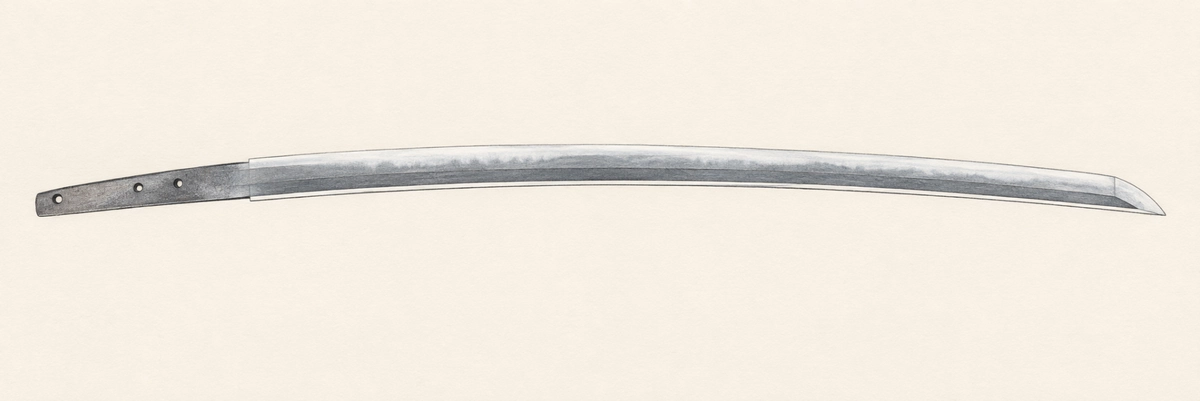
For Touken Ranbu fans, two real swords that inspired sword characters in the game are on show. One is second-half only, so check the dates. The 24 works tied to Touken Ranbu, Hyouge Mono and the drama are listed together under the media filter of my work list.
| No. 232 Namazuo Toshiro | Whole run; Tokugawa Art Museum. A short sword (wakizashi) remade from a polearm blade, named for its resemblance to a catfish tail. The museum describes it as a famous Toyotomi sword passed from Hideyoshi to his son Hideyori, damaged by fire when Osaka Castle fell, and re-tempered for Tokugawa Ieyasu by the swordsmith Echizen Yasutsugu. The blade looked to be roughly 60 cm by eye. |
|---|---|
| No. 216 Nansen Ichimonji | Second half only (14 Oct – 8 Nov); Important Cultural Property; Tokugawa Art Museum. An unsigned Kamakura-period sword. I visited in the first half, so I have not seen it. |
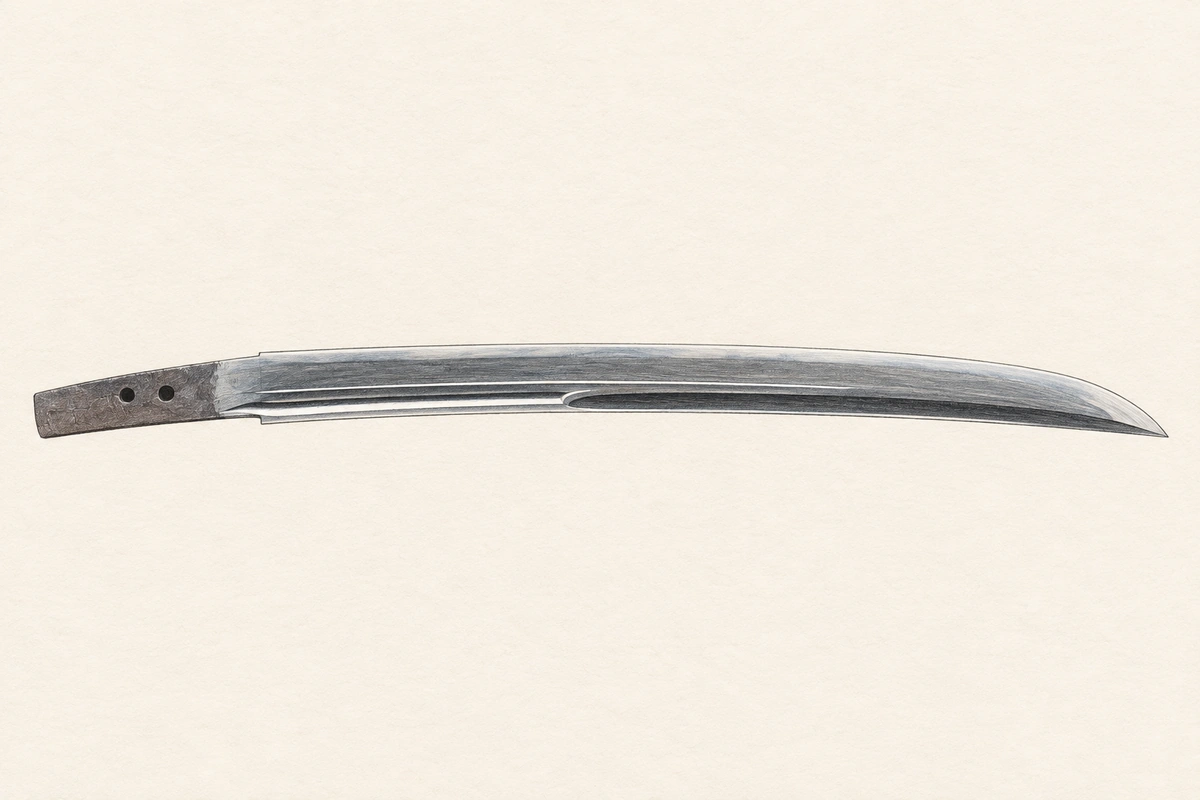
The "thousand gourds" standard (No. 44, whole run): Hideyoshi's battle standard was a cluster of golden gourds, and tradition says he added a gourd after each victory. The example on show dates from the Edo period.
More to enjoy: drama display, shop, themed lunch and the Ieyasu statue
You cannot photograph the historical objects, but the museum also has a Taiga drama display with photo spots, an exhibition shop and a themed lunch, all worth fitting in after the galleries.
Taiga drama production display and photo spots
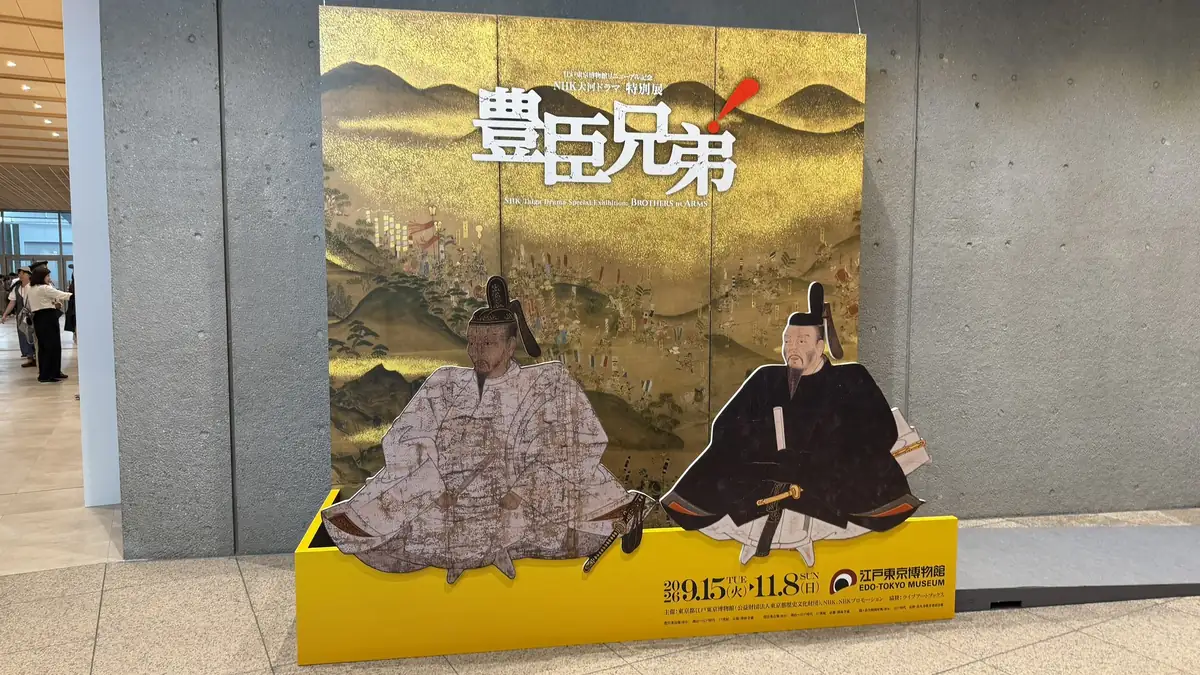
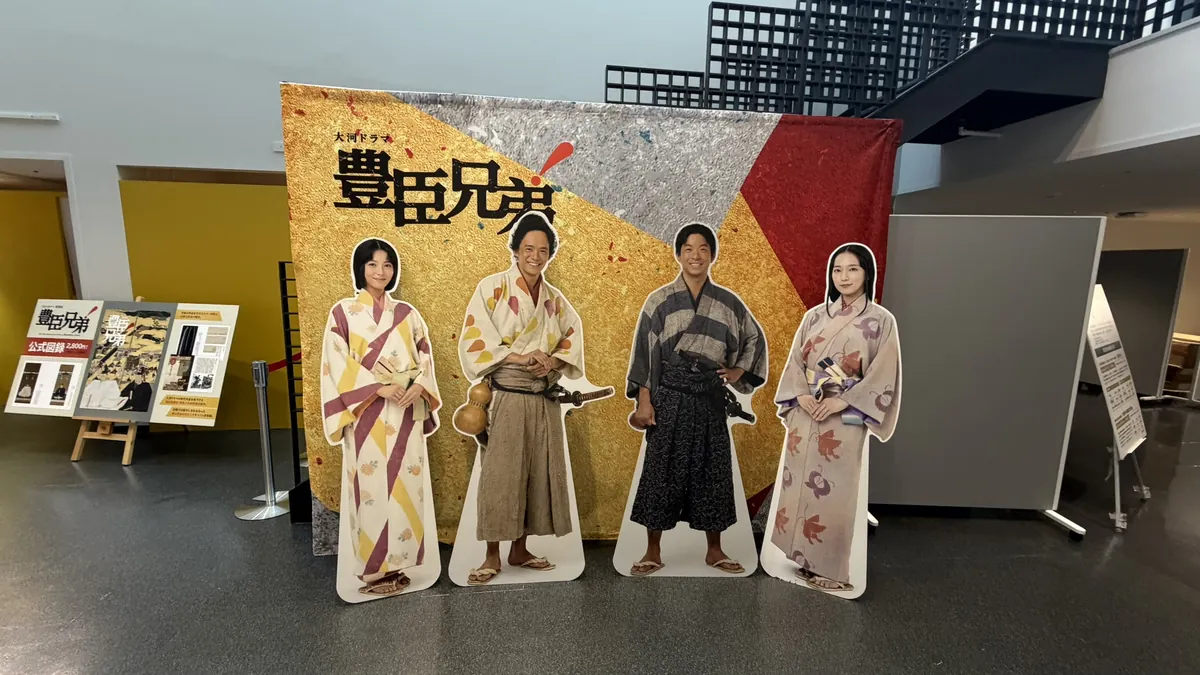
In the corridors you will find a large panel with the brothers' portraits and life-size cut-outs of the drama's main characters, set up for souvenir photos.
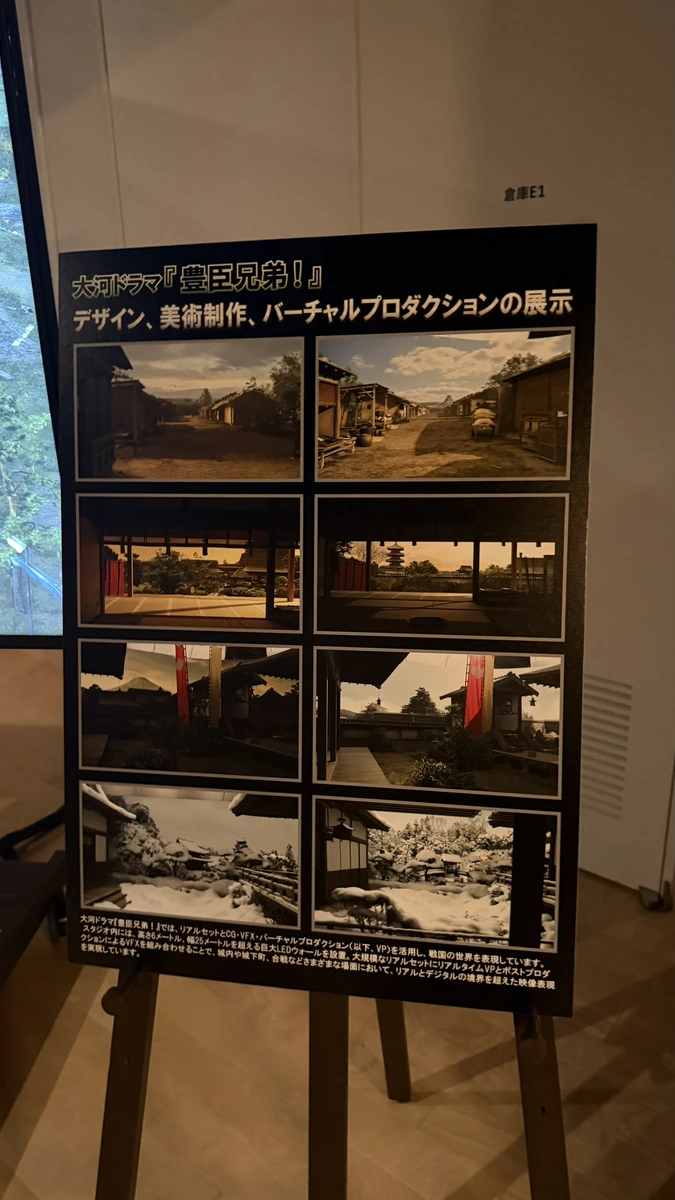
Tap to enlarge
A display in the museum shows how the drama's settings were made, combining real sets with CG, VFX and virtual production, explained on panels and a large screen.
Photos allowed here: the recreated interior of Nagahama Castle
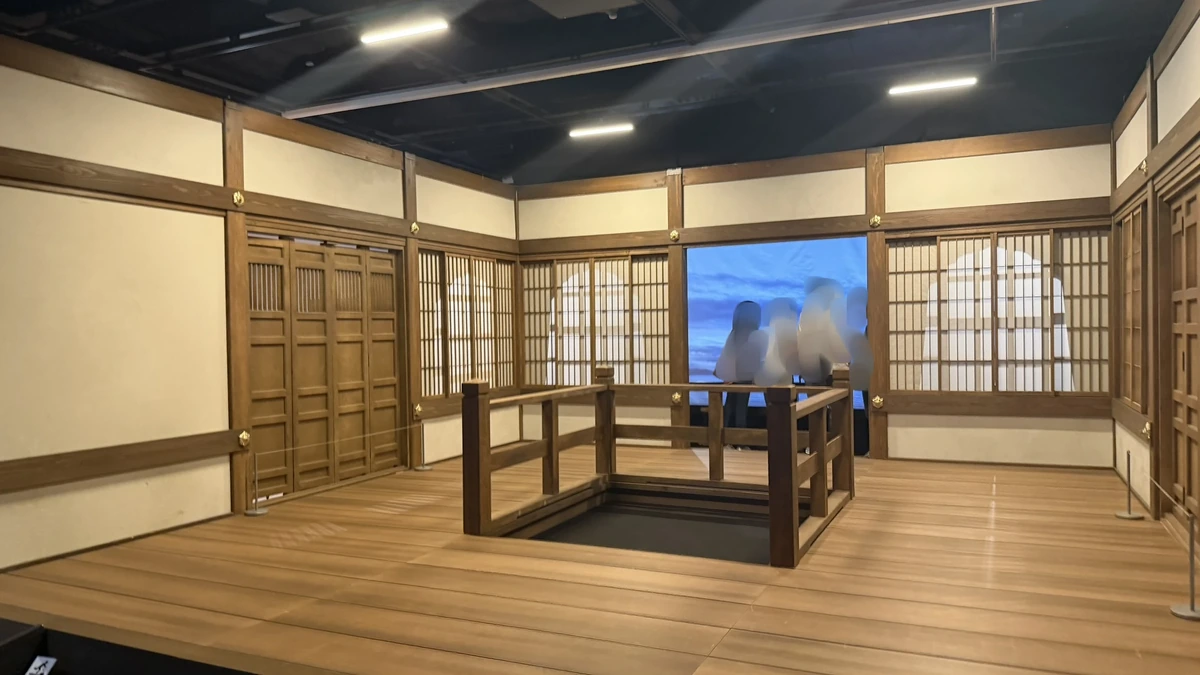
Inside the museum is a full-scale recreation of the interior of Nagahama Castle, the castle Hideyoshi held as his first as a castle-owning lord, combined with a large video screen. Photography is not allowed in the galleries with the historical objects, but this area is an exception, and photography is allowed. It is a good spot for a souvenir photo.
Exhibition shop: catalogue, books and Toyotomi goods
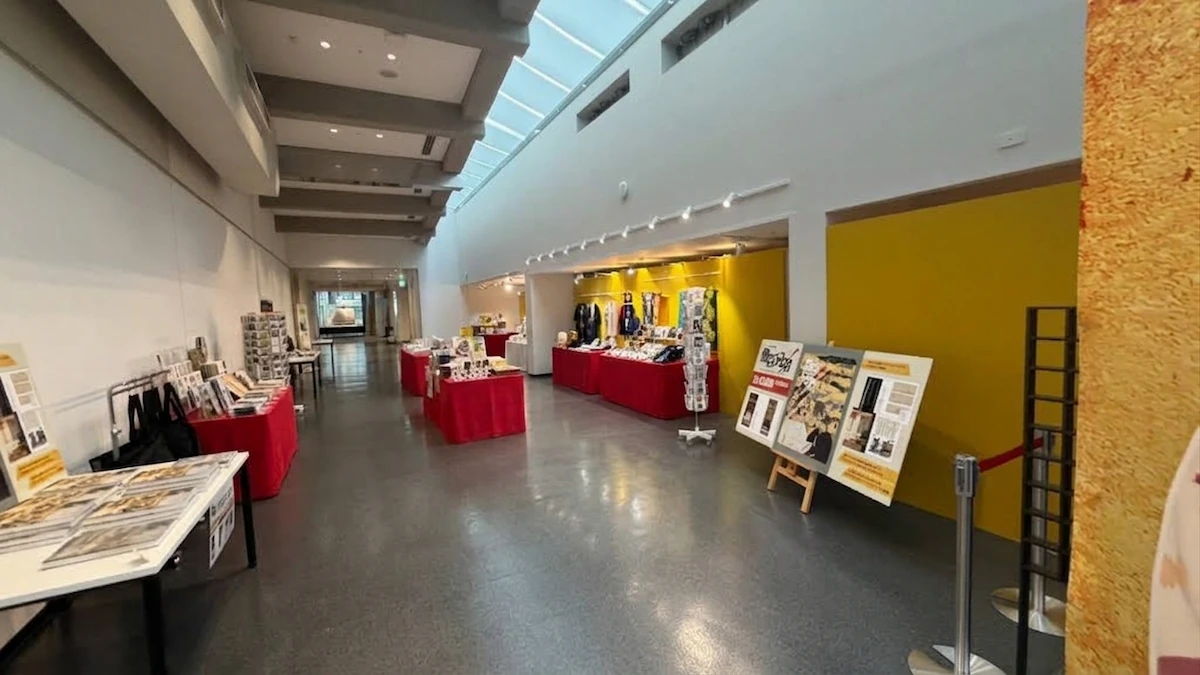
The exhibition shop sells the catalogue, books on the Toyotomi regime and castles, stationery, textiles, tea cups and boxed sweets. It sits right at the exit of the exhibition, so it's an easy stop on your way out. Allow 10–15 minutes if you like to browse.
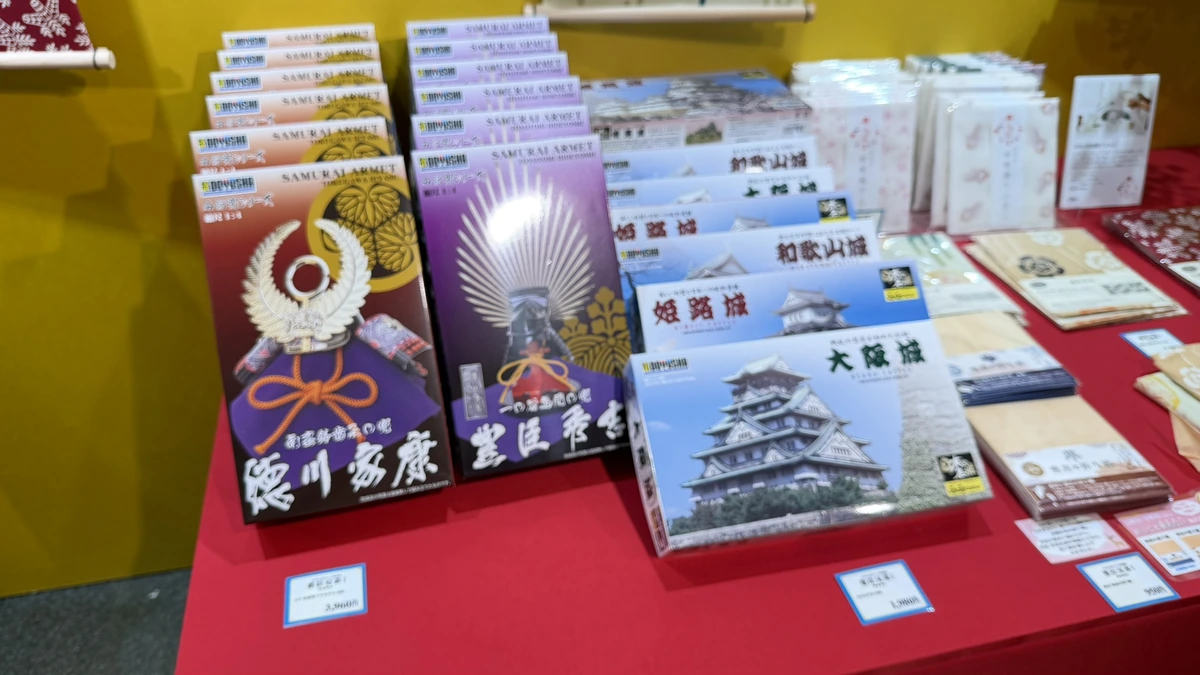
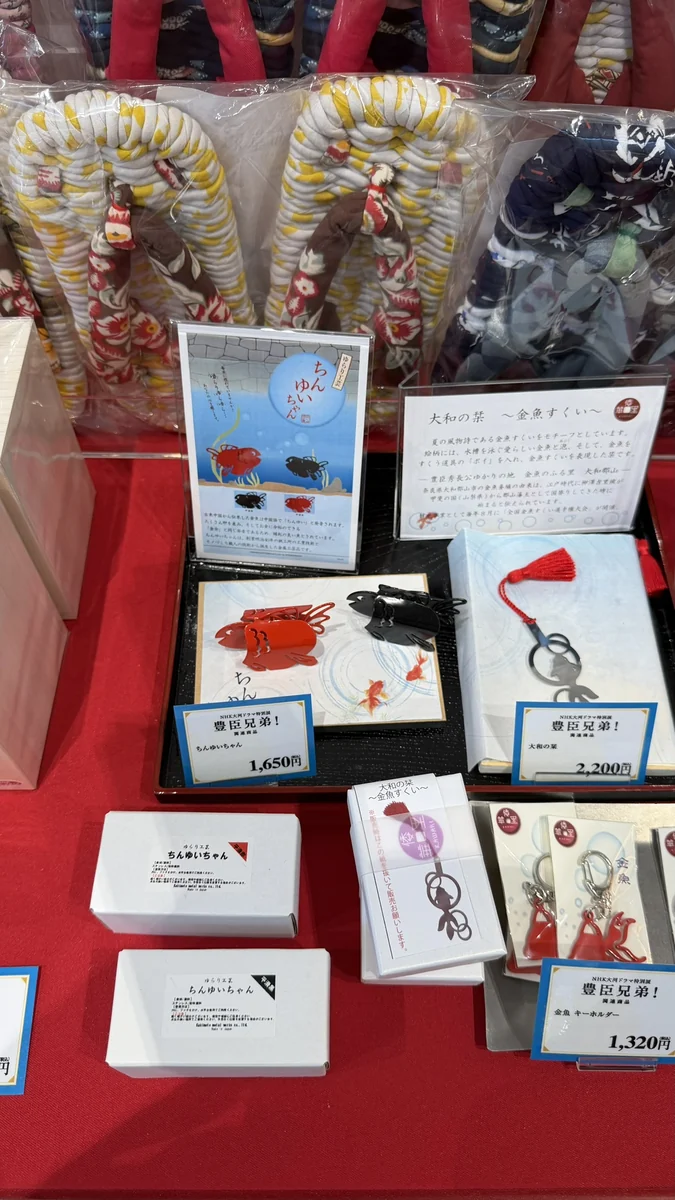
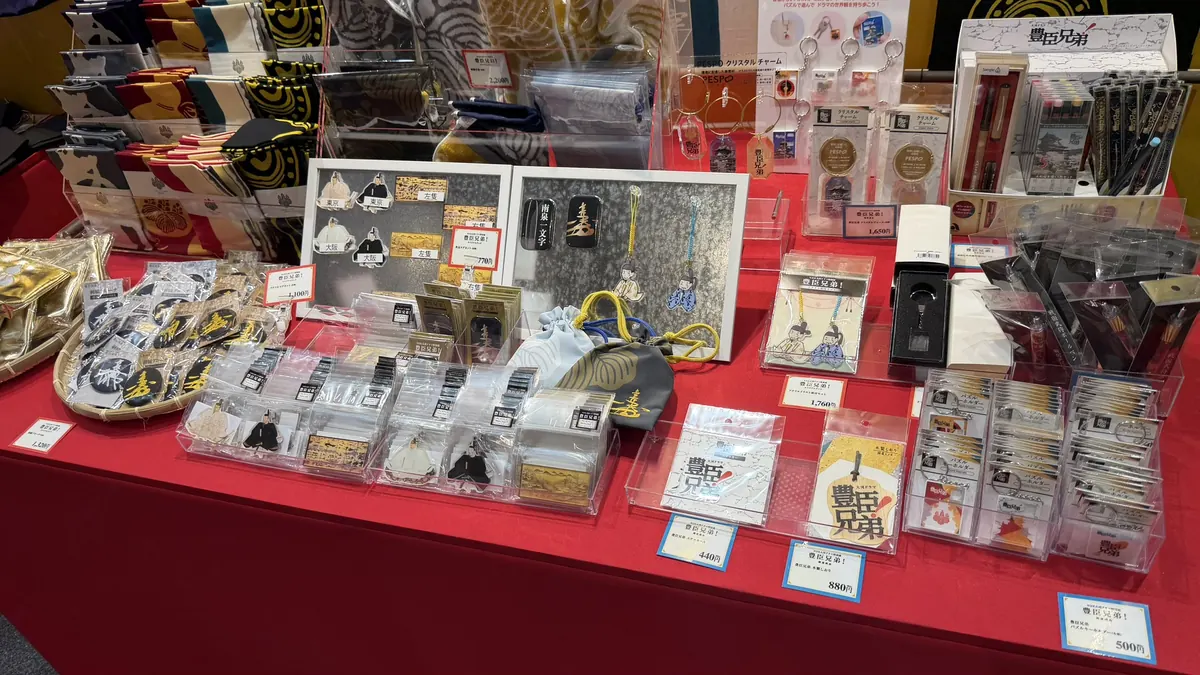
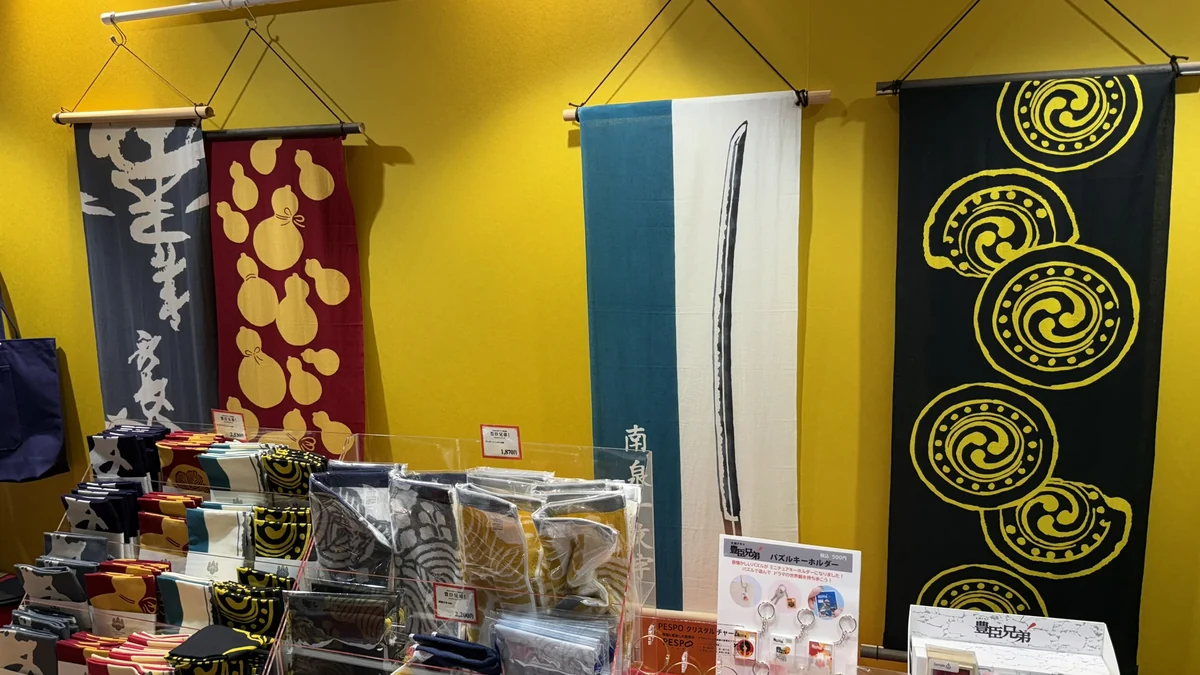
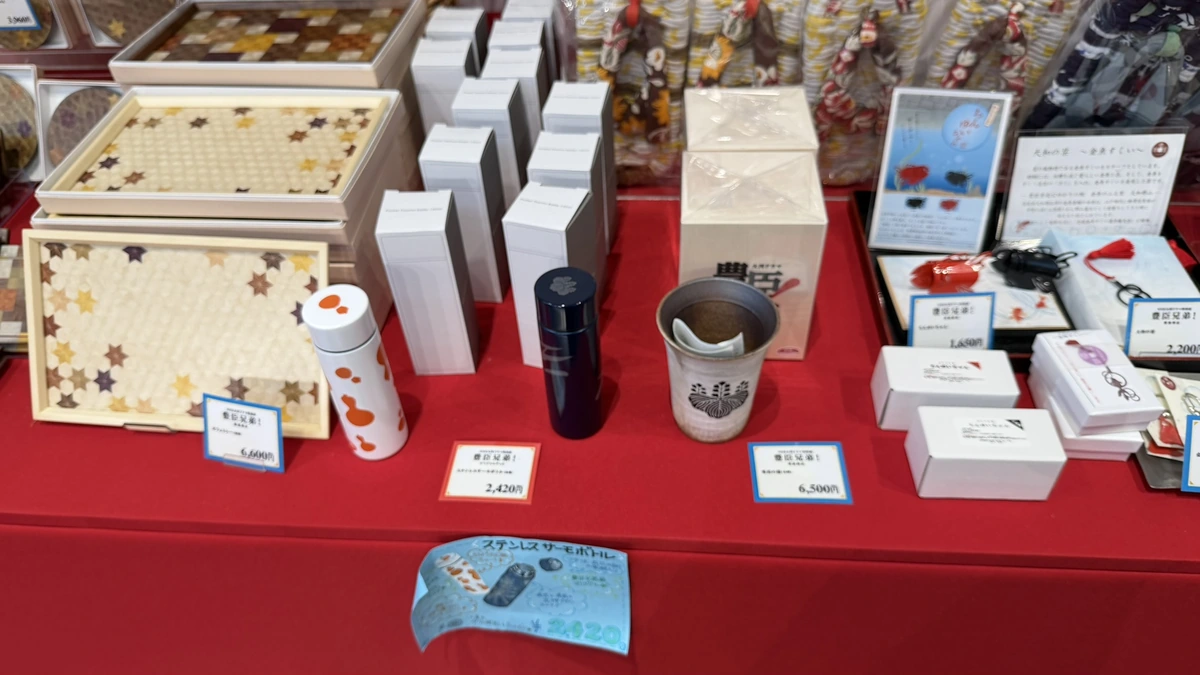
Tap to enlarge
Themed lunch: the "Brothers' Set" at Wa Dining Koyomi
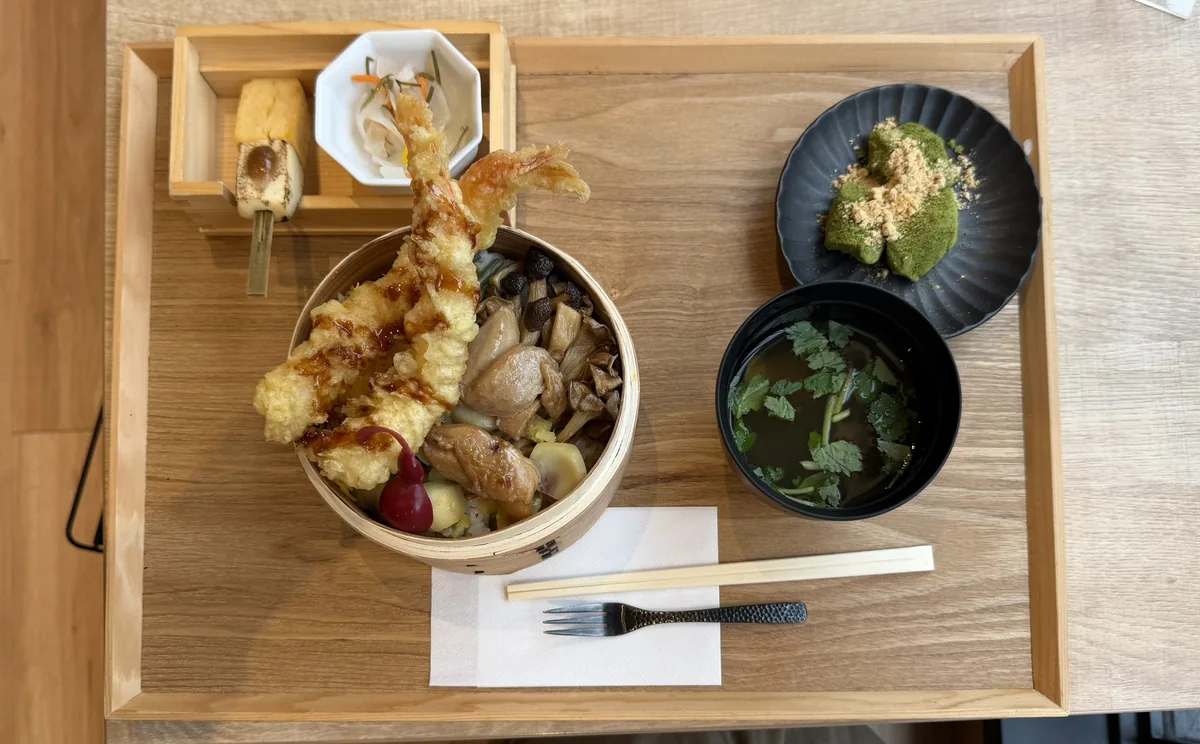
The museum's Japanese restaurant, Wa Dining Koyomi, serves an exhibition tie-in: a two-part steamed rice set called Nishoku Seiro-meshi Kyodai Gozen ("two-colour steamed rice Brothers' Set"). In one steaming basket, shrimp tempura, shredded egg and warabi-mochi stand for the older brother Hideyoshi, while teriyaki chicken, chestnut and sweet potato, and persimmon namasu stand for Hidenaga. On the day I ate it, it cost ¥2,800 and was advertised as limited to 20 servings. The restaurant's official page is Wa Dining Koyomi.
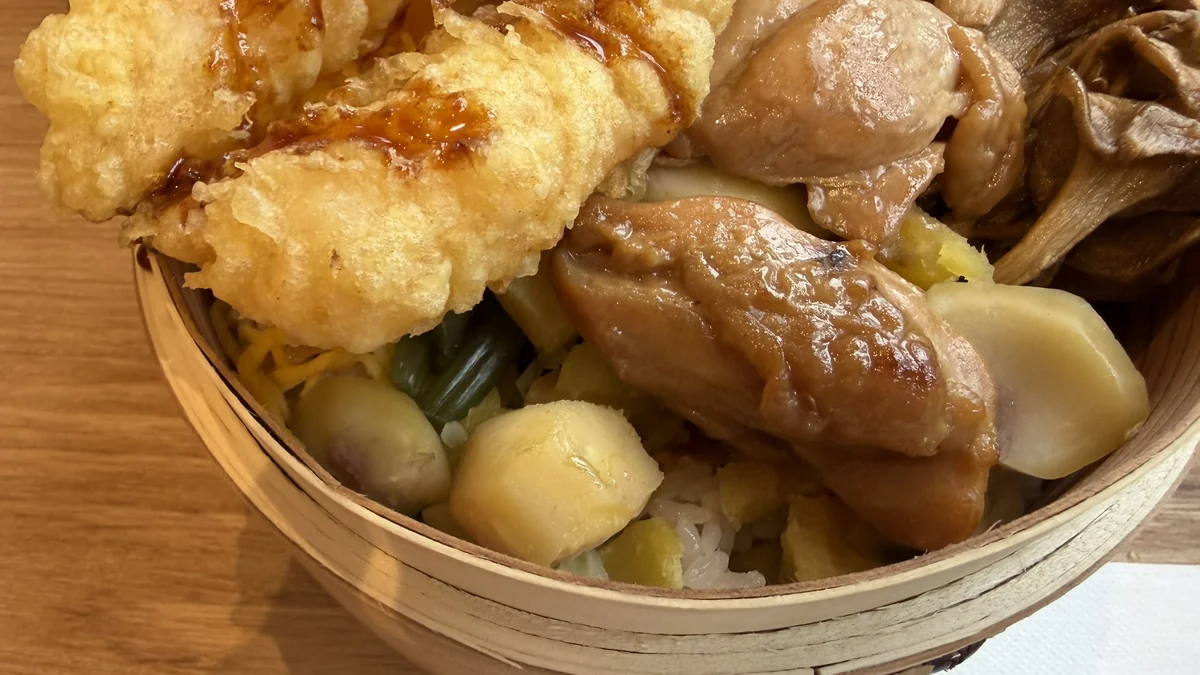
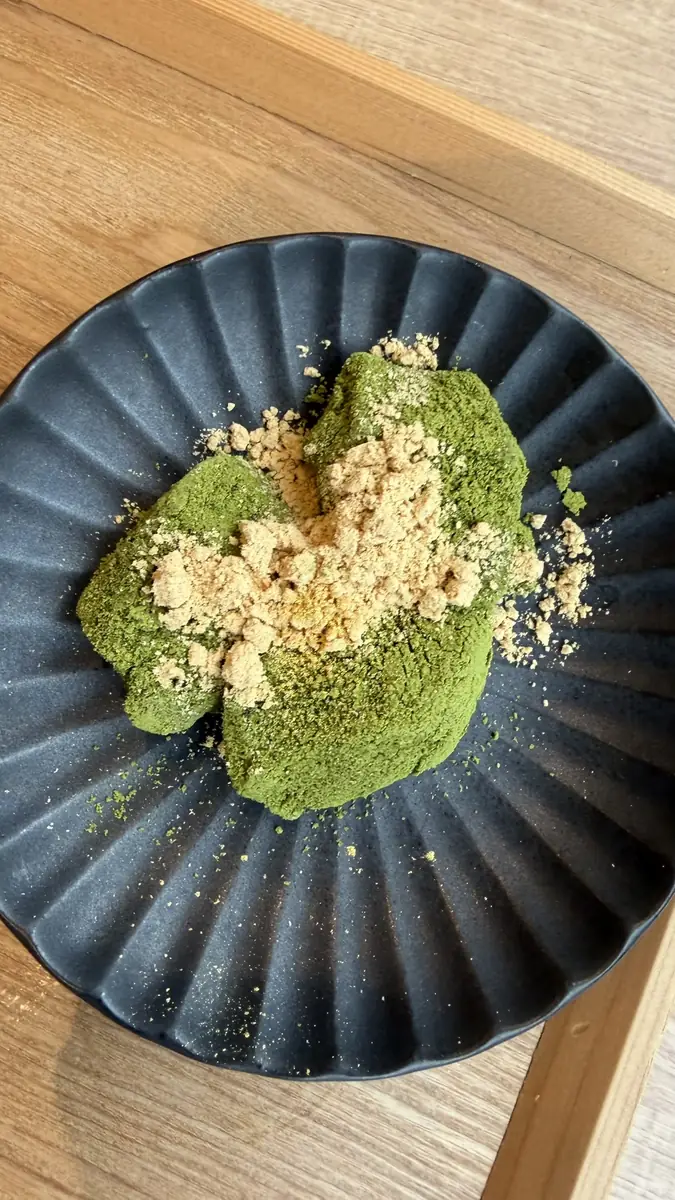
Tap to enlarge
The gold flecks are not gold at all: they are kinako (roasted soybean flour), and the mochi itself is matcha warabi-mochi. The bitterness of the matcha and the mild, not-too-sweet flavour of the kinako work well together. The rice basket also includes chestnut and sweet potato, and their natural sweetness makes a nice contrast with the saltiness of the shrimp tempura and teriyaki chicken.
The table card said the set is planned from 15 September to 8 November, and that the fried vegetables may change depending on supply. Prices and availability can change, so check at the restaurant.
Queues, and finding the restaurantI arrived at around 14:00 and found a queue already forming; I was seated at 14:30, and staff told me only 2 servings of this limited set remained. If you want to try it, going early is a good idea. The restaurant itself is a little hard to find: it sits toward the back of the museum, on the side away from the railway tracks. The map below shows its location.
The location of Wa Dining Koyomi
The Tokugawa Ieyasu statue north of the museum
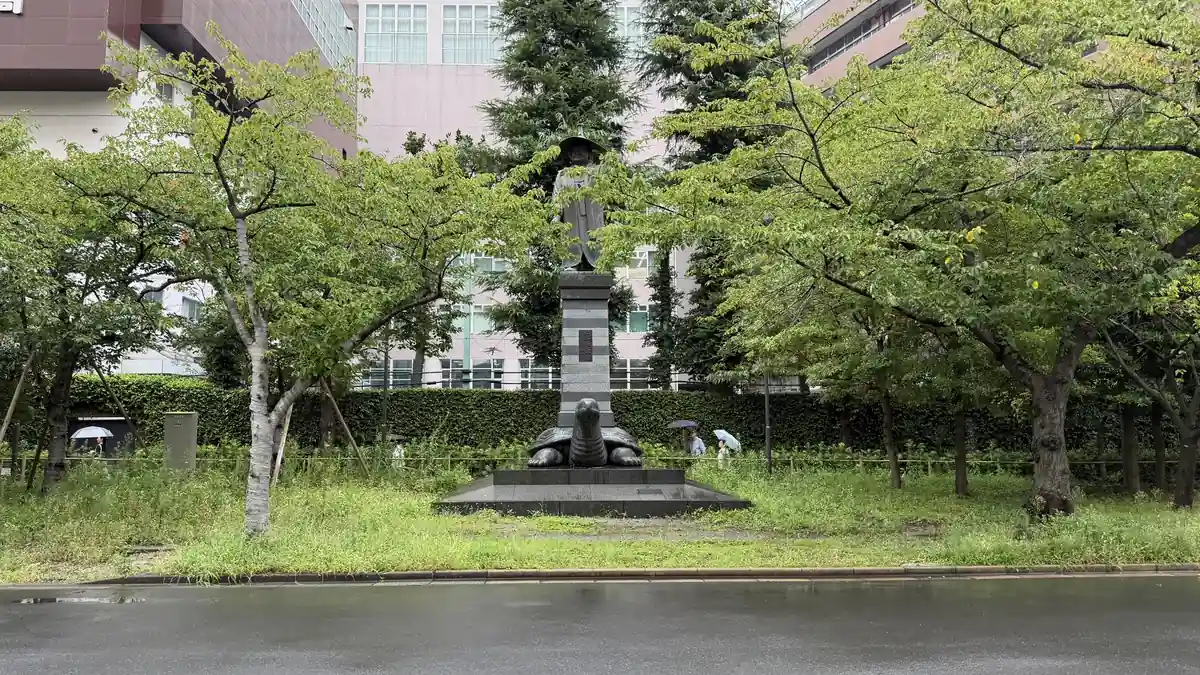
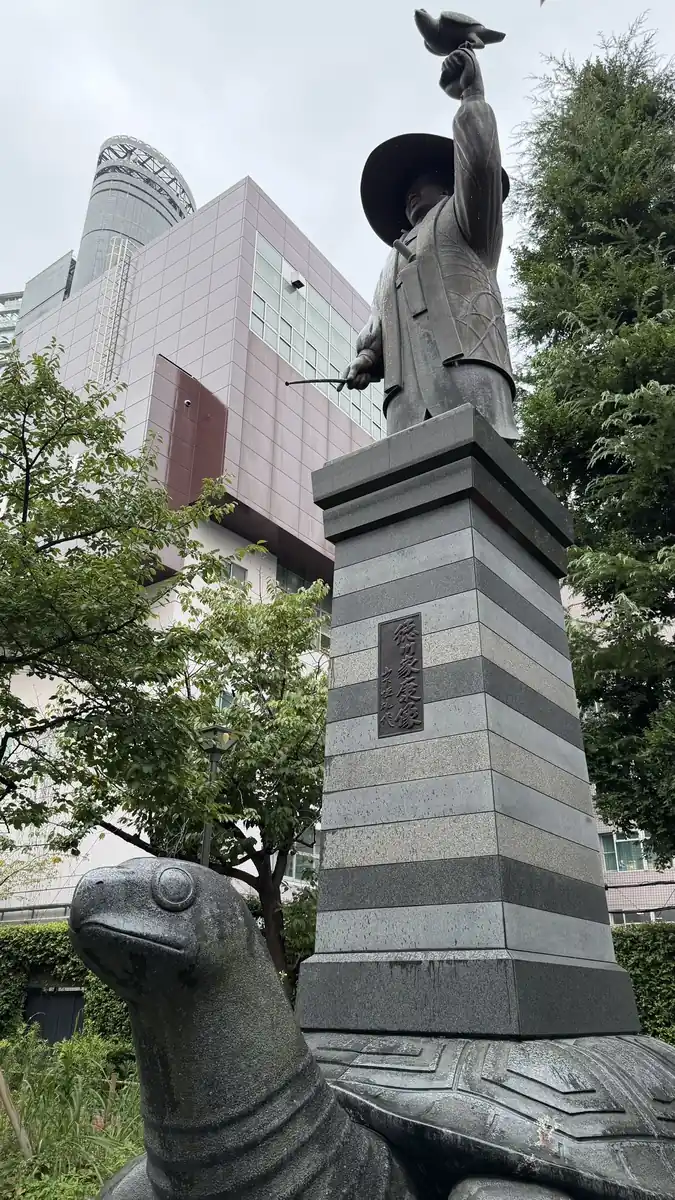
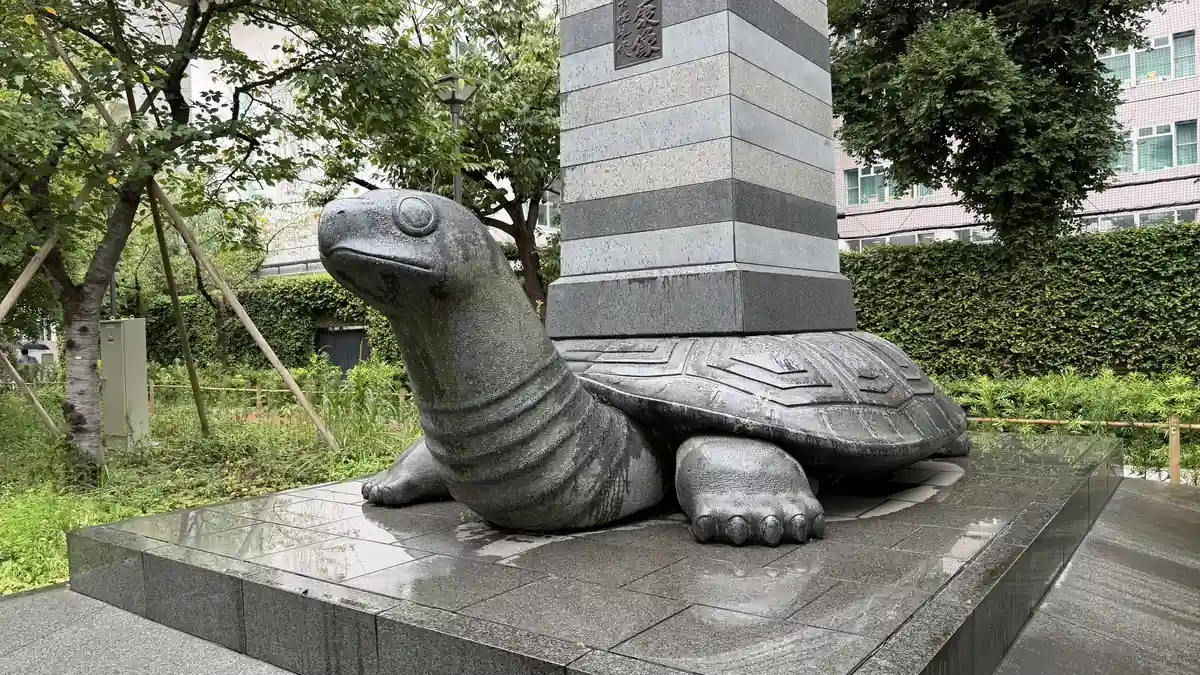
In the green space on the north side of the museum stands a statue of Tokugawa Ieyasu dressed for falconry, wearing a hat and holding a hawk on his left hand. Ieyasu, one of the addressees of Hideyoshi's draft will, went on to found the shogunate in Edo, today's Tokyo, so the statue makes a fitting stop on the way out: from the Toyotomi age to the Tokugawa.
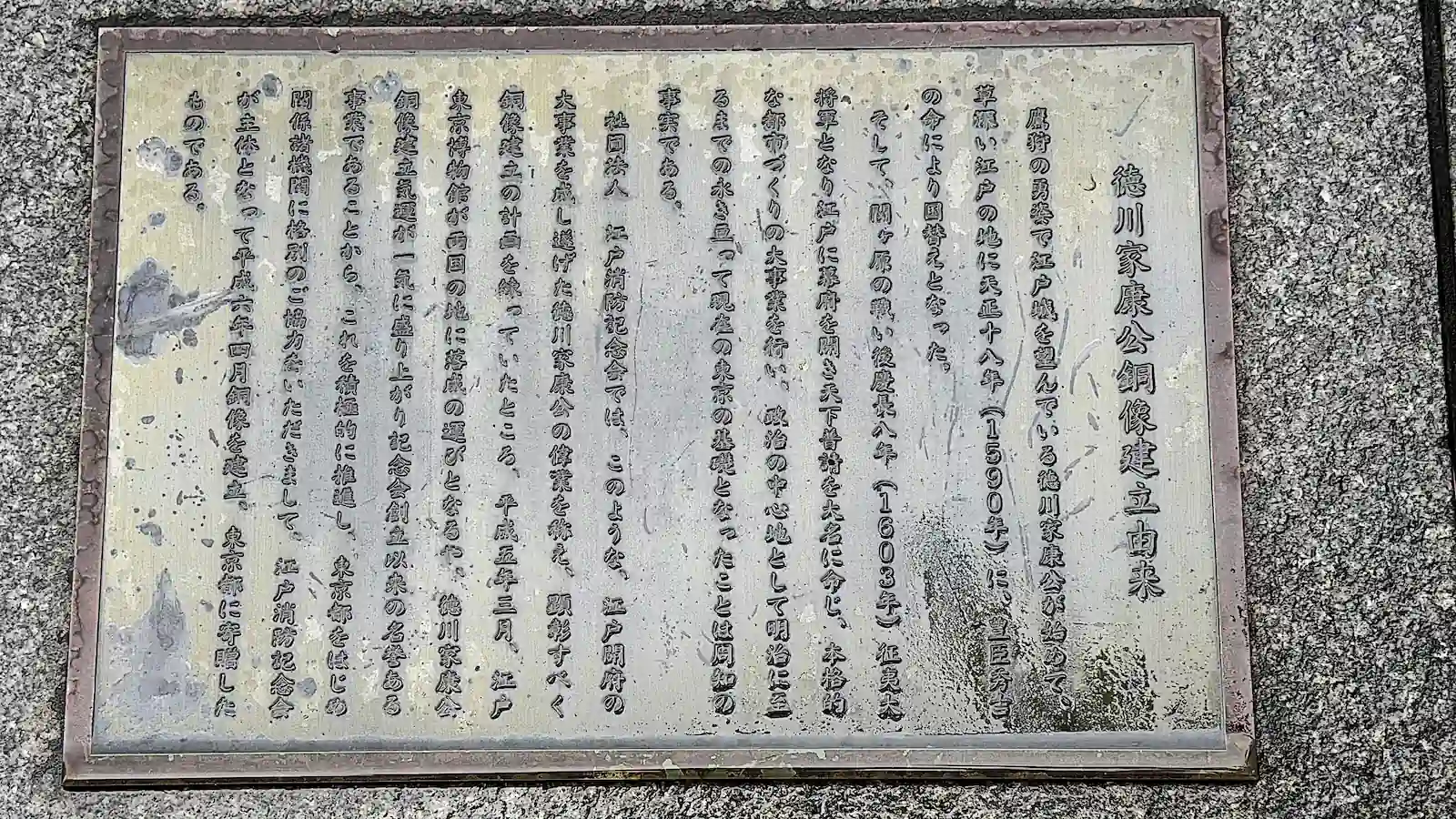
Tap to enlarge
The plaque on the base explains that the statue was erected by the Edo Shobo Kinenkai, a society preserving the traditions of Edo's firefighters, and describes its design. The figure stands on a tall stone pillar supported by a large turtle.
To explore the castle Ieyasu built, see my Edo Castle (Imperial Palace) guide.
Follow the objects to historic sites and earlier venues
My Osaka and Nagoya articles are records of those earlier venues of this touring exhibition. Objects and photography rules differed between venues, so use this page for the Tokyo show. If you saw the Nagoya or Osaka leg, the venue filter in my work list shows what is different in Tokyo.
Frequently asked questions
From 15 September to 8 November 2026 in the 1st-floor Special Exhibition Gallery of the Edo-Tokyo Museum, next to Ryogoku Station. It is closed on Mondays (except 21 September, 12 October and 2 November) and on 24 September, 13 October and 4 November.
I spent about 2 hours 20 minutes in the special exhibition, reading closely and taking notes. Add 10–15 minutes for the shop, and another 2–3 hours if you also want to see the permanent exhibition properly.
The entrance area had English. For individual objects, my impression was that some labels had English and some did not, but I cannot say how many. The official audio guide is Japanese only, so it helps to read up on the key objects before you go.
On the day I visited (19 September 2026), photography was not allowed in the galleries with the historical objects. The Taiga drama display and photo spots elsewhere in the museum were fine for souvenir photos.
No reservation is needed. On my Saturday morning visit, though, the ticket counter queue was long, and a ticket bought online just before entering did not scan straight away. Buying before you arrive is the easier option.
No. The ¥2,100 adult ticket covers the special exhibition only. For both, buy the combined special + permanent exhibition ticket (¥2,740 for adults), sold at the museum and on its own online ticket site.
When I went at around 10:00 on Saturday 19 September 2026, there was a long queue at the ticket counter and the galleries were busy, with waits in front of some cases near the start. Crowds vary by day and time, so buy an online ticket before you arrive and look at the quieter displays first.
As of 20 September 2026, the only discounts I found were through specific membership or employee-benefit schemes in Japan. If you also want to see the permanent galleries, the combined ticket (¥2,740 for adults) is ¥160 cheaper than buying both separately.
☕ Support This Site
Following the Shogun is built on original fieldwork and on-site research.
If you found this guide useful, your support helps keep it going.

You can also support via QR code


comment