


NHK Taiga Drama Special Exhibition "Toyotomi Brothers!"
Osaka Complete Guide
I visited the "Toyotomi Brothers!" special exhibition (official English title: BROTHERS IN ARMS) at the Osaka Museum of History on July 17, 2026, while it was open to the public. Here's what I actually saw: the exhibits, the one area where photography is allowed, ticket prices, and how to get there.
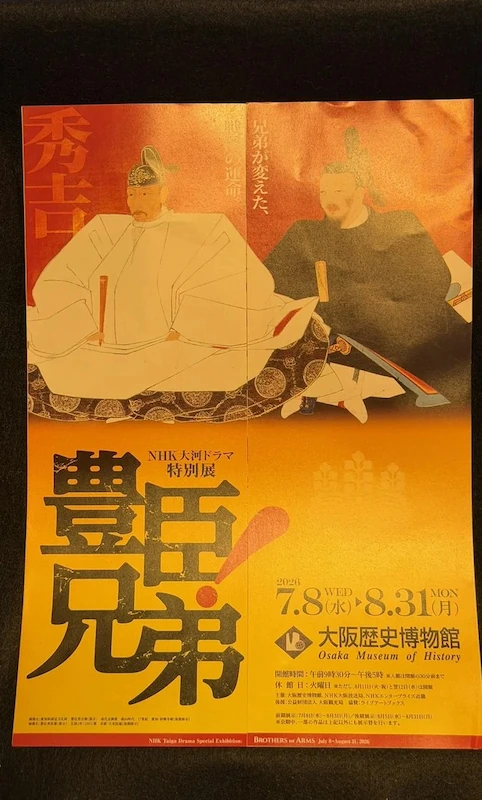
NHK Taiga Drama Special Exhibition "Toyotomi Brothers!" — officially titled in English "BROTHERS IN ARMS" — is open at the Osaka Museum of History, 6th-floor special exhibition room, from July 8 to August 31, 2026. The display is split into an early period (July 8–August 3) and a late period (August 5–August 31), with some items rotated partway through. The Nagoya venue (Tokugawa Art Museum and Nagoya City Hōsa Library) already closed on June 14, 2026, and the exhibition will travel next to the Tokyo Metropolitan Edo-Tokyo Museum from September 15 to November 8, 2026.
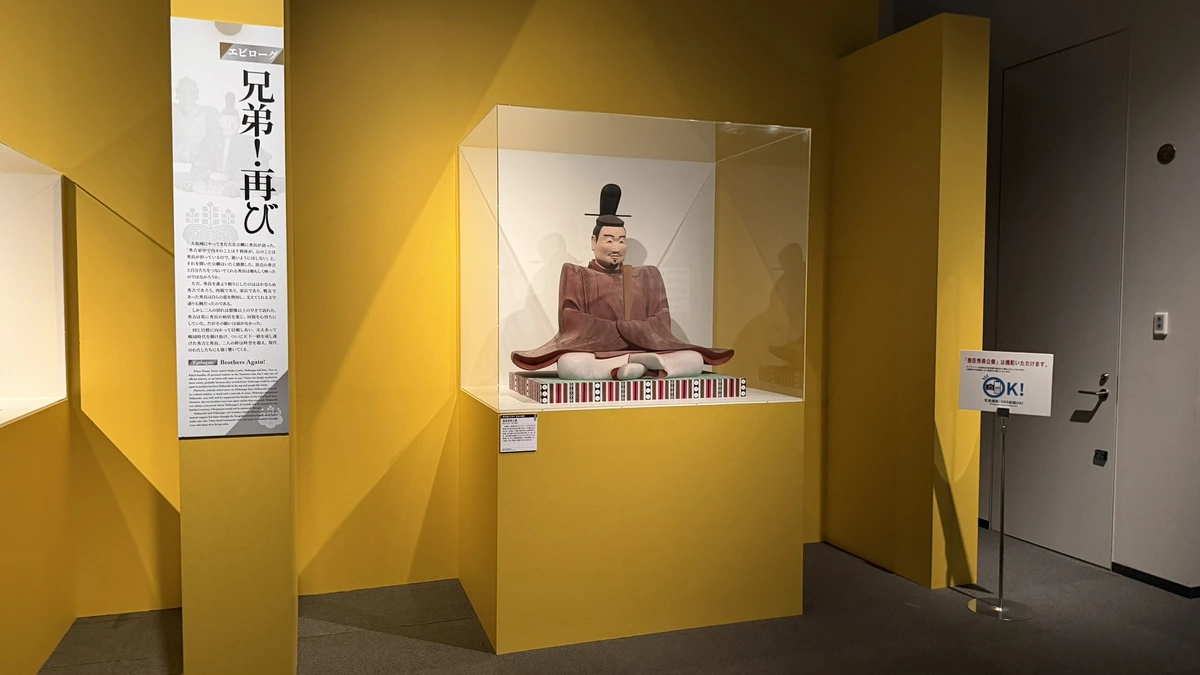
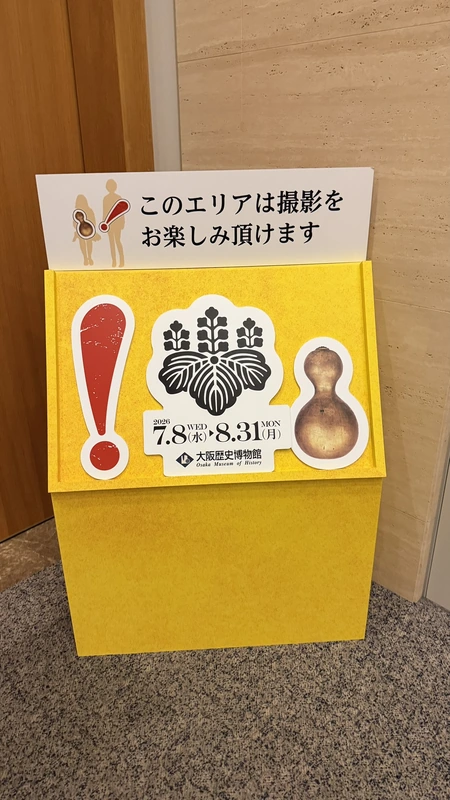
As of my visit on July 17, 2026, photography was not allowed in the main galleries. The only place I was able to take photos was the epilogue corner, "Brothers Again!," where the statue of Toyotomi Hidenaga is displayed. A sign marking this photo-friendly zone was posted at the venue. Photography rules can change, so please check the on-site signage on the day of your visit.
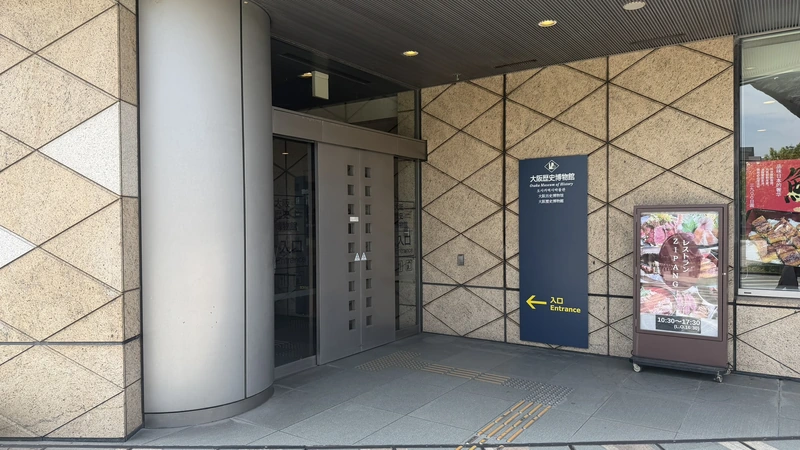
NHK Taiga Drama Special Exhibition "Toyotomi Brothers!" traces the story of Toyotomi Hideyoshi and his younger brother, Toyotomi Hidenaga, through original letters, portraits, folding screens, swords, and other historical objects held by museums and temples across Japan. Following the Nagoya venue (Tokugawa Art Museum and Nagoya City Hōsa Library), the exhibition is now open in Osaka at the Osaka Museum of History's 6th-floor special exhibition room.
This is not a costume-and-props exhibition built around the TV series. It brings together genuine historical materials connected to the Toyotomi brothers' era, gathered from collections across the country. If you're hoping to see the drama's costumes, sets, or behind-the-scenes displays instead, that's a different kind of venue — Japan also has several dedicated "Taiga Drama Museums" for this series, in Nagoya's Nakamura ward, in Nagahama, and in Yamato-Kōriyama. My guide to those venues is linked in the Related Guides section below.
| Venue | Osaka Museum of History, 6F special exhibition room (1-32 Otemae 4-chōme, Chūō-ku, Osaka) |
|---|---|
| Dates | July 8 – August 31, 2026 (early period Jul 8–Aug 3; late period Aug 5–Aug 31) |
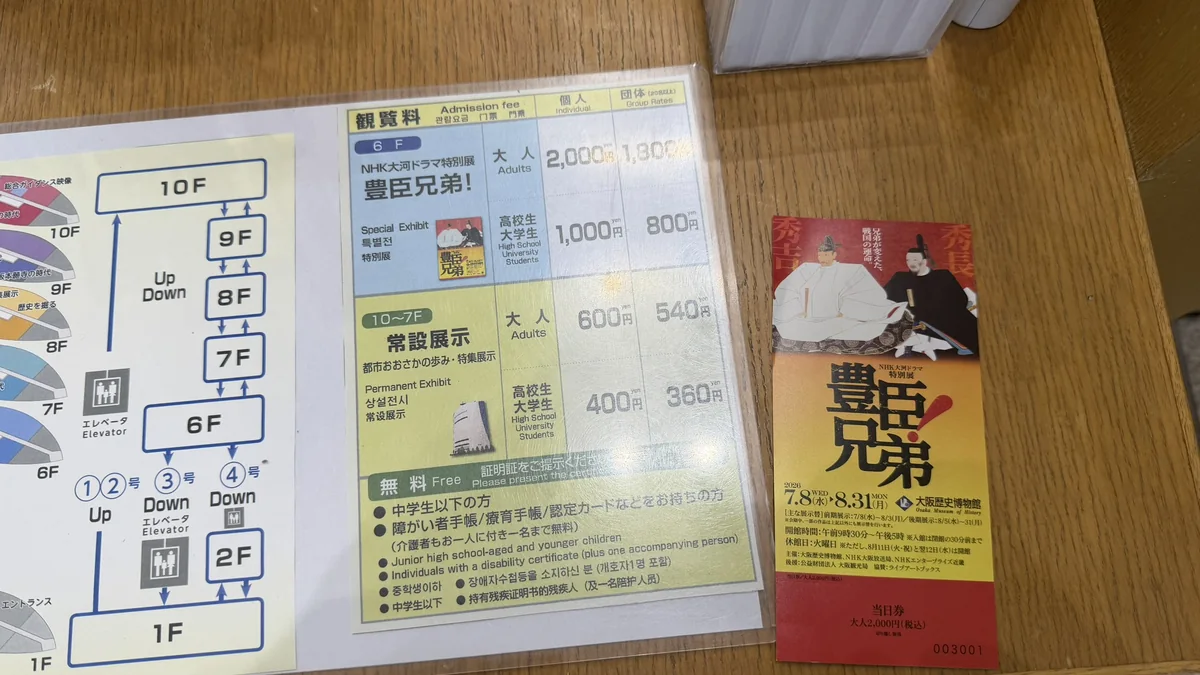
| Admission (same-day) | ¥2,000 adult, ¥1,000 high school / university student |
| Items on Display | 149 |
| Hours | 9:30–17:00 (last entry 16:30) |
| Closed | Tuesdays (open Aug 11 & 12) |
| Nearest Station | Osaka Metro Tanimachi & Chūō Lines, "Tanimachi 4-chōme" Station, Exits 2 & 9 |
- Who This Exhibition Is For
- What I Actually Saw
- The One Photo-Friendly Corner: "Brothers Again!"
- Audio Guide and the Official Catalogue: Getting to Know "the Other Brother"
- How Long It Took, and Whether It's Beginner-Friendly
- A Limited-Time Menu at the ZIPANG Restaurant
- Getting There
- The Permanent Galleries Are Also Worth a Look
- Frequently Asked Questions
- Related Guides & Nearby Sites
Who This Exhibition Is For
This exhibition suits anyone who wants to understand the late Sengoku and Momoyama periods through original letters, portraits, battle screens, swords, and tea utensils, rather than through reenactments or dramatizations.
The Osaka venue is notable for gathering material on the retainers who supported Hidenaga — Tōdō Takatora, Kuwayama Shigeharu, Kuwayama Motoharu, Yokohama Ian, and Kobori Masatsugu — according to the exhibition's official highlights page. It even includes a National Treasure short sword, "Kuwayama Hōshō." Seeing these objects in person makes tangible the people who ran the practical, day-to-day business of the Toyotomi regime — work that gets far less attention than Hideyoshi's own story.
During my visit, I saw a beardless portrait of Hidenaga, portraits of related figures including Oda Nobunaga, Tokugawa Ieyasu, Mōri Terumoto, Kobayakawa Takakage, and Kuroda Yoshitaka (Kanbee), a folding screen depicting the Battle of Shizugatake, and even an old map of the area around Jurakudai — giving a wide-ranging view of the people and events surrounding the Toyotomi brothers. Tea utensils and Noh costumes connected to Sen no Rikyū and Kōdai-in are also on display, so there's plenty here for anyone interested in Momoyama-era culture as well as military history.
If you're after the drama's cast, costumes, or filming sets, this isn't the right venue — for that, see the Taiga Drama Museum guide instead.
What I Actually Saw
According to the item list handed out at the venue, the Osaka exhibition is organized into seven parts: a Prologue ("Brothers of Valor and Wisdom"), Chapter 1 ("Days of Constant Campaigns"), Chapter 2 ("Unifying the Realm"), Chapter 3 ("Entering Yamato"), Chapter 4 ("Power and the Beauty of the Age"), Chapter 5 ("The Sunset of the Toyotomi"), and an Epilogue ("Brothers Again!" — this is the exhibition's own official English translation for that section). This reflects what was on display as of my visit on July 17, 2026; some items rotate during the run.
The Prologue opens with portraits of both Hidenaga and Hideyoshi. The beardless portrait of Hidenaga in particular was a striking departure from the bearded image I'd expected — I hadn't known it existed before seeing it in person.
Chapter 1, "Days of Constant Campaigns," lines up portraits of Oda Nobunaga, Kuroda Yoshitaka, Mōri Terumoto, and Kobayakawa Takakage alongside battle-related material, including a folding screen of the Battle of Shizugatake — letting you trace, screen by screen, how the two brothers fought their way to power.
Chapter 2, "Unifying the Realm," includes a plan of Osaka Castle from the Toyotomi era and gilded roof tiles, along with a folding screen of Jurakudai and an old map of the surrounding neighborhood — a concrete sense of how far Hideyoshi's power base extended once he had unified the country.
Chapter 3, "Entering Yamato," centers on letters and excavated roof tiles connected to Yamato-Kōriyama Castle, Hidenaga's own base of operations. It also covers the retainers who supported him — and one detail I hadn't known before seeing it here: the tea master and garden designer usually known simply as "Kobori Enshū" apparently began his career as a young retainer, or page, in Hidenaga's household.
Chapter 4, "Power and the Beauty of the Age," pairs Noh costumes and tea utensils from the Momoyama period with a Chinese tea jar that passed through the hands of Oda Nobunaga, Toyotomi Hideyoshi, and Tokugawa Ieyasu in turn — all three of Japan's great "unifiers" — plus one of the few tea containers confirmed to have belonged to Hidenaga himself (named "Yakushi-in"). The exhibition also draws on the Tokugawa Art Museum's celebrated sword collection, including the famous blade "Nansen Ichimonji," which overlapped with objects I'd already seen at the Nagoya venue.
Chapter 5, "The Sunset of the Toyotomi," is built around letters from Hidenaga's final years and a record connected to the 200th anniversary of his death — material that marks the closing of the brothers' era.
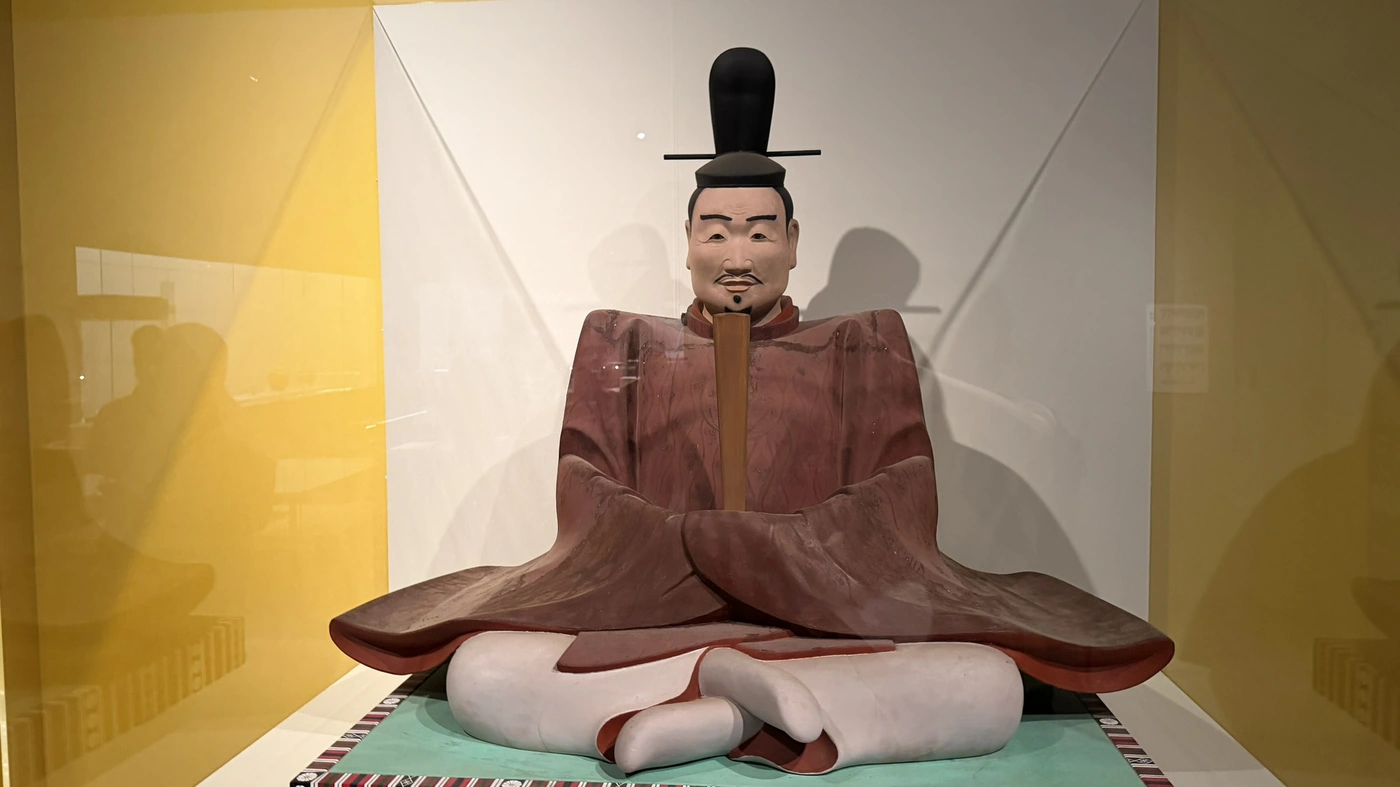
The Epilogue, "Brothers Again!," is the exhibition's only photo-friendly area, and it closes the show with a statue of Toyotomi Hidenaga (dated 1630, from Shungaku-in Temple in Nara). Learning that Hidenaga's memory continued to be honored with new statuary decades after his death, well into the Edo period, was a quiet but meaningful note to end on.
Note: exhibits and rotation schedules change during the run. For the latest information, check the item list on the Osaka Museum of History's official site.
The One Photo-Friendly Corner: "Brothers Again!"
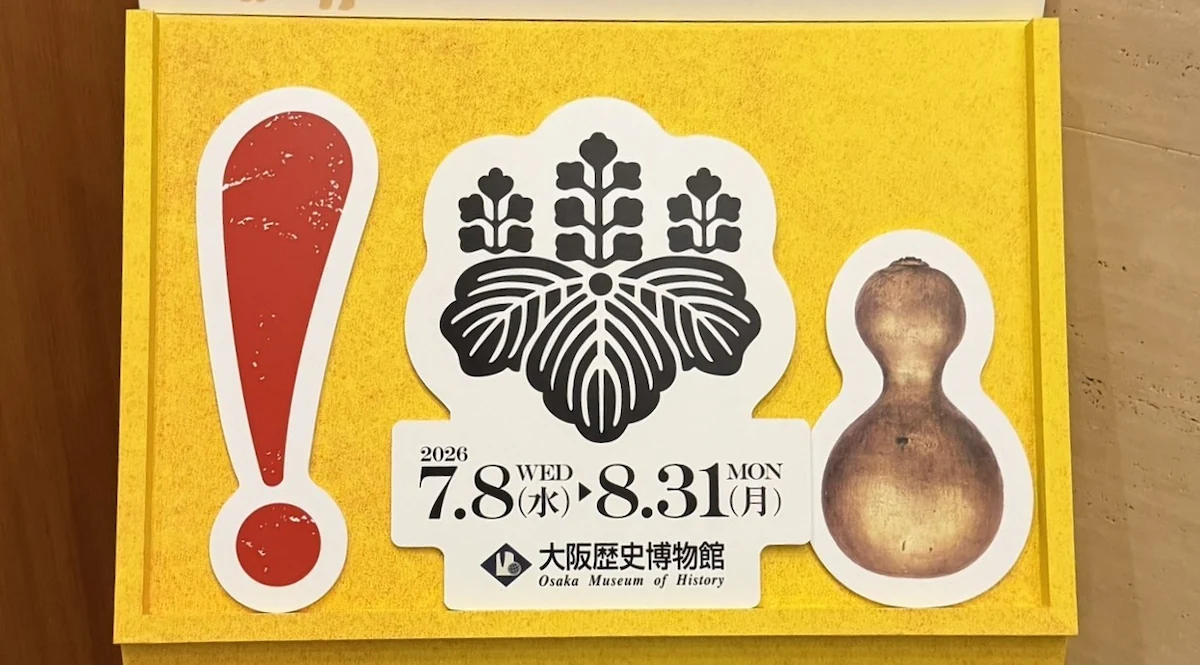
As of my visit on July 17, 2026, the only place inside the venue where I could take photos was the epilogue corner that closes the exhibition, "Brothers Again!" The signage there — decorated with the paulownia crest and Hideyoshi's gourd-shaped battle standard — states clearly, "You are welcome to take photos in this area."
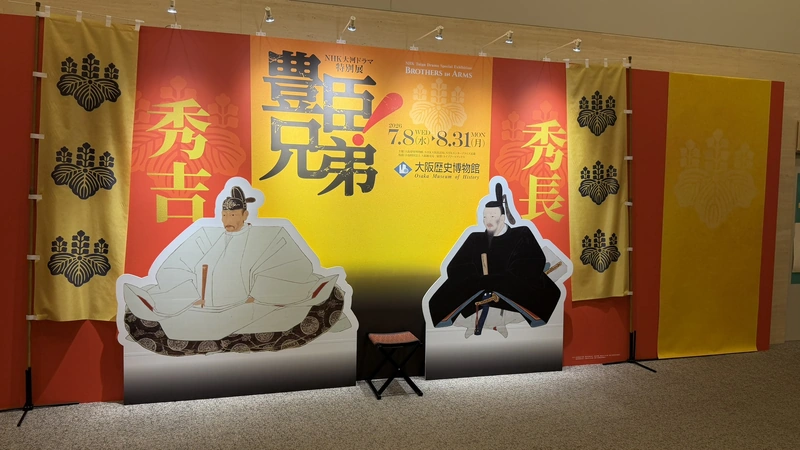
This corner displays the statue of Toyotomi Hidenaga (dated 1630, from Shungaku-in Temple in Nara), showing that even after his death people continued to have new statues made in his memory well into the Edo period. There's also a photo spot with life-size cutout panels of Hideyoshi and Hidenaga, where I saw other visitors taking souvenir photos.
Audio Guide and the Official Catalogue: Getting to Know "the Other Brother"
The Osaka exhibition's audio guide is narrated by Taiga Nakano, the actor who plays Hidenaga in the 2026 drama, with narration woven in from announcer Ayumi Watanabe. A rental unit is available at the venue entrance for ¥700 (tax included), and there's also an app version, "Kiku Bijutsu," for ¥800 (tax included; available from April 18 to November 8, 2026, with unlimited replays during that window and usable outside the venue) — according to the exhibition's official site.
According to the exhibition's official profile, Toyotomi Hidenaga was born in 1540 in Nakamura, Owari Province (present-day Nakamura Ward, Nagoya) — the same village as his elder brother, Hideyoshi, three years his senior. Known for a calm, steady temperament, he acted as the mediator between Hideyoshi and the rival warlords of the day, and after taking Yamato-Kōriyama Castle as his base, he was affectionately known to the local people as "Lord Yamato Dainagon." He died of illness in 1591 at the age of fifty-one.
A quote attributed to Hidenaga — "Private matters go to Rikyū; public matters go to me" — captures how central his role was in the day-to-day running of his brother's government. Having visited the Nagoya exhibition as well, I found that knowing Hidenaga's role in advance changes how the letters and portraits read once you're standing in front of them. I didn't use the audio guide myself this time, but based on the official information, it looks like a good option for anyone who wants to get more out of the visit. The official catalogue (¥2,800, tax included; A4-oversized, 240 pages) is also said to include columns on pieces that couldn't be fully explained on the gallery walls.
How Long It Took, and Whether It's Beginner-Friendly
On my visit on July 17, 2026, it took me about 1 hour and 5 minutes to see the special exhibition in Osaka. That's without an audio guide — just walking through at my own pace.
At the Nagoya venue, I used the audio guide and it took about 1 hour and 40 minutes for the special exhibition alone, so in my own experience Osaka was the shorter visit. That said, your own pace, whether you use an audio guide, and how closely you examine each piece will all affect your time. Take 1 hour 5 minutes as a real, measured data point from my July 17, 2026 visit, not a general rule.
Looking back at my notes, the floor felt somewhat smaller in scale than the Nagoya venue (Tokugawa Art Museum), but the entire 6th-floor special exhibition space at the Osaka Museum of History is dedicated to this show, and being able to see this many historical objects gathered in one place was still a genuinely worthwhile experience. Since the special exhibition occupies a different floor from the museum's regular galleries, visitors are directed to a dedicated elevator that goes straight up to the 6th floor.
Even without much prior knowledge of the Toyotomi brothers, I found the exhibition easy to follow — the sequence moves from portraits, to battle-related material, to material on the people around them, and I felt that structure made it easy to track the flow of events, even as a first-time visitor to this subject.
NHK Taiga Drama Special Exhibition "Toyotomi Brothers!" — Osaka Overview
| Venue | Osaka Museum of History, 6F special exhibition room |
|---|---|
| Dates | July 8 – August 31, 2026 |
| Admission (same-day) | ¥2,000 adult, ¥1,000 high school / university student |
| Admission (group, 20+) | ¥1,800 adult, ¥800 high school / university student |
| Items on Display | 149 |
| Organizers | Osaka Museum of History, NHK Osaka, NHK Enterprises Kinki |
Admission is free for children up to junior-high age, and for visitors with a disability certificate (plus one accompanying carer). Advance tickets were only sold from April 15 to July 7, 2026, so same-day pricing now applies. For the latest details, see the official ticket page (Japanese) or the official English overview.
A Limited-Time Menu at the ZIPANG Restaurant
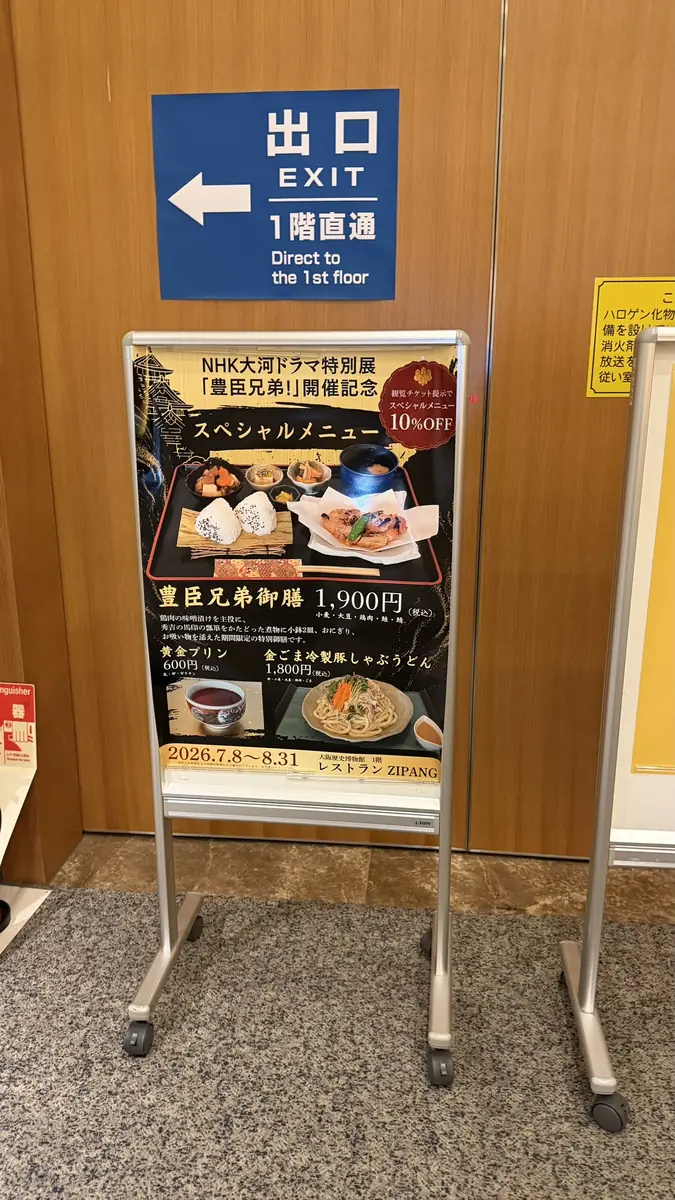
The "ZIPANG" restaurant on the 1st floor of the Osaka Museum of History is running a special menu tied to the exhibition. According to the signage near the exit, the lineup includes the "Toyotomi Brothers Gozen" set meal (¥1,900, tax included) — built around chicken simmered in miso, served with a small dish shaped like Hideyoshi's gourd-shaped battle standard, "Sennari-byōtan" — as well as a "Golden Pudding" (¥600, tax included) and "Cold Pork Shabu-Shabu Udon with Sesame" (¥1,800, tax included). A 10% discount for exhibition ticket holders was also advertised.
I wasn't able to try it myself due to time constraints on this visit, and I'd like to go back and order it next time. If you're interested, please check availability at the restaurant during the run of the exhibition (through August 31, 2026).
Getting There
ACCESS — Osaka Museum of History
| Address | 1-32 Otemae 4-chōme, Chūō-ku, Osaka City, 540-0008 |
|---|---|
| Osaka Metro | Tanimachi & Chūō Lines, "Tanimachi 4-chōme" Station, Exits 2 & 9 — right outside |
| Bus | Osaka City Bus, "Babacho" stop, right in front |
| Hours | 9:30–17:00 (last entry 30 minutes before closing) |
| Closed | Tuesdays (open Aug 11 <Tue, public holiday> and Aug 12 <Wed>) |
| Phone | 06-6946-5728 |
| Note | Hours, prices, and closed days are subject to change. The museum sits right next to Osaka Castle Park, so combining the two into a single day is easy and worthwhile. |
The Permanent Galleries Are Also Worth a Look
The Osaka Museum of History has permanent galleries on floors 7 through 10 covering the history of the city of Osaka, with a separate admission fee from the special exhibition (¥600 adult, ¥400 high school / university student). If you want to see both the special exhibition and the permanent galleries in one visit, it's worth checking the same-day fee chart for both before you plan your time.
Frequently Asked Questions
Related Guides & Nearby Sites
My report on the Nagoya venue (Tokugawa Art Museum and Nagoya City Hōsa Library) covers the exhibits there in detail and is a useful companion to this Osaka report. For readers who want to explore Toyotomi Hideyoshi and Hidenaga's story more broadly, or who want to add Osaka Castle to the same trip, the guides below round things out.
☕ Support This Site
Following the Shogun is built on original fieldwork and on-site research.
If you found this guide useful, your support helps keep it going.

You can also support via QR code


comment