


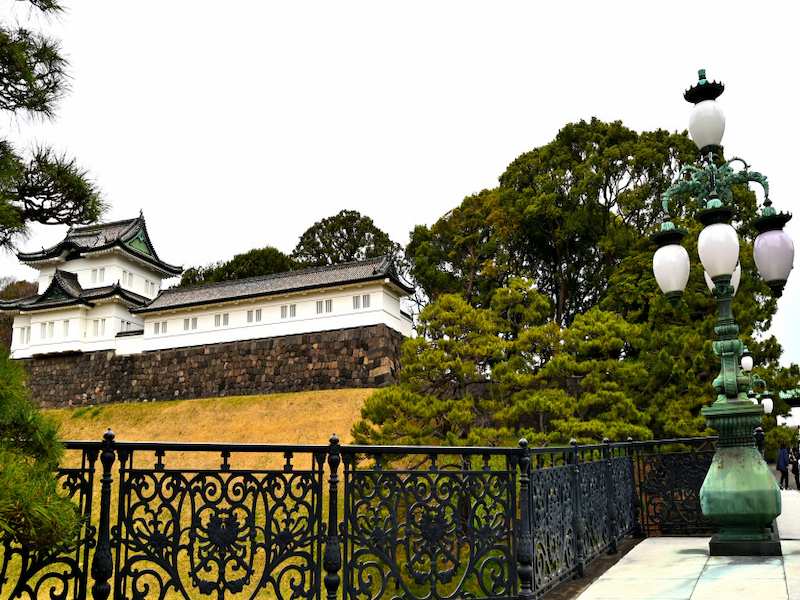
The official Tokyo Imperial Palace tour is free and takes about 75 minutes. Book online in advance, or line up at Kikyo-mon Gate for a same-day ticket. This guide covers both options, the schedule, the six main stops, and what the morning was like when I joined on October 3, 2026.
The Imperial Palace public tour is a free guided tour of the palace grounds organized by the Imperial Household Agency. Over about 1 hour and 15 minutes, the route passes through areas normally closed to the public, including Fujimi-yagura Turret, Nijubashi Bridge, Fushimi-yagura Turret, and the Imperial Palace East Court.
This page explains how to book online, how to get a same-day ticket, when to line up, and what you see at each stop, with photos and notes from my own visit.
- Do You Need Tickets for the Tokyo Imperial Palace?
- Tour Schedule and Reception Times
- Access and Meeting Point
- How to Book the Imperial Palace Tour: Online Reservation or Same-Day Tickets
Do You Need Tickets for the Tokyo Imperial Palace?
No. There is nothing to buy. You can visit the palace grounds in three ways, and all three are free.
- Imperial Palace East Gardens: walk in without a booking. The gardens are closed on Mondays and Fridays. See our East Gardens guide.
- Guided Imperial Palace tour (this page): book a free place online, or pick up a free same-day numbered ticket at Kikyo-mon Gate. Bring ID such as your passport.
- Inui Street: open for a few days in spring and autumn only, with no booking. See our Inui Street guide.
The “ticket” for the guided tour is a free numbered slip that holds your place. The details are below.
Tour Fee
Free
Duration
About 1 hour and 15 minutes
Meeting Point
Kikyo-mon Gate (Inner Sakuradamon Gate)
Languages
The Imperial Household Agency's audio guide app for the tour supports six languages: Japanese, English, Chinese, Korean, French, and Spanish.
How to Join
Book in advance (up to 200 people per tour) or get a same-day numbered ticket (up to 300 people per tour, first come, first served)
What to Bring
ID such as a passport or driver's license. Photocopies are not accepted.
Advance Booking (Online)
Opens at 5:00 a.m. (JST) on the 1st of the month before your visit and closes at 11:59 p.m. (JST) four days before. Up to 200 people per tour, 50 per group.
Same-Day Ticket
Numbered tickets at Kikyo-mon Gate from 9:00 a.m. (morning tour) and 12:30 p.m. (afternoon tour). Up to 300 people per tour, first come, first served, until tickets run out.
No Tours
Sundays, Mondays, national holidays (except Saturdays), afternoons from July 1 to September 30, December 28 to January 4, and days affected by Imperial Court events.
Both Options
Bring valid ID such as a passport (no photocopies). Checked against the official tour page on November 12, 2026.
Tour Schedule and Reception Times
| Morning Tour | Afternoon Tour | |
|---|---|---|
| Numbered Ticket Distribution | From 9:00 a.m. | From 12:30 p.m. |
| Reception Starts | From 9:30 a.m. | From 1:00 p.m. |
| Tour Starts | Around 10:00 a.m. | Around 1:30 p.m. |
| Tour Ends | Around 11:15 a.m. | Around 2:45 p.m. |
Days or tours affected by Imperial Court events
Sundays / Mondays
National holidays specified by law, except when the holiday falls on a Saturday
Afternoons from July 1 to September 30
December 28 to January 4
Access and Meeting Point
Address
1-1 Chiyoda, Chiyoda City, Tokyo
Meeting Point
Kikyo-mon Gate (Inner Sakuradamon Gate)
Nearest Stations
Nijubashimae Station (Chiyoda Line, C10), Exit 6, about 10 min on foot; Otemachi Station (Toei Mita Line, I09), Exit D2, about 10 min on foot
From Tokyo Station (Shinkansen)
About 15 min on foot from the Marunouchi Central Exit of JR Tokyo Station (per the Imperial Household Agency). On October 3, 2026, I used the Marunouchi North Exit
How Much Walking
About 2.2 km (1.4 miles) and about 1 hour outdoors, including one fairly steep slope. Wear comfortable walking shoes
Getting Around
The whole tour is on foot
Bags
There is a bag check. Bring as little as you can; the Imperial Household Agency advises using a coin locker beforehand if needed
Tour Duration
About 1 hour and 15 minutes
Tour Fee
Free
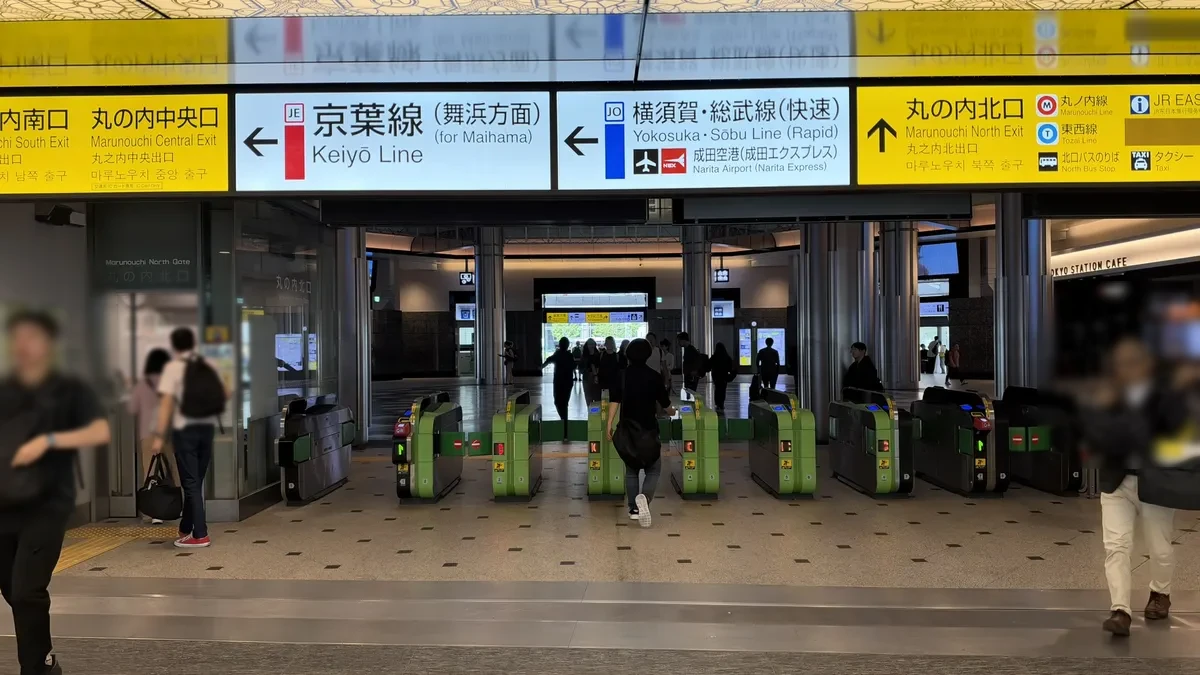 JR Tokyo Station, Marunouchi North Exit
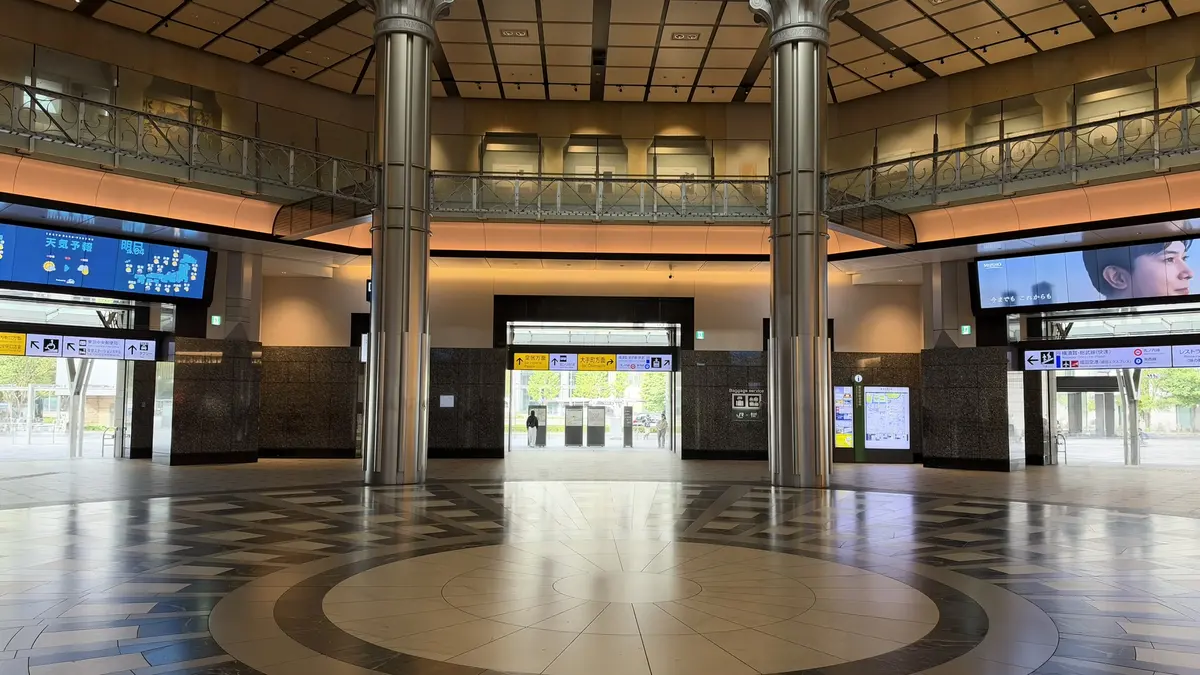 Just past the ticket gates at the Marunouchi North Exit
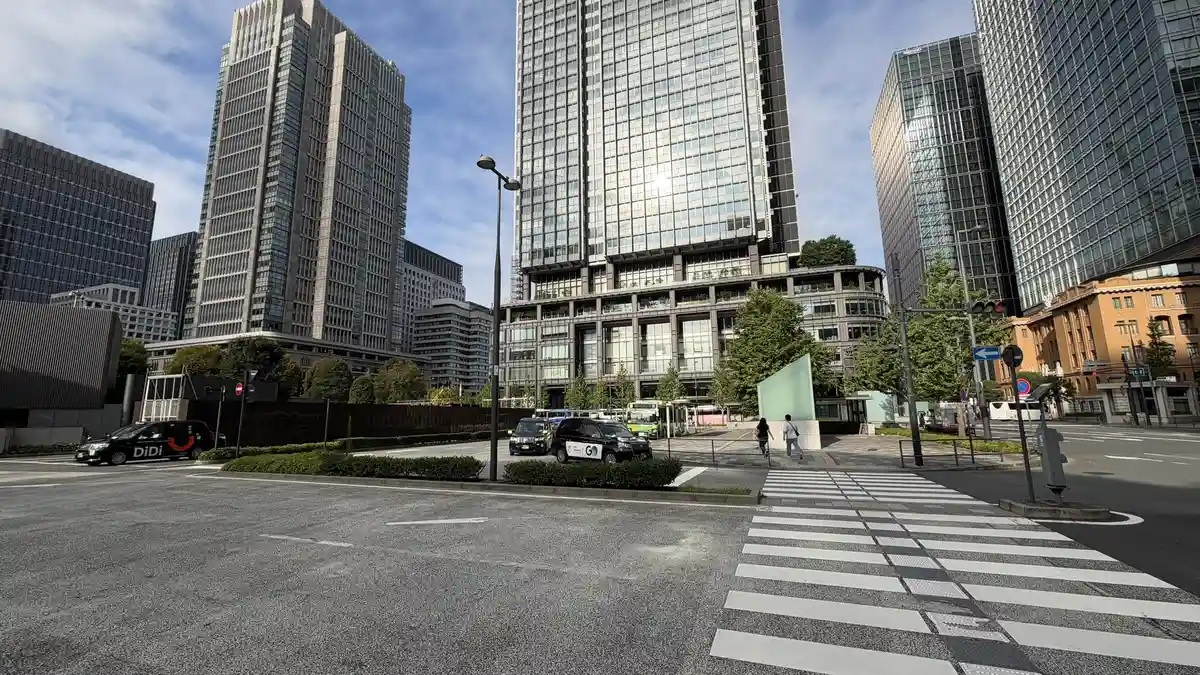 Outside the station, beyond the Marunouchi North Exit gates
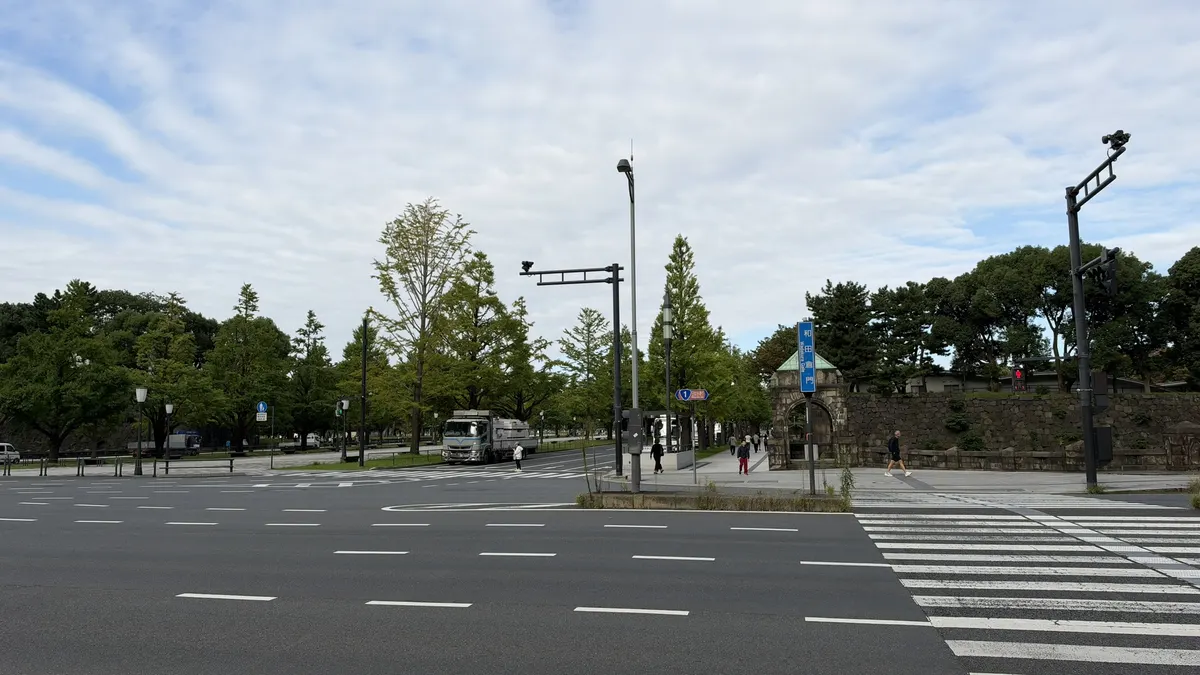
From Exit 6 of Nijubashimae Station (Chiyoda Line)
From Exit D2 of Otemachi Station (Toei Mita Line)
From the Marunouchi Central Exit of JR Tokyo Station
How to Book the Imperial Palace Tour: Online Reservation or Same-Day Tickets
There are two ways to join, and both are free.
Option 1: Book online in advance. Booking opens at 5:00 a.m. Japan time on the 1st of the month before your visit and closes at 11:59 p.m. four days before. Each tour takes up to 200 people booked in advance. Choose this if your date is fixed. Book on the Imperial Household Agency's official tour page.
Option 2: Get a same-day ticket. Numbered tickets are handed out at Kikyo-mon Gate from 9:00 a.m. for the morning tour and from 12:30 p.m. for the afternoon tour. Up to 300 people per tour, first come, first served.
I used the same-day option on October 3, 2026. Here is how the morning went.
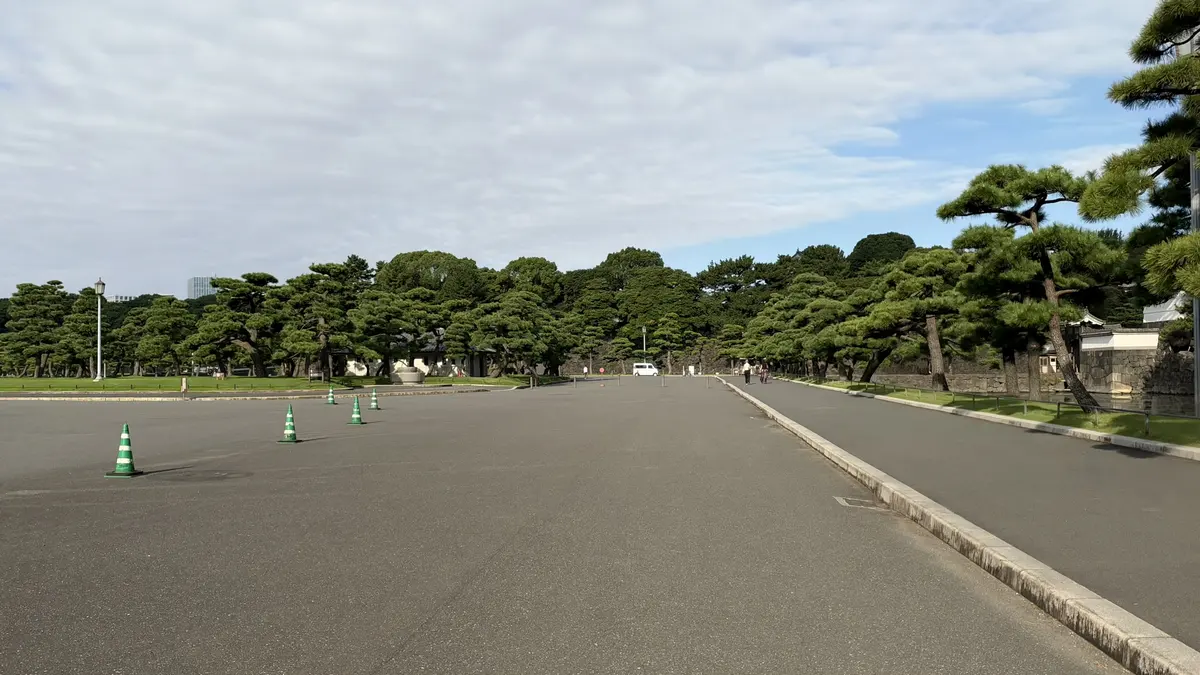 Near the entrance to Kikyo-mon Gate
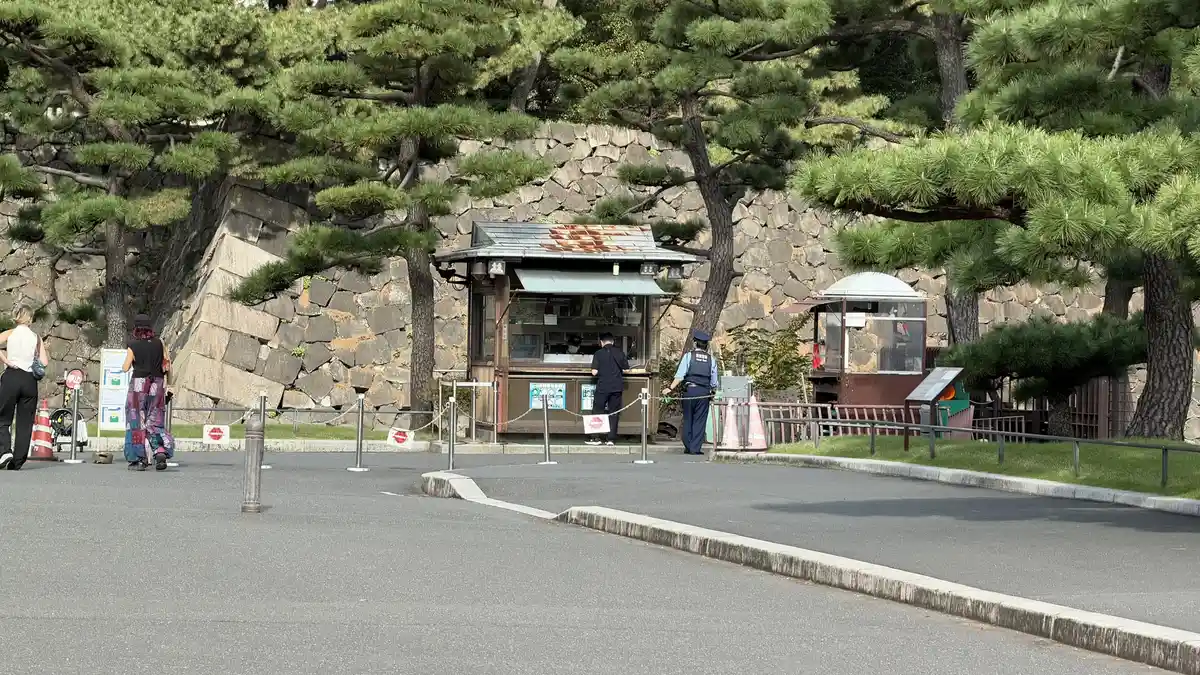 Near the entrance to Kikyo-mon Gate
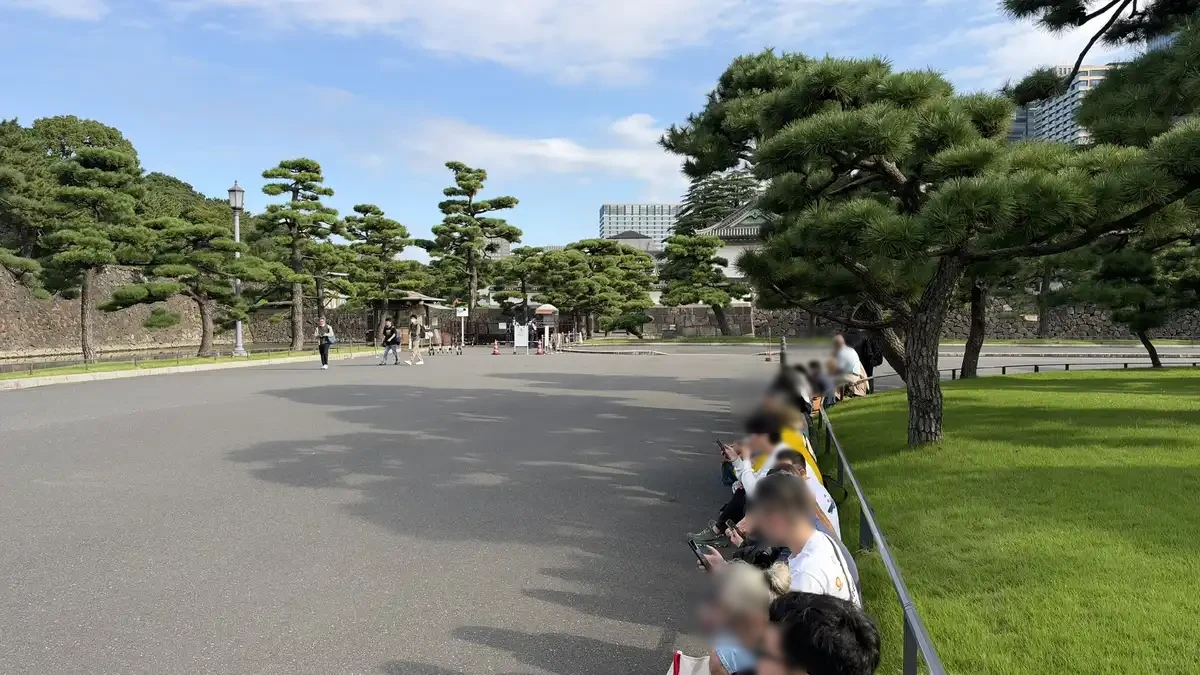 Near the entrance to Kikyo-mon Gate
I arrived at Kikyo-mon Gate at 8:00 a.m., and about 30 people were already in line. By the time tickets were handed out at 9:00 a.m., the line was much longer.
Arriving around 8:00 a.m. was early enough on the day I visited. Same-day tickets are first come, first served, and distribution ends when they run out, so arrive early on busy days.
For the morning tour, tickets are handed out from 9:00 a.m., reception opens at 9:30 a.m., and the tour starts around 10:00 a.m. Once you have your ticket, you can wait nearby, for example at a café, but be back in time for reception.
Local tip: what to do while you wait
If you head back toward Tokyo Station after getting your numbered ticket, you will find a Starbucks, officially named “Starbucks Coffee - Kokyo Gaien Wadakura Fountain Park.” I had a coffee there, then returned to Kikyo-mon Gate around 9:45 a.m. to join the tour.
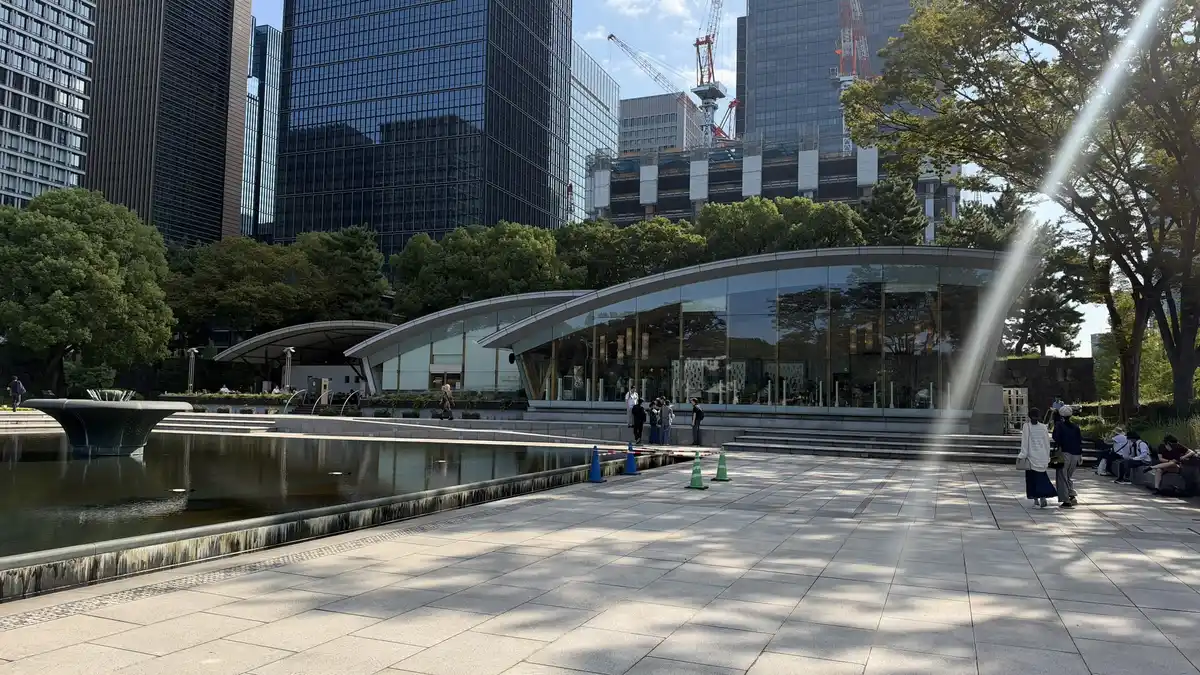 Cafe building at Wadakura Fountain Park
 Mugs on display at the Wadakura cafe
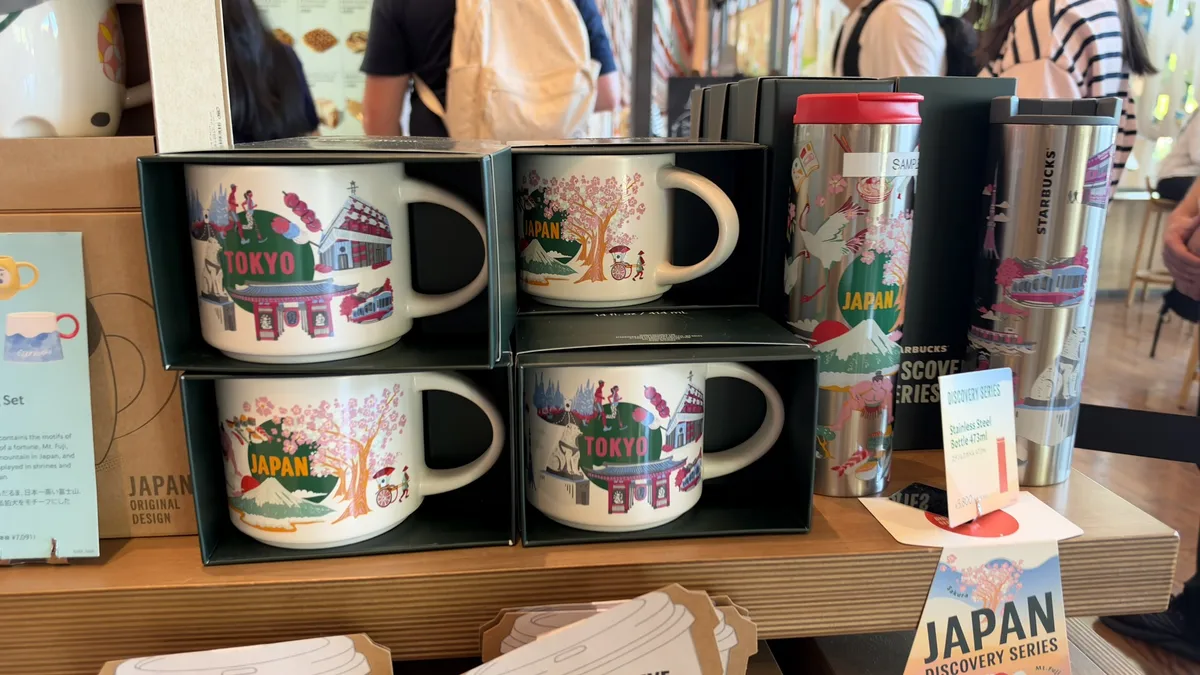 Tokyo and Japan mugs and bottles
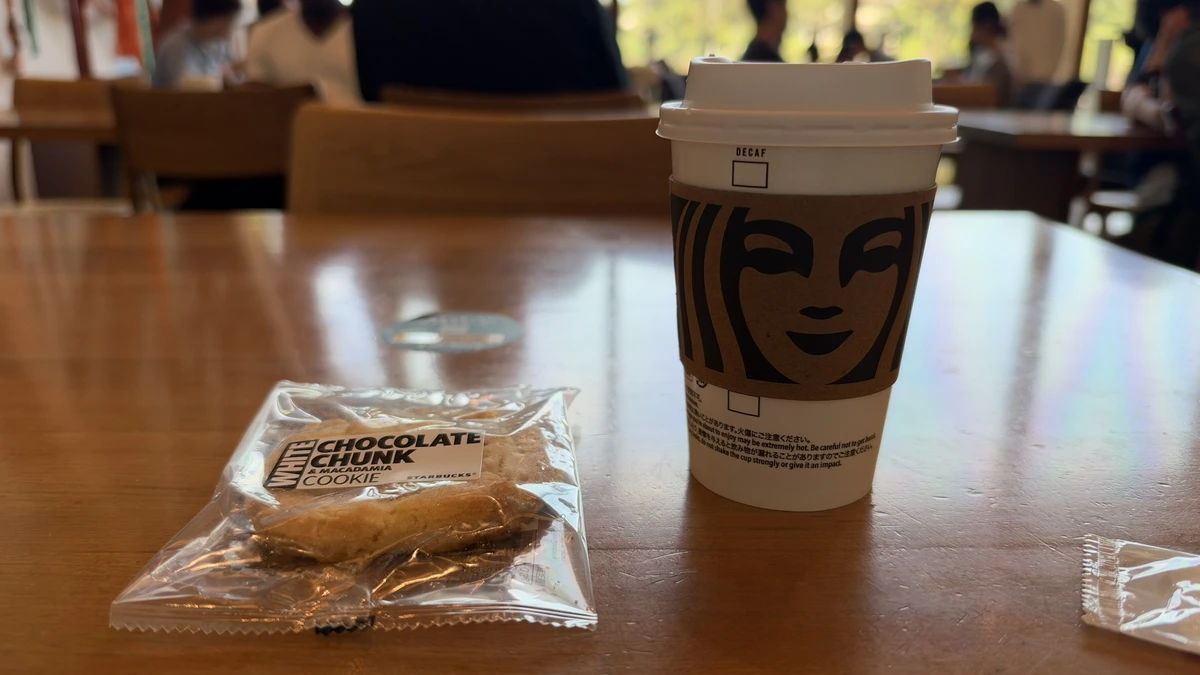 Cafe break before the palace tour
The map shows a route that goes the long way around from Kikyo-mon Gate, but crossing at the crosswalk on the Tatsumi-yagura side is a shortcut.
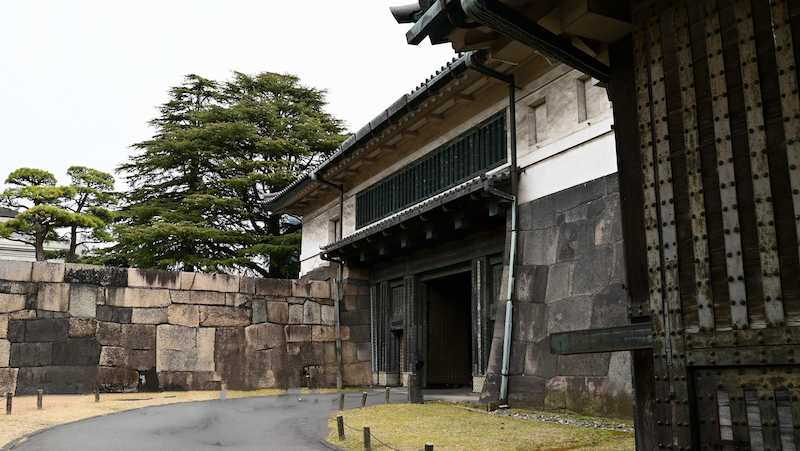
Around 9:45 a.m., I returned to Kikyo-mon Gate and received a numbered tag to wear around my neck. A large number of participants had gathered in the waiting room during my visit, where staff explained the tour rules and precautions. Tour pamphlets in six languages were distributed, and there was also a souvenir corner. An announcement asked visitors to buy souvenirs before the tour began.
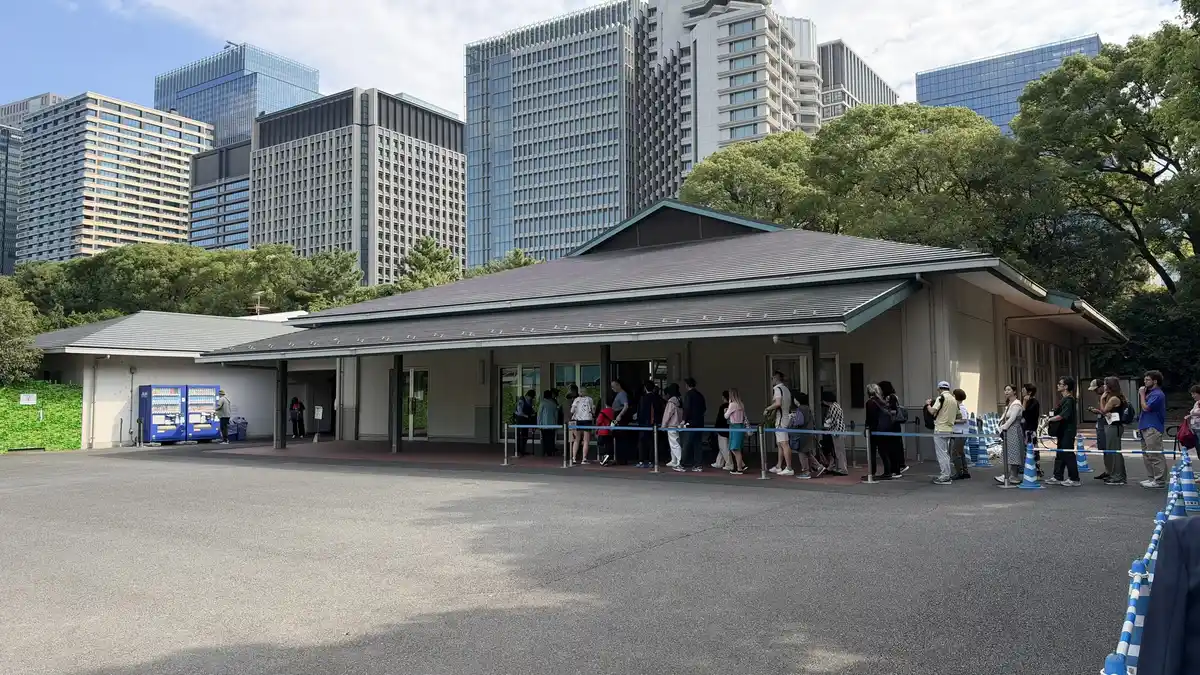 Soumeikan exterior and entrance queue
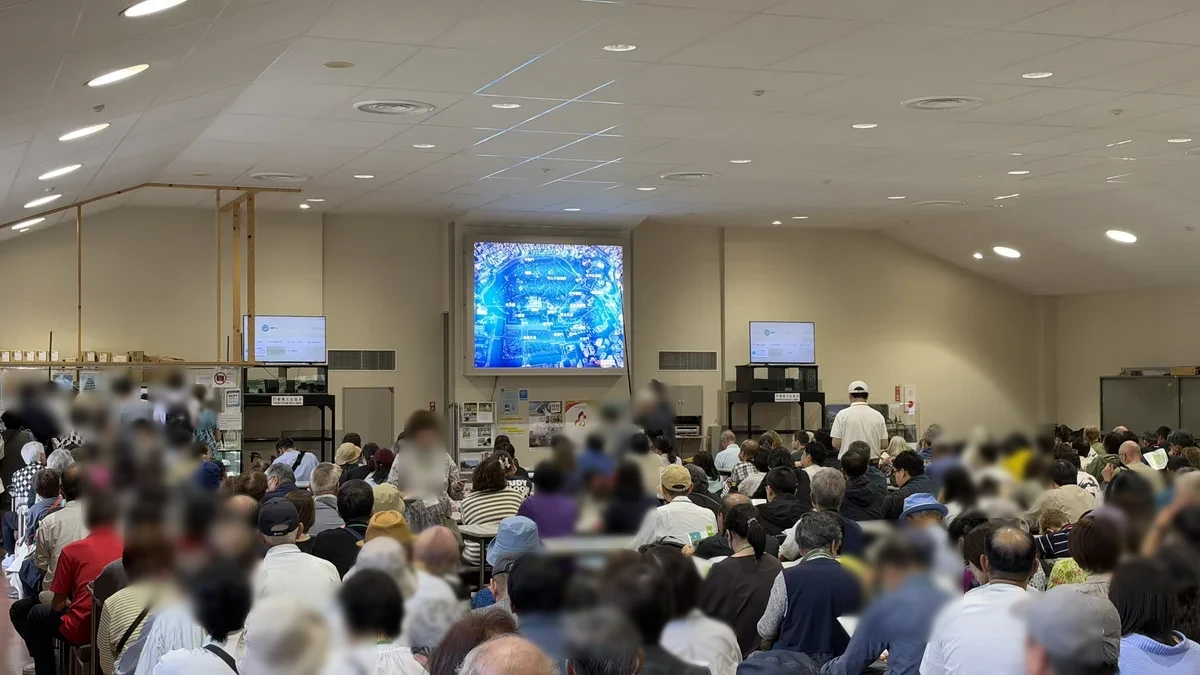 Visitors seated inside Soumeikan
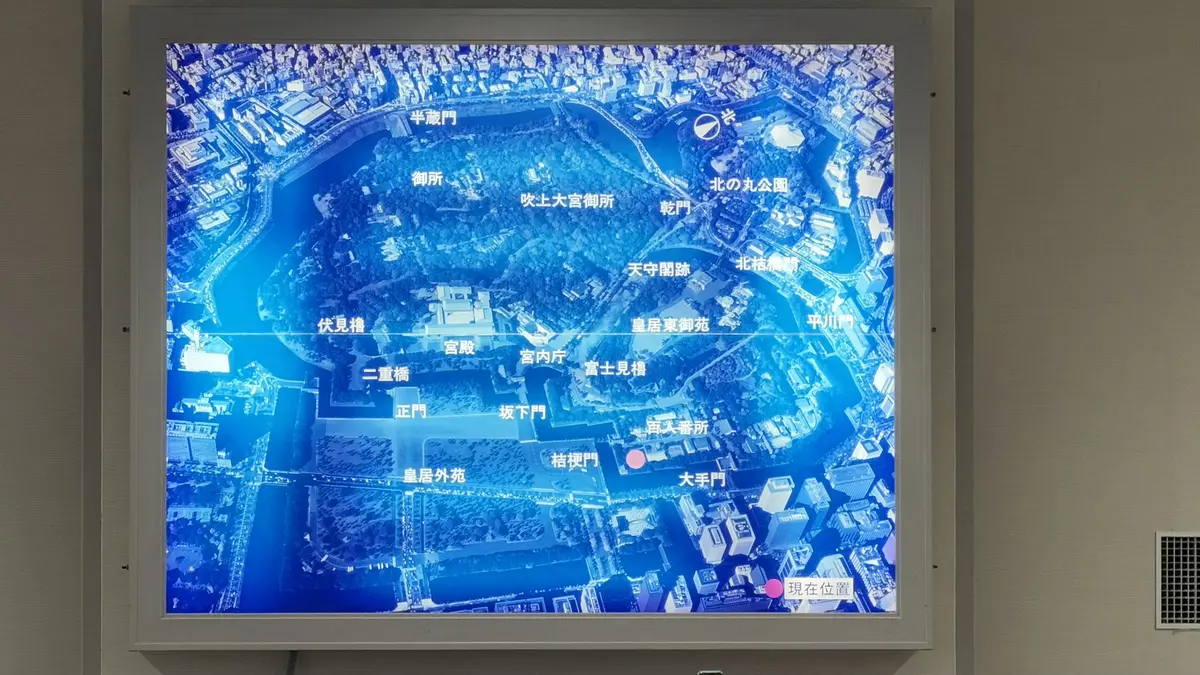 Palace map displayed in Soumeikan
Rules and Walking Etiquette During the Tour
The guide stops at key points as the group walks. The following was explained on my tour on October 3, 2026. Instructions can vary by day and by guide, so follow your guide on site. Official notes from the Imperial Household Agency, such as baggage inspection and coin lockers, are in the Access and Meeting Point section.
- Walk on the left side of the road. The route is a roadway. Stay to the left and do not cross the center line.
- Take photos where the guide stops. The guide stops at key points and points out photo spots. When you have your shot, step aside so the people behind you can take theirs. In some places a line of white stones on the ground marked where to stand.
- Three rules at the iron bridge. Do not step onto the gravel on either side before the bridge. Do not climb onto the raised white strip, like a sidewalk, on the inside of the bridge. Anything dropped from the bridge, such as a camera, phone, or parasol, cannot be retrieved, so hold on tight as you cross.
- Watch the step before the bridge. There are raised edges on both sides, and the guide said many visitors trip and get hurt there. Look down as you pass.
- Return your tag at the end. The tag and strap around your neck are not souvenirs. Hand them back, one per person, when the tour ends.
Highlights of 6 Main Spots
The tour route begins at Fujimi-yagura Turret and ends at Yamashita-dori. Below, I introduce the historical background of each stop along with what I felt on site.
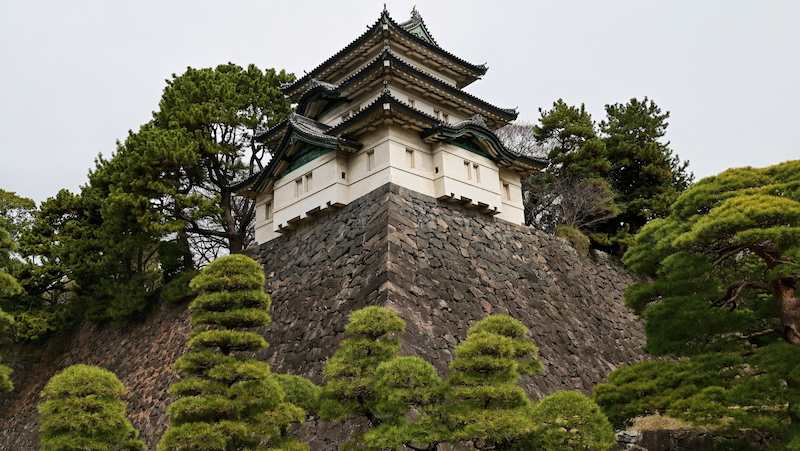
The first stop, Fujimi-yagura Turret, can also be seen from the Imperial Palace East Gardens, but looking up at it at close range from outside the stone wall is an experience unique to the public tour. The contrast between the white walls and black roof tiles is striking, and the turret's commanding presence above its stone wall feels especially powerful. After the main keep burned down in the Great Fire of Meireki in 1657, the shogun is said to have viewed Mount Fuji from here, and the turret effectively served as a substitute for the keep. It was rebuilt two years later, in 1659. The stone wall is about 15 m high and the turret about 16 m (according to a Kikuyo Culture Association pamphlet). According to the guide, surrounding high-rises now block the view, so Mount Fuji can no longer be seen from the turret.
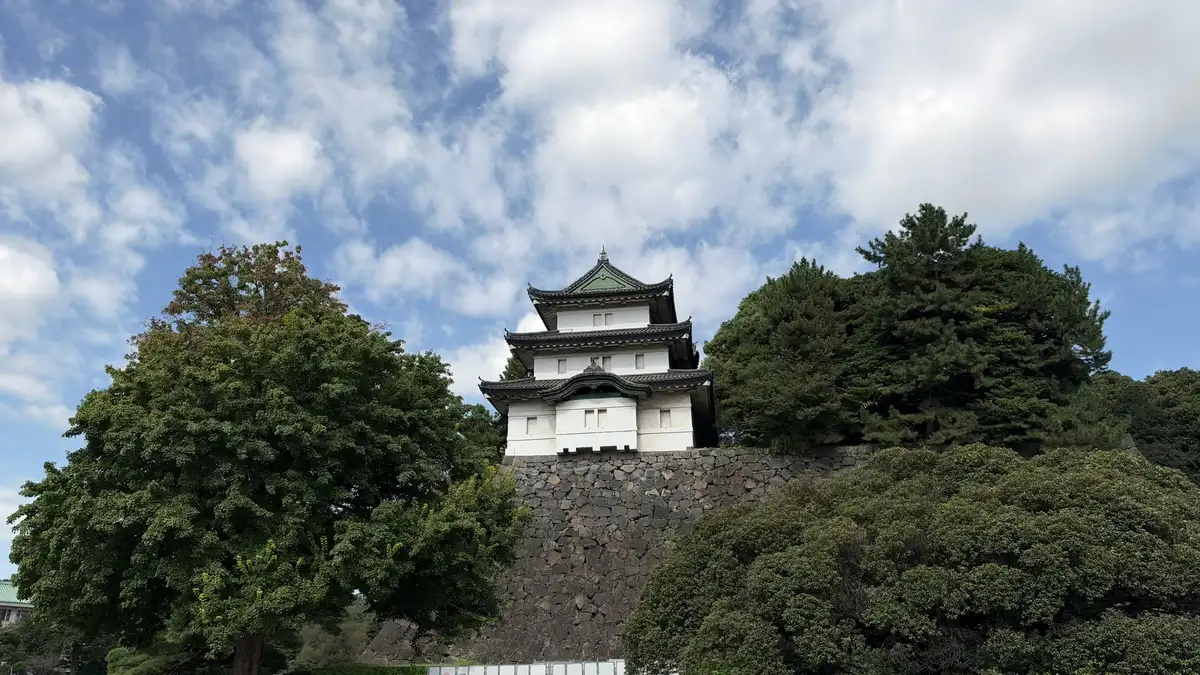 Frontal upward view of Fujimi-yagura Turret
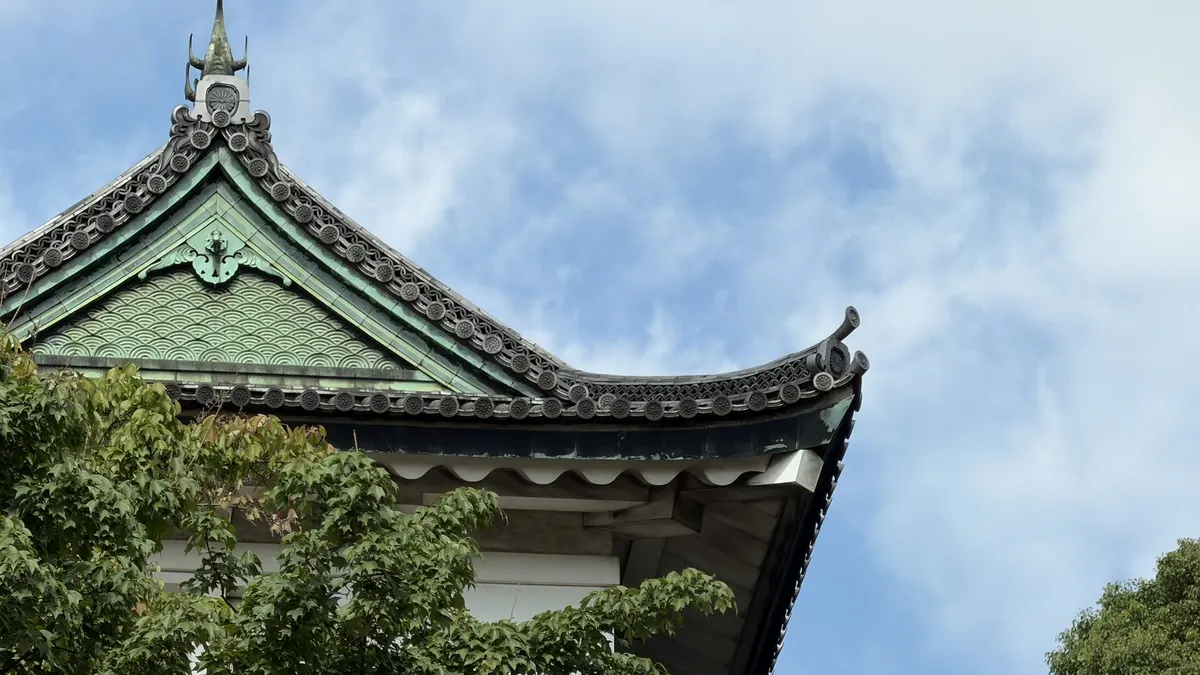 Upper eaves of Fujimi-yagura Turret
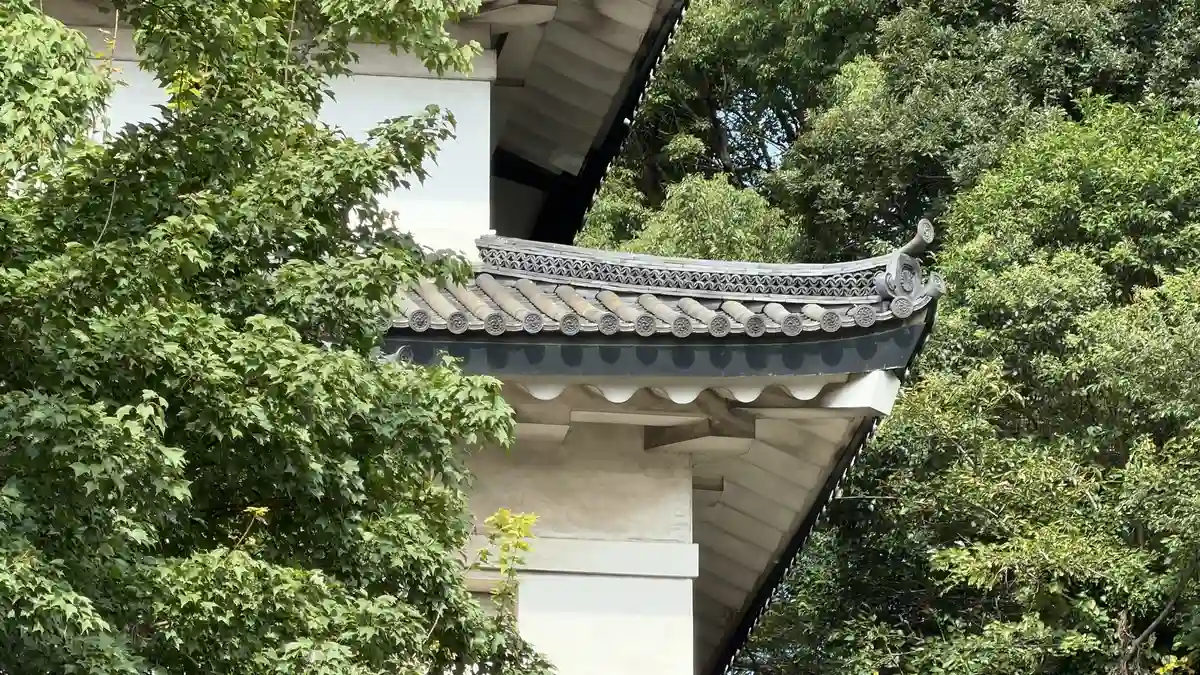 Eaves and white wall of Fujimi-yagura Turret
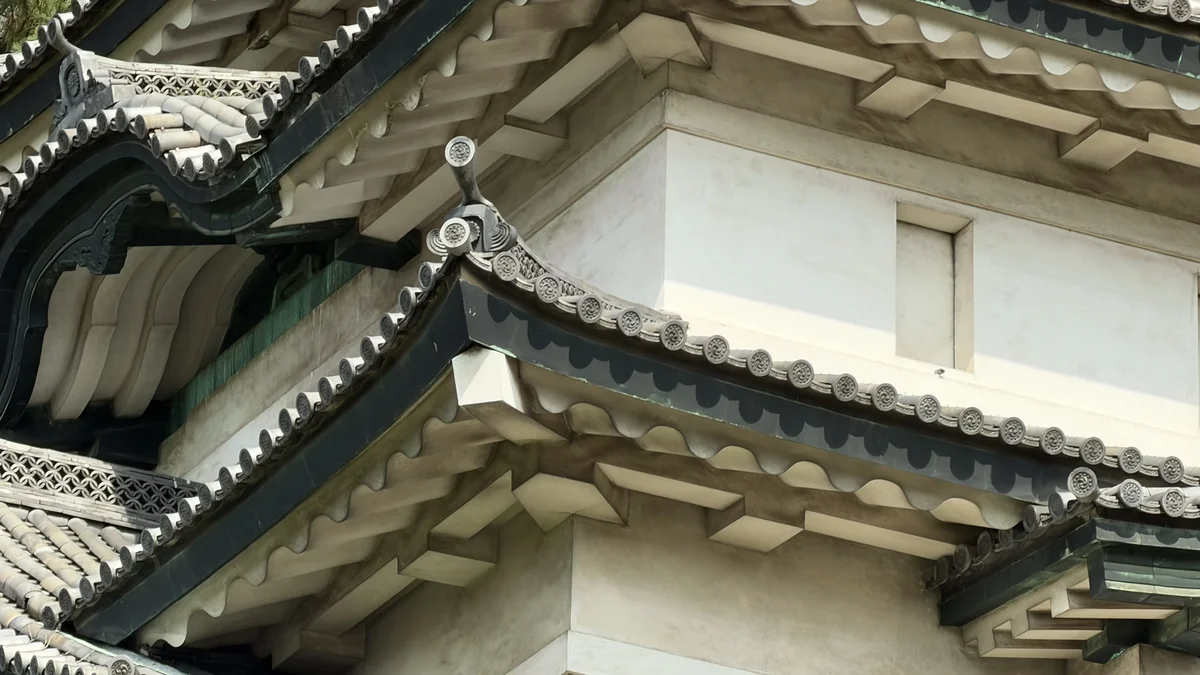 Overlapping eaves of Fujimi-yagura Turret
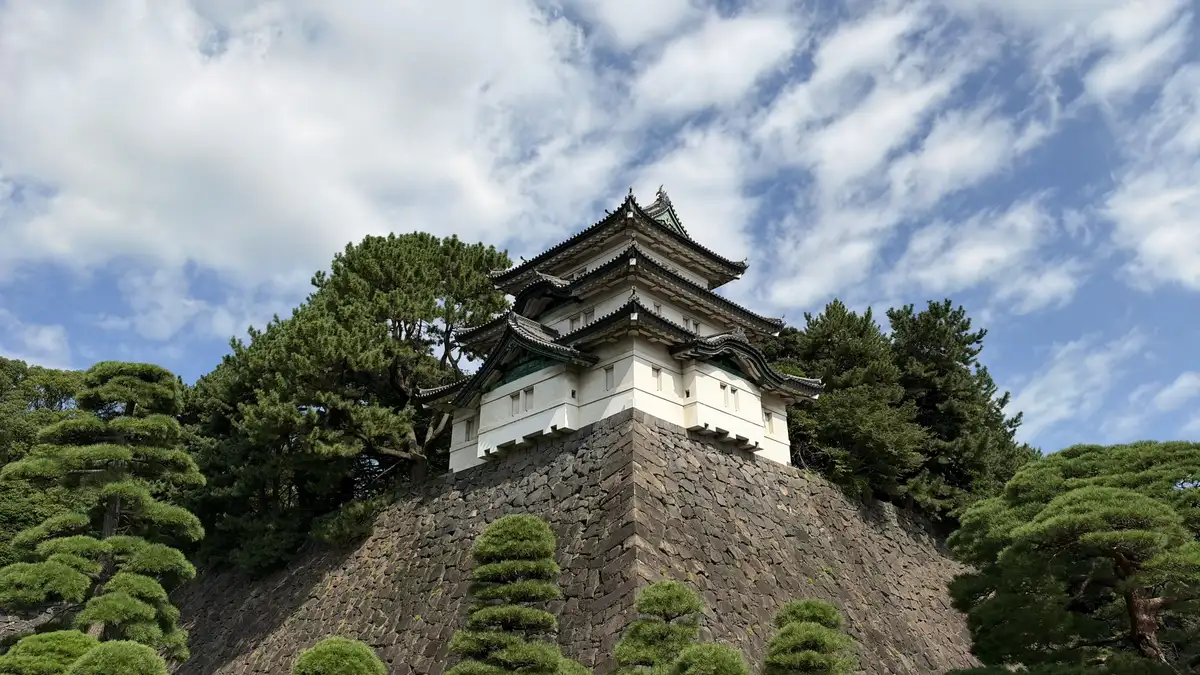 Fujimi-yagura Turret at the stone-wall corner
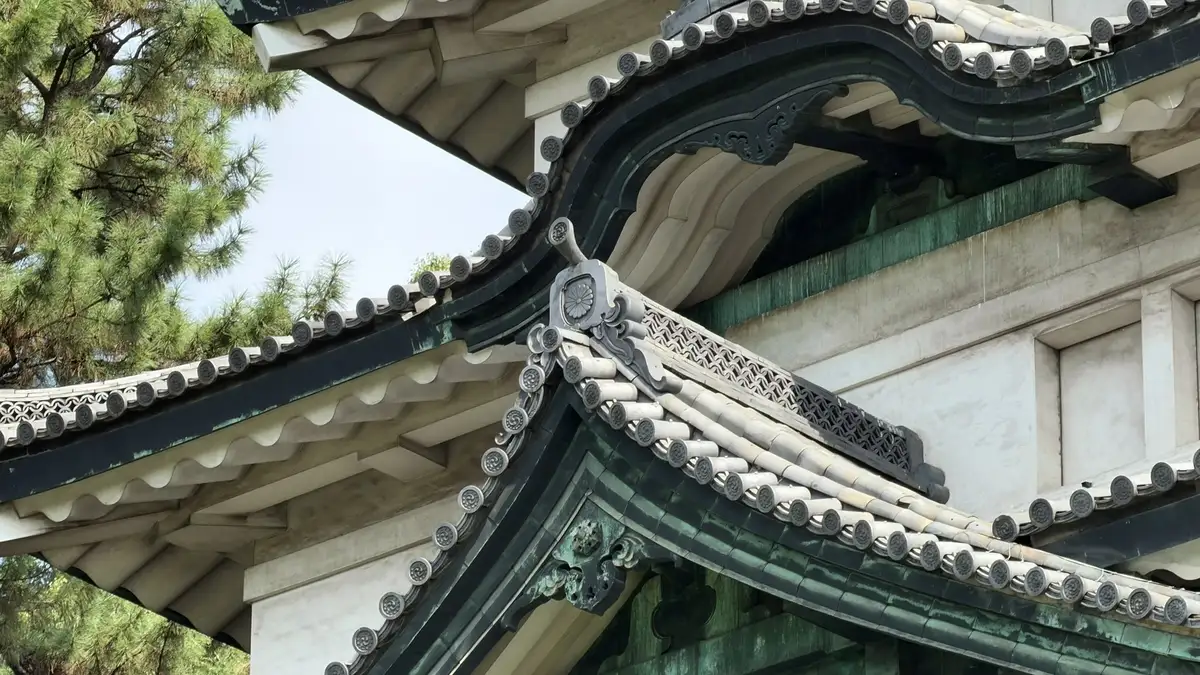 Curved gable detail of Fujimi-yagura Turret
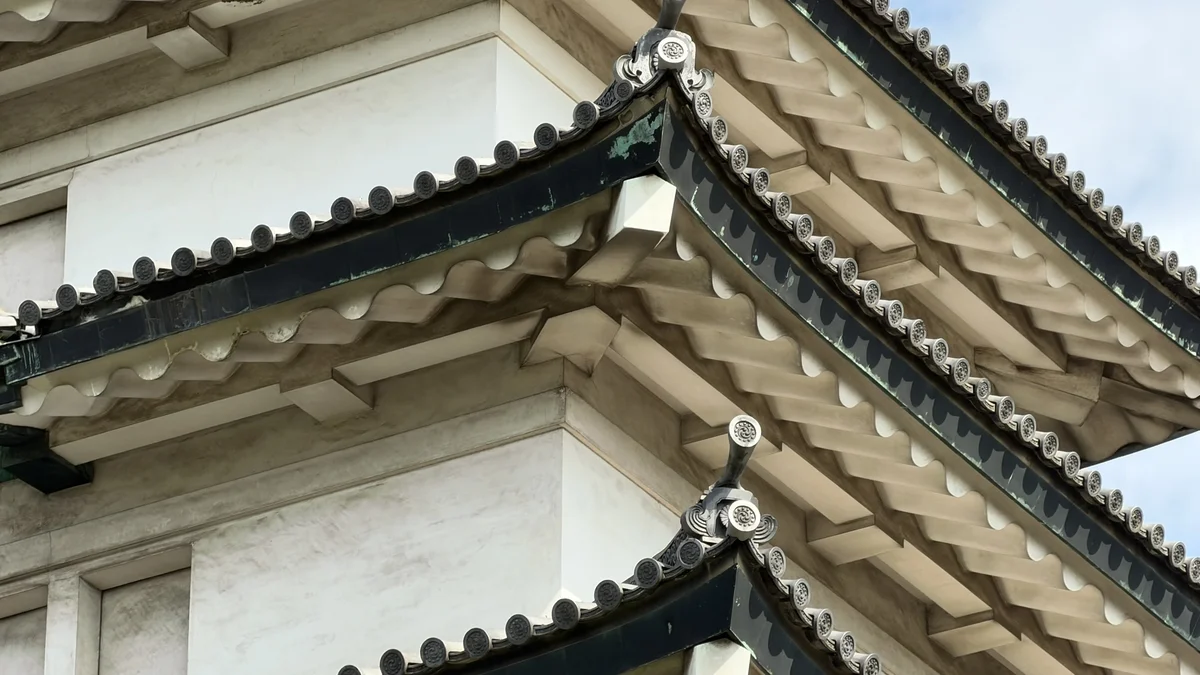 Roof corner and eaves of Fujimi-yagura Turret
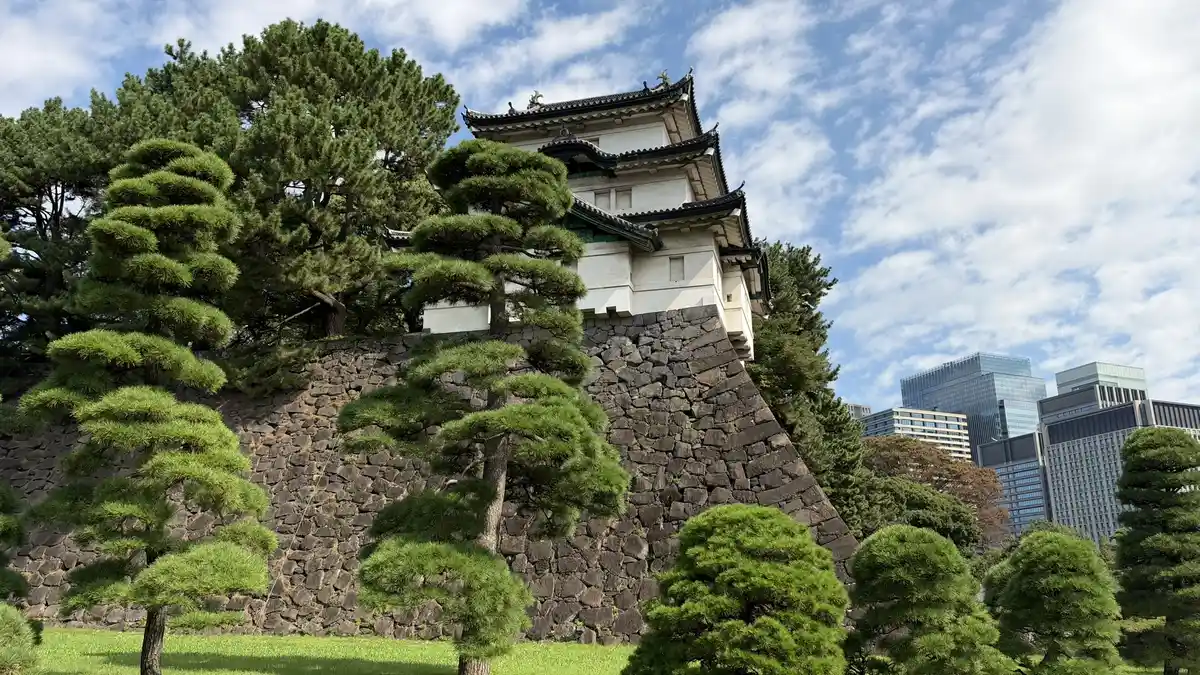 Fujimi-yagura Turret behind pines
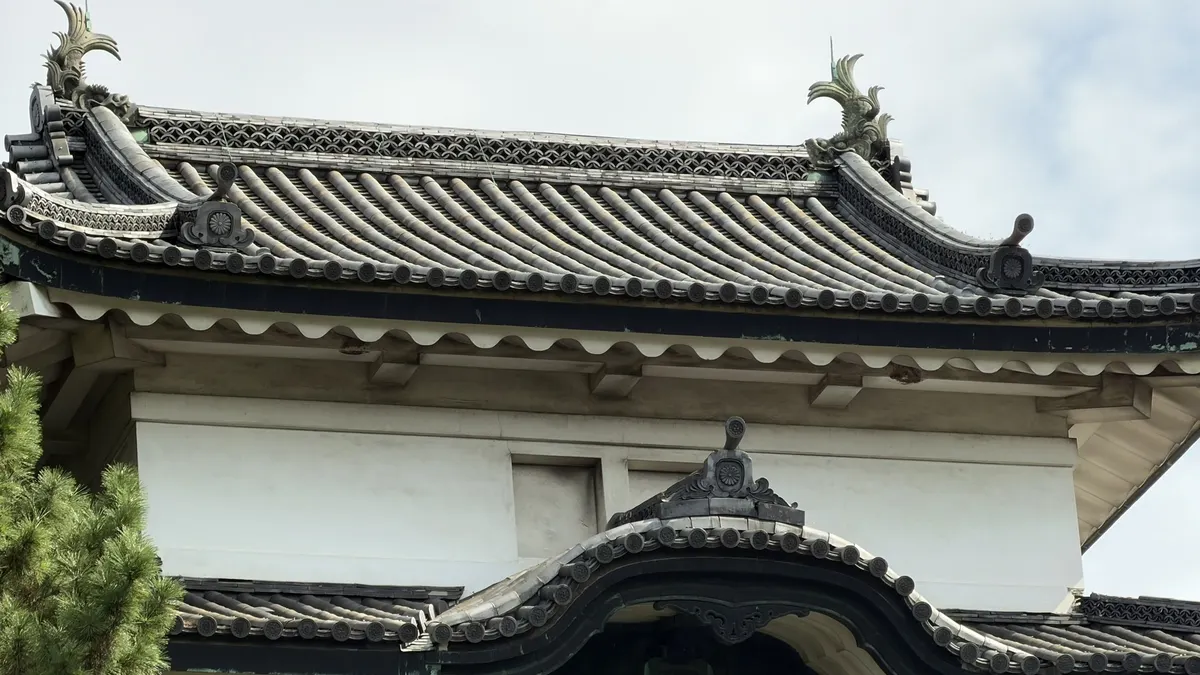 Close view of turret roof ornaments
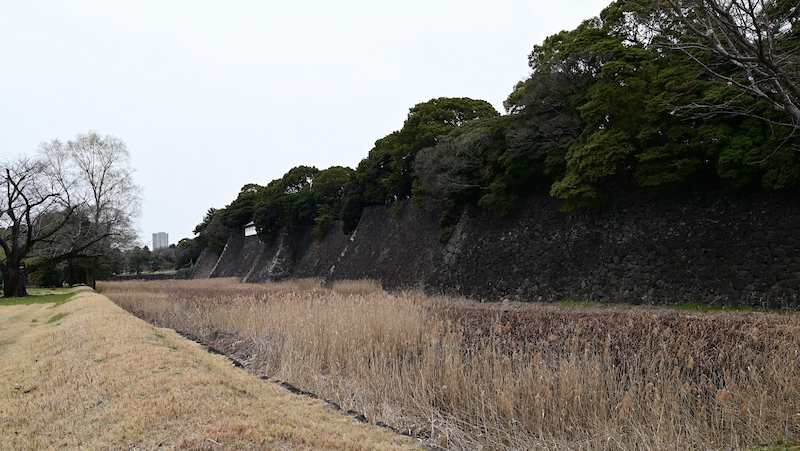
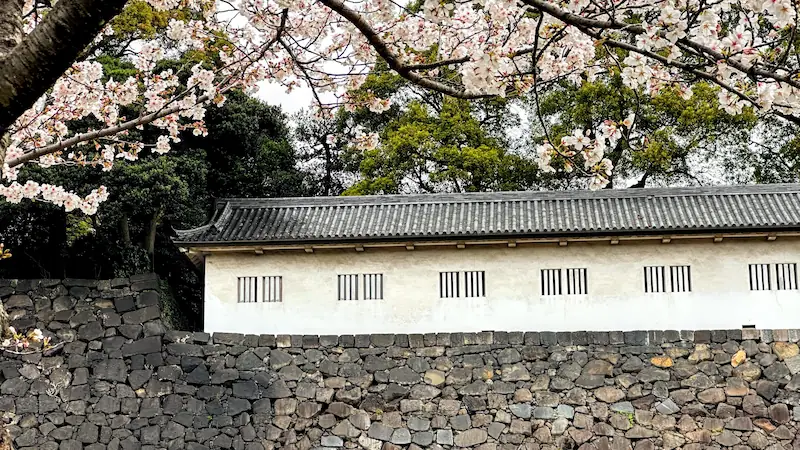
Fujimi-tamon is the only one of Edo Castle's many tamon — long, low defensive structures that also stored weapons — still standing today. It can also be seen from the Honmaru side of the Imperial Palace East Gardens, but the view from outside, across Hasuikebori Moat, is a perspective unique to the public tour. Large lotus flowers bloom in the moat in summer. According to the guide, the best time is July to August; on October 3, the flowering season had passed and lotus leaves covered the water. The shape of the moat and its setting beside the tamon are worth seeing in any season.
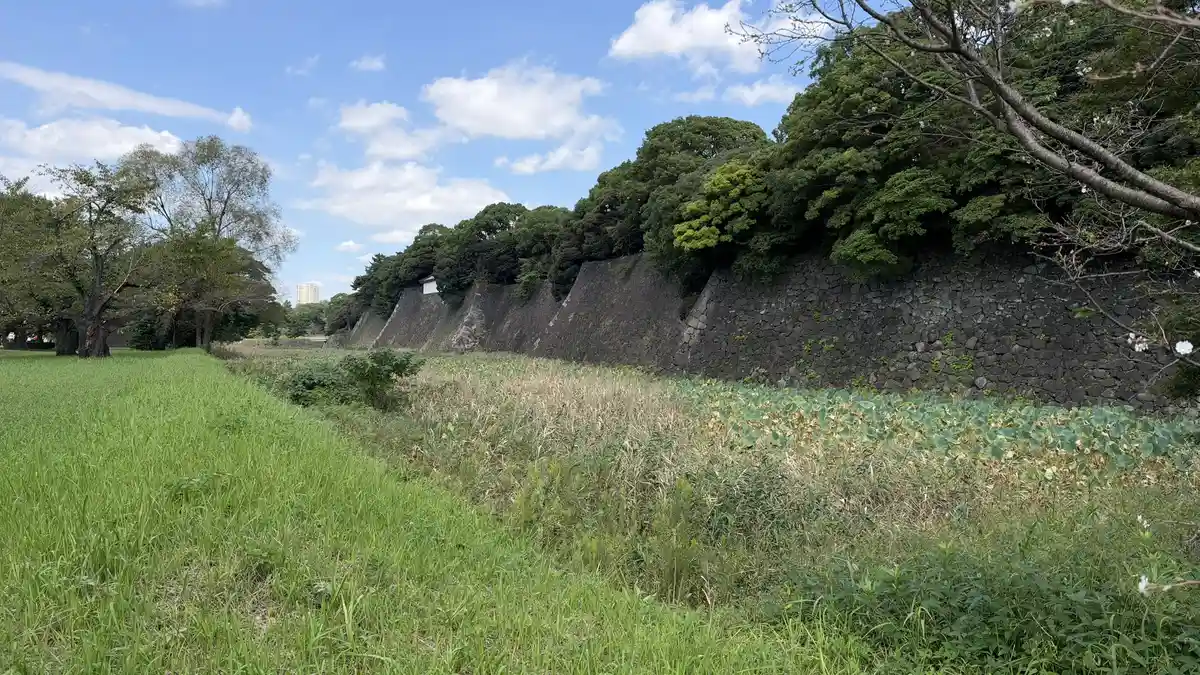 Vegetation covering Hasuikebori Moat
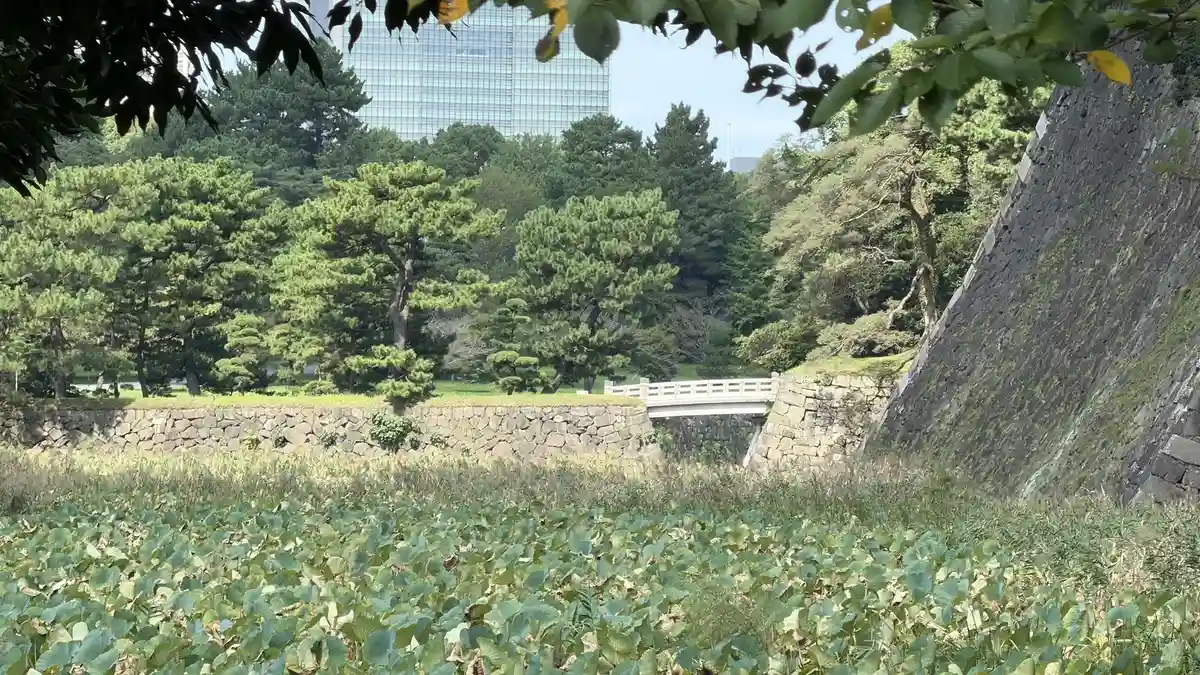 Bridge beyond the lotus-filled moat
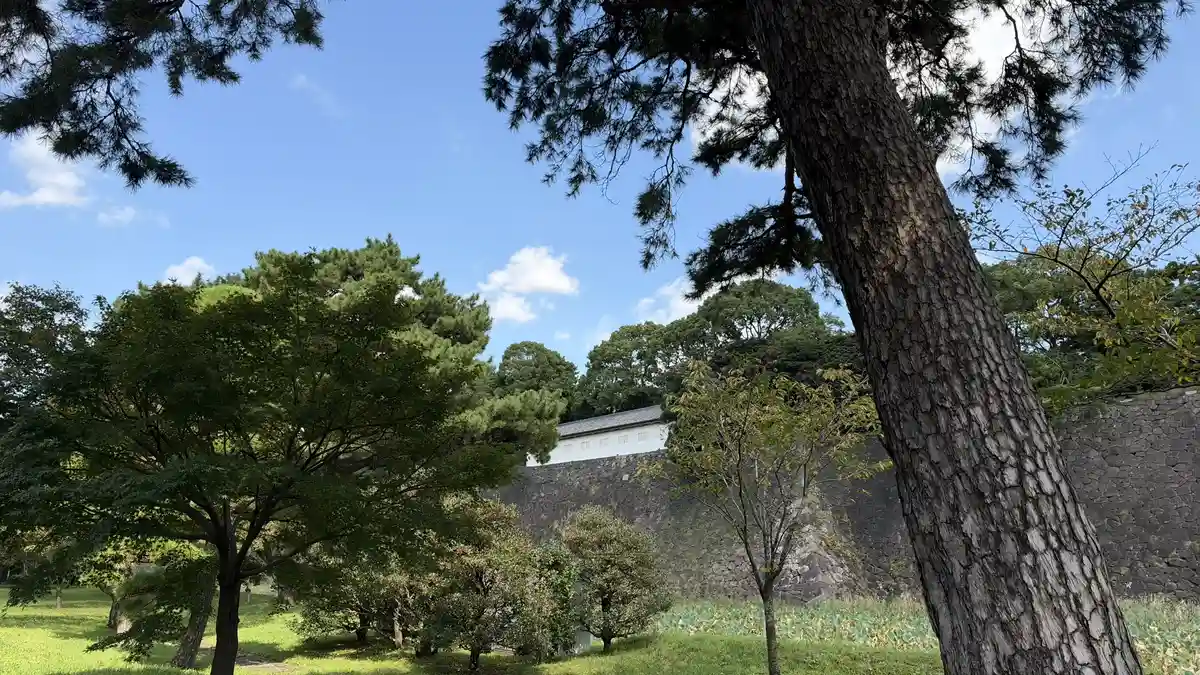 Fujimi-tamon behind pines
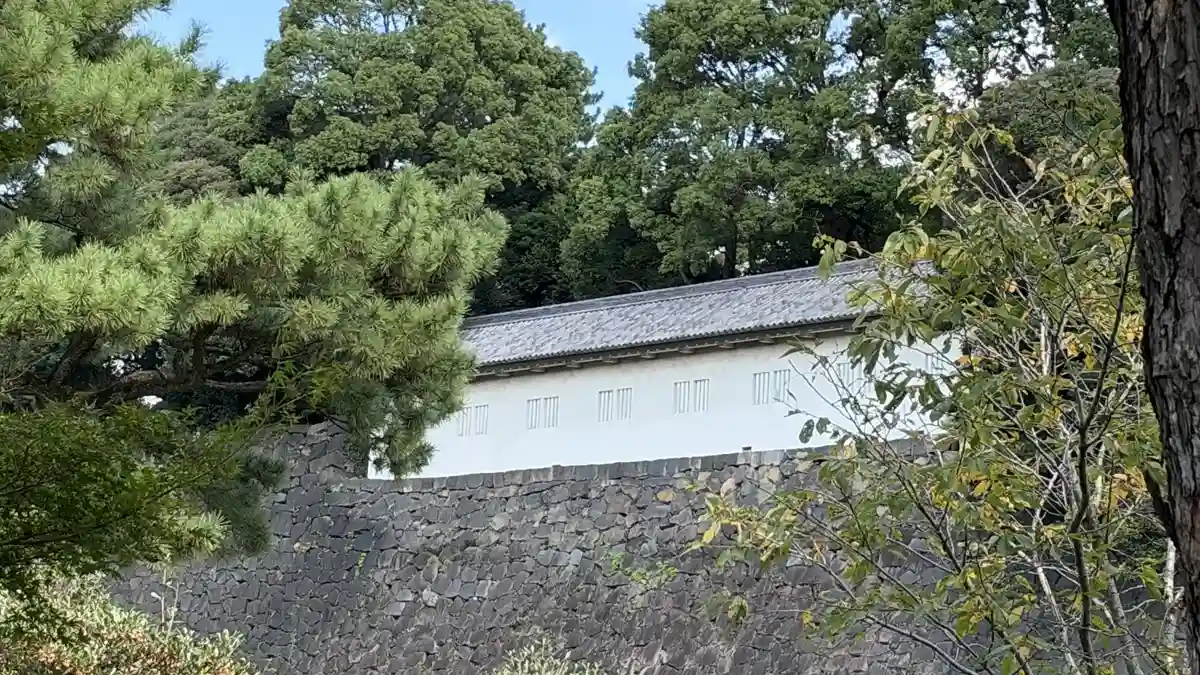 White walls and tiled roof of Fujimi-tamon
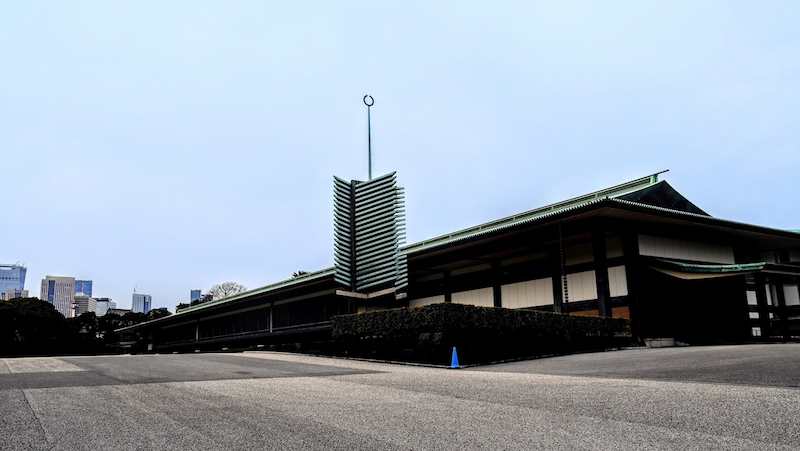
After passing beside the Imperial Household Agency Building, you arrive at the vast Imperial Palace East Court. Large crowds gather here for the New Year's Greeting and the Emperor's Birthday public greeting, and the public tour lets you walk through the same plaza.
The Imperial Household Agency Building was completed in 1935, and from 1952 to 1969 its third floor served as a temporary palace. Beneath the East Court is a parking garage for about 120 large vehicles. The Chumon gate, the Matsu-no-to lamp tower, and the lanterns under the eaves of the Chowaden were built with public donations when the Palace was constructed (according to the Imperial Household Agency).
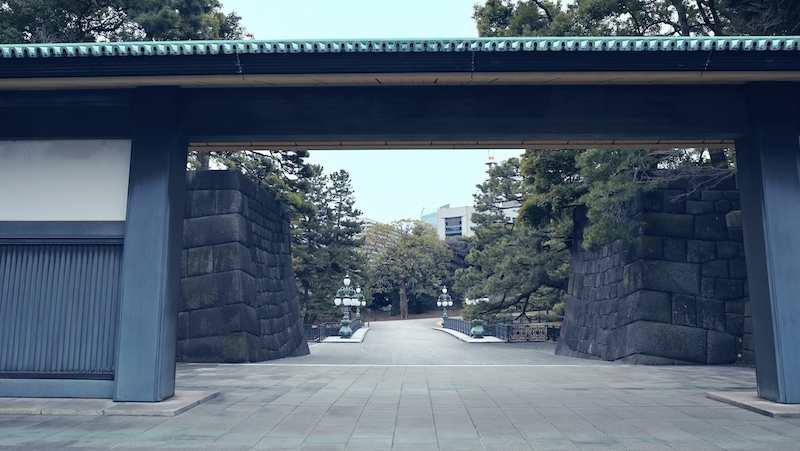
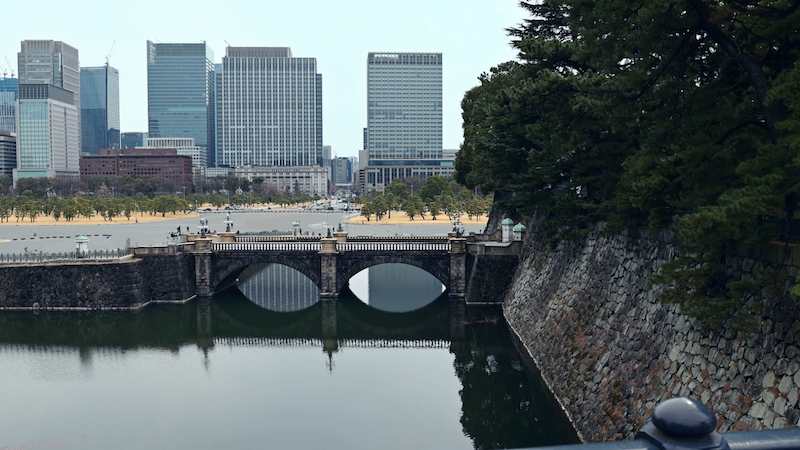
Nijubashi Bridge is one of the highlights of any Imperial Palace visit. Its name comes from the fact that the former bridge had a "double" structure, with a lower bridge and another level built above it. Today it has been rebuilt as a single-level structure, but the name preserves that history. The Main Gate Stone Bridge in front is also nicknamed Meganebashi, or Eyeglasses Bridge — on calm days, the bridge's arches and their reflection can look like a pair of glasses. I have summarized the rules for crossing the bridge in Rules and Walking Etiquette During the Tour.
Over the year-end and New Year period, the Main Gate Stone Bridge, the lamps along the bridge railings, and Fushimi-yagura Turret are lit up. In fiscal 2025 this ran from December 23, 2025, to January 4, 2026, from 5 to 9 p.m. Check the latest announcement on the Imperial Household Agency website to confirm whether the illumination will be held and on which dates.
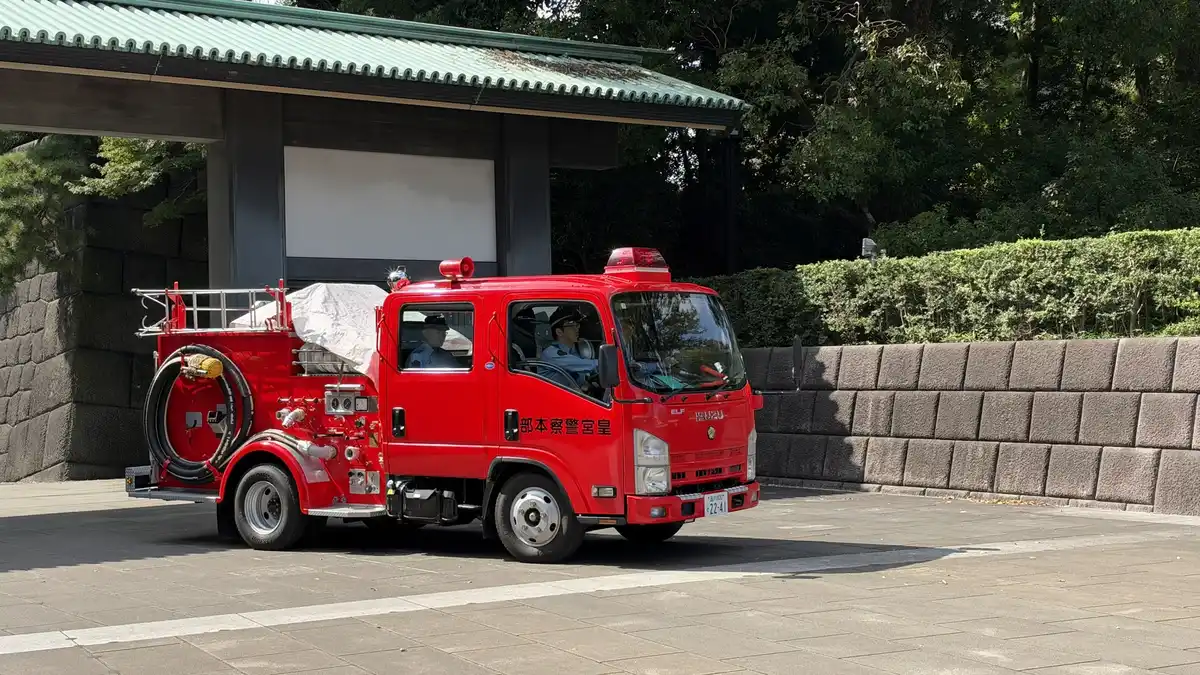
On the way to the iron bridge, I saw a red fire engine, and the guide encouraged us to take photos. It is a fire engine dedicated to the Imperial Palace, and the words “皇宮警察本部” (Imperial Guard Headquarters) were printed on its body.
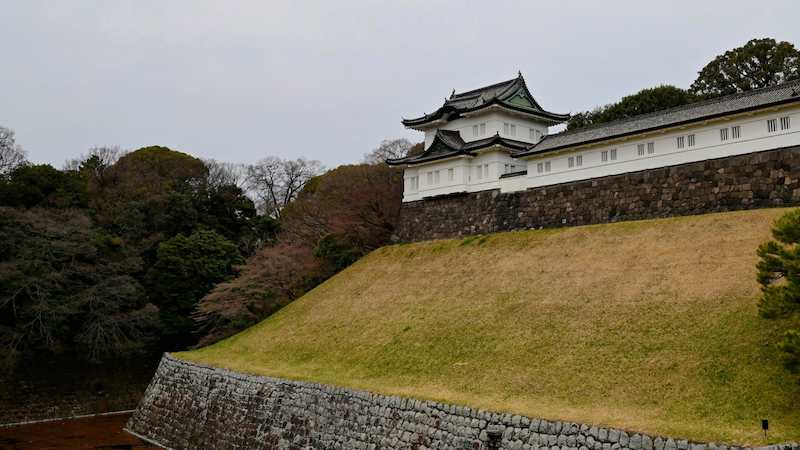
Fushimi-yagura Turret can be seen from Nijubashi Bridge. By long-standing tradition, it is said to have originally stood at Fushimi Castle in Kyoto and later been moved here. The Imperial Household Agency itself describes it as "said to be the most beautiful" of Edo Castle's surviving turrets, and it is a two-story turret that once served as a defensive position. According to the guide, the turret stands high above the moat, so humidity stays low, and it is still used today to store works of art. For photos, the guide suggested including the green street lamp in the foreground for a more atmospheric shot. The guide suggested walking around to the Outer Garden side on the way back: looking toward the palace from beyond the Main Gate Stone Bridge, the stone bridge, the iron bridge, and Fushimi-yagura Turret line up in a single frame. The guide called it a symbolic view of the Imperial Palace.
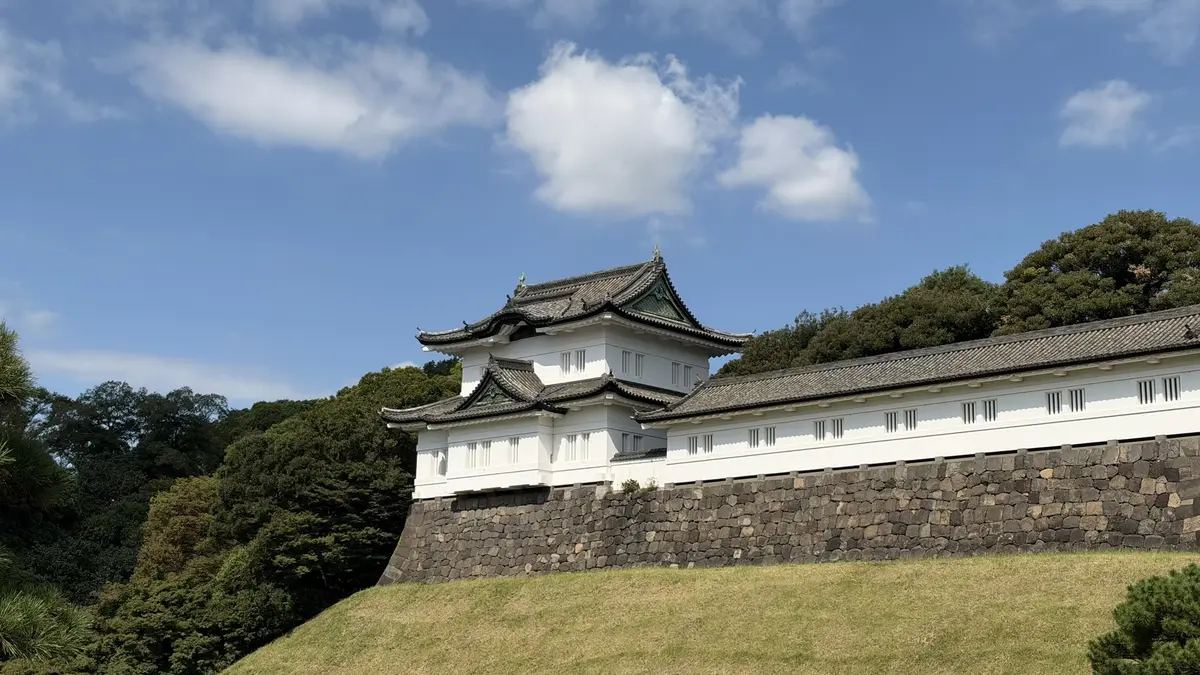 Fushimi-yagura Turret and the adjoining turret
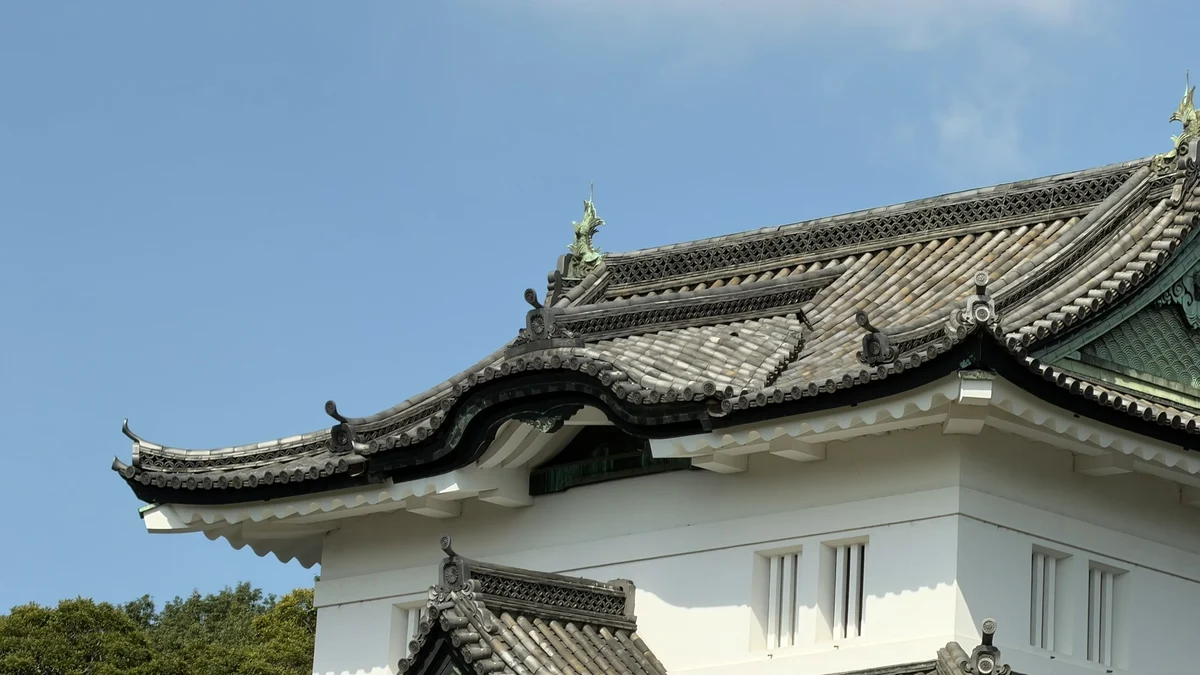 Roofs and gables of Fushimi-yagura Turret
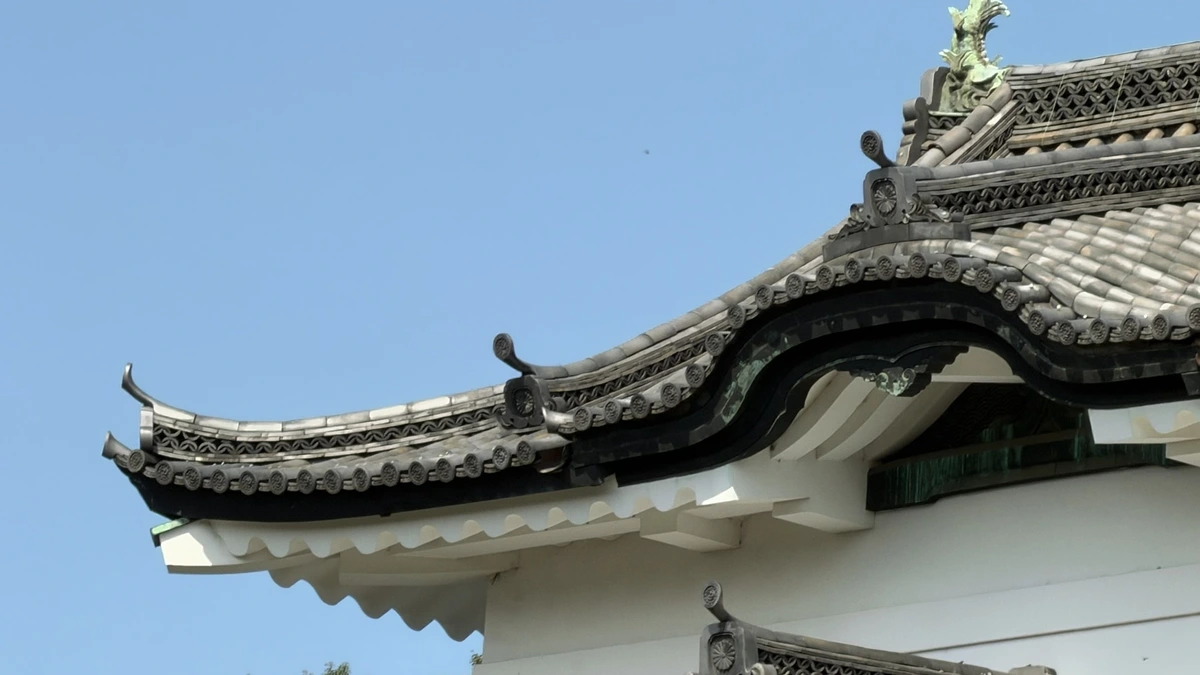 Curved gable and eaves of Fushimi-yagura Turret
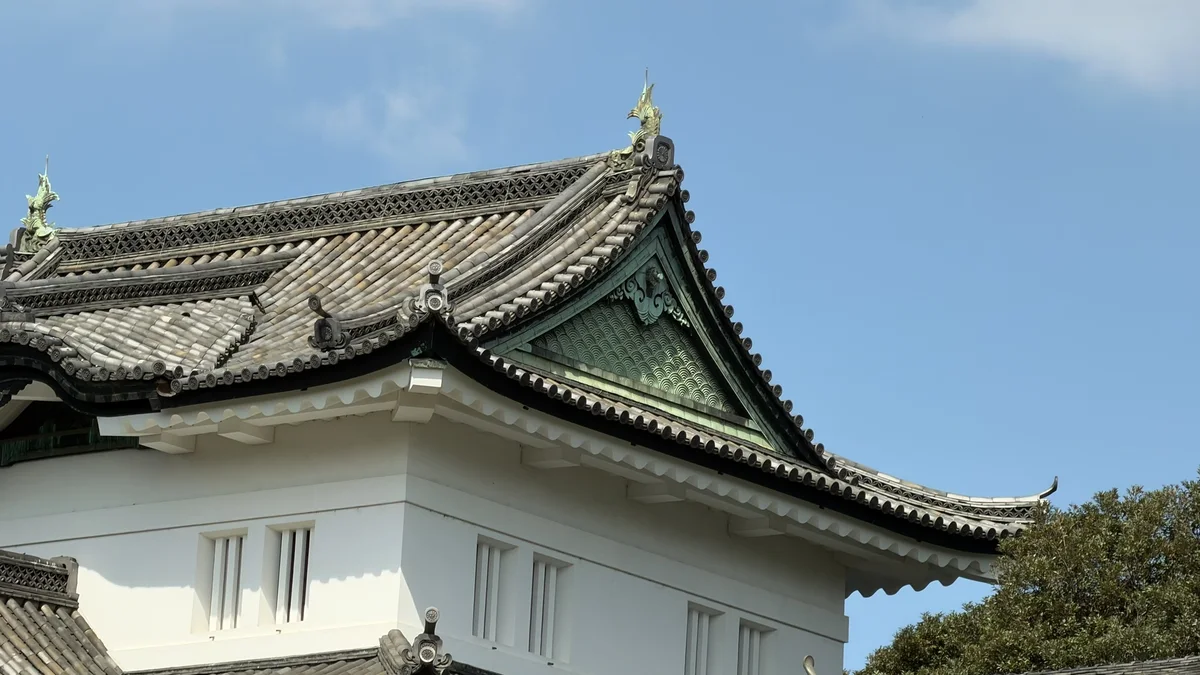 Upper roof of Fushimi-yagura Turret
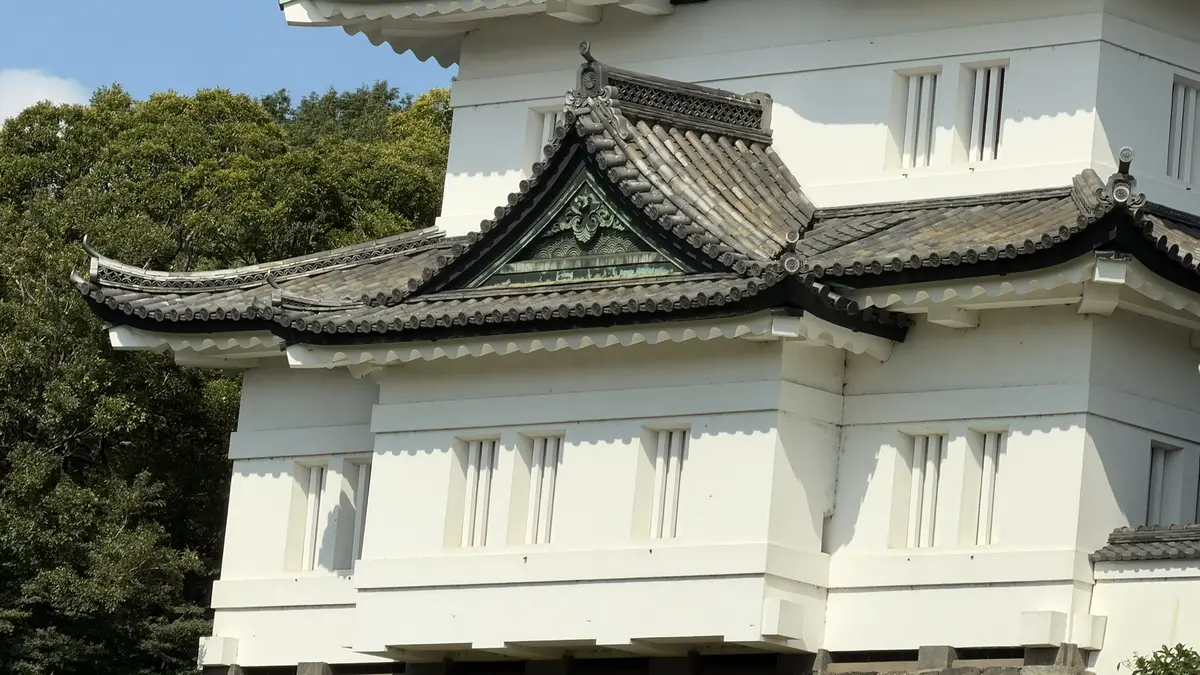 White walls and windows of Fushimi-yagura Turret
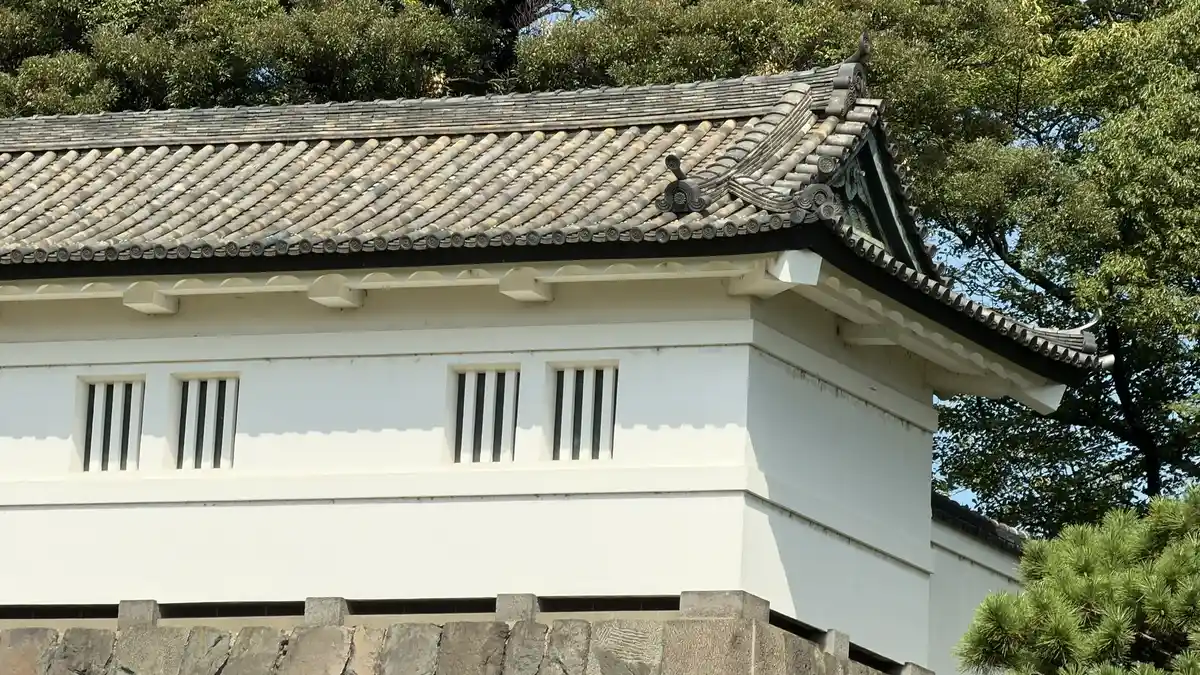 End of the turret adjoining Fushimi-yagura Turret
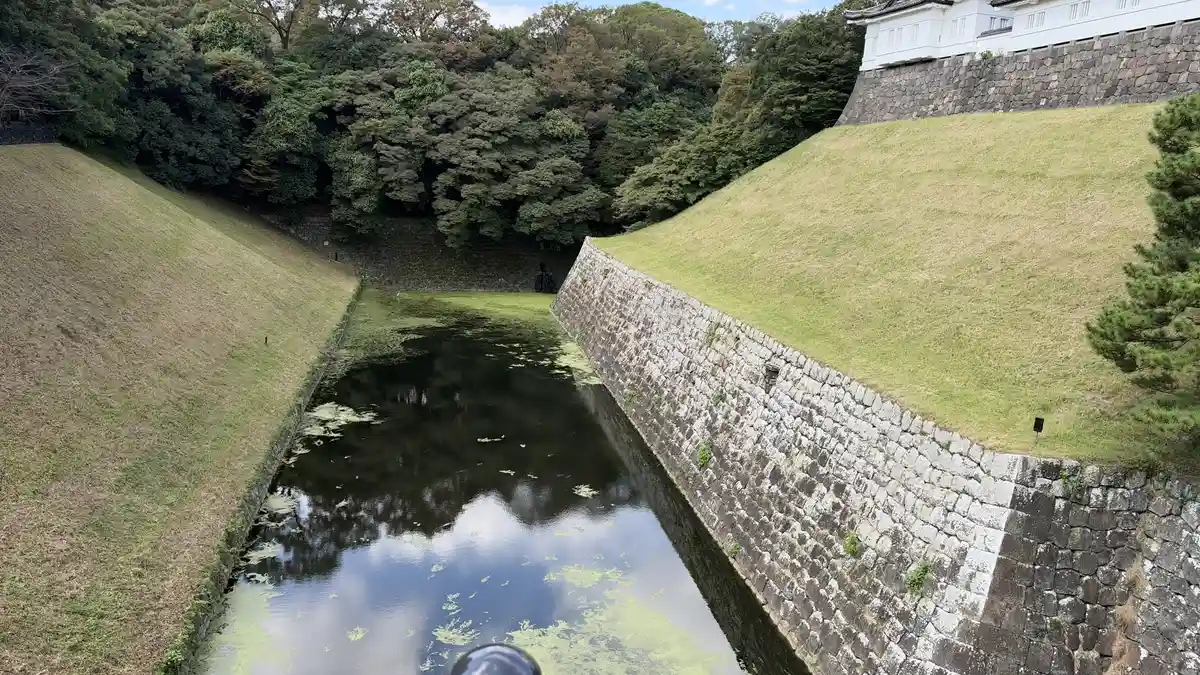 Moat and slopes below the iron bridge
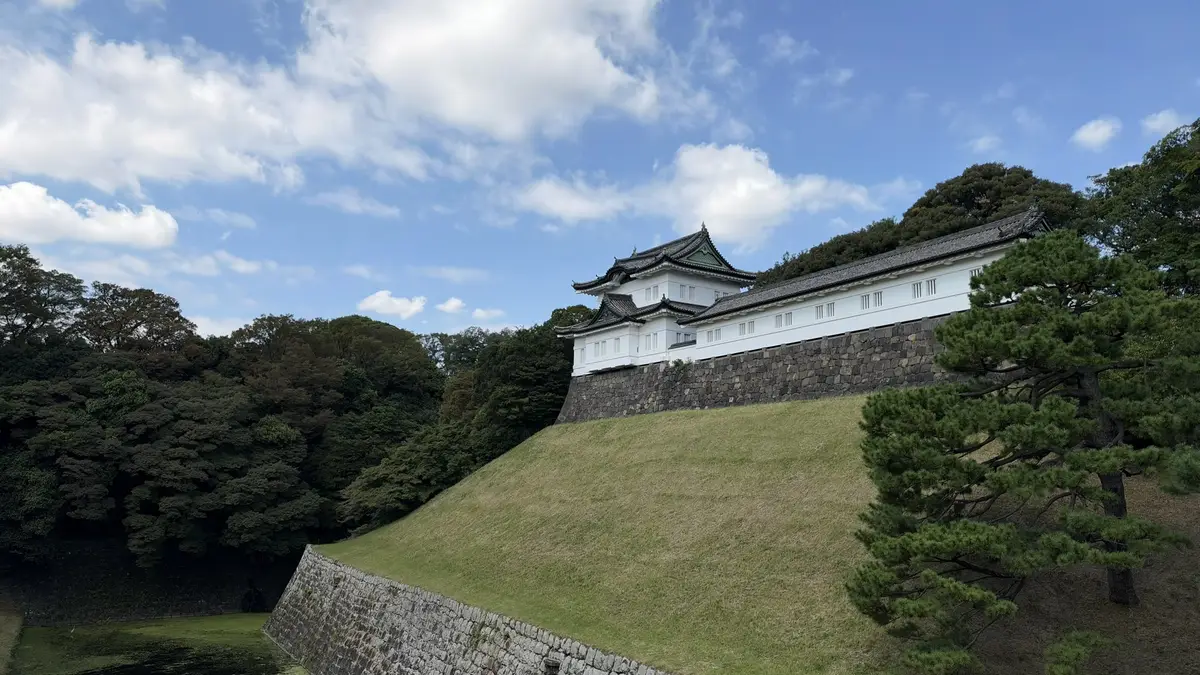 Fushimi-yagura Turret hillside beside the moat
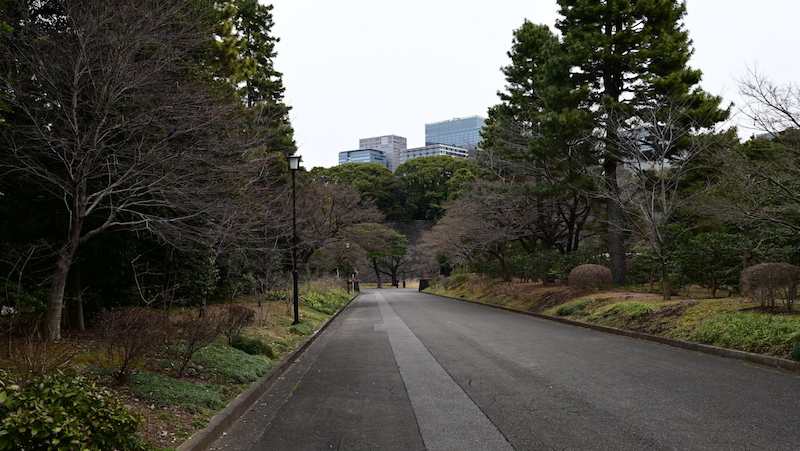
The tour ends along Yamashita-dori, a quiet tree-lined path. On nearby Momijiyama, the Toshogu shrine dedicated to Tokugawa Ieyasu and the mausoleums of successive shoguns once stood during the Edo period. Those buildings no longer remain. Momijiyama was deeply connected with the shogunate's rituals. The Shinobazu-guchi torii gate at Ueno Toshogu Shrine is said to have been moved in 1873 from Momijiyama Toshogu within Edo Castle. See the Ueno Toshogu Shrine guide for photos. Separately, mausoleums of the Tokugawa shoguns survive at Kaneiji Temple in Ueno, the burial place of six of the fifteen shoguns.
Above the stone wall along Yamashita-dori lie the Imperial Palace East Gardens, where you can visit the site of the keep's stone base and more, free of charge. It is a good next stop after the tour. This guide covers the site of Edo Castle's Honmaru, its main enclosure.
More Sights Along the Route
Besides the six main spots, the guide explains several other buildings and views while walking. Below is what I heard. Where details are confirmed by Imperial Household Agency materials I state them as is; where they come only from the guide's spoken explanation and I could not confirm them, I say "according to the guide."
- Sakashita-mon Gate: According to the guide, this is the gate visitors use to leave after the New Year and Emperor's Birthday public greetings.
- Matsu-no-to: A green lamp tower in the East Court. According to the guide, it represents young pine needles, and the ring at its tip is modeled on an ancient bracelet called a kushiro. It was built with public donations at the time of construction.
- Chowaden and the Shunju-no-ma: The long building facing the East Court is the Chowaden. During public greetings, the Emperor addresses the crowd from its central balcony. The Shunju-no-ma inside is a multi-purpose hall used for receptions and audiences.
- The South Garden's topiary: Through the lattice fence on the south side of the Palace you can see large rounded hedges. According to the guide, they are planted with azaleas and other shrubs and trimmed entirely with hand shears, without machines.
- South and North carriage entrances: Both are entrances to the Palace. According to the guide, the South carriage entrance is the most formal entrance in the Palace, used to welcome state guests. The North hall beyond the North carriage entrance is used for audiences, and a guest book is kept there (according to the Imperial Household Agency).
- Homeiden: A hall used for large banquets, such as state banquets and Emperor's Birthday receptions. According to the guide, it is the largest room in the Palace.
- Momijiyama Imperial Sericulture Building: A facility where successive empresses have continued the tradition of raising silkworms (according to the Imperial Household Agency). According to the guide, it is in the Momijiyama area, and the Empress takes part in the silkworm rearing each year around May and June.
- October cherry (Jugatsu-zakura): A name plate for a Jugatsu-zakura stands along Hasuikebori Moat. According to the guide, it is the only October cherry on the tour, and it blooms into early spring. It was in bloom on October 3.
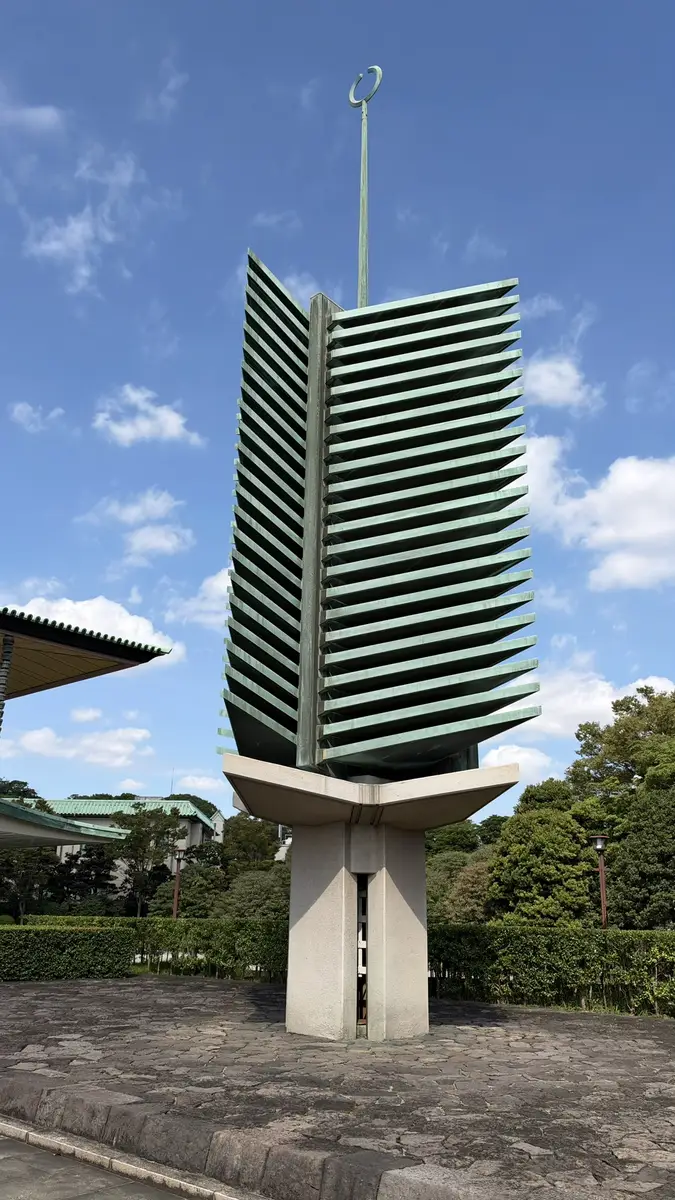 Full view of the Pine Tower
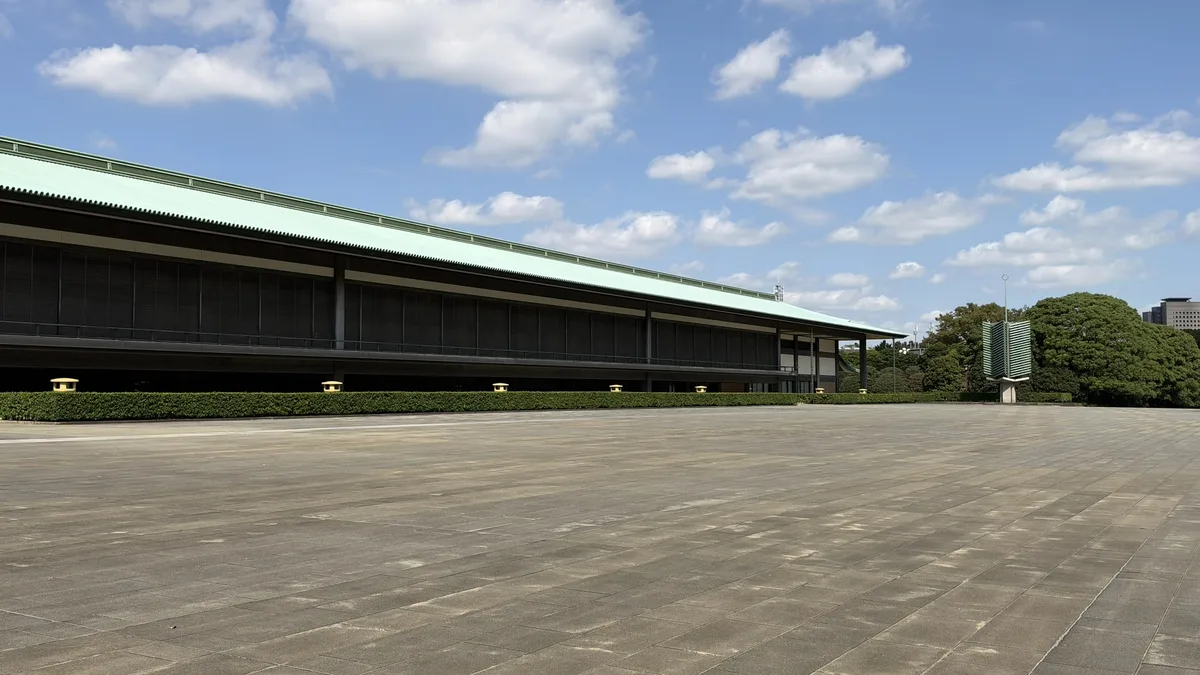 Long facade of Chowaden Hall and Pine Tower
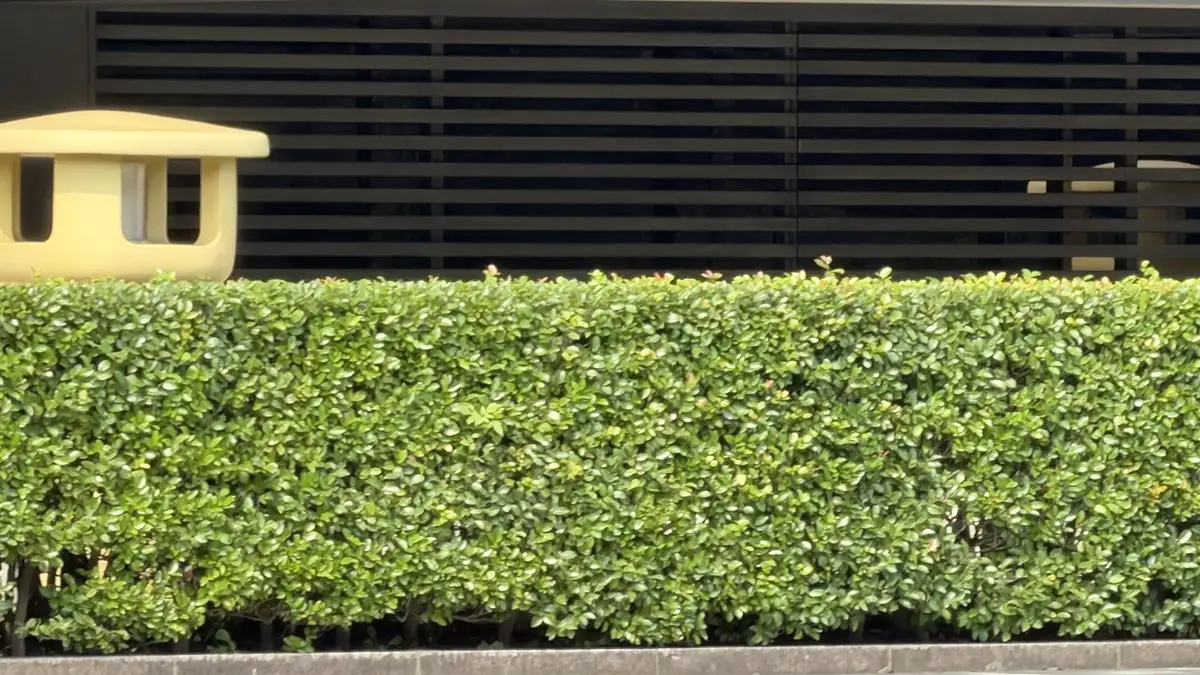 Gold-coloured lantern outside Chowaden Hall
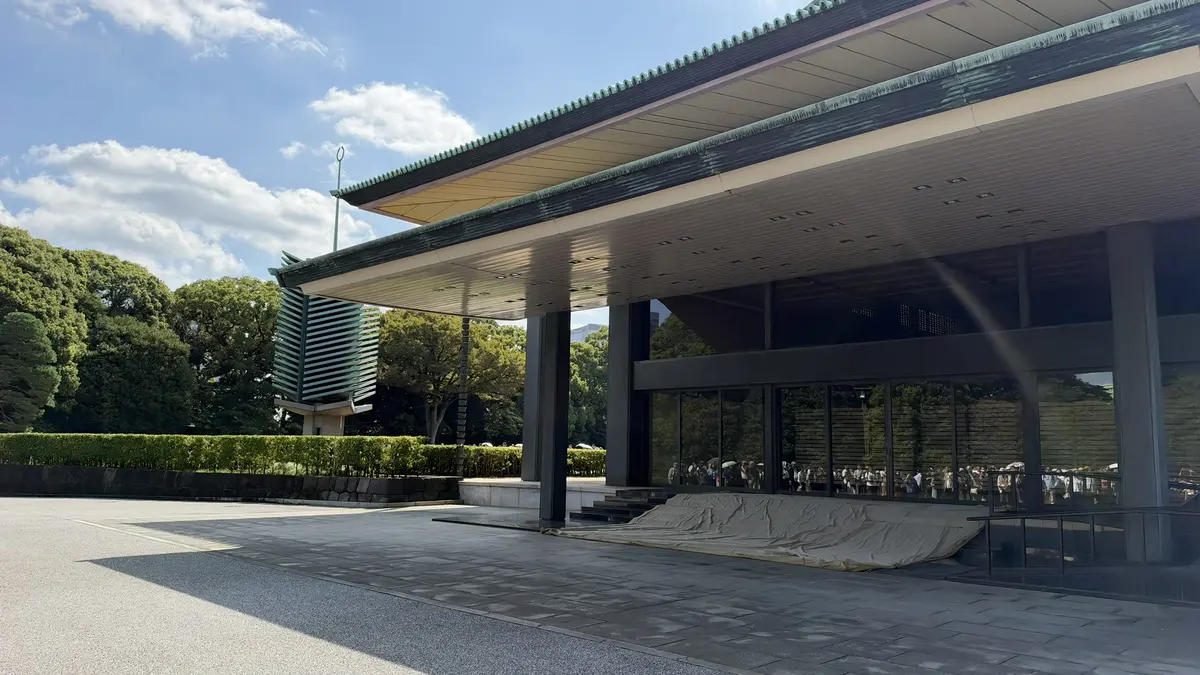 North carriage entrance of the palace
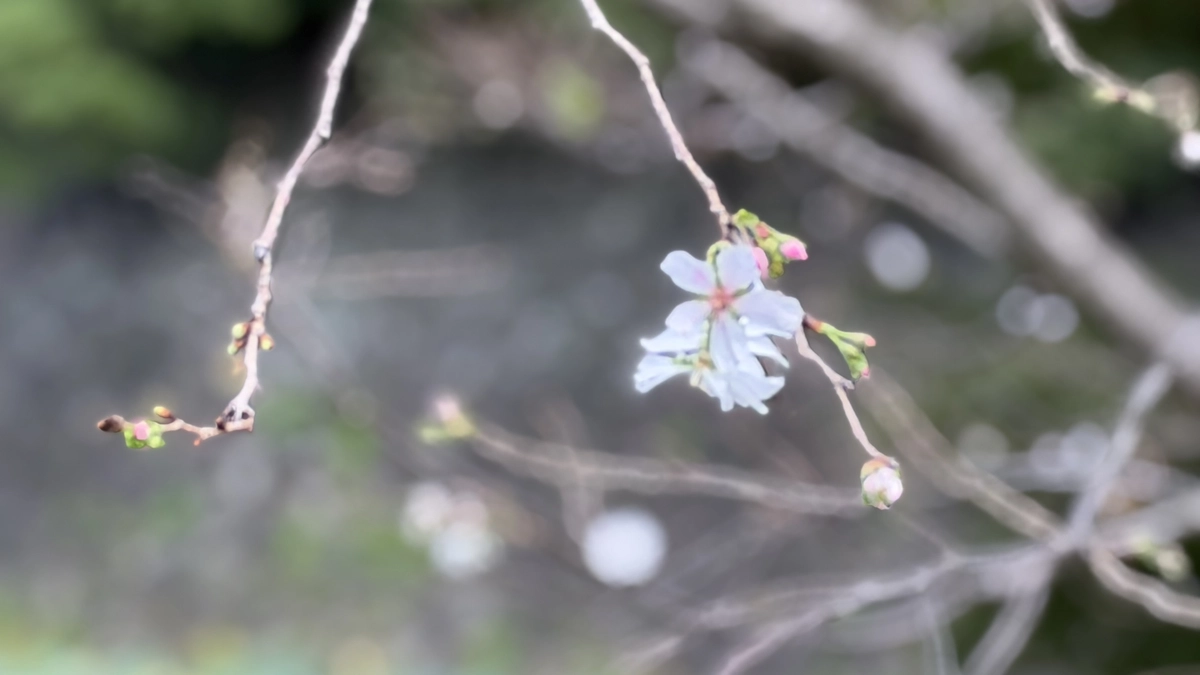 Autumn-flowering cherry beside the route
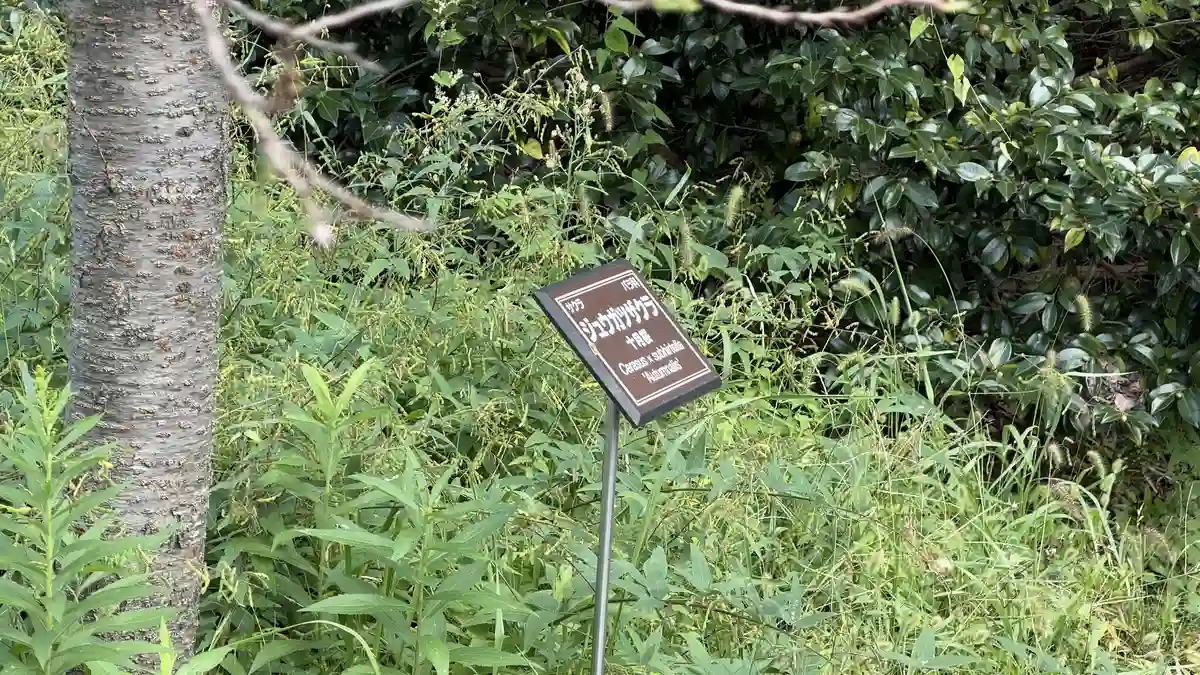 Label for the autumn-flowering cherry
Highlights at a Glance
- Fujimi-yagura Turret: A surviving three-tier turret of Edo Castle. After the main keep burned down, it served historically as a substitute for the keep. The public tour offers a close view looking up at the turret from outside the stone wall.
- Fujimi-tamon and Hasuikebori Moat: Edo Castle's only surviving tamon, a defensive structure that also stored weapons. Seeing it from outside across Hasuikebori Moat offers a different perspective from the Imperial Palace East Gardens.
- Imperial Palace East Court: The public tour lets visitors enter the plaza opened for the New Year's Greeting and the Emperor's Birthday public greeting.
- Nijubashi Bridge and the Main Gate Stone Bridge: Nijubashi takes its name from its former double structure. On calm days, the reflection of the Meganebashi arches is another highlight.
- Fushimi-yagura Turret: A two-story turret said to have been moved from Fushimi Castle. It can be viewed from Nijubashi Bridge, and the Imperial Household Agency describes it as “said to be the most beautiful” of Edo Castle's surviving turrets.
- Yamashita-dori: A quiet tree-lined path near Momijiyama. This tour offers a rare chance to walk near the former site of the shogunate's Toshogu shrine.
Where to stay before or after the Imperial Palace tour
PRThis section contains affiliate links to Agoda. If you book through them, this site earns a commission. I choose hotels for their location and how easy they are to travel from.
The public tour itself takes about 1 hour 15 minutes. Choose a hotel based on when you need to collect your numbered ticket and what else is on your schedule. Here are three areas for three kinds of trip. Prices vary widely by date and room type, so I have not compared them.
CLOSE TO THE SITE
Tokyo Station area
About 15 minutes on foot from the Marunouchi Central Exit to Kikyo-mon Gate (per the Imperial Household Agency)
Numbered tickets for the morning tour are handed out from 9:00 a.m. If you want a short trip to the gate in the morning, the Tokyo Station area works well. It has a wide choice of hotels, and the Marunouchi side is within walking distance of the palace.
From Nijubashimae Station or Otemachi Station, it is about 10 minutes on foot to the gate.
Browse Tokyo Station hotels on AgodaEASY TO MOVE ON
Shinagawa area
About 10 minutes to Tokyo Station by JR
Good if you are heading to another city by Shinkansen or flying out after the tour. Shinagawa Station is on the Tokaido Shinkansen line, and the Keikyu line runs to Haneda Airport. For the palace, ride JR to Tokyo Station and walk from there.
A hotel close to Shinagawa Station makes the next day’s travel much easier. Check the distance to the station on the map before you book.
Browse Shinagawa hotels on AgodaA SPECIAL STAY
The Tokyo Station Hotel
Inside the Marunouchi station building
Opened in 1915 inside the Marunouchi building of Tokyo Station. Kikyo-mon Gate is within walking distance, and the building itself is worth seeing. Best for travelers who want to make the stay part of the trip.
To keep costs down, you can also browse the same Tokyo Station area through 01.
Check rates on AgodaThe links open with Agoda’s default dates and guest count. Check the dates, price, and cancellation terms on the booking page before you reserve.
Frequently Asked Questions (FAQ)
No. There is nothing to buy. The Imperial Palace East Gardens are free to enter without a booking, and they are closed on Mondays and Fridays. The guided Imperial Palace tour is also free: you book a place online in advance, or pick up a free same-day numbered ticket at Kikyo-mon Gate. Bring ID such as your passport for the tour.
At Kikyo-mon Gate, also known as Inner Sakuradamon Gate. Tickets are handed out from 9:00 a.m. for the morning tour and from 12:30 p.m. for the afternoon tour, first come, first served. On October 3, 2026, arriving around 8:00 a.m. was early enough, but lines vary by day, so arrive early. Reception opens at 9:30 a.m. for the morning tour and at 1:00 p.m. for the afternoon tour. Once you have a ticket, you can wait nearby, for example over breakfast, but be back in time for reception.
Yes. The tour is free. You need either an advance booking (up to 200 people per tour) or a same-day numbered ticket (up to 300 people per tour, first come, first served). Bring ID. Photocopies are not accepted.
The official tour takes about 1 hour and 15 minutes. This guide highlights six main spots along the way: Fujimi-yagura Turret, Fujimi-tamon, the Imperial Palace East Court, Nijubashi Bridge, Fushimi-yagura Turret, and Yamashita-dori.
No. You can book in advance or join on the day. Advance bookings are taken online, by post, or in person; online is the practical choice if you are booking from abroad. Same-day numbered tickets are handed out in front of Kikyo-mon Gate, up to 300 people per tour, first come, first served. If your date is fixed, book in advance.
The Imperial Household Agency's audio guide app for the tour supports six languages, including English: Japanese, English, Chinese, Korean, French, and Spanish. Language options for guides and printed materials may change, so check the official Imperial Household Agency website before you go.
The East Gardens are self-guided. You enter from Otemon Gate or Hirakawa Gate and see sites such as the Tenshudai Keep Base and the Honmaru Site at your own pace. The Imperial Palace tour is guided and goes through the western areas that are normally closed, including Fujimi-yagura Turret, Nijubashi Bridge, and Fushimi-yagura Turret. You can see Fujimi-tamon and Fujimi-yagura Turret from different angles on the tour and in the East Gardens.
Yes. Soumeikan, the rest house where the tour gathers, has a shop, vending machines, and restrooms. Bring as little as you can; the Imperial Household Agency advises using a coin locker beforehand if needed.
Yes. Bring ID such as a passport, driver's license, or student ID. Photocopies are not accepted, and you cannot join the tour without showing ID at reception.
There are no tours on Sundays, Mondays, national holidays (except when the holiday falls on a Saturday), afternoons from July 1 to September 30, and December 28 to January 4. Tours are also canceled on days affected by Imperial Court events. Check the tour calendar on the official Imperial Household Agency website before you go.
📋 Imperial Palace Public Tour Summary
The tour is free. It is normally held twice a day, in the morning and afternoon, but there are no tours on Sundays, Mondays, national holidays (except when the holiday falls on a Saturday), afternoons from July 1 to September 30, December 28 to January 4, and days affected by Imperial Court events. Check the Imperial Household Agency's official website for the latest information before you go.
Numbered tickets are handed out at Kikyo-mon Gate, from 9:00 a.m. for the morning tour and from 12:30 p.m. for the afternoon tour. Same-day places are limited to 300 people per tour, first come, first served. Arriving around 8:00 a.m. worked for me on October 3, 2026, but crowd levels vary, so allow extra time. The tour takes about 1 hour and 15 minutes, and the audio guide app supports six languages. The route follows Fujimi-yagura Turret → Fujimi-tamon and Hasuikebori Moat → Imperial Palace East Court → Nijubashi Bridge and Main Gate Stone Bridge → Fushimi-yagura Turret → Yamashita-dori. Bring ID. Photocopies are not accepted.
Related Guides to the Imperial Palace East Gardens
Along with the Imperial Palace public tour, the free-entry Imperial Palace East Gardens are also well worth visiting. You can see Fujimi-tamon and Fujimi-yagura Turret, both viewed during the public tour, from a different angle inside the East Gardens.
Return to the Tokugawa Ieyasu Page

Back to Main Page

☕ Support This Site
Following the Shogun is built on original, on-site research.
If this guide has been helpful, your support is greatly appreciated.

You can also support via the QR code


comment