


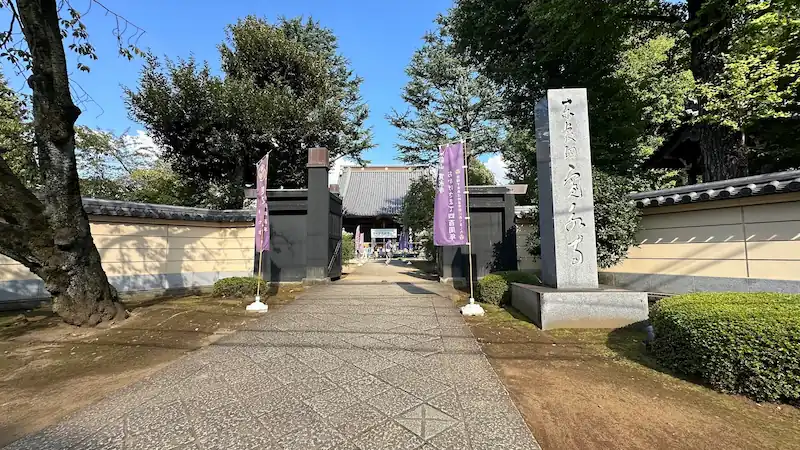
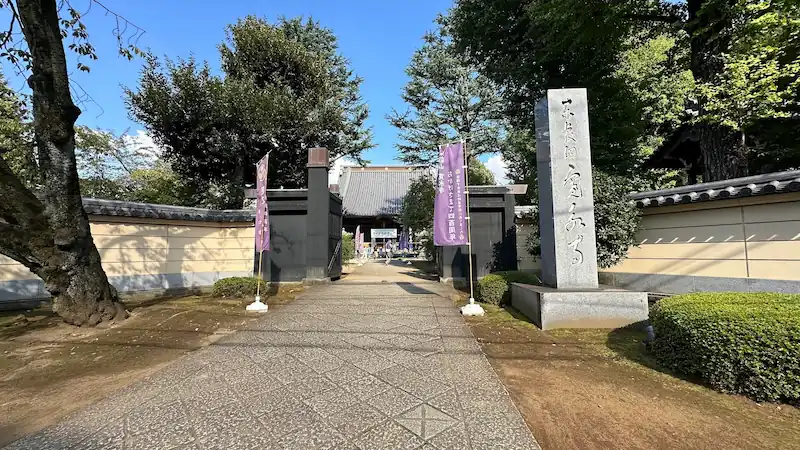
A Day Begins in the Tranquility of Ueno
The sun was already beating down relentlessly on Ueno Park early in the morning.
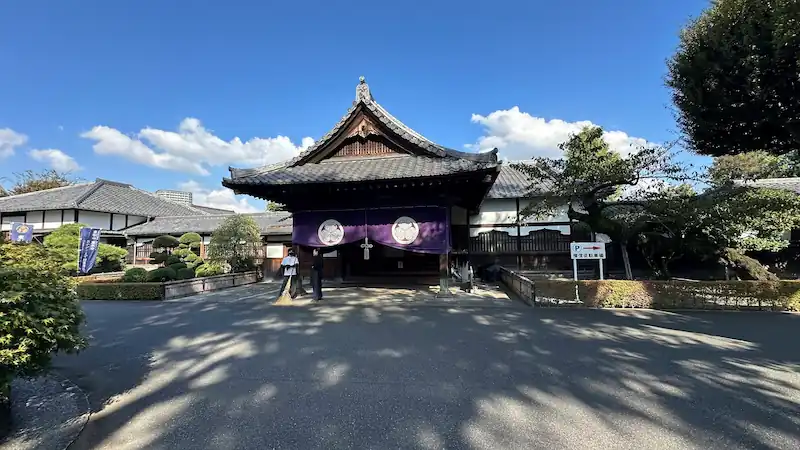
At 10:30 a.m., I arrived at the meeting point for the much-anticipated Kan’ei-ji Terakoya Experience & Tokugawa Shogunate Mausoleum Tour, held at the Main Hall of Ueno Kan’ei-ji Temple.
Despite the early hour, the temperature felt like the peak of summer, and waves of heat seemed to rise from the stone pavement beneath my feet.
“It might be downright reckless to be walking outside at this time of year,” I thought, the scorching heat pressing down on everything.
A crowd of 30 to 40 participants had already gathered in front of the Main Hall. The group was diverse—ranging from middle-aged history enthusiasts clutching cameras to families with small children in tow.
As a staff member took attendance, a calm, composed head priest eventually appeared. Under his guidance, we stepped into the temple grounds.
He shared a variety of perspectives and theories, each one fascinating in its own right.
What Is a Terakoya? The Origins of Education in the Edo Period
Our first stop was a serene, tatami-matted room that radiated the warmth of natural wood—resembling a traditional lecture hall.
At the front of the room stood a desk reminiscent of a teacher’s podium, while rows of neatly arranged tables and chairs awaited the participants.
The setting alone was enough to stir excitement for the upcoming “Terakoya Experience.”
The head priest began by explaining the origins of the terakoya (temple schools).
In the Edo period, children of high-ranking families were typically educated by private tutors. However, for most other children, temples served as the place to learn reading and writing.
One theory suggests that terakoya education began as a way to teach children how to read Buddhist sutras, which were written in classical Chinese (kanbun).
I was particularly surprised to learn that, back then, only a handful of people—such as village leaders and monks—could read and write, and that even naming children was the responsibility of those who were literate.
It was also fascinating to hear that temples like Mount Hiei still sell books on how to read sutras today.
Walking Along the Veranda to the Main Hall—A Path Usually Closed to the Public
After the explanation ended, we lined up and made our way to the Main Hall.
The thought of walking through an area usually off-limits to the public filled me with excitement.
The wooden corridor that lined the veranda offered a cool sensation underfoot with every step, while the distant cries of cicadas accentuated the stillness of summer, creating a tranquil atmosphere unique to the season.
At the center of the Main Hall sat a serene statue of the Medicine Buddha (Yakushi Nyorai).
Although Yakushi Nyorai is widely known as the “healing Buddha,” the one enshrined here at Kan’ei-ji is said to be a classic version with a unique form.
According to the head priest, this particular Yakushi Nyorai has eight arms, seven of which hold weapons.
During the era of civil war in Japan, he was even worshipped as a “god of battle,” while the remaining arm holds a key to a treasure vault.
This key symbolizes wealth, making Yakushi Nyorai revered as a deity who governs both conflict and prosperity.
Furthermore, the name “Yakushi” means “one who dispenses medicine,” highlighting his role as a healer of the living—easing both physical ailments and emotional suffering.
The priest also explained the contrast with Amida Nyorai, who guides souls in the afterlife.
“Yakushi Nyorai saves the living in the here and now, while Amida Nyorai leads souls after death.”
Hearing this distinction served as a reminder of how Buddhism accompanies a person through all stages of life and beyond.
The Act of Wishing—and the Deeper Meaning of Giving Thanks
Before we began to pray, the head priest shared an important piece of wisdom.
Anyone can make a wish, he said, but it’s essential to always offer thanks when that wish is fulfilled.
Buy an amulet, write down your wish—and if it comes true, express your gratitude.
This isn’t merely a ritual. It’s a gesture of sincerity—a way to build a genuine relationship with the Buddha.
Silence filled the Main Hall as the head priest began his sutra chanting.
At first, his voice came in a rapid whisper, then gradually shifted into a more familiar melodic rhythm.
The chanting echoed through the hall, enveloping us in a timeless stillness that made it feel as though the world had momentarily paused.
The Terakoya Experience and a Rare, Special Amulet
After the prayer session in the Main Hall, we returned to the room that resembled a traditional classroom.
Lined neatly on the desks were rare, special amulets not available to the general public.
According to the priest, each amulet’s color corresponds to the symbolic color of a particular Buddha.
As I placed the soft cloth amulet in my palm, a gentle warmth spread through my fingertips.
“This isn’t something to make a wish with,” the priest explained. “It’s a token of gratitude for when your wish comes true.”
His words resonated deeply. I could imagine people of the Edo period placing both their hopes and their thanks into these small amulets.
Once we each received an amulet and returned to our seats, the priest quietly began to share the story of a legendary monk deeply tied to Kan’ei-ji—Great Priest Tenkai.
Birth in Aizu and a Life of Spiritual Pursuit
Tenkai was born in Aizu, Mutsu Province (present-day Fukushima Prefecture).
His childhood name was Funaki, and he was born into the family of a local landowning samurai. His mother is said to have been from the prominent Ashina clan, who ruled Aizu at the time.
Gifted in scholarship from a young age, Tenkai studied at a local temple. Eventually, driven by a desire to deepen his understanding, he embarked on a spiritual journey across the country to further his training.
As a young man, he visited major temples and academic centers such as Enryaku-ji Temple on Mount Hiei, immersing himself in the profound teachings of Buddhism.
However, this was the age of civil war. When Oda Nobunaga launched his infamous attack on Mount Hiei, Tenkai narrowly escaped with his life and found temporary refuge under Takeda Shingen in Kai Province.
He later returned to Aizu at the invitation of the Ashina clan but soon resumed his travels, eventually becoming the head priest of Edosaki Fudoin Temple in Hitachi Province (now Ibaraki Prefecture).
Meeting Tokugawa Ieyasu and Serving at Kita-in Temple
Tenkai’s fateful encounter with Tokugawa Ieyasu is believed to have occurred sometime after the Battle of Sekigahara (post-1600).
Struggling with the future of the Toyotomi clan and the unification of Japan, Ieyasu was becoming increasingly drawn to Buddhism.
Upon meeting Tenkai, he was deeply impressed by his vast knowledge and character, and soon came to trust him immensely.
Around the Genna era (circa 1612), Tenkai was appointed head priest of Kita-in Temple in Kawagoe, Musashi Province.
Kita-in served as the central temple of the Tendai sect in the Kanto region, and it was here that Tenkai and Ieyasu’s relationship grew even stronger.
Interestingly, part of Edo Castle would later be relocated to Kita-in’s grounds—a development whose origins trace back to this very period.
Ieyasu’s Death and the Title of “Tōshō Daigongen”
When Ieyasu passed away in 1616, a major debate arose over what divine title he should be given posthumously.
His close advisor, Konchiin Sūden, suggested granting him the title of “Myōjin,” the same honorific given to Toyotomi Hideyoshi.
However, Tenkai strongly opposed this idea, citing a compelling reason: the title “Toyokuni Daimyōjin” had been given to Hideyoshi, but his lineage and influence had rapidly declined after his death.
“Using the same title is inauspicious—the Tokugawa must not follow the same path,” Tenkai argued.
Instead, he proposed the term “Gongen,” a deity that is a manifestation of the Buddha who appears in human form to save sentient beings, based on the syncretic fusion of Shinto and Buddhism.
Thus, Ieyasu was enshrined as “Tōshō Daigongen”, becoming the guardian deity of the Tokugawa family, most famously honored at Nikkō Tōshōgū Shrine.
This decision reflected Tenkai’s deep desire for the enduring prosperity and protection of the Tokugawa shogunate.
Edo’s Urban Planning and the Founding of Kan’ei-ji
Even after Ieyasu’s death, Tenkai remained a key advisor to the second shogun Hidetada and third shogun Iemitsu, playing an influential role in shaping Edo’s urban development and religious infrastructure.
He is particularly known for the feng shui-inspired design of Edo, in which temples and shrines were strategically placed at spiritually significant compass points—such as the northeast and southwest—to guard Edo Castle.
As part of this master plan, Kan’ei-ji Temple was founded in 1625.
Modelled after Mount Hiei’s Enryaku-ji Temple, Kan’ei-ji became known as the “Mount Hiei of Edo.”
It would go on to become the Tokugawa family’s official temple, eventually housing the Tokugawa Shogunate Mausoleum.
The Great Fire at Kita-in and the Relocation of Edo Castle
In 1638, a massive fire broke out at Kita-in Temple in Kawagoe, destroying much of its temple complex.
However, Tenkai saw this crisis as an opportunity for transformation.
Under the directive of the third shogun, Iemitsu, a portion of the Momijiyama Palace from Edo Castle was relocated to Kita-in, allowing the temple to be rebuilt.
Thanks to this relocation, Kita-in today houses the only surviving structure from the original Edo Castle, which is now designated as an Important Cultural Property of Japan.
Kita-in thus became a powerful symbol of Tenkai’s achievements and the Tokugawa family’s patronage.
A Monk Who Lived a Hundred Years
Even in his later years, Tenkai continued to serve as a spiritual pillar of the Tokugawa shogunate, guiding Edo’s religious and cultural policies.
Astonishingly, he lived to be over 100 years old, surviving through the turbulent times from the Sengoku period to the early Edo era.
As I listened to the gentle voice of the head priest, I glanced out the window, where the sound of cicadas filled the air.
Had it not been for Tenkai, there might be no Edo as we know it, no Kan’ei-ji Temple, and perhaps not even the Shogunate Mausoleum we visited today—
That thought settled deep within me, leaving behind a quiet reverence for the weight of history and the legacy of a single man.
Kan’ei-ji and the Daimyo Pilgrimages
From Tenkai’s life story, the head priest transitioned into discussing what Kan’ei-ji was like during the Edo period.
At the time, Kan’ei-ji, as the Tokugawa family’s official temple, was regarded as a highly prestigious institution.
Many daimyo (feudal lords) closely associated with the Tokugawa clan came to worship there. However, due to the temple’s close ties with the shogunate, they often had to wait their turn to pay their respects.
“When their turn came, a retainer would come fetch them from nearby,” the priest explained.
As a result, dedicated rest temples for the daimyo were gradually established around Kan’ei-ji.
For example, **Gōtoku-ji Temple** was associated with the Ii family of the Hikone Domain, while **Tōgaku-in Temple** served as a rest spot for several clans, including the Ikeda family.
These temples were not only for religious use but also became hubs in the network of the daimyo society in Edo.
The Tokugawa Crest and the Twin-Leaf Aoi
Around Kan’ei-ji and nearby temples and shrines, you’ll often see the three-leaf aoi crest of the Tokugawa family.
Interestingly, you may also spot the more discreet twin-leaf aoi crest carved nearby.
This symbol is the sacred emblem of the Kamo Shrine and is believed to be a remnant of Shinto beliefs that Ieyasu Tokugawa deeply revered.
Searching for these aoi crests as you walk around offers insight into the Tokugawa clan’s spiritual roots and their syncretic fusion of Shinto and Buddhist faiths.
Tōdō Takatora and the Saying “A Warrior Serves Seven Masters”
Then came a surprising name—Tōdō Takatora, a military commander of the early Edo period known for his castle-building expertise and his service under the Tokugawa shogunate.
“To become a true samurai, one must serve seven different lords.”
This well-known saying is attributed to Takatora and reflects the turbulent life of a Sengoku warrior who had to navigate constant change and uncertainty.
Remarkably, Takatora’s grave is located within the grounds of Ueno Zoo.
It’s one of those moments where the past and present of Tokyo unexpectedly intersect in the most surprising of places.
It is also said that when Ieyasu converted to the Tendai sect, Takatora followed suit.
This shows how Tenkai’s influence even extended to the warrior class of the era.
Tenkai and the Cherry Blossoms — Opening Kan’ei-ji to the Public
One of the most unforgettable aspects of Kan’ei-ji’s history is Tenkai’s planting of cherry blossoms.
Believing that the Tokugawa family’s temple should also be accessible to the common people, Tenkai arranged for yamazakura (wild mountain cherry) saplings to be brought from Nara and planted within the grounds.
Cherry trees take many years to grow and bloom.
But given that Tenkai lived to be 108, it’s said that he may have witnessed the blossoms in their full glory during his later years—
The head priest’s tone as he shared this carried a quiet, heartfelt reverence.
The Origins of Libraries and Local Place Names
What surprised me even more was learning that Japan’s first library originated here at Kan’ei-ji.
The Buddhist scriptures and scholarly texts that Tenkai collected eventually formed the foundation of a library system, making Kan’ei-ji a center of learning in its time.
The surrounding area’s place names also hold secrets.
Names like “Sakashita” (meaning “foot of the slope”) were inspired by names from Mount Hiei, showing how Tenkai sought to recreate the spiritual essence of that sacred mountain in Edo.
Even today, these names preserve the presence of Tenkai’s vision.
Kan’ei-ji: Breathing Through the Ages
The head priest’s story journeyed from Tenkai’s life to the broader religious and cultural legacy of Kan’ei-ji and the traces of history that still shape the present day.
Within the temple’s stillness, it felt as if the images of daimyo, townspeople, warriors, and monks from centuries past quietly mingled around us.
“Without Tenkai, perhaps these cherry blossoms, this temple, and even the cityscape of Edo itself might never have come to be.”
With that thought resonating deeply, I gathered my thoughts and prepared to visit the Mausoleum of the Tokugawa Shoguns.
Beyond the Crimson Gate — Entering the Restricted World
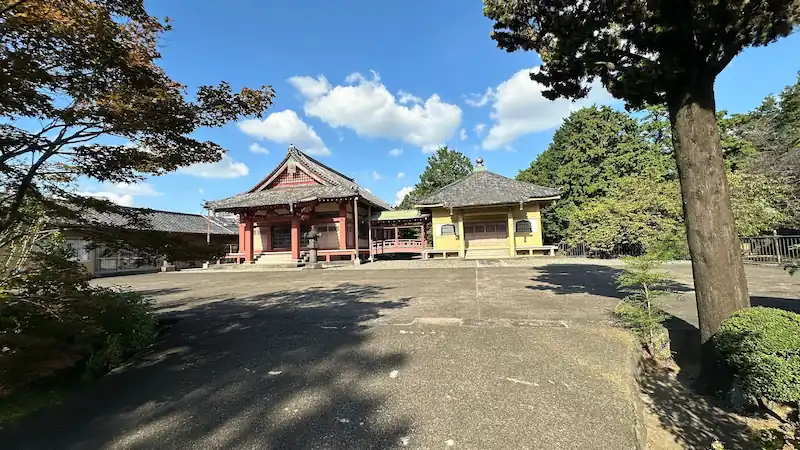
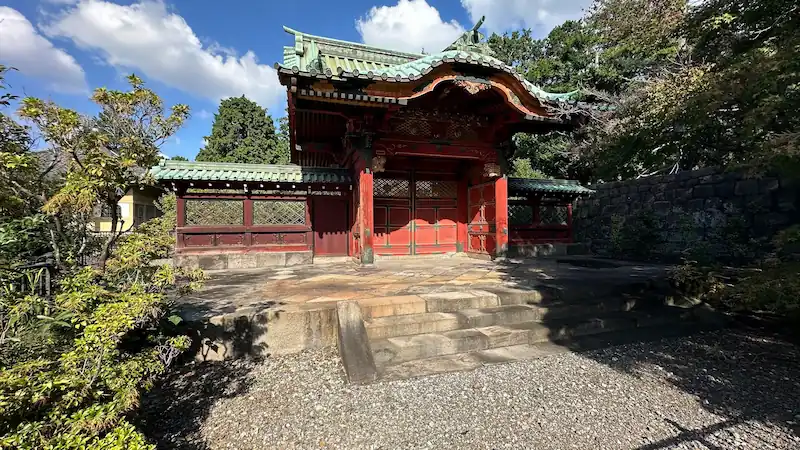
As I walked through the Kan’ei-ji temple grounds, the first thing to catch my eye was the striking Crimson Chokugaku-mon Gate of the Genyū-in Mausoleum, visible even from the public area.
Though aged by time, its vermilion color still glows with an austere elegance.
Passing by it marked the entrance into the non-public section of the grounds—a moment filled with hushed anticipation and awe.
Down a narrow path flanked by high walls, thick foliage surrounded me, and the soft rustling of leaves in the breeze brought a serene rhythm to my ears.
Looking up, I saw sunlight filtering through the branches, bathing the stone-paved approach in a gentle green hue.
And at the end of that path, the quiet mausoleums of shoguns from across the ages stood solemn and still.
The Sacred Pagoda of Jōken-in — Resting Place of the Fifth Shogun, Tsunayoshi
The first structure I encountered was the Jōken-in-den Gohōtō, the mausoleum of Tokugawa Tsunayoshi, the fifth shogun.
This imposing bronze pagoda stands peacefully amidst the dense greenery, its surface weathered by time.
According to the head priest, in Buddhist tradition, “longevity” is considered a virtue. Most traditional graves are made of stone, but bronze lasts even longer and is far more expensive to produce.
Thus, a bronze pagoda is regarded as a particularly high-ranking and prestigious grave.
Tsunayoshi’s tomb being made of bronze reflects both his stature and the prosperity of his era.
How Kan’ei-ji Differs from Zōjō-ji
As I walked, I couldn’t help but recall the Tokugawa family mausoleum at Zōjō-ji Temple in Shiba.
At Zōjō-ji, the graves are grouped together in one location, whereas at Kan’ei-ji, each tomb is independently placed.
This arrangement mirrors Tokugawa Ieyasu’s own mausoleum at Nikkō Tōshōgū, emphasizing the individuality and dignity of each shogun.
Yūtoku-in-den Gohōtō — The Eighth Shogun, Tokugawa Yoshimune
The next tomb I visited was the Yūtoku-in-den Gohōtō, resting place of Tokugawa Yoshimune, the eighth shogun.
Famed for his portrayal as the “Rough-and-Ready Shogun,” Yoshimune was a staunch advocate of frugality.
Reflecting his values, his tomb was made of stone.
“By this period, the shogunate’s finances had become strained, and spending on tomb construction was increasingly limited,” the head priest explained.
This marked a clear shift in the times.
Yet, the stone grave, set atop a stately pedestal, still emanated a dignified presence.
Graves of Ieharu, Iesada, and Atsuhime
We were then led to the tomb of the tenth shogun, Tokugawa Ieharu, and to the graves of the thirteenth shogun, Tokugawa Iesada, and his wife, Princess Atsuhime (Tenshō-in).
What struck me most was that Atsuhime’s grave was placed beside her husband Iesada’s.
Traditionally, shogunal couples were buried separately, but since Atsuhime passed away during the Meiji era—after the fall of the Tokugawa shogunate—they were interred side by side in a rare and touching exception to Edo customs.
Imagining Atsuhime, who endured the turmoil of the Bakumatsu period, resting peacefully beside her husband brought a quiet, lingering warmth to my heart.
Ending the Tour in Silence
Having visited all of the mausoleums, we walked once more along the stone-paved path, returning to the Chokugaku-mon Gate.
The chirping of cicadas blended with the rustling of the trees, creating an almost surreal sense that I had passed between the worlds of Edo and the present.
This final resting place of the Tokugawa shoguns is more than just a cemetery—it is a reflection of the Edo era itself.
The shift from lavish bronze to modest stone graves tells a silent tale of prosperity, decline, and the passage of history.
Reflecting on the Journey
As I looked back on the tour, I realized that Kan’ei-ji is a place where:
- The grand vision of Great Priest Tenkai lives on
- Daimyo gathered to pay their respects in solemn reverence
- The Tokugawa shoguns rest within serene, sacred grounds
All of this reminded me that Kan’ei-ji was truly the spiritual heart of Edo.
“History is still alive here.”
With that thought echoing in my mind, I slowly made my way out through the gate.


comment