


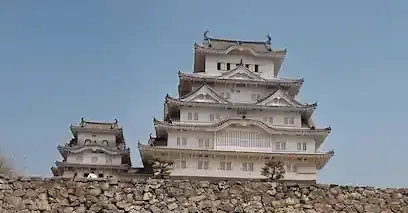
Area 5: Moats, Stone Walls and Defenses
A battlefield of stone and strategy — steep slopes, interlocking gates, moats, and earthen walls, all meticulously designed to slow down and expose intruders.
Area 5 reveals the full extent of Himeji Castle's defensive ingenuity. This zone is packed with steep slopes, interlocking gates, moats, and earthen walls — all meticulously designed to slow down and expose intruders.
Highlights include the Fan-shaped Slope (Ōugi no Kōbai) — an elegant but treacherous incline — the Kamiyamasato Kuruwa with its watchtower remains, and the Sangoku-bori Moat, a reservoir formed by damming the valley between the Himeyama and Sagiyama hills. You'll also encounter relics of deeper history: the foundation stones of the former Main Keep, excavated Gorintō grave markers, and stone walls traditionally attributed to Kuroda Kanbei, the famed strategist of the Toyotomi clan. In this area, architecture, warfare, and legacy intersect.
Kamiyamasato Kuruwa (上山里曲輪)
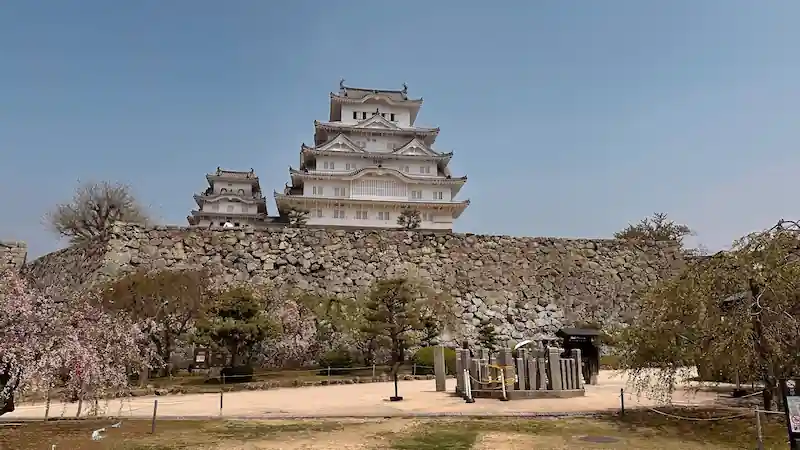
Kamiyamasato Kuruwa (上山里曲輪) is a compound located between the Nu-no-Mon and Ri-no-Mon gates. Historically it primarily contained the multi-tiered Taiko Yagura turret, though no historical records confirm the presence of multiple turrets and long connecting corridors here. Although some structures were dismantled during the Meiji period due to deterioration, the remaining stone walls and foundations offer insight into the castle's defensive design. The area is also home to the famous Okiku's Well, adding a layer of cultural intrigue.
| Year built | Early 17th century |
|---|---|
| Builder | Ikeda Terumasa |
| Current status | Stone walls and foundations remain; area accessible to visitors |
Access: Approx. 1-minute walk (5 m) from Okiku's Well (Okiku Ido)
Suggested time: Quick highlights ~15 min / in-depth exploration ~30 min
Taiko Yagura South Earthen Wall (太鼓櫓南方土塀) 🎥 360°
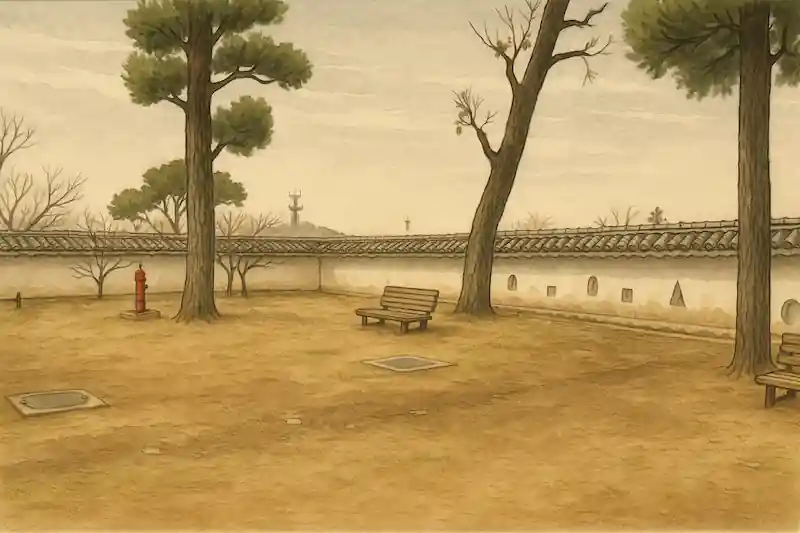
The Taiko Yagura South Earthen Wall (太鼓櫓南方土塀) is a defensive structure exemplifying the strategic architectural design of the early Edo period. Constructed between 1601 and 1609 under Ikeda Terumasa, this 92.3-meter-long wall features thirteen gunports (狭間) and is topped with traditional hon-gawara tiled roofing. Positioned south of the Taiko Yagura (Drum Turret), it allowed defenders to monitor and repel intruders approaching from the south.
| Year built | 1601–1609 |
|---|---|
| Builder | Ikeda Terumasa |
| Structure / features | 92.3 meters long, thirteen gunports, traditional hon-gawara tiled roofing |
| Cultural property status | Important Cultural Property (designated 1931) |
Access: Approx. 1-minute walk (5 m) from Kamiyamasato Kuruwa
Suggested time: Quick highlights ~10 min / in-depth exploration ~20 min
Ri-no-Ichi Watariyagura
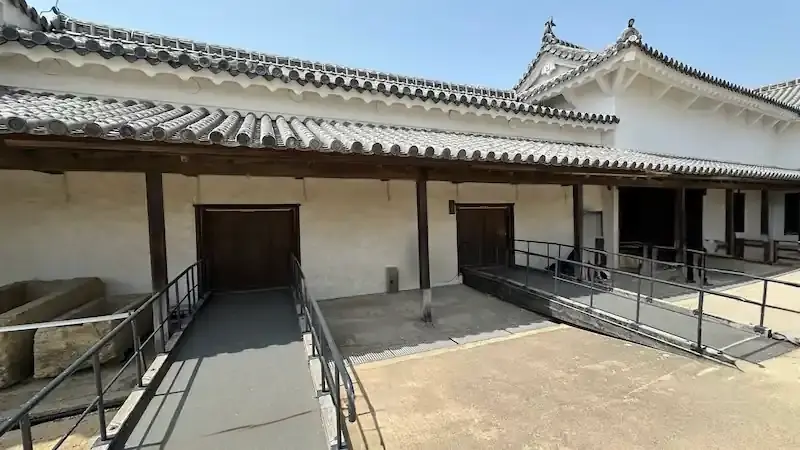
Ri-no-Ichi Watariyagura is a corridor turret connecting to the Kamiyamasato Kuruwa and Nu-no-Mon Gate area. Far more than a passageway, it was engineered as a combat-ready link equipped with loopholes (sama), stone-dropping platforms, and steep stairways, allowing defenders to retreat, regroup, or counterattack. Built during Ikeda Terumasa's 1601–1609 renovation, it was designated an Important Cultural Property in 1931.
| Year built | Early 17th century (Edo period) |
|---|---|
| Builder | Ikeda Terumasa |
| Cultural property status | Important Cultural Property (designated 1931) |
Access: Approx. 1-minute walk (34 m) from Taiko Yagura South Earthen Wall
Suggested time: Quick pass-through ~3 min / in-depth ~10 min
Nu-no-mon Gate
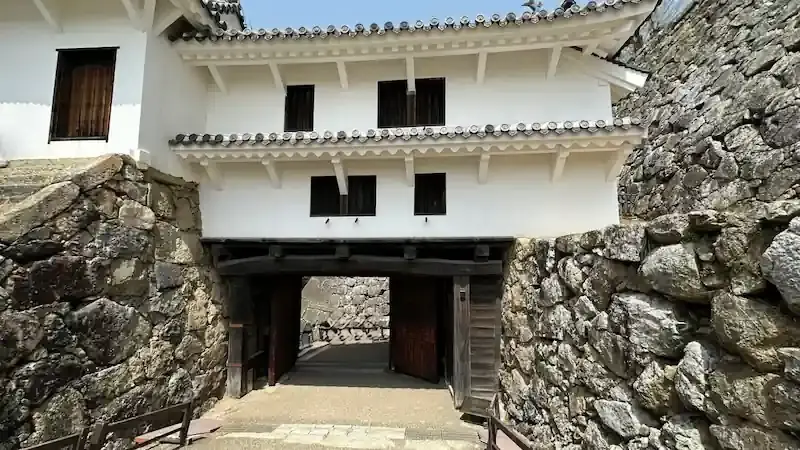
Positioned in the latter half of the castle's climbing route, Nu-no-mon served as a crucial gate in the labyrinthine defense system leading to the Main Keep. Part of the phonetic sequence (i–ro–ha…), it marked a late-stage checkpoint with a narrow, folded passage enclosed within a masugata square. Surrounded by tall stone walls, the gate forced attackers through tight zigzagging paths, exposed to fire from multiple angles.
| Year built | Early 17th century (Edo period) |
|---|---|
| Builder | Ikeda Terumasa |
| Structure / features | Two-story turret gate (yaguramon) unique to Himeji Castle; part of the Ninomaru area |
| Cultural property status | Important Cultural Property |
Access: Approx. 1-minute walk (20 m) from Ri-no-Ichi Watariyagura
Suggested time: Quick look ~3 min / in-depth ~10 min
Ōugi no Kōbai (The Fan-shaped Slope)
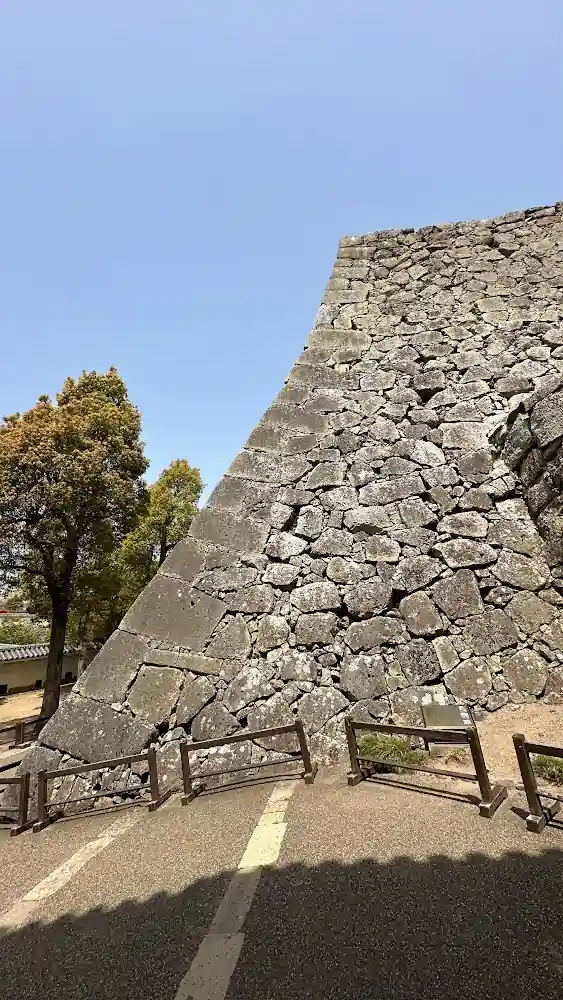
Located on the west face of Bizenmaru, just north of Nu-no-mon Gate, Ōugi no Kōbai — the "Fan-shaped Slope" — is a masterfully constructed stone embankment named for its graceful curve resembling an open folding fan. Built during the early Edo period (1601–1609) under Ikeda Terumasa, its signature gradient — gentle at the base and steep at the top — enhances visual elegance while serving practical defensive purposes: making the wall difficult to scale and dispersing impact forces to prevent collapse. Built using the uchikomi-hagi technique, in which partially trimmed stones are precisely fitted together without mortar, it remains one of the finest examples of stone wall construction in Japanese castle architecture.
| Year built | Early 17th century (Edo period) |
|---|---|
| Builder | Ikeda Terumasa |
| Structure / features | Stone wall designed in a fan shape (ōgi), showcasing advanced masonry techniques |
| Current status | Still standing |
Access: Approx. 1-minute walk (4 m) from Nu-no-mon Gate; viewable from the square in front of the keep
Suggested time: Quick look ~5 min / in-depth ~10 min
Ru-no-Mon Gate
Tap to enlarge
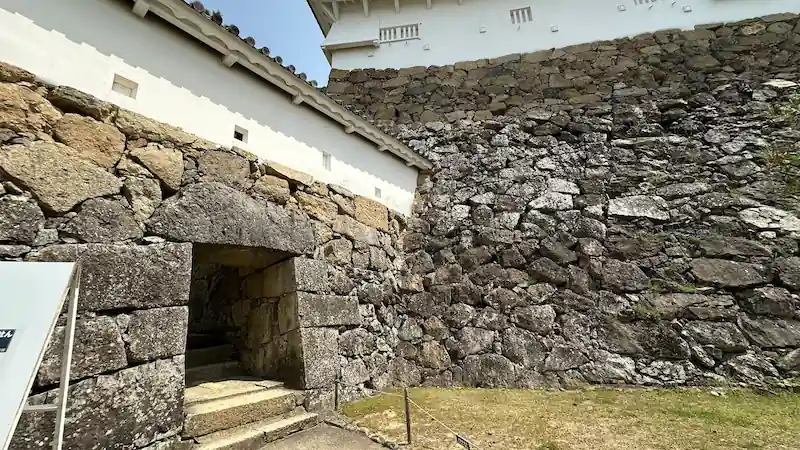
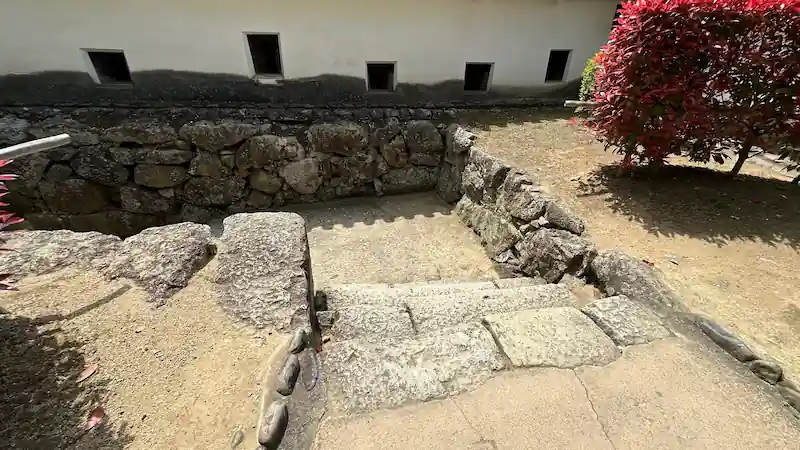
Ru-no-Mon Gate Site marks the location of an umekado — an embedded or recessed gate set into the stone wall — that provided a shortcut route near Hishi-no-Mon toward the Ninomaru, named according to the traditional I-ro-ha kana sequence. Believed to have been built with sturdy wooden doors set within a masugata, the gate no longer stands, but the foundational stones, surrounding masonry, and preserved terrain remain as testaments to its former presence.
| Year built | Early 17th century (Edo period) |
|---|---|
| Builder | Ikeda Terumasa |
| Current status | Structure no longer exists; foundation stones and masugata layout remain |
Access: Approx. 1-minute walk (35 m) from Ōugi no Kōbai
Suggested time: Quick stop ~3 min / in-depth ~10 min
Wo-no-Mon Gate Site
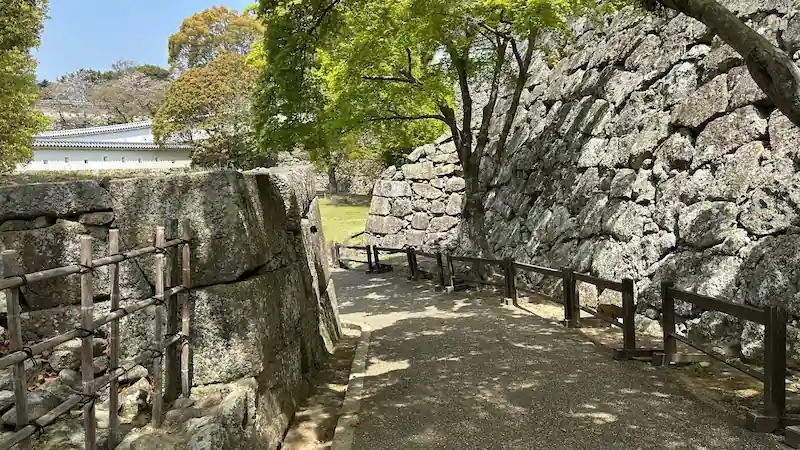
The Wo-no-Mon Gate Site marks the presumed location of a former gate along the main ascent route, near the boundary between Nishi-no-Maru (West Bailey) and the Tenshu-kuruwa; its exact identity and layout are still being confirmed against on-site records. Although the gate itself no longer exists, the stone foundation, remaining base stones, and subtle terrain changes may indicate its former presence. Named according to the traditional I-ro-ha sequence, "Wo" appears late in the syllabary — its precise function, architectural style, and the timing of its removal remain unconfirmed pending further verification.
| Year built | Early 17th century (Edo period) |
|---|---|
| Builder | Ikeda Terumasa |
| Current status | Ruins remain; structure no longer exists |
Access: Approx. 1-minute walk (45 m) from Ru-no-Mon Gate
Suggested time: Quick stop ~3 min / in-depth ~10 min
Ninomaru Ruins
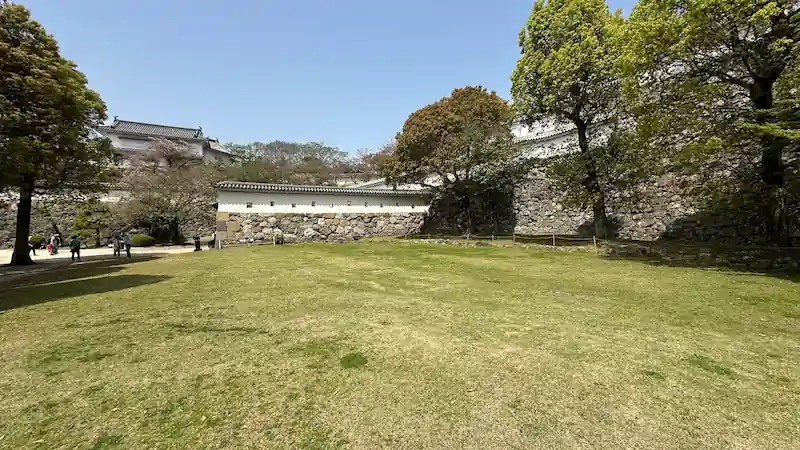
The Ninomaru Ruins span a large compound just south of the Main Keep, functioning primarily as a defensive zone of connected gates, walls, and baileys protecting the Main Keep from that direction. Himeji Domain's main administrative buildings and government offices were centered mainly in the Sannomaru (Third Bailey) rather than here, though this compound was still altered and used across the generations under successive lords, including Ikeda Terumasa, Honda Tadamasa, and the Matsudaira clan. Structures in this area were lost over time and dismantled under the Meiji-era Hai-jōrei (Castle Abolition Edict), never to be reconstructed.
| Year built | Early 17th century (Edo period) |
|---|---|
| Builder | Ikeda Terumasa |
| Current status | Ruins remain; some foundation stones and layouts are visible |
Access: Approx. 1-minute walk (42 m) from Wo-no-Mon Gate Site
Suggested time: Quick stop ~10 min / in-depth ~15 min
Sangoku-bori Moat
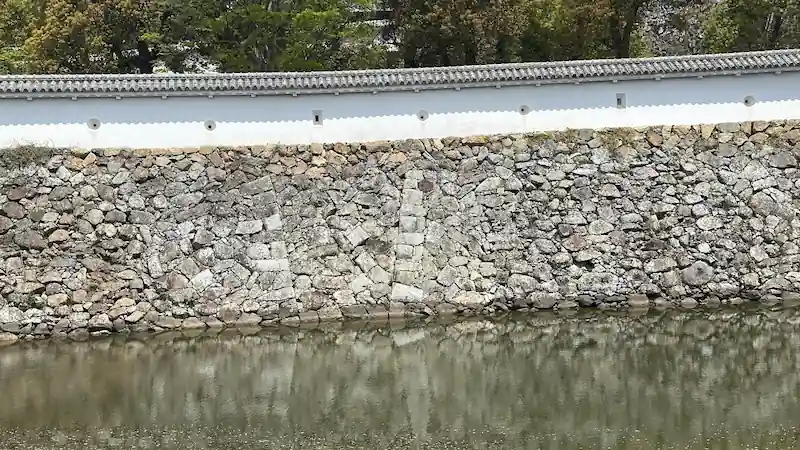
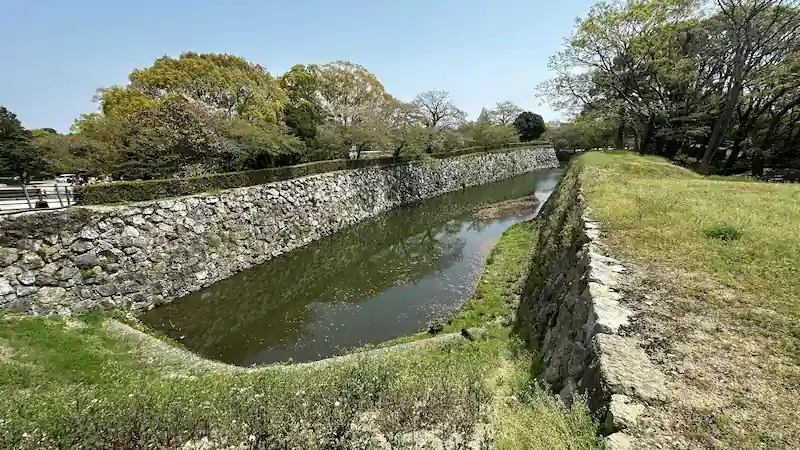
Sangoku-bori is a moat formed by damming the valley between the Himeyama and Sagiyama hills, creating a roughly rectangular, self-contained body of water within the castle grounds. Unlike some other moat sections at Himeji, it still exists today rather than having been filled in. The origin of the name "Sangoku-bori" ("Three-Provinces Moat") is not definitively known — local explanations exist, but no historical record confirms a single account, so its naming should be treated as uncertain rather than settled fact.
| Year built | Early 17th century (Edo period) |
|---|---|
| Builder | Ikeda Terumasa |
| Remarks | Also known locally as the Mikuni Moat; the origin of the name is not definitively established |
| Current status | Extant; the moat still holds water today |
Access: Approx. 1-minute walk (100 m) from Ninomaru Ruins
Suggested time: Quick stop ~5 min / in-depth ~15 min
South Earthen Wall of Hishi-no-Mon (菱の門南方土塀)
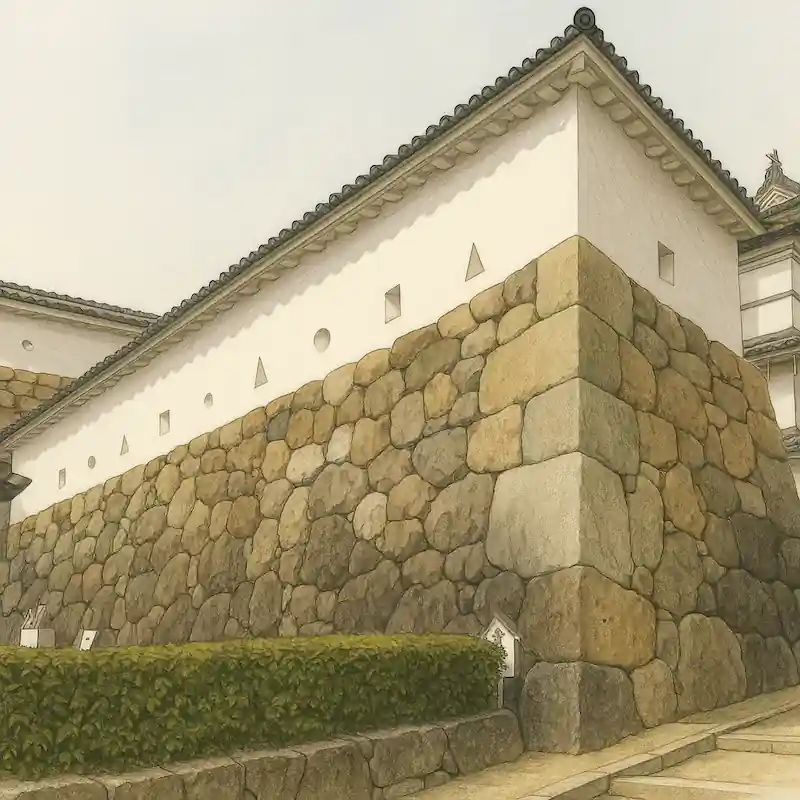
The South Earthen Wall of Hishi-no-Mon (菱の門南方土塀) is part of the complex defensive system surrounding Hishi-no-Mon, the largest gate within the castle. Constructed between 1601 and 1609 under Ikeda Terumasa, the wall's white plaster finish and traditional tiled roofing provided protection against invaders while enhancing the castle's aesthetic appeal, its embrasures ("sama") allowing defenders to fire at attackers.
| Year built | 1601–1609 |
|---|---|
| Builder | Ikeda Terumasa |
| Current status | Still standing |
Access: Approx. 1-minute walk (35 m) from Sangoku-bori Moat
Suggested time: Quick highlights ~10 min / in-depth exploration ~20 min
Garden with the Foundation Stones of the Tenshu
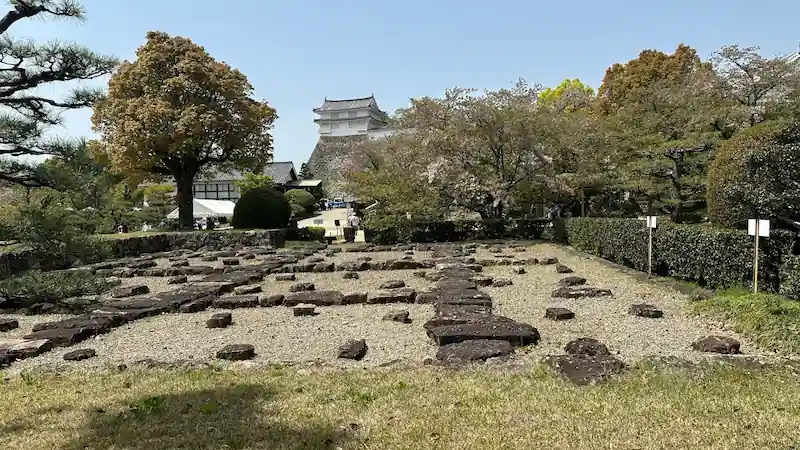
This garden offers visitors a unique look at the massive base stones that once supported the Main Keep. During the extensive Shōwa-era restoration project (1956–1964), often called the Shōwa Great Repair, restoration teams removed these old foundation stones from the Main Keep and arranged them in a garden near the Hishi Gate to match the keep's original floor plan, preserving their historical value. Contrary to some myths, these stones are not simply leftover material from Hideyoshi's original construction that Hideyoshi himself chose not to reuse.
| Year built | 1956–1964 (during the Shōwa restoration) |
|---|---|
| Builder | Restoration team under the Agency for Cultural Affairs |
| Current status | Extant, open to the public |
Access: Approx. 1-minute walk (110 m) from South Earthen Wall of Hishi-no-Mon
Suggested time: Quick stop ~10 min / in-depth up to ~30 min
Excavated Gorintō Aggregation Site (出土五輪塔集積場所)
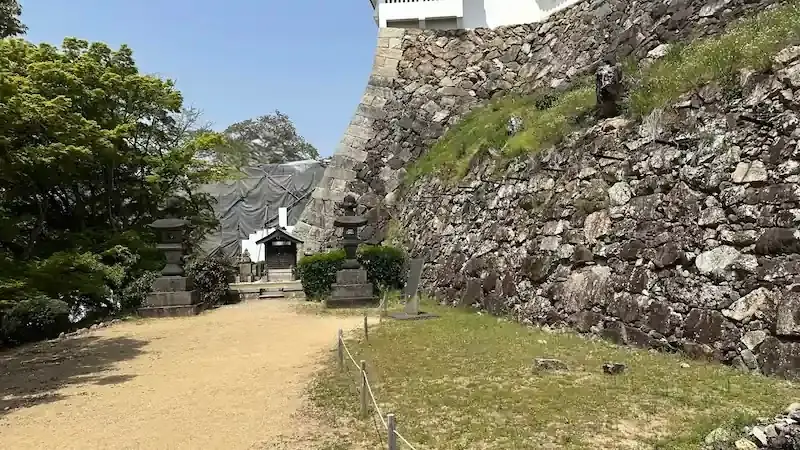
This site is a collection of stone pagodas known as gorintō, unearthed during archaeological excavations within the castle precincts. Gorintō, or five-ringed towers, are traditional Japanese stone monuments used primarily as grave markers or memorials, symbolizing the five elements of Buddhist cosmology: earth, water, fire, wind, and void. Their discovery and preservation offer valuable insight into the religious practices and funerary customs during the castle's active periods, providing a contemplative space for visitors interested in its spiritual and cultural dimensions.
| Year built | Unknown |
|---|---|
| Builder | Unknown |
| Current status | Excavated artifacts displayed on-site with interpretive signage |
Access: Approx. 1-minute walk (50 m) from Garden with the Foundation Stones of the Tenshu
Suggested time: Quick highlights ~10 min / in-depth exploration ~20 min
Stone Walls Constructed by Kuroda Kanbei (官兵衛普請の石垣) 🎥 360°
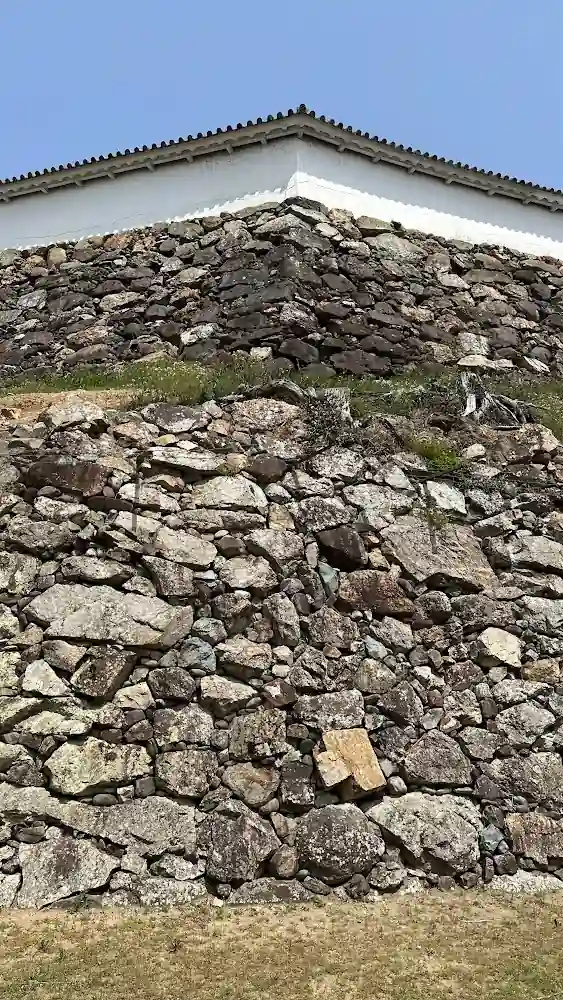
These stone walls are among the oldest surviving structures at Himeji Castle, dating from the late 16th century (Toyotomi–early Edo period) and possibly including early Azuchi-Momoyama era construction under Toyotomi Hideyoshi, later modified during Ikeda Terumasa's renovation. While local tradition attributes these walls to Kuroda Kanbei, no definitive historical record confirms his direct involvement. Built using the nozura-zumi technique — stacking unshaped natural stones without mortar — they reflect Sengoku-period construction methods; some stones are believed to have been repurposed from other structures, such as gravestones. Located in the lower tier of Kamiyamasato Kuruwa, near Okiku's Well.
| Year built | Late 16th century (Azuchi-Momoyama period) |
|---|---|
| Builder | Attributed to Kuroda Kanbei (unconfirmed); later modified by Ikeda Terumasa |
| Current status | Some sections remain visible within the castle complex |
Access: Approx. 1-minute walk (67 m) from Excavated Gorintō Aggregation Site
Suggested time: Quick highlights ~10 min / in-depth exploration ~30 min
Higashi Funaba Kura Ato (東船場蔵跡)
Higashi Funaba Kura Ato (東船場蔵跡) refers to the remains of a storage facility once located within the castle grounds. Although some sources describe it as a former boat storage warehouse, there is no official historical documentation confirming this use — the site's exact function remains unclear, but the stone foundations suggest it was part of the castle's logistical infrastructure. Today, visitors can pause here to reflect on the broader operational side of castle life, beyond just its military or residential functions.
| Year built | Unknown |
|---|---|
| Builder | Unknown |
| Current status | Ruins remain; site marked for historical significance |
Access: Approx. 2-minute walk (110 m) from Stone Walls Constructed by Kuroda Kanbei
Suggested time: Quick highlights ~10 min / in-depth exploration ~20 min
Tono Yonmon (との四門)
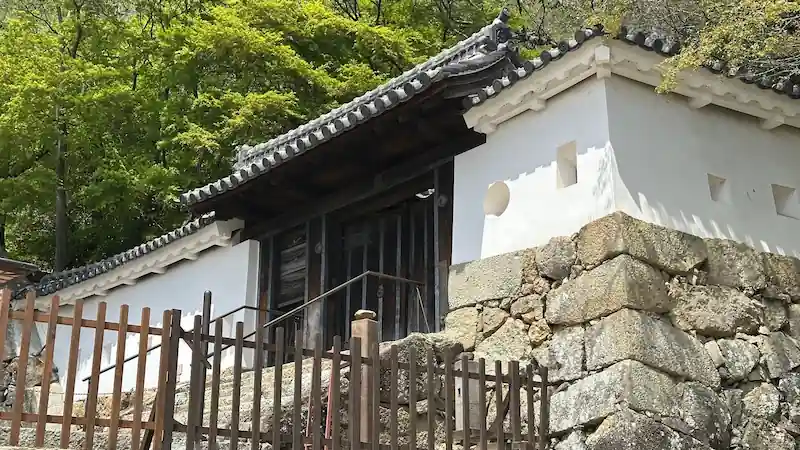
Tono Yonmon (との四門) is one of several gates that once stood along the eastern (karamete) side of the castle. Built in the early 17th century, it likely followed the Kōraimon style, with a simple gabled roof and defensive features. While some accounts mention underground storage facilities here — possibly for gunpowder — there is no definitive historical evidence supporting this claim, and the gate is not designated as an Important Cultural Property. The structure no longer survives, but the site remains of historical interest.
| Year built | Early 17th century (Edo period) |
|---|---|
| Builder | Ikeda Terumasa |
| Current status | Ruins remain; gate structure no longer exists |
Access: Approx. 1-minute walk (75 m) from Higashi Funaba Kura Ato
Suggested time: Quick highlights ~10 min / in-depth exploration ~20 min
Kisaimon Gate Site
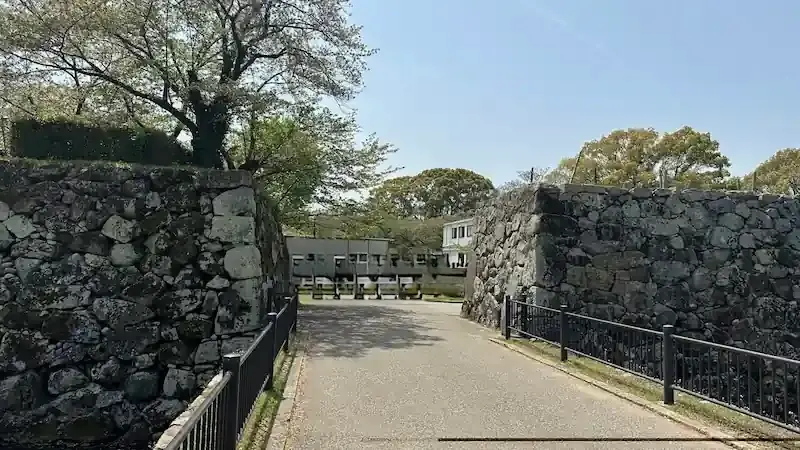
Kisaimon Gate once served as a rear access point to the castle, located near where the spiraling moat encircled the Main Keep compound. It stood near two large warehouses used for storing rice and goods, and local tradition holds it was the gate through which samurai collected their stipends — though no official historical records confirm this specific function. The site is marked by explanatory signage and valued for its strategic location and connection to the castle's logistical layout.
| Year built | Early 17th century (Edo period) |
|---|---|
| Builder | Ikeda Terumasa |
| Current status | Ruins remain; gate structure no longer exists |
Access: Approx. 1-minute walk (75 m) from Tono Yonmon
Suggested time: Quick stop ~5 min / in-depth up to ~15 min
- Kamiyamasato Kuruwa (上山里曲輪)
- Taiko Yagura South Earthen Wall (太鼓櫓南方土塀) 🎥 360°
- Ri-no-Ichi Watariyagura
- Nu-no-mon Gate
- Ōugi no Kōbai (The Fan-shaped Slope)
- Ru-no-Mon Gate
- Wo-no-Mon Gate Site
- Ninomaru Ruins
- Sangoku-bori Moat
- South Earthen Wall of Hishi-no-Mon (菱の門南方土塀)
- Garden with the Foundation Stones of the Tenshu
- Excavated Gorintō Aggregation Site (出土五輪塔集積場所)
- Stone Walls Constructed by Kuroda Kanbei (官兵衛普請の石垣) 🎥 360°
- Higashi Funaba Kura Ato (東船場蔵跡)
- Tono Yonmon (との四門)
- Kisaimon Gate Site
- FAQ
- Himeji Castle Map
- More on Himeji Castle
- Return to the Warlord Page
FAQ
Ōugi no Kōbai is a stone embankment on the west face of Bizenmaru, just north of Nu-no-mon Gate, named for its graceful curve resembling an open folding fan. Built using the uchikomi-hagi masonry technique, its gentle-to-steep gradient is both visually elegant and defensively effective.
Local tradition attributes a section of stone walls near Kamiyamasato Kuruwa to Kuroda Kanbei, but no definitive historical record confirms his direct involvement. The walls date from the late 16th century and were later modified during Ikeda Terumasa's renovation.
Based on an April 2025 visit, walking through all 16 spots, including the Ninomaru Ruins and the Sangoku-bori Moat, took about 90–120 minutes.
Himeji Castle Map
More on Himeji Castle
Return to the Warlord Page


☕ Support This Site
Following the Shogun is built on original fieldwork and on-site research.
If you found this guide useful, your support helps keep it going.

You can also support via QR code


comment