

Hikone Castle Guide: Getting There from Kyoto, Tickets, Time Needed and the Ii Family
Planning guide to Hikone Castle, one of the few Japanese castles whose keep has stood since the early 1600s: how to get there from Kyoto, Osaka, Nagoya and Tokyo, which ticket to buy, how long to allow, and who the Ii family were.
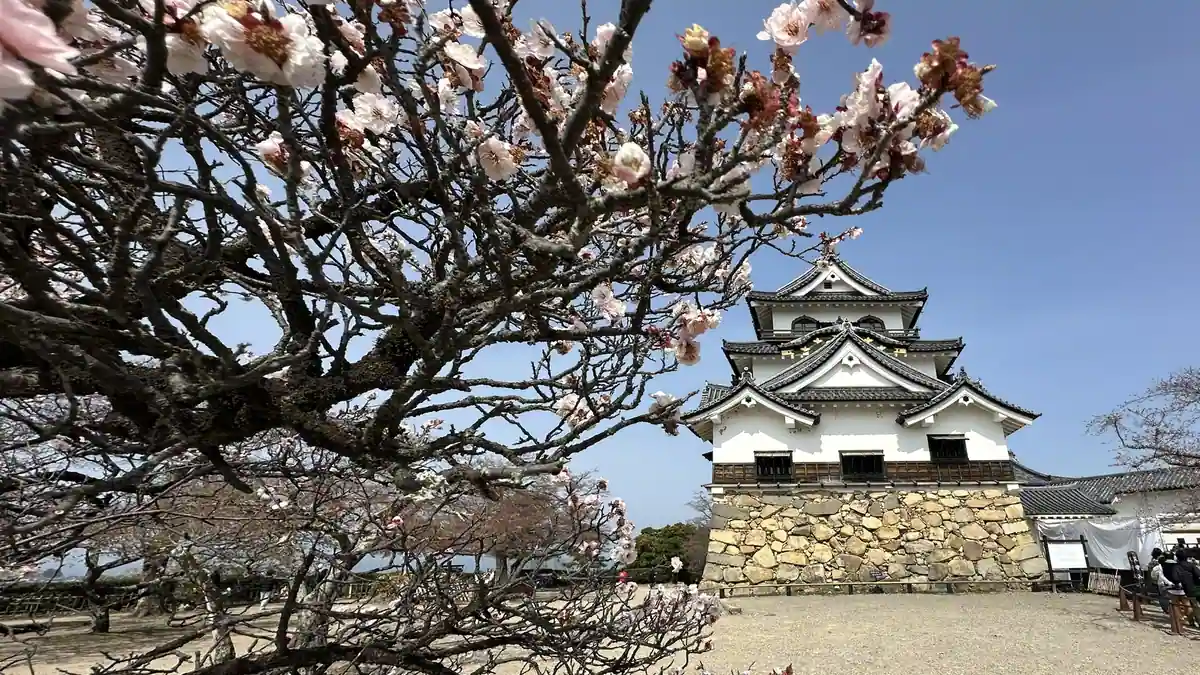
Hikone Castle stands on a low hill in Hikone, Shiga Prefecture, close to the eastern shore of Lake Biwa, Japan's largest lake. Many Japanese castle towers you can visit today are postwar concrete reconstructions. Hikone's keep (tenshu, the main tower of a castle) is not: it has stood since the early 1600s. It is one of the twelve castle keeps in Japan that survive from the samurai era, and one of only five designated National Treasures, along with Himeji, Matsumoto, Inuyama and Matsue.
For two and a half centuries the castle was the seat of the Ii family, the lords of the Hikone domain and among the most trusted retainers of the Tokugawa shoguns. In September 2026, Japan decided to nominate the castle for UNESCO World Heritage listing.
| Question | Short answer |
|---|---|
| Is it worth visiting? | Yes, if you want to see a castle keep that is original rather than rebuilt. The gardens and the museum at the foot of the hill make it a full day. |
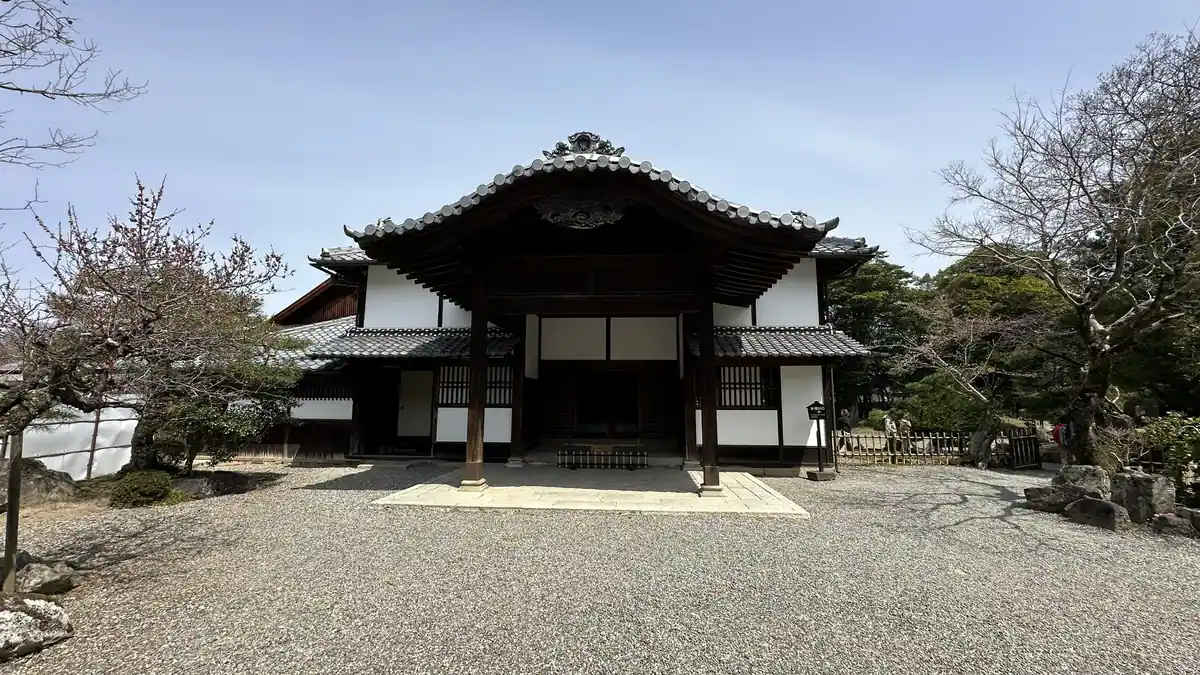
| What's original? | The keep, several turrets and gates, the stable and a Noh stage date from the Edo period (1603–1868). The palace that houses the museum is a 1987 reconstruction. |
| How long? | Seeing the keep, gardens and museum took me about 4.5 hours, of which about 20 minutes was inside the keep. |
| From Kyoto | About 46 minutes by JR Special Rapid to Hikone Station, then about 15 minutes on foot. |
| Where to stay | Kyoto works as a base for a day trip. Stay in Hikone for an early start or the evening illumination. |
This page covers planning: access, tickets, timing and history. For the castle itself, stop by stop in the order I walked it, see the photo guide Walking Hikone Castle: From the Front Gate to the Keep, Gardens and Museum.
In this guide
How to get to Hikone Castle from Kyoto, Osaka, Nagoya and Tokyo
The nearest station is JR Hikone Station on the Biwako Line, as the JR Tokaido Line is called along Lake Biwa. From Kyoto and Osaka you can ride there without changing trains. From Nagoya or Tokyo, take the Tokaido Shinkansen to Maibara, then change to the Biwako Line for one stop back toward Kyoto. Both lines are JR, so the Japan Rail Pass covers them.
Access
| From Kyoto | About 46 minutes to Hikone Station by JR Special Rapid (Shinkaisoku), according to the castle's official estimate; some trains take over 50 minutes. Not every Special Rapid goes as far as Hikone, so check that Hikone is listed as a stop before you board. |
|---|---|
| From Osaka | About 80 minutes by Special Rapid. Again, not all of them run to Hikone. |
| From Nagoya | About 30 minutes by Tokaido Shinkansen to Maibara, then about 5 minutes on the Biwako Line to Hikone. Transfer time not included. |
| From Tokyo | About 2 hours 10 minutes by Tokaido Shinkansen to Maibara, then about 5 minutes to Hikone. Take a Hikari or Kodama train; Nozomi trains do not stop at Maibara. |
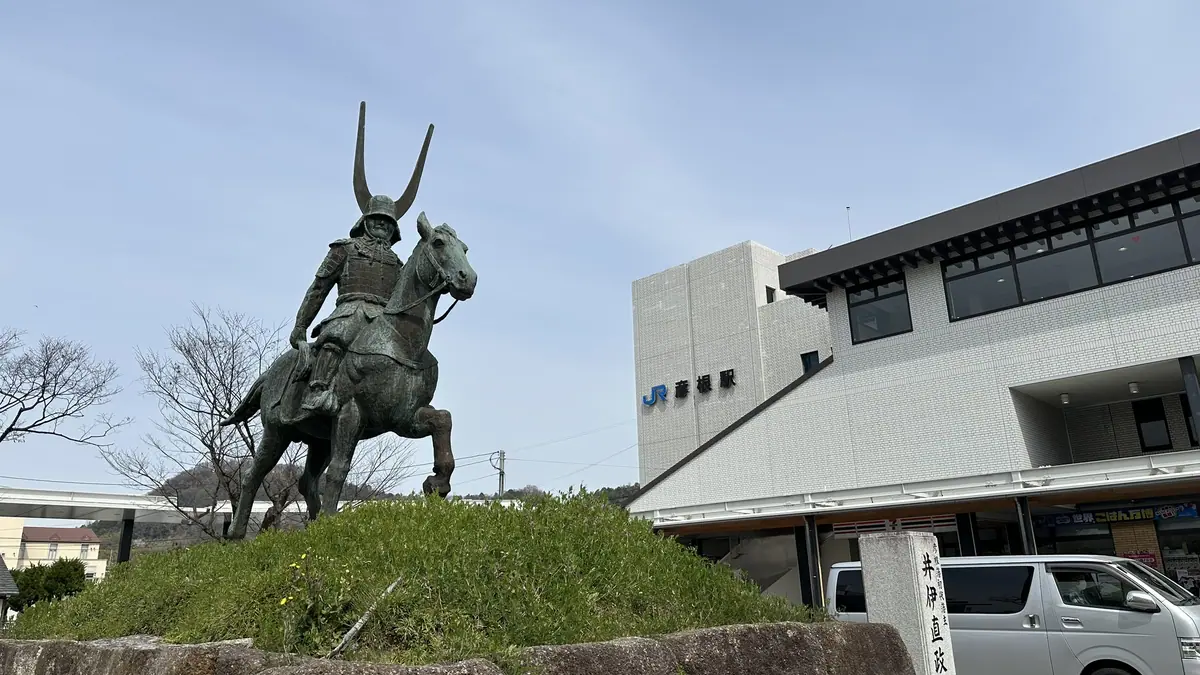
| Station to castle | About 15 minutes on foot from the west exit. Walk straight down the main road from the station until you reach the moat and the white walls of the Sawaguchi gate. |
| By car | About 10 minutes from Hikone IC on the Meishin Expressway. The museum has no parking of its own; use the paid tourist parking lots around the castle. In busy seasons, the city also suggests using Maibara IC or Kotosanzan Smart IC. |
Walking route from Hikone Station to the castle
The route is a straight walk along the main road from the west exit of the station.
Route shown by Google Maps. Allow about 15 minutes on foot, as in the table above.
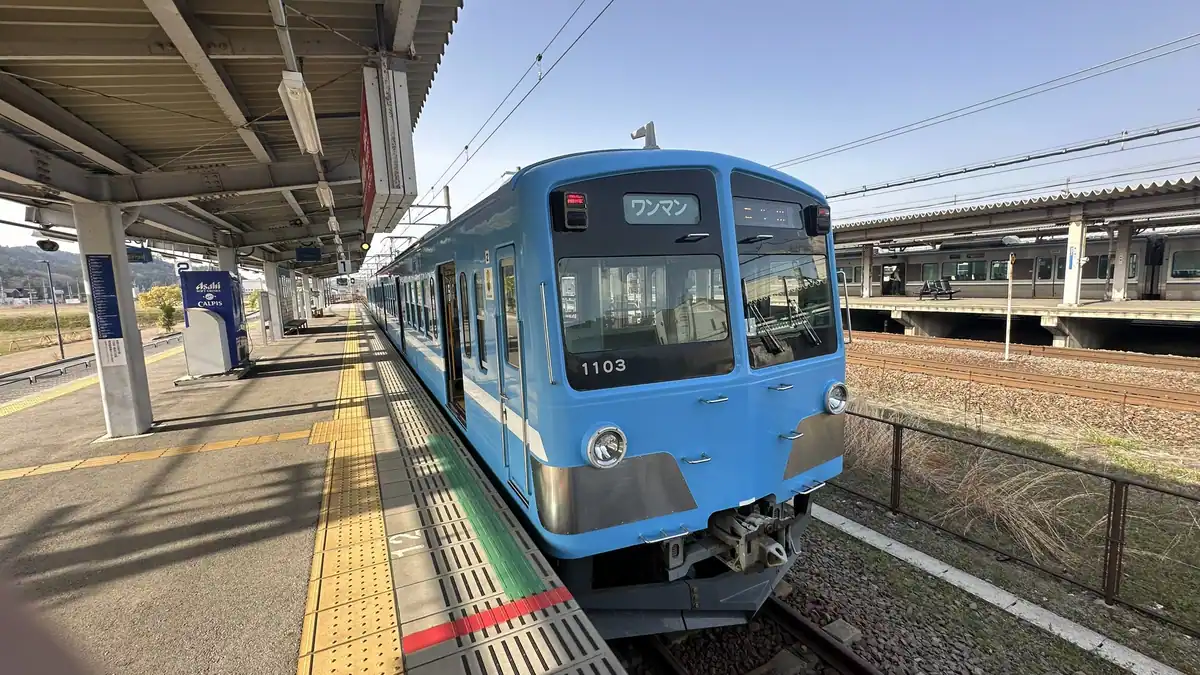
To head back, return to Hikone Station. Platforms are signed by direction: take trains toward Kyoto and Osaka, or the other way to Maibara for the Shinkansen to Nagoya and Tokyo. Last-train times change with the day of the week and the season, so check the timetable for your travel date.
What to see at Hikone Castle and how much time you need
The main sight is the keep at the top of the hill. At the foot of the hill are two gardens built by the lords of Hikone, Genkyuen and Rakurakuen, and the Hikone Castle Museum, which reconstructs part of the castle's palace. You can spend a whole day on the grounds. Here is what each place offers and which ticket it needs.
| Place | What you'll see | Ticket |
|---|---|---|
| Keep (tenshu) | A three-story keep built in the early 1600s. Steep interior stairs lead to the top floor | Castle ticket (includes Genkyuen) |
| Tenbin-yagura and the corridor bridge | A wooden bridge over a deep cut in the hill, and the gatehouse behind it. Yagura are the defensive turrets and gate buildings of a castle | Castle ticket |
| Taikomon-yagura and the Nishinomaru three-story turret | The gate into the main enclosure, and a three-story turret in the western enclosure beyond the keep. You can go inside both | Castle ticket |
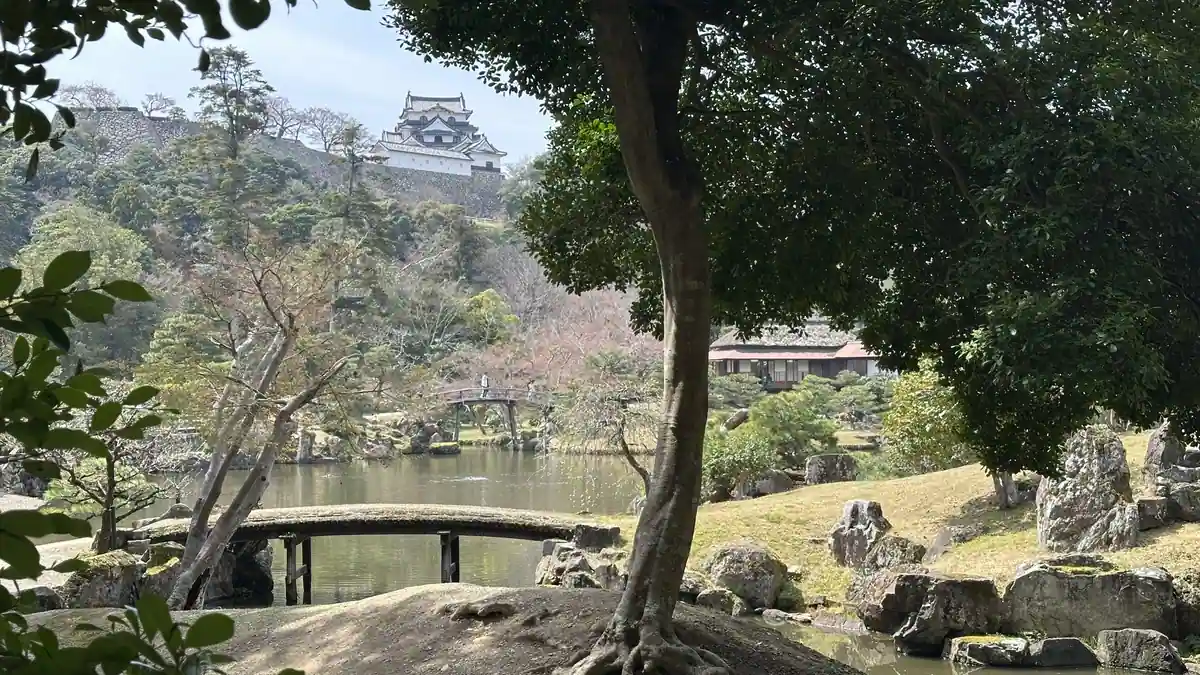
| Genkyuen Garden | A lord's pond garden with views of the keep across the water | Included in the castle ticket (garden-only ticket also sold) |
| Rakurakuen | Part of the lord's secondary residence. The buildings are usually closed; you view them from the garden | Free |
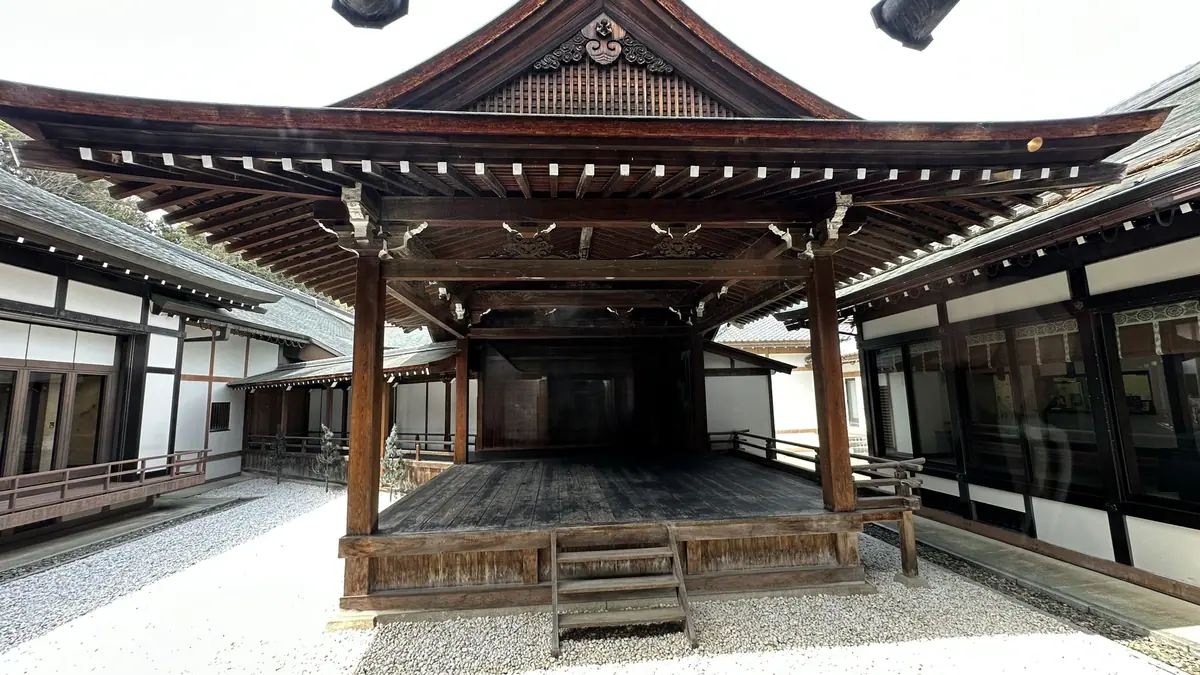
| Hikone Castle Museum | The reconstructed palace, an original Edo-period Noh stage, and items handed down in the Ii family | Separate ticket (combination ticket available) |
| Umaya (stable) | An Edo-period stable inside the castle grounds, said to have held 21 horses | Free |
| Kaikoku Kinenkan | A 1960 re-creation of part of the Sawaguchi turret | Free |
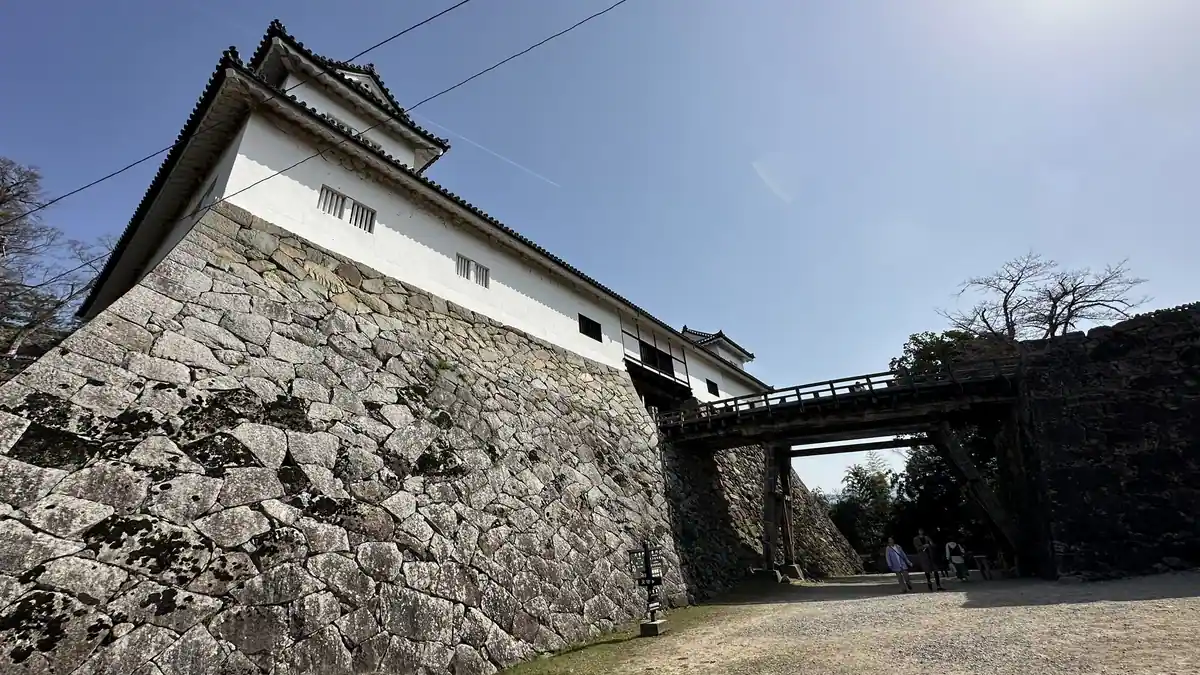
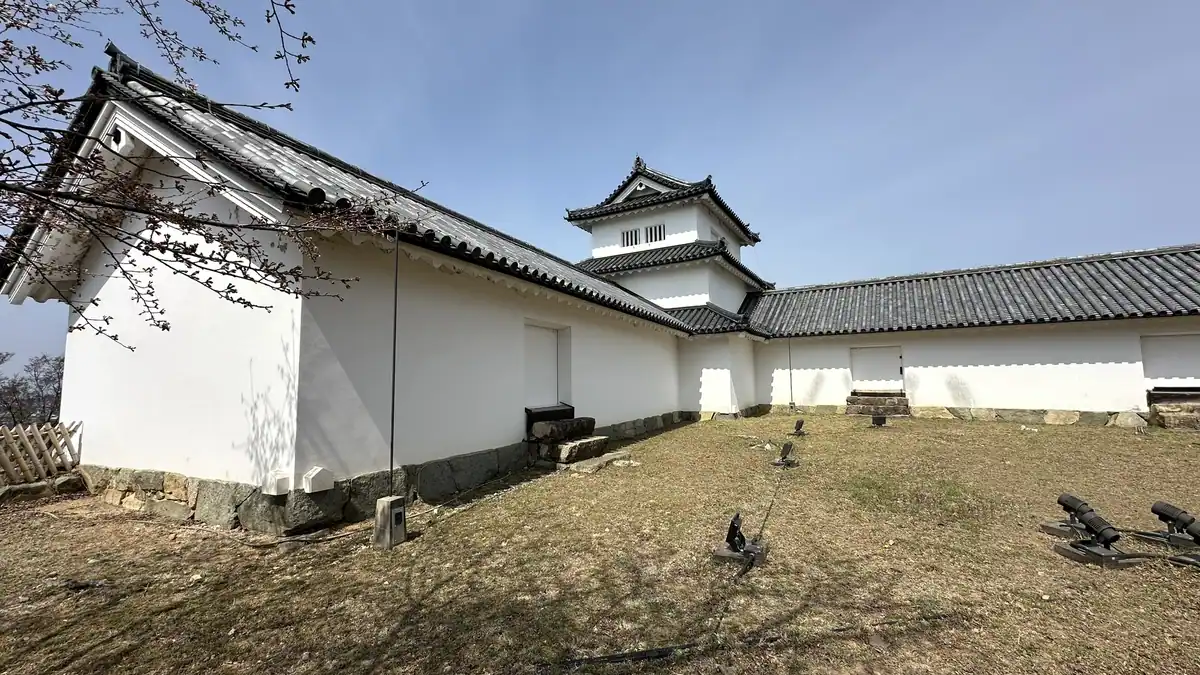
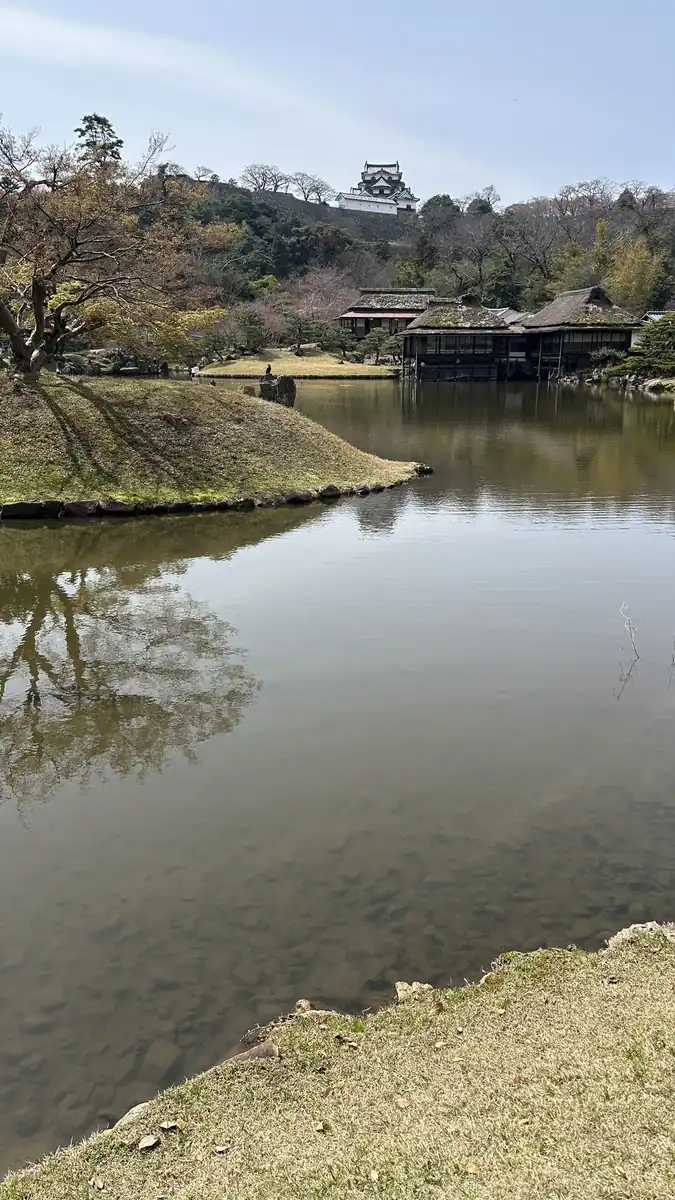
Tap a photo to enlarge it
My own order of priority after seeing the keep, gardens and museum in April 2025. Choose between the gardens and the museum according to your interests.
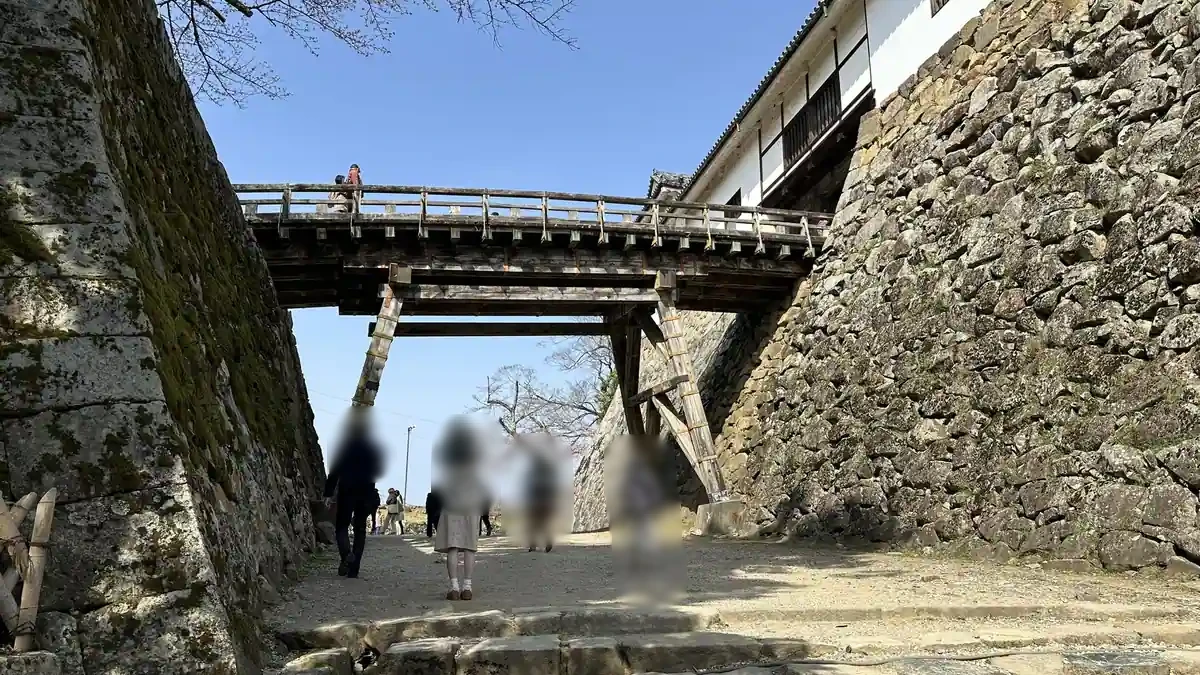
Go to the keep first. At the corridor bridge, the path along the bottom of the cut runs underneath the bridge that the upper path crosses. That layout is what stayed with me most from the visit.
Genkyuen frames the keep across a pond, and Rakurakuen keeps part of the lord's residence. If you have come to Japan wanting to see traditional gardens, make time for these two.
Items handed down in the Ii family, displayed in the reconstructed palace. Add it if you're interested in the history and have time left.
My visit: about four and a half hours for the keep, gardens and museum
On 5 April 2025, it took me about four and a half hours from starting up the hill to leaving the museum. About 20 minutes of that was inside the keep and about 50 minutes in the museum. The total also includes going inside Tenbin-yagura, Taikomon-yagura and the Nishinomaru turret, taking photos as I walked, and a tea break at Hoshodai in Genkyuen. It was a Saturday in spring, and there was a line of people waiting to enter the keep.
The castle grounds continue well beyond the keep, with more turrets and stone walls in the western enclosure, and they felt bigger than I had expected. If your time is limited, see the keep and the corridor bridge first, then add Genkyuen for the garden or the museum for the Ii family collection. Stone steps run all the way from the front gate to the keep, so rest when you need to. If you want to start at the 8:30 opening, staying in Hikone the night before gives you an easy morning (where to stay).
Hikone Castle tickets, prices and opening hours
The castle ticket covers the keep and the other buildings on the hill, plus Genkyuen Garden. The Hikone Castle Museum needs its own ticket, or a combination ticket if you want to see both. Prices since 1 October 2024 are below (official admission page, with English).
| Ticket | Adult / child* | Covers |
|---|---|---|
| Hikone Castle (incl. Genkyuen) | ¥1,000 / ¥300 | Keep, turrets, Genkyuen |
| Combination ticket | ¥1,500 / ¥550 | All of the above + museum |
| Hikone Castle Museum | ¥700 / ¥350 | Museum only |
| Genkyuen only | ¥400 / ¥150 | Genkyuen (not the keep) |
*Child prices are for elementary and junior high school students (ages 6 to 15).
Bought separately, the castle and museum come to ¥1,700 for an adult, so the combination ticket saves ¥200 if you want both (¥100 for children: ¥650 against ¥550). If you're skipping the museum, you don't need the combination ticket. The stable, Rakurakuen and the Kaikoku Kinenkan at Sawaguchi are free. Groups of 30 or more get 20% off.
Opening hours and closing days
| Place | Hours | Closed |
|---|---|---|
| Hikone Castle and Genkyuen | 8:30–17:00 (last entry 16:30; the keep, turrets and stable close at 16:45) | Open every day |
| Museum (March–November) | 9:00–17:00 (last entry 16:30) | 25–31 December, plus other days (see below) |
| Museum (December–February) | 9:00–16:30 (last entry 16:00) | Same as above |
| Kaikoku Kinenkan | 8:30–17:00 (last entry 16:45) | 25–31 December |
Until September 2026 the museum opened at 8:30, and older guides and travel sites may still say so. The castle and Genkyuen still open at 8:30.
Besides the end of December, the museum closes one to three days a month. Closing days from November 2026 to March 2027: 17–18 November; 8, 9 and 17 December; 25–31 December; 13–14 January; 9–10 February; 4 March; 16–18 March (checked on the museum's website on 10 November 2026). Combination tickets are not sold on days when the museum or its exhibition rooms are closed.
Buying tickets
- Buy tickets on the day at the ticket booth at the castle entrance. You don't need to book in advance.
- Regular tickets for the 2026 fiscal year are also sold online through Lawson Ticket (Japanese only; valid for one month from issue, no refunds even if unused; checked 9 November 2026). For most visitors, buying at the gate is simpler.
- The evening illumination of Genkyuen needs its own ticket; your daytime ticket is not valid (see seasonal events).
You take off your shoes to enter the keep, Tenbin-yagura and the Nishinomaru turret. There are shoe racks; if you worry about mix-ups, bring a bag for your shoes. The paths up the hill are slopes and stone steps, with no elevators or ramps. The keep's stairs are steep and narrow, and it cannot be visited in a wheelchair even with a helper. Pets on a leash are allowed outside the buildings only (assistance dogs are welcome inside).
The Ii family and the history of Hikone Castle
Hikone Castle was built in the years right after the Tokugawa family took control of Japan. The family who built it, the Ii, served the Tokugawa shoguns throughout the Edo period (1603–1868), and one of them, Ii Naosuke, made the decision that opened Japan to trade with the West.
The battle that made Tokugawa Ieyasu the most powerful man in Japan; three years later he became shogun. Ii Naomasa, one of Ieyasu's leading generals, fought on his side. In 1601 he was given Sawayama Castle, the former seat of Ishida Mitsunari, who had led the losing army.
Naomasa died before a new castle could be built, and his eldest son Naotsugu took over. Naomasa himself never lived in Hikone Castle.
Work started on Hikone hill, about 1 km from Sawayama, with the full backing of the shogunate and labor from neighboring lords. The keep is thought to have been finished within a few years.
Work stopped during the sieges of Osaka Castle (1614–15) and was finished under Naotsugu's younger brother, Naotaka. From then until the end of the Edo period, the Ii family ruled the Hikone domain (han, the territory a lord governed under the shogun).
Naosuke was born in the lord's secondary residence, now Rakurakuen, and lived from age 17 to 32 in Umoregi-no-ya, a modest house by the middle moat. He later became lord of Hikone and then Tairo, the shogunate's chief minister. In 1858 he signed the treaty that opened Japan to trade with the United States, and in 1860 he was assassinated outside the Sakurada Gate of Edo Castle.
After the domains were abolished in 1871, many castles across Japan were torn down. Hikone's buildings, keep included, were due to be demolished too, but they were saved, according to tradition, after Okuma Shigenobu advised preserving them while accompanying Emperor Meiji on a tour of the region. The palace had already been pulled down in the early Meiji years.
In 1944 the Ii family gave the castle grounds and buildings to the city of Hikone. The keep was designated a National Treasure in 1952, and the castle site a Special Historic Site in 1956. The Hikone Castle Museum, a reconstruction of the palace, opened in 1987.
On 3 September 2026, Japan decided to nominate Hikone Castle as a World Cultural Heritage site. The nomination is due to be sent to UNESCO by 1 February 2027, followed by an ICOMOS site inspection and a decision at the World Heritage Committee in 2028. The castle is not yet on the list.
What's original and what's reconstructed
The castle mixes buildings that have stood since the Edo period with ones that were rebuilt or re-created later. This table separates the keep and turrets, the reconstructed palace, and the Noh stage that was moved back to its original site.
| Building or place | Today |
|---|---|
| Keep, with its attached turrets | Original Edo-period building; National Treasure. Said to have been moved here from Otsu Castle |
| Tenbin-yagura, Taikomon-yagura, Nishinomaru three-story turret, stable | Original Edo-period buildings; Important Cultural Properties. Tenbin-yagura and Taikomon-yagura are thought to have been moved from other castles |
| Corridor bridge | A wooden bridge over the cut in the hill. It is said it could be dropped to stop attackers. Maintained through repeated repairs |
| Palace (Hikone Castle Museum) | Demolished in the early Meiji years. The lord's private quarters were rebuilt in wood; the exhibition and storage areas are reinforced concrete with a reconstructed exterior |
| The palace Noh stage | Built in 1800 and later moved; returned to its original site and restored. Seen inside the museum |
| Kaikoku Kinenkan | A 1960 re-creation of part of the Sawaguchi turret |
Hikonyan, cherry blossoms and autumn evenings
When to see Hikonyan
Hikonyan, a white cat wearing a red samurai helmet, is Hikone's official mascot. A costumed Hikonyan appears around the castle every day. The basic schedule as of 10 November 2026:
| Day / weather | Time and place |
|---|---|
| Good weather | 13:30–14:00 in front of the keep; 15:00–15:30 at the museum (Kabukimon gate) |
| Bad weather | 13:30–14:00 and 15:00–15:30, both at the museum (Kabukimon gate) |
| Weekends and holidays | Also 11:00–11:30 at Yonbancho Square |
Times and places change for events and weather, and appearances may be cancelled when weather warnings are issued. On the morning of your visit, check "本日の登場場所" (today's appearances) on the Hikonyan fan site (Japanese; your browser's translation feature works). When I saw Hikonyan in front of the keep at about 13:30 on 17 April 2024, I didn't have to wait.
Spring
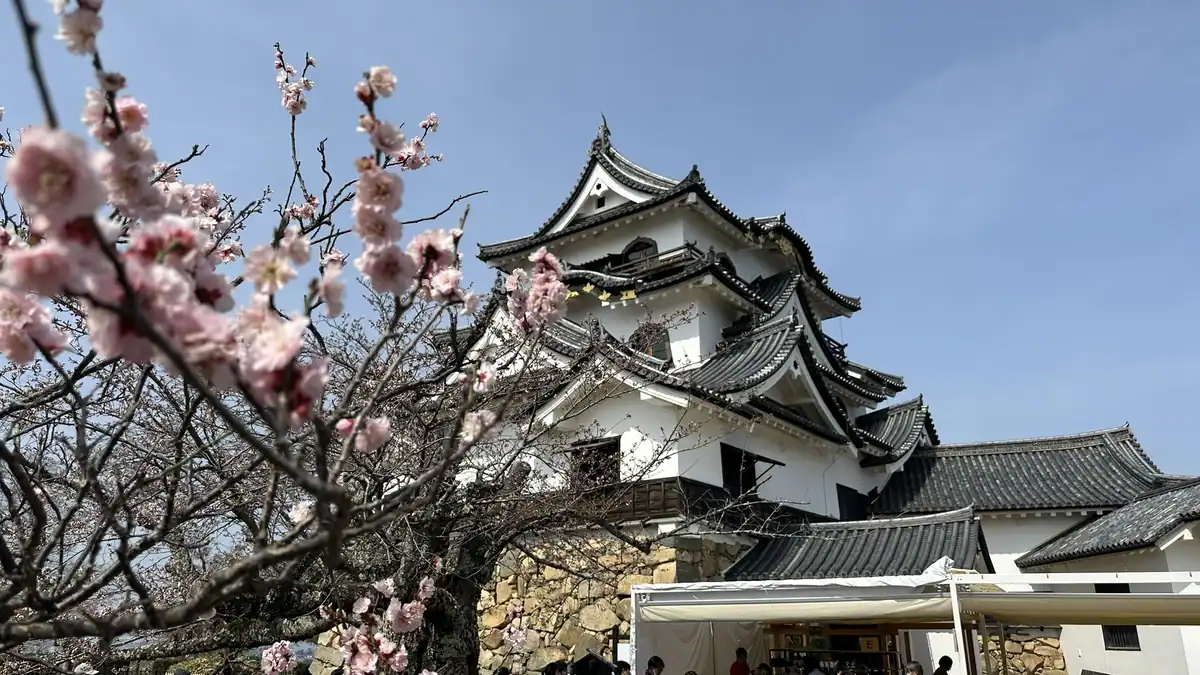
Hikone Castle is one of the region's best-known cherry blossom spots, and in spring people gather along the moats and in the main enclosure. On my visit on 5 April 2025, the trees in front of the keep and around the front gate bridge were in bloom. Blooming dates move from year to year, so check a blossom forecast before fixing your dates.
Autumn evenings: Genkyuen illumination (2026)
18:00–21:00 (last entry 20:30). Tickets on the day are ¥900 for adults and ¥450 for elementary and junior high students; advance tickets are ¥700 and ¥350. Advance tickets are sold on the organizer's booking site (Japanese) until 23:45 three days before your visit, and closer to the date on EX Tabisaki Yoyaku (membership required). Advance tickets cannot be cancelled once bought.
The castle and Genkyuen ticket you bought during the day won't get you in. On 14, 21, 22 and 28 November, the illumination runs alongside a special evening opening of the castle, and a combined castle and Genkyuen ticket (adults ¥1,400, children ¥600) is sold between 18:00 and 19:00 on those days only. Details: Hikone Tourist Association (Japanese).
Last entry is 20:30. If you are returning to Kyoto or Osaka that night, look up the times of the last trains before you go. Staying in Hikone lets you walk the garden without watching the clock (where to stay).
Historic sites near Hikone Castle
Around the castle are places linked to the Ii family and to Ishida Mitsunari. I didn't go inside Umoregi-no-ya, climb to the Sawayama Castle ruins or walk the old town on 5 April 2025, so treat these as options if you have extra time.
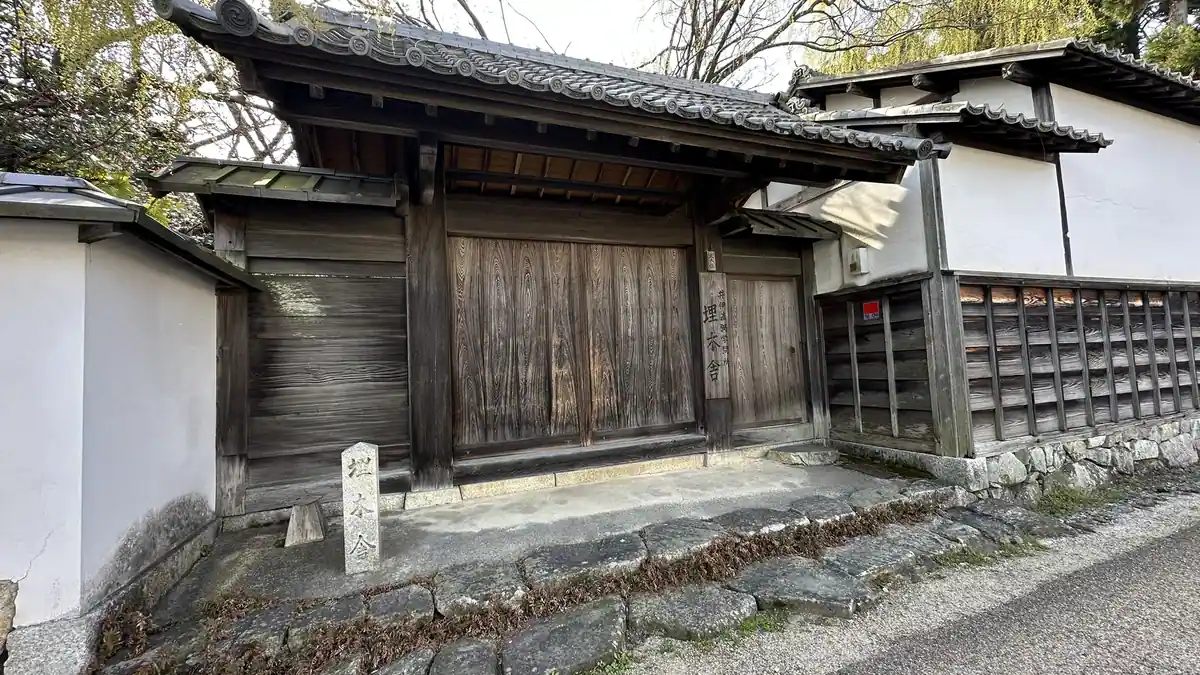
- Umoregi-no-ya: The house where Ii Naosuke spent 15 years, from age 17 to 32,. It stands on the middle moat near the Sawaguchi gate. Check the operator's notices for opening days and hours.
- Sawayama Castle ruins: The castle of Ishida Mitsunari, which Ii Naomasa took over after Sekigahara. It stood on the mountain northeast of Hikone Castle. Reach the summit by the hiking trail from the Ryotanji temple side; you cannot climb from the site of the old main gate.
- Yume Kyobashi Castle Road and Yonbancho Square: A street of old-style shopfronts running from the Kyobashi gate, and the shopping area beside it. Most visitors stop here to eat or shop, and Hikonyan appears at Yonbancho Square on weekend and holiday mornings.
- Other castles and battlefields: On the JR line back toward Kyoto are Omihachiman and Azuchi, where Oda Nobunaga's Azuchi Castle once stood. Beyond Maibara are Nagahama and Sekigahara, the site of the 1600 battle. If you combine any of these with Hikone on the same day, check connections and local travel times first.
Where to stay before or after Hikone Castle
PRThis section contains affiliate links to Agoda. If you book through them, this site earns a commission. I choose hotels for their location and how easy they are to travel from.
Hikone is an easy day trip from Kyoto, but seeing the keep, gardens and museum took me about four and a half hours. If you want to start at opening time, stay for the evening illumination, or move on to another city the next day, staying nearby makes the day easier to plan. Here are four options by purpose. Prices vary a lot by date and room, so I haven't compared them.
CLOSE TO THE CASTLE
Around Hikone Station
About 15 minutes on foot from the west exit to the castle entrance
For starting at the 8:30 opening, or for staying the night after the evening garden illumination.
This opens Agoda's search for the Hikone Station area. Distances to the castle differ by hotel, so check the map.
Browse Hikone Station hotels on AgodaEASY TO MOVE ON
Maibara (city, including Maibara Station)
Maibara to Hikone: about 5 minutes on the JR line, plus waiting time
For travelers taking the Tokaido Shinkansen toward Nagoya or Tokyo the next day.
Not close to the castle. Agoda's Maibara search covers the whole city, so some results are far from the station.
Browse Maibara hotels on AgodaA SPECIAL STAY (BY THE CASTLE)
Hikone Castle Resort & Spa
On the middle moat. 8 minutes on foot from Hikone Station, 5 minutes to the front gate (hotel's figures)
The large public bath, Shiromi-no-yu, looks toward the keep, and some rooms face the castle. Restaurants include Omi beef teppanyaki and Japanese cuisine. Suits visitors who want to do everything on foot.
The keep is visible from the Castle View rooms. Check the room type before you book.
Check rates on AgodaA SPECIAL STAY (ON LAKE BIWA)
Kamenoi Hotel Hikone
On the Lake Biwa shore in Matsubara. About 10 minutes by car from Hikone Station (hotel's figure)
Every room looks out over Lake Biwa, and there is a hot-spring bath on the top floor. For a quiet evening by the lake after a day at the castle.
Too far to walk to the castle or the station. The free shuttle bus from Hikone and Maibara stations needs a reservation, so ask the hotel for times.
Check rates on AgodaThe links open with Agoda’s default dates and guest count. Check the dates, price, and cancellation terms on the booking page before you reserve.
Hikone Castle FAQ
When I saw the keep, Genkyuen, Rakurakuen and the Hikone Castle Museum in April 2025, it took about four and a half hours from starting up the hill to leaving the museum. About 20 minutes of that was in the keep and about 50 minutes in the museum. Your time will depend on crowds and how many photos you take.
The keep is original. It was completed in the early 1600s and is one of five castle keeps in Japan designated National Treasures. The palace that houses the Hikone Castle Museum, on the other hand, is a 1987 reconstruction.
No. The museum costs ¥700 for adults. If you want to see both, the ¥1,500 combination ticket is ¥200 cheaper than buying them separately. Combination tickets are not sold on days when the museum is closed.
Yes. A Genkyuen-only ticket costs ¥400 for adults and ¥150 for children. Rakurakuen next door is free and you can view its buildings from the garden. If you want to see the keep too, buy the castle ticket (¥1,000 for adults), which includes Genkyuen.
About 46 minutes from Kyoto Station to Hikone Station by JR Special Rapid, though some trains take over 50 minutes. From the west exit of Hikone Station it is about 15 minutes on foot to the castle entrance.
On days with good weather, the basic schedule is 13:30–14:00 in front of the keep and 15:00–15:30 at the Kabukimon gate of the Hikone Castle Museum (as of 10 November 2026). It changes with weather and events, so check today's appearances on the official fan site on the day of your visit.
Not yet. In September 2026 Japan decided to nominate it. After the nomination is submitted and ICOMOS inspects the site, the World Heritage Committee is due to decide in 2028.


comment