


Area 1: Main Gate and Outer Grounds
In Area 1, you’ll explore 11 key locations that set the stage for your Himeji Castle experience, from Sakuramon Bridge and the World Heritage Monument to the imposing Hishi-no-Mon Gate.
In Area 1, you’ll explore 11 key locations that set the stage for your Himeji Castle experience. From the World Heritage Monument and remains of historic residences and gates to peaceful spots like the Roan Teahouse and the gentle slope of Onnazaka, this area offers a rich introduction to the castle’s layered history.
Highlights include the Site of the San-no-Maru, where retainers once assembled; the Former Three-Story Turret Site, which hints at past grandeur; and the impressive Hishi-no-Mon Gate, the powerful first gate of the inner compound. Each site reveals a different facet of the castle’s evolution from its early days to its Edo-period magnificence.
Sakuramon Bridge 🎥 360°
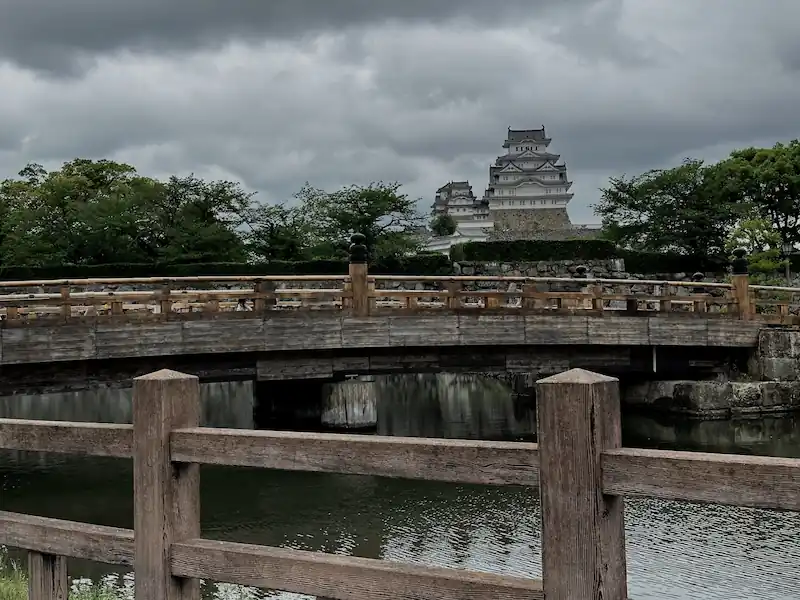
Often considered the main gateway to Himeji Castle, Sakuramon Bridge marks the symbolic starting point for any visit. As you approach from JR Himeji Station (JR-A85), the castle’s radiant white main keep appears through the trees, with this iconic bridge coming into view just ahead.
Spanning the castle’s inner moat, Sakuramon Bridge stands in alignment with the imposing Otemon Gate, guiding visitors into the grandeur of the castle grounds. The current bridge is a modern-era reconstruction. The Edo-period approach to the main gate had its own bridge and gate structures, but today’s wooden-style bridge and the current Otemon Gate were rebuilt after the Meiji era and should be understood as distinct from their Edo-period predecessors. With the White Heron Castle as its stunning backdrop, Sakuramon Bridge has become a popular photo spot.
| Year built | Unknown (originally existed during the Edo period) |
|---|---|
| Builder | Unknown |
| Structure / features | A wooden pedestrian bridge crossing the outer moat, of traditional Edo-period design and famous for cherry blossoms. |
| Renovation history | The Edo-period bridge was removed in the Meiji era; the current bridge is a modern-era reconstruction near the historic site. |
| Cultural property status | Unknown |
Access: Approx. 20-minute walk (1.1 km) from JR Himeji Station (JR-A85), per official estimates
Suggested time: Quick stop around 5 min / in-depth visit around 15 min
Otemon (Sakuramon) Gate 🎥 360°
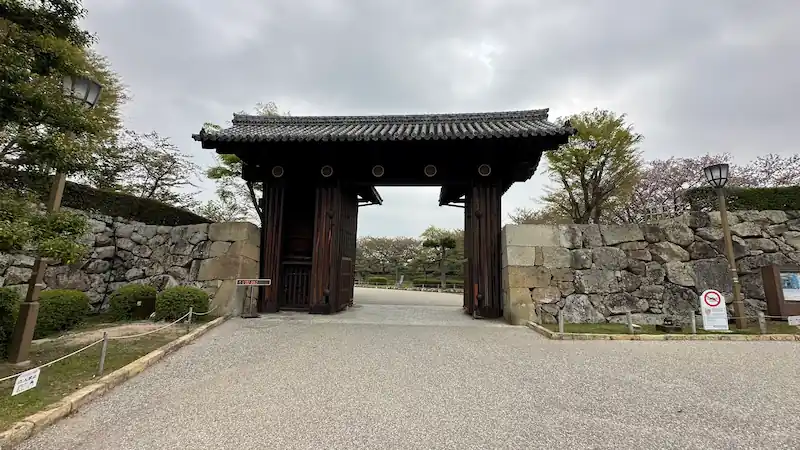
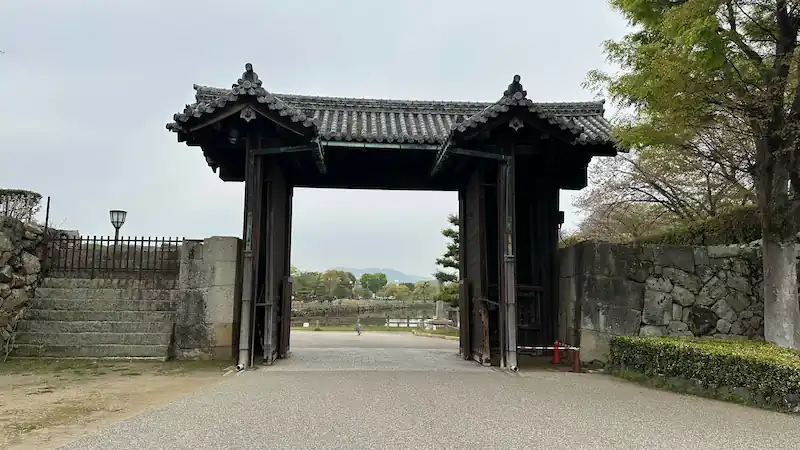
As you step into the grounds of Himeji Castle, the first structure to greet you is the grand Otemon Gate — also known as Sakuramon. Surrounded by towering stone walls, this gate stands as a powerful symbol of the castle’s history and prestige. The current gate was rebuilt in 1938 near the site of the former Kirimon (Kiri-ni-no-Mon) gate. In the Edo period, the main entrance was guarded by a formidable triple-gate complex made up of Sakuramon, Kirimon, and Kirinichi-mon; today’s Otemon Gate is a modern reconstruction and should be understood separately from that original Edo-period approach.
Toyotomi Hideyoshi captured the Harima region in 1577 and began major renovations to Himeji Castle in 1580. This gate route was a key part of his reconstruction plan, which introduced stone-wall techniques and laid the foundation for the modern Japanese castle. Today the gate has been rebuilt in wood near the historic gate line, and its solid construction and flanking high stone walls evoke the age of samurai, even though the present structure dates only from the twentieth century.
| Year built | Unknown (the Edo-period gate complex predates the current structure) |
|---|---|
| Builder | Unknown |
| Structure / features | A masugata-style wooden gate serving as the castle’s main entrance, just past Sakuramon Bridge. |
| Renovation history | The Edo-period triple-gate complex was removed in the Meiji era; the current gate was rebuilt in 1938 near the former Kirimon site, in the style of a Koraimon gate. |
| Cultural property status | Unknown |
Access: Approx. 1-minute walk (40 m) from Sakuramon Bridge
Suggested time: Quick stop around 5 min / in-depth visit around 15 min
World Heritage Himeji Castle Monument
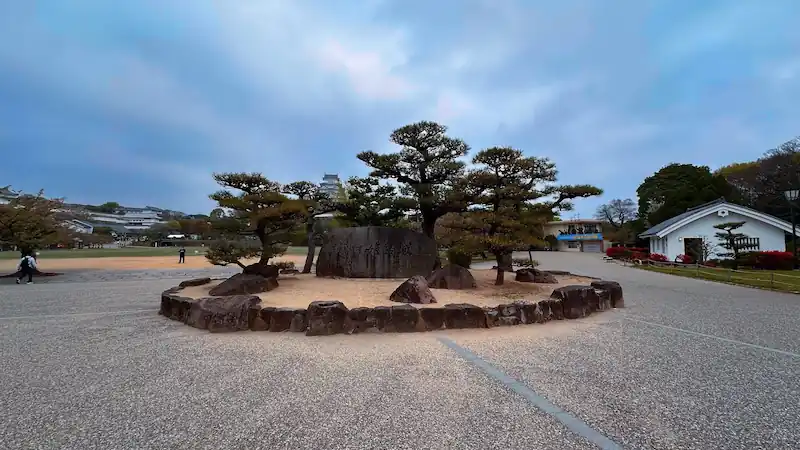
This monument commemorates Himeji Castle’s designation as one of the first UNESCO World Cultural Heritage sites in Japan, registered in 1993. Located just beyond the inner moat in San-no-Maru Square, it offers a prime view of the castle’s striking white keep. Known as the “White Heron Castle” for its graceful appearance, the fortress exemplifies Japan’s early modern castle architecture — originally shaped by Toyotomi Hideyoshi and expanded by Ikeda Terumasa during the Edo period.
| Year built | 1993 (Heisei 5) |
|---|---|
| Builder | Unknown |
| Structure / features | A stone monument marking the year Himeji Castle was listed as a World Heritage site. |
| Cultural property status | Unknown |
Access: Approx. 1-minute walk (87 m) from Otemon (Sakuramon) Gate
Suggested time: Quick stop around 5 min / in-depth visit 10–15 min
Site of the Mukai-Oyashiki Residence 🎥 360°
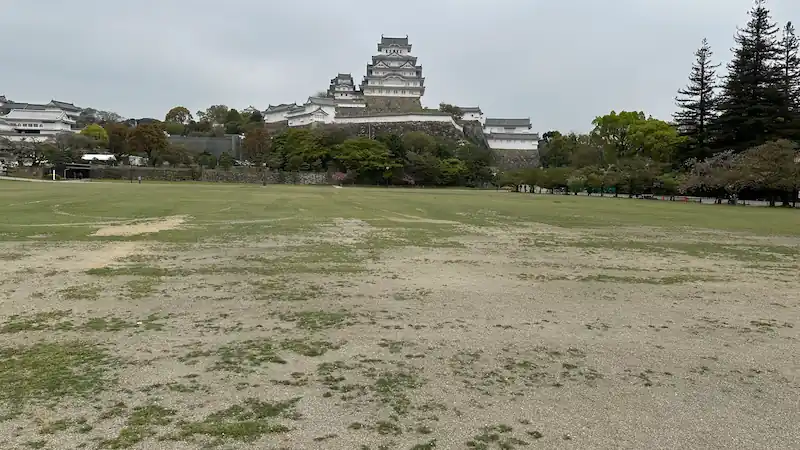
This site in San-no-Maru marks the location of the Mukai-Oyashiki, the domain lord’s own private residence and garden. The term Mukai means “opposite” or “facing,” referencing the site’s position across from the castle’s main citadel and Ni-no-Maru. The residence is said to have included sukiya-style buildings, an artificial hill, and a pond, illustrating the castle’s dual nature — not only a military stronghold, but also a center of everyday life for its lord. No structures survive above ground today.
| Year built | Unknown (likely during the Edo period) |
|---|---|
| Structure / features | The lord’s private residence and garden, said to have included sukiya-style buildings, an artificial hill, and a pond; only the site remains today. |
| Cultural property status | Unknown |
Access: Approx. 1-minute walk (80 m) from the World Heritage Himeji Castle Monument
Suggested time: Quick stop 10 min / in-depth visit around 20 min
Site of the San-no-Maru
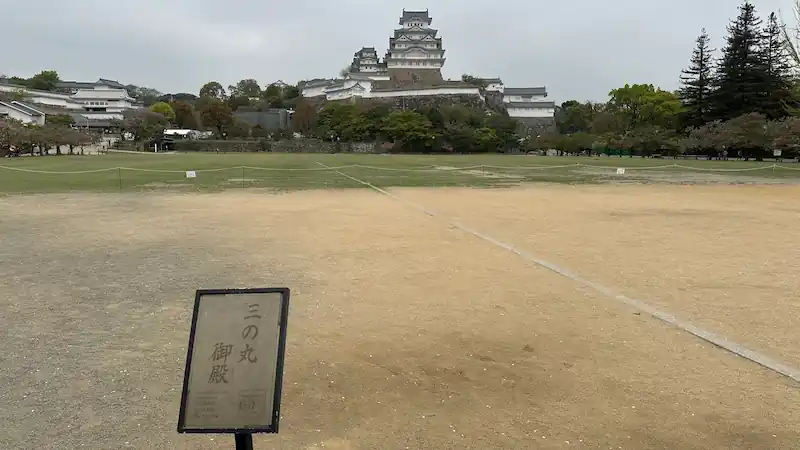
The Site of the San-no-Maru is a vast open area just beyond Otemon Gate. Once the administrative and residential heart of the domain during the Edo period, it housed government offices, the lord’s residence, and samurai officials’ quarters. While the original structures are gone, the expansive lawn and stone walls remain, offering one of the best panoramic views of the castle’s main keep. San-no-Maru functioned as the castle’s hub for governance and daily life, in contrast to the military-centric Honmaru and Ni-no-Maru, evolving into a large, formal complex over the course of the Edo period.
| Year built | Early 17th century (Edo period) |
|---|---|
| Builder | Honda family, lords of Himeji from 1617 to 1639 |
| Structure / features | Administrative center with palatial buildings, tea houses, gardens, and ponds; a 21-meter-wide avenue led toward the main keep. |
| Renovation history | All buildings removed during the Meiji era; only rows of gray flagstones now mark the old central avenue and foundations. |
Access: Directly adjacent to the Site of the Mukai-Oyashiki Residence
Suggested time: Quick stop 10 min / in-depth visit 30 min
Site of the Former Three-Story Turret (Sanjū Yagura Ato)
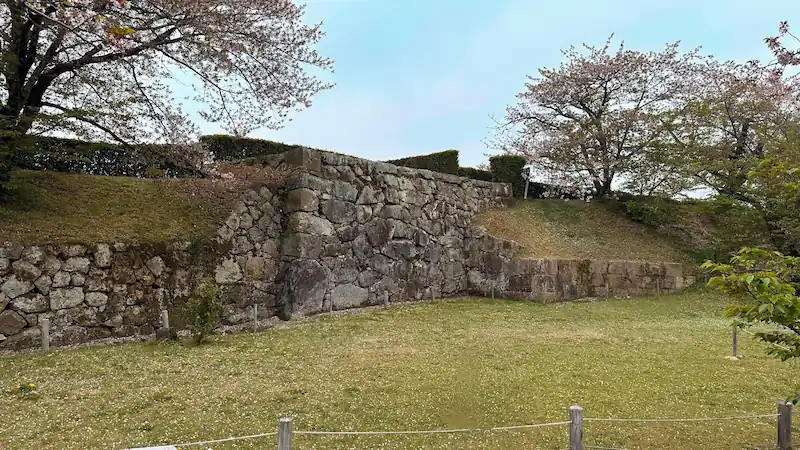
This site marks where a three-story watchtower, the Sanjū Yagura, once stood near the old Otemon gate line, guarding the main approach to Himeji Castle. It was removed during the Meiji era, and no structure remains today. This turret is distinct from the “Taiko Yagura” (Drum Turret), a surviving building located today in Kamiyamasato elsewhere in the castle complex — the two share similar-sounding names but are separate buildings, and should not be confused. The stone walls here display techniques such as nozura-zumi and uchikomi hagi, offering insight into the construction practices of the era.
| Year built | Unknown (existed near the old Otemon gate line during the Edo period) |
|---|---|
| Builder | Unknown |
| Structure / features | A three-story watchtower (Sanjū Yagura) that once guarded the main approach to the castle, surrounded by stone walls; distinct from the surviving Taiko Yagura turret in Kamiyamasato. |
| Renovation history | Removed during the Meiji era; no structure remains today. |
Access: Approx. 2-minute walk (120 m) from the Site of the San-no-Maru
Suggested time: Quick stop around 5 min / in-depth visit around 15 min
Site of the Musashino Palace
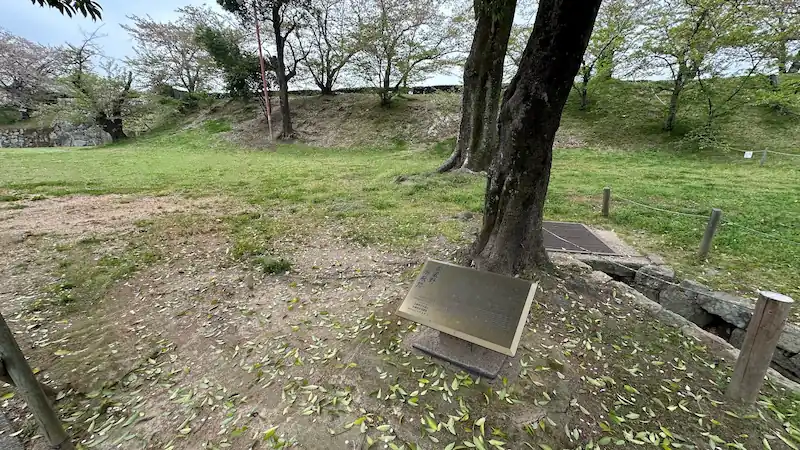
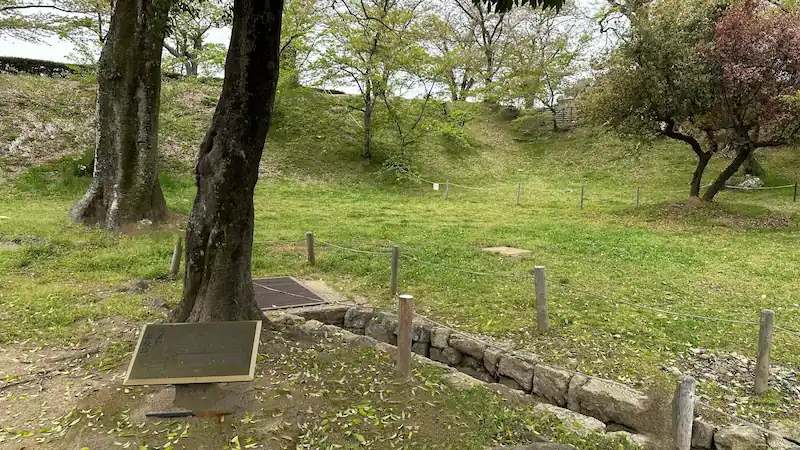
This area, sometimes referred to in modern guides as the Site of the Musashino Palace (though the original name of the residence has not been confirmed in historical records), sits in the San-no-Maru area, which held a group of palace buildings during the Edo period. The area known as “Musashino” is said to have been the residence of Princess Sen (Senhime). No palace structure remains above ground today; only foundation stones and remnants of a garden survive. The name Musashino refers to a symbolic region in the Kanto area associated with the Tokugawa shogunate, underscoring the Himeji Domain’s ties to the central government.
| Year built | Early 17th century (Edo period) |
|---|---|
| Builder | Honda Tadatoki |
| Structure / features | A residence within San-no-Maru; only foundation stones and garden remnants survive today. |
| Remarks | Built as the residence of Princess Sen (Senhime) and her husband, Honda Tadatoki. |
Access: Approx. 1-minute walk (110 m) from the Site of the Former Three-Story Turret
Suggested time: Quick stop 5 min / in-depth visit 15 min
Site of the Sagiyamaguchi Gate
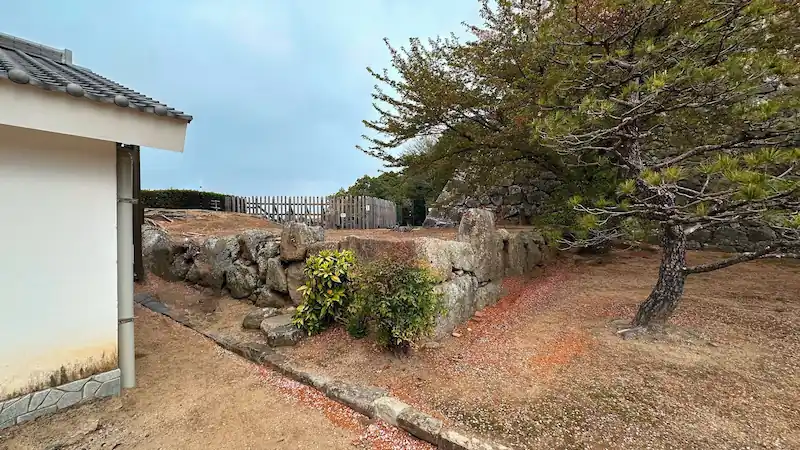
This site marks the former northern entrance of Himeji Castle. Though now a quiet historical ruin, it once served as a practical access point for castle staff, artisans, and occasionally troops — a rear gate with a logistical rather than ceremonial role. It is named after Mount Sagi, considered the origin of the castle’s poetic nickname Shirasagi-jo, “White Heron Castle.” During Hideyoshi’s 1580 modernization of the castle, the northern area was also fortified.
| Year built | Unknown (likely early Edo period) |
|---|---|
| Structure / features | A rear entrance to Himeji Castle, possibly a simple wooden gate with defensive features. |
Access: Approx. 3-minute walk (260 m) from the Site of the Musashino Palace
Suggested time: Quick stop 5 min / in-depth visit 15 min
Roan Teahouse
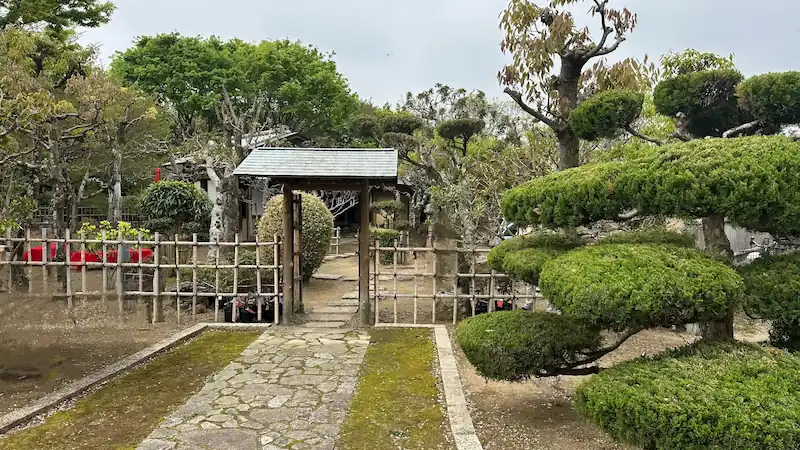

Nestled on the northern edge of San-no-Maru Square, the Roan Teahouse is a refined sukiya-style structure set against the backdrop of Himeji Castle’s walls and towers. Named after the castle’s alternate title, White Heron Castle, Roan is a sanctuary of tranquility built in strict adherence to classic tea-ceremony architecture. While Himeji Castle symbolizes military strength and strategic design, Roan reflects omotenashi — the cultural spirit of hospitality — and the aesthetics of Japanese tea tradition. Hideyoshi himself was an avid practitioner of the tea ceremony and is known to have hosted tea gatherings within the castle.
| Structure / features | A traditional Japanese teahouse in the sukiya-zukuri architectural style. |
|---|---|
| Current status | Still standing; open to visitors. |
Access: Approx. 1-minute walk (50 m) from the Site of the Sagiyamaguchi Gate
Suggested time: Quick stop 10 min / in-depth visit 30 min (including matcha service)
Onnazaka (Women’s Slope)
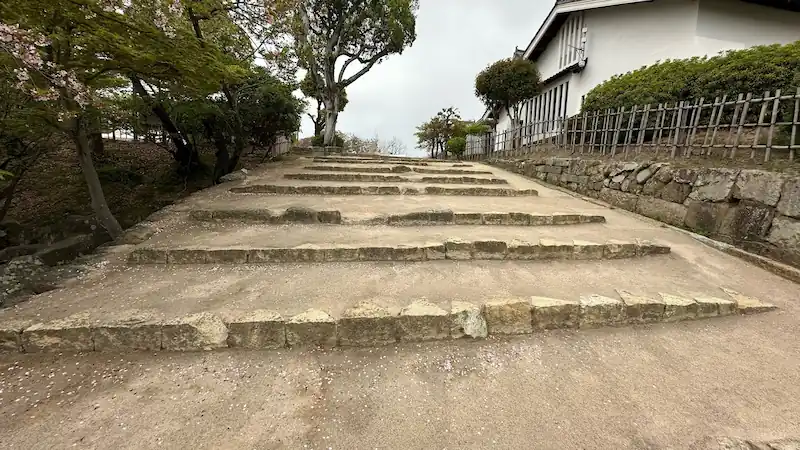
Onnazaka, or “Women’s Slope,” is a gently sloping stone stairway connecting San-no-Maru Square to Ni-no-Maru. Named in contrast to the steep Otokozaka (“Men’s Slope”), the path was not exclusive to women, but its soft curves and easier incline inspired the name. Today it serves as a peaceful passage through the castle grounds, ideal for appreciating the stonework and surrounding nature. The origin of the name and the identities of its historical users are not confirmed in surviving records, so claims that specific figures such as noblewomen used this path should be treated as legend rather than established fact.
| Structure / features | A gentle sloping stone path within the castle grounds. |
|---|---|
| Current status | Still exists and is accessible to visitors. |
Access: Approx. 1-minute walk (110 m) from Roan Teahouse
Suggested time: Quick stop 5 min / in-depth visit around 15 min
Hishi-no-Mon Gate
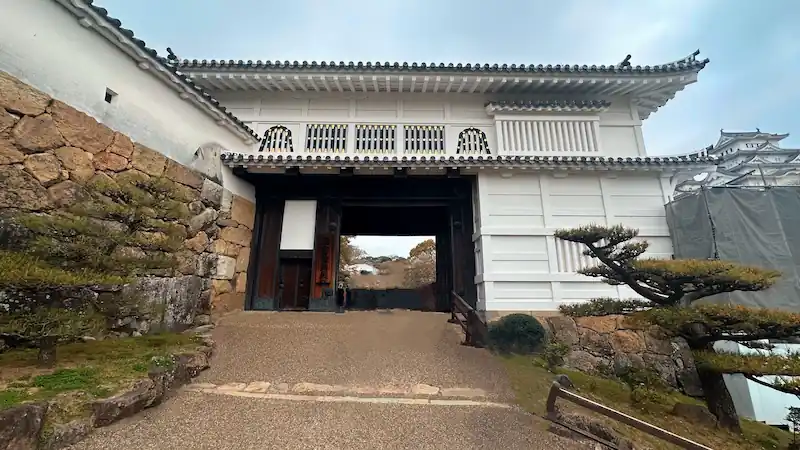
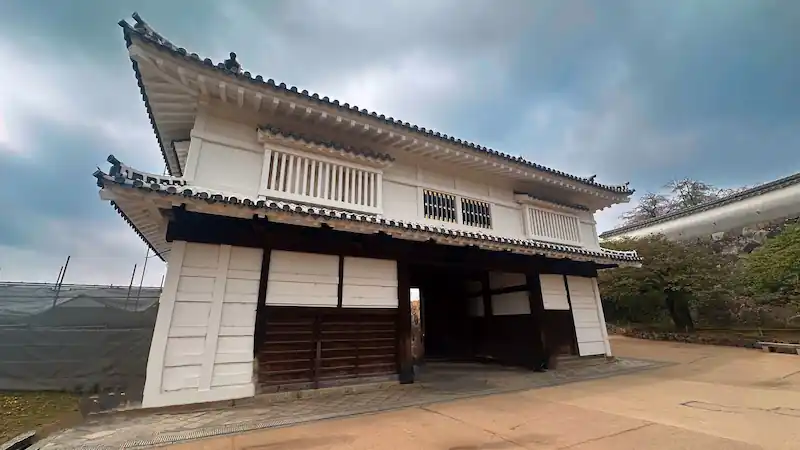
The Hishi-no-Mon Gate is the largest remaining gate at Himeji Castle and served as the formal entrance from San-no-Maru to Ni-no-Maru. This commanding tower gate exemplifies feudal prestige, with its name derived from the diamond-shaped (“hishi”) carving on its crossbeam (kabuki). Built in a two-story irimoya-zukuri (hip-and-gable) style with tiled roofing, its heavy wooden doors are reinforced with iron fittings, and it is flanked by a masugata (box-shaped defensive courtyard) designed to slow invaders. Constructed during Ikeda Terumasa’s renovation of the castle between 1601 and 1609, Hishi-no-Mon is a rare surviving structure from that period and is designated an Important Cultural Property of Japan. Historically, only elite figures such as the daimyo and the shogun were permitted to pass through it.
| Year built | Early 17th century (Edo period) |
|---|---|
| Builder | Ikeda Terumasa |
| Structure / features | The largest gate at Himeji Castle, a yaguramon (gate with a turret on top) in the irimoya-zukuri (hip-and-gable) style, named for the diamond-shaped carving on its crossbeam (kabuki). |
| Renovation history | Restored during major renovations between 2010 and 2015. |
| Cultural property status | Important Cultural Property of Japan |
Access: Approx. 2-minute walk (150 m) from Onnazaka (Women’s Slope)
Suggested time: Quick stop 5 min / in-depth visit 15 min
- Sakuramon Bridge 🎥 360°
- Otemon (Sakuramon) Gate 🎥 360°
- World Heritage Himeji Castle Monument
- Site of the Mukai-Oyashiki Residence 🎥 360°
- Site of the San-no-Maru
- Site of the Former Three-Story Turret (Sanjū Yagura Ato)
- Site of the Musashino Palace
- Site of the Sagiyamaguchi Gate
- Roan Teahouse
- Onnazaka (Women’s Slope)
- Hishi-no-Mon Gate
- FAQ
- More on Himeji Castle
- Return to the Warlord Page
FAQ
Most visitors begin at Sakuramon Bridge, about a 20-minute walk from JR Himeji Station (the official estimate), then continue through Otemon Gate and San-no-Maru Square toward Hishi-no-Mon Gate.
A quick pass through the 11 spots takes roughly 45–60 minutes; allow more time if you plan to stop at the Roan Teahouse for matcha or linger at the World Heritage Monument for photos.
It is the largest surviving gate at Himeji Castle, built between 1601 and 1609 under Ikeda Terumasa and designated an Important Cultural Property of Japan. It marks the formal entrance from San-no-Maru into Ni-no-Maru.
More on Himeji Castle
Return to the Warlord Page


☕ Support This Site
Following the Shogun is built on original fieldwork and on-site research.
If you found this guide useful, your support helps keep it going.

You can also support via QR code


comment