


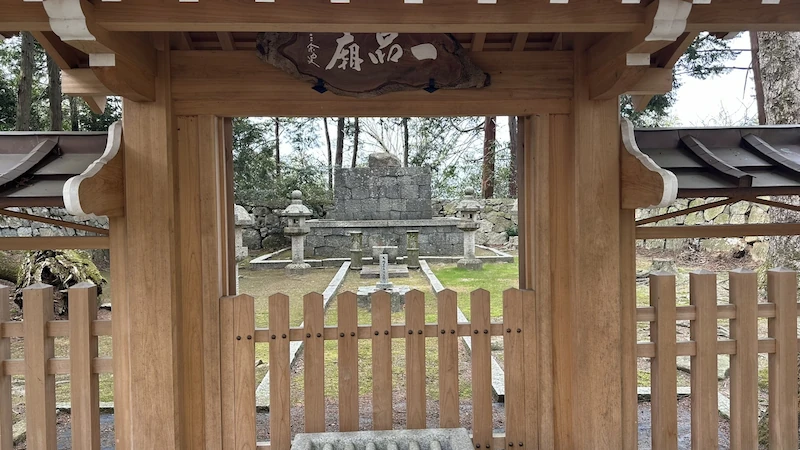
Walking Azuchi Castle's Main Enclosure | 11 Sites from Kuroganemon Gate to the Keep Base
The moment you pass through Kuroganemon Gate, the air feels completely different from the Otemichi approach road below. Beyond this checkpoint — where excavations turned up gold-leafed roof tiles — lies the most important area of the entire castle: the Shukakubu, the central compound Oda Nobunaga built as his base for unifying Japan. Here you'll find Nobunaga's Mausoleum, where Toyotomi Hideyoshi buried his late lord's personal effects; the Honmaru, the "thousand-mat" main bailey where 119 pillar bases still sit in a neat grid; and the Tenshudai, the stone base of the castle tower, said to rival the base of Himeji Castle's keep in size. This is where Azuchi Castle's history can be felt most directly.
The moment you pass through Kuroganemon Gate, the air feels completely different from the Otemichi approach road below. Beyond this checkpoint — where excavations turned up gold-leafed roof tiles — lies the most important area of the entire castle: the Shukakubu, the central compound Oda Nobunaga built as his base for unifying Japan. Here you'll find Nobunaga's Mausoleum, where Toyotomi Hideyoshi buried his late lord's personal effects; the Honmaru, the "thousand-mat" main bailey where 119 pillar bases still sit in a neat grid; and the Tenshudai, the stone base of the castle tower, said to rival the base of Himeji Castle's keep in size. This is where Azuchi Castle's history can be felt most directly.
This page walks you through 11 spots in order, from Kuroganemon Gate to the Tenshudai ruins, with 360° panoramic photos and detailed data for each. Every single pillar base underfoot carries a trace of the scale of Nobunaga's ambition.
The Approach to Kuroganemon Gate
① Site Said to Be Oda Nobutada's Mansion
Where Nobunaga's eldest son lived, midway up the castle — the crossroads of Otemichi and the Dodobashiguchi path
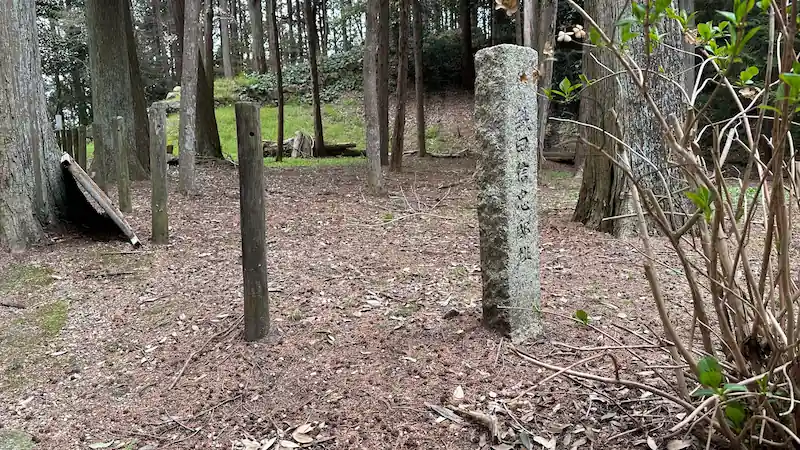
Partway up Azuchi Castle's hillside, at the point where the Otemichi approach road crosses the Dodobashiguchi path, tradition holds that Oda Nobutada — Nobunaga's eldest son and heir — once had his residence. Nobunaga had already handed leadership of the Oda clan to Nobutada, marking him as the family's next head. On the day of the Honnoji Incident in 1582, when the general Akechi Mitsuhide turned on Nobunaga, Nobutada learned that his father was under attack and moved to Nijō Palace (Nijō Shogosho) in Kyoto. After fighting off Akechi's forces there, he took his own life. Nobunaga died at Honnō-ji; Nobutada died separately at Nijō Palace. No buildings survive today, only a stone marker. The site occupies a strategically important junction, and traces of other senior retainers' residences are scattered throughout the surrounding area.
- Stone marker: A marker identifies this as the site of Oda Nobutada's mansion.
- Tokutomi Sohō's poem stone: A stone inscribed with a classical Chinese-style poem about Mt. Azuchi stands nearby and is worth a look on the same stop.
- A crossroads location: The site sits at the junction of the Otemichi approach road and the Dodobashiguchi path — a strategically significant spot.
Quick visit: about 5 min / Unhurried: about 15 min
🗺 Address: Shimotoyoura, Azuchi-cho, Omihachiman, Shiga Prefecture
🚶 Access: You'll reach it as you continue from the Otemichi area toward the Tenshudai.
Rating: Historical value ★★ / Visual appeal ★ / Experience value ★
| Built | 1576–1579 (Tensho 4–7) |
|---|---|
| Traditionally identified resident | Oda Nobutada (Nobunaga's eldest son) |
| Layout / features | Located at the junction of Otemichi and the Dodobashiguchi path |
| Condition today | Stone marker remains; no buildings survive |
| Heritage designation | Special National Historic Site "Azuchi Castle Ruins" |
| What you can see | What excavation and records revealed |
|---|---|
| Stone marker and surrounding stone walls | Positioned at a key defensive junction; several senior retainers' mansion sites are clustered nearby |
Azuchi Castle Ruins archaeological excavation report
- The Honnoji Incident: Nobutada had already been handed leadership of the Oda clan. When he learned his father was under attack, he moved to Nijō Palace and fought Akechi's forces there before taking his own life — dying separately from Nobunaga, and never getting the chance to lead the clan into the future.
- The heir apparent: As Nobunaga's eldest son, Nobutada carried the full weight of his father's expectations for the Oda clan's future.
② Site Said to Be Mori Ranmaru's Mansion
Home to Nobunaga's close attendant, just outside Kuroganemon Gate — a mark of trust
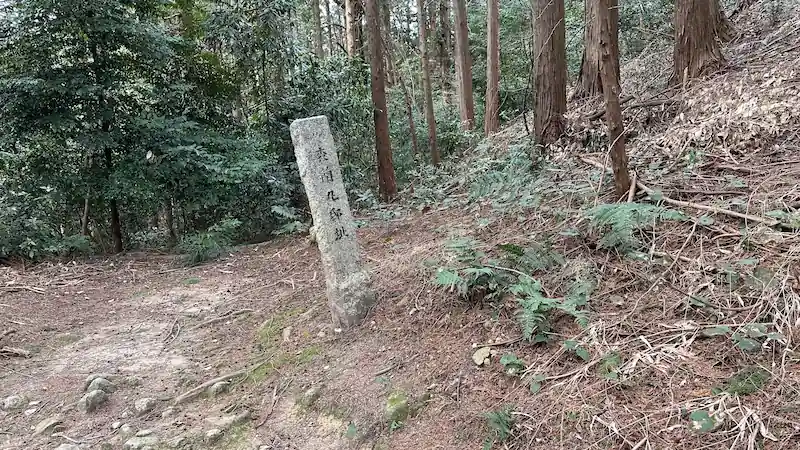
Just before the Kuroganemon Gate ruins is the "Site Said to Be Mori Ranmaru's Mansion," traditionally identified as the residence of Mori Ranmaru (birth name Mori Naritoshi), a close page and attendant of Nobunaga. No buildings remain — you trace the outline of the residence through its stone walls and pillar bases. Ranmaru was deeply trusted by Nobunaga and is known for dying alongside his lord in the 1582 Honnoji Incident.
- Stone wall remains: Stone walls marking the mansion's boundary survive, giving a faint sense of its original layout.
- Position relative to Kuroganemon Gate: Given its position just before the Kuroganemon Gate, it's easy to imagine that Ranmaru may have been trusted enough by Nobunaga to be given a role close to the castle's core.
Quick visit: about 5 min / Unhurried: about 15 min
🗺 Address: Shimotoyoura, Azuchi-cho, Omihachiman, Shiga Prefecture
🚶 Access: Climbing from the Oda Nobutada mansion site toward the Tenshudai, it appears on the left.
Rating: Historical value ★★ / Visual appeal ★ / Experience value ★
| Built | 1576–1579 (Tensho 4–7) |
|---|---|
| Traditionally identified resident | Mori Naritoshi (Ranmaru) |
| Layout / features | Forward position just outside Kuroganemon Gate |
| Condition today | Stone walls and pillar bases survive |
| Heritage designation | Special National Historic Site "Azuchi Castle Ruins" |
| What you can see | What excavation and records revealed |
|---|---|
| Stone wall remains marking the mansion's boundary | Its position just before Kuroganemon Gate suggests Ranmaru may have held a trusted, castle-core role; the Oda Nobuzumi mansion site is nearby |
- A mark of trust: Given its position just before the Kuroganemon Gate, it's easy to imagine that Ranmaru may have been trusted enough by Nobunaga to be given a role close to the castle's core.
- The Honnoji Incident: Mori Ranmaru served as one of Nobunaga's closest attendants and died alongside his lord in the Honnoji Incident.
③ Site Said to Be Oda Nobuzumi's Mansion
Nobunaga's nephew and son-in-law of Akechi Mitsuhide — a traditional site next to the Mori Ranmaru mansion
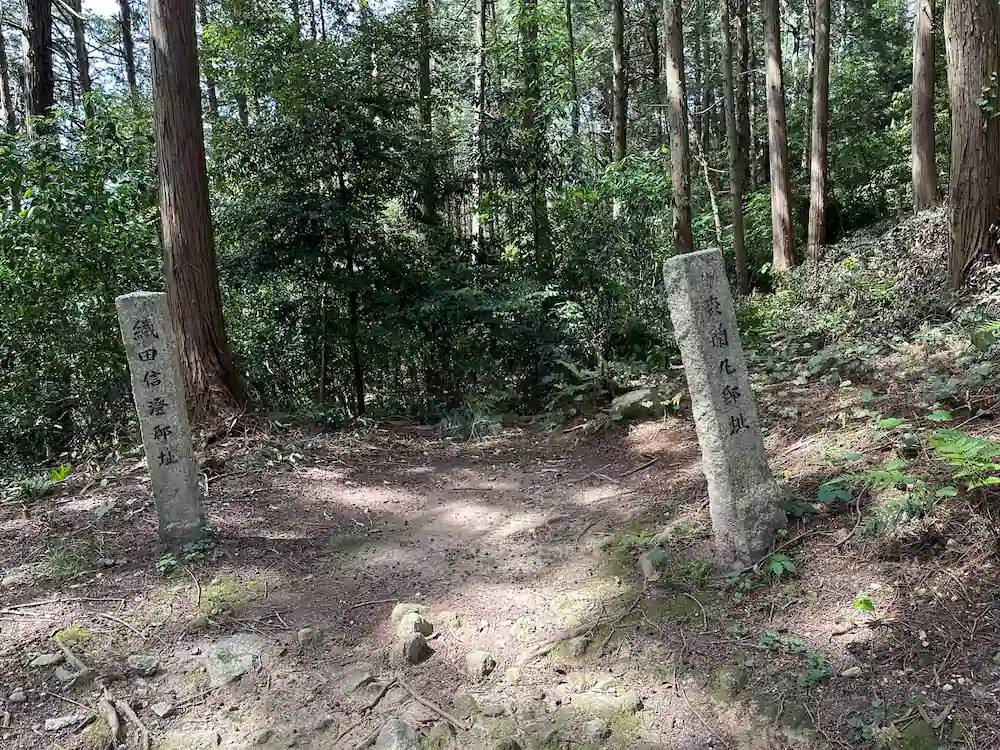
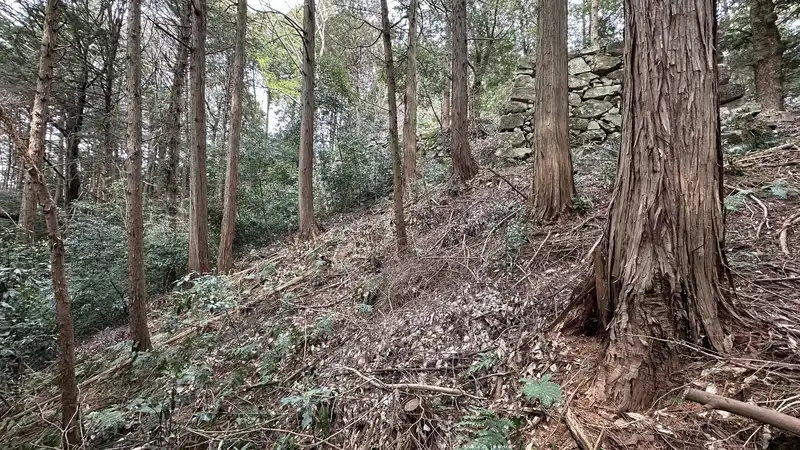
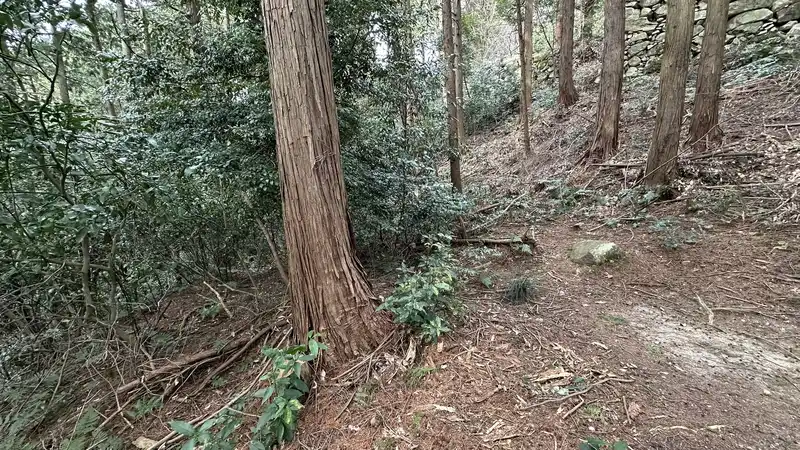
On the way toward Kuroganemon Gate, right beside the Mori Ranmaru mansion site, two stone markers stand side by side: one for "Oda Nobuzumi's mansion site" and one for "Mori Ranmaru's mansion site." Nobuzumi was the son of Oda Nobukatsu (also known as Nobuyuki), Nobunaga's younger brother, making him Nobunaga's nephew. In 1578 he became lord of Omizu Castle and married a daughter of Akechi Mitsuhide. After the Honnoji Incident, he was suspected of colluding with his father-in-law and lost his life as a result. As the "Site Said to Be" (den, 伝) in the name signals, it has not been confirmed with certainty that this is actually where Nobuzumi's mansion stood.
Tap to enlarge
- Stone markers for Oda Nobuzumi and Mori Ranmaru: Two stone markers stand together among the trees, indicating the locations traditionally associated with each man's residence. No remains showing the actual shape or layout of either building survive.
- A cluster of mansion sites along the path to Kuroganemon Gate: Along the route toward the Shukakubu are several sites traditionally linked to Oda-clan relatives and retainers, and this Nobuzumi site is one of them.
Viewing the markers themselves takes only a few minutes. There's no official visit-time estimate for this spot alone, but it's best seen together with the Mori Ranmaru mansion site and Kuroganemon Gate.
🗺 Address: Shimotoyoura, Azuchi-cho, Omihachiman, Shiga Prefecture (within the Azuchi Castle ruins)
🚶 Access: The marker stands at the same spot as the Mori Ranmaru mansion site.
Rating: Historical value ★★ / Visual appeal ★ / Experience value ★
| Layout / features | A traditional mansion site partway up Azuchi Castle's hillside, on the path toward Kuroganemon Gate. Stone markers for "Oda Nobuzumi's mansion site" and "Mori Ranmaru's mansion site" stand side by side. |
|---|---|
| Condition today | No mansion buildings survive. What you can see today is the traditional site itself and the stone markers. |
| Heritage designation | The Azuchi Castle ruins as a whole are a Special National Historic Site. No separate heritage designation specific to this mansion site could be confirmed. |
- Son of Nobunaga's executed brother: Nobuzumi was the son of Oda Nobukatsu (Nobuyuki), the younger brother Nobunaga had put to death. He went on to serve the Oda clan and later became lord of Omizu Castle.
- The "den" (traditional) label: The word "den" (伝) in the site's name signals that this is not confirmed with certainty as Nobuzumi's actual mansion site.
- Ties to Akechi Mitsuhide: Nobuzumi was Akechi Mitsuhide's son-in-law. Because of that connection, he was suspected of conspiring with Mitsuhide after the Honnoji Incident — historians generally believe he was killed within days on the orders of his cousin Oda Nobutaka mainly because of that marriage tie, with little solid evidence that he was actually involved in the plot.
- Nobuzumi in the 2026 Taiga drama: Azuchi Castle sits within the filming-location world of NHK's 2026 year-long historical drama Toyotomi Brothers! ("Toyotomi Kyōdai!") — one of Japan's annual flagship historical dramas, watched by a broad national audience. In it, actor Ogata Atsushi plays Oda Nobuzumi, portrayed as a man torn by conflicting loyalties as Nobunaga's nephew.
④ Kuroganemon Gate Ruins
The first checkpoint into the castle's core, whose name evokes iron plating — a strategic point where gold-leafed roof tiles were unearthed
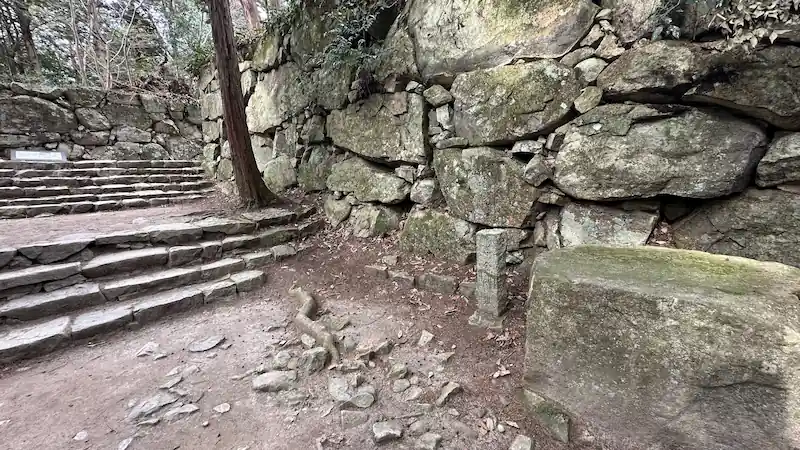
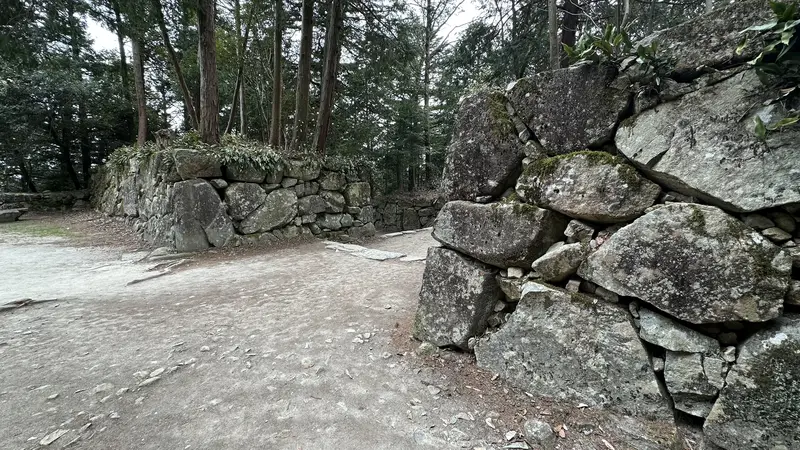
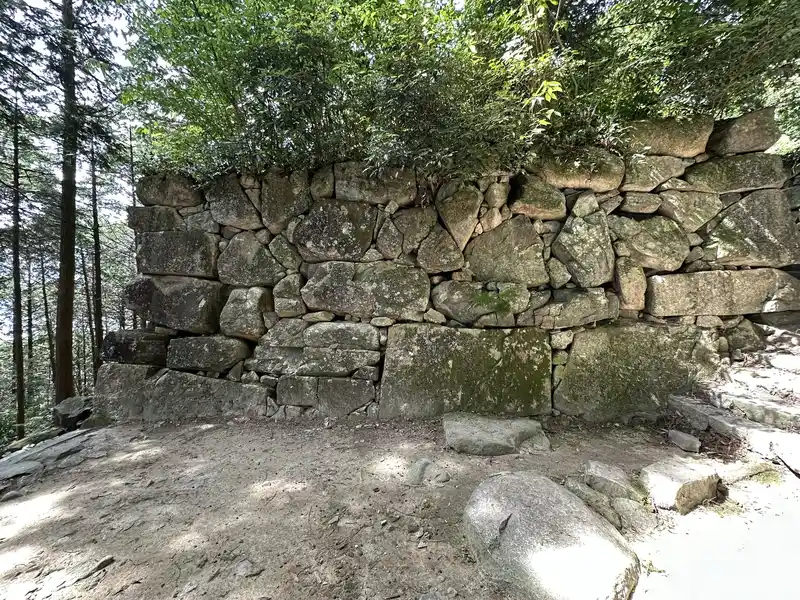
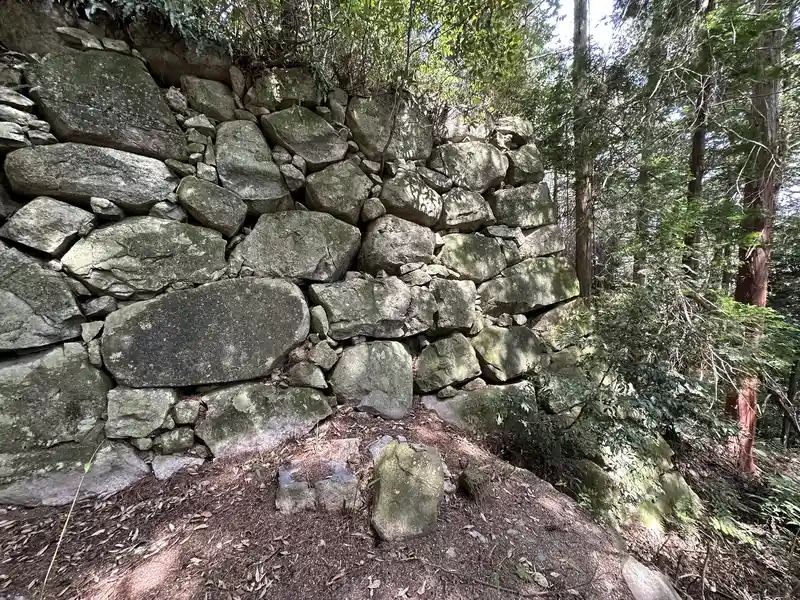
"Kuroganemon Gate Ruins" mark the main entrance into the core of Azuchi Castle. Positioned near the summit, this was the first checkpoint travelers passed on their way to the Honmaru (main bailey) and the Tenshu (castle tower). The surrounding stone walls use especially large stones, giving the site a commanding presence unlike any other part of the castle. The gate itself no longer stands, but the stonework and the layout of its masugata koguchi (a boxed, right-angled gate entrance designed to slow attackers) still tell the story. Excavations in 1993 uncovered evidence of fire along with gold-leafed roof tiles bearing chrysanthemum and paulownia crests — confirming that Kuroganemon Gate, like the castle tower, was consumed by flames when Azuchi Castle burned.
Tap to enlarge
- Massive stone walls: The stone walls around Kuroganemon Gate use unusually large stones, signaling both defensive strength and status.
- Masugata koguchi layout: The passage makes two right-angle turns — a structure where the path bends twice, slowing down any intruder's movement and making them easier to attack from the surrounding walls.
- Gold-leafed roof tiles: Excavations near the gate also turned up gold-leafed tiles bearing chrysanthemum and paulownia crests.
Quick visit: about 5 min / Unhurried: about 15 min
🗺 Address: Shimotoyoura, Azuchi-cho, Omihachiman, Shiga Prefecture
🚶 Access: You'll reach it heading from the Mori Ranmaru mansion site toward the Tenshudai.
Rating: Historical value ★★★ / Visual appeal ★★★ / Experience value ★★
| Built | 1576–1579 (Tensho 4–7) |
|---|---|
| Built by | Oda Nobunaga |
| Layout / features | Masugata koguchi (boxed gate), massive stone walls, a gate traditionally said to have been clad in iron (though the gate itself no longer survives) |
| Condition today | Stone walls and koguchi layout survive |
| Heritage designation | Special National Historic Site "Azuchi Castle Ruins" |
| What you can see | What excavation and records revealed |
|---|---|
| Massive stone walls and masugata koguchi remains | A 1993 excavation confirmed fire damage and gold-leafed roof tiles (chrysanthemum and paulownia crests) |
Azuchi Castle Ruins archaeological excavation report (1993 survey)
- Discovery of the gold-leafed tiles: The 1993 excavation showed that Kuroganemon Gate burned along with the castle tower, and the burned tiles recovered included gold-leafed examples bearing chrysanthemum and paulownia crests.
- Why "Kurogane" (Black Iron): "Kurogane" is an old word for iron. The name suggests the gate may have been a heavy structure making extensive use of iron plating and fittings, but the gate itself no longer survives, so its exact appearance remains uncertain.
Ninomaru and Nobunaga's Mausoleum
⑤ Memorial Pagoda for Oda Nobukatsu and Four Generations
The bloodline carried on by Nobunaga's second son — a stone pagoda honoring four generations
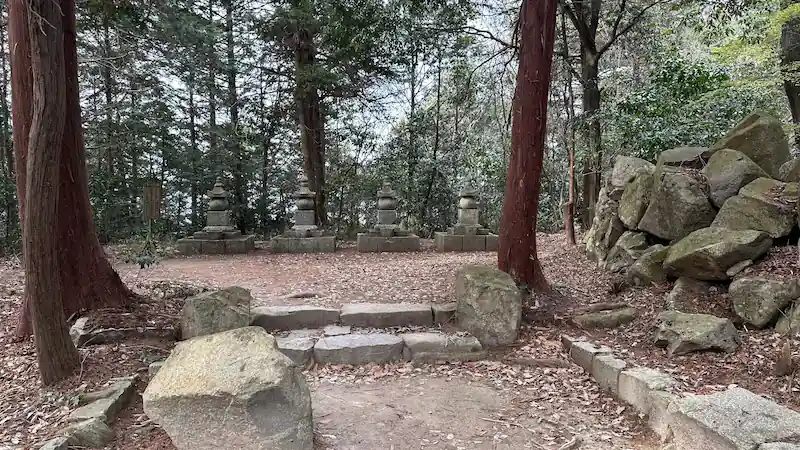
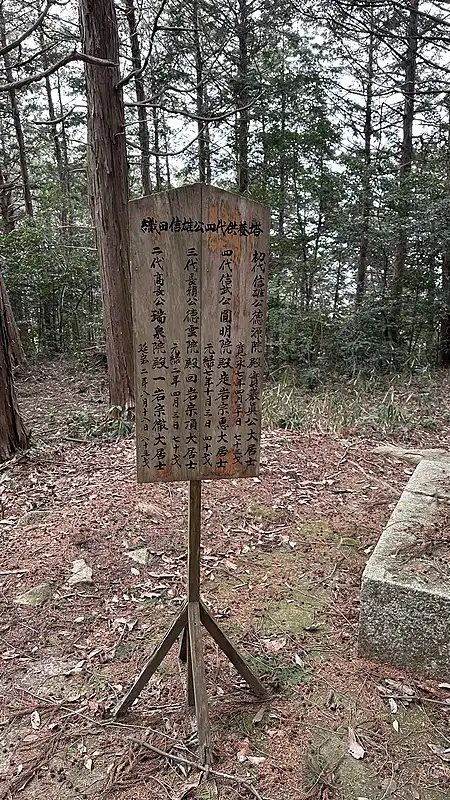
Just past Kuroganemon Gate, on the left, at what's said to be the former site of Hasegawa Hidekazu's mansion, stands the "Memorial Pagoda for Oda Nobukatsu and Four Generations." Nobukatsu (1558–1630) was Nobunaga's second son, and unlike many of his relatives he retained his standing as a feudal lord even after his father's death, carrying the Oda bloodline all the way into the Edo period. This site holds four memorial towers connected to Oda Nobukatsu, Takanaga, Naga(yori), and Nobutake. Shiga Prefecture's preservation and utilization plan suggests they may have been relocated here from Uda in Yamato Province. The site reflects how the relationship between the Oda family and Sōken-ji Temple continued even after Azuchi Castle was abandoned.
Tap to enlarge
- Memorial pagoda: A stone pagoda dedicated to Nobukatsu and four generations of his descendants.
- Surrounding stone walls: Stone walls nearby hint at the former presence of a samurai residence.
Quick visit: about 5 min / Unhurried: about 15 min
🗺 Address: Shimotoyoura, Azuchi-cho, Omihachiman, Shiga Prefecture
🚶 Access: From Kuroganemon Gate, head toward the Tenshudai and turn onto the small path on the left.
Rating: Historical value ★★ / Visual appeal ★ / Experience value ★
| Honorees | Oda Nobukatsu, Takanaga, Nagayori, and Nobutake (four generations) |
|---|---|
| Layout / features | Stone pagoda |
| Condition today | Survives intact |
| Heritage designation | Special National Historic Site "Azuchi Castle Ruins" |
- The Oda clan's survival: Nobukatsu is one of the few figures who retained his standing as a feudal lord after Nobunaga's death, carrying the family's bloodline all the way into the Edo period.
- The traditional Hasegawa Hidekazu mansion site: The memorial pagoda stands on what's said to be the former mansion site of Hasegawa Hidekazu, giving the land itself a layered history.
⑥ Ninomaru South Perimeter Enclosure Ruins
A narrow enclosure that shaped the castle's defensive line
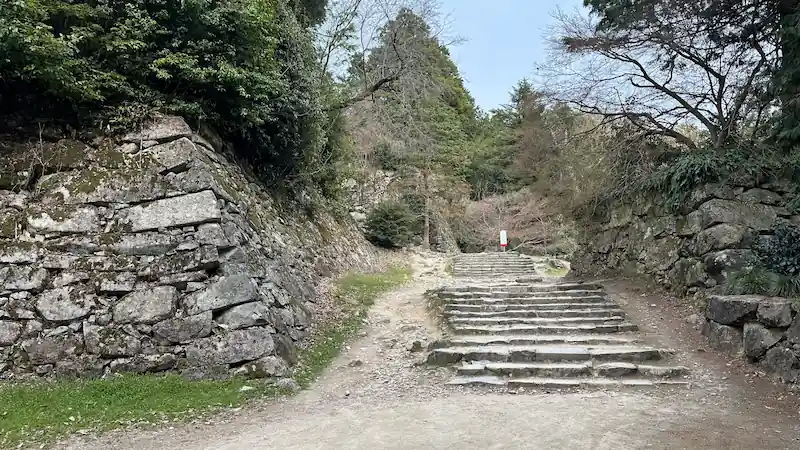
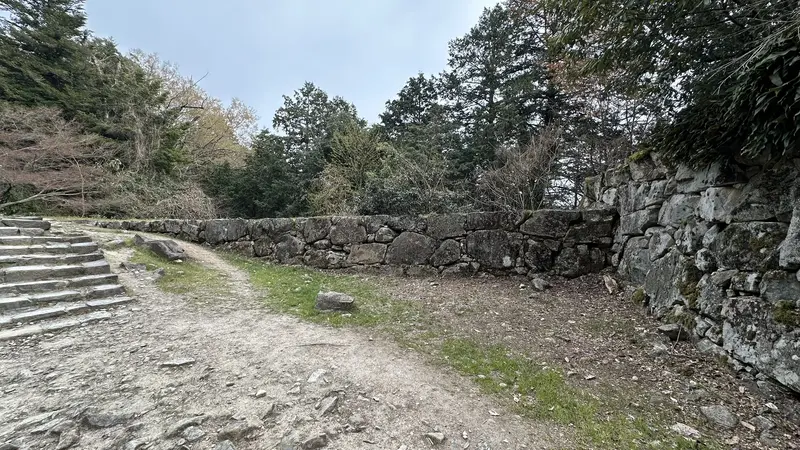
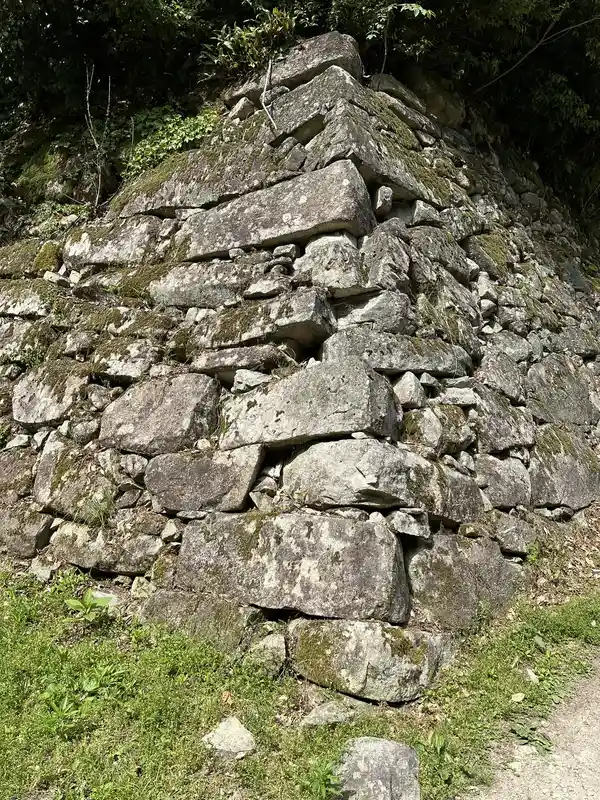
The "Ninomaru South Perimeter Enclosure Ruins" mark a narrow strip of land, called an obikuruwa ("girdle enclosure"), that ran along the south side of the Ninomaru (second bailey). An obikuruwa is a strip of land wrapped around the perimeter of a major enclosure, used both as a defensive line against attackers and for stationing troops or storing supplies. No buildings remain, but the stone walls and terrain still convey the original layout.
Tap to enlarge
- Surviving stone walls: Sections of period stone walls remain, giving a sense of Sengoku-era castle-building techniques.
- The long, narrow terrain: The distinctive shape of an obikuruwa is fun to appreciate while thinking through the castle's defensive strategy.
Quick visit: about 5 min / Unhurried: about 15 min
🗺 Address: Shimotoyoura, Azuchi-cho, Omihachiman, Shiga Prefecture
🚶 Access: From the Oda Nobukatsu memorial pagoda, return to the main path and continue toward the Tenshudai.
Rating: Historical value ★★ / Visual appeal ★ / Experience value ★
| Built | 1576–1579 (Tensho 4–7) |
|---|---|
| Layout / features | Narrow defensive strip along the Ninomaru's perimeter |
| Condition today | Stone walls and terrain survive |
| Heritage designation | Special National Historic Site "Azuchi Castle Ruins" |
- A multi-purpose enclosure: An obikuruwa wraps around a major enclosure, serving not just as a defensive line but also as a route for moving through the castle and transporting supplies.
⑦ Bussokuseki (Buddha's Footprint Stone)
A Medieval Buddha's Footstone Repurposed into the Castle Walls
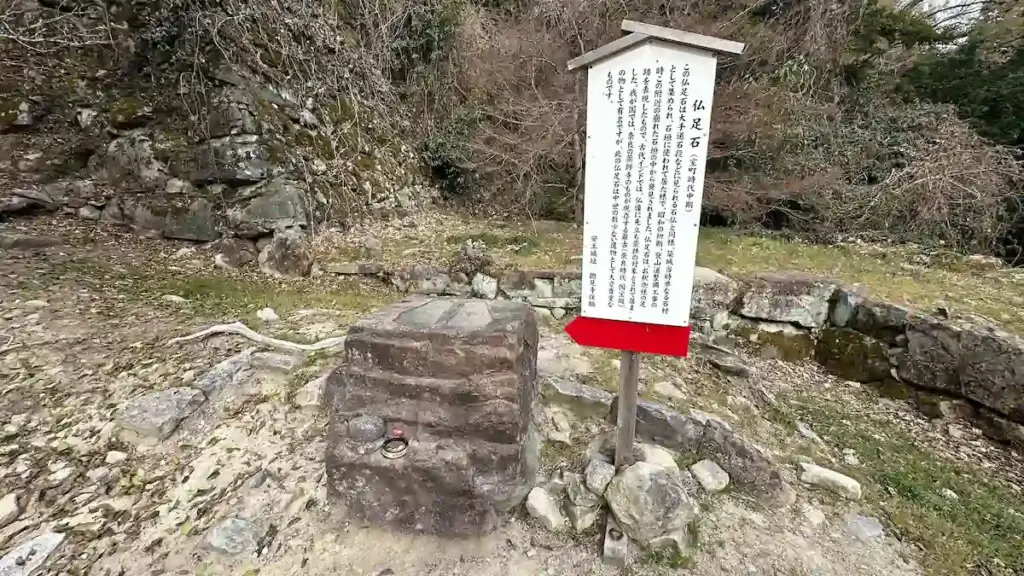
Near the Ninomaru, a bussokuseki has been found within the ruins of Azuchi Castle. A bussokuseki is a stone carved with an image of Buddha's footprints; in ancient India, this was an object of worship that predates Buddhist statues. In Japan, the oldest known example is at Yakushi-ji Temple in Nara, dating to the Nara period and designated a National Treasure. The bussokuseki at Azuchi is a rare medieval example, believed to have been repurposed as building material for the castle's stone walls during construction.
- The stone itself: Carved with an image of Buddha's footprints, this is a valuable relic from the medieval period.
- A symbol of repurposing: This stone stands as evidence that Nobunaga's builders repurposed even Buddhist-related stones as raw construction material.
See panoramic photos here (senior retainers' mansions and Niō-mon Gate)
Quick visit: about 5 min / Unhurried: about 15 min
🗺 Address: Shimotoyoura, Azuchi-cho, Omihachiman, Shiga Prefecture
🚶 Access: From the Ninomaru South Perimeter Enclosure Ruins, continue along the main path toward the Tenshudai.
Rating: Historical value ★★★ / Visual appeal ★ / Experience value ★★
| Date | Medieval period (exact date unknown) |
|---|---|
| Found at | A stone wall near the Ninomaru |
| Layout / features | A repurposed stone carved with Buddha's footprints |
| Condition today | Survives on site |
| Heritage designation | Special National Historic Site "Azuchi Castle Ruins" |
- An object of worship that predates Buddhist statues: A bussokuseki was an object of worship before Buddhist statues existed; in Japan, the oldest known example is at Yakushi-ji Temple in Nara.
- A culture of repurposed stone: Beyond the bussokuseki, Buddhist statues and five-ring memorial stones were also repurposed into Azuchi Castle's stone walls and steps, offering a glimpse of how building materials were gathered during construction.
⑧ Nobunaga's Mausoleum
The resting place Hideyoshi built for his late lord — a sanctuary holding Nobunaga's personal effects
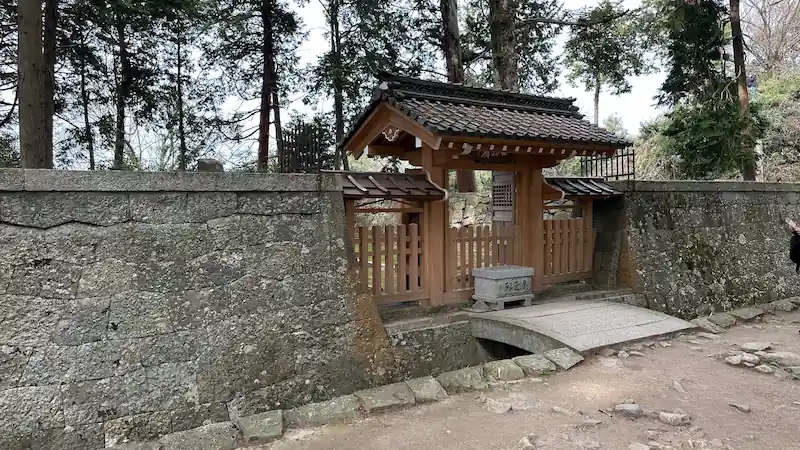
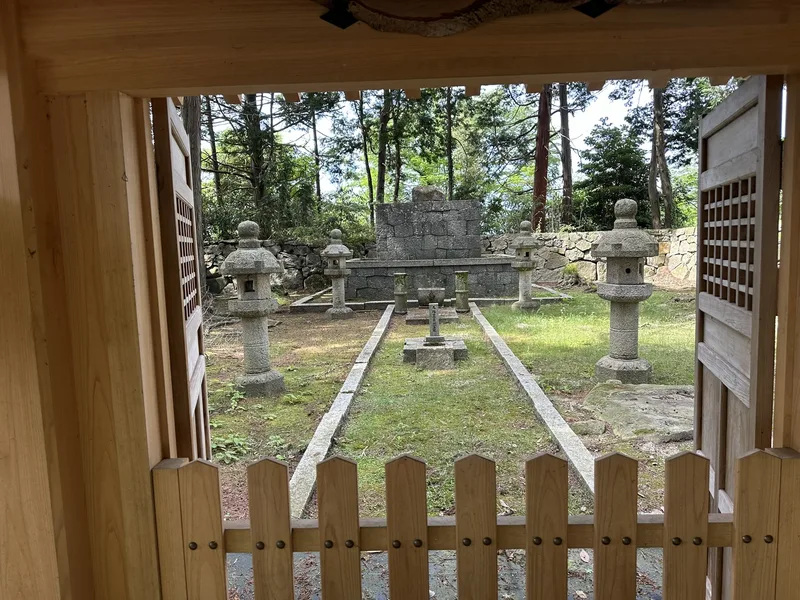
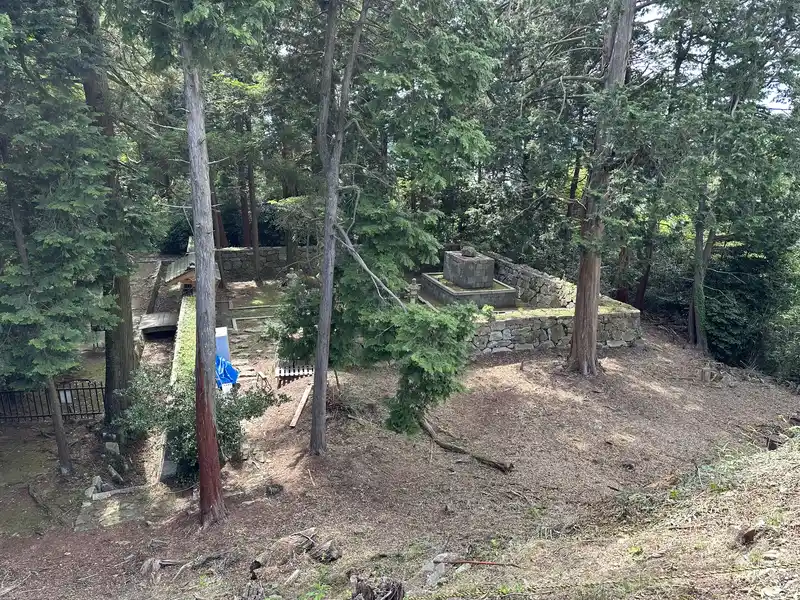
Within the Ninomaru ruins stands the mausoleum of Oda Nobunaga. It was built in February 1583 (Tensho 11) by Hashiba (later Toyotomi) Hideyoshi, and is said to hold personal effects that belonged to Nobunaga — his sword, formal court cap (eboshi), and robes (hitatare). On the first anniversary of his death, June 2 of that same year, a memorial service was held here, attended by members of the Oda clan and its retainers. Every year on June 2 to this day, a memorial service called "Nobunaga-ki" is still held at Sōken-ji Temple (in its temporary main hall).
Tap to enlarge
- Nobunaga's Mausoleum: This is where Nobunaga's personal effects are said to be buried. Visitors are free to pay their respects.
- Surrounding stone walls: Period stone walls remain around the mausoleum.
- Nobunaga-ki: Every June 2, a memorial service called "Nobunaga-ki" is held at Sōken-ji Temple.
Quick visit: about 5 min / Unhurried: about 20 min
🗺 Address: Shimotoyoura, Azuchi-cho, Omihachiman, Shiga Prefecture
🚶 Access: From the Bussokuseki, continue toward the Tenshudai and turn onto the small path on the left.
Rating: Historical value ★★★ / Visual appeal ★★ / Experience value ★★★
| Built | February 1583 (Tensho 11) |
|---|---|
| Built by | Hashiba (Toyotomi) Hideyoshi |
| Buried items | Nobunaga's sword, eboshi cap, and hitatare robes (personal effects) |
| Condition today | The mausoleum survives |
| Heritage designation | Special National Historic Site "Azuchi Castle Ruins" |
| What you can see | What excavation and records revealed |
|---|---|
| The mausoleum and surrounding stone walls | A first-anniversary memorial service was held June 2, 1583; the "Nobunaga-ki" service continues annually to this day |
- The first-anniversary service: The first-anniversary memorial was hosted by Hashiba Hideyoshi on June 2, 1583, attended by members of the Oda clan and its retainers.
- Built by Hideyoshi: The mausoleum was built by Hashiba Hideyoshi, who is said to have buried Nobunaga's personal effects here.
Honmaru and the Tenshudai
⑨ Ninomaru Ruins
Traditionally identified as the Ninomaru — home to Nobunaga's Mausoleum
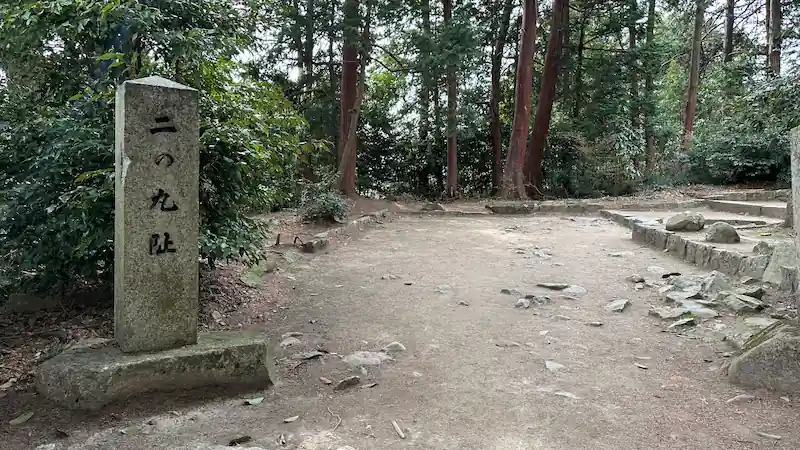
The "Ninomaru Ruins" mark one of Azuchi Castle's principal enclosures and once served as a hub for the castle's core functions. This area, now called the "Traditional Ninomaru Site," contains Nobunaga's mausoleum and surviving stone walls. Given its proximity to the Tenshudai and the Traditional Honmaru Site, it's thought to have been an important part of the castle's core.
- Nobunaga's Mausoleum: The mausoleum Hideyoshi built stands within this area.
- Surviving stone walls: Period stone walls remain around the Ninomaru ruins.
Quick visit: about 5 min / Unhurried: about 15 min
🗺 Address: Shimotoyoura, Azuchi-cho, Omihachiman, Shiga Prefecture
🚶 Access: Located at the same spot as Nobunaga's Mausoleum.
Rating: Historical value ★★★ / Visual appeal ★★ / Experience value ★★
| Built | 1576–1579 (Tensho 4–7) |
|---|---|
| Layout / features | Traditionally identified as the castle's core district, near the Tenshudai and the Traditional Honmaru Site |
| Condition today | Stone walls, pillar bases, and Nobunaga's Mausoleum survive |
| Heritage designation | Special National Historic Site "Azuchi Castle Ruins" |
- The castle's core: Now called the "Traditional Ninomaru Site," this area's closeness to the Tenshudai and the Traditional Honmaru Site suggests it was an important part of the castle's core.
⑩ Honmaru Ruins
A vast palace once called the "Thousand-Mat Hall" — 119 pillar bases that tell the story of its scale
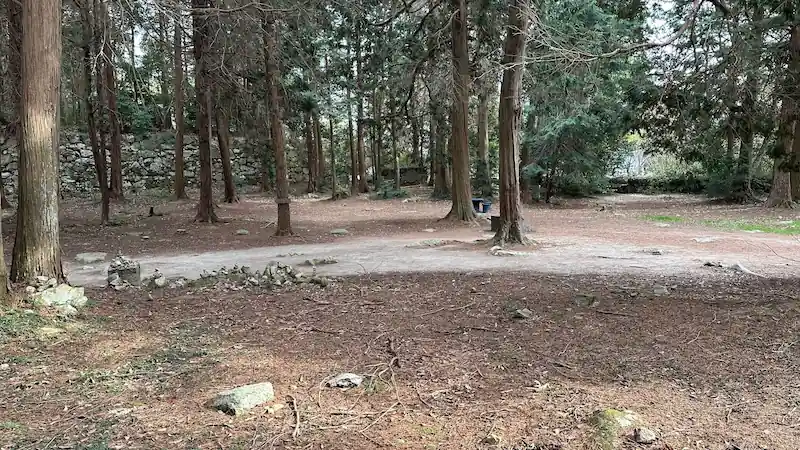
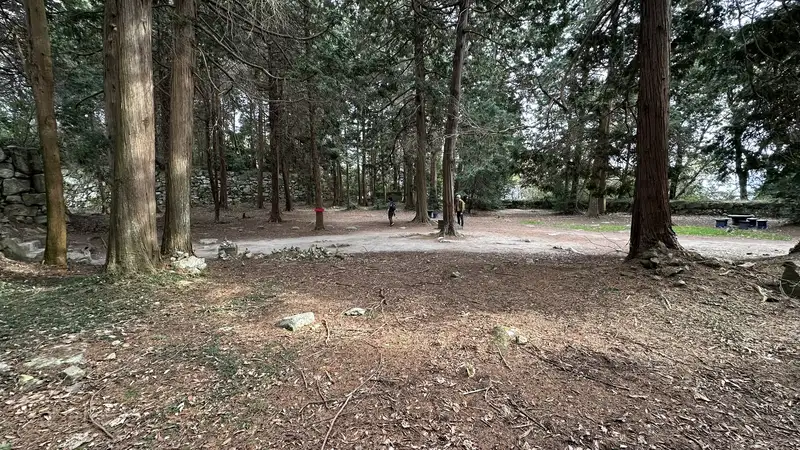
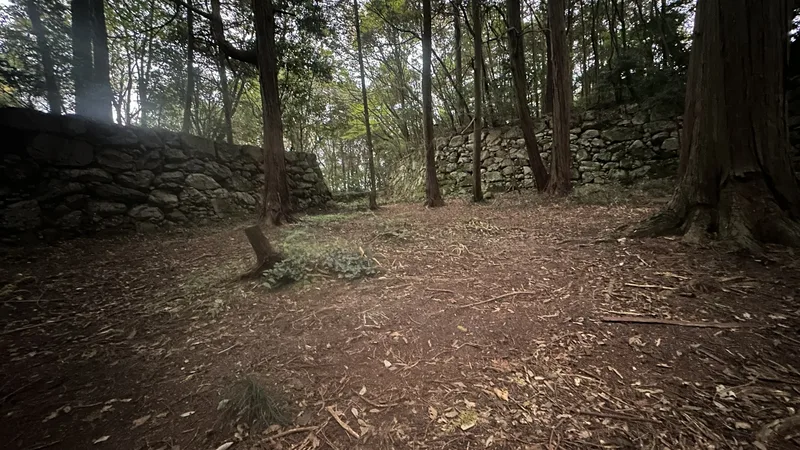
The Honmaru ruins mark the heart of Azuchi Castle. This vast, level site — nicknamed "Senjōjiki," or the "Thousand-Mat Hall" — is believed to have held a grand palace building. Excavations uncovered 119 building pillar bases arranged in a precise grid, revealing both the enormous scale of the original structure and its unusual layout. Based on the layout of the foundation stones, some scholars propose a reconstruction resembling the Seiryōden hall at Kyoto's Imperial Palace. If this really was a palace built to receive an imperial visit, it would mean Azuchi Castle was both Nobunaga's residence and a political stage for welcoming the emperor. That said, this reconstruction theory is disputed, and research continues today.
Tap to enlarge
- 119 building pillar bases: Pillar bases arranged in a grid pattern let you directly sense the scale of the original building.
- The vastness of the "Thousand-Mat Hall": True to its nickname, an astonishingly wide, flat expanse opens up here, remarkable for a mountaintop site.
- A close-up view of the Tenshudai: From the Honmaru ruins you can look directly up at the Tenshudai, making the castle's core layout easy to grasp.
Quick visit: about 5 min / Unhurried: about 20 min
🗺 Address: Shimotoyoura, Azuchi-cho, Omihachiman, Shiga Prefecture
🚶 Access: From the Ninomaru ruins, return to the main path and continue toward the Tenshudai.
Rating: Historical value ★★★ / Visual appeal ★★ / Experience value ★★
| Built | 1576–1579 (Tensho 4–7) |
|---|---|
| Layout / features | The "Thousand-Mat Hall," 119 pillar bases in a grid pattern |
| Condition today | Pillar bases and stone walls survive |
| Heritage designation | Special National Historic Site "Azuchi Castle Ruins" |
| What you can see | What excavation and records revealed |
|---|---|
| 119 pillar bases and stone walls | A layout resembling the Seiryōden at Kyoto's Imperial Palace, possibly built in anticipation of an imperial visit |
- An imperial visit: Based on the foundation-stone layout, some researchers propose a reconstruction resembling the Seiryōden at Kyoto's Imperial Palace, suggesting the palace may have been built with a visit from the emperor in mind — though this theory remains disputed and research continues.
⑪ Tenshudai Ruins 🎥 360°
The pinnacle of Nobunaga's vision — where his legendary tower once stood
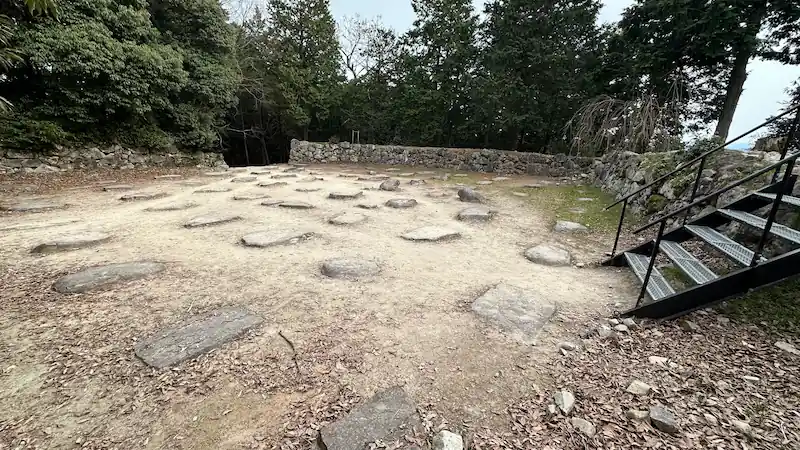
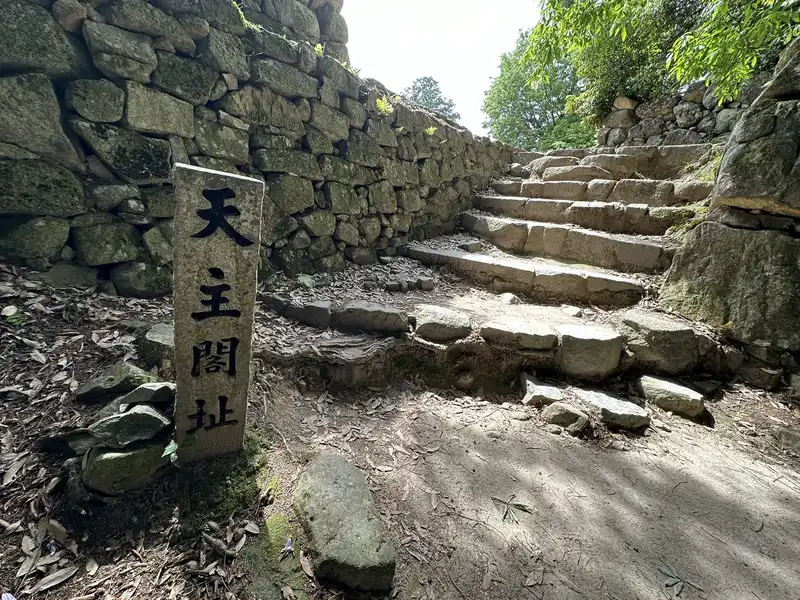
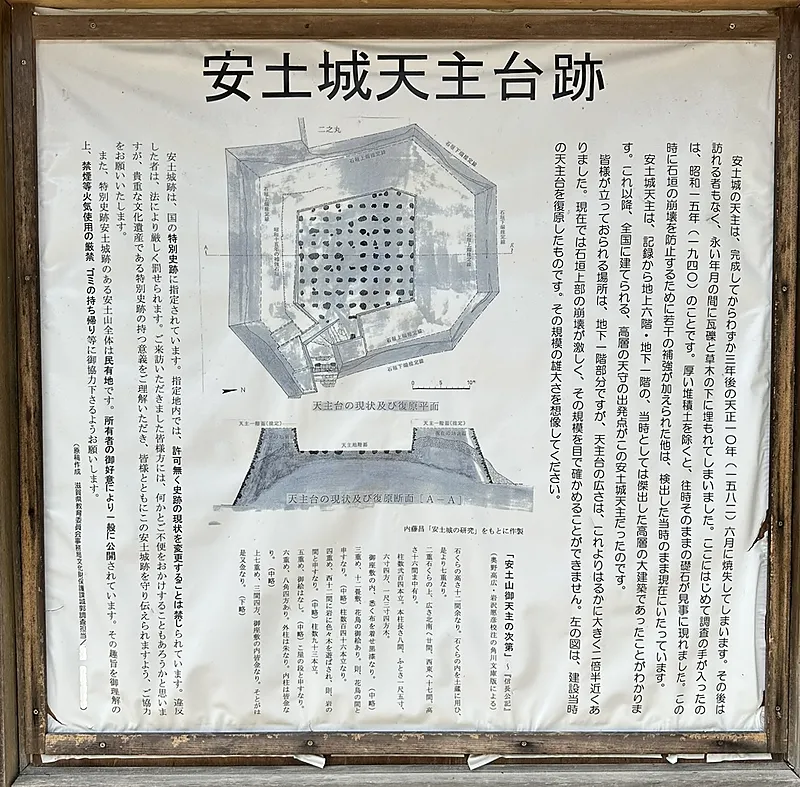
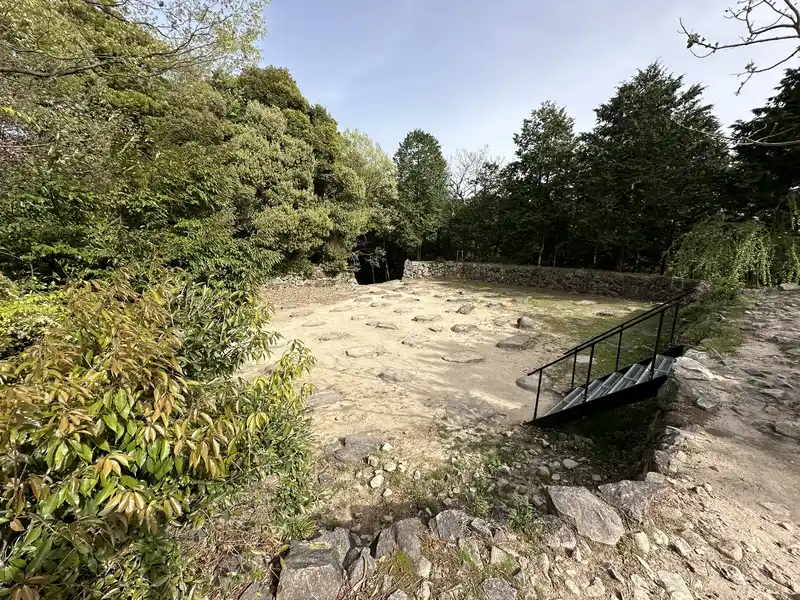
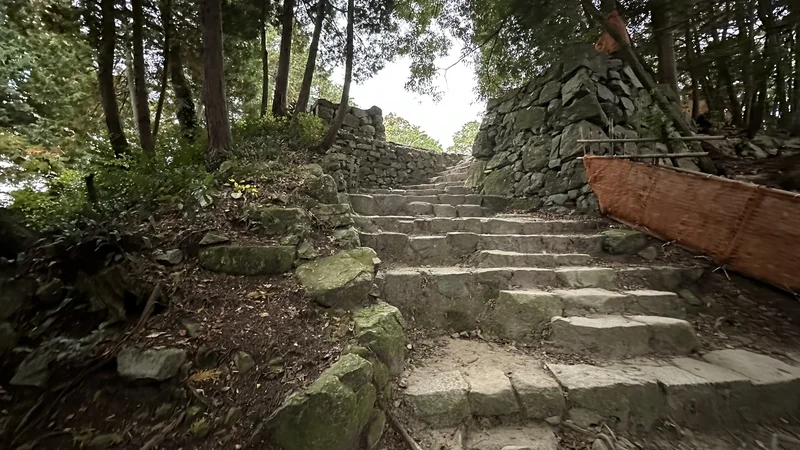
The Tenshudai ruins mark the site where a tenshu, or castle tower, once rose six stories above ground and one below, reaching a height of roughly 32 meters. Its design is said to have incorporated religious elements, making it unlike any castle tower built before it. The tower itself no longer stands, but the surviving stone walls and pillar bases still convey its enormous scale. Research suggests the Tenshudai's footprint is roughly the same size as the base of Himeji Castle's keep — standing here in person, that's hard to believe at first, given how compact it feels, but picturing a 32-meter tower rising from this exact spot brings the scale back into focus.
Tap to enlarge
- The Tenshudai's stone walls: Stone walls roughly 2 meters high enclose the Tenshudai.
- Pillar bases: The pillar bases that once supported the tower are still lined up here, offering a clue to the scale of the original building.
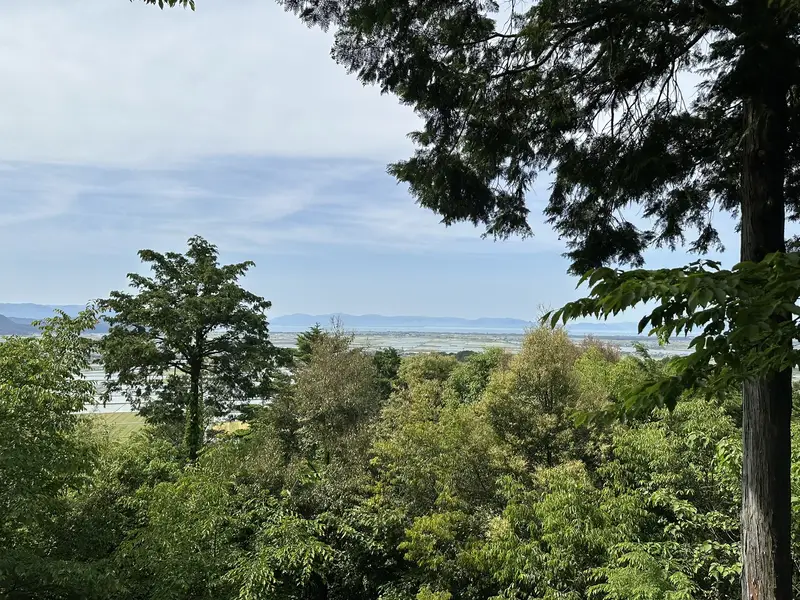
- The view through the trees: From the Tenshudai site, you can see farmland and the Nishinoko ("West Lake") area through gaps in the trees. Today the site is surrounded by trees, but when the tenshu tower stood here, the view may have been considerably wider.
- The mystery of the central pillar: Instead of a normal pillar base at the center, excavators found a hole — raising the possibility that a post was set directly into the ground, and leaving an unresolved structural mystery to this day.
See more panoramic photos here (Shukakubu edition — 13 photos)
Quick visit: about 10 min / Unhurried: about 30 min
🗺 Address: Shimotoyoura, Azuchi-cho, Omihachiman, Shiga Prefecture
🚶 Access: About a 20-minute walk from JR Biwako Line's Azuchi Station to the entrance, then another 25–30 minutes from the entrance to the Tenshudai site — plan for roughly 45–50 minutes total from the station.
Rating: Historical value ★★★ / Visual appeal ★★★ / Experience value ★★★
| Built | 1576–1579 (Tensho 4–7) |
|---|---|
| Layout / features | Six stories above ground, one below, roughly 32m tall, blending religious elements into its design |
| Destroyed | 1582 (Tensho 10), after the Honnoji Incident |
| Condition today | Stone walls and pillar bases survive |
| Heritage designation | Special National Historic Site "Azuchi Castle Ruins" |
| What you can see | What excavation and records revealed |
|---|---|
| Stone walls and pillar bases | The pillar-base layout confirmed an underground level; a hole rather than a base stone at the center points to the unresolved "mystery of the central pillar" |
Azuchi Castle Ruins archaeological excavation report / Shinchō Kōki ("The Chronicle of Lord Nobunaga") by Ōta Gyūichi
- A fusion of religion and architecture: Azuchi Castle's tenshu incorporated religious elements never before seen in castle architecture — a genuinely original structure for its time.
- The mystery of the central pillar: A castle tower's center should normally have a great central pillar resting on its own base stone, but no base stone was found here — only a hole. It's possible the post was set directly into the ground, and this remains one of Azuchi Castle's unsolved mysteries.
- The same scale as Himeji Castle: Research indicates the Tenshudai is roughly the same size as the base of Himeji Castle's keep. In person it feels more compact than you'd expect, but imagining a 32-meter structure rising from this footprint gives a sense of how imposing it must have been.
Frequently Asked Questions (FAQ)
A quick pass takes about 30 minutes; an unhurried visit takes about 60 minutes. This route covers the core of Azuchi Castle, from Kuroganemon Gate to the Tenshudai ruins. If you're continuing on from the Otemichi area, we recommend hydrating and taking a short break before starting the Shukakubu route.
From the Tenshudai site, you can see farmland and the Nishinoko ("West Lake") area through gaps in the trees. Today the site is surrounded by trees, but when the tenshu tower stood here, the view may have been considerably wider — and Lake Biwa once came closer to the base of the castle before land reclamation reshaped the terrain. It's a striking way to picture the outlook Nobunaga once had as he surveyed the realm he sought to unify.
Yes, Nobunaga's Mausoleum is open for visitors to pay their respects freely. It was built in 1583 by Hashiba (Toyotomi) Hideyoshi and is said to hold personal effects belonging to Nobunaga, including his sword and eboshi cap. Every June 2, a memorial service called "Nobunaga-ki" is held at Sōken-ji Temple (in its temporary main hall).
"Kurogane" is an old word for iron. The name suggests the gate may have been a heavy structure making extensive use of iron plating and fittings, but the gate itself no longer survives, so its exact appearance remains uncertain. A 1993 excavation near the gate did uncover gold-leafed roof tiles bearing chrysanthemum and paulownia crests, showing just how prestigious this checkpoint was.
Completed in 1579, Azuchi Castle's tenshu (tower) was an unprecedented structure for its era — six stories above ground, one below, and roughly 32 meters tall. Yet it burned down only three years later, following the 1582 Honnoji Incident. Because nothing survives above ground, it's often called a "phantom tower." Research into the layout of its pillar bases also revealed a hole rather than a base stone at the center, leaving a structural mystery still unresolved today.
A bussokuseki is a stone carved with an image of Buddha's footprints — an object of worship that predates Buddhist statues. The one found near the Ninomaru at Azuchi Castle is believed to have been repurposed as building material for the stone walls during construction. It's one of relatively few surviving medieval examples of a bussokuseki.
Yes — we publish 360° panoramic photos of the Tenshudai ruins, the entrance to Nobunaga's Mausoleum, Kuroganemon Gate, the Bussokuseki, and more. You can view the full Shukakubu edition (13 photos) on its dedicated page.
Other Areas
▶ Sōken-ji Temple Area Detailed Guide (Three-Story Pagoda, Niō-mon Gate, kitchen hearth ruins)
▶ 3 Temples That Preserve Remnants of Azuchi Castle (Chōkō-ji, Saikō-ji, Kōtaku-ji)
Back to the Complete Azuchi Castle Guide
☕ Support This Site
Following the Shogun is built on first-hand, on-the-ground research.
If this article was helpful to you, your support would mean a lot.

You can also support the site by scanning this QR code
Information on this site is current as of March 2026. For the latest opening hours and admission fees, please check the official Sōken-ji Temple website. Please do not reproduce the photos or 360° panoramic images on this page without permission.
Back to the Main Page



comment