


Traditional Site of Hideyori & Lady Yodo’s Deaths
Walking Osaka Castle’s Northern Stronghold
The Northern Stronghold is the least-visited yet most historically resonant area of Osaka Castle. This guide covers 7 spots — from the traditional site where the Toyotomi clan’s story ended, to the Hidden Bailey, more than 80 inscribed stones, Gokurakubashi Bridge, and Aoyamon Gate — where you can quietly take in Osaka Castle’s history away from the crowds.
The Northern Stronghold is the least-visited yet most historically resonant area of Osaka Castle. This is traditionally said to be near where the Toyotomi clan’s story ended in 1615; its defensive design is carved into stone, and massive monoliths still bear witness to Edo-period power. Each spot’s exterior is basically free to see — though entering the Kitajikiri gangi (stepped stone viewing platform) requires paid admission to Nishinomaru Garden.
The Northern Stronghold is the quietest corner of Osaka Castle, yet it carries some of the castle’s heaviest history. This is traditionally said to be near the site where the Toyotomi clan’s story ended in 1615, while the Hidden Bailey and the Kokuinseki Hiroba (Inscribed Stone Square) reveal the scale and defensive thinking behind the Tokugawa reconstruction. The reflection of the Main Tower in the moat at Gokurakubashi Bridge is one of the finest photo opportunities in the castle grounds, and Aoyamon Gate — a postwar reconstruction said to have sometimes been called the “kimon,” or demon gate, during the Edo period — completes the area. Each spot’s exterior is basically free to see; only the Kitajikiri gangi viewing platform requires paid admission to Nishinomaru Garden.
Northern Stronghold Area: Key Facts
| Location | 2-2 Osakajo, Chuo-ku, Osaka |
|---|---|
| Admission | Each spot’s exterior is basically free (the Kitajikiri gangi viewing platform requires paid Nishinomaru Garden admission) |
| Main Highlights | Traditional site of Hideyori & Lady Yodo’s deaths, Hidden Bailey, Kokuinseki Hiroba (80+ inscribed stones), Gokurakubashi Bridge, Higo Stone (54㎡), Aoyamon Gate |
| Access | Via Gokurakubashi Bridge from the Honmaru, or about a 5-minute walk from Osaka Business Park Station (N21) to Aoyamon Gate |
| Suggested Time | About 1–1.5 hours |
The 7 Spots
1. Hidden Bailey (Kakushi Kuruwa)
So easy to miss during a castle visit that it’s simply known as the “Hidden Bailey”
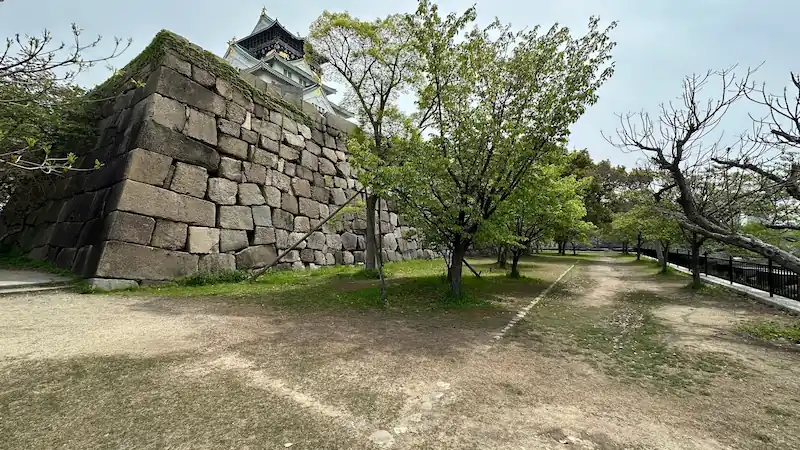
Tucked away on the northwest side of Osaka Castle is the Hidden Bailey (Kakushi Kuruwa) — a kuruwa, or fortified enclosure, so narrow and easy to miss that many visitors walk right past it. Because it’s hard to notice from the main visitor route, it came to be called the “Hidden Bailey.” During the Edo period, it temporarily housed the Enshogura, a gunpowder magazine, and access was tightly restricted. Its angled stone walls and narrow passage still limit sightlines and movement today, and the enclosure now sits quietly among trees, rarely visited.
| Era | Early Edo period (surviving stonework) |
|---|---|
| Origin | Nicknamed “Hidden Bailey” for being easy to miss during a castle visit; temporarily housed the Enshogura (gunpowder magazine) during the Edo period |
| Feature | Angled stone walls and a narrow passage that restrict sightlines |
| Admission | Free |
| Visit Duration | About 10–30 min |
- Easy to miss: It’s easy to overlook from the main visitor route, which is why it’s called the “Hidden Bailey.”
- Gunpowder magazine era: During the Edo period, it temporarily housed the Enshogura (gunpowder magazine), and access was tightly restricted.
- A quiet place to study stonework: One of the quieter spots in the castle to examine masonry up close.
- Inscribed stones nearby: Several stones bearing old carved marks are scattered around the area.
2. Kokuinseki Hiroba (Inscribed Stone Square)
A record of 80-plus inscribed stones from the Tokugawa reconstruction of Osaka Castle
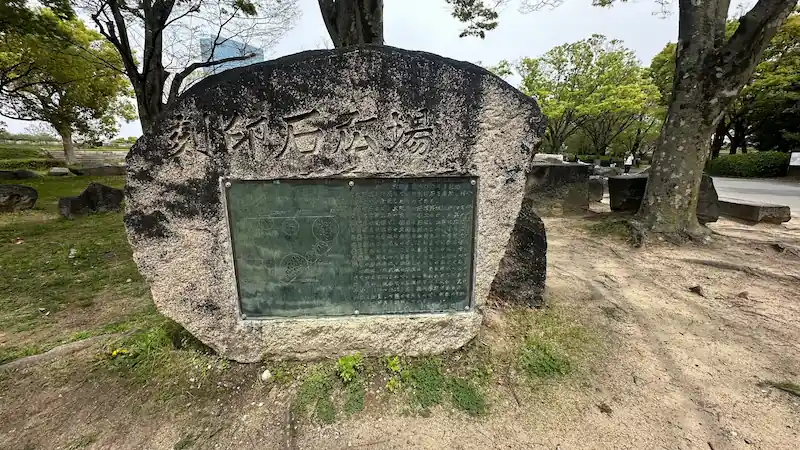
In the Yamazato-maru area on the castle’s north side, the Kokuinseki Hiroba (Inscribed Stone Square) was established in 1983 to mark the 400th anniversary of Osaka Castle’s construction. It displays more than 80 stones carved with kokuinseki — symbols believed to be related to the daimyo lords or stonemason groups who supplied them, though no specific family has been definitively identified. The stones are arranged into six zones by where they were found — Osaka Castle grounds, Ryuzoji-cho, Neyagawa, Kizugawa-guchi, Tamatsukuri-cho, and Other — rather than by which daimyo domain contributed them. Between 1620 and 1629, the Tokugawa shogunate (Japan’s ruling military government from 1603 to 1868) mobilized 64 western daimyo to rebuild the castle’s stone walls, and each carved mark is a small trace of that vast construction effort.
| Established | 1983 — 400th anniversary of Osaka Castle’s construction |
|---|---|
| Stones on Display | 80+ stones, arranged into 6 zones by find location |
| Construction Background | Between 1620 and 1629, the Tokugawa shogunate mobilized 64 western daimyo for the castle’s stonework (background for the site as a whole; individual displayed stones are not assigned to specific domains) |
| Admission | Free |
| Visit Duration | About 20–60 min |
- Arranged by find location: The stones are grouped into six zones based on where they were discovered — not by daimyo domain or clan assignment.
- Wedge-hole traces: Some stones still bear wedge holes (yanaana) used during the quarrying process, a tangible link to Edo-period stonecutting technique.
- Not from the Toyotomi era: A common misconception — all of Osaka Castle’s surviving stone walls date from the Tokugawa reconstruction (1620–1629), not Hideyoshi’s time.
3. Traditional Site of Hideyori and Lady Yodo’s Deaths
May 8, 1615 (Keicho 20) — traditionally said to be where Toyotomi Hideyori and Lady Yodo met their end
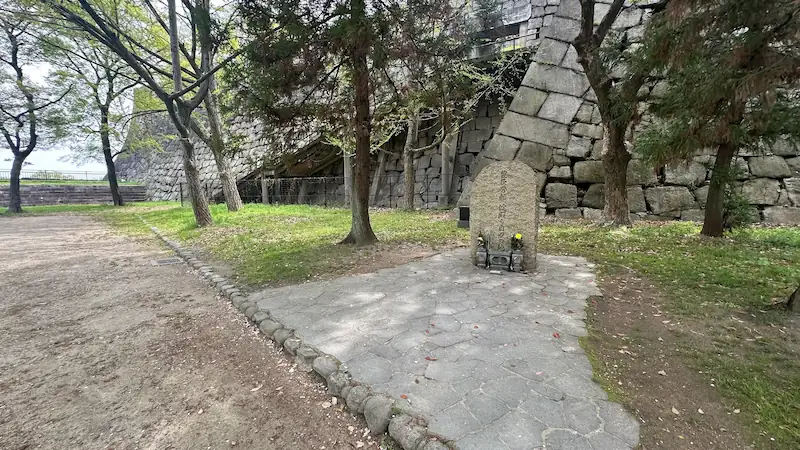
On May 8, 1615 (Keicho 20), during the final battle of the Summer Siege of Osaka — the campaign in which Tokugawa forces defeated the Toyotomi clan — Toyotomi Hideyori and his mother Lady Yodo are traditionally said to have met their end near here, in the former Yamazato-maru enclosure on the castle’s north side. The exact location is disputed among historical sources. In 1997, the City of Osaka erected a monument at this traditionally identified site. Lady Yodo was the daughter of the daimyo Azai Nagamasa and a niece of Oda Nobunaga, the 16th-century warlord who began the unification of Japan; she later became a consort of Toyotomi Hideyoshi, who built the original Osaka Castle. Nearby stands a memorial tower honoring attendants traditionally said to have died alongside them.
| Date | May 8, 1615 (Keicho 20) — Summer Siege of Osaka |
|---|---|
| Monument Erected | 1997, by the City of Osaka |
| Location | Near the former Yamazato-maru (traditional site; sources differ on the exact location) |
| Admission | Free |
| Visit Duration | About 20–30 min |
- The end of an era: The Toyotomi clan’s power in Osaka collapsed with its defeat in the Summer Siege of Osaka.
- Lady Yodo’s lineage: Daughter of the daimyo Azai Nagamasa and niece of Oda Nobunaga, her life connected several major houses of the Sengoku period.
- The 1997 monument: The current stone marker was erected by the City of Osaka.
- A nearby memorial: A memorial tower stands close by, honoring attendants traditionally said to have died alongside them.
4. Gokurakubashi Bridge
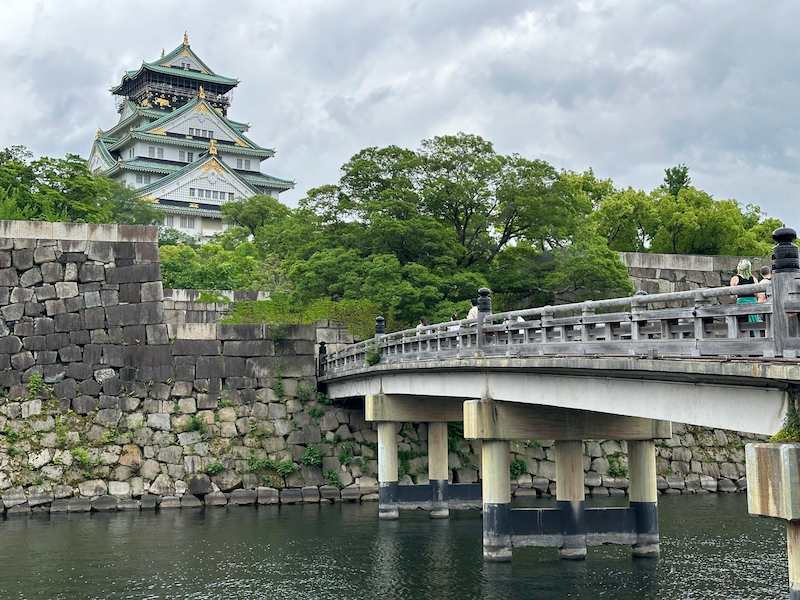
The Main Tower reflected in the inner moat — one of Osaka Castle’s most iconic views
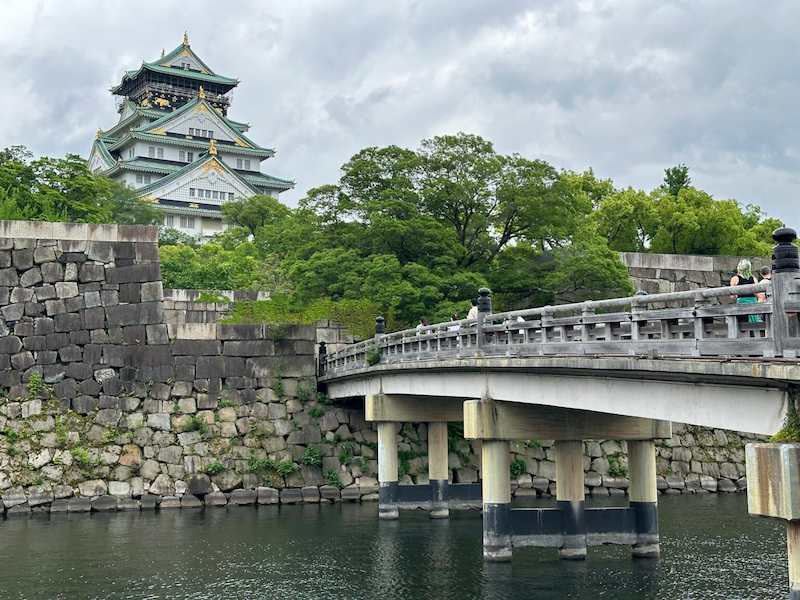
Gokurakubashi Bridge links the Honmaru with the Ninomaru (the castle’s second bailey) and offers one of Osaka Castle’s most photographed views — the Main Tower reflected in the inner moat. A lavish bridge of this name was built in 1596 by Toyotomi Hideyoshi to welcome envoys from Ming-dynasty China. After Hideyoshi’s death, its timbers were moved first to Hokoku Shrine in Kyoto, then later to Hogon-ji Temple on Chikubu Island. A Tokugawa-period wooden bridge stood in roughly the same spot but burned down during the Boshin War, the 1868–1869 conflict that ended the Tokugawa shogunate. The current bridge was rebuilt in 1965 using reinforced concrete while keeping traditional ornamental railings; it spans 54 meters across the inner moat.
| Originally Built | 1596 (Toyotomi Hideyoshi); current structure rebuilt 1965 |
|---|---|
| Length | 54 meters |
| Admission | Free |
| To Station | About 9 min walk to Osaka Business Park Station (N21) |
| Visit Duration | About 5–15 min |
- A ceremonial bridge from 1596: Hideyoshi had a lavish Gokurakubashi built to welcome envoys from Ming-dynasty China.
- Best time for the reflection shot: Morning light from the east produces the clearest mirror image of the Main Tower.
- A quiet alternative: Far less crowded than the main entrance, often peaceful even during peak season.
- An architectural afterlife: Timbers from the Toyotomi-era bridge were later reused at Hokoku Shrine in Kyoto, then at Hogon-ji Temple on Chikubu Island.
5. Kita-shikirimon Gate Ruins (North Partition Gate Ruins)
One of the “shikiri” partition walls and gates within the Tokugawa-era Ninomaru, set on the north side of Nishinomaru
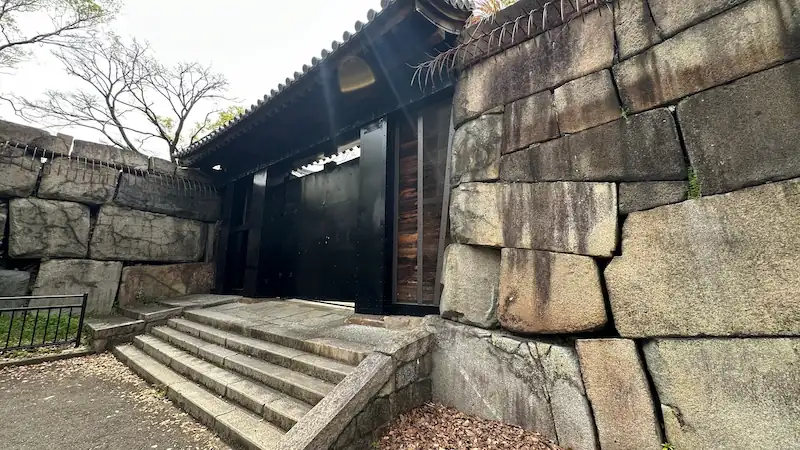
Kita-shikirimon was one of several “shikiri” — stone ramparts and gates used to partition sections of the Tokugawa-era Ninomaru (the castle’s second bailey) — and stood on the north side of Nishinomaru, the western enclosure now occupied by Nishinomaru Garden. (Ninomaru and Nishinomaru are different, similarly named parts of the castle: Ninomaru is the broad second bailey ring, while Nishinomaru is the western enclosure within it.) The original gate was lost after the Meiji Restoration, and the current structure was reconstructed in 1965, differing in appearance from the Edo-period original. It is not normally open to the public, though it is occasionally opened for special events. The surrounding stone walls and moat still carry much of the area’s historic atmosphere.
| Year Built | Edo-period original; reconstructed 1965 |
|---|---|
| Current Status | Usually closed; occasionally opened for special events |
| Admission | Free (exterior) |
| Address | 2-2 Osakajo, Chuo-ku, Osaka |
| Visit Duration | About 15 min (exterior) |
- Rare open days: When opened for Nishinomaru Garden events, visitors can pass through and see areas normally off-limits.
- Well-preserved stonework: The Edo-period stone walls and moat around the gate remain in excellent condition.
- Close to Hokoku Shrine: The gate’s proximity to Hokoku Shrine links this corner of the Northern Stronghold to Hideyoshi’s legacy.
- The gangi viewpoint is paid: Climbing the stone staircase (gangi) to the viewing platform overlooking the Main Tower requires paid admission to Nishinomaru Garden. The exterior of Kita-shikirimon itself can be seen from the free area.
6. Higo Stone
The second-largest monolith in the castle grounds — once popularly attributed to Kato Kiyomasa
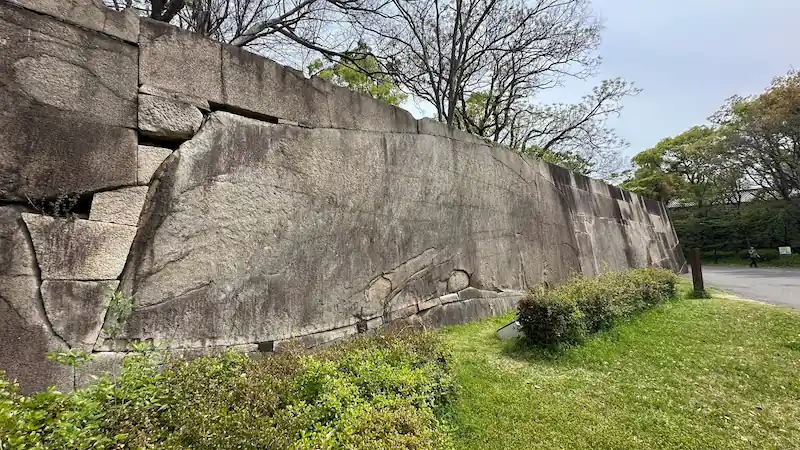
Standing in the masugata courtyard at Kyobashi-guchi, the Higo Stone is the second-largest monolith at Osaka Castle, with a surface area of about 54.17 square meters — roughly the size of 33 tatami mats. It was long popularly said to have been transported by the daimyo Kato Kiyomasa, which is how it came to be called the “Higo Stone” (Higo being Kiyomasa’s home province). Current scholarship instead generally attributes it to the Okayama Ikeda clan, who were responsible for the Tokugawa-era reconstruction of this section of the castle — part of the tenka-bushin system, under which the shogunate assigned castle-construction labor to daimyo across Japan as a demonstration of loyalty and financial strength.
| Size | About 54.17㎡ — second-largest monolith at Osaka Castle |
|---|---|
| Year Installed | Circa 1620s (Edo period) |
| Current Attribution | Generally linked to the Okayama Ikeda clan rather than Kato Kiyomasa |
| Location | Kyobashi-guchi Masugata, Northern Stronghold |
| Visit Duration | About 15–20 min |
- A surprising attribution: Long associated with Kato Kiyomasa, the stone is now generally linked to the Okayama Ikeda clan.
- A symbol of tenka-bushin: Ikeda Tadakatsu’s role reflects the Tokugawa policy of using stone transport to display the loyalty and financial strength of the various daimyo.
7. Aoyamon Gate
A postwar-reconstructed gate at the northeastern entrance to the Ninomaru
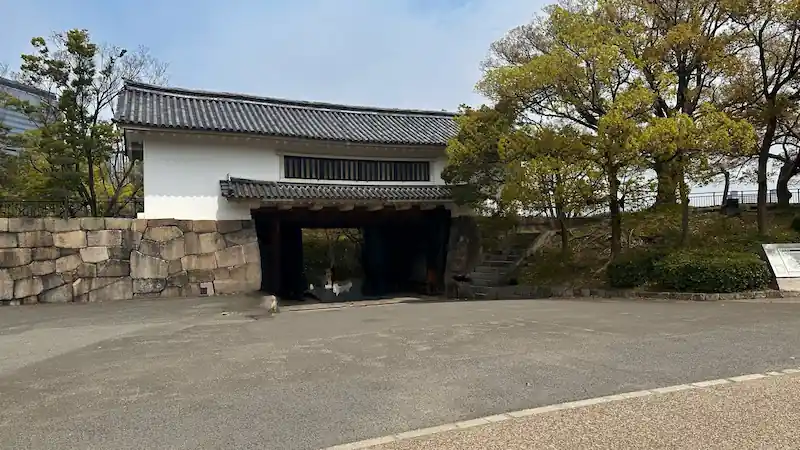
Aoyamon Gate stands at the northeastern entrance to the Ninomaru. Built around 1620 as part of the Tokugawa reconstruction, it was damaged during the upheaval of the Meiji Restoration and in WWII air raids; the gate standing today is a 1970 reconstruction. It combines a masugata courtyard — a rectangular defensive enclosure closed by two gates — with an unusual demasugata, an extended outer section that traps attackers even further. During the Edo period, the gate is said to have sometimes been called the “kimon,” or demon gate, because of its northeastern position, traditionally considered an inauspicious direction. Just outside the gate, the foundation of the former Soroban-bashi (a retractable bridge) is still visible.
| Year Built | Circa 1620 (Genna 6); reconstructed 1970 |
|---|---|
| Feature | Yaguramon gate with an unusual demasugata extension |
| Classification | Postwar reconstruction (rebuilt 1970) |
| Access | About 5 min walk from Osaka Business Park Station (N21) |
| Visit Duration | About 15–20 min |
- Kimon (demon gate): The northeast was traditionally considered an inauspicious direction, and the gate is said to have sometimes been called the “kimon” during the Edo period.
- Demasugata: Rarer than a standard masugata courtyard, this extended outer section trapped attackers more effectively.
- The Soroban-bashi foundation: The base of the former retractable bridge still survives just outside the gate — a rare surviving trace of castle infrastructure.
- Closest gate to Osaka Business Park Station (N21): The most convenient entry/exit point for visitors arriving via the Osaka Metro Nagahori Tsurumi-ryokuchi Line.
Osaka Castle: Full Area Map
Frequently Asked Questions (Northern Stronghold Area)
On May 8, 1615, during the Summer Siege of Osaka, Toyotomi Hideyori and his mother Lady Yodo are traditionally said to have met their end near the former Yamazato-maru on the north side of Osaka Castle. The exact location is disputed among historical sources. In 1997, the City of Osaka erected a monument at this traditionally identified site. Nearby stands a memorial tower honoring attendants traditionally said to have died alongside them.
The Hidden Bailey (Kakushi Kuruwa) is a narrow, easy-to-miss enclosure on the northwest side of Osaka Castle. Because it’s hard to notice from the main visitor route, it’s commonly called the “Hidden Bailey.” During the Edo period, it temporarily housed the Enshogura gunpowder magazine, and access was tightly restricted. Today it’s a quiet, tree-shaded corner of the grounds, rarely visited.
The Higo Stone is the second-largest monolith at Osaka Castle, with a surface area of about 54 square meters. It was long popularly believed that Kato Kiyomasa transported it, but it’s now generally attributed to the Okayama Ikeda clan, who were responsible for the Tokugawa-era reconstruction of this section of the castle.
Yes. The Northern Stronghold is one of the least-visited yet most historically resonant areas of Osaka Castle. It includes the 1615 monument at the site traditionally said to be where the Toyotomi clan’s story ended, the Hidden Bailey, the Kokuinseki Hiroba with more than 80 inscribed stones, Gokurakubashi Bridge, and Aoyamon Gate. Each spot’s exterior is basically free to see (only the Kitajikiri gangi viewing platform requires paid admission to Nishinomaru Garden). The quiet atmosphere is a striking contrast to the busier Honmaru area.
The Northern Stronghold is accessible from within Osaka Castle’s grounds at no extra charge. The most direct route from the Honmaru is across Gokurakubashi Bridge. From Osaka Business Park Station (N21) on the Osaka Metro Nagahori Tsurumi-ryokuchi Line, it’s about a 5-minute walk to Aoyamon Gate.
Aoyamon Gate stands at the northeastern entrance to the Ninomaru. It’s a postwar reconstruction: built around 1620 as part of the Tokugawa rebuilding, it was damaged during the Meiji Restoration and in wartime air raids, and the gate standing today dates from a 1970 reconstruction. It combines a masugata courtyard with an unusual demasugata extension that traps attackers further. During the Edo period, the gate is said to have sometimes been called the “kimon” (demon gate) because of its northeastern position. It’s the closest gate to Osaka Business Park Station (N21).
Continue Exploring
Back to the Osaka Castle Index Page
Back to the Main Page

☕ Support This Site
Following the Shogun is built on original fieldwork and on-site research.
If you found this guide useful, your support helps keep it going.

You can also support via QR code


comment