


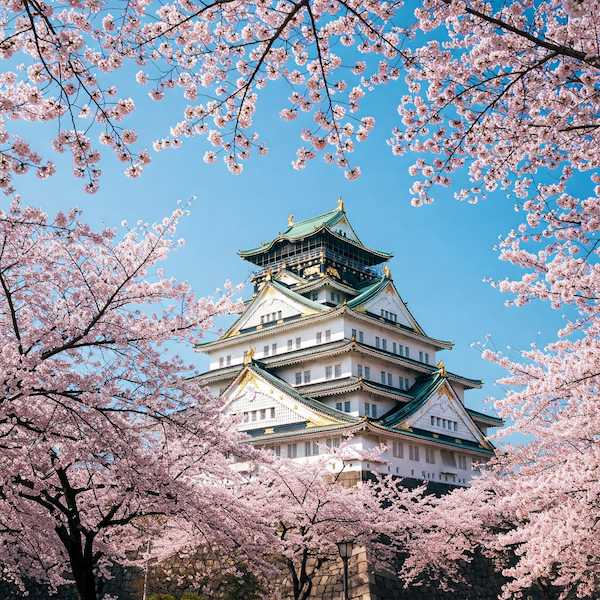
Osaka Castle: 7 Must-See Spots
A Half-Day Walking Route
This walking route links together the seven most rewarding stops at Osaka Castle in one no-backtracking path — from the grand Otemon Gate to the tranquil Gokurakubashi Bridge. Along the way you'll pass through Nishinomaru Garden, Toyokuni Shrine, Sakuramon Gate, the underground Toyotomi-era stone walls, and the Main Tower, taking in traces of both the Toyotomi and Tokugawa eras in a single outing. Every stop has been walked and photographed on-site.
This route brings together seven spots at Osaka Castle, in central Osaka's Chuo Ward, that combine strong visual impact with real historical significance — laid out along a single path with no backtracking required. From the grand entrance at Otemon Gate to the quiet Gokurakubashi Bridge, it passes through Nishinomaru Garden, Toyokuni Shrine, Sakuramon Gate, the Toyotomi-era stone walls preserved underground, and the Main Tower, letting you take in the castle's many layers of samurai-era history in one efficient walk.
Starting at Tanimachi 4-chome Station and finishing at Osaka Business Park Station on the Osaka Metro is the most efficient way to cover the whole route without doubling back.
7-Spot Route: Key Facts
| Time Needed | Pass-through, exteriors only: about 1.5–2 hours · Visiting Nishinomaru Garden, the Stone Wall Museum & Main Tower interior: about 3–4 hours |
|---|---|
| Cost | Mostly free · Nishinomaru Garden charges separate admission · the Main Tower is ¥1,200 for adults (includes the Stone Wall Museum) |
| Start Station | Osaka Metro Tanimachi Line, Tanimachi 4-chome Station (T23/C18), Exit 1-B |
| End Station | Osaka Metro Nagahori Tsurumi-ryokuchi Line, Osaka Business Park Station (N21) |
| Best Time to Go | Around 9 AM, right after opening — the Honmaru area and the Main Tower elevator queue start building up from mid-morning on weekends |
Route Map
The 7 Spots
1. Otemon Gate & Tamon Yagura
The castle's front door — where samurai once passed through one of Osaka Castle's strongest defensive points
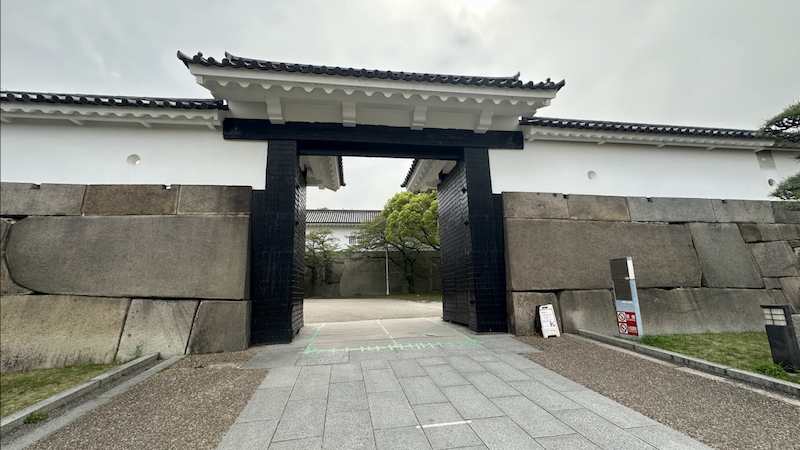
Otemon Gate, together with Tamon Yagura, forms Osaka Castle's grand main entrance. The gate you see today dates from the Tokugawa shogunate's reconstruction of the castle after the fall of the Toyotomi clan in 1615. It is built around a masugata — a square defensive courtyard designed to trap and disorient any attacker who made it through the outer gate.
Tamon Yagura is an imposing, corridor-style turret designated an Important Cultural Property. Its distinctive L-shaped layout was built to maximize defensive firing lines. Just past the gate, in the Oteguchi masugata courtyard, look for the huge stones known as Ote-mitsuke-ishi and Ote-niban-ishi.
Historical significance: ★★★ · Visual appeal: ★★★ · Experience value: ★★
| Year Built | First built in 1628; current Tamon Yagura rebuilt in 1848 |
|---|---|
| Cultural Property | Important Cultural Property (Tamon Yagura) |
| Admission | Free |
| Access | About 10 min walk from Tanimachi 4-chome Station (T23/C18, Exit 1-B) |
| Visit Duration | Quick: ~10 min · In-depth: ~20 min |
- Masugata courtyard: a square space designed to trap attackers and let defenders strike from three sides — standing in the center gives a real sense of the castle's original defensive thinking.
- Kokuinseki (stone-cutter marks): the stone walls around Otemon carry numerous carved marks believed to be related to the daimyo lords and stonemason groups mobilized for the construction work.
- Tamon Yagura's L-shape: a layout rarely seen elsewhere at Osaka Castle, built to cover multiple sightlines and firing angles at once.
- Seasonal color: cherry blossoms in spring and autumn foliage both make a striking contrast against the turret's white plaster walls.
For a closer look at every spot in this area, see the full Otemon Gate Area Guide.
2. Nishinomaru Garden
Linked to Nene, Hideyoshi's wife — one of Osaka's finest cherry blossom spots, with the Main Tower as a backdrop
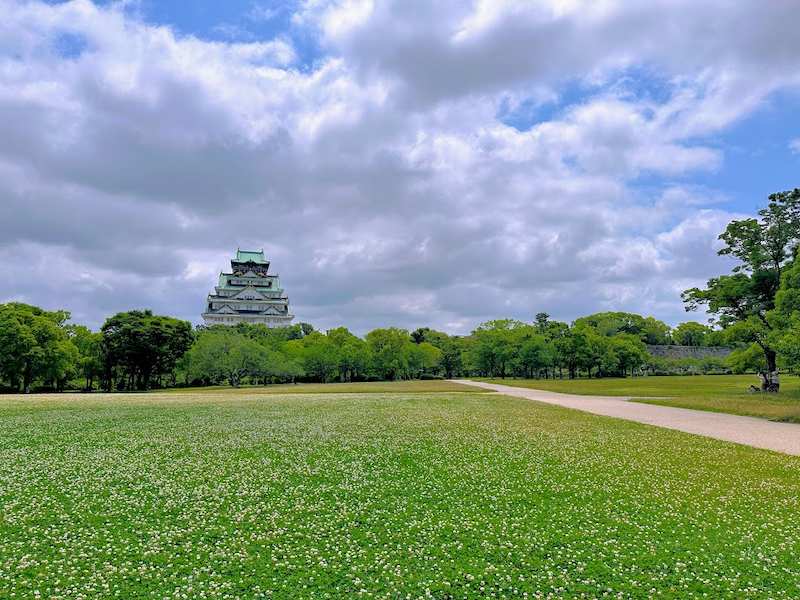
Nishinomaru Garden occupies what was once the western section of the castle grounds and is now a roughly 6.5-hectare lawn garden. In spring, its approximately 300 Somei-yoshino cherry trees make it one of Osaka's best-known hanami (cherry blossom viewing) spots.
Three Important Cultural Property structures stand inside the garden: Sengan Yagura and Inui Yagura (both built in 1620), and Enshogura, Japan's only surviving stone-built gunpowder magazine (built in 1685). A separate admission fee applies to enter the garden.
Historical significance: ★★★ · Visual appeal: ★★ · Experience value: ★★★
| Admission | Standard ¥300; ¥350 during the "Kanō Naitai" cherry-blossom night illumination period (Mar 20–Apr 12 in 2026; dates vary each year) · Closed Mondays (the following Tuesday if Monday is a holiday) and Dec 28–Jan 4 |
|---|---|
| Hours | Mar–Oct: 9:00 AM–5:00 PM · Nov–Feb: 9:00 AM–4:30 PM |
| Important Cultural Properties | Sengan Yagura, Inui Yagura, Enshogura |
| Visit Duration | Quick: ~20 min · Full stroll: ~40 min |
- About 300 cherry trees: illuminated at night during peak bloom, making this one of Osaka's best-loved hanami spots.
- Sengan Yagura (1620): one of the oldest surviving structures anywhere at Osaka Castle.
- Enshogura (1685): the only stone-built gunpowder magazine still standing anywhere in Japan.
Sengan Yagura, Inui Yagura, Enshogura, and the rest of this area are covered in detail in the Nishinomaru Garden Area Guide.
3. Toyokuni Shrine (Hokoku Shrine)
Dedicated to Hideyoshi, Hideyori, and Hidenaga — a stop for prayers of career success
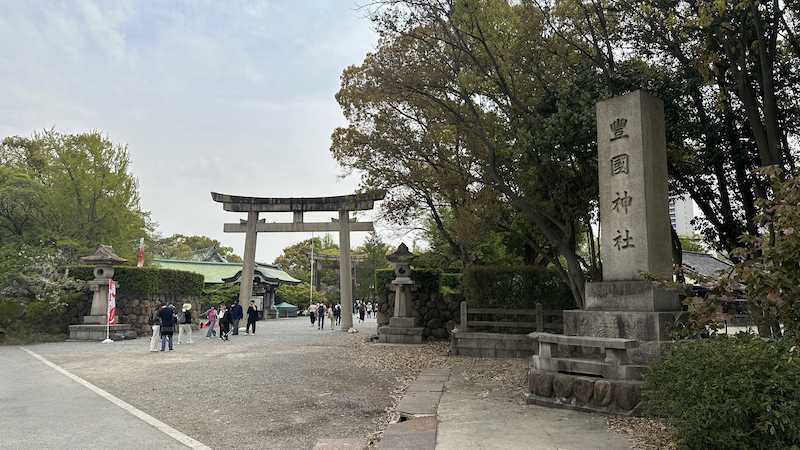
Toyokuni Shrine — the sign at the site reads 豊国神社, read locally in Osaka as "Hokoku Jinja," the same characters read "Toyokuni" at its parent shrine in Kyoto — enshrines Toyotomi Hideyoshi, Toyotomi Hideyori, and Toyotomi Hidenaga. It was founded in 1879 as a branch of Kyoto's Toyokuni Shrine, originally at Yamazaki-no-hana on Nakanoshima island, and moved to its present site inside Osaka Castle Park in 1961.
The grounds include a bronze statue of Hideyoshi and a torii gate, and the shrine is popular with visitors praying for career success and good fortune. Goshuin (shrine stamps) and omamori (amulets) are also available.
Historical significance: ★★ · Visual appeal: ★★ · Experience value: ★★★
| Founded | 1879; moved to its current site in 1961 |
|---|---|
| Admission | Free (goshuin stamp fee is separate) |
| Official Website | osakacastlepark.jp |
| Visit Duration | Quick: ~10 min · With goshuin: ~20 min |
- Enshrined deities: Hideyoshi, Hideyori, and Hidenaga are honored together here.
- Bronze statue: shows Hideyoshi in campaign armor with a fan at his waist, greeting visitors along the approach.
- Career-success shrine: a popular stop for job hunters and anyone seeking a promotion.
Toyokuni Shrine and the rest of this area are covered in the Nishinomaru Garden Area Guide.
4. Sakuramon Gate
The main gate into the Honmaru — home to Takoishi, Osaka Castle's largest stone
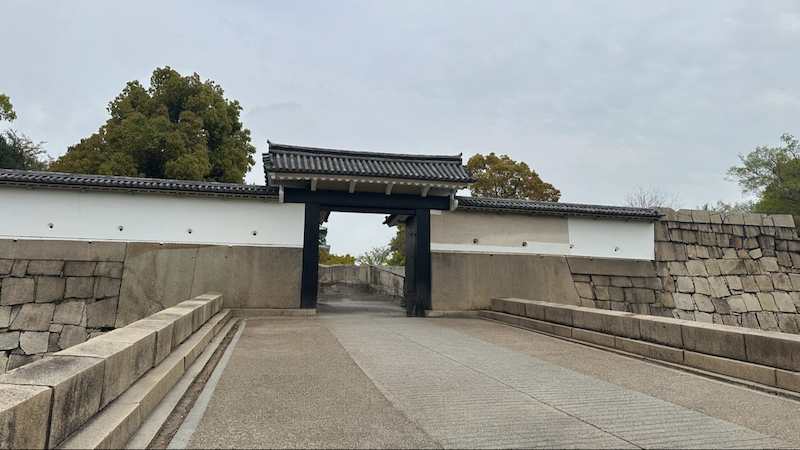
Sakuramon Gate is the southern main gate leading into the Honmaru (the castle's inner citadel). It burned down during the Boshin War and was rebuilt in the Tokugawa-period style in 1887. Inside its masugata courtyard stands Takoishi ("Octopus Stone"), the largest stone at Osaka Castle — about 59 square meters of surface area and an estimated 108 tons, a granite block said to have been transported from Bizen Province (present-day Okayama Prefecture) in 1624.
On either side of the gate stand two more named stones, Ryu-ishi ("Dragon Stone") and Tora-ishi ("Tiger Stone") — according to local tradition, the outlines of a dragon and a tiger appear on their surfaces when they get wet with rain.
Historical significance: ★★★ · Visual appeal: ★★ · Experience value: ★★
| Built | 1626; rebuilt 1887 |
|---|---|
| Cultural Property | Important Cultural Property |
| Highlight | Takoishi — an estimated 108 tons and about 59㎡, the largest stone at Osaka Castle |
| Admission | Free |
| Visit Duration | About 10–20 min |
- Takoishi: the mottled pattern on its surface, said to resemble an octopus (hence the name), comes from natural weathering and the stone's mineral makeup.
- Furisode-ishi: the third-largest stone at the castle (about 54㎡), standing in the same masugata courtyard as Takoishi.
- Ryu-ishi & Tora-ishi: the named stones flanking Sakuramon Gate, said to reveal dragon and tiger shapes when wet.
- Kokuinseki: the surrounding stone walls carry marks believed to be related to the daimyo lords and stonemason groups who took part in rebuilding Tokugawa-era Osaka Castle.
The full picture of the Honmaru area, including Takoishi and the Main Tower, is in the Honmaru Area Guide.
5. Osaka Castle Toyotomi Stone Wall Museum
The buried Toyotomi-era castle — stone walls uncovered in 1984, found almost nowhere else in Japan
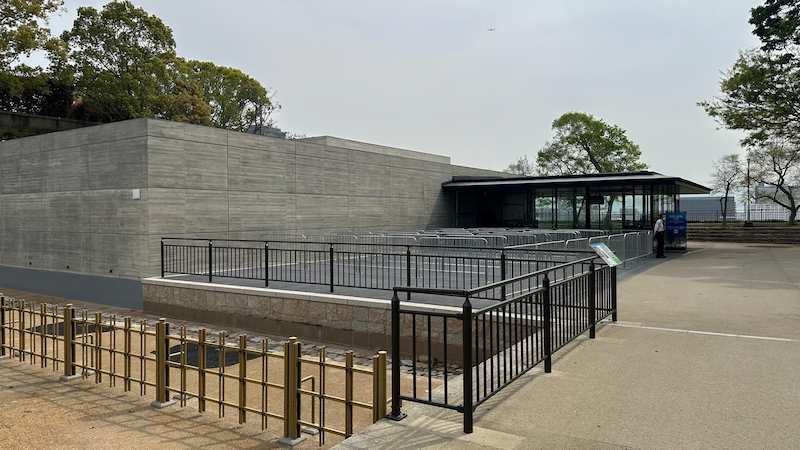
This underground exhibition hall lets visitors see the stone walls of the Osaka Castle that Toyotomi Hideyoshi built, up close. The walls had been buried and were discovered for the first time only in a 1984 excavation. After the fall of Osaka Castle in the summer campaign of 1615, the Tokugawa shogunate covered the Toyotomi-era castle with roughly 6 meters of earth and built an entirely new castle on top of it. In the underground exhibition hall, visitors can view the stone walls of the tsumenomaru (the innermost enclosure) through a glass floor, with multilingual explanatory panels.
Historical significance: ★★★ · Visual appeal: ★★★ · Experience value: ★★★
| Admission | Included with the Main Tower ticket (Adults ¥1,200 / university & high school students ¥600) |
|---|---|
| Hours | 9:00 AM–6:00 PM (last entry 5:30 PM) · Closed Dec 28–Jan 1 |
| Note | May close without notice depending on the stone walls' condition · No restroom inside |
| Official Website | osakacastle.net |
| Visit Duration | About 10–30 min |
- A second castle underground: what's visible above ground today is the Tokugawa-era Osaka Castle; a surviving layer of the Toyotomi-era castle lies buried beneath it.
- Tsumenomaru: the section of stone wall on display once protected the innermost, most private part of Toyotomi Osaka Castle.
- Opening history: the current exhibition facility opened to the public in 2025.
For a full first-hand account of this visit, see our Osaka Castle Toyotomi Stone Wall Museum visit journal.
6. Osaka Castle Main Tower
Osaka's symbol — an 8-floor history museum rebuilt through public donations
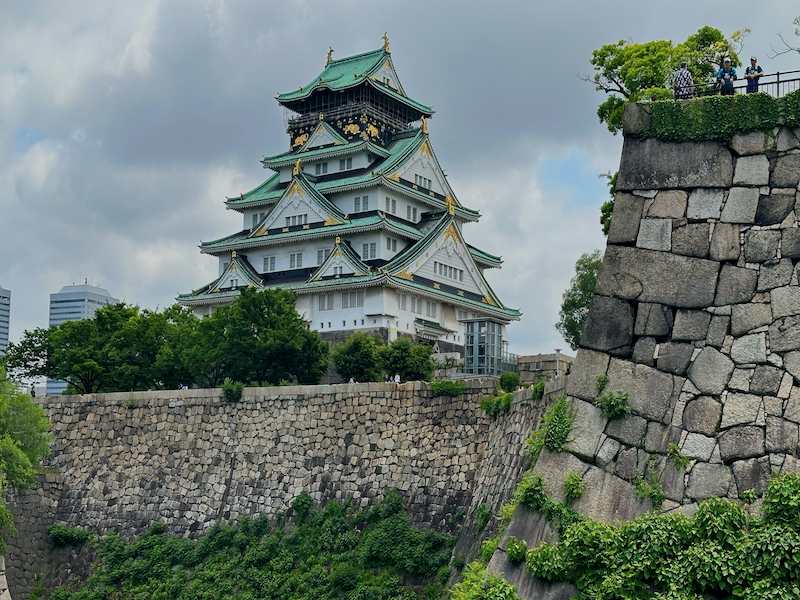
The Osaka Castle Main Tower is the symbol of the castle. The present building was rebuilt in 1931 with donations from the citizens of Osaka, and now functions as an 8-floor museum tracing the life of Toyotomi Hideyoshi and the castle's history.
Exhibits include samurai armor, gilded roof tiles, and the Folding Screen of the Summer Siege of Osaka, and the top-floor observation deck offers sweeping views over central Osaka.
Historical significance: ★★★ · Visual appeal: ★★★ · Experience value: ★★★
| Admission | Adults ¥1,200 / university & high school students ¥600 (ID required) / junior high school age and younger free (ID required) |
|---|---|
| Hours | 9:00 AM–6:00 PM (last entry 5:30 PM) · Closed Dec 28–Jan 1 |
| Official Website | osakacastle.net |
| Visit Duration | Quick visit: ~30 min · In-depth: ~60–75 min |
- Third tower on this site: this is the third main tower built at Osaka Castle, after the Toyotomi- and Tokugawa-era towers, rebuilt through public donations in 1931.
- Exterior design: modeled on the ornate appearance of Hideyoshi's Toyotomi-era tower.
- Cultural property status: registered as a national Registered Tangible Cultural Property in 1997.
Takoishi, the Main Tower, and everything else in this area are covered in the Honmaru Area Guide.
7. Gokurakubashi Bridge
A bridge named for "paradise" — a quiet finish with the Main Tower reflected in the inner moat
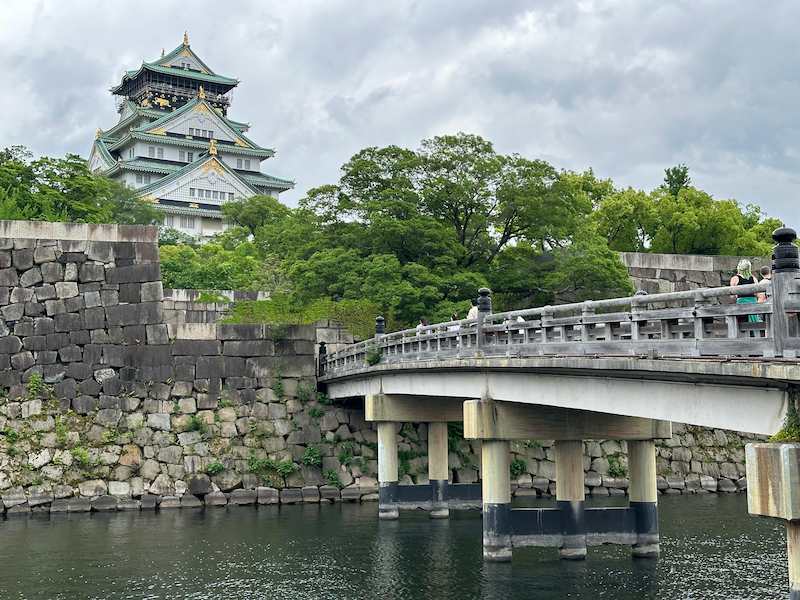
Gokurakubashi Bridge connects the Honmaru with the Ninomaru (second bailey) and is one of the best photo spots in the castle grounds, with the Main Tower reflected in the inner moat. According to tradition, the first bridge here was built in 1596 by Toyotomi Hideyoshi to welcome envoys from Ming-dynasty China. The current bridge is a 1965 reinforced-concrete reconstruction that keeps the traditional giboshi (onion-shaped finial) railings.
This makes a fitting place to end the route. From here, continue past Aoyamon Gate to reach Osaka Business Park Station (N21, Osaka Metro Nagahori Tsurumi-ryokuchi Line), about a 9-minute walk away.
Historical significance: ★★ · Visual appeal: ★★★ · Experience value: ★★
| Origin | First bridge said to have been built by Toyotomi Hideyoshi in 1596; current bridge rebuilt in 1965 |
|---|---|
| Admission | Free |
| Access | About 9 min walk to Osaka Business Park Station (N21) |
| Visit Duration | Quick: ~5 min · With photos: ~15 min |
- Classic reflection shot: on a calm day, the Main Tower appears clearly mirrored in the moat.
- Quiet northern route: noticeably calmer than the busy Honmaru area.
- Route to Aoyamon Gate: the natural path if you're heading toward Osaka Business Park.
Gokurakubashi Bridge and the rest of the quiet historic sites in this area are covered in the Northern Stronghold Area Guide.
Frequently Asked Questions
If you mainly pass through and view the exteriors, plan on about 1.5–2 hours total, including walking and sightseeing. If you also want to spend real time inside Nishinomaru Garden, the Stone Wall Museum, and the Main Tower, allow about 3–4 hours. Starting at Tanimachi 4-chome Station and finishing at Osaka Business Park Station is the most efficient route.
Yes. This route is designed for first-time visitors. It follows an easy-to-walk order and is curated to hit both visually striking sights and historically important spots, so you don't need any prior background knowledge to enjoy it.
Most of the spots on this route are free to visit. Nishinomaru Garden requires a separate admission fee. The Osaka Castle Main Tower (which includes the Osaka Castle Toyotomi Stone Wall Museum) is ¥1,200 for adults. Otemon Gate, Toyokuni Shrine, Sakuramon Gate, and Gokurakubashi Bridge are all free.
The tour starts at Otemon Gate, about a 10-minute walk from Osaka Metro's Tanimachi 4-chome Station (station numbers T23/C18, Exit 1-B). It finishes at Gokurakubashi Bridge, from which it's about a 9-minute walk to Osaka Business Park Station (N21) on the Osaka Metro Nagahori Tsurumi-ryokuchi Line.
Gokurakubashi Bridge offers a view of the Main Tower reflected in the inner moat, especially beautiful in morning light. Otemon Gate is also popular for its composition of powerful stone walls and the Tamon Yagura turret. In spring, Nishinomaru Garden — where you can enjoy cherry blossoms and the Main Tower together — is considered one of Osaka's best photo spots as well.
Starting around 9 AM is recommended. You'll be able to enjoy Nishinomaru Garden and the Main Tower right after they open, and it helps you get ahead of the crowds — on weekends, the Honmaru area and the Main Tower elevator line start building up from the morning onward. Morning light also gives the best reflection shot at Gokurakubashi Bridge.
Yes — the tour works perfectly well without it if you'd rather avoid the extra fee. That said, Nishinomaru Garden is the only place on this route to see the three Important Cultural Properties Sengan Yagura, Inui Yagura, and Enshogura up close, and in spring it's also one of the castle's best cherry blossom spots, so it's worth the visit if you have the time.
Want to Explore Further?
This route is built to cover Osaka Castle's highlights efficiently. If you want the fuller history of each area, the lesser-known details, and the full story behind every Important Cultural Property, the area-by-area complete guides below go much deeper.
Back to the Warlords Behind Osaka Castle


Return to the Homepage

☕ Support This Site
Following the Shogun is built on original fieldwork and on-site research.
If you found this guide useful, your support helps keep it going.

You can also support via QR code


comment