


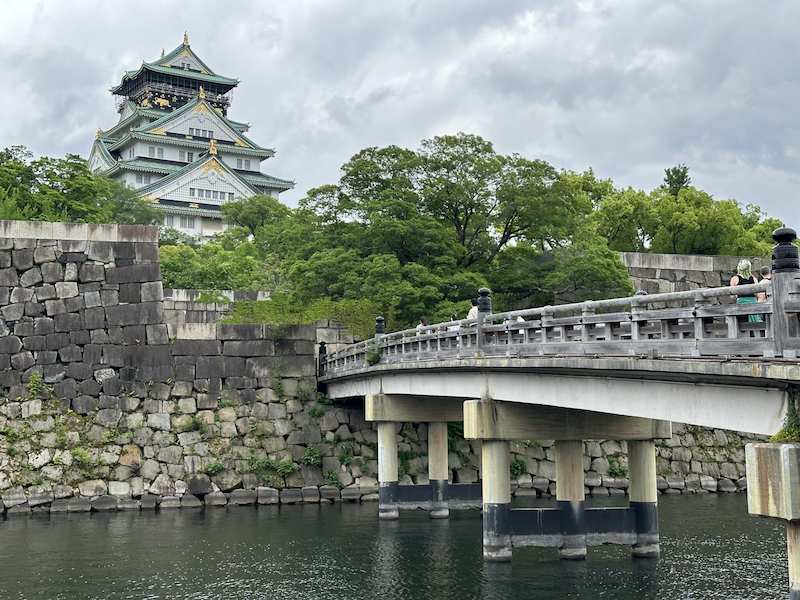
Otemon Gate & Tamon Yagura
Osaka Castle’s Historic Main Entrance
An on-site visit to the Otemon Gate area, Osaka Castle’s main entrance. Walk through the masugata-style Otemon Gate, the kokuinseki-carved south and north walls, and the Important Cultural Property Tamon Yagura, and see the Tokugawa shogunate’s defensive thinking up close in 5 spots.
The Otemon Gate area is Osaka Castle’s grand main entrance, and one of the most historically layered corners of the grounds. After the Toyotomi-era castle fell to Tokugawa forces in 1615, the Tokugawa shogunate rebuilt Osaka Castle from the ground up starting in the 1620s — on a larger, more heavily fortified scale than before — and the Otemon Gate area preserves that reconstruction in unusually concentrated form. Highlights include Otemon Gate itself, with its box-shaped masugata courtyard designed to trap intruders; the famous giant stones inside it; the south and north walls, both carved with kokuinseki — stones inscribed with marks believed to be related to the daimyo lords or stonemason groups who supplied them, though no specific family has been definitively identified; and the Important Cultural Property Tamon Yagura (first built around 1628, rebuilt in 1848). The entire area is free to visit.
Otemon Gate Area: Key Facts
| Location | 1-1 Osakajo, Chuo-ku, Osaka |
|---|---|
| Access | Osaka Metro Tanimachi Line, Tanimachi 4-chome Station (T23/C18) — about 10 min on foot |
| Admission | Free (the entire Otemon Gate area, part of Osaka Castle Park) |
| Suggested time | Quick visit: about 30 min / Thorough visit: about 45 min–1.5 hours |
| Main spots | Otemon Gate, the Ote-mitsuke-ishi & Ote-niban-ishi giant stones, the South Wall & North Wall (kokuinseki), Tamon Yagura (Important Cultural Property) |
The 5 Spots
1. Tamon Yagura North Wall
The white-plastered wall running north from Tamon Yagura along the outer moat
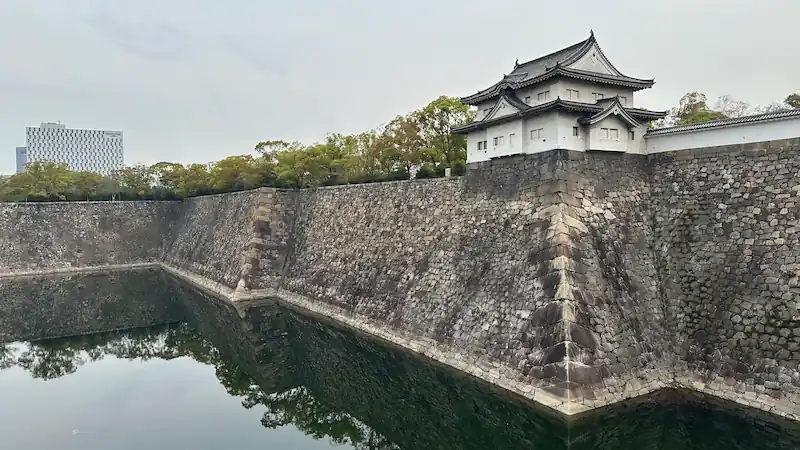
The Tamon Yagura North Wall is an Important Cultural Property wall running along the outer moat from the north side of Tamon Yagura. Together with the turret, it formed part of the defensive line protecting Osaka Castle’s main entrance. It was built as part of the Tokugawa-era defenses at Osaka Castle, and the wall standing today is believed to date from the late Edo period (the early-to-mid 1800s).
The contrast between the massive stone base and the white plaster above is one of the best photo compositions in the castle grounds — especially striking against spring cherry blossoms or autumn foliage.
| Year built | Built as part of the Tokugawa-era defenses; the surviving wall is believed to date from the late Edo period |
|---|---|
| Cultural property | Important Cultural Property (part of the Tamon Yagura complex) |
| Admission | Free |
| Access | About 15–18 min on foot from Tanimachi 4-chome Station (T23/C18) |
| Suggested time | About 5–15 min |
- Structural junction: Where Tamon Yagura connects to the north wall — a detail that shows how the gate and the moat approach were defended as one system.
- Massive stone base: The wall’s lower courses give a sense of the sheer scale of Osaka Castle’s Tokugawa-era reconstruction.
- Continuous defensive line: The long wall and turret together formed an unbroken line of defense above the moat.
- Changing light: The white plaster shifts color through the day, and is especially photogenic at dawn and dusk.
2. Otemon Gate
A masugata courtyard, massive stone walls, and Osaka Castle’s most famous giant stones
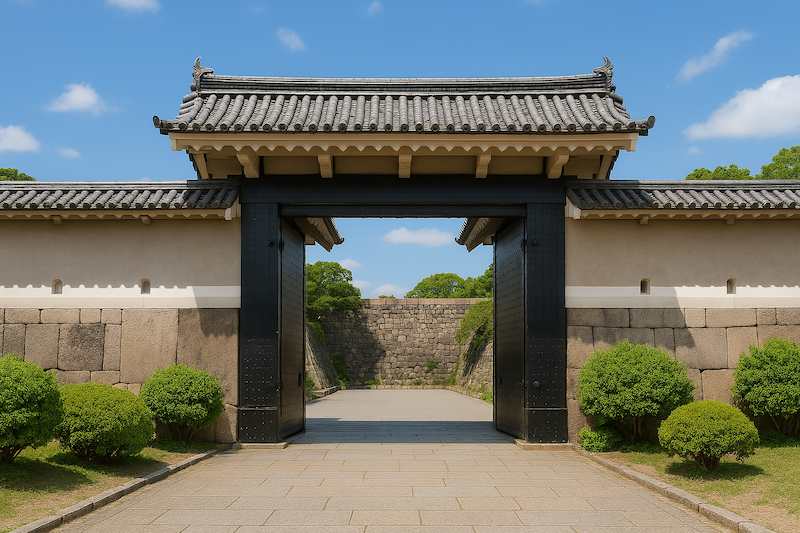
Otemon Gate is Osaka Castle’s main entrance. It was created during the Tokugawa reconstruction of the castle, and the gate seen today reflects repair and rebuilding work from around the Kaei era (Kaei 1, 1848), along with a further restoration in 1967. Inside the gate is a box-shaped defensive courtyard called a masugata — a design that forced intruders to make a sharp right-angle turn, exposing them to attack from above and from the sides.
Inside the masugata stand several famous giant stones, including the Ote-mitsuke-ishi and Ote-niban-ishi. The surrounding walls also carry kokuinseki — marks believed to be related to the daimyo lords or stonemason groups involved in construction — with each stone standing as a small historical record of the era.
| Year built | Created during the Tokugawa reconstruction era; repaired/rebuilt around Kaei 1 (1848); repaired again in 1967 |
|---|---|
| Cultural property | Important Cultural Property (Otemon Gate) |
| Admission | Free |
| Address | 1-1 Osakajo, Chuo-ku, Osaka |
| Suggested time | Quick: about 5 min / Thorough: about 15 min |
- Masugata layout: Standing inside gives a visceral sense of the historical defensive strategy — intruders faced attack from three directions at once.
- Giant stones: The Ote-mitsuke-ishi and Ote-niban-ishi are among the best-known megaliths in this part of Osaka Castle.
- The Tokugawa-era main gate: The current gate belongs to the Tokugawa rebuilding of the castle and preserves the form of the Edo-period main entrance.
- Kokuinseki: The marks carved into the surrounding stones record the domains mobilized for construction.
- Cherry blossoms: In spring, blossoms around the gate make it one of Osaka Castle’s most photographed seasonal scenes.
3. Otemon South Wall
A long defensive wall carrying many kokuinseki
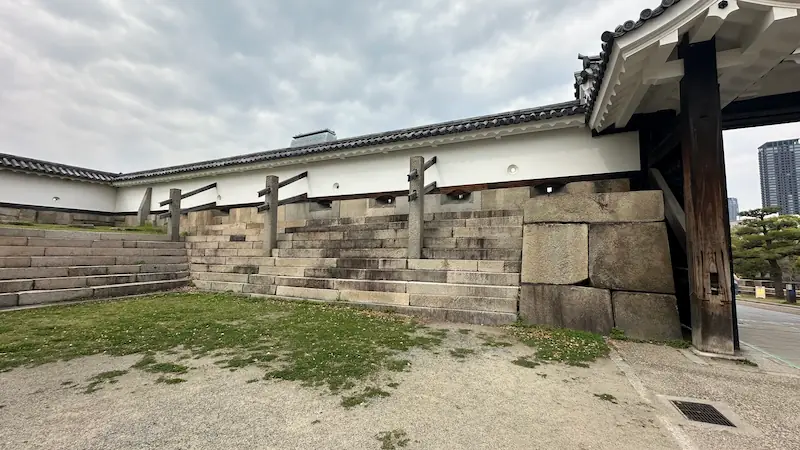
The Otemon South Wall is a long wall running just south of Otemon Gate, built in the 1620s as part of the outer defensive line during the Tokugawa reconstruction of the castle. Many of its stones carry kokuinseki — marks believed to be related to the daimyo lords or stonemason groups involved in the work — making this wall a valuable record of Japan’s stone-wall building culture and the scale of labor mobilized for the castle’s reconstruction.
| Year built | Circa 1620s (Edo period) |
|---|---|
| Cultural property | Important Cultural Property |
| Admission | Free |
| Address | 1-1 Osakajo — Otemon South Wall |
| Suggested time | About 5–15 min |
- Kokuinseki hunting: Each stone carries a distinct mark, believed to be tied to the daimyo lords and stonemason groups mobilized for construction.
- Gentle curve: The wall has a slight curve, creating shifting shadow patterns through the day.
- Political symbol: Through the reconstruction of the castle, the Tokugawa shogunate demonstrated its control over the daimyo lords who supplied the labor and materials.
- Scale of stone transport: This stonework reflects the scale of planning and transport needed to rebuild Osaka Castle.
4. Otemon North Wall
A quieter counterpart to the South Wall — a good place to study the stonework up close
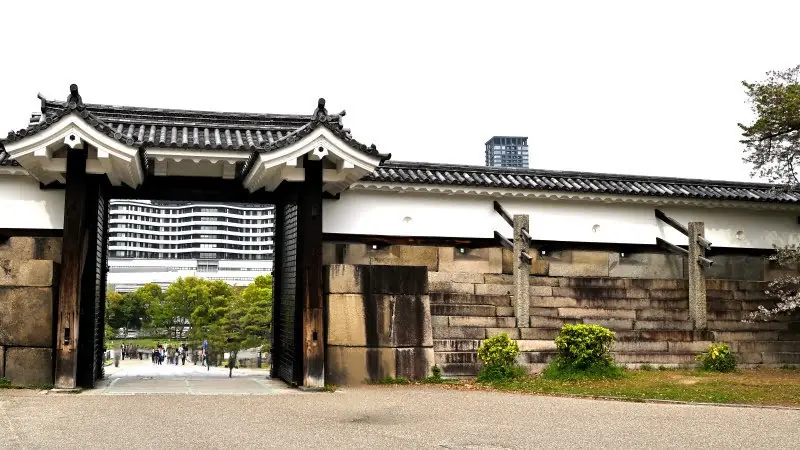
The Otemon North Wall is arranged symmetrically with the South Wall. Built during the Tokugawa reconstruction in the 1620s, it controlled the movement and sightlines of anyone approaching the main gate. Its bold stone base and white plaster upper section combine functional defense with visual authority. Many of its stones still carry kokuinseki identifying the daimyo lords and stonemasons involved.
| Year built | Circa 1620s (Edo period) |
|---|---|
| Cultural property | Important Cultural Property |
| Admission | Free |
| Address | 1-1 Osakajo — Otemon North Wall |
| Suggested time | About 5–15 min |
- Kokuinseki: Like the south wall, this side preserves marks left by the daimyo lords and stonemasons involved in construction.
- Stone-and-plaster contrast: The rough stone base and smooth white plaster above show the functional beauty of Edo-period castle defenses.
- Part of the tenka-bushin: This wall belongs to the tenka-bushin — the nationwide castle-building levy the Tokugawa shogunate imposed on daimyo lords across the country — carried out in the 1620s.
- A quiet place to look closely: Because fewer visitors linger here, it’s a good spot to study the masonry details at close range.
5. Tamon Yagura
L-shaped, about 710 sq m, a large corridor-style turret first built around 1628
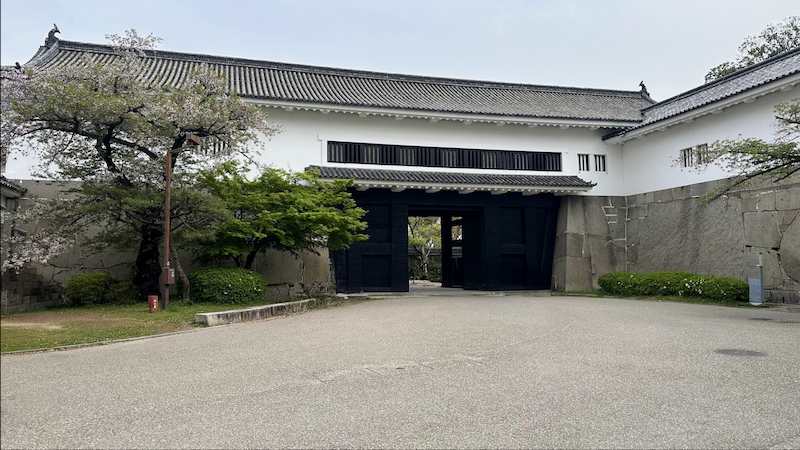
Tamon Yagura is an Important Cultural Property turret built in a long, barrack-like form. It was first built around 1628, burned down after a lightning strike in 1783, and was rebuilt in 1848. With a floor area of about 710 square meters, it is widely described as the largest surviving corridor-style (tamon-yagura) turret in Japan. It has the only L-shaped layout in Osaka Castle, designed to give defenders overlapping sightlines and fields of fire in two directions at once.
Inside are defensive features including yari-otoshi (spear-drop openings) and musha-bashiri (warrior corridors). The combination of its long horizontal form, massive stone foundation, and elegant white plasterwork makes it one of the most architecturally striking structures in the castle grounds. The turret is made up of two connected buildings: the watari-yagura, with four rooms as large as 70 tatami mats each, and the tsuzuki-yagura, with six rooms of 9, 12, and 15 tatami mats (a tatami mat is a traditional Japanese room-size unit, roughly 1.65 square meters). The building stands about 14.7 m tall.
| Year built | First built around 1628; burned down by lightning in 1783; rebuilt in 1848 |
|---|---|
| Cultural property | Important Cultural Property |
| Floor area | About 710.25 sq m (corridor-style turret) |
| Height | About 14.7 m |
| Interior layout | Watari-yagura (4 rooms of up to 70 tatami mats) & tsuzuki-yagura (6 rooms of 9, 12, and 15 tatami mats) |
| Interior access | Special exhibition periods only |
| Suggested time | Exterior: about 15 min / Interior (when open): about 30 min |
- Only L-shaped turret: The only L-shaped turret in Osaka Castle, giving overlapping sightlines and defensive fire in two directions at once.
- Watari-yagura and tsuzuki-yagura: Tamon Yagura is made of two connected buildings — the watari-yagura (4 rooms of up to 70 tatami mats) and the tsuzuki-yagura (6 rooms of 9, 12, and 15 tatami mats) — with tatami-floored rooms running throughout the interior.
- Last line of defense: Equipped with spear-drop openings and warrior corridors, it served as a final stronghold.
- Rebuilt after a lightning strike: First built around 1628, it burned down after a lightning strike in 1783 and was rebuilt in 1848.
- Guarding Otemon Gate: Positioned above the approach to the main entrance, it was key to repelling any attacker who broke through the gate.
- A morning photo spot: Its white plaster walls catch the morning light beautifully, making it one of the best dawn photo spots in the castle grounds.
Osaka Castle: Full Area Map
Frequently Asked Questions (Otemon Gate Area)
Yes. The entire Otemon Gate area — including Otemon Gate, the south and north walls, and the exterior of Tamon Yagura — is free to visit as part of Osaka Castle Park. Most of the park grounds are open at all times, though individual gates and facility buildings have their own opening hours.
Tamon Yagura is an Important Cultural Property turret first built around 1628. It burned down after a lightning strike in 1783 and was rebuilt in 1848. It is widely described as the largest surviving corridor-style turret in Japan, and its distinctive L-shaped layout was designed to give overlapping defensive fire in two directions. It consists of two connected buildings — the watari-yagura (4 rooms of up to 70 tatami mats) and the tsuzuki-yagura (6 rooms of 9, 12, and 15 tatami mats) — and originally included spear-drop openings (yari-otoshi).
The Ote-mitsuke-ishi is one of the famous giant stones in the Otemon Gate masugata courtyard. Together with the Ote-niban-ishi, it shows the scale of the Tokugawa-era stonework at Osaka Castle. Note that the “Takoishi,” said to bear the outline of an octopus, is a separate stone in the Sakuramon masugata in the Honmaru area — not one of the giant stones at Otemon Gate.
Kokuinseki are stones carved with symbols believed to be related to the daimyo lords or stonemason groups who supplied them, or to the management of the stone materials. They appear on both the south and north walls of Otemon Gate, and are thought to record the involvement of the many feudal domains mobilized by the Tokugawa shogunate for the castle’s stonework in the 1620s.
The interior of Tamon Yagura is only open to the public during special exhibition periods. Check the official Osaka Castle website for the current schedule. The exterior can always be viewed and photographed for free.
Covering all 5 spots efficiently takes about 30–45 minutes. If you want to search for kokuinseki in detail or examine both walls closely, allow up to about 1.5 hours.
Continue Exploring
Back to the Osaka Castle Index Page
Back to the Main Page

☕ Support This Site
Following the Shogun is built on original fieldwork and on-site research.
If you found this guide useful, your support helps keep it going.

You can also support via QR code


comment