


Inside Himeji Castle’s Hishi-no-Mon Gate
A rare, first-person look inside a section of Himeji Castle that’s normally closed to visitors — the interior of Hishi-no-Mon, the castle’s largest surviving gate.
- Overview / Hub
- 0. Table of Contents
- 1. Main Gate and Outer Grounds
- 2. Nishi-no-Maru — The Princess’s Retreat
- 3. Main Keep and Connecting Towers
- 4. East Bailey and Okiku’s Well
- 5. Moats, Stone Walls and Defenses
- 6. Gardens, Shrines and Surroundings
- Quick Tour: 7 Best Spots
- Special Report: Hishi-no-Mon Gate
The Journey to Himeji and the Rising Anticipation
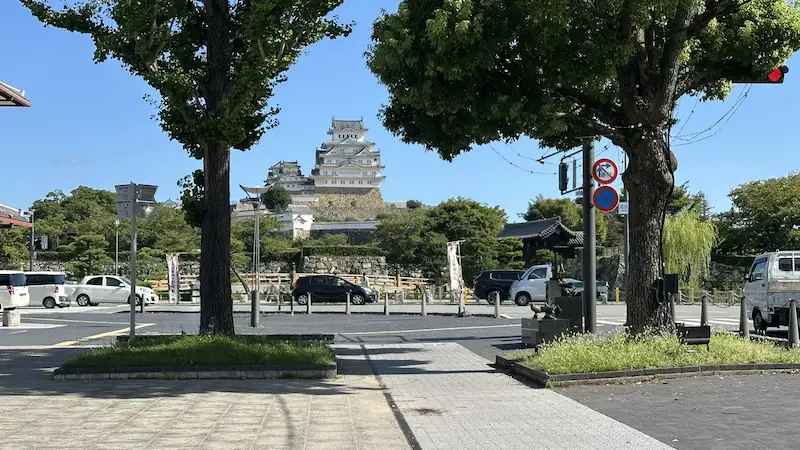
Early in the morning, I boarded the first train from Shin-Yokohama Station (JH16) and took the Shinkansen Hikari bound for Himeji Station (JR-A85). Although I’ve visited Himeji Castle many times before, the moment I step off the train at Himeji Station (JR-A85) and see the main keep rising proudly in front of me, I can’t help but feel my heart race. What made this day even more special was the rare opportunity to enter the Hishi-no-Mon Gate, an area normally closed to the public. For a history enthusiast, it was truly a long-awaited moment.
“Once again, I’ll get to witness another hidden side of Himeji Castle.”
With that thought in mind, I made my way toward the castle, where the dazzling White Heron Castle stood proudly against the clear blue sky, welcoming me in all its splendor.
What is the Hishi-no-Mon Gate?
The Hishi-no-Mon is one of the gates guarding the main entrance of Himeji Castle and is the largest surviving gate within the complex. Its name is said to come from the diamond-shaped motifs incorporated into its decorative design.
Built in the early Edo period, the gate has been designated as an Important Cultural Property of Japan. Its exterior takes the form of a commanding two-story turret gate that served as a powerful defensive structure against intruders, while also displaying ornate decorations symbolizing authority and prestige. It is truly a gate that embodies both “martial strength and refined beauty.”
Normally, visitors can only pass beneath its exterior and are not allowed inside. This special opening, however, offered a rare and invaluable chance to step directly into the interior of this historic architectural masterpiece.
Entering the Special Exhibition
After passing through the Hishi-no-Mon, a small guardhouse appears on the left, now serving as the reception area. Here, I paid the 200-yen admission fee. Following the staff’s instructions, I exited once more and climbed a temporary staircase, which provided access to the second floor of the gate.
From the guardhouse, I could get a clear view of the massive stone walls supporting the gate.
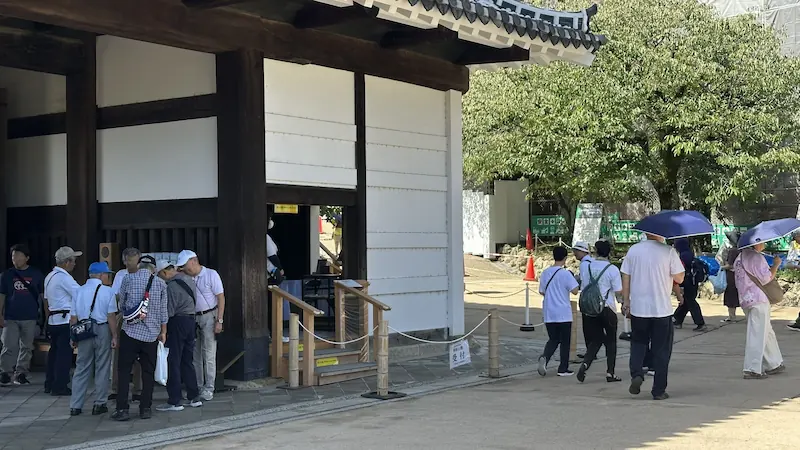
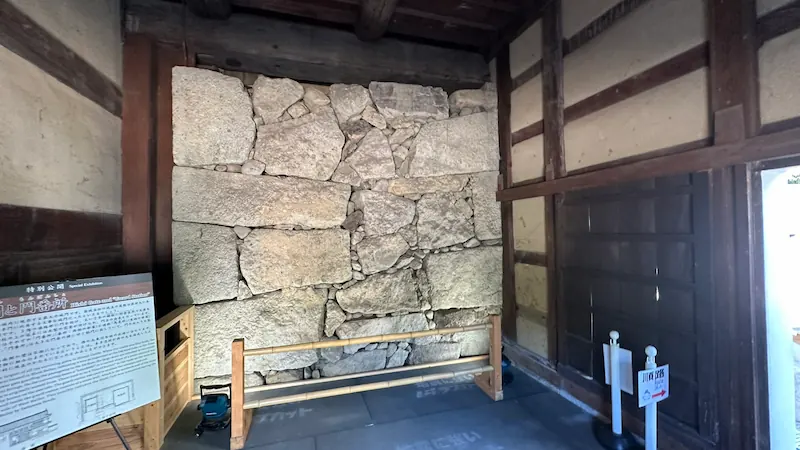
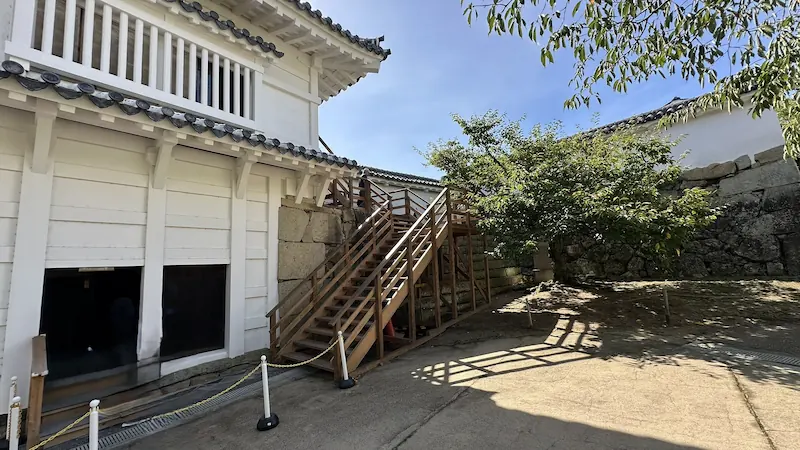
The moment I reached the top of the stairs and stepped inside the gate, I was overwhelmed by a deep surge of emotion.
To be walking through a space that is usually off-limits filled me with a profound sense of gratitude. Even the smallest displays or faintest traces within these walls felt precious, as they allowed me to imagine the centuries of history that unfolded here.
Impressions of the Hishi-no-Mon Interior
The first thing that struck me upon entering was the impressive height of the ceiling. The space felt far larger and more open than I had expected, supported by massive wooden pillars. Gentle light filtered in through the latticed windows, and the interior carried a refreshing coolness compared to the air outside.
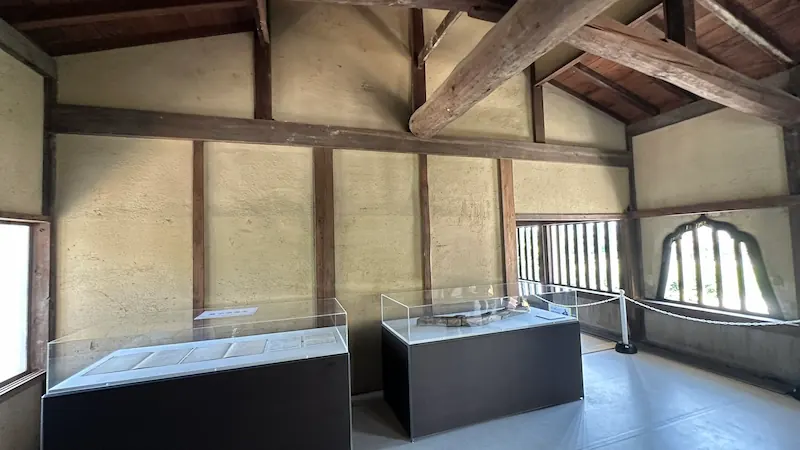
The gate’s interior was divided into three rooms, each connected so visitors could walk through while viewing the displays. Along the walls were historical documents and scale models, and from certain windows, one could glimpse rare perspectives of the main keep and the road in front of the Hishi-no-Mon — views normally impossible to see.
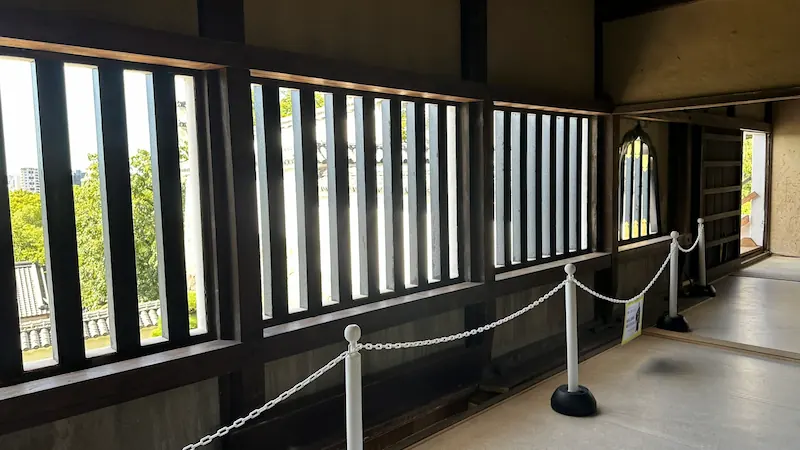
“So this is where they once defended the castle…”
That thought naturally came to mind as I stood inside.
Encounter with the Aoi Crest
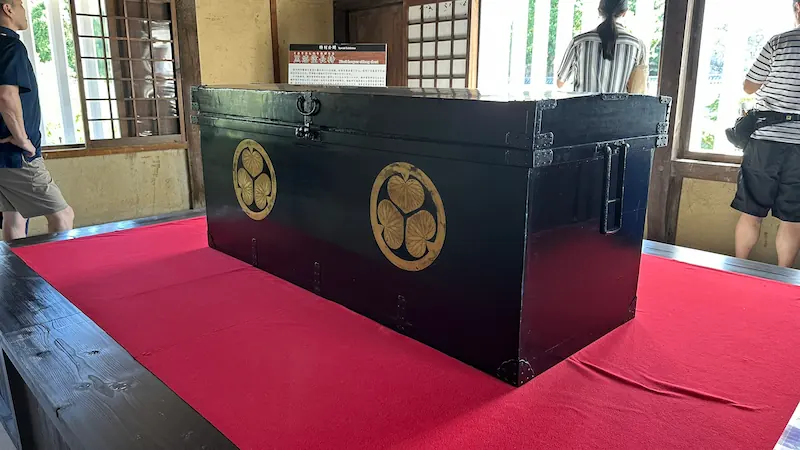
In the innermost room stood a large chest adorned with the famous Aoi no Gomon, the hollyhock crest. It was identified as a Kuro-urushi-nuri Nagamochi, a long chest coated in black lacquer.
Ever since I became fascinated with history, just seeing the triple hollyhock crest has filled me with excitement. Imagining what might once have been stored inside this chest gave it a significance far greater than a mere museum piece.
According to the exhibit’s own on-site caption, this black-lacquered nagamochi bore two prominent Aoi crests on its surface and was displayed as a piece passed down within the Sakai clan. The placard noted the presence of the Aoi crest as a point of particular interest, suggesting some connection between the Sakai family and the Tokugawa or Matsudaira clans, though the exhibit did not go further than that in spelling out the relationship.
A Rare View from Within
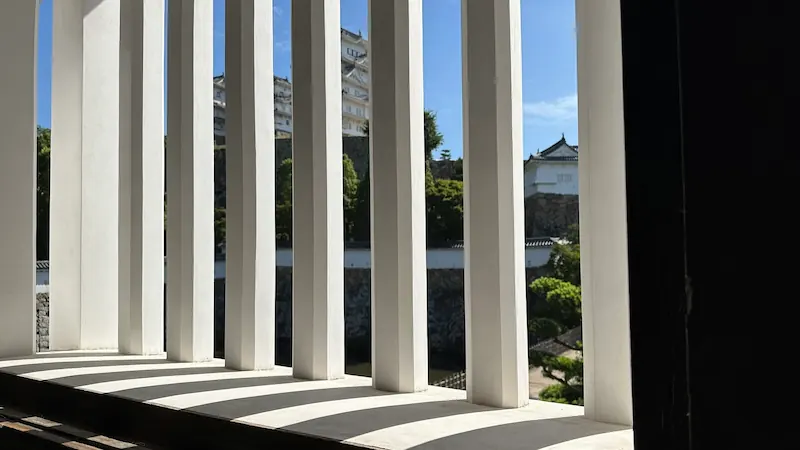
Looking out from the windows, I saw familiar sights — the road before the Hishi-no-Mon and the towering main keep — yet from a completely new angle. Places I had walked countless times before revealed an entirely different character from this vantage point.
“So this is the perspective of those who once defended the castle.”
That thought transformed the view before my eyes. In that moment, the castle’s layout ceased to feel like a tourist route and instead revealed itself as a carefully designed defensive system.
The Role and Significance of the Hishi-no-Mon Gate
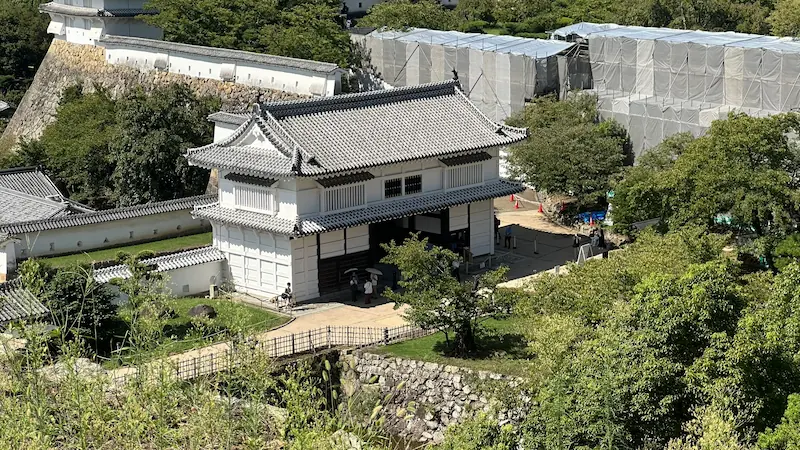
Let’s pause for a moment to reflect on history. The Hishi-no-Mon was strategically located to guard the main route from the Otemon (front gate) to the Ninomaru (second bailey), making it one of the most critical elements in Himeji Castle’s defense. Its two-story turret design was built to repel intruders, allowing soldiers to station themselves inside and mount a defense during times of conflict.
At the same time, the Hishi-no-Mon served as a powerful symbol of authority and prestige. As the largest surviving gate guarding the entrance to the Ninomaru, it functioned as a ceremonial stage that showcased the grandeur and dominance of Himeji Castle.
Combining both defense and symbolism, the Hishi-no-Mon was far more than a mere gate. This is why the rare opportunity to step inside — a space usually closed to the public — felt so profoundly meaningful.
Special Exhibition Schedule & Visitor Information (Autumn 2025)
| Title | Exclusive Opening of “Hishi-no-Mon” Gate |
|---|---|
| Dates | September 1 (Mon) – September 30 (Tue), 2025 — now closed |
| Hours (were) | 9:00 AM – 4:30 PM (last entry 4:00 PM) |
| Location | Hishi-no-Mon Gate, second-floor turret |
| Admission (was) | 200 yen (adults / elementary to high school students); separate Himeji Castle admission ticket required |
| Official source | himeji-kanko.jp/event/1697 |
FAQ
Not currently. The interior was open to the public only during a special exhibition from September 1 to September 30, 2025. Check the official Himeji Castle event page for any future openings.
Historical documents and scale models were displayed across the gate’s three connected interior rooms, along with a black-lacquered chest (nagamochi) bearing the Tokugawa-associated Aoi crest, believed to have belonged to the Sakai clan.
It stands along the main approach route in Area 1 of Himeji Castle, between the Otemon (front gate) and the Ninomaru (second bailey), and is the largest surviving gate in the castle complex.
Hishi-no-Mon Gate Information

More on Himeji Castle
☕ Support This Site
Following the Shogun is built on original fieldwork and on-site research.
If you found this guide useful, your support helps keep it going.

You can also support via QR code


comment