


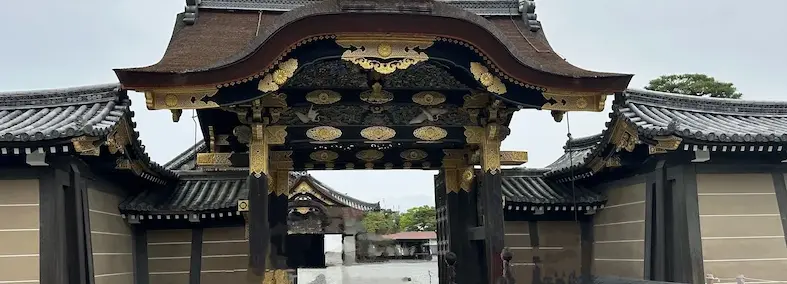
Nijo Castle: Ninomaru Palace Area
Karamon Gate, the National Treasure Palace & Special Scenic Garden
The vividly carved Karamon Gate, refined to receive an imperial procession; the opulent Ninomaru Palace that supported the shogun's rule; and the only surviving shoin-style garden built around Daoist ideals of immortality. Together they preserve, in remarkable detail, the authority and aesthetic brilliance of the Tokugawa shogunate, based on first-hand, on-site research.
The "Karamon Gate," "Ninomaru Palace," and "Ninomaru Garden" together form the symbolic heart of Nijo Castle — a space that still conveys the authority and aesthetic brilliance of the Tokugawa shogunate.
The vividly colored Karamon was refined to receive imperial processions; the opulent Ninomaru Palace supported the shogun's statecraft; and the strolling garden, grounded in the Horai immortality ideal, is the only surviving example of its kind built alongside a shoin-style palace. Together, they immerse visitors in the depths of Edo-period beauty and power.
The 3 Spots of the Ninomaru Palace Area
Karamon Gate
One of Japan's Three Great Karamon, built to receive an imperial visit
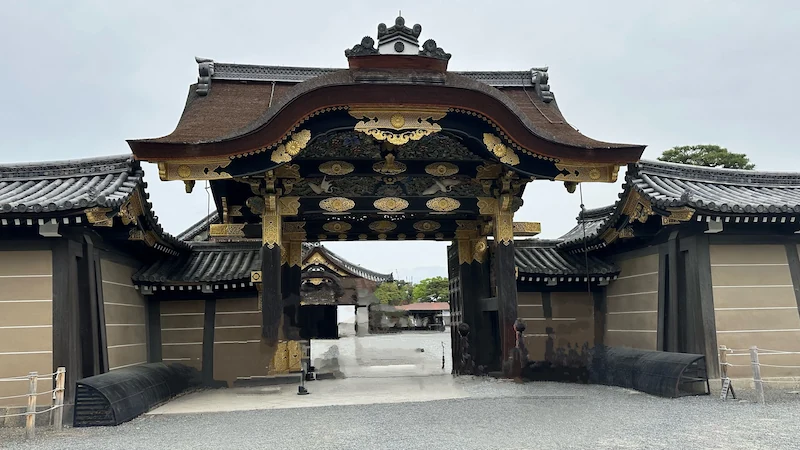
The Karamon serves as the grand gate to the Ninomaru Palace and was built for Emperor Go-Mizunoo's 1626 (Kanei 3) imperial visit. This four-post gate features a gabled cypress-bark roof (hinoki-buki) with karahafu (undulating gables) on both front and back, richly adorned with polychrome carvings and gilt metal fittings. Motifs such as "pine, bamboo and plum with cranes," symbolizing longevity, and guardian karajishi (Chinese lions) protecting the sacred precinct give the entire gate the exuberant splendor of Momoyama-period craftsmanship.
In 2013 (Heisei 25), conservation work renewed the cypress-bark roofing, re-gilded the decorative fittings, restored colors on the carved transoms, and refinished the lacquer.
Historical Data
| Year Built | 1626 (Kanei 3), prepared for Emperor Go-Mizunoo's visit |
|---|---|
| Builder | Unknown (likely commissioned by the shogunate) |
| Structure & Features | Four-post gate; gabled form; cypress-bark roof. Karahafu on both front and rear. Polychrome carvings and gilt fittings depicting motifs such as pine–bamboo–plum, cranes, karajishi (guardian lions), and butterflies. Designed as a sumptuous, high-prestige front gate. |
| Repairs & Restoration | Roof restored to cypress-bark in the Meiji era. Comprehensive conservation completed in 2013 (re-roofing with cypress bark, re-gilding, recoloring of carved transoms, lacquer refinishing). |
| Current Status | Extant; open as the front gate to the Ninomaru Palace. Designated an Important Cultural Property of Japan. |
| Loss/Damage | No record of major loss. Some documents indicate a temporary relocation in 1627. |
| Cultural Property | Important Cultural Property of Japan ("Karamon"). |
| Notes | The carved motifs are thought to embody prayers for the castle's protection and prosperity. |
Access
Suggested Visit Time
Quick highlights: about 10 minutes / Deeper visit: about 30 minutes (to study the carvings and ornament in detail)
Highlights
- Exquisite carvings: The transoms feature auspicious motifs — cranes and turtles with pine, dragons and tigers, and karajishi — all rendered in vivid polychromy that makes the entire gate gleam.
- Gilt metalwork: Gold-leafed fittings on every part of the gate accentuate its grandeur.
- Historical find: During conservation work, Tokugawa's triple-hollyhock crest (aoi-mon) was discovered beneath chrysanthemum crests — historical evidence of the castle's transfer from Tokugawa to imperial ownership in the Meiji era.
Ninomaru Palace
The stage of the 1867 Taisei Hokan — Japan's only surviving castle palace (National Treasure)
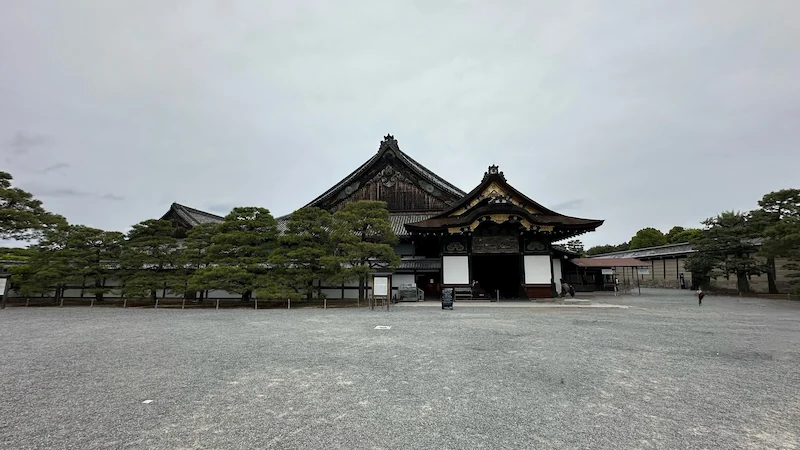
The Ninomaru Palace symbolizes Tokugawa authority, having served for shogunal lodging, ceremonies, and the day-to-day business of government. A quintessential example of early Edo shoin-zukuri architecture — and the only castle palace of its kind that still survives — it is adorned throughout with Kano-school mural paintings, intricate transom carvings, and lavish gilt fittings.
Historical Data
| Year Built | Major works completed in the early Edo (Kanei) period |
|---|---|
| Builder | Tokugawa Shogunate (by shogunal order) |
| Structure & Features | A group of palatial buildings in shoin style. Six main components: Tozashu (Retainers' Hall), Shikidai (Ceremonial Antechamber), Ohiroma (Great Hall), Sotetsu-no-ma (Sago Palm Room), Kuro-shoin (Black Study), and Shiro-shoin (White Study). Roofs and gables overlap in a staggered (goose-line) plan. Interiors feature "upper dais" rooms, alcoves, shelves, shoin windows, and a bedchamber framework; walls and doors carry Kano-school paintings, transom carvings, gilt fittings, and polychrome ceilings. |
| Repairs & Restoration | Major renovation for the 1626 (Kanei 3) imperial visit. Damaged in the 1662 (Kanbun 2) earthquake and repaired. Later damaged by fires and lightning through the late Edo period, with repairs each time. |
| Current Status | Extant: approx. 33 rooms; floor area ≈ 3,300 m²; over 800 tatami mats. Designated a National Treasure and open to the public. |
| Loss/Damage | Struck by the 1750 (Kan'en 3) lightning fire that also destroyed the tenshu (main keep). Parts of the Ninomaru buildings also suffered in the 1788 (Tenmei 8) Great Fire. |
| Cultural Property | National Treasure (all six Ninomaru Palace buildings designated in 1952). |
| Notes | An exceptionally rare surviving example of a castle palace — few such buildings survive anywhere in Japan. |
Access
Suggested Visit Time
Quick highlights: about 30 minutes / Deeper visit: about 60 minutes (to study each room's decoration and historical background)
Highlights
- Tozashu (Retainers' Hall): The largest building in the palace, where visitors waited to be received. Tiger paintings on the sliding doors and walls give it the nickname "Tiger Room" — a striking symbol of Tokugawa power.
- Ohiroma (Great Hall): The stage for the shogun's formal ceremonies, lavishly decorated across a broad space.
- Kuro-shoin & Shiro-shoin: The shogun's private wings — Kuro-shoin used for affairs of state, Shiro-shoin as living quarters.
- Nightingale floors: Floorboards designed to chirp underfoot, a built-in security feature to detect intruders.
Ninomaru Garden
Japan's only surviving shoin-style palace garden, expressing Horai immortality ideals (Special Place of Scenic Beauty)
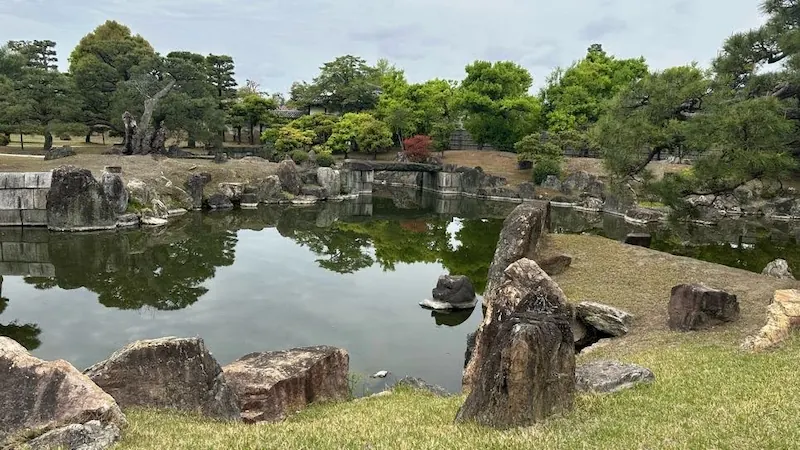
Ninomaru Garden is Nijo Castle's signature Japanese garden and a celebrated example of the shoin-style strolling pond garden. A central Horai Island is flanked by Crane and Turtle Islands, expressing the Daoist Horai ideal of immortality and longevity. The garden was designed to be admired from three directions — the Ohiroma (Great Hall), the Kuro-shoin, and the former Gyoko Palace (imperial lodging) — offering a beautiful, distinct composition from every vantage point.
Historical Data
| Year Built | Early Edo period; likely developed alongside the Ninomaru Palace |
|---|---|
| Builder | Tokugawa Shogunate (as part of the palace works) |
| Structure & Features | Strolling pond garden. Hills, stepping stones, tsukiji walls, and plantings arranged around the central pond, composed as an integrated scene together with the palace. Records indicate the grounds once hosted the Gyoko Palace, a lodging built for the Emperor. |
| Repairs & Restoration | Detailed ledgered records are limited, but the garden has undergone maintenance from early modern times into the modern era to reach its present form. |
| Current Status | Extant and open to the public, preserved together with the palace architecture. |
| Loss/Damage | No record of complete destruction; no confirmation of major war or fire damage. |
| Cultural Property | Designated a Special Place of Scenic Beauty (1953). |
| Notes | Sources note that an imperial lodging once stood on the garden site. The castle's overall plan integrates the garden, palace and Karamon as a single composition. |
Access
Suggested Visit Time
Quick highlights: about 15 minutes / Deeper visit: about 30 minutes (to explore the composition and history)
Highlights
- Horai and Crane–Turtle Islands: The central Horai Island, flanked by Crane and Turtle Islands, symbolizes immortality and longevity in Daoist thought.
- Waterfall rockwork: On the west side of the Great Hall, a stone composition evokes a waterfall, adding a sense of movement to the scene.
- Stone placements: Tall, vertical stones are used throughout, giving the layout a powerful, upright rhythm.
- Seasonal plantings: Cherry blossoms and azaleas in spring, autumn foliage later in the year — the garden offers a different face with each season.
Next Area

Previous Area

Back to the Complete Guide

Back to the Main Page

☕ Support This Site
Following the Shogun is built on original fieldwork and on-site research.
If you found this guide useful, your support helps keep it going.

You can also support via QR code


comment