


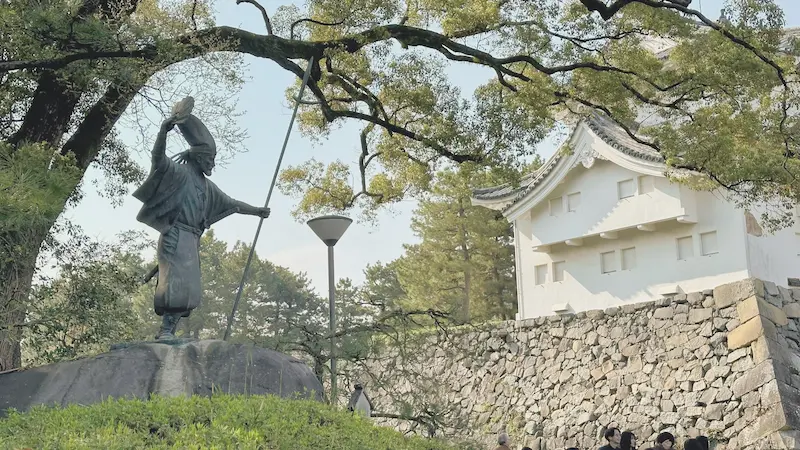
The Katō Kiyomasa Statue and Two Stone Monuments at Nagoya Castle
Scattered throughout Nagoya Castle’s Ninomaru Garden are stone monuments and statues that quietly recount episodes from Japan’s past—like the “Site of the Aomatsuba Incident”, the “Han Kun Hiden Monument”, and the “Kiyomasa Stone-Pulling Statue” honoring castle-building master Katō Kiyomasa. Each marker carries messages that transcend time. By exploring these landmarks, you can uncover the inner workings of the Owari Domain and the behind-the-scenes stories of Nagoya Castle's construction.
On This Page
3 Spots in Ninomaru Garden
All three monuments below are clustered together in Ninomaru Garden, each just a one- to two-minute walk from the last. Each spot's highlights, visit time, access notes, and trivia are available by tapping “Open Details” on its card.
Site of the Aomatsuba Incident
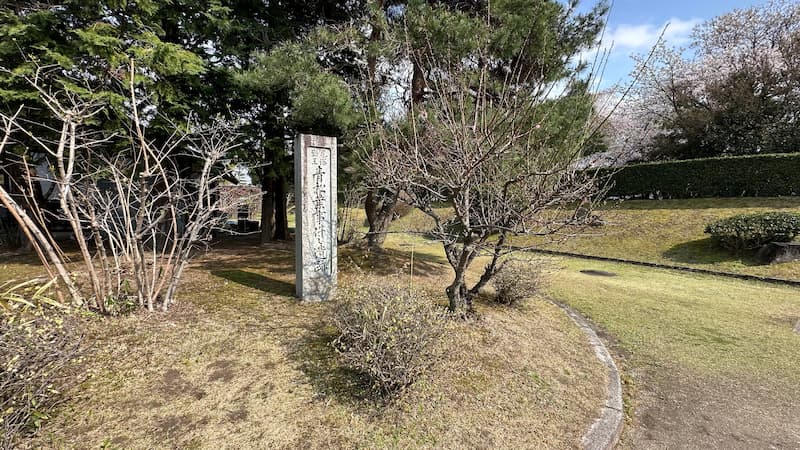
The Aomatsuba Incident Monument, tucked quietly within Nagoya Castle, commemorates a political purge that occurred within the Owari Domain during the final days of the Tokugawa shogunate. In January 1868 (Keiō 4), Tokugawa Yoshikatsu, the 14th lord of the Owari Domain, executed 14 retainers aligned with the pro-shogunate faction and punished 20 others.
The incident, reflecting internal power struggles and conflict over how to respond to Japan’s new government, was named after Watanabe Shinzaemon Aritsuna, one of the executed samurai, whose poetic name “Aomatsuba” inspired the incident’s title. For more details, see local resources such as Nagoya Navi’s “Nagoya Castle Exploration #9 – The Aomatsuba Incident” or its corresponding Wikipedia entry.
Today, this stone monument preserves the memory of those turbulent times, silently conveying the tension and gravity of Owari’s political climate during the collapse of the Tokugawa regime.
- Aomatsuba Incident Monument: A quietly placed stone monument behind the East Gate gift shop, marking a significant event in samurai history.
- Han Kun Hiden Monument: Nearby stands another stone inscribed with the principles of the Owari Domain, written by its first lord, Tokugawa Yoshinao.
- Seasonal Tip: In spring, the surrounding cherry blossoms create a peaceful, reflective atmosphere perfect for historical exploration.
Recommended visit time: Quick visit ~3 minutes / In-depth visit ~10 minutes
Address: 1-1 Honmaru, Naka-ku, Nagoya, Aichi Prefecture, Ninomaru area
Access: Approx. 1-minute walk (55m) from the Nagono Castle Ruins
Trivia- Historical Insight: The incident exposed tensions between the pro-shogunate and pro-imperial factions within the domain, reflecting the complex political shifts of the era.
- Hidden Detail: This monument often doesn’t appear on official maps—check its location in advance.
- Famous Connections: Tokugawa Yoshikatsu, the man behind the purge, was the half-brother of Tokugawa Yoshinobu and is also known for his later work as a photographer.
Han Kun Hiden Monument Secret Clan Precepts Monument
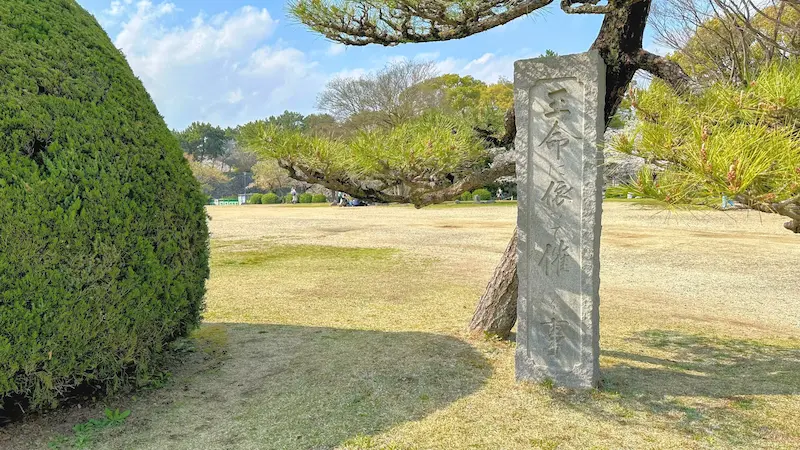
The Han Kun Hiden Monument is inscribed with the phrase “Act According to the Emperor’s Command” from the closing of the Gunyō Gakan (a military treatise), written by Tokugawa Yoshinao, the first lord of the Owari Domain. This teaching was passed down as a core principle of the domain’s governance.
The inscription reflects the domain’s loyalty to the Emperor and foreshadows the Owari Domain’s eventual support of the new Meiji government during the Bakumatsu period (the final years of the Tokugawa shogunate, 1853–1868). As a symbol of political philosophy, this stone prompts visitors to consider the deeper ideologies behind Japan’s transition from shogunate to imperial rule.
- Han Kun Hiden Monument: A vital historical inscription representing the Owari Domain’s foundational ideals and dedication to imperial authority.
- Ninomaru Garden: A beautiful, culturally designated space where nature and history meet.
- Seasonal Tip: Cherry blossoms in spring and fiery foliage in autumn enhance the serenity of the monument’s setting.
Recommended visit time: Quick visit ~3 minutes / In-depth visit ~10 minutes
Address: 1-1 Honmaru, Naka-ku, Nagoya, Aichi Prefecture, Ninomaru Garden
Access: Approx. 1-minute walk (50m) from the Aomatsuba Incident Monument
Trivia- Historical Insight: Yoshinao’s philosophy of absolute loyalty to the emperor heavily influenced the domain’s stance during the Meiji Restoration.
- Hidden Detail: This monument is often overlooked in official castle maps—be sure to locate it beforehand.
- Famous Connections: Tokugawa Yoshinao was the ninth son of Tokugawa Ieyasu and the founder of the Owari Tokugawa family.
Statue of Katō Kiyomasa Hauling Stones
Located within Ninomaru Garden, the Statue of Katō Kiyomasa Pulling Stones honors the legendary castle builder who played a major role in constructing Nagoya Castle. Known for his mastery of stonework, Katō Kiyomasa was said to have led the labor himself—standing atop giant stones and chanting to coordinate the movement of his workers.
The bronze statue recreates this iconic scene and offers a powerful image of leadership and craftsmanship. Another statue of Kiyomasa can also be found near the Honmaru East Ichinomon Gate, donated by the Nagoya Kita Lions Club in 1980.
- Kiyomasa Stone-Pulling Statue: A striking bronze depiction of Katō Kiyomasa leading the transport of massive stones during castle construction.
- Ninomaru Garden: A scenic and tranquil space designated as a cultural site, perfect for peaceful reflection.
- Seasonal Tip: The garden shines in all seasons—cherry blossoms in spring, vibrant foliage in autumn, and quiet snowscapes in winter.
Recommended visit time: Quick visit ~5 minutes / In-depth visit ~10 minutes
Address: 1-1 Honmaru, Naka-ku, Nagoya, Aichi Prefecture, inside Ninomaru Garden
Access: Approx. 2-minute walk (60m) from the Han Kun Hiden Monument
Trivia- Historical Insight: Kiyomasa was not only a general under Toyotomi Hideyoshi but also a master architect, known for commanding construction directly from the field.
- Hidden Detail: Nagoya Castle features other spots linked to Kiyomasa, including the famed “Kiyomasa Stone” embedded in the stone walls.
- Famous Connections: Revered as a military and architectural genius, Katō Kiyomasa left a lasting legacy in Japan’s fortress-building history.
A personal ranking based on repeated on-site visits by the Following the Shogun team (most recently June 2026). This is our own judgment, not the castle's official recommendation.
The one of the three that communicates without any background knowledge. This bronze recreates Katō Kiyomasa moving a massive foundation stone, giving form to the tradition that he stood on the stone himself and called out the rhythm during work on the keep's stone base. Easy to photograph, too.
A monument to the January 1868 purge in which Tokugawa Yoshikatsu, the 14th lord of the Owari domain, executed 14 retainers identified as pro-shogunate. If the closing years of the samurai era interest you, it is a way into the question of why Owari sided with the new imperial government. The monument itself is small and easy to walk past.
A stone inscribed with "act in accordance with the imperial command," the domain precept written by Tokugawa Yoshinao, first lord of Owari. Read together with the Aomatsuba Incident it clarifies the domain's position, but on its own the stone carries limited information. Fine to pass by if time is short.
Nagoya Castle Guide Full Map
Nagoya Castle: Hours, Admission & Access
| Hours | 9:00 am – 4:30 pm (last entry to Honmaru Palace 4:00 pm) |
|---|---|
| Closed | December 29 – January 1 |
| Admission | Adults ¥500 (through September 30, 2026) / ¥1,000 (from October 1, 2026) Free for junior-high age and under, before and after the change Verified August 23, 2026. The increase was approved by the Nagoya City Council. Tickets bought before the change date remain valid afterwards. |
| Nearest station | Nagoya Castle Station (Meijo subway line), about a 5-minute walk |
Please check the official Nagoya Castle website for the latest hours and fees before you visit.
Why was Nagoya Castle built? Tokugawa Ieyasu, founder of the Tokugawa shogunate, ordered the castle rebuilt in November 1609; construction began in January 1610 and the main keep was completed in December 1612. It became the seat of the Owari Tokugawa family, the senior-most of the three Tokugawa branch houses (the Gosanke), and one of the most important castle towns in Japan.
FAQ
In January 1868 (Keiō 4), Tokugawa Yoshikatsu, the 14th lord of the Owari Domain, executed 14 retainers aligned with the pro-shogunate faction and punished 20 others. The incident is named after Watanabe Shinzaemon Aritsuna, one of the executed samurai, whose poetic name “Aomatsuba” inspired the title.
It bears the phrase “Act According to the Emperor’s Command,” taken from the closing of the Gunyō Gakan military treatise written by Tokugawa Yoshinao, the first lord of the Owari Domain. This teaching was passed down as a core principle of the domain’s governance.
The bronze statue recreates Katō Kiyomasa leading the transport of massive stones during Nagoya Castle’s construction. Kiyomasa was said to have stood atop the stones himself, chanting to coordinate the workers moving them into place.
Nagoya Castle is open 9:00 am to 4:30 pm (last entry to Honmaru Palace at 4:00 pm), closed December 29 through January 1. Adult admission is currently ¥500, rising to ¥1,000 from October 2026. The nearest station is Nagoya Castle Station on the Meijo subway line, about a 5-minute walk.
Related Articles on Nagoya Castle
Next Article
Previous Article
Index Article
More Nagoya Castle Guides
☕ Support This Site
Following the Shogun is built on original fieldwork and on-site research.
If you found this guide useful, your support helps keep it going.

You can also support via QR code


comment