


Kanazawa Castle Vol. 6: West Bailey & Outer Bailey — Gyokuseninmaru Garden & Nezumitamon in 360°
From a garden you just "look at" to one you truly experience. Tour the three-dimensional Gyokuseninmaru Garden, rising 22 meters from pond to parapet, matcha at Gyokusen-an, the striking black-plastered Nezumitamon Gate & Bridge, the stonework showcase of the Riko Turret Platform, and the former front entrance at the Otemon Gate Ruins and Kuromon — all in immersive 360° panoramas.
West Bailey & Outer Bailey
Gyokuseninmaru Garden is free to enter. Restored in 2015, this daimyo strolling garden has a roughly 22-metre drop from the pond to the top of the surrounding stonework. The only charge in this area is the optional matcha service at Gyokusen-an (¥1,000). Nezumitamon Gate, reconstructed in 2020, is also free to pass through.
Gyokuseninmaru Garden (玉泉院丸庭園) 🎥 360°
A daimyo's strolling garden — 22m of cascading stonework, seasonal beauty, and night illumination
Gyokuseninmaru Garden is a daimyo garden in the castle's western bailey, restored and opened in March 2015 based on excavations and historical sources. From the early 1600s onward, successive Maeda lords admired this space. This is a strolling pond garden fed by Tatsumi Waterway. The vertical difference from the pond bed to the top of the highest stone wall is about 22 meters. Waterfalls and streams are integrated with the shikishi-tanzaku-zumi stonework (a "paper-card & poem-slip" pattern).
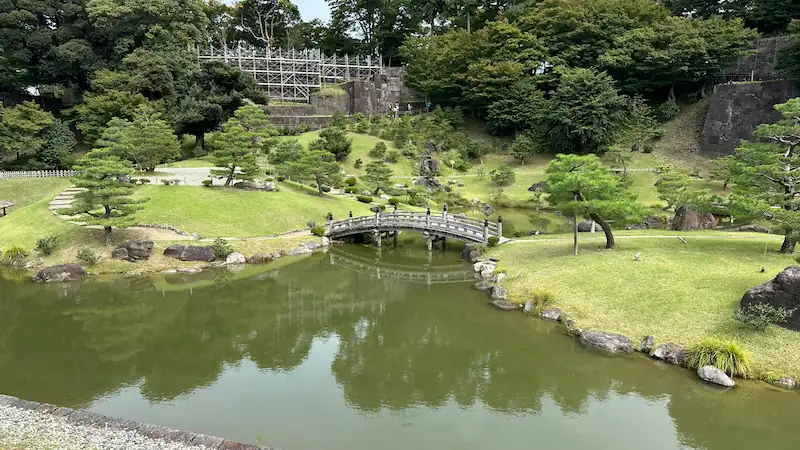
- Shikishi-tanzaku stonework: Straight and curved alignments; the stone wall itself becomes an ornamental element
- Waterfalls and flowing water: A composition that changes with time and light
- Pond, islands, and paths: As you stroll, new perspectives unfold
- Borrowed scenery: Stone walls and Sanjikken Nagaya are framed as shakkei
- Nighttime lighting: "Fantastical space" with lighting shifting every seven minutes
Quick look: ~5 min / In-depth: ~30 min
🗺 Address: 1-1 Marunouchi, Kanazawa (inside Kanazawa Castle Park)
🚶 Access: About 7 minutes (≈500 m) from Tsurunomaru Rest House.
🕰 Hours: Mar 1–Oct 15: 7:00–18:00 / Oct 16–end of Feb: 8:00–17:00
| Recommendation | Historical Significance: ☆☆ / Visual Appeal: ☆☆☆ / Experiential Value: ☆☆ |
|---|
| Reopened | March 2015 |
|---|---|
| Style | Strolling pond garden (chisen kaiyu-shiki) |
| Elevation Change | ≈22 m from pond bed to top of stone wall |
| Key Features | Waterfalls & streams, shikishi-tanzaku stone walls, ornamental stones, islands, walking paths |
| Admission | Free (garden area) |
| Hours | Mar 1–Oct 15: 7:00–18:00 / Oct 16–end of Feb: 8:00–17:00 |
- Name origin: Linked to Lady Eihime (Oda Nobunaga's 4th daughter), wife of Maeda Toshinaga, known as "Gyokusen-in."
- Lost and reborn: Disappeared after Meiji; revived from buried remains and old drawings.
- "Stone Wall Museum" vision: The layered masonry has such intricate artistry it's praised as a museum of stone walls.
- Three-stage night lighting: Dusk → early night → moonlit scenes.
- Older than Kenrokuen?: Origins traced to around 1634, possibly predating Kenrokuen's formation.
Gyokusen-an Tea House (玉泉庵)
Matcha and seasonal sweets with the garden's waterfalls as your backdrop
Gyokusen-an is a tearoom and rest house set within Gyokuseninmaru Garden, offering one of the best vantage points over the scenery. In the Edo period, this site housed the "Roji-yakusho," an office responsible for garden maintenance. From inside, you can take in the artful stonework — especially the shikishi-tanzaku pattern — and enjoy a quiet moment with matcha and wagashi.
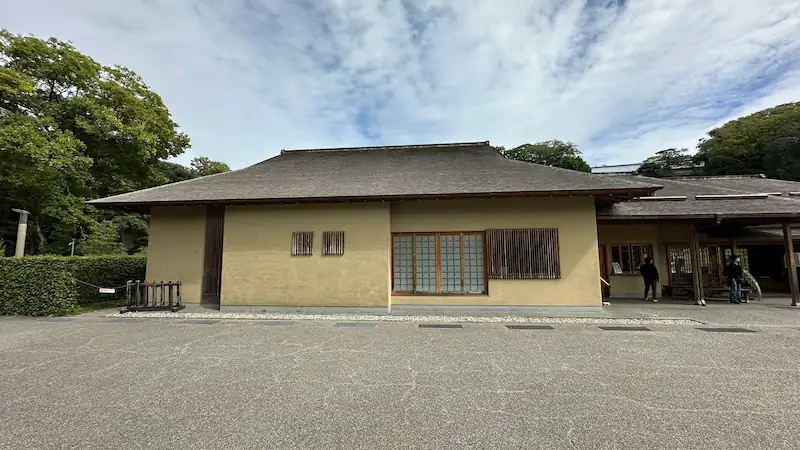
- Harmony with borrowed scenery: Windows frame waterfalls, stone walls, and pond
- Matcha with seasonal sweets: A classic pairing — an experience of "garden & tea"
- Available for private tea gatherings: Can be reserved for ceremonies and events
- A site layered with meaning: Rebuilt on the former Roji-yakusho grounds
Matcha break: ~15 min
🗺 Address: 1-1 Marunouchi, Kanazawa (inside Gyokuseninmaru Garden)
🚶 Access: About 2 minutes along the Gyokuseninmaru Garden path.
🍵 Tea Service: 9:00–12:00 and 13:00–16:30 (last admission 16:00) / Matcha with an original namagashi: ¥1,000. Closed Dec 29–Jan 3.
| Recommendation | Historical Significance: ☆☆ / Visual Appeal: ☆☆☆ / Experiential Value: ☆☆ |
|---|
| Structure | Single-story timber; shingle roof; approx. 226 m² |
|---|---|
| Rooms | Lounge, info desk, Japanese rooms (12 & 8 tatami), mizuya, veranda, entrance |
| Tea Service | 9:00–12:00 and 13:00–16:30 (last admission 16:00). Matcha with an original namagashi: ¥1,000. Closed Dec 29–Jan 3. |
| Closed | Dec 29–Jan 3 |
Nezumitamon Gate & Bridge (鼠多門・鼠多門橋) 🎥 360°
Black namako plaster meets timber bridge — the castle's striking 2020 finale
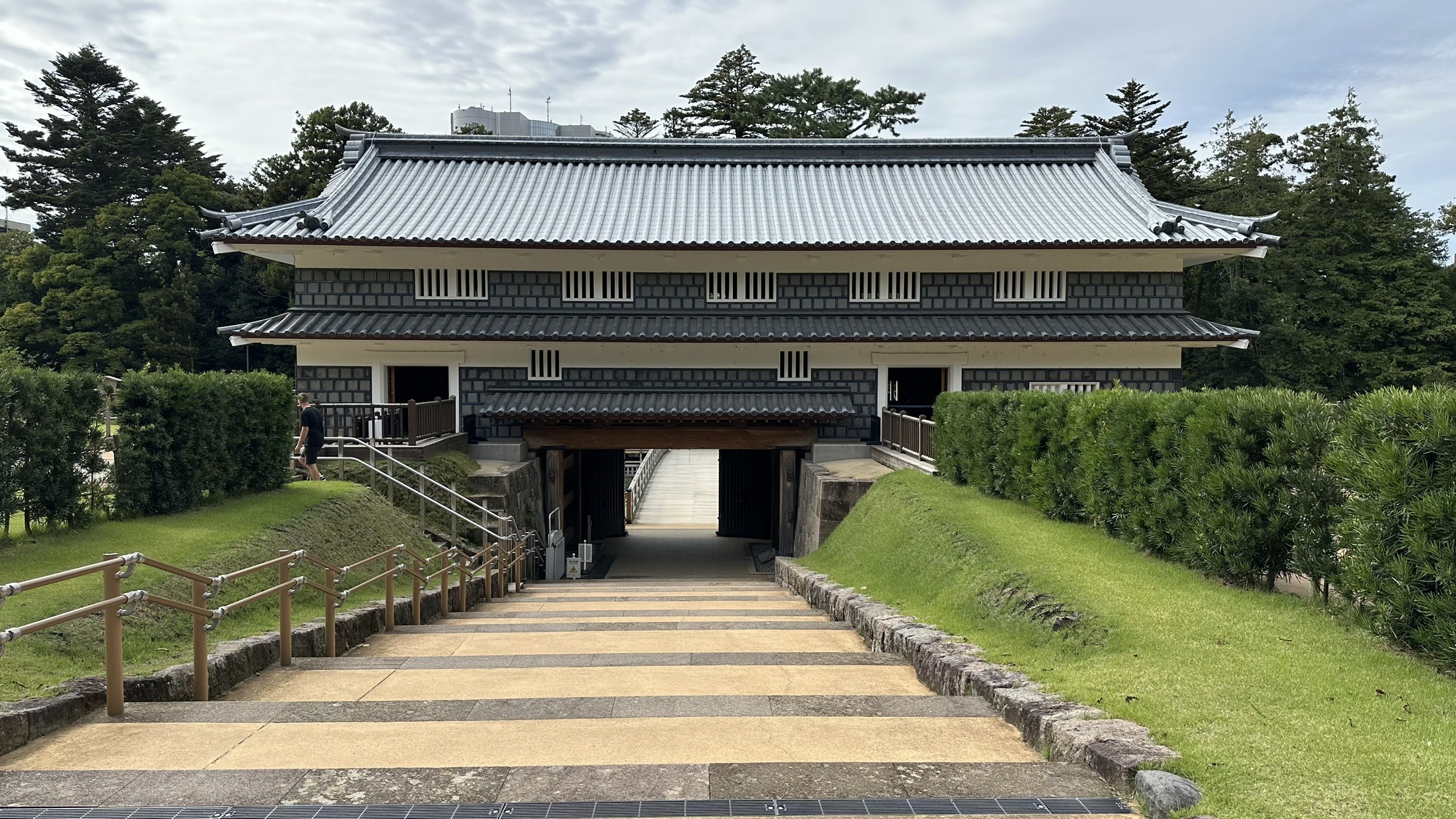
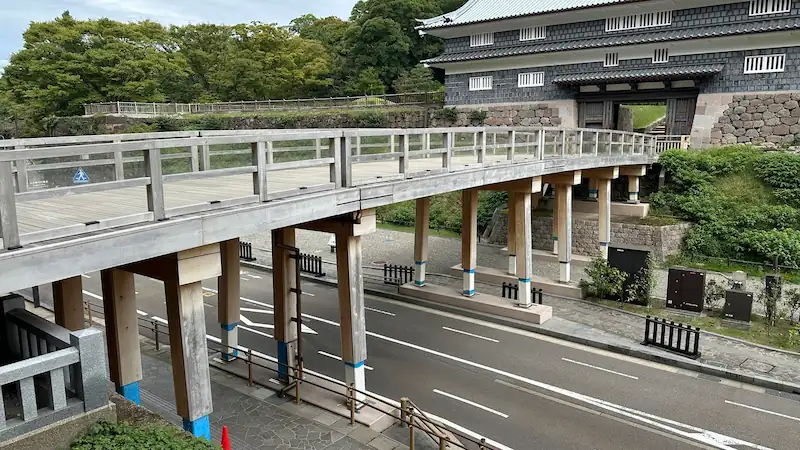
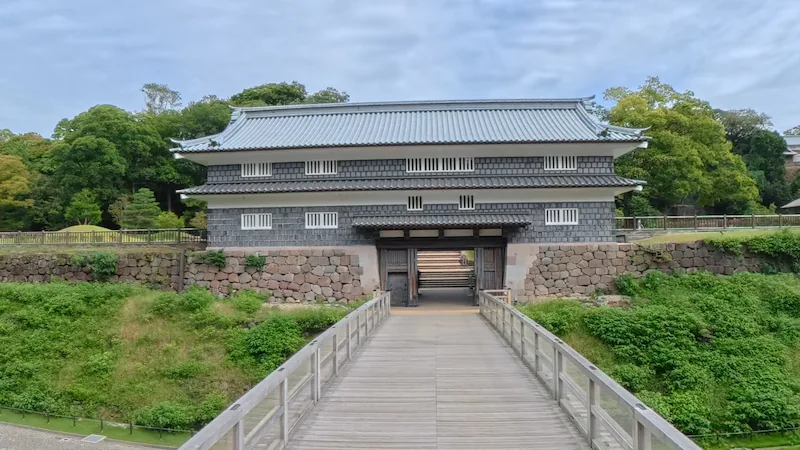
Nezumitamon is a two-story turret gate on the castle's west side. It once linked the Kanaya Demaru (near today's Oyama Shrine) to Gyokuseninmaru via Nezumitamon Bridge. Reconstructed in July 2020 after roughly 140 years, the gate's hallmark is its black namako plaster — a unique finish among Kanazawa Castle's gates. The bridge, the castle's largest wooden span, uses a hybrid system: timber exterior with internal steel for seismic safety.
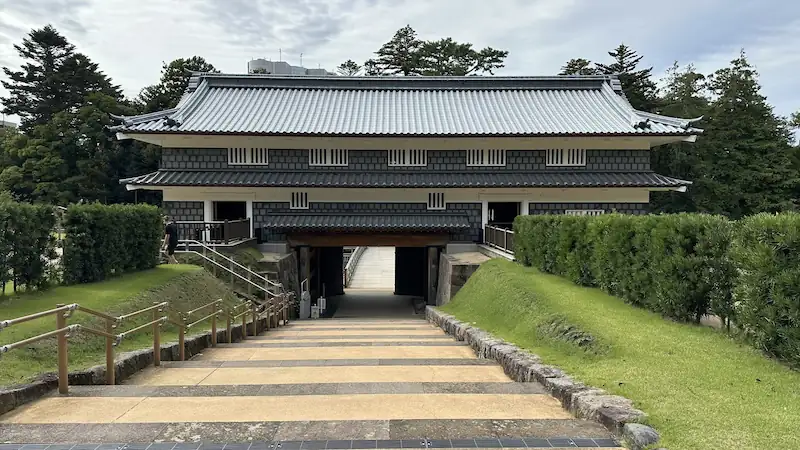
- Bold black namako plaster: Black-jointed tiles make this gate stand out
- Sense of scale: The castle's largest wooden-style bridge — feel its impressive span
- Interior exhibits: Learn about restoration and history from inside the turret (free)
- Night lighting: Dramatic shadows across gate and bridge
- Revived walking axis: Oyama Shrine → Nezumitamon → Gyokuseninmaru → castle
Quick look: ~5 min / In-depth: ~15 min
🗺 Address: 1-1 Marunouchi, Kanazawa (inside Kanazawa Castle Park)
🚶 Access: About 2 minutes (≈120 m) from Gyokusen-an.
| Recommendation | Historical Significance: ☆☆ / Visual Appeal: ☆☆☆ / Experiential Value: ☆☆☆ |
|---|
| Completed | July 18, 2020 |
|---|---|
| Gate Structure | Two-story turret gate; lead tiles; white plaster + namako walls; black-plaster joints |
| Bridge | Largest wooden-style bridge in the castle; timber exterior with internal steel |
| Role | Route linking Oyama Shrine to Gyokuseninmaru |
| Status | Reconstructed; interior open (free) |
- Why "Nezumi"?: Likely named for the gate's gray-toned plaster finish.
- Back after ~140 years: Restores the castle's west entrance sequence.
- Hybrid engineering: Traditional timber outside, concealed steel inside for quake resilience.
- A new sightseeing axis: Re-links Oyama Shrine and the castle, enriching walking itineraries.
Riko Turret Platform (鯉喉櫻台) 🎥 360°
L-shaped stone projection into the moat — a masterpiece of functional beauty
The massive stonework projecting into the eastern tip of Imori-bori (Imori Moat) is the Riko Turret Platform. It likely functioned as an outwork-like stone platform thrusting in an L-shape into the moat. Rising about 14.4 m from the moat bed, it eliminated blind spots and shored up defenses toward Kurahashi Gate and Gyokuseninmaru. A 2008–2010 restoration used around 900 stones, including about 250 excavated originals.
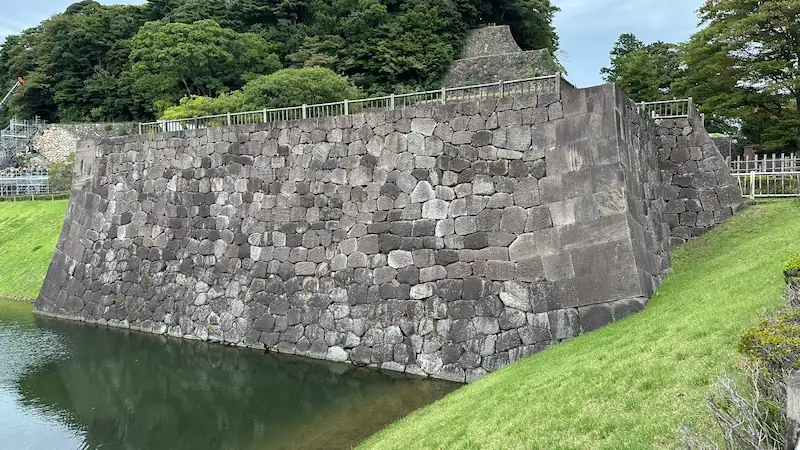
- A dramatic overhang: L-shaped projection cuts into the moat — a pinnacle of functional beauty
- Stonecutters' craft: Sharply worked corners showcase Kaga's advanced stonewall techniques
- Mirror-like water scenes: Restored moat reflects pale stone; sunsets and illumination are especially photogenic
Quick look: ~5 min / In-depth: ~15 min
🗺 Address: 1-1 Marunouchi, Kanazawa (eastern end of Imori-bori)
🚶 Access: About 9 minutes from Nezumitamon Bridge.
| Recommendation | Historical Significance: ☆☆ / Visual Appeal: ☆ / Experiential Value: ☆ |
|---|
| Construction | Early Edo; renovated in Kanbun 4 (1664) |
|---|---|
| Structure & Features | L-shaped stone platform projecting into Imori-bori; Tomuro stone; approx. 14.4 m from moat bed |
| Restoration | 2008–2010 with ~900 stones (incl. ~250 excavated originals) |
| Status | Restored stone wall open to the public (moat water reinstated) |
- The "carp's throat" nickname: The jutting form may have evoked a carp's throat.
- Authentic restoration: About 250 excavated stones were reused, supplemented with new Tomuro stone.
- From Toshiie onward: Castle-building matured under successive Maeda lords, with stonework reaching a zenith.
Otemon Gate Ruins (大手門跡) 🎥 360°
The castle's original main entrance — massive turret bases and masugata traces
The Otemon Gate Ruins mark the site of Kanazawa Castle's principal gate and the starting point of one of the largest masugata gate complexes. Under Sakuma Morimasa the castle's main gate had been at Nishi-cho-guchi (today's Kuromon); after Maeda Toshiie entered in 1583, the main gate was moved here, to the "Ozaka-guchi." Today, no buildings remain; what you see are stone walls and turret platforms.
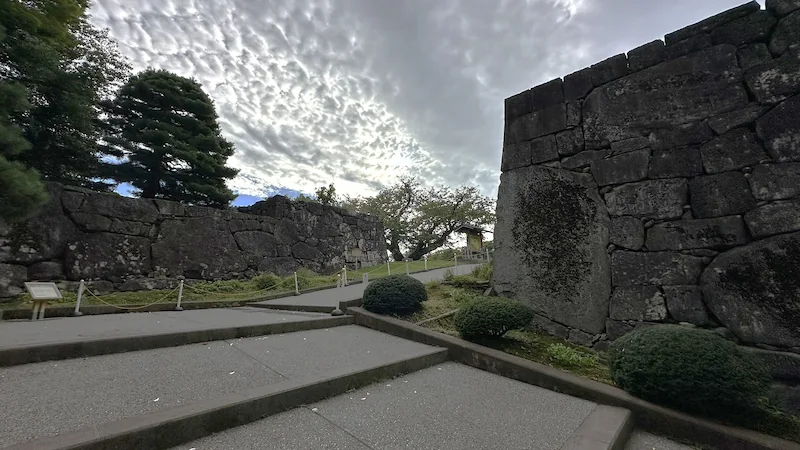
- Masugata defensive layout: The angled, non-straight approach reveals the ingenuity of the defense plan
- Massive turret bases: Among the castle's largest surviving stone platforms
- Imagine the procession: Envisioning the route adds depth to your exploration
Quick look: ~5 min / In-depth: ~20 min
🗺 Address: Approx. 2-26 Ote-machi, Kanazawa
🚶 Access: Along the outer Ote-bori moat. About 10 min from "Kenrokuen-shita" bus stop.
| Recommendation | Historical Significance: ☆☆ / Visual Appeal: ☆ / Experiential Value: ☆ |
|---|
| Era | Tensho era → became the castle's main gate (Ozaka-guchi) after Maeda Toshiie entered in 1583 |
|---|---|
| Structure | Large masugata entrance with turret platforms; only stonework survives |
| Current Status | No gate; stone walls and turret bases remain |
| Cultural Status | Part of the National Historic Site "Kanazawa Castle Ruins" |
- When Otemon meant "main gate": This site was historically the castle's face, unlike today's Ishikawa-mon.
- Masons' marks: Many stones bear chiselled symbols from multiple stonecutter guilds.
- Ote-bori Moat: The moat runs along the approach in front — its scale still hints at the grandeur of the former main entrance.
Kuromon (黒門) 🎥 360°
The temple-era entrance — where Kanazawa's history began before the castle existed
Kanazawa Castle's Kuromon lies on the northwest side at what used to be called the "Nishi-cho-guchi Gate." Under Sakuma Morimasa this was the castle's main gate; after Maeda Toshiie shifted the main approach to Ozaka-guchi in 1583, Nishi-cho-guchi became a secondary gate. Known as "Nishi-cho-guchi Gate" in the Edo period, it came to be called "Kuromon" (Black Gate) after the Meiji era. The gate buildings no longer survive, but the entrance and pathway have been maintained as "Kuromon-guchi."
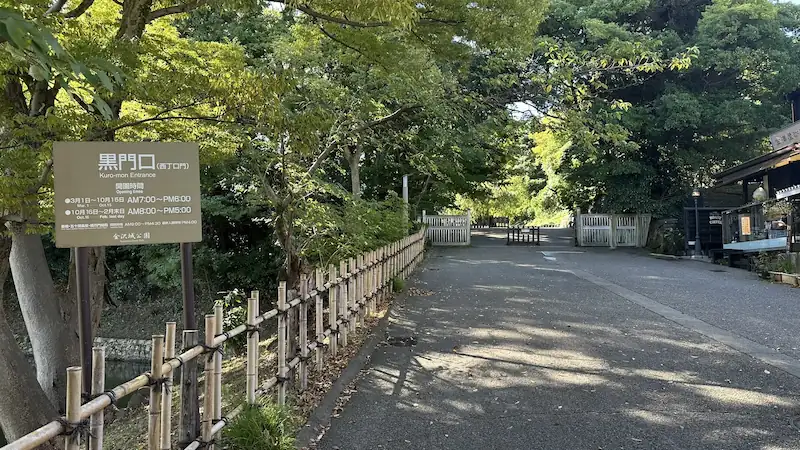
- Traces of the early main gate: Reflects the castle's formative stage as temple-to-castle transition
- Path facing the Ote-bori: Sense one of the castle's defensive axes
- Link to the castle town: Convenient from Omicho Market / Musashigatsuji area
- Adjacent cherry blossoms: Pair with Kuromonmae Green Space in spring
Quick look: ~3 min / In-depth: ~10 min
🗺 Address: Marunouchi, Kanazawa (west side of Ote-bori)
🚶 Access: About 10 minutes from "Kenrokuen-shita" or "Minami-machi" bus stops.
| Recommendation | Historical Significance: ☆☆ / Visual Appeal: ☆ / Experiential Value: ☆ |
|---|
| Location & Origins | Main gate under Sakuma Morimasa → secondary gate after 1583, when Maeda Toshiie shifted the main approach to Ozaka-guchi |
|---|---|
| Name Changes | "Nishi-cho-guchi Gate" → "Kuromon" after Meiji era |
| Current Status | No gate buildings; grounds and path maintained as "Kuromon-guchi" |
| Cultural Status | Part of the National Historic Site "Kanazawa Castle Ruins" |
- Why "Kuromon"?: One theory ties the Meiji-era nickname to the dark tone of the gate or walls.
- Go-hime connections: Near Kuromonmae Green Space are remains associated with Go-hime, Maeda Toshiie's 4th daughter.
- A practical trailhead: Many guides propose starting at "Kuromon-guchi" for first-time visitors.
Frequently Asked Questions
It's a daimyo strolling garden restored and reopened in 2015, featuring a roughly 22-meter elevation change from pond to parapet and distinctive shikishi-tanzaku patterned stonework. Its origins may date to around 1634, possibly predating Kenrokuen.
Yes — Gyokusen-an serves matcha with an original seasonal namagashi for ¥1,000, from 9:00–12:00 and 13:00–16:30 (last admission 16:00), closed Dec 29–Jan 3.
It's finished in black namako plaster, a striking look not used on any other gate at Kanazawa Castle. Reconstructed in July 2020 after roughly 140 years, it's paired with the castle's largest wooden-style bridge.
It was an L-shaped outwork-like stone platform projecting into Imori-bori moat, designed to eliminate blind spots and strengthen defenses toward Kurahashi Gate and Gyokuseninmaru.
The Otemon Gate Ruins mark the site of Kanazawa Castle's original principal gate, a large masugata complex. The main gate moved here from Nishi-cho-guchi (today's Kuromon) after Maeda Toshiie entered in 1583, and today only stone walls and turret platforms remain.
Previous Page

Back to the Table of Contents

Information on this page is based on on-site research, official publications from Ishikawa Prefecture, and publicly available historical sources. Opening hours, fees, and access conditions are subject to change. We recommend checking the official website before your visit. 360° panorama photos were captured on-site by the author.
- Complete Guide — Hours, Admission & 6-Area Walking Route
- Kanazawa Castle in 1 Hour — 7 Must-See Spots & Route Map
- Vol. 1 — Ishikawa-mon Gate & Sannomaru North Garden
- Vol. 2 — Kahoku-mon & Hashizume-mon Gates
- Vol. 3 — Kita-no-maru: Kikko-ishi Walls & Meiji Army HQ
- Vol. 4 — Ninomaru Core: Hishi Yagura & Sanjikken Nagaya
- Vol. 5 — Honmaru: Oldest Stone Walls & Tsurumaru Storehouse
- Vol. 6 — Gyokusen'inmaru Garden & Nezumitamon Gate (this page)
☕ Support This Site
Following the Shogun is built on original fieldwork and on-site research.
If you found this guide useful, your support helps keep it going.

You can also support via QR code


comment