


Three Surviving Important Cultural Properties in Nagoya Castle's Honmaru
In the southern section of Nagoya Castle's Honmaru (main compound), visitors can discover a series of historically rich landmarks that survived war and time: the Omote Ni-no-mon Gate, the Southeast Turret, the Southwest Turret, and the Ruins of the Ichi-no-mon Gate. This article will guide you through their architectural details and highlights, offering insight into their unique roles in the castle's defenses and heritage.
On This Page
4 Spots in the Southern Honmaru
Nagoya sits roughly midway between Tokyo and Osaka on the Tokaido Shinkansen line — about 80 minutes from Tokyo and 50 minutes from Osaka — making Nagoya Castle an easy addition to a Tokyo–Kyoto–Osaka itinerary. All four sites below are within a one- to three-minute walk of each other inside the Honmaru (本丸), the innermost and most heavily fortified compound of a Japanese castle. Each spot's highlights, visit time, access notes, and trivia are available by tapping "Open Details" on its card.
Omote Ni-no-mon Gate
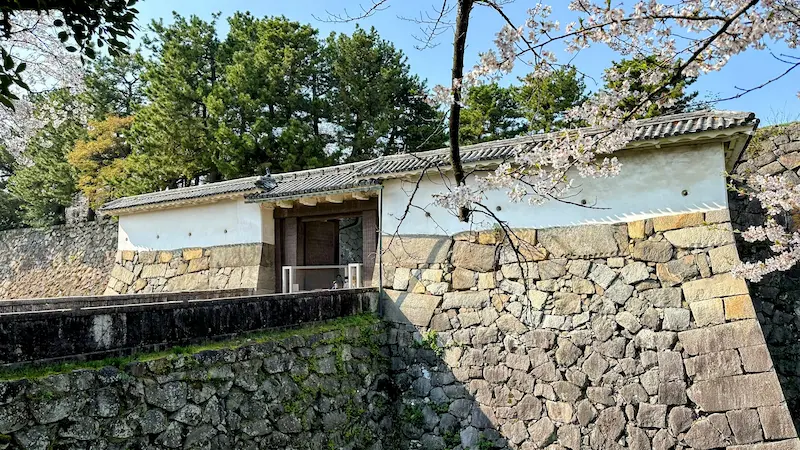
Located on the southern side of the Honmaru, the Omote Ni-no-mon Gate (表二之門) was constructed in 1612 (Keichō 17) and is designed in the Kōraimon style, a common Japanese castle-gate form with a peaked roof over two front pillars. Built from thick timber reinforced with iron plates, this gate served both as a defensive and ceremonial entrance to the castle. The flanking earthen walls feature teppō-zama (gun ports), designed to repel attackers.
Miraculously spared from destruction during World War II, this gate still retains its original pillars and lintels and is designated as a National Important Cultural Property — Japan's second-highest tier of protected heritage structure, one step below National Treasure status.
- Omote Ni-no-mon Gate: A rare surviving example of early Edo-period castle gate design.
- Southeast Turret: Located nearby, this three-story turret is also a designated Important Cultural Property.
- Seasonal Views: Cherry blossoms in spring and fiery leaves in autumn create a striking contrast with the historic architecture.
Recommended visit time: Quick visit ~5 minutes / In-depth visit ~15 minutes
Address: 1-1 Honmaru, Naka-ku, Nagoya, Aichi Prefecture, South of Honmaru
Access: Approx. 1-minute walk (110m) from the Statue of Katō Kiyomasa
Trivia- Historical Significance: This gate was a key entry point into the Honmaru and contributed significantly to the castle's defensive layout.
- Defensive Feature: The flanking walls' gun ports reflect sophisticated military design meant to thwart close-range attacks.
- Famous Connection: Constructed as part of Tokugawa Ieyasu's castle-building campaign.
Southeast Turret Tōnan-sumi Yagura
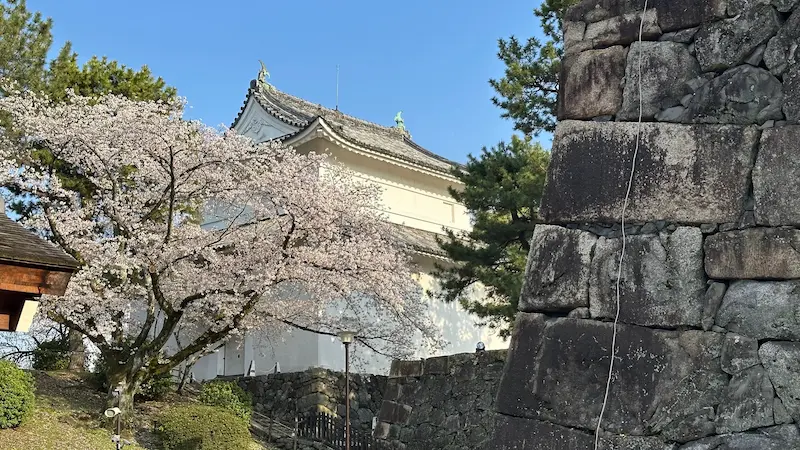
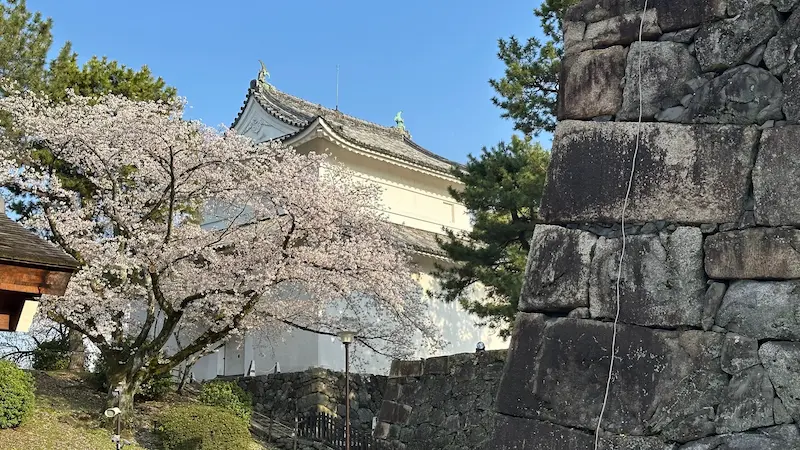
The Southeast Turret, located at the southeastern corner of the Honmaru, is one of the few original turrets still standing at Nagoya Castle. Built around 1612, it is structured with two external tiers but houses three interior floors, a clever design that once earned it the name Tatsumi Turret.
The turret features the Aoi crest, symbol of the Tokugawa clan, prominently displayed on its ornamental tiles. Unlike many structures that perished in wartime bombings, this turret survived World War II and retains its original form.
- Unique Structure: Two-story exterior, three-story interior, with stone drop chutes for defense.
- Aoi Crest Tiles: Decorative tiles display the Tokugawa family crest.
- Seasonal Views: Spring and autumn provide a picturesque backdrop for photography and reflection.
Recommended visit time: Quick visit ~5 minutes / In-depth visit ~15 minutes
Address: 1-1 Honmaru, Naka-ku, Nagoya, Aichi Prefecture, Southeast Corner of Honmaru
Access: Approx. 1-minute walk (45m) from Omote Ni-no-mon Gate
Trivia- Historical Detail: Once known as Tatsumi Turret, it is one of the few remaining original structures from the Edo period.
- Hidden Feature: The east-facing roof on the third floor features an arched karahafu gable — an ornamental curved gable reserved for high-status buildings.
- Famous Connection: Commissioned under Tokugawa Ieyasu's direction as part of the castle's original defensive network.
Ichi-no-mon Gate Ruins
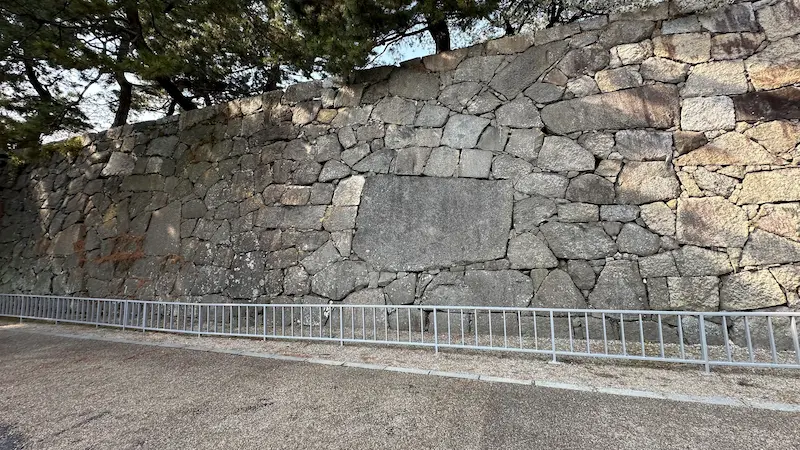
The Ichi-no-mon Gate Ruins mark the site of what was once one of the main entrances to the Honmaru. Together with the Omote Ni-no-mon Gate, it formed a masugata — a square defensive courtyard that funneled and exposed invading forces.
The gate featured a two-story irimoya-style roof (a traditional hip-and-gable roof form) and a stone drop mechanism above the doors. Sadly, it was destroyed during air raids in 1945, leaving only the original stone foundations visible today.
- Stone Foundations: The remaining stone base reveals the scale and defensive layout of the former masugata gate.
- Historical Signage: Informational boards explain the structure and significance of the former gate.
- Seasonal Views: The contrast of cherry blossoms against the historic stone is especially stunning in spring.
Recommended visit time: Quick visit ~3 minutes / In-depth visit ~15 minutes
Address: 1-1 Honmaru, Naka-ku, Nagoya, Aichi Prefecture, Site of Ichi-no-mon Gate
Access: Approx. 1-minute walk (10m) from Southeast Turret
Trivia- Historical Significance: Served as a primary gate in tandem with Omote Ni-no-mon, forming an essential part of the castle's defenses.
- Hidden Feature: The scale of the remaining stonework allows visitors to visualize the gate's original grandeur.
- Famous Connection: Built during Tokugawa Ieyasu's rule as part of the castle's primary security network.
Southwest Turret Seinan-sumi Yagura
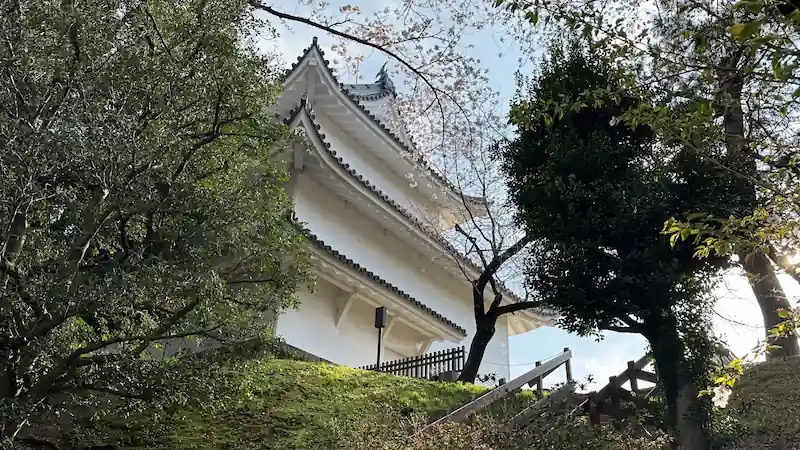
The Southwest Turret, or Honmaru Hitsuji-saru Turret, sits on the southwest corner of the Honmaru. Built around 1612, this structure features an unusual format: while it appears to be two stories from the outside, it is actually three stories inside — its first floor lacks an external roof, creating a deceptive exterior.
The turret measures approximately 11.8 meters east-west, 13.5 meters north-south, and stands about 14.1 meters high. It features an irimoya-style tiled roof combining flat and round tiles. The second-floor west and south walls include chidorihafu gables — small triangular gable ornaments — and stone drop defenses.
Originally destroyed by a stone wall collapse in 1921, the turret was rebuilt in 1923 by the Imperial Household Ministry using ornamental tiles bearing the imperial chrysanthemum crest.
- Unique Structure: Appears two-storied but is three floors inside — an architectural rarity.
- Imperial Decorations: Rebuilt with roof tiles featuring the chrysanthemum crest, a symbol of the imperial family.
- Seasonal Views: A beautiful location for viewing spring blossoms and fall foliage.
Recommended visit time: Quick visit ~5 minutes / In-depth visit ~15 minutes
Address: 1-1 Honmaru, Naka-ku, Nagoya, Aichi Prefecture
Access: Approx. 3-minute walk (100m) from the Ichi-no-mon Ruins
Trivia- Noteworthy History: After the 1921 collapse, the turret was rebuilt using imperial crests — marking a rare imperial restoration.
- Hidden Feature: Though usually closed to the public, the interior is occasionally open during special exhibitions.
- Famous Connection: Originally part of Tokugawa Ieyasu's design, this turret contributed to the southwestern defenses of the castle.
A personal ranking based on repeated on-site visits by the Following the Shogun team (most recently June 2026). This is our own judgment, not the castle's official recommendation.
This is what to see first inside the Honmaru. Built around 1612 and one of the few structures that survived the 1945 air raids intact, it is a National Important Cultural Property — two tiers outside, three floors inside, with the Tokugawa hollyhock crest on its ornamental tiles. The exterior can be viewed at any time.
Right beside the turret and directly on the path into the Honmaru, so you will pass through it anyway. Also an original surviving Important Cultural Property. Worth stopping rather than walking straight through — the gun ports in the flanking earthen walls are visible up close.
Another original Important Cultural Property, but the interior is normally closed and it sits about 100 m away from the Southeast Turret. If the exterior is enough for you, you can take it in while crossing the Honmaru. If your visit happens to fall during a special opening, move this to the top of the list.
Destroyed in the 1945 air raids — only the stone base remains. It formed a masugata (box-shaped defensive courtyard) together with the Omote Ni-no-mon Gate, so glancing at the stonework while you are at that gate is enough. No need to budget separate time for it.
Nagoya Castle Guide Full Map
Nagoya Castle: Hours, Admission & Access
| Hours | 9:00 am – 4:30 pm (last entry to Honmaru Palace 4:00 pm) |
|---|---|
| Closed | December 29 – January 1 |
| Admission | Adults ¥500 (through September 30, 2026) / ¥1,000 (from October 1, 2026) Free for junior-high age and under, before and after the change Verified August 23, 2026. The increase was approved by the Nagoya City Council. Tickets bought before the change date remain valid afterwards. |
| Nearest station | Nagoya Castle Station (Meijo subway line), about a 5-minute walk |
Please check the official Nagoya Castle website for the latest hours and fees before you visit.
Why was Nagoya Castle built? Tokugawa Ieyasu, founder of the Tokugawa shogunate, ordered the castle rebuilt in November 1609; construction began in January 1610 and the main keep was completed in December 1612. It became the seat of the Owari Tokugawa family, the senior-most of the three Tokugawa branch houses (the Gosanke), and one of the most important castle towns in Japan.
FAQ
The Omote Ni-no-mon Gate was built in 1612 (Keichō 17) in the Kōraimon style and is designated a National Important Cultural Property. It survived World War II and still retains its original pillars and lintels.
Three structures survived wartime bombing and remain today: the Omote Ni-no-mon Gate, the Southeast Turret, and the Southwest Turret, all designated National Important Cultural Properties. The Ichi-no-mon Gate was destroyed in the 1945 air raids, and only its stone foundations remain.
The Southwest Turret is normally closed to the public, though its interior can occasionally be viewed during special openings. The exterior can be viewed at any time from the southwest corner of the Honmaru.
Nagoya Castle is open 9:00 am to 4:30 pm (last entry to Honmaru Palace at 4:00 pm), closed December 29 through January 1. Adult admission is currently ¥500, rising to ¥1,000 from October 2026. The nearest station is Nagoya Castle Station on the Meijo subway line, about a 5-minute walk.
Related Articles on Nagoya Castle
Next Article
Previous Article
Index Article
More Nagoya Castle Guides
☕ Support This Site
Following the Shogun is built on original fieldwork and on-site research.
If you found this guide useful, your support helps keep it going.

You can also support via QR code


comment