


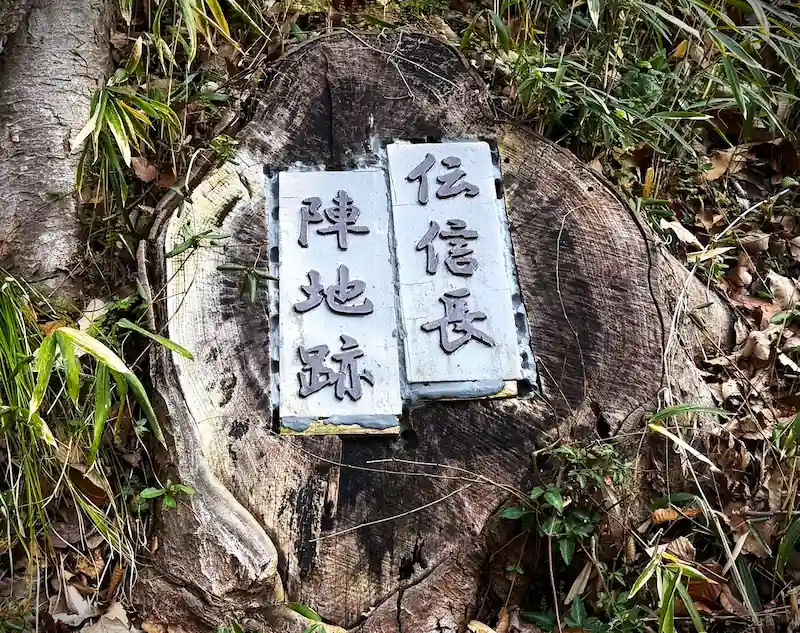
Toragozenyama Castle Ruins
In 1572, Oda Nobunaga threw up a line of forward camps along a low ridge called Toragozenyama (虎御前山), directly across the valley from Odani Castle, the mountain stronghold of his enemy Azai Nagamasa. The camp sites of Nobunaga himself, of Kinoshita Hideyoshi (the future Toyotomi Hideyoshi), of Shibata Katsuie and of other Oda commanders still lie strung along the ridge, and today a marked hiking trail links them together.
This page covers all eleven route stops of Toragozenyama Castle, a Nagahama City designated historic site, with photographs taken on the ground. There is no gate and no entrance fee, and the trailhead is a 15-minute walk from Torahime Station. You can either walk the southern half and come back the way you came (1 to 1.5 hours), or cross the whole ridge from one station to the next (2 to 3 hours).
The trail is signposted in Japanese only, so the two route pages below include photographs of the junctions where walkers actually go wrong, along with what survives at each camp and how to make sense of it. Japanese place names are given here in Japanese script as well, so you can match them against the signs you will see on the ground.
Essential information
| Admission | No charge on our February 2026 visit; policies can change, so confirm before travelling. |
|---|---|
| Time needed | Short walk (the six southern sites, then back the way you came): 1 to 1.5 hours. Full traverse (all eleven sites, Torahime Station to Kawake Station): 2 to 3 hours. |
| Nearest station | Torahime Station (虎姫駅, JR-A08) on the JR Hokuriku Main Line — about 15 minutes on foot to the trailhead (1.2 km) |
| Station at the far end | Kawake Station (河毛駅, JR-A07) on the JR Hokuriku Main Line — about 15 minutes on foot (1 km) down from the northern viewpoint |
| Parking | Toragozenyama Park parking lot (free, more than 10 spaces). It fills up at weekends and in peak season, so arrive early in the day. |
| Castle seal | The Reiwa 8 (2026) spring limited edition went out of sale on 31 May 2026. A new design has been on sale since 17 June 2026. Stock and current editions change, so check with the sales point below before you count on buying one. |
| Elevation | About 225 m (738 ft) |
| Designation | Nagahama City designated historic site |
| Hiking trail opened | 2004 |
| Footwear | This is a mountain path, so proper walking shoes are essential. Some sections are slippery after rain. |
The history of Toragozenyama Castle
1572: why Nobunaga built a castle across the valley
By 1572, the long struggle between Oda Nobunaga — the warlord who came closest to unifying sixteenth-century Japan — and Azai Nagamasa, the lord of northern Omi Province (roughly today’s Shiga Prefecture), had reached its final phase. Nagamasa’s seat, Odani Castle, was a mountain fortress with high ground at its back, and a frontal assault on it was not a realistic option. Instead, Nobunaga chose to build a line of forward camps on Toragozenyama, the ridge that rises across the valley from Mount Odani, about 225 metres high.
The straight-line distance from Toragozenyama to Odani Castle is roughly 2 km, and from the crest of the ridge you look straight across at the mountain the castle sat on — an ideal position for cutting the castle’s supply lines and keeping it under constant observation and pressure. Work began on 27 July and the camps are recorded as finished on 8 or 9 August, less than a fortnight later.
1573: the fall of Odani Castle
On 27 August 1573, acting on Nobunaga’s orders, Kinoshita Hideyoshi stormed the Kyogokumaru, one of the enclosures of Odani Castle, and pushed on into the Komaru above it. The attack split the castle in two and cut off Azai Hisamasa and his son Nagamasa from one another. On 1 September, Nagamasa took his own life and Odani Castle fell.
Toragozenyama Castle had served as the front line for about a year and two months, and the fall of Odani ended its purpose. Even after it was abandoned, the shaping of the ridge survived well, and after conservation work by Nagahama City it is now open as the hiking trail described on this page.
Kinoshita Hideyoshi at Toragozenyama: the first step towards ruling Japan
The commander who held the front line here as garrison commander of Toragozenyama Castle was Kinoshita Hideyoshi — the man later known as Toyotomi Hideyoshi, who went on to rule all of Japan. He changed surnames more than once during his career, so the same man appears in sources as Kinoshita, as Hashiba and finally as Toyotomi; the stone marker on this ridge uses the earliest of the three. What he achieved in this campaign deepened Nobunaga’s trust in him, and after Odani fell he was given the Kohoku district, the northern shore of Lake Biwa, as lord of Nagahama Castle. NHK’s 2026 taiga drama Toyotomi Brothers! covers exactly this stretch of his life, and this is one of the few places where you can stand on the ground where it happened.
Timeline
- 27 July: construction begins
- 8 to 9 August: the works are completed
- Nobunaga builds across the valley to besiege Odani Castle
- His commanders are spread out along the ridge
- 27 August: Hideyoshi takes the Kyogokumaru
- He pushes straight on into the Komaru
- 1 September: Azai Nagamasa dies by his own hand and Odani Castle falls
- Toragozenyama Castle has served its purpose
- Designated a historic site by Nagahama City
- The hiking trail opened in 2004
- Stone markers stand at each commander’s camp site
Choosing your route
Torahime Station (about 15 minutes on foot) to Yaai Shrine at the trailhead, north along the ridge past the six southern sites, then back the same way to Yaai Shrine and the station. Allow 1 to 1.5 hours including the walk from and to the station. If you have half a day, take the full traverse instead.
Torahime Station (about 15 minutes on foot) to Yaai Shrine, north past the six southern sites, on through the camp sites of Nobunaga, Hideyoshi and Shibata Katsuie, then down the northern slope from the viewpoint to Kawake Station, where the castle seal is sold (about 15 minutes on foot). Allow 2 to 3 hours. Going station to station means no climbing back over ground you have already covered, and you see all eleven sites.
Getting there
Toragozenyama is in Nagahama, on the north-eastern shore of Lake Biwa in Shiga Prefecture. That puts it well north of Kyoto rather than anywhere near it, but still within comfortable reach: this is a day trip from Kyoto or Nagoya rather than a destination you need to base yourself at.
By train: Torahime Station and Kawake Station
Both stations are on the JR Hokuriku Main Line and both are operated by JR West, so a Japan Rail Pass covers the journey and IC cards such as ICOCA, Suica and PASMO can be used at the gates. Torahime (虎姫駅, JR-A08) is the next station north of Nagahama and is where the walk starts; Kawake (河毛駅, JR-A07) is one further north again and is where the full traverse ends. Both Special Rapid (shin-kaisoku) and local trains stop at them, which means some services run straight through from Kyoto and Osaka without a change.
By car: from Toragozenyama Park parking to the trailhead
If you are driving, use the Toragozenyama Park parking lot near Yaai Shrine. It is free and holds more than ten cars, and the trailhead is a few steps away. It can fill up at weekends and in peak season, so arriving early in the morning is the safer plan.
Access maps: Torahime Station to the trailhead, and the traverse to Kawake Station
From Torahime Station to the Toragozenyama Park parking lot is about 1 km, or roughly 15 minutes on foot.
The route out over the north end of Toragozenyama towards Kawake Station. Once you are down off the ridge it is about 1 km, or roughly 15 minutes on foot, to Kawake Station, where the castle seal is sold.
The camp sites, area by area
The eleven route stops are covered in detail across two pages, split into a southern and a northern half. Each page gives the surviving earthworks, the time to allow and the practical notes for every site. If you want to walk without second-guessing yourself at junctions, the site names below link straight to the relevant section of each page.
The southern route, up from Yaai Shrine
This page follows the ridge north from Yaai Shrine and covers the southern camp sites in walking order. If this is your first time on Toragozenyama, read it first to fix the trailhead and the junctions in your mind.
- 01 Reputed camp of Taga Sadayoshi
- 02 Yaai Shrine
- 03 Reputed camp site of Hachiya Yoritaka
- 04 Toragozenyama Observation Deck
- 05 Reputed camp site of Niwa Nagahide
- 06 Reputed camp site of Takigawa Kazumasu
The northern route: the heart of the position
This is the core of Toragozenyama Castle. The camp sites of Hori Hidemasa, Oda Nobunaga, Kinoshita Hideyoshi and Shibata Katsuie follow one another here, and it is the stretch where earthen ramparts, trench cuts and an elongated box-shaped gateway are easiest to read on the ground — a Japanese fortification built of shaped earth rather than stone.
- 07 Reputed camp site of Hori Hidemasa
- 08 Reputed camp site of Oda Nobunaga
- 09 Reputed camp site of Kinoshita Hideyoshi
- 10 Reputed camp site of Shibata Katsuie
- 11 Toragozenyama North Viewpoint
The castle seal (gojōin)
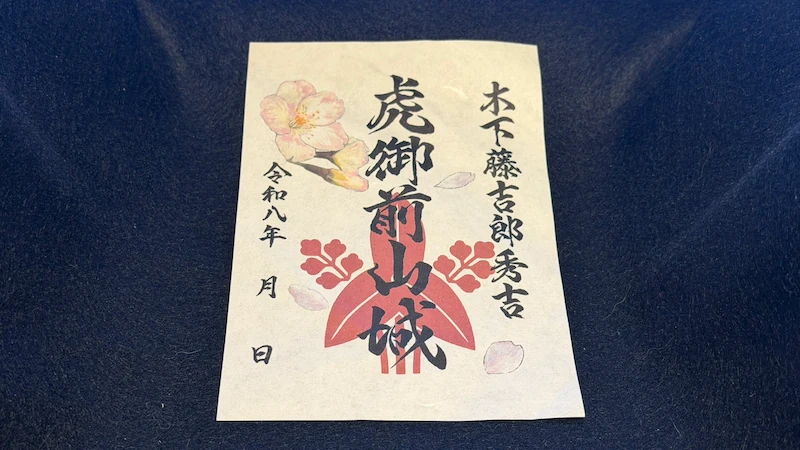
A castle seal, or gojōin (御城印), is a printed and stamped sheet of paper sold as a memento of a visit to a Japanese castle — the castle equivalent of the goshuin seals that collectors gather at temples and shrines. Many are limited editions, so the design on sale changes over time.
It was sold between 7 March and 31 May 2026 and that run has ended. For remaining stock, whether a successor edition exists and the current state of sales, contact the sales point below directly.
A new Toragozenyama Castle seal went on sale on 17 June 2026 at 500 yen, again at the Kawake Station Community House. The design places Oda Nobunaga’s family crest at the centre together with the names and crests of four of his retainers recorded as holding camps within the castle. Researched online rather than seen in person — source: Kojodan castle news, 11 June 2026. Please confirm current availability before travelling.
Kawake Station Community House, Nagahama, Shiga Prefecture. Tel: 0749-78-2280. Open 06:30 to 18:00.
The Reiwa 8 spring limited edition was 450 yen including tax per sheet. Standard editions may also be available.
※ Kawake Station is on the JR Hokuriku Main Line. On the full traverse, it lies about 15 minutes on foot from the point where you come down off the northern end of Toragozenyama.
Frequently asked questions
The Reiwa 8 (2026) spring limited edition went out of sale on 31 May 2026. A new design has been on sale at the Kawake Station Community House in Nagahama, Shiga Prefecture since 17 June 2026, at 500 yen. Editions and stock change, so contact the community house directly to confirm what is available.
No admission fee was charged on our February 2026 visit. Toragozenyama is maintained as a Nagahama City designated historic site and the hiking trail has no gate. Policies can change, so confirm current status before travelling if this matters to your plans. Do bear in mind that Yaai Shrine at the trailhead is an active place of worship, so keep things quiet as you pass through.
Allow 1 to 1.5 hours for the short walk, which goes from Torahime Station via Yaai Shrine, takes in the six southern sites and turns back. Allow 2 to 3 hours for the full traverse of all 11 route stops, coming out on the Kawake Station side. If you plan to stop for photographs and rests, set aside half a day and you will not feel rushed.
It is the remains of the line of forward camps that Oda Nobunaga built on Toragozenyama in 1572, across the valley from Azai Nagamasa’s Odani Castle, in order to besiege it. Camp sites associated with Taga Sadayoshi, Hachiya Yoritaka, Niwa Nagahide, Takigawa Kazumasu, Hori Hidemasa, Oda Nobunaga, Kinoshita Hideyoshi (the future Toyotomi Hideyoshi) and Shibata Katsuie survive along the ridge, and this was the front line of the campaign until Odani Castle fell in 1573.
The nearest station is Torahime Station (虎姫駅, JR-A08) on the JR Hokuriku Main Line, and it is about 15 minutes on foot (1.2 km) from there to Yaai Shrine at the trailhead. By car, the Toragozenyama Park parking lot is free. If you walk the ridge right through to the north, you can come out at Kawake Station (河毛駅, JR-A07) instead, about 15 minutes on foot from the bottom of the descent.
Yes — the Toragozenyama Park parking lot is free and holds more than ten cars. It is a few steps from Yaai Shrine at the trailhead, and there are toilets in the park nearby. It can get busy at weekends and in peak season, so arriving early is worth it.
Going by the name Kinoshita Hideyoshi at the time, the future Toyotomi Hideyoshi held the front line here for a long stretch as garrison commander of Toragozenyama Castle. On 27 August 1573, acting on Nobunaga’s orders, he stormed the Kyogokumaru enclosure of Odani Castle and pushed straight on into the Komaru — actions that led directly to the castle’s fall.
Historically the strongest are the reputed camp site of Oda Nobunaga and the reputed camp site of Kinoshita Hideyoshi. The earthworks there survive comparatively well — earthen ramparts, traces of ditches, stepped enclosures — and they make the relationship with Odani Castle across the valley easy to feel. If you want to read fortification structure, add the reputed camp site of Hori Hidemasa, where you can pick out three enclosures divided by trench cuts.
It is a route a first-time hiker can take on, but this is a mountain path, so comfortable clothes and proper walking shoes are essential. The summit is only about 224 m and the climb from Yaai Shrine up to the ridge is not a big one, but the ridge itself rises and falls. Footing is slippery after rain, so take care.
You can if you have the energy, but doing both properly takes a full day. A realistic plan is Toragozenyama (2 to 3 hours) in the morning and the climb at Odani Castle (2 to 3 hours) in the afternoon. The usual approach to Odani is from JR Kawake Station to its trailhead. For the details, see the Odani Castle guide.
As of the February 2026 visit, no drama-related banners, information boards or special exhibitions were found on site. The site itself is where Kinoshita Hideyoshi (the future Toyotomi Hideyoshi) served as garrison commander, which makes it a rare place to experience the early part of his life covered by the drama on the actual ground. Check locally for the current situation when you visit.
※ The information here is based on my own visit and on published material, but the state of preservation of the earthworks and the identification of each traditional site are matters on which views differ. When you visit, it is worth reading the material published by the Nagahama City Board of Education and the information boards on site alongside this guide. Times and access details are guides only. This is a mountain path, so please come prepared for the weather and for the walking. Castle seal stock and sales arrangements can change, so check before you travel.
☕ Support this site
Following the Shogun is written from my own visits to the sites.
If a guide has been useful to you, a contribution helps keep the work going.

You can also support the site from this QR code


comment