


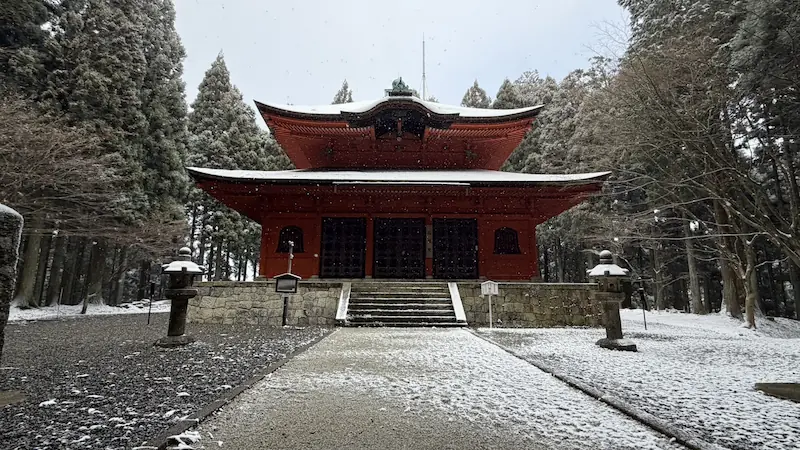
Mt. Hiei Enryakuji Todo Precinct: 7 Highlights & the Konpon Chudo Restoration
The moment you step off the cable car at the summit, the air is different. Down in the city it had been clear; up here in the Todo precinct, snow was falling.
The moment you step off the cable car at the summit, the air is different. Down in the city it had been clear; up here in the Todo precinct, snow was falling. That shift alone tells you this is somewhere else entirely. Todo is the founding ground of Enryakuji — the precinct where Saicho built his first hermitage in 788 — and it remains the heart of the complex, with seven National Treasure and Important Cultural Property structures clustered around Konpon Chudo Hall. Stand before the row of founding figures enshrined in the Daiko-do (Great Lecture Hall) — Honen, Shinran, Dogen, Nichiren — and the phrase "mother mountain of Japanese Buddhism" stops being a label and becomes something you actually feel. Start here, and the full shape of Enryakuji begins to make sense.
Todo Precinct — Spots on This Page
About the Todo Precinct
Of the three precincts of Enryakuji — Todo, Saito, and Yokawa — Todo is the oldest and the site of the temple's founding. It was here that Saicho established Ichijo Shikan-in (present-day Konpon Chudo Hall) in 788, and the precinct has grown around that origin point ever since, with Monju-ro Gate, the Daiko-do, Amida-do, the Hokke Soji-in East Pagoda, and other halls clustered in the surrounding area. Todo is easily reached by a 10-minute walk from Enryakuji Cable Station, and the nearby Enryakuji Bus Center makes it the natural departure point for the Saito and Yokawa precincts as well. The area contains one National Treasure and four Important Cultural Properties — most of them rebuilt in the 17th century under the patronage of Toyotomi Hideyoshi and Tokugawa Iemitsu following the near-total destruction of the Nobunaga burning in 1571. Of the three precincts, Todo makes the most visually immediate impression, but it's inside the Daiko-do, standing before the wooden figures of the great Buddhist reformers who trained here, that the weight of Enryakuji as the "mother mountain of Japanese Buddhism" quietly lands.
Spot Details
Konpon Chudo Hall 🎥 360°
The main hall of Enryakuji — a National Treasure where the Eternal Flame has burned for over 1,200 years
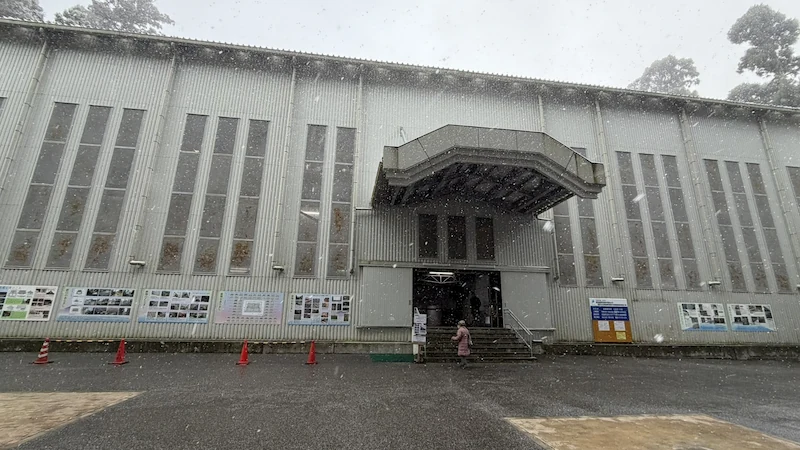
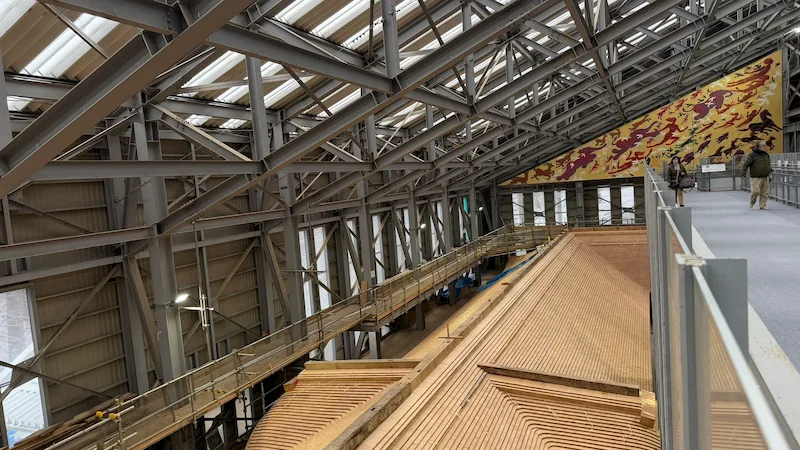
At the center of the Todo precinct stands Konpon Chudo Hall — the main hall of the entire Enryakuji complex, tracing its origins to the hermitage Saicho founded here in 788. The hall was destroyed in 1571 during Nobunaga's devastating assault on the mountain. Toyotomi Hideyoshi built a temporary structure on the site in 1585, and the current building was raised in 1642 under the direction of the third Tokugawa shogun, Iemitsu. The vast hip-and-gable-roofed structure, eleven bays wide, is covered in copper shingles. Deep inside, the Eternal Flame (fumetsu no hoto) — a lamp said to have burned continuously for more than 1,200 years — still flickers. A major restoration project that began in 2016 is projected to run for approximately 15 years, with completion expected around 2031; worship remains possible throughout. A special viewing platform called the gakushu stage gives visitors a close-range view of the copper roof and the repair work in progress — a vantage point that will simply cease to exist once the scaffolding comes down. Since January 8, 2026, a standing proxy image of the secret principal deity (Yakushi Nyorai, the Buddha of Healing) and the Eternal Flame have been transferred for special veneration to the adjacent Manpai-do Hall, where visitors can approach them more closely than usual.
Highlights
- The gakushu stage — a view that only exists now: Stepping up onto the viewing platform in the courtyard puts you at eave height, close enough to see individual copper shingles and the details of the ongoing repair work. Once restoration is complete, this angle is gone forever.
- The Yakushi Nyorai proxy image and the Eternal Flame at Manpai-do: Since January 8, 2026, the standing proxy image of the secret principal deity and the Eternal Flame have been specially enshrined in the Manpai-do Hall — an unusually close encounter with both that is unique to the restoration period.
- Seasonal highlights: The area around Konpon Chudo is particularly striking in early summer, when fresh green maple leaves frame the hall, and again in autumn when the surrounding trees turn.
⏳ Time estimate: Quick visit 10 min / Thorough visit 20–30 min
🗺 Address: 4220 Sakamoto Honmachi, Otsu, Shiga
🚶 Access: Approx. 10-minute walk from Enryakuji Cable Station
⭐ Recommended Historical Significance: ☆☆☆ Visual Impact: ☆☆☆ Experiential Value: ☆☆
| Year Built | Founded 788 (Enryaku 7); current structure rebuilt 1642 (Kanei 19) |
|---|---|
| Builder | Founded by Dengyo Daishi Saicho; current structure rebuilt by order of Tokugawa Iemitsu |
| Structure & Features | Hip-and-gable roof (irimoya-zukuri), copper shingles, 11 bays wide. Principal deity: Yakushi Nyorai (Buddha of Healing). The Eternal Flame burns in the inner sanctuary. |
| Cultural Property Designation | Konpon Chudo Hall: National Treasure. Surrounding covered corridor: Important Cultural Property. |
| Current Status | Major restoration underway (2016 — approx. 15-year project). Worship and gakushu stage viewing available. |
| Destruction | Burned to the ground in 1571 during Oda Nobunaga's assault on Mt. Hiei. |
Trivia & Background
- A name that changed: Saicho's original hermitage was called Ichijo Shikan-in. The name Konpon Chudo was bestowed by Emperor Saga in 823. After being destroyed in the Nobunaga burning, it was rebuilt first under a temporary structure by Hideyoshi, then fully restored during the Kanei era under the Tokugawa — making the current building one of the landmarks of that 17th-century revival.
- The placement of the Eternal Flame: Temple guides explain that the flame and the principal deity are positioned at the eye level of worshippers — a deliberate arrangement intended to express the Tendai teaching that the Buddha and the ordinary person are ultimately one (butsupan ichijo).
- The weight of the burning: Actually walking the mountain changes how you understand what Nobunaga did here. The sheer difficulty of reaching the summit — let alone storming it in force — makes the thoroughness of the destruction all the more staggering.
Monju-ro Gate 🎥 360°
The main gate of Enryakuji — a mid-Edo-period two-story gate that doubles as a hall enshrining Manjushri
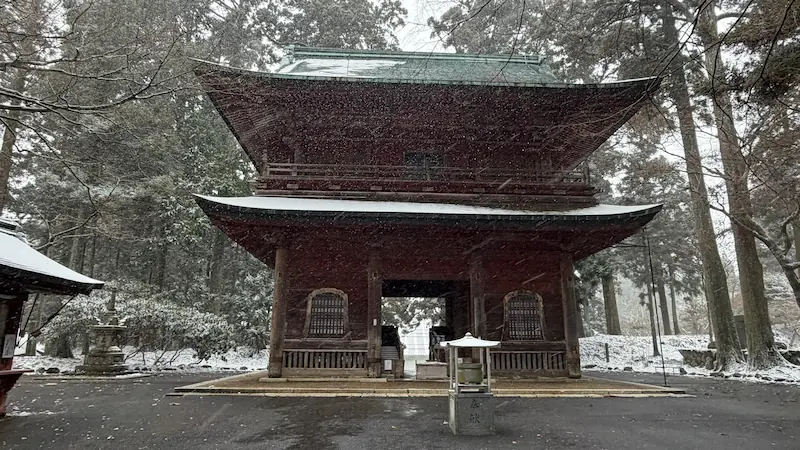
Rising above a steep flight of stone steps on the east side of Konpon Chudo Hall, Monju-ro is the mountain gate that pilgrims ascending the eastern trail have passed through for centuries. Its founding is attributed to the monk Ennin (known posthumously as Jikaku Daishi), who modeled it on a Manjushri hall he encountered at Mt. Wutai in China during his nine-year study journey there. The current structure was rebuilt following a fire in 1668 (Kanbun 8) and represents mid-Edo-period gate architecture. What makes it unusual is that the upper story functions as a Buddhist hall — the bodhisattva Manjushri (Monju Bosatsu, the deity of wisdom, deeply venerated in East Asian Buddhism) is enshrined there, making it simultaneously a gate and a place of worship. The combination of the steeply pitched stone staircase and the gate looming above creates a sharp visual boundary between the world below and the sacred precinct above. Capped with snow in winter, Monju-ro intensifies the otherworldly quality of the summit in a way that's hard to shake.
Highlights
- A gate that marks the threshold: Standing at the top of the steep stone steps, Monju-ro frames the entrance to the sacred precinct above Konpon Chudo. The incline is sharp — extra caution is needed in winter when the steps are icy.
- Gate and hall in one: The upper story contains a fully functioning Buddhist hall — an architectural rarity that reflects both the gate's ceremonial role and its devotional purpose.
⏳ Time estimate: Quick visit 10 min / Thorough visit 10–15 min
🗺 Address: Sakamoto Honmachi / Sakamoto 4-chome, Otsu, Shiga
🚶 Access: A short climb up steep stone steps from Konpon Chudo Hall (approx. 5 min — use caution on the stairs)
⭐ Recommended Historical Significance: ☆☆☆ Visual Impact: ☆☆ Experiential Value: ☆
| Year Built | Founded 866 (Jogan 8); current structure rebuilt 1668 (Kanbun 8) |
|---|---|
| Builder | Founded by Jikaku Daishi Ennin |
| Structure & Features | Three-bay, two-story gate (nijumon); hip-and-gable roof (irimoya-zukuri), copper shingles. Upper story contains a Buddhist hall enshrining Manjushri Bodhisattva. |
| Cultural Property Designation | National Important Cultural Property (designated July 25, 2016) |
| Current Status | Standing |
Trivia & Background
- Modeled on a Chinese original: Ennin spent nine years studying in Tang Dynasty China and is said to have drawn inspiration from a Manjushri hall on Mt. Wutai (Wutai Shan), one of the four sacred Buddhist mountains of China and the traditional seat of Manjushri's manifestation. The gate he created upon returning was thus both a threshold and a transplanted piece of continental Buddhist culture.
- A dual function in Tendai practice: Within the Tendai system of practice formalized by Saicho, Monju-ro is associated with the "constant-sitting meditation" (joza zanmai) — one of the four forms of samadhi practice observed on the mountain.
Daikoku-do Hall 🎥 360°
The birthplace of Japan's Daikoku-ten devotion — a prayer hall enshrining the triple-faced deity of worldly fortune
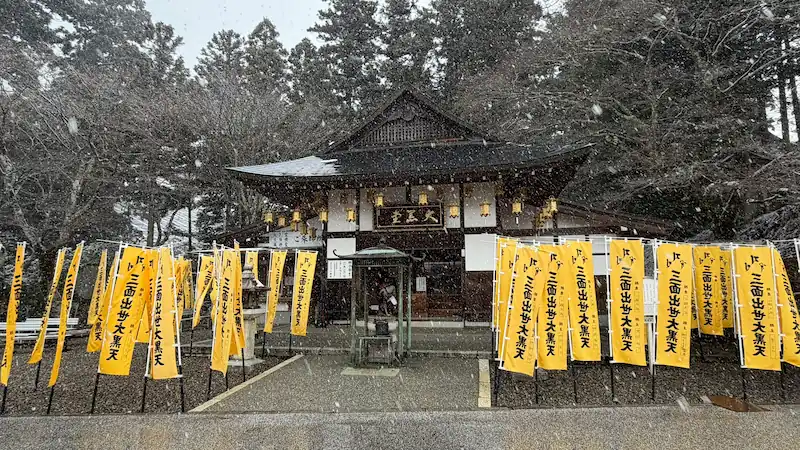
Continuing through Todo from Monju-ro, you emerge onto a plaza in front of the Ichiguu Kaikan building, where Daikoku-do Hall stands. Temple accounts describe this as the spot where Saicho, on one of his ascents of the mountain, received a vision of Daikoku-ten — and Enryakuji presents the site as the origin point of Daikoku-ten devotion in Japan. (In Japanese religious tradition, Daikoku-ten is one of the Seven Lucky Gods, a deity of wealth, prosperity, and good harvests — the round-faced, mallet-wielding figure widely depicted in Japanese folk art and displayed in homes and businesses.) The principal deity enshrined here is the Sanmen Shusseidaikokuten — a triple-faced form that fuses Daikoku-ten, Bishamonten (deity of warriors and fortune), and Benzaiten (goddess of music, eloquence, and the arts) into a single figure. According to Enryakuji's own account, Toyotomi Hideyoshi — the warlord who rose from peasant origins to become the supreme ruler of Japan — prayed to this triple deity for advancement, and the name "Sanmen Shusseidaikokuten" (Triple-Faced Deity of Rising Fortune) was established in honor of his ascent. Amid the solemn grandeur of Todo's other halls, the frank, worldly-aspiration character of Daikoku-do stands out.
Highlights
- The triple-faced deity: The fusion of three distinct deities into a single figure is rare in Japanese Buddhist iconography and gives this hall a devotional character that stands apart from the other structures in Todo.
- An easy stop on the circuit: Daikoku-do faces the open plaza in front of the Ichiguu Kaikan building, making it a natural and effortless pause as you move through the precinct.
⏳ Time estimate: Quick visit 5 min / Thorough visit 10 min
🗺 Address: 4220 Sakamoto Honmachi, Otsu, Shiga
🚶 Access: Approx. 3-minute walk from Monju-ro Gate
⭐ Recommended Historical Significance: ☆☆ Visual Impact: ☆ Experiential Value: ☆☆
| Structure & Features | Hall facing the plaza in front of the Ichiguu Kaikan building. Principal deity: Sanmen Shusseidaikokuten (a triple-faced fusion of Daikoku-ten, Bishamonten, and Benzaiten) |
|---|---|
| Cultural Property Designation | Not designated |
| Current Status | Standing |
| Notes | Ritual ceremonies are held on auspicious Kinoe-ne days (the first day of the 60-day cycle in the traditional East Asian calendar, considered especially favorable for Daikoku-ten). Prayer services are also available upon request. |
Trivia & Background
- The origin of Japan's Daikoku-ten devotion: Enryakuji presents this hall as the site where Saicho first received a vision of Daikoku-ten, and therefore as the origin of Daikoku-ten worship in Japan. The deity subsequently spread throughout the country, becoming one of the most beloved figures in Japanese popular religion — the smiling, rice-bale-sitting god of wealth found in kitchens, shops, and festivals nationwide.
- Ritual calendar: Special ceremonies are held here on Kinoe-ne days — a date in the traditional 60-day cyclical calendar particularly auspicious for Daikoku-ten.
- Hideyoshi's connection: According to Enryakuji's account of the deity's origins, Toyotomi Hideyoshi prayed to this triple-faced figure for advancement in his career before achieving supreme power — a story that encapsulates the hall's character as a place of very direct, very human aspiration.
Daiko-do (Great Lecture Hall) 🎥 360°
The academy that shaped Japanese Buddhism — a relocated Edo-period hall housing the founders of Japan's major Buddhist schools
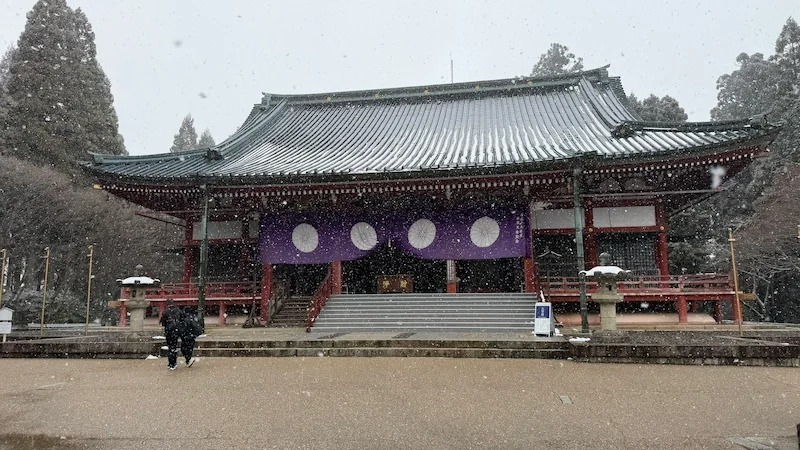
Further along the Todo path stands the Daiko-do — the hall that best shows what Enryakuji actually was: a place of prayer, but also a mountain where monks came to argue, debate, and be tested. For centuries this served as the primary lecture and scholastic hall of the complex, where monks heard teachings on the Lotus Sutra and engaged in formal disputation — a form of rigorous intellectual training that shaped the entire course of Japanese Buddhist thought. The previous Daiko-do was destroyed by fire in 1956. The current building, erected in 1964, is the former Sanbutsu-do of Sakamoto at the mountain's base — itself originally the Honchi-do of the Toshogu shrine — relocated and reconstructed here. Inside, the principal deity is Dainichi Nyorai (Mahavairocana, the cosmic Buddha central to esoteric Buddhism). Flanking the central altar are wooden figures of the great reformers who trained at Enryakuji before founding their own schools: Honen (Pure Land Buddhism), Shinran (Jodo Shinshu, the tradition with the largest number of adherents of any Buddhist school in Japan today), Dogen (Soto Zen), and Nichiren (Nichiren Buddhism), among others. Standing before them, knowing they all trained on the same mountain, the phrase "mother mountain of Japanese Buddhism" acquires a weight that no amount of reading quite prepares you for. Walking past the exterior and moving on is a mistake.
Highlights
- The founding figures, in wood: Flanking Dainichi Nyorai are the carved likenesses of Honen, Shinran, Dogen, Nichiren, and other reformers who all trained on this mountain before establishing their own schools. The cumulative weight of that fact — felt in front of the actual statues rather than read on a page — is the defining experience of this hall.
- The center of scholastic training: This was the hall where the Lotus Sutra was lectured and formal Buddhist debate was conducted — making it the best place on the mountain to understand Enryakuji's historic role as an intellectual and theological powerhouse.
- Seasonal ceremonies: The Daiko-do serves as the venue for major ritual events including the Sange-e (mountain founding ceremony) in April, the Shotoku Taishi memorial rite, and the January 26th ceremony commemorating the founding of the Tendai school.
⏳ Time estimate: Quick visit 15 min / Thorough visit 20 min
🗺 Address: Sakamoto Honmachi, Otsu, Shiga
🚶 Access: Approx. 5-minute walk from Daikoku-do Hall
⭐ Recommended Historical Significance: ☆☆☆ Visual Impact: ☆☆☆ Experiential Value: ☆☆
| Year Built | Early Edo period (the building itself dates to 1634) |
|---|---|
| Builder | Not recorded |
| Structure & Features | Seven bays wide, six bays deep; single-story hip-and-gable roof (irimoya-zukuri) with a three-bay projecting porch; copper shingles. Principal deity: Dainichi Nyorai (Mahavairocana). |
| Restoration History | The previous Daiko-do was destroyed by fire in 1956. The current building is the former Sanbutsu-do (originally the Toshogu Honchi-do) from Sakamoto at the foot of the mountain, relocated and rebuilt here in 1964. |
| Cultural Property Designation | National Important Cultural Property (designated as "Enryakuji Daiko-do, formerly Toshogu Honchi-do") |
Trivia & Background
- A Tokugawa building on a Tendai mountain: The current Daiko-do was originally the Honchi-do of the Toshogu shrine — a type of shrine dedicated to the deification of Tokugawa Ieyasu, founder of the Edo shogunate. The layering of a Tokugawa-era devotional structure onto Enryakuji's primary academic hall is one of those quietly remarkable overlaps that Japanese historical architecture keeps producing.
- The bell in front: The Peace Bell (Kaiunno Kane) in front of the hall is a favorite with visitors and brings an unexpectedly gentle, open quality to what is otherwise a space of considerable intellectual gravity.
Walking into the Daiko-do, I found wooden figures of Honen, Shinran, Dogen, and Nichiren arranged around the central image of Dainichi Nyorai. Knowing that all these founding figures trained on the same mountain — this mountain — is one thing to read about. Standing in front of the statues, it's something else. Don't stop at the exterior. The density you feel inside the hall doesn't carry through the walls.
── Visitor's Note (December 2025, a snowy day)
Kaidan-in (Ordination Hall) 🎥 360°
Saicho's life's ambition made stone — the ordination hall where Tendai monks receive their vows, the quietest corner of Todo
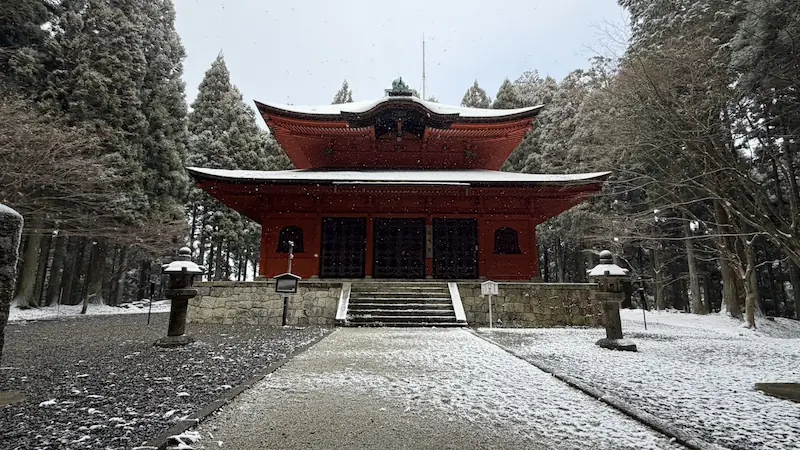
A short climb beyond the Daiko-do, Kaidan-in is the stillest corner of the Todo precinct. This is the ordination hall — the place where Tendai monks formally receive the Buddhist precepts (vows) that mark their entry into the ordained monastic community, a ceremony of enormous significance in any Buddhist tradition. It embodies the central ambition of Saicho's life: the establishment of an independent Mahayana ordination platform at Enryakuji, separate from the older ordination system then controlled by the rival Nara temples. Saicho petitioned the imperial court for this right for decades but died in 822, just seven days before permission was granted — making Kaidan-in a monument both to what he achieved and to what it cost him. The current building is believed to date from 1678 (Enpo 6), and its design — a compact square-plan hall (hojo-zukuri) with a decorative "kara-hafu" cusped gable above the front entrance — gives it a composed, dignified appearance suited to its purpose. Inside, the floor is stone — an uncommon feature that speaks directly to the severity of an ordination chamber. The crowds that fill Konpon Chudo thin sharply here, and the silence that takes their place is its own kind of information.
Highlights
- The ordination hall: This is where Tendai monks formally enter the ordained monastic community. Of all the stops in Todo, it is the one that most clearly shows Enryakuji still working as a training institution rather than a heritage site.
- Architecture with intention: The single-story building reads almost as two stories thanks to its secondary eave (mokoshi), and the stone floor inside communicates the gravity of its ceremonial function without a word of explanation.
- Spring: Cherry blossoms near Kaidan-in in spring add a soft contrast to the stone lanterns and cedar forest surroundings — a surprisingly delicate scene in an otherwise austere corner of the precinct.
⏳ Time estimate: Quick visit 5 min / Thorough visit 10 min
🗺 Address: Sakamoto Honmachi, Otsu, Shiga
🚶 Access: Approx. 3-minute walk from the Daiko-do
⭐ Recommended Historical Significance: ☆☆☆ Visual Impact: ☆☆ Experiential Value: ☆
| Year Built | Believed to date from 1678 (Enpo 6) |
|---|---|
| Structure & Features | Three bays square (hojo-zukuri); single-story with a secondary eave (mokoshi); pyramidal roof (hojo-zukuri) with cusped gable (kara-hafu) above the front entrance; thatched roof. Stone floor interior; enshrines Shakyamuni Buddha, Manjushri, and Maitreya. |
| Cultural Property Designation | National Important Cultural Property |
| Current Status | Standing |
| Notes | Site of formal ordination ceremonies for Tendai monks entering the monastic order |
Trivia & Background
- The ambition of a lifetime: Saicho spent the final years of his life in a sustained effort to win imperial approval for an independent Mahayana precepts platform at Enryakuji — separate from the Hinayana ordination system that the established Nara temples controlled and wished to keep exclusive. He died in 822, just one week before the court issued its approval. Kaidan-in stands as the fulfillment of a vision its founder never lived to see.
- The stone floor: The interior's stone paving is an unusual feature for a Japanese Buddhist hall, and one that directly signals the singular gravity of the ceremony performed here.
Amida-do Hall 🎥 360°
A prayer hall built for the mountain's 1,150th anniversary — a water-harp cistern, an Important Cultural Property bell tower, and the practice of ancestor memorial still alive today
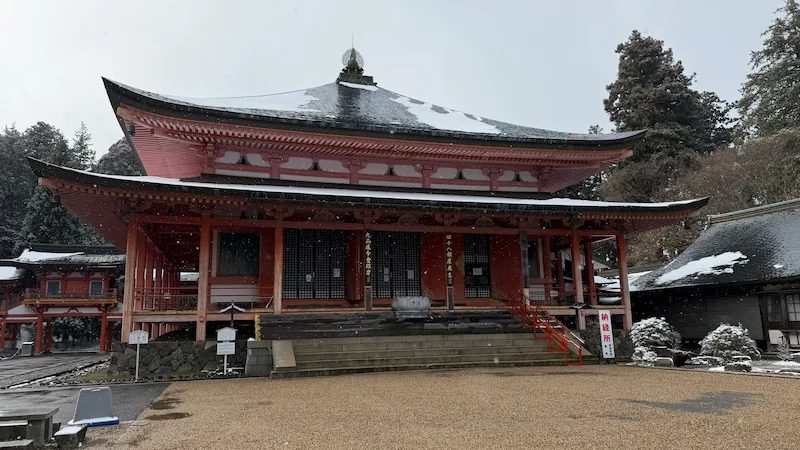
Walking deeper into Todo from the Daiko-do, Amida-do Hall appears alongside the Hokke Soji-in East Pagoda. Built in 1937 to commemorate the 1,150th anniversary of Enryakuji's founding, this hall serves as the precinct's dedicated space for ancestor memorial services (ekō) — the Buddhist practice of generating and dedicating spiritual merit to deceased family members, which remains a deeply embedded part of Japanese religious life. The principal deity is a large seated Amida Nyorai (Amitabha Buddha) in the jōroku scale — roughly three meters tall, the traditional "one-jō-six-shaku" measurement considered the ideal height for a standing buddha image. Daily nenbutsu (invocations of Amida Buddha's name) are performed here for the benefit of the deceased. In front of the hall stands a suikinkutsu — a Japanese garden acoustic device consisting of an inverted buried pot that amplifies the sound of dripping water into a soft, resonant tone resembling a koto string. Beside it, the bell tower is a National Important Cultural Property. The name "Hokke Soji-in" carried by this section of Todo preserves the name of a far larger complex that existed here before Nobunaga's 1571 destruction. In autumn, the hall's vermilion lacquerwork against the surrounding maple trees produces one of the most vivid color contrasts in the entire precinct.
Highlights
- A living memorial practice: Regular memorial rites are still conducted here for lay worshippers, which is where Enryakuji's link to ordinary Japanese life is easiest to observe firsthand.
- The suikinkutsu and the bell tower: The water-harp cistern produces a faint, almost otherworldly resonance — pause and listen. The adjacent National Important Cultural Property bell tower is worth its own moment.
- Autumn color: When the maples are at their peak, the contrast between the hall's deep red lacquerwork and the surrounding foliage makes this one of the most photographed spots in the precinct.
⏳ Time estimate: Quick visit 15 min / Thorough visit 15–20 min
🗺 Address: 4220 Sakamoto Honmachi, Otsu, Shiga
🚶 Access: Approx. 5-minute walk from Kaidan-in
⭐ Recommended Historical Significance: ☆☆ Visual Impact: ☆☆ Experiential Value: ☆☆
| Year Built | 1937 (Showa 12) |
|---|---|
| Structure & Features | One section of the Hokke Soji-in complex; ancestor memorial hall. Principal deity: Amida Nyorai (Amitabha) in the joroku scale (approx. 3 meters). |
| Cultural Property Designation | The bell tower in front of the hall is a National Important Cultural Property. |
| Current Status | Standing |
| Notes | A suikinkutsu (water-harp cistern) stands before the hall. Memorial rites are held on the 15th of each month, at the spring and autumn equinox services (higan), and at the mid-summer Bon (Ullambana) memorial service. |
Trivia & Background
- Memory preserved in a name: Amida-do is a relatively modern construction (1937), but its placement within the area designated "Hokke Soji-in" keeps alive the name of a much larger and more ancient complex that was wiped out in 1571 — a quiet act of institutional memory.
- Open to lay worshippers: Any visitor may request to have a deceased family member included in the regular memorial rites performed here. The monthly 15th ceremony and the equinox services are the main opportunities.
Hokke Soji-in East Pagoda 🎥 360°
Rebuilt after 400 years — the vermilion pagoda that anchors Saicho's vision of six sacred towers, restored to the mountainside in 1980
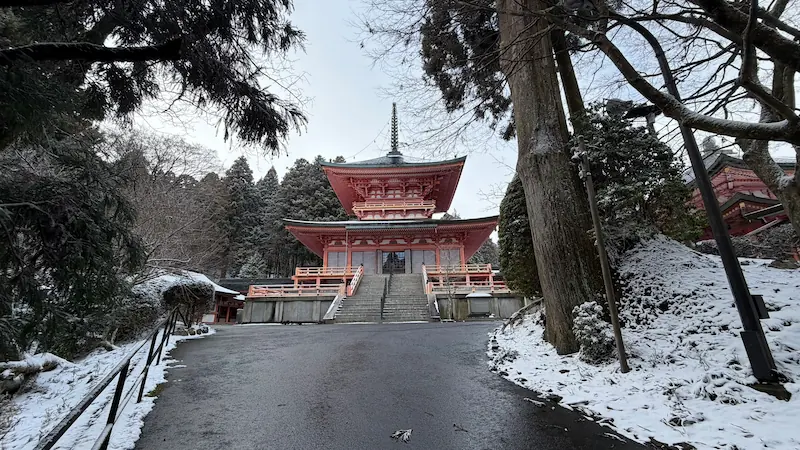
Standing directly beside Amida-do Hall, the Hokke Soji-in East Pagoda is the most visually commanding structure in the deeper section of Todo — a tall, vermilion-lacquered pagoda that catches the eye from across the open ground. The current pagoda was rebuilt in 1980, but its origins trace back to 821 (Konin 12), when the central pillar was erected as part of Saicho's ambitious plan to build six sacred pagodas across the provinces of Japan for the protection of the state — a vision of national-scale religious architecture that places this structure within a much larger historical imagination. That plan, and the Hokke Soji-in complex that housed it, were obliterated in Nobunaga's 1571 burning. What stands here today is the result of roughly 400 years of absence followed by 20th-century reconstruction. That particular combination — destruction, long silence, and deliberate revival — is built into the object itself. Inside, the principal deities are the Gochi Nyorai (Five Wisdom Buddhas, a grouping central to esoteric Buddhist cosmology), with Dainichi Nyorai at the center. The upper story holds relics of the historical Buddha (busshari), the Lotus Sutra, and written sutras dedicated by temple supporters.
Highlights
- Four centuries of absence, one act of restoration: Destroyed in 1571 and not rebuilt until 1980 — the gap is nearly 400 years. Standing beside Amida-do, the pagoda embodies both the violence of what was lost and the sustained will to recover it.
- The Five Wisdom Buddhas: The Gochi Nyorai are a grouping central to Shingon and Tendai esoteric Buddhism, representing the five aspects of the cosmic Buddha's wisdom — a theologically dense interior for what reads, from the outside, as a purely visual landmark.
- Photography: The pagoda's vermilion against cherry blossoms in spring, and against snow in winter, makes it one of the most reliably striking photographs in the precinct.
⏳ Time estimate: Quick visit 5 min / Thorough visit 10 min (including surrounding grounds)
🗺 Address: 4220 Sakamoto Honmachi, Otsu, Shiga (within Enryakuji)
🚶 Access: Directly adjacent to Amida-do Hall
⭐ Recommended Historical Significance: ☆☆ Visual Impact: ☆☆☆ Experiential Value: ☆☆
| Year Built | Central pillar erected 821 (Konin 12); current pagoda rebuilt 1980 (Showa 55) |
|---|---|
| Builder | Conceived by Saicho; the Hokke Soji-in complex was completed by Ennin |
| Structure & Features | Central pagoda of the Rokusho Hoto (Six Sacred Pagodas) network. Principal deities: Gochi Nyorai (Five Wisdom Buddhas). Upper story contains busshari (Buddha relics), the Lotus Sutra, and dedicated sutras. |
| Destruction | Destroyed in Oda Nobunaga's burning of Enryakuji, 1571 |
| Current Status | Standing (rebuilt 1980) |
Trivia & Background
- Built for an emperor's spirit: According to official temple accounts, the central pillar of the original pagoda was erected in 821 as an offering for the spirit of Emperor Kanmu — the emperor who had supported Saicho's founding mission and whose patronage made Enryakuji possible.
- Sutras from supporters: In addition to the Lotus Sutra and Buddha relics, the upper story holds written sutras dedicated by lay supporters over the years — making the pagoda both a cosmological symbol and a living repository of individual faith.
Practical Visitor's Guide: Todo Precinct
Covering all seven spots at a relaxed pace takes approximately 1.5 to 2 hours. The natural walking order is: Konpon Chudo → Monju-ro → Daikoku-do → Daiko-do → Kaidan-in → Amida-do → Hokke Soji-in East Pagoda. If you plan to stay for a group dharma talk at the Daiko-do (walk-in registration accepted 9:00–15:30), add around 30 minutes. For dining, the Kissa Reiho café inside the Enryakuji Kaikan and Tsuruki Soba — operating at two locations, the Enryakuji Bus Center and the Ichiguu wo Terasu Kaikan — are the main options. During peak season, arriving early is recommended.
In winter, the stone-paved paths and stone steps throughout the precinct become extremely treacherous under snow and ice. Waterproof trekking footwear is essential; sneakers or anything without ankle support will leave you cold, wet, and quickly exhausted. If you plan to continue to Saito or Yokawa, check the official Enryakuji website before setting out — shuttle buses may be suspended in winter, turning what would be a 10–15 minute ride into a 100-minute mountain hike. Confirm your return transport before you leave, not after you arrive.
Enryakuji Todo Precinct FAQ
Allow about 1.5 to 2 hours to cover all 7 spots at a relaxed pace. If you stay for a group dharma talk at the Daiko-do (walk-in registration required), add another 30 minutes.
Yes. The combined pass (¥1,000 for adults, ¥600 for middle and high school students, ¥300 for elementary school students) covers all three precincts, but visiting Todo alone is perfectly fine. From Enryakuji Cable Station, it's about a 10-minute walk to Konpon Chudo Hall.
Yes. Despite the ongoing 15-year restoration project (begun 2016), Konpon Chudo remains open for worship. The gakushu viewing stage lets you observe the roof repairs at close range — a view that will no longer exist once restoration is complete. Since January 2026, the Yakushi Nyorai proxy image and the Eternal Flame have been specially enshrined in the Manpai-do Hall for closer viewing.
The summit is considerably colder than the city below, and paved paths and stone steps become extremely slippery in snow. Waterproof trekking shoes are the only sensible choice — sneakers will leave you cold, wet, and drained. Check the official website for shuttle bus availability before heading out, as service may be suspended in winter.
Shuttle buses are the standard option — about 10 minutes to Saito, about 15 minutes to Yokawa. In winter, service may be suspended, in which case reaching the other precincts means hiking mountain trails (over 100 minutes on foot from Todo to Yokawa). Confirm your return transport before you leave.
Yes. The Kissa Reiho café inside the Enryakuji Kaikan (temple guesthouse) and Tsuruki Soba — operating at two locations, the Enryakuji Bus Center and the Ichiguu wo Terasu Kaikan — are the main dining options. During busy periods, arriving early is advisable.
Continue to the Other Precincts
Once you've finished Todo, the shuttle bus to Saito and Yokawa is worth taking. With each precinct you enter, the crowds thin, the air changes, and the mountain draws you deeper in. Each area has its own history, its own silence, and a face of Enryakuji that Todo, for all its grandeur, doesn't show you.
☕ Support This Site
Following the Shogun is built on original fieldwork and on-site research.
If you found this guide useful, your support helps keep it going.

You can also support via QR code


comment