


← Part of the Hosokawa Gracia Travel Guide — 4 sites in Kyoto & Osaka
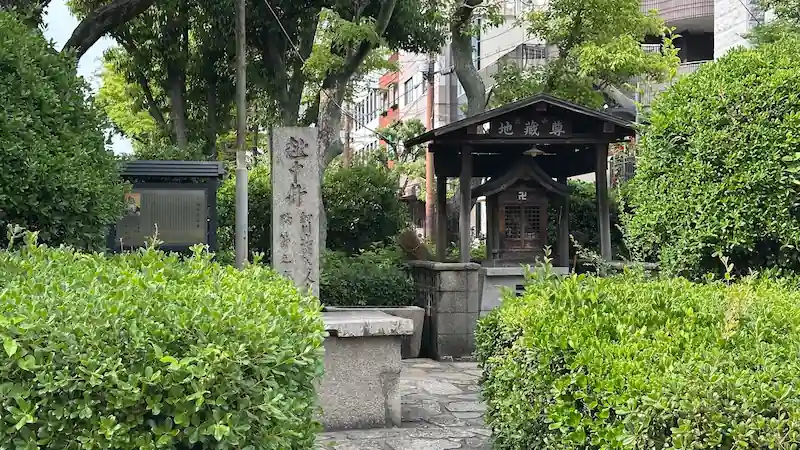
Etchū-no-I (Etchū Well): The Final Moments of Hosokawa Gracia
Were you moved by Lady Mariko's unwavering spirit in Shogun? Etchū Well marks the real place where her story ended, on the former grounds of the Hosokawa residence in Osaka. Two more sites — a stone monument and a Catholic church with her statue — are within a few minutes' walk.
3 Historic Sites at Etchū-no-I
Etchū-no-I (Etchū Well)
Historical Value ★★★ / Visual Appeal ★★ / Experiential Value ★
Located on the former kitchen site of the residence once belonging to Hosokawa Tadaoki (Lord Etchū) in the outer third enclosure of Osaka Castle, Etchū-no-I is a historic well steeped in tragedy and faith. In 1600, as tensions mounted ahead of the Battle of Sekigahara, Lady Gracia—daughter of Akechi Mitsuhide, wife of Tadaoki, and a converted Christian since 1587—refused to become a hostage of Ishida Mitsunari.
Her Christian faith forbade suicide, so instead she had her retainer, Ogasawara Hidekiyo, end her life by piercing her chest with a spear; the residence was then set ablaze. At just 37 years old, her death has been remembered ever since as an act of unwavering faith and principle. Today, the well stands as a solemn reminder of her final moments.
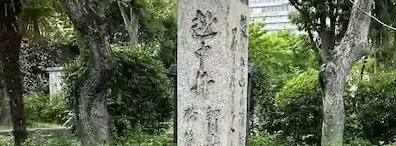
In 1934, a monument was erected on the site, and in 1959, the well was restored by local residents. The stone bears her haunting farewell poem:
"To know the time to fall—
Just like a flower in its prime,
That is the essence of both
The blossom and the human spirit."
- Restored Well: Once part of the residence's kitchen, the well silently echoes the aftermath of the fire and the dramatic end of a noblewoman's life.
- Monument & Final Poem: Gracia's farewell is engraved on the stone, immortalizing her strength of faith and noble resolve.
- Tamatsukuri Church & Etchū Park: Right next door, visitors can see statues of Gracia and Christian lord Takayama Ukon, offering a deeper dive into Christian heritage in Japan. Open year-round.
- Seasonal Scenery: Visit in spring for fresh greenery or in autumn to enjoy a peaceful stroll among the fallen leaves.
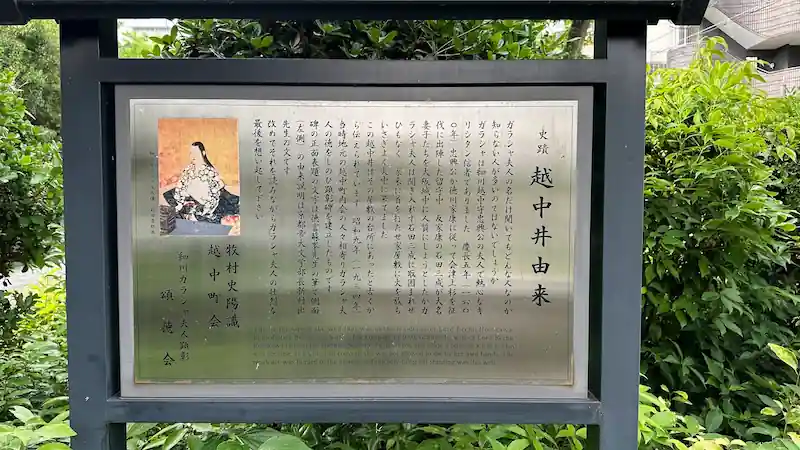
Tap to enlarge
The Well – Historical BackgroundWhile many may have heard the name of Lady Gracia, few truly know who she was. Gracia was the wife of Hosokawa Tadaoki (Lord Etchū), and a devoted Christian convert.
In the year 1600 (Keichō 5), during Lord Tadaoki's absence as he marched with Tokugawa Ieyasu to subdue the Uesugi clan in Aizu, Ishida Mitsunari—leader of the anti-Tokugawa forces—attempted to take the wives and children of daimyo as hostages in Osaka Castle.
Lady Gracia refused to comply. Surrounded by Ishida's forces, and forbidden by her Christian faith from taking her own life, she had a retainer take her life; the residence was then set ablaze.
This well, known as the Ecchu Well, is said to have been located in the kitchen of that residence. In 1934 (Shōwa 9), the local community of Ecchu gathered to honor Lady Gracia's virtue and erected this commemorative monument.
The calligraphy of the monument's title was written by the esteemed scholar Tokutomi Sohō, and the explanatory inscription on the left side was composed by Professor Shinamura Izuru, then Dean of the Faculty of Letters at Kyoto Imperial University.
Source: Catholic Archdiocese of Osaka
Data| Era | Azuchi-Momoyama Period (~1600) |
|---|---|
| Builder | Hosokawa Tadaoki |
| Structure & Feature | Kitchen well of the former residence; named after Tadaoki's official title "Etchū no Kami" |
| Restoration History | Monument erected in 1934; well restored in 1959 |
| Current Status | Monument and restored well preserved as a historical site |
| Destruction | Residence no longer exists; only landform remains |
| Cultural Designation | Designated Historical Site by Osaka Prefecture (designation date unconfirmed; March 16, 2009 is the publish date of the Osaka City Board of Education's webpage, not a designation date) |
Quick stop: About 10 minutes / In-depth exploration: Around 30 minutes
Address & AccessAddress: 2-12 Morinomiya-Chūō, Chūō-ku, Osaka City, Osaka Prefecture
Access: Approx. 11-minute walk (800m) from Morinomiya Station (JR-O06/C19/N20) — JR Osaka Loop Line / Osaka Metro Chūō Line / Nagahori Tsurumi-ryokuchi Line.
Located near Osaka Castle Park — see the full Osaka Castle Park guide to combine both visits.
From Kansai International Airport (KIX): Approx. travel time: 65 minutes, Fare: 1,160 yen
From Shin‑Osaka Station (M13/JR-A46): Approx. travel time: 22 minutes, Fare: 290 yen
Fares above reflect this page's original research; please verify current fares before traveling.
Monument of the Former Residence of Hosokawa Tadaoki (Lord Etchū)
Historical Value ★★★ / Visual Appeal ★ / Experiential Value ★
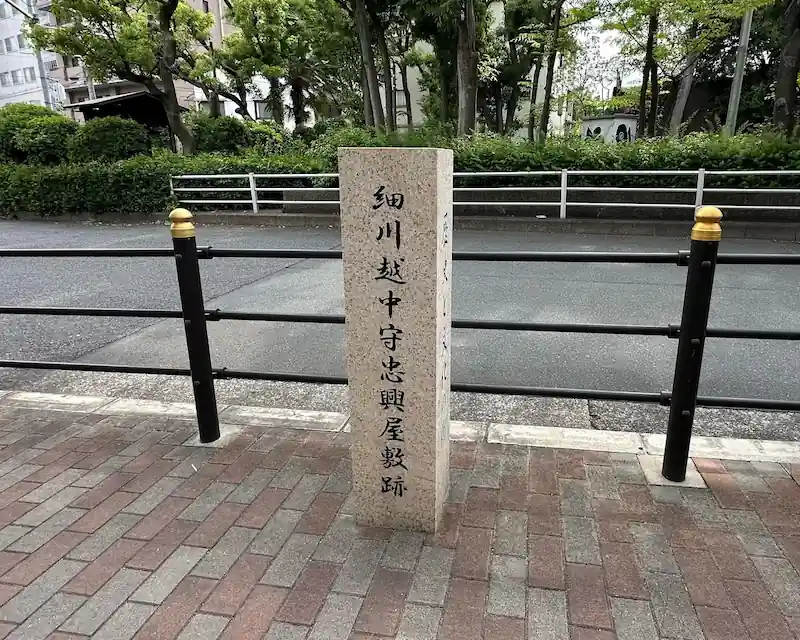
This stone monument stands on the site of the former residence of Hosokawa Tadaoki (Lord Etchū), located in the San-no-maru area south of Osaka Castle. As the place where Lady Gracia ended her life, it remains a key landmark preserving the memory of a deeply symbolic moment in Japanese history. Nearby, you'll also find Etchū-no-I, the restored well that marks the tragic site of her martyrdom.
Visitors can feel the tense atmosphere of the Sekigahara prelude and Gracia's unwavering faith by standing in this place of remembrance.
| Era | Shōwa period (exact date unknown; likely by local women's associations) |
|---|---|
| Builder | Local volunteers, possibly the Women's Federation |
| Structure & Feature | Vertical stone monument inscribed with calligraphy by Tokutomi Sohō, reading "Etchū-no-I" and "Site of Tadaoki's Residence" |
| Restoration History | The well was restored in 1959; the monument was installed several decades ago |
| Current Status | Monument, informational signs, the well, and a small Jizō hall are scattered around the site |
| Cultural Designation | Designated Historical Site of Osaka Prefecture (Hosokawa Residence & Etchū Well) |
Approx. 5–7 minutes
Address & AccessAddress: 2-12-8 Morinomiya-Chūō, Chūō-ku, Osaka City, Osaka Prefecture
Access: Located directly across the street from Etchū-no-I
Statue of Hosokawa Gracia at the Catholic Tamatsukuri Church
Historical Value ★★★ / Visual Appeal ★★★ / Experiential Value ★★
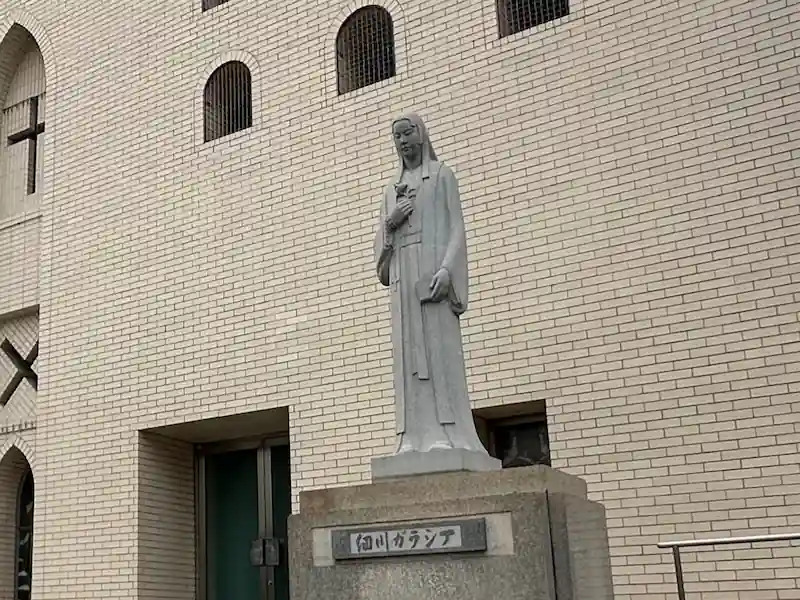
The Catholic Tamatsukuri Church, also known as the Osaka Cathedral of St. Mary, was built on the former grounds of the Hosokawa residence. Today, it serves as a spiritual and artistic tribute to Hosokawa Gracia, a Christian martyr and tragic heroine of the Sengoku period. To the right of the church entrance stands a stone statue of Gracia, sculpted by Masayoshi Abe, symbolizing her steadfast Christian faith and the dignity of her final moments.
Inside the church, you'll find the moving mural "Gracia on Her Final Day" by renowned painter Inshō Dōmoto, along with magnificent stained glass and the resonant tones of a pipe organ, creating a sacred space where history and faith intertwine.
- Statue of Hosokawa Gracia: Standing tall on the right side of the entrance, this powerful image represents her spiritual strength and martyrdom.
- Takayama Ukon Statue: Facing Gracia on the left side, this juxtaposition of two Christian daimyo offers a rare and moving tableau.
- Mural by Inshō Dōmoto: "Gracia on Her Final Day" is one of the church's most touching artistic tributes.
- Stained Glass & Pipe Organ: The chapel's tranquil aura is shaped by nearly 100 pieces of stained glass and a 2,400-pipe organ.
- Seasonal Highlights: In spring and autumn, the soft natural light enhances the beauty of the church's tiles and glass, creating an especially reflective experience.
Tap to enlarge
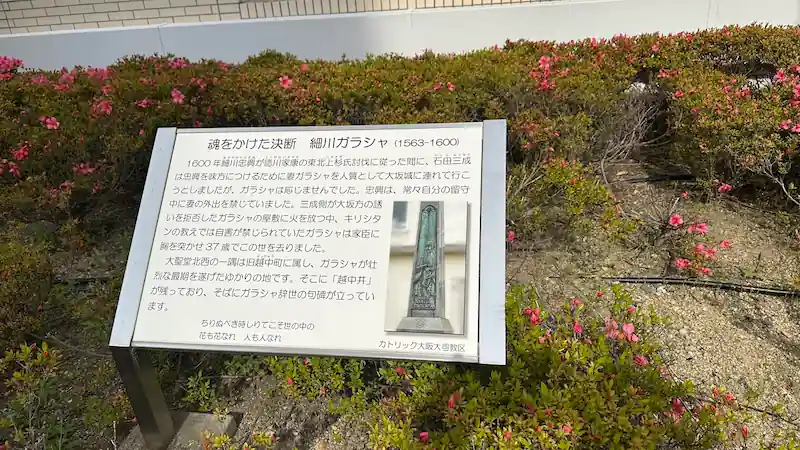
A Soulful Decision — Hosokawa Gracia (1563–1600)In the year 1600, while Hosokawa Tadaoki was away with Tokugawa Ieyasu on a campaign against the Uesugi clan in the northeast, Ishida Mitsunari attempted to bring Tadaoki to his side by taking his wife, Gracia, as a political hostage and bringing her to Osaka Castle. Gracia, however, refused to comply.
Tadaoki had long forbidden Gracia from leaving their residence while he was away. As Mitsunari's forces set fire to her home in retaliation for her refusal, Gracia, adhering to Christian teachings which strictly forbade suicide, ordered a retainer to pierce her chest, ending her life at the age of 37.
The northwest corner of the cathedral grounds lies within what was formerly Etchū-chō, the area where Gracia met her dramatic end. Today, the Etchū Well (Etchū-no-I) remains there, alongside a stone monument engraved with her farewell poem, preserving the memory of her resolute faith and sacrifice.
To know the time to fall—
That is what makes a flower a flower,
And a person truly human.
Source: Catholic Archdiocese of Osaka
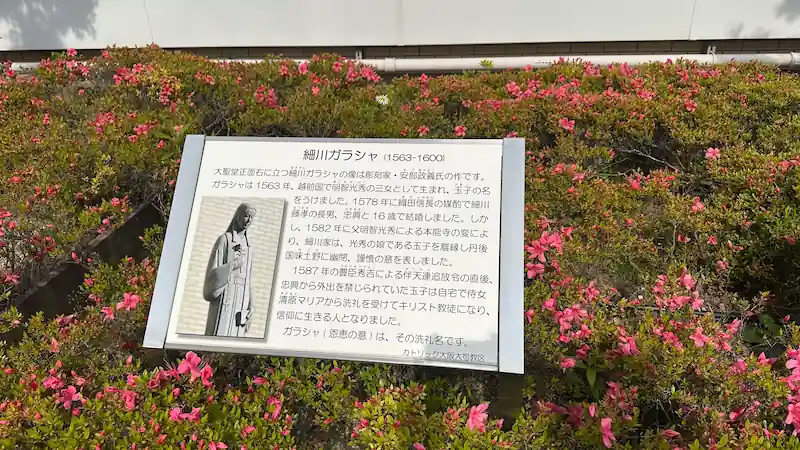
Hosokawa Gracia (1563–1600)The statue of Hosokawa Gracia, located to the right of the cathedral's main entrance, was sculpted by Masayoshi Abe.
Gracia was born in 1563 in Echizen Province as the third daughter of Akechi Mitsuhide, and was originally named Tama (Tamako). In 1578, at the age of 16, she married Hosokawa Tadaoki, the eldest son of Hosokawa Fujitaka, in a union arranged by Oda Nobunaga.
However, in 1582, following her father's betrayal and assassination of Nobunaga during the Incident at Honnō-ji, the Hosokawa family, in a show of loyalty to the ruling powers, repudiated Tama and confined her to Midono in Tango Province, effectively placing her under house arrest.
After Toyotomi Hideyoshi's 1587 Edict Expelling Christian Missionaries, Tadaoki forbade Tama from going out. During this time, she received baptism from her maid, Maria Kiyohara, within the confines of her home, becoming a devoted Christian. Her baptismal name, Gracia, means "grace" or "blessing." Her earlier confinement in Tango Province is covered in more depth in Kyotango: Where Hosokawa Gracia Lived in Hiding and Confinement.
Source: Catholic Archdiocese of Osaka
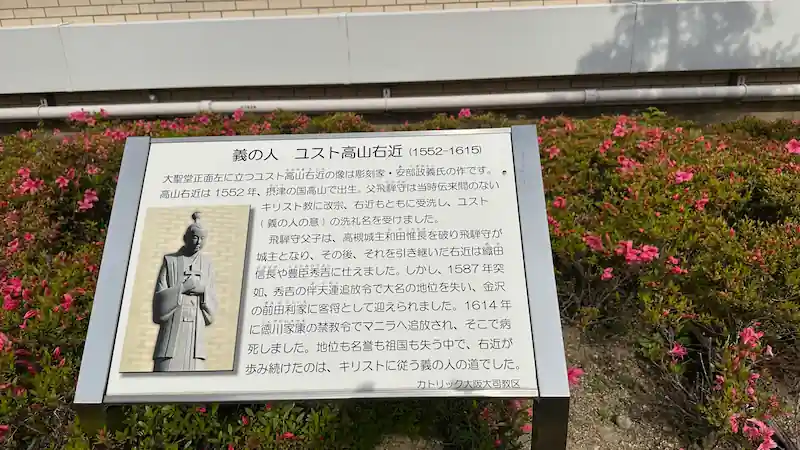
Justo Takayama Ukon (1552–1615), Man of JusticeThe statue of Justo Takayama Ukon, standing to the left of the cathedral's main entrance, was sculpted by Masayoshi Abe.
Takayama Ukon was born in 1552 in Takayama, Settsu Province. His father, Takayama Tomoteru (Lord of Hida), converted to Christianity at a time when the faith was still relatively unknown in Japan. Ukon was baptized alongside his father and received the Christian name "Justo," meaning "man of justice."
The Takayama father and son defeated Wada Koremasa, the then-lord of Takatsuki Castle, and Tomoteru assumed control of the castle. Ukon succeeded him and later served under both Oda Nobunaga and Toyotomi Hideyoshi. However, in 1587, Hideyoshi suddenly issued the Edict of Christian Expulsion, and Ukon lost his status as a feudal lord. He was later welcomed by Maeda Toshiie in Kanazawa as a guest retainer.
In 1614, under Tokugawa Ieyasu's Christian ban, Ukon was exiled to Manila, where he fell ill and died. Though he lost his status, honor, and homeland, Ukon continued walking the path of justice as a true follower of Christ.
Source: Catholic Archdiocese of Osaka
Data| Era | Originally in 1894, rebuilt in 1963 after destruction in WWII |
|---|---|
| Builder | Catholic Archdiocese of Osaka |
| Structure & Feature | Reinforced concrete with tile façade; flanked by statues at the entrance |
| Restoration History | Destroyed in 1945, reconstructed in 1963; houses numerous artistic works |
| Current Status | Sanctuary, courtyard, stained glass, and statues are well preserved |
| Cultural Designation | No cultural-property designation confirmed. Church status: Cathedral of the Archdiocese of Osaka-Takamatsu |
For quiet prayer or art appreciation: 30 minutes to 1 hour
Address & AccessAddress: 2-24-22 Tamatsukuri, Chūō-ku, Osaka City, Osaka Prefecture
Access: Approx. 3-minute walk (230m) from Etchū-no-I
Based on an on-site visit in May 2025. This is the author's personal ranking, not an official recommendation.
The actual place where Gracia died. The restored well and her farewell-poem monument exist only here.
About a 3-minute walk from Etchū-no-I. The statues, mural, and stained glass make this the most visually and experientially rewarding of the three sites.
Directly across the street from Etchū-no-I, but almost nothing of the original residence remains. If you're pressed for time, the well itself covers the same story.
| Nearest Station | Morinomiya Station (JR Osaka Loop Line / Osaka Metro Chūō Line / Nagahori Tsurumi-ryokuchi Line) — 11-min walk from Etchū-no-I and the monument. Tamatsukuri Station (Osaka Metro Chūō Line / JR Osaka Loop Line) also serves the church. |
|---|---|
| Practical Shinkansen Station | Shin-Osaka Station. Including the transfer to Morinomiya, about 22 minutes total (see below). |
| Travel Time From Major Cities | From Tokyo: approx. 2 hr 45 min – 3 hr including transfers / From Kyoto: approx. 35–45 min / From Nagoya: approx. 1 hr 10 min – 1 hr 25 min (all approximate; varies by train and connection). |
| Difficulty | Flat city streets. All 3 sites are reachable entirely on foot (easy). |
| Recommended Transport | Train + walking |
| Parking | Unconfirmed — no dedicated parking is listed for Etchū-no-I or the monument. Nearby coin-operated lots are the practical option. |
| Hours | Etchū-no-I and the monument are outdoor sites with no set hours. Catholic Tamatsukuri Church: approx. 9:00 AM–4:00 PM (please confirm in advance). |
| Notes | The church is an active place of worship. It may not be open to visitors during Mass or other services — check the official site before your visit. |
FAQ
It's a well on the former grounds of Hosokawa Tadaoki's residence. In 1600, his wife Hosokawa Gracia — the real-life figure behind Lady Mariko in Shogun — had a retainer end her life here rather than become a hostage of Ishida Mitsunari. A monument was erected in 1934, and the well was restored in 1959. It's a Designated Historical Site of Osaka Prefecture.
Etchū-no-I: about 10–30 minutes. The residence monument: about 5–7 minutes. Catholic Tamatsukuri Church: about 30 minutes to 1 hour. Walking to all 3 sites takes roughly 45 minutes to 1.5 hours in total.
Etchū-no-I is close to Osaka Castle Park, about an 11-minute walk from Morinomiya Station, making it an easy add-on to an Osaka Castle visit.
Yes. Etchū-no-I and the residence monument face each other across the street, and Catholic Tamatsukuri Church is about a 3-minute walk from Etchū-no-I. All 3 are within easy walking distance of each other.
It's an active place of worship, so we recommend checking the official site for the latest details on admission and Mass times. This guide lists approximate visiting hours of 9:00 AM–4:00 PM as general reference only.
← Back to Hosokawa Gracia Travel Guide — 4 Sites in Kyoto & Osaka

☕ Support This Site
Following the Shogun is built on original fieldwork and on-site research.
If you found this guide useful, your support helps keep it going.

You can also support via QR code


comment