


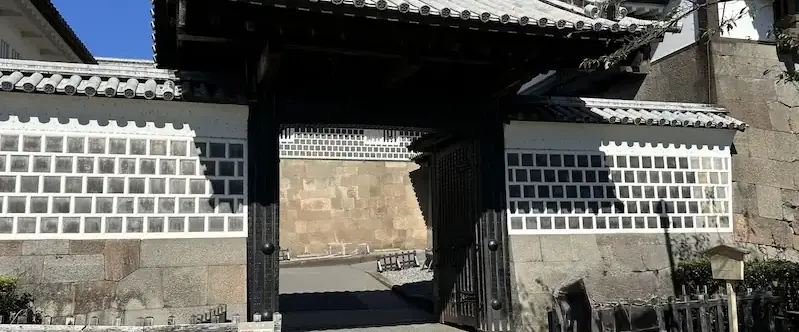
Kanazawa Castle Vol. 1: Ishikawa-mon Gate & Sannomaru North Garden — Edo-Period Original in 360°
From simply "seeing" history to truly experiencing it. The Ishikawa-mon Gate, located on the rear (karamete) side of Kanazawa Castle Park, is famed for its imposing structure designated as an Important Cultural Property and for its legendary lead roof tiles — features that are still very much alive today.
In the adjacent Sannomaru North Garden, a tranquil landscape unfolds where stone walls meet greenery, letting you feel the profound beauty and engineering of Kanazawa Castle.
Rear Approach / Ishikawa-mon Area
Ishikawa-mon Gate is one of only three genuine Edo-period buildings still standing at Kanazawa Castle. Rebuilt in 1788 and designated a National Important Cultural Property, it is free to view at any time. The gate stands on the castle's rear (karamete) side, directly facing Kenrokuen Garden.
Ishikawa-mon Gate (石川門) 🎥 360°
Lead roof tiles, masugata defense, and Kenrokuen views — a surviving Edo-era masterpiece
Ishikawa-mon is one of Kanazawa Castle's signature gates and among the few castle structures that still survive today. Positioned on the castle's karamete (rear/secondary) side, it faces toward Ishikawa District, which is how it got its name. In the Edo period, it was counted as one of the three principal entrances known as the "San Gomon."
The structure you see today was rebuilt in 1788 (Tenmei 8) after a fire in 1759 (Horeki 9). Ishikawa-mon comprises multiple defensive elements — a turreted gate, adjoining turret, Korai-mon (outer gate), and a taiko-bei (earthen-and-plaster "drum" wall) — arranged in a robust masugata (box-shaped) layout. The roof uses lead tiles, and legend holds that, in wartime, their lead could be melted down to make bullets.
After Maeda Toshiie moved his base to Kanazawa Castle, the fortifications were systematically strengthened and this gate grew in importance. Because the castle served as the Maeda lords' seat of power, the placement of gates and turrets and the overall defensive scheme likely balanced both prestige and military function.
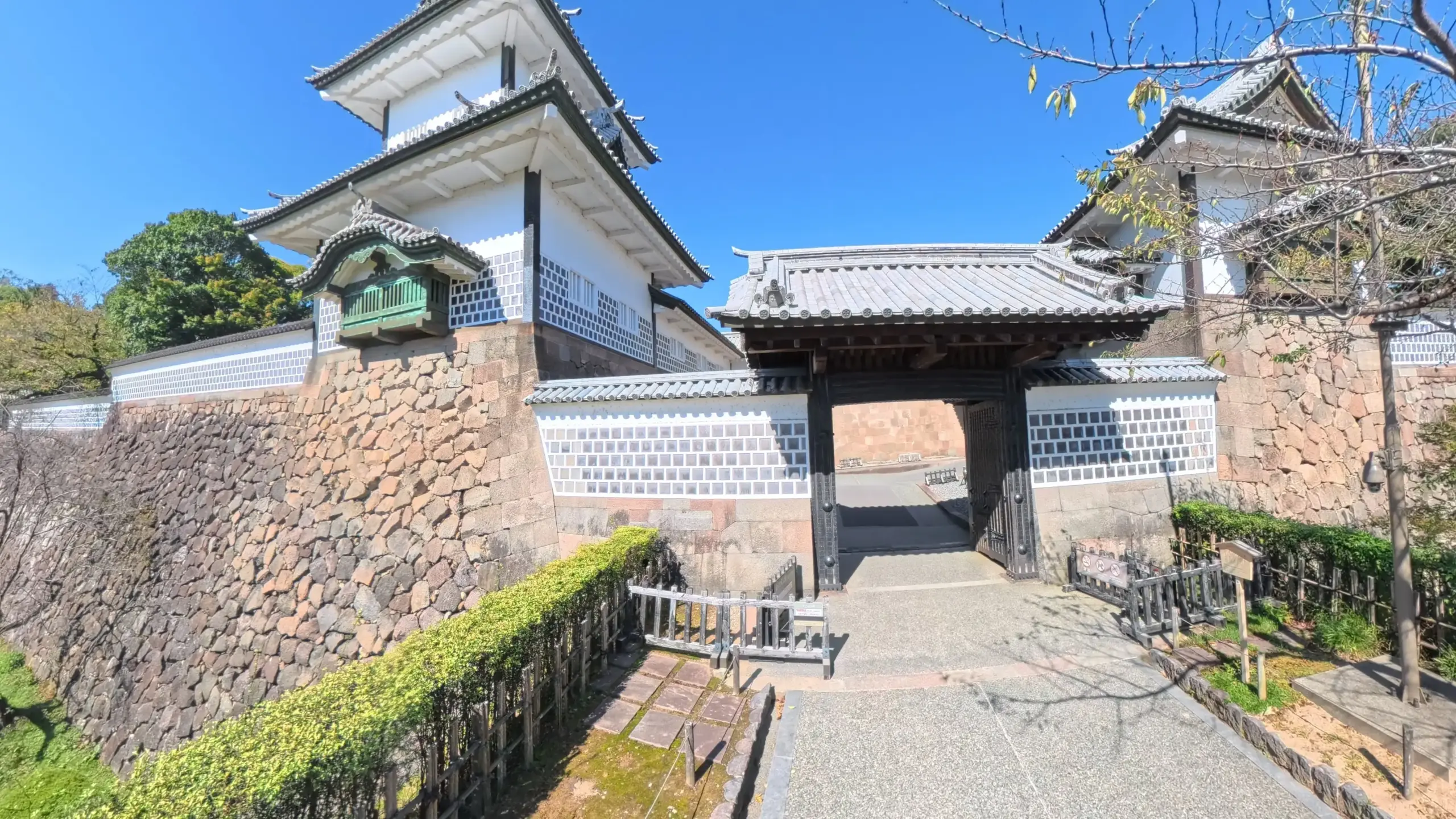
- Masugata Layout & Gate Ensemble: Multiple gate elements — Korai-mon → turreted gate → adjoining turret — convey a layered, heavy-duty defense
- Lead-Tiled Roof: Tiles made with lead are said to have been repurposed for bullets in wartime; the weathered, whitish patina is part of the appeal
- Night Illumination: Seasonal/time-dependent lighting amplifies the atmosphere after dark
- Context in the Landscape: Sited within a panorama that unites Kenrokuen and the castle's stone walls
Quick look: ~10 min / In-depth: ~20 min
🗺 Address: 1-1 Marunouchi, Kanazawa, Ishikawa
🚶 Access: Nearest bus stop: "Kenrokuen-shita / Kanazawa Castle," about 4 min on foot (≈300 m). About 30 min on foot (≈2.2 km) from JR Kanazawa Station.
| Recommendation | Historical Significance: ☆☆☆ / Visual Appeal: ☆☆☆ / Experiential Value: ☆ |
|---|
| Year Built | 1788 (reconstructed) |
|---|---|
| Builder | Maeda clan (during the tenure of Lord Maeda Harunobu) |
| Structure & Features | Turreted gate, adjoining turret, Kōrai-mon, masugata layout, and taiko-bei wall |
| Repairs & Restorations | Dismantling repairs and conservation works in the Shōwa era |
| Current Status | Extant (designated Important Cultural Property) |
| Destruction/Damage | Destroyed in the 1759 fire → reconstructed |
| Cultural Designation | Designated a National Important Cultural Property in 1950 (Shōwa 25) |
| Notes | One of Kanazawa Castle's key surviving structures, alongside Sanjikken Nagaya and Tsurumaru Warehouse |
- A "Back" Gate: Functioned historically as a rear/secondary entrance (karamete), emphasizing defense rather than ceremony.
- Lead Tile Lore: The anecdote about melting tiles for musket balls is widely told, though definitive records confirming actual use are lacking.
- One of the "San Gomon": Together with Kahoku-mon and Hashizume-mon, Ishikawa-mon was esteemed as one of the three principal gates protecting the castle.
Sannomaru North Garden (三の丸北園地) 🎥 360°
Open lawn, surviving stonework, and a feel for the castle's original scale
Sannomaru North Garden is an open, plaza-like space on the north side of the Sannomaru area where surviving stone walls and fences blend with greenery to create a calm, contemplative scene. Walking here gives you a feel for the castle's overall scale and the weight of its masonry. It's also a spot where you can sense how the castle's kuruwa (baileys) — Honmaru, Ninomaru, and Sannomaru — were arranged. While no major buildings remain, the stone walls, earthworks, and spatial composition help you imagine the castle's original extent — making this an ideal stop along your walking route.
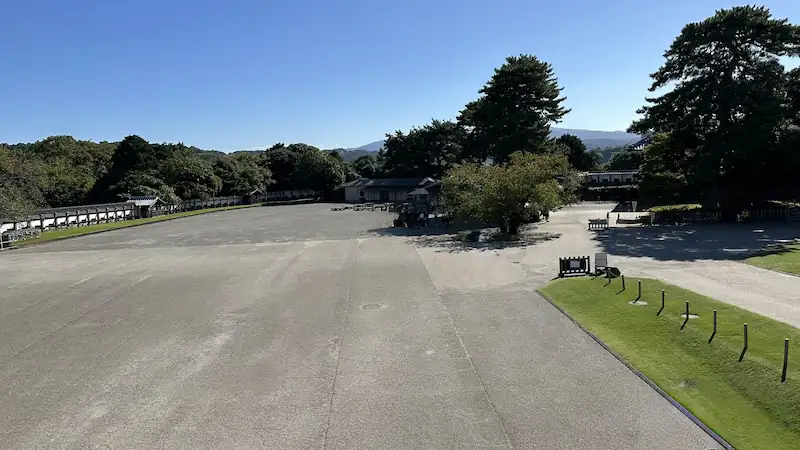
- Surviving Stonework & Fences: Examine the castle's wall structures running along the garden's edge
- Open Spatial Views: The broad, open grounds reveal the internal organization of the castle; the contrast of greenery and stonework is striking
- Seasonal Nature: Spring greens and cherry blossoms, and autumn foliage, create vivid contrasts with the ruins
Quick look: ~3 min / In-depth: ~10 min
🗺 Address: Marunouchi, Kanazawa, Ishikawa
🚶 Access: About a 1-minute walk north from Ishikawa-mon Gate — ideal as a short detour along the castle's walking route.
| Recommendation | Historical Significance: ☆ / Visual Appeal: ☆ / Experiential Value: ☆ |
|---|
| Year Built | — (no distinct building) |
|---|---|
| Builder | — |
| Structure & Features | Stone walls, fences, and a landscaped plaza |
| Repairs & Restorations | Garden/grounds improvements as part of the castle-ruins park projects |
| Current Status | Stone walls and fences remain; portions preserved and maintained |
| Destruction/Damage | No castle buildings remain here |
| Cultural Designation | No individual building designation (treated as preserved ruins) |
| Notes | Valuable as a walking space that conveys the castle's internal layout |
- Feel the Castle's Layout: A place where you can grasp how the Honmaru, Ninomaru, and Sannomaru baileys related to one another.
- The Beauty of "Negative Space": Even without reconstructed buildings, the spatial composition itself is compelling.
- Links to the Toshiie & Matsu Era: Part of the areas organized during Maeda Toshiie's rule of Kaga; likely connected to phases of castle expansion.
Frequently Asked Questions
The structure you see today was rebuilt in 1788 after a fire in 1759, and it is one of the few Kanazawa Castle structures that still survives — it was designated a National Important Cultural Property in 1950 (Showa 25).
Karamete refers to the castle's rear or secondary entrance, as opposed to the main (ote) entrance. Ishikawa-mon sits on this rear side, and its design historically emphasized defense over ceremony.
The nearest bus stop is "Kenrokuen-shita / Kanazawa Castle," about a 4-minute walk (approx. 300 m). On foot from JR Kanazawa Station, it takes about 30 minutes (approx. 2.2 km).
An open, plaza-like lawn where surviving stone walls and fences meet greenery. No major buildings remain here, but the stonework, earthworks, and open spatial composition give a strong sense of the castle's original scale. It's about a 1-minute walk north from Ishikawa-mon Gate.
It's a widely told anecdote about Ishikawa-mon's lead-tiled roof, but definitive records confirming that the tiles were actually melted down for musket balls are lacking.
Next Page
Back to the Table of Contents

Information on this page is based on on-site research, official publications from Ishikawa Prefecture, and publicly available historical sources. Opening hours, fees, and access conditions are subject to change. We recommend checking the official website before your visit. 360° panorama photos were captured on-site by the author.
- Complete Guide — Hours, Admission & 6-Area Walking Route
- Kanazawa Castle in 1 Hour — 7 Must-See Spots & Route Map
- Vol. 1 — Ishikawa-mon Gate & Sannomaru North Garden (this page)
- Vol. 2 — Kahoku-mon & Hashizume-mon Gates
- Vol. 3 — Kita-no-maru: Kikko-ishi Walls & Meiji Army HQ
- Vol. 4 — Ninomaru Core: Hishi Yagura & Sanjikken Nagaya
- Vol. 5 — Honmaru: Oldest Stone Walls & Tsurumaru Storehouse
- Vol. 6 — Gyokusen'inmaru Garden & Nezumitamon Gate
☕ Support This Site
Following the Shogun is built on original fieldwork and on-site research.
If you found this guide useful, your support helps keep it going.

You can also support via QR code


comment