


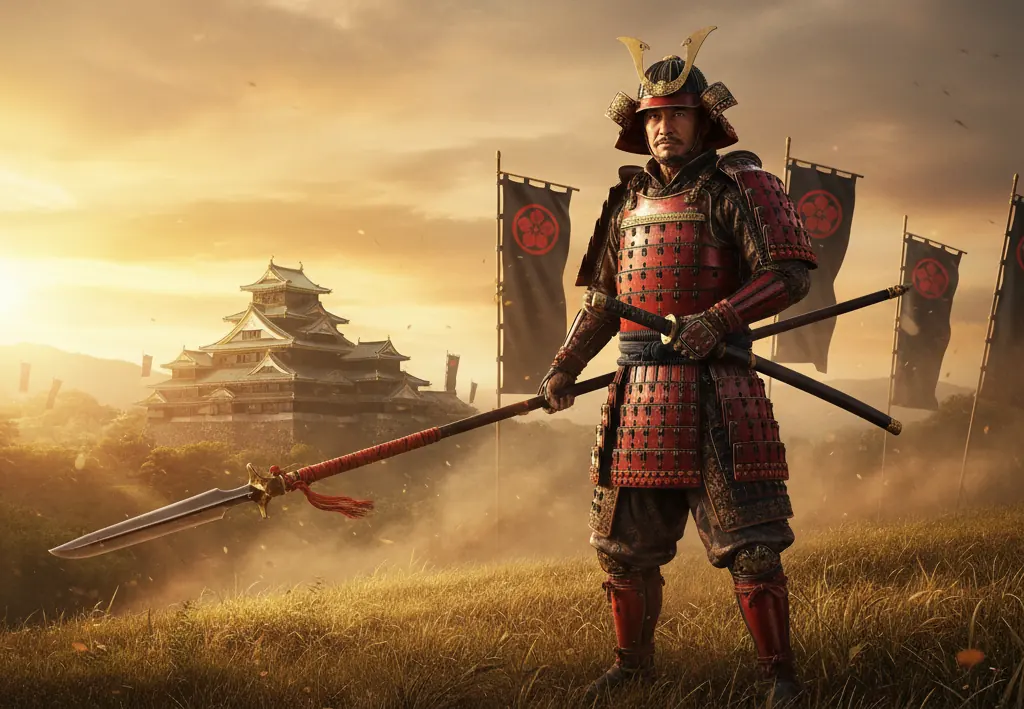
Maeda Toshiie Biography: From Nobunaga’s Page to Lord of Kaga
Maeda Toshiie (1538–1599) was a samurai commander, Toyotomi statesman, and founder of the Kaga Domain. This biography traces his life from his youth as Inuchiyo, a page under Oda Nobunaga, to his rise as one of the senior lords who helped hold Hideyoshi’s government together after Japan’s unification.
Toshiie’s life connects many of the biggest names of the Sengoku period: Oda Nobunaga, Toyotomi Hideyoshi, Tokugawa Ieyasu, Shibata Katsuie, and his wife Matsu. His death in April 1599 removed one of the last checks on Ieyasu’s ambitions, helping set Japan on the road to Sekigahara.
This biography covers
This is the detailed biography page. If you only need a quick overview or travel information, start with the main Maeda Toshiie guide.
- his early life in Owari Province and service under Oda Nobunaga;
- his reputation as “Mataza of the Spear”;
- his difficult choice after the Honnō-ji Incident;
- his rise under Toyotomi Hideyoshi and the founding of the Kaga Domain;
- his role as one of the Five Elders;
- why his death in 1599 changed the course of Japanese history.
For travel routes and on-site locations, see the main Maeda Toshiie guide.
- Maeda Toshiie: Timeline at a Glance
- The SHŌGUN Connection: Why Toshiie's Death Started Everything
- Early Life: Growing Up in Owari and Entering Nobunaga's Service
- The Road to Power: Shibata, Hideyoshi, and a Fateful Choice
- Ruling the Kaga Domain — Japan's Wealthiest Non-Tokugawa Territory
- The Korean Campaign, the Five Elders, and His Final Days
- What He Left Behind: The Legacy of Maeda Toshiie
- What to Notice When You Visit Kanazawa
- Frequently Asked Questions
- Related Pages
Maeda Toshiie: Timeline at a Glance
| 1538 | Born in Arako Village, Owari Province — present-day Nakagawa Ward, Nagoya. Known in his youth as Inuchiyo |
|---|---|
| 1560 | Battle of Okehazama |
| 1570 | Battle of Anegawa |
| 1575 | Battle of Nagashino |
| June 1582 | Honnō-ji Incident. Sides with Shibata Katsuie at the Kiyosu Conference |
| 1583 | Battle of Shizugatake — withdraws mid-battle. Later granted two districts of Kaga and establishes his base at Kanazawa Castle |
| 1584 | Komaki-Nagakute campaign — defends the north |
| 1590 | Odawara Campaign |
| 1592 | Leads 8,000 troops as one of the first commanders to depart for the invasion of Korea |
| August 1598 | Hideyoshi dies. Toshiie is appointed one of the Five Elders (Go-Tairō) |
| April 1599 | Dies at his Fushimi residence, aged 62 |
| 1600 | Maeda forces fight on the Tokugawa side at the Battle of Sekigahara |
The SHŌGUN Connection: Why Toshiie's Death Started Everything
The international drama SHŌGUN portrays the turbulent years surrounding the Battle of Sekigahara, focusing on the power struggle between figures modeled after Tokugawa Ieyasu ("Toranaga") and Ishida Mitsunari ("Ishido"). The series references the death of a ruler resembling Toyotomi Hideyoshi — yet Maeda Toshiie himself does not appear.
He was already gone. Toshiie died in April 1599 — months before the events the drama depicts. During his lifetime, Ieyasu dared not act openly. Toshiie's presence maintained a fragile balance among the Toyotomi factions. His death was the starting gun. Had he lived even a few years longer, the entire power dynamic — and perhaps the outcome of Japanese history — might have been very different.
Though his name is unfamiliar to most Western audiences, Maeda Toshiie was the pivot on which the SHŌGUN story turns. Understanding his life makes the drama — and the real history behind it — significantly richer.
Early Life: Growing Up in Owari and Entering Nobunaga's Service
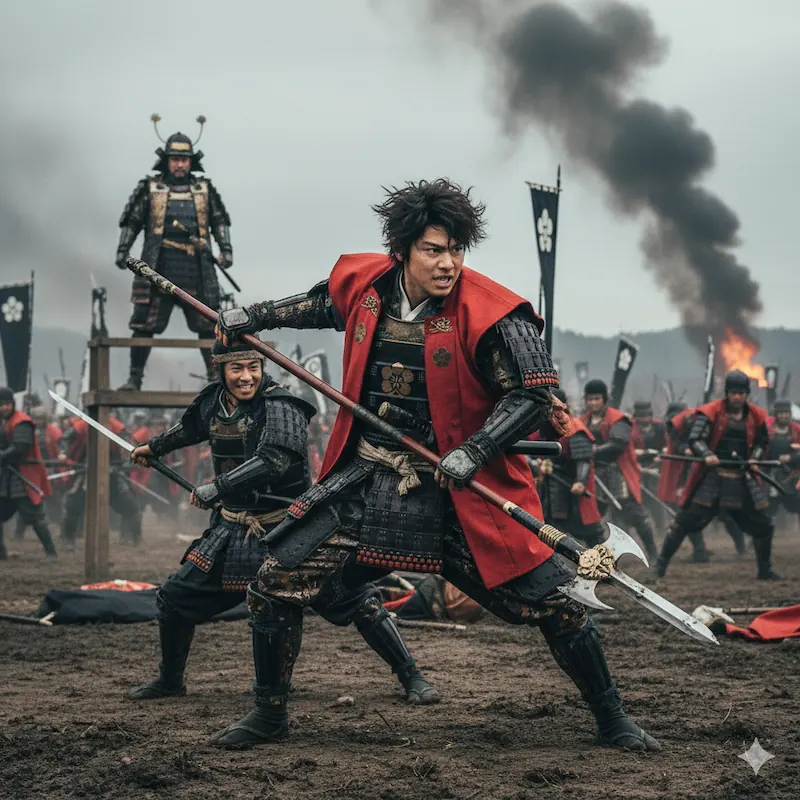
Toshiie was born in 1538 in Arako Village (荒子), Kaitō District, Owari Province — a province in what is now western Aichi Prefecture, and specifically present-day Nakagawa Ward, Nagoya. He was the fourth son of Maeda Toshiharu, the lord of Arako Castle, and was known in his youth as Inuchiyo. Around age 14, he entered the service of Oda Nobunaga as a page. Despite having elder brothers, Toshiie was chosen to succeed the family headship — an unusual decision that reflected Nobunaga's deep trust in him.
In his youth, he formed a close friendship with another young retainer, Kinoshita Tōkichirō — later known to history as Toyotomi Hideyoshi. Nobunaga playfully nicknamed Hideyoshi "the Monkey" and Toshiie "the Dog," highlighting their contrasting personalities but close camaraderie. The two would remain bound by that early friendship for the rest of their lives.
Toshiie's military career began when he was selected for Nobunaga's elite corps, the "Aka-horo-shū" — a unit distinguished by their red capes. His prowess with the spear earned him the moniker "Mataza of the Spear." He gained fame through battles at Okehazama (1560), Anegawa (1570), and Nagashino (1575), establishing himself as one of the Oda clan's foremost commanders.
The Road to Power: Shibata, Hideyoshi, and a Fateful Choice
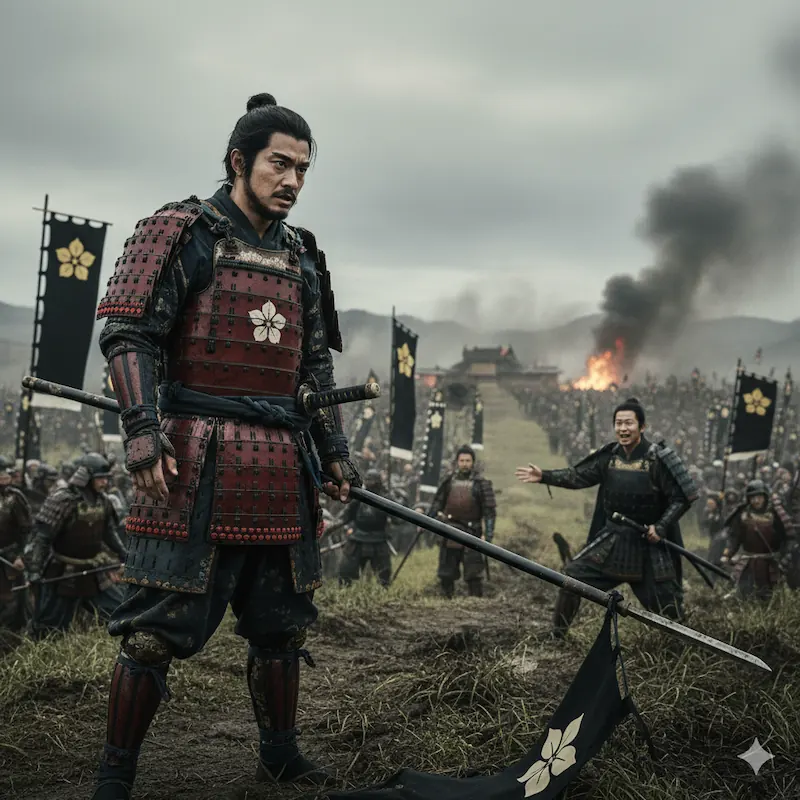
In June 1582, Oda Nobunaga was assassinated in the Honnō-ji Incident (本能寺の変). At the time, Toshiie was serving under Shibata Katsuie in the northern provinces and was unable to participate in the immediate response. During the Kiyosu Conference, held to decide Nobunaga's succession, he sided with Shibata — but his longstanding friendship with Hideyoshi left him torn.
In the decisive Battle of Shizugatake (1583), Toshiie initially fought under Shibata's command but withdrew mid-battle — a move that demoralized Shibata's army and helped secure Hideyoshi's victory. He subsequently surrendered to Hideyoshi, who rewarded him generously: confirming his old fiefs and adding two districts of Kaga. Establishing his new base at Kanazawa Castle (金沢城), Toshiie came to rule over Noto and half of Kaga Province — the two provinces that together make up today's Ishikawa Prefecture.
From there, his rise was rapid. He defended the north during the Komaki-Nagakute campaign (1584), joined the Odawara Campaign (1590), and played a significant role in Toyotomi administrative governance throughout the 1580s and 1590s.
Ruling the Kaga Domain — Japan's Wealthiest Non-Tokugawa Territory
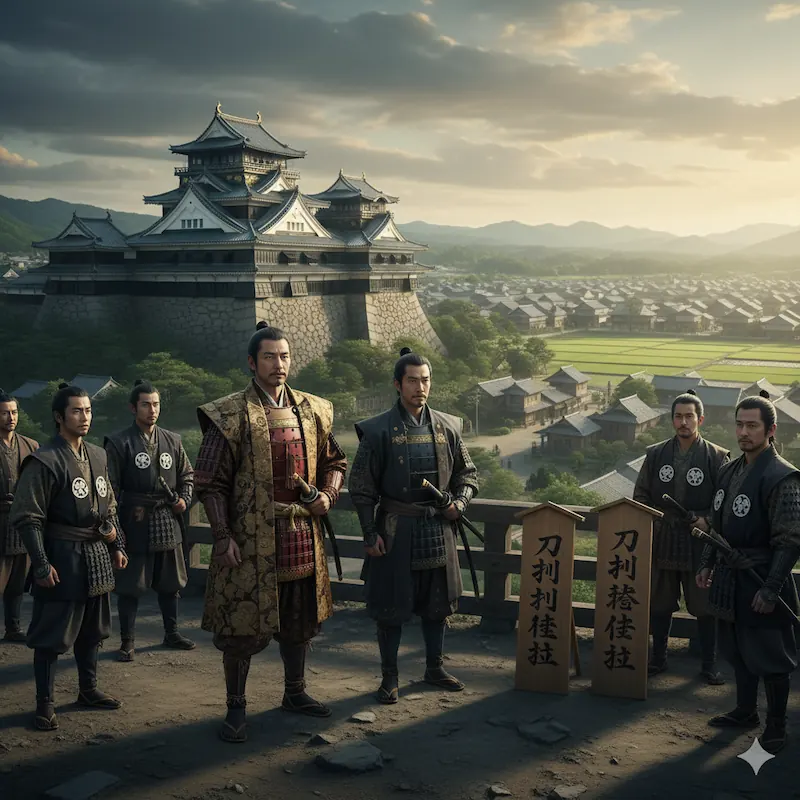
After Japan's unification, Toshiie was granted Kaga, Noto, and parts of neighboring Etchū — the province that corresponds roughly to today's Toyama Prefecture — amassing a total of approximately 830,000 koku in annual rice yield, with some sources claiming close to one million. "Koku" was the unit used in Sengoku and Edo Japan to measure a domain's wealth — specifically, the volume of rice it could produce in a year. At close to one million koku, the Kaga Domain was second in economic power only to the Tokugawa shogunate itself. This gave rise to the famous epithet "Kaga Hyakumangoku" (Kaga of One Million Koku), and made the Maeda the rough equivalent of an independently wealthy regional kingdom — capable of fielding a large army, yet choosing to coexist peacefully with the Tokugawa for over 260 years.
From Kanazawa Castle, Toshiie devoted himself to sound governance: conducting land surveys, restoring public order, and enforcing Hideyoshi's "Sword Hunt Edict" to stabilize a region that had been ravaged by the Ikkō-ikki uprisings — armed revolts led by militant Buddhist congregations. The prosperous foundation of the later Kaga Domain can largely be attributed to Toshiie's era of reform.
He also earned deep respect for his compassion and leadership. He famously sheltered the Christian lord Takayama Ukon, and was often described as "the conscience of the Toyotomi government." His administration of Kaga revealed that his greatness extended far beyond the battlefield.
The Korean Campaign, the Five Elders, and His Final Days
In 1592, Hideyoshi launched the invasion of Korea. Toshiie, leading 8,000 troops, was among the first commanders to depart. Though he saw little direct combat in Korea, he remained a senior statesman whose authority lent stability to the Toyotomi regime.
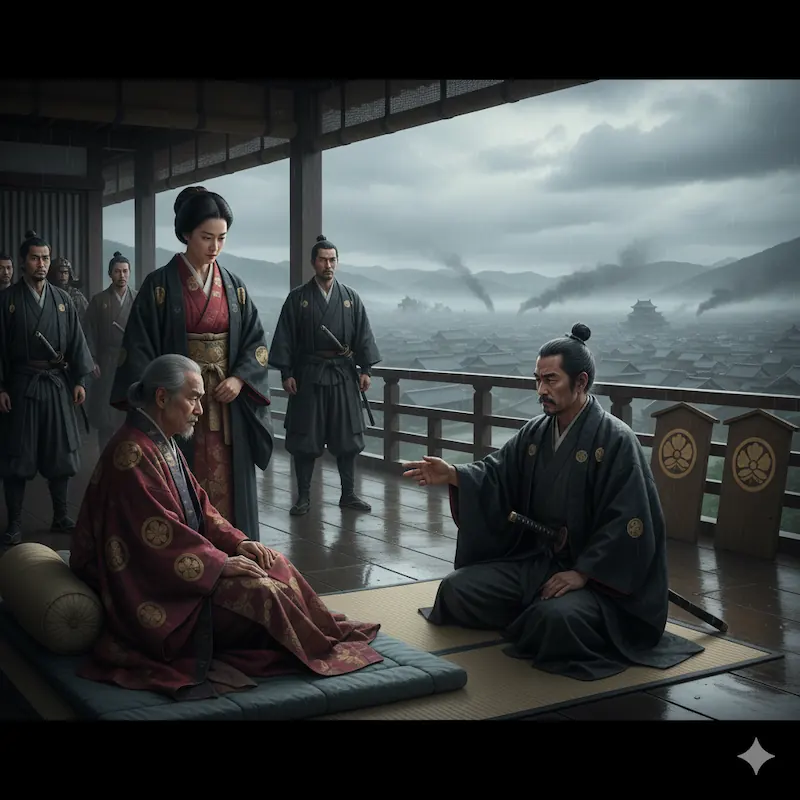
When Hideyoshi died in August 1598, Toshiie was appointed — per Hideyoshi's will — as one of the Five Elders (Go-Tairō): the senior lords charged with governing jointly and protecting the young heir, Toyotomi Hideyori, until he came of age. The Five Elders were Tokugawa Ieyasu, Maeda Toshiie, Mōri Terumoto, Ukita Hideie, and Uesugi Kagekatsu. Of these, only Toshiie had the personal authority and military resources to check Ieyasu's ambitions.
But Toshiie himself was gravely ill. In April 1599 — barely eight months after Hideyoshi's death — he died at his Fushimi residence (伏見), in what is now the southern part of Kyoto, at age 62. His death removed the last great figure capable of restraining Tokugawa Ieyasu. Within months, Ieyasu accused Toshiie's heir of treason.
Toshiie's widow Matsu (later Hoshūin) then made a remarkable decision: she voluntarily offered herself as a hostage to Ieyasu in Edo. Her act of self-sacrifice preserved the Maeda clan. At the Battle of Sekigahara (1600), the Maeda forces fought on the Tokugawa side, ensuring the clan's survival into the Edo period — and the continuation of the Kaga Domain for over 260 years.
What He Left Behind: The Legacy of Maeda Toshiie
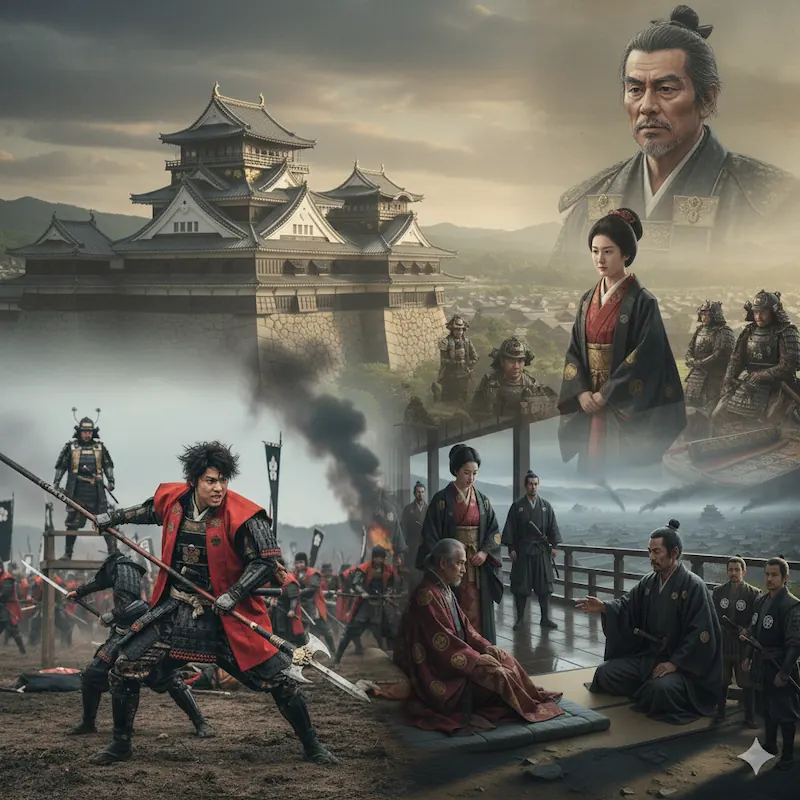
Maeda Toshiie is remembered not only as a fearless warrior — the "Mataza of the Spear" — but as a loyal and astute statesman. Many historians speculate that had he lived longer, the fate of the Toyotomi regime might have taken a very different course. His legacy endured through the Maeda clan: under his descendants, the Kaga Domain flourished as one of Japan's wealthiest and most culturally refined regions throughout the Edo period.
The story of Matsu's selfless decision to become a hostage is celebrated as a symbol of devotion and loyalty. Toshiie's life — bridging the violent end of the Sengoku era and the long peace of the Edo period — continues to captivate audiences today, inspiring novels, dramas, and historical works in Japan and beyond.
What to Notice When You Visit Kanazawa
Unlike many Sengoku-era castle towns, Kanazawa (金沢) — the capital of Ishikawa Prefecture — was never bombed during World War II — meaning the streets, shrines, and castle grounds Toshiie established survive in a form that is remarkably intact. Three sites in particular repay close attention:
At Kanazawa Castle Park (金沢城公園), look closely at the stonework: the massive walls were engineered to last centuries, and they have. The reconstructed gates and turrets give a clear sense of the scale of the domain Toshiie was building.
At Oyama Shrine (尾山神社), the unusual Western-influenced gate — added in the Meiji era — reflects how the Maeda legacy was reinterpreted across time. The shrine is dedicated to both Toshiie and Matsu, and the atmosphere feels more intimate than a standard tourist stop.
At Tentoku-in Temple (天徳院), Matsu's story is told through the memorial buildings she commissioned herself before her death. Visiting here makes her decision — to walk into captivity to save her family — feel immediate rather than abstract.
→ See the full travel guide: visiting Maeda Toshiie's legacy in Kanazawa, Nagoya & Kyoto
Frequently Asked Questions
The two were close friends from their youth as pages under Oda Nobunaga. Nobunaga nicknamed Hideyoshi "the Monkey" and Toshiie "the Dog" — contrasting in style, but inseparable in bond. Toshiie later served as one of Hideyoshi's Five Elders and was given guardianship of Hideyoshi's young heir when Hideyoshi died in 1598.
The Five Elders were senior lords appointed by Toyotomi Hideyoshi to govern jointly and protect his young heir after his death. The five were Tokugawa Ieyasu, Maeda Toshiie, Mōri Terumoto, Ukita Hideie, and Uesugi Kagekatsu. Toshiie was the only one with enough personal prestige and military resources to act as a genuine counterweight to Ieyasu. His death eight months after Hideyoshi's left the other elders without a unifying figure.
Toshiie was fighting under Shibata Katsuie's command in 1583 when he chose to withdraw mid-battle rather than fight against his old friend Hideyoshi. The move demoralized Shibata's army and proved decisive. Historians debate whether it was a calculated act of loyalty to Hideyoshi or a pragmatic read of the battlefield — either way, it defined the rest of his career.
The clan survived the transition to Tokugawa rule, largely due to Matsu's decision to serve as a hostage and the Maeda forces' participation on the Tokugawa side at Sekigahara (1600). Under Toshiie's son Toshinaga and subsequent generations, the Kaga Domain continued under Maeda rule for the entire Edo period — over 260 years. Kanazawa developed into one of Japan's great cultural cities during this time.
"Kaga Hyakumangoku" (加賀百万石) means "Kaga of One Million Koku" and refers to the extraordinary wealth of the domain Toshiie founded. It became a shorthand for the Maeda clan's power and cultural prestige throughout the Edo period — and is still used in Kanazawa today to describe the region's identity and heritage.
The two were never close in the way Toshiie and Hideyoshi were, but they were colleagues within the Toyotomi system and maintained outward cooperation. After Hideyoshi's death, tensions rose quickly as Ieyasu began maneuvering for power. Toshiie positioned himself as the head of the faction opposing Ieyasu — but his illness prevented the confrontation from coming to a head before his death in April 1599.
In Japan, Toshiie is a celebrated historical figure — particularly in the Hokuriku region, where the Maeda clan's legacy shapes local identity. He has been the subject of multiple NHK historical dramas, novels, and museum exhibitions. In Kanazawa, his image appears in everything from shrine dedications to tourism branding. Outside Japan, he remains largely unknown, though interest has grown among English-speaking audiences following the success of SHŌGUN.
Toshiie's grave is located in Kyoto, near Kōdai-ji Temple (高台寺) — the same area where Nene (Hideyoshi's widow) is memorialized. He died at his Fushimi residence in April 1599 and was interred there. His wife Matsu is enshrined separately at Tentoku-in Temple in Kanazawa.
Related Pages
☕ Support This Site
Following the Shogun is built on original fieldwork and on-site research.
If you found this guide useful, your support helps keep it going.

You can also support via QR code

