


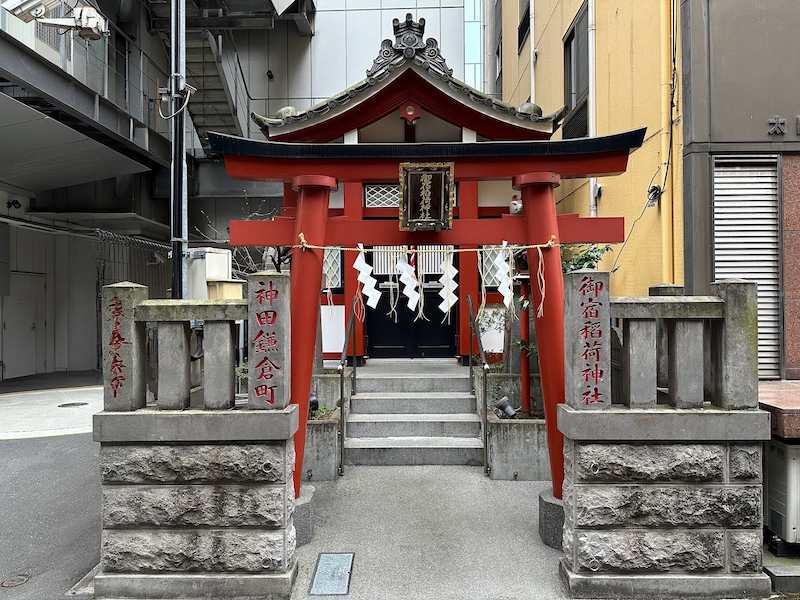
Edo Castle’s Outer Grounds: Sakuradamon, Tayasu-mon, Shimizu-mon and Chidorigafuchi
Spread around the outer perimeter of the Imperial Palace East Gardens, the outer grounds are dotted with Edo Castle gates, moats, shrines, and famous cherry-blossom sites. The essential highlights are Sakuradamon Gate, Tayasu-mon Gate, Hanzomon Gate, and Chidorigafuchi.
- ① Otemon Gate Area
- ② Fujimi-yagura Turret Area
- ③ Honmaru Area
- ④ Ninomaru Area
- ⑤ Outer Grounds (This Page)
- ▶ Back to the Complete Guide
Spread around the outer perimeter of the Imperial Palace East Gardens, the outer grounds are dotted with Edo Castle gates, moats, shrines, and famous cherry-blossom sites. The essential highlights are Sakuradamon Gate, Tayasu-mon Gate, Hanzomon Gate, and Chidorigafuchi.
Sakuradamon Gate is known as the stage of the Sakuradamon Incident and remains a nationally designated Important Cultural Property that still preserves the structure of a large masugata defensive gate. Tayasu-mon Gate and Shimizu-mon Gate are also nationally designated Important Cultural Properties, preserving Edo Castle’s gate architecture on the Kitanomaru Park side. Chidorigafuchi, meanwhile, is a beloved destination for spring cherry blossoms and boating, while also offering a sense of Edo Castle’s history of defense and water management.
Suggested Time
All 9 sites: about half a day / Highlights only: 1.5 to 2 hours
Admission
Viewing the exteriors and visiting the shrines is generally free. Chidorigafuchi boat rentals require a fee.
Relationship to the Imperial Palace East Gardens
The outer grounds are spread around the perimeter of the East Gardens. Some sites are less affected by the East Gardens’ opening hours.
Note
The distance between sites is significant, so comfortable walking shoes are recommended if you plan to visit them all.
Outer Grounds
The nine sites are spread across the west, south, and north sides of the Imperial Palace. Rather than trying to see everything in a single sweep, divide your walk into routes such as “Hanzomon and Chidorigafuchi,” “Sakuradamon and Kikyo-mon,” and “Kitanomaru Park.” This makes the visit more relaxed and manageable.
Hirakawa Tenmangu
An Edo-period Tenmangu shrine with a surviving bronze torii—where faith in scholarship, matchmaking, and the sacred nade-ushi ox still lives on
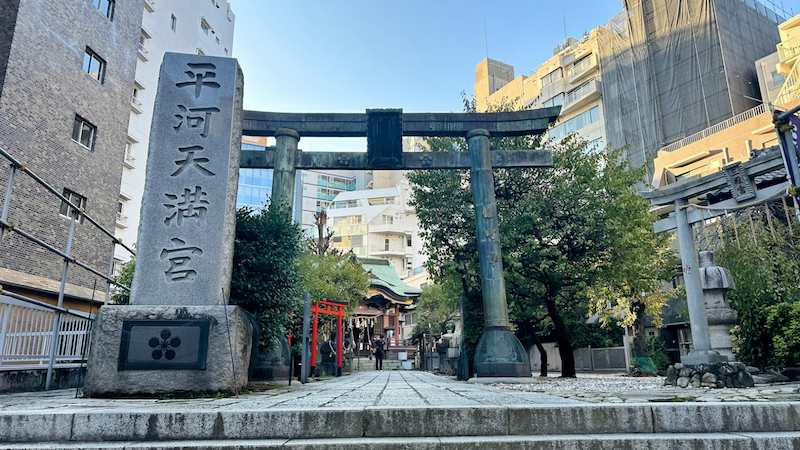
Hirakawa Tenmangu is a Tenmangu shrine often counted as one of Edo’s three great Tenjin shrines, dedicated to Sugawara no Michizane, the deity of learning. Within the grounds are a bronze torii gate, a nade-ushi ox statue, matchmaking plum trees, and other features that let visitors feel the atmosphere of Edo-period faith even in the heart of modern Tokyo.
The feature most worth noting is the bronze torii, donated in December 1844 by people from the Kojimachi area. Designated a Chiyoda City Cultural Property on April 1, 1994, the gate reveals late Edo-period townspeople’s devotion and metalworking skill through its construction—copper plates wrapped around stone pillars—and the lion carvings on its base.
Detailed Historic Site Data
| Main Deity | Sugawara no Michizane |
|---|---|
| Bronze Torii Donation | December 1844. Some sources record the year as Tenpo 15 (1844). |
| Cultural Property Designation | The bronze torii is a Chiyoda City Cultural Property (designated April 1, 1994). |
| Highlights Within the Grounds | Bronze torii, nade-ushi ox statue, matchmaking plum trees, guardian lion-dogs, chikara-ishi strength stones, and more. |
| Structure and Features | A torii gate made by wrapping copper plates around stone pillars. Lion carvings can be seen on the base. |
| Visiting Status | The shrine grounds are open for worship. Conditions may change during ceremonies or events. |
Highlights
- Bronze Torii: Donated in 1844, this cultural property conveys both late Edo-period faith and casting technology.
- Lion Carvings on the Base: Look closely at the torii base to appreciate the expressive carved lions.
- Nade-ushi Ox: A classic Tenmangu highlight. Visitors traditionally rub the part of the ox corresponding to the area of the body they hope to heal or strengthen.
- Matchmaking Plum Trees: One of Hirakawa Tenmangu’s signature features. The shrine is cherished not only for scholarship but also for matchmaking.
Trivia
- Traces of Wartime Damage: Parts of the bronze torii’s pillars are said to bear damage from machine-gun fire during wartime air raids, leaving traces of modern history as well.
- Evidence of Townspeople’s Faith: The torii was donated by people from the Kojimachi area, making it an important record of local faith in the late Edo period.
| Address | 1-7-5 Hirakawacho, Chiyoda City, Tokyo |
|---|---|
| From Hanzomon Station | About 3 minutes on foot from Exit 1 of Hanzomon Station (Z05), Tokyo Metro Hanzomon Line (approx. 240 m) |
| Suggested Time | Quick visit: about 5 minutes / In-depth visit: about 15 minutes |
| Admission | Free |
Open the map to see the relationship between Hanzomon Station (Z05) and Hirakawa Tenmangu.
Chidorigafuchi
A moat that once functioned as a dam to secure water—now a famous boating and cherry-blossom site with roughly 230 to 260 sakura trees in spring
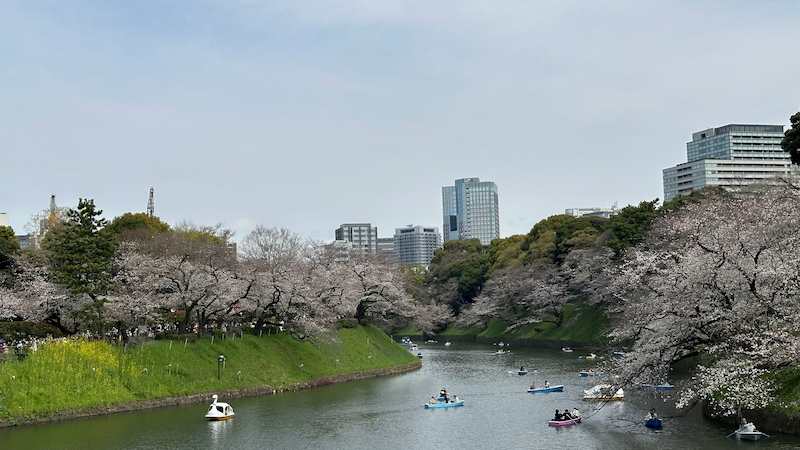
Chidorigafuchi is a moat located on the northwestern side of the Imperial Palace. According to the Chiyoda City Tourism Association, in the early years of Edo it functioned as a dam that stopped a stream flowing from the Kojimachi area in order to secure water.
Today it has been developed as the approximately 700-meter-long Chidorigafuchi Green Way, where spring brings a vivid landscape formed by a tunnel of blossoms and the surface of the moat. Official guides vary in listing the number of cherry trees at around 230 to 260, but there is no doubt that this is one of Tokyo’s premier hanami destinations, with Somei Yoshino and Oshima cherry trees in bloom. The municipal Chidorigafuchi Boat Pier is also nearby, and the experience of looking up at the blossoms from the water is especially popular in spring. The Chidorigafuchi National Cemetery, which houses the remains of those who died in World War II, stands adjacent to the area.
Detailed Historic Site Data
| Historical Role | It is described as having functioned as a dam to secure water in the early years of Edo. |
|---|---|
| Number of Cherry Trees | About 230 to 260 along Chidorigafuchi Green Way. Figures may vary depending on the official guide. |
| Length of the Green Way | Approximately 700 meters |
| Boat Pier | The municipal Chidorigafuchi Boat Pier is located here. Check official information for hours, closing days, and fees. |
| Adjacent Facility | Chidorigafuchi National Cemetery |
| Origin of the Name | Several theories exist, including one that the shape of the moat resembles a plover, and another that it was named for the birds, such as miyakodori, that gathered here. |
| Visiting Status | Walking the green way is free. Boat rentals require a fee. |
Highlights
- Cherry-Blossom Tunnel (Spring): When the cherry trees bloom together along the green way, they form a tunnel of blossoms beside the moat. The best viewing period is usually from late March to early April.
- Chidorigafuchi Boat Pier: Rowing a boat on the moat and looking up at the blossoms from the water is an exceptional experience. Because operating conditions can change, checking ahead is safest.
- Chidorigafuchi National Cemetery: Nearby is a quiet place of prayer, offering a striking contrast to the festive atmosphere of cherry-blossom viewing.
- Japanese Snowbell Trees (Early Summer): Beyond cherry blossoms, visitors can also enjoy seasonal flowers and fresh greenery along the green way.
Trivia
- Its Role as a Dam: In the formative period of Edo Castle, this area is described as a place where a small stream was dammed to secure a water source.
- Notes on Boat Use: Closing days, operating hours, fee revisions, and boating zones may change. Checking same-day official information will give you peace of mind.
| Address | Around 2-chome Kudanminami, Chiyoda City, Tokyo |
|---|---|
| From Hanzomon Station | About 11 minutes on foot from Exit 5 of Hanzomon Station (Z05), Tokyo Metro Hanzomon Line (approx. 750 m) |
| Suggested Time | Quick visit: about 15 minutes / In-depth visit: about 30 to 60 minutes |
| Walking Fee | Free (boats require a fee) |
Open the map to see the relationship between Hanzomon Station (Z05) and Chidorigafuchi Green Way.
Hanzomon Gate
A western gate carrying a name linked to Hattori Hanzo—an Edo Castle strategic point leading toward the Koshu Kaido road
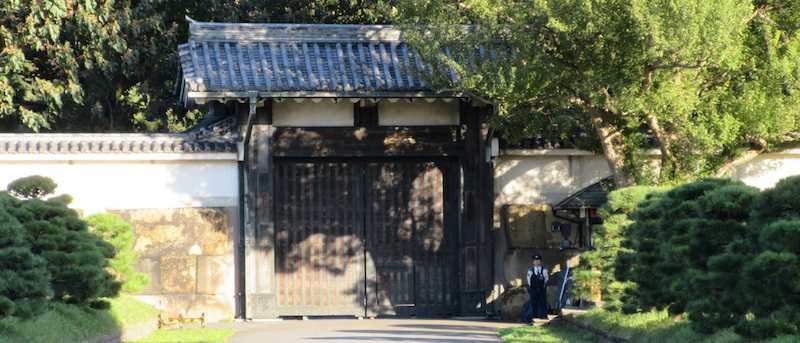
Hanzomon Gate is one of Edo Castle’s inner gates. It was also known as the “Kojimachi entrance,” and together with Yotsuya Gate, it formed a key strategic point on the route toward the Koshu Kaido. The gate’s name is said to derive from a tradition that Hattori Hanzo, an Iga retainer, was granted a residence in this area along with his followers.
According to Chiyoda City, the gate was built in Genna 6 (1620) by Date Masamune, lord of the Sendai Domain, and six other eastern daimyo. In Meiji 4 (1871), the watari-yagura gate was removed, and today only the Korai-mon remains. It is used as a service gate for the Imperial Family entering and leaving the Imperial Palace. Because it leads toward the Koshu Kaido, it is also often described in connection with emergency escape routes.
Detailed Historic Site Data
| Construction | Described as having been built in Genna 6 (1620) by Date Masamune and six other eastern daimyo. |
|---|---|
| Alternate Name | Kojimachi entrance |
| Origin of the Name | One theory says Hattori Hanzo, an Iga retainer, was granted a residence in this area. |
| Surviving Condition | The watari-yagura gate was removed in Meiji 4 (1871), and the Korai-mon gate remains today. |
| Current Use | Used as a service gate for the Imperial Family entering and leaving the Imperial Palace. It is not open for public passage. |
Highlights
- Korai-mon Gate and Hanzobori Moat: Seeing the surviving Korai-mon together with Hanzobori Moat conveys the scale of Edo Castle’s western defenses.
- Connection to the Koshu Kaido: Outside Hanzomon Gate, the route continues toward the Koshu Kaido. Notice how this historical route connects with today’s roads.
- The Hattori Hanzo Origin Theory: The gate name is linked to Hattori Hanzo, making this a place where you can imagine the relationship between Edo Castle and the Iga retainers.
- No Public Passage: Today the gate serves the Imperial Family, so visitors generally view it from outside.
Trivia
- An Alternate Theory Involving an Elephant Float: Another tradition says the name came from an elephant float in the Sanno Festival that could not pass fully through the masugata gate, entering only halfway.
- A Name Still Alive Today: The gate’s name survives in modern Tokyo’s transportation network through the Hanzomon Line and Hanzomon Station.
| Address | 1-saki, Kojimachi 1-chome, Chiyoda City, Tokyo |
|---|---|
| From Hanzomon Station | About 1 minute on foot from Exit 3b of Hanzomon Station (Z05), Tokyo Metro Hanzomon Line (approx. 100 m) |
| Suggested Time | Quick visit: about 5 minutes / In-depth visit: about 10 minutes |
| Admission | Free exterior viewing |
Open the map to see the relationship between Hanzomon Station (Z05) and Hanzomon Gate.
Sakuradamon Gate 360°
The stage of the Sakuradamon Incident—the Outer Sakuradamon Gate of Edo Castle, preserving one of the largest surviving masugata gate spaces
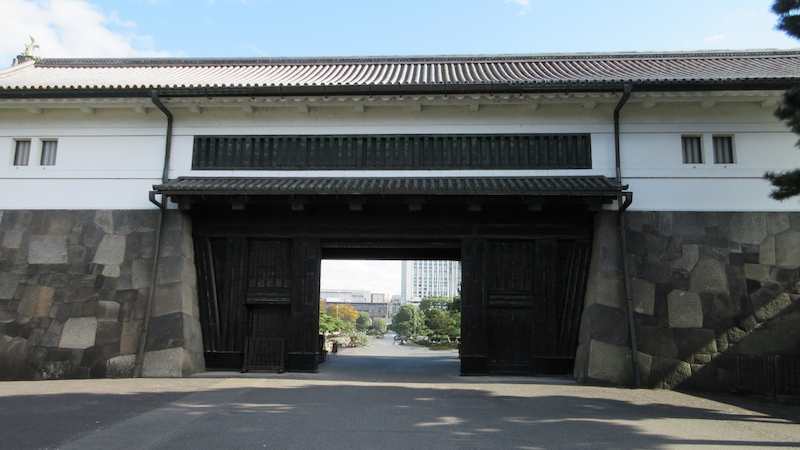
Sakuradamon Gate was one of the gates that protected the outer perimeter of Edo Castle and is also known as Outer Sakuradamon Gate. The Ministry of the Environment explains that it was repaired in Kan’ei 13 (1636), damaged in the Great Kanto Earthquake of 1923, and later rebuilt using an iron-mesh dozo-style construction.
Sakuradamon Gate is a masugata-style castle gate with a square defensive space between its Korai-mon and watari-yagura gates. Because it preserves a large masugata space unusually well among surviving gates, it was designated a National Important Cultural Property in June 1961. It is also famous as the stage of the late Edo-period Sakuradamon Incident.
Detailed Historic Site Data
| Repair | Described as having been repaired in Kan’ei 13 (1636). |
|---|---|
| Structure and Features | A masugata castle gate consisting of a Korai-mon and a watari-yagura gate. The masugata space is described as measuring 15 ken by 21 ken. |
| Reconstruction | Damaged in the Great Kanto Earthquake and rebuilt at that time using iron-mesh dozo-style construction. |
| Cultural Property Designation | Nationally Designated Important Cultural Property (designated June 1961) |
| Historical Event | The gate became the stage of the Sakuradamon Incident on March 3, 1860. |
Highlights
- Large Masugata Space: The square space between the first and second gates lets you experience a defensive structure characteristic of Edo Castle.
- Site of the Sakuradamon Incident: The area just outside the gate was the stage of an event that dramatically shifted late Edo-period politics.
- Imperial Palace Outer Garden Scenery: Seeing the moat, stone walls, and gate together conveys the scale of Edo Castle’s outer perimeter.
Trivia
- Sakuradamon Incident: On March 3, 1860, Chief Minister Ii Naosuke was attacked by ronin from the Mito Domain and others. The incident is known as a turning point in late Edo-period politics.
- Outer Sakuradamon Gate: Because Kikyo-mon Gate is also called “Inner Sakuradamon Gate,” this gate is known as “Outer Sakuradamon Gate.”
| Address | Around 1 Kokyogaien, Chiyoda City, Tokyo |
|---|---|
| From Sakuradamon Station | About 2 minutes on foot from Sakuradamon Station (Y17), Tokyo Metro Yurakucho Line (approx. 200 m) |
| Suggested Time | Quick visit: about 5 minutes / In-depth visit: about 15 minutes |
| Admission | Free |
Open the map to see the relationship between Sakuradamon Station (Y17) and Sakuradamon Gate.
Onjuku Inari Shrine
An Inari shrine preserving the tradition that Ieyasu once lodged here—the name “Onjuku” carries the memory of his transfer to the Kanto region
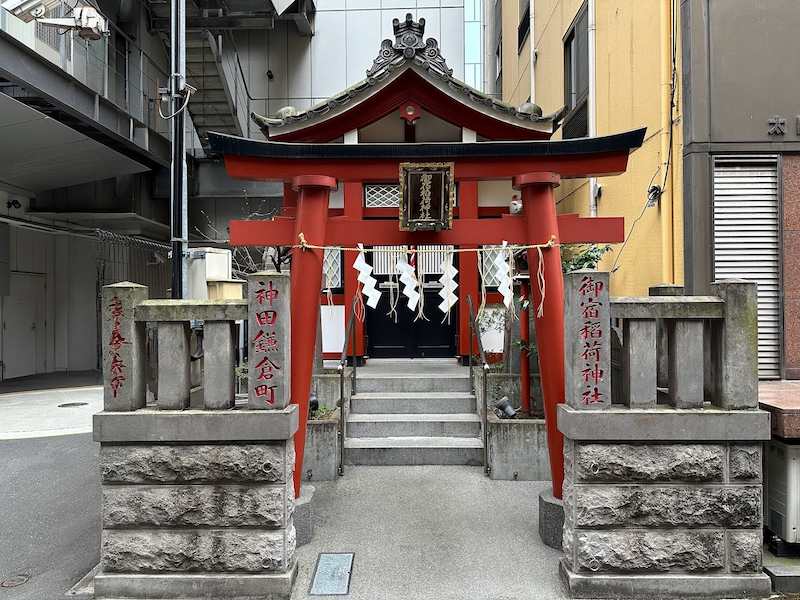
Onjuku Inari Shrine is an Inari shrine in Uchikanda, Chiyoda City. The Chiyoda City Tourism Association introduces a tradition that when Tokugawa Ieyasu was transferred to the Kanto region, a small shrine stood in the residence where he lodged. To commemorate Ieyasu’s stay, it came to be called “Onjuku Inari Shrine” and was granted shrine land.
The shrine building was completely destroyed in wartime fires, but the sacred object is said to have survived. The shrine was rebuilt in 1956, and the present building was newly constructed in 2007. Although the grounds are not large, this is a place that preserves a tradition connected to Ieyasu’s transfer to the Kanto region.
Detailed Historic Site Data
| Origin | Traditionally said to derive from a small shrine enshrined in the residence where Tokugawa Ieyasu lodged when he was transferred to the Kanto region. |
|---|---|
| After Wartime Damage | The shrine building burned down in the war, but the sacred object is said to have survived. |
| Rebuilding and New Construction | Rebuilt in 1956; the present shrine building was newly constructed in 2007. |
| Main Blessing | The Chiyoda City Tourism Association describes the shrine as connected with fire prevention and disaster prevention. |
| Visiting Status | Open for worship. As this is a small neighborhood shrine, please visit quietly and respectfully. |
Highlights
- The Name “Onjuku”: The shrine name itself preserves the tradition that Tokugawa Ieyasu once lodged here.
- A Small Historic Site in Uchikanda: Although the surrounding area is highly urbanized, this spot still evokes traditions connected to Ieyasu’s arrival in the Kanto region.
Trivia
- Ieyasu’s Transfer to the Kanto Region: Tokugawa Ieyasu’s transfer to the Kanto region in 1590 was a major turning point that later led to the development of Edo. Onjuku Inari Shrine is one of the traditional sites preserving memories of that era.
| Address | 1-6-8 Uchikanda, Chiyoda City, Tokyo |
|---|---|
| Access | About 7 minutes on foot from JR Kanda Station (JY02/JK27) (approx. 500 m) / About 4 minutes on foot from Exit A2 of Otemachi Station (M18/T09/C11/Z08/I09) |
| Suggested Time | Quick visit: about 5 minutes / In-depth visit: about 15 minutes |
| Admission | Free |
Open the map to see the relationship between Kanda Station (JY02/JK27), Otemachi Station (M18/T09/C11/Z08/I09), and Onjuku Inari Shrine.
Kikyo-mon Gate (Inner Sakuradamon Gate)
The meeting point for Imperial Palace general tours—an inner Sakuradamon gate best viewed together with Kikyo-bori and Hamaguri-bori moats
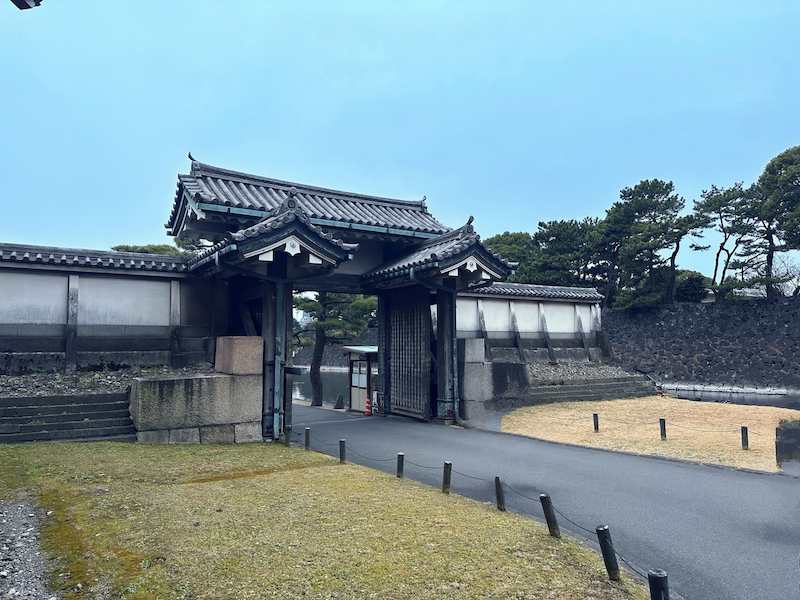
Kikyo-mon Gate, also called Inner Sakuradamon Gate, is often discussed as the counterpart to Sakuradamon Gate, the Outer Sakuradamon Gate. Today it is also designated as the meeting point for Imperial Palace general tours; visitors joining the tour gather at this gate.
There are several explanations for the gate’s name, including one that links it to the kikyo (bellflower) crest said to have been used by Ota Dokan. Even today, the gate is an important point for understanding the inner perimeter of Edo Castle together with Kikyo-bori and Hamaguri-bori moats.
Detailed Historic Site Data
| Alternate Name | Inner Sakuradamon Gate |
|---|---|
| Origin of the Name | One theory connects the name to the kikyo crest said to have been used by Ota Dokan. |
| Location | A gate located on the Imperial Palace side, paired in name with Outer Sakuradamon Gate. |
| Current Role | Used as the meeting point for Imperial Palace general tours. |
| Cultural Property Designation | The surrounding remains are within the Special Historic Site “Edo Castle Ruins.” Confirm official information for any individual building designation. |
Highlights
- Entrance for Imperial Palace General Tours: Because tour participants gather at Kikyo-mon Gate, it is closely connected to modern Imperial Palace visits.
- Scenery with Kikyo-bori and Hamaguri-bori Moats: Viewing not only the gate but also the moats and stone walls helps convey the atmosphere of an inner gate.
- Relationship to Tatsumi-yagura Turret: Seeing Kikyo-mon Gate together with Tatsumi-yagura Turret gives the Edo Castle scenery on the Imperial Palace Outer Garden side a more defined outline.
- The Name Inner Sakuradamon Gate: It is also called Inner Sakuradamon Gate to distinguish it from Sakuradamon Gate, the Outer Sakuradamon Gate.
Trivia
- The Kikyo Crest Theory: Several theories exist for the gate name, but one often mentioned is its connection to the kikyo crest said to have been used by Ota Dokan.
- Tour Meeting Point: Imperial Palace general tour information provides access routes and travel times to Kikyo-mon Gate.
| Address | Around 1 Chiyoda, Chiyoda City, Tokyo |
|---|---|
| From Nijubashimae Station | About 8 minutes on foot from Nijubashimae Station (C10), Tokyo Metro Chiyoda Line (approx. 500 m) |
| Suggested Time | Quick visit: about 10 minutes / In-depth visit: about 20 minutes |
| Admission | Free exterior viewing |
Open the map to see the relationship between Nijubashimae Station (C10) and Kikyo-mon Gate.
Tatsumi-yagura Turret
A two-story turret preserving the defenses of Edo Castle’s southeast—also known as Sakurada Two-Story Turret
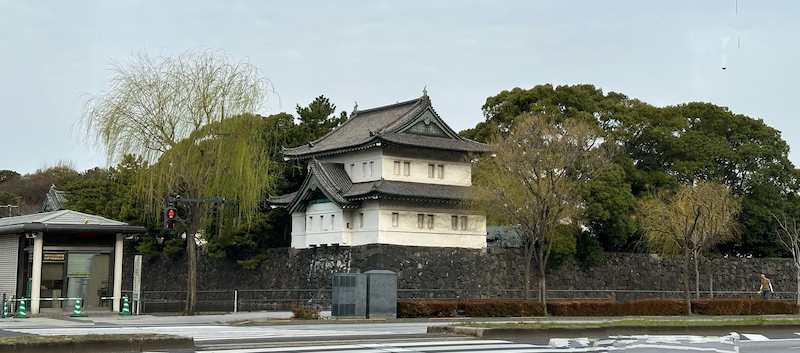
Tatsumi-yagura Turret guarded the southeast—or tatsumi—direction of Edo Castle and is also called the Sakurada Two-Story Turret. Its contrast of white walls and black tile roof is striking, and it forms one of the most representative Edo Castle views seen from the Imperial Palace Outer Garden side together with the area around Kikyo-mon Gate.
Edo Castle once had many turrets, but only a limited number still convey the atmosphere of the Edo period today. Tatsumi-yagura is often introduced alongside Fujimi-yagura and Fushimi-yagura as one of the surviving turrets, allowing visitors to sense the appearance of Edo Castle’s defensive architecture from outside. The view combined with Kikyo-mon Gate and the Nijubashi Bridge area is especially memorable, making it one of the best places on the Imperial Palace Outer Garden side to grasp the outline of Edo Castle.
Detailed Historic Site Data
| Alternate Names | Sakurada Two-Story Turret, Sakurada Tatsumi-yagura Turret |
|---|---|
| Location | A turret located in the southeast, or tatsumi, direction of Edo Castle. |
| Structure and Features | A two-story turret characterized by white walls and a black tile roof. |
| Surviving Condition | Survives today. Its exterior can be viewed from the Imperial Palace Outer Garden side. |
| Cultural Property Designation | An Edo Castle remnant under the jurisdiction of the Imperial Household Agency. Confirm official information for any individual building designation. |
Highlights
- The Appearance of a Two-Story Turret: The well-balanced white walls and black roof tiles create the imposing scenery characteristic of Edo Castle.
- Combined View with Kikyo-mon Gate and Nijubashi: Viewing it together with Kikyo-mon Gate, the moats, and the Nijubashi Bridge area makes it easier to understand Edo Castle’s outline from the Imperial Palace Outer Garden.
- Sama Loopholes and Ishi-otoshi Openings: From the exterior, you can also notice practical defensive features designed to protect the castle.
- Value as a Surviving Turret: Because only a limited number of Edo Castle turrets survive, even the exterior is well worth seeing.
Trivia
- The Meaning of “Tatsumi”: Tatsumi is a word that indicates the southeast direction. The name connects the castle’s orientation with its defensive facilities.
- Sakurada Two-Story Turret: This turret is often discussed together with the scenery around Sakuradamon Gate and Kikyo-mon Gate.
| Address | Around 1 Chiyoda, Chiyoda City, Tokyo |
|---|---|
| From Kikyo-mon Gate | About 5 minutes on foot (approx. 300 m). Within walking distance from Nijubashimae Station (C10), Tokyo Metro Chiyoda Line. |
| Suggested Time | Quick visit: about 5 minutes / In-depth visit: about 15 minutes |
| Admission | Free exterior viewing |
Open the map to see the relationship between Nijubashimae Station (C10), Kikyo-mon Gate, and the area around Tatsumi-yagura Turret.
Shimizu-mon Gate 360°
An Important Cultural Property masugata gate guarding the east side of Kitanomaru—preserving an inscription from Manji 1
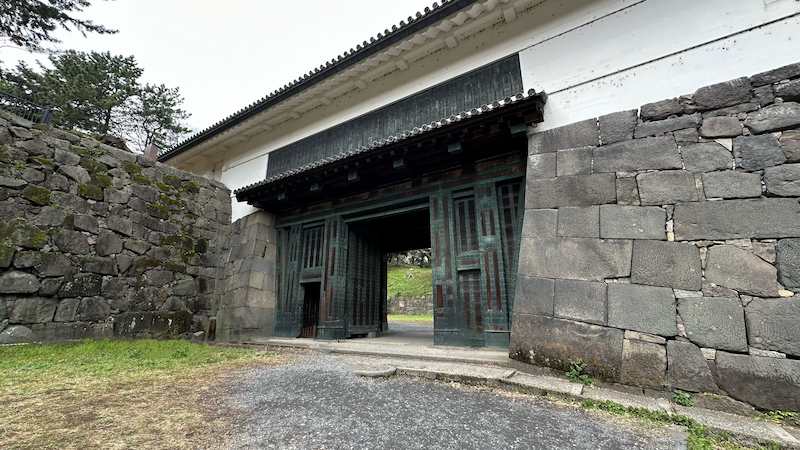
Shimizu-mon Gate is a former Edo Castle gate preserved on the east side of Kitanomaru Park and is a nationally designated Important Cultural Property. The Chiyoda City Tourism Association introduces it as a masugata castle gate built in Kan’ei 1 (1624) by Asano Nagaakira, the first lord of the Hiroshima Domain.
Cultural-property materials, however, explain that the present structure can be identified as having been built in Manji 1 (1658) based on inscriptions on the door hinge fittings. For a public article, it is safest to explain it as “said to have been built in Kan’ei 1, with the present building preserving an inscription from Manji 1.”
Detailed Historic Site Data
| Construction | Introduced as having been built in Kan’ei 1 (1624) by Asano Nagaakira. |
|---|---|
| Present Building | Based on inscriptions on the door hinge fittings, it is described as having been built in Manji 1 (1658), after the Great Fire of Meireki. |
| Structure and Features | A masugata gate consisting of a Korai-mon and a yagura-mon. Together with the stone steps, it strongly preserves the atmosphere of the Edo period. |
| Cultural Property Designation | Nationally Designated Important Cultural Property (designated June 7, 1961) |
| Connection to the Shimizu Family | In Horeki 9 (1759), Shigeyoshi, the second son of the ninth shogun Ieshige, founded a household within this gate, taking the name Shimizu from the gate. |
Highlights
- Inscription from Manji 1: The inscription remaining on the door fittings provides a clue for dating the building.
- Masugata and Stone Steps: The combination of Korai-mon gate, yagura-mon gate, and stone steps is a classic highlight of a castle gate on the Kitanomaru side.
- Connection to the Shimizu Family: The name of the Shimizu family, one of the three Tokugawa collateral houses, is said to derive from this gate.
Trivia
- The Shimizu Family of the Gosankyo: The Shimizu family was one of the Gosankyo, the three collateral houses of the Tokugawa. The gate name is connected to the origin of that family name.
- A Gate to Experience a Masugata: Shimizu-mon Gate preserves its Korai-mon, yagura-mon, and stone steps, making it a valuable place to physically experience the structure of a masugata gate.
| Address | 1-1 Kitanomaru Koen, Chiyoda City, Tokyo |
|---|---|
| From Kudanshita Station | About 4 minutes on foot from Kudanshita Station (T07/Z06/S05), Toei Shinjuku Line and Tokyo Metro lines (approx. 300 m) |
| Suggested Time | Quick visit: about 15 minutes / In-depth visit: about 30 minutes |
| Admission | Free |
Open the map to see the relationship between Kudanshita Station and Shimizu-mon Gate.
Tayasu-mon Gate 360°
A Kitanomaru gate preserving some of Edo Castle’s oldest architecture—the Korai-mon carries memories of the Genna and Kan’ei eras
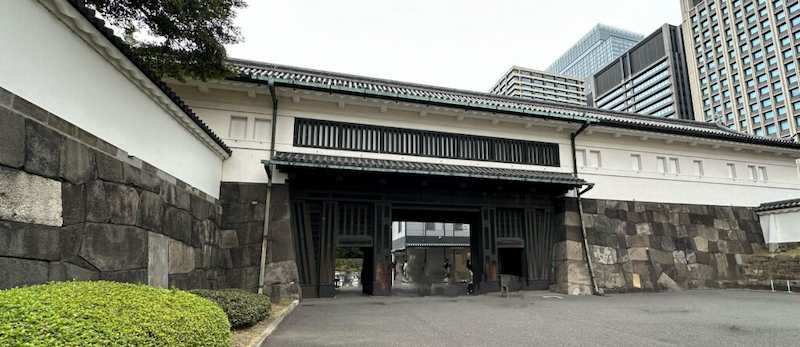
Tayasu-mon Gate is a former Edo Castle gate preserved at the northern end of Kitanomaru Park and is a nationally designated Important Cultural Property. According to Chiyoda City, it is thought to have been built in Genna 6 (1620), repaired in Kan’ei 13 (1636), and handed down to the present, with the Korai-mon gate regarded as the oldest building within Edo Castle.
Cultural-property materials explain that the present structure can be dated to Kan’ei 13 (1636) based on inscriptions on the hanging fittings of the Korai-mon gate doors. In either case, it is an exceptionally important site in the outer grounds, valued as a precious gate dating back to the period when Edo Castle’s overall defensive enclosure was being completed.
Detailed Historic Site Data
| Construction and Repair | According to Chiyoda City, it is thought to have been built in Genna 6 (1620) and repaired in Kan’ei 13 (1636). |
|---|---|
| Date in Cultural-Property Materials | The present building is described as dating to Kan’ei 13 (1636) based on inscriptions on the hanging fittings of the Korai-mon doors. |
| Structure and Features | A masugata gate consisting of a Korai-mon and a yagura-mon. It is one of the most valuable surviving gates of Edo Castle. |
| Cultural Property Designation | Nationally Designated Important Cultural Property (designated June 7, 1961) |
| Connection to the Tayasu Family | The Tayasu family, one of the three Tokugawa collateral houses, took its name from the location around this gate. |
Highlights
- One of Edo Castle’s Oldest Surviving Gates: This is a must-see site when exploring Edo Castle’s surviving architecture.
- Korai-mon and Yagura-mon Gates: Together they preserve the structure of a masugata gate, conveying the defensive design of Edo Castle.
- Stone Walls and Historic Layers: Even after wartime damage and later restoration, parts of the stonework near the ground are described as preserving their Edo-period form.
- Entrance to Kitanomaru Park: Because it stands at an entrance to Kitanomaru Park, visitors can easily combine it with a walk through the park or a visit to Shimizu-mon Gate.
Trivia
- The Tayasu Family of the Gosankyo: The Tayasu family, one of the Gosankyo, the three collateral houses of the Tokugawa, took its name from this area.
- History of the Stone Walls: The stone walls collapsed due to wartime damage and were repaired in 1965 as part of Kitanomaru improvements, but the lowest two or three courses above ground are described as retaining their Edo-period form.
| Address | Kitanomaru Koen, Chiyoda City, Tokyo |
|---|---|
| From Kudanshita Station | About 3 minutes on foot from Exit 2 of Kudanshita Station (T07/Z06/S05), Toei Shinjuku Line and Tokyo Metro lines (approx. 200 m) |
| Suggested Time | Quick visit: about 15 minutes / In-depth visit: about 30 minutes |
| Admission | Free |
Open the map to see the relationship between Kudanshita Station and Tayasu-mon Gate.
Frequently Asked Questions
Sakuradamon Gate is the Outer Sakuradamon Gate on the Imperial Palace Outer Garden side and is known as the site of the Sakuradamon Incident. Tayasu-mon Gate and Shimizu-mon Gate are former Edo Castle gates preserved on the Kitanomaru Park side, and both are nationally designated Important Cultural Properties. Tayasu-mon Gate is described as one of Edo Castle’s oldest surviving structures, while Shimizu-mon Gate is known for an inscription dating to Manji 1 (1658).
One explanation says Hanzomon Gate was named after Hattori Hanzo, the Iga-born retainer whose residence, together with those of his followers, is said to have stood in this area. Another tradition links the name to an elephant float used in the Sanno Festival, so more than one origin story survives.
If you visit all nine sites—Hirakawa Tenmangu Shrine, Chidorigafuchi, Hanzomon Gate, Sakuradamon Gate, Onjuku Inari Shrine, Kikyo-mon Gate, Tatsumi-yagura Turret, Shimizu-mon Gate, and Tayasu-mon Gate—allow roughly half a day including travel time. If you focus only on the main highlights, about 1.5 to 2 hours can be enough.
The cherry blossoms at Chidorigafuchi usually reach their best viewing period from late March to early April. Official guides describe Chidorigafuchi Green Way as having roughly 230 to 260 cherry trees, and visitors can enjoy the blossoms across the moat from the boat area. Before visiting, check the latest blooming status and boat operation information from Chiyoda City or the Chiyoda City Tourism Association.
Hirakawa Tenmangu is a Tenmangu shrine dedicated to Sugawara no Michizane. Its bronze torii gate was donated in December 1844 and was designated a Chiyoda City Cultural Property on April 1, 1994.
Hirakawa Tenmangu, Hanzomon Gate, and Chidorigafuchi are near Hanzomon Station (Z05) on the Tokyo Metro Hanzomon Line; Sakuradamon Gate is near Sakuradamon Station (Y17) on the Tokyo Metro Yurakucho Line; Onjuku Inari Shrine is convenient from JR Kanda Station (JY02/JK27) or the Tokyo Metro/Toei Otemachi Station area (M18/T09/C11/Z08/I09); Kikyo-mon Gate and Tatsumi-yagura Turret are convenient from Nijubashimae Station (C10) on the Tokyo Metro Chiyoda Line or the Tokyo Station area (JT01/JO19/JK26/JY01/JC01); and Shimizu-mon Gate and Tayasu-mon Gate are convenient from Kudanshita Station (T07/Z06/S05) on the Tokyo Metro/Toei lines. Because the outer-ground sites are widely spread out, it is best to divide your route by purpose and area.
According to Chiyoda City, Tayasu-mon Gate is thought to have been built in Genna 6 (1620), repaired in Kan’ei 13 (1636), and handed down to the present, with its Korai-mon gate described as the oldest building within Edo Castle. Cultural-property materials, however, explain that the present structure can be confirmed as dating to Kan’ei 13. For a public article, it is safest to say either “among the oldest surviving structures of Edo Castle” or “the Korai-mon gate is described as Edo Castle’s oldest surviving building.”
Edo Castle Ruins Full Map
The outer grounds are spread across the west, south, and north sides of the Imperial Palace. Hanzomon Gate, Hirakawa Tenmangu, and Chidorigafuchi are on the west side; Sakuradamon Gate, Kikyo-mon Gate, and Tatsumi-yagura Turret are on the south side; and Shimizu-mon Gate and Tayasu-mon Gate are on the north side.
Related Articles on the Edo Castle Ruins
Previous Area: Ninomaru Area
Edo Castle Ruins Complete Guide (Table of Contents)
Back to Main Page
☕ Support This Site
Following the Shogun is built on original fieldwork and on-site research.
If you found this guide useful, your support helps keep it going.

You can also support via QR code
This page is a historical travel guide created by Following the Shogun.


comment