


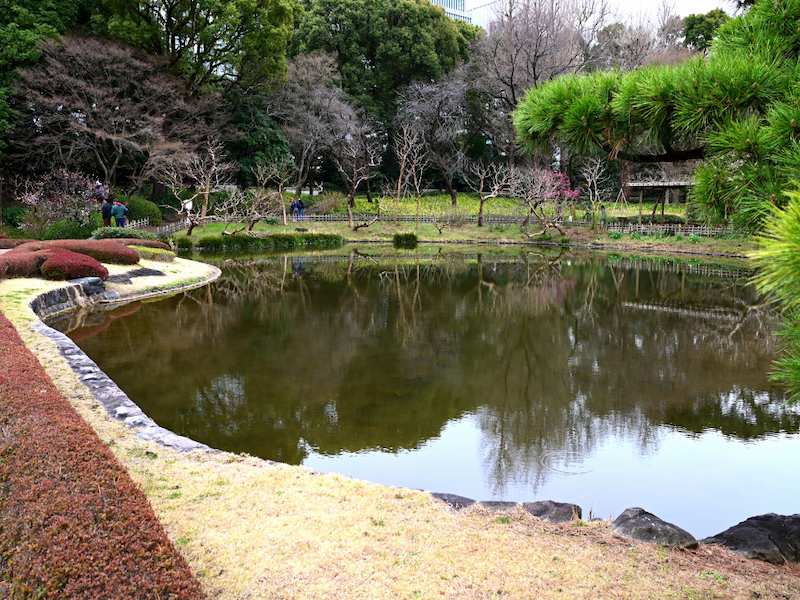
Edo Castle’s Ninomaru: Garden, Teahouse, Hirakawa Gate and Shiomizaka Slope
After the tension and grandeur of the Honmaru Area, the Ninomaru Area offers a calmer side of the Imperial Palace East Gardens, bringing together gardens, a teahouse, gates, and a historic slope. The present Ninomaru Garden is a stroll garden created when the East Gardens opened to the public in 1968.
- ① Otemon Gate Area
- ② Fujimi-yagura Turret Area
- ③ Honmaru Area
- ④ Ninomaru Area (This Page)
- ⑤ Outer Grounds
- ▶ Back to the Complete Guide
After the tension and grandeur of the Honmaru Area, the Ninomaru Area offers a calmer side of the Imperial Palace East Gardens, bringing together gardens, a teahouse, gates, and a historic slope. The present Ninomaru Garden is a stroll garden created when the Imperial Palace East Gardens opened to the public in 1968, using garden plans from around the mid-18th century as a reference.
Hirakawa Gate was also known as Otsubone-mon because it served as a service gate for women working in the Ooku, and as the Impure Gate because it was used when the dead or criminals were taken out of the castle. At Shiomizaka Slope, visitors can enjoy the landform of a slope said to have once overlooked Hibiya Inlet, along with the stone-wall scenery beside Swan Moat.
Opening Hours
Hours vary by season. Last entry is 30 minutes before closing.
Closed Days
Mondays and Fridays, December 28 to January 3, and days affected by events or official functions. Schedules may change due to national holidays and other circumstances.
Suggested Time
Quick visit: about 1 to 1.5 hours / In-depth visit: 2 hours or more
Admission
Free. No advance reservation required.
Access from the Previous Area
About 7 minutes on foot from the Honmaru Area (Kitahanebashi-mon Gate)
Next Area
From Shiomizaka Slope, continue toward the Outer Grounds, including Sakuradamon Gate and Chidorigafuchi.
Ninomaru Area
Entering from Hirakawa Bridge and Hirakawa Gate, then continuing through Suwa-no-Chaya Teahouse and Ninomaru Garden to Shiomizaka Slope, this area reveals a different side of Edo Castle from the defensive lines of the Honmaru: a landscape of garden beauty and historic gateways.
Hirakawa Bridge 360°
A wooden bridge carrying memories of the Keicho era—the entrance to the Ninomaru Area leading toward Hirakawa Gate
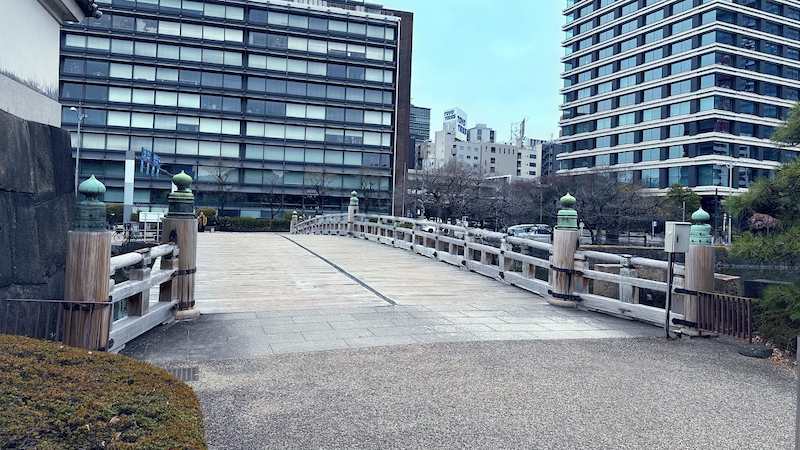
Hirakawa Bridge is a wooden bridge spanning Hirakawa Moat and serves as the entrance from the Hitotsubashi 1-chome side toward Hirakawa Gate in the Imperial Palace East Gardens. The first bridge is said to have been built in Keicho 19 (1614), and the current bridge was rebuilt on March 31, 1988. It is made of Taiwanese cypress, with stone piers and abutments and steel used in the foot girders.
The giboshi ornamental finials on the railings are said to have originally belonged to Nijubashi Bridge and were moved to Hirakawa Bridge when Nijubashi was replaced in 1887. Because Hirakawa Gate stands immediately beyond the bridge, this spot lets visitors experience the approach into an Edo Castle gate.
Detailed Historic Site Data
| First Built | Believed to have been first built in Keicho 19 (1614). |
|---|---|
| Current Bridge Rebuilt | March 31, 1988 (Showa 63) |
| Structure and Features | A wooden bridge using Taiwanese cypress. The piers and abutments are stone, and the foot girders are steel. Length: 29.7 m; width: 7.82 m. |
| Giboshi Finials | The finials are said to have originally been on Nijubashi Bridge and were moved to Hirakawa Bridge when the bridge was replaced in 1887. |
| Current Condition | The current bridge is a wooden bridge rebuilt in 1988. |
| Cultural Property Designation | The surrounding area is included within the Special Historic Site “Edo Castle Ruins.” Check official information for whether the bridge itself has an individual designation. |
Highlights
- Appearance of the Wooden Bridge: The wooden bridge over Hirakawa Moat harmonizes beautifully with the surrounding stone walls and moat scenery.
- History of the Giboshi Finials: Noticing the finials said to have been moved from Nijubashi Bridge helps reveal the layered history of Edo Castle’s bridges.
- Approach to Hirakawa Gate: Walking from the bridge toward the gate lets visitors experience the structure of an Edo Castle entrance.
Trivia
- Giboshi Reused from Nijubashi Bridge: When Nijubashi Bridge was replaced in 1887, the giboshi finials from the former bridge are said to have been moved to Hirakawa Bridge.
- An Entrance Integrated with Hirakawa Gate: Hirakawa Bridge stands directly before Hirakawa Gate. Viewing the bridge, gate, masugata compound, and moat together makes its meaning as an Edo Castle entrance clearer.
| Address | Hitotsubashi 1-chome to the Imperial Palace East Gardens, Chiyoda City, Tokyo |
|---|---|
| From Kitahanebashi-mon Gate | About 7 minutes on foot (approx. 500 m) |
| Suggested Time | Quick visit: about 5 minutes / In-depth visit: about 15 minutes |
| Admission | Free |
Open the map to see the relationship between Kitahanebashi-mon Gate and Hirakawa Bridge.
Hirakawa Gate 360°
A gate used by the women of the Ooku and the Gosankyo—two faces as both Otsubone-mon and the Impure Gate
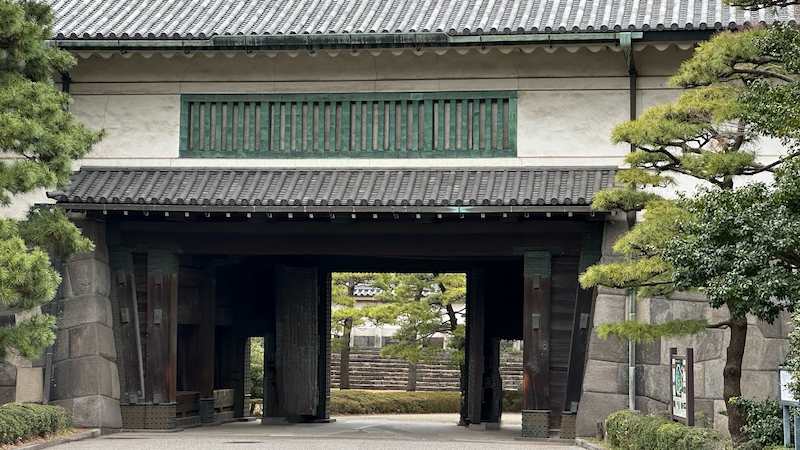
Hirakawa Gate is considered the main gate of Edo Castle’s Sannomaru. Because it served as a service gate leading to the Honmaru Ooku women’s quarters, it was also called Otsubone-mon. It was also a formal entrance used by the Gosankyo—the Tayasu, Hitotsubashi, and Shimizu branches of the Tokugawa family.
At the same time, it was known as the Impure Gate because it was used when the dead or criminals were taken out of the castle. It is a gate where outward formality and the role of removing taboo or impurity from the castle overlapped, revealing the spatial order of Edo Castle.
Detailed Historic Site Data
| Construction and Development | The Chiyoda City Tourism Association describes it as the main gate of Edo Castle’s Sannomaru, built in Genna 6 (1620) by Date Masamune, lord of the Sendai Domain, and several other daimyo. |
|---|---|
| Structure and Features | An inner gate of Edo Castle where the gate and masugata compound remain. The obikuruwa extending toward Hirakawa Moat is also worth noting. |
| Current Condition | It is still used today as one of the entrances and exits of the Imperial Palace East Gardens. |
| Alternate Names | Otsubone-mon, as a service gate for women of the Ooku; and the Impure Gate, used when the dead or criminals were taken out of the castle |
| Cultural Property Designation | This remnant is included within the Special Historic Site “Edo Castle Ruins.” Check official information for any individual structure designation. |
Highlights
- Masugata Structure: After crossing the bridge and entering the gate, you experience a masugata layout that prevents a straight approach. It shows how castle gates were designed to slow down enemies.
- Obikuruwa Bailey: This long, narrow area extends toward Hirakawa Moat. Viewing it as part of Edo Castle’s defensive line makes the structure even more interesting.
- Unity with Hirakawa Bridge: Walking the route from the bridge to the gate makes it easier to imagine Hirakawa Gate’s role as an entrance to the castle.
Trivia
- Origin of the Name “Impure Gate”: The gate was also called the Impure Gate because it was used when the dead or criminals were taken out of the castle.
- Entrance for the Gosankyo: It is also said to have been used as an entrance for the Tayasu, Hitotsubashi, and Shimizu houses, the Gosankyo branches of the Tokugawa family, giving it a status beyond that of a simple back gate.
- An Entrance Still Used Today: Today it functions as an entrance and exit of the Imperial Palace East Gardens and is convenient for visitors coming from the Takebashi Station side.
| Address | 1 Chiyoda, Chiyoda City, Tokyo |
|---|---|
| From Hirakawa Bridge | About 1 minute on foot (approx. 50 m) |
| Suggested Time | Quick visit: about 5 minutes / In-depth visit: about 15 minutes |
| Admission | Free |
Open the map to see the relationship between Hirakawa Bridge and Hirakawa Gate.
Suwa-no-Chaya Teahouse 360°
A teahouse moved from Fukiage Gyoen—a Meiji-era sukiya-style building standing in Ninomaru Garden
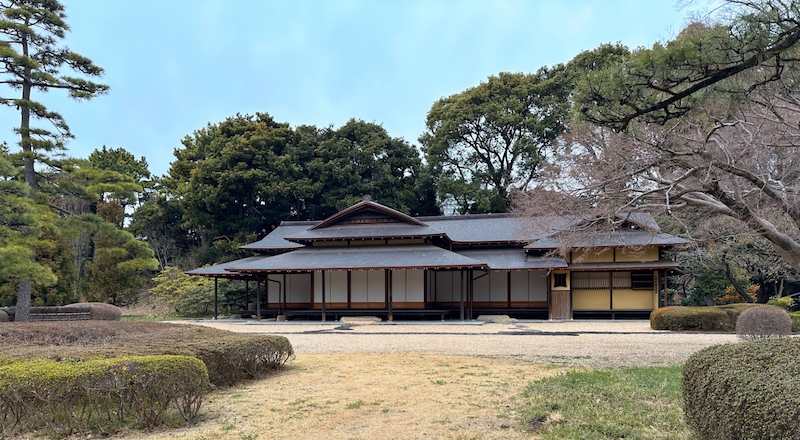
Suwa-no-Chaya Teahouse was originally built in 1912 in Fukiage Gyoen, on the western side of the Imperial Palace, under the direction of Emperor Meiji. When the Imperial Palace East Gardens were developed, it was moved to its current location in Ninomaru Garden.
The name “Suwa” is said to come from a Suwa shrine that once stood at the teahouse’s original location. The interior is normally closed to the public, but its elegant Meiji-era sukiya-style exterior gives a refined presence to the scenery of Ninomaru Garden.
Detailed Historic Site Data
| Year Built | 1912 (Meiji 45) |
|---|---|
| Original Location | Fukiage Gyoen, on the western side of the Imperial Palace |
| Relocation | Moved to the current Ninomaru Garden location during development of the Imperial Palace East Gardens |
| Structure and Features | A sukiya-style teahouse. The interior is normally closed to the public. |
| Name Origin | The name is said to derive from a Suwa shrine that once stood at the original location. |
Highlights
- Meiji-Era Sukiya Architecture: The graceful exterior reflects the refinement of sukiya-style architecture and enhances the garden landscape.
- Harmony with Ninomaru Garden: The teahouse blends quietly into the garden scenery, making it one of the area’s most photogenic features.
- Exterior Viewing: The interior is normally closed, but the exterior can be enjoyed from the surrounding garden paths.
Trivia
- Moved from Fukiage Gyoen: The building did not originally stand here. It was moved as part of the development of the Imperial Palace East Gardens.
- Origin of the Name: A Suwa shrine is said to have stood at the original location, and the name Suwa-no-Chaya is thought to derive from that connection.
| Address | 1 Chiyoda, Chiyoda City, Tokyo |
|---|---|
| From Hirakawa Gate | About 6 minutes on foot (approx. 400 m) |
| Suggested Time | Quick visit: about 20 minutes / In-depth visit: about 40 minutes, including a garden stroll |
| Admission | Free (exterior only) |
Open the map to see the relationship between Hirakawa Gate and Suwa-no-Chaya Teahouse.
Ninomaru Garden 360°
A stroll garden inspired by mid-18th-century plans—a peaceful Ninomaru retreat where long-finned nishikigoi swim
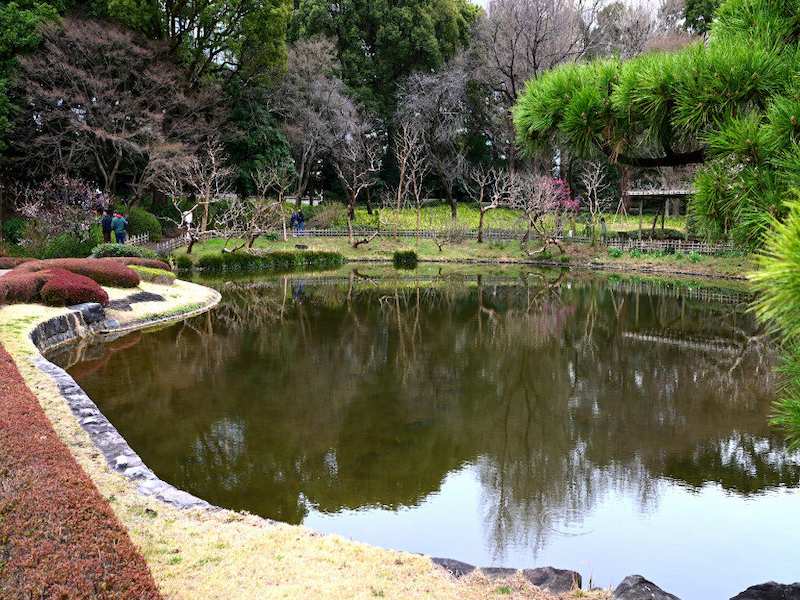
Ninomaru Garden is a stroll garden developed in the Ninomaru district, where palace buildings and gardens once stood during the Edo period. The Edo-period buildings were repeatedly destroyed by fire, and the area fell into disrepair after the Meiji period. The present garden was created when the Imperial Palace East Gardens opened to the public in 1968, using garden plans from around the mid-18th century as a reference.
In the pond swim Hirenaga Nishikigoi, long-finned ornamental carp created by crossing Indonesian long-finned carp with Japanese nishikigoi, an idea associated with Emperor Emeritus Akihito. In early summer, visitors can enjoy Japanese irises in the iris field, and in autumn the garden offers beautiful fall foliage, making this one of the East Gardens’ richest natural landscapes.
Detailed Historic Site Data
| Present Garden | A stroll garden created when the Imperial Palace East Gardens opened to the public in 1968, using garden plans from around the mid-18th century as a reference. |
|---|---|
| Edo-Period Background | The Ninomaru included palace buildings and, at times, gardens, but the buildings were repeatedly destroyed by fire. |
| Structure and Features | A stroll garden designed to be enjoyed while walking around the pond. Highlights include Ninomaru Pond, the iris field, and surrounding plantings. |
| Current Condition | Survives as a garden developed when the East Gardens opened in 1968. |
| Special Notes | The pond contains Hirenaga Nishikigoi associated with Emperor Emeritus Akihito’s idea. The iris field grows 84 varieties of Japanese irises. |
Highlights
- Hirenaga Nishikigoi: This variety was born from an idea associated with Emperor Emeritus Akihito, and its long fins and tail create an elegant sight as the fish swim through the pond.
- Stroll Garden Composition: Walking around the pond lets you enjoy changes in stone arrangements, plantings, and reflections on the water.
- Iris Field: Eighty-four varieties of Japanese irises are planted here, with flowers usually enjoyed from late May to mid-June.
- Autumn Foliage: In autumn, the whole garden takes on color, and the foliage reflected on the pond creates especially beautiful scenery.
Trivia
- Developed for the 1968 Public Opening: The present garden was developed when the Imperial Palace East Gardens opened to the public. It is not the Edo-period Ninomaru Garden preserved completely intact.
- Life in Ninomaru Pond: In addition to Hirenaga Nishikigoi, aquatic plants such as spatterdock, dwarf spatterdock, and fringed water lily can be seen in Ninomaru Pond.
| Address | 1 Chiyoda, Chiyoda City, Tokyo |
|---|---|
| From Suwa-no-Chaya Teahouse | About 10 minutes on foot (approx. 800 m) |
| Suggested Time | Quick visit: about 15 minutes / In-depth visit: about 30 to 60 minutes |
| Admission | Free |
Open the map to see the relationship between Suwa-no-Chaya Teahouse and Ninomaru Garden.
Shiomizaka Slope
A slope connecting the Honmaru and Ninomaru—a historic path said to have once overlooked the sea
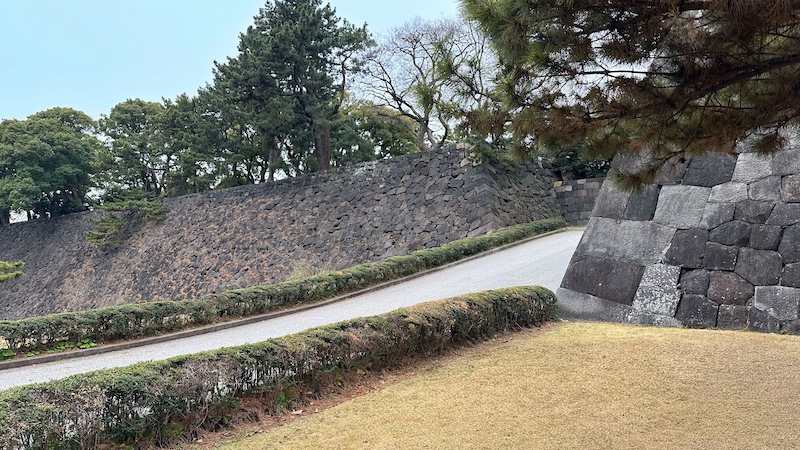
Shiomizaka Slope connects the Honmaru and Ninomaru. In the early Edo period, Hibiya Inlet is said to have reached close to this slope, and the lowlands around present-day Tokyo Station, as well as the direction of Tokyo Bay beyond, could be seen from here.
Swan Moat stretches beside the slope, allowing visitors to enjoy the combination of stone walls and water. When returning from Ninomaru Garden toward the Honmaru, this route also lets you feel the elevation difference between the Honmaru and Ninomaru and experience the terrain inside Edo Castle.
Detailed Historic Site Data
| Year Built | Unknown |
|---|---|
| Structure and Features | A slope connecting the Honmaru and Ninomaru. Visitors can enjoy stone-wall scenery along Swan Moat. |
| Name Origin | The name is said to come from the fact that, in the early Edo period, Hibiya Inlet and the direction of Tokyo Bay could be viewed from here. |
| Current Condition | Survives today. |
| Cultural Property Designation | This remnant is included within the Special Historic Site “Edo Castle Ruins.” Check official information for any individual designation. |
Highlights
- Elevation Difference Between the Honmaru and Ninomaru: Walking the slope lets you experience the terrain and defensive structure inside Edo Castle.
- Scenery of Swan Moat: The combination of Swan Moat and the stone walls beside the slope is a classic Ninomaru Area highlight.
- Imagine the Origin of the Name: Although the sea can no longer be seen today, walking while imagining the former view toward Hibiya Inlet and Tokyo Bay reveals how Edo’s landform has changed.
Trivia
- Hibiya Inlet: In the early Edo period, the area around present-day Tokyo Station was lowland, and Tokyo Bay and Tsukudajima are said to have been visible beyond it.
- Relationship with Swan Moat: Walking Shiomizaka Slope lets you feel the change in terrain from the calm scenery of Ninomaru Garden toward the higher ground of the Honmaru.
| Address | 1 Chiyoda, Chiyoda City, Tokyo |
|---|---|
| From Ninomaru Garden | About 10 minutes on foot (approx. 800 m) |
| Suggested Time | Quick visit: about 5 minutes / In-depth visit: about 15 minutes |
| Admission | Free |
Open the map to see the relationship between Ninomaru Garden and Shiomizaka Slope.
Frequently Asked Questions
Yes. Admission to the Imperial Palace East Gardens is free, and advance reservations are not required. All sites in the Ninomaru Area, including Ninomaru Garden, can be visited free of charge. Opening hours and closed days vary by season and events, so please check the official Imperial Household Agency website before visiting.
If you visit the five sites—Hirakawa Bridge, Hirakawa Gate, Suwa-no-Chaya Teahouse, Ninomaru Garden, and Shiomizaka Slope—at a quick pace, allow about 1 to 1.5 hours. If you want to stroll through Ninomaru Garden more slowly, plan for more than 2 hours.
The giboshi finials on the railings of Hirakawa Bridge are said to have originally been installed on Nijubashi Bridge and moved to Hirakawa Bridge when Nijubashi was replaced in 1887. They are valuable Edo Castle-related relics bearing inscriptions from the Keicho and Kan’ei periods.
During the Edo period, the Ninomaru included palace buildings and, at times, gardens, but the buildings were repeatedly destroyed by fire and the area fell into disrepair after the Meiji period. The present stroll garden was created when the Imperial Palace East Gardens opened to the public in 1968, using mid-18th-century garden plans as a reference.
In the early Edo period, Hibiya Inlet is said to have reached close to this slope, and the lowlands around present-day Tokyo Station and the direction of Tokyo Bay beyond could be seen from here. That view is considered the origin of the name Shiomizaka, or Tide-Viewing Slope.
Hirakawa Gate was also called Otsubone-mon because it served as a service gate for women working in the Ooku, the women’s quarters of the Honmaru. At the same time, it was also known as the Impure Gate because it was used when the dead or criminals were taken out of the castle.
Edo Castle Ruins Full Map
The Ninomaru Area is a calm part of the Imperial Palace East Gardens where garden scenery, gates, and historic landforms come together. From Shiomizaka Slope, visitors can continue toward the Outer Grounds, including Sakuradamon Gate and Chidorigafuchi.
Related Articles on the Edo Castle Ruins
Next Area: Outer Grounds
Previous Area: Honmaru Area
Edo Castle Table of Contents
Back to Main Page

☕ Support This Site
Following the Shogun is built on original fieldwork and on-site research.
If you found this guide useful, your support helps keep it going.

You can also support via QR code
This page is a historical travel guide created by Following the Shogun.


comment