Nikko Toshogu: Every Spot Explained — Gates, Carvings, Okumiya
2026.04.16
NIKKO | Complete On-Site Guide to Every Spot
Nikko Toshogu Complete On-Site Guide
From the reverse side of the Sleeping Cat to the carving count on Karamon and what rests beneath the Inner Sanctuary Treasure Pagoda — this guide covers every spot from the First Torii Gate to the Inner Sanctuary, based on an on-site visit on February 22, 2026.
HighlightsYomeimon, Three Monkeys, Sleeping Cat, Inner Sanctuary Treasure Pagoda
Inner SanctuaryAbout 30 min round trip / 207 stone steps
Guide FocusDetails that change how you see every spot
✅Visited and verified on site February 22, 2026. I walked Toshogu, Taiyuin, and the Treasure Museum in person. This page is based on that on-site experience, signboard photos, and field notes from that day. Exhibitions, admission fees, and opening hours may change — check official sources before your visit.
Complete Archive — Full On-Site Guide to Every Spot
What is on the reverse side of the Sleeping Cat? Why does Karamon Gate have more carvings than Yomeimon? What rests beneath the Inner Sanctuary Treasure Pagoda? Nikko Toshogu is full of details that change once you know where to look. This page is a complete guide to every spot from the First Torii Gate to the Inner Sanctuary, based on an on-site visit on February 22, 2026. It works as pre-trip reading and as a field reference on site.
Start with the overall structure section. It explains the three-stage flow from outside to center to Inner Sanctuary.
I want to check one specific spot
Jump directly from the table of contents. Each spot is explained in a field-dictionary format.
I want to understand it deeply
Read each spot's trivia panels. Signboard summaries and field notes are included throughout.
◆
The Overall Structure of Toshogu: Outer Precinct → Central Core → Inner Sanctuary
Walking through Nikko Toshogu, the atmosphere changes in three stages: outer precinct → central core → Inner Sanctuary. Know this structure in advance and you'll always know which layer you're standing in.
1
Outer Precinct, Approach, and Entrance Area
First Torii Gate → Five-Story Pagoda → Omote-mon Gate
The transition from town to sacred mountain precinct. The moment when the vermilion pagoda appears against the green forest is the first shift in atmosphere.
2
Central Core: Gates and Shrine Buildings
Three Monkeys → Yomeimon → Main Shrine Building
The density of visual information rises sharply. Immediately after passing through Yomeimon, you strongly feel that you have entered the central zone.
3
Inner Sanctuary Area
Sakashita-mon → 207 Stone Steps → Treasure Pagoda
The route shifts from brilliant color to quiet cedars. More than color, the amount of light changes. This is the destination: the place where Ieyasu rests.
On-site note: The Treasure Hall / Treasure Museum is separate from the main Toshogu route. It is located slightly apart and requires a separate ticket. Best added after visiting the Inner Sanctuary and Taiyuin. The guide to Taiyuin and the Treasure Museum is on the Archive page.
◆
Full On-Site Guide to Every Spot: From the First Torii Gate to the Inner Sanctuary
Each spot is organized in a field-friendly dictionary format. The depth of each explanation reflects its priority based on the actual on-site experience.
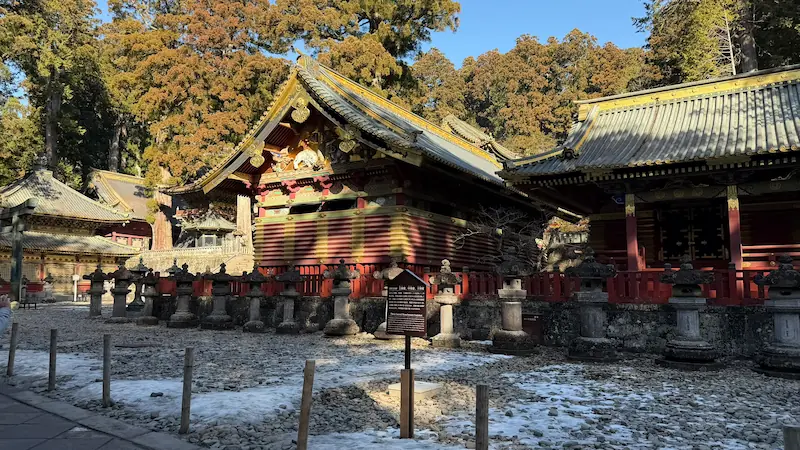
Photography timing note: The exterior of the Honjido / Crying Dragon Hall, the Sacred Stable, the inner guard station, and the Sleeping Cat are easier to photograph early in the morning before crowds build. Lines begin forming at several points after around 10 a.m.
Gate & ToriiGates, torii, and corridors
This section focuses on elements where crossing a boundary changes the atmosphere.
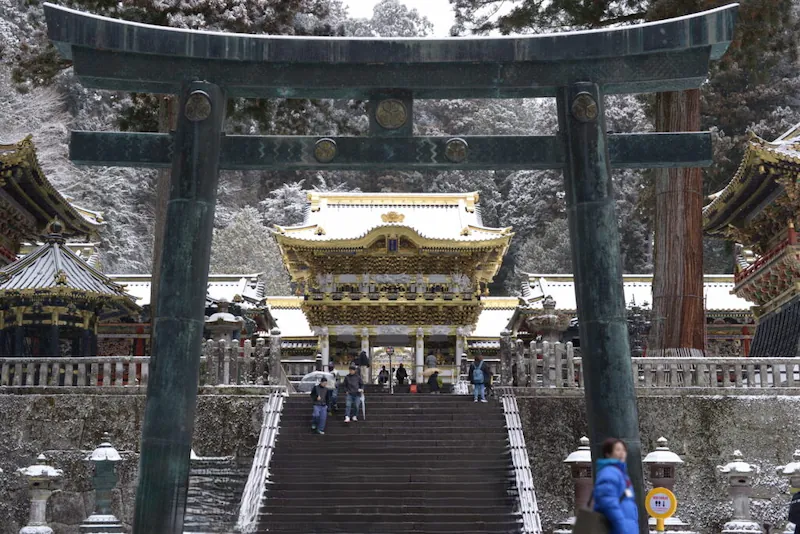
Stone Torii
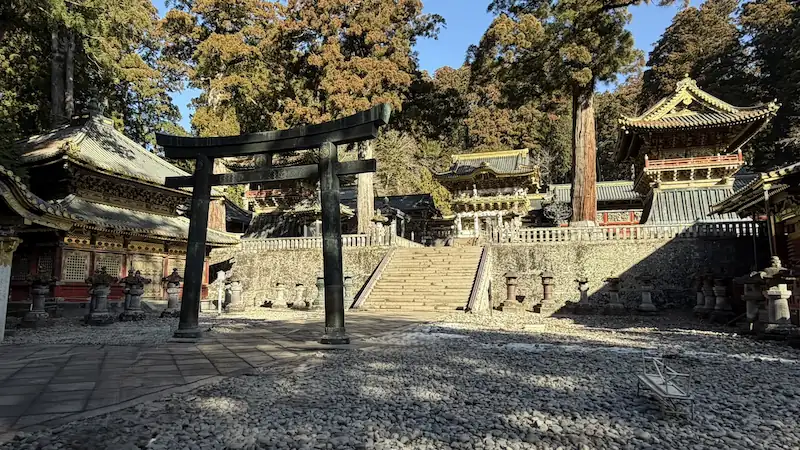
First Torii Gate
The opening of Toshogu / boundary into the sacred precinct
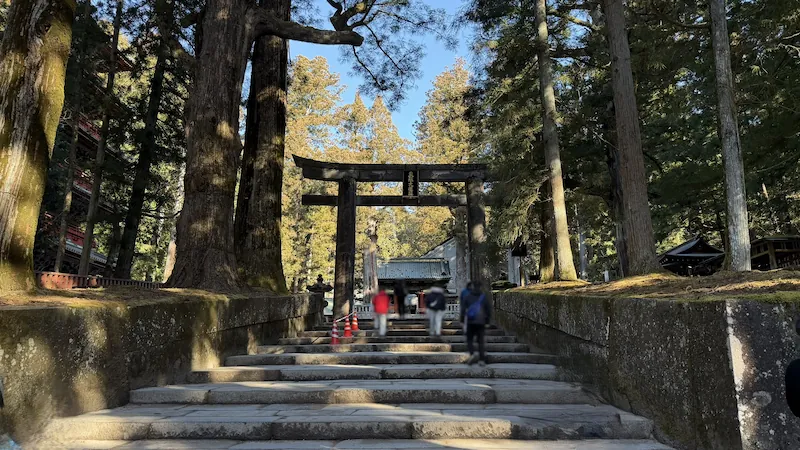
What matters here is less what stands there than where you are about to enter. Pass through the torii and the Five-Story Pagoda and Omote-mon Gate align ahead; the approach changes from asphalt to gravel and earth. This is where the experience shifts from touring a historic site to entering sacred ground.
🖼 Photos
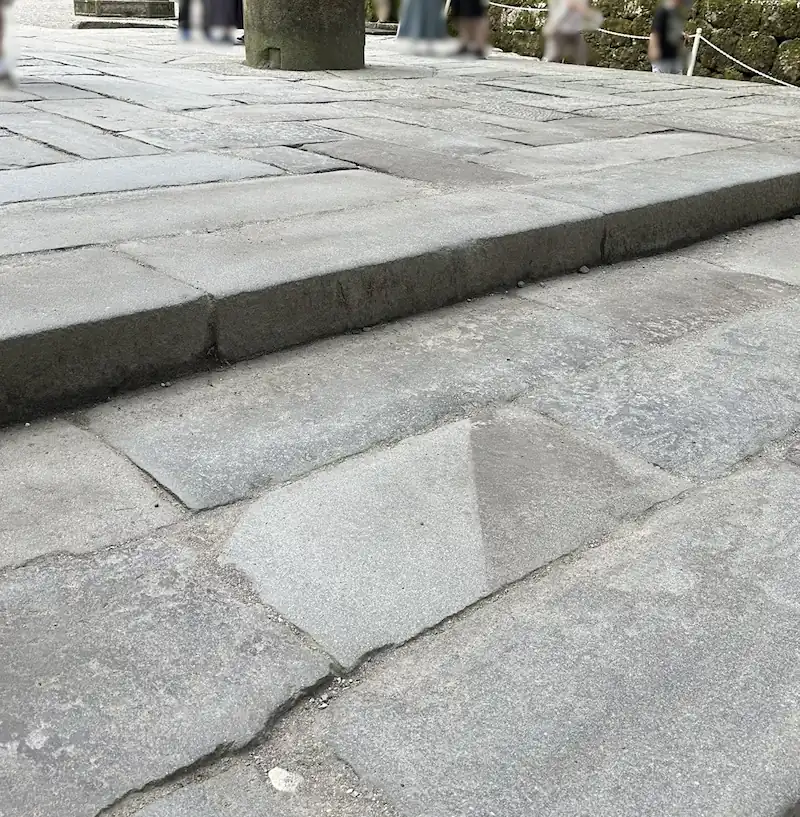
Terifuri-ishi stone
Terifuri-ishi stone. This single stone is set into the tenth step of the First Torii Gate. Its surface appears divided diagonally into two colors, and the color difference is said to become clearer when rain is approaching or humidity is high. A small detail to enjoy underfoot before entering the shrine.
Donated by Kuroda Nagamasa in 1618. Among torii built in the Edo period, this is one of the largest in Japan. The stones were divided into 15 pieces and transported from Kaya-san in present-day Itoshima City, Fukuoka Prefecture, using sea, river, and land routes before being assembled here. It stands about 9.2 meters tall.
Important Cultural Property
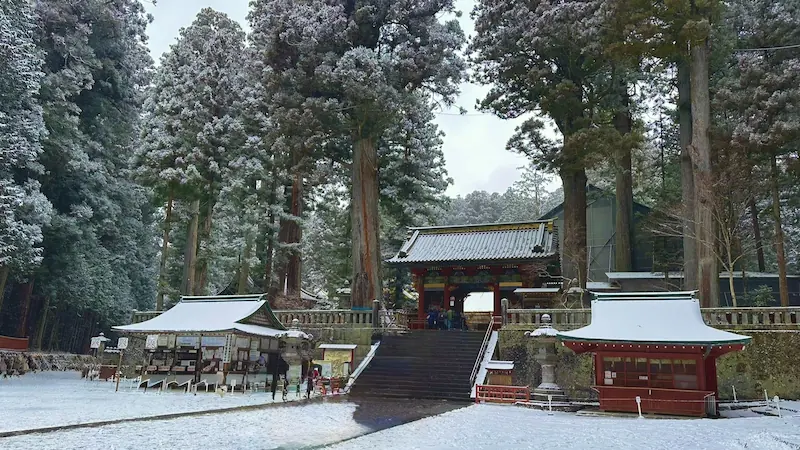
Omote-mon Gate
The first boundary from the outer precinct into the central area
Once through this gate, the sights start crowding together. After Omote-mon, your gaze isn't necessarily pulled straight to the Three Monkeys — the Three Sacred Storehouses and surrounding buildings often appear first. This is where you start to understand how dense Toshogu's central area really is.
📜 Historic Site Data
Year Built
1636, during the major Kan'ei reconstruction ordered by Tokugawa Iemitsu
Alternate Name
Nio-mon Gate
Architectural Style
Yakkyaku-mon, an eight-legged gate. Four main pillars are supported by four front and four rear support pillars, for a total of twelve pillars
Model
Modeled after Tegai-mon Gate at Todaiji Temple in Nara, a National Treasure of ancient architecture
Carvings
Chinese lions, peonies, baku, and related motifs. Source counts differ, including 66 or 82
Cultural Status
Important Cultural Property, designated in 1908
🖼 Photos
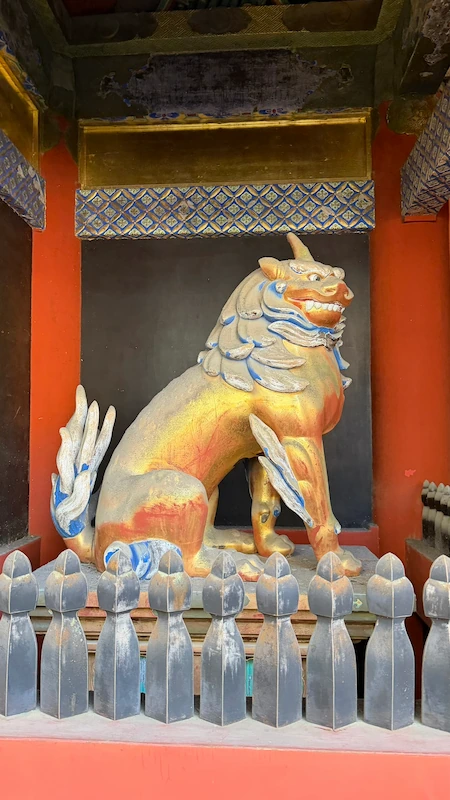
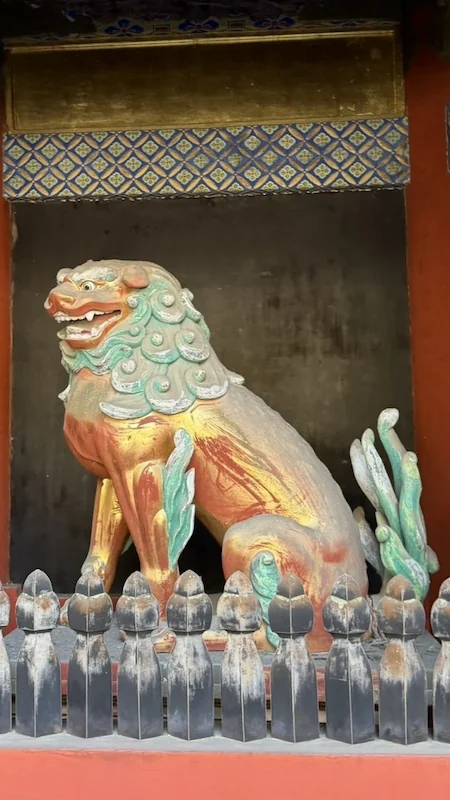
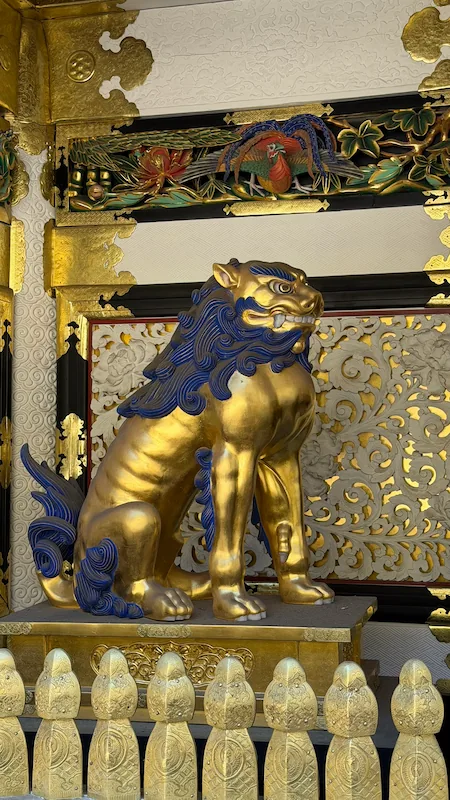
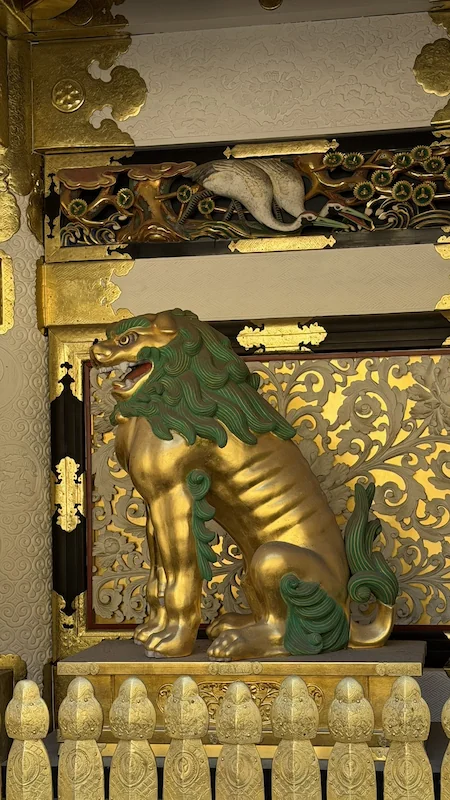
Left komainuRight komainu
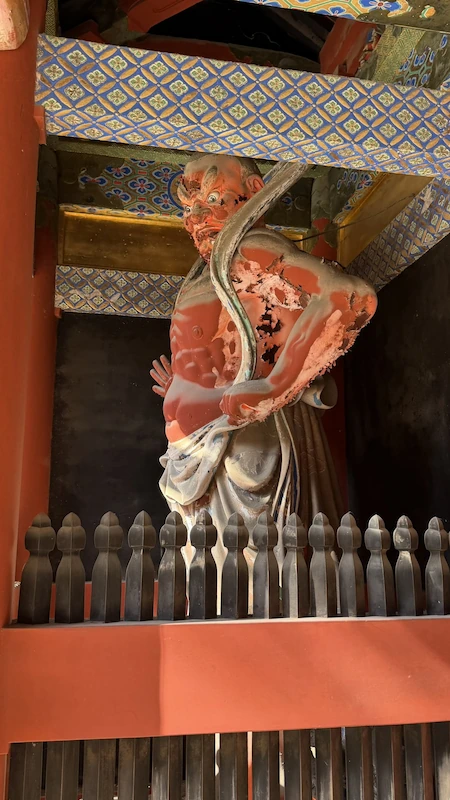
The Nio figures were made by Hogen Koon, a master Buddhist sculptor from Kyoto. The imposing Nio figures, about four meters tall, were created by Hogen Koon, a Kyoto sculptor also known for the seated wooden statue of Tenkai at Rinnoji. Edo-period Nikko drew on master craftsmen working under shogunal patronage.
The Nio figures were once moved to Taiyuin under the Meiji policy separating Shinto and Buddhism. In 1871, the Meiji government's shinbutsu bunri policy prohibited Buddhist-derived Nio figures from standing at a Shinto shrine. The statues were moved to Taiyuin and returned to Omote-mon in 1897. The gate therefore preserves a visible trace of the disruption caused by the separation of Shinto and Buddhism.
Omote-mon was modeled after Tegai-mon Gate at Todaiji in Nara. By incorporating the ancient eight-legged gate format, Toshogu's builders deliberately brought older Japanese architectural tradition into the Tokugawa shrine complex.
There is a baku inside Omote-mon. A baku — the mythical beast that eats nightmares — appears above the doorway. Because legend says baku feed on iron and copper, they are also treated as symbols of a peaceful age without weapons. The largest stone in the precinct, known as Awa-ishi, is also set into the stone wall to the right of Omote-mon.
Important Cultural Property
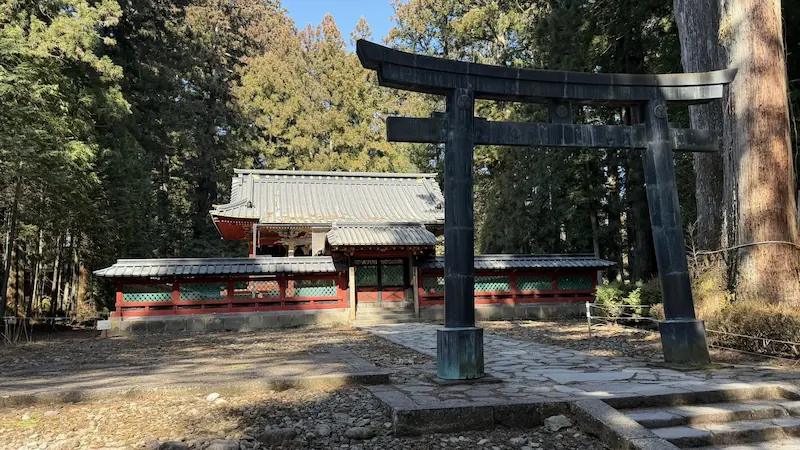
Bronze Torii Gate
In front of Yomeimon / the approach that builds tension
The atmosphere doesn't change dramatically here — the shift is completed at Yomeimon just ahead. Think of the Bronze Torii as the final approach before that shift happens. In the panorama, you can drag the view to confirm the composition in which Yomeimon aligns directly ahead.
North Star belief and spatial alignment. The arrangement of the Bronze Torii and Yomeimon is sometimes read through North Star belief and directional relationships with Edo. The point in the sky extended from the Bronze Torii is said to align with Hokushin, the North Star, and Edo is said to lie to the south of the line connecting Yomeimon and the Bronze Torii. There is also an interpretation that connecting the major buildings forms the pattern of the Big Dipper. These include elements of tradition and interpretation, but they offer a compelling way to read the site on the ground.
Bronze Torii Gate — directly facing Yomeimon
National Treasure
Yomeimon Gate
The central switch of Toshogu / the atmosphere changes immediately after you pass through
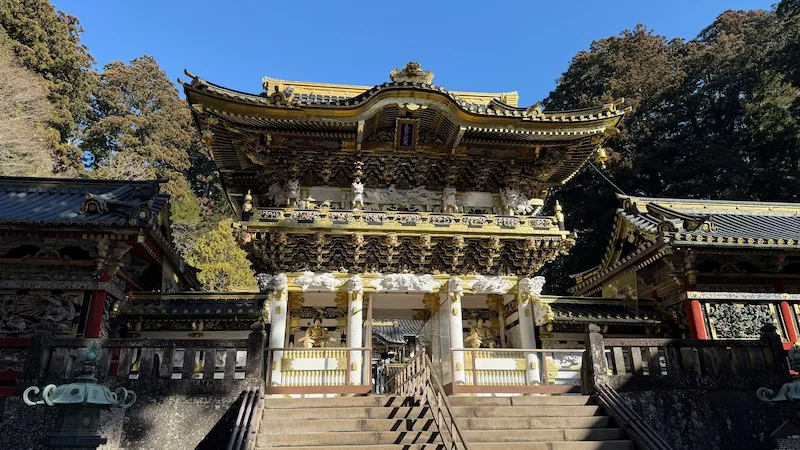
The carvings don't look as if they were simply added to the gate — the gate almost seems buried inside the density of them. What I felt most strongly on site was that the atmosphere changed not before the gate, but immediately after passing through it.
🖼 Photos
Yomeimon Gate — full view, with the density of carvings almost swallowing the gate
Suijin figure
The Gate of the Setting Sun. Yomeimon is also called Higurashi-no-mon because its carvings are so numerous that one could look at them until sunset without tiring of the view. Its twelve pillars and more than 500 carvings mix sacred beasts, flowers, birds, immortals, sages, and children at play. Dragon paintings cover the ceiling — look up as you pass through.
The reverse pillar as a charm against evil. Among the gurimon patterns carved on the twelve pillars, only the second pillar from the west on the north side has the pattern reversed. The idea is that a building begins to decay once complete, so it was intentionally left "unfinished" to ward off evil. A 1987 investigation also found two more reverse pillars among the sixteen pillars separating the main hall and worship hall, making three in total.
Reading the stories in the carvings. Three of the seven lower front figure carvings depict the Chinese story of the Duke of Zhou listening to appeals. The rear side includes seven immortals, including Kinko Sennin riding a carp; the east side has the "Four Sleepers and Tiger," and the west side has the "Three Sages Tasting Vinegar," featuring Confucius, Shakyamuni, and Laozi.
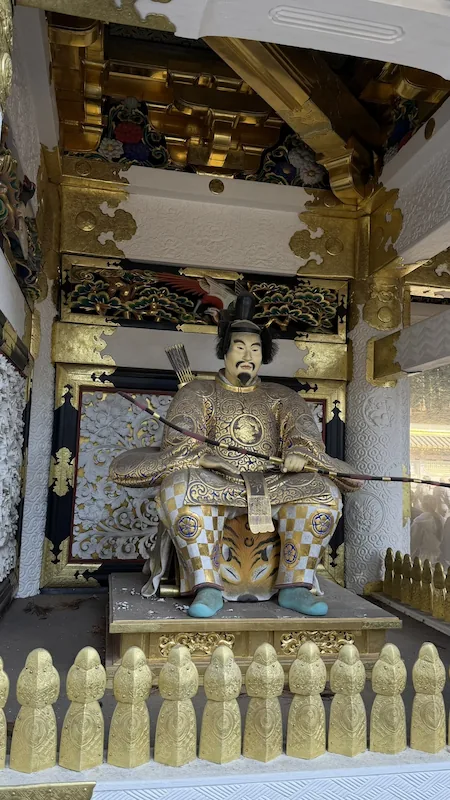
The mystery of the Suijin figures. Patterns on the knees and feet of the Suijin figures are sometimes said to resemble the crests of Oda Nobunaga or Akechi Mitsuhide, but who they represent remains uncertain. Toshogu contains many designs that seem to leave deliberate mysteries behind.
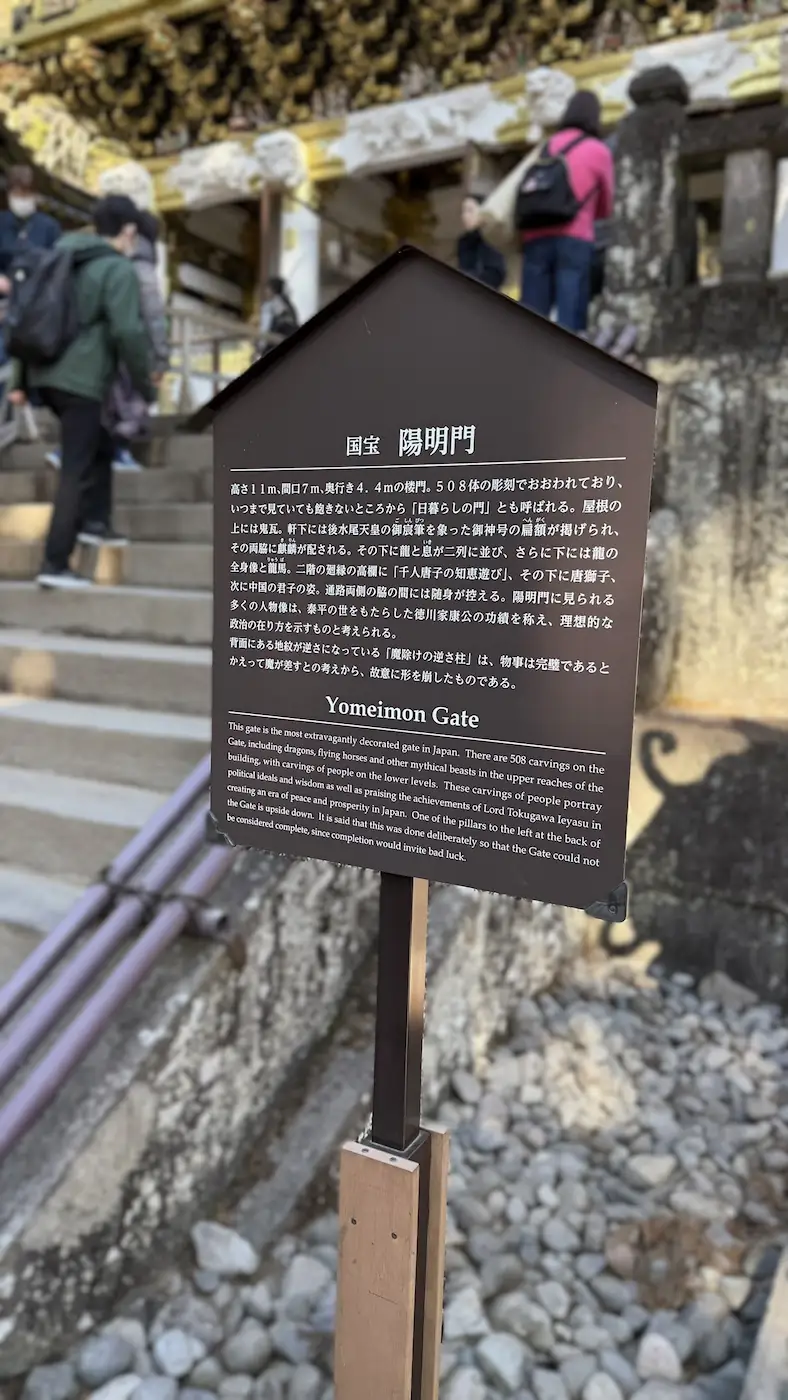
📋 Signboard
Yomeimon is described as Toshogu's representative gate, where architecture, carving, and ornament become the highlight. On site, you feel not only the beauty of the ornament but also the strong sense that this is the center of Toshogu.
Important Cultural Property
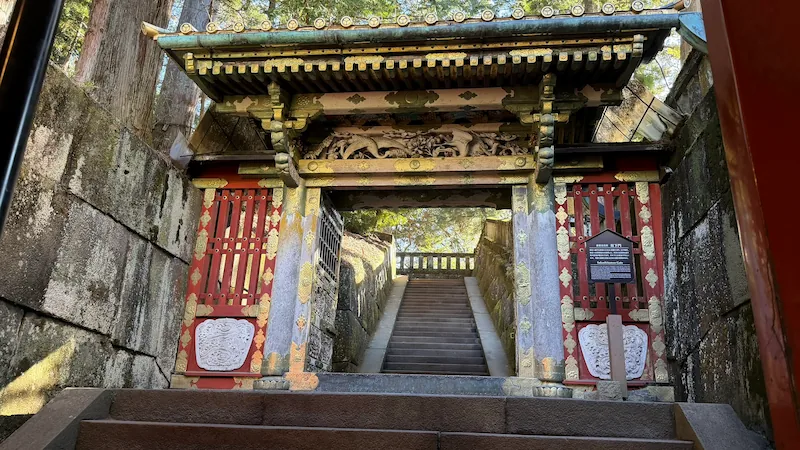
Sakashita-mon Gate
Below the Sleeping Cat / boundary to the Inner Sanctuary area
After passing through this gate, the route shifts from brilliant color to the quiet of the cedar grove. The biggest change is not color itself, but the amount of light. Once the trees cover you overhead, it drops noticeably — and the feeling of entering another world becomes stronger.
📜 Historic Site Data
Year Built
Built in 1636. Aside from roof rethatching, repainting, and changes to decorative metal fittings, the gate has not undergone later formal alterations
Features
Cloisonné decorative metal fittings; crane carvings in the transom; peony and arabesque motifs on the lower panels
Cultural Status
Important Cultural Property
Notes
The National Treasure Sleeping Cat is installed above this gate. The Inner Sanctuary is normally included in the Toshogu visiting area, but access may change for ceremonies, events, or repairs
A gate using cloisonné decorative metal fittings. Since its construction in 1636, Sakashita-mon has preserved much of its original form. Nikko City cultural property records note that the gate has not been altered in later structural form apart from roof, paint, and fittings. The cloisonné on the decorative metal fittings sets it apart from other gates and shows refined craftsmanship.
The cranes in the transom announce the entrance to the Inner Sanctuary. Cranes are auspicious birds of longevity and sacredness. The candle stand among the three ritual objects in front of the Inner Sanctuary Treasure Pagoda also uses crane and turtle imagery. The cranes on Sakashita-mon can be read as a visual announcement of the sacred zone ahead.
In the Edo period, this gate was kept closed. The Inner Sanctuary was a restricted sacred area, and general visitors were only able to enter comparatively recently — beginning with a special opening connected with the 350th anniversary festival in 1965.
Sakashita-mon — directly below the Sleeping Cat and the entrance to the Inner Sanctuary area
◆
SculptureCarvings by theme
This section brings together elements whose meanings shift depending on story, placement, and visual context — not fame alone.
Important Cultural Property
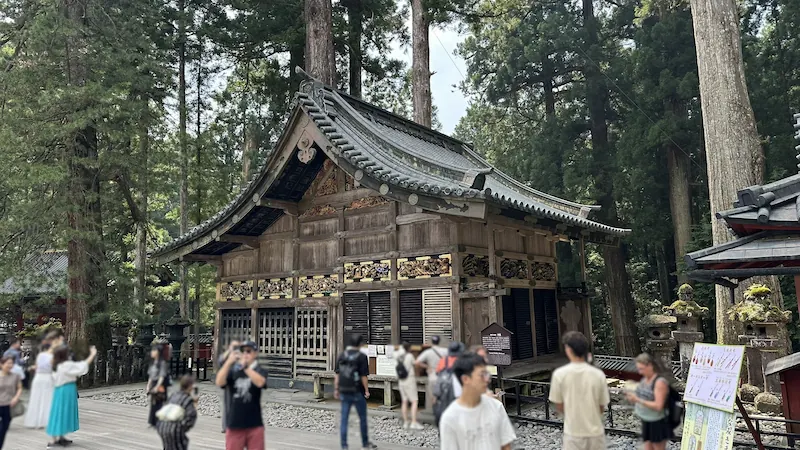
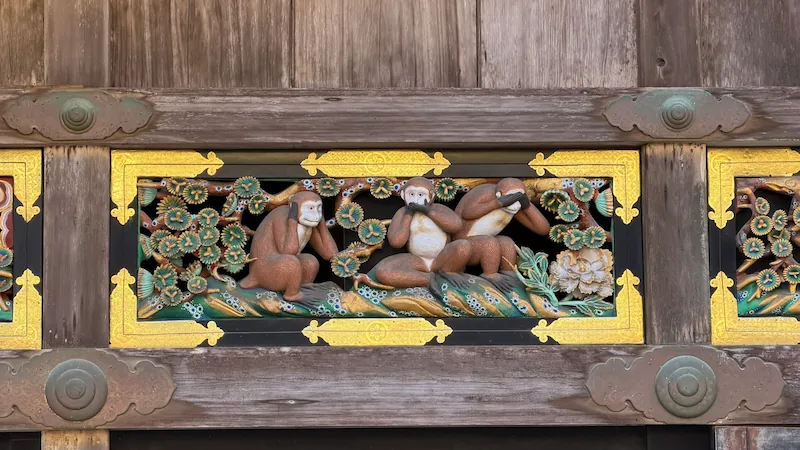
Sacred Stable and Three Monkeys
If you stop at the Three Monkeys, you miss most of the story
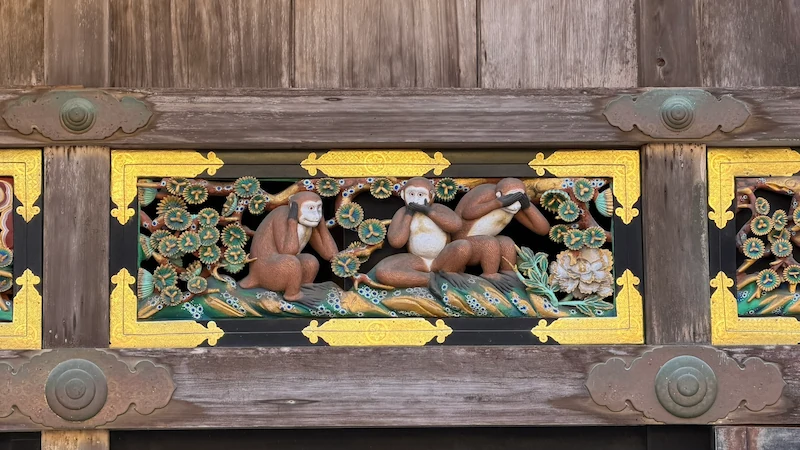
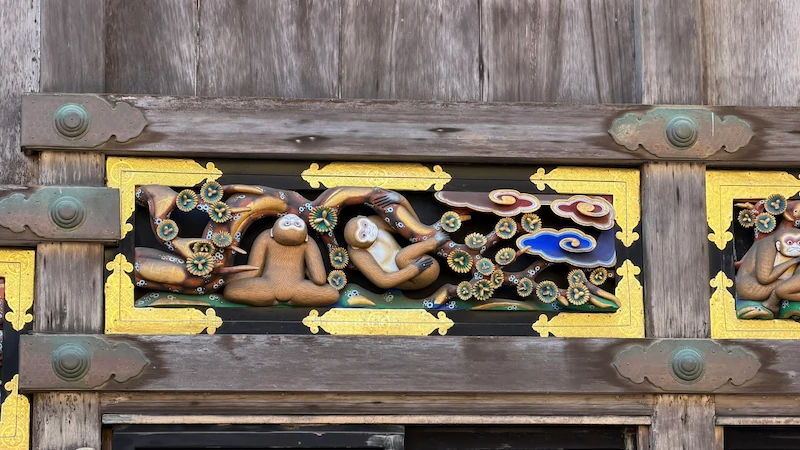
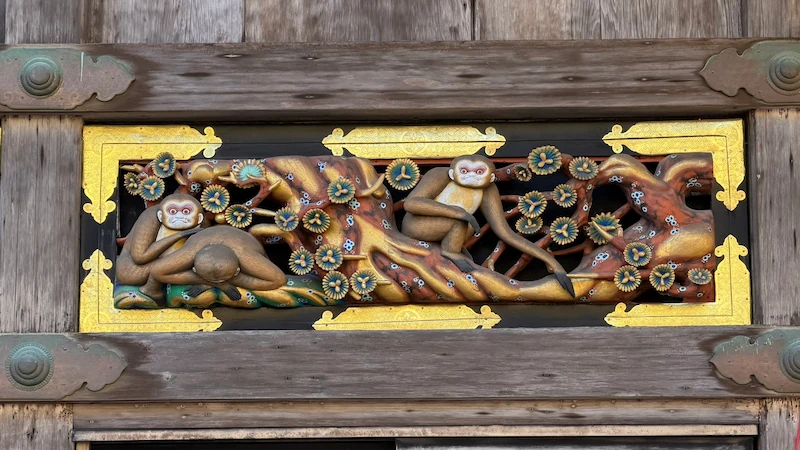
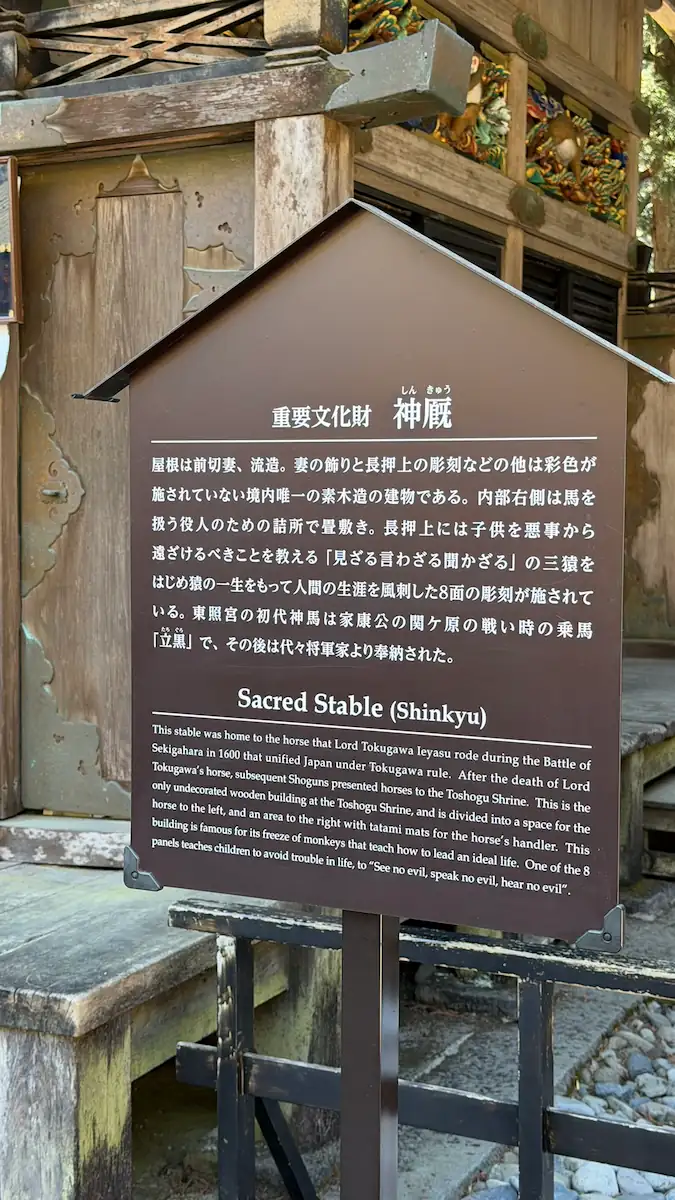
The Three Wise Monkeys are the most famous feature here, but they're only one panel in a sequence of eight that tells a story of human life.
🖼 Photos
Eight panels and sixteen monkeys — the full story of life. A total of eight panels and sixteen monkeys are arranged from left to right, using monkeys as an analogy for the human life cycle. The famous Three Monkeys are only the second panel, representing childhood. The sequence runs from birth to childhood, independence, youth, setback and consolation, love, a couple facing rough waves together, pregnancy, and back again to the next birth.
Why monkeys are on a horse stable. There was an old belief that monkeys protect horses from illness. In yin-yang five-phase thought, horses correspond to fire and monkeys to water; because water overcomes fire, monkeys were believed to protect horses. The origin of sarumawashi monkey performance is also said to lie in stable rituals praying for horses' health.
Why there is no "fourth monkey." Some interpretations add a fourth monkey to the familiar see-no-evil, speak-no-evil, hear-no-evil trio, but the Toshogu carving shows only three. One explanation is that the number four was avoided because of its association with death in Japanese, and the fourth meaning was judged unsuitable for a sacred site.
📋 Signboard
The Sacred Stable is explained as a building connected with the sacred horse, while the monkey carvings are easy to understand as a series of life lessons and a story of life. They are not simply animals — they are an entrance into symbolic reading.
National Treasure
Sleeping Cat
Above Sakashita-mon Gate / carving marking the boundary to the Inner Sanctuary
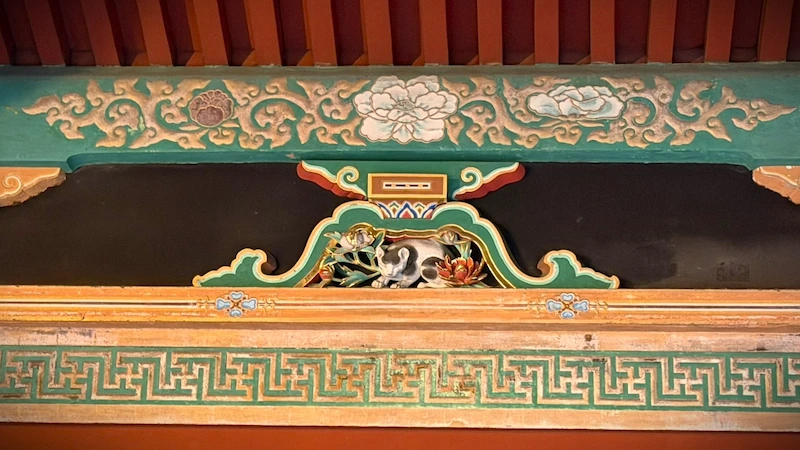
Famous as a standalone carving, the Sleeping Cat works primarily as a boundary marker — it announces that the atmosphere is about to change. Its meaning depends on what comes after: Sakashita-mon Gate and the path to the Inner Sanctuary.
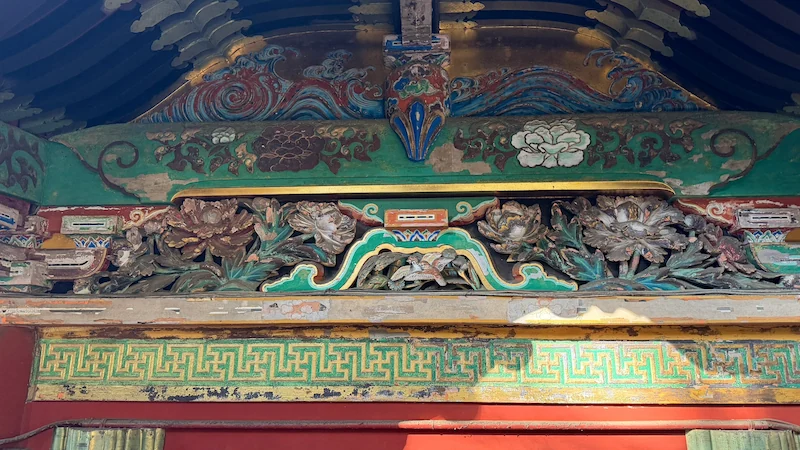
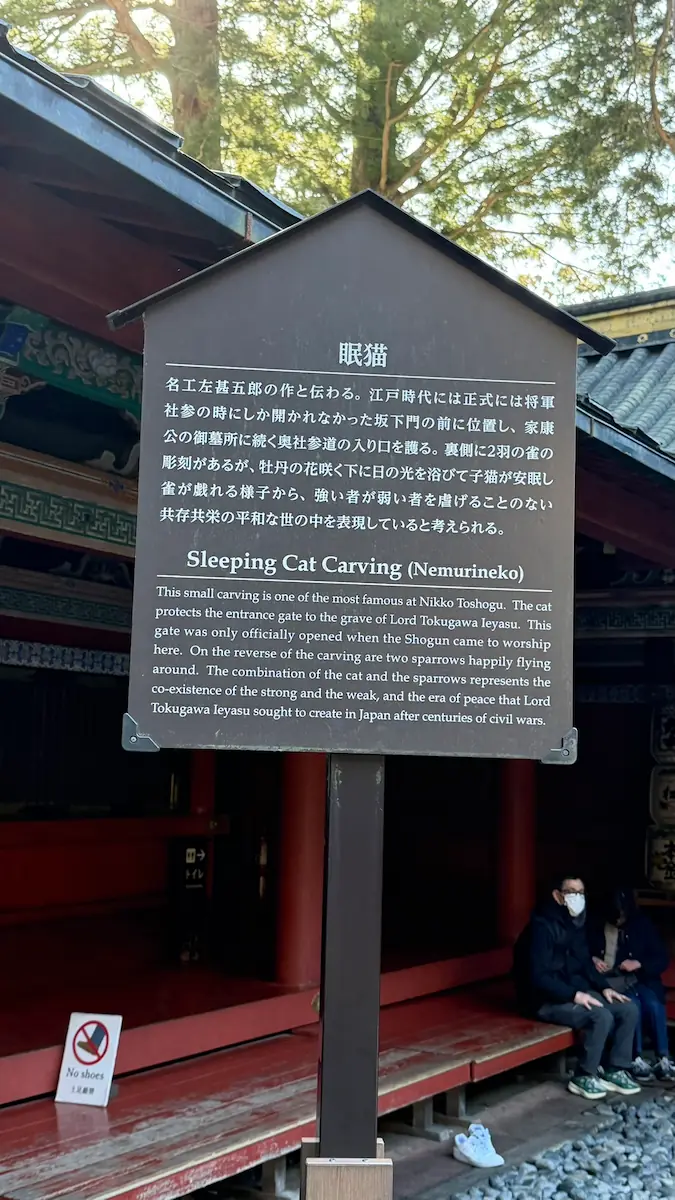
There are sparrows on the reverse side. The Sleeping Cat itself is surprisingly small — about 21 centimeters long — but its greatest detail is on the reverse side. Behind the transom toward Sakashita-mon, two sparrows are carved playing in a bamboo grove. A cat is a natural enemy of sparrows, but because the cat is asleep, they can play safely. Together, the cat and sparrows express the peaceful world brought by the Tokugawa shogunate.
🖼 Sparrows on the reverse side
Two sparrows on the reverse side
The legend of Hidari Jingoro. The Sleeping Cat is traditionally attributed to Hidari Jingoro, a legendary early Edo-period sculptor. His life dates are unknown, and even his historical existence is uncertain. More than 100 works across Japan are attributed to him, spanning nearly 300 years, so the name may have represented a school or lineage rather than a single individual.
Sleeping, or pretending to sleep? The cat's front legs are planted firmly, and some say it looks ready to spring at any moment. After the 2016 restoration, some visitors felt its eyes seemed slightly open. From certain angles, the shoulders look tense — as though watching prey.
📋 Signboard
The Sleeping Cat is one of Toshogu's representative carvings, placed on the route toward the Inner Sanctuary. Reading the signboard transforms it from "a famous cat" into a meaningful marker before the deeper zone begins.
Important Cultural Property
Three Sacred Storehouses
Buildings that easily enter your view just after Omote-mon Gate
After passing through Omote-mon, the Three Sacred Storehouses are often the first buildings you notice — sometimes before the Sacred Stable. Focus only on the Three Monkeys and you'll miss how densely built Toshogu actually is. The storehouses carry their own animal carvings worth a look.
📜 Historic Site Data
Year Built
1636, during the major Kan'ei reconstruction
Composition
Three buildings: Lower, Middle, and Upper Sacred Storehouses, arranged in a bent formation just after Omote-mon Gate
Architectural Style
Azekura-zukuri, the same style associated with the Shosoin at Todaiji in Nara
Stored Items
Costumes, horse gear, ritual implements, and tools for the Hyakumono-zoroe Sennin Musha Gyoretsu procession, enough for around 1,200 participants
Upper Storehouse
Also called the Gohōzō, it stored especially important shrine treasures and contained a Buddhist altar-like shumidan
Cultural Status
Important Cultural Property
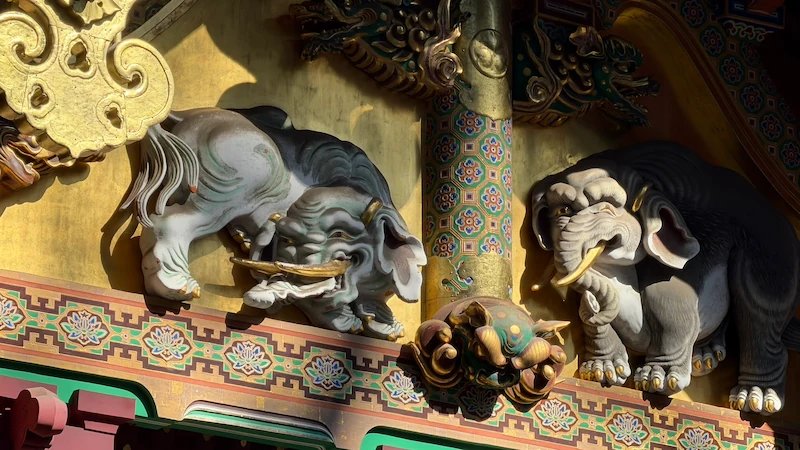
Imaginary elephants
Azekura construction automatically adjusts humidity. The storehouses use the same azekura-zukuri style as the Shosoin. Logs are stacked in a crisscross pattern, and the wood expands in humid seasons to narrow gaps, then contracts in dry seasons to improve ventilation. This natural humidity-control system helped protect valuable costumes for centuries.
Costumes for 1,200 people are stored here. The Three Sacred Storehouses hold costumes, horse gear, ritual tools, and other equipment for the Hyakumono-zoroe Sennin Musha Gyoretsu procession. Originally held on Ieyasu's death anniversary on April 17, the procession reenacts the transfer of his spirit from Kunozan to Nikko and continues in the May annual festival today.
The "imaginary elephants" were drawn without seeing a real elephant. On the south gable of the Upper Storehouse are two elephant carvings, black and white. The design is attributed to the official shogunal painter Kano Tanyu, but real elephants had not yet been seen in early Edo Japan. Their ears, legs, fur, and tails differ from real elephants, which is why they are called "imaginary elephants." They are counted among Toshogu's three great carvings.
There is a "toilet for the deity" beside the storehouses. Between the Lower and Middle Storehouses stands Saijo, the only building at Toshogu with no carvings. It is a private toilet for the deity. The interior is not open to the public and contains nine lacquered toilets, said never to have been used since construction.
◆
Shrine BuildingsBuildings and their roles
Important Cultural PropertyExterior outside paid area
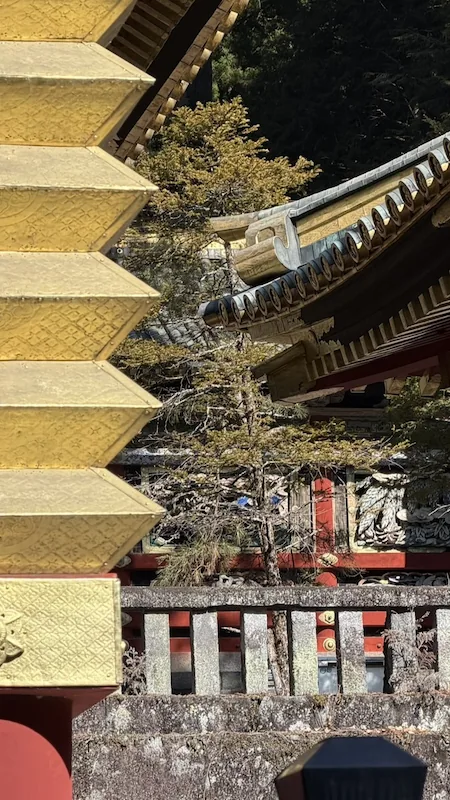
Five-Story Pagoda
Exterior visible outside Omote-mon Gate / special interior openings may require a separate fee
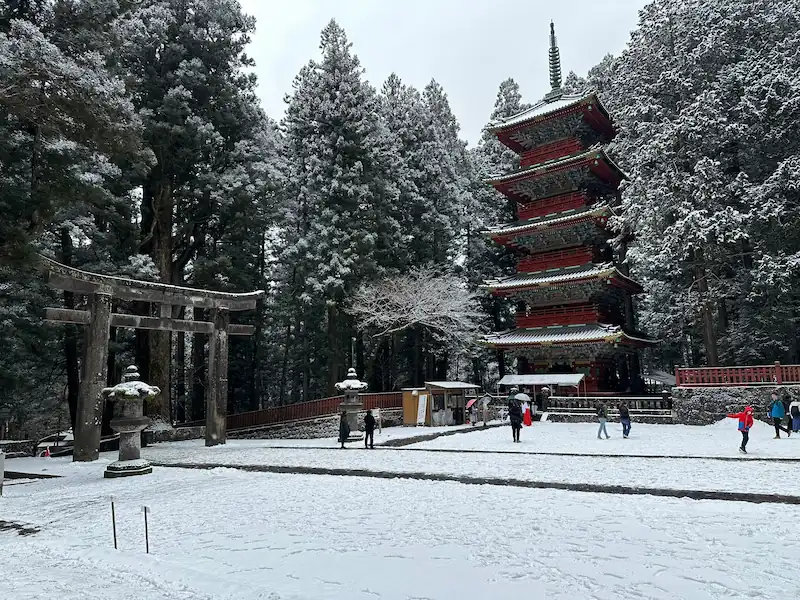
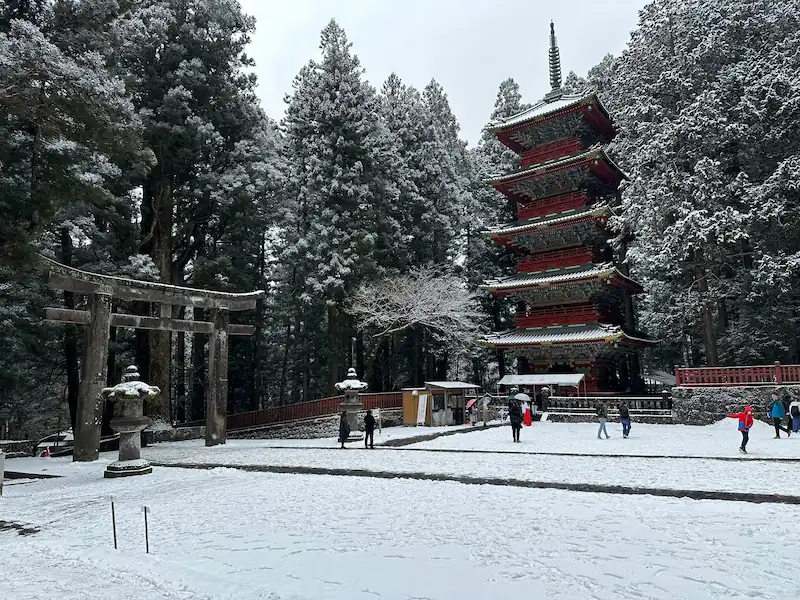
Immediately after passing through the First Torii Gate, the vivid vermilion Five-Story Pagoda appears against the green forest. Standing near the entrance, it sets the visual tone for everything ahead.
🖼 Photos
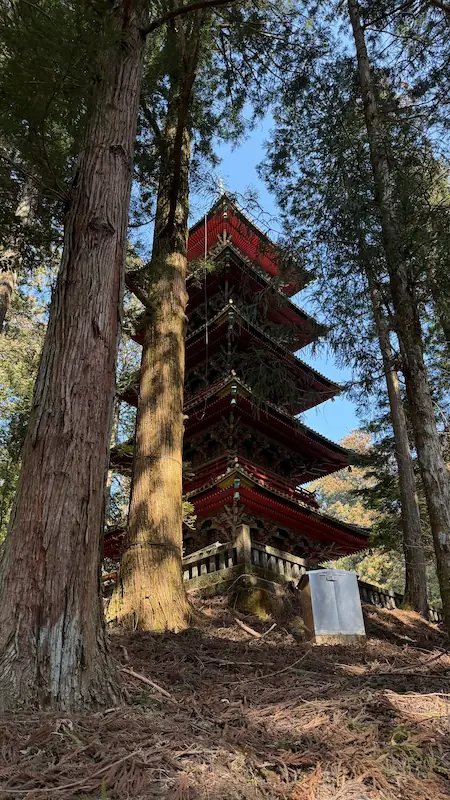
Photographed from behind the pagodaZodiac signs of the first three Tokugawa shogunsThe suspended central pillar appears to float
The zodiac signs of the first three Tokugawa shoguns face the front. The first story has twelve zodiac carvings, but instead of beginning with the rat, it begins with the tiger because Ieyasu was born in the Year of the Tiger. Hidetada was born in the Year of the Rabbit and Iemitsu in the Year of the Dragon, so the first three shoguns' signs appear in sequence at the front.
The central pillar "floats" — an ancestor of Tokyo Skytree's vibration-control concept. The central pillar, about 60 centimeters in diameter, is not fixed into the ground but suspended from the fourth story. This seismic idea is often described as a predecessor to the central-pillar vibration-control system used in Tokyo Skytree. The pagoda is 36 meters tall; it burned down by lightning in 1815 and the present structure was rebuilt in 1818.
Why there is a pagoda at a shrine. A five-story pagoda is originally a Buddhist structure. Its presence at a shrine is rare in Japan and shows that Toshogu functioned as a Shinto-Buddhist syncretic sacred site before the Meiji separation of Shinto and Buddhism. The pagoda was donated by Sakai Tadakatsu in 1648. The exterior stands outside Omote-mon and can be viewed without an admission ticket.
No-ticket area
Temporary Shrine Hall
No-ticket area / easy-to-miss building near the entrance
Worth pausing at, but easy to overlook on a first visit — it stands beside the First Torii Gate and Omote-mon, in the free-access area.
📜 Historic Site Data
Year Built
1639, built by Tokugawa Iemitsu
Role
A temporary shrine hall used to house the deity, Tokugawa Ieyasu, while the Main Shrine building was under repair
Architectural Style
Gongen-zukuri, with worship hall, connecting chamber, and main hall; includes a bronze torii, Karamon-style gate, and side gates
Transfers
Since its construction, the deity was transferred here nineteen times for repairs. It has not been used since the late Edo period
Cultural Status
Important Cultural Property
Notes
Located east of the First Torii Gate, near the Treasure Museum; in the no-ticket area
Normally such buildings are removed, but Toshogu used this one nineteen times. At many shrines, a temporary hall used during repairs is dismantled after the main building is restored. Toshogu's lavish shrine buildings required repeated maintenance, so the Temporary Shrine Hall became a permanent structure. From its construction to the late Edo period, Ieyasu's spirit was transferred here whenever the Main Shrine was repaired, and all ceremonies were performed here.
The mystery of the grapevine arabesque. Behind the worship hall are grapevine arabesque motifs — the only building in Toshogu where grapevine carving or depiction appears. The reason remains unclear, making it a point of interest among history enthusiasts.
The tiger carvings relate to Ieyasu's zodiac year. The bell tower includes tiger and tragopan carvings. The tiger appears because Tokugawa Ieyasu was born in the Year of the Tiger in 1542. Even in a temporary residence for the deity, the symbolic grammar remains consistent.
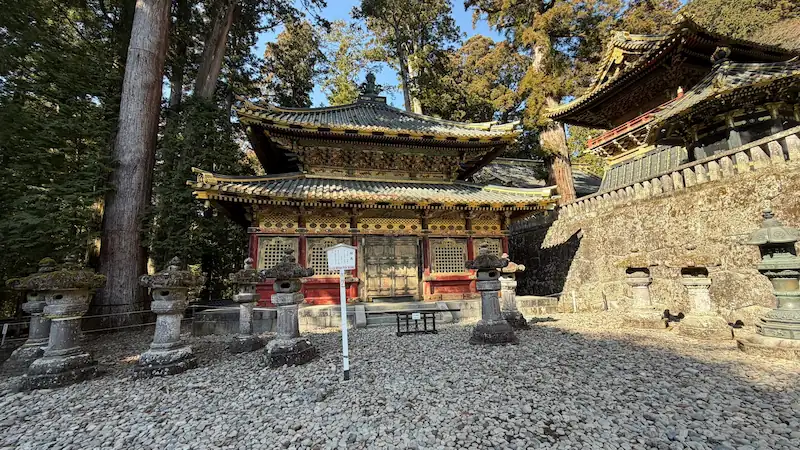
Temporary Shrine Hall — beside the First Torii Gate and Omote-mon Gate, in the no-ticket area
Important Cultural Property
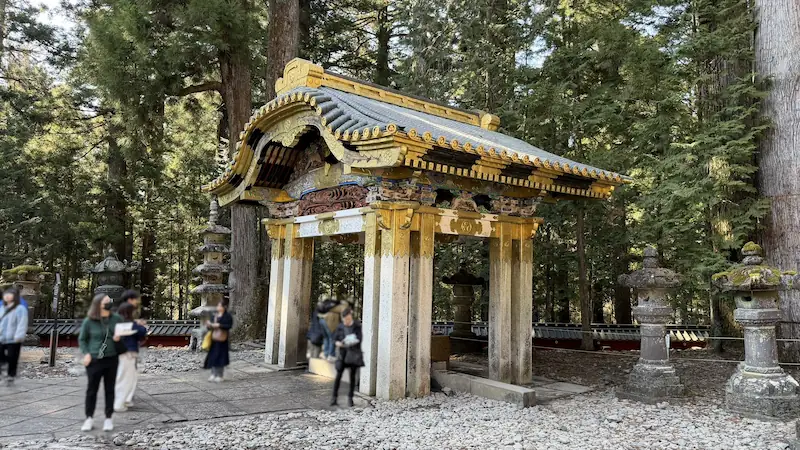
Omizuya Purification Pavilion
Japan's first roofed purification pavilion / Toshogu's density extends to supporting structures
Omizuya: Toshogu's ornamentation extends to supporting structures like this one. Even after the Sacred Stable, the ornament density here still registers.
📜 Historic Site Data
Year Built
1620
Feature
Regarded as Japan's first roofed purification pavilion
Cultural Status
Important Cultural Property
Current State
Extant
Notes
Also called Suibansha; located opposite the prayer hall / upper shrine office
Japan's first roofed purification pavilion. This is said to be the first example of the roofed purification-pavilion form now commonly found at Japanese shrines. Built in 1620, it shows that Toshogu established new forms not only in architecture and decoration, but also in ritual practice.
The Dutch lantern stands nearby. Near the Omizuya is the rotating lantern donated in 1643 by the Dutch East India Company / Dutch trading post at Dejima. It is a brass chandelier-like lantern marked with the Tokugawa triple-hollyhock crest, but the crest appears upside down. Legends say the Dutch did it deliberately, though it may have been a production-direction issue.
The Korean bell is also nearby. A bell donated by the Korean kingdom in 1643 is displayed in this area. Brought when Korean envoys visited Nikko Toshogu, it shows how Toshogu functioned as an international ceremonial site in the Edo period.
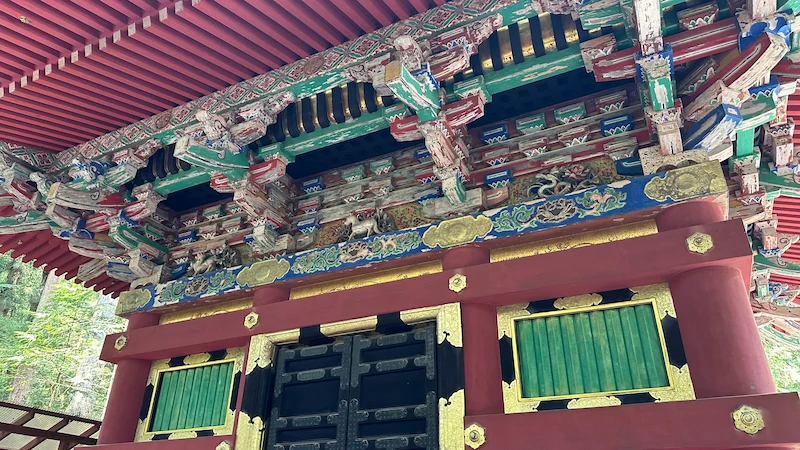
Important Cultural Property
Rinzo / Sutra Repository
Octagonal rotating bookshelf / a Buddhist "library" holding the complete sutras
Easy to overlook in the central precinct, Rinzo is a reminder that Toshogu was never purely a Shinto shrine.
📜 Historic Site Data
Year Built
Built in 1620. Some original material from that period remains, and the building was rebuilt into its present form in 1636
Alternate Name
Kyozo, or sutra repository
Architecture
Two-tiered square structure with a lower pent roof; copper-tile roofing
Interior
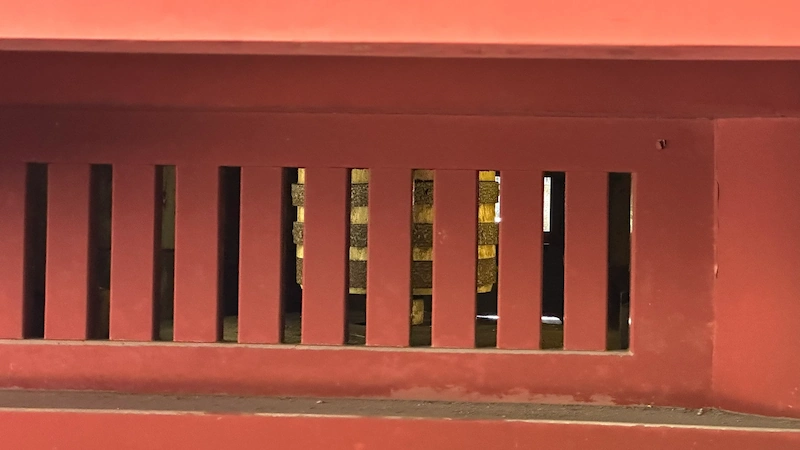
Contains an octagonal rotating bookshelf, not open to the public, storing the complete Buddhist canon
Cultural Status
Important Cultural Property
Current State
Extant
Rotating the bookshelf was believed to bring the same merit as reading the complete sutras. The octagonal rotating shelf housed the complete Buddhist canon, or issaikyo. Turning the shelf once was believed to grant the same merit as reciting all the scriptures — a way for ordinary people who could not read all the texts to still participate in Buddhist merit-making. The interior is not open today, but the exterior still conveys the weight of a building made to protect scripture.
Why is there a Buddhist sutra repository at a shrine? Before the Meiji separation of Shinto and Buddhism in 1871, Toshogu was a syncretic sacred site where Shinto and Buddhism functioned together. Rinzo is a surviving trace of that world. After shinbutsu bunri, Rinnoji and Toshogu were separated, but Rinzo remained on the Toshogu side.
One of the earliest buildings at Toshogu. The current Rinzo was rebuilt in 1636, but parts of the foundation use material from the 1620 construction. This makes it one of the earliest buildings in the Toshogu complex — and shows that scripture was housed at Ieyasu's mausoleum from the very beginning.
National Treasure
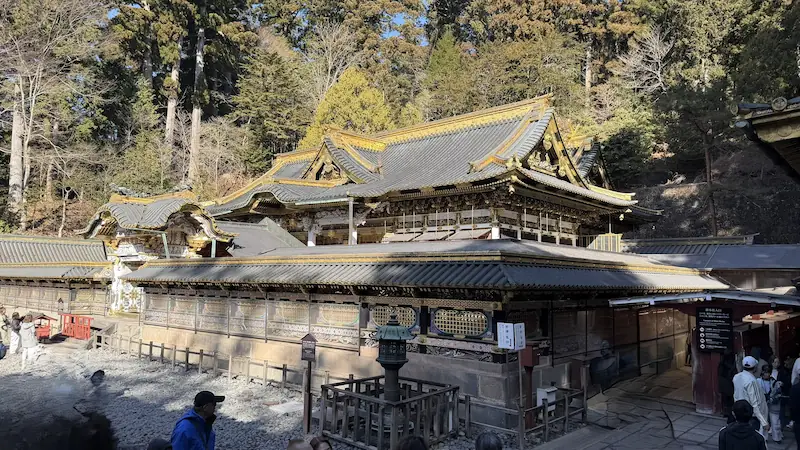
Main Shrine Building and Worship Hall
The central shrine building / the point where visitor becomes worshipper
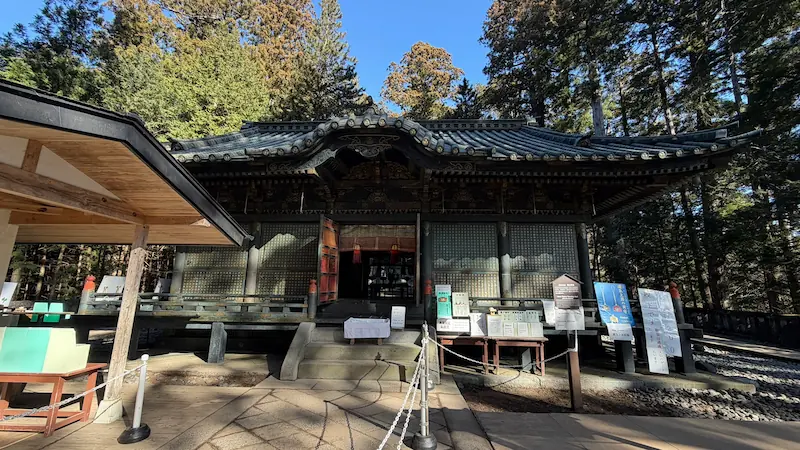
This is Toshogu's central shrine building and the clearest point where a visit shifts into something closer to worship. Removing your shoes does most of the work.
Reverse pillars are also hidden in the main hall. The reverse pillar of Yomeimon is famous, but a 1987 investigation found two more among the sixteen pillars separating the main hall and worship hall. Because photography is prohibited and visitors remove shoes inside, it is difficult to examine them at length on site.
Note: You remove your shoes here. Photography is prohibited inside the Main Shrine building. Enter with the sense that this is not a place to photograph, but a place to face the center.
From Karamon to the Main Shrine building — entrance to the sacred area where you remove your shoes
National Treasure
Karamon Gate
Important gate before the Main Shrine building
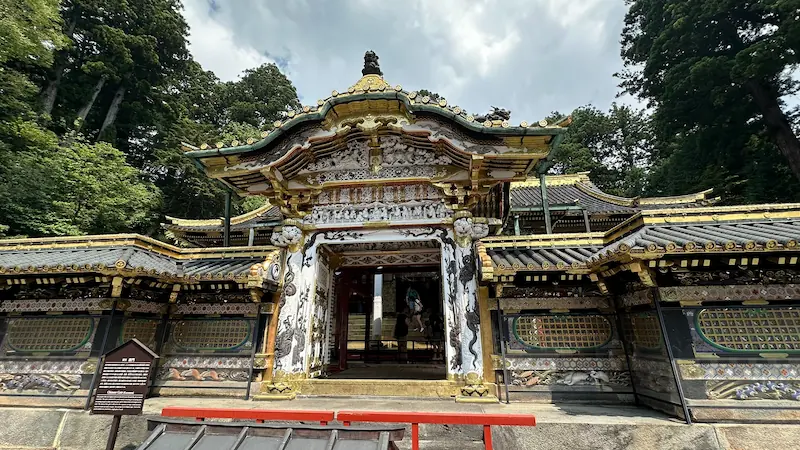
Karamon makes most sense in relation to the shrine building directly behind it — the gate and the shrine read as a pair.
📜 Historic Site Data
Year Built
1636. Except for roof rethatching, it remains as originally built
Architecture
Four-sided karahafu gables. Though only about 3 meters wide and 2 meters deep, it stands as the front gate of the Main Shrine building — the most important position
Carvings
611 carvings, second only to the Main Shrine building's 2,468 and exceeding Yomeimon's 508
Exterior
Painted white with gofun, a white pigment made from burnt shells
Cultural Status
National Treasure, designated in 1951
611 carvings — higher density than Yomeimon. Karamon has 611 carvings, second only to the Main Shrine building. Given the small size of the gate, its carving density is often described as the highest at Toshogu. It also contains 64 figures across six figure-carving scenes; along with Yomeimon, it is one of the only gates at Toshogu with human figures carved into it.
The face of Emperor Shun is said to resemble Ieyasu. Above the doorway is the scene of Emperor Shun receiving New Year's greetings from his ministers. Shun, a sage ruler in Chinese mythology, was chosen because he rose to rule through virtue and ability rather than bloodline. His face is said to have been intentionally made to resemble Tokugawa Ieyasu, symbolizing Tokugawa legitimacy after Toyotomi Hideyoshi's death.
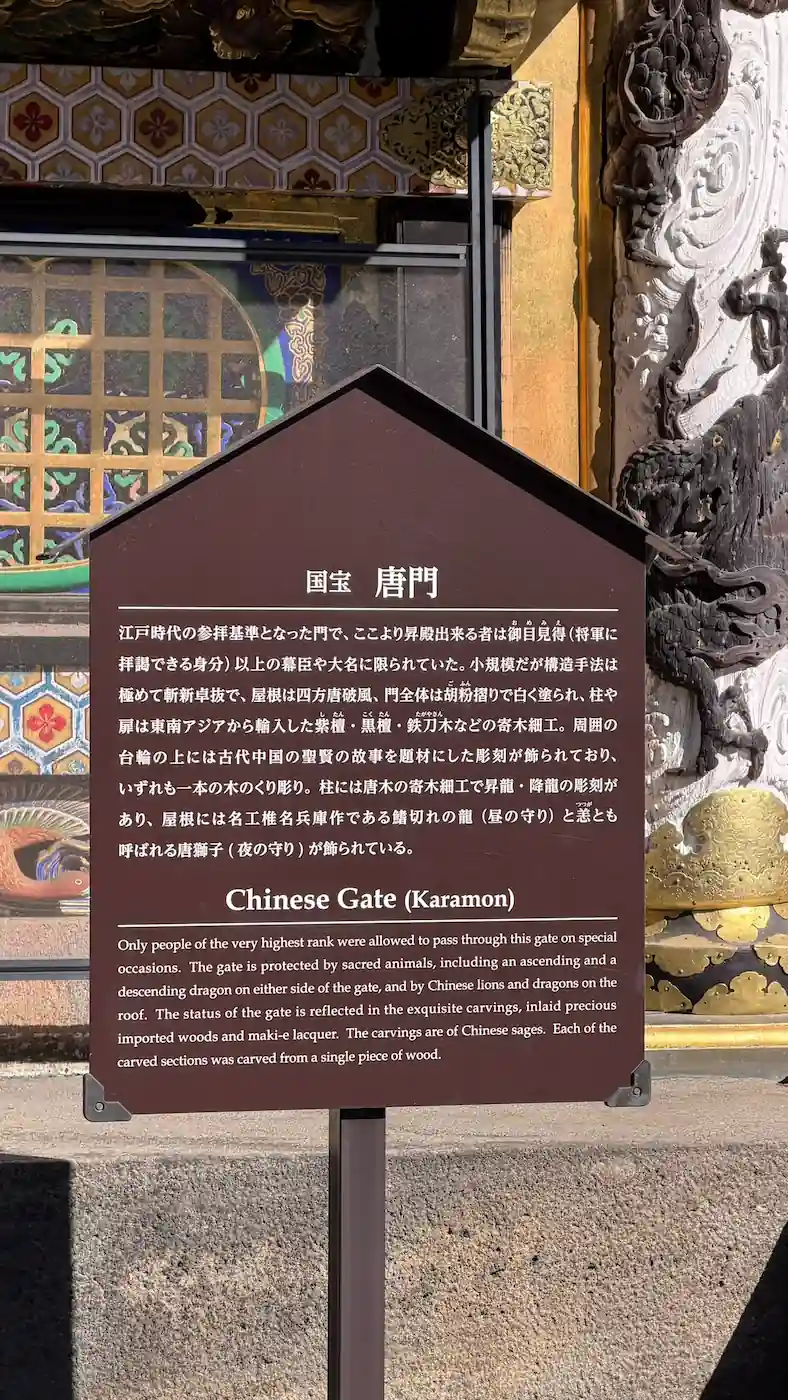
In the Edo period, only those permitted to meet the shogun could pass. Karamon was not an ordinary gate. It was reserved for imperial envoys, shogunal retainers, daimyō, and others whose rank allowed direct audience with the shogun. Even today, it is normally closed and is opened only for New Year, major festivals, and visits by guests of national-level status.
Gofun white, tsutsuga, and dragons protect day and night. The white surface comes from gofun, a shell-based pigment. A mythical beast called tsutsuga sits at the roof ridge, while dragons appear at the roof ends. Based on a story that dragons protect the day and tsutsuga protects the night, the design suggests round-the-clock protection of the Main Shrine building. The tsutsuga's feet are held by golden rings, and the dragons' fins are cut so they cannot escape.
📋 Signboard
Karamon is explained as the important gate before the Main Shrine building. Its meaning deepens when read in relation to the shrine building behind it.
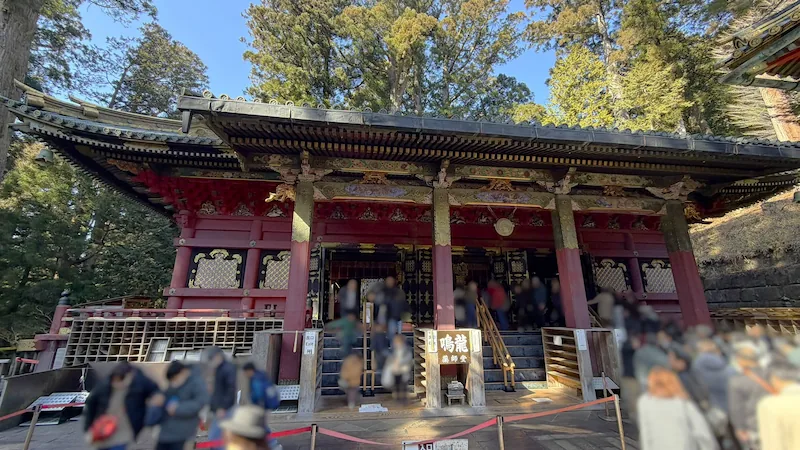
Crying Dragon
Honjido Hall / Crying Dragon
Easy to miss / the closing point of the central precinct
Heading down from Yomeimon, it's easy to walk straight past — Honjido is to your right as you descend the steps. Don't miss it.
The Crying Dragon only "cries" directly beneath its head. When wooden clappers are struck directly beneath the head of the large dragon painted on the ceiling, a distinctive resonance can be heard. The same sound does not resonate in the same way beneath other parts of the dragon. Today, the experience is presented through a guided demonstration. Visitors remove their shoes before entering.
Goshuin and limited amulets are especially rich here. During the February 22, 2026 visit, in addition to the standard written goshuin for 500 yen, a limited Crying Dragon goshuin for 1,000 yen and a limited card-style amulet were available. Because these limited items are not available elsewhere, it is worth checking Honjido if you want them. All four goshuin locations, offering fees, and photographs of the actual seals are collected in the Nikko goshuin guide.
Note: You remove your shoes here. Exterior photos are easier in the morning. Lines begin forming around 10 a.m.
◆
Inner Sanctuary: The Space of Ieyasu's Deification
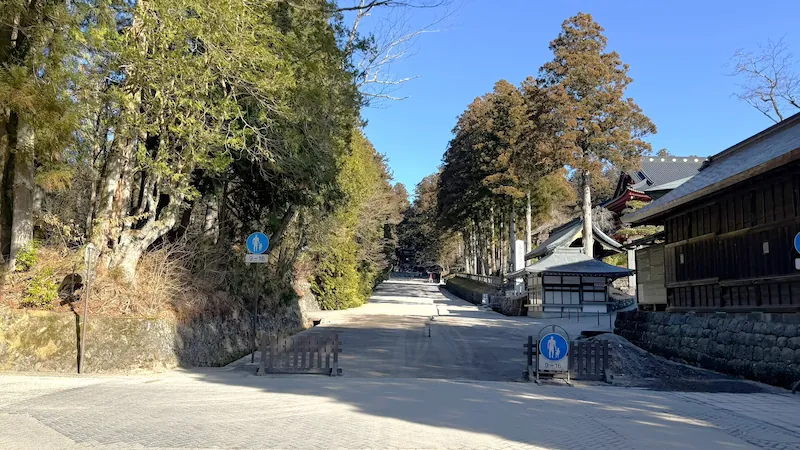
The Inner Sanctuary is the area of Toshogu where the meaning of "enshrining Ieyasu as a deity" is felt most strongly. The route from Sakashita-mon Gate toward the stone steps is one of the most dramatic atmospheric transitions in the entire shrine.
Stone Steps and Route — 207 Steps
The cedar grove, stone path, and steps ahead create a quiet tension unlike anything in the central precinct. When the torii at the top comes into view, the feeling shifts from "how much further?" to "I am almost there." How much this route resonates depends largely on whether you already know Ieyasu's story.
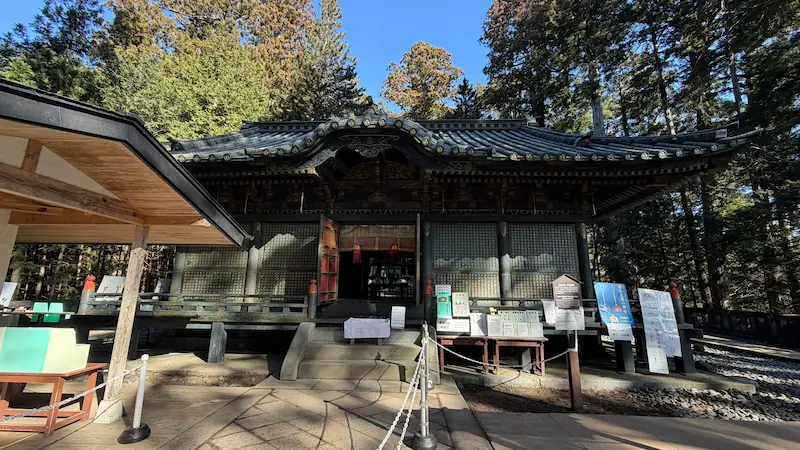
Inner Sanctuary Worship Hall
Inner Sanctuary Worship Hall
The worship hall appears after you climb the 207 stone steps. Here you worship, and beyond it the route continues toward Inuki-mon Gate and the Treasure Pagoda. The silence here — so unlike the glittering central precinct — creates a strong sense of arrival.
📜 Historic Site Data
Year Built
1636
Role
The worship hall of the Inner Sanctuary, where successive Tokugawa shoguns prayed during visits to Nikko
Cultural Status
Important Cultural Property
The innermost sacred place visited by successive shoguns. The Inner Sanctuary worship hall was where Tokugawa shoguns prayed during official Nikko visits. A shogunal visit to Nikko was a major political and ritual event that displayed bakufu authority. When the shogun stood in this worship hall, the ancestral deity Ieyasu resting behind him at the Treasure Pagoda formed the core of Tokugawa legitimacy.
Inner Sanctuary approach 1 — just after Sakashita-mon Gate
Inner Sanctuary approach 2 — near the entrance to the 207 stone steps
Inner Sanctuary worship hall — after climbing the 207 stone steps
Inuki-mon Gate
Standing behind the worship hall at the entrance to the Treasure Pagoda area, Inuki-mon is a unique gate made entirely of bronze casting except for its doors — pillars, beams, roof, and other main elements. It heightens the dignity of the Inner Sanctuary as the final gate before the Treasure Pagoda.
📜 Historic Site Data
Construction
The original gate was stone. After it collapsed in a mid-Edo-period earthquake, it was rebuilt in bronze
Structure
All parts except the doors — roof, pillars, beams, and rails — are cast in bronze
Name
The name comes from the inuki casting method, in which molten metal is poured into a mold and the solidified piece is removed by pushing it out from the rear
Cultural Status
Important Cultural Property
Originally stone, rebuilt in bronze after earthquake damage. Today's Inuki-mon is bronze, but the original was stone. After repeated earthquakes in the mid-Edo period caused it to collapse, it was rebuilt in bronze for durability. The collapsed old stone gate and torii had been buried near the Inner Sanctuary; they were excavated in 1967 and are now restored beside the Treasure Museum.
What does "inuki" mean? The gate's defining feature is that the main elements other than the doors were made by bronze casting — molten metal poured into a mold, then extracted from the back after hardening. The name Inuki-mon comes from this casting process. When first made, it may have been close in color to a ten-yen coin; today it is covered in green patina.
General visitors could not enter until 1965. The Inner Sanctuary was long restricted to limited people. General visitors were able to see Inuki-mon up close only after the special opening connected with the 350th anniversary festival in 1965.
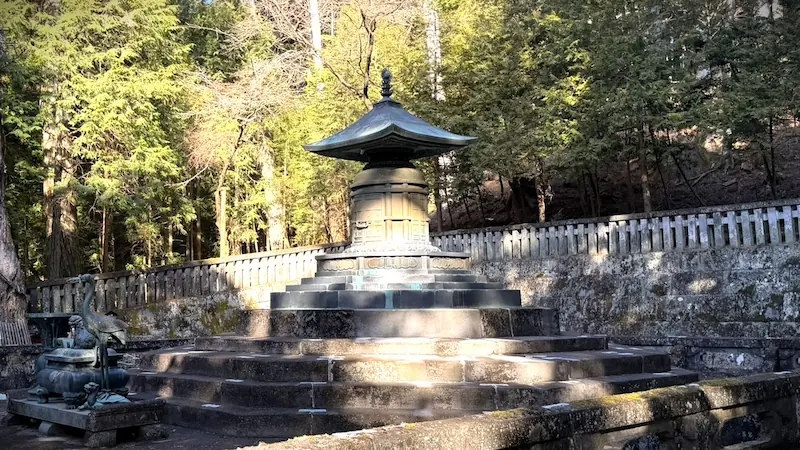
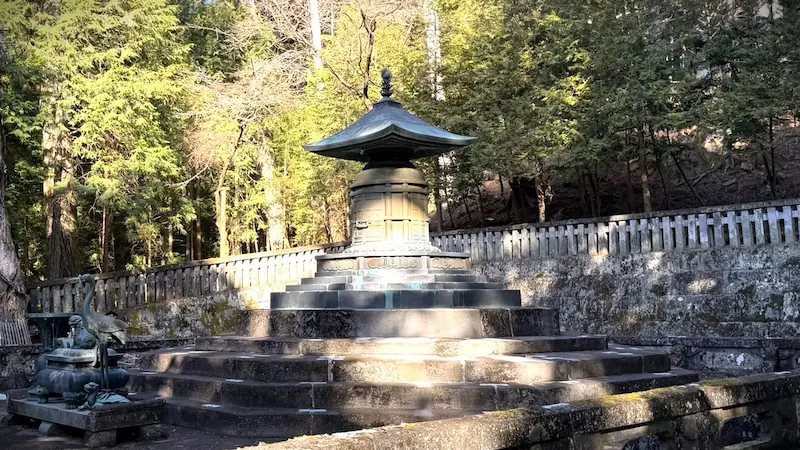
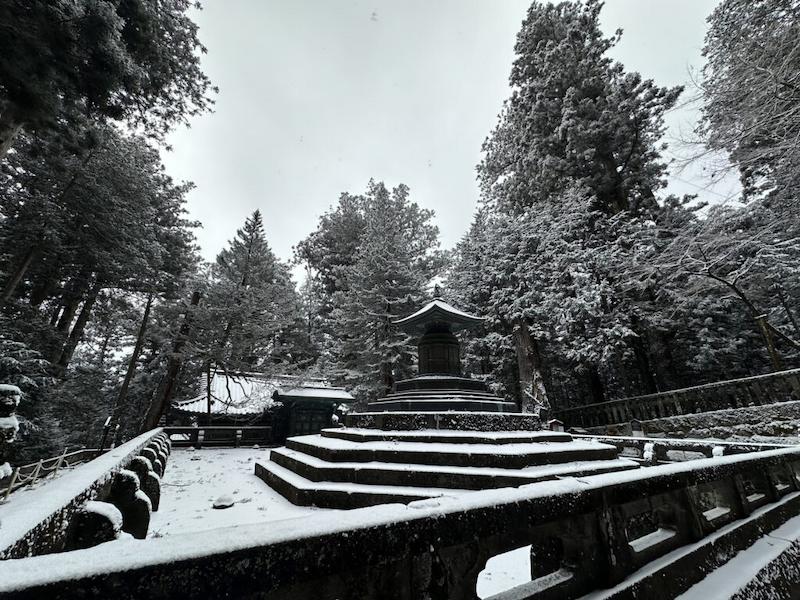
Inner Sanctuary Treasure Pagoda
Inner Sanctuary Treasure PagodaSnow-covered view
Pause before approaching. Take in the whole cleared space within the cedars, and the specialness of being here becomes tangible. At the Inner Sanctuary, seeing the pagoda first and then returning toward the worship hall often leaves the strongest impression — not merely that you "saw" it, but that you arrived.
📜 Historic Site Data
Year Built
Built in wood in 1636. After collapsing in 1683, it was rebuilt in bronze
Height
About 5 meters
Maker
Shiina Iyo
Base
The Treasure Pagoda stands on an octagonal stone base of nine tiers
Three Ritual Objects
A crane-shaped candle stand, a lion incense burner, and a flower vase. The candle stand uses crane and turtle imagery as symbols of longevity
Cultural Status
Important Cultural Property
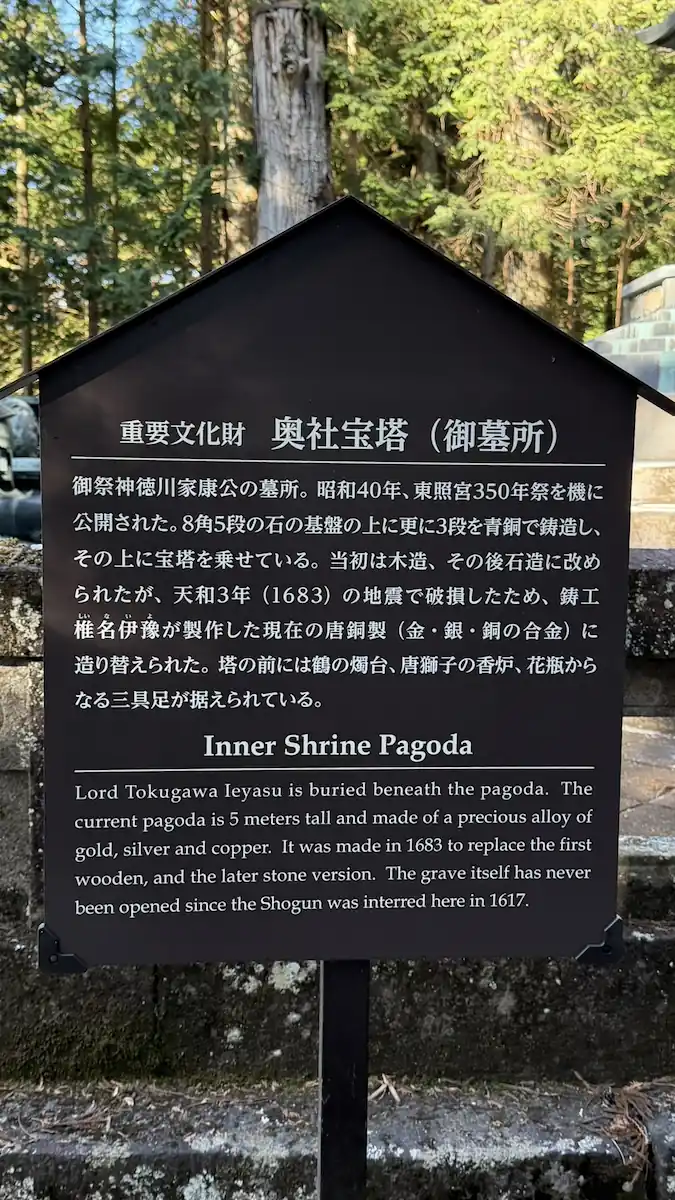
The Treasure Pagoda is said never to have been opened since its construction. Ieyasu's sacred coffin is said to be placed beneath the pagoda, but it is also said to have never been opened since construction, so the internal state is unknown. There are multiple views about Ieyasu's remains, including theories that only part of the remains were transferred from Kunozan to Nikko. None has been confirmed, leaving the pagoda as a sacred mystery protected for four centuries.
Originally wooden, rebuilt in bronze after an earthquake. The present Treasure Pagoda is bronze, but the first version was wooden. It collapsed in the Tenna earthquake of 1683 and was remade in bronze by Shiina Iyo. Standing on its nine-tiered octagonal stone base, the five-meter pagoda appears especially numinous among the cedars.
Why cranes and turtles appear among the ritual objects. In front of the pagoda are three ritual objects: a crane candle stand, a lion incense burner, and a flower vase. The candle stand uses crane and turtle imagery because cranes symbolize a thousand years and turtles ten thousand years — expressing the wish to enshrine Ieyasu as an eternal guardian deity.
📋 Signboard
The Inner Sanctuary Treasure Pagoda is explained as the central element enshrining Ieyasu. The impression deepens when you take in the entire space preserved within the cedar grove, rather than reading it as a single structure.
Treasure Pagoda — where Ieyasu rests, beside Kanae-sugi
Kanae-sugi Cedar
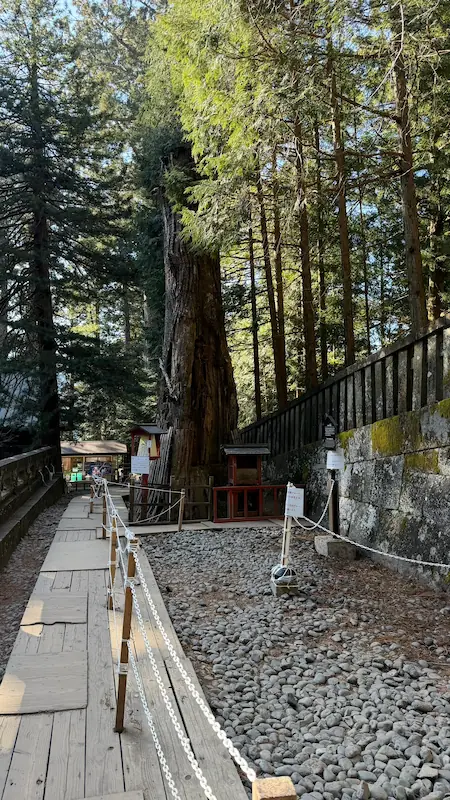
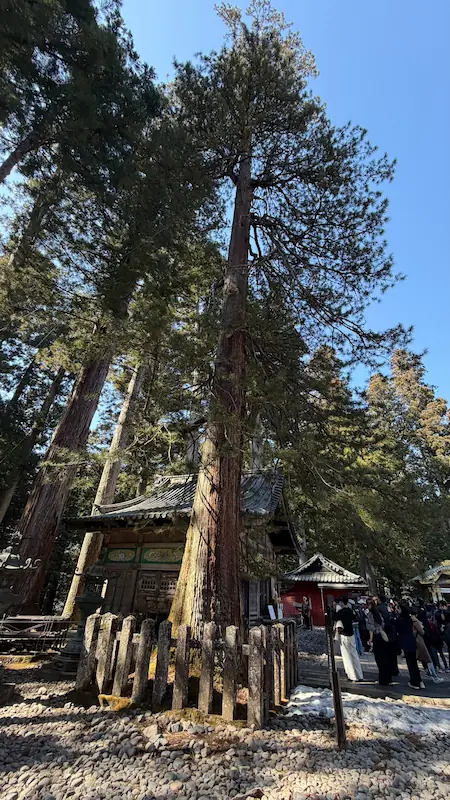
The Inner Sanctuary is shaped as much by the surrounding cedars as by its main structure. The tall trees create an atmosphere that makes it easy to sense this space has been kept deliberately apart for nearly 400 years.
Kanae-sugi — the hollow cedar that grants wishes. The tree is said to be more than 600 years old and has a hollow inside its trunk. There is a tradition that wishes made toward this hollow will be granted. The character kanae, meaning "to grant," can be written with the elements for "mouth" and "ten," giving it an auspicious sense of prayers being fully conveyed. After climbing the 207 steps, praying toward the cedar in the surrounding silence is one of the most memorable experiences of the Inner Sanctuary. A small shrine stands before the tree, and Kanae-sugi amulets limited to the Inner Sanctuary are also available.
◆
Legendary Trees and Plants — Koyamaki and Iemitsu's Pine
At Toshogu, stories attach not only to buildings, but also to plants. Reading the on-site explanations, you begin to see why certain trees have been preserved in their particular places.
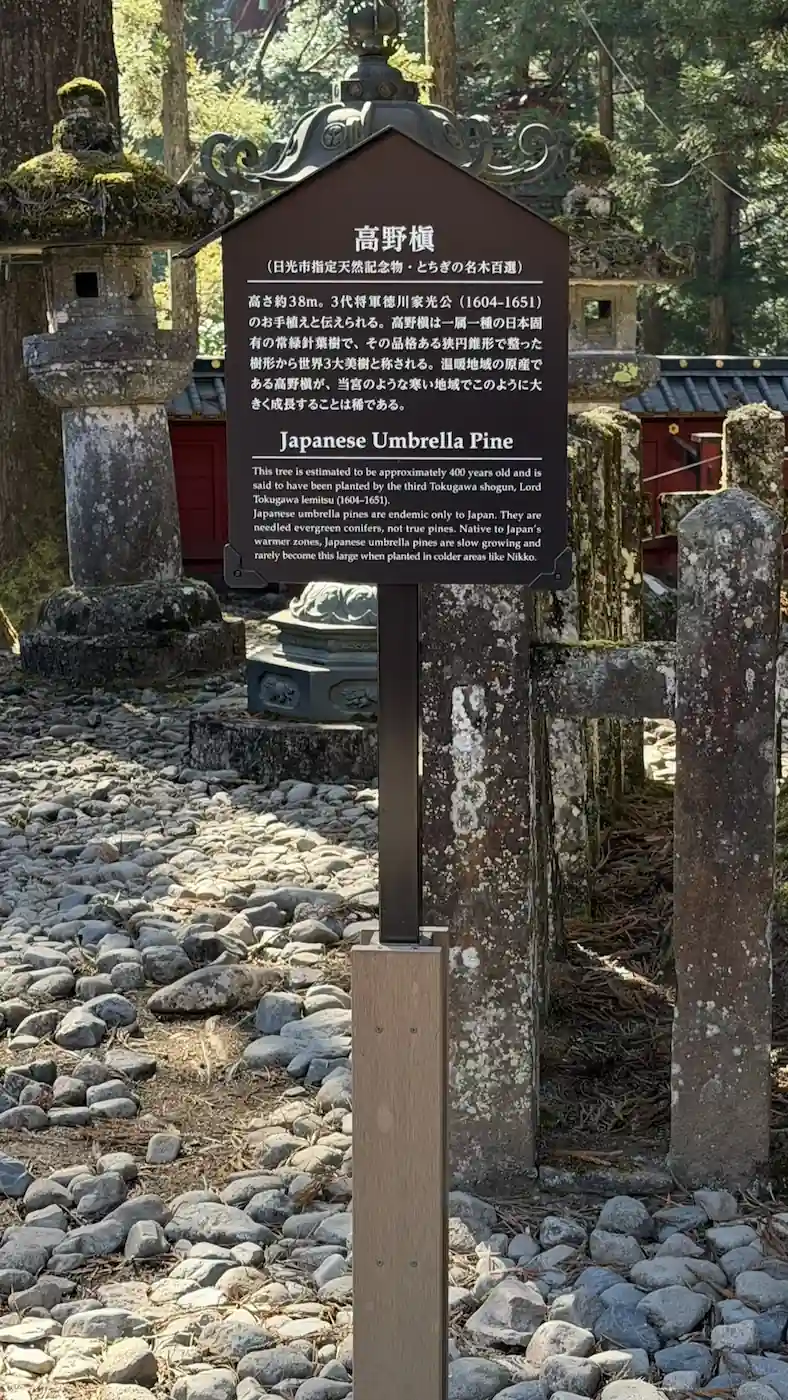
Koyamaki Tree
Koyamaki tree
🖼 Photos
Koyamaki leavesKoyamaki signboard
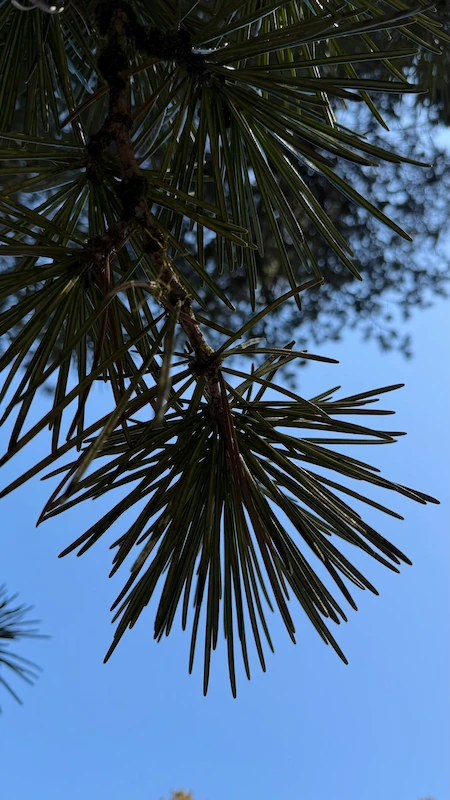
A Nikko City-designated natural monument and one of Tochigi's famous trees. Introduced as a Nikko City-designated natural monument and one of Tochigi's 100 famous trees, this Koyamaki stands about 38 meters tall and is traditionally said to have been planted by Tokugawa Iemitsu. Koyamaki is an evergreen conifer endemic to Japan and the only species in its genus. Praised as one of the world's three most beautiful trees, it is rare for a Koyamaki to grow this large in a cold region like Nikko.
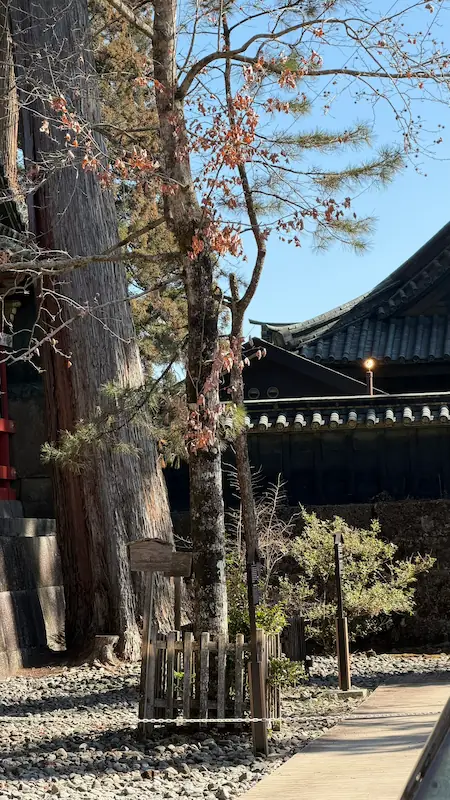
Iemitsu's Hand-Planted Pine
Iemitsu's hand-planted pine
Worth pausing at, but you can't approach it closely — it's viewed from a distance on site.
Traditionally said to have been planted by Tokugawa Iemitsu. This pine is said to have been planted by the third shogun, Tokugawa Iemitsu, to commemorate the completion of the great Kan'ei reconstruction in 1636. Pine is a warrior-class symbol and an auspicious evergreen sign of longevity. The tradition presents Iemitsu as planting it in prayer for eternal respect toward his grandfather Ieyasu and the long prosperity of the shogunate.
The distance itself communicates sacredness. Fences and distance prevent visitors from approaching the pine closely. Like the Koyamaki, it is treated as a venerable sacred tree — you see it from afar, and that distance is part of what the place communicates.
Iemitsu's hand-planted pine, alternate angle
◆
Frequently Asked Questions
Immediately after passing through. Before it, the experience still feels like visiting a famous landmark; after crossing it, the pressure shifts into entering the center of Tokugawa authority.
No. The Sacred Stable has eight panels and sixteen monkeys, readable as the course of life from birth to old age. The Three Wise Monkeys are only the second panel.
The Sleeping Cat is above Sakashita-mon Gate. On the reverse side, facing the Inner Sanctuary, two sparrows play in a bamboo grove. Because the cat is asleep, the sparrows can play safely — an image of Tokugawa peace.
There are 207 stone steps. During the February 22, 2026 visit, the round trip took about 30 minutes in the quiet early morning.
Yes. You remove your shoes at the Main Shrine / Worship Hall and at the Honjido / Crying Dragon Hall. Photography is prohibited inside the Main Shrine building.
A Nikko City-designated natural monument, about 38 meters tall, traditionally said to have been planted by Tokugawa Iemitsu.
There are 611 carvings — more than Yomeimon's 508. Given its size, Karamon has exceptional carving density.
Yes. The exterior can be viewed from outside Omote-mon Gate, in the no-ticket area. Special interior openings may require a separate fee. It stands just after the First Torii Gate, where the vermilion tower appears against the green forest.
Near the Inner Sanctuary Treasure Pagoda after climbing the 207 steps. The tree is said to be more than 600 years old, and wishes made toward the hollow in its trunk are said to be granted.
During the February 22, 2026 visit, a standard written goshuin was available for 500 yen, and a limited Crying Dragon goshuin for 1,000 yen. A limited card-style amulet was also available. Offerings and prices may change. See the Nikko goshuin guide for every location and photos of the seals.
Photography is prohibited inside the Main Shrine / Worship Hall. Inside Honjido, follow the guide's instructions. Other outdoor areas are generally open to photography — please be considerate of other visitors when it is crowded.





comment