


Nikko Toshogu Guide — 5-Page Structure
- Essential: Tickets, access, time required, and the best route (start here for practical first-visit information)
- ▶ This Page (Story): Ieyasu’s deification and the political meaning of the shrine’s design
- Complete: Every Spot — Gates, Sculptures, Shrine Buildings & Inner Sanctuary
- Archive: Taiyuin, Treasure Museum & Hidden Spots
- Goshuin Guide: locations, offering fees, and photos of the actual seals
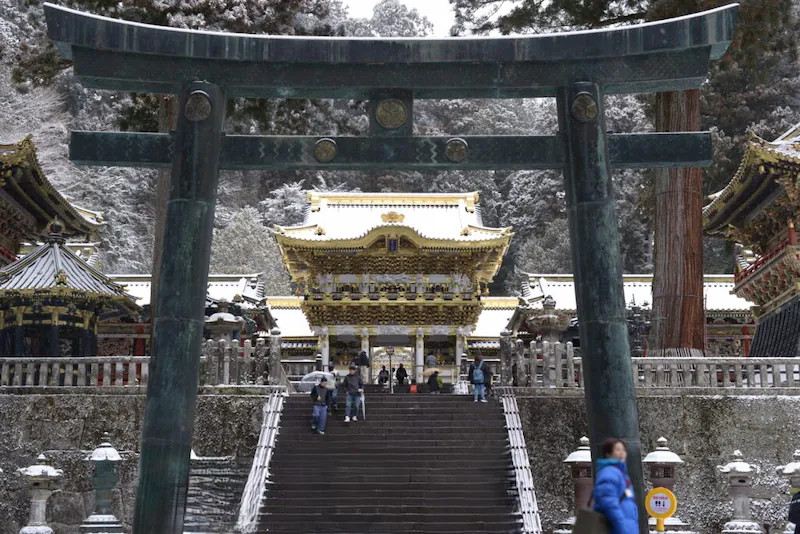
The moment I passed through Yomeimon Gate, the air inside the precinct changed. Walked in February 2026, this page reads the shrine’s design as an argument: why Ieyasu was enshrined here, and what Iemitsu’s reconstruction was built to fix in place.
The moment I passed through Yomeimon Gate, the air inside the precinct changed.
On February 22, 2026, I walked through Nikko Toshogu and felt something no photograph fully conveys: this is not merely a lavish sightseeing spot. Why was Tokugawa Ieyasu enshrined in Nikko? Why did Tokugawa Iemitsu order a reconstruction on such an extraordinary scale? And what does it mean to arrive at the Inner Sanctuary after climbing all 207 stone steps?
The answer isn’t in the beauty of the buildings alone. It’s in the order you walk, and the way the space changes around you. This page maps that meaning through both on-site experience and historical interpretation.
- Understand Toshogu as more than “beautiful because it is ornate”
- Work out whether Ieyasu’s deification was religious, political, or both
- See how Yomeimon, the Three Wise Monkeys, the Sleeping Cat, and the Inner Sanctuary each carry part of the story
- Know what to look for, and in what order, on a future visit
- How Ieyasu came to be enshrined in Nikko, including the Kunozan-to-Nikko sequence
- What Iemitsu’s Great Reconstruction was built to fix in place
- How Toshogu’s spatial design reshapes the psychology of visitors
- The turning points in the shrine’s story that can be confirmed on site
- How Taiyuin functions as a site of succession in relation to Toshogu
- Why Nikko? The Meaning of the Place
- From Sengoku Warlord to Tosho Daigongen
- What Iemitsu’s Great Reconstruction Was Trying to Do
- The Treasure Museum Video: Ieyasu Through Martial Power, Wisdom, and Righteousness
- How the Architecture Embeds Tokugawa Legitimacy
- A Note on Sources: Fact, Tradition, and Interpretation
- What to Check On Site
- Yomeimon Gate: Splendor as Composition and Story
- The Three Wise Monkeys: Don’t Stop at the Three Famous Figures
- Sleeping Cat → Sakashita Gate: Passing the Boundary to the Inner Sanctuary
- The Inner Sanctuary: The Pagoda and the Sense of Open Sky
- Taiyuin: Iemitsu’s Succession
- Winter at Toshogu: Gold Against Snow and Stillness
- FAQ
- Related Pages
- Return to the Tokugawa Ieyasu Page
- Return to the Main Page
Why Nikko? The Meaning of the Place
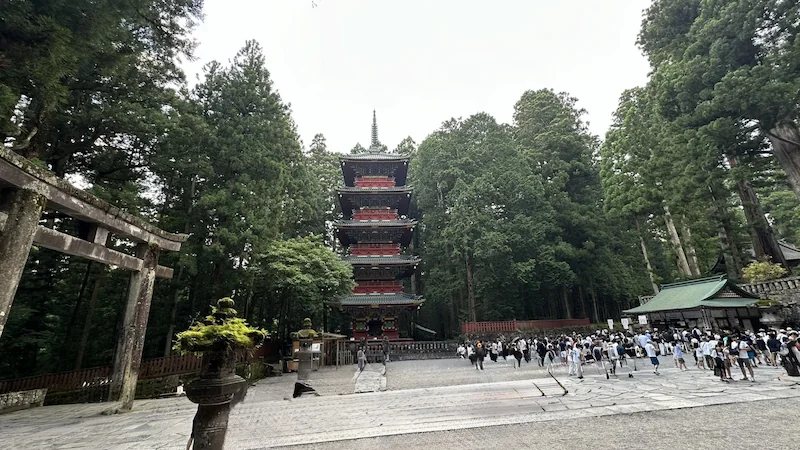
Read Nikko Toshogu not as a sightseeing attraction but as the end point of the Sengoku age, and one question becomes unavoidable: why was Ieyasu enshrined in Nikko? Why not Edo? Why not Suruga? Why place the “center” in a sacred mountain landscape enclosed by nature?
I felt the force of that question immediately after passing through the First Torii Gate. Ahead stood the Five-Story Pagoda and Omotemon Gate, and the atmosphere shifted from ordinary temple-and-shrine sightseeing into the feeling of having entered Nikko itself — like crossing a boundary.
The ground changes as you walk: asphalt gives way to gravel, earth, and approach path. The buildings of Rinnoji appear along the way, and you feel the sacred district — Sannai — gradually drawing you in. Nikko is a place where your mood changes simply by moving through it.
The Intersection of Geography, Sacred Space, and Power
The fact that Toshogu, Rinnoji, and Futarasan Shrine stand close together inside Nikko Sannai is part of the site’s power. By placing the center of Ieyasu worship on top of this older sacred landscape, the Tokugawa order could be connected to a vessel of time much longer than one political regime.
This is a place of faith, but it is also a place where Tokugawa rule is made to look right. Walking there, Toshogu’s splendor cannot be explained by devotion alone. In Iemitsu’s era, authority was translated directly into buildings and decoration, and Ieyasu’s deification became visible not only as religion, but as political power.
The stage was not placed in the political center of Edo. Edo’s power could shift with time. A sacred place carries older, harder-to-argue-with weight. To place Ieyasu in Nikko was to connect Tokugawa order not merely to the convenience of the victors, but to a larger frame: faith, sacred geography, and nature.
As a way of ending the Sengoku age, this was deeply rational. Winning by force does not prevent the next generation from trying to overturn that victory by force. To fix the ending, the victor had to be worshipped as a god — and that god had to be placed inside a powerful sacred vessel. Nikko was chosen as that vessel.
Splendor is not eternal. It can become a burden. When later financial strain on the shogunate is also considered, this vast stage set appears not only as authority, but as authority that was expensive to maintain. Nikko reflects both Tokugawa strength and Tokugawa limits.
The Relationship with Kunozan
Ieyasu is generally said to have been buried at Kunozan soon after his death and then, according to his wishes, transferred to Nikko the following year. The sequence from Kunozan to Nikko is not just a movement on a timeline. Think of Kunozan as the beginning and Nikko as the definitive version. Nikko was the place where Ieyasu’s deification could be completed as a Tokugawa state narrative — and this naturally leads into the meaning of Iemitsu’s Great Reconstruction.
 Related site — Kunozan, Shizuoka
Kunozan Toshogu: Where Ieyasu Was Buried First
Ieyasu died in 1616 and, following his own instructions, was buried at Kunozan; the transfer to Nikko followed in 1617. Kunozan Toshogu is regarded as the first Toshogu, and its gongen-zukuri shrine is described as the prototype. Note that Yomeimon and the carvings most visitors photograph at Nikko come from the 1636 Kan’ei reconstruction — a separate event from the 1617 founding. On-site notes on the National Treasure shrine and Ieyasu’s tomb.
Read the Kunozan Toshogu guide →
Related site — Kunozan, Shizuoka
Kunozan Toshogu: Where Ieyasu Was Buried First
Ieyasu died in 1616 and, following his own instructions, was buried at Kunozan; the transfer to Nikko followed in 1617. Kunozan Toshogu is regarded as the first Toshogu, and its gongen-zukuri shrine is described as the prototype. Note that Yomeimon and the carvings most visitors photograph at Nikko come from the 1636 Kan’ei reconstruction — a separate event from the 1617 founding. On-site notes on the National Treasure shrine and Ieyasu’s tomb.
Read the Kunozan Toshogu guide →
From Sengoku Warlord to Tosho Daigongen
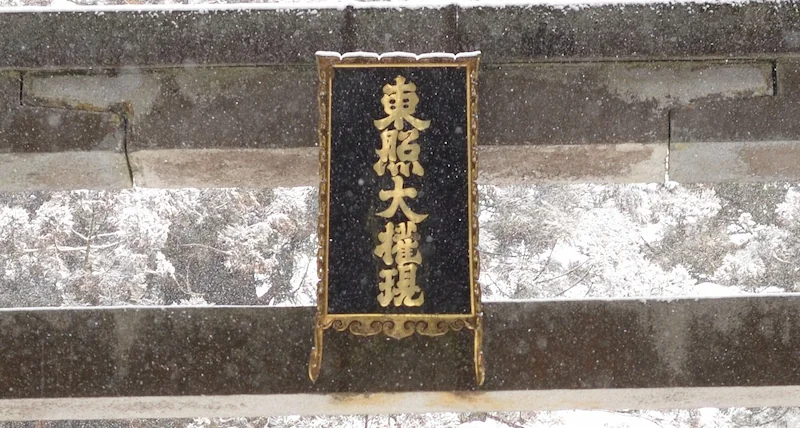
Inside the precinct, Ieyasu’s worship as Tosho Daigongen is strongly felt. The shrine name Toshogu is related but distinct, and separating the two makes the structure easier to understand. The inscriptions and plaques seen on site vary by location; this article focuses on the function — Toshogu as the place where Ieyasu is worshipped as Tosho Daigongen.
The Ieyasu here is no longer simply a Sengoku warlord or a shogun. He is worshipped as a god who watches over Tokugawa peace. The victor of the age of war is transformed after death into its guardian. As you walk through Toshogu, that transformation gradually becomes legible.
Ieyasu as the Victor of the Sengoku Age
Ieyasu’s life was not only about winning. It was about fixing the order that came after victory. (Ieyasu’s full life story is covered separately on the Tokugawa Ieyasu page.)
- He experienced the realities of the Sengoku age early, living as a hostage in childhood
- He survived among stronger powers such as the Imagawa and Oda, making careful decisions as his position grew
- Under the Toyotomi regime, he preserved his strength within the existing order while watching for the next age
- After Sekigahara, he seized the initiative and founded the Edo shogunate
But to understand Toshogu, the more important question is not that Ieyasu won — it’s how that victory was retold after his death.
The Sengoku age was harsh in a way that is difficult to imagine today. Against that background, some warlords — Ieyasu included — begin to look as though they were seeking not merely victory, but a stable world in which people no longer had to kill one another. From this perspective, the peace symbols throughout Toshogu are not simply propaganda. They can also be read as prayers by people who had survived a century of conflict.
Deification as a Political and Religious Device
Worshipping Ieyasu as Tosho Daigongen was not mere memorialization. Ieyasu the human being was elevated into the idea of rightness that underpins Tokugawa order.
Peace immediately after the Sengoku age was still fragile. Politics therefore leaned on the harder-to-move authority of faith. Toshogu is the place where that idea became visible as space.
Crucially, Ieyasu is not presented as a conqueror alone, but as an ideal ruler — one under whom people could live without fear of war. The next section, on the Treasure Museum video and its three values — martial power, wisdom, and righteousness — shows how that idealization is assembled.
What Iemitsu’s Great Reconstruction Was Trying to Do
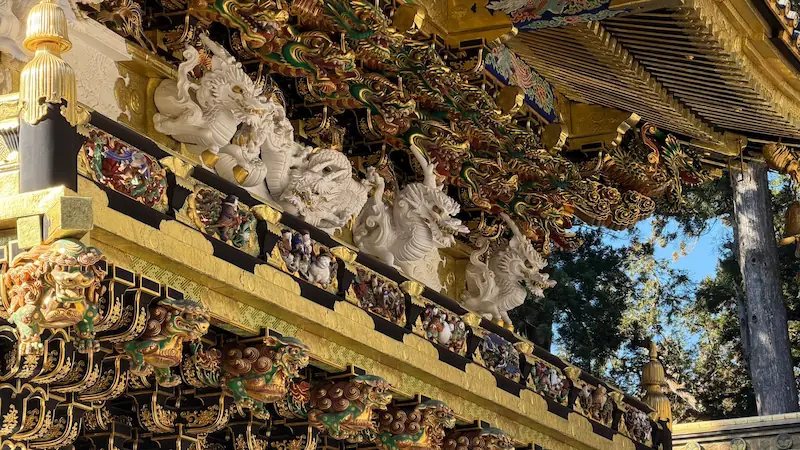
Nikko Toshogu’s splendor is purposeful. In the Kan’ei era, the third shogun, Tokugawa Iemitsu, ordered a large-scale reconstruction of the shrine. What matters is that this reconstruction did more than make the buildings more lavish. It turned the order centered on Ieyasu into something visitors could physically experience.
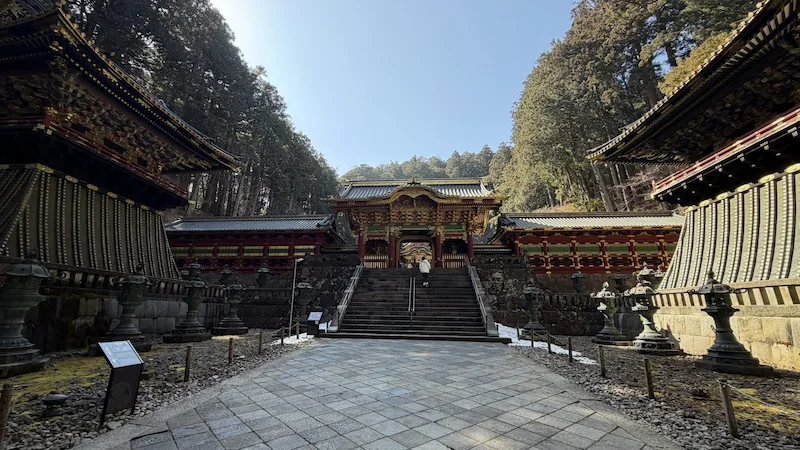
I felt its national scale in the sheer sweep of the precinct as I moved from the torii through Omotemon, Yomeimon, the Main Shrine, and the Inner Sanctuary. But what stood out even more was the density of the buildings and decoration. There are many large shrines in Japan. Toshogu is different because the density of detail is almost excessive. It does not rely on austere dignity. It is built to show and to narrate.
Reading Splendor as an Expression of Authority
Standing before Yomeimon, the first things that strike you are the number of carvings, their detail, and the use of color. This density does more than impress the eye. It pressures the body into understanding: this is the center of Tokugawa authority.
Sengoku architecture often tends toward practical purposes — attacking and defending. Toshogu pours time and money into decoration, then connects that decoration across the entire site. Such splendor only makes sense if the world is assumed not to be destroyed again. In other words, Toshogu visualizes the world the Tokugawa wanted to create: an order built on the assumption that peace would continue.
The point is not that luxury makes authority great. Rather, luxury pulls Tokugawa order away from “it continues because it is strong” and toward “it continues because it is right.” That is splendor as authority.
The Logic of Turning Toshogu into a State Device
Filial devotion to his grandfather was part of Iemitsu’s motivation — but devotion alone cannot explain the scale and density of what was built.
Toshogu is designed to tell visitors:
- This is not the grave of a private individual
- This is the center of Tokugawa order
- Therefore, the “ending” of the Sengoku age cannot be shaken
The crucial point is that none of this is told in words. It’s imprinted through spatial experience. As you pass from gate to gate and move closer to the center, the tension rises. Before the mind explains it, the body has already accepted the center of Tokugawa authority. That is the strength of Toshogu as a state device.
The Contrast with Taiyuin Reinforces Iemitsu’s Intention
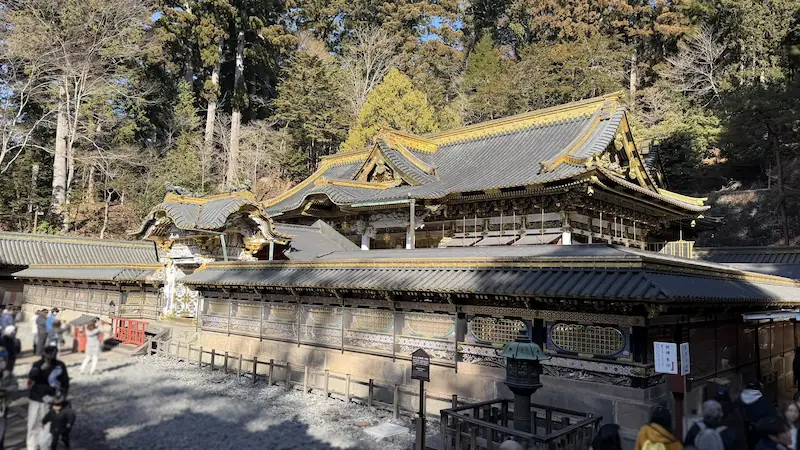
When I visited Taiyuin, I felt that if Toshogu is motion, Taiyuin is stillness. Both use a world of gold, but the resonance is different. Taiyuin does not compete. It inherits. (Taiyuin’s highlights are covered spot by spot on the Taiyuin, Treasure Museum & Hidden Spots archive.)
Iemitsu places his grandfather, Ieyasu, at the center as a god, and positions his own mausoleum beside that center. The arrangement and difference in atmosphere allow Tokugawa succession to be established without disturbing the hierarchy: the center remains Ieyasu. In this sense, Iemitsu’s reconstruction strengthened Ieyasu through splendor while also fixing Iemitsu’s own place within the order.
The Heisei-Era Restoration: How Yomeimon Got Its Color Back
The splendor described above hasn’t come down unchanged since the Edo period. Toshogu’s buildings are wood, lacquer, and painted decoration, all of which degrade over time and require periodic restoration. I did not confirm this in person during my visit, so this section relies on published information rather than on-site research (sources include Konishi Decorative Arts Co. and other published materials).
According to those published sources, Nikko Toshogu underwent a long restoration program known as the “Heisei Restoration,” carried out between 2003 and 2024. The National Treasure Yomeimon Gate specifically was restored over roughly four years, from June 2013 to its completion on March 10, 2017. Restoration of the painted decoration on the Sacred Stable — the building carved with the Three Wise Monkeys — is also reported to have progressed during and after the same period. Behind the shrine’s vivid color lies this ongoing cycle of conservation work.
The Treasure Museum Video: Ieyasu Through Martial Power, Wisdom, and Righteousness
The first room of the Treasure Museum opens with a video — a kind of prologue to the exhibition. It screens in a small theater-like space with cinema-style seats and ran about 20 minutes on the day I visited. The effect is deliberate: the museum hands you a story about Ieyasu before it shows you the objects.
The video doesn’t dwell on historical complexity so much as assemble Ieyasu’s virtues into one clear narrative: the hero who created peace. I summarize that narrative through three axes — martial power, wisdom, and righteousness — as the values the video emphasizes.
Martial Power: The Strength to Survive the Sengoku Age
The Ieyasu of the video is not presented first as an ambitious conqueror. His story begins with childhood hostage experience and the turmoil of war, then moves toward a desire to end conflict.
What struck me was how defeat and suffering are reframed as lessons rather than failures. Martial strength is connected not with destruction, but with training and rebuilding. In the video, “martial power” is not praised as violence itself. It becomes the strength that had to exist in order to create the conditions for peace.
Wisdom: Governance and Long-Term Strategy
The “wisdom” the video emphasizes is not cleverness for its own sake. It is wisdom for governance: learning in a difficult environment, organizing institutions, and eventually shaping a city such as Edo.
Significantly, wisdom here is not cunning. It’s presented as the practical skill needed to maintain order over time — less about winning battles than about moving society toward conditions in which battles become less likely.
Righteousness: Legitimacy and Moralization
This may be the core of the video. Ieyasu is not framed simply as someone people obeyed because he was strong. The story moves toward a picture of people gathering around him because they understood and shared his purpose. Values such as not harboring resentment, valuing trust, and maintaining a fair order are brought forward repeatedly.
This “righteousness” is not just morality — it functions as legitimacy. It creates the feeling that this peace was not merely the convenience of the victor, but something that ought to be preserved. The video ultimately gathers martial power and wisdom into righteousness, moving Ieyasu from victor to guardian.
After watching the video, the buildings, gates, and carvings are easier to see not as decoration, but as devices for fixing the story of peace.
How the Architecture Embeds Tokugawa Legitimacy
The power of Nikko Toshogu is not simply that magnificent buildings stand here and there. Its real strength is that the more you walk, the more the level of importance seems to rise — and your own mood changes with it. The buildings are not merely placed in sequence. The route through gates, corridors, shrine buildings, and the Inner Sanctuary forms one story.
Yomeimon was where I most strongly felt the level rise. At that gate, Toshogu shifts from famous sight to sacred center. From that point onward, the splendor no longer feels playful. It becomes the sensation of entering the heart of a sacred domain.
The Hierarchy of Gates, Corridors, and the Main Shrine
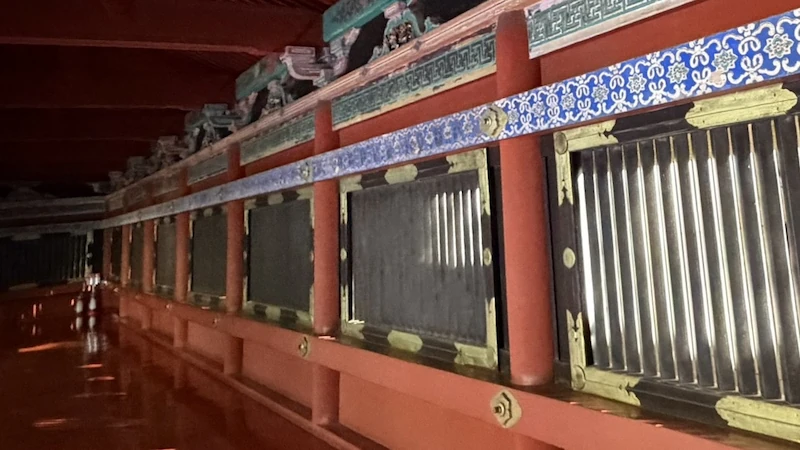
Toshogu is designed so that each gate makes you feel the next area is of a higher order. Yomeimon is the most powerful turning point. The density of carving, the color, and the sheer amount of visual information strike all at once, making you understand that this is the Tokugawa center.
Beyond that, the quality of space changes. You walk through corridors, remove your shoes, and feel the coolness underfoot. Some spaces are dim, separating you from the brightness and noise outside. This is not just circulation. It is close to a ritual passage — the space turns a sightseer into a worshipper.
Inside the Main Shrine and Worship Hall, that feeling becomes decisive. The dimness, the old painted surfaces, and the arrangement at the front make it clear that this is not an exhibit but a ritual center. Photography is prohibited, which also shifts the mode: from looking to facing.
The sequence — overwhelmed at the gate, physically prepared by the corridors, finally facing the center — completes a psychological argument. Tokugawa legitimacy enters not as explanation, but as experience.
The Inner Sanctuary as the Space of Deification
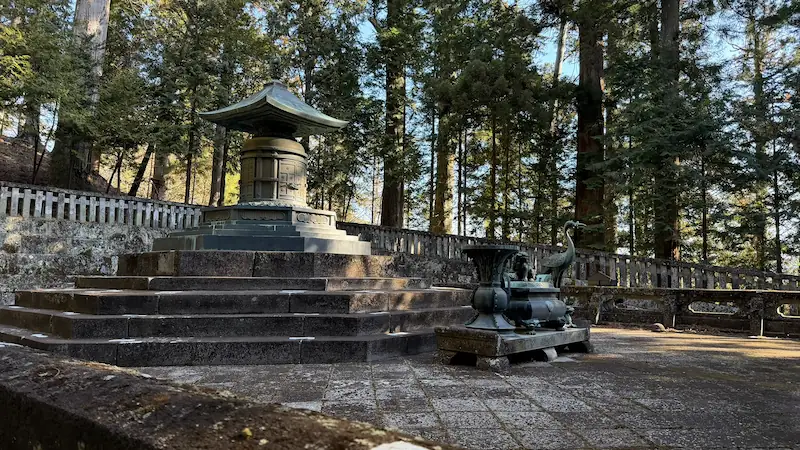
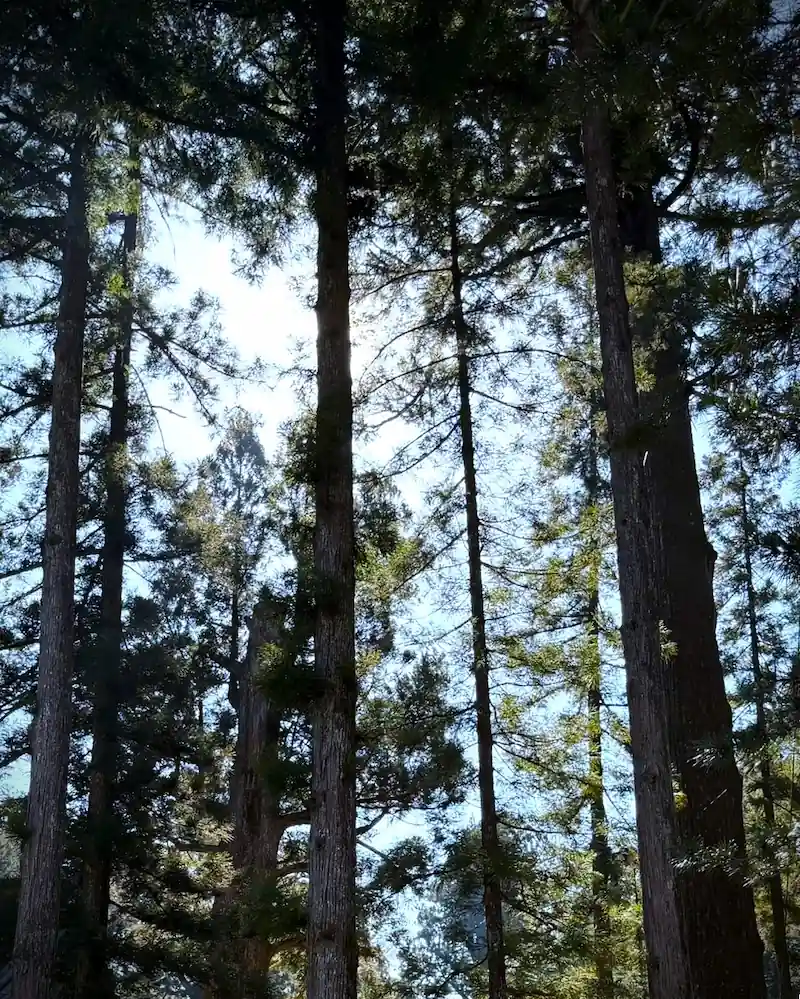
The route toward the Inner Sanctuary changes the air again. Sakashita Gate, just beyond the Sleeping Cat, has detailed carvings, but the color feels more restrained than Yomeimon. After passing through it, you leave the glittering world behind and enter a stone path surrounded by tall cedars. The tension comes from the meeting of nature and human design.
Eventually, looking up from below, the bronze torii rises at the top of the stone steps. Passing through it genuinely feels like entering a higher level of sacredness. That sense of arrival is the clearest evidence that the Inner Sanctuary is not merely “behind” the shrine. It is designed as the point where deification reaches its destination.
What makes this work is that the route leads you to the worship hall on the way back. First you see the pagoda and feel that this is the center. Then you pray. Because the order works this way, you don’t simply “see” the Inner Sanctuary — you feel that you have arrived. The Inner Sanctuary functions not only as a physical center, but as the end point of the story.
A Note on Sources: Fact, Tradition, and Interpretation
This article distinguishes between three things: established fact, site tradition, and interpretive reading. Confirmed history forms the base. But Toshogu also carries layers of memory, hope, and storytelling that are worth examining on their own terms — not as facts, but as evidence of how people wanted to understand the place.
- Fact: dates, systems, events, and relationships that can be supported by common historical accounts or official information
- Narrative: on-site signboards, museum presentations, oral traditions, and widely circulated stories — not all of which are facts, but all of which show how people wanted to understand the site
- Interpretation: my reading of why those stories matter and what they emphasize — presented not as final truth, but as readings that make the site’s structure easier to understand
Rumors Are Included, but Clearly Marked: Tenkai, Akechi Mitsuhide, and Other Stories
Nikko has stories connected with Akechi Mitsuhide and Tenkai: the theory that Tenkai was Mitsuhide, claims about Akechi-style motifs at Yomeimon, and the origin of the place name Akechidaira. Even when such stories are not historically confirmed, they remain part of the fascination of the site.
Here’s how this article approaches them:
- If reliability is weak, the story is clearly presented as rumor or tradition
- The article then asks why the rumor is attractive and what kind of desire or story it reveals
- It is kept separate from sections that require factual reading — dates, systems, and relationships between historical figures
The Tenkai = Mitsuhide theory is generally considered weak as history. But the question worth asking is: why does this rumor persist? The desire to place a hidden architect behind Nikko speaks to Toshogu’s power as a site that generates stories. Here, a rumor isn’t evidence — it’s a prompt for asking why people wanted that story.
Yomeimon’s Reversed Pillar and Kunozan’s Reversed Crest — Warding Off Misfortune by Staying Unfinished
Yomeimon Gate has what’s known as a reversed pillar. I’ve seen it myself on site — subtle enough that you could easily walk past without noticing. Part of the carved pattern on the pillar is deliberately upside down. I’ve heard this explained on site as following a tradition that a building begins to decline the moment it’s completed, so one detail is left deliberately unfinished as a charm against misfortune. This should be treated as a local tradition rather than a confirmed historical fact.
Interestingly, the same idea turns up at Kunozan Toshogu in Shizuoka, where a Tokugawa hollyhock crest is reportedly placed deliberately upside down in one spot, for what I understand to be the same “never quite finish it” reasoning. The fact that both Toshogu shrines carry this same reversed motif is a striking coincidence — it points to a shared set of values at sites built to honor Ieyasu: the hope for permanence, expressed paradoxically by leaving something incomplete.
With this approach, Toshogu becomes easier to see not as a lavish tourist site, but as a place where the end of the Sengoku age was remade into a story everyone could accept.
What to Check On Site
Having read about Nikko as a place, Iemitsu’s reconstruction, and the spatial hierarchy of the buildings, the best way to walk Toshogu is to decide what you want to notice — not just which famous sights to find. Here are the points where I personally felt the story change during my visit.
Yomeimon Gate: Splendor as Composition and Story
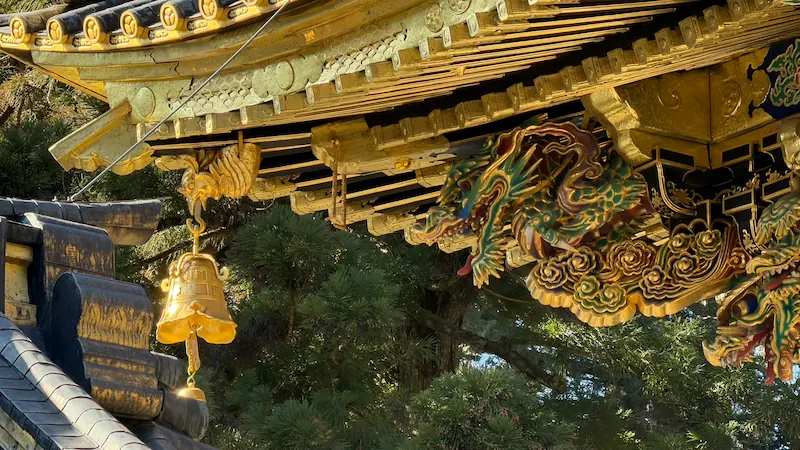
Before looking closely at the carvings, notice the composition. What impressed me most was how the torii lines up with Yomeimon from the front. Your gaze is naturally drawn toward the center, and your body understands that everything beyond this point is core space.
Then notice how Yomeimon isn’t simply a gate with carvings — it looks almost as though the gate is buried inside them. The amount of information is enormous, and the carvings are not mere decoration; they carry narrative. The famous idea that one could look at Yomeimon all day and never tire of it makes sense because each glance reveals something new. Here, splendor is not just brightness. It is density that narrates Tokugawa legitimacy. Looking for the reversed pillar mentioned above is one more way to read this gate.
The Three Wise Monkeys: Don’t Stop at the Three Famous Figures
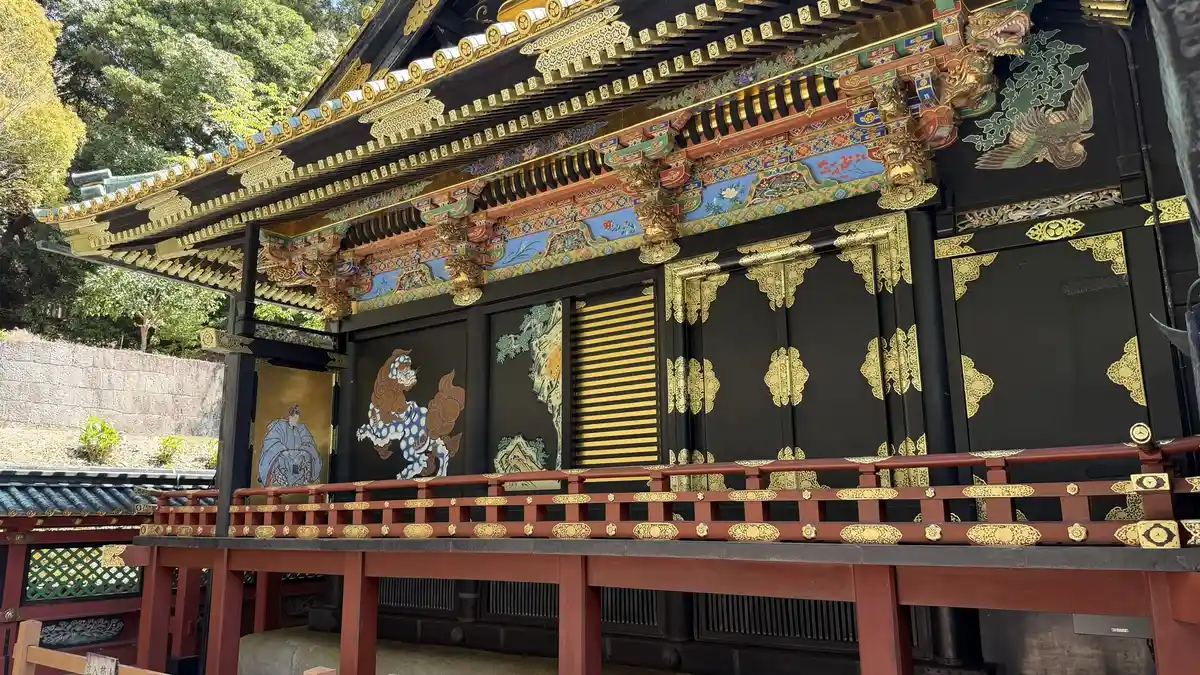
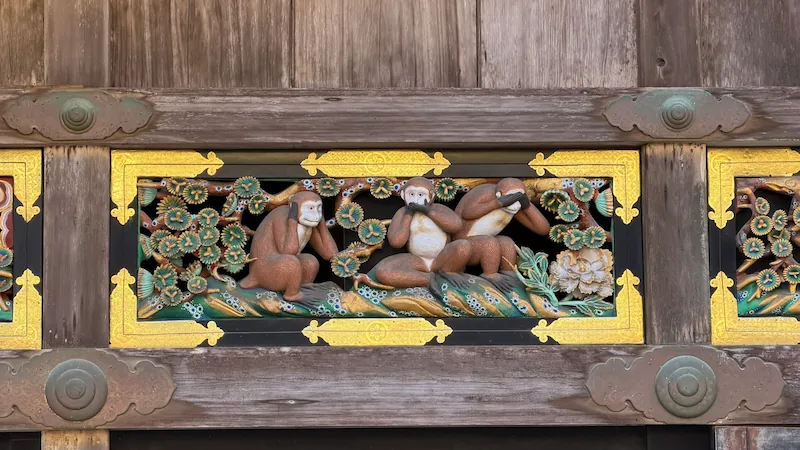
The Three Wise Monkeys are famous, but on site, the important thing is to look beyond them. The building they are carved on, the Sacred Stable, contains several monkey scenes, which can be read as a sequence of human life. This is one sign that Toshogu’s story is not only about military victory. It also turns toward how people should live: order, conduct, and teaching.
Sleeping Cat → Sakashita Gate: Passing the Boundary to the Inner Sanctuary
Beyond the Sleeping Cat, the air changes. Sakashita Gate has carvings, but not the bright spectacle of Yomeimon. Its coloring is more restrained, giving it a quiet strength. Rather than overwhelming with brilliance, the route grows quieter as it moves inward — teaching you, through atmosphere alone, that the Inner Sanctuary is not just a rear area but the entrance to the space of deification.
The Inner Sanctuary: The Pagoda and the Sense of Open Sky
At the Inner Sanctuary, the feeling of arrival did not come only from seeing the pagoda. The surrounding area is enclosed by tall cedars, yet the space around the pagoda feels as if the sky opens there. That spatial experience is decisive. Even without reading a word of explanation, you feel it: this is the center. Architecture and nature work together to elevate the place where Ieyasu is enshrined. By the time you arrive here, Toshogu’s role as the place that fixed the end of the Sengoku age into sacred experience becomes much easier to feel.
Taiyuin: Iemitsu’s Succession
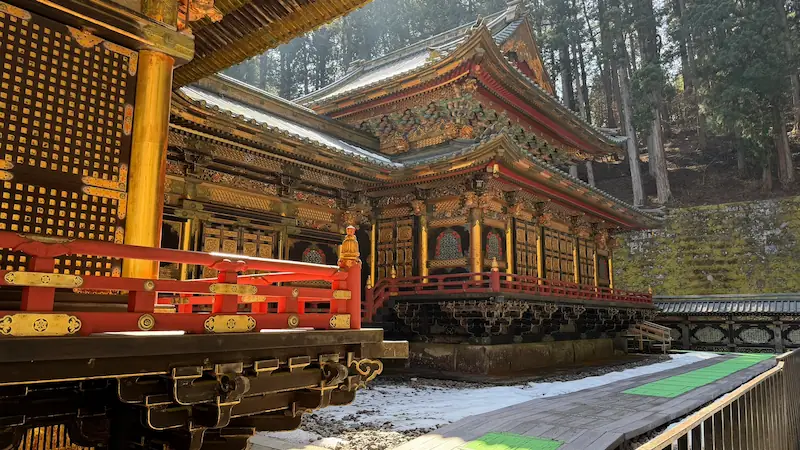
Taiyuin shares Toshogu’s world of gold, yet its impression is different. The clearest difference lies in color and light.
- Toshogu: white and gold are prominent, and sunlight tends to make the gold appear bright
- Taiyuin: vermilion and gold feel stronger together, and the surrounding trees make the gold appear darker and more subdued
If Toshogu is motion, Taiyuin is stillness. This is not merely a matter of taste — it also feels like the right distance for Iemitsu, who honors the center while positioning himself as inheritor. Seeing Taiyuin after Toshogu makes this staging of succession easier to understand.
Winter at Toshogu: Gold Against Snow and Stillness
This visit took place in February, in the depths of winter, and I have a personal fondness for Toshogu in that season. Gold carvings seen through snow and crisp winter air carry a different kind of stillness than the greens of summer or the maples of autumn. If you’re still deciding when to visit, winter is worth considering on its own merits, not just as an off-season alternative.
FAQ
Nikko was an old sacred mountain area. By placing Ieyasu there, Tokugawa order could be connected to a longer time frame of faith, sacred place, and nature rather than to the convenience of one victorious regime. It made Ieyasu appear not merely as a victor, but as a guardian.
The usual narrative is that Ieyasu was first buried at Kunozan after his death and was later transferred to Nikko. Rather than a simple change of location, this can be read as a stage in elevating Ieyasu’s deification from regional worship to a national center. Think of Kunozan as the beginning and Nikko as the definitive version.
They are often discussed together, but separating them helps. Tosho Daigongen is Ieyasu’s divine title, while Toshogu is the shrine dedicated to him. This article focuses on what becomes possible once Ieyasu is worshipped as a divine presence.
It fixed legitimacy as experience. Each gate raises the level of the place; the corridors regulate the visitor’s behavior; the Inner Sanctuary becomes the destination. The route itself makes Tokugawa order felt physically rather than explained verbally.
They are famous, but their placement matters. The monkey carvings can be read as a sequence of life, while the Sleeping Cat sits at the boundary to the Inner Sanctuary. Their meaning becomes clearer when seen as turning points in the story, not isolated symbols.
Toshogu’s splendor is not defensive or practical. It visualizes a story meant to preserve order. The victor of the Sengoku age is moved after death into the role of guardian, and that transformation is experienced through architecture, decoration, and route.
You can see the structure of succession. Ieyasu, the grandfather, is placed at the center, while Iemitsu fixes his own position as inheritor. Toshogu feels central and powerful; Taiyuin feels quieter and close by. The contrast reads as succession without rivalry.
Stories that are not historically confirmed should not be treated as evidence. But they’re still worth examining. The desire to place a hidden architect behind Nikko speaks to Toshogu’s power as a site that generates stories. The Tenkai = Mitsuhide theory is generally considered weak as history, but its persistence is meaningful as memory and imagination.
It is not a fixed historical term, but an interpretive phrase used here. Even after Sekigahara and the Siege of Osaka, making people accept that the age of war was over required another task. Toshogu can be read as the place where that task took shape through deification and spatial design.
It helps you notice where the story changes: the shift at Yomeimon, the way corridors turn sightseers into worshippers, the stillness beyond the Sleeping Cat, and the sense of arrival at the Inner Sanctuary. With these points in mind, Toshogu becomes a place that fixed the end of the Sengoku age into sacred space — not just a collection of famous sights.
According to published sources, Nikko Toshogu as a whole underwent a long restoration program known as the Heisei Restoration between 2003 and 2024. The National Treasure Yomeimon Gate specifically was restored over about four years, from June 2013 to its completion on March 10, 2017. This information comes from published sources rather than my own on-site research (sources include Konishi Decorative Arts Co. and other published materials).
Yes — I’ve seen this reversed pillar myself on site. Part of its carved pattern is deliberately upside down, following a tradition that leaving one detail unfinished wards off misfortune, since a building is said to begin declining the moment it’s completed. The same idea is reported at Kunozan Toshogu, where a hollyhock crest is said to be inverted in one location — an interesting parallel shared between the two Toshogu shrines.
Related Pages
Return to the Tokugawa Ieyasu Page
Return to the Main Page
☕ Support This Site
Following the Shogun is built on original fieldwork and on-site research.
If you found this guide useful, your support helps keep it going.

You can also support via QR code


comment