


Kunozan Toshogu: Tokugawa Ieyasu’s First Tomb, and How to Visit It
When Tokugawa Ieyasu died in 1616, his own instructions sent his body not to Nikko but to Kunozan (久能山), a steep coastal hill outside the city of Shizuoka. The shrine built over that grave was finished in 1617, is designated a National Treasure today, and is described by the shrine itself as the origin of every Toshogu shrine in Japan. This guide is based on a visit on 3 April 2026, riding the ropeway up from the Nihondaira plateau and walking down the 1,159 stone steps of the old pilgrimage path afterwards.
- Is Kunozan Toshogu worth visiting, and what actually remains?
- Ropeway or 1,159 steps: decide before you set out
- Getting to Kunozan Toshogu from Shizuoka, Tokyo, Kyoto and Osaka
- What it costs and how long to allow: tickets, bundles and bus fares
- Why Ieyasu was buried here: his 1616 instructions and the 1617 shrine
- Before the shrine: Kunozan was a temple, and then a castle
- Kunozan and Nikko Toshogu: first burial, first shrine, later Nikko
- What to see on site: eight places not to walk past
- The Kunozan Toshogu Museum: Ieyasu’s own possessions, and a no-photography rule
- Frequently asked questions
- Related Pages
- Official sources
Is Kunozan Toshogu worth visiting, and what actually remains?
Most visitors meet the Toshogu shrines at Nikko, north of Tokyo. Kunozan came first. Tokugawa Ieyasu — the warlord who won the battle of Sekigahara in 1600 and founded the Tokugawa shogunate, the military government that ruled Japan until 1868 — died in 1616 and left instructions that his body be buried on this hill. The shrine describes itself as the first foundation of the Toshogu tradition that later spread across the country.
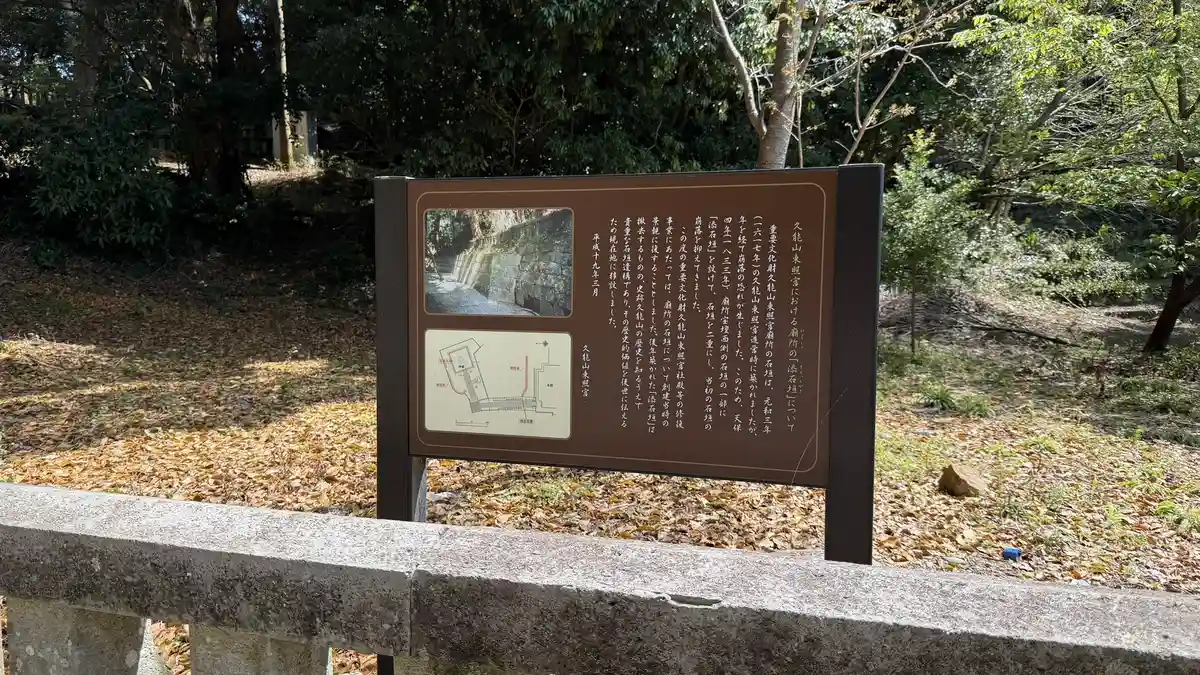
The practical point for a traveller is that this is not a ruin. The main shrine buildings completed in 1617 are still standing and were designated a National Treasure — Japan’s highest heritage category — in December 2010. The two-storey gate, the sacred stable, the drum tower, the Hie Shrine and several other early-1600s structures survive as Important Cultural Properties, the tier immediately below National Treasure. Unlike most Japanese castle sites, where only stone walls and earthworks are left, here you look up at original lacquered and painted woodwork.
Good for
Following Ieyasu in order
This is where he was buried first. Seeing Kunozan before Nikko makes the move to Nikko the following year far easier to understand.
Good for
Early Edo-period architecture up close
The National Treasure buildings are finished in black lacquer with densely painted carvings. You can stand just outside the railing, so the detail is genuinely readable.
Good for
Views of Mount Fuji and the sea in one day
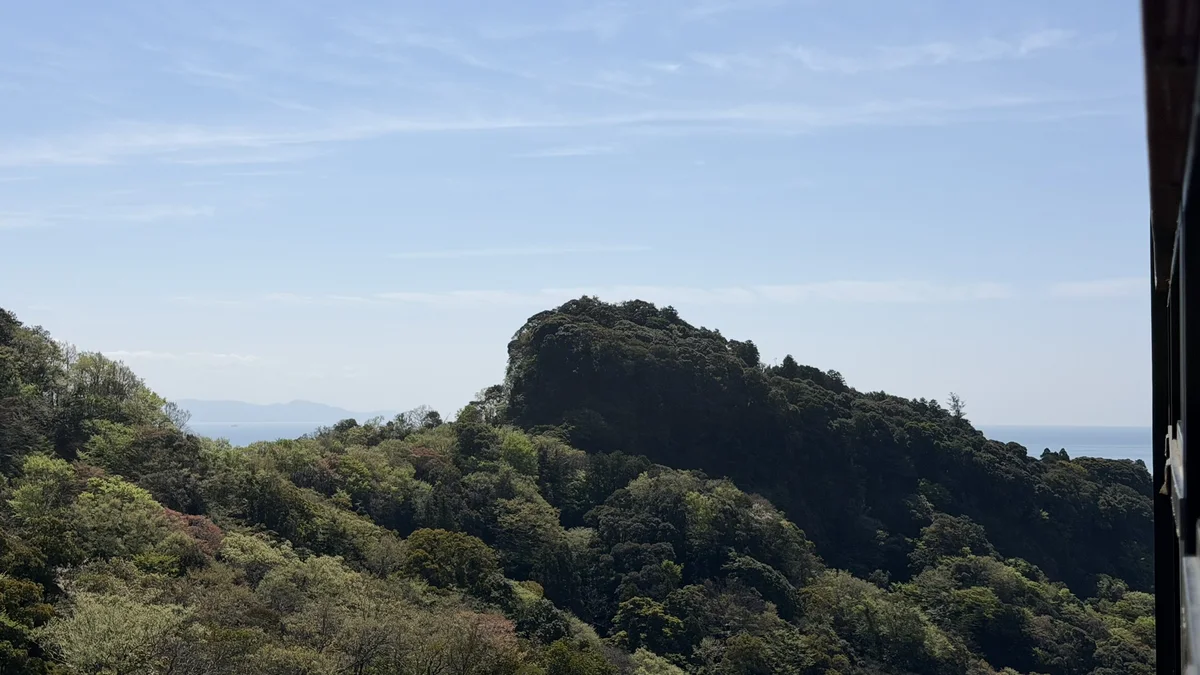
Nihondaira, the plateau at the ropeway’s upper station, looks across Shimizu Port to Mount Fuji. The hill itself looks down on Suruga Bay.
Think twice if
You need step-free access
Even with the ropeway there are stone steps inside the grounds. The shrine states that the route to the main hall is stairs only, with no ramps, and that wheelchair access is not possible.
Compared with Nikko this is a smaller and much quieter site. That is not a drawback. The walk from the gate to the main hall is short, so the time you save goes into looking at the carvings instead of queueing.
Ropeway or 1,159 steps: decide before you set out
No road reaches Kunozan Toshogu, and cars cannot drive up to it. There are two entrances on opposite sides of the hill, and the one you choose changes your walking time, your effort, and — this catches people out — which bus stop you leave from.
- North entrance: Nihondaira plateau (日本平) → Nihondaira Ropeway → Kunozan upper station
- South entrance: Kunozan-shita bus stop (久能山下) → the old stone stairway, 1,159 steps → the shrine
| Option | Effort and time | What you gain | Getting back |
|---|---|---|---|
| Ropeway both ways | Only the steps inside the grounds. The ride itself is about 5 minutes each way | Mount Fuji from Nihondaira, and Suruga Bay from the cabin | Same entrance and exit. Buses from Nihondaira return to Shizuoka and Higashi-Shizuoka stations |
| Stairway both ways | 1,159 steps up and back down. The shrine gives about 20 minutes for the climb from the foot | The whole historic approach, plus the Suruga Bay view from the Ichinomon gate | Same entrance and exit. Buses from Kunozan-shita back towards Shizuoka Station |
| Ropeway up, stairway down (the route used here) |
The climb is done for you; you only walk the steps downhill | Mount Fuji, the bay and the historic approach in a single visit | You come out somewhere different from where you went in, so plan the return from Kunozan-shita |
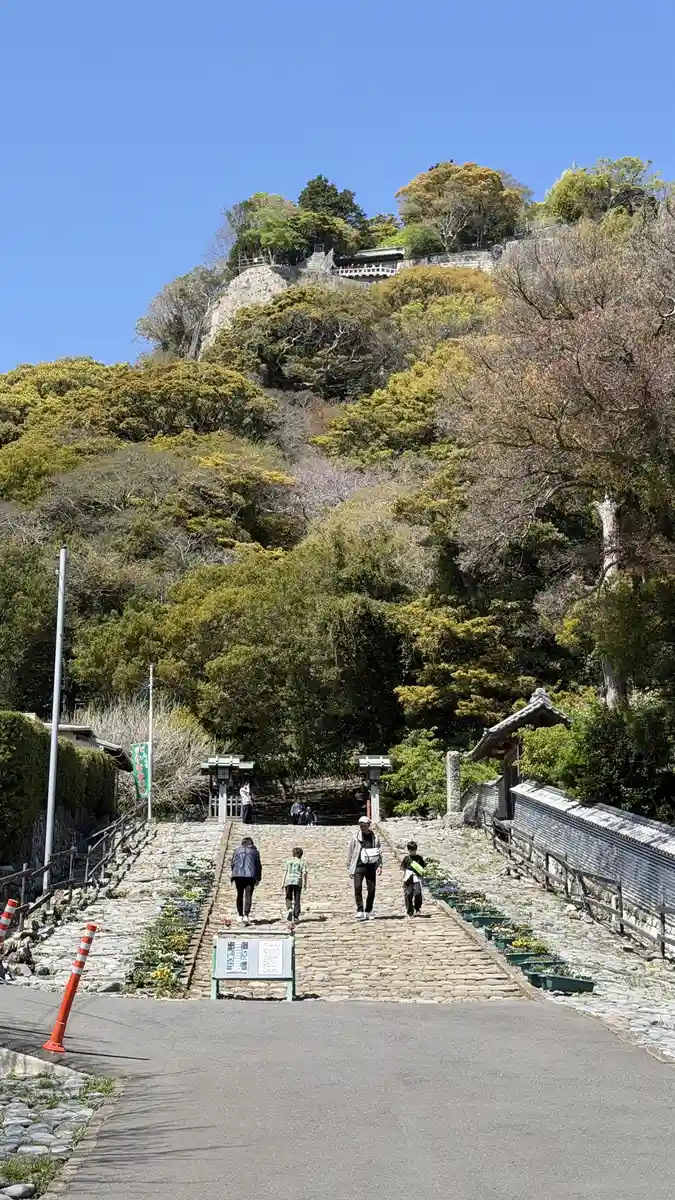
I took the third option. Going down, the stairway was not hard work. It is worth knowing, though, that these are not modern engineered stairs. They are built from fitted stone blocks, and neither the height nor the depth of the steps is consistent, so you watch your feet even on the way down. Going up the same stairway is a real climb.
From the upper station you pass through the two-storey gate, climb to the main hall, and climb again to the mausoleum. This was no surprise to me, but for anyone who finds stairs difficult it adds up. The shrine states plainly that the route to the main hall is stone steps with no ramps or similar facilities.
The stairway climbs in seventeen switchbacks over stone blocks rather than poured concrete. Smooth-soled shoes are a bad idea in either direction.
Tap any photo to enlarge
Getting to Kunozan Toshogu from Shizuoka, Tokyo, Kyoto and Osaka
Shizuoka sits on the Tokaido Shinkansen line roughly midway between Tokyo and Nagoya, which makes it an easy stop on a Tokyo–Kyoto itinerary rather than a detour. The practical base is JR Shizuoka Station (JR静岡駅). Both routes up the hill start there by local bus. I actually started one station further east, at JR Higashi-Shizuoka Station (JR東静岡駅), because the Nihondaira bus calls there too.
Do not confuse the two: Shizuoka Station is the Shinkansen stop, while Higashi-Shizuoka Station is a local-line station about one stop away with no Shinkansen service. Both are operated by JR Central, so a Japan Rail Pass covers the trains but not the buses or the ropeway.
Shizuoka sits on the Pacific side of Honshu, roughly midway between Tokyo and Nagoya. By Hikari shinkansen, the rough guide is: Tokyo Station to Shizuoka Station is 180.2 km and about 1 hour; from Kyoto Station about 1 hour 20–30 minutes; from Shin-Osaka about 2 hours (the fastest Nozomi trains do not stop at Shizuoka, so these times are for the Hikari and Kodama services that do). In everyday terms, Shizuoka is a little closer to Tokyo than the midpoint between Tokyo and Shin-Osaka.
As a landmark for finding the right platform, JR Central’s conventional-line station numbering gives Shizuoka Station the code “CA-17” (numbers increase from Atami Station, “CA-00,” heading towards Nagoya; confirmed via press coverage). Neighbouring Higashi-Shizuoka Station is said to carry “CA-16,” though that comes from a station-numbering reference site rather than press coverage we could independently confirm. The Shinkansen gates themselves are not numbered, but the code appears on the conventional-line platform signage.
Access — Kunozan Toshogu
| Address | 390 Negoya, Suruga-ku, Shizuoka City, Shizuoka Prefecture |
|---|---|
| Nearest useful station | JR Shizuoka Station. JR Higashi-Shizuoka Station is also served by the Nihondaira bus |
| Shinkansen station | JR Shizuoka Station, served by Hikari and Kodama trains on the Tokaido Shinkansen (Nozomi trains do not stop here) |
| From major cities | The Nihondaira Ropeway leaflet gives roughly 1 hour from Tokyo and about 50 minutes from Shinagawa by Hikari, about 1 hour from Nagoya and about 2 hours from Shin-Osaka. Kodama trains take longer. Times vary by service, so check on the day |
| North route (ropeway) | From JR Shizuoka Station take the Nihondaira route bus (日本平線, route number 41) run by Shizutetsu Just Line (しずてつジャストライン, the local bus operator in the Shizuoka Railway group) to the terminus, Nihondaira Ropeway (日本平ロープウェイ). The shrine gives about 45 minutes, then about 5 minutes on the ropeway. The same bus route calls at Higashi-Shizuoka Station |
| South route (stairway) | From JR Shizuoka Station take the same operator’s Ishida-Kaido route bus (石田街道線) to Higashi-Otani (東大谷), about 40 minutes, then change to route 14 for a Kunozan-shita (久能山下) service, about 15 minutes. The Ishida-Kaido name covers several route numbers (11, 12, 14 and others) depending on which branch a bus takes, so it is safest to check the destination board reads “Higashi-Otani” or “Kunozan-shita” rather than the number alone. The shrine notes that some direct services also run. From the foot of the hill, allow about 20 minutes for the steps |
| Ropeway hours | First cabin from Nihondaira 9:10; last cabin from Kunozan 17:00 (checked 26 September 2026) |
| Ropeway fares | Adults (junior high school age and above) ¥1,250 return, ¥700 one way. Children aged 4 to 12 ¥630 return, ¥350 one way (checked 26 September 2026) |
| Recommended option | Ropeway if you want to limit climbing. The stairway if you want the historic approach and the Ichinomon view |
| Difficulty on site | Stone steps only. The stairway has seventeen switchbacks and 1,159 steps. The shrine states there are no ramps to the main hall and that wheelchair use is not possible |
| By car | Vehicles cannot reach the shrine itself. Park at the top of Nihondaira — the shrine describes the car park there as free, with space for 200 cars — or use a private car park at Kunozan-shita and walk up |
| Opening hours | 9:00–17:00, open every day. Last admission 10 minutes before closing (checked 26 September 2026) |
| Planned closure | The ropeway is scheduled to stop for equipment renewal work from Tuesday 1 December to Monday 21 December 2026. The shrine can still be visited on foot by the stairway during that period. Services can also be suspended in bad weather or after an earthquake, so check on the day |
Map: Higashi-Shizuoka Station to Nihondaira Ropeway
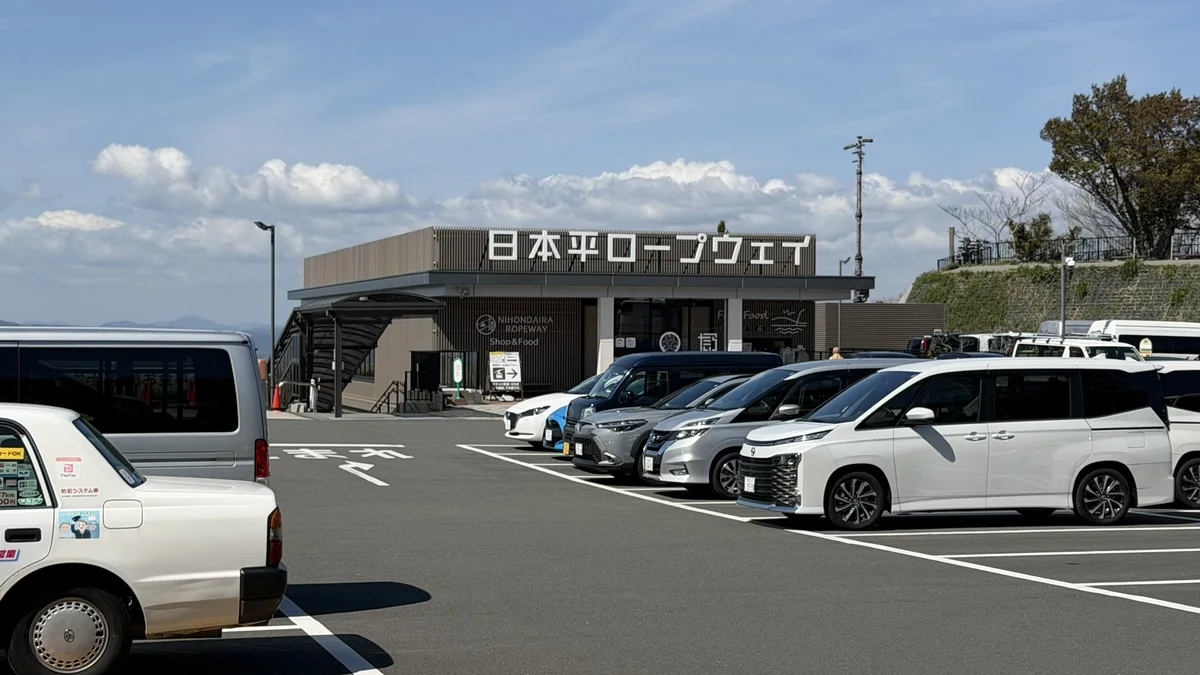
By public transport, from JR Higashi-Shizuoka Station to the Nihondaira Ropeway station
Bus destination displays and stop signs are mostly in Japanese. The characters to look for on the bus are 日本平ロープウェイ for the ropeway terminus, and 久能山下 if you are heading for the foot of the stairway instead.
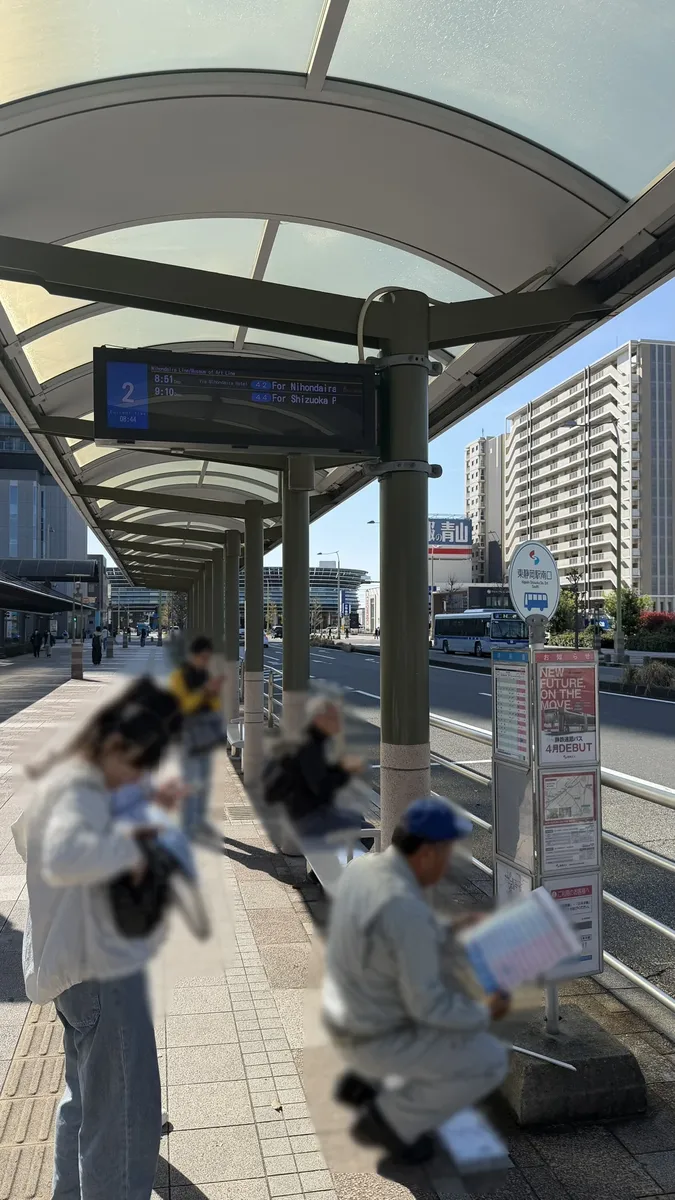
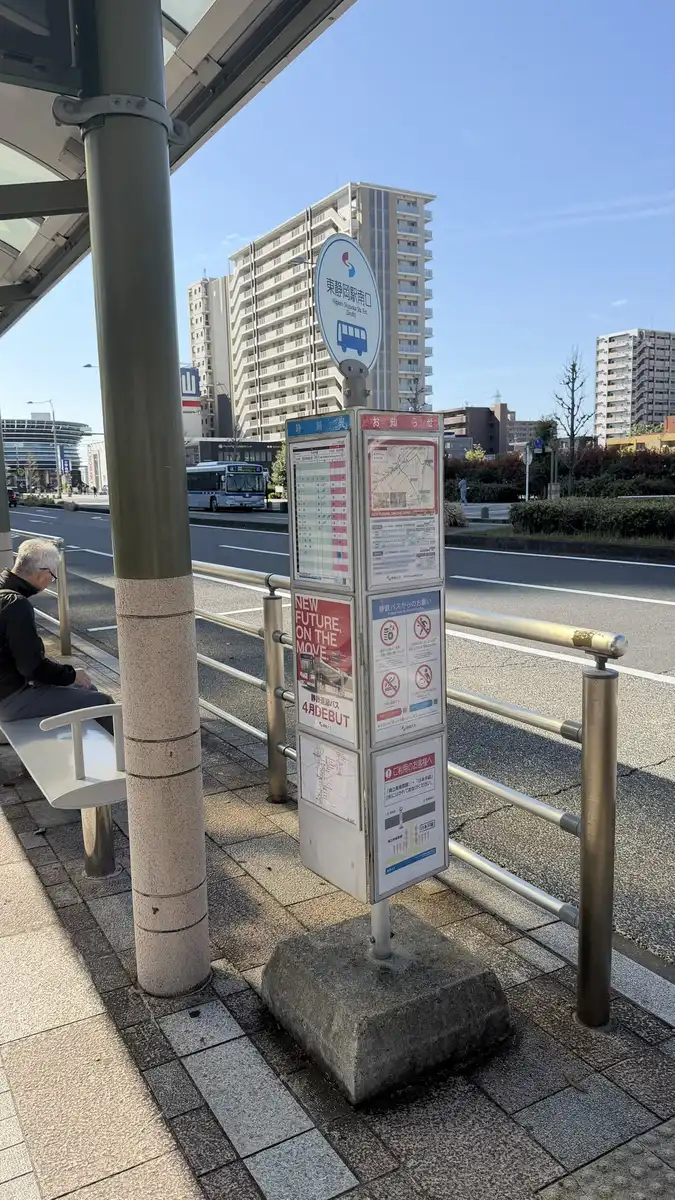
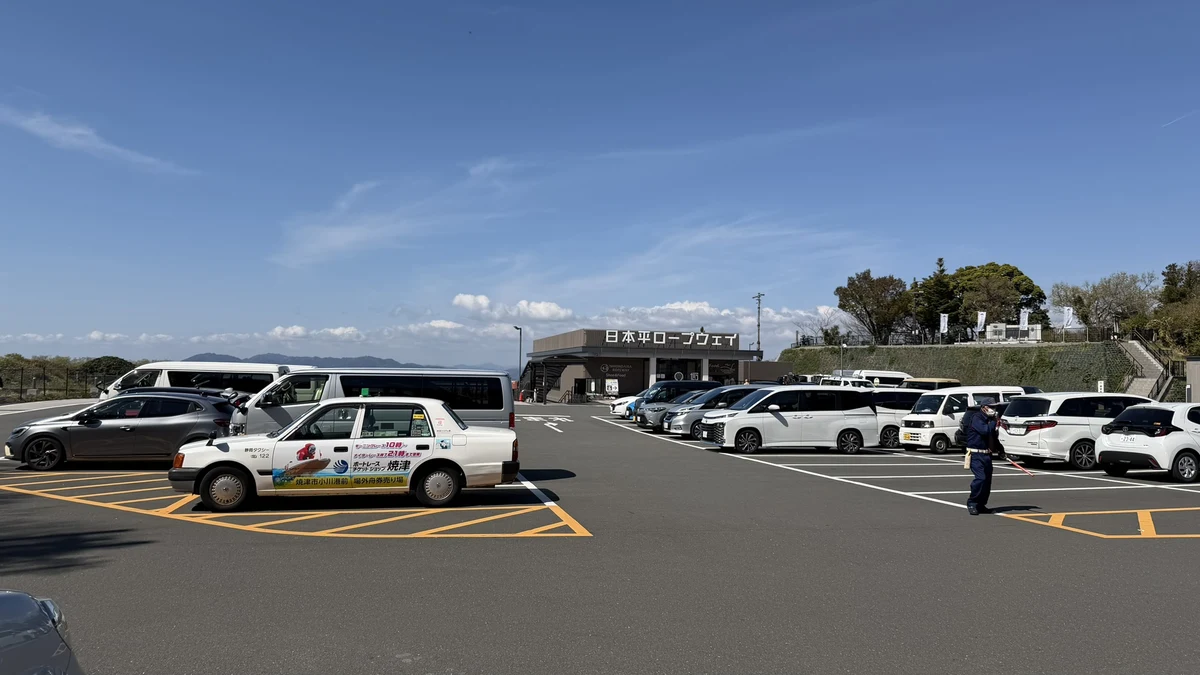
Tap any photo to enlarge
Allow a few minutes at Nihondaira before boarding the ropeway. In early April the cherry trees were in flower and Mount Fuji stood clearly beyond Shimizu Port. Getting Mount Fuji and Suruga Bay on the same short trip is one of the genuine advantages of approaching from this side.
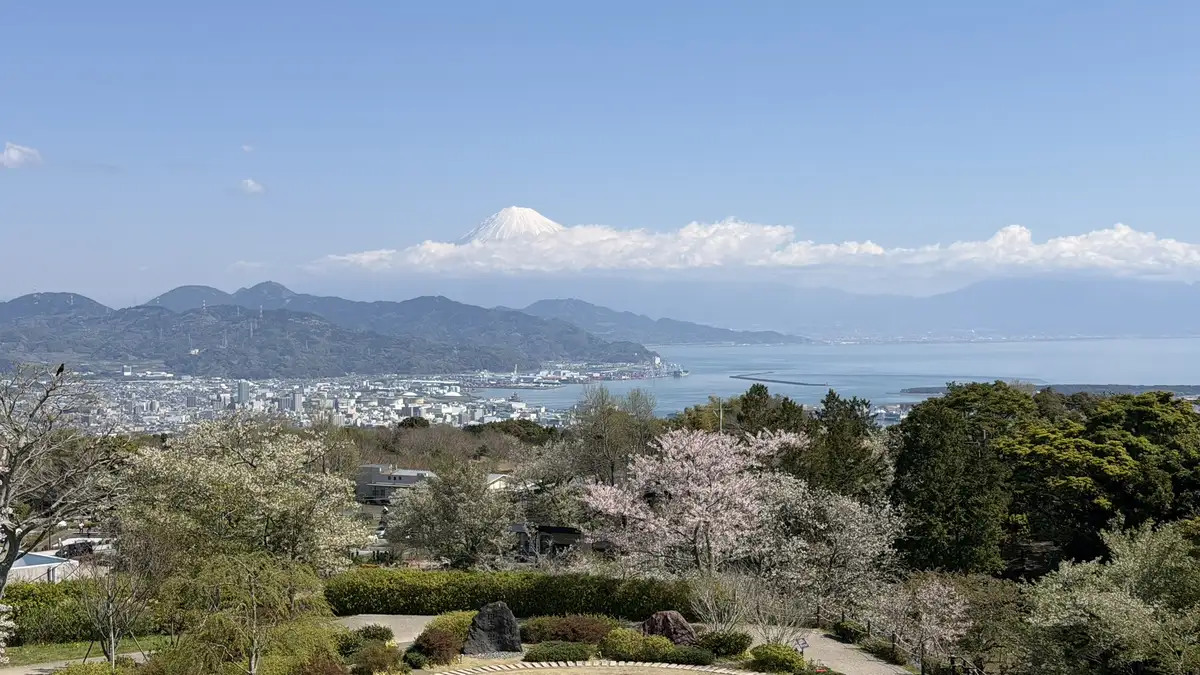
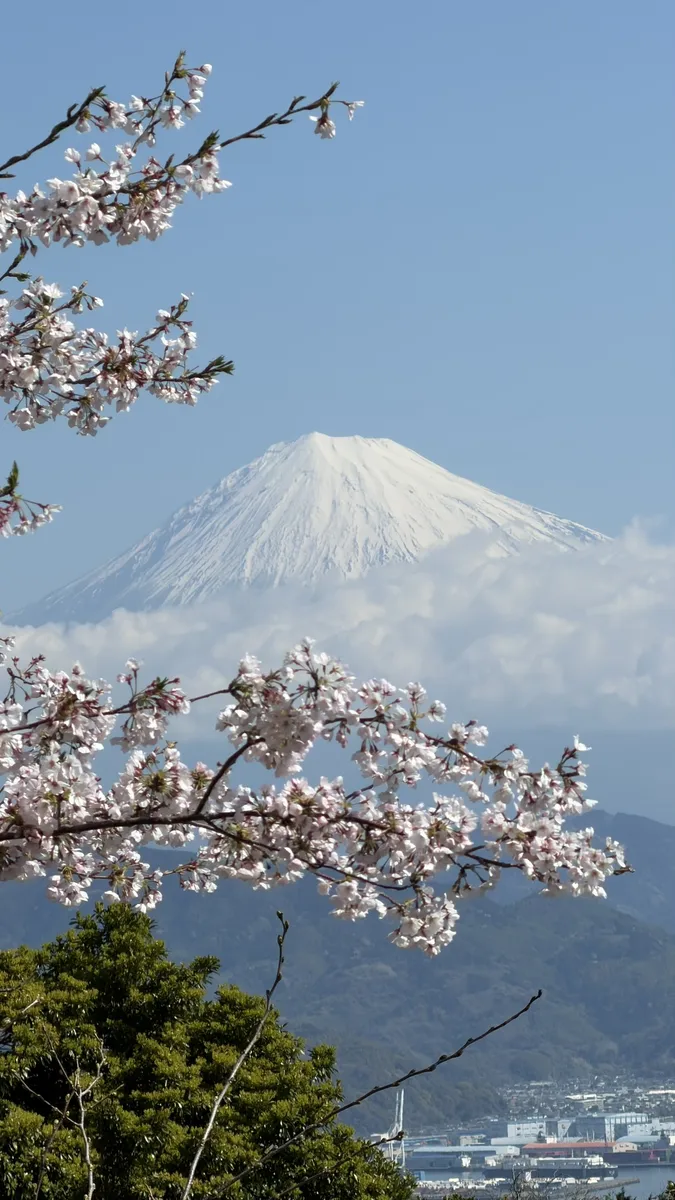
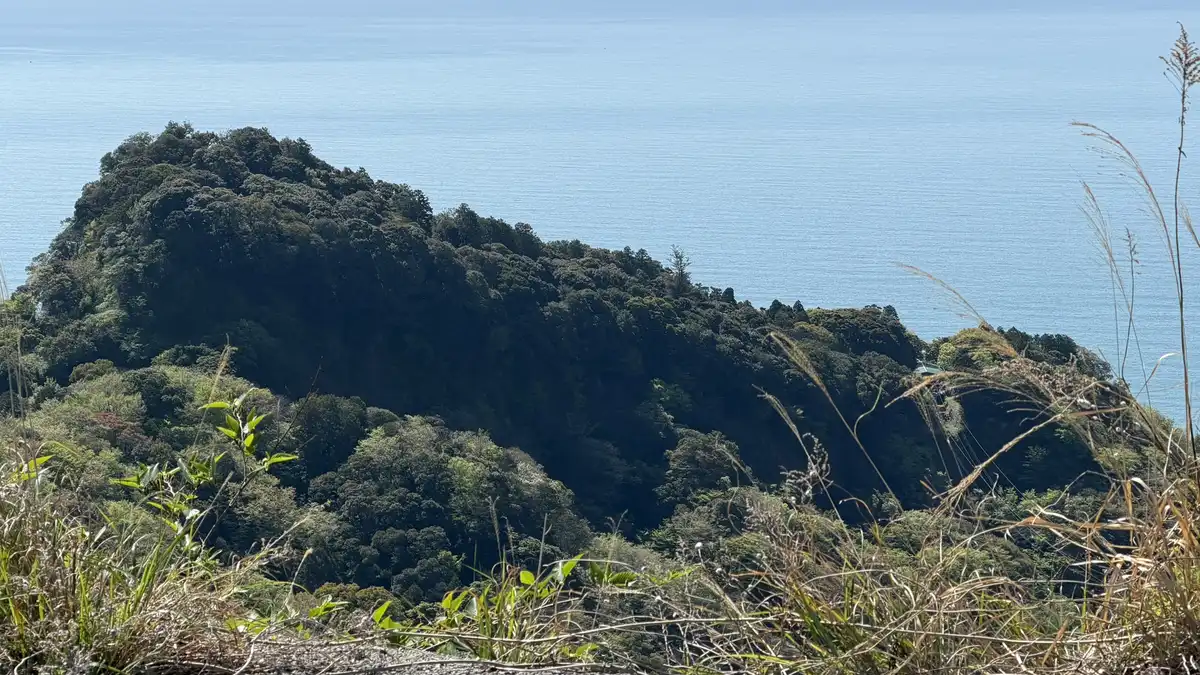
Tap any photo to enlarge
What it costs and how long to allow: tickets, bundles and bus fares
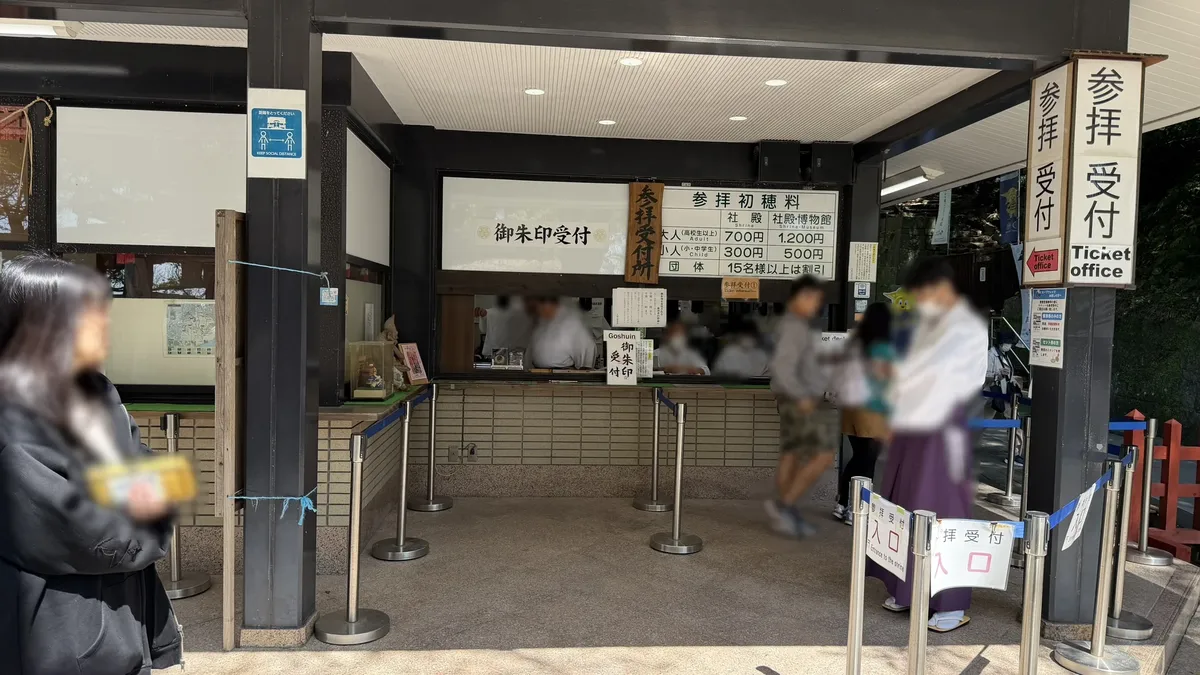
Admission is split three ways: the shrine buildings, the museum, or a combined ticket. If you want to see Ieyasu’s personal possessions and the shogunal arms and armour, take the combined ticket. If you are here for the architecture and the tomb alone, the shrine ticket is enough. If you are using the ropeway, there are bundles that include a return ride, but the discount is not what you would expect — on one of them there is no discount at all, which is worth knowing before you queue.
| Ticket | Shrine | Museum | Combined |
|---|---|---|---|
| Adults (high school age and above) | ¥700 | ¥600 | ¥1,200 |
| Children (elementary and junior high) | ¥300 | ¥300 | ¥500 |
Individual rates, checked against the shrine’s official information on 26 September 2026. Separate rates exist for groups of 15 or more and for visitors holding a Japanese disability certificate.
| Ropeway bundle | Adult | Junior high | Elementary |
|---|---|---|---|
| Two-part ticket (return ride + shrine) | ¥1,950 | ¥1,550 | ¥930 |
| Three-part ticket (return ride + shrine + museum) | ¥2,300 | ¥1,700 | ¥1,100 |
Nihondaira Ropeway rates, checked 26 September 2026. Both bundles assume a return ride, so they do not suit the ropeway-up, stairway-down route.
What the bundles actually save, and what the whole trip costs
The answer is not what the word “bundle” suggests. The two-part ticket costs exactly the same as buying a return ropeway ride and a shrine ticket separately — there is no discount at all, only the convenience of one transaction instead of two. The three-part ticket does save money if you are going to the museum: ¥150 for an adult.
| Ticket | Bundle | Bought separately | Difference |
|---|---|---|---|
| Two-part, adult | ¥1,950 | ¥1,950 (¥1,250 ride + ¥700 shrine) | No saving |
| Two-part, junior high | ¥1,550 | ¥1,550 (¥1,250 ride + ¥300 shrine) | No saving |
| Two-part, elementary | ¥930 | ¥930 (¥630 ride + ¥300 shrine) | No saving |
| Three-part, adult | ¥2,300 | ¥2,450 (¥1,250 ride + ¥1,200 combined) | Saves ¥150 |
| Three-part, junior high | ¥1,700 | ¥1,750 (¥1,250 ride + ¥500 combined) | Saves ¥50 |
| Three-part, elementary | ¥1,100 | ¥1,130 (¥630 ride + ¥500 combined) | Saves ¥30 |
Calculated from the published rates of Nihondaira Ropeway and Kunozan Toshogu, checked 26 September 2026. The two operators draw the adult line in different places: the ropeway charges the adult fare from junior high school age, while the shrine charges the adult rate only from high school age. That is why a junior high school student pays an adult ropeway fare and a child admission.
If you are riding the ropeway both ways, though, there is a cheaper way still. Shizutetsu Bus sells a combined ticket covering the bus, the ropeway and admission — ¥3,000 for an adult, ¥1,450 for a child. It includes the bus both ways between Shizuoka Station / Shin-Shizuoka and Nihondaira Ropeway, the ropeway both ways, and the combined admission ticket for the shrine and the museum (Shizutetsu Bus information, checked 26 September 2026).
| From Shizuoka Station, ropeway both ways, with the museum (one adult) | Made up of | Total |
|---|---|---|
| Shizutetsu Bus combined ticket | Bus both ways, ropeway both ways and combined admission, all included | ¥3,000 |
| Ropeway three-part ticket plus bus fares | ¥1,420 bus return + ¥2,300 three-part ticket | ¥3,720 |
| Everything bought separately | ¥1,420 bus return + ¥1,250 ropeway return + ¥1,200 combined admission | ¥3,870 |
Calculated from the published rates of Shizutetsu Bus, Nihondaira Ropeway and Kunozan Toshogu, checked 26 September 2026.
That is ¥870 less than buying the parts separately and ¥720 less than the ropeway’s own three-part ticket. It also produces an oddity worth noticing: at ¥3,000 with the museum included, it costs less than the ¥3,370 you would pay for a round trip with shrine admission and no museum at all. If you are making a return trip from Shizuoka Station, start here. It is sold at the Shin-Shizuoka and Shizuoka Station bus offices, and also as a digital ticket through the RYDE PASS app; it is valid for one nominated day only.
The catch is the bus section, which runs between Shizuoka Station / Shin-Shizuoka and Nihondaira Ropeway and nowhere else. If you board at Higashi-Shizuoka, as on this visit, or if you walk down the stairway and take the bus back from the coast, the return half goes unused and buying the parts separately works out cheaper.
Adding the buses gives you the real cost of the visit. These are the fares paid on 3 April 2026. Bus fares are revised from time to time, so check the current figure with Shizutetsu Just Line on the day.
| Bus leg (one way) | Fare |
|---|---|
| JR Higashi-Shizuoka Station → Nihondaira Ropeway | ¥570 |
| JR Shizuoka Station → Nihondaira Ropeway | ¥710 |
| Kunono-kyoku-mae (久能局前, at the foot of the stairway on the coast) → JR Shizuoka Station | ¥650 |
Fares paid on 3 April 2026. Starting from Higashi-Shizuoka rather than Shizuoka saves ¥140 each way, ¥280 on a return trip. Higashi-Shizuoka is one stop east of Shizuoka on the JR Tokaido Line, and the Nihondaira bus calls at both.
Put together, one adult pays this much for each way of doing it.
| Route (one adult) | Made up of | Total |
|---|---|---|
| Ropeway both ways from Higashi-Shizuoka (shrine only) | ¥1,140 bus return + ¥1,950 two-part ticket | ¥3,090 |
| Ropeway both ways from Higashi-Shizuoka (with museum) | ¥1,140 bus return + ¥2,300 three-part ticket | ¥3,440 |
| Ropeway up, stairway down (shrine only) — the route taken here |
¥570 bus + ¥700 one-way ride + ¥700 shrine + ¥650 bus home | ¥2,620 |
| Ropeway up, stairway down (with museum) | ¥570 bus + ¥700 one-way ride + ¥1,200 combined + ¥650 bus home | ¥3,120 |
Starting from JR Higashi-Shizuoka Station. From Shizuoka Station, add ¥280 to the bus cost of a return trip.
Going up by ropeway and walking down the stairway comes out ¥470 cheaper for the shrine alone, or ¥320 cheaper with the museum, and it gets you the 1,159 steps as well. What you give up is the symmetry: you come back to the city from the coast road rather than from Nihondaira. The steps are uneven in height even going down, so this is not a decision to make on price alone.
Buy the two-part ticket at ¥1,950 and ride only one way and you have paid ¥550 more than you needed to, since a one-way ride and a shrine ticket come to ¥1,400. The three-part ticket at ¥2,300 costs ¥400 more than the ¥1,900 a one-way ride and a combined ticket would have cost.
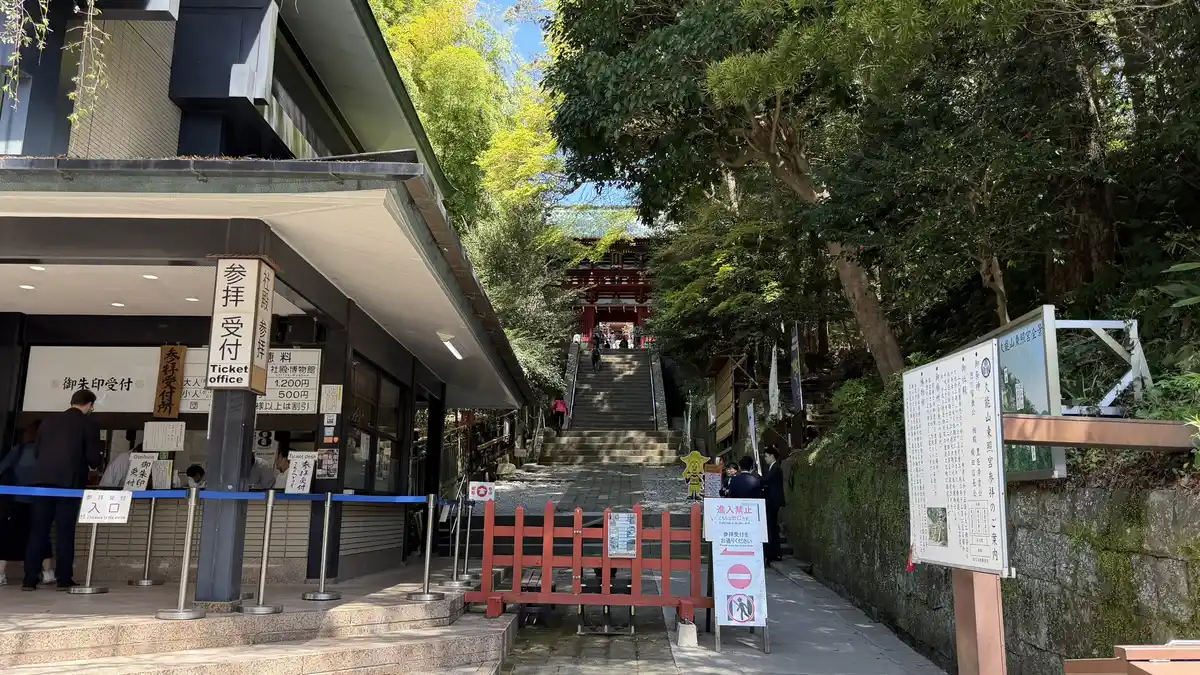
Ropeway tickets and the bundles are sold at the ropeway station at Nihondaira; admission tickets are sold at the reception desk at the top. Nihondaira Ropeway notes that a bundle has to be stamped at the shrine office when you use it.
For timing, the shrine publishes segment estimates: about 30 minutes from the stone gateway at the foot of the hill to the shrine office, about 10 minutes from there to the main hall, about 5 minutes on to the mausoleum, and 30 to 40 minutes for the museum. Added together, climbing the stairway and seeing the museum comes to roughly 90 minutes to two hours.
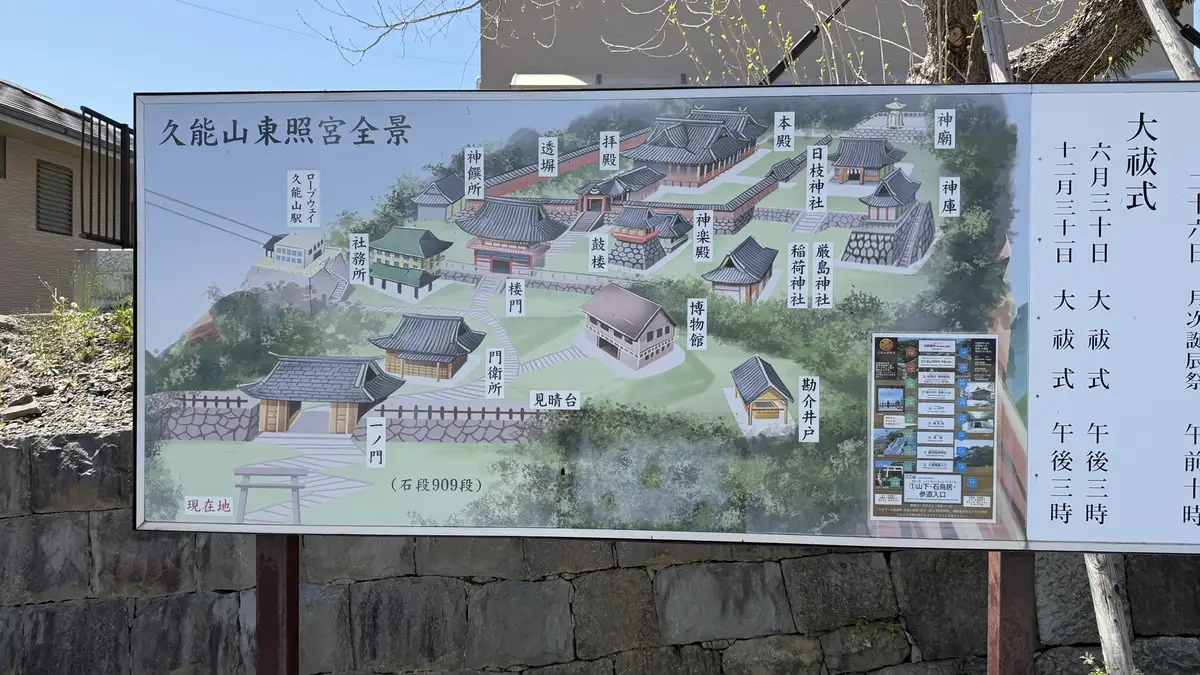
In practice, stopping constantly for photographs, it took me about two hours and fifteen minutes from arriving at the top of the ropeway to reaching the bottom of the stairway, including about 20 minutes in the museum. The one hard limit to keep in mind is the 16:50 cut-off for admission.
Why Ieyasu was buried here: his 1616 instructions and the 1617 shrine
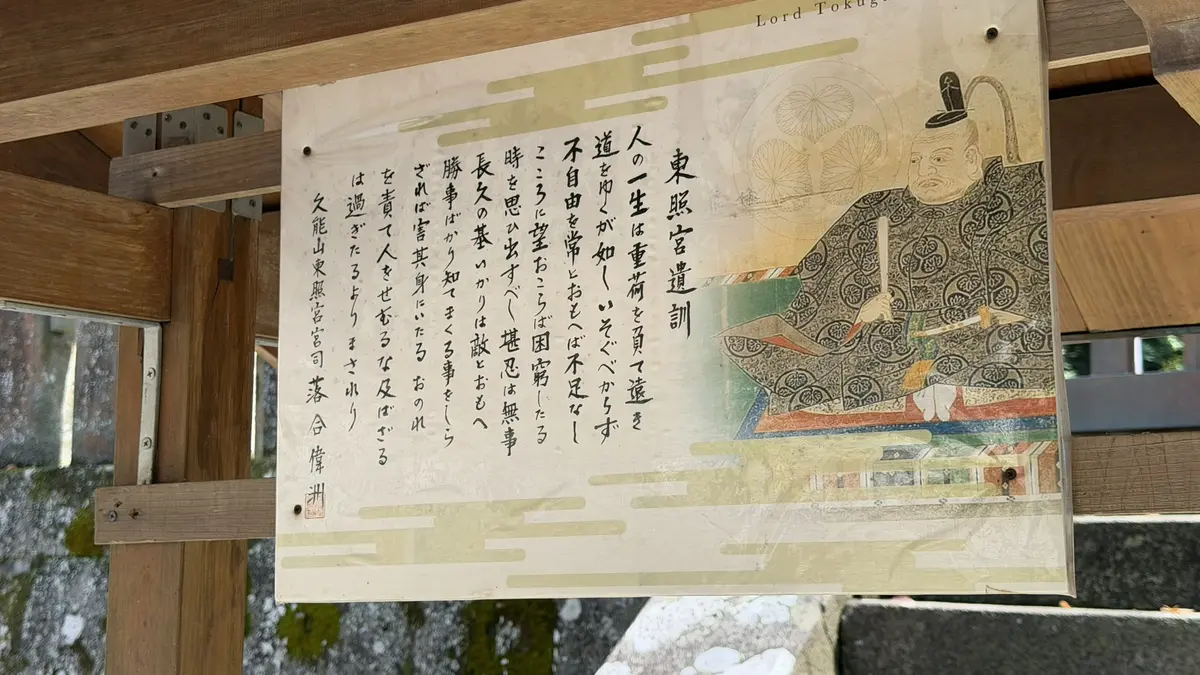
Tokugawa Ieyasu was born at Okazaki Castle in Mikawa Province — today the eastern part of Aichi Prefecture — in the twelfth month of 1542 by the old Japanese calendar. He died in 1616 at the age of 75 at Sunpu, the castle town that is now central Shizuoka City. According to the shrine, his own instructions meant that he was carried up to Kunozan and buried the same night.
Construction of the shrine over that grave began in May 1616 and was finished in December 1617, about a year and seven months later. The work was directed by Nakai Masakiyo, the shogunate’s chief carpenter. Ieyasu was enshrined under the divine name Tosho Daigongen (東照大権現), and the architectural form used here is known as gongen-zukuri after that name. The shrine states that this became the model for the many Toshogu shrines founded across Japan afterwards.
Ieyasu named three separate places.According to information published by the shrine, the diary of the monk Konchiin Suden records that in 1616 Ieyasu directed that his body be buried at Kunozan in Suruga Province (now central Shizuoka Prefecture), that his funeral be held at Zojoji temple in Edo — present-day Tokyo — and that after the first anniversary of his death a small hall be built at Nikko, in Shimotsuke Province, to make him the guardian deity of the eight eastern provinces. The division of roles between Kunozan, Edo and Nikko was planned from the start.
One point deserves care, because sources word it differently. Kunozan Toshogu states today that the mausoleum stands on the spot where Ieyasu’s body was buried. A reference case published by the Edo-Tokyo Museum library, on the other hand, cites literature saying that his coffin was moved from Kunozan to Nikko in 1617. Where his remains finally lie is therefore described differently depending on the source. This guide treats as established only what both accounts share: that he was buried at Kunozan in 1616, and that an enshrinement at Nikko followed in 1617.
Tap any photo to enlarge
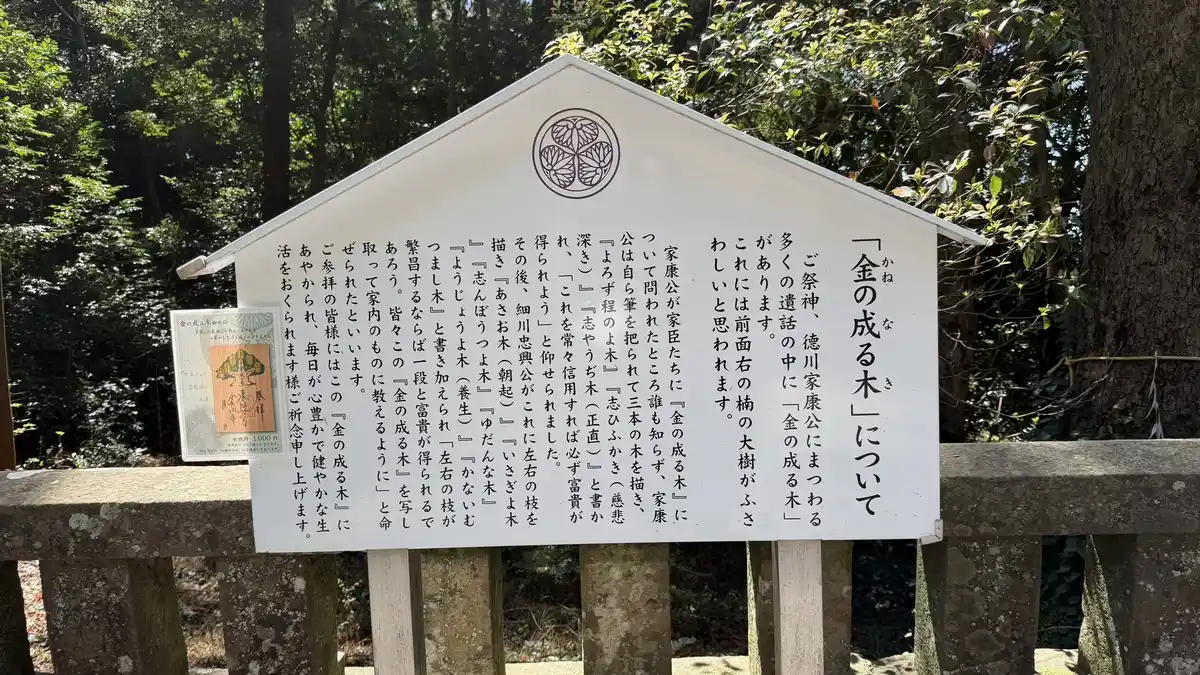
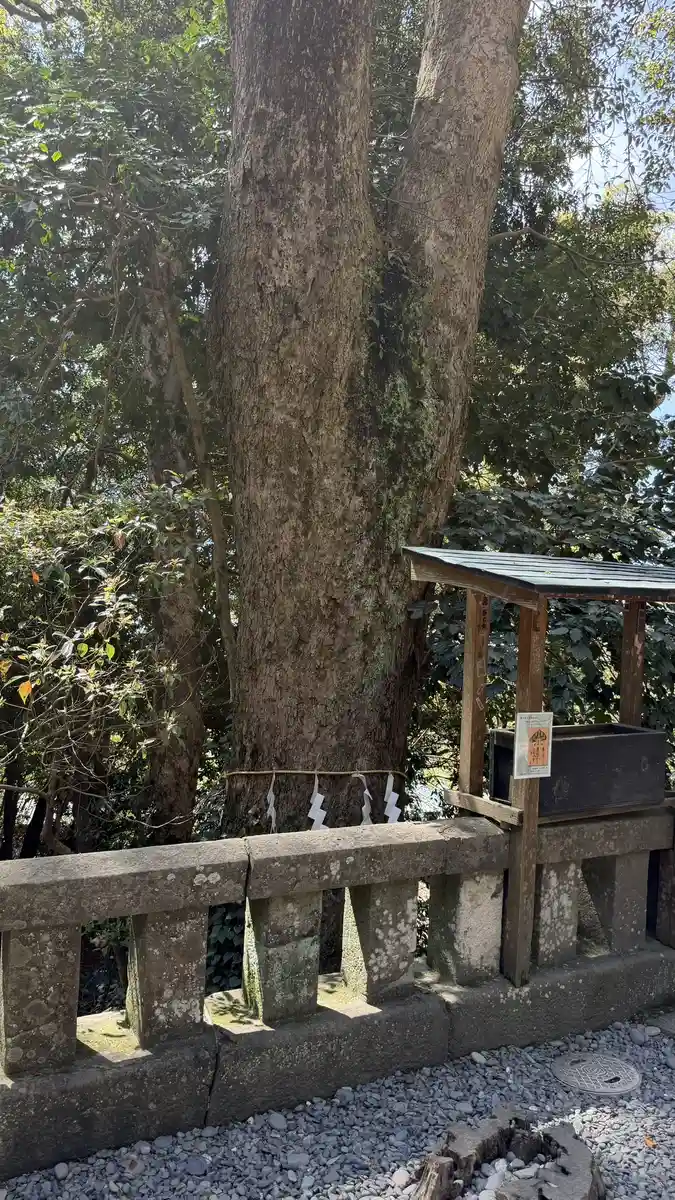
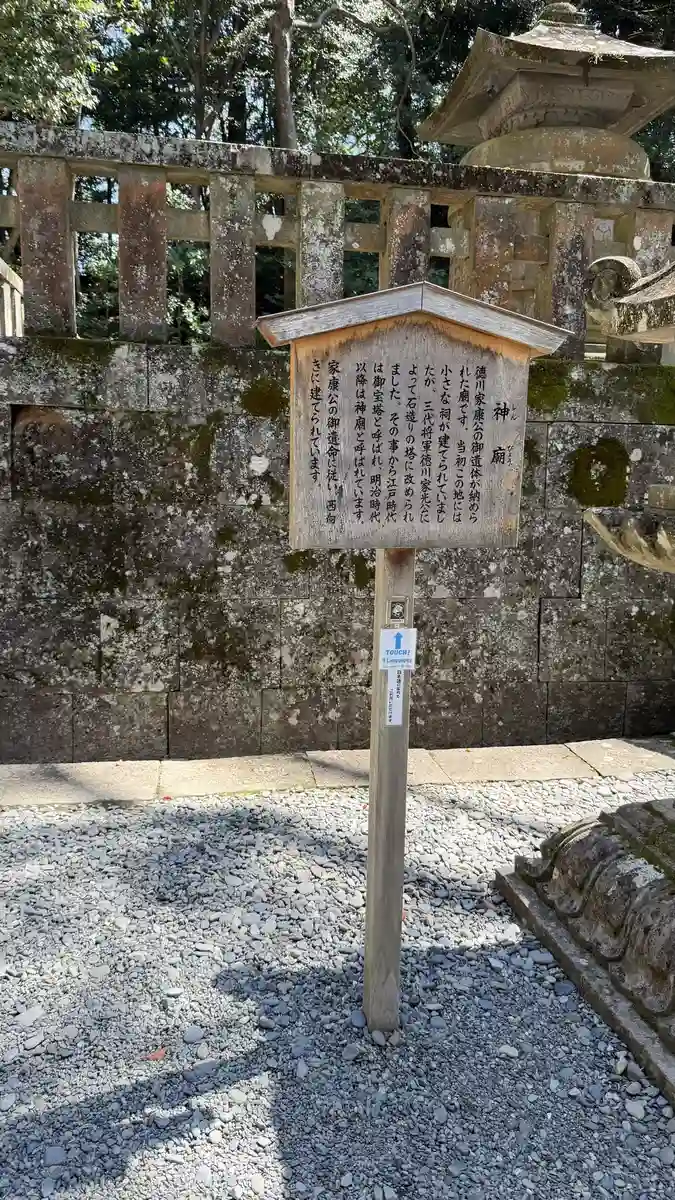
Beside the mausoleum stands a large camphor tree the shrine calls the money tree. Its information board explains that Ieyasu once drew three trunks for his retainers — labelled moderation, compassion and honesty — and told them that believing in these would always bring prosperity. Read the board first, then look up at the tree: it makes clear that this hilltop was laid out as a place of instruction as well as a grave.
Before the shrine: Kunozan was a temple, and then a castle
Two earlier layers of history sit under the shrine. Knowing them changes how the stone walls and the shape of the ground read when you are standing there.
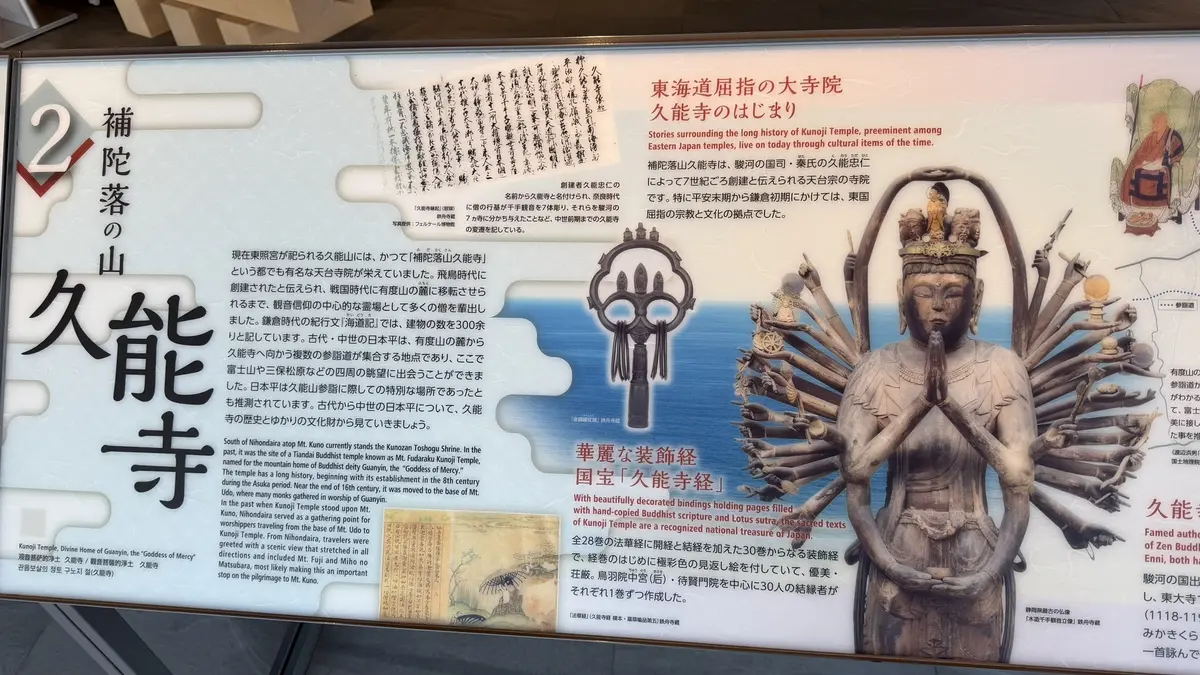
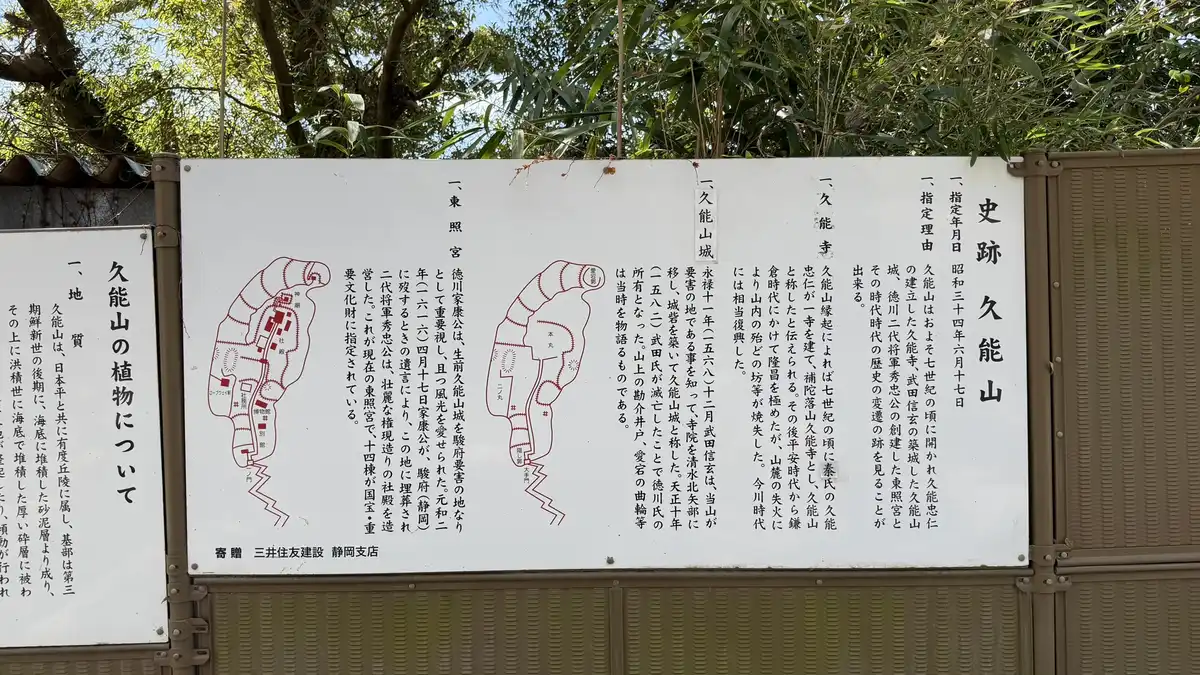
According to the shrine, the history of Kunozan begins in the early seventh century, when a man named Kuno Tadahito built a hall here and named it Kunoji. The temple is said to have flourished from the late Heian period into the early Kamakura period, roughly the twelfth and thirteenth centuries.
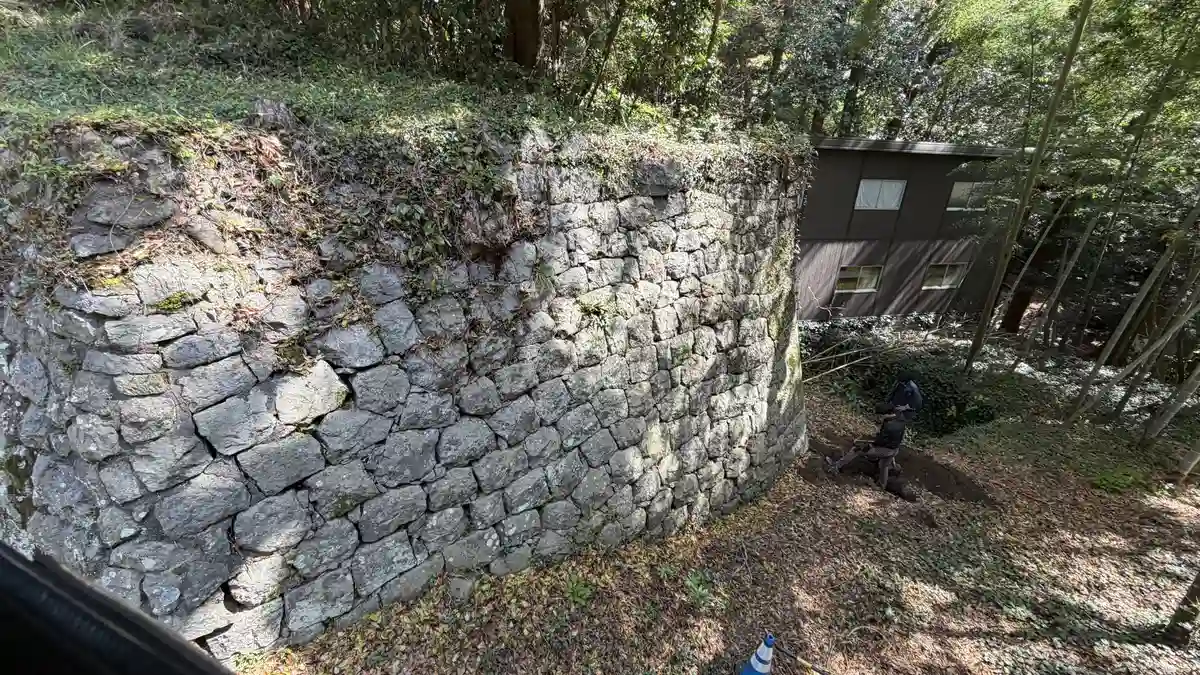
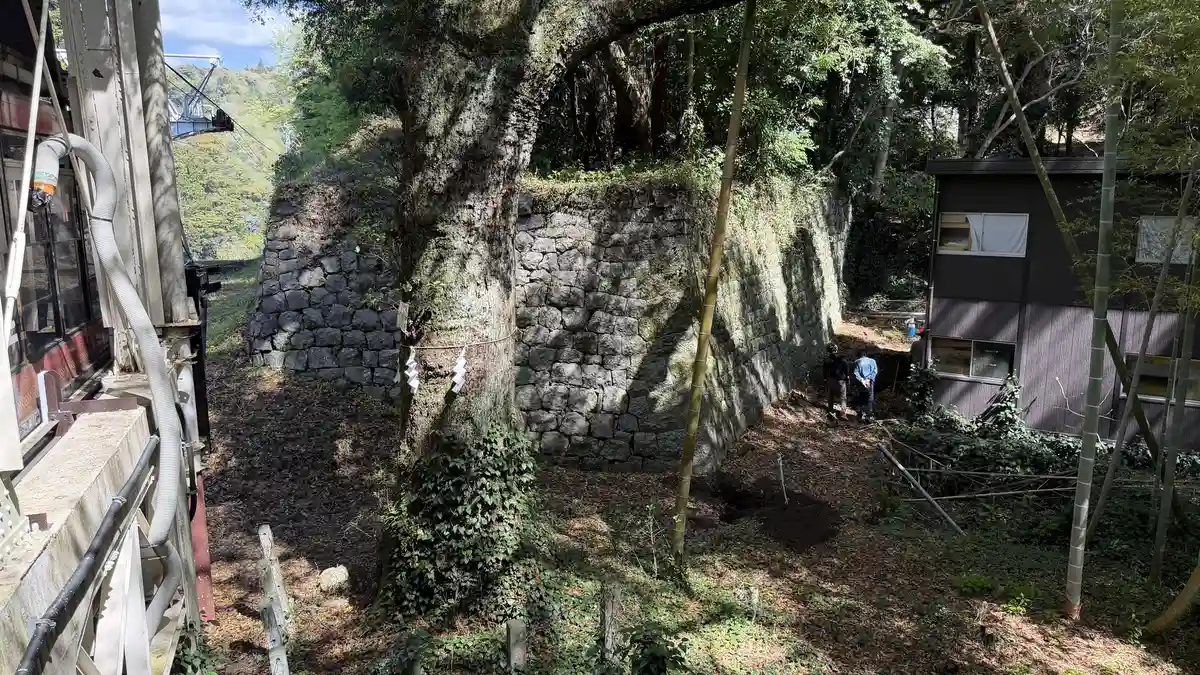
In 1568 the warlord Takeda Shingen invaded Suruga Province. Recognising the hill as a natural stronghold, he moved Kunoji temple to nearby Kitayabe — the site of the present Tesshuji temple — and fortified the hilltop as Kuno Castle. The castle-like stone walls inside a shrine precinct come from this layer.
After the Takeda were destroyed and Suruga passed to the Tokugawa, the hill became Tokugawa property. The shrine records that Ieyasu told his retainer Sakakibara Terihisa he always regarded Kunozan as the inner keep of Sunpu Castle. After the burial of 1616 the hill became a shrine.
Part of the hill is a kinsokuchi, ground that is closed to visitors. Press reports describe it as holding a subsidiary shrine to Atago along with earthworks and a moat surviving untouched from the Kunozan castle period, and say it had not been opened to the public for some four hundred years. The same reports mention a path said, on the evidence of one document, to have been walked by Oda Nobunaga and Tokugawa Ieyasu, now used by the priests. Limited special visits have been run there as part of a JR Central campaign, but this is not somewhere you can simply walk into, and whether any such visit is running changes from season to season. Check the current information from the shrine or JR Central if it interests you (position as of 26 September 2026).
A well on the hill is known locally as the Kansuke Well, after Yamamoto Kansuke, remembered in later tradition as a strategist in Takeda Shingen’s service. I could not find the attribution confirmed in the shrine’s own main information, so it is best read as a local name rather than documented fact.
Tap any photo to enlarge
Kunozan and Nikko Toshogu: first burial, first shrine, later Nikko
Kunozan and Nikko are not rivals, and neither is the “real” one. They are different stages of the same plan. Ieyasu died in 1616 and was buried at Kunozan under his own instructions; the enshrinement at Nikko followed in 1617. Kunozan Toshogu presents itself as the first foundation of the Toshogu tradition, and its gongen-zukuri shrine as the model that the later shrines followed.
What most visitors photograph at Nikko today — the Yomeimon gate, the walls of dense carving — belongs to the great rebuilding of 1636, not to the original foundation of 1617. Those are two separate events, which is why this guide avoids the common shorthand that Kunozan predates Nikko by a set number of years. The useful comparison is not the gap in years but the direction of influence: the form appears at Kunozan first, and spreads from there.
Information published by the shrine includes a diagram of three lines said to connect Toshogu sites: one running from Cape Omaezaki through Kunozan Toshogu, Mount Fuji and Serada Toshogu to Nikko Toshogu; a second from Kunozan Toshogu through Sunpu Castle, Horaisan Toshogu and Okazaki Castle towards Kyoto; and a third from Edo Castle through Nikko Toshogu to the Pole Star. Whatever you make of the geometry, the diagram shows how consistently Kunozan has been treated as the starting point.
If Nikko is already on your itinerary, two companion guides on this site may help. Nikkō Tōshōgū: what the shrine’s design is trying to make you believe follows how the idea of enshrining Ieyasu as a deity, which starts here, was expanded at Nikko. For the practical side, see the Nikko Toshogu visitor guide.
What to see on site: eight places not to walk past
These are listed in the order I walked them, coming up by ropeway and leaving down the stairway. Open any card for more photographs, a rough time to allow, and a note on whether the structure is original or a former site.
Romon, the two-storey gate🎥 360°
The formal entrance, under a tablet naming Ieyasu as a deity
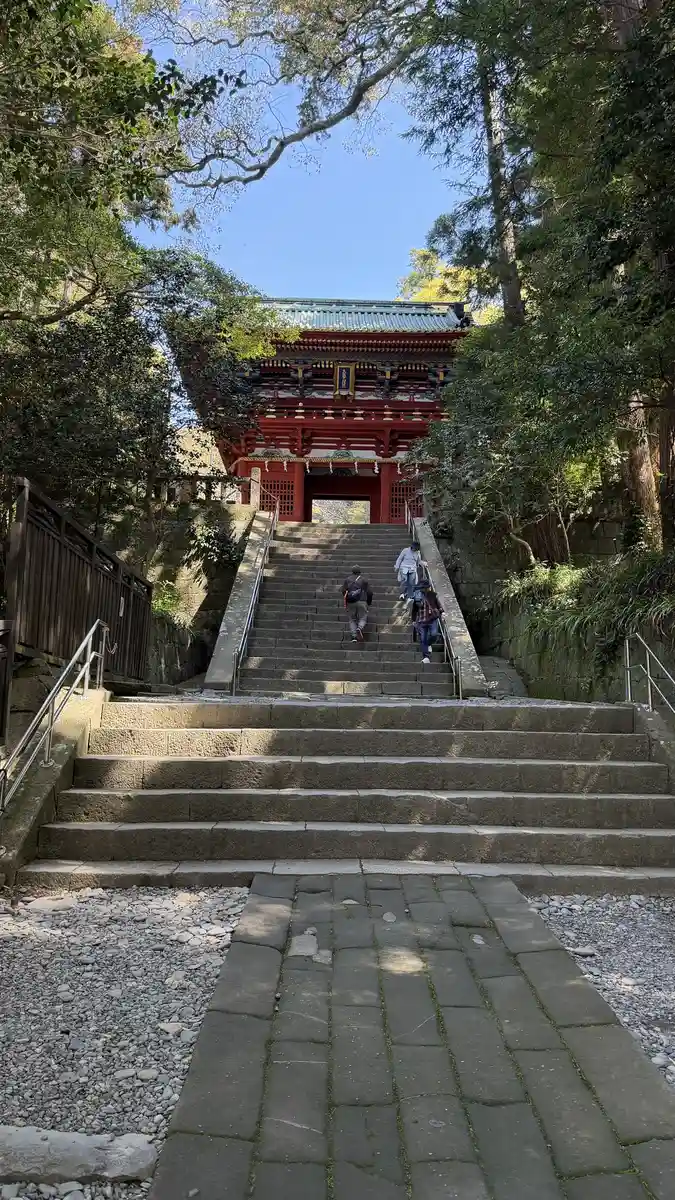
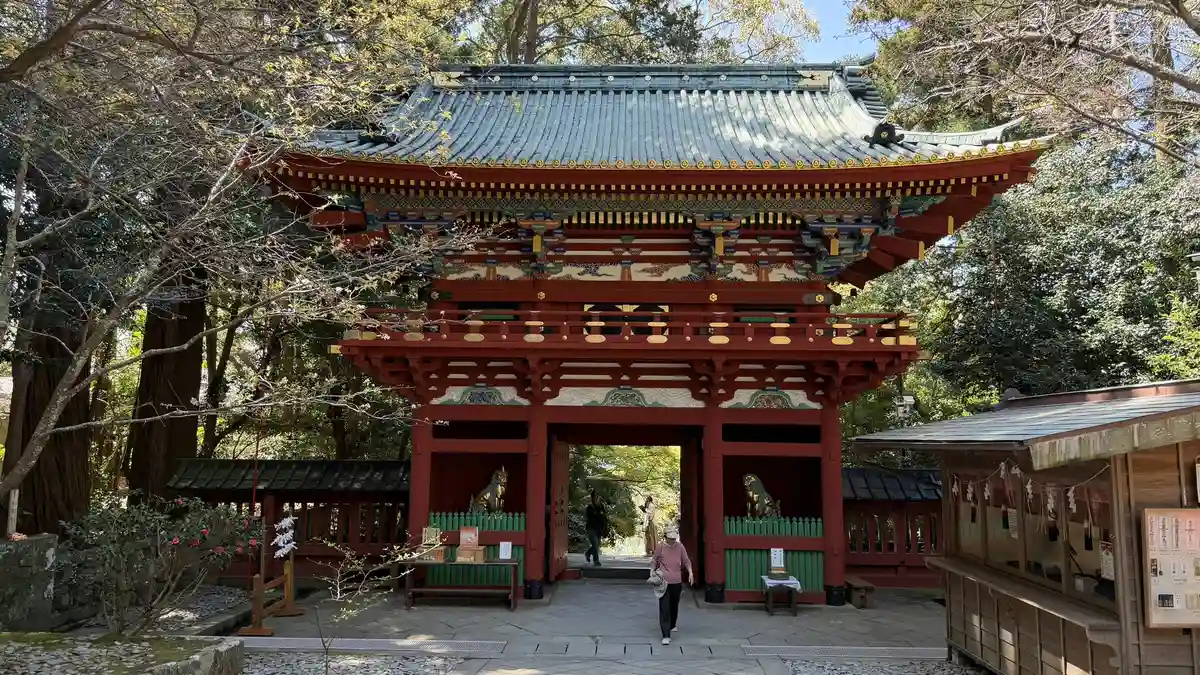
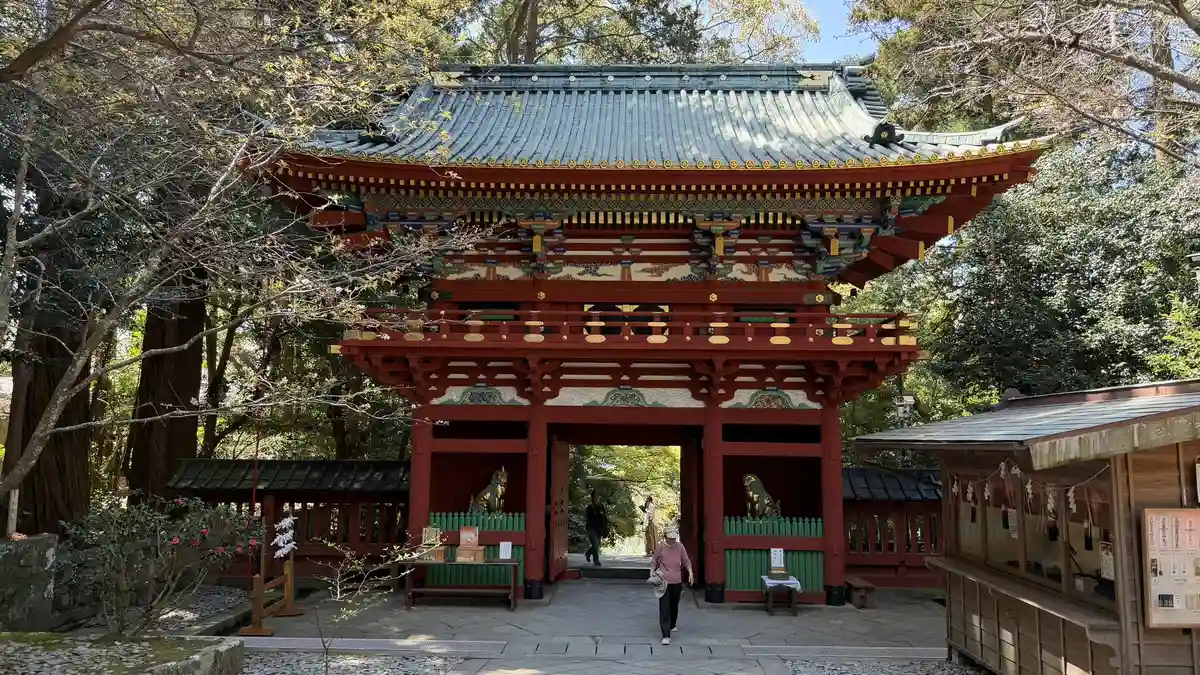
A vermilion two-storey gate standing where the path finally opens out. It is the first place most people stop, simply because it appears all at once.
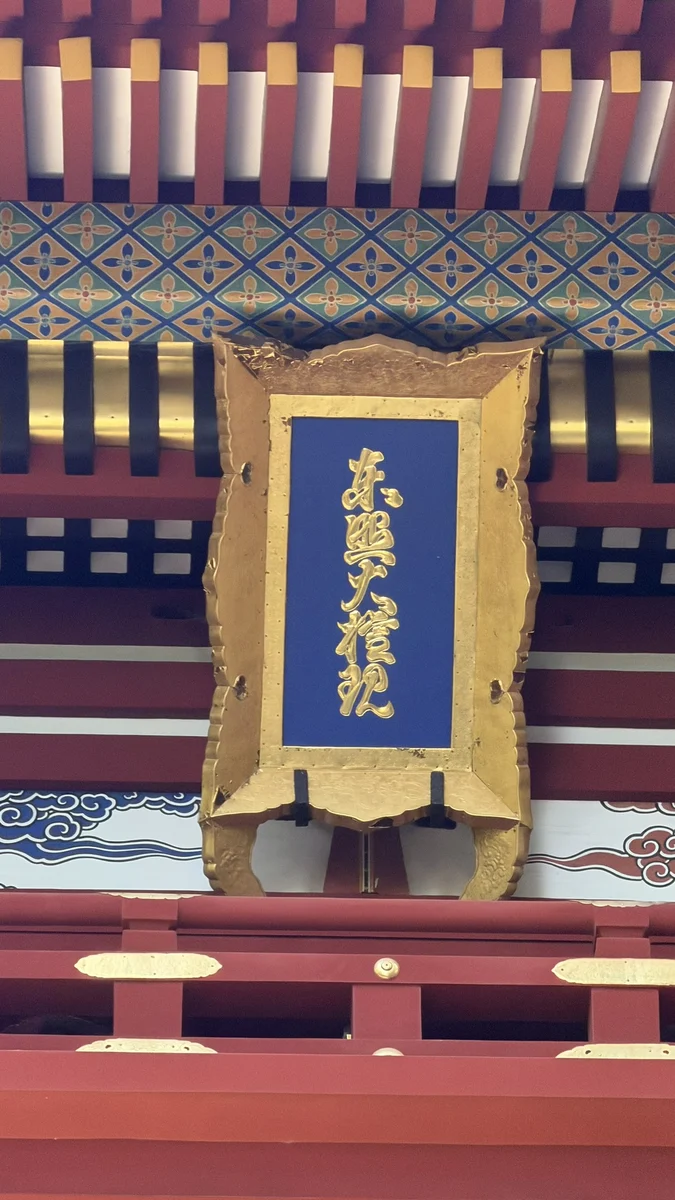
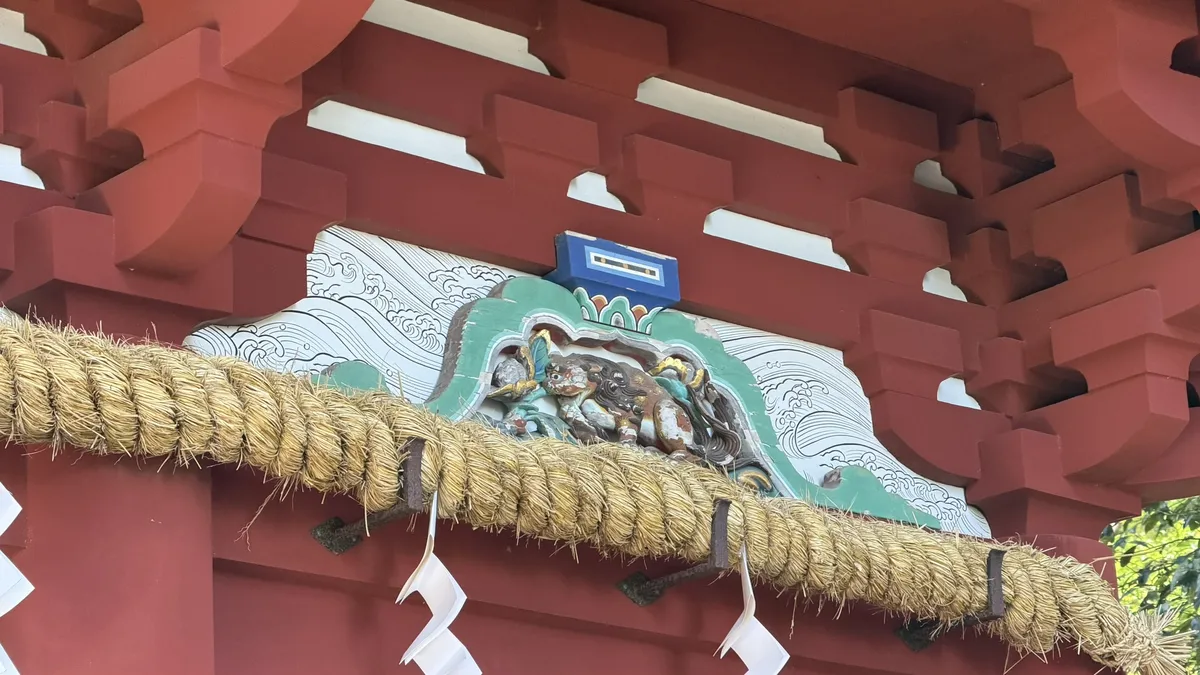
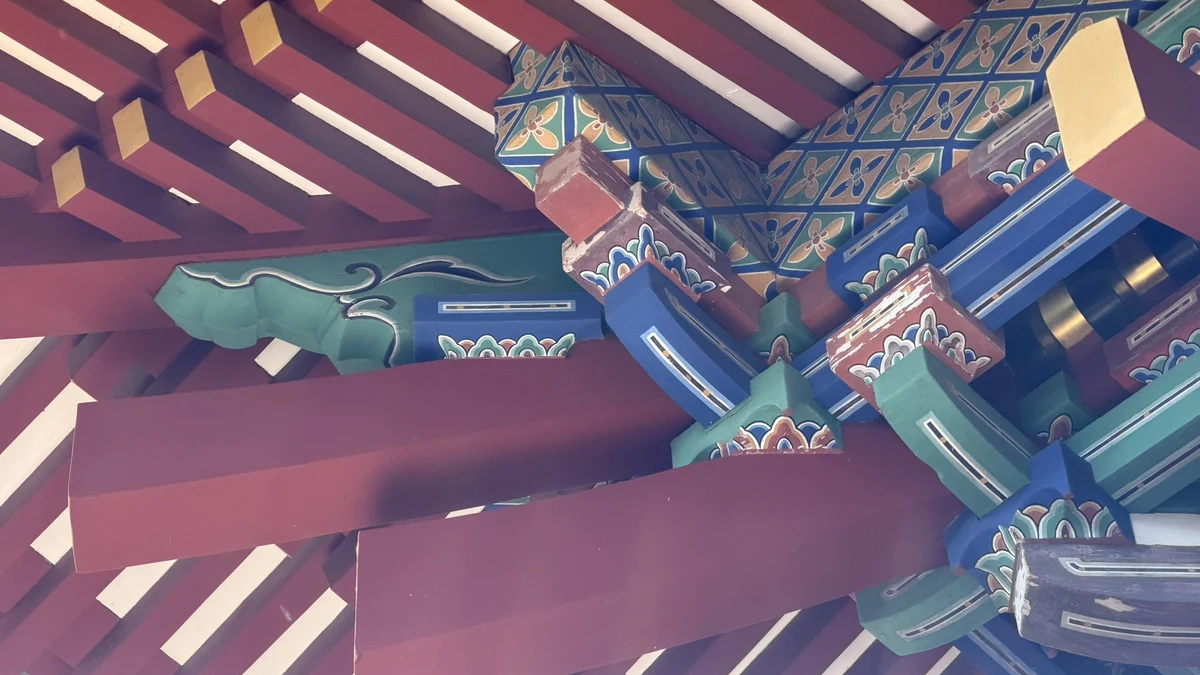
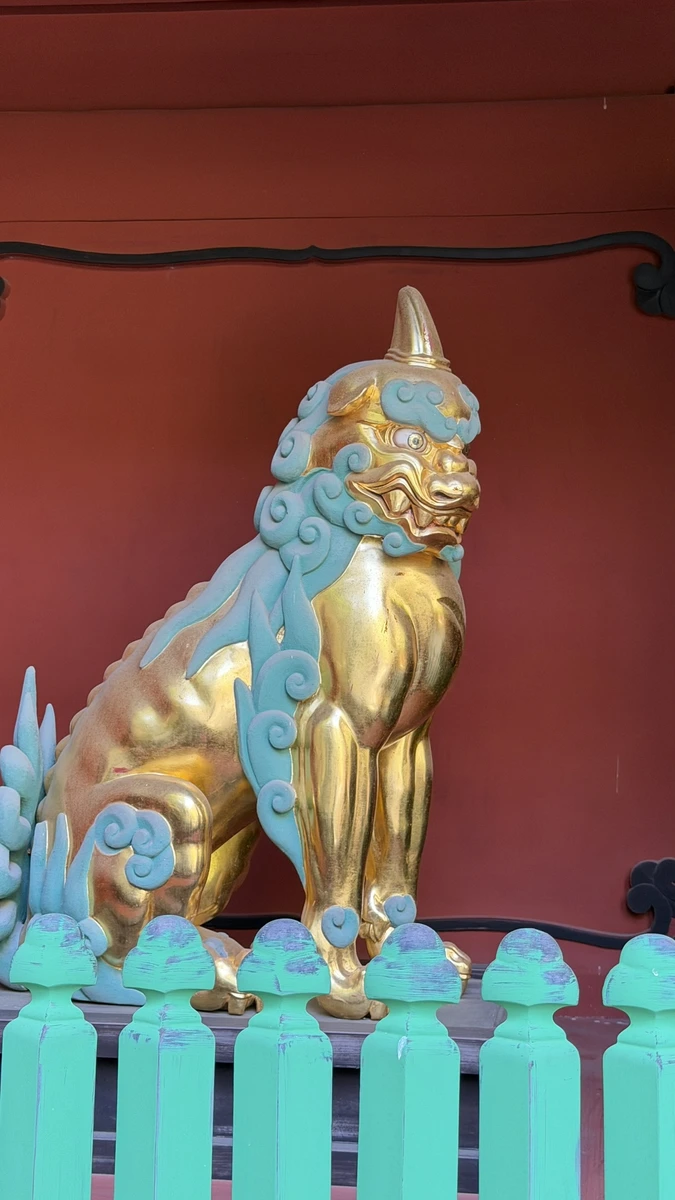
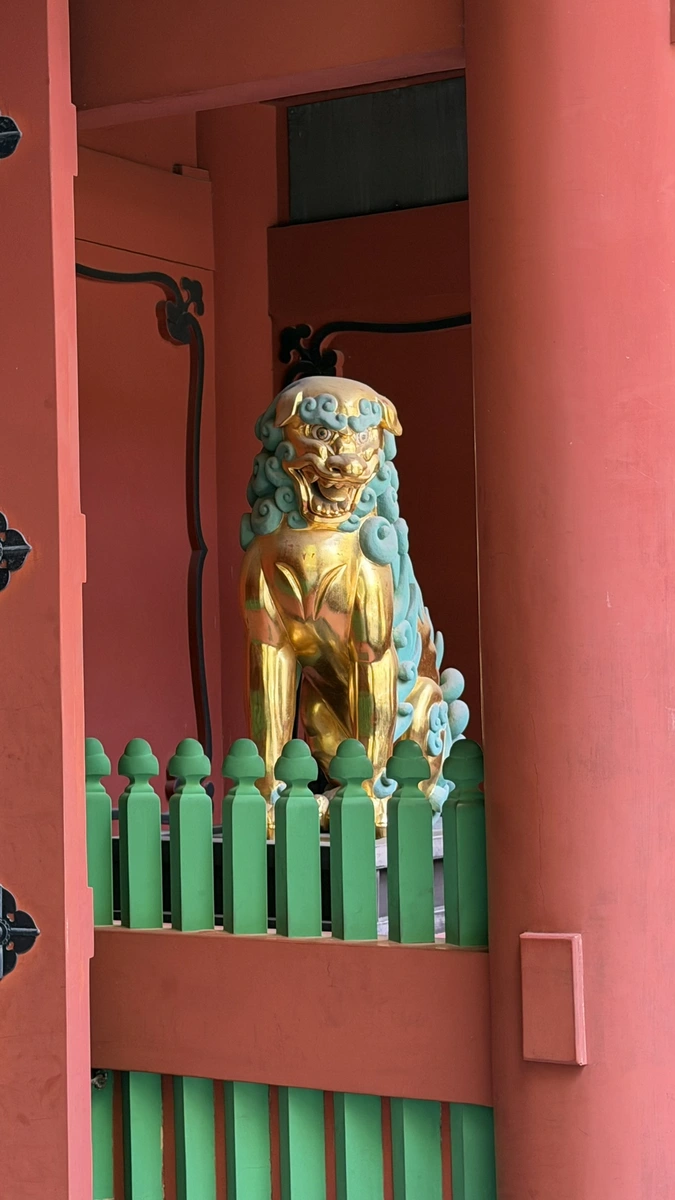
The shrine explains that the tablet on the upper storey, reading Tosho Daigongen, was named and written by Emperor Go-Mizunoo himself, which is why the gate is also called the Chokugaku-mon, the gate of the imperial tablet. Up close, the bracket clusters under the eaves are picked out in vermilion, blue, green and gold, and painted guardian lion figures sit in the bays on either side.
What to look for
- The Tosho Daigongen tablet on the upper storey
- Painted bracket clusters and the tapir carving under the eaves
- The large straw rope hung across the front
- The guardian lion figures set into the side bays
- The copper-tiled roofs, best seen from inside the precinct
Tap any photo to enlarge
Time to allow
About 10 minutes, looking up at the carving and the tablet. Turn round after you pass through, when the roof profile reads best.
| Status | Original structure (Important Cultural Property) |
|---|---|
| Highlights | Tablet, painted brackets, straw rope, guardian figures |
| Underfoot | Stone steps, with handrails in places |
Tosho Daigongen is Ieyasu’s name as a deity rather than his name as a man. The gate that carries it works as a threshold: from here on, you are inside sacred ground.
Shinkyu, the sacred stable
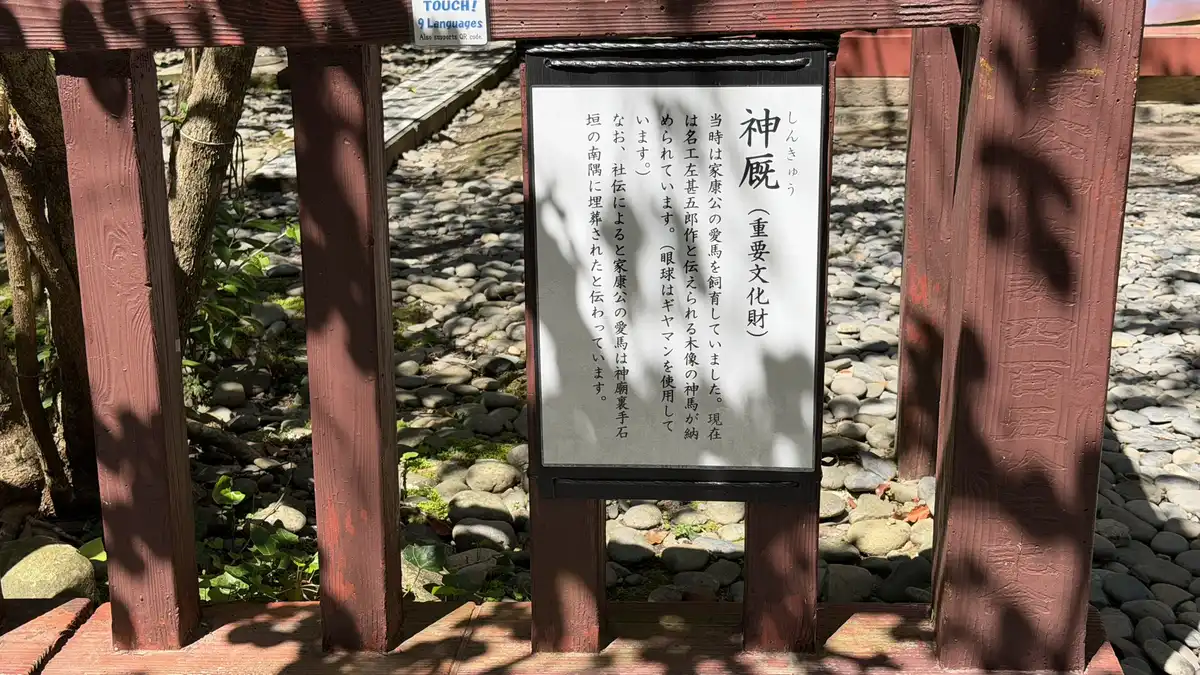
A small building holding a white wooden horse
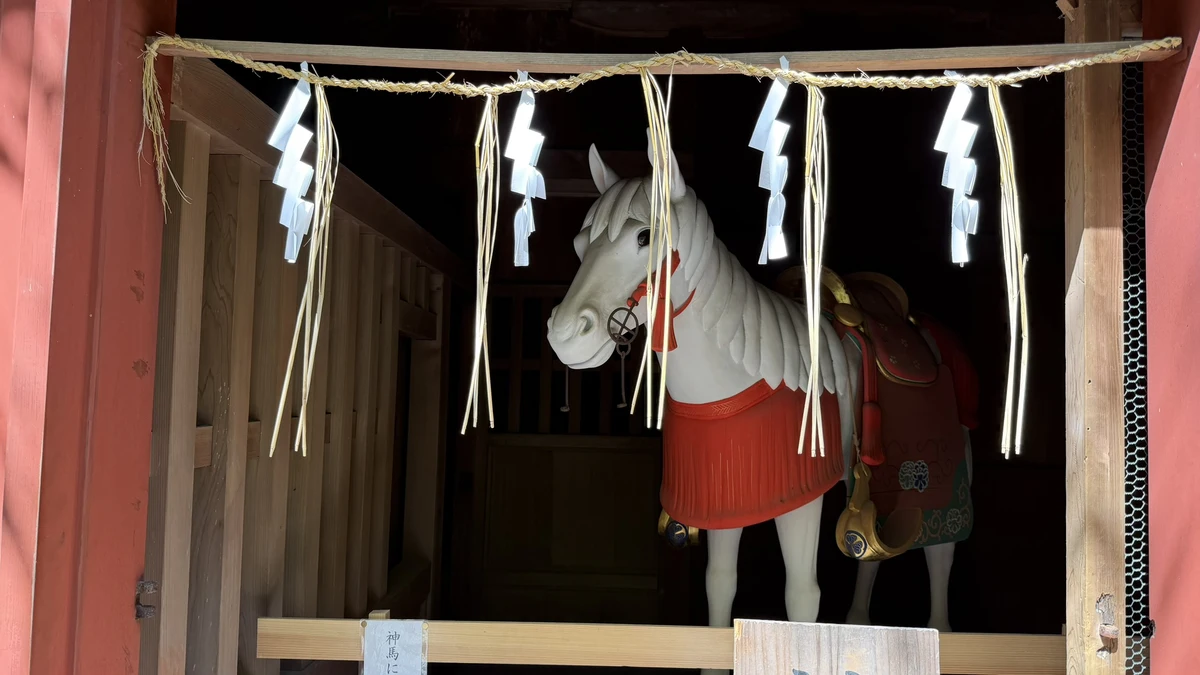
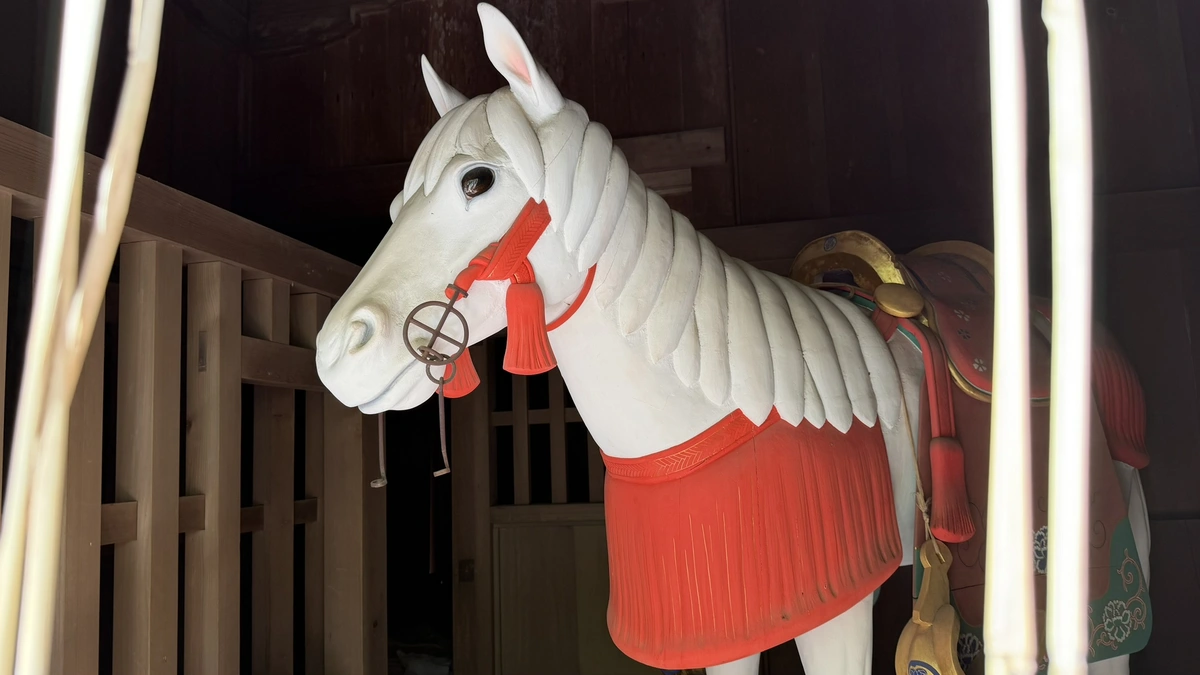
A modest building a little beyond the gate. Look inside and you find a white wooden horse with a straw rope hung in front of it. A sacred horse, kept for the deity, is a standard feature of larger Shinto shrines; here the building itself is listed as an Important Cultural Property.
Because it sits quietly to one side of the path, it is easy to walk straight past on the way to the main hall. The information board is the thing to watch for.
What to look for
- The white wooden horse and the rope hung before it
- The information board marking it as an Important Cultural Property
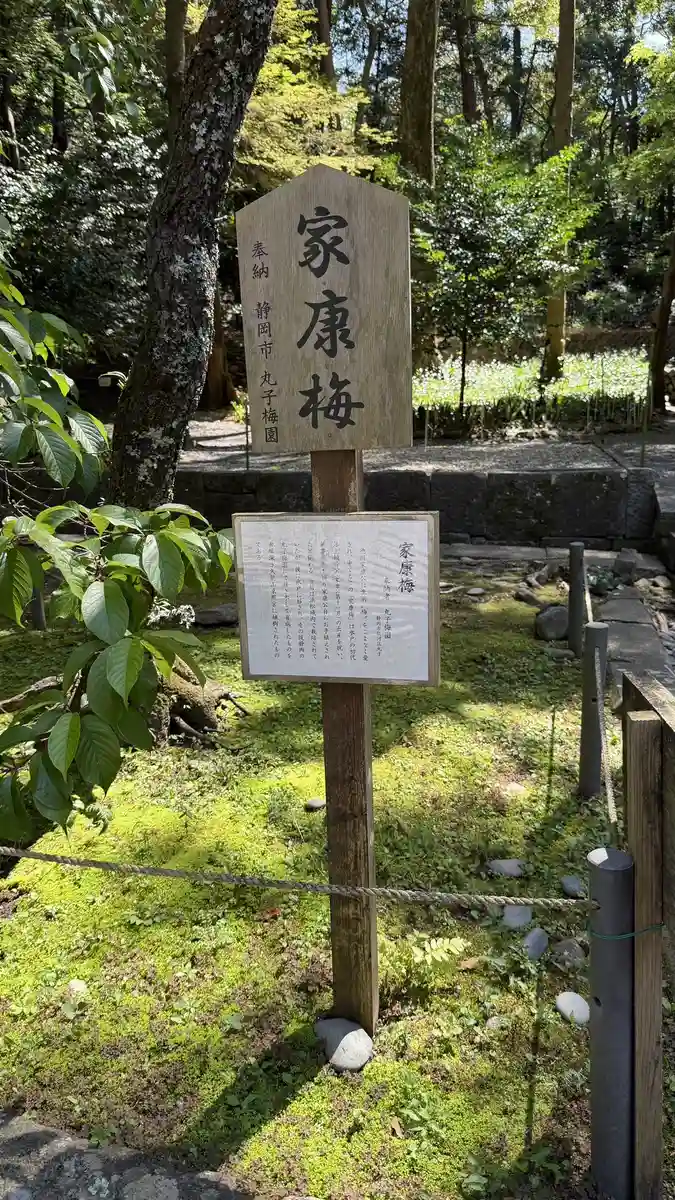
- The named plum tree nearby, labelled as Ieyasu’s plum
Tap any photo to enlarge
Time to allow
About 3 minutes to stop and look inside.
| Status | Original structure (Important Cultural Property) |
|---|---|
| Inside | A white wooden horse |
| Easily missed | Watch for the board on the right of the path |
Koro, the drum tower
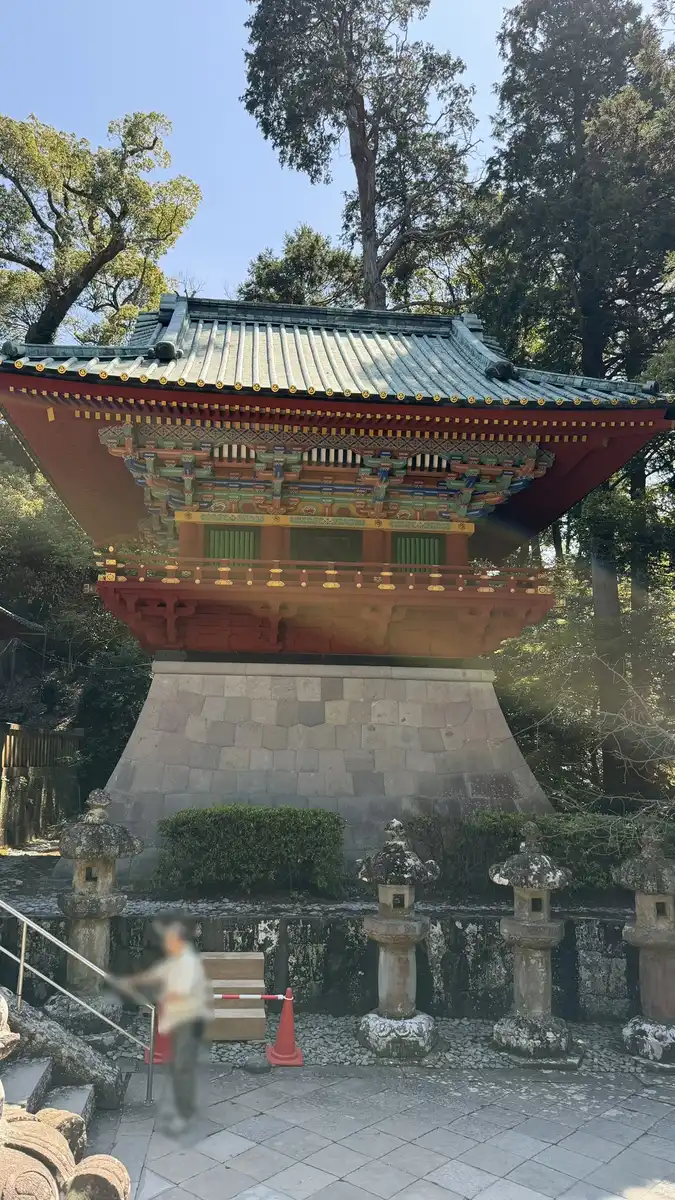
Two vermilion storeys on top of a stone base
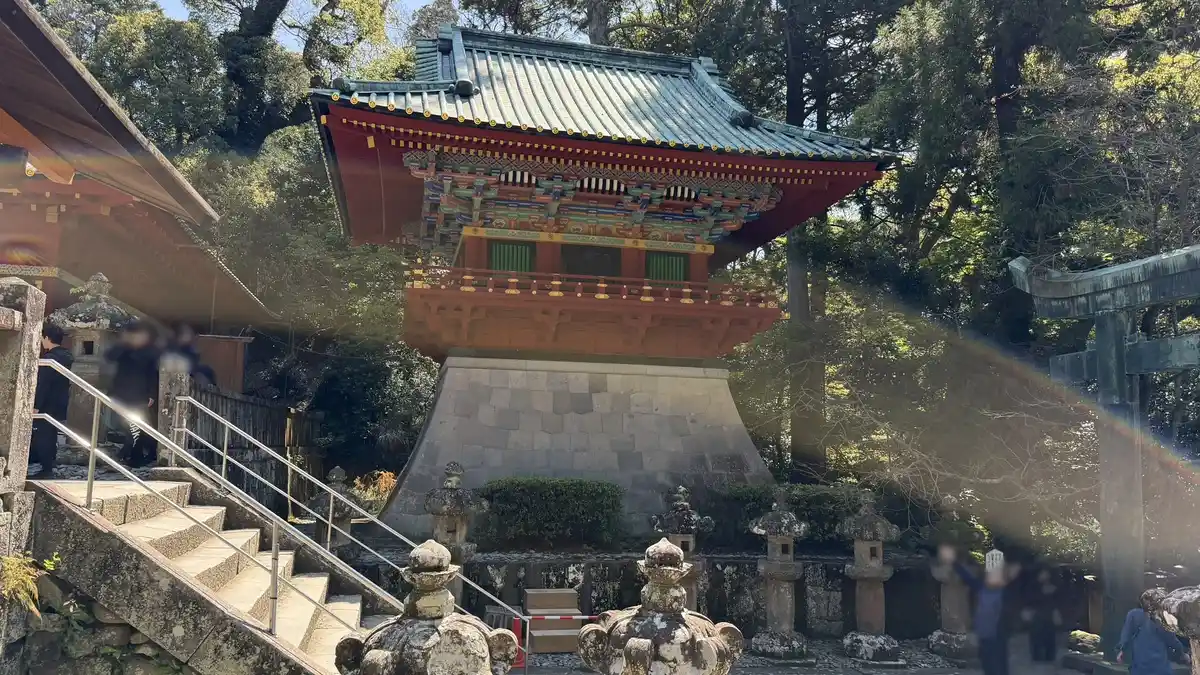
It stands on higher ground beside the steps up to the main hall, so you always see it from below. Photographs flatten it; in person the stone base adds to the height and the building reads as far more substantial.
Stone lanterns line the path here and cycads grow between them. The planting on this part of the hill is noticeably not that of an inland shrine, and it keeps reminding you that this is a hilltop above the sea.
What to look for
- The two storeys raised on a stone base
- The view up from the lantern-lined steps
- The cycads growing around it
Tap any photo to enlarge
Time to allow
About 5 minutes, stopping on the steps.
| Status | Original structure (Important Cultural Property) |
|---|---|
| Position | Above the steps that climb to the main hall |
| Photo tip | Include a stone lantern in the foreground to convey the height |
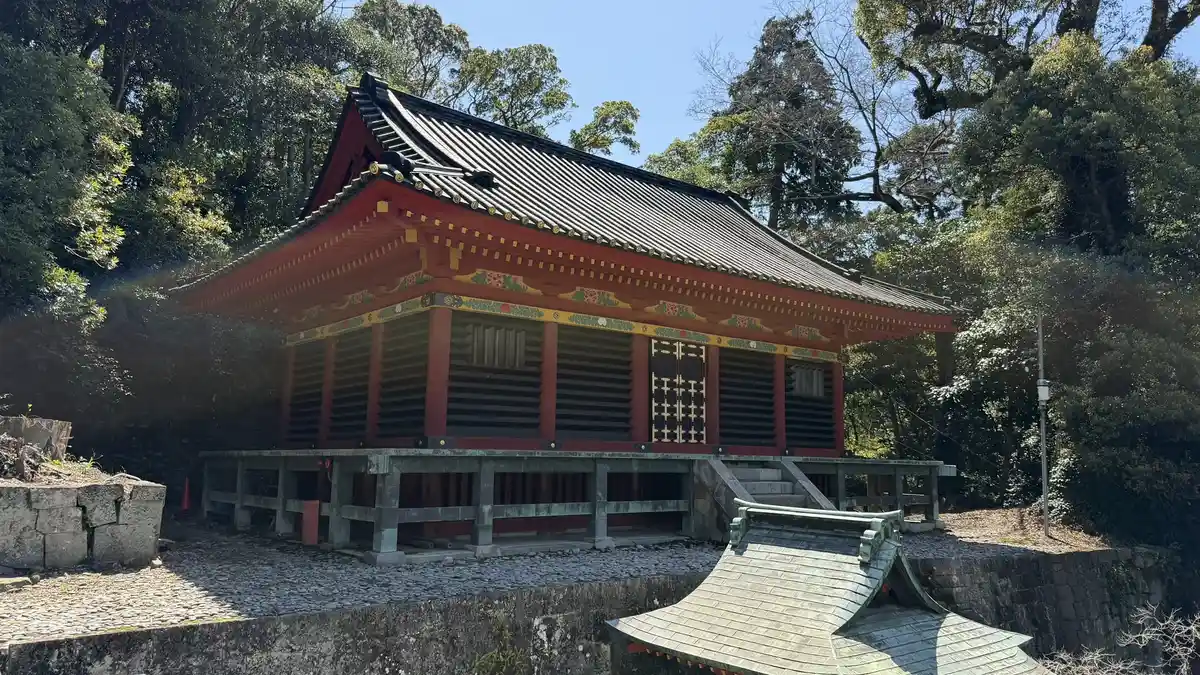
Hie Shrine
Physical evidence of how this hill’s religion was rewritten
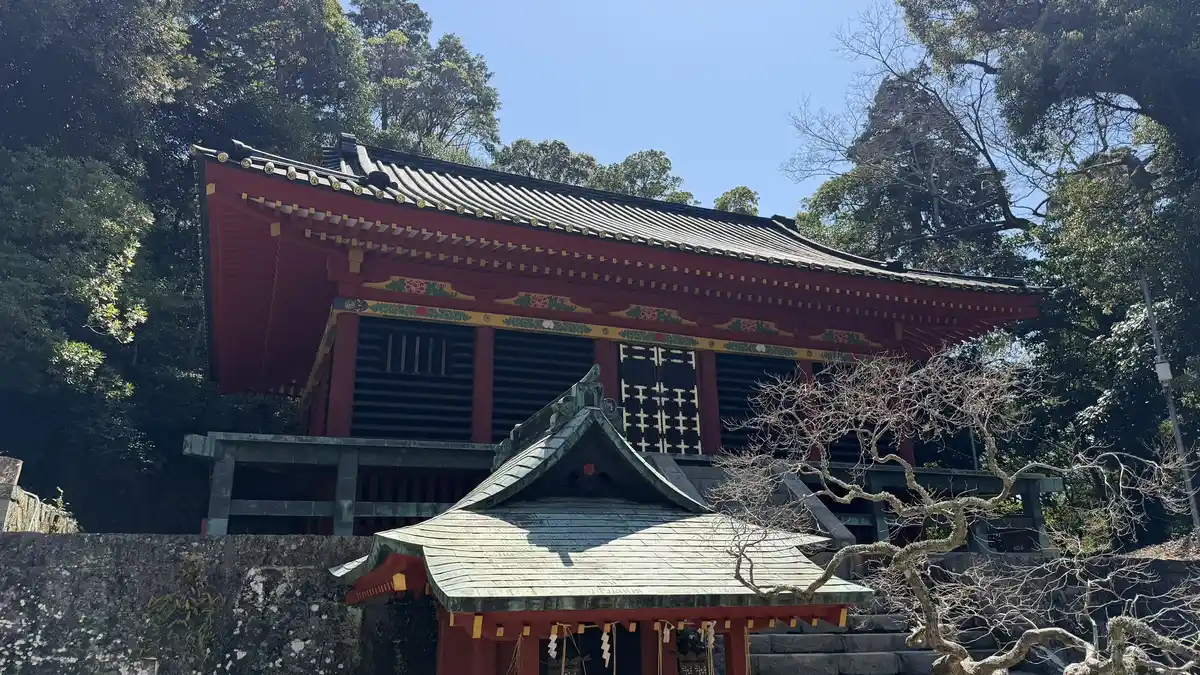
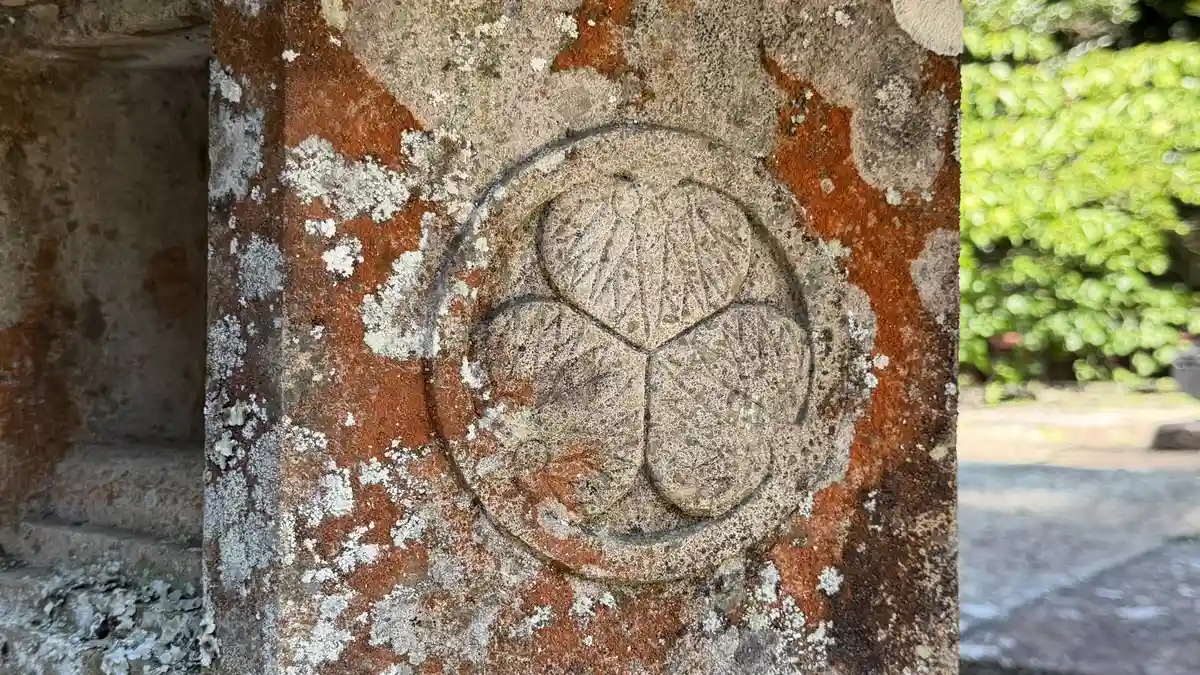
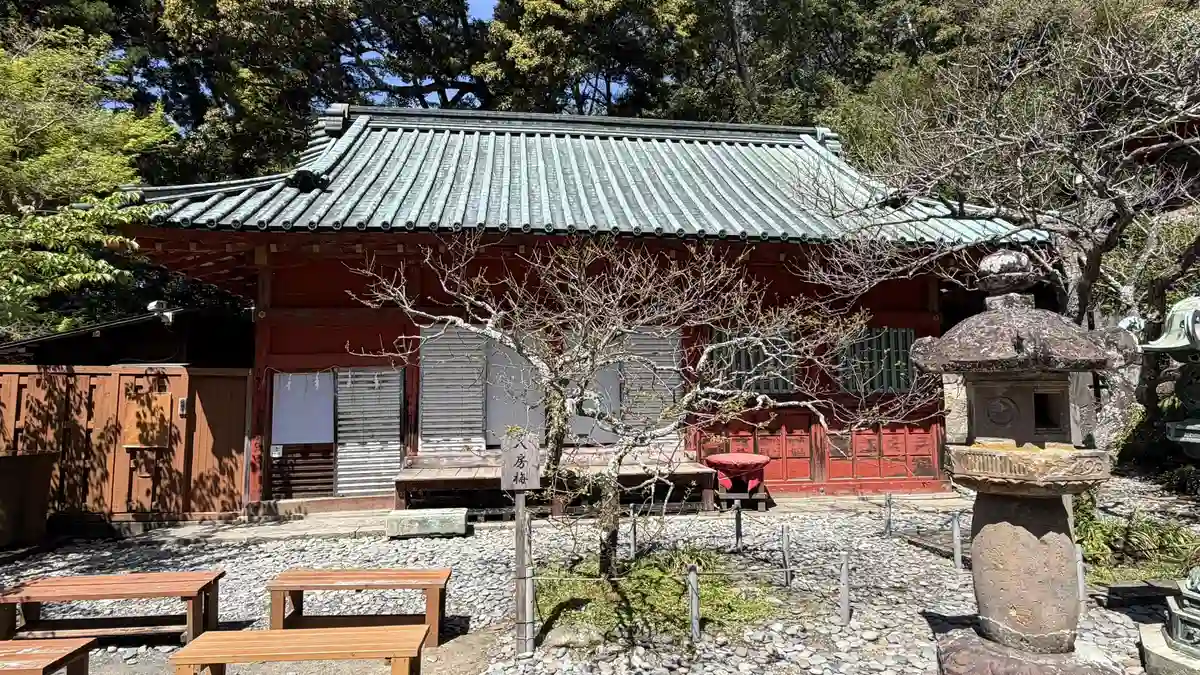
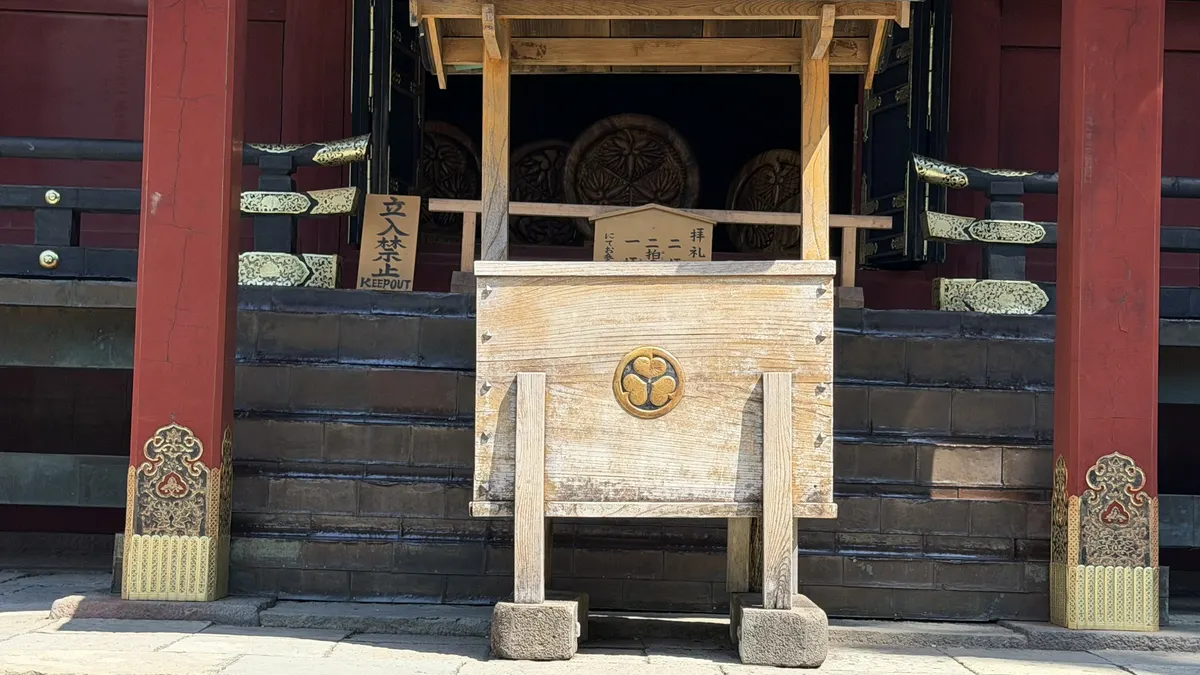
A subsidiary shrine set slightly off the main path. Vermilion walls under a long low roof, and an offertory box marked with the triple hollyhock crest of the Tokugawa family.
Kunozan was a Buddhist temple long before it was a shrine, and Shinto and Buddhism were formally separated by government policy in the early Meiji period, from 1868. A building like this surviving inside the precinct is a reminder that the religion of this hill has been reorganised more than once. Most visitors walk past it towards the main hall; it is worth the two-minute detour.
What to look for
- Vermilion walls under a copper-coloured roof
- The offertory box carrying the Tokugawa crest
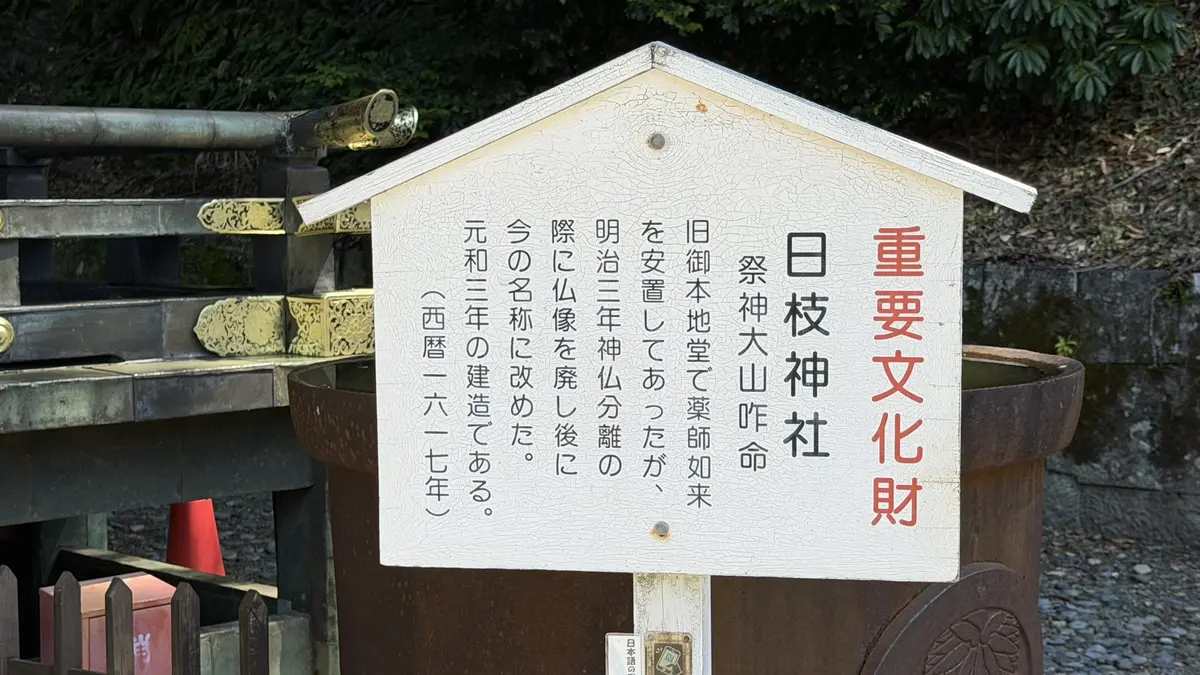
- The information board naming it an Important Cultural Property
- The side elevation, seen from higher ground
Tap any photo to enlarge
Time to allow
About 5 minutes, including reading the board.
| Status | Original structure (Important Cultural Property) |
|---|---|
| Position | Slightly off the main path, before the main hall |
| Easily missed | Look for the information board instead of heading straight up |
The main shrine buildings🎥 360°
Completed 1617, and the model for every later Toshogu
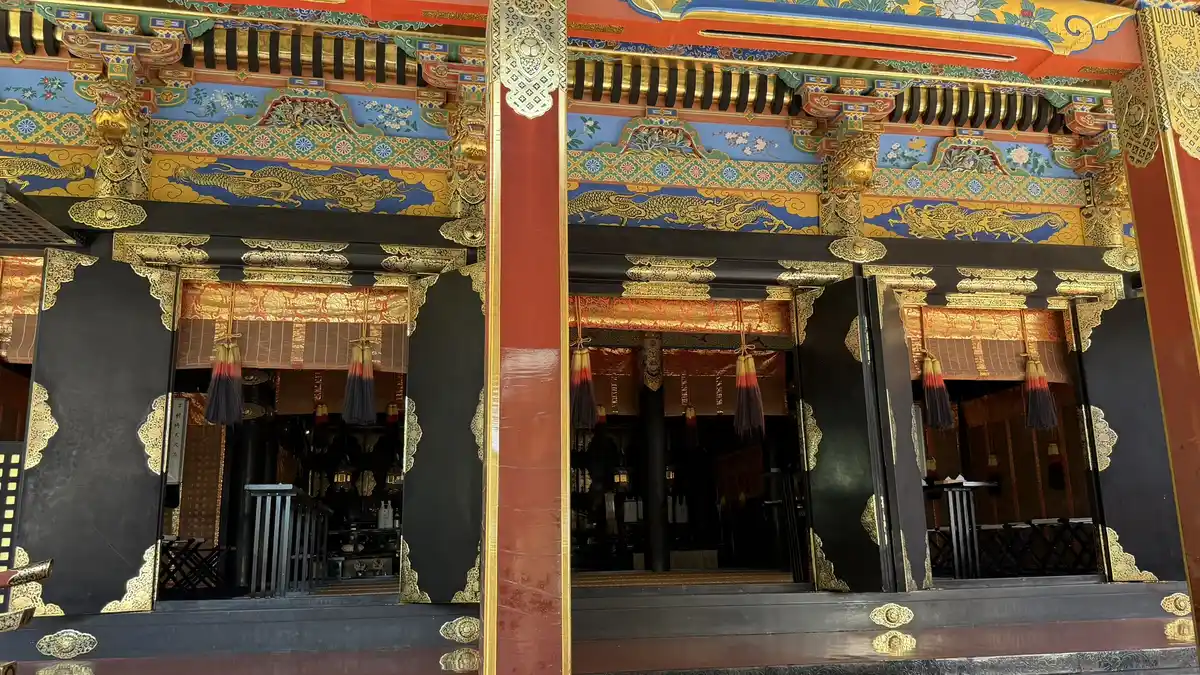
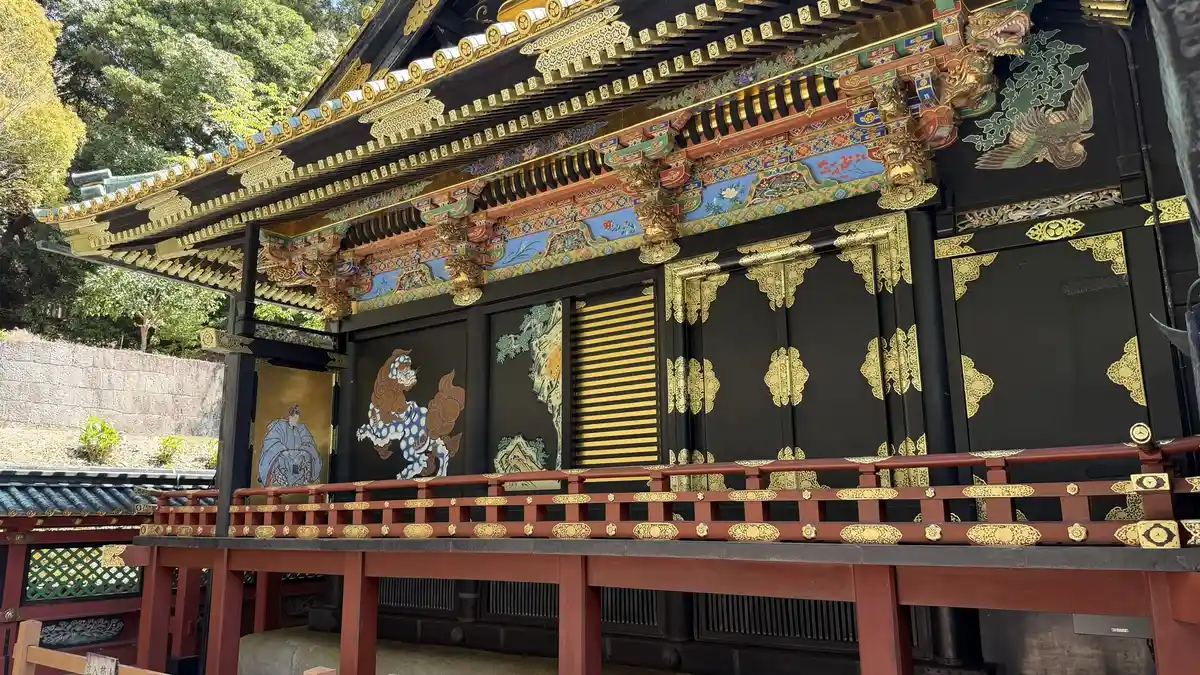
This is the heart of the site. The shrine describes it as a compound building in which the inner sanctuary and the worship hall are linked by a lower floored chamber between them, finished throughout in lacquer and combining carving with decorative metalwork. Because Ieyasu was enshrined as Tosho Daigongen, the form is called gongen-zukuri, and the shrine states that it became the model for the Toshogu shrines built later across Japan. It was designated a National Treasure in December 2010.
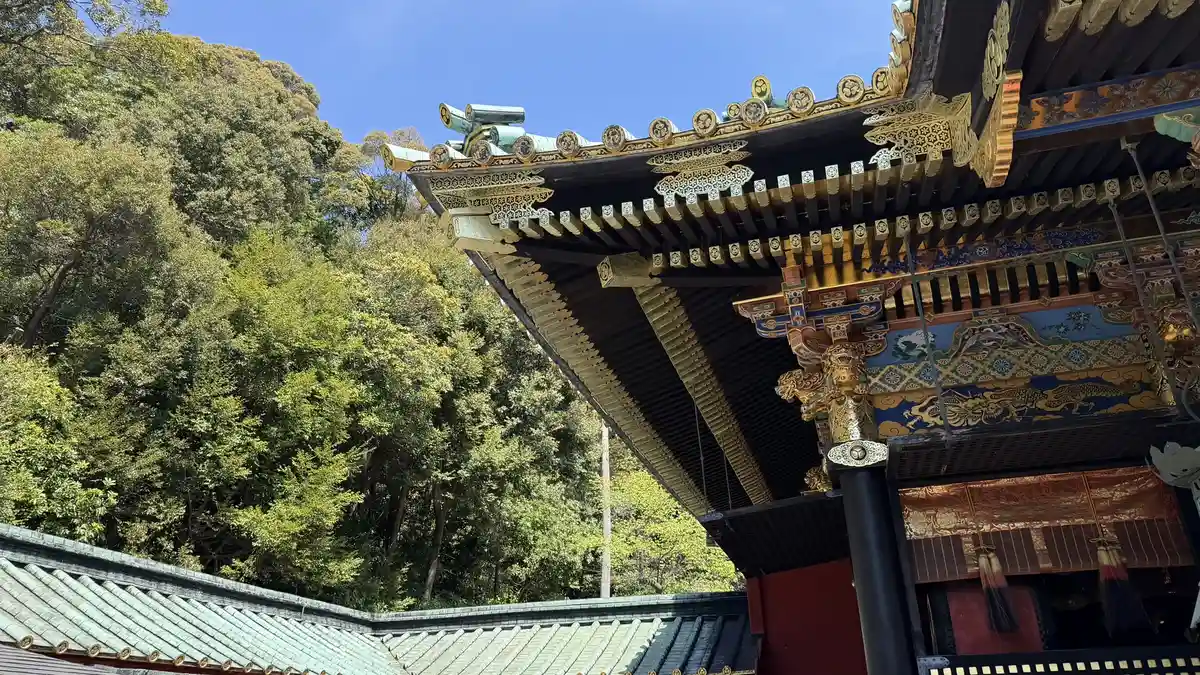
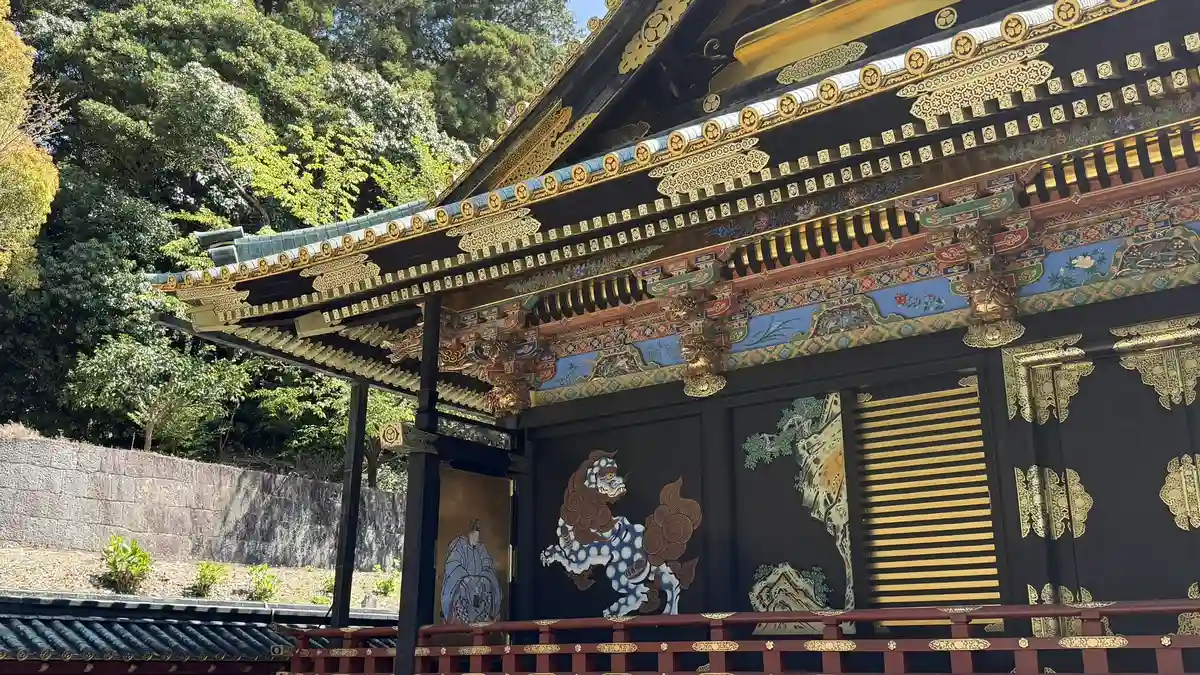
Standing in front of it, the frontage is not especially wide. That turns out to be the point: you can get right up to the railing and work through the detail piece by piece. Painted figures sit on black lacquered panels, with vermilion, blue and gold bracket clusters stacked above them. On the visit of 3 April 2026 it was possible to stand close to the railing and pick out the bracket work and the door carving in detail.
One more thing is worth knowing before you stand here: who is actually enshrined. The shrine’s own account of its origins names Tokugawa Ieyasu as the principal deity, with Toyotomi Hideyoshi and Oda Nobunaga enshrined alongside him as aidono deities. The three warlords who between them decided the outcome of the Sengoku period share this one building — which comes as a surprise if you arrive expecting a shrine to Ieyasu alone.
What to look for
- The black lacquered doors and the dense carving above them
- Painted bracket clusters carrying the deep overhanging eaves
- Figures and animals painted onto the black panels
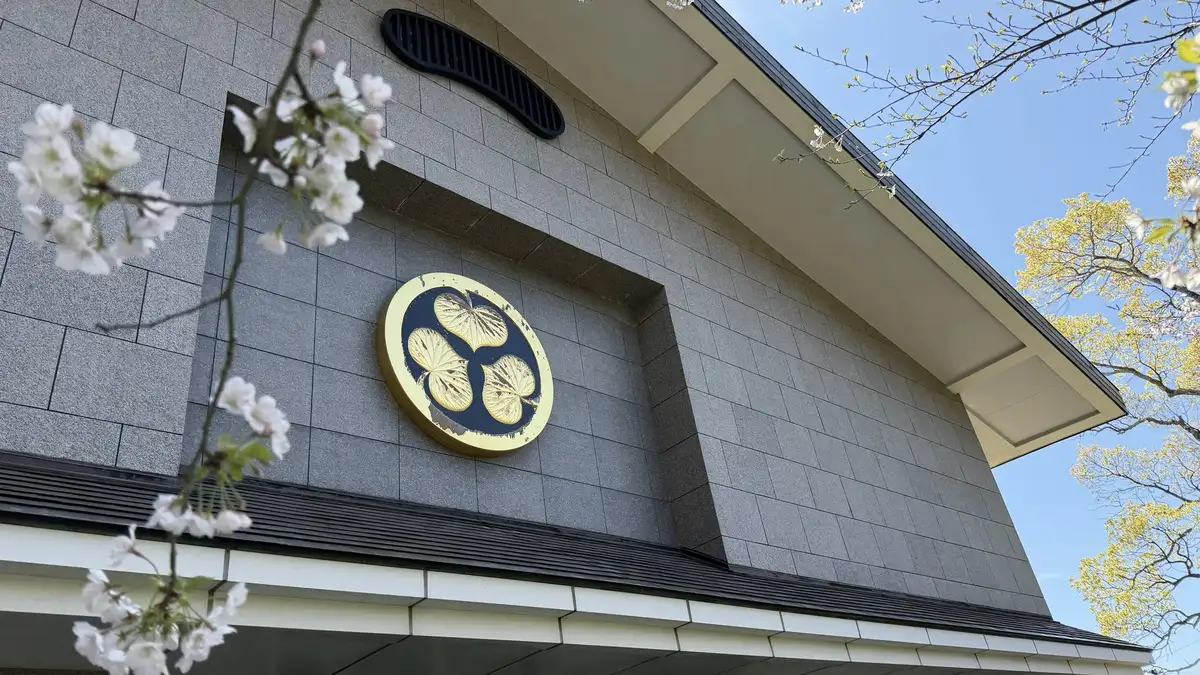
- Gold Tokugawa crests running along the roof edge and gable
- The vermilion fence and the small gate beside the hall
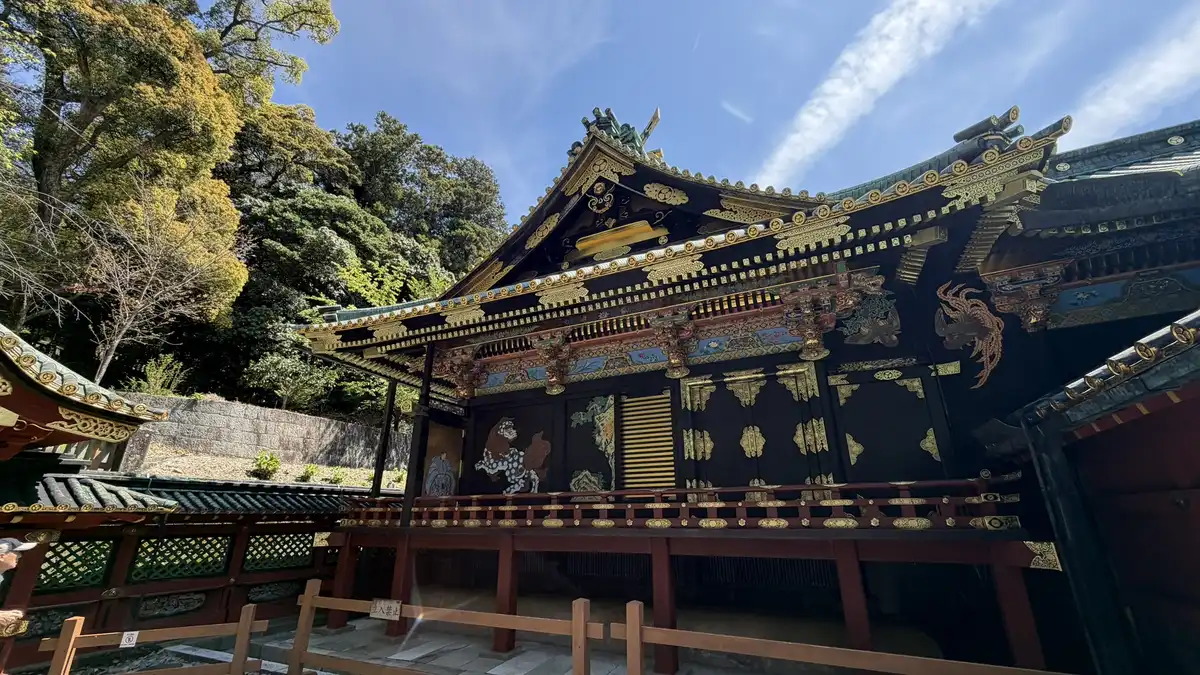
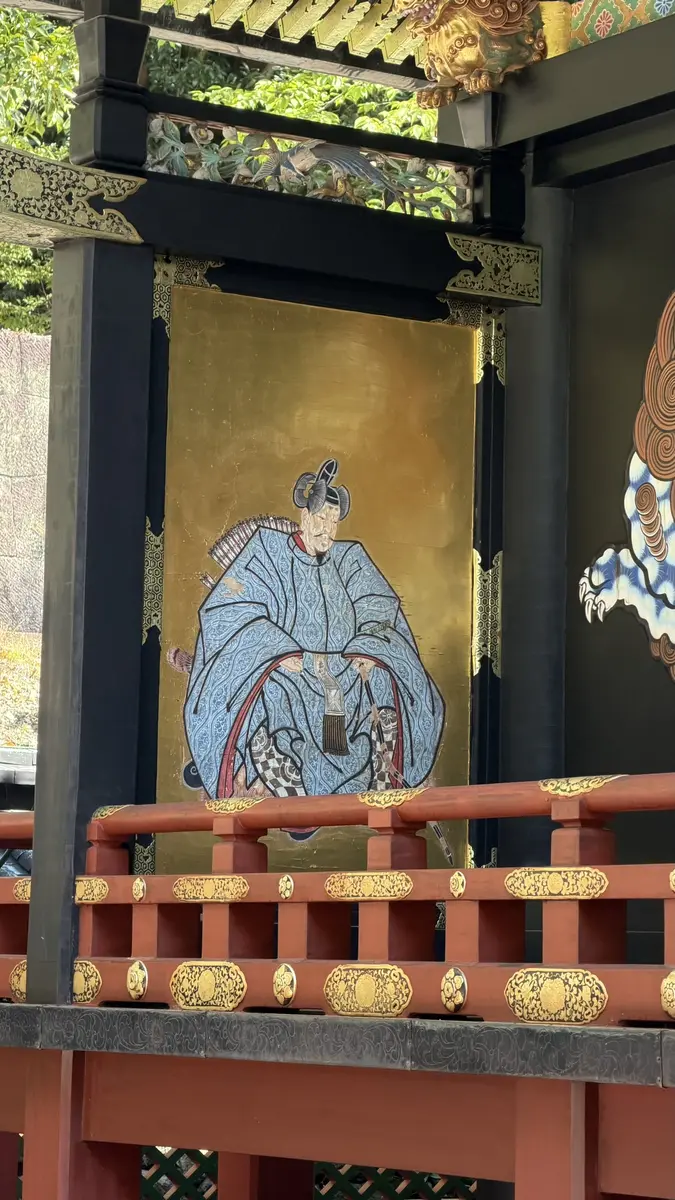
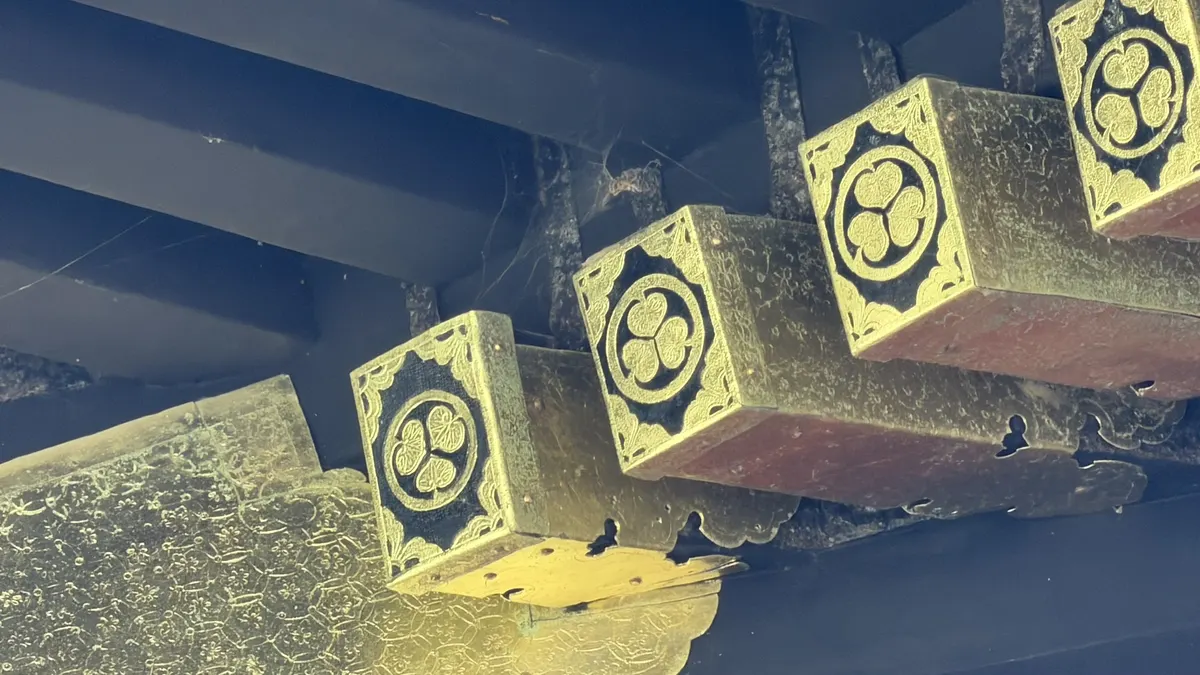
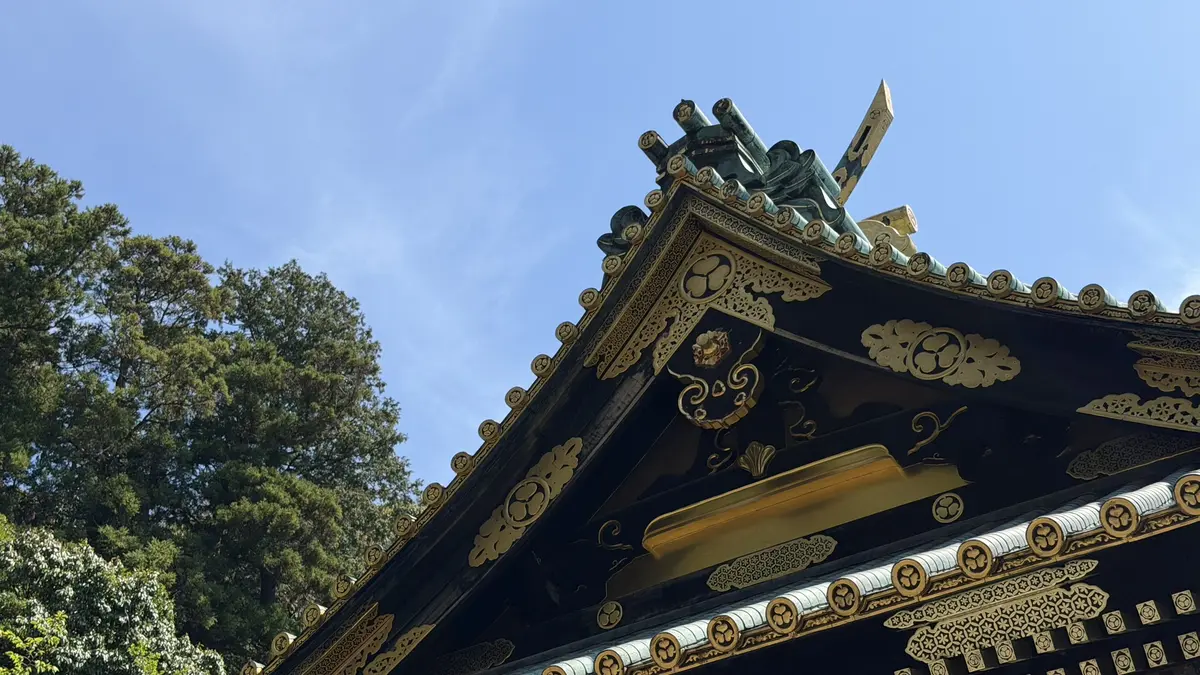
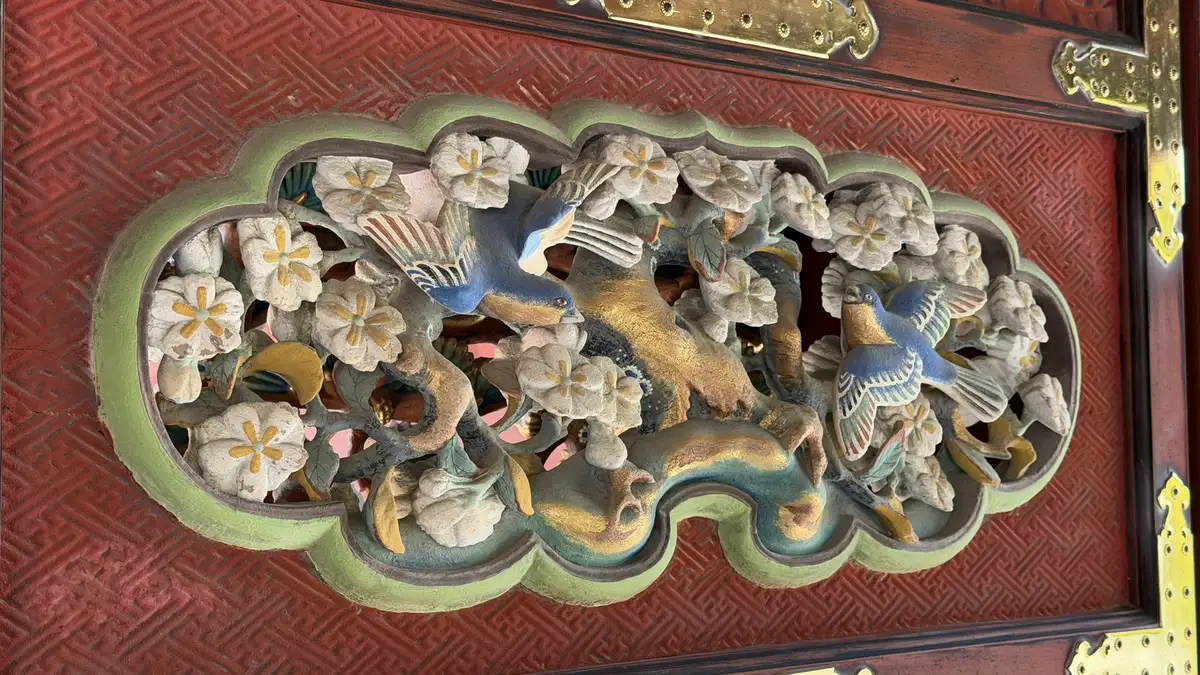
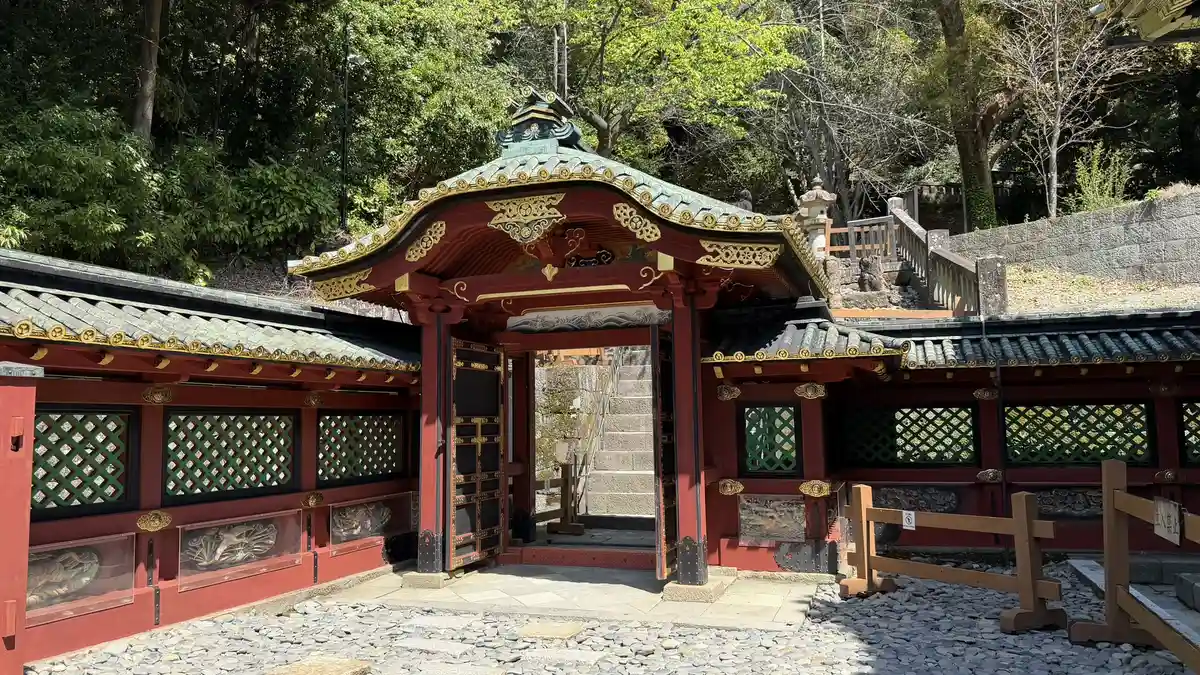
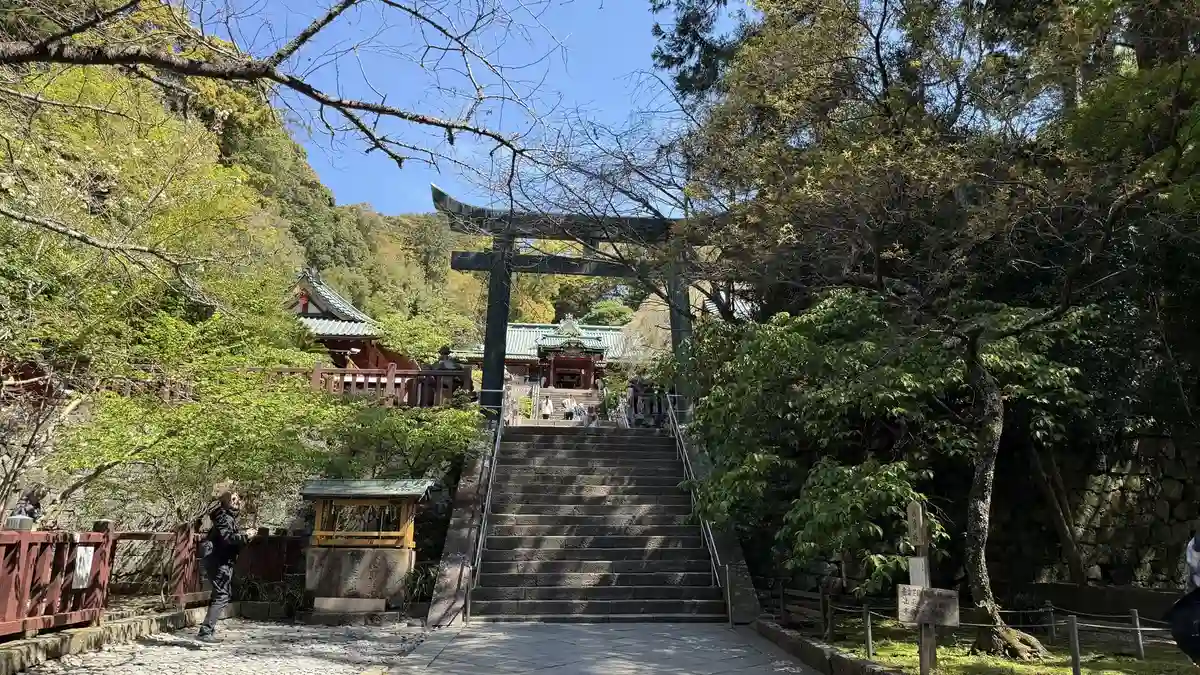
Tap any photo to enlarge
Time to allow
20 to 30 minutes to pay respects and walk round the carving once. Start following the detail and it easily becomes an hour.
| Status | Original structure (National Treasure, designated December 2010) |
|---|---|
| Enshrined here | Principal deity: Tokugawa Ieyasu. Enshrined alongside him: Toyotomi Hideyoshi and Oda Nobunaga (per the shrine’s account of its origins) |
| What is covered | The inner sanctuary, the connecting chamber and the worship hall |
| Built | Begun May 1616, completed December 1617 |
| Master carpenter | Nakai Masakiyo, chief carpenter to the shogunate |
The shrine points out two details that reward a slow look. One hollyhock crest on the roof is set upside down, which is said to mean that the building is deliberately left incomplete, expressing a wish for further growth. On the worship hall there is also a carving of a boy breaking a water jar — a Chinese story in which a child smashes a valuable jar to save a friend who has fallen in, used here to stand for the value of a life. Both are above eye level, so you only find them if you go looking.
The mausoleum path and the stone pagoda🎥 360°
A lantern-lined climb to the tomb itself
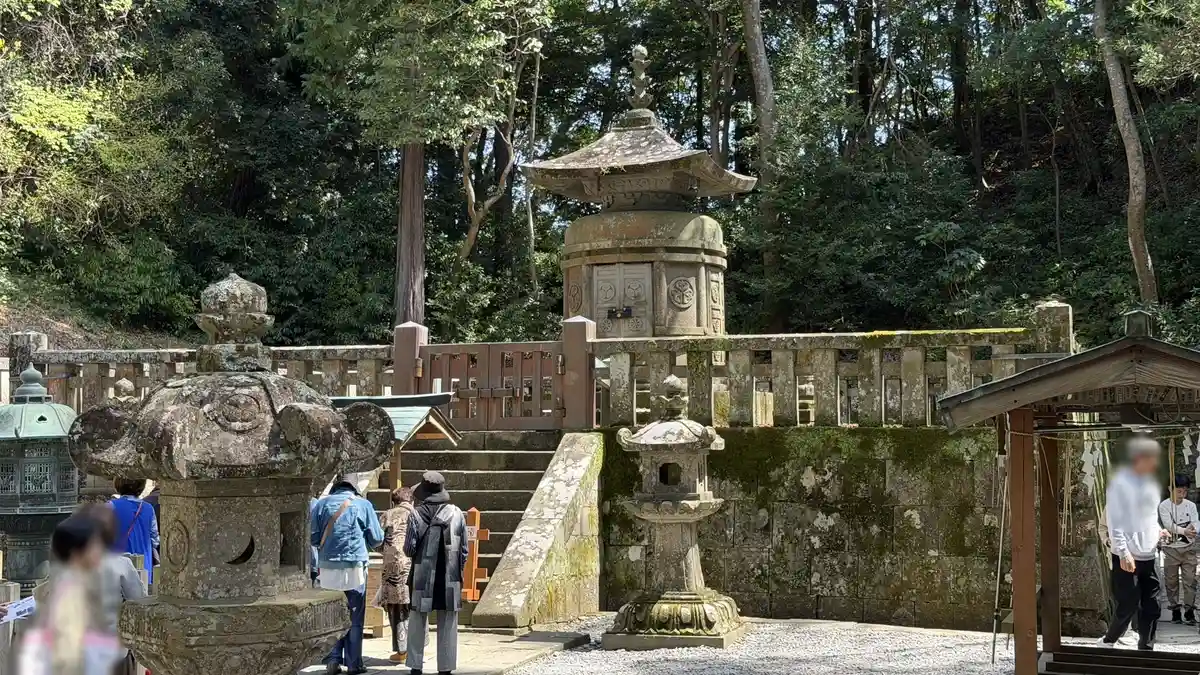
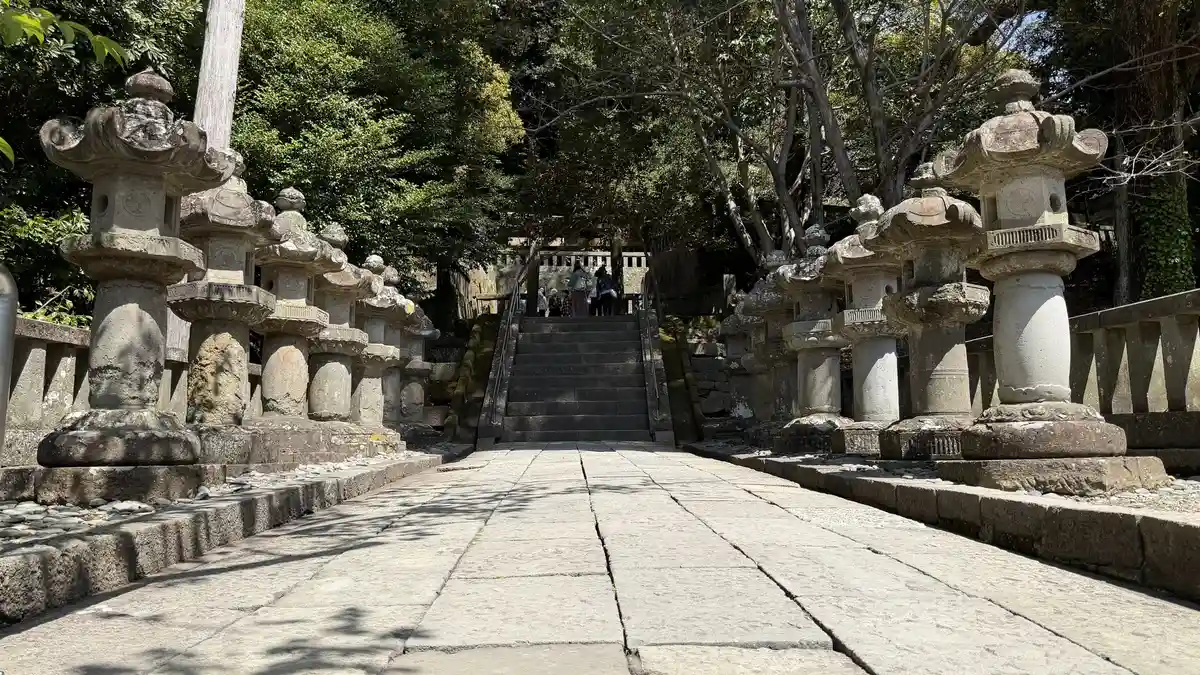
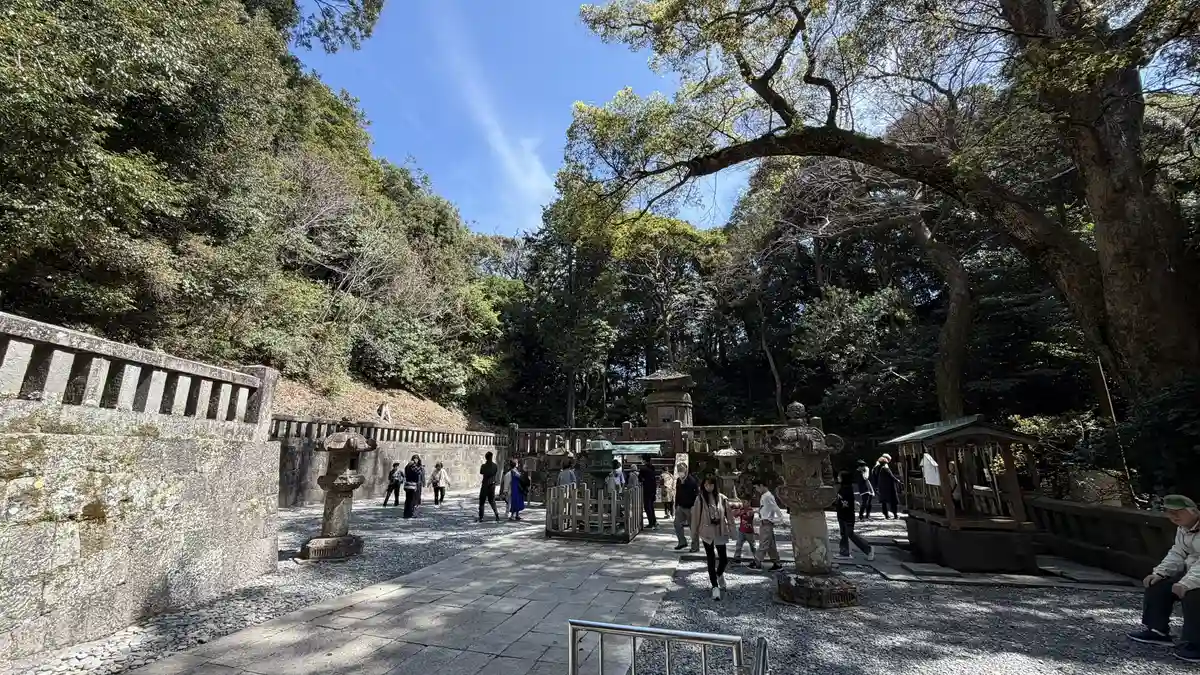
A path lined with stone lanterns leads up from the side of the main hall. It is short but uphill, and enclosed by tall trees, so the atmosphere changes completely from the open ground in front of the shrine. The shrine allows about 5 minutes for this stretch.
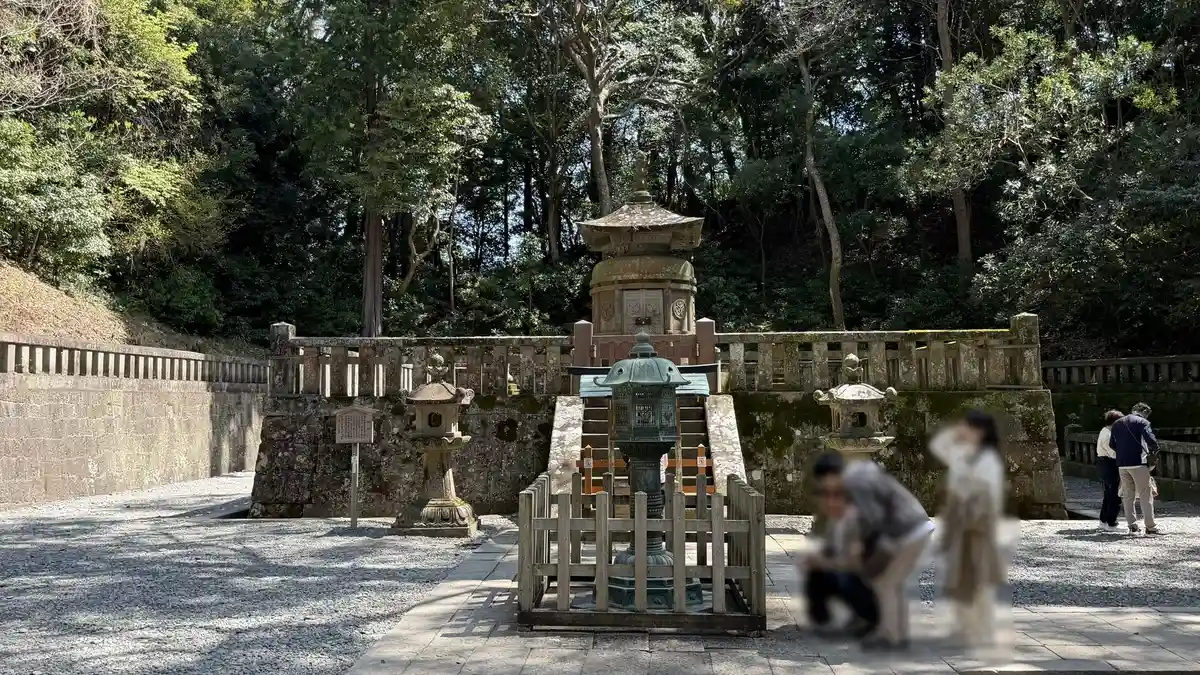
At the top is the mausoleum. According to the shrine, a small wood-and-cypress-bark pagoda stood here from the shrine’s founding in 1616; the present stone pagoda, 5.5 metres high with an outer girth of about 8 metres, replaced it in 1640, built by Tokugawa Iemitsu, Ieyasu’s grandson and the third shogun. By Ieyasu’s own instruction it faces west: to the west stand Horaisan, where his parents are said to have prayed for a child, and beyond it Daijuji Temple and Okazaki Castle, his birthplace, with the line continuing on towards Kyoto. Knowing why it faces this way draws your eye toward the direction beyond it.
What to look for
- The approach path lined on both sides with stone lanterns
- The stone pagoda and the direction it faces
- The great camphor tree beside it, known as the money tree
- The explanatory board at the side of the mausoleum
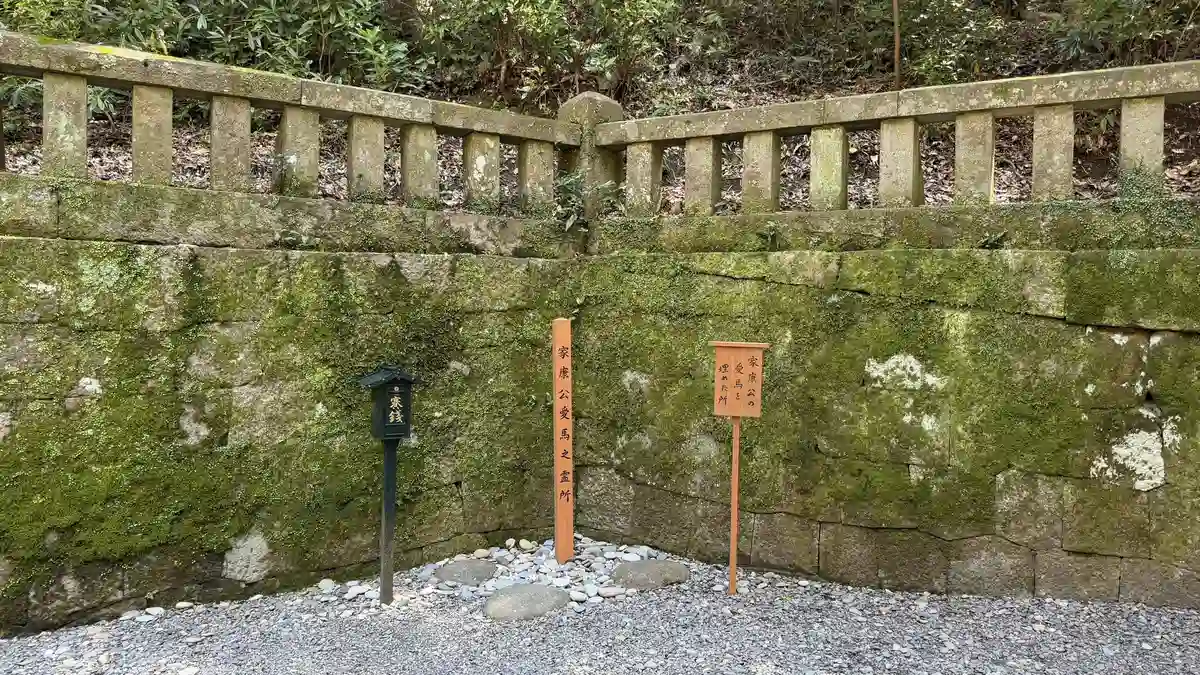
- Carving on the bases of the lanterns in front of the pagoda
Tap any photo to enlarge
Time to allow
About 20 minutes there and back from the main hall, including time to read the boards.
| Status | Original structure (stone pagoda) |
|---|---|
| Size | 5.5 m high, outer circumference 98 m (per the shrine) |
| Erected by | Tokugawa Iemitsu, the third shogun |
| Orientation | Facing west, towards Horaisan, Daijuji Temple and Okazaki Castle, and on towards Kyoto |
| Getting there | About 5 minutes uphill from the main hall |
Sources differ on where Ieyasu’s remains finally lie. Kunozan Toshogu states that the mausoleum stands over his burial place. A reference case published by the Edo-Tokyo Museum library cites literature saying his coffin was moved from Kunozan to Nikko in 1617. This guide treats the shared ground — burial at Kunozan in 1616, enshrinement at Nikko in 1617 — as established, and goes no further.
Site of the five-storey pagoda
Nothing is standing, which is exactly why people walk past
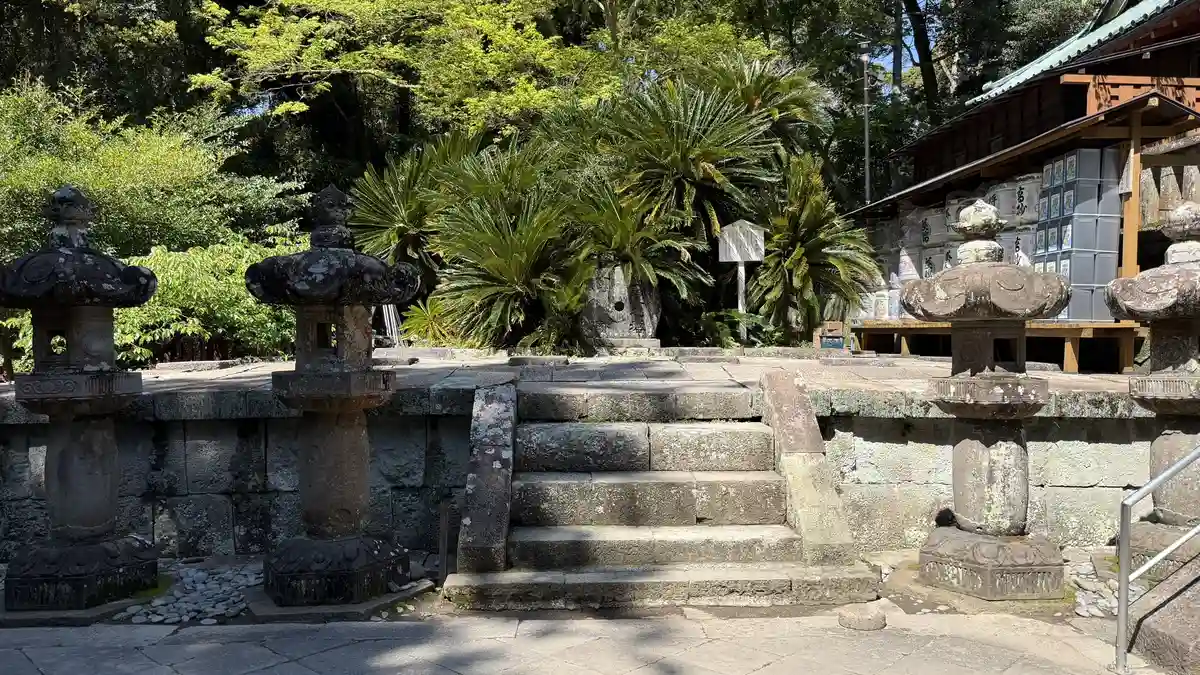
According to the shrine’s precinct information, a five-storey pagoda was begun here in 1635 and completed in 1636. It was removed during the separation of Shinto and Buddhism in the Meiji period, and only foundation stones and similar traces remain.
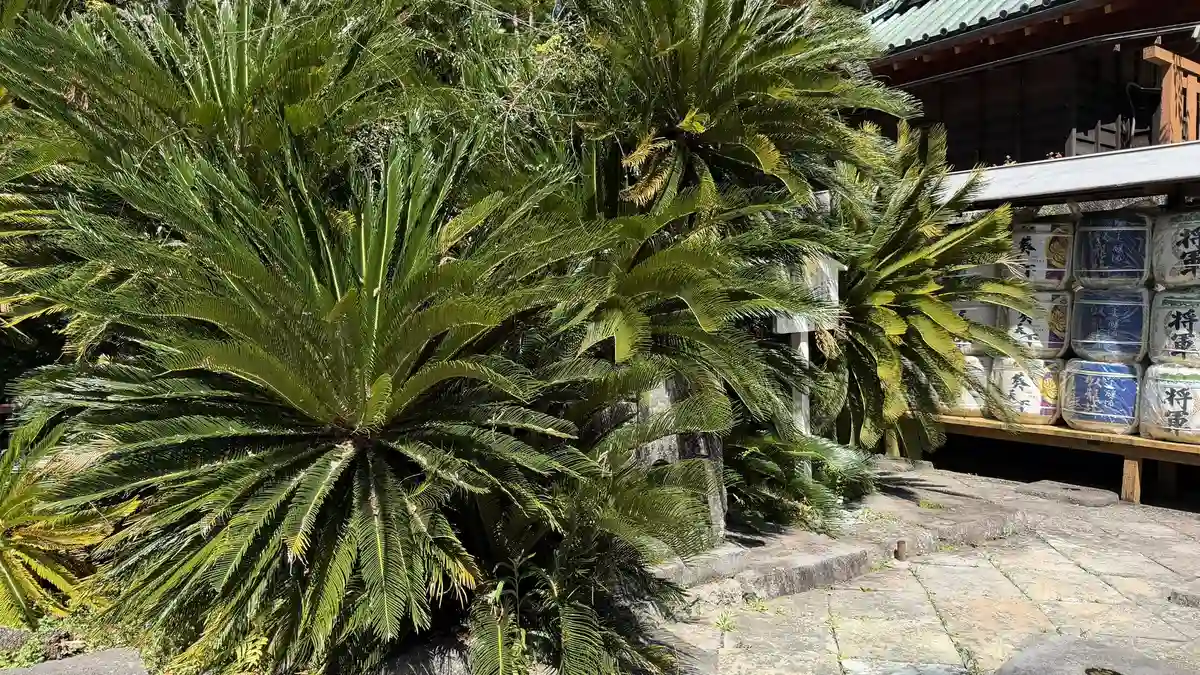
This was the easiest thing on the hill to miss. The site is planted with cycads, so what you actually see is a clump of greenery rather than anything that announces itself. Walking up towards the main hall, it is very easy to pass it without noticing. Look for the signage instead of looking for a structure.
What to look for
- The stand of cycads planted on the site
- The information board and stone lanterns around it
- The contrast between surviving buildings and former sites in one precinct
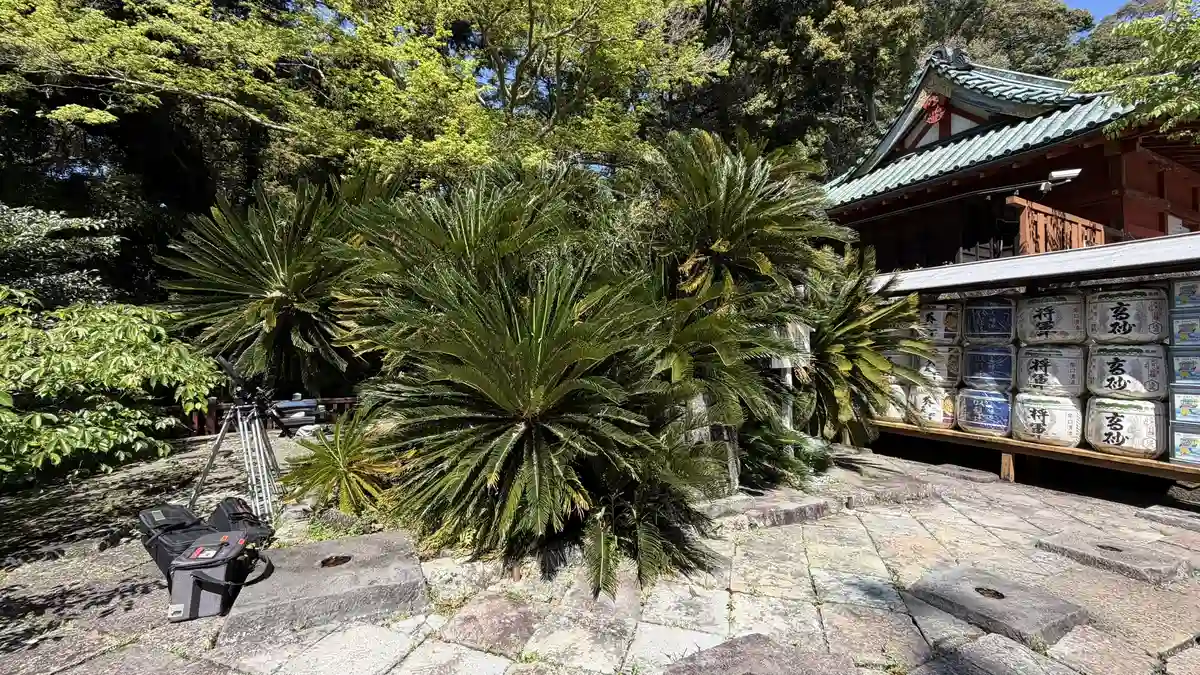
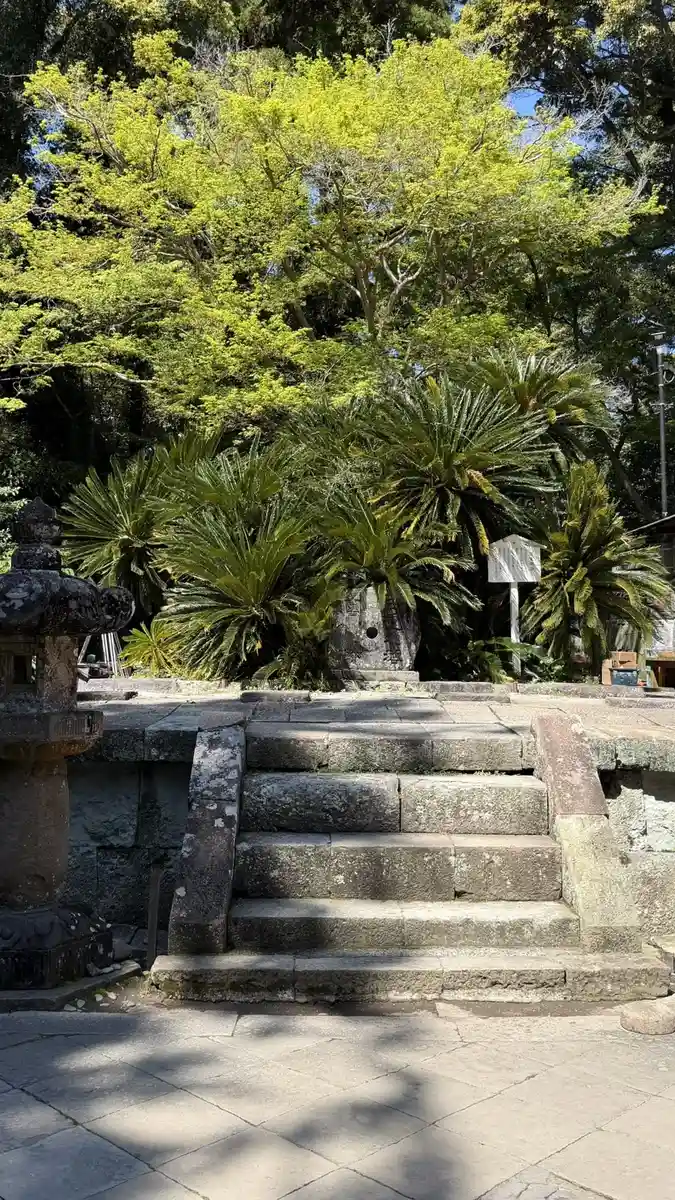
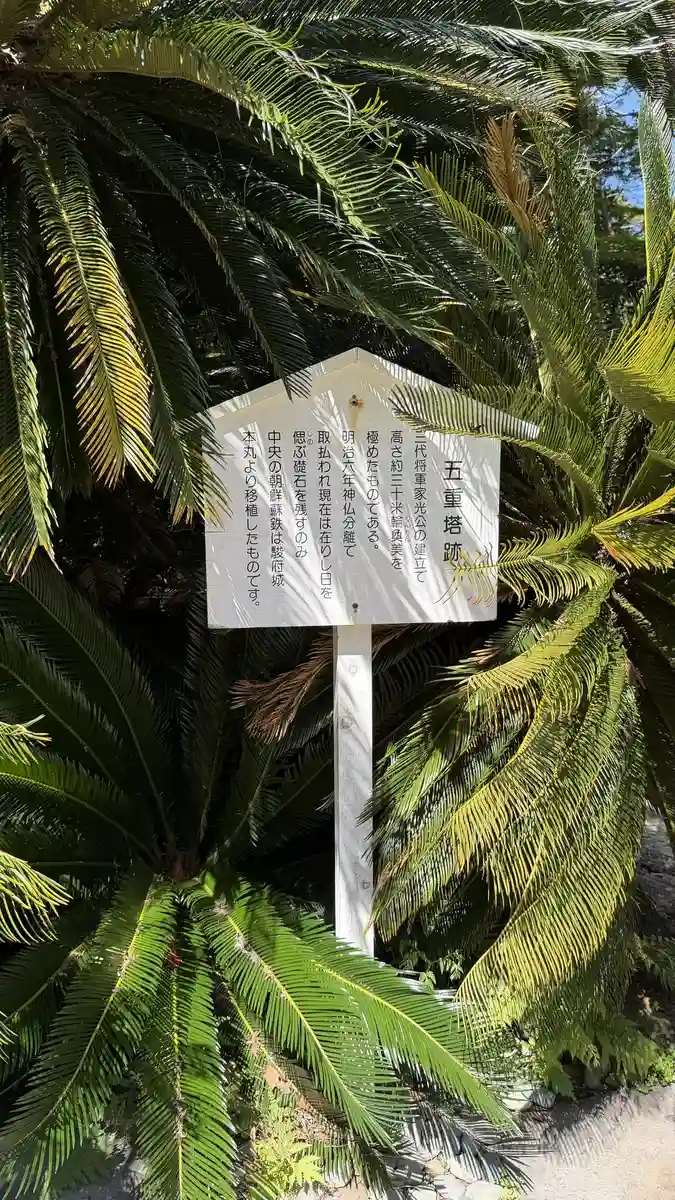
Tap any photo to enlarge
Time to allow
About 5 minutes to find the spot and stop.
| Status | No building survives (former site, foundation traces) |
|---|---|
| Built and removed | Begun 1635, completed 1636; removed at the separation of Shinto and Buddhism |
| How not to miss it | Use the cycads and the signage as your marker |
A pagoda here means that Kunozan Toshogu once combined Buddhist and Shinto worship, as most major Japanese religious sites did before 1868. Read alongside the surviving Hie Shrine, the empty pagoda site lets you trace the changing religion of this hill — temple, castle, shrine — in a single precinct.
The stone stairway, the Ichinomon gate and the torii at the foot
Seventeen switchbacks and 1,159 steps — the only way up until the ropeway
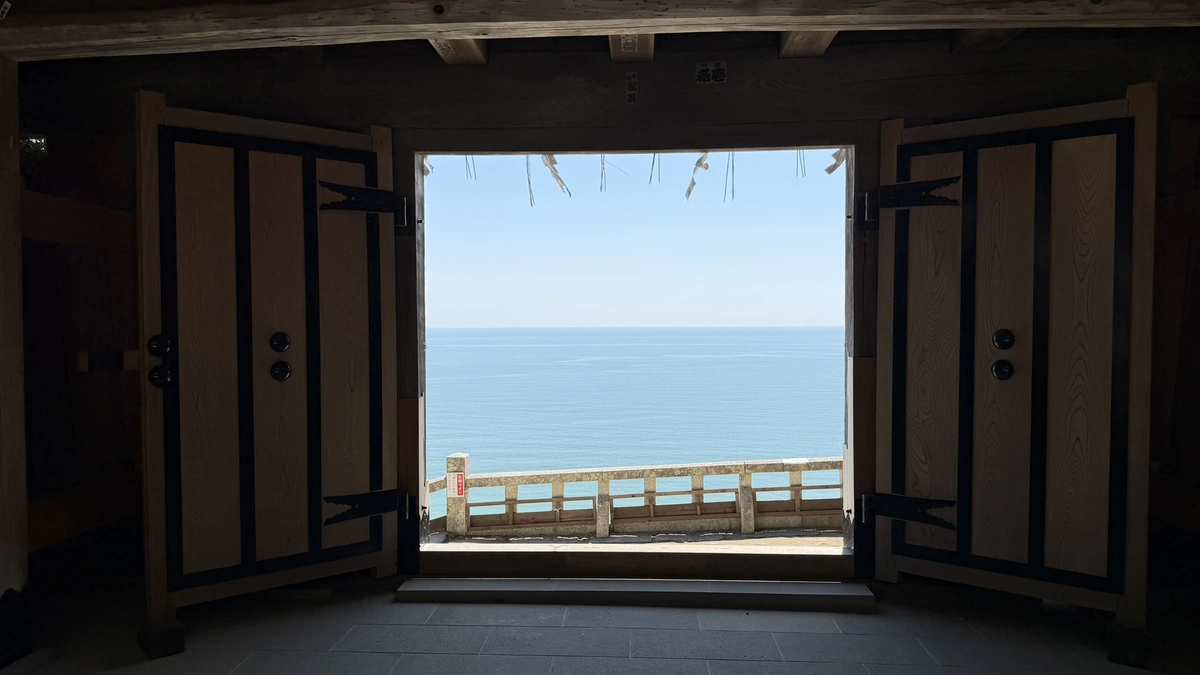
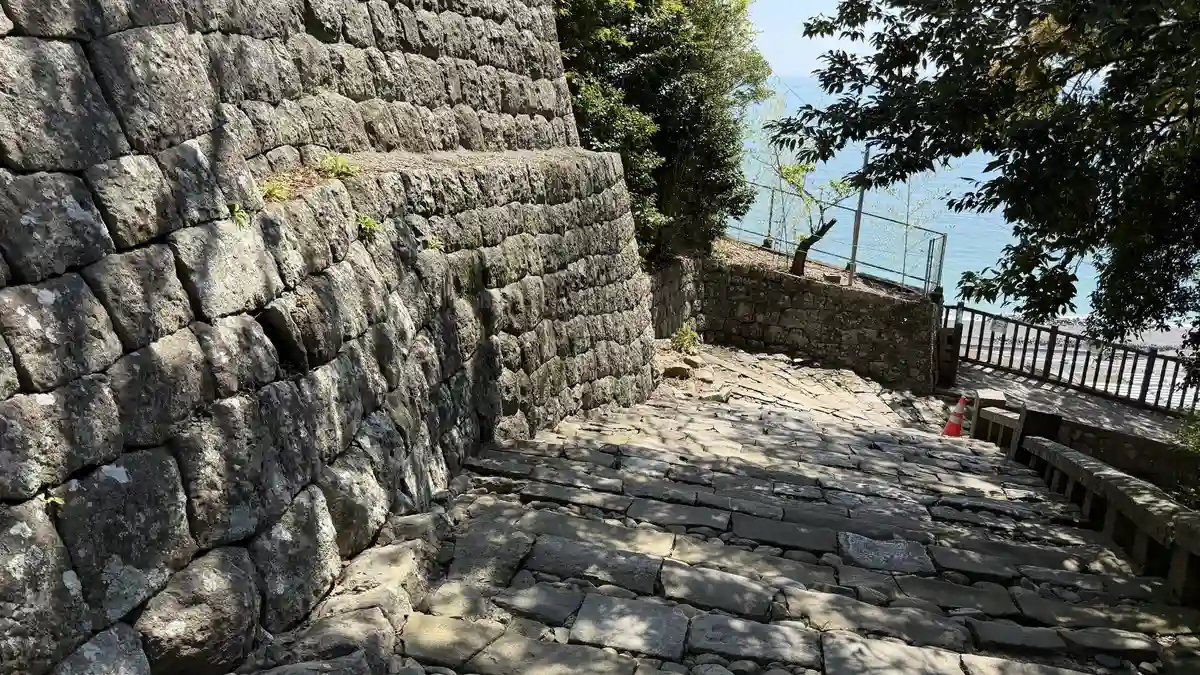
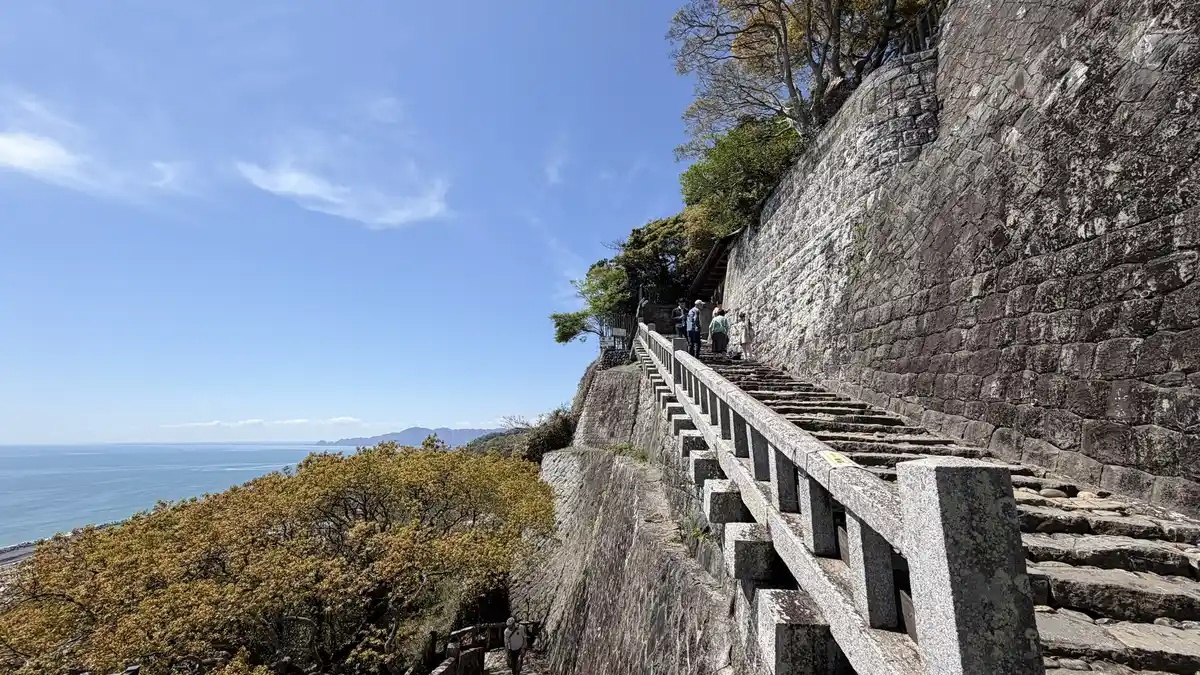
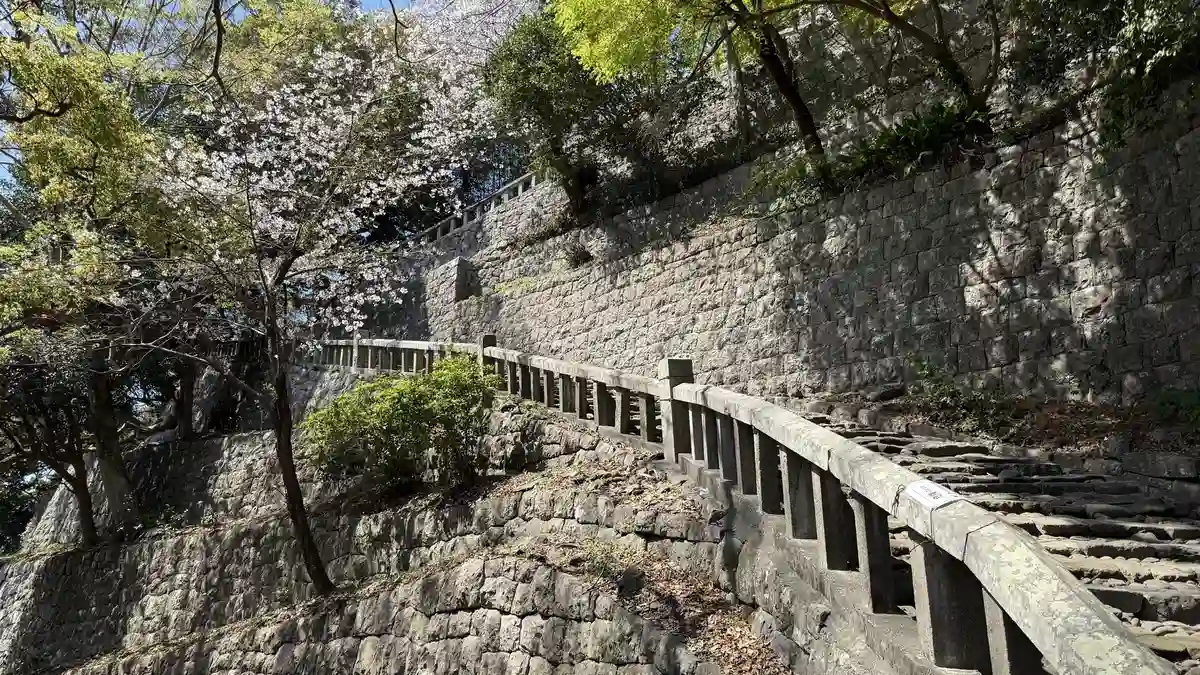
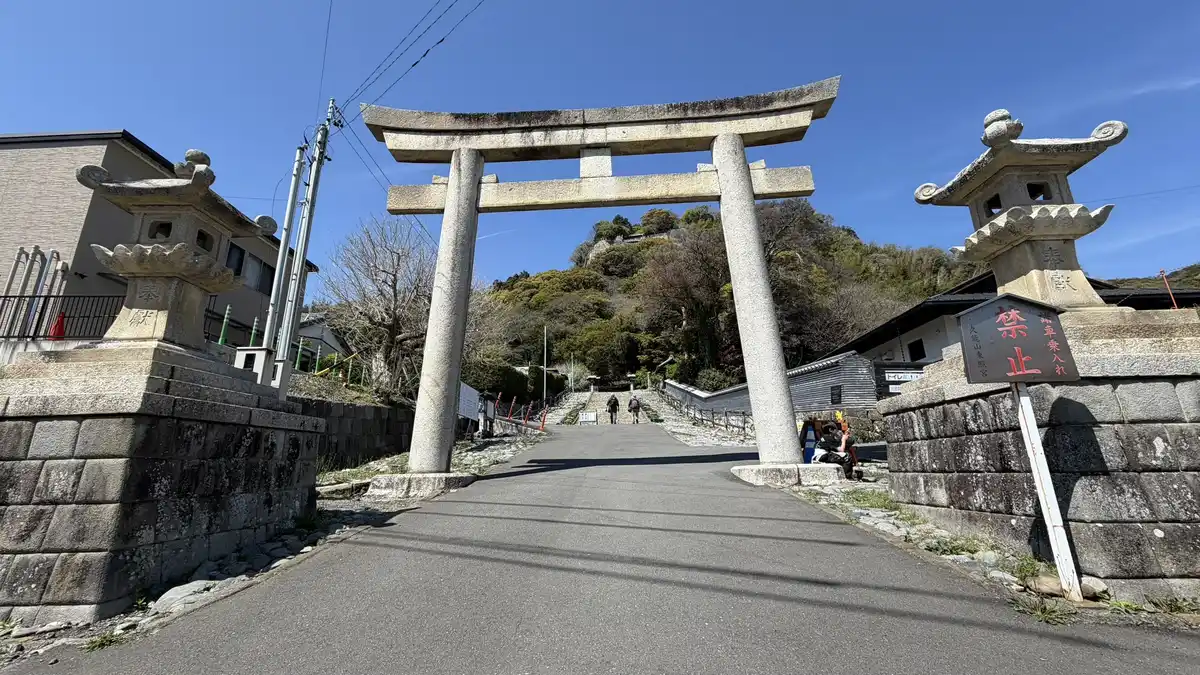
The shrine states that the stairway runs from the stone torii at the foot of the hill to the front of the inner sanctuary in seventeen switchbacks and 1,159 steps. Until the ropeway opened, this was the only route to the shrine. The shrine also passes on a local joke: pilgrims used to climb reciting ichi-ichi go-kuro-san, which puns on the number 1,159 and means roughly “thanks for your trouble”.
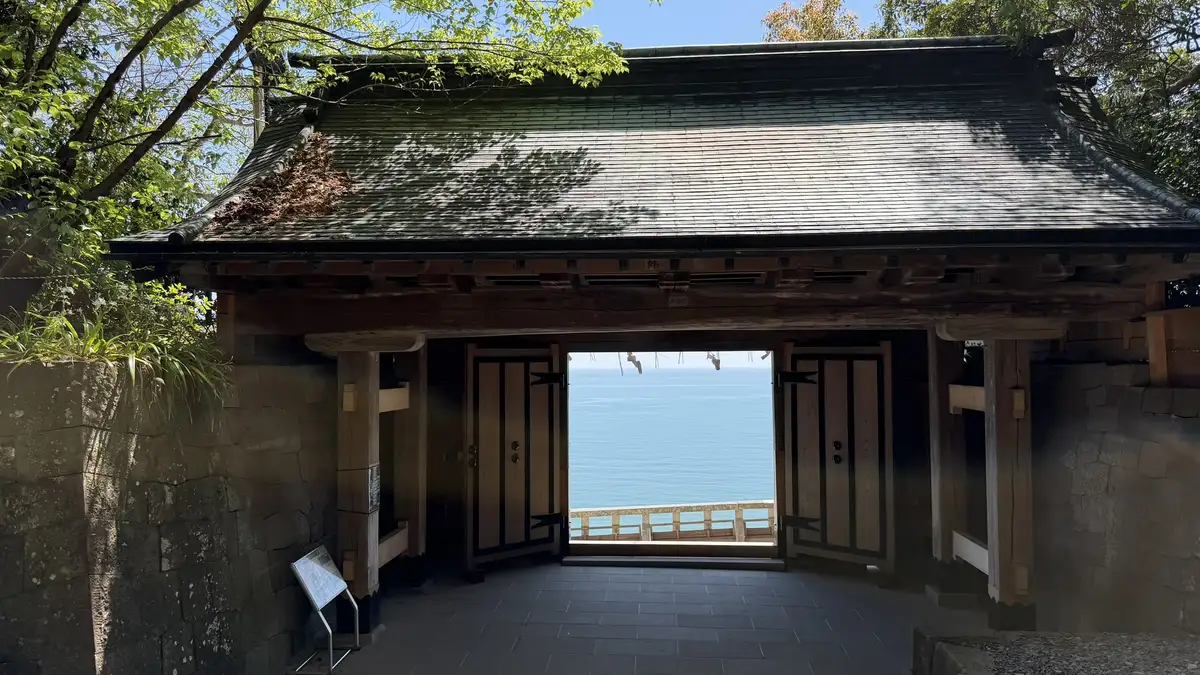
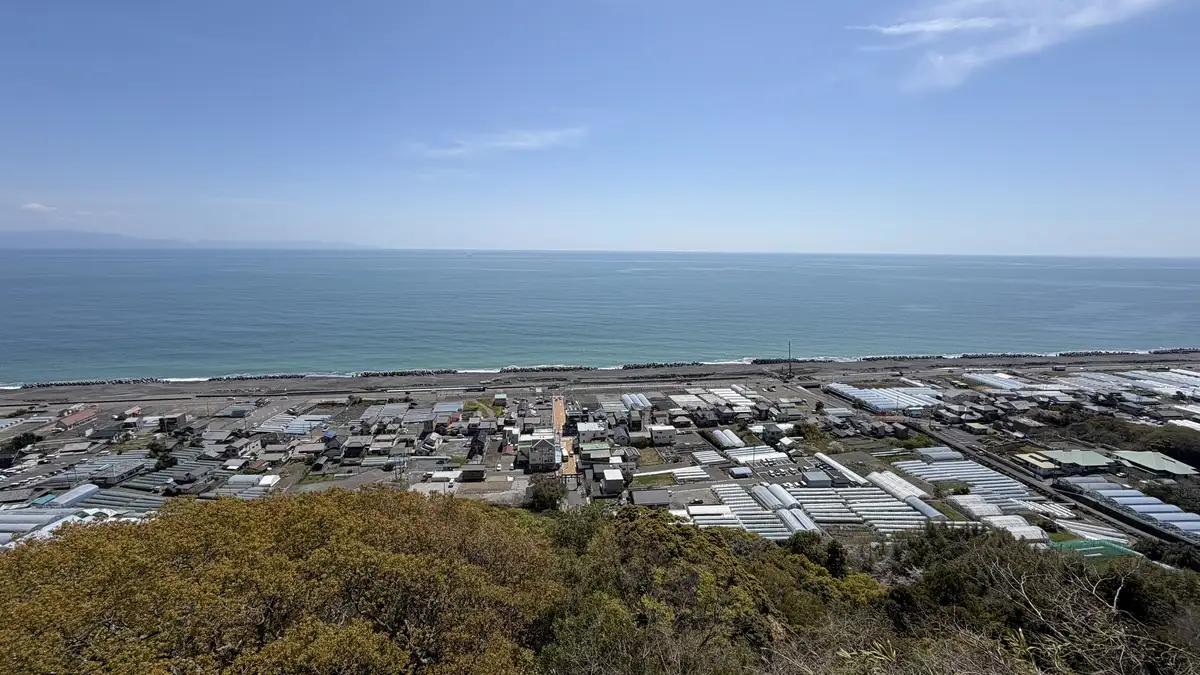
The single best view of the day was from the Ichinomon gate. Its square opening works as a frame, and the bay and coastline drop into it. Coming down, the steps themselves were not hard going — but they are built from fitted stone blocks of uneven height, so you do watch your footing. Going up, the shrine’s figure of about 20 minutes from the foot is optimistic for most people; the segment estimate of about 30 minutes from the torii to the shrine office is closer to what it feels like.
What to look for
- Suruga Bay framed in the Ichinomon gate
- The fitted stone steps and the seventeen switchbacks
- Long runs of stone walling beside the path
- Cherry blossom along the route in spring
- The stone torii at the foot and the shrine pillar beside it
- The branch path down to the Kuno plum grove
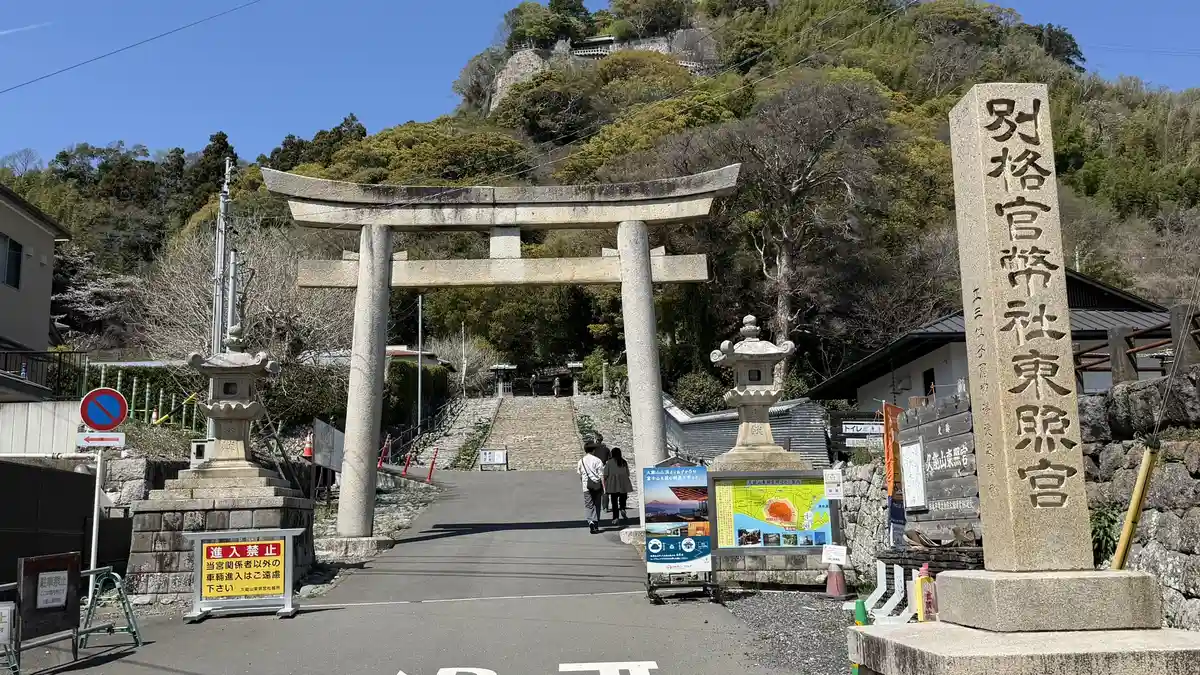
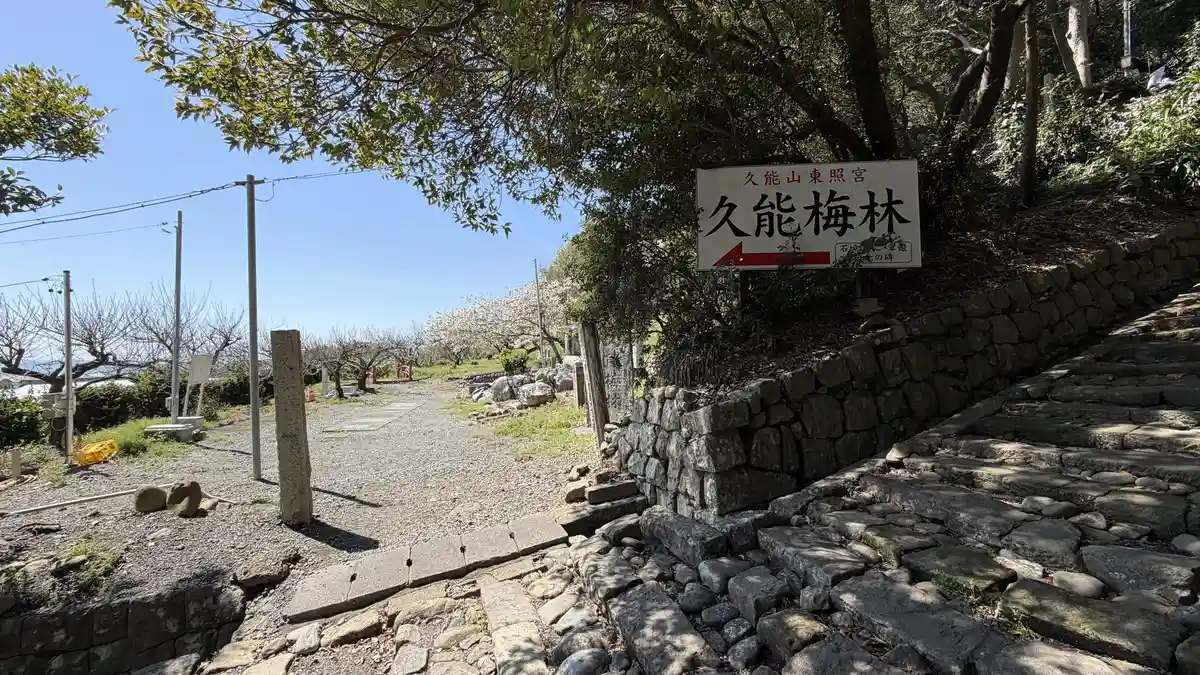
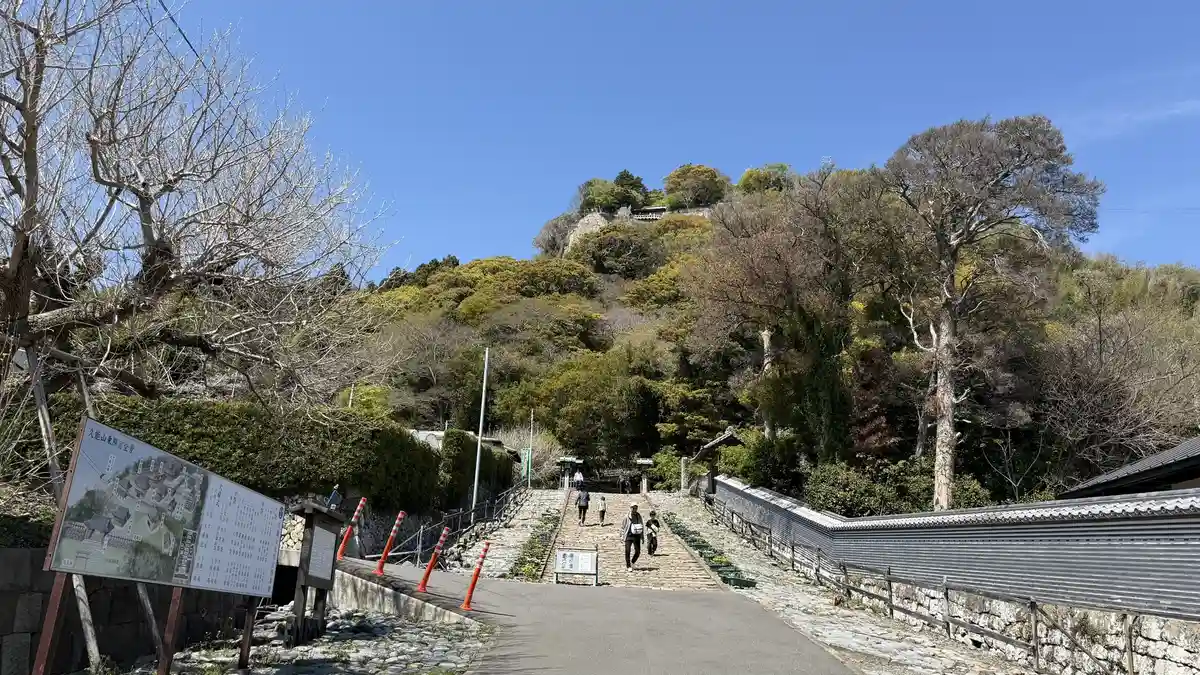
Tap any photo to enlarge
Time to allow
Coming down with frequent photo stops took me about 30 minutes. The shrine gives about 20 minutes for the climb from the foot of the hill.
| Status | In use (part of the designated historic site of Kunozan) |
|---|---|
| Scale | Seventeen switchbacks, 1,159 steps from the torii to the inner sanctuary |
| Underfoot | Fitted stone blocks of uneven height and depth |
| Advice | Watch your footing downhill; allow extra time going up |
| During the ropeway closure | The shrine can still be reached by this stairway from 1 to 21 December 2026 |
The inscribed pillar beside the torii names the shrine by a rank from the state Shinto system of the Meiji period, when shrines were graded and funded by the government. The stone is itself a small piece of evidence that Kunozan was reclassified by the modern state, long after the Tokugawa shogunate had gone.
The Kunozan Toshogu Museum: Ieyasu’s own possessions, and a no-photography rule
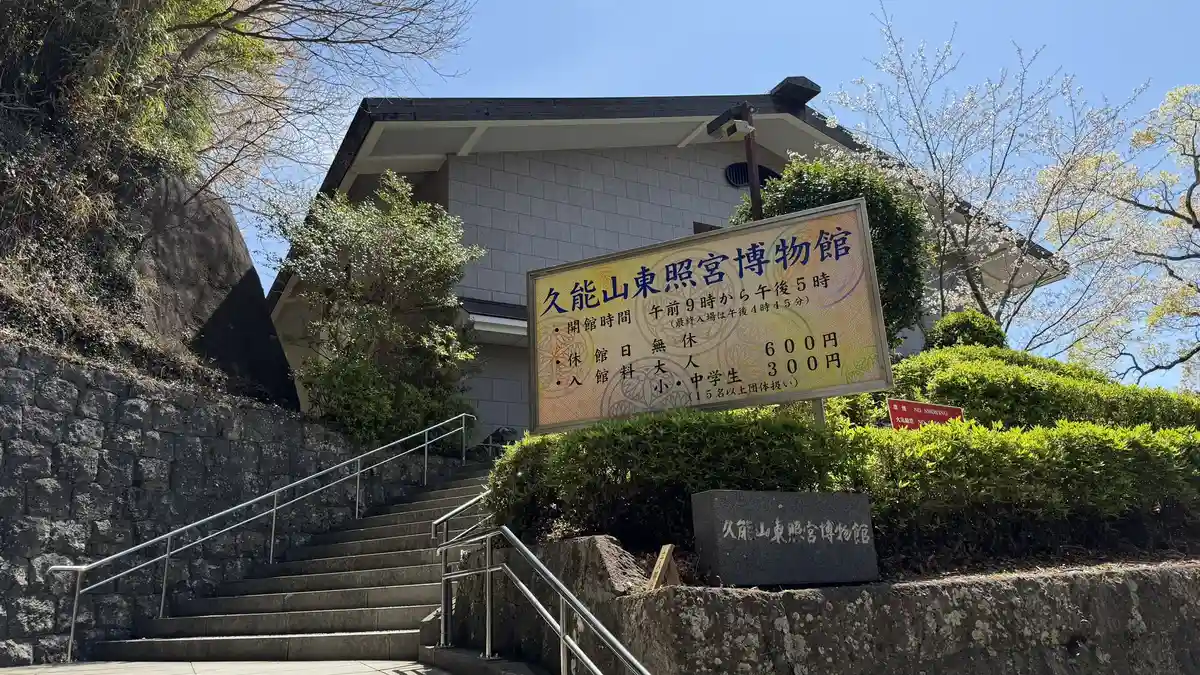
The museum stands close to the ticket counter. According to the museum, its holdings number more than 2,000 items, and its particular strengths are the group of objects Ieyasu used personally and a substantial collection of arms and armour belonging to successive Tokugawa shoguns. Even if you came for the architecture, this is worth the extra ticket.
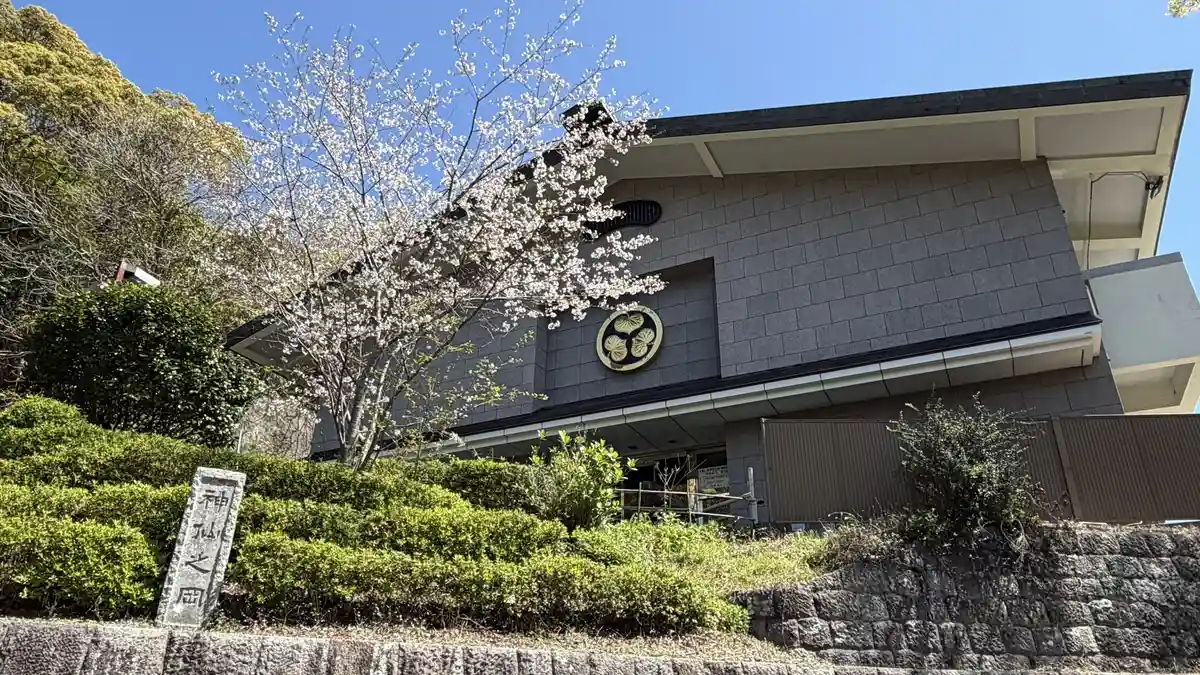
I spent about 20 minutes inside in April 2026. What stayed with me was a gilded suit of armour, which the shrine presents as having belonged to Ieyasu himself. Standing in front of it, the striking thing is not the gold but the plain fact that a man wore it and moved in it. Displays are rotated, so check the current exhibition on the official site before you go.
The museum states that photography is prohibited throughout the galleries. If you want a record of what you saw, plan on the exhibition listing or a catalogue instead.
The museum is scheduled to close for internal facilities work from 1 to 21 December 2026 (checked 26 September 2026). The Nihondaira Ropeway is out of service over exactly the same dates.
The museum opens 9:00–17:00 with last admission at 16:45, and the shrine stops admissions 10 minutes before 17:00. Arriving late in the afternoon means choosing between the two, or visiting the museum first.
Tap any photo to enlarge
Goshuin: a seal slip cut from cedar, and a JR Central collaboration
A goshuin is a seal and calligraphy record of a visit, written into a book that pilgrims carry from shrine to shrine. At Kunozan Toshogu they are issued at the reception desk at the shrine office. The shrine gives the standard goshuin as ¥500, brushed directly into your book, with the desk open from 9am to 5pm (checked 26 September 2026).
The one worth going out of your way for is made of wood. It is the “money tree” goshuin, and the shrine describes it as a seal slip made from cedar, with the scent of the wood still on it. It costs ¥1,000. Because it is wood rather than paper, it cannot be brushed into a goshuin book and is issued as a loose slip only. It refers to the large camphor known as the money tree that stands beside Ieyasu’s mausoleum, and to the precept attached to it — so it reads differently if you walk the mausoleum approach first.
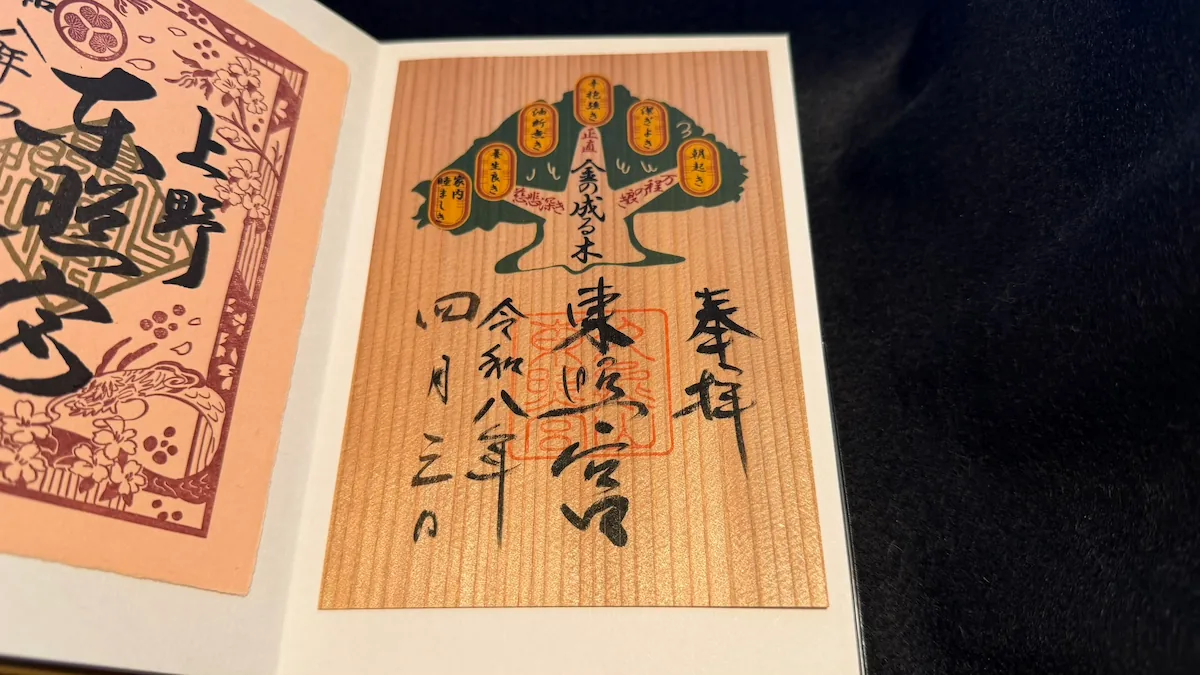
There is also a special goshuin that comes with a JR Central product rather than with a visit. JR Central’s information describes a bundle of a specially designed amulet carrying a Shinkansen motif and a special goshuin bearing the ichi-fuji ni-taka san-nasubi motif associated with Ieyasu, sold together with the combined shrine and museum admission ticket. It is booked in advance through JR Central’s “EX Tabisaki Yoyaku” service, so it is not something you can decide on once you are standing at the shrine office. The contents and the period change, so check JR Central’s current information before you travel (position as of 26 September 2026).
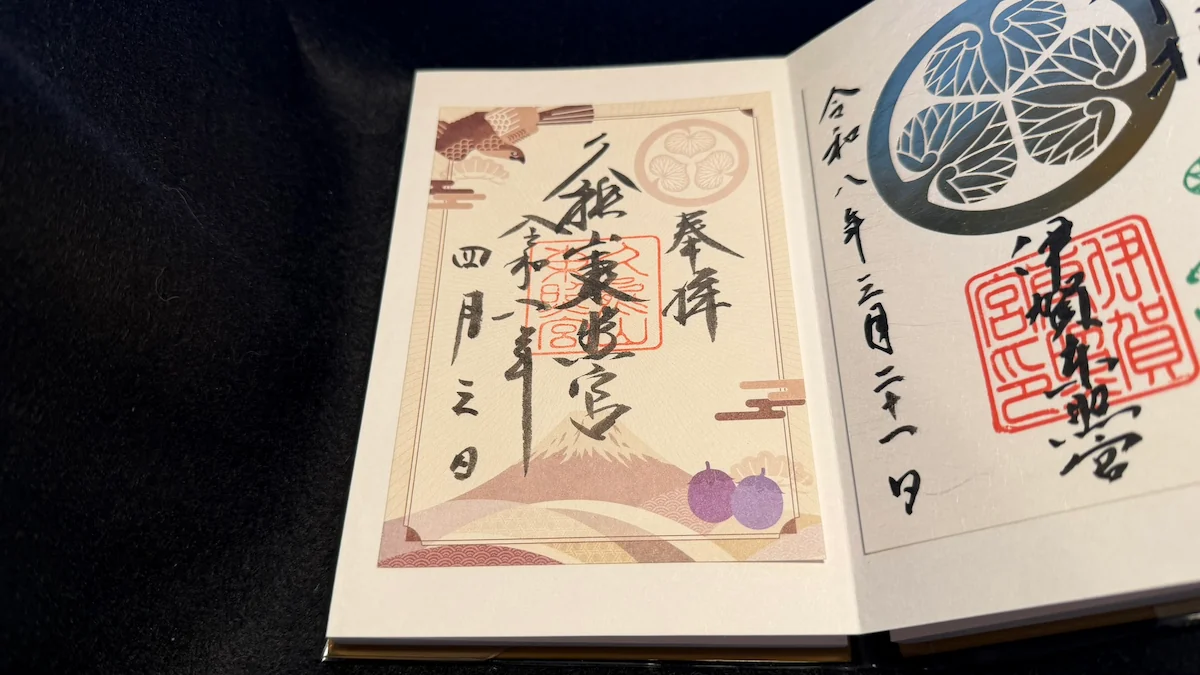
9am to 5pm at the shrine office. Admission closes ten minutes before that, so if you are arriving late in the day, decide in advance whether the goshuin or the museum comes first.
The JR Central goshuin is part of a product booked in advance. You cannot sign up for it after you arrive at Kunozan, so arrange it before you set out if that is what you are after.
Fitting Kunozan into a Japan itinerary
Kunozan takes half a day at most, which makes Shizuoka a natural half-day stop rather than an overnight commitment. If you are travelling between Tokyo and Kyoto on the Tokaido Shinkansen, you can leave Tokyo in the morning, see the shrine, and be in Kyoto the same evening — provided you take Hikari or Kodama trains, since the fastest Nozomi services do not stop at Shizuoka.
If you want to add more Tokugawa history in the same city, the site of Sunpu Castle — where Ieyasu spent his last years — is a park near Shizuoka Station and is easy to reach on foot from there.
Three other places filled the rest of that day. One is a small shrine you can reach on the way to the ropeway; the other two have nothing to do with Ieyasu but are worth knowing about, because one of them cannot be had anywhere else in Japan and the other is a pilgrimage site in its own right for a particular kind of traveller.
Nihondaira Hotel Toshogu (bunrei)🎥 360°
A small shrine in the Nihondaira Hotel garden, one stop before the ropeway
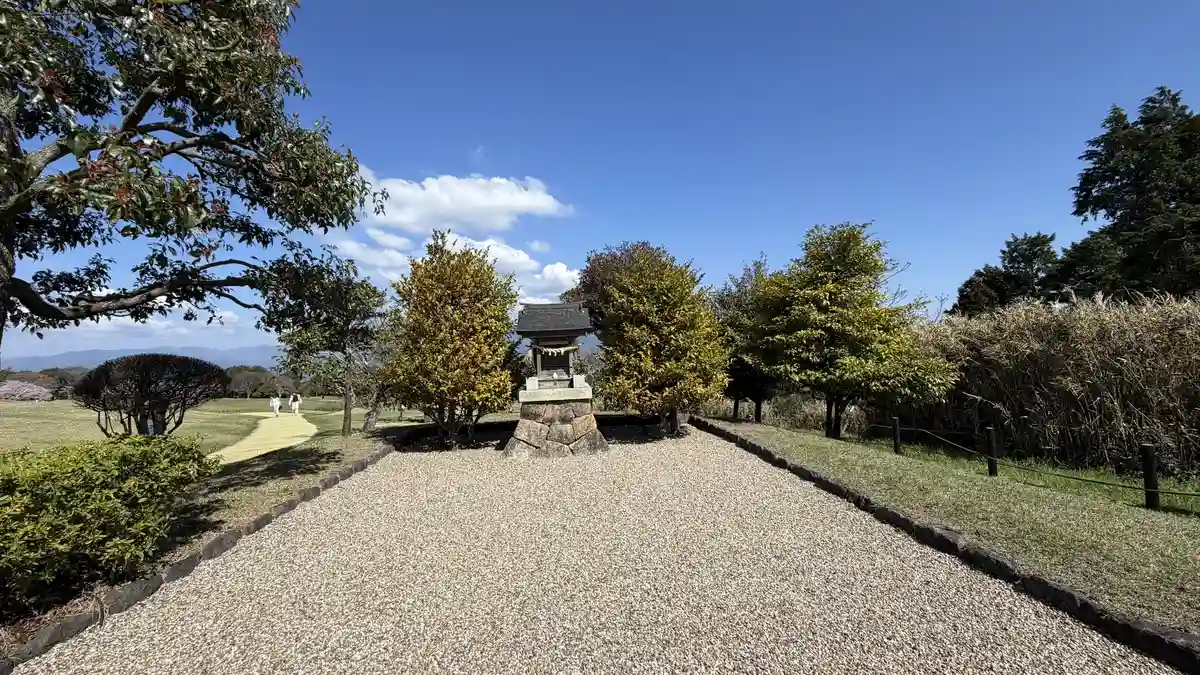
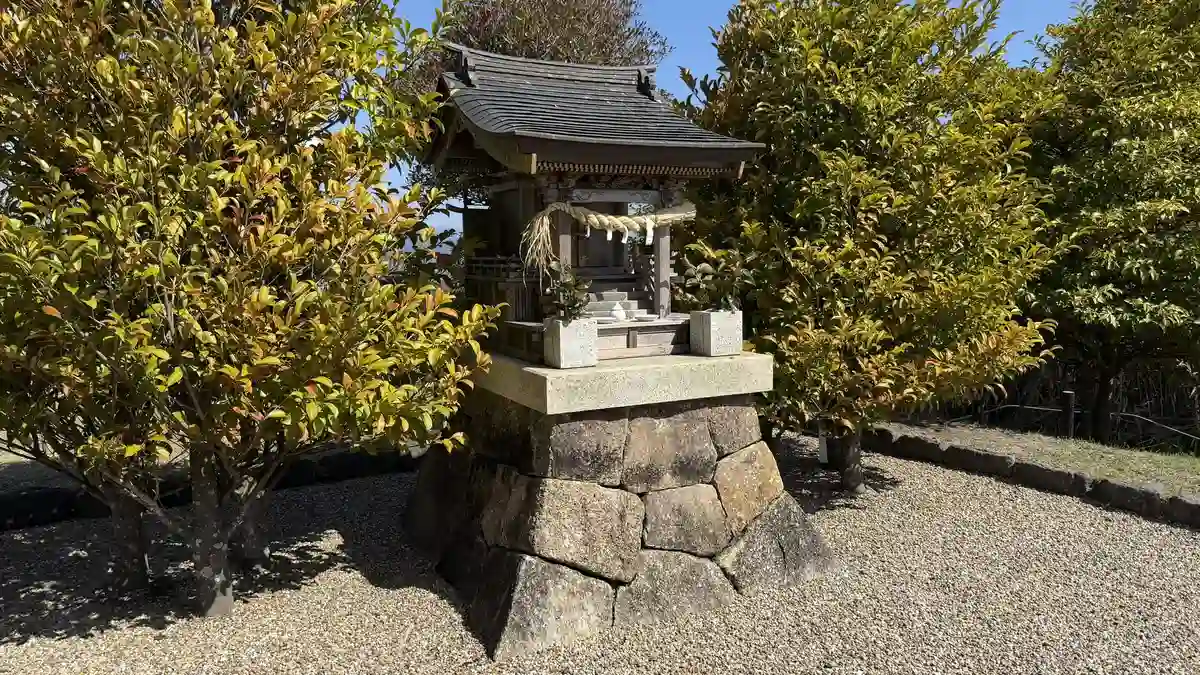
The bus to the Nihondaira Ropeway (Nihondaira Route, bus 41) has a stop called “Nihondaira Hotel” one before the terminus. Getting off there and walking into the hotel’s lawn garden, you find, at its eastern edge, a small wooden shrine building hung with a sacred rope (shimenawa) and set on a stacked-stone plinth. Map data records the name as “Nihondaira Hotel Toshogu (bunrei)” — a bunrei being a divided or branch spirit enshrined at a second location.
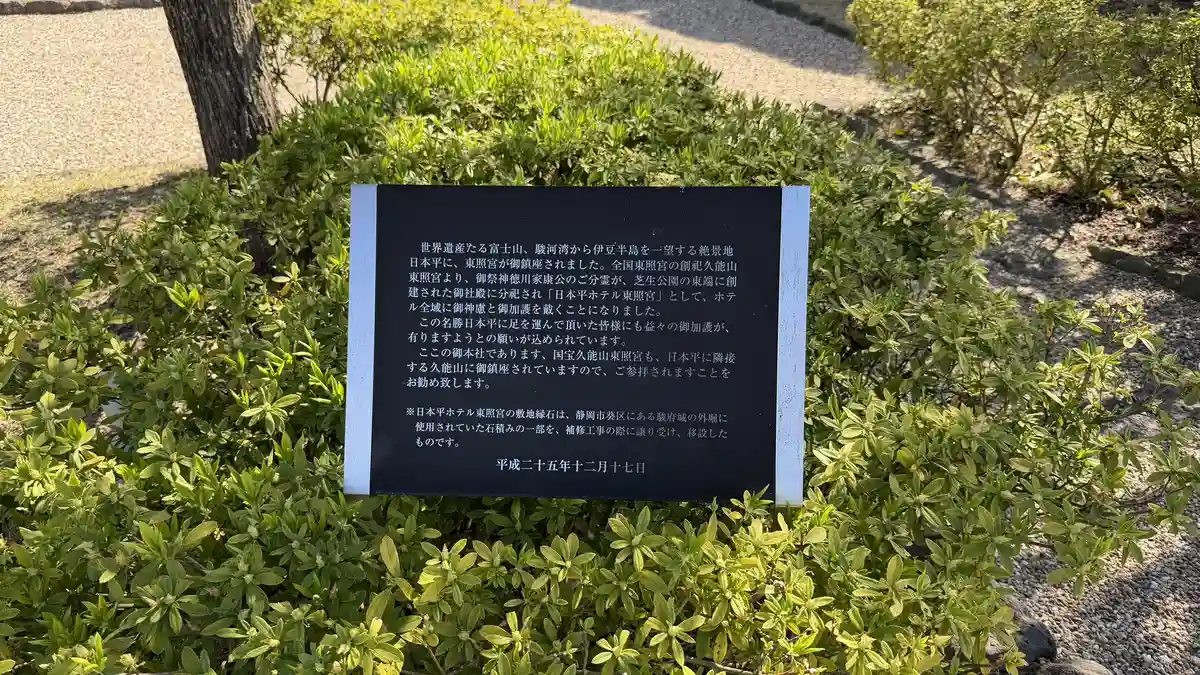
An information board on site (erected 17 December 2013) explains that this shrine building was founded by inviting a branch spirit of Tokugawa Ieyasu, the deity of Kunozan Toshogu — the founding shrine of every Toshogu in Japan — and enshrining it in a new shrine building at the eastern edge of the lawn garden, named “Nihondaira Hotel Toshogu,” so that the whole hotel would receive its divine protection. The board states that this was done in the hope that visitors to this scenic spot of Nihondaira would also receive that protection, and it recommends visiting the head shrine itself, the National Treasure Kunozan Toshogu, which stands on the neighbouring hill.
One more detail from the same board is worth knowing: the kerbstones bordering the shrine’s plot are said to be part of the stonework once used in the outer moat of Sunpu Castle, in Aoi Ward, Shizuoka City, transferred and relaid here during repair work on the castle. Ieyasu spent his final years at Sunpu Castle, so stone from that castle now sits at the foot of a shrine built to enshrine him — a small connection easy to miss without reading the board.
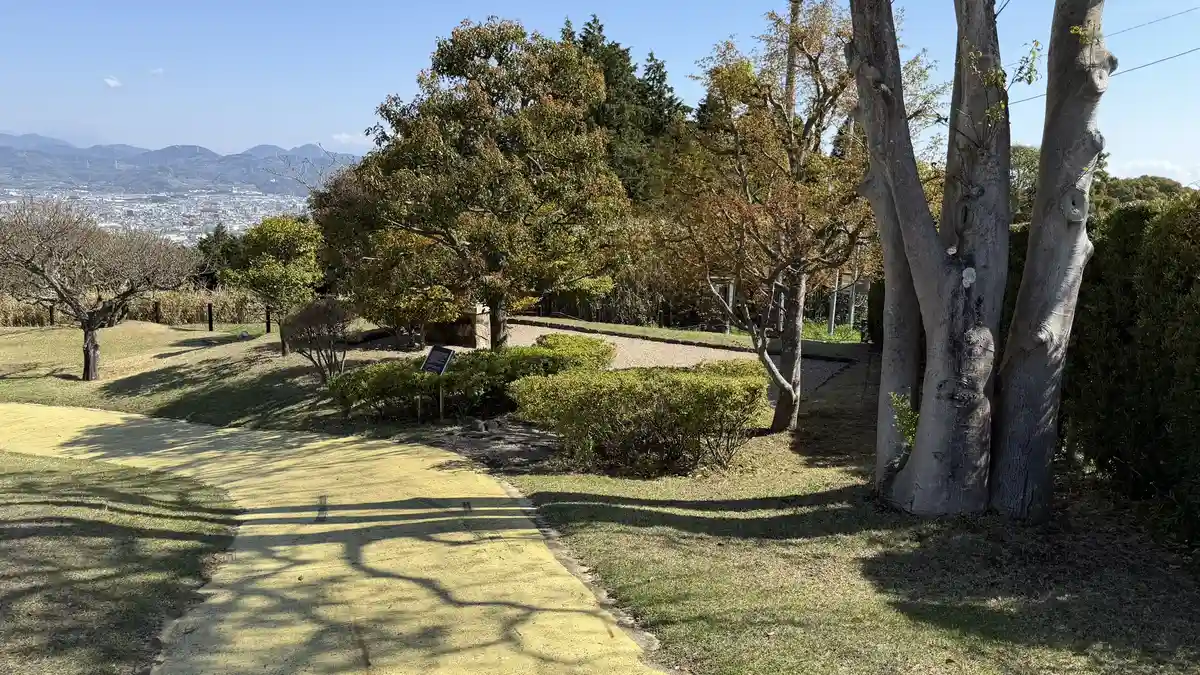
Tap to enlarge
Nihondaira Hotel Toshogu (bunrei)
It sits on the same Nihondaira bus route used for the ropeway, so it works as a stop either on the way up or on the way back. Five minutes is enough.
Sumiyaki Restaurant Sawayaka
A hamburg-steak chain that exists only in Shizuoka Prefecture
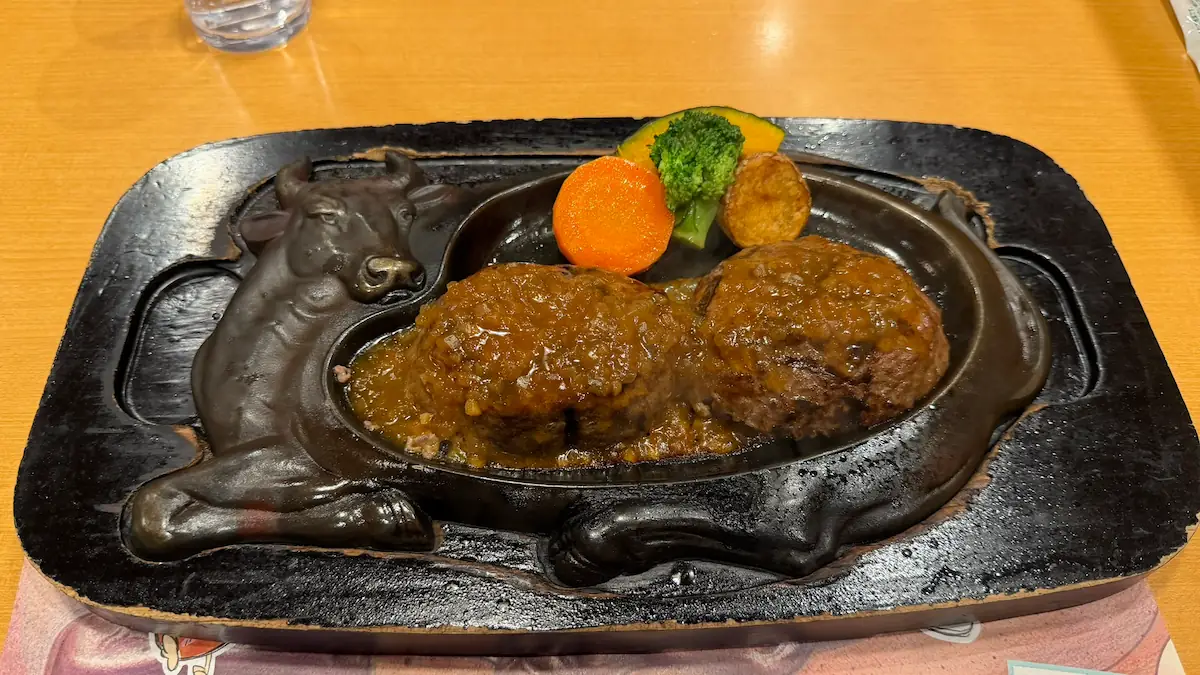
Sumiyaki Restaurant Sawayaka (炭焼きレストランさわやか) is a hamburg-steak chain that exists only in Shizuoka Prefecture. Every branch on the company’s own store list is inside the prefecture, with none anywhere else in Japan (checked 26 September 2026), which is why people who grew up in Shizuoka treat it as the taste of home and why visitors queue. The signature dish, the genkotsu hamburg, is a 250g charcoal-grilled beef patty at ¥1,540 (official menu, checked 26 September 2026). Waits are long at weekends; the company runs a numbered-ticket system at the door and also lets you join the queue from your phone.
The branch used on this visit, Shin-Shizuoka Cenova, closed on 13 May 2026, and a new branch opened on 10 July 2026 in the MARK IS Shizuoka shopping complex, nearest to JR Higashi-Shizuoka Station. That is the one to aim for now, and it suits anyone using the northern route, since the Nihondaira bus also calls at Higashi-Shizuoka. Putting your name down and walking over to Sunpu Castle Park while you wait works well too.
The signature way to eat the genkotsu hamburg is to split it open yourself right before eating and press the cut halves against the hot iron plate it arrives on, finishing the centre to your own taste. If you already like Japanese hamburg-steak chains such as Hungry Tiger or Bronco Billy, this one will very likely suit you too. There is always a queue, but whenever there is time to spare, this is where we go.
Sawayaka, MARK IS Shizuoka branch (nearest station: JR Higashi-Shizuoka)
Sauna Shikiji
Known nationally as the “holy land of sauna”
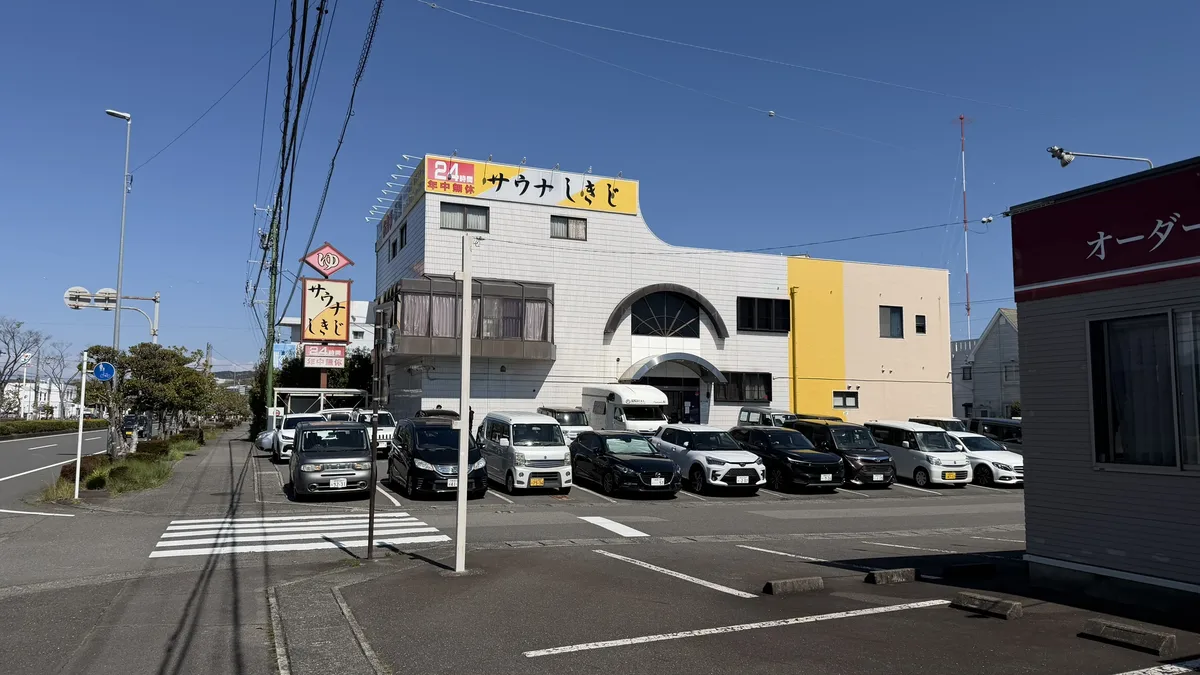
Sauna Shikiji (サウナしきじ) is in Shikichi, Suruga Ward, on the same side of the city. Shizuoka Prefecture’s official tourism guide describes it as known nationally as the “holy land of sauna,” drawing enthusiasts from all over Japan. It has a Finnish sauna and a Korean-style herbal steam sauna scented with toki (Japanese angelica) and mint, and the cold plunge is filled with spring water drawn from under the site, which the guide notes is soft enough to drink. It is open 24 hours, every day; bathing is ¥1,700 on weekdays and ¥1,900 at weekends for men, and from ¥1,200 for women (Shizuoka prefectural tourism guide, checked 26 September 2026). Prices and hours change, so check before you go.
If you are in Japan for the sauna culture specifically, the order to do this in is worth planning: walk down the 1,159 steps of the stairway first, then take the bus here. Arriving with your legs genuinely tired changes what the cold plunge does.
The building and bathing hall feel less like a glossy modern super sento and more like an old-fashioned neighbourhood bathhouse. That said, the saunas themselves live up to the “holy land” reputation. The Korean-style herbal steam room in particular produces an enormous amount of steam that wraps around the whole body, and it feels noticeably hotter than an ordinary dry sauna. The cold plunge afterwards is properly cold too — whether that owes something to the quality of the spring water is hard to say — and the sense of totonou, the settled, well-being feeling that follows, was genuinely one of the best parts of the day.
Sauna Shikiji (Shikichi, Suruga Ward, Shizuoka)
A personal ranking based on a visit on 3 April 2026. It is not the order recommended by Kunozan Toshogu.
Completed in 1617 and still standing. You can get close enough to the railing to read the carving and the brackets properly, which is not true at most comparable sites.
The only point on the hill where the fact that this is a grave becomes concrete. About 5 minutes uphill from the main hall. Skip it and half the reason for coming disappears.
Ieyasu’s personal possessions and shogunal arms and armour, which the buildings alone cannot show you. Note the 16:45 cut-off and the no-photography rule.
The best view of the day. Even if you are returning by ropeway, it is worth walking a little way down the stairway for it and coming back up.
An Important Cultural Property, but it sits directly beside the steps and takes seconds to take in. On a tight schedule, look up as you pass.
Frequently asked questions
Sources word this differently. Kunozan Toshogu states that its mausoleum stands where Ieyasu’s body was buried. A reference case published by the Edo-Tokyo Museum library cites literature saying his coffin was moved from Kunozan to Nikko in 1617. What is not in dispute is that he was buried at Kunozan in 1616 under his own instructions, and that an enshrinement at Nikko followed in 1617. This guide does not pick a side beyond that.
No. After the upper station you still climb through the gate to the main hall, and again to the mausoleum. The shrine states that the route to the main hall consists of stone steps with no ramps or similar facilities, and that wheelchair access is not possible. The amount of climbing is far less than the 1,159-step stairway, but it is not zero.
Walking down on 3 April 2026, with frequent photo stops, took about 30 minutes and was not physically demanding. The steps are fitted stone blocks rather than modern engineered stairs, though, and their height and depth vary, so you watch your feet in both directions. Going up is a genuine climb. The shrine gives about 20 minutes from the foot of the hill, and about 30 minutes from the torii to the shrine office.
Yes, and that is the route used for this guide. The thing to plan for is that you come out at a different place from where you went in: you do not return to Nihondaira, so your bus home leaves from Kunozan-shita at the foot of the hill. Note also that the ropeway’s two-part and three-part tickets include a return ride. Buy one and ride only one way and an adult overpays by ¥550 on the two-part ticket or ¥400 on the three-part one, so buy a one-way fare (¥700 for adults) and an admission ticket separately.
The shrine’s own estimates are about 30 minutes from the torii at the foot to the shrine office, about 10 minutes from there to the main hall, about 5 minutes on to the mausoleum, and 30 to 40 minutes for the museum. In practice, arriving at the top of the ropeway and walking down to the foot of the stairway took me about two hours and fifteen minutes, including about 20 minutes in the museum. Limiting yourself to the shrine and the tomb, an hour is enough.
Not to the shrine itself. Drivers park at the top of Nihondaira and change to the ropeway — the shrine describes that car park as free with space for 200 cars — or park at a private car park at Kunozan-shita and climb the stairway.
The Nihondaira Ropeway is scheduled to stop for equipment renewal work from Tuesday 1 December to Monday 21 December 2026, and the ropeway operator notes that the shrine can still be visited as usual by the stone stairway during that period. The Kunozan Toshogu Museum is also scheduled to close for facilities work over the same dates. If you are travelling then, plan on climbing the stairway and leave the museum for another trip (both checked 26 September 2026).
Related Pages
☕ Support This Site
Following the Shogun is researched on the ground, site by site.
If this guide helped you plan your visit, a small contribution keeps it going.

You can also scan the QR code
Official sources
Official sources
- Kunozan Toshogu — History and origins — Ieyasu’s dates, the burial at Kunozan under his own instructions, the shrine as the first Toshogu foundation
- Kunozan Toshogu — The main shrine buildings — Begun 1616 and completed 1617, the National Treasure designation, Nakai Masakiyo
- Kunozan Toshogu — The precinct — Seventeen switchbacks and 1,159 steps, the Ichinomon view, the Important Cultural Properties, the pagoda site
- Kunozan Toshogu — From Kunoji temple to Kuno Castle — The layers of history before the shrine
- Kunozan Toshogu — Admission — Ticket prices, opening hours and last admission, and the statement that there is no step-free route
- Kunozan Toshogu — FAQ — Segment-by-segment walking times
- Kunozan Toshogu — Access — Bus routes and journey times on both sides, no vehicle access, parking
- Kunozan Toshogu Museum — Collection size and strengths, and the December 2026 closure
- Kunozan Toshogu Museum — Visitor information — Opening hours, 16:45 last admission, photography prohibited
- Kunozan Toshogu Museum — Current exhibition — What is on display now
- Shizutetsu Bus — Combined bus, ropeway and Kunozan Toshogu ticket — Price, what is included, where it is sold, validity and the digital ticket
- Kunozan Toshogu — Goshuin information — The standard goshuin and its price, the cedar “money tree” seal slip, and reception hours
- JR Central — The special goshuin and amulet at Kunozan Toshogu — The Shinkansen amulet and special goshuin, advance booking through EX Tabisaki Yoyaku, and the bundled admission ticket
- Nihondaira Ropeway — Visitor information — Operating hours, the 5-minute ride, fares, and the two- and three-part tickets
- Nihondaira Ropeway — Suspension for equipment renewal — Closed 1–21 December 2026; the shrine remains reachable by the stairway
- Edo-Tokyo Museum library — Reference case — Literature stating that Ieyasu’s coffin was moved from Kunozan to Nikko in 1617
- Travel Watch — Inside the closed ground at Kunozan Toshogu — The Atago subsidiary shrine and the castle-period earthworks within the closed ground, the path said to have been walked by Nobunaga and Ieyasu, and the limited special visits (press report)
- Kunozan Toshogu visitor leaflet, distributed on site — The shrine buildings, the jar-breaking carving, the inverted crest, the Romon gate tablet, the mausoleum, the money tree, the three Toshogu lines, and the stairway
- Nihondaira Ropeway leaflet — Fares, bundled tickets, operating hours and travel times to Shizuoka
- Sumiyaki Restaurant Sawayaka — Store list (every branch within Shizuoka Prefecture), the 250g genkotsu hamburg at ¥1,540, phone-based queueing, and the opening date of the MARK IS Shizuoka branch
- Shizuoka Prefecture official tourism guide — Sauna Shikiji — Its reputation as the “holy land of sauna,” the Finnish and Korean-style herbal saunas, the spring-water plunge, 24-hour opening and bathing rates
- On-site information boards — The Romon gate, the sacred stable and Hie Shrine (all Important Cultural Properties), the historic site of Kunozan, Ieyasu’s precepts, and the money tree
- Norimono News — JR Central’s conventional-line station numbering rollout — The numbering scheme starting from Atami Station (CA-00), with Shizuoka Station at CA-17 (Higashi-Shizuoka at CA-16 per a secondary numbering reference; not independently confirmed by JR Central press coverage)
- Ekitan — Tokyo Station to Shizuoka Station, fares and time — The 180.2 km operating distance and shinkansen travel time
- Ekitan — Shizuoka Station to Kyoto Station, Hikari travel time — The roughly 1 hour 20–30 minute guide time
- Yahoo! Map — Nihondaira Hotel Toshogu (bunrei) — The place name and location (Bahashiri, Shimizu Ward, Shizuoka City) as recorded in map data
- On-site information board, “Nihondaira Hotel Toshogu” (Nihondaira Hotel, erected 17 December 2013) — The founding of the branch shrine from Kunozan Toshogu, and the origin of the kerbstones taken from Sunpu Castle’s outer moat
Fares, opening hours and operating days change. This guide reflects official information as of 26 September 2026. Please check the official pages before you travel.


comment