




Why Mt. Fuji's Summit Is Shrine Land — From Ieyasu's Donation to the 1974 Supreme Court Ruling
Everything above Mt. Fuji's 8th Station is, legally, the precincts of a single Shinto shrine. The reason runs through Tokugawa Ieyasu's donation, Toyotomi Hideyoshi's protective charter, and a 20th-century Supreme Court ruling. We also cover what the Edo-period Fuji-ko movement left along the trail, and the six shrines and sanctuaries between the 5th Station and the summit.
Quick Summary
| Bottom line | Above the 8th Station is, legally, the Okumiya precincts of Fujisan Hongu Sengen Taisha |
|---|---|
| Origin | Tokugawa Ieyasu is said to have donated the summit to the shrine around 1606 |
| Hideyoshi's role | During the 1590 Odawara campaign, Hideyoshi issued a charter protecting the shrine's lands |
| Legal conclusion | Confirmed by the 1974 Supreme Court ruling; roughly 3.85 million sq m formally transferred in 2004 |
| Physical evidence | A stone reading "shrine precincts" stands at Hon-Hachigome, and one reading "Okumiya of Fujisan Hongu Sengen Taisha" stands at the crater rim |
| Faith on the trail | Shaped by Edo-era Fuji-ko; Jikigyo Miroku died fasting at Eboshi-iwa, 8th Station, in 1733 |
This article covers the history of who owns the summit of Mt. Fuji, how warlords from Ieyasu and Hideyoshi to Takeda Shingen and Date Masamune shaped the Sengen shrines, the Edo-period Fuji-ko movement, and the histories of the shrines along the trail itself. Our day-by-day account of the August 2026 climb (huts, trail signage, the walk itself) is in the separate Yoshida Trail climbing report.

Partway up the Yoshida Trail, at Hon-Hachigome, we noticed a stone marker standing among the mountain huts, inscribed with wording identifying the ground as the precincts of Fujisan Hongu Sengen Taisha. There is no sign and no explanation beside it. From that point at roughly 3,400m, all the way to the summit, the land is said to belong to the shrine.
Higher up, at the crater rim, we found a second stone, this one inscribed "Okumiya of Fujisan Hongu Sengen Taisha" — the second such marker after the one at Hon-Hachigome.
The "precincts" here means legal title to the land. Why does the summit of one mountain belong to one shrine? The answer goes back to decisions made by a handful of warlords between the Sengoku and Edo periods.
 🥾 Companion Article
See the Actual Climb — Our Trip Report
Our own two-day, one-night ascent from the 5th Station to the summit — all 15 huts photographed, 8 360° panoramas, and the tips we picked up on the ground.
🥾 Companion Article
See the Actual Climb — Our Trip Report
Our own two-day, one-night ascent from the 5th Station to the summit — all 15 huts photographed, 8 360° panoramas, and the tips we picked up on the ground.
Tokugawa Ieyasu — Building the Shrine, Donating the Summit
Of the three unifiers, Ieyasu had the longest relationship with Mt. Fuji. He spent roughly a third of his life in Suruga Province, from his youth to his final years. After winning at Sekigahara in 1600 and becoming shogun in 1603, he is said to have begun construction the following year, in 1604, of Fujisan Hongu Sengen Taisha's main hall, worship hall, offering hall, and gate, in thanks for the victory and as a prayer for his shogunate's stability.
The main hall raised at that time is built in the two-storey "Sengen-zukuri" style, a form with few parallels in shrine architecture. It is a National Important Cultural Property today.
Around 1606, Ieyasu is further said to have donated the land above the 8th Station of Mt. Fuji to the shrine as its precincts. The donation is understood to have served a practical purpose as well: settling disputes between mountain ascetics and priests over rights to the summit, and building a framework for shogunal control of religious institutions.
Later generations invoked that donation as legal grounds. In 1779, amid a dispute over the mountain's boundaries and pilgrimage fees, the shogunate's three Edo magistrates are said to have issued a ruling, citing Ieyasu's donation documents, holding that the land above the 8th Station was the shrine's precincts.
Separately, the New Year saying "Fuji first, hawk second, eggplant third" is often explained as a list of things Ieyasu favored in Suruga: the view of the mountain, hawking, and the region's prized early-season eggplant. A competing explanation reads it as simply ranking the tallest things in Suruga. The origin is not settled.

Toyotomi Hideyoshi — The Odawara Campaign and a Charter for the Shrine
For Hideyoshi too, in the final push to unify Japan, Mt. Fuji and its surroundings were ground worth securing. During the 1590 Siege of Odawara he marched an army said to number over 200,000 along the Tokaido, passing the foot of the mountain on his way to subduing the Later Hojo clan.
Alongside that campaign, Hideyoshi is said to have issued Fujisan Hongu Sengen Taisha a shuinjo, a vermilion-seal charter, protecting the shrine's lands, and to have personally donated further land to it. The shrine at that time carried substantial religious and economic weight as Suruga Province's leading shrine. Recognizing and adding to its holdings served a political end: it reorganised privileges previously held under the Takeda and Imagawa, and marked the Toyotomi regime as the protector of a traditional sacred site.
A well-known anecdote has Hideyoshi, in camp at Odawara, offering Ieyasu the eight provinces of the Kanto. Some readings treat Ieyasu's resulting move east of Mt. Fuji as an extension of thinking that took the mountain as the dividing line between east and west.

Oda Nobunaga — A Victory Tour of Mt. Fuji
In March 1582, Nobunaga, together with Ieyasu, destroyed the Takeda clan of Kai Province. On his way back to Azuchi Castle after settling the campaign's aftermath, he made what would be the only excursion of his life to view Mt. Fuji, an episode recorded in Ota Gyuichi's chronicle, the Shincho Koki.
According to that record, Nobunaga left Kofu with Ieyasu on April 10 and lodged at Sakaguchi. The next day the party advanced along the Nakamichi road and camped at Motosu. Setting out before dawn on the 12th, they reached an area near present-day Asagiri Kogen, viewing Mt. Fuji still streaked with snow, and toured the lava cave at Hitoana. They are said to have asked in detail about Maruyama at Kamiide, a site tied to Minamoto no Yoritomo's great hunt of 1193, and about Shiraito Falls, already known as a scenic landmark. That evening they reached Omiya, around present-day Fujisan Hongu Sengen Taisha, and stayed in quarters Ieyasu had prepared. On the 13th, Nobunaga left Omiya, crossed the Fuji River, and returned to Azuchi via the Tokaido.
The reception was Ieyasu's doing; he had been granted Suruga Province for his part in the Takeda campaign. He is said to have widened the roads, cleared brush, laid on water, and posted heavy security behind layered stockades, with over a thousand huts built for the occasion. The lodging at Omiya was decorated with gold and silver, and Nobunaga, pleased with the hospitality, is said to have given Ieyasu a prized sword. A stone called Fujimi-ishi, where Nobunaga is said to have sat to look at the mountain, still stands in front of the Fujinomiya City Central Library.
Two months later, on June 21, 1582, Nobunaga fell at the Honno-ji Incident. This was the only time he saw Mt. Fuji.

Takeda Shingen and Katsuyori — Guarding the Border Through Faith
For the Takeda of Kai Province, Mt. Fuji lay on their southern border and on the route of any advance into Suruga. Shingen extended protection and donations to Fuji Omuro Sengen Shrine on the northern foot (in present-day Fujikawaguchiko) and to Fujisan Hongu Sengen Taisha on the southern foot alike.
In November 1557, Shingen submitted a written prayer to Fuji Omuro Sengen Shrine for the safe childbirth of his eldest daughter, Ogai-in, who had married Hojo Ujimasa under the Kai-Sagami-Suruga alliance. He is said to have vowed that if the birth went safely he would reopen the Funatsu checkpoint. Ogai-in did give birth safely, later bearing Hojo Ujinao, the fifth head of the Hojo clan. Shingen is also said to have issued a "dragon vermilion-seal charter" to the Sengen shrines in his domain, confirming their rights in return for prayers on his behalf.
Katsuyori, who succeeded him, kept up the family's devotion. He began rebuilding Fujisan Hongu Sengen Taisha's halls in 1576 and held a rededication ceremony in 1578. Those buildings were later lost to fire, but they are said to have laid the ground that Ieyasu's grand reconstruction built on.

Imagawa Yoshimoto and Fujisan Hongu Sengen Taisha
The Imagawa, who ruled Suruga, extended special protection to Fujisan Hongu Sengen Taisha across generations. During the Kawahigashi conflict between the Imagawa and the Hojo in the Tenbun era, the shrine's Goma Hall and other buildings were damaged. Yoshimoto first ordered a reconstruction funded by public subscription, but Hodo-in, the temple then administering the shrine, carried out the rebuilding on its own resources. Yoshimoto is said to have thought highly enough of this to issue a land grant covering the restoration costs.

Date Masamune's Poem
Many Sengoku warlords also practiced waka and tea. Date Masamune, first lord of the Sendai domain, is remembered among them for a waka about Mt. Fuji.
"Fuji no yama / miru tabi goto ni / keshiki zo kawaru / Fuji no yama / hajimete mukau / kokochi koso sure." The poem is read as saying that Fuji, changing with season, weather, and hour, feels like a first meeting however many times you look at it.

What Happened Next — The 1974 Supreme Court Ruling and the 2004 Transfer
In the Meiji era, the government's land-nationalization policy placed the summit of Mt. Fuji under state ownership. After the war, following the enactment of the Religious Corporations Act, the shrine is said to have sued the national government to overturn that nationalization, arguing that the land above the 8th Station had been shrine property since Ieyasu's donation.
On April 9, 1974, Japan's Supreme Court is said to have ruled in the shrine's favour, upholding its claim to the land above the 8th Station, excluding the weather station and the trails. Following that ruling, in December 2004, the Tokai Regional Finance Bureau is reported to have sent formal notice transferring roughly 3.85 million square meters of summit land to the shrine at no cost. Some four centuries after Ieyasu's donation, the shrine's ownership was settled on paper.
The shrine's own website states that everything above the 8th Station is Okumiya precincts, amounting to roughly 1.2 million tsubo. The stone at Hon-Hachigome and the one at the crater rim mark that boundary on the ground today.


Tap to enlarge
Fuji-ko and Jikigyo Miroku — The People Who Built the Trail's Faith
Everything so far has been about warlords protecting the mountain from below. The shrines and small stone sanctuaries on the trail itself, and the huts that sustain them, came from somewhere else: the ordinary townspeople of Edo.
During the Edo period, associations called Fuji-ko formed across Japan, bound together by devotion to the mountain. The figure credited with reviving the movement is Jikigyo Miroku. Born in 1671, he is said to have become a disciple of a Fuji ascetic in Edo in 1688. Because he spread his teaching among the poor, he was also known by a nickname meaning "the beggar Miroku."
In 1733, at the age of 63, Miroku left his home in Komagome and began a fast at Eboshi-iwa, a rock at what was then the 7.5th Station and is now the 8th Station of the Yoshida route. A small wooden shrine was built in front of the rock, and Tanabe Juroemon, an oshi (pilgrim guide) from Yoshida, is said to have attended him throughout. Accounts differ on the length of the fast, giving either 31 or 35 days; Miroku died there on the mountain. The teachings he spoke during that time were compiled as the "Scroll of Thirty-One Days" and are said to have become the scripture of Fuji-ko.
After his death, his daughter and his disciples founded association after association, and the movement is said to have grown to the point that people spoke of "the eight hundred and eight ko of Edo." Climbing Mt. Fuji stopped being the preserve of mountain ascetics and became something ordinary people did, in white robes, in long files. The reason huts line the Yoshida Trail today, many of them with a shrine attached, is that the arrangement built in this period never stopped running.
The three sites described below — Horai Kameiwa Hachidai Ryujin, Eboshi-iwa-no-miya, and Fujisan Tenpaigu — were all placed along the trail during these Fuji-ko centuries.

| Starting point | Fuji Subaru Line 5th Station (approx. 2,305m), the Yoshida Trail trailhead. Komitake Shrine stands on the same grounds |
|---|---|
| Direct highway bus from Tokyo | A direct highway bus from Busta Shinjuku takes about 2h35m per the official guideline |
| Train + local bus | The "Fuji Excursion" limited express runs from Shinjuku to Kawaguchiko Station in about 1h54m (about ¥4,200 one way). From Kawaguchiko Station, a local bus reaches the 5th Station in about 55 minutes (¥2,000 one way / ¥3,400 round trip, revised July 1, 2026). From Fujisan Station it takes about 1h5m |
| Climbing season | The 2026 season runs July 1 to September 10; priests are not stationed at the shrines above the 8th Station outside this window |
| Entry rules | Reports indicate a ¥4,000 trail-use fee, gate closures from 2:00 PM to 3:00 AM, and a daily climber cap. Please check official sources for the latest regulations |
the Fujiyoshida City official 2-day Yoshida Trail climbing itinerary
Fares, journey times, and entry rules were checked against operator and municipal sources in August 2026 and are subject to change. Please confirm the latest details before you travel. The shrines above the 8th Station (Tenpaigu, Kusushi Shrine, and the Okumiya) can only be reached on foot from this 5th Station.
Shrines and Sanctuaries Along the Trail
Here are the places of worship we passed on the Yoshida Trail in August 2026, in order of altitude: Komitake Shrine at the 5th Station; Horai Kameiwa Hachidai Ryujin, Eboshi-iwa-no-miya, and Fujisan Tenpaigu at the 8th Station; and Kusushi Shrine and the Okumiya of Fujisan Hongu Sengen Taisha at the summit. Their origins differ — some come from warlord donations, others were placed here during the Fuji-ko centuries.
Each shrine card also shows the goshuin we received there on August 21-22, 2026 — 11 in total. Designs and what is on offer can change from year to year and through the season, so we have photographed every one as a record of what was available in the 2026 season specifically.
One caveat: near Horaikan hut we found and photographed the stone inscribed with Kameiwa's name, but could not confirm the small sanctuary enshrining Hachidai Ryuo and Fukutoku Benten. Beside Gansomuro we found the hall and torii of Eboshi-iwa-no-miya, but could not specifically identify the Eboshi-iwa rock formation itself, where Miroku is said to have died. The photographs below reflect what we were able to confirm in each case.
When we climbed on August 21-22, 2026, staff at each place told us that the following three are being issued for 2026 (Reiwa 8) only.
- The wooden goshuin at Fujisan Tenpaigu (we were told the number issued is limited as well)
- Kusushi Shrine's goshuin
- The Okumiya's goshuin
This is what we were told in person at each place on the day, not something we confirmed against a published announcement. Please check with each site about whether the same ones will be offered in later seasons.
Komitake Shrine — A Shrine on a Mountain Older Than Fuji 🎥 360°

A short walk from the Fuji Subaru Line 5th Station bus terminal, past an approach lined with red railings, stands Komitake Shrine. Yamanashi Prefecture's official tourism site gives its founding as 937. It sits on the summit of a different mountain, Komitake, which is older than Mt. Fuji and which, together with Ko-Fuji, formed the base that repeated eruptions built the present mountain upon. The shrine stands at what is now Fuji's 5th Station because that is the older mountain's peak.
The deity enshrined is Komitake Taroubou Shoushin, a tengu regarded as a god of opening the way. The area around the 5th Station is called the Tengu's Garden, and tradition holds that tengu once ruled it. In the grounds sits a tengu's great axe weighing 375kg. A steady stream of climbers stops here to pray for a safe ascent, and pilgrim staffs and amulets are available.
Goshuin

Tap to enlarge


Tap to enlarge
Horai Kameiwa Hachidai Ryujin — A Water Deity in the Rock

Horaikan hut stands at about 3,150m, just above the rock scrambles of the 7th Station and almost exactly halfway between the 5th Station and the summit. According to Fujiyoshida City's tourism guide, a large rock known as Kameiwa — "turtle rock" — sits near the hut, with a small sanctuary enshrining Hachidai Ryuo, the eight dragon kings, to which Fukutoku Benten was later added.
Hachidai Ryuo is a water deity. Mt. Fuji is a volcano with no running water on its slopes; for Edo-period pilgrims, water was something you bought at a hut or carried up yourself. The same deity is enshrined one station below, in a lava cave called Oana beneath Toyokan hut at the 7th Station — a chamber of about eight tatami mats where water drips from the ceiling. On a mountain this dry, the places where water appeared and the god of water were bound together.
We stopped at Horaikan for a bowl of hot soup. We found the stone inscribed with Kameiwa's name, but we could not confirm the sanctuary itself, where Hachidai Ryuo and Fukutoku Benten are enshrined.


Tap to enlarge
Eboshi-iwa-no-miya — The Rock Where Jikigyo Miroku Died

Gansomuro hut at the 8th Station stands directly beside Eboshi-iwa. This is the rock where, in 1733, Jikigyo Miroku began his fast and died. At the time the spot was known as the 7.5th Station.
According to the history the hut publishes, Miroku's death was the impetus for building Eboshi-iwa Shrine, dedicated to him. Gansomuro itself was founded at more or less the same moment, and its first keeper is said to have been Tanabe Juroemon, the man who attended Miroku through the fast. The hut is therefore both a place to sleep and a business the family that witnessed his death has run ever since. The Tanabe family held it through seven generations; the Kawamura family has held it since the eighth.
The site is older still. In 1985, a bronze mirror-icon of Fudo Myoo dated 1482 was found near Gansomuro, which is taken as evidence that a hall already stood here in the Muromachi period. Some form of religious building has occupied this point at 3,250m for close to 550 years.
We rested at Gansomuro on our climb, and found and photographed the hall and torii of Eboshi-iwa-no-miya standing beside it. We were not, however, able to specifically identify and photograph the Eboshi-iwa rock formation itself, where Miroku is said to have died.
Goshuin

Tap to enlarge


Tap to enlarge
Fujisan Tenpaigu — A Shrine Moved Down From the Summit 🎥 360°

Fujisan Tenpaigu stands next to Gansomuro. A white torii marks the entrance, and the trail runs straight on to the hall. What struck us was simply that a properly built wooden shrine hall stands at 3,250m.
According to Fujiyoshida City's tourism guide, the shrine was moved here from the summit in 1882 — a hall that had stood at the top of the mountain, brought down to the 8th Station. Priests are said to stay here from mid-July to mid-August each year, issuing talismans and amulets. When we passed, paper goshuin and commemorative stamps were laid out on the volcanic gravel.
Fujisan Tenpaigu's predecessor, a worship hall called Tenpaisho, originally stood near Kinmeisui on the summit. Its stone-built structure is said to have collapsed almost every year under the summit's harsh conditions, and repairs done by hand had become unsustainable. It was moved to Gansomuro at the 8th Station of the Yoshida Trail in 1882. Gansomuro was likely chosen as the new site because it was the sacred spot where Jikigyo Miroku, reviver of the Fuji-ko movement, had died, and already held Mirokudo, a hall dedicated to him. As a site of particular importance to the Fuso-kyo sect, it suited a home for Tenpaisho's faith to continue. Tenpaisho and Gansomuro were thus brought together as what is now Fujisan Tenpaigu. Some accounts attribute the move to the Meiji-era separation of Buddhism and Shinto, but that policy's implementation predates the move by roughly eight years; Fuso-kyo's own account holds that the direct cause was the difficulty of maintaining the summit structure.
The history published by Gansomuro explains that Tenpaigu was built as the Shinto Fuso-kyo organization took shape in the Meiji era, and that its object of worship is brought up from the head office and enshrined here each summer.
Goshuin


Tap to enlarge


Tap to enlarge
Kusushi Shrine — The First Shrine at the Yoshida Summit

Come through the torii at the Yoshida-guchi summit after climbing through the night, and Kusushi Shrine appears alongside the row of huts. According to Fujisan Hongu Sengen Taisha's official site, it stands at the top of the Subashiri, Yoshida, and Kawaguchiko trails, and enshrines Onamuchi-no-Mikoto and Sukunahikona-no-Mikoto. It is a subsidiary shrine of the Okumiya — a smaller shrine placed under the administration of a main shrine.
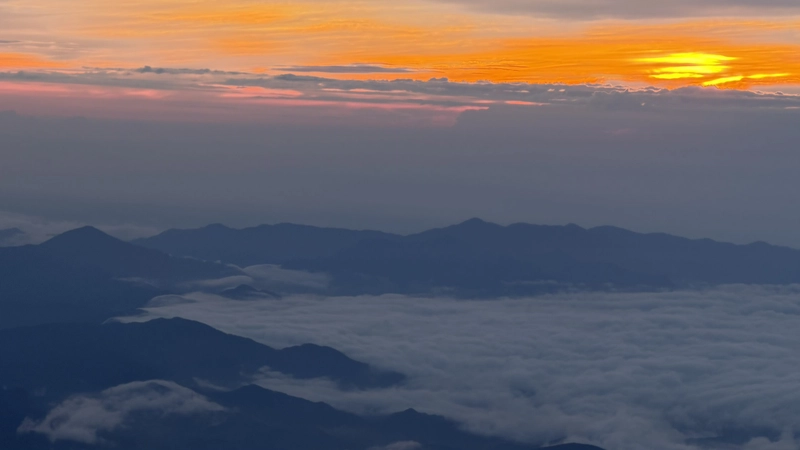
White guardian lion-dogs flank the entrance, and a stone pillar stands before the hall. Goshuin and shrine crests are on display. Where the Okumiya sits on the far side of the crater, Kusushi is the first shrine anyone climbing the Yoshida Trail reaches. People kept stopping to pay their respects while waiting for sunrise.
Goshuin


Tap to enlarge


Tap to enlarge
The Okumiya — The Shrine That Holds the Summit 🎥 360°

An hour or so around the eastern arc of the crater rim, on the southeastern side, stands the Okumiya of Fujisan Hongu Sengen Taisha. Per the shrine's official site, its principal deity is Asama-no-Okami (Konohanasakuya-hime), with her father Oyamatsumi and Ninigi-no-Mikoto enshrined alongside. Priests serve here during the July-August climbing season, handling prayers and even wedding ceremonies.
The land marked by the boundary stones described at the top of this article is, legally, this Okumiya's precincts — roughly 1.2 million tsubo, according to the shrine's own site. Just short of the Okumiya stands a stone inscribed "Ginmeisui, Fujisan Hongu Sengen Taisha," and the "Okumiya of Fujisan Hongu Sengen Taisha" stone on the crater rim is close by. A shrine hall, a torii, and stone lanterns stand in order on volcanic gravel at 3,700m.
Goshuin


Tap to enlarge


Tap to enlarge
Our own priority order after walking the Yoshida Trail over two days in August 2026. Not an official recommendation.
You can visit before you start climbing, at no cost in energy, and pilgrim staffs are sold here. The tengu's great axe is not something you will see elsewhere, so stop by as soon as you are off the bus.
The trail runs past the front of the hall, so visiting costs you nothing. Look for the white torii. A wooden shrine hall standing at 3,250m is not a sight you get anywhere else.
It is right there once you pass through the summit torii. You can visit while waiting for sunrise, with no extra walking.
Both sit right by their huts, but we walked past without finding either. If you intend to look for them, check where they are before you set off.
Budget about an hour round trip along the eastern crater rim. The Okumiya stone and Ginmeisui are on this stretch. If your descent timing is uncertain, stopping at Kusushi is perfectly reasonable.
Our August 2026 climb used the Yoshida Trail on the Yamanashi side. We did not visit the Fujinomiya-side sites below — the main hall of Fujisan Hongu Sengen Taisha, Fujimi-ishi, or Hitoana. What follows is background drawn from documented history and tradition.
Fujisan Hongu Sengen Taisha and the Southern-Foot Sites
The main hall, worship hall, and gate of Fujisan Hongu Sengen Taisha are the buildings Ieyasu is said to have had constructed, and are a National Important Cultural Property today. A short walk from the grounds, in front of the Fujinomiya City Central Library, stands Fujimi-ishi, the stone where Nobunaga is said to have sat to view the mountain. The episode is said to derive from the Shincho Koki, though we have not been able to verify the passage directly.
Hitoana, the lava cave Nobunaga is said to have toured, survives as one of the component sites of Mt. Fuji's UNESCO World Heritage listing. Fuji Omuro Sengen Shrine, on the northern foot, is where Takeda Shingen submitted his written prayer.
| Full name | Fujisan Hongu Sengen Taisha |
|---|---|
| Address | 1-1 Miyacho, Fujinomiya, Shizuoka |
| By train | About a 10-minute walk from JR Minobu Line Fujinomiya Station. From the Shinkansen, bus or taxi from Shin-Fuji Station |
| By car | About 20 min from Tomei Expwy Fuji IC, or 15 min from Shin-Tomei Shin-Fuji IC, via the Nishi-Fuji Bypass |
| Parking | ¥200/hour or ¥1,500/day for cars (free within 30 min for worshippers; 2 hours free for prayer visitors) |
the official website of Fujisan Hongu Sengen Taisha (Japanese only)
Confirmed via the shrine's official website in August 2026. Hours and access can change for events, so please check the official site for current information.
Frequently Asked Questions
Yes. Legally, everything above the 8th Station is the Okumiya precincts of Fujisan Hongu Sengen Taisha. Land said to have been donated by Tokugawa Ieyasu had the shrine's ownership confirmed by Japan's Supreme Court in 1974, and was reported to have been formally transferred from the national government in 2004. A stone reading "shrine precincts" stands at Hon-Hachigome, and one reading "Okumiya of Fujisan Hongu Sengen Taisha" stands at the crater rim.
Yes. During the 1590 Siege of Odawara, Hideyoshi's army passed the foot of Mt. Fuji, and he is said to have issued Fujisan Hongu Sengen Taisha a charter protecting its lands and donated further land to it. He was less directly involved than Ieyasu in the shrine's construction, but the charter is understood as a political statement of Toyotomi protection over a traditional sacred site.
There are six on the Yoshida Trail: Komitake Shrine at the 5th Station; Horai Kameiwa Hachidai Ryujin, Eboshi-iwa-no-miya, and Fujisan Tenpaigu at the 8th Station; Kusushi Shrine at the summit; and the Okumiya of Fujisan Hongu Sengen Taisha further round the crater rim. Priests serve at the Okumiya and Kusushi during the climbing season, and goshuin are available. Tenpaigu is also said to be staffed from mid-July to mid-August, issuing talismans and amulets. Their histories and how to fit them in are covered in the trail-shrines section of this article.
An ascetic credited with reviving the Fuji-ko movement in Edo. Born in 1671, he spread his teaching among the poor and was nicknamed "the beggar Miroku." In 1733, aged 63, he began a fast at Eboshi-iwa, at what was then the 7.5th Station and is now the 8th Station of the Yoshida route, and died there. Accounts give the fast as either 31 or 35 days. The teachings he spoke were compiled as the "Scroll of Thirty-One Days," and after his death the movement grew to the point that people spoke of "the eight hundred and eight ko of Edo."
The huts are said to have developed their lodging function to accommodate the mass group pilgrimages of the Edo-period Fuji-ko. Gansomuro at the 8th Station is said to have been founded in the wake of Jikigyo Miroku's death, with its first keeper being Tanabe Juroemon, the Yoshida pilgrim guide who attended him. The reason so many huts have a shrine attached is that this arrangement has simply carried on.
We did not visit the Fujinomiya-side sites — the main hall, Fujimi-ishi, and so on — on this Yoshida Trail climb. We did visit three shrines firsthand: the Okumiya and Kusushi Shrine at the summit, and Komitake Shrine at the 5th Station. The southern-foot sites are presented here as background drawn from documented history and tradition.
Our account of the climb itself — the huts, trail signage, sunrise, and the descent — is in the companion Yoshida Trail climbing report.
On our climb of August 21-22, 2026 we received 11 in total, from five shrines: Komitake Shrine, Eboshi-iwa-no-miya, Tenpaigu, Kusushi Shrine, and the Okumiya of Fujisan Hongu Sengen Taisha. Eboshi-iwa-no-miya's and Tenpaigu's goshuin are both issued from the same counter, beside Tenpaigu's hall at the 8th Station, rather than from two separate places. Photographs of every one — including Kusushi Shrine's silver Mt. Fuji and the Okumiya's gold Mt. Fuji two-page spreads — are in the goshuin block inside each shrine card above. Staff on site told us that three of them — the wooden goshuin at Fujisan Tenpaigu, Kusushi Shrine's, and the Okumiya's — are issued for 2026 only, and that the wooden one at Tenpaigu is limited in number too. The same ones may not be available in later seasons. Check each site's official information before you go.
Related Articles
☕ Support This Site
Following the Shogun is built on original fieldwork and on-site research.
If you found this guide useful, your support helps keep it going.

You can also support via QR code


comment