


Genbao Castle Ruins: Shibata Katsuie's Headquarters in the 1583 Battle of Shizugatake
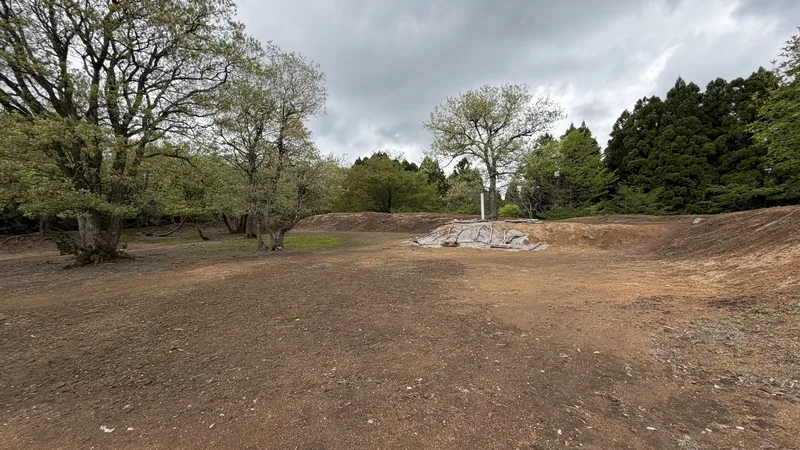
Genbao Castle Ruins (玄蕃尾城跡), also recorded as Uchinakao-yama Castle (内中尾山城), is a mountaintop fortress on the Fukui–Shiga prefectural border where the warlord Shibata Katsuie made his headquarters during the 1583 Battle of Shizugatake. There is no tenshu (main keep) and no stone walls here — what survives are the earthworks themselves: a main enclosure, earthen ramparts, dry moats, an umadashi defensive earthwork, and several koguchi gate approaches, still readable on the ground more than four centuries later. Reaching the site by car means driving a narrow forest road near the Yanagase Tunnel to a small parking area, then walking a mountain trail into the castle grounds. There are no reconstructed castle buildings here. The main interest is in following the changes in elevation and identifying the ramparts, dry moats, and gate approaches underfoot.
On This Page
Quick Verdict
| Good fit for | Castle enthusiasts, anyone interested in the Battle of Shizugatake, and travelers who enjoy reading earthworks — ramparts, moats, and gate shapes — rather than looking at stone walls or rebuilt buildings. |
|---|---|
| Know before you go | No castle buildings or stone walls survive above ground here — everything beyond the parking area is a mountain trail. |
| Time needed | Tsuruga City's official guidance gives about 20 minutes on foot from the parking area to the main enclosures. On this visit, walking the full loop and back to the car took about an hour. |
| How to get there | A car is the practical option. Public transit is possible but involves a long walk from the nearest bus stop. |
Before You Go
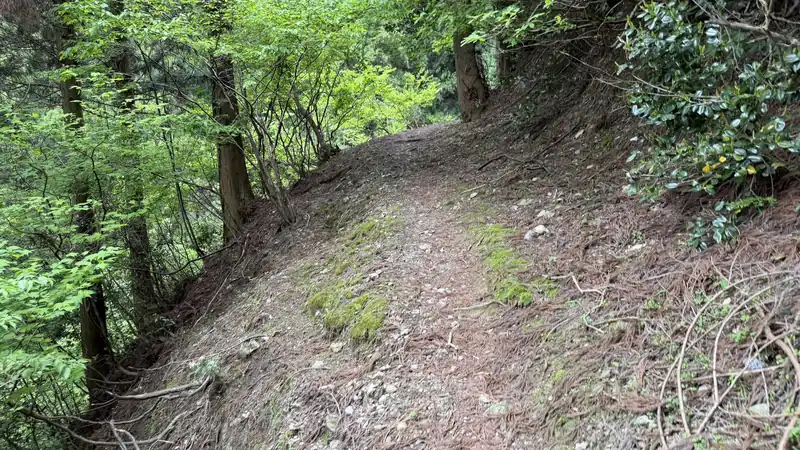
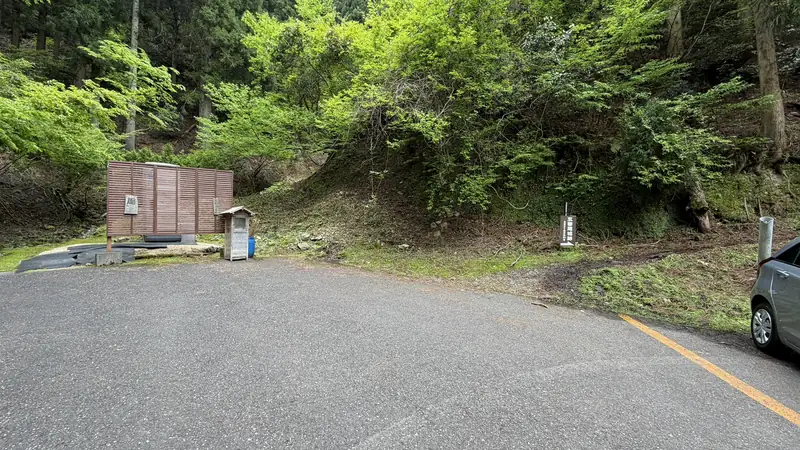
Genbao Castle sits on a mountain ridge along the border between Fukui and Shiga prefectures. Beyond the small parking area, the route becomes a mountain trail almost immediately. On this visit, shortly after rain, the ground under the fallen leaves was still damp and muddy the whole way up. Sneakers were fine, but they picked up a lot of mud — shoes you don't mind getting dirty are a safer choice after rain.
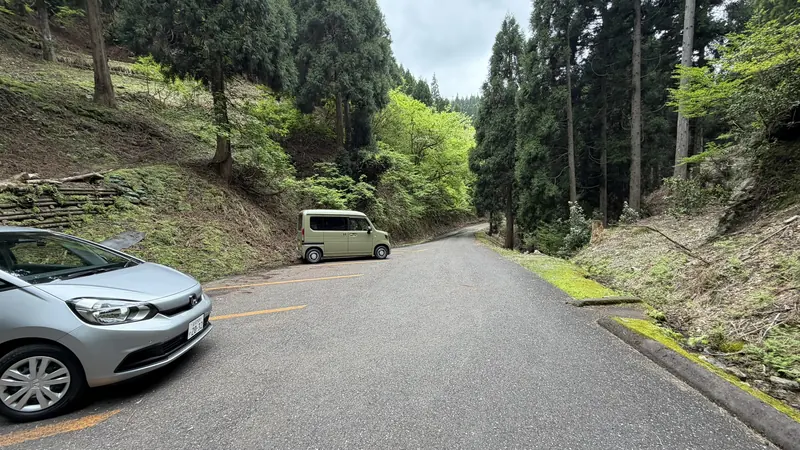
The parking area has a portable toilet and a reception post with pamphlets and a visitor logbook (in place since April 18, 2026; facilities can change with the season, so check Tsuruga City's official Genbao Castle page before your visit). It's worth using the toilet here before you start climbing.
Tsuruga City has issued notices about bear sightings and rockfall on the forest road, along with warnings that the road itself is narrow. A rockfall in April 2025 has since been cleared, but the road remains narrow, so drive carefully.
Winter visits need extra caution. On a February visit, arriving by rental car from Maibara Station, snow made it impossible to drive the forest road, and the visit had to be abandoned. Road conditions and restrictions change through the winter, so check Fukui Prefecture's Michi Joho Net Fukui road-condition and traffic-camera site before setting out. For the parking area and on-site facilities, see Tsuruga City's official Genbao Castle page.
Getting There
Access & Practical Information
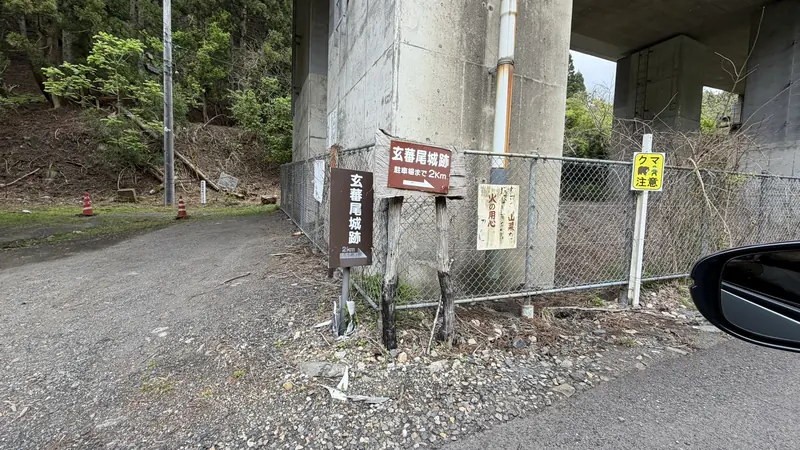
Genbao Castle sits right on the Fukui–Shiga border, and there are two practical routes by car: 1) from Tsuruga, on the Fukui (Sea of Japan) side, and 2) from Maibara or Nagahama, on the Shiga (Lake Biwa) side. Both routes converge on the same forest road and the same small parking area, reached via the Yanagase Tunnel (柳ケ瀬トンネル) on Prefectural Route 140 (Tsuruga–Yanagase Line). The tunnel is narrow, single-lane with traffic-light control, and has a height restriction of 2.8 m.
Route 1: From Tsuruga (Fukui side)
| Nearest major station | Tsuruga Station, on the Hokuriku Shinkansen, the JR Hokuriku Main Line (JR West), the JR Kosei Line, the JR Obama Line, and the Hapi Line Fukui (a third-sector local railway that took over former JR lines after the 2024 Shinkansen extension to Tsuruga). |
|---|---|
| By car | About 20 minutes from Tsuruga IC on the Hokuriku Expressway to the trailhead, and then a further 20-minute walk (per Fukui Prefecture and Tsuruga City guidance). From the sign near the Yanagase Tunnel, the forest road to the parking area took about 8 minutes on this visit. The Yanagase Tunnel has a 2.8 m height restriction. |
| The forest road | Paved, but quite narrow. On this visit we watched carefully for oncoming traffic the whole way. The parking area holds only about 5 cars and can fill up. |
Route 2: From Maibara or Nagahama (Shiga side)
| By car | From Maibara IC (or Kinomoto IC) on the Hokuriku Expressway, head north on Route 8 toward Tsuruga, then take Prefectural Route 140 (Tsuruga–Yanagase Line) through the Yanagase Tunnel into Tone, on the Fukui side. From there, the drive to the parking area follows the same forest road as Route 1. |
|---|---|
| How we did it | On this visit, we picked up a car-share vehicle at Maibara Station and drove this route to Genbao Castle. Travel time depends on road conditions, so check a car navigation system or map app before setting out. |
Without a car
| Community bus | From Tsuruga Station, the Arachi community bus line runs to the Tone stop in about 27–34 minutes. From there it's roughly a 50-minute walk to the parking area, and a further 20-minute walk to the main castle area. Services are limited, and some runs require reservation up to an hour in advance, so check the timetable for both directions before you go. |
|---|---|
| Taxi | About 25 minutes from Tsuruga Station, followed by the same 20-minute walk. |
| From the Nagahama/Kinomoto side | Walking in from the Shiga side is also possible. Nagahama-Maibara tourism information describes a bus from JR Kinomoto Station to the Yanagase stop (about 28 minutes), followed by roughly a 1.8 km walk to the castle ruins. |
On-site facilities and public access
| Facilities | The parking area has a portable toilet and a reception post. |
|---|---|
| Public access | Open for self-guided walking. |
Tap to enlarge
Genbao Castle Location
▼ Route from the parking area to Genbao Castle Ruins
This route map is for general reference only and is not a guarantee of safe passage.
Genbao Castle is a rural mountain site, well off the routes most international visitors travel, so getting there usually means building it into a wider trip through the Kyoto–Osaka–Nagoya region rather than visiting as a stand-alone stop. Rough travel times from major cities:
- From Tokyo: A direct Hokuriku Shinkansen service reaches Tsuruga Station; travel time is roughly 3 hours 20 minutes depending on the train.
- From Kyoto: The Thunderbird limited express reaches Tsuruga in about 1 hour.
- From Osaka Station: The Thunderbird limited express reaches Tsuruga in roughly 1 hour 20–30 minutes.
- From Nagoya: The Shirasagi limited express reaches Tsuruga in roughly 1 hour 40 minutes (some itineraries connect via Maibara).
Travel times vary by train, so check current schedules and transfers at JR West's Tsuruga Station page. Maibara, on the Tokaido Shinkansen line between Tokyo/Nagoya and Kyoto/Osaka, is a useful transfer point if you're combining Genbao Castle with a wider trip around Lake Biwa; Nagahama, just north of Maibara, is another practical base if you plan to visit other Shizugatake-related sites on the same trip.
1583: Why Katsuie Made His Stand Here
In 1582, the powerful daimyo Oda Nobunaga — who had unified much of central Japan — was killed at Kyoto's Honnoji temple by one of his own generals, Akechi Mitsuhide, in what is known as the Honnoji Incident. Another of Nobunaga's generals, Hashiba Hideyoshi (later known as Toyotomi Hideyoshi), avenged Nobunaga within weeks and quickly became the dominant figure among Nobunaga's former retainers. After Nobunaga's death, disagreements among his senior retainers over succession and political power deepened the rivalry between Hideyoshi and the older, more senior general Shibata Katsuie, eventually leading to open conflict.
In March 1583, Katsuie established his headquarters at this mountain fortress — recorded as both Genbao Castle and Uchinakao-yama Castle — near routes linking Echizen Province (roughly today's Fukui Prefecture) with northern Omi, during the confrontation that culminated in the Battle of Shizugatake. In the fighting that followed, one of Katsuie's commanders, Sakuma Morimasa, launched a surprise attack on Hideyoshi's forces at Oiwayama; Hideyoshi countered with a forced march back to the battlefield and routed Katsuie's army. Katsuie retreated from this castle without a fight, then withdrew to his main base, Kitanosho Castle (in what is now Fukui City), where he and his wife Oichi took their own lives shortly afterward — ending the succession struggle in Hideyoshi's favor. Because Genbao Castle itself was never fought over, Tsuruga City notes that its earthworks — the ramparts, moats, and gates — survive in relatively good condition (this does not mean the site is unchanged from 1583).
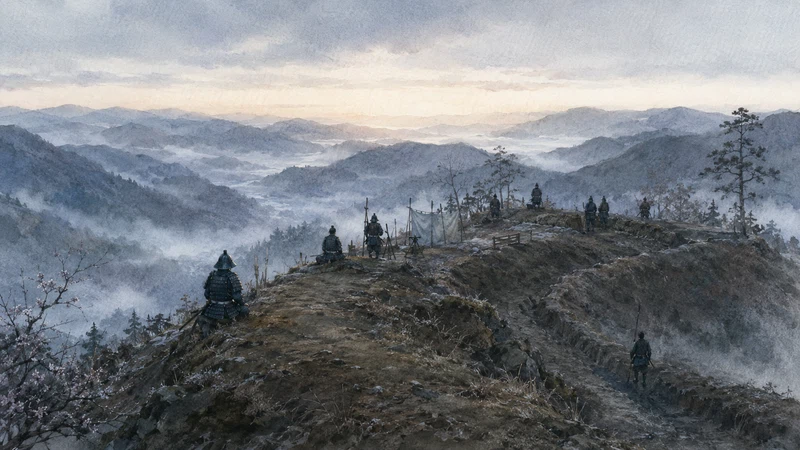
Walking the site today, you're tracing the ground Katsuie's headquarters actually occupied. No buildings survive, but comparing the on-site map with the earthworks underfoot makes the scale and layout of the headquarters easier to picture. Standing on the earthworks and picturing Katsuie's army camped here left a different impression than simply looking at the location on a map.
What Remains Today
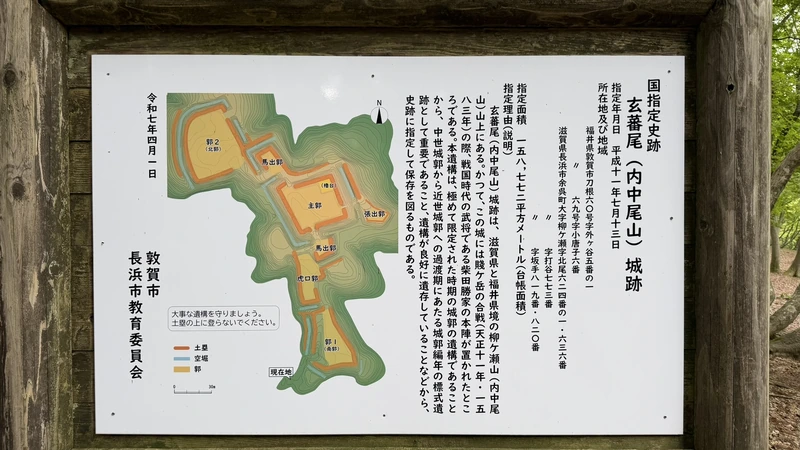
There is no tenshu (main keep) and no stone wall at Genbao Castle. According to Fukui Prefecture's cultural properties records, what survives is a layout of four kuruwa (fortified enclosures), dry moats, earthen ramparts, a raised earthen causeway, an umadashi (a barbican-style earthwork guarding a gate), and a presumed yagura-dai (turret platform).
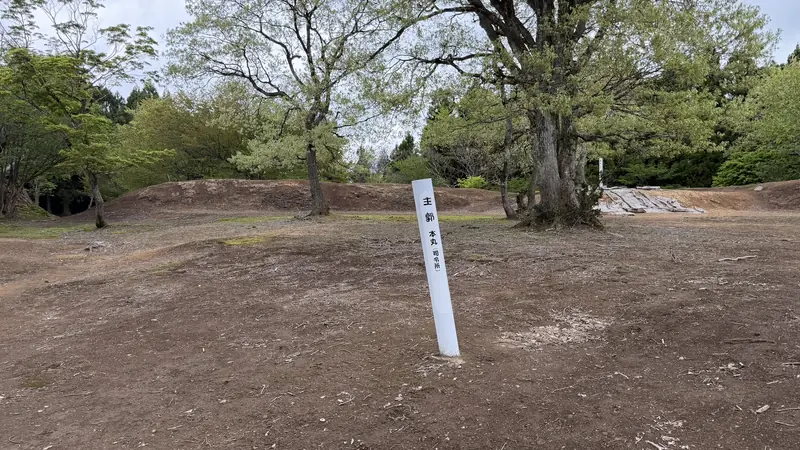
The honmaru — the castle's central, most important enclosure — is a roughly rectangular space enclosed by earthen ramparts and dry moats. The surrounding ramparts are described as roughly 0.6–2 m high, with substantial dry moats on the east, south, and west sides.
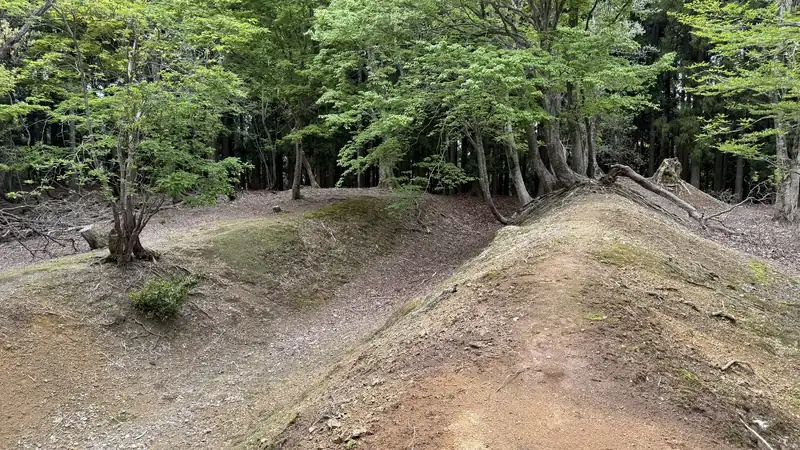
Once you enter the castle grounds, the man-made banks and dry moats become easier to distinguish from the ordinary mountain trail. There are no standing buildings or stone walls, so the site can look sparse at first, but the changes in elevation become much easier to follow when compared with the on-site map.
At the entrance to the castle grounds is a map showing the full layout, and small white signs mark the name of each enclosure and gate. On this visit, comparing the map with the signs made it easy to follow which section was which — the koguchi (gate), the umadashi (barbican), and so on.
The Route We Walked
From the parking area, the trail turns into a mountain path almost immediately. At the point where the trail enters the castle grounds proper, there's a map showing the overall layout, which is the first clear sign you've reached the site.
We walked the outer perimeter first to get a sense of the overall shape, then worked our way through the interior enclosures, following the small white signs from one feature to the next.
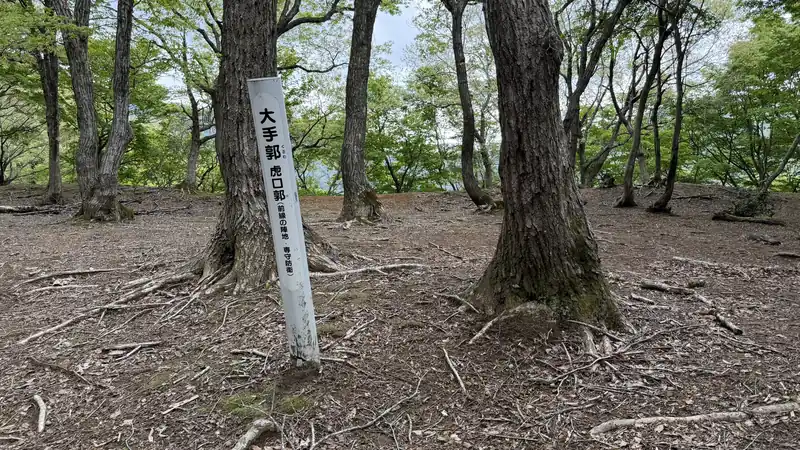
Parking area → mountain trail → map at the entrance to the castle grounds → South Koguchi (main gate) → Ōte Enclosure → East Koguchi → Koshiguruwa (lower terrace) → Haridashi Enclosure → presumed Yagura-dai (turret platform) → Honmaru (main enclosure) → Umadashi (barbican) → Karamete Enclosure (rear gate area) → back to the parking area.
We didn't get seriously lost at any point — the white signs were a real help in matching what we were seeing to the map. This is simply the order we happened to visit things in on this trip, not the only reasonable way to walk the site.
Main Enclosures and Highlights
Genbao Castle's layout uses several Japanese castle terms worth knowing before you go: kuruwa, a fortified enclosure or terrace within the castle; koguchi, a gate or entrance, often deliberately staggered to slow attackers; umadashi, a barbican-style earthwork built to shield a gate; and honmaru, the main or central enclosure of a Japanese castle. These terms come up throughout the layout below.
South Koguchi (Main Gate)
The southern entrance to the castle. A staggered earthen passage forms the approach here, and passing through it gives a real sense of entering the fortified area.
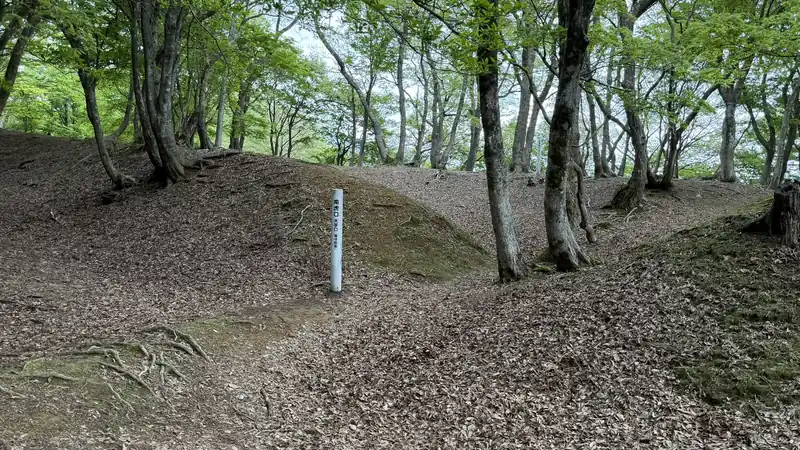
Ōte Enclosure
The enclosure just beyond the South Koguchi — the "ōte," or front, section of the castle. From here the layout leads on toward the next gate.
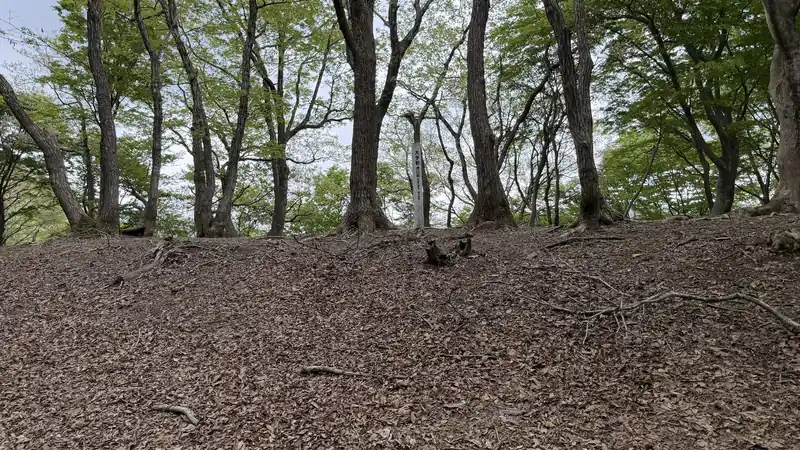
East Koguchi
The castle has more than one koguchi (gate), and this is the one on the eastern side. Like the others, it's a passage shaped from earth rather than a built gate structure.
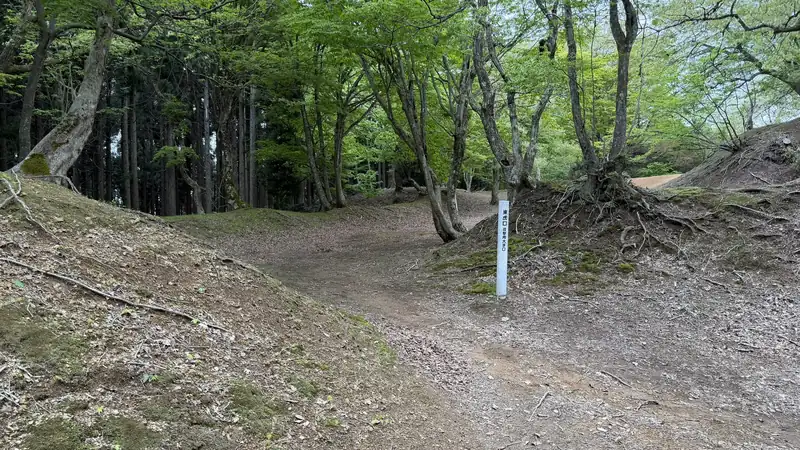
Koshiguruwa (Lower Terrace)
Around the honmaru, the ground steps down into a lower terrace known as the koshiguruwa. Walking through, the change in elevation underfoot is noticeable even before you see it.
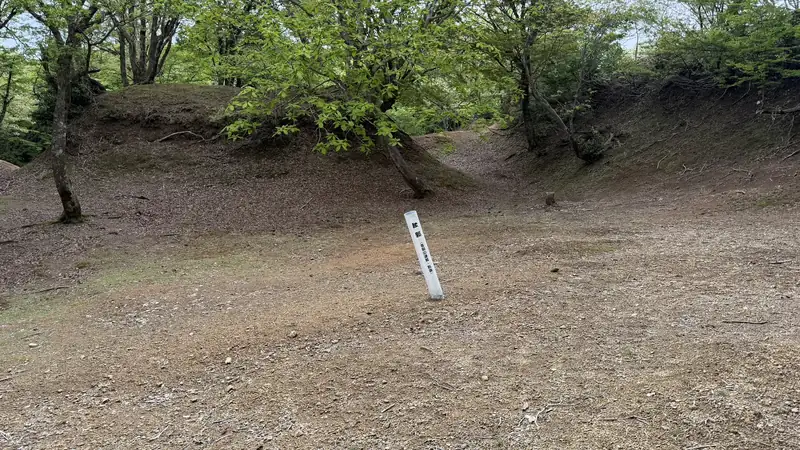
Haridashi Enclosure (Projecting Enclosure)
An enclosure that juts outward from the main line of the earthworks. Tracing the outer edge of the site, the way this section projects out from the rest is easy to follow on foot.
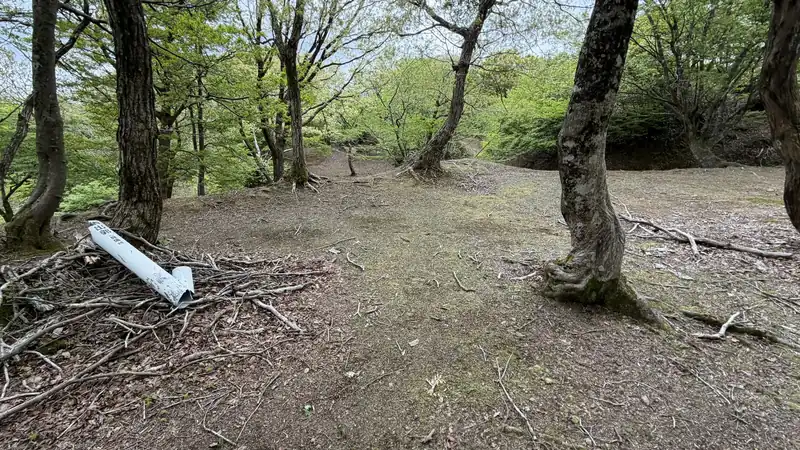
Presumed Yagura-dai (Turret Platform)
At the northeast corner of the honmaru, the ground rises noticeably above the surrounding terrain — a difference in height that's easy to confirm just by standing there. Fukui Prefecture's cultural properties records note that stone footings found here suggest a yagura (turret) once stood on this platform, though there is no confirmation that a full tenshu (main keep) existed at the site.
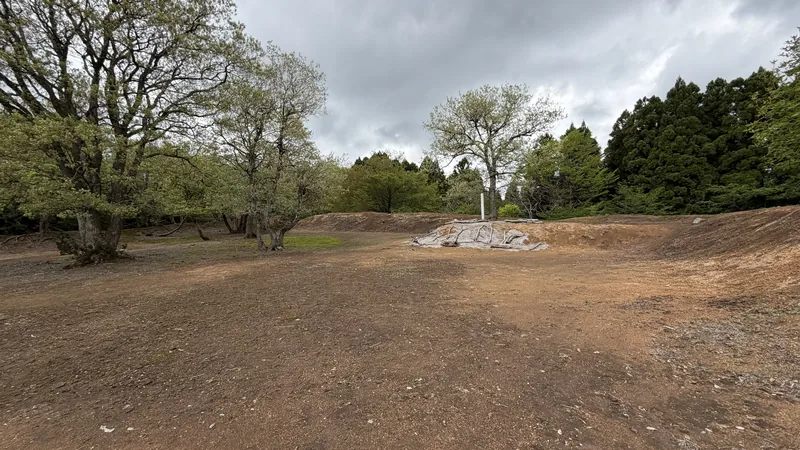
Honmaru (Main Enclosure)
The rectangular central enclosure, bounded by earthen ramparts and dry moats — the heart of the castle, reached after passing through the gates and outer enclosures described above. Exact measurements vary between sources, so we haven't given specific figures here.
Umadashi (Barbican)
A defensive earthwork built to work together with a nearby gate and causeway. On its own it looks like a simple raised mound, but combined with the neighboring koguchi and earthen causeway, it functioned as a shield protecting the entrance.
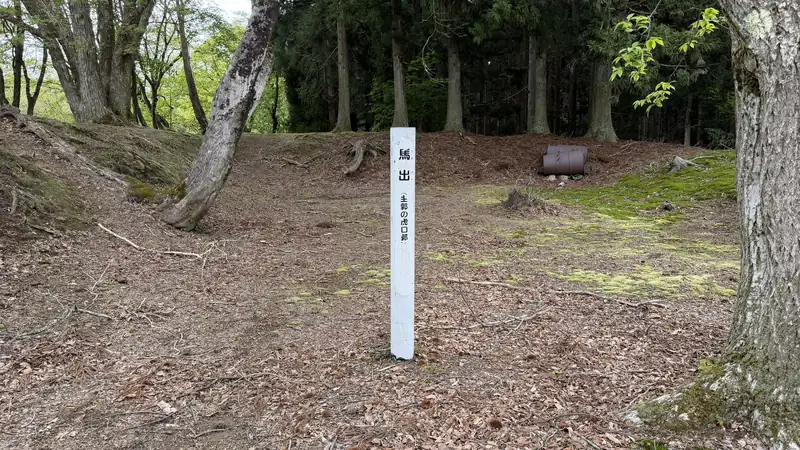
Karamete Enclosure (Rear Gate Area)
One of the later stops on our route, on the opposite side of the site from the southern gate cluster. On this visit, the karamete side — the castle's rear approach — felt noticeably different from the main southern entrance.
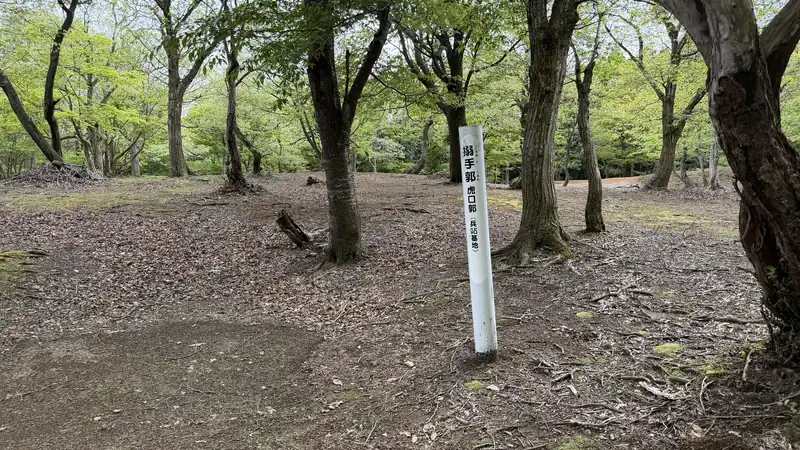
Ramparts, Dry Moats, and the Great Moat
Of everything at Genbao Castle, this is where the ramparts and moats were easiest to pick out on this visit — the rise of the earthen banks against the drop of the dry moats. Photos tend to flatten these height differences, but on the ground, following the rise and fall underfoot makes the shape much easier to read.
360° Panoramas
These 360° panoramas were shot on site. They show the presumed yagura-dai, the interior of the castle, and the ramparts and moats over a wider field of view than a standard photo.
Surviving Earthworks, Modern Additions, and Presumed Features
Genbao Castle preserves substantial earthworks associated with the 1583 fortress, alongside modern visitor facilities and at least one feature identified through archaeological evidence as presumed rather than certain. Here's how to tell them apart.
| Surviving earthworks | The ramparts, dry moats, causeway, umadashi, and koguchi — the shaped earth itself. |
|---|---|
| Modern additions | The white signs marking each feature, the map at the entrance to the castle grounds, and the portable toilet and reception post at the parking area. |
| Presumed feature | The yagura-dai (turret platform). Stone footings suggest a turret once stood here, but there is no confirmation that a full tenshu (main keep) existed at the site. |
Whether every visible earthen shape here dates exactly to 1583 isn't something this article alone can settle. Keeping these distinctions in mind makes it easier to understand what you're looking at on site.
Castle Stamp and Gojoin
Genbao Castle is No. 140 on Japan's Continued 100 Great Castles list, a project by the Japan Castle Association (日本城郭協会) that names 100 additional noteworthy castle sites beyond the original 100 Great Castles. Many castle enthusiasts collect a rubber stamp at each site in a dedicated stamp book. The Genbao Castle stamp is kept at the parking-area reception post and at JR Yogo Station; from April 4 to December 20, 2026, it is also available at the Shizugatake Sengoku Station (10:00–16:00). If you're visiting specifically for the stamp, check the Japan Castle Association's latest notice before you go.
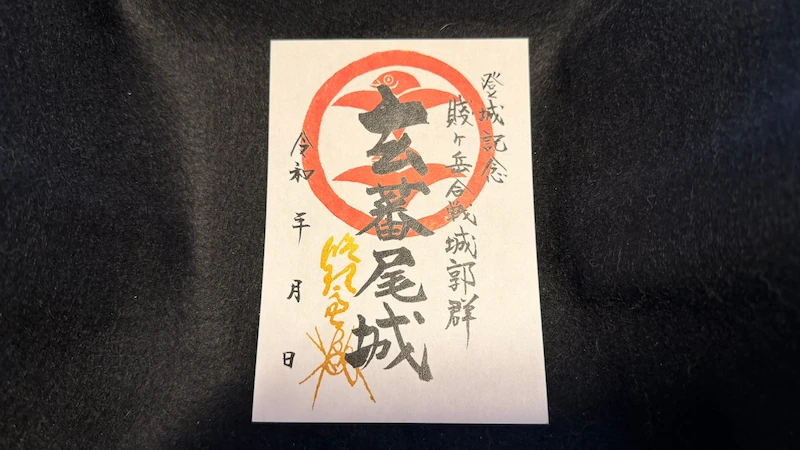
Genbao Castle also has a gojoin (御城印), a commemorative castle seal issued for castle visitors — a different kind of item from the goshuin traditionally collected at temples and shrines. Tsuruga City's official information lists the Genbao Castle Preservation Society's gojoin as available from the Culture and Exchange Promotion Division on the 3rd floor of Tsuruga City Hall and from the Tsuruga City Museum. Distribution is limited to one per person, and it is not available by mail.
On this visit, we were also able to buy the gojoin at Shizugatake Sengoku Station. Availability there isn't guaranteed to continue, so if you want to be sure of getting one, check Tsuruga City's official page for the latest information.
We didn't collect Japan's Continued 100 Great Castles stamp on this visit. Locations and hours can change, so if you're stamp-hunting, check the Japan Castle Association's guidance beforehand.
FAQ
If you enjoy reading earthworks — ramparts, dry moats, and gate shapes — rather than looking at stone walls or rebuilt buildings, yes. It suits travelers with a specific interest in the Sengoku period or the Battle of Shizugatake more than casual sightseers, since reaching it involves a real mountain trail with no facilities beyond the parking area.
No tenshu (keep) and no stone walls — the site is entirely earthworks: a main enclosure, ramparts, dry moats, an umadashi, several koguchi gate approaches, and a presumed turret platform.
Tsuruga City's official guidance gives about 20 minutes on foot from the parking area to the main enclosures. On this visit, walking the full loop from the parking area and back took about an hour.
From Tsuruga Station, the Arachi community bus reaches the Tone stop, followed by roughly a 50-minute walk to the parking area and a further 20-minute walk to the main castle area. Services are limited and some runs require advance reservation, so check the timetable in both directions before you go.
The approach is a mountain trail rather than a paved sightseeing route. At the time of our visit, the small feature markers we saw were in Japanese. Visitors should be comfortable with basic trail walking. If your main interest is standing castle buildings, another castle may make an easier introduction. Genbao is better suited to visitors who specifically want to see an unrestored earthwork castle.
No reconstructed castle buildings stand at the site. What survives are earthworks such as ramparts, dry moats, koguchi gate approaches, and the umadashi. Their present form has been affected by more than four centuries of weathering and preservation, so the ground visible today should not be treated as completely unchanged from 1583. The information signs, entrance map, and parking-area facilities are modern additions.
Tsuruga is the most direct base if you're arriving on the Hokuriku Shinkansen or from Fukui. Maibara, on the Tokaido Shinkansen line, is convenient if you're routing through the Kyoto–Osaka–Nagoya area. Nagahama, just north of Maibara on Lake Biwa, is a good choice if you plan to combine this visit with other Shizugatake-related sites in the Kohoku (northern Lake Biwa) area.
No — they're different locations. Genbao Castle was Shibata Katsuie's headquarters; Shizugatake was where the decisive fighting took place. Visiting both gives a clearer sense of how the headquarters and the battlefield related to each other on the ground.
Nearby Sites
Genbao Castle is one of several sites connected to the Battle of Shizugatake. Combining it with the Shizugatake battlefield itself and the site of Tagamiyama Fort — a stronghold of Hashiba Hidenaga's forces — lets you trace how the two armies were positioned on the ground. The nearby Kinomoto Jizo-in temple is also worth a stop, and Kinomoto's free exhibitions on the Battle of Shizugatake make a good addition to the same trip (Toyotomi Great Return Station & Kohoku Library). Timed to the 2026 NHK historical drama Toyotomi Brothers!, the Kita-Ōmi Toyotomi Exhibition in Nagahama also places Genbao Castle within its Shizugatake-battle area.
If you're driving in from the Maibara or Nagahama side, it's worth combining the visit with some time in Nagahama itself (Toyotomi Brothers! Nagahama Guide).
We'll be covering more sites connected to Shibata Katsuie and the Battle of Shizugatake on Following the Shogun over time.
About This Guide & Support the Site
This guide is based on a first-hand visit and on-site photography by Following the Shogun. For more about who's behind the site, see our About This Site page.
If you'd like to support the ongoing fieldwork that goes into guides like this one, you can do so below.
☕ Support This Site
Following the Shogun is built on first-hand visits and on-site research.
If this guide was useful, your support helps keep the fieldwork going.

You can also scan the QR code to support the site


comment