



Odaka Castle Ruins, Washizu Fort & Marune Fort: A 120-Minute Walk Through the Opening Battles of Okehazama
In Nagoya's Midori Ward, three National Historic Sites sit within a few hundred meters of each other — Odaka Castle Ruins (大高城跡), Washizu Fort Ruins (鷲津砦跡), and Marune Fort Ruins (丸根砦跡). Together they preserve the opening skirmishes of the 1560 Battle of Okehazama, one of the most consequential battles in Japanese history.
Nagoya's Oodaka area, in the city's Midori Ward about 15 minutes south of Nagoya Station on the JR Tokaido Main Line (local trains only), preserves a rare cluster of history: the staging ground for the "opening skirmishes" of the 1560 Battle of Okehazama. Odaka Castle Ruins, Washizu Fort Ruins, and Marune Fort Ruins sit within a few hundred meters of one another, and all three are protected as a single National Historic Site. The 2026 NHK taiga (historical) drama Toyotomi Brothers! also dramatizes the Battle of Okehazama, and interest in these sites has grown since the broadcast began.
This guide is based on an on-site visit: we walked all three ruins ourselves. Starting and ending at Odaka Station, the full loop takes about 120 minutes. Following the terrain on foot — rather than just looking at a map — makes it far easier to understand how the battle lines of Oda Nobunaga, Tokugawa Ieyasu, and Imagawa Yoshimoto actually crossed here.
Oodaka is more than a scattering of castle ruins. In 1560, the warlord Oda Nobunaga (織田信長) was trying to cut off Odaka Castle, then held by his rival the Imagawa clan, by building two siege forts nearby: Washizu and Marune. Meanwhile, a young samurai still going by the name Matsudaira Motoyasu — the man who would later become the shogun Tokugawa Ieyasu (徳川家康) — was fighting on the Imagawa side against Nobunaga. This is the ground where the future rivals-turned-allies Nobunaga and Ieyasu first faced each other as enemies, their decisions playing out across a few hundred meters of hillside.
The tension built up around these three sites broke suddenly at the Battle of Okehazama, fought nearby on 19 May 1560 (by the old lunar calendar). Facing a much larger army led by the powerful regional lord Imagawa Yoshimoto, Nobunaga won with a surprise attack — a victory credited with changing the course of Japanese history and setting Nobunaga on the path toward unifying the country. Washizu Fort, Marune Fort, and Odaka Castle Ruins are the places where visitors can trace this "opening skirmish" on foot today. Walking the actual distances between the sites turns the battle lines on a map into something you can physically feel.
The 2026 NHK taiga drama Toyotomi Brothers! also depicts the Battle of Okehazama as a major turning point in its story. Walking the Oodaka sites alongside watching the drama turns the battle from something you saw on screen into something you can stand inside — the terrain and the distances between the forts do most of the storytelling.

In Japan, goshuin stamps are traditionally collected at shrines and temples — but many castles and castle ruins also sell their own castle-specific version, called goshujo, and Oodaka is no exception. Stamps for Odaka Castle, Washizu Fort, and Marune Fort can all be purchased at the Odaka Tourist Information Center (open Saturdays and Sundays, 10:00 a.m.–4:00 p.m.), about a 7-minute walk (roughly 550 m) from Odaka Castle Ruins.
Details (Japanese): https://www.nagoya-info.jp/useful/guide_detail/33/
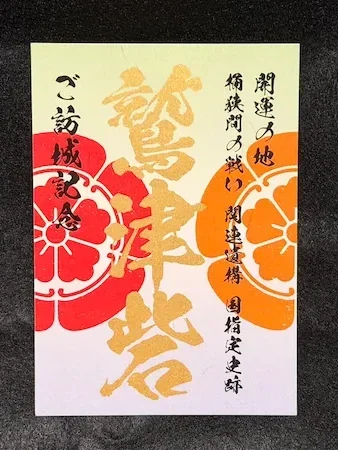
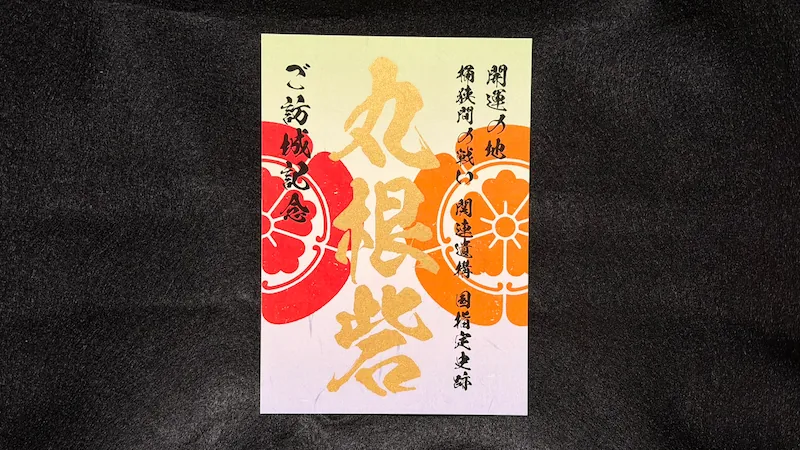
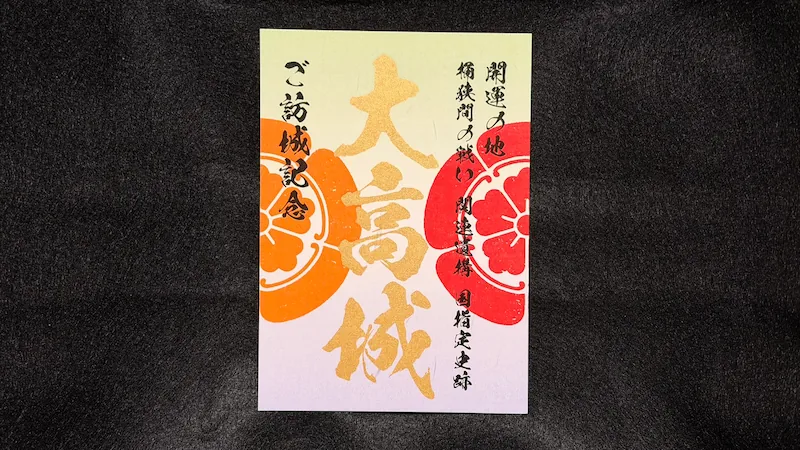
Tap a photo to enlarge
The Sites and How to Walk the Route
On the JR Tokaido Main Line, about 15 minutes from Nagoya Station (local trains only).
Odaka Castle Ruins Park (大高城跡公園).
Where the castle stamps are sold.
Washizu Fort Ruins Park (鷲津砦公園).
A satellite-fort (tsukejiro) site.
Walk back to the starting point.
Nagoya City's official pages list no gate hours or admission fee for any of the three sites, so they appear to be open year-round with free access, as is typical for historic-site parks in Japan. None of the three sites has its own dedicated parking lot. Visitors commonly use the free Odaka Ryokuchi Park No. 6 parking lot or paid parking near Odaka Station instead (this parking information comes from unofficial sources, so please confirm current details locally before you go).
Odaka Castle Ruins (大高城跡)
Our rating
Historical value: ☆☆☆
Visual appeal: ☆
Experience value: ☆

Just before the fighting spilled over into the Battle of Okehazama, a young samurai still known as Matsudaira Motoyasu — later the shogun Tokugawa Ieyasu — pulled off a daring supply run into a besieged Odaka Castle, delivering food to its defenders under pressure from Nobunaga's forces. That moment is preserved in the terrain of this hilltop ruin in Nagoya's Oodaka district. The castle was first built in the Muromachi period as the residence of a local lord named Hanai Bicchu-no-kami; it later passed through the Mizuno clan before coming under the control of the Imagawa clan, who held Owari Province's rival territory. Imagawa Yoshimoto's ally Unodono Nagateru defended it here against Nobunaga. After Yoshimoto's defeat and death, the castle was abandoned, but the outline of its baileys — honmaru (main enclosure) and ninomaru (secondary enclosure) — along with traces of its moats, are still visible on the ground today.
Recent ground-penetrating radar surveys and excavations by Nagoya City's Board of Education confirmed a moat in a location matching an early Edo-period map, with an estimated width of over 15 meters and a depth of over 4 meters at its deepest point. Walking the traces of the earthen bridge and moat here lets visitors retrace, on foot, the ground Ieyasu crossed during one of the turning points of his early career.
Within the castle grounds stands Shiroyama Hachiman Shrine, said to have been founded by Hanai Bicchu-no-kami, who according to tradition brought a divided spirit from Tsurugaoka Hachimangu Shrine in Kamakura (a major Hachiman shrine associated with the Minamoto samurai clan) sometime in the early 1500s. During the Edo period, only samurai were permitted to worship here; today the shrine is maintained by the local neighborhood association, with festivals held every September and at New Year. The grounds also preserve a pair of stone lanterns donated in 1670 by Shimizu Tadatoki and a water basin donated in 1837 by Yamaguchi Genbei.


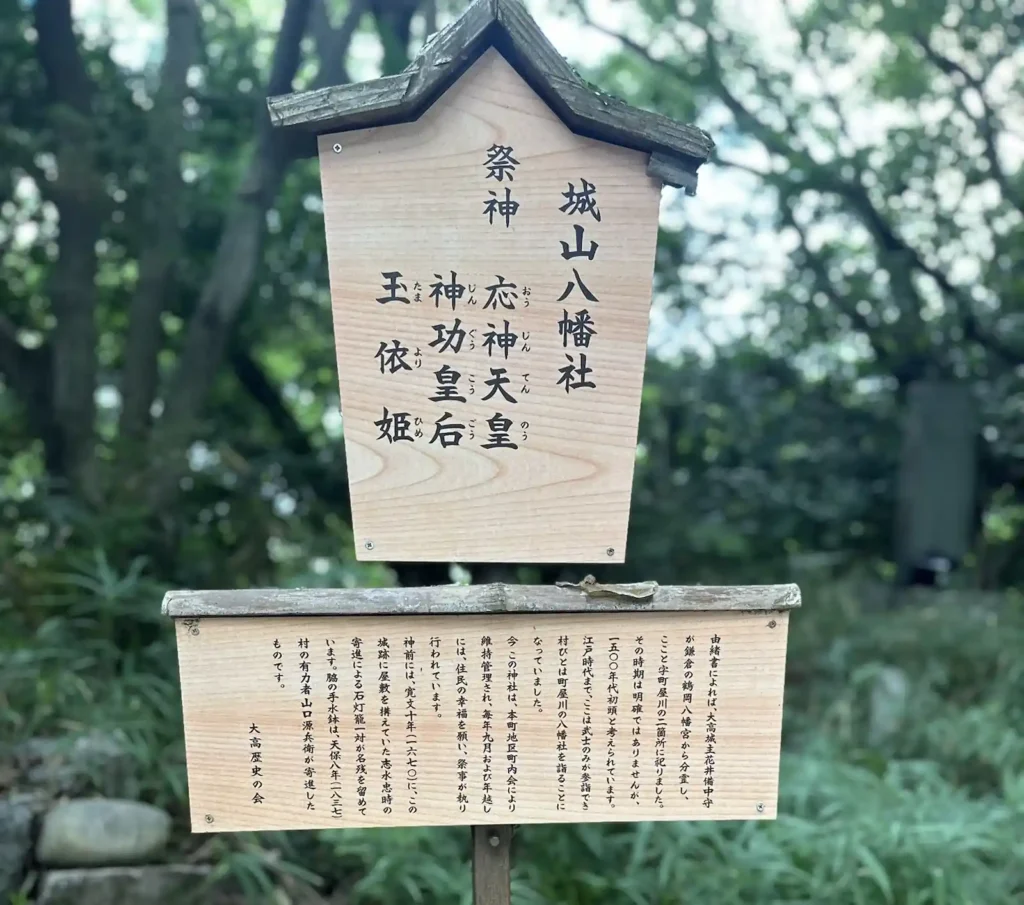
Tap a photo to enlarge
Key facts| Built | Muromachi period (believed to be around 1504–1521) |
|---|---|
| Built by | Hanai Bicchu-no-kami |
| Structure & features | Built around honmaru and ninomaru baileys; traces of moats and an earthen bridge remain |
| Excavation history | Ground-penetrating radar survey from FY2019; first excavation Jan 17–Mar 11, 2022 (confirmed moat remains) |
| Current condition | No original buildings remain; moat, earthen-bridge, and bailey traces can be seen within the park |
| Decline | Abandoned after Imagawa Yoshimoto's defeat and death; the earthen ramparts were largely destroyed over time, though moat traces survive |
| Cultural property status | National Historic Site ("Odaka Castle Ruins, with attached Marune Fort Ruins and Washizu Fort Ruins"); designated December 14, 1938 |
| Notes | A stone marker reading "Historic Site: Odaka Castle Ruins" stands near the former honmaru; Marune Fort and Washizu Fort (both part of the same designation) are nearby |
Address: 459-8001 Aichi, Nagoya, Midori Ward, Odaka-cho, Shiroyama (大高町字城山)
Getting there: About an 11-minute walk (roughly 800 m) from JR Odaka Station on the JR Tokaido Main Line.
Suggested visit time: About 20 minutes for a quick look, up to about 1 hour to explore in depth.
Parking: No dedicated lot — see "Parking & Opening Hours" above (please confirm locally).
- Moat and earthen-bridge traces: follow the faint lines still visible in the park, and the castle's defensive layout starts to take three-dimensional shape (recent surveys have also confirmed moat remains here).
- The honmaru and ninomaru terrain: subtle changes in elevation show how the castle was built to be defensible — and help visitors imagine the tension of Ieyasu's supply mission.
- Seasonal color: cherry blossoms in spring and autumn foliage both bring out the shape of the hill the castle sits on.
- Historical background: Odaka Castle is closely tied to the Battle of Okehazama and became well known as the site of Matsudaira Motoyasu's (Tokugawa Ieyasu's) first major military feat — his supply run into the besieged castle.
- Lesser-known detail: ground-penetrating radar surveys beginning in FY2019 and the first-ever excavation in 2022 confirmed the exact position of the castle's moat.
- Historical figures: with Odaka Castle under Imagawa control, Oda Nobunaga built Marune Fort and Washizu Fort nearby to tighten the pressure — setting the stage for the Battle of Okehazama, where Ieyasu, Nobunaga, and Imagawa Yoshimoto's paths all crossed.
Washizu Fort Ruins (鷲津砦跡)
Our rating
Historical value: ☆☆☆
Visual appeal: ☆
Experience value: ☆

With Odaka Castle in enemy hands, Oda Nobunaga needed a way to cut off its supply lines and take back the initiative — Washizu Fort Ruins preserves the trace of that strategy. In 1559, Nobunaga built this fort on a hill northeast of Odaka Castle, together with Marune Fort, to keep the castle under constant watch. Set on a low ridge about 35 meters above sea level and roughly 40 by 69 meters in size, the fort was compact but strategically placed — the same tension that gripped Nobunaga's forces the night before the Battle of Okehazama still seems to linger in the shape of this wooded rise.
During the Battle of Okehazama, the fort was held by the father-and-son pair Iio Sadamune and Nobumune, along with Oda Nobuhira and other defenders, but they were overwhelmed by an Imagawa force under Asahina Yasutomo, and most of the garrison was killed in the fighting. The site is now maintained as a park; standing at its stone marker, the triangular siege line Nobunaga drew between Odaka Castle, Marune Fort, and Washizu Fort stops being an abstraction on a map and becomes something you can feel in the actual walking distance.
According to the on-site information board, Washizu Fort was built by Oda forces in 1559 on a hill about 700 meters northeast of Odaka Castle. Positioned at one end of an isosceles-triangle siege line with Odaka Castle at its apex and Marune Fort at the other base point, the fort also commanded the road connecting the Odaka and Narumi areas. On May 19, 1560 (old lunar calendar), in the opening stage of the Battle of Okehazama, Iio Sadamune and his men made their stand here and were wiped out by Imagawa general Asahina Yasuyoshi's forces.


Tap a photo to enlarge
Key facts| Built | 1559 |
|---|---|
| Built by | Oda Nobunaga |
| Structure & features | A hilltop fort about 35 m above sea level, roughly 40 m by 69 m |
| Excavation history | Preserved as a historic site and developed as a park (stone marker installed) |
| Current condition | No original buildings remain (preserved as Washizu Fort Park, with a stone marker) |
| Decline | Captured and abandoned during the opening stage of the Battle of Okehazama in 1560 |
| Cultural property status | National Historic Site ("Odaka Castle Ruins, with attached Marune Fort Ruins and Washizu Fort Ruins"); designated December 14, 1938 |
| Notes | A key point on the Midori Ward "Odaka Castle Town" historic walking course (about 5.7 km) |
Address: 459-8001 Aichi, Nagoya, Midori Ward, Odaka-cho, Washizu 65 (大高町鷲津65)
Getting there: About a 3-minute walk (roughly 260 m) from JR Odaka Station.
Suggested visit time: About 20 minutes for a quick look, up to about 35 minutes to explore in depth.
Parking: No dedicated lot — see "Parking & Opening Hours" above (please confirm locally).
- The Washizu Fort marker and park entrance: standing at the marker, it's easy to feel that this really was the front line — the surrounding terrain is essentially the fort's original defensive layout.
- The hillside elevation (about 35 m): even a modest rise in elevation was enough for lookout, defense, and communication — a reminder of how directly Nobunaga used terrain as a weapon.
- Seasonal color: dappled light through fresh greenery in early summer, and soft fallen leaves in autumn, both suit the fort's wooded atmosphere.
- Historical background: Washizu Fort formed one corner of a triangular siege position with Odaka Castle at the apex and Marune Fort at the other base point.
- Lesser-known detail: the fort sits only about 200 m north of Odaka Station, so the shift from a modern station front to a wooded Sengoku-period hillside happens surprisingly fast.
- Historical figures: built by Oda Nobunaga; defended by Iio Sadamune and others, most of whom were killed here during the opening stage of the Battle of Okehazama.
Marune Fort Ruins (丸根砦跡)
Our rating
Historical value: ☆☆☆
Visual appeal: ☆
Experience value: ☆

Tucked behind a residential neighborhood, a small patch of woods survives like an island — this is Marune Fort Ruins, a tsukejiro (a satellite fort built specifically to besiege an enemy stronghold) that Oda Nobunaga built in 1559. To keep the Imagawa-held Odaka Castle from moving troops or supplies in or out, Nobunaga ringed it with several forts, including Washizu, tightening its supply lines. Marune Fort was placed at the tip of a ridge extending from the Narumi direction; though small — about 36 by 28 meters — it was surrounded by an outer moat and served as a lookout post over the road and surrounding terrain.
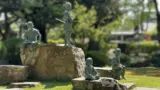
In the early morning of the day of the Battle of Okehazama itself, Sakuma Morishige, the commander defending this fort, was killed after fierce fighting against an assault led by Matsudaira Motoyasu — the same man who would later become Tokugawa Ieyasu. The stone marker and memorial standing quietly among the trees here are a reminder that Nobunaga's entire strategy rested on nothing more than a few hundred meters of elevation and a few earthworks.


Tap a photo to enlarge
Key facts| Built | 1559 |
|---|---|
| Built by | Oda Nobunaga |
| Structure & features | A small satellite fort (tsukejiro) at a ridge tip; about 36 m by 28 m, believed to have been surrounded by an outer moat roughly 3.6 m wide |
| Excavation history | Preserved as a historic site with a stone marker, memorial to the fallen, and information board |
| Current condition | No original buildings remain; a stone marker and memorial survive, and traces of the bailey and moat can be made out in the terrain in places |
| Decline | Fell during the opening stage of the 1560 Battle of Okehazama and was abandoned afterward; surrounding residential development has made some remains difficult to identify |
| Cultural property status | National Historic Site ("Odaka Castle Ruins, with attached Marune Fort Ruins and Washizu Fort Ruins"); designated December 14, 1938 |
| Notes | Defending commander Sakuma Morishige was killed here; the attacking force is traditionally identified as led by Matsudaira Motoyasu (later Tokugawa Ieyasu) |
Address: 459-8001 Aichi, Nagoya, Midori Ward, Odaka-cho, Marune (大高町丸根 / Marune Fort Ruins)
Getting there: About a 13-minute walk (roughly 900 m) from Washizu Fort Ruins, the previous stop on this route.
Suggested visit time: About 5 minutes for a quick look, up to about 20 minutes to explore in depth.
Parking: No dedicated lot — see "Parking & Opening Hours" above (please confirm locally).
- The Marune Fort marker and memorial to the fallen: a small cluster of stone markers standing quietly among the trees — standing on the actual battle site brings the Okehazama story much closer.
- The ridge-tip terrain: though the fort itself is small, the high point at the ridge's tip offers a clear read on the surrounding land — you can imagine exactly how Nobunaga used this earthwork fort to watch and blockade the area.
- Seasonal color: pleasant shade under fresh greenery in early summer, and a carpet of fallen leaves in autumn — even the short climb rewards visitors with a sense of the season.
- Historical background: building a separate fort only a few hundred meters from Washizu Fort let Nobunaga keep the two positions independent across the valley terrain while still tightening the overall siege ring around Odaka Castle.
- Lesser-known detail: surrounded by ordinary houses, only the fort itself survives as a small "island" of forest — a Sengoku-period holdout easy to walk right past if you're not watching for it.
- Historical figures: built by Oda Nobunaga, defended by Sakuma Morishige, and attacked by a young Matsudaira Motoyasu — later Tokugawa Ieyasu. All three names intersect at this single spot, making it one of the most concentrated sites connected to the Battle of Okehazama.
Frequently Asked Questions
Yes. All three sites are protected under a single designation, "Odaka Castle Ruins, with attached Marune Fort Ruins and Washizu Fort Ruins," designated a National Historic Site on December 14, 1938.
Starting and ending at Odaka Station, the full loop takes about 120 minutes. Individually: Odaka Castle Ruins takes about 20 minutes for a quick look or up to 1 hour to explore in depth; Washizu Fort Ruins about 20 minutes or up to 35 minutes; and Marune Fort Ruins about 5 minutes or up to 20 minutes.
Stamps for Odaka Castle, Washizu Fort, and Marune Fort are all sold at the Odaka Tourist Information Center, open Saturdays and Sundays from 10:00 a.m. to 4:00 p.m. It's about a 7-minute walk (roughly 550 m) from Odaka Castle Ruins.
The night before the Battle of Okehazama, a young samurai still known as Matsudaira Motoyasu — later Tokugawa Ieyasu — fought on the Imagawa side and successfully delivered supplies into besieged Odaka Castle. On the day of the battle itself, he led the attack on Marune Fort, where the defending commander Sakuma Morishige was killed. Nobunaga, Ieyasu, and Imagawa Yoshimoto's movements all crossed within a few hundred meters of each other here.
None of the three sites has its own dedicated parking lot. Visitors commonly use the free Odaka Ryokuchi Park No. 6 parking lot or paid parking near Odaka Station instead. This information comes from unofficial sources, so please confirm current details locally before your visit.
Explore More of Nagoya & the Battle of Okehazama


More Warlord Profiles



☕ Support This Site
Following the Shogun is built on original fieldwork and on-site research.
If you found this guide useful, your support helps keep it going.

You can also support via QR code


comment