


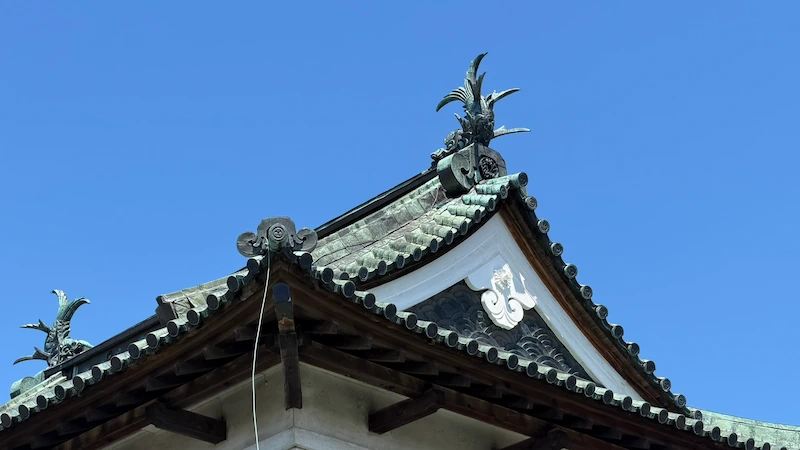
Hirosaki Castle History|Tsugaru Clan, the Lost Tower & the 1810 Keep
Why the current keep is not the original. The Tsugaru clan's independence, the lightning strike that ended the first tower, and why a more than 200-year-old wooden keep still stands today.
The Tsugaru Clan & Hirosaki Castle
Hirosaki Castle served as the main stronghold of the Tsugaru domain throughout the Edo period (1603–1868). The castle grounds, now preserved as Hirosaki Park, are designated by the national government as a Historic Site under the name "Tsugaru Clan Castle Ruins, Hirosaki Castle Ruins."
Why did the Tsugaru clan build a castle here?
The Tsugaru clan's story begins with its founder, Tsugaru Tamenobu (1550–1607). Originally a retainer of the powerful Nanbu clan, which controlled much of northern Honshu, Tamenobu broke away and declared independence — seizing control of the Tsugaru region in what is now western Aomori Prefecture. He secured recognition of his territory from Toyotomi Hideyoshi, the great unifier who held national authority at the time, cementing his independent standing.
Tamenobu's break from the Nanbu clan created a tension that would persist throughout the entire Edo period. The Tsugaru and Nanbu clans disputed territory and court rankings for generations. Building Hirosaki Castle — a powerful, permanent castle on the western edge of the Tsugaru plain — was not just a practical military move. It was a declaration of independence, permanence, and legitimacy in defiance of the Nanbu. The Information Center has exhibits on this rivalry that bring the history to life.
For the Nanbu side of the story, see our guide to Morioka Castle Ruins & Morioka Hachimangu.
Tamenobu's son, the 2nd domain lord Tsugaru Nobuhira, completed Hirosaki Castle in 1611 (Keicho 16). The layout follows a teikakushiki nawabari (trapezoidal enclosure) design — the Honmaru (Main Bailey) at the center, surrounded by the Nijomaru, Sannomaru, Kitanokaku, and Nishi-no-Kaku, all enclosed by multiple moats and earthworks.
Why is the current keep smaller than the original?
When Hirosaki Castle was completed in 1611, its keep was an imposing five-story tower. In 1627 (Kanei 4), lightning struck the keep and burned it down. For approximately 180 years after that, Hirosaki Castle had no keep at all.
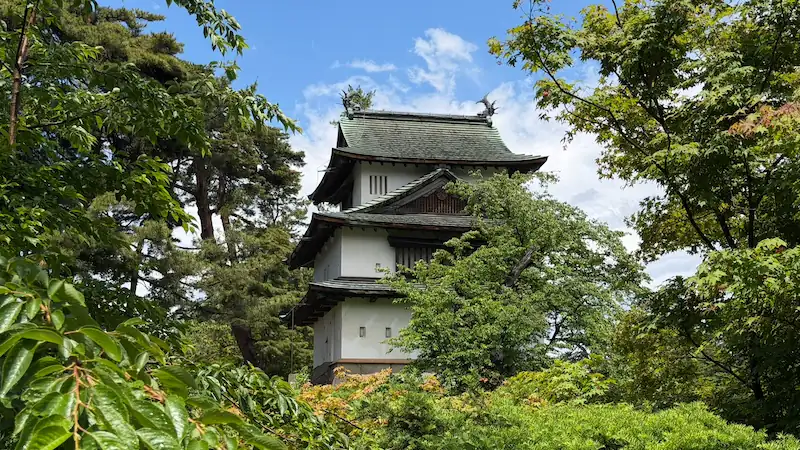
After the 1627 fire, rebuilding a keep required permission from the Tokugawa shogunate — the central government that controlled all aspects of domain governance. The shogunate was deeply suspicious of powerful domain lords and had strict rules limiting castle construction. The Tsugaru clan eventually found a workaround: when the 9th domain lord Tsugaru Yasuchika received approval in 1810, the application described the new structure as a "corner turret" rather than a keep. This allowed construction to proceed within the rules. The resulting three-story building is the keep standing today.
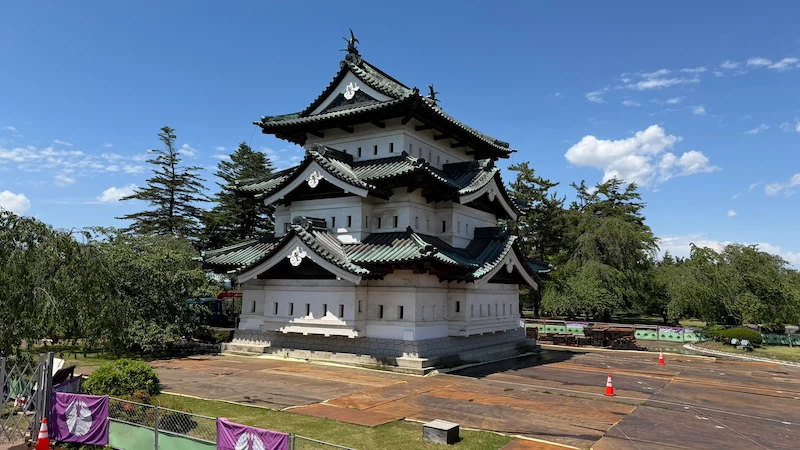
The current keep was built in 1810 (Bunka 7) by the 9th domain lord Tsugaru Yasuchika. It is a three-story wooden structure positioned at the southeast corner of the Honmaru. Though smaller than the original five-story keep, it has stood continuously since then — never demolished, never reconstructed — making it one of Japan's 12 surviving original keeps (現存天守).
9 Important Cultural Property Buildings
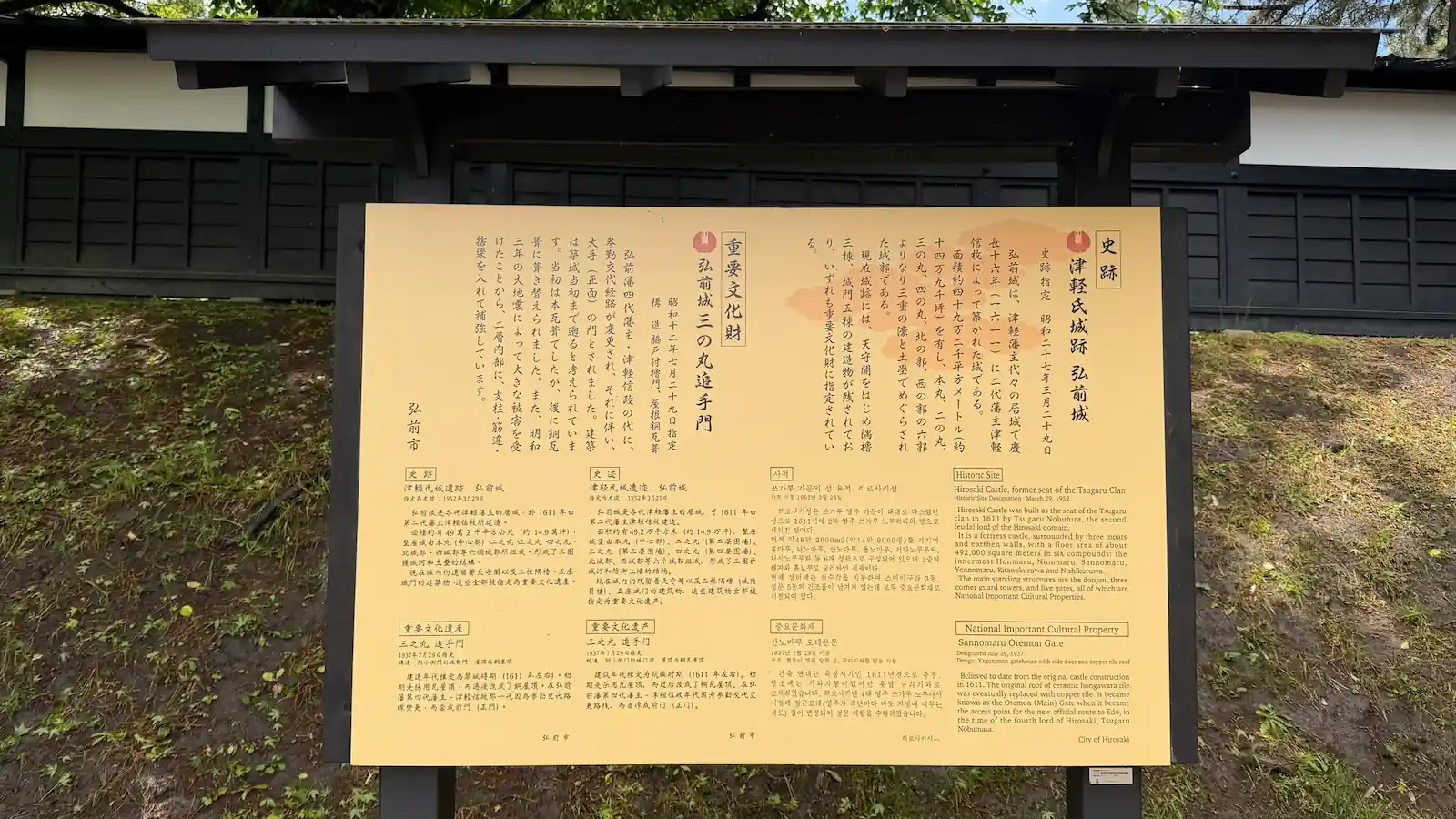
Hirosaki Castle has 9 buildings designated as Important Cultural Properties — all original Edo-period structures. This is an exceptionally high number compared to other Japanese castles.
| Building | Type | Status (May 2026) |
|---|---|---|
| Keep (3-story) | Original surviving keep | Exterior viewable / interior closed |
| Nijomaru Tatsumi Turret | Corner turret | Exterior viewable |
| Nijomaru Hitsujisaru Turret | Corner turret | Exterior viewable |
| Nijomaru Ushitora Turret | Corner turret | Exterior viewable |
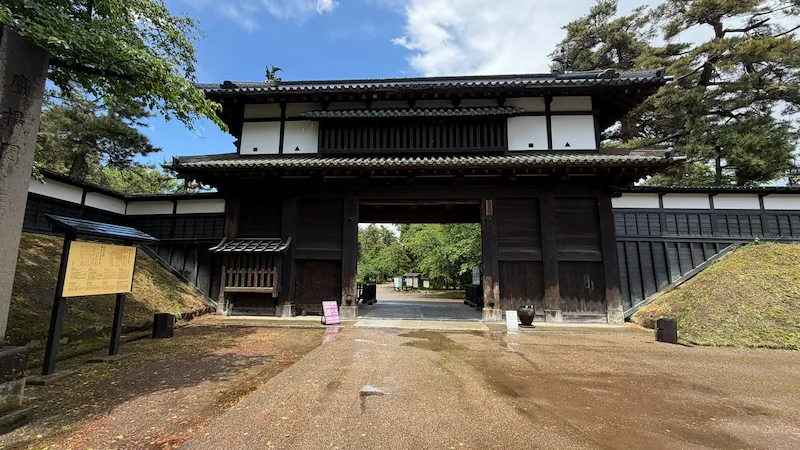
| Otemon Gate | Original gate | Open / freely passable |
| Higashimon Gate (Sannomaru) | Original gate | Exterior viewable |
| Higashiuchimon Gate (Nijomaru East Inner Gate) | Original gate | Preservation repair (2026) |
| Minamiuchimon Gate | Original gate | Open / viewable |
| Kamenokomon Gate (North Gate) | Original gate | Preservation repair (2026) |
For a detailed guide to each building with 360° panoramas and maps, see the Architecture Guide.
Original / Reconstructed / Ruins — What's the Difference?
Before visiting Hirosaki Castle, it helps to understand three terms that appear frequently in Japanese castle guides.
A wooden castle keep built in the Edo period or earlier that has remained standing without being demolished and rebuilt. Japan has only 12 such keeps. Hirosaki, Matsumoto, Inuyama, Hikone, and Himeji castles are among the most well known. These are the rarest and most historically significant of all Japanese castle towers.
Many of Japan's most famous castles — Osaka, Nagoya, Kumamoto — have keeps that were destroyed in the Meiji era or in World War II and later rebuilt, usually in reinforced concrete. These reconstructions are historically significant as symbols, but they are not original buildings. When Japanese tourism materials distinguish "original" from "reconstructed," this is the key difference.
Hirosaki's keep is original — but with an important nuance. The current three-story keep built in 1810 is not the same as the original five-story keep from 1611, which was destroyed by lightning in 1627. The 1810 keep has stood continuously since then, maintained and repaired through the centuries, and is the building you see today. Its survival is remarkable — and is precisely what makes Hirosaki Castle historically exceptional.
Two more original keeps covered on this site: Inuyama Castle and Himeji Castle.
The Hikiya Project — Moving the Keep
Why was the keep moved?
Keep relocation and stone wall repair (May 2026) / Tap to enlarge
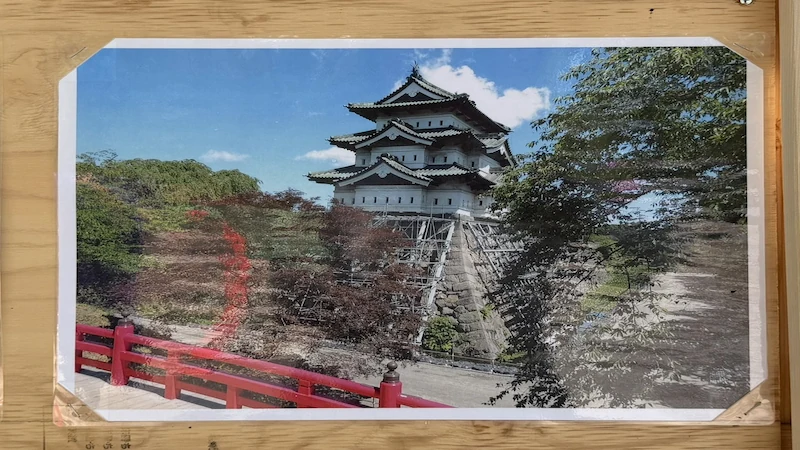
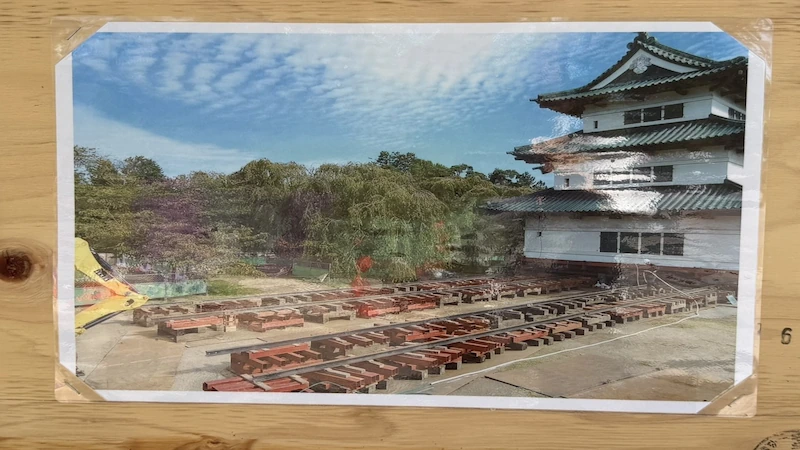
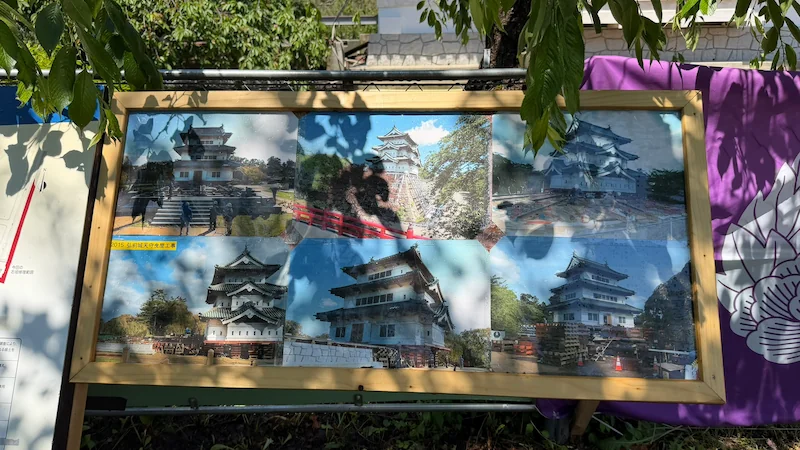
In 2015, the Hirosaki Castle keep was relocated approximately 77.62 meters from its original stone base to a temporary position in the center of the Honmaru. This process — called hikiya — was necessary because the stone walls beneath the keep had been gradually bulging outward over centuries, a condition called harami. If left unrepaired, collapse was a real risk. Rather than dismantling the Edo-period wooden keep, engineers moved the entire structure intact. The project attracted widespread attention in Japan and internationally as an extraordinary example of heritage preservation.
The process of returning the keep to its original position is called hikimodoshi. This work is currently underway and is scheduled for completion during 2026. However, following the return, the keep will continue to undergo structural reinforcement and preservation work. The keep interior is closed from November 24, 2025, until approximately March 31, 2033 (subject to change). Please check official sources for the latest schedule before visiting.
According to Hirosaki City (flyer issued March 12, 2026, in Japanese), the keep is scheduled to be moved back onto its original stone base between July and mid-November 2026, and a public pulling event was held on August 21–23. News reports in August 2026 said roof and wall repairs will follow the move, and that the keep is scheduled to reopen to the public in fiscal 2033.
The photos and construction details on this page reflect the author's May 2026 visit. Check Hirosaki City or Hirosaki Park for the latest information.
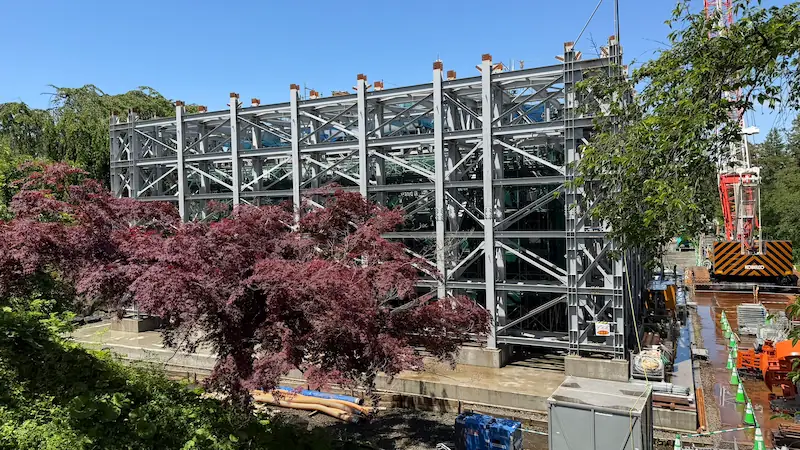
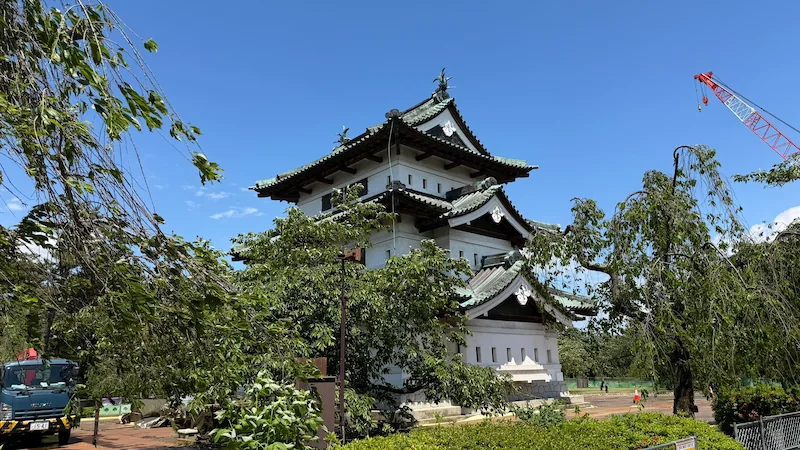
Stone wall repair area (May 2026) / Tap to enlarge
Moving a 400-ton wooden castle keep without dismantling it is an extraordinary feat of civil engineering and heritage conservation. The project required careful structural analysis, custom equipment, and precise coordination to shift the entire building millimeter by millimeter. It was covered extensively by Japanese media and highlighted internationally as a model for preserving irreplaceable wooden architecture.
Learn the history at the Information Center
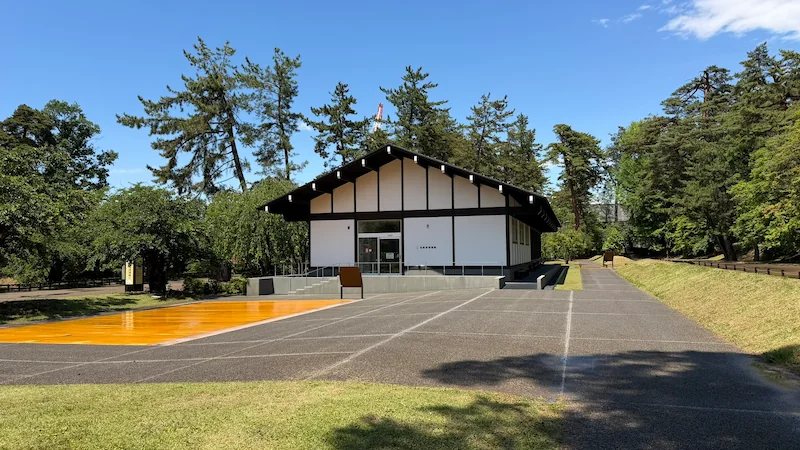
The Hirosaki Castle Information Center is located just inside the south entrance (Otemon Gate side). Open year-round, free admission (9:00–17:00). It is strongly recommended as a first stop before exploring the castle grounds.
Exhibits cover the Tsugaru clan's history, the evolution of the castle from its construction to the present day, and the mechanics of the hikiya and hikimodoshi projects. Displays also explore the Tsugaru clan's complex relationship with the Nanbu clan, and the clan's connection to Toyotomi Hideyoshi — whose wooden image was enshrined as the castle's guardian deity in the Honmaru.
FAQ
Tsugaru Nobuhira, the 2nd domain lord, completed it in 1611 (Keicho 16). His father, Tsugaru Tamenobu, founded the clan's power by breaking away from the Nanbu clan.
The original five-story keep burned down after a lightning strike in 1627. The castle had no keep for about 180 years, until the 9th domain lord Tsugaru Yasuchika built the current three-story keep in 1810.
Rebuilding a keep required permission from the Tokugawa shogunate, which strictly limited castle construction. Describing the new building as a corner turret allowed construction to proceed within the rules.
Yes. The 1810 keep has never been demolished or reconstructed, making it one of Japan's 12 surviving original keeps. It is not the first keep on the site, which was the five-story tower lost in 1627.
The stone walls beneath it had been bulging outward (harami), and collapse was a real risk. In 2015 the keep was moved intact, approximately 77.62 meters, to a temporary position in the center of the Honmaru so the walls could be repaired.
The interior is closed from November 24, 2025 until approximately March 31, 2033, subject to change. News reports in August 2026 said the keep is scheduled to reopen to the public in fiscal 2033.
Related Pages
☕ Support Following the Shogun
This site is produced through field research across Japan.
If this guide helped you plan your visit, your support keeps the research going.

Scan to support via QR code


comment