

Choshoji Temple & Zenringai
The Tsugaru Clan's Family Temple and a Castle-Town Defense in Stone and Wood
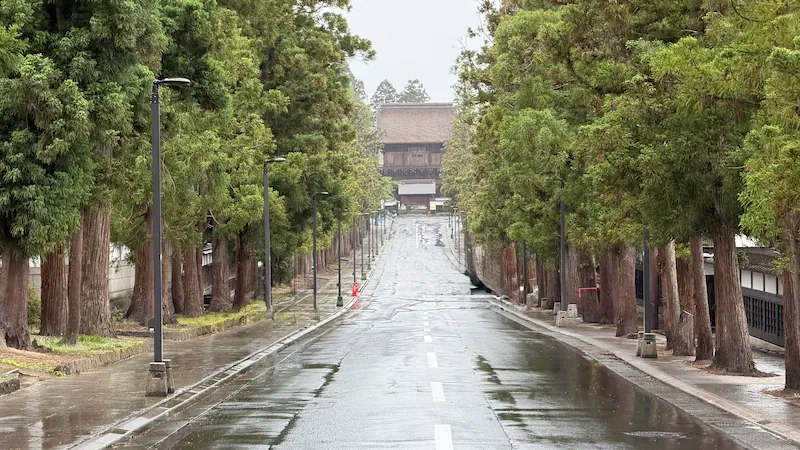
A straight road lined with 33 Zen temples leads southwest from Hirosaki — and at the far end stands Choshoji, the former family temple of the Tsugaru feudal lords, its towering Sanmon gate rising above the surrounding trees.
📋 At a Glance
| 🏛 Sanmon & Main Hall | Nationally designated Important Cultural Properties. Accessible during a normal visit. |
|---|---|
| 🚪 Visiting | Normal visit (free, 9:00–16:00): Sanmon, kuri, main hall area, and Soryukutsu are accessible. Inner hall, Mieido, and mausoleums require an advance-reservation guided tour. |
| ⏱ Time Needed | Normal visit only: a short walk covers the main buildings. Allow extra time for Zenringai and nearby sites. Guided tour adds about 40 minutes. |
| 🚇 Nearest Station | Hirosaki Station (JR Ou Main Line) → Konan Bus (~15 min) → "Moricho Choshoji-iriguchi" stop → ~10 min walk |
| From Tokyo | Shinkansen to Shin-Aomori (~3 hrs), then local/limited express to Hirosaki (~30–40 min). Day trip possible; overnight stay recommended for exploring the castle district fully. |
| 🖌 Temple Seal | During my visit, goshuin requests were handled at the kuri (monks' quarters). Conditions may change — check before visiting. |
| 👥 Best For | Fans of Zen temple architecture, wooden buildings, and Japanese feudal history |
Is Choshoji Temple Worth Visiting?
Choshoji is a good fit if you enjoy Zen temple architecture, well-preserved wooden buildings, or stories of a feudal clan's history. At 16.2 meters tall, the Sanmon gate makes a strong impression. The combination of Zenringai's quiet temple-lined approach and the building complex at the end of the road gives a sense of the deliberate planning that shaped this part of Hirosaki's castle town.
It is not a destination for elaborate displays or large crowds. The grounds have a quiet atmosphere, making it easy to take in the buildings at your own pace. The connection to Hirosaki Castle's southwestern defense adds a layer of historical depth that is not always obvious from the outside but becomes clear with a bit of background.
How Long Does It Take?
A normal visit covering the Sanmon gate, kuri, main hall, and Soryukutsu takes a short while to complete at a relaxed pace. The guided tour of the inner areas adds approximately 40 minutes (per the Hirosaki Tourism and Convention Bureau). If you walk the full length of Zenringai or combine Choshoji with nearby Saishoin Temple and Hirosaki Castle, allow more time — a half-day covers the area comfortably.
Is It Beginner-Friendly?
Yes. The route from the bus stop along Zenringai to the temple is straightforward — the road runs in a straight line with no confusing turns. The temple grounds are level and easy to navigate. Knowing a little background about Choshoji-kamae (the castle-town defensive enclosure) beforehand makes the visit more meaningful, though it is not required.
🚇 Getting There
| Nearest Station | Hirosaki Station (JR Ou Main Line) |
|---|---|
| By Bus | Konan Bus to "Moricho Choshoji-iriguchi" stop → ~10 min walk to Choshoji For the start of Zenringai (near Kuromon gate): "Moricho" stop → ~5 min walk |
| Recommended Transport | Bus from Hirosaki Station is the most practical option. Walking the full Zenringai approach from the bus stop adds atmosphere. Bicycle rental is also available in central Hirosaki. |
| On the Ground | Zenringai is a flat, straight road — easy to walk in any footwear. The temple grounds are also level. No special gear needed. |
| Shinkansen Gateway | Shin-Aomori Station. Transfer to local or limited express train for Hirosaki Station (~30–40 min depending on service). |
| From Tokyo | Tohoku/Hokkaido Shinkansen to Shin-Aomori (~3 hrs), then connect to Hirosaki. A day trip is possible; an overnight stay allows more time for the castle district. |
| From Sendai | Shinkansen to Shin-Aomori (~1 hr 20–30 min), then connect to Hirosaki (~30–40 min). Total roughly 2 hours. |
| By Car | Search for Choshoji Temple on Google Maps or a navigation system. Approaching via the Zenringai road adds to the atmosphere. Check parking availability with the temple or Hirosaki Tourism and Convention Bureau before your visit. |
| Notes | Bus schedules and stop names are subject to change. Check the Konan Bus website before your trip. Some seasonal services (including the Tamenobu-go tourist bus) do not run in winter. |
📍 Choshoji Temple location (Sanmon gate)
📍 Zenringai location
History and Background
The Tsugaru Clan's Family Temple
Choshoji's origins trace back to a temple said to have been founded by Oura Mitsunobu, a warrior lord of the late Muromachi period, in Tanezato — present-day Ajigasawa. According to tradition, the temple was relocated several times as the Tsugaru clan consolidated power, moving via Horikoshi before eventually settling in its current location in Hirosaki.
In the early Edo period, Tsugaru Nobuhira — the second lord of the Hirosaki domain — reorganized the temple at its current site around 1610. The Sanmon gate, built by Nobuhira in 1629 and standing 16.2 meters tall, remains the most visible monument of that patronage. It underwent major repairs in 1809, which modified some of its details, but it has stood on the same spot ever since.
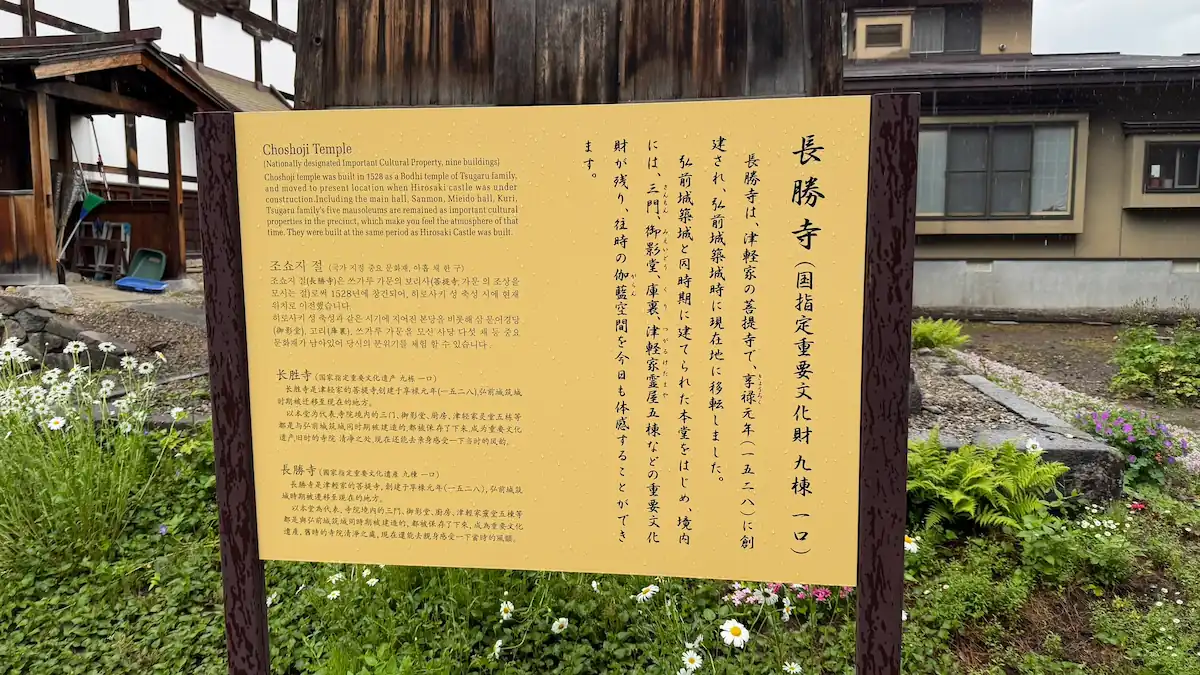
Choshoji continued to serve as the Tsugaru family temple through the Edo period. The Mieido hall — housing a wooden image of Tsugaru Tamenobu, the first domain lord — and five mausoleum buildings were built and maintained for successive generations of the clan. These structures are now nationally designated Important Cultural Properties.
Why Were 33 Temples Gathered Here?
The straight road of Zenringai and the 33 temples that line it were not arranged by chance. The entire district was designed as part of Choshoji-kamae, a southwestern defensive enclosure for Hirosaki Castle. Moats, earthworks, angled gateways (masugata), and natural terrain features were combined into a defensive barrier on the castle town's most exposed flank — and the row of temples was deliberately positioned within it.
Choshoji-kamae is now a designated component of the nationally protected Hirosaki Castle Ruins historic site. Walking through Zenringai today, the defensive structure is not immediately obvious. But a map view makes the layout clear: the straight line of temples runs directly along the southwestern axis of the castle, precisely where a planned defensive barrier would be placed.
Choshoji-kamae is the collective name for the southwestern defensive enclosure of Hirosaki Castle. In the Nishishigemori district — the area that includes Zenringai — a defensive line was constructed combining moats, earthworks, angled gateways, and natural terrain. The 33 Soto Zen temples were gathered along this corridor as part of that defensive plan. The area is now a designated component of the Hirosaki Castle Ruins national historic site.
🗺 Route map: Hirosaki Station → Saishoin → Zenringai → Choshoji
Normal Visit vs. Guided Tour
What You Can See During a Normal Visit
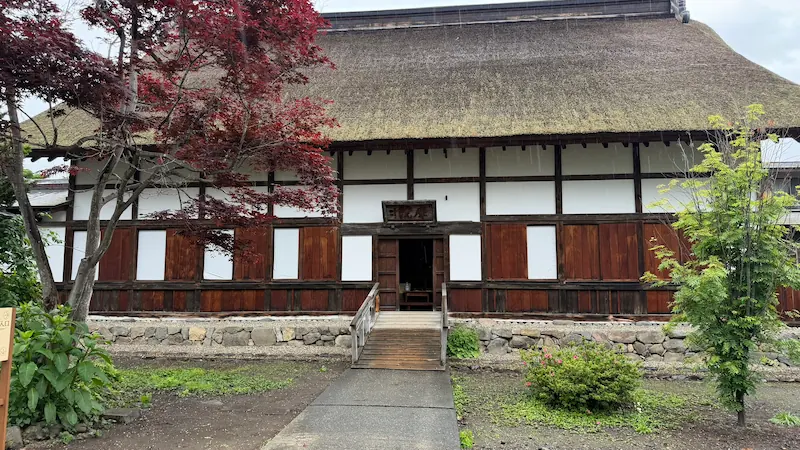
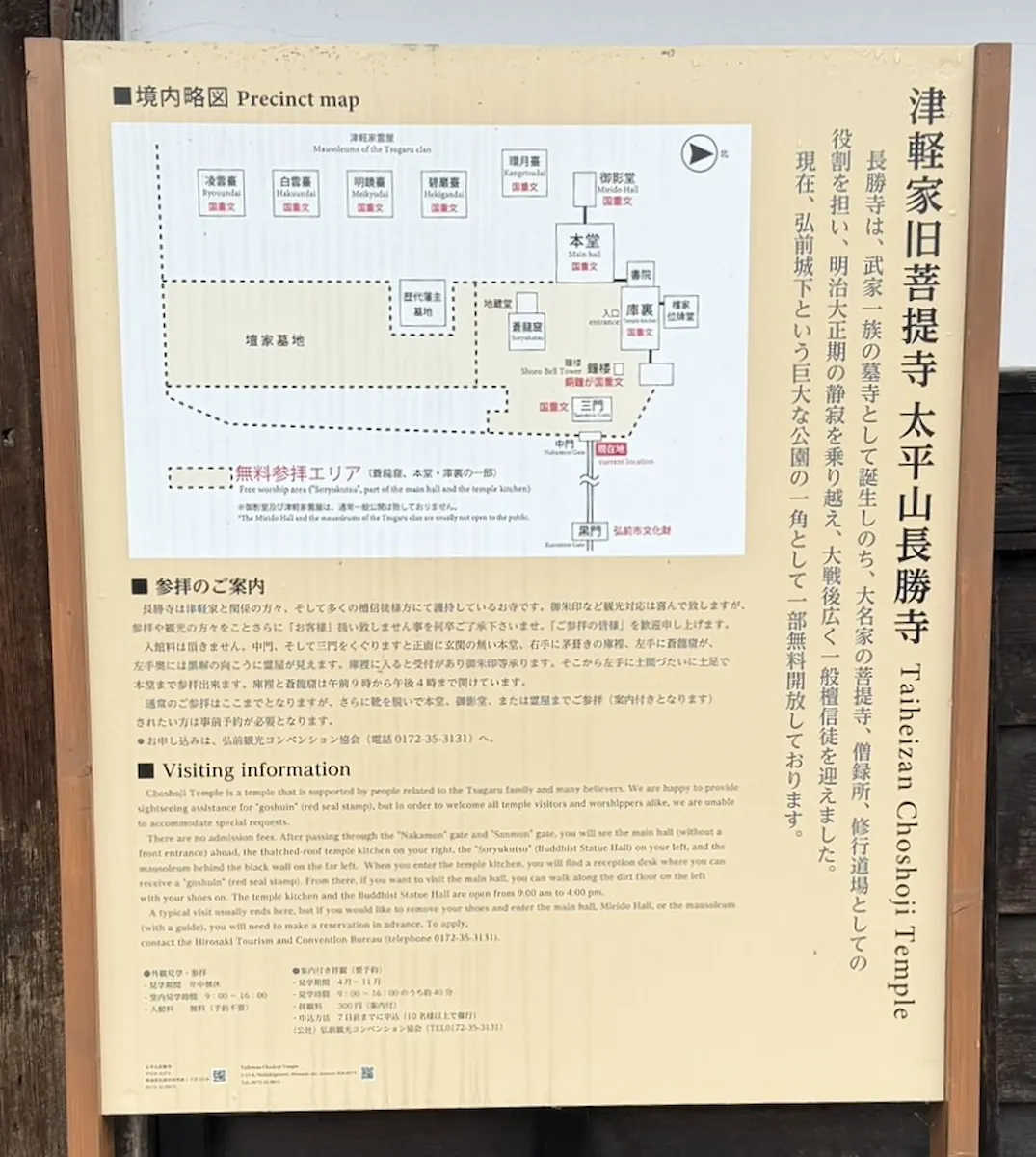
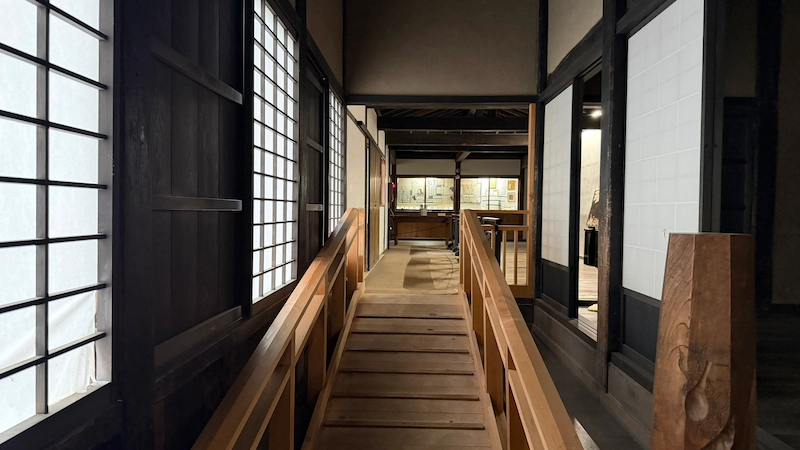
During a normal visit, you enter through the kuri (monks' quarters) and proceed along an earthen-floored corridor toward the main hall. The Sanmon gate, the main hall area, and Soryukutsu are all accessible without a guide (hours: 9:00–16:00; no admission fee for a normal visit).
Guided Tour: Inner Hall, Mieido, and Mausoleums
Visiting the inner main hall, Mieido hall, and Tsugaru family mausoleums requires a guided tour booked in advance through the Hirosaki Tourism and Convention Bureau. At the time of writing, the Bureau listed the following details: ¥300 per person, minimum 10 people, available late April through November, approximately 40 minutes, bookings required at least 7 days in advance. Please confirm all current conditions via the Bureau's official page before your visit.
What Remains Today
The Zenringai district in western Hirosaki preserves the layout of 33 Soto Zen temples along a single straight road, established around 1610 when the second domain lord gathered the temples here as part of the Choshoji-kamae defensive plan. Temple gates and stone walls line both sides of the approach toward Choshoji, and the atmosphere is quiet and unhurried.
The district's arrangement — a straight corridor of temples running along the castle's southwestern axis — still reflects the original castle-town planning. The layout has remained largely intact for over 400 years.
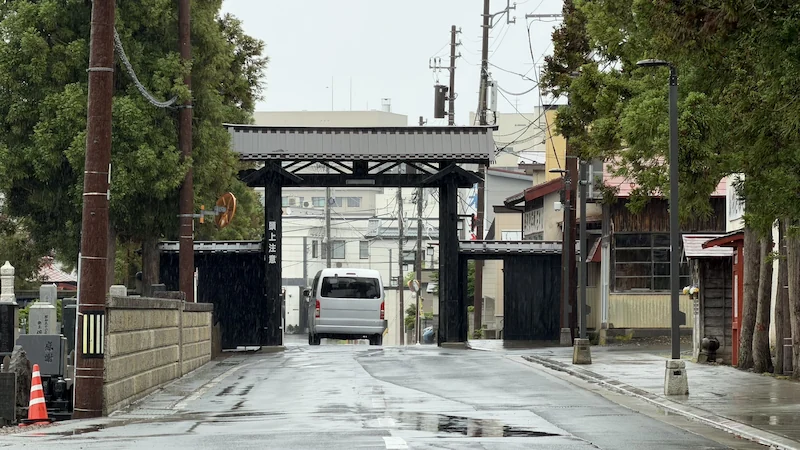
The Kuromon at the eastern end of Zenringai is a Hirosaki City-designated cultural property. Built in the Korai-mon style (a form of gate used in castle architecture), it served as the main outer gate of the Choshoji-kamae enclosure. The exact construction date is not recorded in surviving sources. According to city heritage documentation, the gate was not present at this location before 1677, but is shown in records from 1687 onward — suggesting it was built sometime in that ten-year span. It marks the eastern boundary of Zenringai and the starting point of the temple approach.
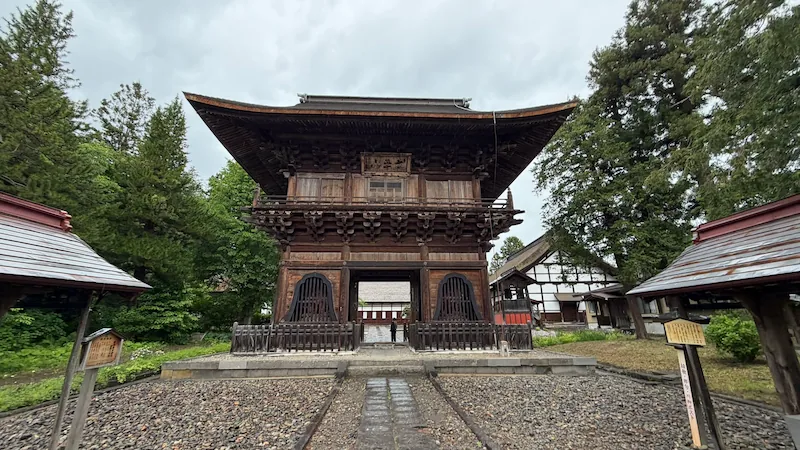
Built in 1629 by Tsugaru Nobuhira, the Sanmon gate stands 16.2 meters tall — taller than it appears in photographs. It underwent major repairs in 1809 that modified some of its details, including the addition of Nio (guardian) statues and flower-head windows on the lower level. It is a nationally designated Important Cultural Property and the most photographed structure at Choshoji.
Walking through the gate and looking up at the ceiling gives a strong sense of how it was constructed. The proportions work well for photographs from the front and from an angle.
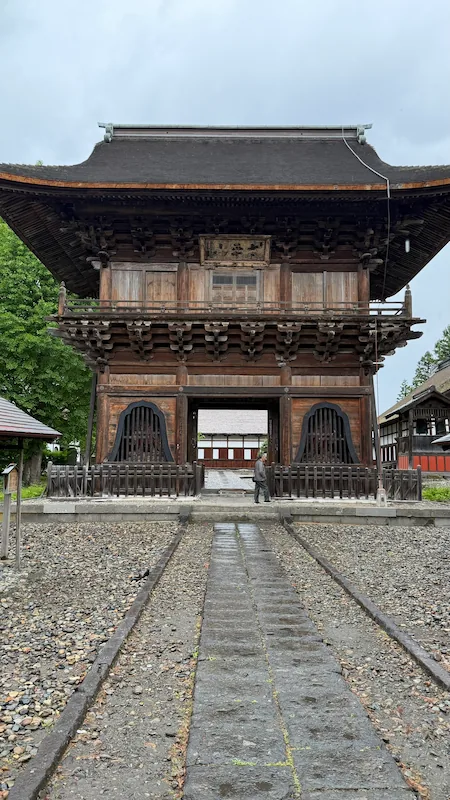
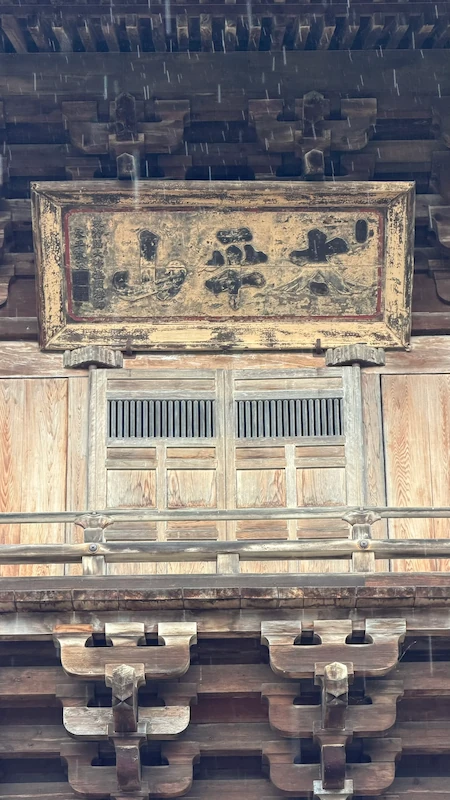
Tap to enlarge
📜 Sanmon Gate — Site Data
| Built | 1629 (Kan'ei 6) |
|---|---|
| Builder | Second domain lord Tsugaru Nobuhira |
| Height | 16.2 meters (approx. 4 stories) |
| Repairs | Major repairs in 1809 (Bunka 6) — flower-head windows and Nio statues added |
| Designation | Important Cultural Property of Japan |
| Current state | Extant (post-1809 repair form) |
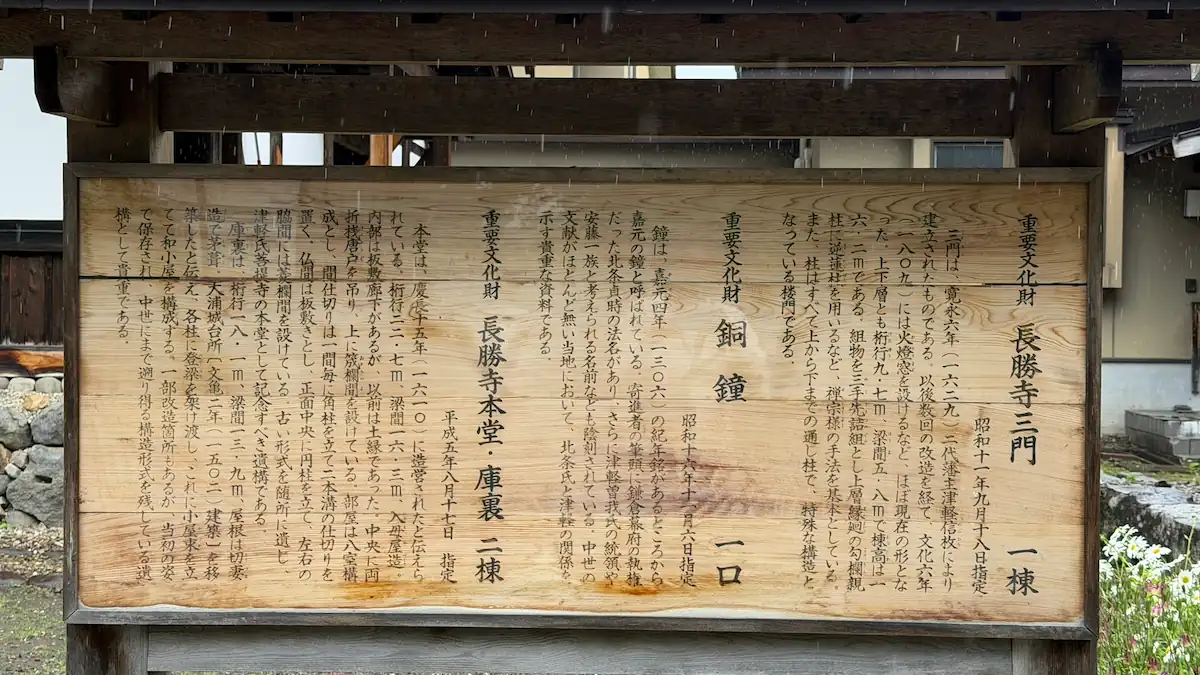
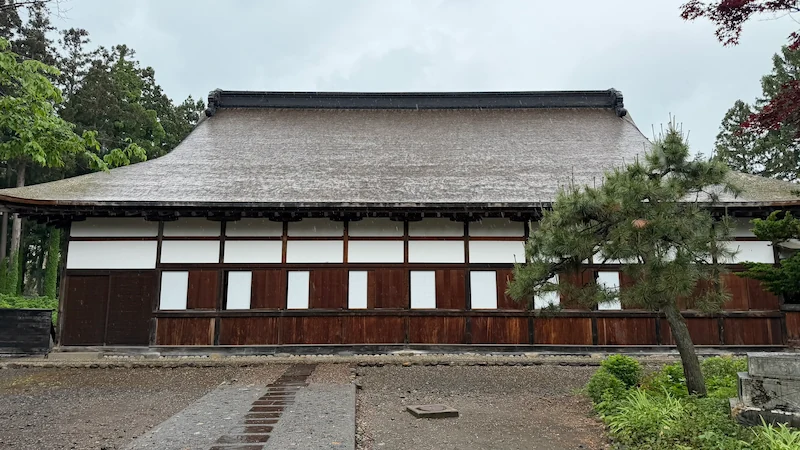
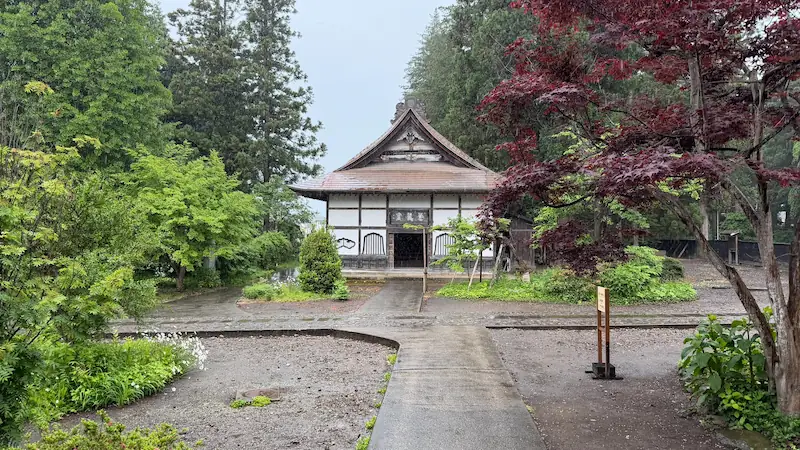
The main hall is believed to date from around 1610, making it an early surviving Soto Zen main hall structure. It underwent restoration between 2005 and 2008, bringing it closer to its original form. It is a nationally designated Important Cultural Property. You can enter through the kuri and proceed along an earthen-floored corridor to the main hall side. The interior is open and tall — an impressive space that feels like a working temple rather than a museum.
The kuri is traditionally said to have been relocated from Oura Castle's kitchen quarters around the Keicho era (c. 1596–1614). It was rebuilt in 1794 (Kansei 6), with records showing that older materials were reused in the reconstruction — a nationally designated Important Cultural Property. During a normal visit, the kuri serves as the reception point and the entry to the main hall route.
📜 Kuri — Site Data
| Original (tradition) | Said to have been relocated from Oura Castle's kitchen quarters, Keicho era (c. 1596–1614) |
|---|---|
| Rebuilt | 1794 (Kansei 6) |
| Note | Records confirm that older materials were reused in the 1794 reconstruction |
| Designation | Important Cultural Property of Japan |
| Current state | Extant (1794 rebuilt form) |
| Role | Reception point and route entry for normal visits. Temple seal (goshuin) requests handled here during my visit. |
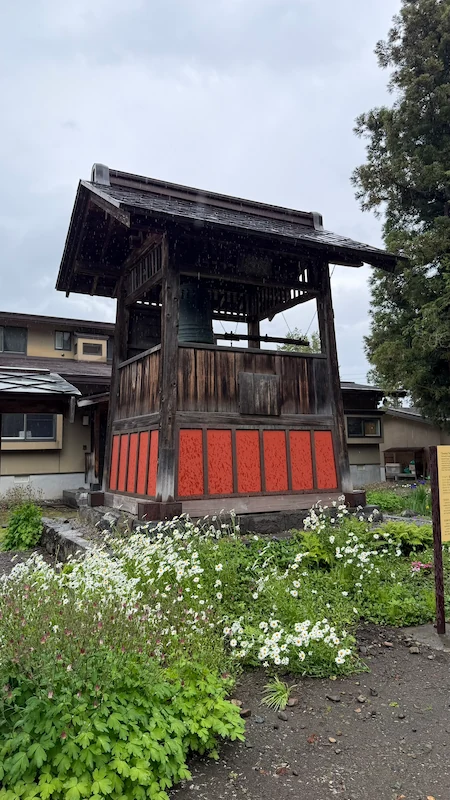
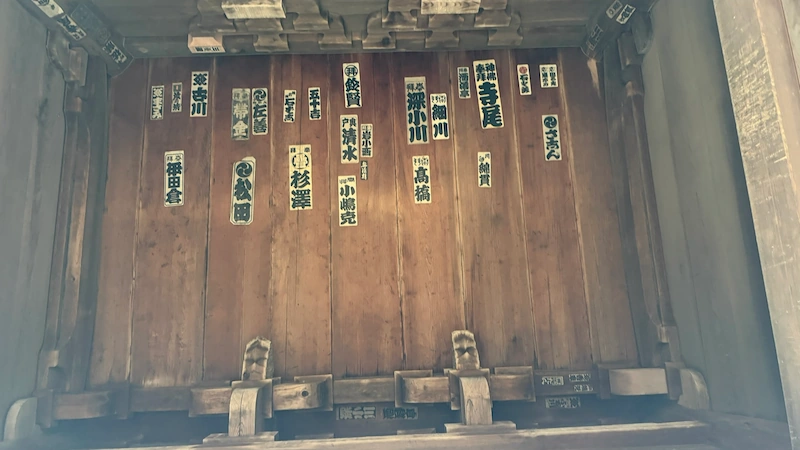
The bronze bell, known as the Kagen-sho, bears an inscription dated 1306 (Kagen 4) — predating the founding of Choshoji by about 200 years. According to temple records, it was originally held at Manzo-ji temple in Fujisaki and was moved to Choshoji during the Keicho era (c. 1596–1615). It is considered one of the older historic bronze bells associated with the region and is a nationally designated Important Cultural Property. The bell can be seen from outside, behind the Sanmon gate.
The zushi-do (miniature shrine hall) at the center of Soryukutsu was built in 1638 (Kan'ei 15) by the third domain lord Tsugaru Nobuyoshi, originally to enshrine the principal deity of Hyakutaku-ji temple within the Iwakiyama Shrine complex. Following the Meiji-era separation of Shinto and Buddhism, Hyakutaku-ji was dissolved and the zushi-do was relocated to Choshoji. It is designated as a prefectural cultural property. The cave space itself contains a large number of Buddhist images — an enclosed, dimly lit interior very different in atmosphere from the open grounds. It is one of the more unusual and memorable parts of a normal visit. For details about the individual figures and their history, the on-site signs are the best reference.
The Mieido hall was likely built in 1629 (Kan'ei 6) by Tsugaru Nobuhira to mark the 23rd memorial service of the first domain lord, Tsugaru Tamenobu. It underwent major repairs and reconstruction in 1805 (Bunka 2), including repositioning and reorientation of the building. It houses a wooden image of Tamenobu and is a nationally designated Important Cultural Property. This building is part of the guided tour area and is not accessible during a normal visit.
Five mausoleum buildings for successive generations of the Tsugaru clan stand within the temple grounds — all nationally designated Important Cultural Properties. Their construction dates are each documented: Kangetsu-dai (first lord's consort, built 1672), Hekigan-dai (second lord Nobuhira, built 1631), Meikyo-dai (Nobuhira's consort Manten-hime, built 1638), Hakuun-dai (third lord Nobuyoshi, built 1656), and Ryo'un-dai (sixth lord Nobusugu, built 1753). Each is built in plain wood with the Tsugaru clan crest painted on the exterior. These mausoleums are the most direct physical record of Choshoji's role as the Tsugaru family temple, and are part of the guided tour area.
Choshoji-kamae is the collective name for the southwestern defensive enclosure of Hirosaki Castle, built around 1610 alongside the castle's construction. It combined moats, earthworks, angled gateways (masugata), and natural terrain features into a defensive barrier on the castle's most exposed flank. The 33 temples of Zenringai were gathered within this corridor as a deliberate part of that defensive plan.
The enclosure is now part of the nationally designated Hirosaki Castle Ruins historic site (designated 1952). At ground level in Zenringai, the defensive structure is not immediately obvious. A map view, or a look at the site from the direction of Hirosaki Castle's third enclosure (san-no-maru), makes the spatial relationship much clearer.
🏰 Choshoji-kamae and Hirosaki Castle's Southwest Defense
Choshoji-kamae refers to the defensive structures arranged along Hirosaki Castle's southwestern flank. In the Nishishigemori district — the area that includes Zenringai — a defensive line was built combining moats, earthworks, angled gateways, and natural terrain features such as slopes and cliffs.
The decision to concentrate 33 temples along this corridor was deliberate. Temple buildings, walls, and boundaries contributed to the defensive structure. In an emergency, the temple district could serve as a physical and human barrier protecting the western approaches to the castle town.
From ground level today, these defensive features are difficult to identify in the landscape. The on-site maps and signboards at Choshoji and along Zenringai explain the layout clearly. The area is a designated component of the Hirosaki Castle Ruins national historic site.
| Name | Choshoji-kamae (長勝寺構) |
|---|---|
| Established | Around 1610 (Keicho 15), concurrent with Hirosaki Castle's construction |
| Purpose | Southwestern outer defense of Hirosaki Castle |
| Components | Moats, earthworks, masugata (angled gateways), natural terrain, 33 temple buildings |
| Designation | National Historic Site (as part of Hirosaki Castle Ruins; designated 1952) |
| Current state | Temple-street layout largely intact. Defensive terrain features are difficult to read at ground level. |
Traditions and Deeper Notes
📜 Key Events at Choshoji
A timeline of major events connecting Choshoji Temple to the Tsugaru clan.
- Late Muromachi period: Oura Mitsunobu said to have founded the original temple in Tanezato, present-day Ajigasawa (tradition)
- As the Tsugaru clan rose: Temple relocated via Horikoshi toward Hirosaki (tradition)
- Around 1610: Second lord Tsugaru Nobuhira reorganizes the temple at its current site; main hall built. Zenringai and Choshoji-kamae established.
- 1629: Nobuhira builds the Sanmon gate and Mieido hall
- 1631: Hekigan-dai mausoleum built (second lord Nobuhira)
- 1638: Meikyo-dai mausoleum built (Nobuhira's consort Manten-hime). Soryukutsu zushi-do built by third lord Nobuyoshi.
- 1656: Hakuun-dai mausoleum built (third lord Nobuyoshi)
- 1672: Kangetsu-dai mausoleum built (first lord's consort)
- 1753: Ryo'un-dai mausoleum built (sixth lord Nobusugu)
- 1794: Kuri rebuilt; older materials reused (confirmed by records)
- 1805: Mieido repaired and repositioned
- 1809: Major repairs to Sanmon gate
- 2005–2008: Main hall restored toward its original form
- Present: Buildings are nationally designated Important Cultural Properties; accessible by normal visit or guided tour
According to tradition, Choshoji traces its origins to a temple founded by Oura Mitsunobu in Tanezato in the late Muromachi period. The temple is said to have been relocated several times — from Tanezato to Horikoshi, and eventually to its current site — as the Tsugaru clan consolidated power in the region. The details of these relocations vary between historical sources, and the founding account should be understood as a traditional narrative rather than a precisely documented history.
Manten-hime, who arrived in Hirosaki as the consort of the third domain lord Tsugaru Nobuyoshi, was a ward of Tokugawa Ieyasu. Her mausoleum at Choshoji (Meikyo-dai, built 1638) is distinguished by the Tokugawa hollyhock crest on its exterior rather than the Tsugaru clan crest — a visible sign of the Tsugaru–Tokugawa relationship in this period.
Choshoji's story stretches back to Tanezato, where the original temple stood near the ruins of Tanezato Castle in present-day Ajigasawa. Horikoshi Castle, a predecessor site to Hirosaki Castle, is another connected location. Both are covered separately on this site.
📜 Guided Tour Overview
Visiting the inner main hall, Mieido hall, and Tsugaru family mausoleums requires a guided tour booked in advance through the Hirosaki Tourism and Convention Bureau.
The following details were listed on the Bureau's website at time of research. Please verify current conditions before your visit.
| Fee | ¥300 per person (subject to change) |
|---|---|
| Group size | Minimum 10 people |
| Season | Late April through November |
| Duration | Approximately 40 minutes |
| Booking | Contact the Hirosaki Tourism and Convention Bureau at least 7 days in advance |
Temple Seal (Goshuin)
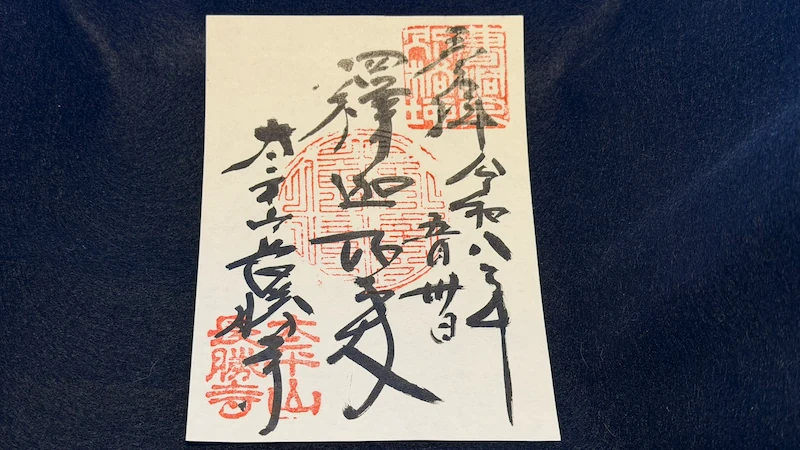
During my visit, I was able to request a goshuin (handwritten temple calligraphy seal) at the kuri. I rang the bell at the kuri entrance and a temple staff member came out to assist. Availability, fees, and conditions may change — please check with Choshoji Temple or the Hirosaki Tourism and Convention Bureau for current details before your visit.
FAQ
Nearby Sites and Related Articles
Choshoji and Zenringai fit naturally into a wider circuit of Hirosaki's historical sites. The three places below each connect directly to the stories at Choshoji.
Hirosaki Castle is the heart of the castle-town defense that Choshoji-kamae was designed to support. Visiting the castle after Choshoji gives a much clearer picture of how the two sites relate. Saishoin Temple and Yasaka Shrine are located between Zenringai and Hirosaki Station — an easy addition to a Choshoji visit that rounds out the area's temple and shrine heritage. Hirosaki Toshogu connects the Tsugaru clan's relationship with the Tokugawa family, a theme that runs directly through the history of the Manten-hime mausoleum at Choshoji.
☕ Support This Site
Following the Shogun is built on original field research and on-site visits.
If this article was useful, your support helps keep it going.

You can also scan the QR code to support


comment