


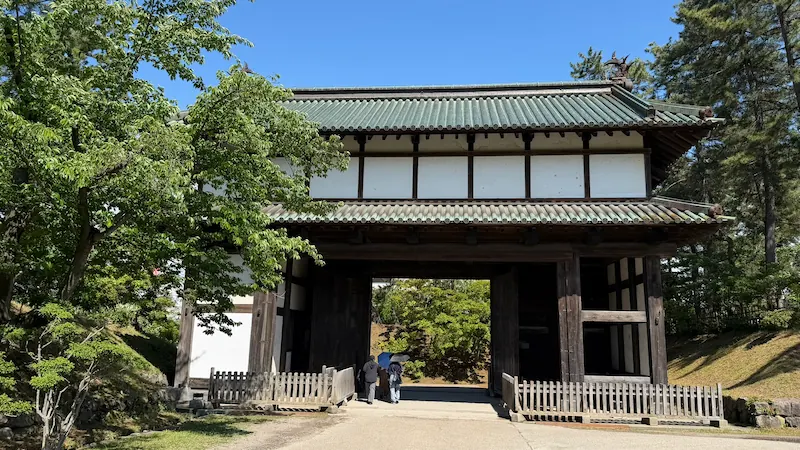
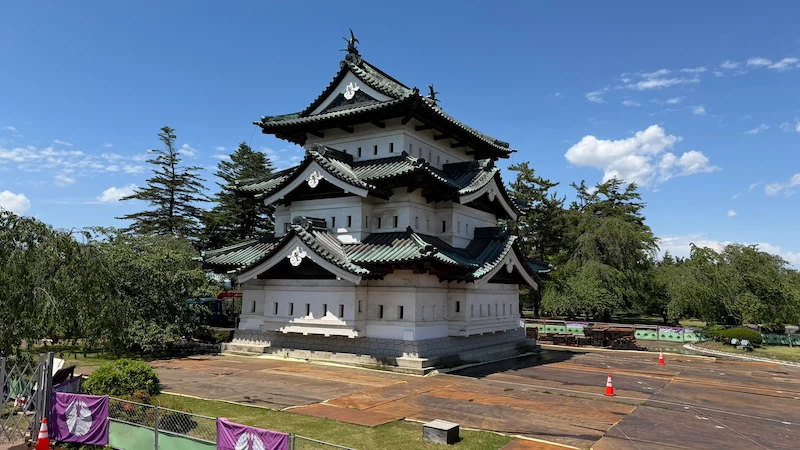
Hirosaki Castle Buildings Guide|Keep, 3 Corner Turrets & 5 Gates
A building-by-building guide to all 9 Important Cultural Property structures — with 360° panoramas, maps, and historical context for each one.
This page focuses on the castle buildings themselves. For access from Hirosaki Station, admission fees, opening status, and practical visit planning, see the main Hirosaki Castle Visit Guide.
Read the Hirosaki Castle Visit Guide|Access, Admission & FAQ 2026
All 9 Important Cultural Property Buildings at a Glance
Hirosaki Castle has 9 Important Cultural Property buildings — more original surviving structures than almost any other castle in Japan. All were built in the Edo period and have never been reconstructed.
| Type | Name | Status (May 2026) |
|---|---|---|
| Keep | Hirosaki Castle Keep (Tenshu) | Interior closed (exterior viewable) |
| Corner Turret | Nijomaru Hitsujisaru Turret (SW) | Exterior viewable |
| Corner Turret | Nijomaru Tatsumi Turret (SE) | Exterior viewable |
| Corner Turret | Nijomaru Ushitora Turret (NE) | Exterior viewable |
| Gate | Otemon Gate (Main South Gate) | Open / viewable |
| Gate | Minamiuchimon Gate (South Inner Gate) | Open / viewable |
| Gate | Higashiuchimon Gate (East Inner Gate / Nijomaru) | Preservation repair (open, photographing difficult) |
| Gate | Higashimon Gate (East Gate / Sannomaru) | Exterior viewable |
| Gate | Kitamon / Kamenokomon Gate (North Gate) | Preservation repair (open, photographing difficult) |
Among Japan's 12 castles with original surviving keeps, Hirosaki is exceptional for how many other original structures remain. Having 3 original corner turrets is rare nationwide — and all 5 surviving gates are also original Edo-period construction. Even during ongoing preservation work, the quantity and quality of what remains here is remarkable.
Keep (Tenshu)
According to Hirosaki City (flyer issued March 12, 2026, in Japanese), the keep is scheduled to be moved back onto its original stone base between July and mid-November 2026, and a public pulling event was held on August 21–23. News reports in August 2026 said roof and wall repairs will follow the move, and that the keep is scheduled to reopen to the public in fiscal 2033.
Construction details elsewhere on this page reflect the author's May 2026 visit. Check Hirosaki City or Hirosaki Park for the latest information.
Hirosaki Castle Keep 🎥 360°
One of Japan's 12 surviving original keeps / Interior closed — exterior fully viewable
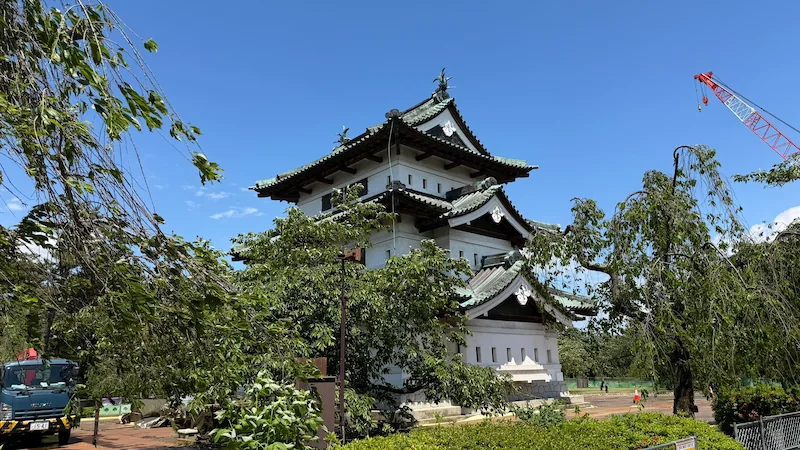
The Hirosaki Castle keep is a three-story original wooden structure built in 1810. It is one of Japan's 12 surviving original keeps (現存天守) — buildings that have stood continuously since the Edo period without reconstruction. The keep interior is currently closed due to ongoing preservation and structural reinforcement work, but the exterior can be viewed at close range.
Keep Base & Hikiya Details
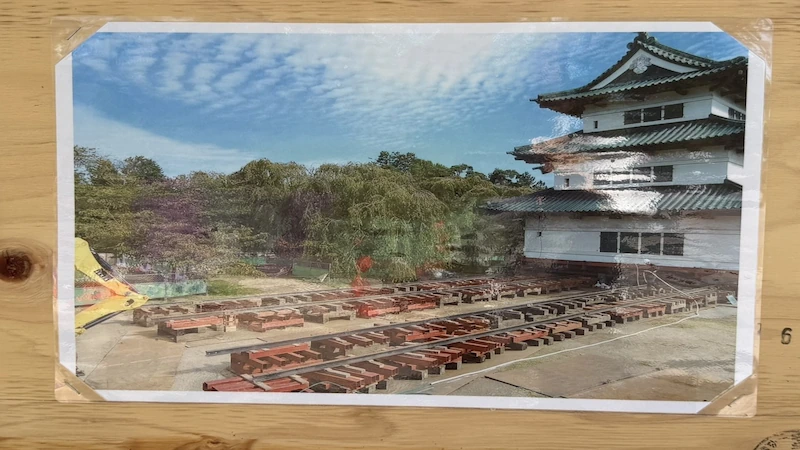
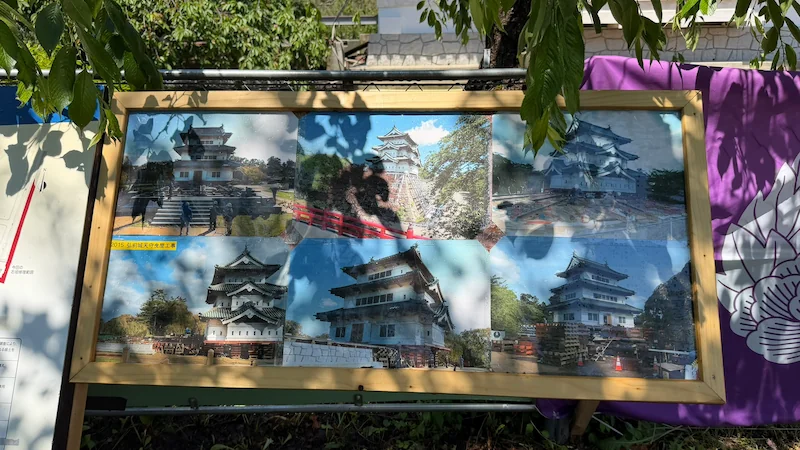
Tap to enlarge
| Built | 1810 (Bunka 7) |
|---|---|
| Structure | Three-story wooden keep |
| Designation | Important Cultural Property |
| Current status | Interior closed (from Nov 24, 2025 — several years). Exterior fully viewable. |
| Hikiya / Hikimodoshi | In 2015, the keep was relocated approximately 77.62m from its original stone base for stone wall repair. It is currently being moved back (hikimodoshi) to its original position. |
The original five-story keep built around 1611 was struck by lightning and burned down in 1627. For approximately 180 years, Hirosaki Castle had no keep at all. The current three-story keep was built in 1810 by the 9th domain lord, Tsugaru Yasuchika. To obtain shogunate approval — which restricted new keep construction — the Tsugaru clan submitted the building as a "corner turret." This political workaround is part of what makes Hirosaki's history fascinating.
Over centuries, the stone walls beneath the keep had gradually bulged outward — a condition called harami. Left unrepaired, collapse was a real risk. In 2015, rather than dismantling the 400-ton wooden keep, engineers relocated the entire structure 77.62 meters to the center of the Honmaru. This was an extraordinarily rare preservation technique for a wooden castle keep, attracting widespread attention in Japan and abroad. The keep is now being moved back to its original position — a process called hikimodoshi — which is underway in 2026.
The full story — from the 1627 lightning strike to the 1810 rebuild — is in the Hirosaki Castle History guide.
3 Corner Turrets
Three original corner turrets survive in the Nijomaru (Second Bailey), positioned at the southwest, southeast, and northeast corners. All three were built around 1611 and are designated Important Cultural Properties. Having three original corner turrets intact in one castle is rare in Japan.
Hitsujisaru Turret (Southwest) 🎥 360°
Southwest (Hitsujisaru) / c. 1611 (Keicho 16) — original construction
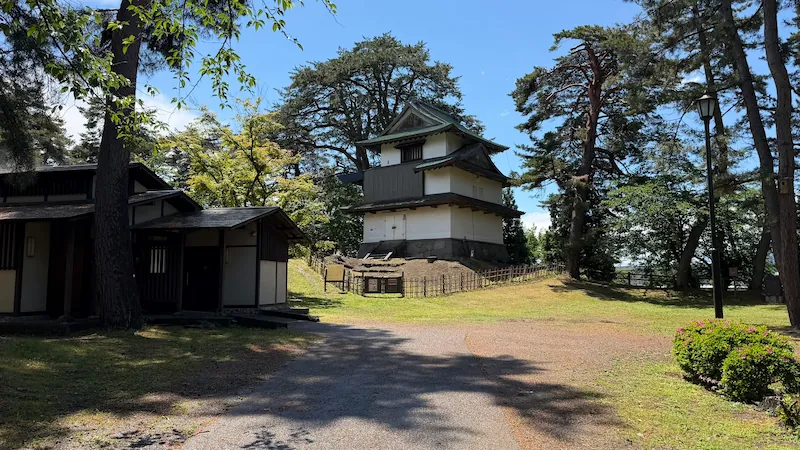
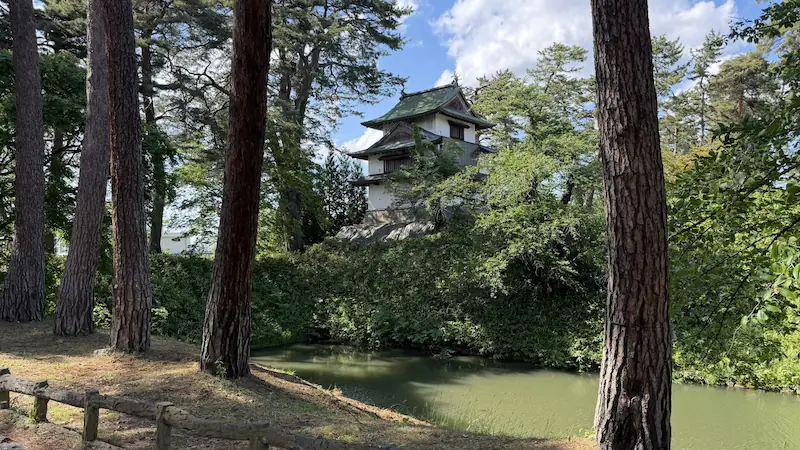
| Direction | Southwest (Hitsujisaru) |
|---|---|
| Built | c. 1611 (Keicho 16) — original construction |
| Repair record | Repaired in Genroku 12 (1699) — documented on a ridge board found inside |
| Designation | Important Cultural Property (designated as Old National Treasure in 1937) |
| Status | Exterior viewable |
A ridge board (munefuda) found inside documents a repair in 1699 — over 80 years after the castle was built. The fact that this repair was carefully recorded and the building preserved through the Edo period reflects the sustained commitment the Tsugaru clan had to maintaining these structures.
Hitsujisaru Turret location (Google Map)
Tatsumi Turret (Southeast) 🎥 360°
Southeast (Tatsumi) / c. 1611 (Keicho 16) — original construction
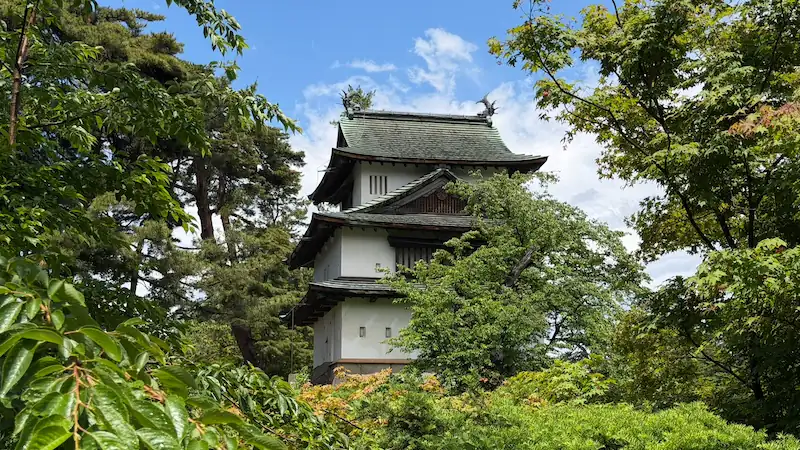
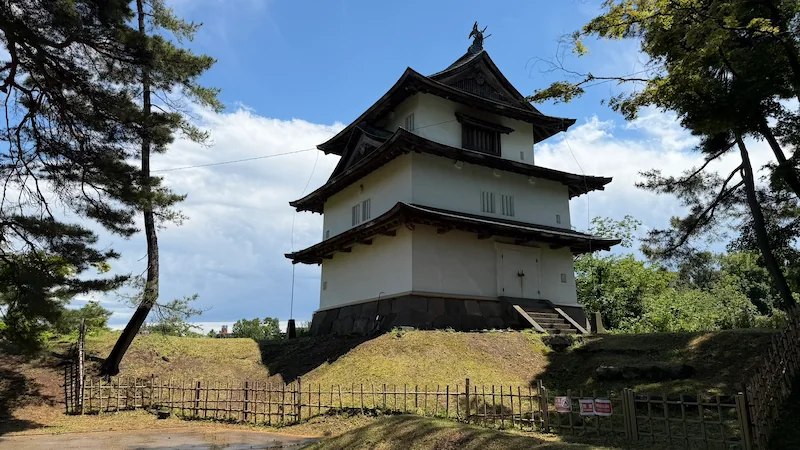
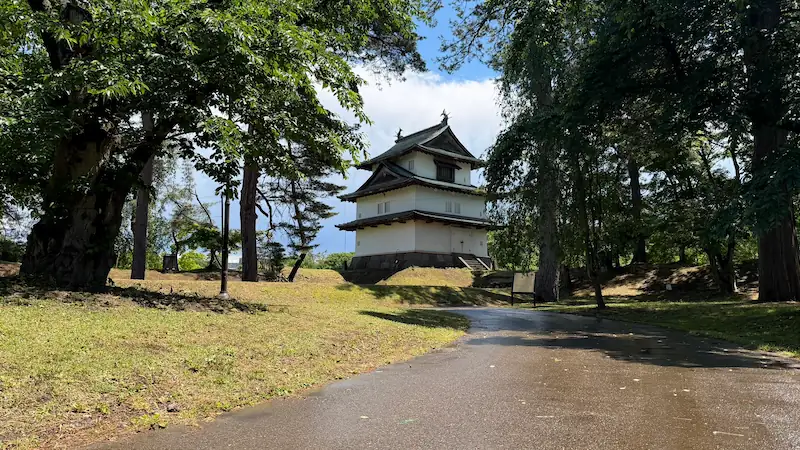
Tap to enlarge
| Direction | Southeast (Tatsumi) |
|---|---|
| Built | c. 1611 (Keicho 16) — original construction |
| Repair record | Repaired in Kyoho 19 (1734) — documented on a ridge board found inside |
| Designation | Important Cultural Property |
| Status | Exterior viewable |
The 1734 repair record, combined with the 1699 repair of the Hitsujisaru Turret, shows that these buildings were regularly maintained throughout the Edo period — not simply left to stand on their own. This sustained care is a major reason they survive today.
Tatsumi Turret location (Google Map)
Ushitora Turret (Northeast) 🎥 360°
Northeast (Ushitora) / Considered the best-preserved of the three turrets
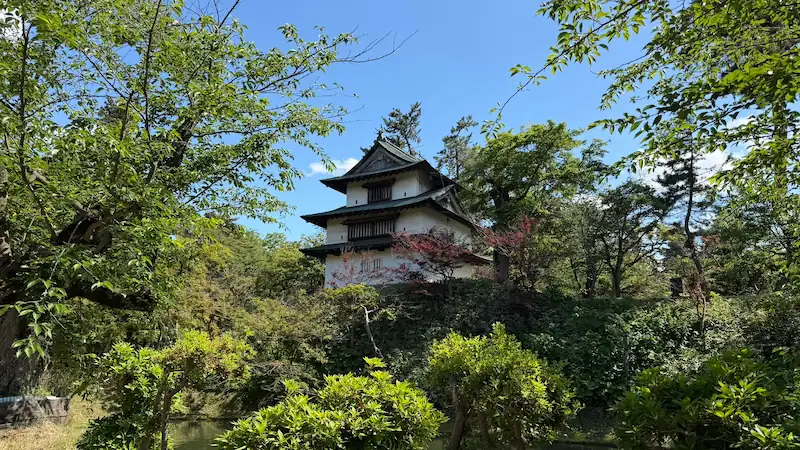
| Direction | Northeast (Ushitora) |
|---|---|
| Built | c. 1611 (Keicho 16) — original construction |
| Repair record | No major repair records documented — considered the best-preserved of the three turrets |
| Designation | Important Cultural Property |
| Status | Exterior viewable |
In traditional Japanese architecture and castle planning, the northeast direction was called kimon — the "demon gate" — and was considered vulnerable to malevolent forces. Castles often placed special emphasis on fortifying this corner. The placement of the Ushitora Turret (Ushitora = northeast in the old zodiac compass) at precisely this corner reflects this spatial philosophy.
Ushitora Turret location (Google Map)
5 Original Gates
Hirosaki Castle has 5 surviving original gates, all Important Cultural Properties. As of May 2026, two gates — Higashiuchimon and Kamenokomon — are undergoing preservation repair and are wrapped in scaffolding. Otemon, Minamiuchimon, and Higashimon are fully viewable.
Otemon Gate (Main South Gate) 🎥 360°
South face of Sannomaru — main entrance to Hirosaki Park / Open and freely passable
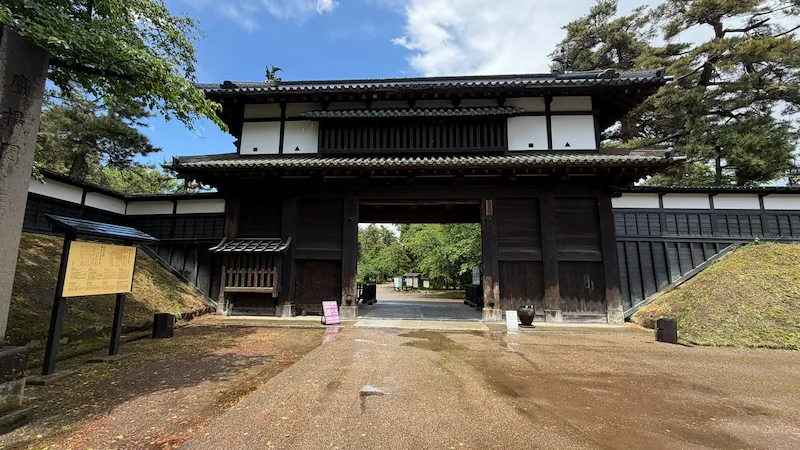
| Location | South face of Sannomaru — main entrance to Hirosaki Park |
|---|---|
| Built | c. 1611 (Keicho 16) — original construction |
| Repair record | Preservation repair carried out in fiscal years 2021–2022 |
| Designation | Important Cultural Property |
| Status | Open and freely passable |
Otemon served as the official main entrance through which the domain lord and distinguished visitors would pass. In castle architecture, the main gate (otemon, 大手門) was designed not just for access but to project authority — its scale, positioning, and the space before it were carefully planned to impress and control visitors. The Information Center just inside is a recommended first stop.
Otemon Gate location (Google Map)
Minamiuchimon Gate (South Inner Gate) 🎥 360°
South face, inner side of Nijomaru / Open and viewable
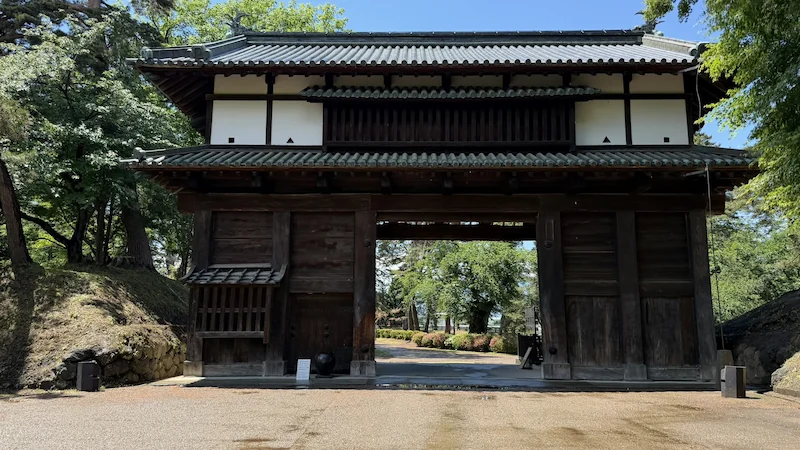
| Location | South face, inner side of Nijomaru |
|---|---|
| Built | c. 1611 (Keicho 16) — original construction |
| Repair record | Subject to preservation repair in the Reiwa period |
| Designation | Important Cultural Property |
| Status | Open and viewable |
Minamiuchimon was part of a masugata — a square enclosure between two gates that forced attackers to stop, turn, and expose themselves to fire from above. This design, common in major Japanese castles, meant that even if an enemy broke through the outer gate, they would be trapped in the enclosure before reaching the inner gate. Hirosaki preserves several examples of this defensive logic.
Minamiuchimon Gate location (Google Map)
Higashiuchimon Gate (East Inner Gate / Nijomaru) 🎥 360°
East face, inner side of Nijomaru / Preservation repair in progress — passable but photographing difficult
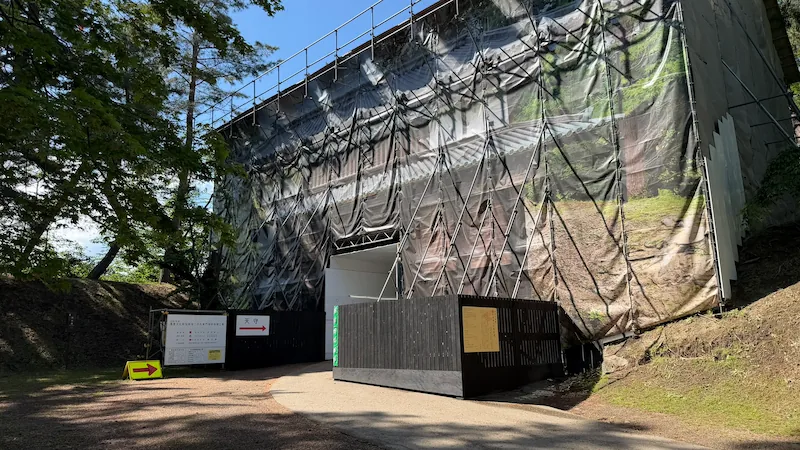
| Location | East face, inner side of Nijomaru |
|---|---|
| Built | c. 1611 (Keicho 16) — original construction |
| Repair record | Preservation repair: Sep 12, 2025 – approx. Mar 5, 2027 |
| Designation | Important Cultural Property |
| Status | Preservation repair in progress — passable but photographing difficult |
"Higashiuchimon" (East Inner Gate, Nijomaru) and "Higashimon" (East Gate, Sannomaru) are two separate gates. The current preservation repair applies to Higashiuchimon — not Higashimon. Higashimon is viewable normally.
Higashiuchimon Gate location (Google Map)
Higashimon Gate (East Gate, Sannomaru) 🎥 360°
East face of Sannomaru / Exterior viewable
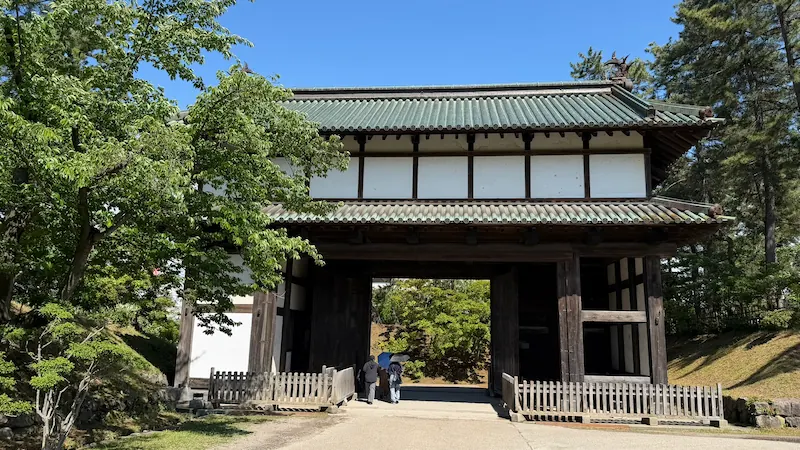
| Location | East face of Sannomaru |
|---|---|
| Built | c. 1611 (Keicho 16) — original construction |
| Repair record | Designated Important Cultural Property in 1953 (additional designation). Current preservation repair applies to Higashiuchimon and Kamenokomon — not this gate. |
| Designation | Important Cultural Property |
| Status | Exterior viewable |
Higashimon (Sannomaru East Gate) and Higashiuchimon (Nijomaru East Inner Gate) have similar names in Japanese. The current preservation repair is for Higashiuchimon, not Higashimon. Higashimon is fully viewable.
Higashimon Gate location (Google Map)
Kamenokomon Gate / Kitamon (North Gate) 🎥 360°
North face of Kitanokaku (North Enclosure) / Preservation repair in progress — passable but photographing difficult
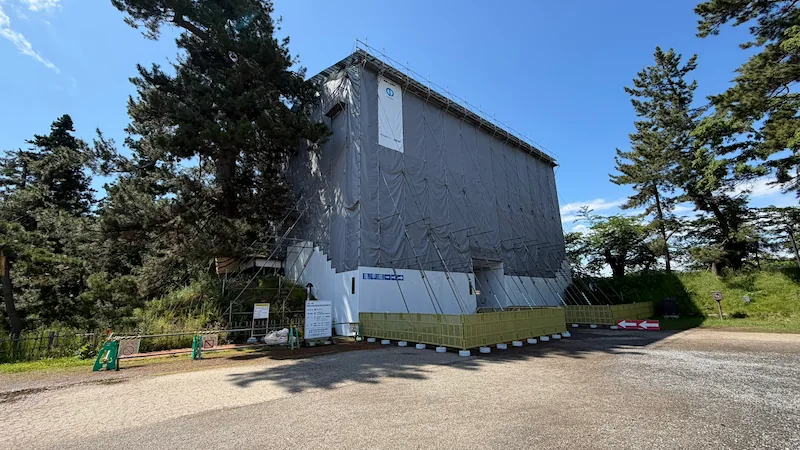
| Location | North face of Kitanokaku (North Enclosure) |
|---|---|
| Built | c. 1611 (Keicho 16) — original construction |
| Repair record | Preservation repair: Sep 12, 2025 – approx. Mar 5, 2027 |
| Designation | Important Cultural Property |
| Status | Preservation repair in progress — passable but photographing difficult |
According to local tradition, Kamenokomon was used as a secret rear exit — a gate through which the lord could quietly leave the castle unnoticed. In castle planning, the north gate (karamete) typically served as the rear entrance, used for supply routes and retreat paths rather than formal arrivals. Whether or not the legend is accurate, the gate's position and function align with this tradition.
Kamenokomon Gate location (Google Map)
The bridge just north of this gate is covered in the Grounds Guide: Kamenoko-bashi Bridge.
Yoriki Guardhouse
The Yoriki Guardhouse is not one of the 9 Important Cultural Property buildings, but it is a rare surviving example of an Edo-period guardhouse structure within a Japanese castle complex. It stands independently — not attached to any gate — in the east side of the Nijomaru.
Yoriki Guardhouse (Nijomaru East Gate Yoriki Bansho) 🎥 360°
The only surviving yoriki guardhouse at Hirosaki Castle / Once located at 12 positions throughout the castle
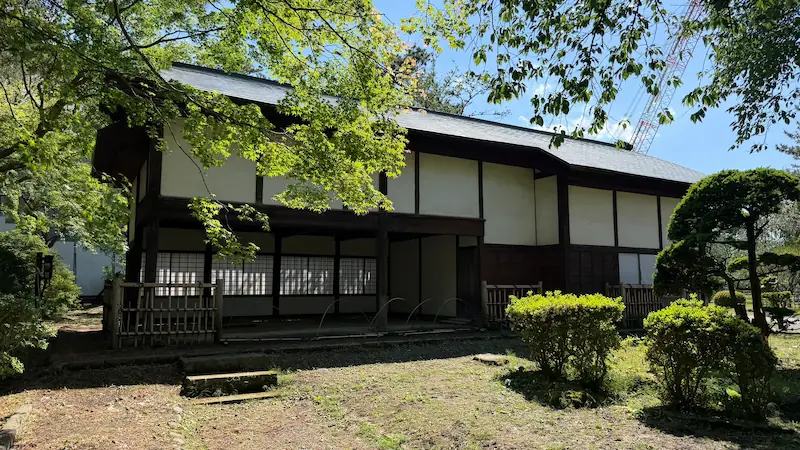
A yoriki was a samurai who assisted higher-ranking retainers — a role roughly equivalent to a deputy constable. Their guardhouses (bansho) were positioned at key points throughout the castle grounds, not adjacent to specific gates. During the domain period, 12 such guardhouses stood within Hirosaki Castle. This is the only one that survives.
| Type | Castle security facility (guardhouse) |
|---|---|
| Location | East side of Nijomaru (current position is post-relocation) |
| Built | Estimated: early Edo-period materials, modified mid-Edo period |
| Relocation record | Relocated c. 1915; then again 1979–1982 under Agency for Cultural Affairs guidance |
| Designation | Not included in the 9 Important Cultural Property buildings — reference building |
| Status | Viewable |
The timber framing of this building closely resembles that of the Sannomaru East Gate (Higashimon), suggesting it was built using early Edo-period materials and later modified in the mid-Edo period. After the domain was abolished, it was not demolished — and around 1915 it was relocated for the first time. From 1979, over a period of three years and under the guidance of the Agency for Cultural Affairs, it was carefully restored and moved to its current location. The fact that a small guardhouse was preserved across two relocations and over 400 years speaks to the exceptional care taken at Hirosaki Castle.
Yoriki Guardhouse location (Google Map)
Based on the author's May 2026 visit. This is a personal ranking, not an official recommendation from Hirosaki City or Hirosaki Park.
One of Japan's 12 surviving original keeps. The interior is closed, but you can view the exterior at close range.
Three original corner turrets in one castle is rare in Japan, and all three exteriors are viewable. If you only have time for one, choose Ushitora: it has no major repair records and is considered the best-preserved.
Original gates from c. 1611, all viewable in May 2026. Otemon is the main entrance to Hirosaki Park.
Under preservation repair until approx. March 5, 2027. You can walk through, but scaffolding and sheeting cover the whole structure. Worth a proper look once the repair is finished.
FAQ
Nine buildings are designated Important Cultural Properties: the keep, 3 corner turrets, and 5 gates. All were built in the Edo period.
No. The interior has been closed since November 24, 2025 for preservation and structural reinforcement work, but the exterior can be viewed at close range. News reports in August 2026 said the keep is scheduled to reopen to the public in fiscal 2033.
Hirosaki City scheduled the move back onto the original stone base for July to mid-November 2026. The keep was relocated approximately 77.62m in 2015 so the stone walls beneath it could be repaired.
Yes. Higashiuchimon and Kamenokomon are under preservation repair from September 12, 2025 to approximately March 5, 2027, and both can be passed through. Scaffolding and sheeting cover the structures, so photography is difficult.
No. Higashimon is the Sannomaru East Gate and Higashiuchimon is the Nijomaru East Inner Gate. The current repair applies to Higashiuchimon, and Higashimon is viewable normally.
No. It is not included in the 9 Important Cultural Property buildings. It is the only survivor of the 12 guardhouses that once stood within Hirosaki Castle.
Related Pages
☕ Support Following the Shogun
This site is produced through field research across Japan.
If this guide helped you plan your visit, your support keeps the research going.

Scan to support via QR code


comment