


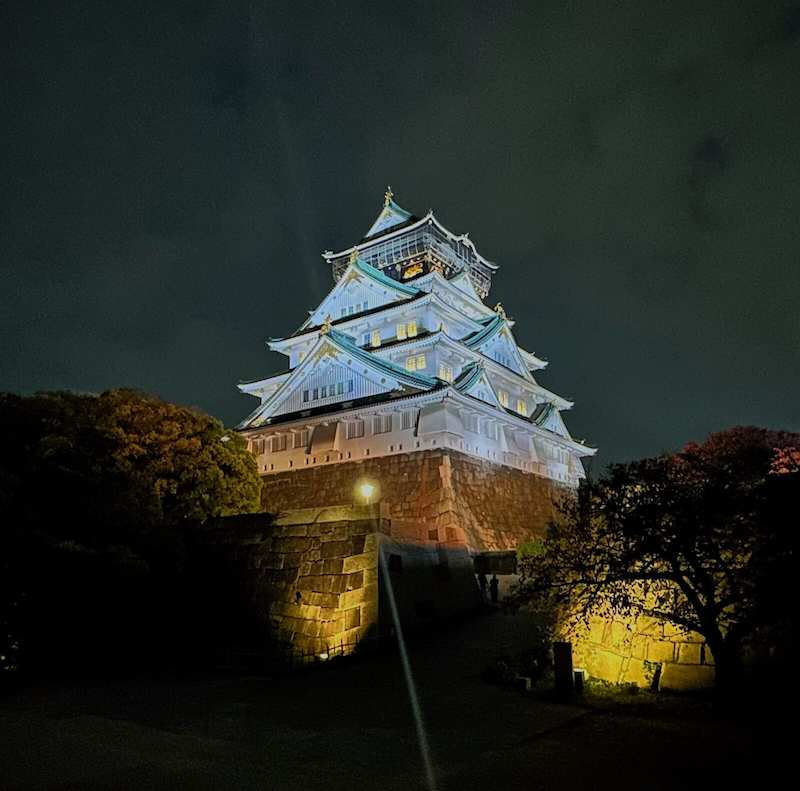
Sakuramon Gate, the Takoishi Stone & the Main Tower
Walking Osaka Castle’s Honmaru Area
The Honmaru — Osaka Castle’s central and most heavily defended enclosure — holds some of its most dramatic history. This guide covers 9 spots, from Sakuramon Gate and its 108-ton Takoishi stone, to Toyotomi-era stone walls buried underground, the Tokugawa Shogunate’s Kinzo treasury, and the Main Tower itself.
The Honmaru is the heart of Osaka Castle and the site of its most dramatic historical treasures. Sakuramon Gate guards the entrance to the Honmaru alongside the 108-ton Takoishi stone; the Osaka Castle Toyotomi Stone Wall Museum reveals a stone wall from the Toyotomi era that lay buried beneath the Tokugawa-era castle for centuries; Kinzo served as the Tokugawa Shogunate’s treasury; and the Main Tower is an 8-floor museum offering sweeping views across the city. Three Important Cultural Properties stand here, alongside one of Japan’s most compelling archaeological discoveries, viewable up close.
Honmaru Area: Key Facts
| Location | 1-1 Osakajo, Chuo-ku, Osaka |
|---|---|
| Main Tower Admission | Adults ¥1,200 / University & high school students ¥600 (ID required) / Junior high school students and younger free (proof required) |
| Main Tower Hours | 9:00–18:00 (last entry 17:30) · Closed Dec 28–Jan 1 |
| Important Cultural Properties | Sakuramon Gate, Kinzo, Kinmeisui Well House |
| Main Highlights | Takoishi (108 tons), Osaka Castle Toyotomi Stone Wall Museum (underground Toyotomi-era stone walls), the Main Tower |
| Suggested Time | Outdoor area only: about 1 hour / Including the Main Tower: about 2–2.5 hours |
The 9 Spots
1. Sakuramon Gate
Gateway to the Honmaru — the 108-ton Takoishi and the Dragon & Tiger Stones
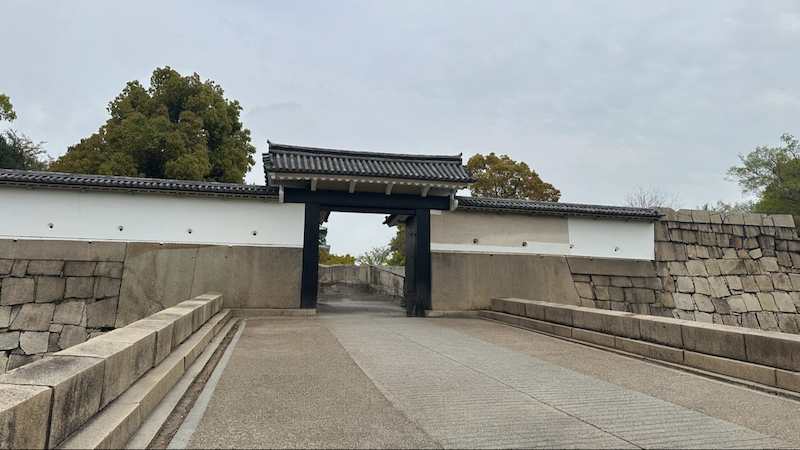
Sakuramon Gate is the grand southern entrance to Osaka Castle’s inner bailey, the Honmaru. It burned down during the Boshin War — the 1868–1869 conflict that ended the Tokugawa shogunate — and was rebuilt in 1887 in Tokugawa-period style. Inside its masugata (a rectangular defensive courtyard enclosed by two gates, designed to trap attackers in a confined kill zone) stands the Takoishi (Octopus Stone), the largest stone in Osaka Castle at roughly 108 tons, about 5.5 meters high and 11.7 meters wide, with a surface area of around 59 square meters. It was transported from Bizen Province (present-day eastern Okayama Prefecture) in 1624. Flanking the gate’s inner entrance stand the Ryū-ishi (Dragon Stone) and Tora-ishi (Tiger Stone), traditionally said to reveal their namesake shapes when wet with rain.
| Year Built | Originally built around 1626; rebuilt in 1887 |
|---|---|
| Cultural Property | Important Cultural Property |
| Key Feature | Takoishi (108 tons, approx. 5.5m high × 11.7m wide, ~59㎡) — the largest stone in Osaka Castle |
| Admission | Free |
| Suggested Time | About 10–20 min |
- The Takoishi (108 tons): Its octopus-like surface pattern comes from natural weathering, not carving.
- Furisode-ishi (~54㎡): The third-largest stone in the castle, also inside the masugata.
- Dragon Stone & Tiger Stone: Placed flanking the gate; traditionally said to reveal their shapes when wet with rain.
- Kokuinseki (carved marks): Marks on the surrounding walls are believed to be related to the daimyo lords or stonemason groups who supplied the stone.
- The current gate: Rebuilt in 1887 and repaired again in 1969.
2. Ginmeisui Well Curb
A well curb from the Honmaru Palace, relocated during the 1931 Main Tower reconstruction
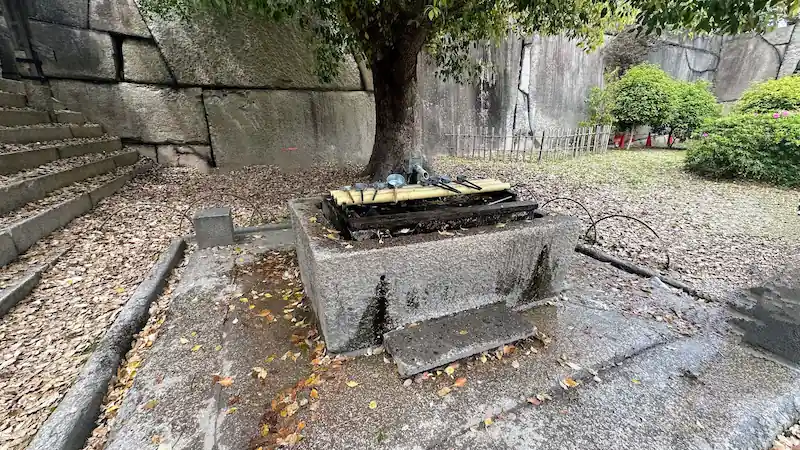
The Ginmeisui (“silver radiance water”) well curb originally stood near the northeast corner of the Honmaru palace kitchen and is thought to have supplied drinking water for the officials guarding the inner bailey. It was relocated to its present position in 1931, during the Main Tower’s reconstruction. The surviving stone curb and the granite paving around it are fine examples of Tokugawa-period stonemasonry. Don’t confuse this with the similarly named Kinmeisui (“golden radiance water”) well inside the Main Tower’s paid area (Spot 8) — the two wells have similar-sounding names but are in different locations and served different roles.
| Period | Tokugawa period |
|---|---|
| Relocated | 1931, during the Main Tower reconstruction |
| Current Status | Well curb relocated from its original site |
| Admission | Free |
| Suggested Time | About 5–10 min |
- Original location: Near the northeast corner of the Honmaru palace kitchen.
- Purpose: Thought to have supplied drinking water for officials guarding the Honmaru.
- Relocation: Moved to its current site in 1931 when the Main Tower was rebuilt.
3. Giant Stones of the Sakuramon Masugata
Takoishi (108 tons), Furisode-ishi, Dragon Stone & Tiger Stone — engineering feats of 1624
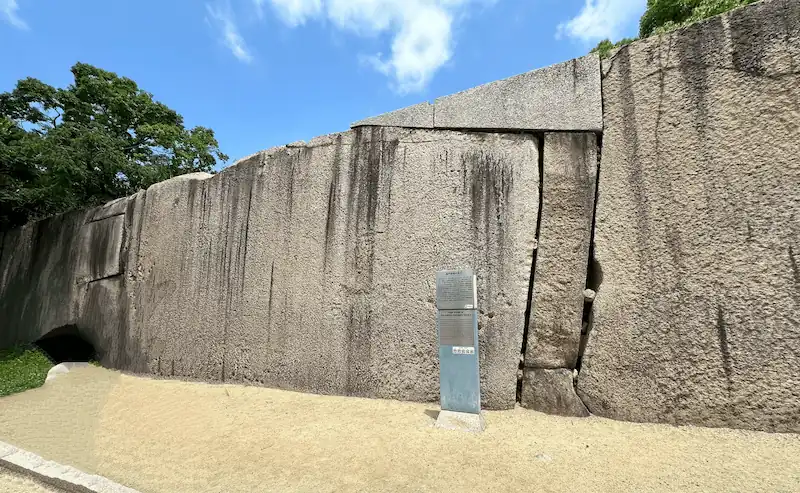
Inside the Sakuramon masugata stands Osaka Castle’s most famous collection of giant stones. The Takoishi (approx. 108 tons, about 5.5m high × 11.7m wide, ~59㎡) is the largest stone in the castle; the Furisode-ishi (~54㎡) is the third-largest. Both were set in place in 1624 (Kan’ei 1) under the direction of Ikeda Tadakatsu, the feudal lord responsible for this section of stonework. The Ryū-ishi (Dragon Stone) and Tora-ishi (Tiger Stone) flank the gate and are traditionally said to reveal their shapes on the wet stone surface after rain. These giant stones reinforced the castle’s defenses while also proclaiming Tokugawa power to everyone who passed through.
| Takoishi | ~108 tons, approx. 5.5m high × 11.7m wide, ~59㎡ — the largest stone in Osaka Castle |
|---|---|
| Furisode-ishi | ~54㎡ — the third-largest stone |
| Dragon & Tiger Stones | Positioned flanking the gate — traditionally said to reveal their shapes when wet |
| Year Installed | 1624 (Kan’ei 1), under Ikeda Tadakatsu |
| Suggested Time | About 15–30 min |
- The octopus pattern: A result of the stone’s natural mineral weathering, not carving.
- Transporting 108 tons: Moving the stone from Bizen Province was a major undertaking overseen by Ikeda Tadakatsu.
- Best viewing tip: Visit just after rain, when the Dragon and Tiger Stone patterns are easiest to see.
4. The Camphor Tree
Popularly linked to Hideyoshi — actually planted in 1898 by an Imperial Army division commander
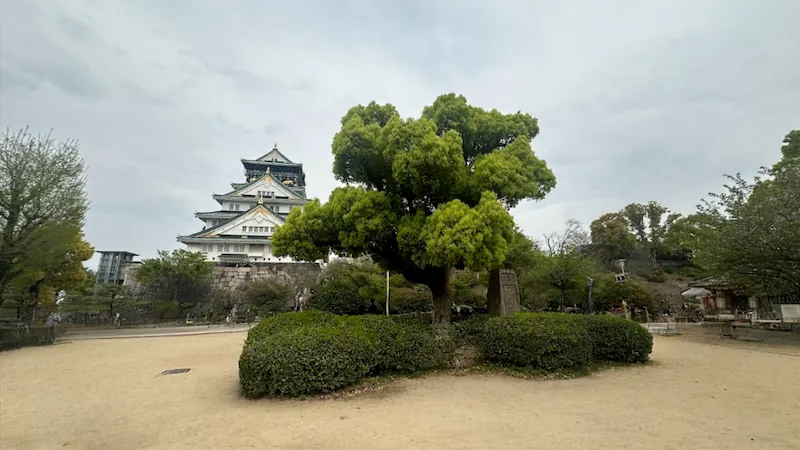
This large camphor tree is popularly known as the “Camphor Tree Planted by Toyotomi Hideyoshi” — the 16th-century warlord who built the original Osaka Castle. In reality, the tree standing here today was planted in March 1898 by Ogawa Mataji, then commander of the Imperial Japanese Army’s 4th Division. The site is a good example of how legend and modern commemorative memory overlap at Osaka Castle.
| Actual Planting | March 1898 (Meiji 31) |
|---|---|
| Planted By | Ogawa Mataji, Commander of the Imperial Army’s 4th Division |
| Popular Belief | Locally associated with Toyotomi Hideyoshi |
| Admission | Free |
| Suggested Time | About 10–15 min |
- Legend and fact: A tree planted in the Meiji era later became associated with a Sengoku-period warlord.
- The memorial marker: A nearby inscription is thought to have helped popularize the Hideyoshi association.
- A natural photo frame: The broad canopy makes an attractive frame for Main Tower photographs.
5. Kinzo (Gold Storehouse)
Tokugawa Shogunate treasury — converted to its present form in 1751, repaired in 1837
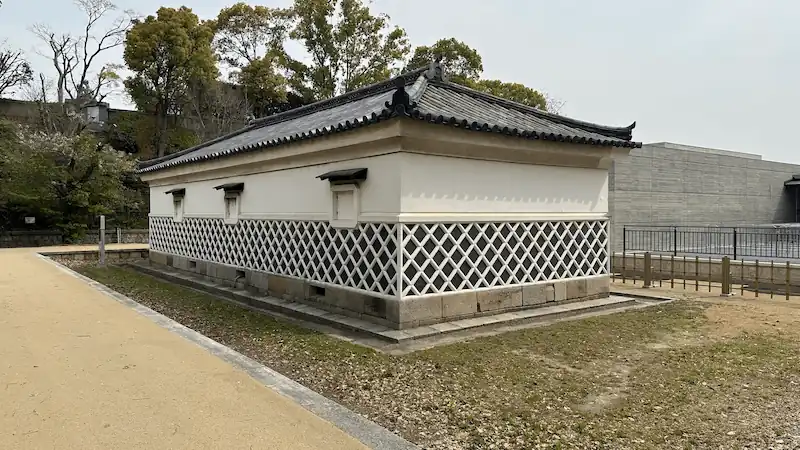
The Kinzo (Gold Storehouse) was originally a two-story building. In 1751 (Hōreki 1), the Tokugawa Shogunate converted it into its present single-story form to store gold and silver coins. A major repair followed in 1837 (Tenpō 8). Its distinctive namako-kabe (sea cucumber wall) plasterwork — alternating black tiles and white plaster seams — is both visually elegant and fire-resistant. It is designated an Important Cultural Property.
| Year Built | Converted to single-story form in 1751 (Hōreki 1); major repair in 1837 (Tenpō 8) |
|---|---|
| Cultural Property | Important Cultural Property |
| Feature | Namako-kabe plasterwork |
| Admission | Free (exterior) |
| Suggested Time | About 10–20 min |
- Hōreki 1 (1751): The building, originally two stories, was rebuilt into its present single-story form.
- Tenpō 8 (1837): A major repair took place.
- Namako-kabe: The exterior combines decorative effect with fire resistance.
6. Osaka Castle Toyotomi Stone Wall Museum
The buried castle revealed — Toyotomi-era stone walls opened to the public in 2025
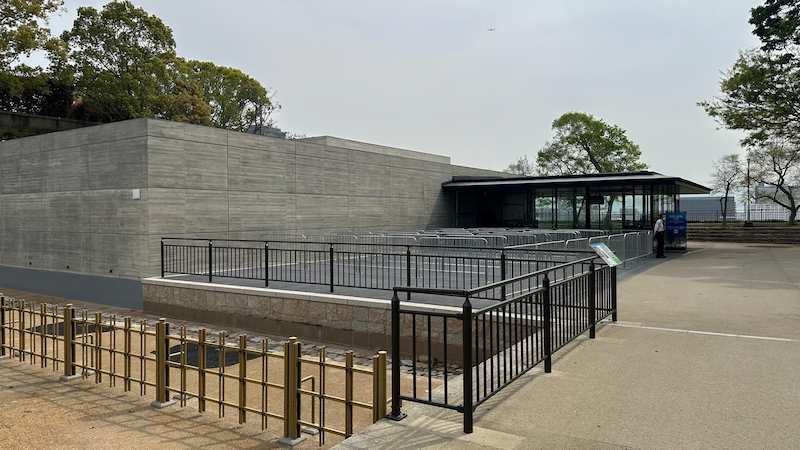
The Osaka Castle Toyotomi Stone Wall Museum displays a stone wall from Toyotomi Hideyoshi’s Osaka Castle. The buried wall was first discovered during a 1984 excavation, and the museum opened to the public in 2025. After the Summer Siege of Osaka in 1615, the Tokugawa Shogunate buried the Toyotomi-era castle under a massive layer of fill and rebuilt Osaka Castle on top of it. Inside, visitors can view the stone wall of the tsumenomaru (the innermost enclosure of the Toyotomi Honmaru) underground, through glass, with multilingual explanations. Admission is included with the Main Tower ticket, and there is no additional fee.
| Admission | Included with Main Tower ticket (Adults ¥1,200 / University & High School Students ¥600) — no separate fee |
|---|---|
| Hours | 9:00–18:00 (last entry 17:30) · Closed Dec 28–Jan 1 |
| Note | May close without notice depending on stone wall conditions · No restroom inside |
| Official Site | osakacastle.net |
| Suggested Time | About 10–30 min |
- The hidden castle: Above ground stands the Tokugawa-era Osaka Castle; underground lies a stone wall from the Toyotomi period.
- Tsumenomaru: The exposed wall belonged to the innermost, most private residential enclosure of the Toyotomi Honmaru.
- Public opening: The current museum opened in 2025.
- Viewing conditions: Public viewing may be suspended without notice for safety reasons.
7. Zannen-ishi (Regret Stones)
Giant stones that never made it into the walls — a testament to the scale of the Tokugawa reconstruction
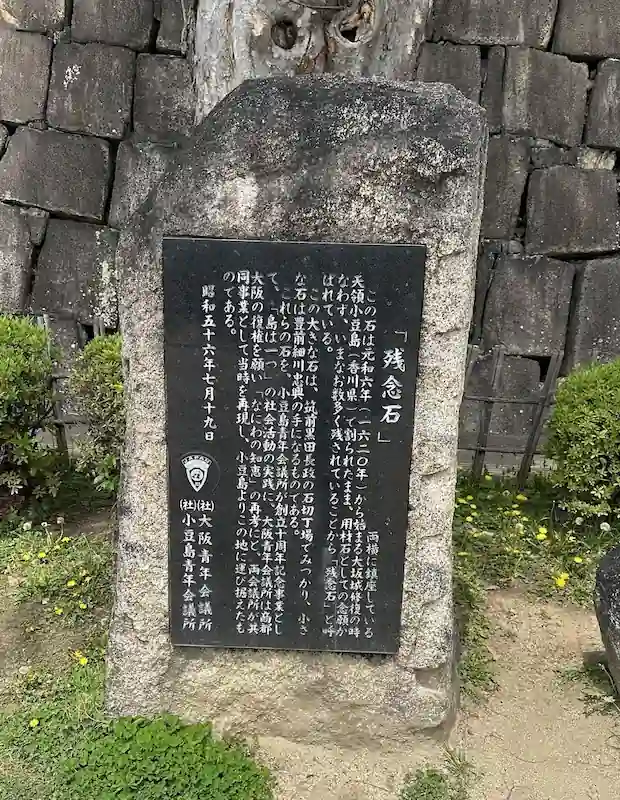
The Zannen-ishi (Regret Stones) are massive stones that were quarried and transported for the Tokugawa reconstruction of Osaka Castle but ultimately never used. Around 80 similar stones are displayed nearby at the Kokuinseki Hiroba (Inscribed Stones Plaza). Some of the displayed stones bear kokuinseki (carved marks) believed to be related to the daimyo lords or stonemason groups who quarried and supplied them.
| When Quarried | Early 17th century (around the 1620s) |
|---|---|
| Display Location | Kokuinseki Hiroba (Inscribed Stones Plaza), near the Main Tower |
| Admission | Free |
| Suggested Time | About 20–60 min (for a thorough visit) |
- Kokuinseki Hiroba: More than 80 stones are gathered here.
- 1983 development: The display area was created as part of Osaka Castle’s 400th-anniversary project.
- Seto Inland Sea origins: Much of Osaka Castle’s stone was shipped in by boat from islands in the Seto Inland Sea.
8. Kinmeisui Well House
An Important Cultural Property built in 1626, covering a well once called “golden water” in the Tokugawa period
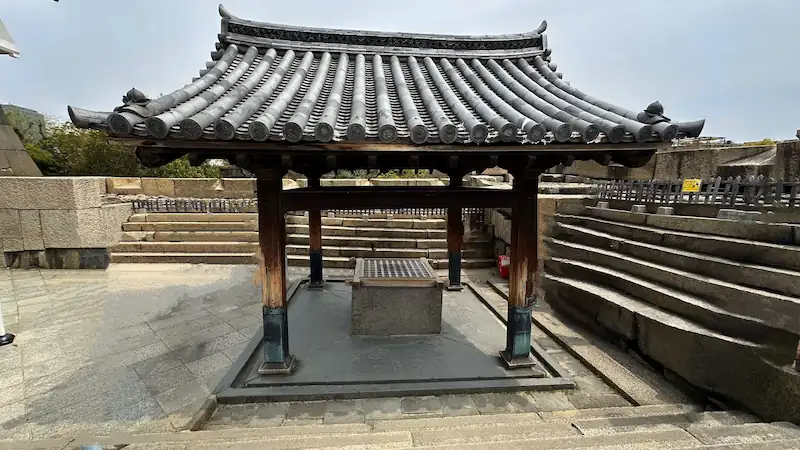
The Kinmeisui Well House stands atop the komaru-dai (small-keep platform) and protected a vital emergency water source in case of a siege. During the Tokugawa period the well was known as Ōgon-sui (“golden water”), a name traditionally said to have later become fixed as Kinmeisui (“golden radiance water”). Dismantling repairs in 1969 established that the current structure was built in 1626. The well’s depth is recorded differently across sources — one calculation, based on the historical document Ōsaka Chikujō Chōba Wari-zu (a construction-assignment map from the castle’s rebuilding), puts it at approximately 37.72 meters. Given its elevated position on the platform, this represents a remarkable feat of engineering. The Kinmeisui Well House lies along the route up to the small-keep platform after entering the Main Tower — viewing it up close requires a Main Tower admission ticket.
| Year Built | 1626 (Kan’ei 3) |
|---|---|
| Cultural Property | Important Cultural Property |
| Depth | Recorded differently across sources (approx. 37.72m per one calculation based on the Ōsaka Chikujō Chōba Wari-zu) |
| Admission | Included with Main Tower ticket (viewing requires entry to the paid Main Tower area) |
| Suggested Time | About 10–20 min |
- 1626 construction: The current well house dates to the Tokugawa-era rebuilding.
- 1969 repair: Dismantling repairs clarified the building’s construction date.
- A protected water source: Its position on the small-keep platform underscores its importance in siege planning.
9. Osaka Castle Main Tower
Osaka’s symbol — an 8-floor museum rebuilt by public donation in 1931
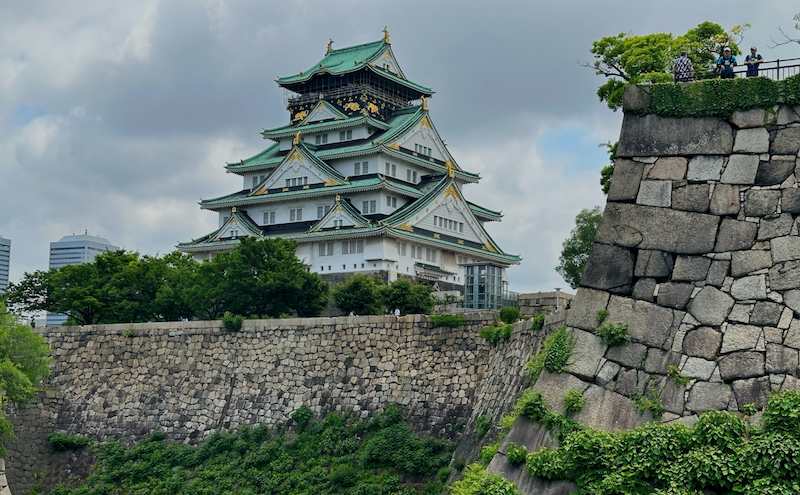
The Osaka Castle Main Tower is the iconic symbol of Osaka. It is the third iteration of the castle’s keep, rebuilt in 1931 with donations from Osaka’s citizens. It now operates as an 8-floor museum covering the life of Toyotomi Hideyoshi and the history of Osaka Castle, and its exterior is modeled on the opulent main tower of the Toyotomi era. The building was registered as a national Tangible Cultural Property in 1997 and further designated an Osaka City Tangible Cultural Property in 2025.
| Admission | Adults ¥1,200 / University & high school students ¥600 (ID required) / Junior high school students and younger free (proof required) |
|---|---|
| Hours | 9:00–18:00 (last entry 17:30) · Closed Dec 28–Jan 1 |
| Floors | 8 floors of exhibit and observation space |
| Official Site | osakacastle.net |
| Suggested Time | Quick visit: about 30 min / Full visit: about 60–75 min |
- Rebuilt by citizens: The 1931 reconstruction was funded by donations from Osaka residents.
- Exterior design: Modeled on the opulent main tower of the Toyotomi era.
- 1997 registration: Listed as a national Tangible Cultural Property.
- 2025 designation: Also designated an Osaka City Tangible Cultural Property.
- Museum function: Has operated as the Osaka Castle Museum since its reconstruction.
Osaka Castle: Full Area Map
Frequently Asked Questions (Honmaru Area)
The Takoishi (Octopus Stone) is the largest stone in Osaka Castle, weighing approximately 108 tons, about 5.5 meters high and 11.7 meters wide, with a surface area of around 59 square meters. It stands inside the Sakuramon masugata courtyard and was transported from Bizen Province in 1624. Its name comes from octopus-like patterns that emerged naturally through weathering. The Dragon Stone and Tiger Stone flank the gate’s entrance and are traditionally said to reveal their shapes when wet with rain.
The Osaka Castle Toyotomi Stone Wall Museum displays a stone wall from Toyotomi Hideyoshi’s Osaka Castle. The buried wall was first discovered during a 1984 excavation, and the museum opened to the public in 2025. Admission is included with the Osaka Castle Main Tower ticket.
Main Tower admission is ¥1,200 for adults and ¥600 for university and high school students (ID required). Junior high school students and younger are free (proof required). This also includes entry to the Osaka Castle Toyotomi Stone Wall Museum. Hours are 9:00–18:00 (last entry 17:30), and the Main Tower is closed from December 28 to January 1.
The Kinzo was originally a two-story building. In 1751 (Hōreki 1), the Tokugawa Shogunate converted it into its present single-story form, used to store gold and silver coins. A major repair followed in 1837 (Tenpō 8). It features distinctive namako-kabe (sea cucumber wall) plasterwork, with alternating black tiles and white plaster seams, and is designated an Important Cultural Property. The exterior can be viewed for free.
The Ryū-ishi (Dragon Stone) and Tora-ishi (Tiger Stone) are placed flanking the entrance to Sakuramon Gate. According to tradition, their namesake shapes become visible on the stone surface when wet with rain.
Most of the Honmaru area is free to visit. Sakuramon Gate, the Ginmeisui well curb, Kinzo (exterior), the Zannen-ishi, and the camphor tree are all free. The Main Tower museum, the Osaka Castle Toyotomi Stone Wall Museum (included with the Main Tower ticket), and the Kinmeisui Well House are within the Main Tower’s paid ticketed area.
Continue Exploring
Back to the Osaka Castle Index Page
Back to the Main Page

☕ Support This Site
Following the Shogun is built on original fieldwork and on-site research.
If you found this guide useful, your support helps keep it going.

You can also support via QR code


comment