


Toyotomi Hideyoshi: From Farmer to Ruler of Japan
Toyotomi Hideyoshi (1537–1598) was born into a peasant family and ended his life as the ruler of all Japan.
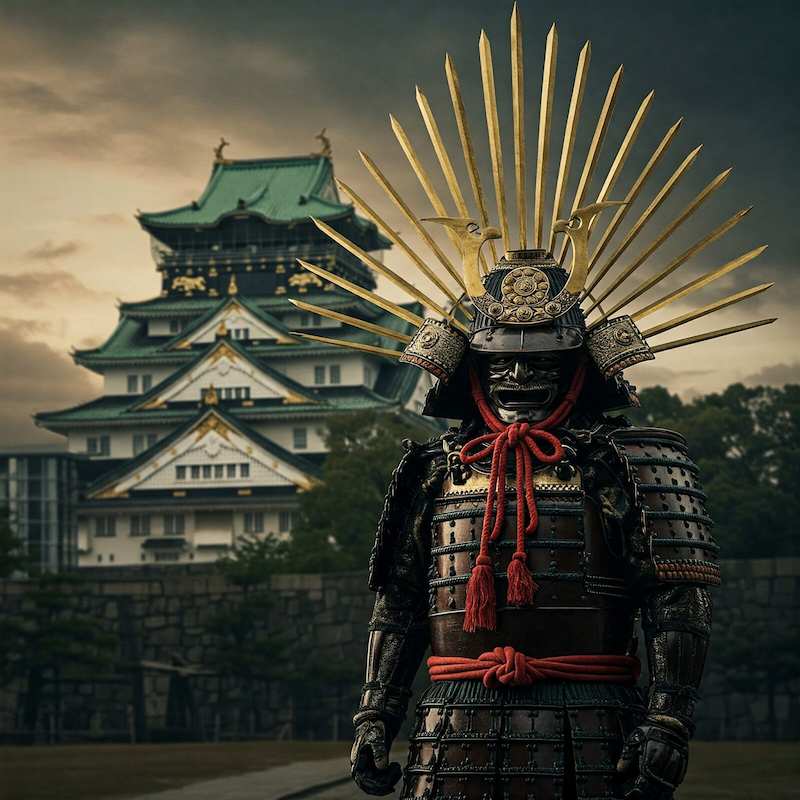
AI illustrationThe pictures on this page are imagined scenes inspired by the historical record. They are not documentary photographs or exact reconstructions.
Toyotomi Hideyoshi (1537–1598) was born into a peasant family and ended his life as the ruler of all Japan — the most extraordinary rise in the country’s history. He entered the service of the warlord Oda Nobunaga as a common foot soldier, earned a domain of his own through a run of military successes, and after Nobunaga was killed in 1582 took the country in hand himself, completing its unification in 1590. What follows is his life in order: the rise, the reforms that reshaped Japan, the war that undid him, and how the story connects to the places you can still visit today.
Early Life and Service Under Oda Nobunaga
Hideyoshi was born in 1537 in Owari Province — roughly the western half of today’s Aichi Prefecture, the area around modern Nagoya — into a farming household. This was the Sengoku period, when regional lords known as daimyo fought each other for territory and a man’s birth normally settled his station for life.
Despite those beginnings, his resourcefulness and easy way with people won him a place in the service of Oda Nobunaga. He started as an ashigaru, a common foot soldier. Within a few years he had made a name for himself as Kinoshita Tōkichirō, a retainer Nobunaga trusted with real responsibility.
He proved most valuable in the unglamorous work of supply and logistics, including the Battle of Anegawa (1570) against the allied Asai and Asakura clans and the Battle of Nagashino (1575). In 1577 he took Miki Castle in Harima Province, in what is now southwestern Hyogo Prefecture, in a long siege that showed he could carry a campaign on his own.
Nobunaga’s Death and the Unification of Japan

In 1582 Nobunaga was killed by one of his own generals, Akechi Mitsuhide, at a temple in Kyoto called Honnō-ji — the event known in Japan as the Honnō-ji Incident. Hideyoshi moved faster than any of Nobunaga’s other commanders. Within days he had defeated Mitsuhide at the Battle of Yamazaki, fought at the foot of Mount Tennōzan (天王山) between Kyoto and Osaka, and taken the lead in the succession.
The following year he removed his last serious rival inside the Oda camp, Shibata Katsuie, at the Battle of Shizugatake, north of Lake Biwa in present-day Shiga Prefecture. That victory made him Nobunaga’s successor in all but name.
In 1584 he clashed with Tokugawa Ieyasu at the Battle of Komaki and Nagakute, north of modern Nagoya. Rather than let the fighting drag on, he negotiated a settlement — diplomacy typical of him. In 1585 he was appointed Kampaku (関白), imperial regent and the highest civil office a subject could hold, which put the authority of the imperial court behind his campaigns. He then brought the remaining regional powers to heel one after another: the Shimazu in Kyushu, the Mōri in western Japan, and the Date in the northeast. In 1590 he destroyed the Hōjō clan at the Siege of Odawara, and the unification of Japan was complete.
The Taikō Land Survey and the Sword Hunt – Strengthening Domestic Rule

With the country unified, Hideyoshi turned to holding it together. The Taikō kenchi (太閣検地), or Taikō land survey, measured farmland and its productive capacity across the whole country. It fixed who held what and what they owed, and it hardened the line between warriors and farmers — which in turn made a return to the constant warfare of the Sengoku period far less likely.
The Sword Hunt edict (刀狠令) went further, banning commoners from owning weapons. It served two ends at once: it limited what a rebellious daimyo could raise from the countryside, and it made peasant uprisings much harder to mount. These domestic measures did as much as any battle to bring the Sengoku period to a close.
Taikō (太閣) is the title used by a retired kampaku. It is the name by which Hideyoshi is still most commonly known in Japan, and the one the FX series SHŌGUN borrows for the character modelled on him.
The Invasions of Korea and Hideyoshi’s Final Years

In 1592 Hideyoshi sent an army across to the Korean Peninsula, intending to march on and conquer Ming China. The two campaigns are known in Japan as the Bunroku and Keichō campaigns (文禂・慶長の役) and in English as the Imjin War. Fierce Korean resistance, the arrival of Ming reinforcements and supply problems back in Japan turned the war steadily against him. His own health was failing, and in 1598 he died with the continental campaign unfinished.
He left a young son, Hideyori, as his heir. Without Hideyoshi himself the Toyotomi regime lost its hold quickly. Tokugawa Ieyasu won the decisive Battle of Sekigahara in 1600, and in 1615, at the summer Siege of Osaka, the Toyotomi house was destroyed and the country passed to the Tokugawa.
Hideyoshi’s Legacy
Hideyoshi is remembered as the great self-made man of Japanese history. The journey from a farming household to ruler of the country was without parallel, and his gift for strategy and for winning people over still draws attention centuries later. Without his rule, the Sengoku wars might well have run on far longer.
Modern business leaders and strategists continue to draw lessons from his ability to manage people, wield power, and adapt to changing circumstances. He unified Japan and then, in the end, handed the stage to the Tokugawa — one of the most dramatic lives in Japanese history.
Toyotomi Hideyoshi and SHŌGUN
The FX series SHŌGUN features a character modelled after Toyotomi Hideyoshi, referred to only as the Taikō. In the series, the power vacuum following his death sets the stage for the struggle among the Five Elders (Go-Tairō).
The real life was more dramatic than the fiction. Rising from humble origins, Hideyoshi used intelligence, leadership and sheer audacity to change the course of Japanese history. For the castles, battlefields and temples connected to him that you can still visit, see the Toyotomi Hideyoshi travel guide.
Frequently Asked Questions
He was born in 1537 into a farming household in Owari Province, roughly the western half of today’s Aichi Prefecture around modern Nagoya. His resourcefulness and easy way with people won him a place in the service of Oda Nobunaga, and he rose from common foot soldier to trusted retainer within a few years.
In 1582, after Oda Nobunaga was killed by Akechi Mitsuhide at Honnō-ji in Kyoto, Hideyoshi defeated Mitsuhide within days at the Battle of Yamazaki and took the lead in the succession. The following year he beat Shibata Katsuie at the Battle of Shizugatake, which made him Nobunaga’s successor in all but name.
In 1590. After being appointed Kampaku (imperial regent) in 1585, he brought the Shimazu in Kyushu, the Mōri in western Japan and the Date in the northeast under his control, then destroyed the Hōjō clan at the Siege of Odawara in 1590, completing the unification.
The Taikō land survey measured farmland and its productive capacity across the whole country, fixing who held what and what they owed, and hardening the line between warriors and farmers. The Sword Hunt edict banned commoners from owning weapons, limiting what a rebellious daimyo could raise from the countryside and making peasant uprisings much harder.
In 1592 he sent an army to the Korean Peninsula intending to go on and conquer Ming China. Fierce Korean resistance, Ming reinforcements and supply problems back in Japan turned the war against him. His health failed, and he died in 1598 with the campaign unfinished.
He left a young son, Hideyori, as his heir, but the Toyotomi regime lost its hold quickly. Tokugawa Ieyasu won the decisive Battle of Sekigahara in 1600, and in 1615 the summer Siege of Osaka destroyed the Toyotomi house and the country passed to the Tokugawa.
Yes. The FX series features a character modelled after Toyotomi Hideyoshi, referred to only as the Taikō. In the series, the power vacuum following his death sets the stage for the struggle among the Five Elders (Go-Tairō).
From History to Screen: Meet Taiko

Return to the Toyotomi Hideyoshi Page
☕ Support This Site
Following the Shogun is built on original fieldwork and on-site research.
If you found this guide useful, your support helps keep it going.

You can also support via QR code

