


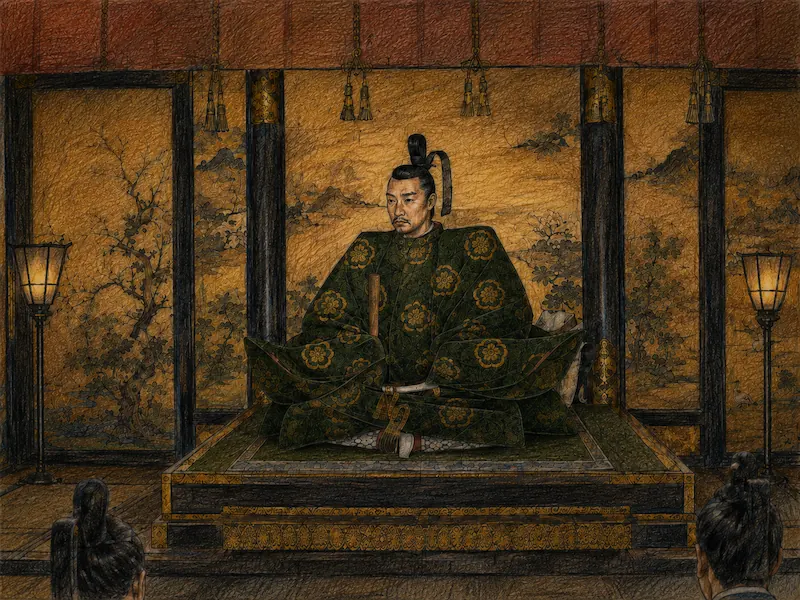
Oda Nobunaga: Full Biography — Life, Battles, and the Honnō-ji Incident
Oda Nobunaga (1534–1582) was the Sengoku-period warlord who began the unification of Japan and did not live to finish it. On 21 June 1582 he was trapped at Honnō-ji Temple in Kyoto by his own general Akechi Mitsuhide and took his own life. He was 47.
Oda Nobunaga (1534–1582) was the Sengoku-period warlord who began the unification of Japan and was killed before he could finish it. He took control of a divided clan in Owari Province, destroyed a far larger army at Okehazama in 1560, entered Kyoto in 1568, made firearms decisive at Nagashino in 1575, broke the armed Buddhist institutions that had operated as powers in their own right, and built Azuchi Castle on Lake Biwa — then, on 21 June 1582, was trapped at Honnō-ji Temple in Kyoto by his own general Akechi Mitsuhide and committed seppuku, aged 47. He is counted as the first of Japan's Three Unifiers; Toyotomi Hideyoshi and Tokugawa Ieyasu finished what he started.
This page is the full biography: early life, the battles that defined him, the reforms and construction that outlasted him, the Honnō-ji Incident, and what he left behind. If you arrived from the FX drama SHŌGUN, the character Kuroda Nobuhisa is modelled directly on Nobunaga; if you arrived from Assassin's Creed Shadows (2025), the game's late Sengoku setting is his world. Both connections are covered below. If you would rather visit the places — Azuchi, Gifu, Kiyosu, Okehazama, Honnō-ji — start with the Oda Nobunaga sites and travel guide.
| Born | 1534, Shōbata Castle, Owari Province (Aichi Prefecture) |
|---|---|
| Died | 21 June 1582, Honnō-ji Temple, Kyoto — the second day of the sixth month of Tenshō 10 in the calendar of the time |
| Age at death | 47 — often given as 49 in Japanese sources, which use a different age count |
| Cause of death | Seppuku during the Honnō-ji Incident, after Akechi Mitsuhide’s betrayal; body never recovered |
| Role | First of Japan's Three Unifiers |
| Motto / seal | Tenka Fubu — "Rule the Realm by Force" |
| Highest office held | Udaijin (Minister of the Right), from 1577 — he was never shogun |
| Words recorded in the Shinchō Kōki | Ze hi ni oyobazu (是非に及ばず) — "It cannot be helped" |
| Key battles | Okehazama (1560), Anegawa (1570), Nagashino (1575) |
| Greatest construction | Azuchi Castle (1576–1582), Shiga Prefecture |
| SHŌGUN counterpart | Kuroda Nobuhisa (fictional) |
| Successors | Toyotomi Hideyoshi → Tokugawa Ieyasu |
| Sites to visit | Oda Nobunaga sites and travel guide |
Oda Nobunaga Timeline: 1534–1582
Forty-eight years, compressed. The dates below are the fixed points of Nobunaga’s career; each one is explained in full further down the page.
| 1534 | Born at Shōbata Castle, Owari Province (modern Inazawa, Aichi Prefecture). Childhood name Kippōshi. |
|---|---|
| c. 1551 | His father Oda Nobuhide dies. Nobunaga inherits a divided clan and spends most of the decade fighting his own relatives for control of it. |
| 1560 | Battle of Okehazama. With a fraction of the numbers, he defeats and kills Imagawa Yoshimoto. The victory makes his name nationally. |
| 1567 | Takes Inabayama Castle, renames the town Gifu, and begins using the seal Tenka Fubu. |
| 1568 | Enters Kyoto and installs Ashikaga Yoshiaki as the 15th Ashikaga shogun. |
| 1570 | Battle of Anegawa against the Asai and Asakura, fought alongside Tokugawa Ieyasu. The ten-year siege of Ishiyama Hongan-ji begins. |
| 1571 | Attacks and burns the Enryaku-ji monastery complex on Mount Hiei, dealing a severe blow to its political and military power. |
| 1573 | Expels Yoshiaki from Kyoto. The Ashikaga shogunate, which had ruled since 1338, ends. |
| 1575 | Battle of Nagashino. The Oda–Tokugawa army defeats the Takeda from behind prepared fieldworks. Firearms matter; the familiar three-stage-volley-against-cavalry account is disputed. |
| 1576 | Begins building Azuchi Castle on Lake Biwa — widely described as Japan's first full-scale early-modern castle keep. |
| 1577 | Appointed Udaijin (Minister of the Right). It is the highest office he will ever hold; he never becomes shogun. |
| 1580 | Ishiyama Hongan-ji comes to terms and withdraws, ending the decade-long conflict over its Osaka stronghold. |
| 21 June 1582 | The Honnō-ji Incident. Akechi Mitsuhide surrounds the temple at dawn. Nobunaga commits seppuku, aged 47. His body is never found. |
| 2 July 1582 | Hashiba (Toyotomi) Hideyoshi returns from western Japan and destroys Mitsuhide at the Battle of Yamazaki, eleven days after the betrayal. |
Early Life and Rise to Power
Born in Owari: The Young Lord They Dismissed
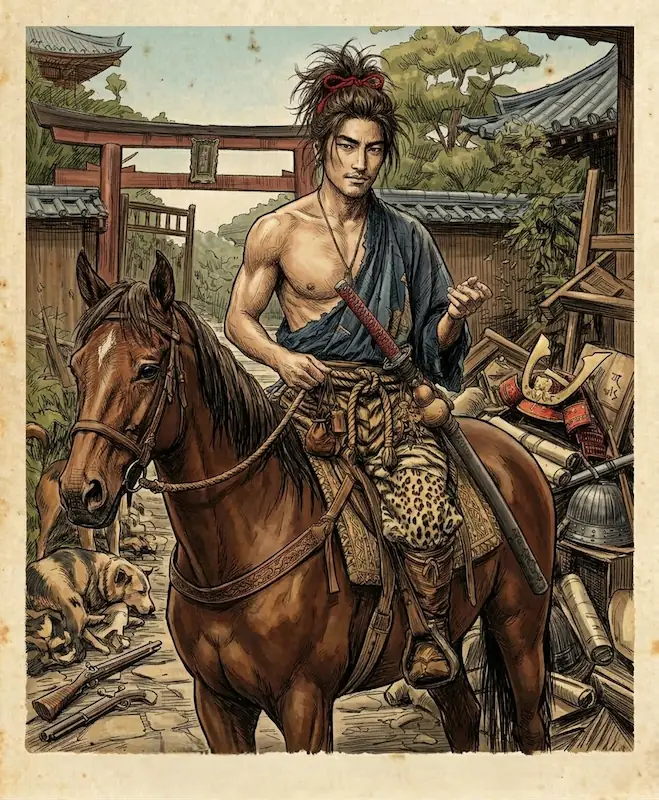
Oda Nobunaga was born in 1534 at Shōbata Castle in Owari Province — modern-day Inazawa City in Aichi Prefecture. His childhood name was Kippōshi. As a youth he gained a reputation for eccentric behavior and was widely dismissed as a fool (utsuke-mono). He ate while walking, dressed carelessly, and ignored the formalities expected of a lord's son. The assessment was wrong. Beneath the erratic exterior was a fiercely independent mind that refused to be constrained by inherited convention — the same quality that would later define his career.
After the death of his father, Oda Nobuhide, Nobunaga assumed leadership of the Oda clan and began asserting dominance over both internal rivals and external enemies within and beyond Owari. It was not smooth: family members challenged his succession, and the clan itself was fractured. By the late 1550s he had consolidated enough control to look outward.
The Battle of Okehazama (1560): The Victory That Made His Name
In 1560, the powerful warlord Imagawa Yoshimoto marched a large army into Owari — estimates of his strength range from 20,000 to 40,000 men. His ultimate objective is still debated: the traditional account has him advancing on Kyoto, while a good deal of modern scholarship reads the campaign as aimed at Owari itself. Either way, Nobunaga, with a fraction of that number, chose to attack rather than retreat or negotiate. He located Yoshimoto's camp at Okehazama and struck; contemporary accounts describe heavy rain around the time of the attack. It was swift, chaotic and decisive. Yoshimoto was killed.
The Battle of Okehazama did not make Nobunaga the most powerful warlord in Japan. What it did was transform his standing overnight: a provincial lord who had destroyed one of the great houses of eastern Japan. His reputation spread immediately. Within a few years, the alliances that would define the next two decades began to form around him — including his relationship with a young retainer named Toyotomi Hideyoshi, and a strategic agreement with Tokugawa Ieyasu that would hold until Nobunaga's death.
The Okehazama Battlefield in Aichi Prefecture can be visited today — see the Aichi sites guide for access details.
How Nobunaga Changed Japan
Tenka Fubu: Rule the Realm by Force
Oda Nobunaga adopted the seal Tenka Fubu (天下布武), meaning "Rule the Realm by Military Force," as both a personal motto and a political statement. He stamped it on official documents and equipment. In a period when regional warlords competed for local dominance, the phrase has often been read as declaring ambitions that reached beyond a single province. What tenka — "the realm" — meant to Nobunaga himself is genuinely contested: some historians take it as all of Japan, others as the central Kinai region and the political order centred on Kyoto. Either way, it was not a modest claim, and it sat uneasily with the shogunate, the court, and the religious institutions that had exercised quasi-governmental power for generations.
Firearms and the New Battlefield
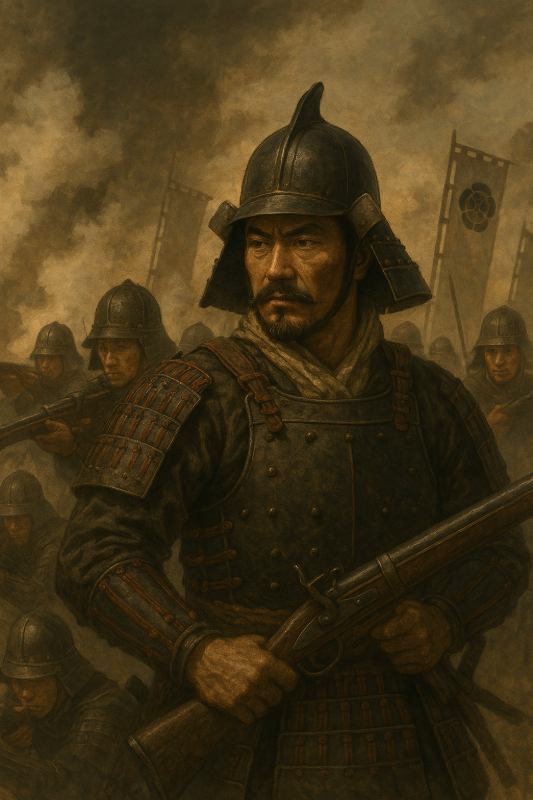
Portuguese traders introduced firearms to Japan around 1543. Within a generation, Nobunaga was making extensive use of them and integrating them into larger operations. He recruited specialist arquebusiers, managed supply lines for ammunition and weapons, and coordinated firearms with conventional troop movements in ways that made the combination decisive rather than supplementary.
The Battle of Nagashino in 1575 is the most cited example, and also the most mythologised. The familiar picture — three thousand guns, a rotating three-stage volley, a Takeda cavalry charge broken by massed fire — has been substantially revised by later scholarship, which questions the volley drill, the numbers, and how far the Takeda force can be described as a cavalry army at all. What is not in dispute is the outcome: the combined Oda–Tokugawa army, firing from behind prepared fieldworks, destroyed the Takeda as a first-rank power. Firearms mattered at Nagashino, but they mattered in combination with fortifications, terrain and troop numbers rather than on their own.
Nagashino is in eastern Aichi Prefecture; the sites covered on this site for that region are listed in the Aichi sites guide.
Dismantling the Buddhist Military Powers
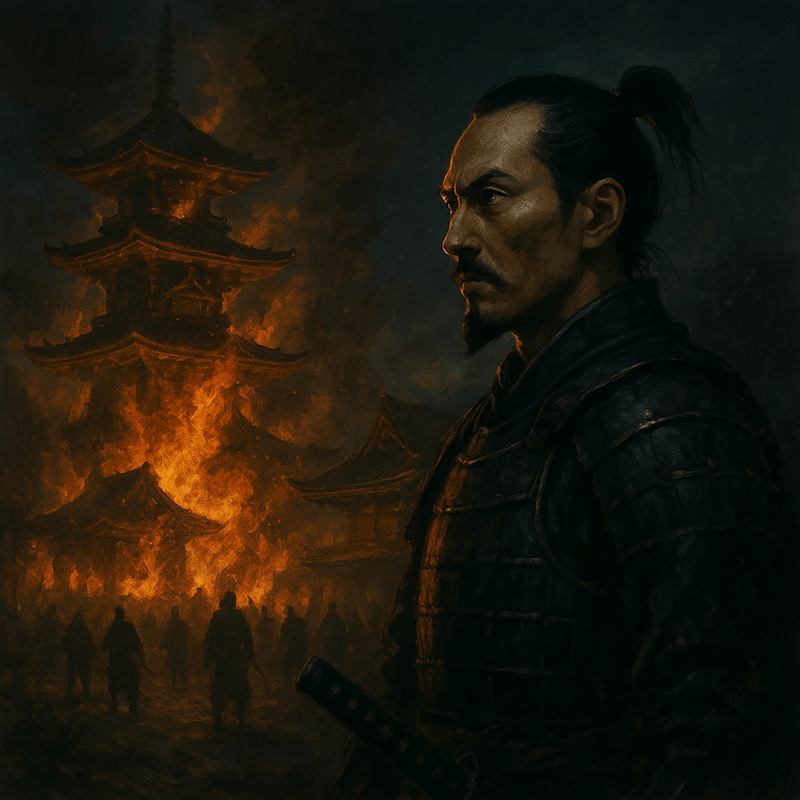
By the Sengoku period, several major Buddhist institutions had evolved from religious centers into political and military powers in their own right. The Tendai monastery complex on Mount Hiei — Enryaku-ji — maintained armed monks, held influence over the Imperial Court, and had allied itself with Nobunaga's enemies. In 1571, Nobunaga moved against it: his forces assaulted the mountain and burned the temple complex. Contemporary accounts describe many people killed, including noncombatants; the figures given vary widely between sources and have been debated by later historians. The action dealt a severe blow to Enryaku-ji's political and military position.
The conflict with organized Buddhism did not end there. The Ikkō-ikki, a militant Buddhist movement centered on Ishiyama Hongan-ji in what is now central Osaka, held out against Nobunaga for nearly a decade. The siege lasted from 1570 to 1580, when the Hongan-ji leadership — under pressure from Nobunaga's forces and an imperial decree — came to terms and evacuated. The complex burned shortly afterwards; the cause has never been settled. On that site, Toyotomi Hideyoshi would later build Osaka Castle.
These campaigns are sometimes described as religious persecution. A common alternative reading is that they were strategic — that Nobunaga was breaking institutions which held autonomous military and political power, whether religious, aristocratic or regional. Both readings are interpretations of his motives rather than statements he left behind, and historians continue to disagree about how much weight the religious dimension should carry.
Azuchi Castle: A New Kind of Power
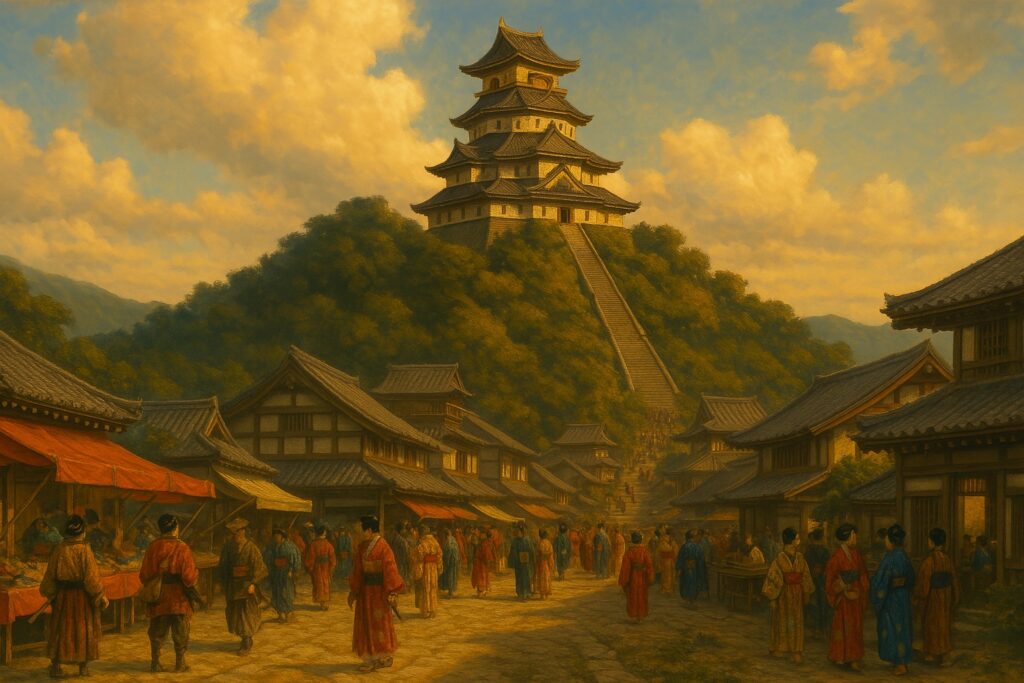
In 1576, Nobunaga began construction of Azuchi Castle on the shores of Lake Biwa in Ōmi Province (modern Shiga Prefecture). Completed in 1579, it marked a major development in late-Sengoku castle architecture. Traditional fortifications were functional — military structures designed to be defended. Azuchi Castle was both a fortress and a statement: a multi-story tower decorated with gold leaf and elaborate murals by the painter Kanō Eitoku, visible across the lake, announcing to everyone who saw it that a new kind of authority had arrived.
The castle's central tower — five stories tall externally, six internally — is widely described as the first high-rise tenshu (main keep) of this scale in Japan: a purpose-built central tower designed as the symbolic and administrative core of a domain, not merely a watchtower or last-resort refuge. The design became highly influential in the castle-building era that followed under Hideyoshi and Ieyasu.
Nobunaga also applied rakuichi-rakuza around Azuchi — measures that reduced or waived certain market dues and the privileges of the established guilds, opening trade in the castle town to merchants who had previously been shut out. The effect was to make the castle town an economic centre as well as a political one. The policy has often been read as an early step towards the commercial towns of the Edo period, though how far it can carry that weight is debated.
Azuchi Castle stood for three years. In 1582, shortly after Nobunaga's death at Honnō-ji, the castle burned. The cause — accidental fire, deliberate arson, or something else — has never been established. The ruins on Mt. Azuchi in Shiga Prefecture are designated a Special Historic Site. The stone foundations, the approach path, and the grave of Nobunaga's father survive on the mountain. For visit information, see the Shiga sites guide.
The Honnō-ji Incident: Betrayal and Death
How Did Oda Nobunaga Die?
The short answer
Oda Nobunaga died on 21 June 1582 at Honnō-ji Temple in Kyoto, aged 47. Akechi Mitsuhide, one of his own senior generals, surrounded the temple before dawn with an army of around 13,000. Nobunaga had a personal guard of a few dozen. He fought, was wounded, withdrew into an inner room and committed seppuku. The temple burned, and his body was never recovered.
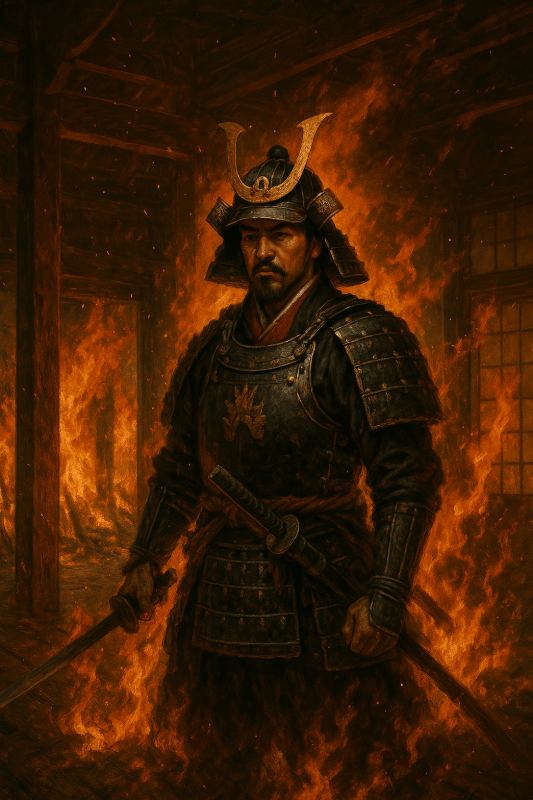
Nobunaga spent the night of 20 June 1582 at Honnō-ji Temple in Kyoto, accompanied by only a small personal guard — he was travelling, not campaigning, and had no reason to expect an attack. He was preparing to depart the following morning for western Japan, where his general Hashiba Hideyoshi (later Toyotomi Hideyoshi) was engaged in a campaign against the Mōri clan. One of his most trusted and capable generals, Akechi Mitsuhide, was supposed to be marching west to reinforce that campaign. Instead, Mitsuhide turned his army toward Kyoto.
Shortly before dawn on 21 June, Mitsuhide's men closed around the temple. By the time Nobunaga's attendants understood what was happening, there was no way out and no time to summon anyone. According to the Shinchō Kōki — the chronicle written by Nobunaga's own retainer Ōta Gyūichi, the closest thing to a contemporary record — Nobunaga fought first with a bow and then with a spear, was wounded in the arm, withdrew deeper into the building, closed the door behind him and committed seppuku. The temple burned around him.
He was 47 years old. He had come closer to unifying Japan than anyone before him, and he died two days short of his forty-eighth birthday, with the last campaign still unfinished. His eldest son and heir, Oda Nobutada, was killed the same morning a few streets away at the Nijō Shingosho — the New Nijō Palace, a different place from the Tokugawa-era Nijō Castle that survives in Kyoto today. Losing both men in a single morning is why the succession fell apart so quickly, and why it was Hideyoshi rather than an Oda who inherited what Nobunaga had built.
Nobunaga's Last Words: "Ze hi ni oyobazu"
The Shinchō Kōki records that when Nobunaga was told the banners outside carried the crest of Akechi Mitsuhide, he said four words: 是非に及ばず — ze hi ni oyobazu, also read ze hi mo nashi.
It is usually translated "It cannot be helped," which is accurate but flat. The phrase literally weighs ze (right) against hi (wrong) and dismisses the exercise: there is no point arguing whether this is right or wrong, no point asking why. Coming from a man who had spent twenty-eight years refusing to accept what could not be changed, it reads as recognition — Mitsuhide was competent, the encirclement was already complete, and the matter was decided before Nobunaga was awake.
How Old Was Nobunaga When He Died — 47 or 49?
Both numbers are correct, under different counting systems, which is why English pages disagree with each other.
Nobunaga was born on 23 June 1534 and died on 21 June 1582 — two days before his forty-eighth birthday. By the Western count, which starts at zero and adds a year on each birthday, he was 47. Japanese sources normally give 49, because the traditional kazoedoshi count treats a newborn as one year old and adds a year at every New Year rather than on the birthday. Neither figure is a mistake; if you see "died at 49" in English, it has been carried across from a Japanese source without conversion.
Why Did Akechi Mitsuhide Betray Him?
The motive behind Mitsuhide's betrayal remains one of the most discussed questions in Japanese history, and no definitive answer exists. The theories fall into several broad categories:
Personal grievance. Several accounts describe Nobunaga publicly humiliating Mitsuhide on multiple occasions — mocking him in front of other generals, striking him, reassigning land he had been promised. If accurate, the betrayal had a personal dimension beyond political calculation.
Political ambition. Mitsuhide may have calculated that with Nobunaga gone and his senior generals scattered across distant campaigns, he had a realistic chance of seizing power. He was killed at the Battle of Yamazaki less than two weeks later — too quickly to tell whether his ambition had any political substance behind it.
External manipulation. Some historians have proposed that Mitsuhide was encouraged or directed by external actors — the Imperial Court, the Mōri clan, or Tokugawa Ieyasu — who wanted Nobunaga removed. No direct evidence supports any specific conspiracy of this kind.
Ideological opposition. A minority view holds that Mitsuhide's opposition was principled — that he objected to Nobunaga's methods or his treatment of the court and religious institutions in ways that went beyond personal calculation. This interpretation has limited support in the primary sources.
The question cannot be resolved because the one person who knew the answer was dead within a fortnight, and no written account from Mitsuhide himself survives.
The Mystery of the Missing Body
Nobunaga's body was never found in the ruins of Honnō-ji. The fire was intense, and the temple burned completely, but the absence of any identifiable remains — of one of the most powerful men in Japan, at a location that was immediately secured — has been a subject of speculation for four centuries. The theories range from the mundane (the fire was simply too complete) to the more elaborate (Nobunaga escaped, or the body was deliberately hidden or removed). No physical evidence has been produced to settle the question, and it likely never will be.
Honnō-ji was rebuilt on a different site in Kyoto and can be visited today — see the Kyoto sites guide for access details.
Nobunaga's Legacy: What He Started and What Came After
Nobunaga's sudden death created a vacuum that could have fragmented Japan again. It didn't. Hashiba Hideyoshi — who had been Nobunaga's most successful general and had risen from comparatively humble origins to one of the most powerful positions in Japan — reacted with extraordinary speed. Informed of the attack while on campaign in western Japan, he negotiated a swift peace with the Mōri clan and marched his army back east. Eleven days after Honnō-ji, at the Battle of Yamazaki, Hideyoshi defeated Mitsuhide; Mitsuhide died shortly afterwards during the retreat. He then maneuvered politically to position himself as Nobunaga's successor.
Hideyoshi completed the national unification Nobunaga had started, imposing his authority over the remaining independent domains by 1590. Tokugawa Ieyasu, who had been Nobunaga's most important ally and had carefully positioned himself through the years of conflict, waited. After Hideyoshi's death in 1598, Ieyasu won the decisive Battle of Sekigahara in 1600 and established the Tokugawa shogunate in 1603 — a system that would govern Japan for the next 265 years.
The three-stage sequence — Nobunaga starts it, Hideyoshi completes it, Ieyasu institutionalizes it — is sometimes captured in a Japanese saying about the three men and a cuckoo that refuses to sing: Nobunaga says he will kill it if it doesn't sing; Hideyoshi says he will make it sing; Ieyasu says he will wait until it sings. The saying is a later caricature rather than contemporary evidence, but it captures how the three men came to be contrasted.
What Nobunaga left behind, beyond the political trajectory, was a set of precedents: that firearms could be decisive in Japanese warfare; that commercial free markets could be created by policy; that monumental architecture could be used as a statement of political authority; and that the institutions that had held autonomous power — religious, aristocratic, or regional — were not immovable. Several of these policies and precedents were carried forward by his successors.
Nobunaga in Fiction: SHŌGUN and Assassin's Creed Shadows
Kuroda Nobuhisa in SHŌGUN
In the FX/Hulu drama SHŌGUN, the character Kuroda Nobuhisa serves as a fictionalized counterpart to Oda Nobunaga. Kuroda is dead before the story begins, and his weight in the series comes almost entirely from the consequences of that death — the vacuum it left, and what the survivors did in it — rather than from his presence in the ongoing action. This structure mirrors Nobunaga's actual historical position: a figure whose absence shaped everything that followed.
The parallels are specific. Kuroda's sudden assassination by a trusted general (Akechi Jinsai in the drama) echoes the Honnō-ji Incident. The political contest that drives the series — who controls the heir, which regent takes power, who inherits the dead ruler's authority — reflects the historical aftermath of Nobunaga's death in 1582. Lady Ochiba's position in the drama echoes that of Yodo-dono (Chacha), who was Nobunaga's niece in real history. The series adjusts this to a father-daughter relationship to sharpen her personal stakes in the story.
For the full breakdown of SHŌGUN's characters and their real historical counterparts:

Assassin's Creed Shadows (2025)
Assassin's Creed Shadows (2025) is set in late Sengoku Japan — specifically the period of Nobunaga's consolidation of power. Nobunaga appears as a historical character in the game, portrayed in a manner consistent with his reputation for ruthlessness and military authority. The game's setting includes locations in the Kinai region and around Lake Biwa that correspond to real historical sites covered on this site.
The real Nobunaga was more complex than the "demon king" archetype that has attached to him in popular culture. He was also a patron of the arts, a serious student of foreign technology and ideas, and someone who engaged substantively with the Jesuit missionaries who arrived in Japan during his lifetime. The primary sources — Jesuit letters, the chronicle of his retainer Ōta Gyūichi, and the records of the castle town at Azuchi — describe a figure capable of both extraordinary violence and sustained institutional reform.
Frequently Asked Questions
Oda Nobunaga (1534–1582) was a warlord of Japan's Sengoku period and the first of the country's Three Unifiers. Born in Owari Province, he took control of a divided clan, won a decisive victory at Okehazama in 1560, entered Kyoto in 1568, and spent the next fourteen years dismantling the rivals — military, religious and aristocratic — that stood between him and national authority. He built Azuchi Castle, widely described as Japan's first full-scale early-modern castle keep, and died at Honnō-ji in 1582, aged 47, after being trapped there by his own general Akechi Mitsuhide.
He died on 21 June 1582 at Honnō-ji Temple in Kyoto, aged 47. He was staying there with only a small personal guard when Akechi Mitsuhide — a senior general who was supposed to be marching west to reinforce a different campaign — surrounded the temple before dawn. With no way out and no time to summon reinforcements, Nobunaga fought briefly, was wounded, withdrew into an inner room and committed seppuku. The temple burned and his body was never recovered from the ruins.
21 June 1582, before dawn, at Honnō-ji Temple in Kyoto. In the Japanese calendar of the time the date was the second day of the sixth month of Tenshō 10. He had been in Kyoto for a single night, on his way west to join a campaign against the Mōri clan.
47 by the Western count. He was born on 23 June 1534 and died on 21 June 1582, two days short of his forty-eighth birthday. Japanese sources usually say 49, because the traditional kazoedoshi system counts a newborn as one year old and adds a year at New Year rather than on the birthday. Both figures describe the same lifespan.
Escape was not realistically available: Mitsuhide had committed a large force — figures around 13,000 are commonly cited — to sealing a temple defended by a few dozen. Beyond that, why Nobunaga chose as he did cannot be known. The reasoning usually offered is that a captured lord became a political instrument, and a displayed head became proof that a rebellion had succeeded, so ending his own life denied Mitsuhide both. That is a reading of the situation rather than something Nobunaga explained. What is recorded is narrower: he withdrew inside, took his own life, and no body was ever produced from the ruins.
The Shinchō Kōki, the chronicle written by his retainer Ōta Gyūichi, records that on being told the attackers carried Akechi's crest he said 是非に及ばず — ze hi ni oyobazu, also read ze hi mo nashi, usually translated "It cannot be helped." More literally, it dismisses the question of right and wrong as pointless now. Nobody inside the building survived, so the line is tradition rather than transcript.
No. Nobunaga never held the title. He installed Ashikaga Yoshiaki as the 15th Ashikaga shogun in 1568 and expelled him in 1573 — ending the shogunate rather than taking it. The highest office Nobunaga himself held was Udaijin (Minister of the Right), from 1577. One traditional explanation is that the title was reserved by convention for claimants of Minamoto descent, and the Oda claimed Taira ancestry; historians disagree about how binding that convention really was. The next shogun was Tokugawa Ieyasu, in 1603.
It lost control of its own succession within weeks. Nobunaga's designated heir, Oda Nobutada, died in Kyoto on the same morning as his father. Adult sons did survive — Nobukatsu and Nobutaka among them — but losing Nobunaga and Nobutada together destabilised the regime and opened a contest over who would run it. At the Kiyosu Conference that summer, Hideyoshi backed Nobunaga's infant grandson Sanbōshi (Oda Hidenobu) as nominal head — and made himself the real power. Nobunaga's second son Nobukatsu allied with Tokugawa Ieyasu against Hideyoshi at Komaki-Nagakute in 1584, then came to terms. The family survived as minor daimyō houses through the Edo period, but never ruled again.
The Oda line descending from his second son Nobukatsu continued as small daimyō houses — Tendō and Kaibara among them — until the end of the Edo period, and the family name survives. The best-known modern figure to claim the descent is the Olympic figure skater Oda Nobunari, who introduces himself as a descendant of Nobunaga. That is his family's own account: widely reported in Japan, but not independently documented in English-language genealogical sources.
Five themes stand out: advancing the unification of Japan after a century of civil war; the upset victory at Okehazama in 1560; extensive and influential use of firearms, most famously at Nagashino in 1575; his campaigns against the powerful armed Buddhist institutions, Enryaku-ji and Ishiyama Hongan-ji above all; and Azuchi Castle, a landmark in late-Sengoku castle architecture and a building designed as a statement of authority rather than only a fortification. He is also famous for how he died — betrayed by his own general, three years short of finishing the job.
No one knows, and the question is one of the most debated in Japanese history. The main theories are personal grievance (several accounts describe Nobunaga humiliating him publicly), political ambition, manipulation by outside parties such as the Imperial Court or the Mōri clan, and principled opposition to Nobunaga's methods. None can be confirmed. Mitsuhide was defeated and killed within two weeks of the betrayal and left no written explanation.
Not completely. Nobunaga came closer than anyone before him, but he was killed in 1582 before the process was finished. It was Toyotomi Hideyoshi who completed national unification by 1590, and Tokugawa Ieyasu who institutionalized it with the shogunate in 1603. Nobunaga is counted as the first of Japan's Three Unifiers because he started the process and made the others possible — not because he finished it.
The label Dairokuten Maō ("Demon King of the Sixth Heaven") is sometimes associated with Nobunaga, and he may have used it himself in certain contexts. The label attached itself to his campaigns against religious opponents — the burning of Enryaku-ji, the killings at Nagashima — and hardened over the centuries into a popular image of a ruler contemptuous of religious authority. How much of that image reflects the man and how much is later mythmaking is a question historians disagree on.
The Battle of Okehazama (1560) was the engagement in which Nobunaga, with a small force, defeated and killed Imagawa Yoshimoto, who was leading a much larger army through Owari. Yoshimoto's wider strategic objective is still debated — the traditional account has him advancing on Kyoto, while much modern scholarship reads the campaign as aimed at Owari itself. Either way, the victory transformed Nobunaga from a provincial lord into a national figure.
Tenka Fubu (天下布武) was Nobunaga's personal seal and motto, meaning roughly "Rule the Realm by Military Force." He stamped it on official documents as a declaration that his authority was national rather than regional, and that he intended to impose it by force if necessary. It was a direct challenge to the shogunate and the existing political order.
Enryaku-ji held significant political and military power, maintained armed forces, and had allied with Nobunaga's enemies. In 1571 his forces attacked and burned much of the complex. Contemporary accounts describe many deaths, including noncombatants, though the totals given vary widely between sources. Political and military motives were clearly involved, and Nobunaga moved against secular rivals with comparable force — but how the religious dimension of the campaign should be interpreted is still debated among historians.
Azuchi Castle, built from 1576 on the shores of Lake Biwa in Shiga Prefecture, is widely described as the first Japanese castle to carry a high-rise tenshu on this scale — a purpose-built tower designed as a symbol of political authority as much as a military fortification. It was decorated with gold leaf and elaborate murals, and visible across the lake. The castle burned in 1582, shortly after Nobunaga's death. The ruins on Mt. Azuchi are now a nationally designated Special Historic Site.
Akechi Mitsuhide was one of Nobunaga's senior generals — cultivated, intelligent, and trusted with major commands. After his betrayal at Honnō-ji, he held power for approximately thirteen days before Toyotomi Hideyoshi's army returned from western Japan and defeated him at the Battle of Yamazaki. Mitsuhide died shortly after the battle — killed by bandits, according to some accounts, or in the fighting itself. His brief period of power became known in Japanese history as the "thirteen days of Mitsuhide."
Nobunaga had sustained contact with Jesuit missionaries, particularly the Italian Jesuit Alessandro Valignano and the Portuguese Luis Frois, who wrote detailed accounts of him. What is recorded is that he received them repeatedly, questioned them about European technology, geography and astronomy, and extended protection to Jesuit missions against Buddhist opposition. He never converted. The motives usually attributed to him — practical interest in useful knowledge, and a willingness to use the Jesuits against established Buddhist power — are interpretations drawn from those actions rather than positions he stated.
Firearms reached Japan through Portuguese traders around 1543. Nobunaga made extensive use of them and coordinated them with his other troops rather than treating them as a novelty: recruiting specialist arquebusiers and organising the supply of powder and shot. Nagashino in 1575 is the standard example, where firearms and prepared fieldworks together contributed to the Oda–Tokugawa victory over the Takeda. Later scholarship questions the familiar version of that battle — the three-stage volley, the numbers, and how far the Takeda force can be called a cavalry army — but the scale on which he used firearms was real.
Four threads run forward from him. Politically, he began the unification that Hideyoshi completed by 1590 and Ieyasu institutionalised in 1603. Militarily, he made large-scale firearms use a prominent feature of Sengoku warfare. Economically, the rakuichi-rakuza measures he applied at Azuchi eased market dues and guild privileges, opening the castle town to outside merchants. Architecturally, the tenshu at Azuchi became highly influential in the castle-building age that followed. How original each of these was, and how much long-term effect each had, remain matters of historical interpretation.
SHŌGUN is set in a fictionalized version of 1600 Japan, after the death of the Nobunaga-inspired character Kuroda Nobuhisa. The drama's political structure — competing regents, a child heir, a foreigner caught in the middle — is based on the real situation that followed Toyotomi Hideyoshi's death in 1598. The broad historical dynamics are accurately reflected. Specific characters and events are fictionalized, and the series adjusts several relationships (including Lady Ochiba's connection to Kuroda) for dramatic purposes.
Jeroen Lamers' Japonius Tyrannus (2000) is a major English-language scholarly study of Nobunaga. Mary Berry's Hideyoshi (1982) covers the period in depth from Hideyoshi's perspective and includes significant treatment of the Nobunaga years. For the Sengoku period broadly, Stephen Turnbull's work provides accessible military history, though some of his conclusions on specific battles have been revised by later scholarship.
Visit the Sites: Field Guides to Nobunaga's Japan
The castles, battlefields, and ruins associated with Nobunaga span a wide arc of central Japan — from his home province in Aichi through Gifu and Shiga to Kyoto. This page is a biography. For what physically survives at each site, how to get there from Nagoya or Kyoto, 360° panoramas and field notes taken on the ground, use the field guide hub:
☕ Support This Site
Following the Shogun is built on original fieldwork and on-site research.
If you found this guide useful, your support helps keep it going.

You can also support via QR code

