


Grave of Toshiie Maeda & Tentokuin Temple
Tentokuin, the memorial temple of Princess Tama; Touunji, named after Toshiie himself; the Maeda family cemetery on Mt. Noda, resting place of successive Kaga lords; and Houenji, founded by Toshiie — explore 4 spots in the Utatsuyama, Kodatsuno & Takaramachi area with 360° panoramas.
Toshiie Maeda was the founding lord of the Kaga Domain, which once governed the Kaga, Noto, and Ecchu provinces. The Utatsuyama, Kodatsuno & Takaramachi area forms a “corridor of memory and quiet” where the prayers and family history of the Kaga ruling house still linger. Tentokuin, built in memory of Princess Tama; Touunji, named for Toshiie himself; the Maeda family cemetery on Mt. Noda, where generations of Kaga lords are laid to rest; and Houenji, founded by Toshiie — here, the spiritual world of the samurai (Zen Buddhism), the landscape of memorial (cemeteries and gardens), and the history of the women behind the domain all overlap on a single stretch of terrain. This page walks through each temple and historic site with 360° photography, covering highlights such as main gates, dry-landscape gardens, mortuary tablets, portraits, and memorial stupas, along with their historical background, visiting tips, and time estimates.
Tentokuin Temple — the “Temple of Princess Tama” 🎥 360°
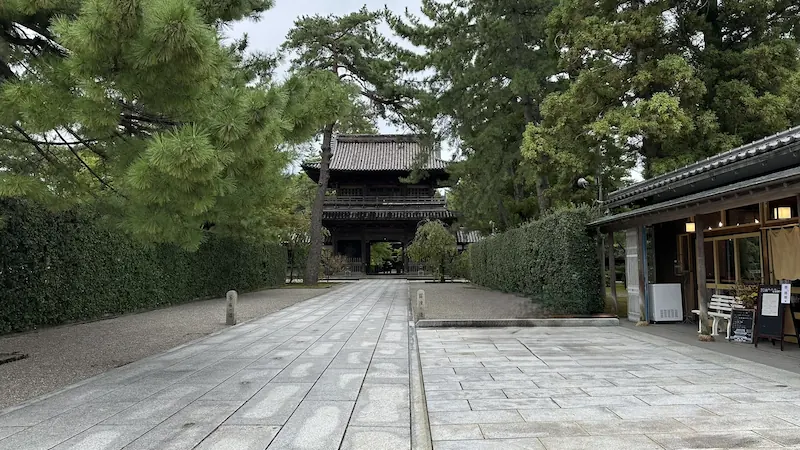
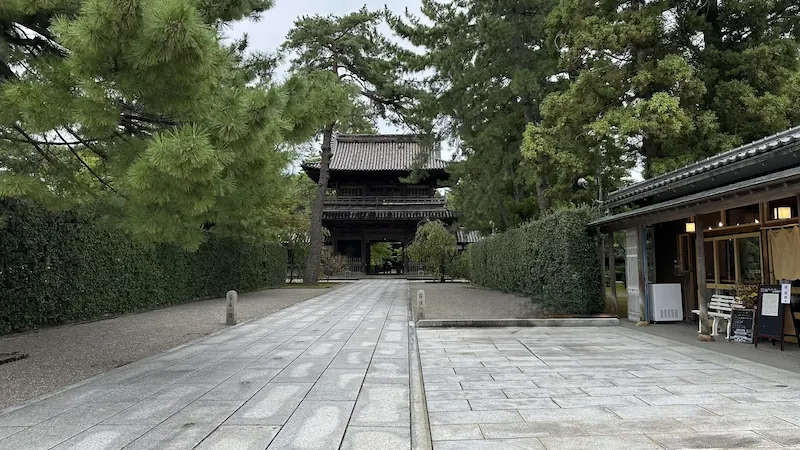
Tentokuin is the memorial temple of Princess Tama, principal wife of Toshitsune Maeda, the third lord of the Kaga Domain, and is affectionately known in Kanazawa as the “Temple of Princess Tama.” Sent from Edo as a daughter of the shogun Hidetada Tokugawa to marry into the Maeda family, Tama helped anchor the domain’s standing at the shogunate’s court, but died at just 24. Grieving her death, Toshitsune founded this temple, naming it after her Buddhist name, “Tentokuin-den Kenun Juntei Daizenjyoni.” The quiet story of a woman behind the scenes of history is still told here, on a peaceful plateau overlooking the city.
- Main Gate (Two-Story Gate): Built in 1694, with an irimoya hip-and-gable roof and traditional tile construction — an Ishikawa Prefectural Tangible Cultural Property.
- Garden (Mokusho Zen Garden): A dry-landscape garden expressing Soto Zen philosophy, offering a quiet space to walk and settle the mind while taking in the view.
- Karakuri Puppet Show “The Story of Princess Tama and Tentokuin”: Six puppets reenact Princess Tama’s life in a roughly 15-minute performance.
- Gold-Leaf Goshuin Experience: Started to mark the temple’s 400th anniversary, this hands-on goshuin (temple seal) experience lets visitors apply gold leaf themselves — popular with tourists.
- Matcha Tea Room: A tea room facing the garden where visitors can enjoy matcha while taking in the view.
- Sutra-Copying Experience: Visitors can also try their hand at sutra copying in a quiet setting — a good way to settle the mind.
- Otori Stone & Kinryu Inari Shrine: Elements of folk belief tied to matchmaking and household harmony; the Otori Stone is used for wish-making.
🌎 Official Website (Japanese only)
⏳ Visiting Time: Main highlights: about 30 minutes / A leisurely visit including experiences: about 60 minutes
🗺 Address: 4-4-4 Kodatsuno, Kanazawa, Ishikawa
🚶 Access: About 20 minutes from Kanazawa Station by local bus, then a 3-minute walk from the “Tentokuin-mae” stop.
⭐ Recommendation: Historical Value ★★★ / Visual Appeal ★★★ / Experiential Value ★★★
| Year Founded | 1623 (Genna 9) |
|---|---|
| School / Mountain Name | Soto Zen Buddhism / Kinryuzan |
| Founding Priest / Founder | Founding priest: Kyoteki Kyozan / Founder: Toshitsune Maeda |
| Structure & Features | Main gate (two-story), main hall, garden (“Mokusho Zen” garden), tea room, karakuri puppet-theater stage, and more |
| Cultural Designation & Surviving Structures | Main gate: an Ishikawa Prefectural Tangible Cultural Property, a two-story gate built in 1694. The main hall and other buildings are later reconstructions, open to visitors. |
| Restoration History | Repeated fires destroyed most of the original complex; only the 1694 main gate survives from that era. |
| Current Condition | Well preserved; both the garden and facilities are open to visitors. |
| Notes | Interactive elements include the karakuri puppet show “The Story of Princess Tama and Tentokuin,” a gold-leaf goshuin (temple seal) experience, and a matcha tea room. |
| Admission & Hours | Adults ¥500, junior high ¥300, elementary ¥200 (group discount for 30+). Open 9:30–16:30 (Mar–Nov) and 9:30–16:00 (Dec–Feb); closed Wednesdays in winter. As of September 2026. |
The Origin of the Name: The temple’s name, Tentokuin, comes from Princess Tama’s Buddhist name, “Tentokuin-den Kenun Juntei Daizenjyoni.”
Why the Temple Was Founded: Tradition holds that Toshitsune founded the temple in 1623 in memory of his late wife, Princess Tama.
A Fire-Scarred History: Many of the original buildings were lost to fire over the centuries; only the 1694 main gate preserves its original structure today.
Kotokuzan Touunji Temple 🎥 360°
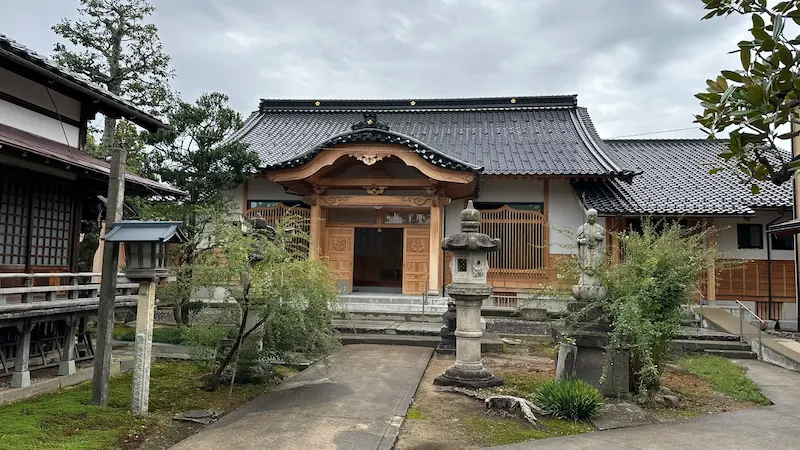
Touunji is a Soto Zen temple in Kanazawa’s Noda-machi district, with the mountain name Kotokuzan. Also known locally as “Kumanbo Daigongen,” it served as the memorial temple and grave-keeping temple for Toshiie Maeda, founding lord of the Kaga Domain, and received strong patronage from the Maeda ruling family for generations. Its name comes from Toshiie’s posthumous Buddhist name, “Kotokuin-den Touun Jouken Daikoji.” The founding priest was Shozan Jogei, second head priest of Houenji Temple, and the temple was originally a small hermitage called “Houenji Annex” before later being renamed Touunji.
- Toshiie’s Memorial Cenotaph: A five-tiered stone stupa about 3 meters tall. Tradition holds it was built as a place for Hoshunin (Toshiie’s widow) to pay her respects, since traveling to Toshiie’s actual grave on Mt. Noda was difficult for her.
- Portraits of the Maeda Family & Hoshunin: The temple preserves portraits of Toshiie and his wife, designated as Kanazawa City Cultural Properties.
- Kumanbo Daigongen: A long-standing folk belief centered on three deities (Kumanbo, Hachimanbo, and Terunyakubo). Legend holds a shrine to them once stood within Kanazawa Castle before later being enshrined at Touunji, forming a deep bond between the temple and this local faith.
- Ties to the Kaga Ruling Family: Named after Toshiie’s posthumous Buddhist name, the temple received land grants and protection from successive Kaga domain lords, carrying the weighty role of memorial and grave-keeping temple for the ruling Maeda house.
- Graves of Kazue Shimada and Others: Records note that the grave of former Kaga domain retainer Kazue Shimada, implicated in the Kioizaka Incident of the Meiji era, is said to be located on the grounds.
- Winter and Spring Scenery: The plantings, stonework, and graveyard layout combine to create an especially evocative atmosphere in the snow-covered season.
⏳ Visiting Time: Main highlights: about 10 minutes / A closer look: about 20 minutes
🗺 Address: Chi-386 Noda-machi, Kanazawa, Ishikawa
🚶 Access: About 30 minutes from Kanazawa Station by bus, then a Hokuriku Railroad local bus to the “Noda” stop, followed by a 3-minute walk.
⭐ Recommendation: Historical Value ★★★ / Visual Appeal ★★ / Experiential Value ★
| Year Founded | 1600 (Keicho 5) |
|---|---|
| Founding Priest | Shozan Jogei (2nd head priest of Houenji Temple) |
| School | Soto Zen Buddhism |
| Principal Image | Shakyamuni Buddha |
| Structure & Features | Main hall, a memorial cenotaph for Toshiie (a five-tiered stone stupa about 3 meters tall), a shrine to Kumanbo Daigongen, and more |
| Relocation & Fire History | Complex burned down in 1616 (Genna 2) and was rebuilt by Hoshunin; burned again in the early Meiji era and was subsequently restored |
| Current Condition | Survives and is maintained today (on a reduced scale compared to its original extent) |
| Cultural Properties & Treasures | Portraits of Toshiie Maeda and Hoshunin (Kanazawa City Designated Cultural Properties), among other items |
| Notes | Home to Toshiie’s memorial cenotaph, memorial temple of the Kaga Hakke senior retainer families, and the site of Kumanbo Daigongen worship |
The Origin of the Name: The temple was named Kotokuzan Touunji after Toshiie’s posthumous Buddhist name, “Kotokuin-den Touun Jouken Daikoji.”
Hoshunin’s Determination: Legend holds that after Toshiie’s death, when the temple burned down and rebuilding proved difficult, his widow Hoshunin (Matsu) personally donated land to support the temple’s survival.
A Temple with a Custodial Role: Having presided over Toshiie’s funeral, the temple went on to serve as the place from which his grave on Mt. Noda was ritually honored — a special memorial site and stronghold for the ruling Maeda family.
Grave of Toshiie Maeda (Maeda Family Kaga Domain Lords’ Cemetery) 🎥 360°
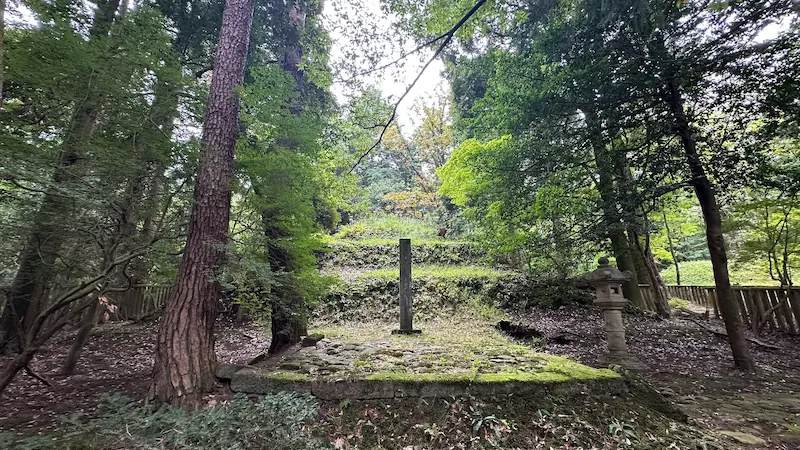
The Grave of Toshiie Maeda sits within the Maeda family cemetery on Mt. Noda (Nodayama) in Kanazawa, the burial ground for successive Kaga Domain lords, their principal wives, and children. Its origin traces back to Toshihisa Maeda, Toshiie’s elder brother, being laid to rest here; the site was later formally established as the domain’s ruling-family cemetery, partly at Toshiie’s own wish. Roughly 80 graves are arranged across the lushly wooded hillside a short distance from Kanazawa Castle, with the founding lord Toshiie’s own grave built at the highest point among them.
- Grave of Toshiie Maeda: Located at the top of the burial ground, a three-tiered square mound surrounded by a square moat, roughly 19 meters on each side — an imposing structure.
- Grave of Lady Matsu: Resting beside Toshiie’s grave, the pair make for a striking sight.
- Toshinaga’s Grave (in Takaoka): Forming a linked pair with the Kanazawa cemetery, this grave is part of the same nationally designated site, located in Takaoka.
- Graves of Retainers and the Kaga Hakke: The lower tier of the burial ground holds the graves of senior Kaga Domain retainers.
- A View Over the City: Set on the hillside, the cemetery also offers a pleasant view down over the surrounding streets.
- Harmony with Nature: Old cedar and pine trees are abundant, and the interplay of sunlight through the leaves and moss varies beautifully with the seasons.
⏳ Visiting Time: Viewing the graves only: about 30–45 minutes / A leisurely walk taking in the inscriptions and surroundings: about 60–90 minutes
🗺 Address: Nodayama Cemetery, Kanazawa, Ishikawa
🚶 Access: From Kanazawa Station, take a Hokuriku Railroad or local bus to the “Nodayama” stop, then walk up the hillside — roughly a 20–30-minute walk. Check current Kanazawa tourism information for detailed directions.
⭐ Recommendation: Historical Value ★★★ / Visual Appeal ★★★ / Experiential Value ★★
| Designation | National Historic Site “Maeda Family Kaga Domain Lords’ Cemetery” (Toshiie’s grave is at its core) |
|---|---|
| Location | Noda-machi, Kanazawa, and Takaoka City (site of Toshinaga’s grave) |
| Date Designated | February 12, 2009 (Heisei 21) |
| Area | Kanazawa side: 86,294.35 m² / Takaoka side (Toshinaga’s grave): 33,391.91 m² |
| Structure & Features | Earthen mound-style graves, a three-tiered square mound surrounded by a moat-like trench, with retainer and townspeople’s graves both above and below the main burial ground |
| Principal Graves | Toshiie, his principal wife Matsu, Toshinaga, and other domain lords and family members |
| Surveys & Research | Surveys and excavations conducted since 2004 (Heisei 16) have confirmed moat structures from the original construction, among other findings |
| Current Condition | Generally well preserved, though the 2024 (Reiwa 6) Noto Peninsula earthquake damaged and toppled some stone lanterns and fences — visitors should take care when touring the site. |
Toshiie’s Wish and the Choice of Site: Tradition holds that Mt. Noda was chosen as the burial ground in accordance with Toshiie’s own wishes.
A Distinctive Construction Style: Most graves here take the form of earthen mounds surrounded by a moat-like trench — a design considered unusual compared with the burial customs of other domains.
A Note on Earthquake Damage: The January 2024 (Reiwa 6) Noto Peninsula earthquake toppled and damaged some stone lanterns and fences here; as a protected historic site, visitors are asked to take care when touring the grounds.
Houenji Temple 🎥 360°
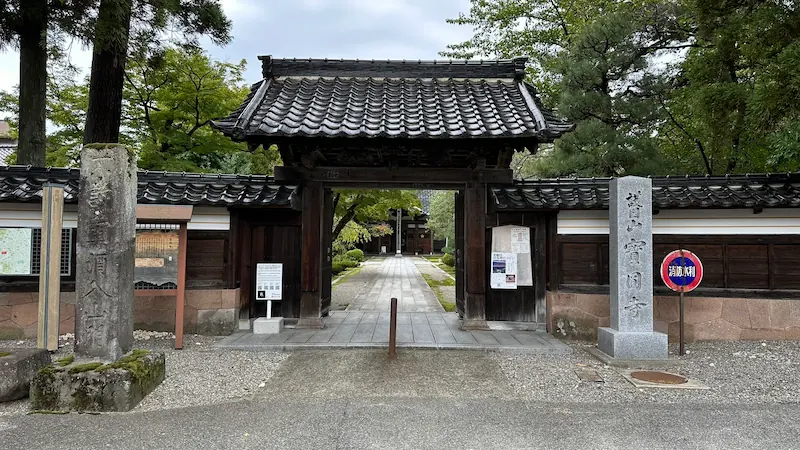
Houenji is a Soto Zen temple founded by Toshiie Maeda, founding lord of the Kaga Domain, and is sometimes called the “Temple of Toshiie and Matsu.” Toshiie had deep faith in the Zen priest Daito Keijo, whom he had followed since his days in Echizen Fuchu, and invited him to Kanazawa to found this temple. It was first built near what is now Kenrokuen Garden before later being relocated to Kodatsuno. As a memorial temple, it holds the mortuary tablets and heirloom statues of the Maeda ruling family, carrying considerable historical weight.
- Main Gate, Main Hall, and Priests’ Quarters: All three are National Registered Tangible Cultural Properties; the main hall, rebuilt in the early Meiji era, has a dignified architectural presence.
- Nio Guardian Statues: Two large Nio statues stand inside the hall — one dating to the Kamakura period, the other a Showa-era restoration.
- Memorial Halls for Mortuary Tablets, Portraits, and Hair Relics: The Maeda family’s mortuary tablets are enshrined here, along with a tradition that a portrait and a lock of Toshiie’s hair are kept on the grounds.
- Garden and Grounds: The layout makes thoughtful use of the site’s original terrain, with greenery integrated throughout the grounds.
- 13th Stop on the Hokuriku 33 Kannon Pilgrimage: As the 13th stop on this regional pilgrimage route, the temple is also a destination for Kannon devotion.
⏳ Visiting Time: Strolling the grounds: about 20–30 minutes / Including the interior: about 45 minutes
🗺 Address: 6-14 Takara-machi, Kanazawa, Ishikawa
🚶 Access: Take the Yuwaku Line bus via Kodatsuno from Kanazawa Station, get off at Kodatsuno, then walk 8 minutes.
⭐ Recommendation: Historical Value ★★★ / Visual Appeal ★★★ / Experiential Value ★★
| Year Founded | 1583 (Tensho 11) |
|---|---|
| Founder | Toshiie Maeda |
| Founding Priest | Daito Keijo |
| School / Mountain Name | Soto Zen Buddhism / Gohozan Houenji |
| Relocation & Fires | Relocated to Kodatsuno in 1620 (Genna 6) under Toshitsune; damaged by fire during the Horeki era and again in the early Meiji era, and rebuilt each time |
| Current Condition | Main hall, main gate, and priests’ quarters are preserved and registered as tangible cultural properties, open to visitors |
| Cultural Designation | Main gate, main hall, and priests’ quarters: National Registered Tangible Cultural Properties |
| Notes | The main hall houses two large Nio guardian statues and a statue donated by Toshiie himself; it also serves as the Maeda family’s memorial temple, holding their mortuary tablets |
Why the Temple Was Relocated: After first being built near what is now Kenrokuen Garden, the temple was relocated to Kodatsuno under Toshitsune.
Fire and Recovery: The temple suffered major losses in fires during the Horeki era and again in the early Meiji era, but was rebuilt each time and survives to the present day.
Toshiie’s Funeral: Tradition holds that Toshiie’s funeral was conducted at this temple.
Based on multiple personal visits — this is the author’s own priority order, not an official recommendation for the Utatsuyama & Kodatsuno area.
Rich in hands-on experiences — a karakuri puppet show and a gold-leaf goshuin experience — making it the easiest of the four to enjoy as a visitor. Both the garden and main gate are well worth seeing.
A National Historic Site where the founding lord himself is buried. Reaching it requires a walk up a hillside path, but it is the essential spot for experiencing the history of the Kaga ruling family firsthand.
The memorial temple Toshiie founded himself, and tradition holds his funeral was held here. Its National Registered Tangible Cultural Property main gate and hall are also worth seeing.
Interesting highlights such as Toshiie’s memorial cenotaph, but off the beaten tourist path. Worth a visit if you have extra time.
Utatsuyama & Kodatsuno Area Map
| Nearest Station | JR Kanazawa Station |
|---|---|
| From the Station | About 20–30 minutes by local bus from Kanazawa Station to each spot (general public info, unverified on-site). Approximate stops: “Tentokuin-mae” for Tentokuin, “Noda” for Touunji, “Nodayama” for the Grave of Toshiie Maeda, and “Kodatsuno” for Houenji |
| Useful Shinkansen Station | JR Kanazawa Station (Hokuriku Shinkansen) |
| From Tokyo | About 2 hours 30 minutes via the Hokuriku Shinkansen “Kagayaki” (general public info, unverified on-site) |
| From Osaka | Limited Express Thunderbird to Tsuruga, transfer to the Hokuriku Shinkansen; about 2 hours 20 minutes total (general public info, unverified on-site) |
| From Kyoto | Limited Express Thunderbird to Tsuruga, transfer to the Hokuriku Shinkansen; about 2 hours total (general public info, unverified on-site) |
| From Nagoya | Limited Express Shirasagi to Tsuruga, transfer to the Hokuriku Shinkansen; about 3 hours total (general public info, unverified on-site) |
| Getting Around Locally | The four spots are spread apart, so bus travel is more practical than walking between them. Reaching the Grave of Toshiie Maeda requires a 20–30-minute walk up a hillside path, so comfortable walking shoes are recommended |
| Recommended Transport | Local buses from Kanazawa Station are the main way to get around; expect to rely on the bus between spots as well |
| Parking | Parking is available near each temple and the cemetery (capacity and rates unconfirmed) |
| Notes | Some stone lanterns and fences at the Grave of Toshiie Maeda were damaged in the 2024 (Reiwa 6) Noto Peninsula earthquake — please watch your step when visiting |
※ Shinkansen times, fares, and bus details above are general estimates based on publicly available information, not figures verified on-site by this website. Please check official sources such as JR West / JR East for the latest information.
Explore More Toshiie Maeda Heritage Sites
Frequently Asked Questions
Adding up the visiting-time estimates for each spot, a quick tour takes about 1.5–2 hours in total, while a leisurely visit takes about 3–4 hours. It’s worth budgeting extra time for bus travel between spots.
As noted above, reaching it requires about a 20–30-minute walk up a hillside path from the bus stop. Comfortable walking shoes are recommended.
The karakuri puppet show “The Story of Princess Tama and Tentokuin” runs about 15 minutes (as of September 2026). The performance schedule and whether reservations are required are not published, so please contact Tentokuin directly before your visit.
Yes. Touunji served as Toshiie’s memorial and grave-keeping temple and preserves his memorial cenotaph, while the Grave of Toshiie Maeda is the National Historic Site where Toshiie himself is actually buried. Visiting both together deepens the picture.
The Grave of Toshiie Maeda. It is the National Historic Site cemetery of successive Kaga Domain lords, and the founding lord Toshiie’s own grave sits at the highest point of the burial ground. See the Grave of Toshiie Maeda section above for details.
☕ Support This Site
Following the Shogun is built on first-hand, on-site research.
If this article helped you, your support keeps this project going.

You can also scan the QR code to support this site
Next Page
Previous Page
Back to the Toshiie Maeda Heritage Index
Back to the Homepage



comment