


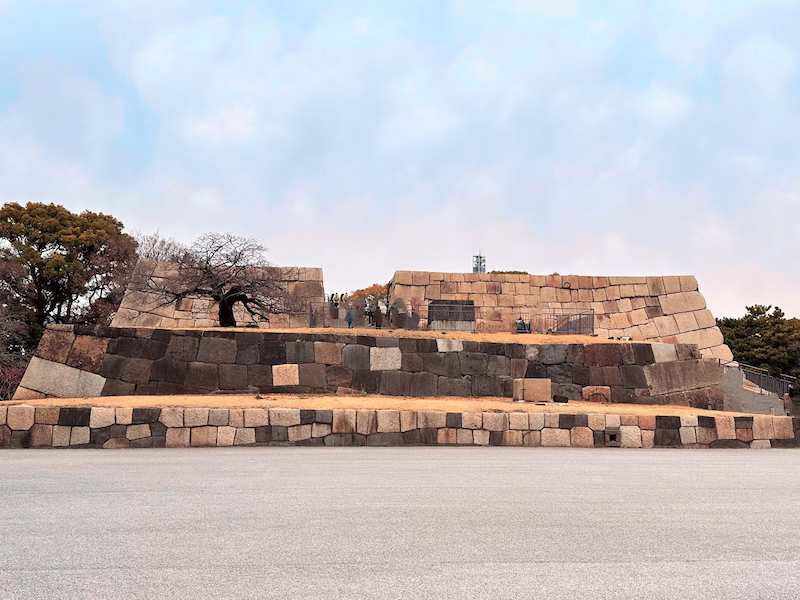
Edo Castle’s Honmaru: The Tenshudai Keep Base, Fujimi-tamon and the Ooku Site
After passing through the Fujimi-yagura Turret Area, you finally enter the heart of Edo Castle: the Honmaru Area. This was where the shogun conducted affairs of government, where the Ooku women’s quarters stood, and where the authority of the Tokugawa shogunate was embodied for more than 260 years.
- ① Otemon Gate Area
- ② Fujimi-yagura Turret Area
- ③ Honmaru Area (This Page)
- ④ Ninomaru Area
- ⑤ Outer Grounds
- ▶ Back to the Complete Guide
After passing through the Fujimi-yagura Turret Area, you finally enter the heart of Edo Castle: the Honmaru Area. This was where the shogun conducted affairs of government, where the Ooku women’s quarters stood, and where the authority of the Tokugawa shogunate was embodied for more than 260 years.
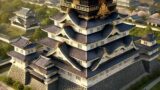
This area has three major highlights. The first is the Tenshudai Keep Base, an approximately 11-meter-high stone base that visitors can climb for broad views across the castle grounds. The second is Fujimi-tamon Defense House, the only surviving tamon, or longhouse-style defensive storehouse, at Edo Castle. The third is the reconstructed model of Edo Castle’s main keep, a 1/30-scale display that brings back the lost keep destroyed in 1657 and never rebuilt.
Opening Hours
Hours vary by season. Last entry is 30 minutes before closing.
Closed Days
Mondays and Fridays, December 28 to January 3, and days affected by events or official functions. Schedules may change due to national holidays and other circumstances.
Suggested Time
Quick visit: about 1 to 1.5 hours / In-depth visit: 2 hours or more
Admission
Free. No advance reservation required.
Access from the Previous Area
Immediately beyond the Fujimi-yagura Turret Area (Matsu-no-Oroka Corridor Site)
Next Area
From Kitahanebashi-mon Gate, continue toward the Ninomaru Area or Outer Grounds.
Honmaru Area
Seven sites follow in sequence: Fujimi-tamon Defense House, the Stone Chamber, the Honmaru Site, the reconstructed main-keep model, the Daidokoro-mae Sanju-yagura Turret Site, the Tenshudai Keep Base, and Kitahanebashi-mon Gate. This is one of the densest and most rewarding areas of the Edo Castle ruins.
Fujimi-tamon Defense House
Edo Castle’s only surviving tamon—a longhouse-style weapons storehouse that defended the western side of the Honmaru
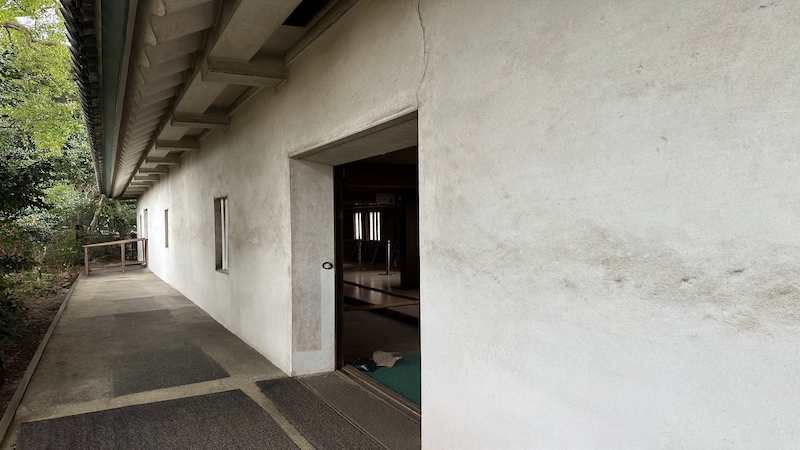
Fujimi-tamon is located on the western side of Edo Castle’s Honmaru and is the only tamon structure still surviving at Edo Castle. A tamon was a longhouse-style turret built on stone walls and other defensive lines. It served both as a defensive position and as a storehouse for weapons and other equipment. Of the tamon structures that once stood in the Honmaru, only Fujimi-tamon remains today.
Fujimi-tamon is a longhouse-style tamon turret standing atop the stone walls on the western side of the Honmaru. Tamon structures were designed to repel attackers trying to cross moats or climb stone walls, using narrow windows for gunfire and archery, while also storing weapons and supplies. Looking up at the high stone walls from the Hasuikebori Moat side offers a vivid sense of the Honmaru’s defensive design.
Detailed Historic Site Data
| Architectural Form | A longhouse-style tamon standing on the stone walls on the western side of the Honmaru. |
|---|---|
| Role | A building that functioned both as a defensive position and as a storehouse for weapons and other equipment. |
| Structure and Features | A longhouse-style tamon built on stone walls. The view looking up from the Hasuikebori Moat side is especially noteworthy. |
| Current Condition | Survives today as the only remaining tamon structure at Edo Castle. |
| Cultural Property Designation | This remnant is included within the Special Historic Site “Edo Castle Ruins.” Check official information for any individual structure designation. |
Highlights
- Edo Castle’s Only Surviving Tamon: Of the tamon structures that once stood in the Honmaru, only Fujimi-tamon survives. Its longhouse-like exterior lets you imagine its dual role in defense and weapons storage.
- Longhouse Structure on Stone Walls: Looking up from the Hasuikebori Moat side reveals clearly how the tamon functioned as a defensive facility built atop the stone walls.
- Interior Viewing: Visitors can currently view the interior. Seeing the longhouse-like space and narrow windows up close makes its role as a defensive position and weapons storehouse easier to understand.
Trivia
- The Role of a Tamon: A tamon was a longhouse-style building constructed on stone walls or earthen embankments. It served as both a defensive position and a storehouse for weapons and other equipment.
- Origin of the Name “Tamon”: The term tamon refers to a longhouse-style structure built on stone walls or embankments. It is sometimes said to derive from Tamonten, one of the Four Heavenly Kings, or from a defensive lookout function known as monomi.
| Address | 1-1 Chiyoda, Chiyoda City, Tokyo |
|---|---|
| From Matsu-no-Oroka Corridor Site | About 1 minute on foot (approx. 100 m) |
| Suggested Time | Quick visit: about 15 minutes / In-depth visit: about 30 minutes |
| Admission | Free. Interior viewing is currently available. Public access may change, so please also check on-site guidance when visiting. |
Open the map to see the relationship between the Matsu-no-Oroka Corridor Site and Fujimi-tamon Defense House.
Stone Chamber
A stone storehouse built from Izu stone—an emergency refuge whose original purpose remains debated
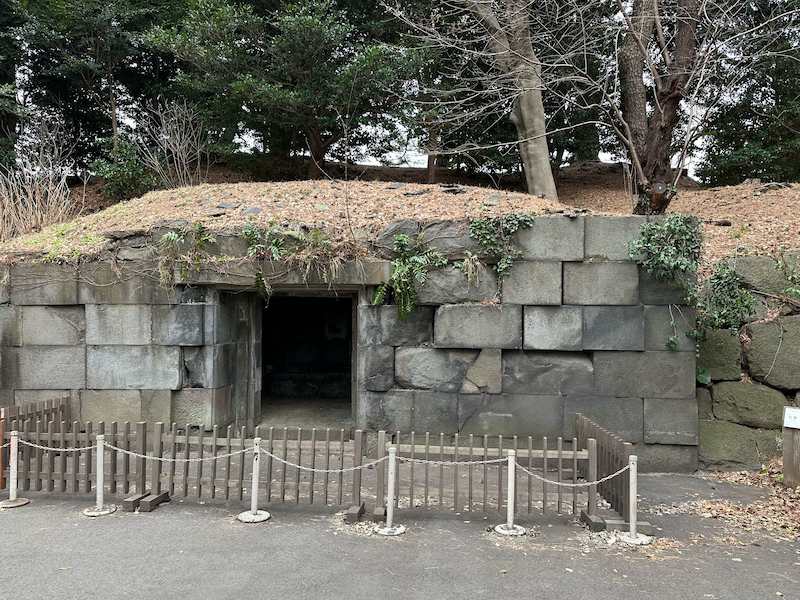
The Stone Chamber, standing along Hasuikebori Moat, is a stone storehouse built by tightly stacking andesite from the Izu Peninsula, known as Izu stone. The interior measures about 20 square meters, and several theories remain about its original use, including an escape passage theory and a treasury theory. The Imperial Household Agency and the Chiyoda City Tourism Association explain that because the Ooku women’s quarters were located nearby during the Edo period, it was likely used to shelter important items during emergencies such as fires.
The exterior walls still show burn marks caused by the heat of fire, allowing visitors to see traces of past conflagrations carved directly into the surface of the Izu stone. Though modest and easy to overlook, it is one of the sites in Edo Castle where the physical traces of history can be felt most directly.
Detailed Historic Site Data
| Year Built | Unknown |
|---|---|
| Builder | Unknown |
| Structure and Features | A stone storehouse built from andesite from Izu, known as Izu stone. The interior measures about 20 square meters. |
| Current Condition | Survives today, with burn marks on the outer walls. |
| Theories About Use | Theories include an escape passage and a treasury, but it is explained as likely having been a place to shelter important items during emergencies such as fires. |
| Cultural Property Designation | This remnant is included within the Special Historic Site “Edo Castle Ruins.” Check official information for any individual structure designation. |
Highlights
- Visible Burn Marks: The burn marks on the Izu-stone exterior walls are evidence of the repeated fires of the Edo period. The discoloration of the stone hints at the intense heat of those fires.
- Precise Stonework: The cut-stone construction, with Izu stone stacked tightly and precisely, reflects advanced masonry techniques of the time. Notice how accurately the vertical and horizontal joints align.
- Contrast with Hasuikebori Moat: The scenery around the Stone Chamber and the moat changes with the seasons and adds to the quiet appeal of the site.
Trivia
- Properties of Izu Stone: Andesite from the Izu Peninsula was transported to Edo by ship. Because of its fire resistance, it was widely used for stone walls and stone storehouses. Many stones used in Edo Castle came from Izu and Soshu, today’s Kanagawa area.
- Near the Ooku: The Stone Chamber stands near the area where the Ooku women’s quarters are thought to have been located during the Edo period. For that reason, it may have been used to protect valuable items during emergencies such as fires.
| Address | Inside the Imperial Palace East Gardens, Chiyoda City, Tokyo |
|---|---|
| From Fujimi-tamon Defense House | About 1 minute on foot (approx. 50 m) |
| Suggested Time | Quick visit: about 5 minutes / In-depth visit: about 10 minutes |
| Admission | Free |
Open the map to see the relationship between Fujimi-tamon Defense House and the Stone Chamber.
Honmaru Site 360°
The heart of the Tokugawa shogunate—the site of the “Study of the Realm” sleeping beneath a broad lawn
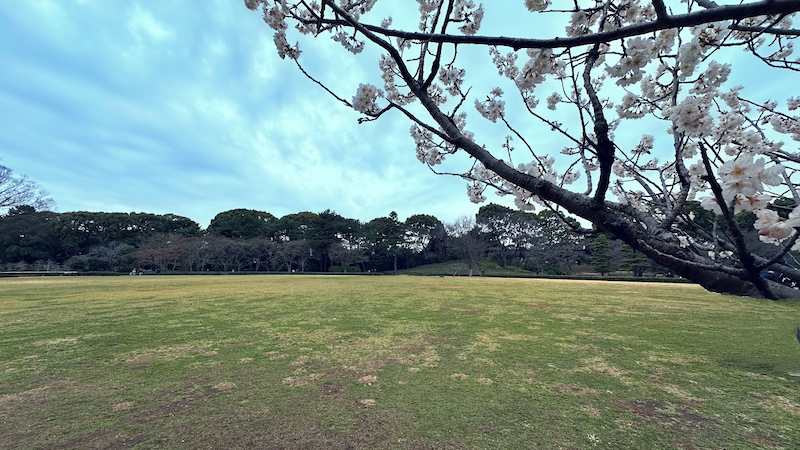
Today the Honmaru Site is a broad lawn, but it was once occupied by the Honmaru Palace, the shogun’s main residence and seat of government. The palace was divided into three major sections: the Omote Palace, Nakaoku, and Ooku. In the Great Hall of the Omote Palace, daimyo assembled at New Year, making it a space that embodied the authority of the Tokugawa shogunate. Known as the “Study of the Realm,” the Honmaru Palace burned down in the fire of 1863 (Bunkyu 3) and was never rebuilt.
The site is now maintained as the Honmaru Great Lawn. Walking with the help of signs and historical materials, while imagining the palace buildings that once stood here, gives a powerful sense of the scale of the Tokugawa government’s central space. The sheer openness and scale of the space are among the site’s greatest highlights.
Detailed Historic Site Data
| Year Lost | Destroyed by fire in 1863 (Bunkyu 3), the final loss of the palace |
|---|---|
| Former Structure | Composed of three areas: the Omote Palace, Nakaoku, and Ooku |
| Main Facilities | Great Hall, Shiro-shoin, Kuro-shoin, Nakaoku, Ooku, and other spaces |
| Current Condition | The Honmaru Palace buildings no longer survive. The area is now maintained as the Honmaru Great Lawn. |
| Notes | This was the site of Edo Castle’s Honmaru during the Edo period. The Imperial Household Agency describes the area as measuring approximately 130,000 square meters. |
Highlights
- Walk with Signs and Historical Materials: Although the area is now an expansive lawn, walking while imagining the Honmaru Palace buildings that once stood here helps convey the scale of the Honmaru.
- Experience the Scale: The openness of the great lawn is itself one of the site’s main attractions. It gives visitors a sense of the vast space that once served as the core of the Tokugawa shogunate.
- Connection with the Tenshudai and Fujimi-tamon: Viewing the Tenshudai Keep Base and Fujimi-tamon from the Honmaru Site helps you understand the castle’s structure around the Honmaru Palace in three dimensions.
Trivia
- History of Fires: The Honmaru Palace burned down and was rebuilt repeatedly, beginning with the Great Fire of Meireki in 1657. Its final destruction came in 1863, during the turbulent final years of the shogunate, and it was never rebuilt afterward.
- The Core of the Tokugawa Government: The Honmaru Palace contained the Omote Palace, Nakaoku, and Ooku, supporting government affairs, ceremonies, and the shogun’s daily life.
- The Peak Under the Third Shogun Iemitsu: Edo Castle reached its greatest scale during the era of the third shogun, Tokugawa Iemitsu, when the Tenshudai was completed and the Honmaru Palace was fully developed.
| Address | 1-1 Chiyoda, Chiyoda City, Tokyo |
|---|---|
| From Stone Chamber | About 2 minutes on foot (approx. 200 m) |
| Suggested Time | Quick visit: about 10 minutes / In-depth visit: about 20 minutes |
| Admission | Free |
Open the map to see the relationship between the Stone Chamber and the Honmaru Site.
Reconstructed Model of Edo Castle’s Main Keep
The lost keep revived at 1/30 scale—a finely detailed model recreating the splendor of the Kan’ei-period keep
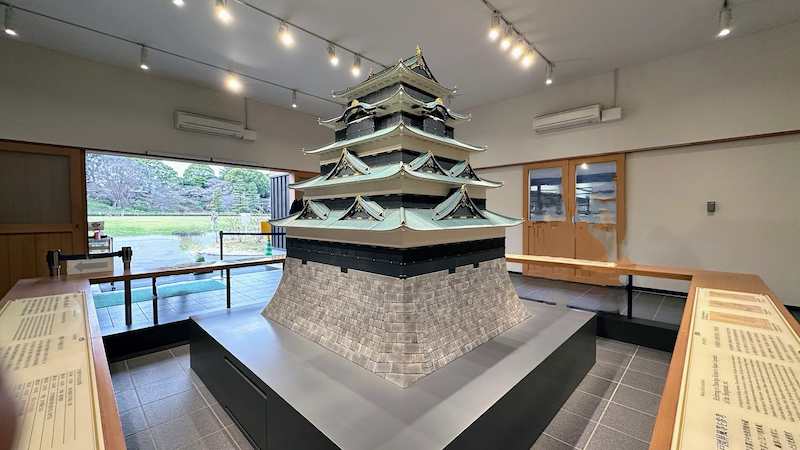
The reconstructed model of the main keep, on permanent display in the annex of the Honmaru Rest House, faithfully recreates the Kan’ei-period main keep (built in 1638 and destroyed in the Great Fire of Meireki in 1657) at 1/30 scale. It opened to the public on September 29, 2020.
Edo Castle’s main keep was built in three versions: Keicho, Genna, and Kan’ei. The current model recreates the final Kan’ei-period keep. After climbing the Tenshudai Keep Base and imagining that the keep once stood there, viewing this model makes its scale and magnificence much more tangible.
Detailed Historic Site Data
| Opened to the Public | September 29, 2020 (Reiwa 2) |
|---|---|
| Model Subject | The Kan’ei-period main keep, built in 1638 and destroyed in 1657 |
| Scale | 1/30 |
| Display Location | Honmaru Rest House Annex, within the Honmaru Site |
| Display Status | Permanent display in the Honmaru Rest House Annex. Viewing follows the opening days and hours of the Imperial Palace East Gardens. |
| Admission | Free |
Highlights
- Finely Detailed 1/30-Scale Model: The white walls, black roof tiles, and layered structure of the keep are carefully reproduced, giving visitors a concrete image of Edo Castle before the keep was lost.
- Best Viewed Together with the Tenshudai: Climbing the Tenshudai Keep Base before viewing the model, or doing the reverse, helps you understand the relationship between the actual stone base and the building that once stood on it.
- Use the Rest House: The nearby rest area is useful for a break, hydration, and browsing materials.
Trivia
- Three Generations of Main Keeps: Edo Castle’s keep was rebuilt three times: in the Keicho period (1607), Genna period (1623), and Kan’ei period (1638). The Kan’ei-period keep was the largest, with five above-ground stories, one basement level, and an estimated height of about 58 meters.
- Hoshina Masayuki’s Famous Advice: The decision to abandon reconstruction after the fire is traditionally linked to Hoshina Masayuki, younger brother of Tokugawa Iemitsu and adviser to the fourth shogun, Ietsuna, who argued that the keep was merely a symbol of military power and that the suffering of the people should be prioritized.
| Address | 1-1 Chiyoda, Chiyoda City, Tokyo |
|---|---|
| From Honmaru Site | About 1 minute on foot (approx. 10 m) |
| Suggested Time | Quick visit: about 10 minutes / In-depth visit: about 20 minutes |
| Admission | Free |
Open the map to see the relationship between the Honmaru Site and the reconstructed main-keep model.
Daidokoro-mae Sanju-yagura Turret Site 360°
A stone-wall lookout over the Ninomaru Garden—the site of a three-tier turret lost in the 1863 fire
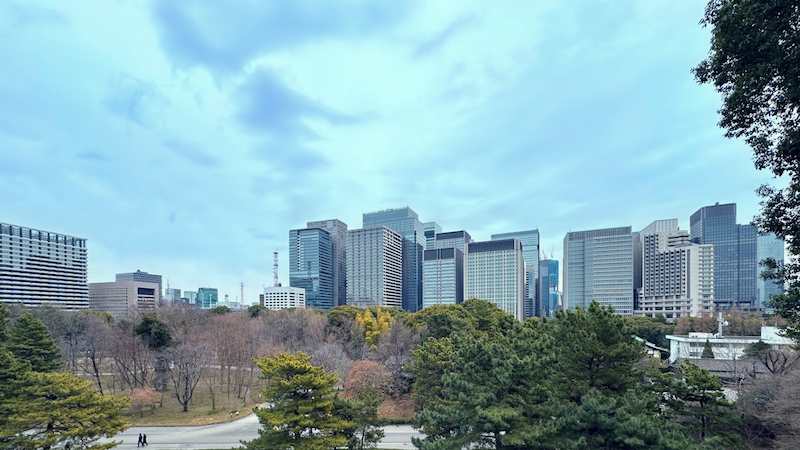
The Daidokoro-mae Sanju-yagura Turret Site, located on the eastern side of the Honmaru, is the site of a three-tier turret that burned down in the fire of 1863 (Bunkyu 3). Today its stone walls remain, and the upper area has been developed as a lookout. From the top of the stone walls, visitors can see the Ninomaru Garden and Swan Moat, with a distinctive view where Edo-period garden scenery overlaps with the high-rise skyline of modern Tokyo.
Detailed Historic Site Data
| Year Built | Unknown |
|---|---|
| Structure and Features | Site of a three-tier turret. The top of the stone walls has been developed as a lookout. |
| Current Condition | The stone walls survive. |
| Loss and Damage | Destroyed in the great fire of 1863 (Bunkyu 3) |
| Cultural Property Designation | This remnant is included within the Special Historic Site “Edo Castle Ruins.” Check official information for any individual structure designation. |
Highlights
- View from the Lookout: One of the best viewpoints in the Honmaru Area, overlooking the Ninomaru Garden, Swan Moat, and the direction of Kitanomaru. From the height of the stone walls, you can sense the scale of the castle.
- Contrast Between Modern Tokyo and History: The view of the Ninomaru Garden with central Tokyo’s high-rise buildings behind it creates a striking composition where the Edo period and the present overlap.
- Cherry Blossoms in Spring: During cherry-blossom season, the contrast between the flowers and the stone walls is especially beautiful.
Trivia
- Connection to the Kitchen: As the name “Daidokoro-mae,” meaning “in front of the kitchen,” suggests, the turret once stood near the kitchen area of the former Honmaru Palace. It helped protect one of the everyday working areas of the shogunate.
| Address | 1-1 Chiyoda, Chiyoda City, Tokyo |
|---|---|
| From Reconstructed Main-Keep Model | About 2 minutes on foot (approx. 100 m) |
| Suggested Time | Quick visit: about 10 minutes / In-depth visit: about 20 minutes |
| Admission | Free |
Open the map to see the relationship between the reconstructed main-keep model and the Daidokoro-mae Sanju-yagura Turret Site.
Tenshudai Keep Base 360°
The 11-meter stone base where the lost keep once rose—the symbol of Edo Castle whose rebuilding was abandoned after Hoshina Masayuki’s counsel
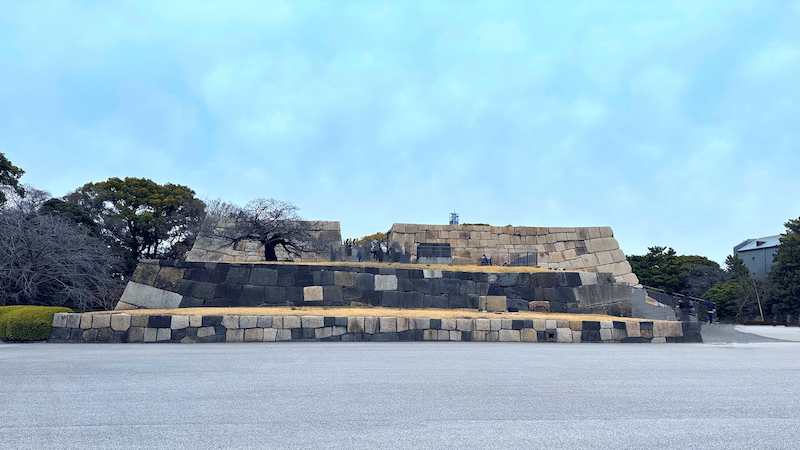
The greatest highlight of the Honmaru Area is the Tenshudai Keep Base. Edo Castle’s main keep was built three times, in the Keicho, Genna, and Kan’ei periods, but the Kan’ei-period keep burned down in the Great Fire of Meireki in 1657. The stone base that survives today is believed to have been built the following year by construction work undertaken by the Maeda family of the Kaga Domain. It preserves a stone structure measuring roughly 41 meters east to west, 45 meters north to south, and about 11 meters high.
Visitors can climb to the top of the Tenshudai. From the 11-meter-high stone base, the view over the Imperial Palace East Gardens, Kitanomaru, and central Tokyo is one of the most open vistas in this area. Standing there while imagining the approximately 58-meter-high keep that once rose above this base is a remarkable experience.
Detailed Historic Site Data
| Current Keep Base | After the Kan’ei-period keep burned down in the Great Fire of Meireki in 1657, the present base is believed to have been built the following year by the Maeda family of the Kaga Domain. |
|---|---|
| Structure and Features | A stone base measuring roughly 41 meters east to west, 45 meters north to south, and about 11 meters high. Visitors can climb to the top. |
| History of the Main Keep | Edo Castle had three main keeps, built in the Keicho, Genna, and Kan’ei periods. The final Kan’ei-period keep burned down in the Great Fire of Meireki in 1657 and was never rebuilt. |
| Scale of the Keep | Kan’ei-period keep: five above-ground stories, one basement level, and an estimated height of about 58 meters |
| Current Condition | The stone base survives. The main keep burned down in 1657 and was not rebuilt. |
| Cultural Property Designation | This remnant is included within the Special Historic Site “Edo Castle Ruins.” Check official information for any individual structure designation. |
Highlights
- Climbing Experience: Climbing to the top of the Tenshudai is one of the most recommended experiences in the Honmaru Area. The view from the top is among the most open and expansive in the East Gardens.
- Stone Marks on the Base: The stones of the Tenshudai bear marks carved by daimyo families as proof of the stones they transported for construction. Searching for them as you walk adds another layer of enjoyment.
- Scale of the Stone Base: Seeing the stone base up close—about 11 meters high and 41 meters wide—reveals the massive foundation needed to support the Kan’ei-period keep, which stood about 58 meters tall.
- Connection with the Reconstructed Keep Model: After climbing the Tenshudai, viewing the 1/30-scale model in the rest house makes it easier to imagine the keep that once stood on this base.
Trivia
- Hoshina Masayuki’s Counsel: Hoshina Masayuki, younger half-brother of Tokugawa Iemitsu and lord of the Aizu Domain, is said to have argued against rebuilding the keep, saying that it was merely a symbol of military power and that the suffering of the people should be considered. His counsel shifted the shogunate’s policy, and the keep was never rebuilt.
- Types of Stone Marks: Stars, circles, written characters, and family crests can be found carved into stones, differing by the daimyo family responsible for them.
| Address | 1-1 Chiyoda, Chiyoda City, Tokyo |
|---|---|
| From Daidokoro-mae Sanju-yagura Turret Site | About 5 minutes on foot (approx. 400 m) |
| Suggested Time | Quick visit: about 10 minutes / In-depth visit: about 20 minutes |
| Admission | Free, including access to the top |
Open the map to see the relationship between the Daidokoro-mae Sanju-yagura Turret Site and the Tenshudai Keep Base.
Kitahanebashi-mon Gate
The northern fortress gate protected by a drawbridge—the northern edge of Edo Castle, facing the keep base
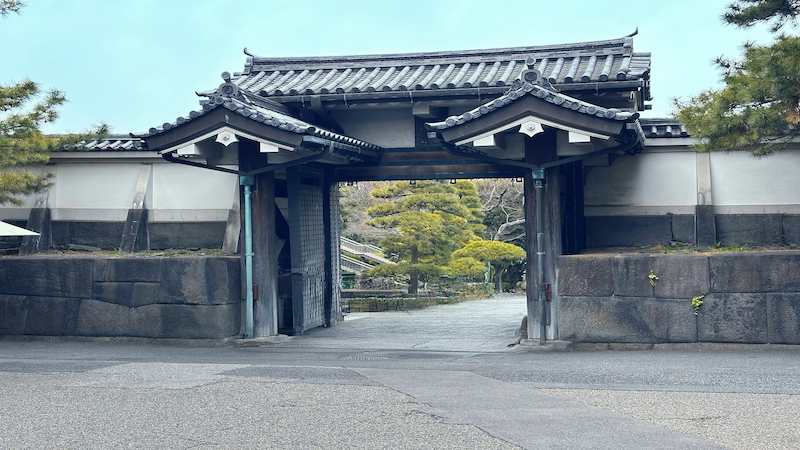
Kitahanebashi-mon Gate, located at the northern edge of the Honmaru, was a castle gate protecting the boundary between the Honmaru and Kitanomaru. As the name hanebashi, or “drawbridge,” suggests, the bridge in front of the gate was once designed to be raised in an emergency. Entering through this gate gives a direct view toward the Tenshudai Keep Base, and historically it functioned as a front line of defense on the castle’s northern side.
Today it serves as one of the entrances and exits of the Imperial Palace East Gardens. On the gate pillars, you can still see metal fittings said to have held the pulleys for the drawbridge. The views of Hirakawa Moat and Inui Moat are also beautiful, making this a fitting final stop in the Honmaru Area.
Detailed Historic Site Data
| Year Built | Unknown, estimated to date from the early Edo period |
|---|---|
| Builder | Tokugawa Shogunate |
| Structure and Features | Remains of a gate and bridge that protected the northern side of the Honmaru. The bridge is explained as having been designed to be raised in emergencies. |
| Current Condition | It is now used as one of the entrances and exits of the Imperial Palace East Gardens. The Chiyoda City Tourism Association describes the kabukimon-style gate and bridge as surviving elements. |
| Cultural Property Designation | This remnant is included within the Special Historic Site “Edo Castle Ruins.” Check official information for any individual structure designation. |
Highlights
- Traces of the Drawbridge: The metal fittings on the gate pillars are said to have held pulleys for the drawbridge. They are subtle details, but they bring the gate’s defensive function to life.
- View Toward the Tenshudai: Entering through the gate, the Tenshudai Keep Base appears directly ahead. This helps visitors understand the gate’s role in the northern defense of the Honmaru.
- Hirakawa Moat and Inui Moat: The surrounding moat scenery is beautiful and gives a strong impression of the northern edge of Edo Castle.
Trivia
- The Meaning of “Hanebashi”: Hanebashi means a bridge that can be raised. By lifting the bridge in an emergency, the gate could block access and strengthen the defense of the Honmaru.
- A Useful Exit Today: Today the gate is used as an entrance and exit of the Imperial Palace East Gardens and is convenient for visitors heading toward Takebashi Station.
| Address | 1-1 Chiyoda, Chiyoda City, Tokyo |
|---|---|
| From Tenshudai Keep Base | About 3 minutes on foot (approx. 200 m) |
| Suggested Time | Quick visit: about 5 minutes / In-depth visit: about 15 minutes |
| Admission | Free |
Open the map to see the relationship between the Tenshudai Keep Base and Kitahanebashi-mon Gate.
Frequently Asked Questions
Yes. Visitors can climb to the top of the Tenshudai Keep Base. From the stone base, about 11 meters high, you can enjoy sweeping views of the Imperial Palace East Gardens and central Tokyo, with especially beautiful scenery during cherry-blossom season.
It is on permanent display in the annex of the Honmaru Rest House in the Imperial Palace East Gardens. The model recreates the Kan’ei-period main keep at 1/30 scale and opened to the public on September 29, 2020. Viewing follows the opening days and hours of the Imperial Palace East Gardens.
If you visit the seven sites—Fujimi-tamon Defense House, Stone Chamber, Honmaru Site, reconstructed main-keep model, Daidokoro-mae Sanju-yagura Turret Site, Tenshudai Keep Base, and Kitahanebashi-mon Gate—at a quick pace, allow about 1 to 1.5 hours. For a deeper visit, plan for more than 2 hours.
Fujimi-tamon is the only surviving tamon structure at Edo Castle. Visitors can currently view the interior and experience its role as a defensive position and weapons storehouse through its longhouse-like space and narrow windows. However, public access may change, so check on-site guidance and official information when visiting.
After the main keep burned down in the Great Fire of Meireki in 1657, there were plans to rebuild it, but they were never realized because of the shogunate’s financial difficulties and political judgment. Hoshina Masayuki, a senior shogunal adviser, is said to have argued that the keep was not essential, leading to the cancellation of reconstruction.
Yes. Kitahanebashi-mon Gate is one of the entrances and exits of the Imperial Palace East Gardens, and it is convenient if you are heading toward Exit 1a of Takebashi Station on the Tokyo Metro Tozai Line. Opening days and closing times vary by season and events, so check the official Imperial Household Agency website before visiting.
Admission to the Imperial Palace East Gardens is free, and advance reservations are not required. All sites in the Honmaru Area can be visited free of charge. Opening hours and closed days vary by season and events, so please check the official Imperial Household Agency website before visiting.
Edo Castle Ruins Full Map
The Honmaru Area lies at the core of the Imperial Palace East Gardens. From Kitahanebashi-mon Gate, visitors can continue toward the Ninomaru Area or head out toward the Takebashi side.
Related Articles on the Edo Castle Ruins
Next Area: Ninomaru Area
Previous Area: Fujimi-yagura Turret Area
Edo Castle Table of Contents
Back to Main Page

☕ Support This Site
Following the Shogun is built on original fieldwork and on-site research.
If you found this guide useful, your support helps keep it going.

You can also support via QR code
This page is a historical travel guide created by Following the Shogun.


comment