


Saishoin Temple & Hirosaki Yasaka Shrine
An Edo-period pagoda designated as an Important Cultural Property, standing quietly a kilometer east of Hirosaki Castle — about 15–20 minutes on foot.
If you're visiting Hirosaki Castle, there's a short detour that rewards you with some of the finest traditional architecture in the Tohoku region.
Walking route from Hirosaki Castle to Saishoin Temple — approximately 15–20 minutes
Tucked into a quiet residential neighborhood about a kilometer east of Hirosaki Castle, Saishoin Temple stands around a five-storied pagoda designated as an Important Cultural Property. Built in the early Edo period, the pagoda has remained on this site for centuries — though it underwent a full dismantling and repair after typhoon damage in 1991. Walking through the gate, past wooden halls enclosed by trees, it's easy to see why this place stays with visitors long after they leave.
Hirosaki Yasaka Shrine sits directly adjacent to the temple grounds. The two sites share a single visit route and together take about 30 minutes.
Quick Summary
| Main Highlight | Five-Storied Pagoda — Edo-period original, nationally designated Important Cultural Property. One of the finest surviving wooden pagodas in the Tohoku region. |
|---|---|
| Pagoda Status | Original structure — date inscription from 1664. Full dismantling repair after Typhoon 19 (1991), completed 1994. Original with major repair — not untouched, not a reconstruction. |
| Other Structures | Gomado Hall (historical, Daienji-origin), Old Niomon Gate (built 1827, relocated ca. 1964, registered 2025), New Niomon Gate (built 1984), Bell Tower (rebuilt 1956), Main Hall (rebuilt, 20th century), purification basin |
| Co-spot | Hirosaki Yasaka Shrine — immediately adjacent. Not the same as Kyoto's Yasaka Shrine. |
| Visit Time | About 30 minutes combined (20 min Saishoin + 10 min Yasaka Shrine) |
| Admission | Normally free. Admission fees may apply during cherry blossom, Neputa Festival, and autumn foliage periods. Check current information before visiting. |
| From Hirosaki Castle | About 1 km east — 15–20 minutes on foot |
| From Hirosaki Station | About 30 min on foot, or bus to "Koko-mae" / "Honcho" stop, then a few minutes' walk |
| From Tokyo | Tohoku Shinkansen to Shin-Aomori (approx. 3 hr), then JR Ou Line to Hirosaki (approx. 35 min) |
| Address | 63 Doyamachi, Hirosaki, Aomori 036-8196 |
| Opening Hours | 9:00–16:30 (hours may vary by season) |
Is It Worth Visiting?
Yes — especially if you're already at Hirosaki Castle and want to experience traditional Japanese temple and shrine architecture alongside your visit.
Saishoin doesn't feel like a major tourist attraction. It sits quietly in a residential area, surrounded by trees, and most visitors arrive as part of a broader Hirosaki walk. That's exactly what makes it rewarding: the Edo-period pagoda is genuine, the grounds are unhurried, and the contrast between old wooden architecture and the surrounding neighborhood feels distinctly Japanese.
Walking from the gate, past the hall and up to the pagoda, then through to the adjacent Hirosaki Yasaka Shrine — the whole route takes about 30 minutes. For anyone visiting Hirosaki with an interest in the castle town's history, it's a natural extension of the day.
Getting There
| Nearest Station | JR Hirosaki Station (JR Ou Line) |
|---|---|
| By Bus | From Hirosaki Bus Terminal, take a route to "Koko-mae" (Hirosaki Koko-mae) or "Honcho" stop — both are a few minutes' walk from the temple. Bus fare approximately ¥150 (IC card ¥130) as of 2026; confirm current fares before traveling. |
| On Foot from Station | About 30 minutes |
| From Hirosaki Castle | About 1 km east of the castle's main gate area — roughly 15–20 minutes on foot. Along the way you'll pass a historical sign at the site of the former Shimoshirokane Pond, a detail connecting the walk to the castle town's history. |
| From Tokyo | Tohoku Shinkansen to Shin-Aomori (approx. 3 hr), then JR Ou Line to Hirosaki (approx. 35 min), then walk or bus as above |
| Parking | Limited spaces near the temple. Confirm availability on-site. |
Historical Background
Why does a pagoda stand in this quiet neighborhood?
Saishoin Temple's grounds trace their origins to a temple-shrine complex that existed before the Meiji-era policy known as shinbutsu bunri — the forced separation of Buddhism and Shinto.
Before the Meiji Restoration (1868), this site was part of the broader Daienji Temple complex, which combined Buddhist practice with the veneration of Gozu Tennō — a deity associated with disease prevention and the Gion Festival tradition. This blending of Buddhist and Shinto elements was common across Japan until Meiji government policy required the two practices to be formally separated.
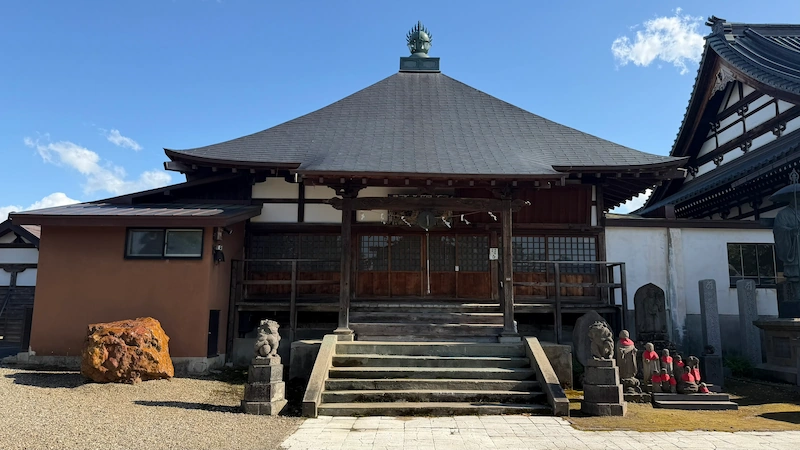
As a result, the Buddhist portion of the site continued as Saishoin, while the Shinto veneration of Gozu Tennō was carried on by the neighboring Hirosaki Yasaka Shrine. The Gomado Hall on the temple grounds is a surviving structure from the original Daienji complex, and it anchors the historical relationship between the two adjacent sites. The Tsugaru clan, who governed Hirosaki Castle and the surrounding castle town through the Edo period, were closely involved in shaping the religious landscape of this part of the city.
📜 How one site became two
The Meiji government's shinbutsu bunri policy required combined temple-shrine complexes throughout Japan to formally divide their religious functions. Sites that had venerated Buddhist and Shinto deities side by side under a single administration were required to separate.
The original Daienji complex was part of this transformation. The veneration of Gozu Tennō — linked to plague prevention and the Gion Festival tradition — continued under the new Hirosaki Yasaka Shrine, while the Buddhist portions of the site remained as Saishoin Temple. The Gomado Hall is one of the physical elements that bridges this transition: a surviving structure from the original Daienji complex, and one of the few tangible links between the two adjacent sites today.
The physical proximity of Saishoin and Hirosaki Yasaka Shrine is not a coincidence. It is a visible trace of the earlier, integrated worship tradition that existed here for centuries before the Meiji separation.
What Remains Today
Saishoin's grounds include several distinct structures with different histories and preservation statuses. Knowing which are original, rebuilt, or relocated helps set expectations before you visit.
Five-Storied Pagoda
Northernmost surviving Edo-period pagoda in Japan
The pagoda is the site's centerpiece. Standing 31.2 meters tall, it was built in the early Edo period on the initiative of Kyokai, the sixth abbot of Daienji, as a memorial for those who died on both sides during the Tsugaru clan's campaigns to unify the region. A 1664 ink inscription found inside confirms the construction date. When designated an Important Cultural Property in 1908, the original notes described it as "the finest pagoda in the Tohoku region" — the first cultural property designated in Aomori Prefecture.
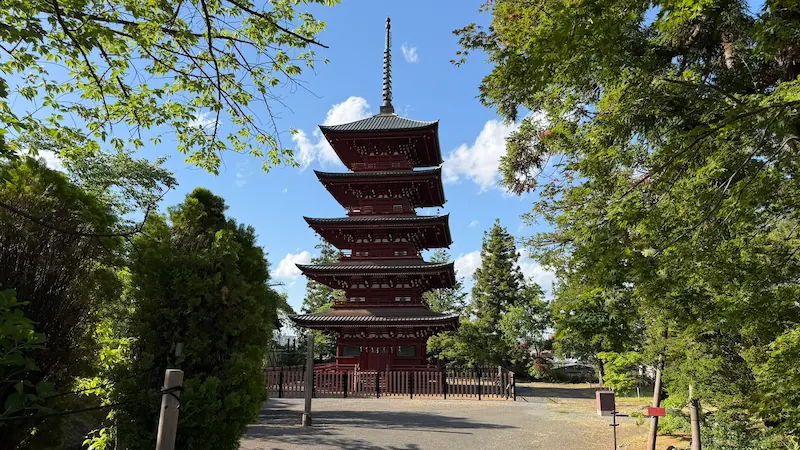
The pagoda is an original Edo-period structure, not a reconstruction. However, Typhoon 19 caused significant damage in 1991, and the entire structure underwent a full dismantling repair (kaitai shuuri): taken apart completely, each component inspected, repaired or reinforced, then reassembled. It is best understood as an original structure with major modern restoration.
📜 Pagoda Data
| Construction | Work began 1656 (Meireki 2). An ink inscription dated August 1664 (Kanbun 4) was found inside the structure, confirming when assembly was underway. Traditionally described as completed 1667 (Kanbun 7). |
|---|---|
| Commissioned by | Kyokai, 6th abbot of Daienji, under the patronage of the Tsugaru clan (3rd lord, Nobuyoshi) |
| Purpose | Memorial for those killed in the Tsugaru unification campaigns — enemy and ally alike, according to temple tradition |
| Height | 31.2 meters total |
| Designation | Designated Important Cultural Property April 23, 1908 (Meiji 41) — first in Aomori Prefecture. Original notes: "the finest pagoda in the Tohoku region." |
| Typhoon damage | Typhoon 19 (1991) caused significant structural damage. Full dismantling repair carried out; completed autumn 1994. Completion ceremony held spring 1995. |
| Current status | Original structure with major restoration. Exterior viewing only. |
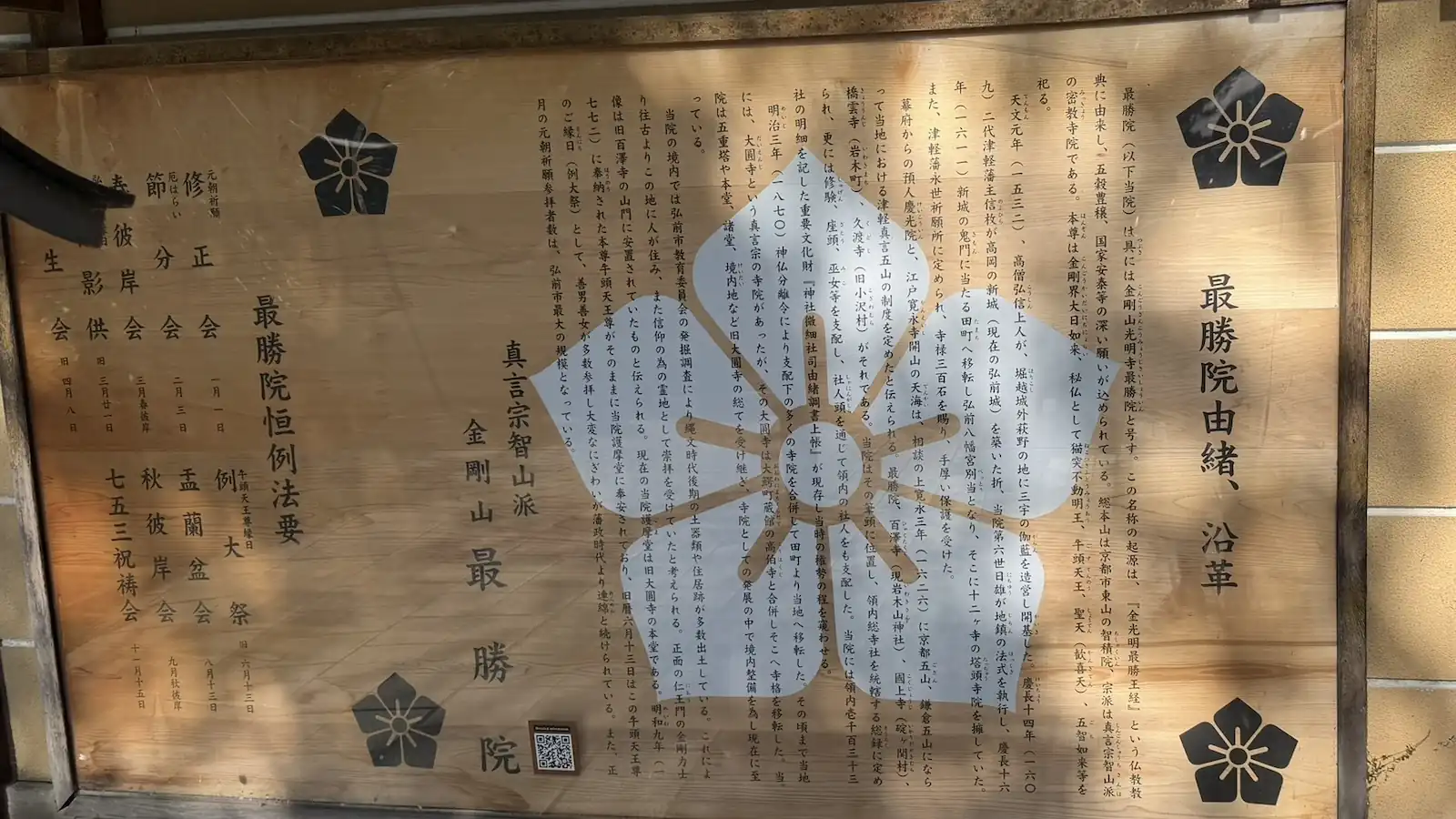
📋 On-Site Signs
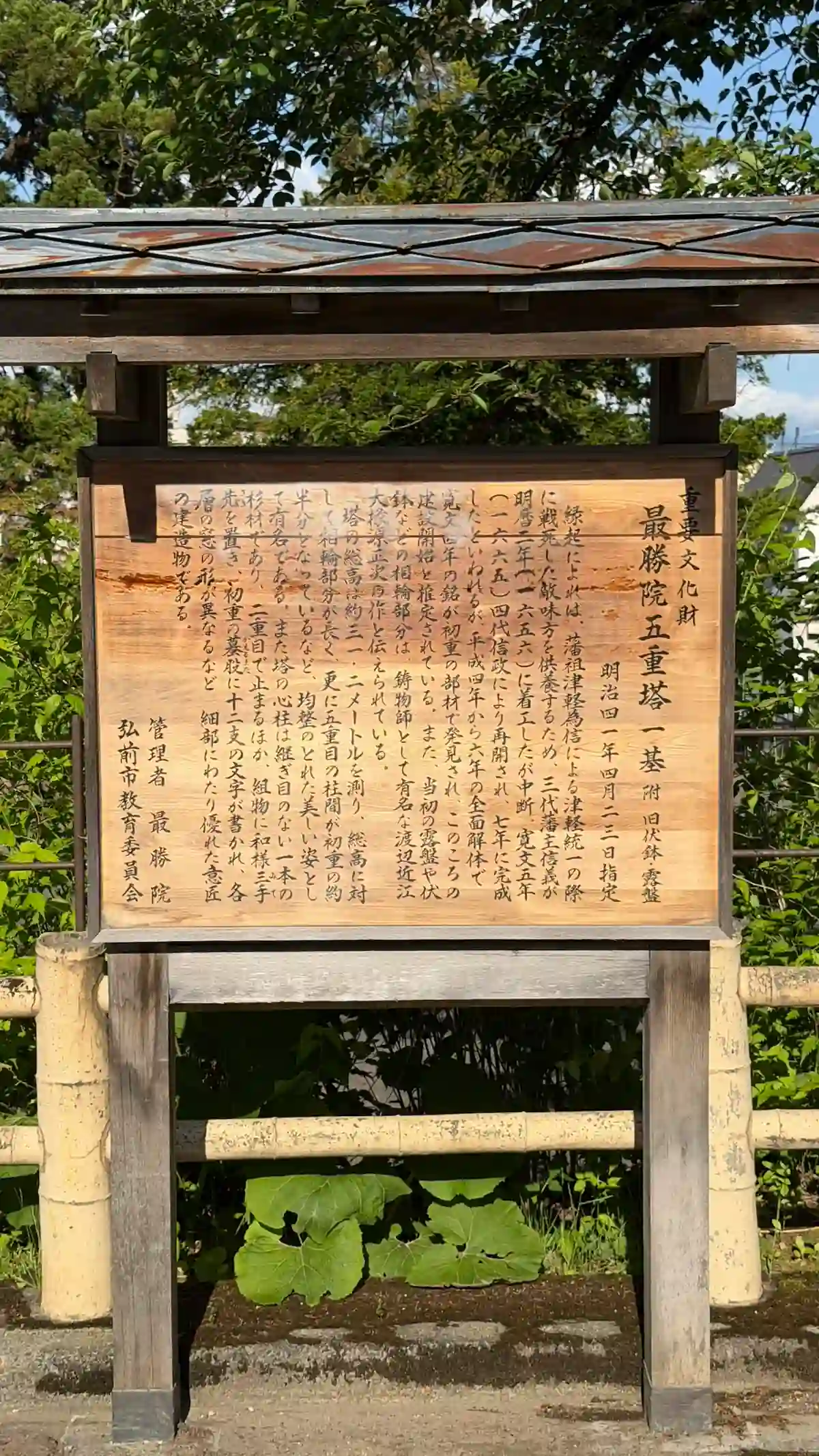
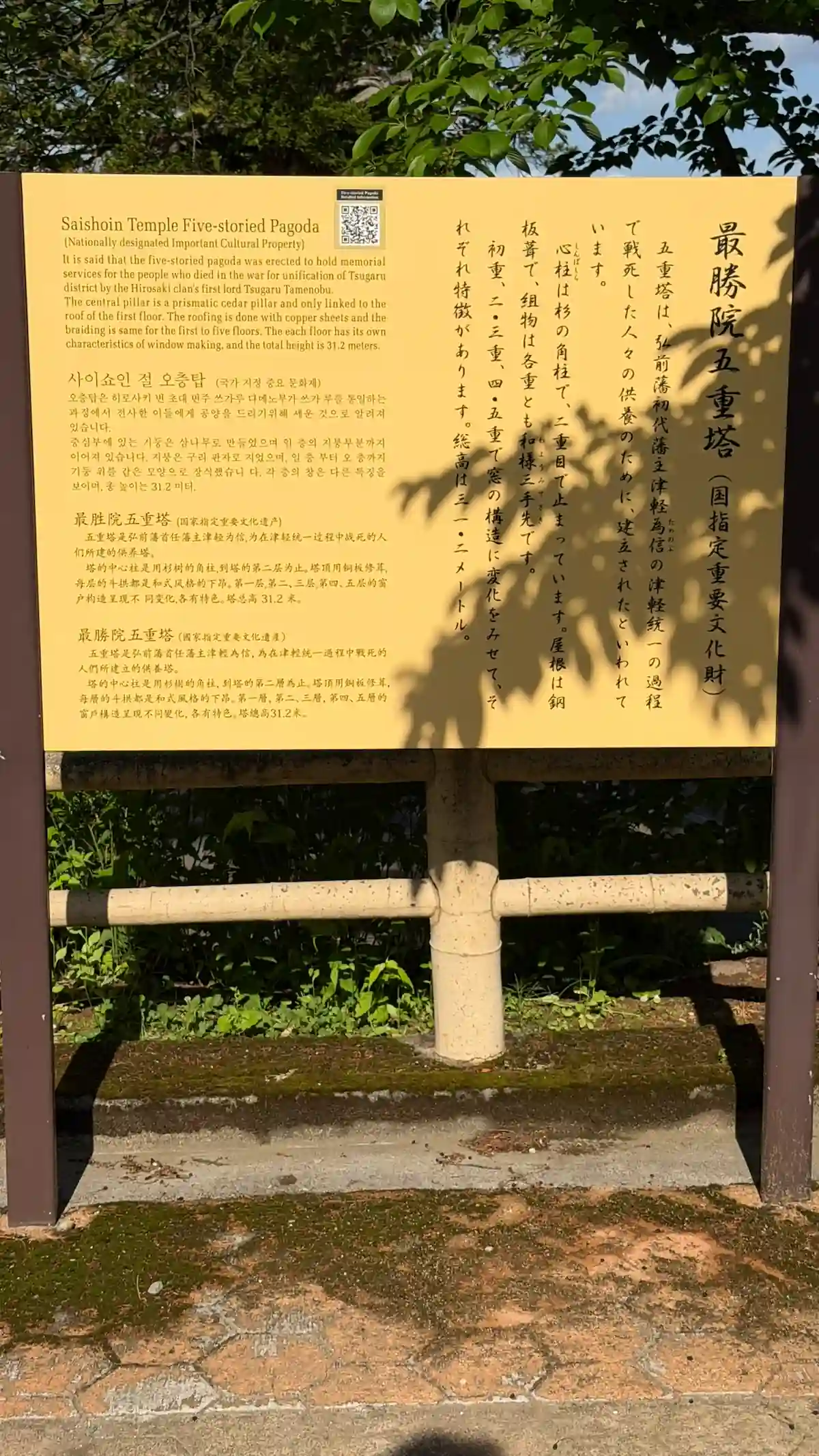
Tap to enlarge
Main Hall (Hondo)
Rebuilt in the 20th century
The current Main Hall was rebuilt in the 20th century. It enshrines the principal image of Dainichi Nyorai and stands on the grounds alongside the original pagoda.
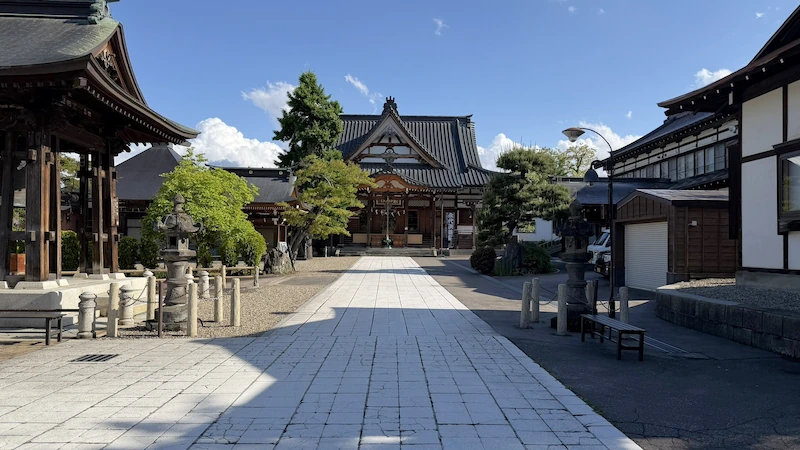
The Main Hall was rebuilt in the 20th century; the exact year of rebuilding is unclear. The roof was further modified in 2002.
Gomado Hall
Inherited from the original Daienji complex
The Gomado Hall is a surviving structure inherited from the original Daienji complex. It is described as the former main hall of the old Daienji and survived the Meiji-era separation of Buddhism and Shinto, remaining on the grounds as one of the few physical links between Saishoin and Hirosaki Yasaka Shrine. Construction date is unknown.
The Gomado Hall is described as the old main hall of the Daienji complex that once occupied this site. It survived the Meiji-era separation and still stands on the grounds today. Exact construction date: unknown.
Niomon Gates and Nio Statues
Old gate (1827) and new gate (1984)
There are two Niomon gates at Saishoin, each from a different period. The contrast between them reflects how the grounds have changed over the years.
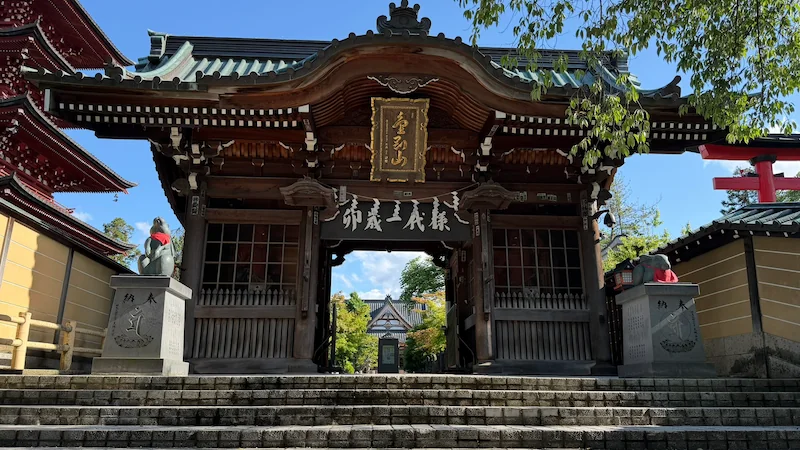
🏯 Old Niomon Gate
| Built | 1827 (Bunsei 10). Carpenter: Narita Yosaburo. |
|---|---|
| Repaired | 1927 (Showa 2) — roof re-covered |
| Relocated | Around 1964 (Showa 39) — moved from the western side of the grounds to its current position |
| Designation | Registered Tangible Cultural Property, November 17, 2025 (Reiwa 7) |
| Current status | Relocated / Registered Tangible Cultural Property |
🏯 New Niomon Gate (current main entrance)
| Built | 1984 (Showa 59) — constructed for the 1,150th memorial year of Kobo Daishi (Kukai) |
|---|---|
| Current status | Serves as the main entrance gate |
🗿 Nio Statues
The guardian Nio statues were carved in 1653 (Joo 2) — confirmed by a record found inside during restoration work. This makes them the oldest Nio statues in Aomori Prefecture. In 2017, one statue's eye fell loose; a full dismantling repair followed and was completed in 2022.
Bell Tower and Bell of Peace
Rebuilt after the original was lost in WWII
The original bell was requisitioned for the war effort during World War II and never returned. The current bell and tower were rebuilt in 1956 and are known as the "Bell of Peace." According to local tradition, the base platform reuses the pedestal of the former bronze statue of Tsugaru Tamenobu that once stood in Hirosaki Castle's main keep compound.
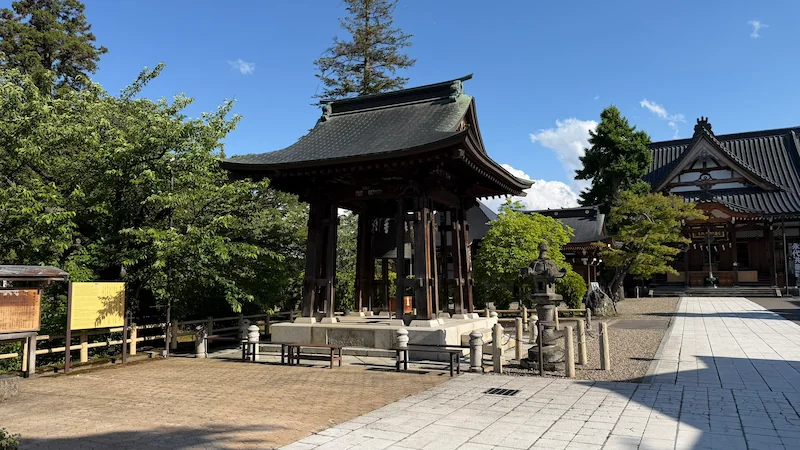
Purification Basin (Mizuya)
Ritual hand-washing before entering the hall
The stone basin near the approach to the main hall is used for ritual hand-washing before worship — a standard feature of temple and shrine grounds throughout Japan.
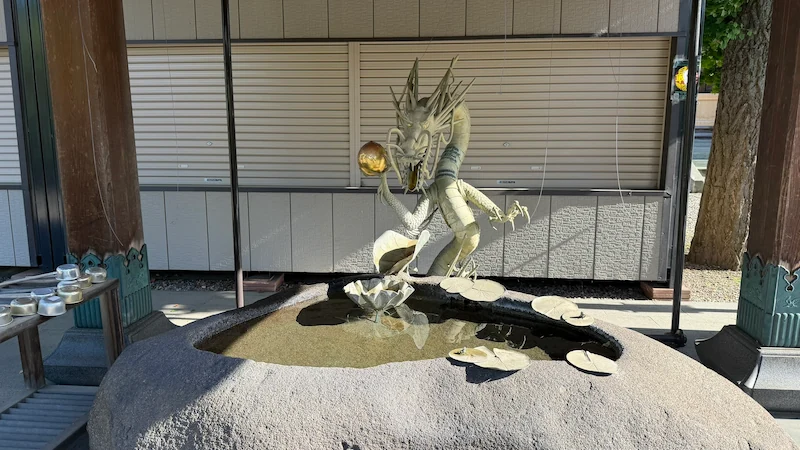
Hirosaki Yasaka Shrine
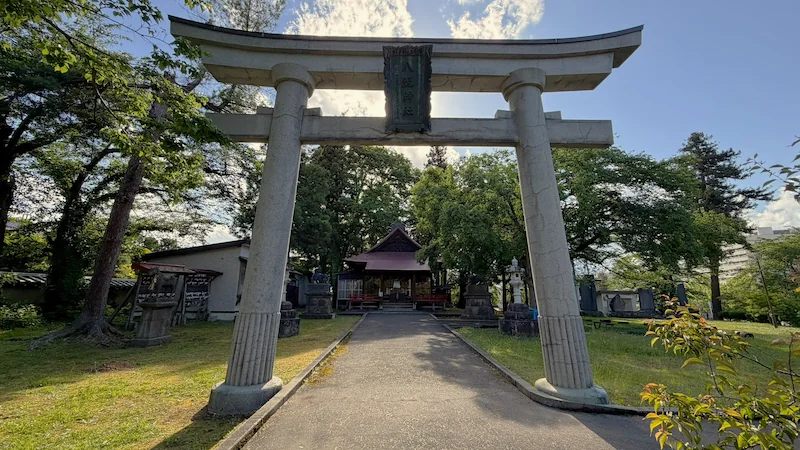
Hirosaki Yasaka Shrine and Kyoto's Yasaka Shrine share a name and both connect to Gozu Tennō veneration, but they are completely separate shrines. Hirosaki Yasaka Shrine is an independent local shrine rooted in Hirosaki's own history.
Hirosaki Yasaka Shrine sits directly adjacent to Saishoin and is easily visited as part of the same route. Most visitors walk naturally from the temple grounds into the shrine without retracing their steps.
The shrine continues the Shinto functions carried over from the former Daienji complex after the Meiji separation. Its annual Gion-e festival is usually held in late July and traces its origins to this tradition. For the current schedule, shrine hours, priest availability, or goshuin, please confirm directly with the shrine or local event information before visiting.
Traditions and Deeper Notes
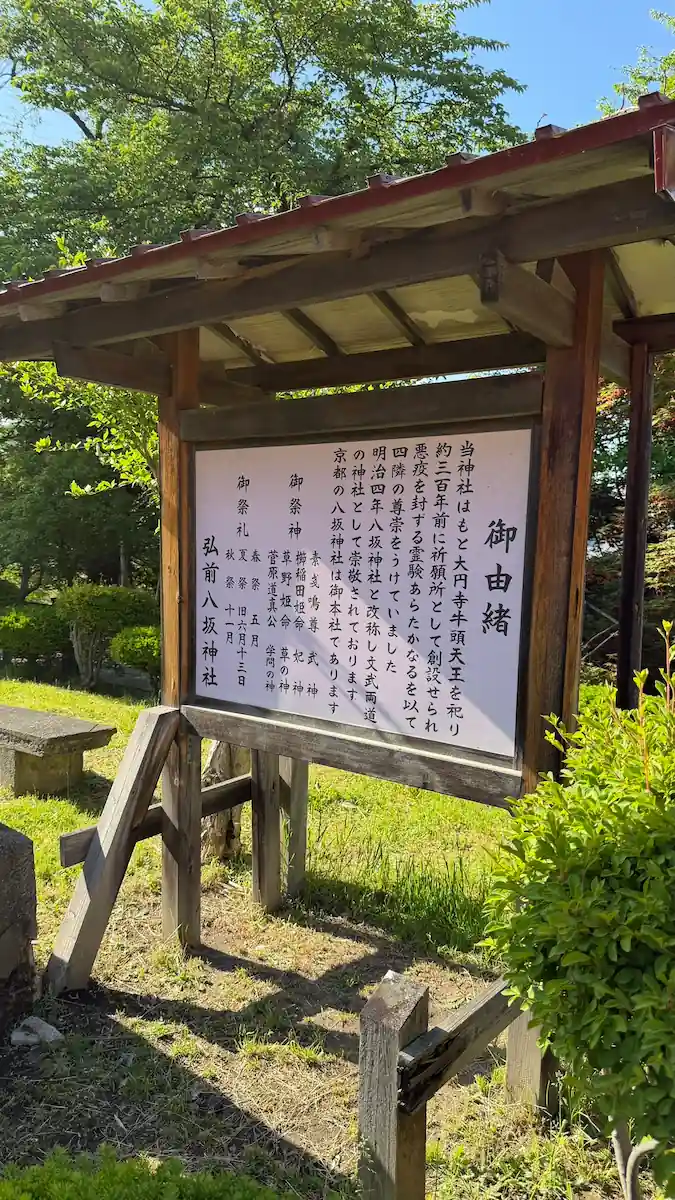
The pagoda's construction date is supported by a 1664 ink inscription found within the structure. Some sources refer to work beginning slightly earlier; the 1664 date represents the confirmed record of when assembly was underway. Completion is traditionally placed at 1667. On-site signs describe the history in detail and are worth reading during your visit.
The pairing of Saishoin and Hirosaki Yasaka Shrine reflects a pattern found throughout Japan: temple-shrine complexes administratively separated during the Meiji period, whose physical proximity remains as a visible trace of the earlier integrated tradition.
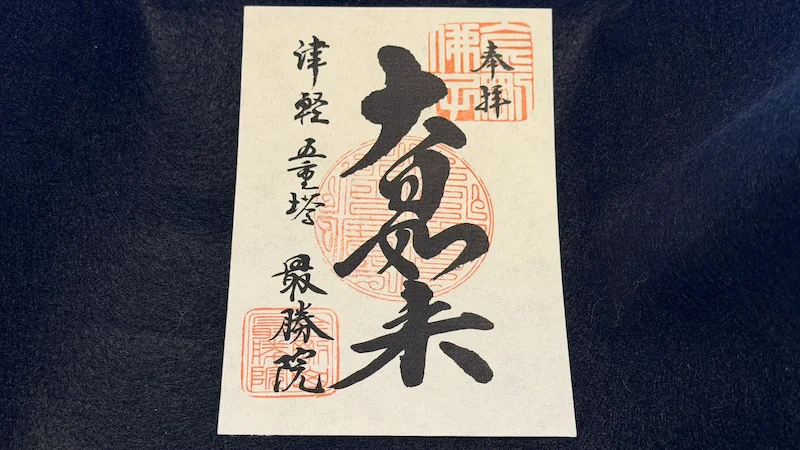
Goshuin (Temple Stamp)
During our visit, we were able to receive a goshuin — the calligraphy stamp collected at temples and shrines across Japan. For current availability, location, hours, and fee, please check directly with the temple before visiting.
Getting a Base in Hirosaki
Hirosaki is compact enough to cover in a day from Aomori City or Shin-Aomori Station, but staying overnight gives you more time for the castle, the temple district, and the lesser-known corners of the castle town. The area around Hirosaki Station has accommodation options at various price points.
FAQ
Nearby Sites
Saishoin and Hirosaki Yasaka Shrine fit naturally into a broader Hirosaki castle town itinerary.
☕ Support This Site
Following the Shogun is built on on-site research. If this article has been useful for your trip, your support is appreciated.

Scan to support via QR code


comment