


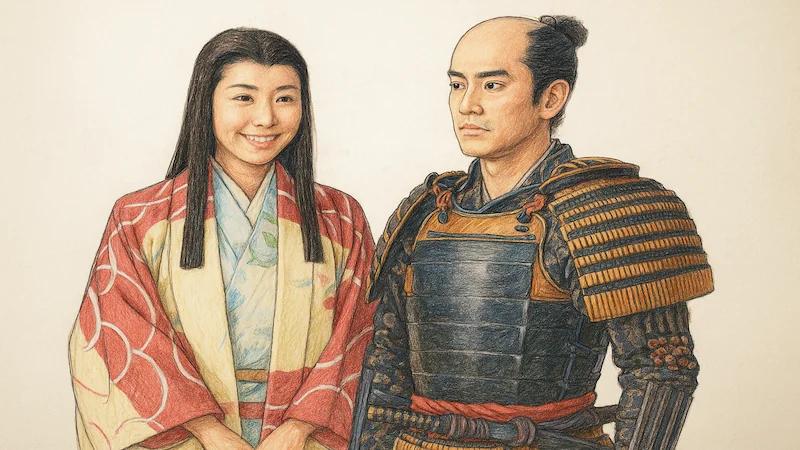
Toshiie and Matsu (2002 Taiga Drama) Review: Impressions and Historical Accuracy
A verdict after all 49 episodes, the highlights, and how the drama’s Matsu compares with the historical record.
Toshiie and Matsu (利家とまつ〜加賀百万石物語〜) is NHK’s 2002 taiga drama, the name for the broadcaster’s yearlong historical series. Across 49 episodes it follows the samurai Maeda Toshiie and his wife Matsu from his early years serving Oda Nobunaga to the survival of the Maeda family after his death. I watched every episode on NHK On Demand, and this review covers my verdict, the highlights, and how the drama compares with the historical record. Spoilers are flagged before they appear.
Verdict: Five Stars If You Love the Sengoku Period
| Rating | ★★★★★ for viewers who love the Sengoku period, Japan’s era of warring states, and its three unifiers: Nobunaga, Hideyoshi, and Ieyasu |
|---|---|
| Best for | Anyone who wants to learn about Sengoku warlords |
| Highlights | The exchanges between Toshiie and Hideyoshi, and the warmth between Toshiie and Matsu |
| Drawbacks | Slow stretches over 49 episodes, and the question of how much of Matsu’s role is historical |
| How I watched | All 49 episodes on NHK On Demand |
| English subtitles | None that I recall |
Toshiie crossed paths with Nobunaga, Hideyoshi, Ieyasu, Shibata Katsuie, and many other leading figures. Follow his life through this drama, and the Sengoku stories you watch or read afterward begin to connect: separate dots become lines. It is a series that makes the period more rewarding to explore.
What Is Toshiie and Matsu?
Where most taiga dramas center on Nobunaga, Toyotomi Hideyoshi, or Tokugawa Ieyasu, this one tells the Sengoku period from the side of the lords and wives around them. Toshiaki Karasawa plays Toshiie, and Nanako Matsushima plays Matsu.
| Title | Toshiie and Matsu (利家とまつ〜加賀百万石物語〜, Toshiie to Matsu: Kaga Hyakumangoku Monogatari) |
|---|---|
| Broadcaster | NHK, 41st taiga drama |
| Aired | January 6 to December 15, 2002 |
| Episodes | 49 |
| Leads | Toshiaki Karasawa (Maeda Toshiie), Nanako Matsushima (Matsu) |
| Writer | Yō Takeyama (竹山洋) |
| Music | Toshiyuki Watanabe (渡辺俊幸) |
| Average rating | 22.1% (Kanto region, household rating, average over the full run; Video Research) |
A note on terms. The Maeda domain became known as the “million-koku” domain. A koku was a unit of rice, roughly what one person ate in a year, and a lord’s rank was measured in koku. Kaga, the Maeda territory, grew into the largest domain of the Edo period.
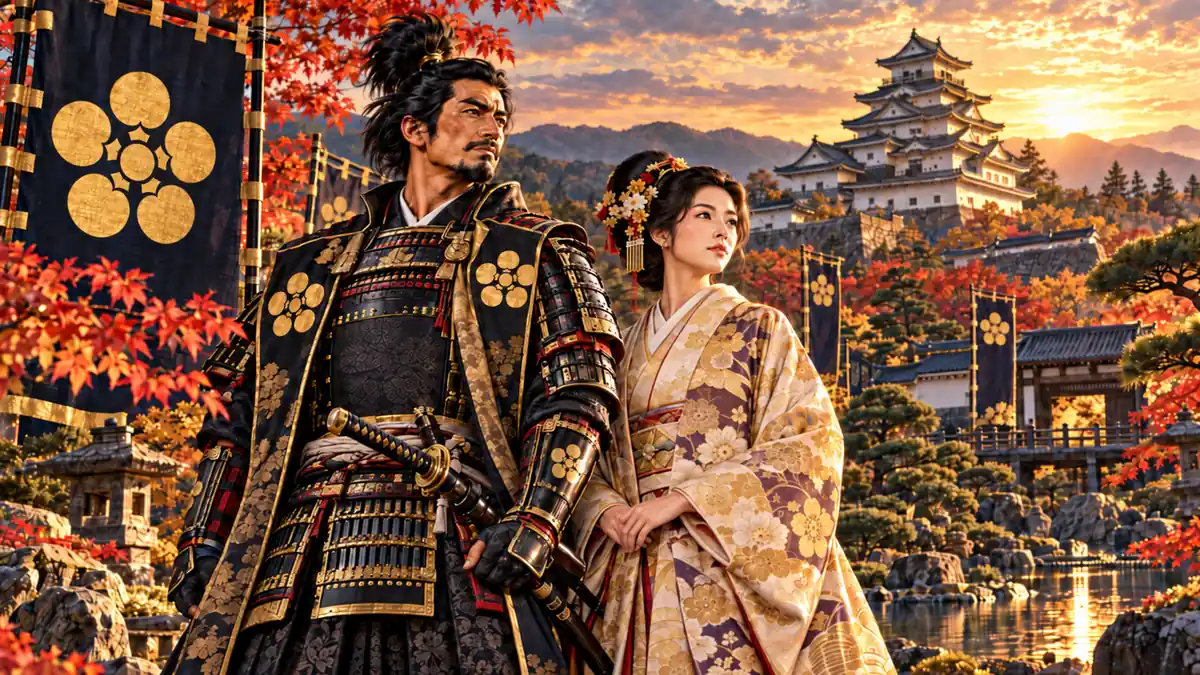
Main Characters and Cast
The main characters and cast are below. Matsu, Toshinaga, Keijirō, and Go-hime were played by other actors in their younger years; the table lists the adult roles.
| Maeda Toshiie | Toshiaki Karasawa. The lead. Serves Nobunaga, later Hideyoshi, and lays the foundation of the Maeda domain. |
|---|---|
| Matsu | Nanako Matsushima. Toshiie’s wife. She backs her husband but also makes her own decisions to protect the family. |
| Oda Nobunaga | Takashi Sorimachi. Toshiie’s lord. |
| Toyotomi Hideyoshi | Teruyuki Kagawa. A friend of Toshiie from their youth who later rules Japan. |
| Nene | Noriko Sakai. Hideyoshi’s wife and a close friend of Matsu. The drama calls her One (おね). |
| Tokugawa Ieyasu | Masahiro Takashima. The daimyo (feudal lord) who gains power after Hideyoshi’s death. |
| Shibata Katsuie | Ken Matsudaira. A senior Oda retainer whom Toshiie calls “Oyaji-sama” (親父様), roughly “father figure.” |
| Sassa Narimasa | Yuichiro Yamaguchi. One of the three lords who governed Fuchu with Toshiie. |
| Maeda Toshinaga | Hideaki Ito. Toshiie and Matsu’s eldest son, who inherits the family. |
| Maeda Keijirō | Mitsuhiro Oikawa. A flamboyant “kabukimono” (eccentric) of the Maeda clan. |
| Sawaki Yoshiyuki (佐脇良之) | Yutaka Takenouchi. A warrior with close ties to Toshiie. |
| Go-hime | Risa Sudo. Toshiie and Matsu’s daughter, adopted by Hideyoshi. |
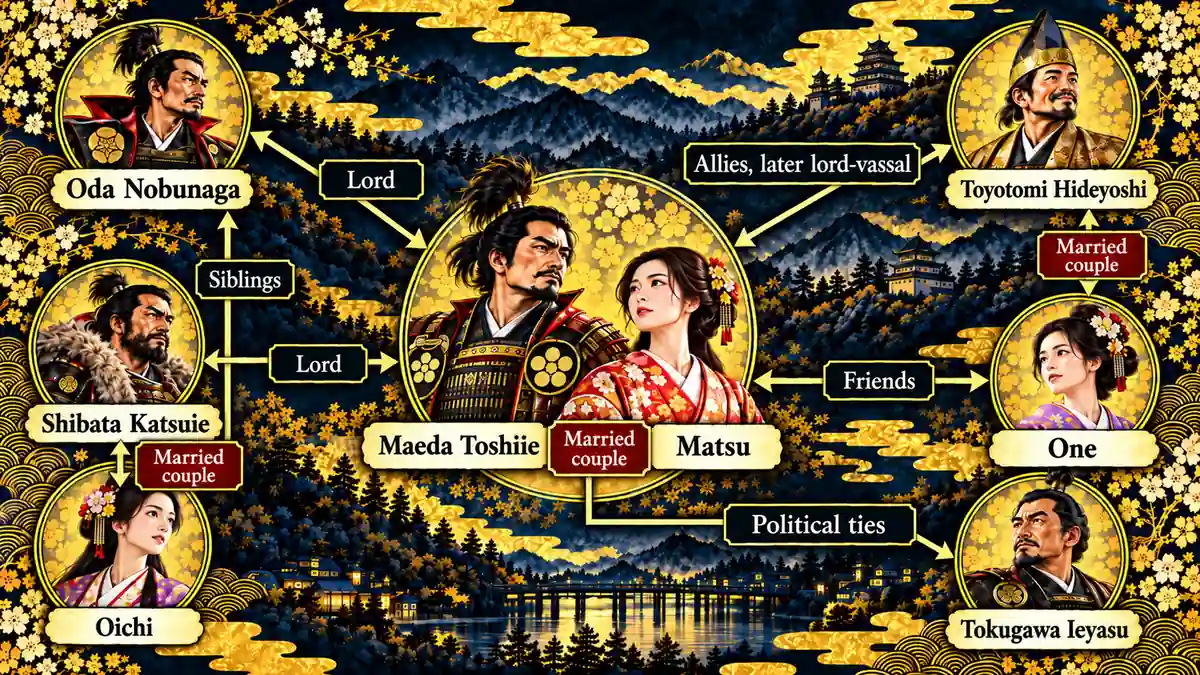
Three relationships carry the story. The first is Toshiie and Matsu themselves. The second is Toshiie’s position between Katsuie and Hideyoshi: Katsuie is the senior he looks up to, Hideyoshi the friend he grew up beside. The third is the bond between Matsu and Nene, wife of Hideyoshi.
For Toshiie’s own life story, see the Maeda Toshiie biography. For the three unifiers, see the profiles of Nobunaga, Hideyoshi, and Ieyasu.
Plot by Era (No Spoilers)
The story opens with the young Toshiie in Nobunaga’s service. Here is how it unfolds, era by era, without giving away the ending.
Serving Nobunaga (to the 1570s)
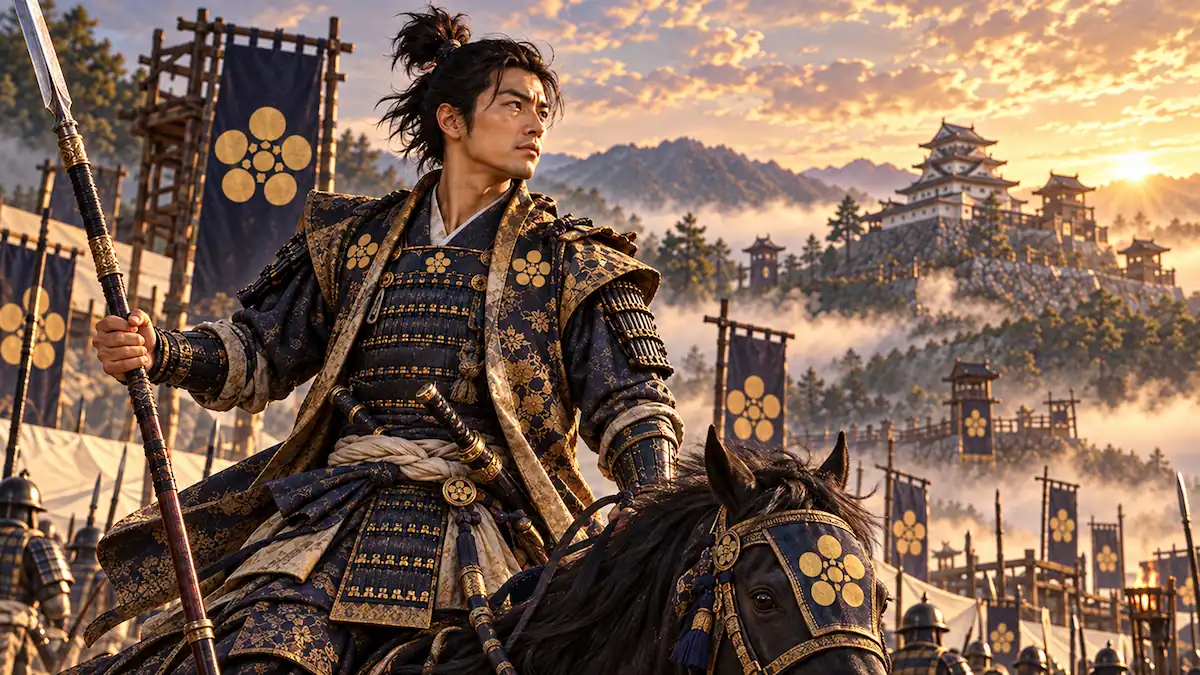
Toshiie was born in Arako, in Owari Province (roughly western Aichi Prefecture today; Arako is now part of Nagoya), and served Oda Nobunaga, the warlord who began the unification of Japan. His skill with the spear earned him the nickname “Mataza of the Spear” (槍の又左). His start was rough. In 1559 he killed Jūami, an attendant of Nobunaga, fled, and was barred from service. In 1560 he joined the Battle of Okehazama without permission and took three heads, yet was still not forgiven. A strong showing at the Battle of Morube in 1561 finally won him a return.
Echizen and Shizugatake (1575–1583)
In 1575 Toshiie, Sassa Narimasa, and Fuwa Mitsuharu were given charge of Fuchu in Echizen Province (now Echizen City, Fukui Prefecture). They became known as the “Three Lords of Fuchu” (府中三人衆). According to Echizen City, the three governed three districts around Fuchu, 100,000 koku in total, by joint decision.
In 1582, Nobunaga was killed by his general Akechi Mitsuhide in the Honnō-ji Incident in Kyoto. In 1583, Shibata Katsuie and Hideyoshi, who had risen to Nobunaga’s succession, fought at Shizugatake, in present-day Shiga Prefecture. Toshiie stood with Katsuie, then withdrew in the middle of the battle. NHK’s episode 31, “Husband and Wife at Shizugatake” (賤ヶ岳の夫婦), and episode 32, “Burning Castle: Katsuie and Oichi” (炎上、勝家と市), cover this period. After the battle Toshiie joined Hideyoshi and entered Kanazawa Castle.
Under Hideyoshi, and Ieyasu’s rise (1583–1598)
Under Hideyoshi, who had become ruler of Japan, Toshiie’s lands grew, beginning with two districts of Kaga added after Shizugatake. His daughter Go-hime was adopted by Hideyoshi and later married Ukita Hideie. In Hideyoshi’s last years, Toshiie became one of the senior lords, with Ieyasu among them, charged with supporting Hideyoshi’s young son Hideyori. In the drama, the friendship between Toshiie and Hideyoshi runs through this long stretch of time.
What I Thought: Highlights and Drawbacks
Toshiie and Hideyoshi
What stays with me most are the exchanges between Toshiie and Hideyoshi. Friends since their youth, the two keep a close eye on each other even after Hideyoshi becomes ruler of Japan and Toshiie his vassal.
Toshiie and Matsu
The other highlight is the warmth between Toshiie and Matsu. Matsu is the steady, capable one who supports Toshiie, and their marriage is the thread that runs through all 49 episodes. Of the whole cast, my favorite character is Toshiie himself.
Drawbacks
Two things gave me pause. The first is length: over 49 episodes, some stretches feel slow.
The second is Matsu. The drama has her not only supporting Toshiie but acting on her own to protect the family, and I wondered whether the real Matsu did quite so much. The History vs. Drama section below checks that against the sources.
The Ending (Spoilers): Toshiie’s Death and Matsu’s Journey to Edo
This section and the next reveal the plot of episode 49, “Eternal Love” (永遠の愛), and what happened after Toshiie’s death. If you have not seen the drama, skip ahead to Places to Visit.
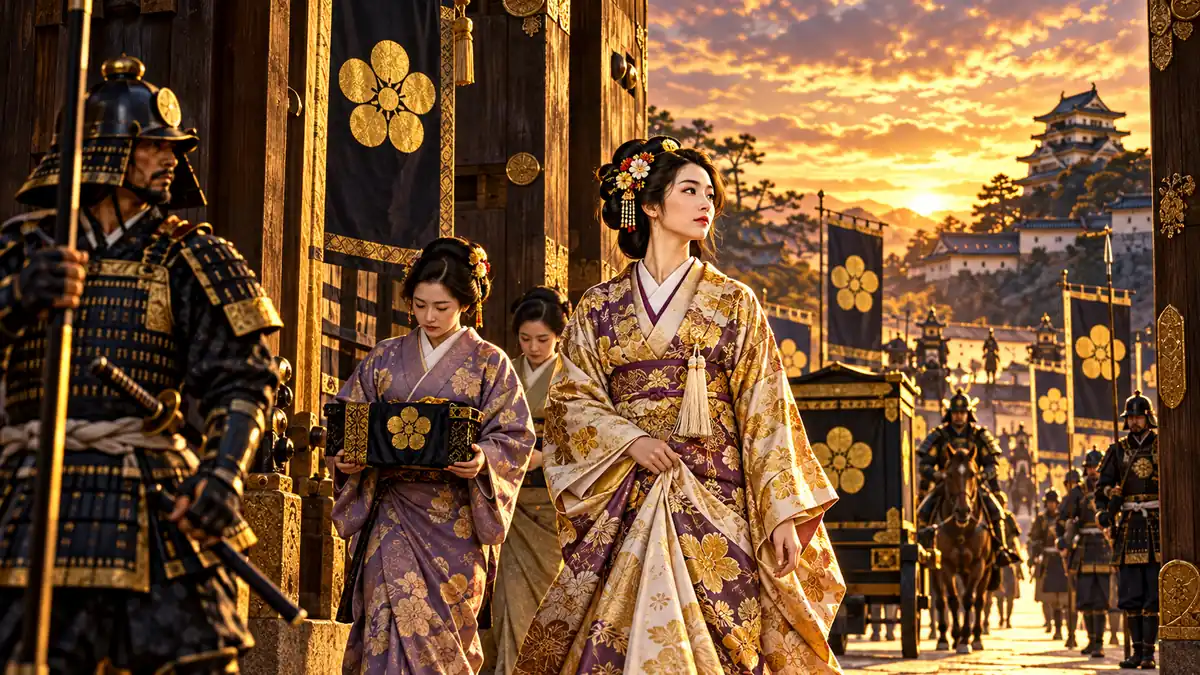
According to the official synopsis of episode 49 on NHK On Demand, the final episode opens with Toshiie, sensing his end, having Matsu write down his last wishes before he dies. Toshinaga, told to stay in Osaka, takes over the guardianship of Hideyori. Yodo-dono, Hideyoshi’s concubine and Hideyori’s mother, tries to draw him into a faction against Ieyasu. Ieyasu, wanting to avoid a war with the Maeda, asks Matsu to come to him as a hostage, and she sets out for Edo of her own accord.
Historically, Toshiie died in Osaka on April 27, 1599 (the third day of the intercalary third month of Keichō 4), at the age of 62. In his last years he served as guardian of Hideyori and supported him in Osaka Castle. What happened to the Maeda after his death is covered in the next section.
History vs. Drama: What the Sources Confirm
Dialogue and feelings in a drama come from the script. For each scene below, how the drama shows it is kept separate from what the sources confirm, starting with Matsu.
Did Matsu really do all that?
| In the drama | In the final episode, per NHK’s official synopsis, Matsu leaves for Edo as a hostage. |
|---|---|
| What the sources confirm | Toshiie died in 1599, and rumors then spread that Toshinaga was plotting against Ieyasu. Kanazawa City says the family sent Toshinaga’s mother, Hōshun-in (Matsu), to Edo as a hostage to show he had no such intent. The Maeda Tosa-no-kami Family Museum states that she lived in Edo as a hostage from the fifth year of Keichō (1600) and returned to Kanazawa in the nineteenth year (1614). |
| What cannot be said | That Matsu negotiated with Ieyasu as an equal and brokered a peace. A hostage is a political condition imposed to clear suspicion, and none of the sources I checked support that reading. That the hostage arrangement helped the Maeda survive does fit the record. |
The sources confirm that Matsu lived in Edo as a hostage. The rest of what the drama gives her is best taken as the writers’ portrayal.
Did friendship alone explain the retreat at Shizugatake?
| In the drama | Toshiie is shown caught between Katsuie and his friend Hideyoshi. |
|---|---|
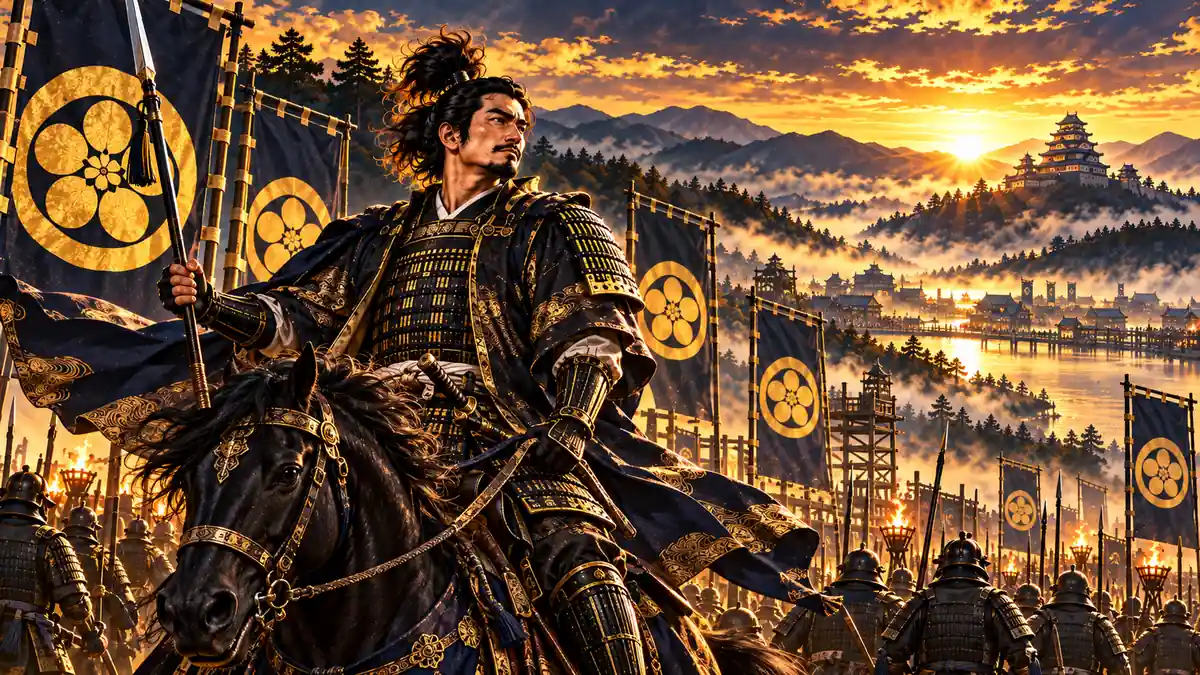
| What the sources confirm | In April 1583 Toshiie took about 5,000 men into position on Katsuie’s side, then withdrew during the fighting, a move that sealed Hideyoshi’s victory. He then led Hideyoshi’s advance against Kitanosho Castle, kept his home territory, and was granted two more districts of Kaga. |
| What cannot be said | Why he withdrew. One theory holds that he had already accepted Hideyoshi’s overtures, but there is no way to settle his motive. Friendship and guilt are best read as feelings written into the drama. |
You can see the battlefield in our Shizugatake guide. Katsuie’s headquarters is covered in the Genbao Castle Ruins article.
Was the Fuchu 100,000 koku Toshiie’s?
| What the sources confirm | Echizen City says Nobunaga had Fuwa Mitsuharu, Sassa Narimasa, and Maeda Toshiie govern the area around Fuchu, three districts totaling 100,000 koku, by joint decision. The city’s chronology dates this to 1575. |
|---|---|
| Easy to misread | The 100,000 koku is the combined figure for the three men, not Toshiie’s alone. One account gives Toshiie’s own holding as 33,000 koku, which with the other two comes close to 100,000. |
Dramatic license
Some scenes, such as the exchanges between Nobunaga and Matsu, have no basis in the record and are the writers’ invention. The lack of a record does not prove a scene never happened, and an invented scene can still work as drama.
Places to Visit After Watching
These are places tied to the history of Toshiie and Matsu, not filming locations. Some are not Sengoku-era sites. Kanazawa is the main city of the Hokuriku region on the Sea of Japan coast, reached from Tokyo by the Hokuriku Shinkansen. From Kyoto or Osaka, take the JR Thunderbird limited express to Tsuruga Station and change to the Hokuriku Shinkansen. Check current timetables with JR before you travel. For the full picture, see Toshiie Maeda’s 25 Spots in Kanazawa and the main Toshiie guide.
| Kanazawa Castle Park (金沢城公園) | The castle Toshiie entered in 1583. Edo-period originals and reconstructed buildings stand side by side. → Kanazawa Castle Park complete guide, 1-hour route |
|---|---|
| Oyama Shrine (尾山神社) | Enshrines Toshiie and Matsu. According to the shrine’s history page, it was founded in 1873 on the site of Kanayagoten, an outer bailey of Kanazawa Castle, and its gate was completed in 1875. It is not a Sengoku-era building. → Kenrokuen and Oyama Shrine |
| Grave of Maeda Toshiie | Toshiie’s resting place. With the nearby temple, it is a place to remember him rather than a historic stage. → Grave of Toshiie Maeda and Tentokuin Temple |
| Shizugatake (Shiga Prefecture) | The site of the 1583 battle where Toshiie withdrew. → Shizugatake guide, Genbao Castle Ruins, Kitanosho Castle Ruins |
Where to Watch Toshiie and Matsu
I watched all 49 episodes on NHK On Demand and don’t recall any English subtitles. Availability, covered episodes, and pricing change over time, and the full series, digests, and individual episodes may be handled differently. The official NHK On Demand page is in Japanese. I could not confirm an official English-subtitled release or whether the service can be used outside Japan, so check the page for the current status.
Frequently Asked Questions
If you love the Sengoku period and Nobunaga, Hideyoshi, and Ieyasu, I give it five stars. Toshiie crossed paths with so many leading figures that following him makes other Sengoku stories easier to connect. At 49 episodes, some stretches feel slow.
Anyone who wants to learn about Sengoku warlords. Following Toshiie shows how Nobunaga, Hideyoshi, Ieyasu, Shibata Katsuie, and others were linked, which helps when you watch other dramas about the period.
It aired from January 6 to December 15, 2002, as NHK’s 41st taiga drama. There are 49 episodes. Toshiaki Karasawa played Maeda Toshiie and Nanako Matsushima played Matsu.
Scenes with no record, such as conversations between Nobunaga and Matsu, are invented. Toshiie’s withdrawal at Shizugatake is historical, but the reason cannot be established. The 100,000 koku of Fuchu was shared by three men, not Toshiie alone.
After Toshiie’s death, rumors spread that Toshinaga was plotting against Ieyasu. To show there was no such intent, his mother Matsu was sent to Edo as a hostage. She went there in 1600.
I watched it on NHK On Demand and don’t recall any English subtitles. I could not confirm an official English-subtitled release or whether the service works outside Japan, so check the official NHK On Demand page for the current status.
Sources
- Video Research: NHK Taiga Drama ratings (Japanese)
- Toshiie and Matsu: cast and broadcast data (Japanese Wikipedia)
- Echizen City: history of Echizen, the Three Lords of Fuchu (Japanese)
- Echizen City: historical chronology (Japanese)
- Kanazawa City: Sengoku to Edo periods (Japanese)
- Maeda Tosa-no-kami Family Museum: Hōshun-in (Japanese)
- Oyama Shrine: history (Japanese)
- NHK On Demand: Toshiie and Matsu (Japanese)
Related Pages
☕ Support This Site
Following the Shogun is built on original fieldwork and on-site research.
If you found this guide useful, your support helps keep it going.

You can also support via QR code


comment