


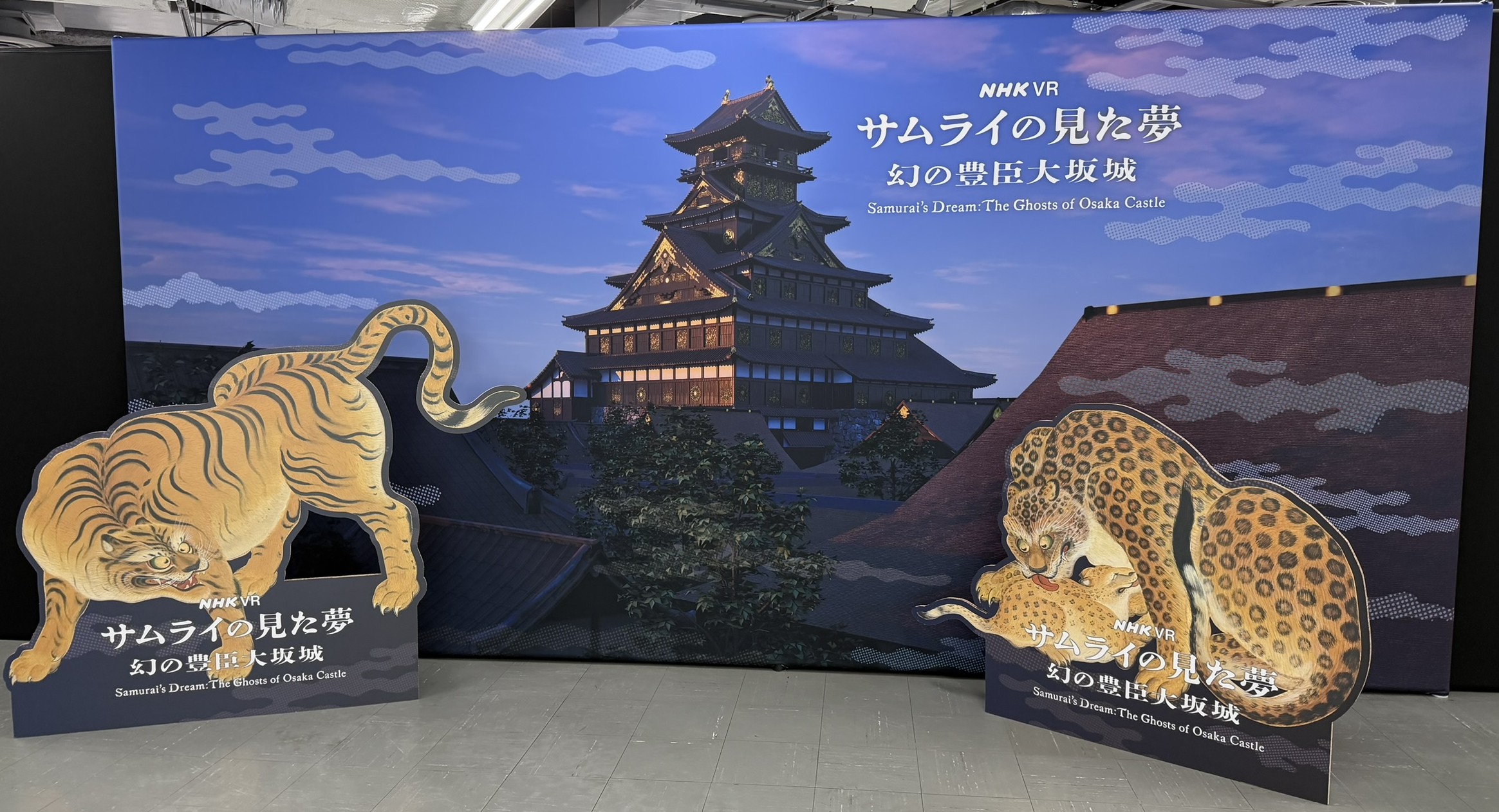
This page covers everything you need to know about the NHK VR event “Samurai’s Dream: The Ghosts of Osaka Castle” at Shibuya BEAM in Tokyo.
- Event overview, ticket prices, and access information
- Practical tips before you go (restrooms, glasses, escalators, etc.)
- Exhibition highlights inside the venue
- VR experience review (spoiler sections are hidden behind an accordion)
- Post-VR exhibits: the Golden Tea Room and Hideyoshi’s helmet
- What makes this event special for history enthusiasts
- Honest thoughts on value for money
- Introduction
- Event Overview
- Access and Preparation
- Arriving at the Venue: Stepping onto the 4th Floor
- The Video Panel Corridor: Gateway to the Toyotomi World
- The Chaos of the Battlefield: Taiga Drama Props Exhibition
- Map of Toyotomi Osaka Castle: A Pre-VR Briefing
- The VR Experience: Traveling 400 Years Back to Toyotomi Osaka Castle
- Post-VR Exhibits: The Golden Tea Room and Hideyoshi’s Helmet
- What This Event Means for History Enthusiasts
- Value for Money
- Practical Information Summary
- Frequently Asked Questions (FAQ)
Introduction
From March 20 to May 31, 2026, the BEAM Gallery on the 4th floor of Shibuya BEAM in Tokyo is hosting NHK VR “Samurai’s Dream: The Ghosts of Osaka Castle” (サムライの見た夢~幻の豊臣大坂城~). This immersive event brings together NHK’s expertise from its taiga dramas and history programs to recreate Toyotomi Osaka Castle — a magnificent fortress lost over 400 years ago — in virtual reality.
A quick note for context: the Osaka Castle that stands today is not the one Toyotomi Hideyoshi built. The Toyotomi-era castle fell during the Siege of Osaka in 1615, and the Tokugawa shogunate later rebuilt Osaka Castle on a different plan. Many of the stone walls, moats, and historic structures visible today date from the Tokugawa period or later, while the current Main Tower is a 1931 reconstruction. What Hideyoshi built — a castle often imagined with black lacquer and lavish gold decoration — has been lost to history. This VR event brings that vanished Toyotomi Osaka Castle back to life.
I visited on Saturday, March 29, shortly after the event opened, and here is my full report.
Event Overview
| Item | Details |
|---|---|
| Event Name | NHK VR “Samurai’s Dream: The Ghosts of Osaka Castle” |
| Dates | March 20, 2026 (Fri/Holiday) – May 31, 2026 (Sun) |
| Hours | 10:00 AM – 9:00 PM (Last entry: 8:30 PM) |
| Venue | Shibuya BEAM 4F, BEAM Gallery (31-2 Udagawacho, Shibuya-ku, Tokyo) |
| Duration | Approx. 40 min (25 min VR experience + 15 min setup/instructions) |
| Organizer | NHK, NHK Promotions |
| Co-production | NTT Docomo Studio & Live, VIVERSE (HTC Group) |
Ticket Prices
| Category | Weekdays | Weekends/Holidays |
|---|---|---|
| General | ¥2,500 | ¥3,000 |
| Junior/Senior High School | ¥1,000 | ¥1,000 |
| Elementary School | ¥500 | ¥500 |
Children aged 6 or younger cannot participate in the VR experience. Children aged 7–12 need to be accompanied by a guardian aged 18 or older and must provide a consent form signed by a legal guardian. According to the Japanese official FAQ, children aged 10 or younger also need to participate with an accompanying person aged 13–69.
Access and Preparation
Getting There
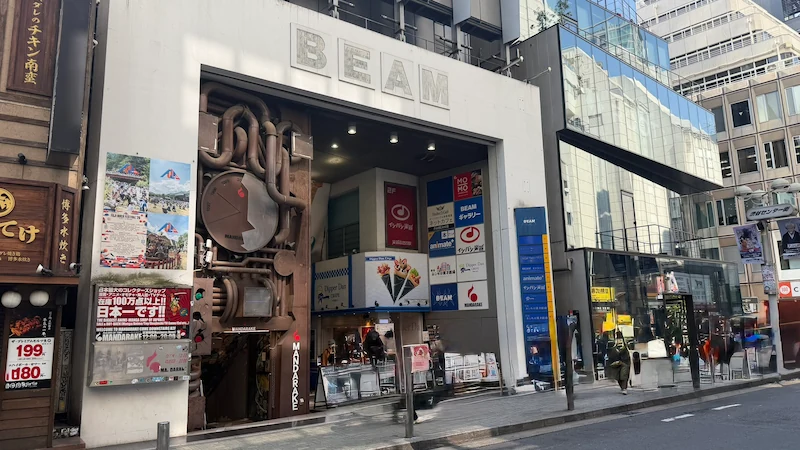
Shibuya BEAM is about a 5-minute walk from Shibuya Station (JY20/G01/Z01/F16/TY01/DT01/IN01). Head through Center-gai (Center Street) and look for the building with distinctive pipe-shaped sculptures on its facade. It is home to Mandarake and other shops, so it is easy to spot.
Buying Tickets
Tickets are sold for designated time slots through Asoview and Fever. The official English ticket page states that advance ticket purchase is required, so booking ahead is strongly recommended. According to the Japanese official FAQ, same-day tickets may be available at the venue if there are open slots, but availability is not guaranteed. When I checked around noon on March 29, many time slots were still open, but crowd levels may vary by date, weekend, or holiday period.
Important Tips: What to Know Before You Go
There are no public restrooms inside the event venue. The official FAQ says the venue does not have restrooms for general use, so make sure to use one at a nearby facility before arriving.
No trash cans either. Be prepared to take any garbage with you.
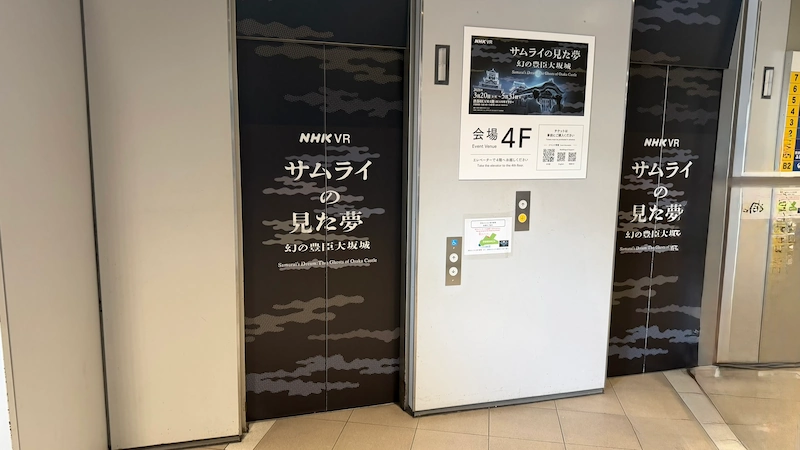
The escalator does not go to the 4th floor. (As of March 29) You need to take the elevator to reach the venue on the 4th floor. The elevator doors are wrapped with “Samurai’s Dream” branding, so the event atmosphere starts right here.
A note for glasses wearers. According to the official website, if you use progressive (multifocal) lenses, regular single-vision glasses are recommended for a better VR experience. If you normally wear progressive lenses, consider bringing a spare pair of regular glasses just in case.
Arriving at the Venue: Stepping onto the 4th Floor
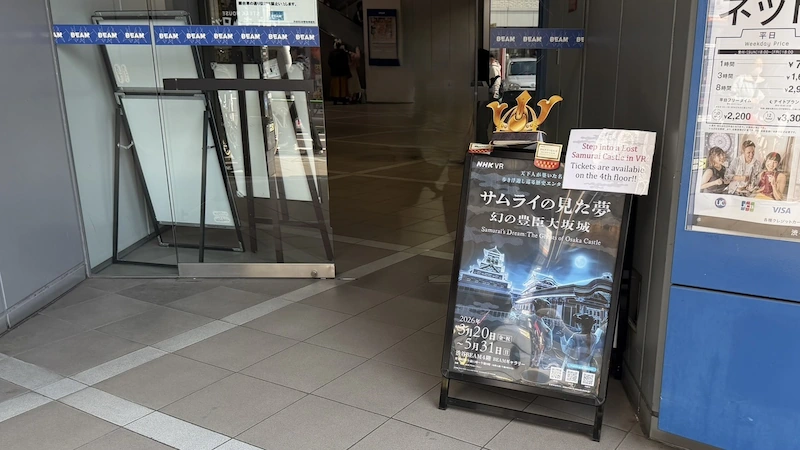
When you arrive at the 4th floor by elevator, the first thing you will see is a set of lockers. Store your belongings to free up your hands, then proceed to the paid VR area. When I visited, the flow felt mainly designed for ticket holders, but the official website also mentions a free area with photo spots and exhibits related to the NHK period drama “Brothers in Arms.” The exact viewing area may depend on the venue operation on the day, so check the official site before visiting.
The Video Panel Corridor: Gateway to the Toyotomi World
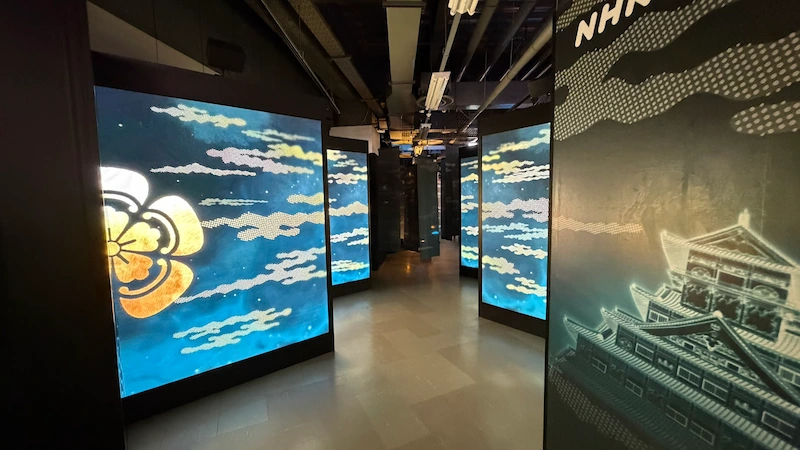
The first thing that greets you upon entry is a corridor lined with large video panels. The Toyotomi family crest (kiri mon) and cloud motifs are beautifully projected across the screens, creating a fantastical space bathed in blue light. The anticipation for the VR experience ahead builds instantly.
The Chaos of the Battlefield: Taiga Drama Props Exhibition
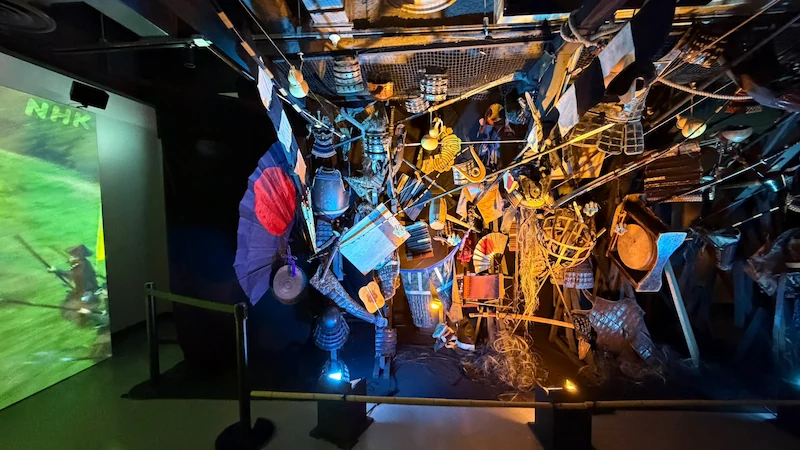
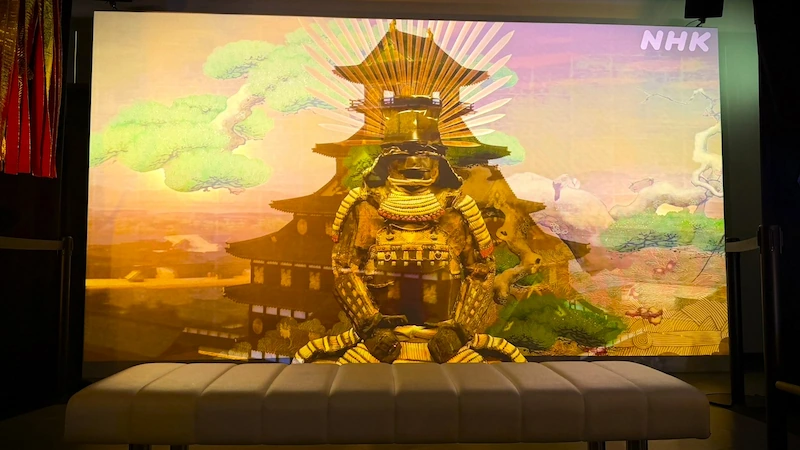
Beyond the corridor, a jaw-dropping space awaits. Armor, swords, bows, spears, horse gear, war helmets, and battle flags — actual props used in the filming of the NHK taiga drama “Toyotomi Kyodai!” (豊臣兄弟!) — are roughly hung and mounted across the walls and ceiling.
This is not a neatly arranged museum display. It feels more like a haunted house, or perhaps an art installation capturing the raw chaos of a battlefield. A large screen sits at the center, playing footage that appears to be scenes from the taiga drama. There are benches where you can sit and watch, and this area alone is well worth the visit.
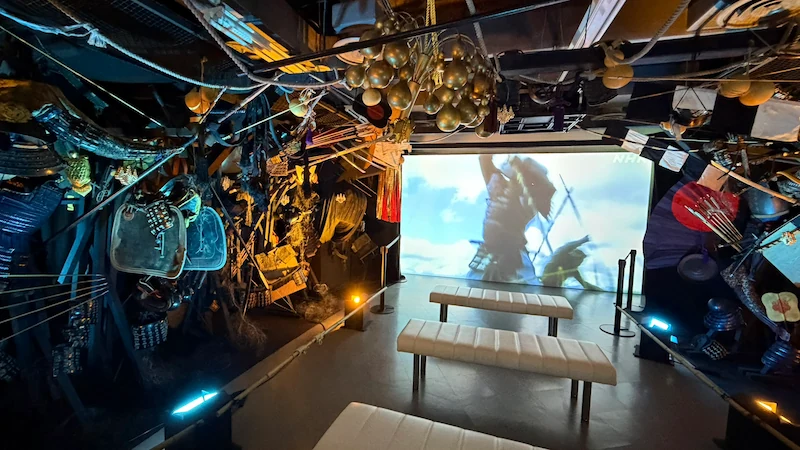
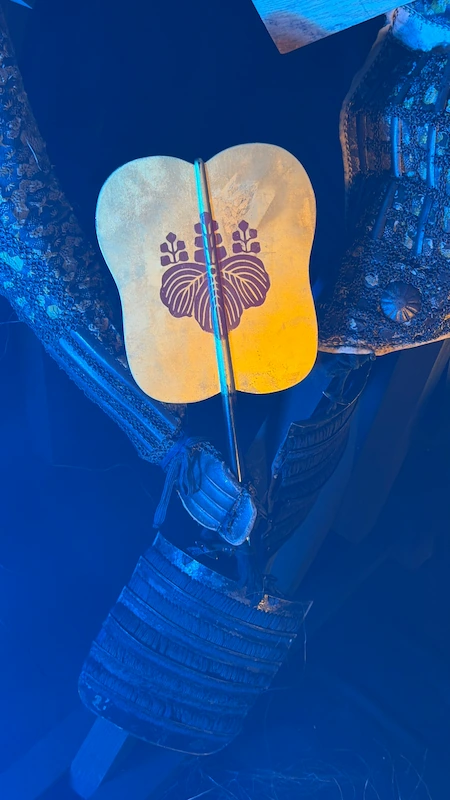
You can also spot an uma-jirushi (horse-mounted battle standard) bearing the Toyotomi clan’s go-shichi no kiri crest (the paulownia crest with five-seven flowers). The attention to detail is remarkable.
Map of Toyotomi Osaka Castle: A Pre-VR Briefing
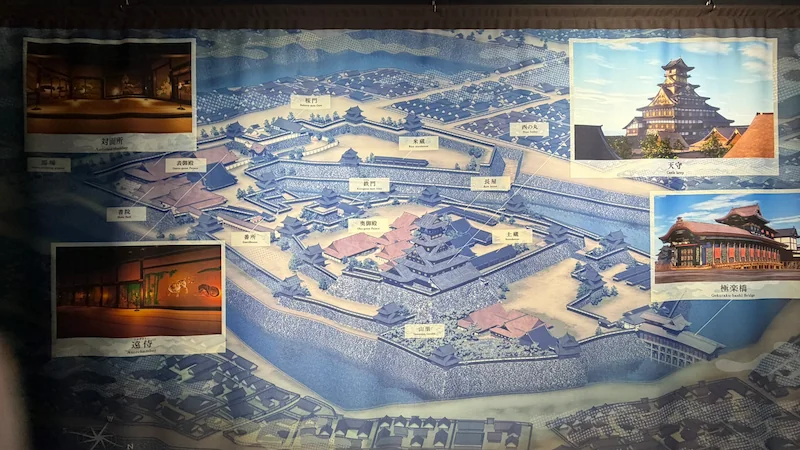
Just before the VR experience begins, a large panel displays a bird’s-eye view of the entire Toyotomi Osaka Castle complex. Key structures are labeled: the castle keep (tenshu), Gokurakubashi Bridge, the audience chamber (taimen-jo), the outer palace (omote goten), the inner palace (oku goten), Yamazato-maru garden, the iron gate (kurogane mon), Sakura-mon gate, guardhouses, storehouses, Nishi-no-maru (western bailey), and more. Each building is accompanied by a CG rendering. Studying this “map” before entering VR helps deepen the sense of immersion.
The VR Experience: Traveling 400 Years Back to Toyotomi Osaka Castle
Putting on the Goggles and Time-Traveling
Now for the main event. Once the VR headset (head-mounted display) is on, you are instantly transported from modern-day Shibuya to Osaka 400 years ago.
This is a “walk-through” VR experience — you physically walk through the venue as you explore the virtual world. Roughly every five minutes, you move forward 1–3 meters, stop to listen to narration or take in the scenery, then advance again. You are mostly standing within a 2m × 5m area, but at certain points you physically walk into rooms, giving you a genuine sense of exploring the castle on foot.
The narration comes from a blue will-o’-the-wisp character who serves as the spirit of Osaka Castle. The voice is provided by Saori Hayami, a renowned voice actress known for roles such as Yor Forger in SPY×FAMILY and Shinobu Kocho in Demon Slayer. Her voice is both mystical and warm, guiding you through the world of Toyotomi Osaka Castle.
During the VR experience, you can freely look around in 360 degrees. Turn around, look up at the ceiling — meticulously recreated scenery extends in every direction. Even the decorative details on ceiling panels and the underside of thresholds are carefully rendered. There is something new to discover wherever you look.
VR Highlights (Spoiler-Free)
The VR experience features the following scenes. If you want to go in completely unspoiled, the information above should already give you a good sense of whether this event is for you.
- The full view of Osaka Castle — The Toyotomi castle approaches with breathtaking intensity.
- Gokurakubashi Bridge — The ornate bridge associated with Toyotomi Osaka Castle is recreated in VR.
- Unexpected castle residents — Animals you would never expect to find in a castle make an appearance.
- The true face of the ruler — A memorable scene revealing Hideyoshi’s personal character.
- Sengoku armor collection — Episodes about Hideyoshi’s armor are introduced.
- The front lines of the Siege of Osaka — The climax takes you to the battlefield. The immersion is something you can never feel through a 2D screen. I was moved to tears.
For the full detailed account, open the section below.
▶ Read the Full VR Experience Report — Click Here (Spoiler Warning!)
Floating Stone Pavement: Osaka Castle from Above
The first highlight is a scene where you view the castle from high above. You are standing on stone pavement in the VR world when it slowly begins to rise — like a magic carpet lifting you into the sky. As you ascend to dizzying heights, the full panorama of Toyotomi Osaka Castle unfolds before your eyes.
The castle you see here is drastically different from today’s Osaka Castle. The current castle was rebuilt by the Tokugawa shogunate, but the Toyotomi-era version was clad in black lacquer with lavish gold leaf decoration — far more opulent. And crucially, there are no modern buildings around it. With no skyscrapers or high-rises in sight, the castle’s commanding presence is overwhelming. You truly feel the majesty of the fortress once described as “unmatched in the three kingdoms” (sankoku musō).
Crossing Gokurakubashi Bridge
Next, you visit Gokurakubashi, an ornate bridge closely associated with the splendor of Toyotomi Osaka Castle. I had previously seen the Chinese-style gate (karamon) at Hogonji Temple on Chikubushima Island in Shiga Prefecture, which is said to have been relocated from this very bridge. But that was just a fragment of the original. In VR, you can see the entire bridge and walk through its interior on foot. Having seen the real karamon in person, experiencing the complete bridge in VR was deeply moving.
Inside the Castle: Tigers, Elephants, and the Daily Life of a Ruler
Inside the castle, the VR experience introduces unexpected animals associated with Hideyoshi’s world, including tigers and elephants. Whether as symbols of foreign exchange, power, or spectacle, their appearance makes the castle feel far more cosmopolitan than a modern visitor might imagine.
One particularly memorable scene shows Hideyoshi seated in the place of honor (kamiza), then deliberately stepping down to the lower seat (shimoza) to approach his subordinates and speak with them face to face. Despite being the supreme ruler of Japan, he made the effort to come to his people rather than summoning them. This single scene perfectly captures Hideyoshi’s renowned ability to win hearts and minds.
Hideyoshi’s Armor and the Great Warlords
The VR experience includes an episode about how Hideyoshi treasured his personal armor. It is explained that the rear crest (ushirodate) of his helmet featured an iris (shōbu) motif, which also had the effect of making him appear taller. Seeing Hideyoshi at life-size scale in VR and getting a sense of his actual physical stature is a discovery unique to this medium.
There is also a scene where four famous sets of armor are displayed side by side. While the narration does not name the warlords, any Sengoku history fan would instantly recognize them: Kuroda Nagamasa’s great water-buffalo horn helmet, Naoe Kanetsugu’s helmet with the character for “Love” (ai) on its crest, Sanada Yukimura’s deer-antler helmet, and Katō Kiyomasa’s tall eboshi-style helmet.
The Front Lines of the Siege of Osaka: I Could Not Stop the Tears
The climax of the VR experience is the battlefield of the Siege of Osaka.
Before I knew it, I was standing inside the Tokugawa army’s encampment. Soldiers stretched out before me, cannons aimed at Osaka Castle. I have watched countless battle scenes in movies and on television. But standing in the midst of it in VR was an entirely different experience.
The immersion is something a 2D screen can never deliver. The pure joy of feeling “I am here, at this moment in history.” And at the same time, an awareness of the men who fought and died here, risking everything. These complex emotions surged all at once, and before I realized it, tears were streaming down my face.
The roughly 25-minute VR experience was so absorbing that I completely lost all sense of time. When I was told afterward that it had been “25 minutes,” I could hardly believe it — that is how dense and immersive the experience was.
Post-VR Exhibits: The Golden Tea Room and Hideyoshi’s Helmet
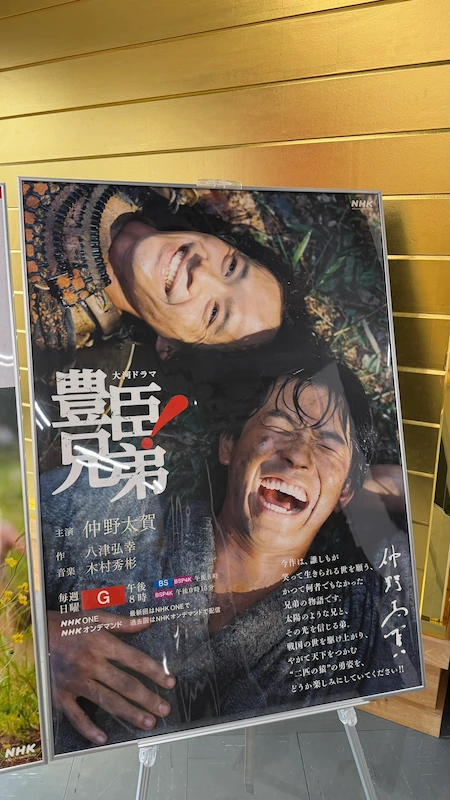
After the VR experience, there are various panel displays related to the NHK taiga drama “BROTHERS IN ARMS” (Toyotomi Kyodai! / 豊臣兄弟!). These include cast member panels and life-size photo spot panels.
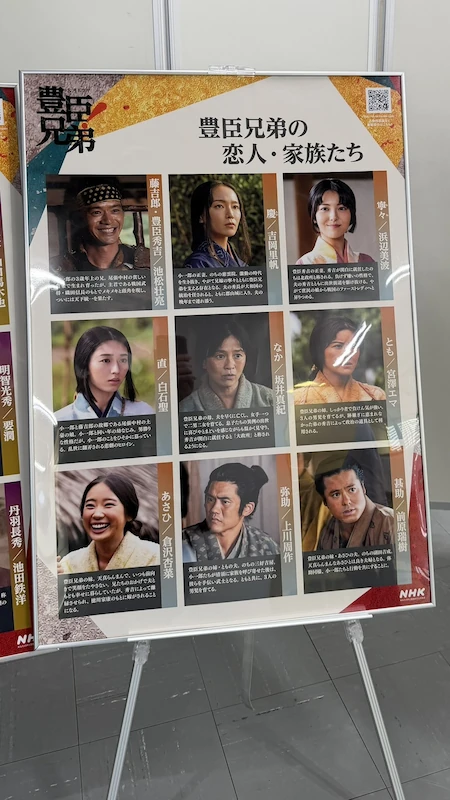
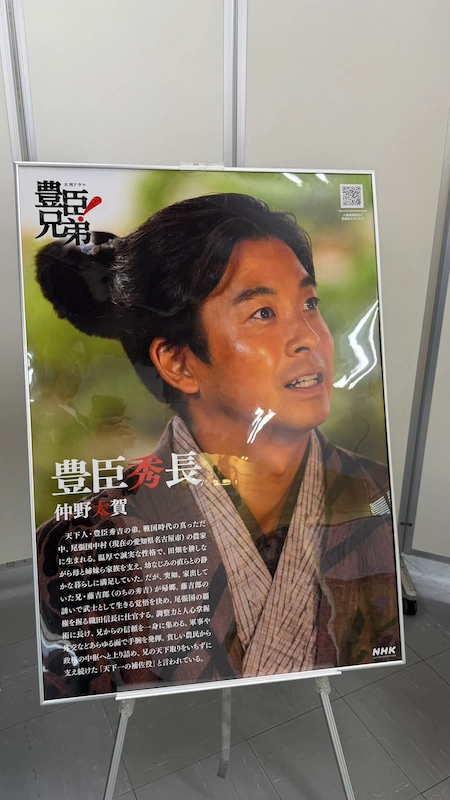
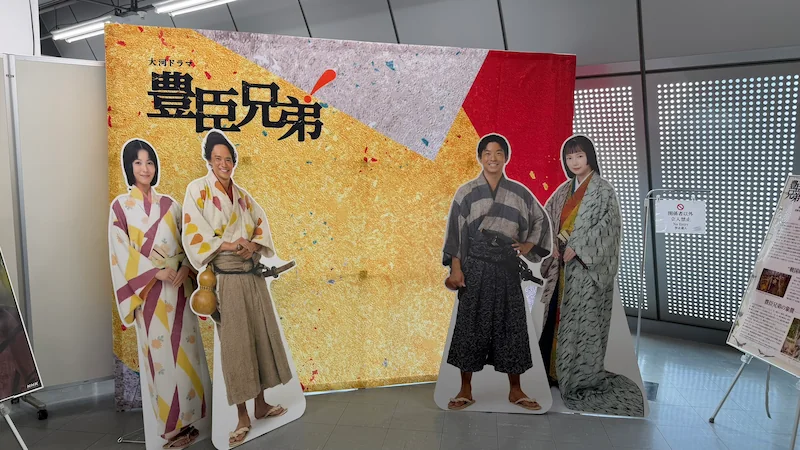
Hideyoshi’s Ichinotani-style Helmet (Replica)
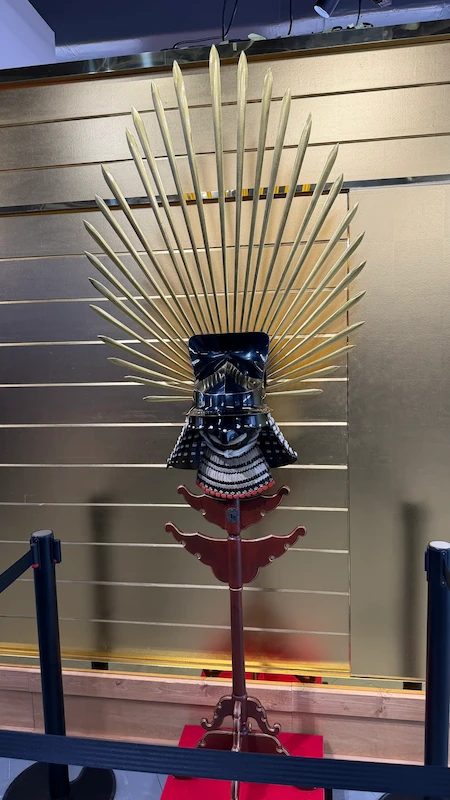
A magnificent replica of Hideyoshi’s ichinotani-nari kabuto (helmet) is displayed against a gold folding screen. The distinctive fan-shaped front crest radiates an authority befitting the ruler of Japan.
The Golden Tea Room: Finally Stepping Inside
The unexpected highlight of the exhibition was a full-scale reconstruction of Hideyoshi’s famous Golden Tea Room (kin no chashitsu). Hideyoshi was known for his extraordinary love of gold, and the original Golden Tea Room is generally described as a portable tea room covered in gold leaf, created to display his power and wealth. Historical records also connect the Golden Tea Room with tea gatherings for powerful guests, diplomatic envoys, and other important visitors.
I had previously seen a similar reconstruction at the Saga Prefectural Nagoya Castle Museum near the Hizen Nagoya Castle ruins in Karatsu, Saga — the historic base associated with Hideyoshi’s invasions of Korea. But that was a view from the outside only. This time, I was able to step inside.
Inside, the space is compact — exactly as you would expect from a tea room. Deep red felt (mōsen) covers the floor, the walls are covered in gold, and tea utensils including a tea kettle (chagama) and water jar (mizusashi) are arranged in place. The room is small, but the combination of gold and red feels like a concentrated expression of Hideyoshi’s aesthetic of overwhelming opulence.
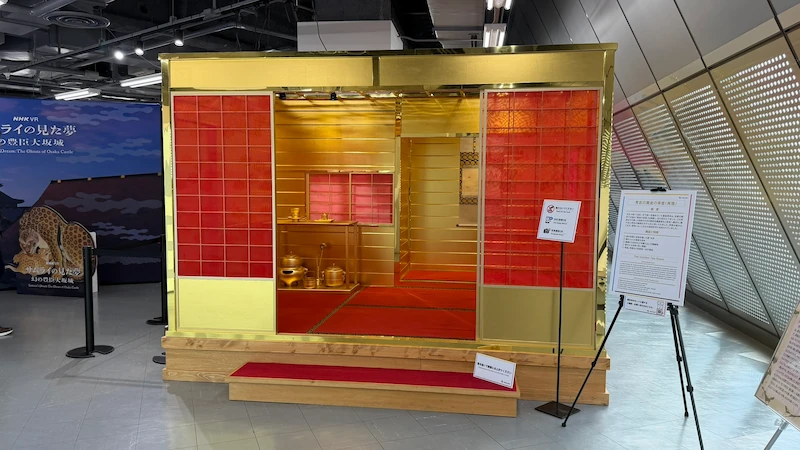
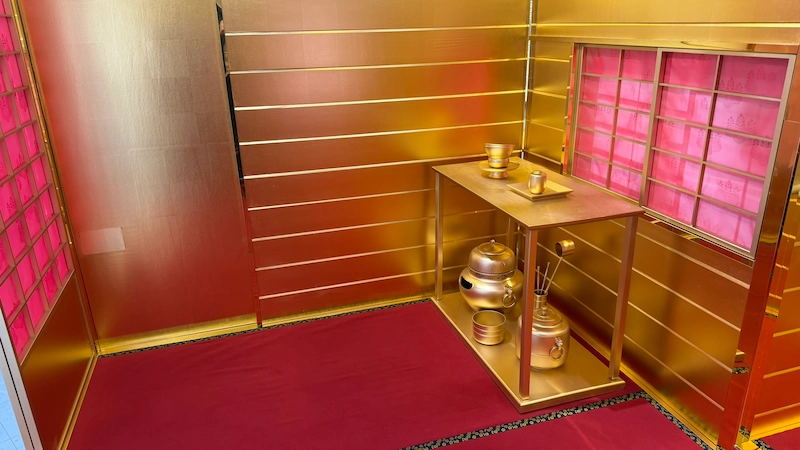
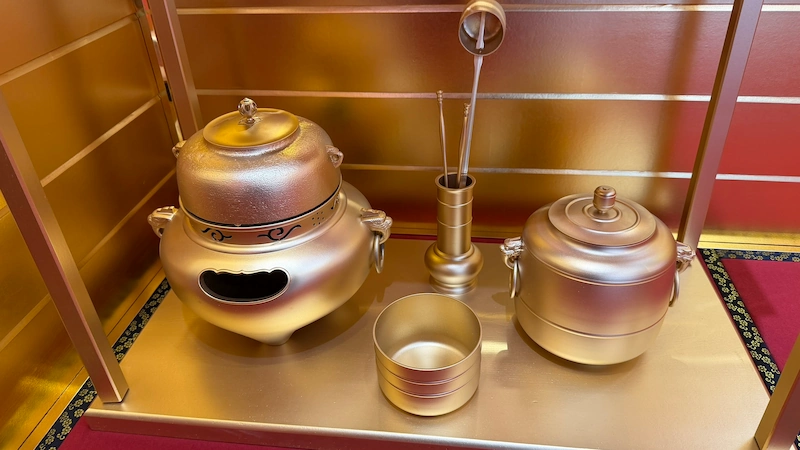
My only minor disappointment was that the ceiling was open, allowing fluorescent light to pour in from above. Originally, the room would have been lit only by candlelight or natural light from small windows. Experiencing it under those conditions would have brought the atmosphere even closer to what Hideyoshi’s guests would have felt. Still, being able to physically stand inside this ultimate expression of Hideyoshi’s “golden taste” was an extraordinary experience.
What This Event Means for History Enthusiasts
The greatest value of this VR event is simple: it lets you experience Toyotomi Osaka Castle — lost for over 400 years — at life-size scale.
You can look up at the castle Hideyoshi built from your own eye level. If you have seen the surviving karamon gate from Gokurakubashi Bridge at Chikubushima, experiencing the complete bridge in VR is an unparalleled thrill. Watching Hideyoshi move before you, you even get a sense of the ruler’s physical stature.
And above all, being placed inside the battlefield of the Siege of Osaka is something no 2D screen can replicate. Hideyoshi the warrior swinging his sword, Hideyoshi the statesman governing the realm — through VR, you encounter multiple facets of this historical figure in a way that is an extraordinary privilege for anyone who loves Japanese history.
Value for Money
I paid the weekend rate of ¥3,000, and I would say it is absolutely worth experiencing at least once. The 25-minute VR immersion combined with the props exhibition and Golden Tea Room makes for a satisfying overall experience on a first visit. That said, if asked whether I would pay ¥3,000 again for a repeat visit, I would have to think about it. But if you are a fan of Japanese history and have not been yet, I would say go without hesitation.
Practical Information Summary
| Item | Details |
|---|---|
| Venue | Shibuya BEAM 4F, BEAM Gallery |
| Access | 5-minute walk from Shibuya Station (JY20/G01/Z01/F16/TY01/DT01/IN01) |
| Dates | March 20 – May 31, 2026 |
| Hours | 10:00 AM – 9:00 PM (Last entry 8:30 PM) |
| Duration | Approx. 40 min (25 min VR + 15 min setup) |
| Tickets | Advance booking via Asoview or Fever is strongly recommended. Same-day tickets may be available at the venue if there are open slots. |
| Price | General: ¥2,500 weekdays / ¥3,000 weekends & holidays |
| Restrooms | No public restrooms inside the event venue; use a nearby facility beforehand |
| Trash cans | None (take your trash with you) |
| Escalator | Does not go to the 4th floor — use the elevator |
| Glasses | Progressive lenses not recommended; bring regular glasses |
| Age restriction | Children aged 6 or younger cannot participate; children aged 7–12 require a guardian consent form |
| Official site | NHK VR “Samurai’s Dream” official site |
Frequently Asked Questions (FAQ)
Where can I buy tickets?
Tickets are sold for designated time slots through Asoview and Fever. The official English ticket page states that advance purchase is required, so booking online before you go is strongly recommended. The Japanese official FAQ also notes that same-day tickets may be available at the venue if there are open slots, but this is not guaranteed.
How long does it take?
The VR experience itself is about 25 minutes, with an additional 15 minutes for instructions and headset fitting, totaling about 40 minutes. If you include time to browse the post-VR exhibits (panels, Golden Tea Room, etc.), plan for about 1 hour overall.
Are there restrooms in the building?
No. The official FAQ says there are no public restrooms inside the event venue. It is strongly recommended that you use a restroom at a nearby facility before arriving.
Can children participate?
Children aged 6 or younger cannot participate in the VR experience. Children aged 7–12 require a consent form signed by a legal guardian. According to the Japanese official FAQ, children aged 10 or younger must participate with an accompanying person aged 13–69. Elementary school tickets are ¥500, and junior/senior high school tickets are ¥1,000.
Can I wear glasses during the VR experience?
Glasses can generally be worn with the VR headset, but some frame shapes may not fit. The official FAQ also notes that progressive or multifocal glasses and contacts may cause blurred vision during the VR experience. If you normally use progressive lenses, bringing regular single-vision glasses may be safer.
How do I get to the venue?
The venue is on the 4th floor of Shibuya BEAM, about a 5-minute walk from Shibuya Station (JY20/G01/Z01/F16/TY01/DT01/IN01). Note that the escalator does not go to the 4th floor (as of March 29, 2026), so you will need to use the elevator.
Is it crowded? Are reservations easy to get?
When I checked the ticket page around noon on March 29, 2026, many time slots still had availability. However, crowd levels can vary by date, weekend, and holiday period, and the official FAQ notes that waiting times may occur during busy periods. Check the latest ticket availability before visiting.


comment