


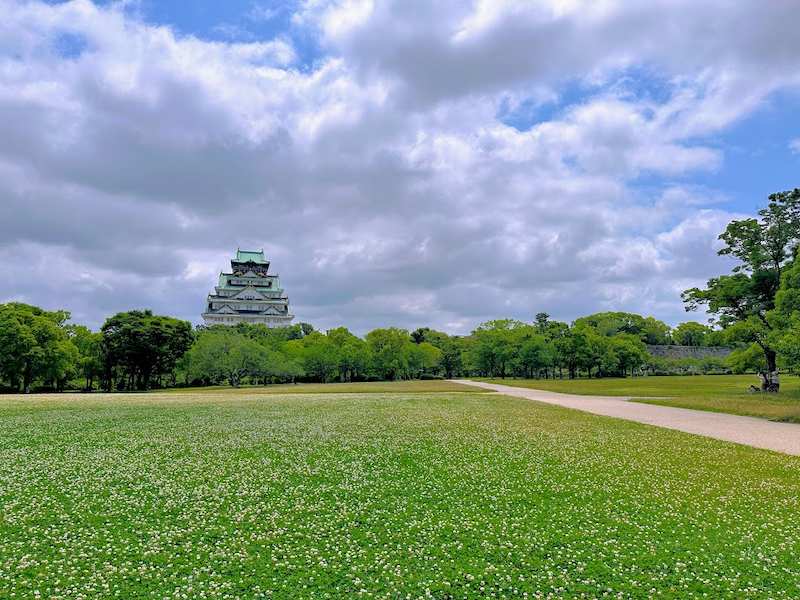
Sengan Yagura, Inui Yagura & Enshōgura
Walking Osaka Castle’s Nishinomaru Garden
The Nishinomaru Garden area is traditionally linked to Kita-no-Mandokoro (Nene), the lawful wife of Toyotomi Hideyoshi. This guide covers 9 spots packed with some of Osaka Castle’s finest highlights — the Important Cultural Properties Sengan Yagura, Inui Yagura, and Enshōgura, around 300 cherry trees, and Toyokuni Shrine.
The Nishinomaru Garden area is traditionally associated with Toyotomi Hideyoshi — the 16th-century warlord who built the original Osaka Castle — and his lawful wife, Kita-no-Mandokoro (Nene). This 6.5-hectare paid garden contains three Important Cultural Properties: Sengan Yagura and Inui Yagura (both built in 1620), and Enshōgura (1685), Japan’s only surviving stone gunpowder storehouse. The garden is also one of Osaka’s premier cherry blossom spots, with around 300 Somei Yoshino cherry trees that bloom each spring against the backdrop of the castle’s main tower.
Nishinomaru Garden Area: Key Facts
| Location | 2-1 Osakajo, Chuo-ku, Osaka |
|---|---|
| Garden Admission | ¥300 standard · ¥350 during the Kanō Naitā cherry-blossom illumination period (closed Mondays) |
| Main Spots | Sengan Yagura, Inui Yagura, and Enshōgura (all Important Cultural Properties), Toyokuni Shrine, Rokuban Yagura (Sixth Turret), Ichiban Yagura (First Turret) |
| Cherry Blossom Season | Late March – early April · around 300 trees |
| Suggested Time | Garden only: about 20–40 min / Whole area: about 1.5–2 hours |
The 9 Spots
1. Taiko Yagura Ruins
Stone base of the turret that once housed the noon drum, signalling time across the castle
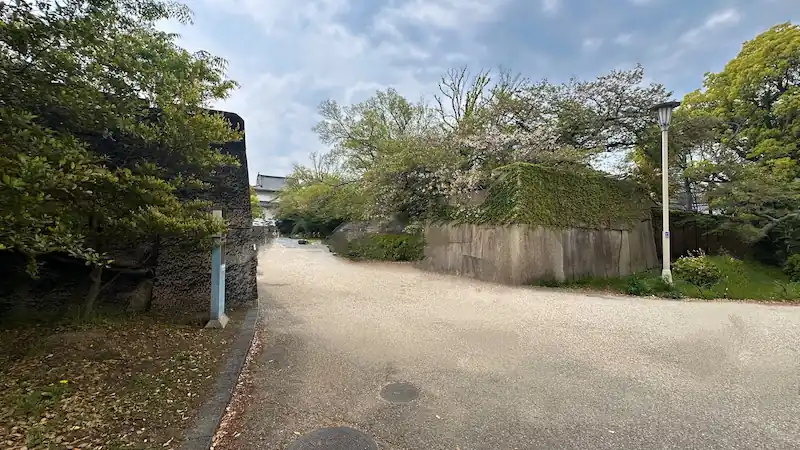
The Taiko Yagura Ruins mark the former site of a two-story turret-gate — a yagura, the defensive turrets found throughout Japanese castles — that housed a drum on its upper floor. Built around 1628, the turret sounded the shōgo taiko (noon drum) daily to signal midday, a custom that continued into the early Meiji period. The structure burned down during the Boshin War of 1868, the conflict that ended the Tokugawa shogunate and restored imperial rule. Only the stone base survives today.
| Year Built | Early 17th century; destroyed 1868 (Boshin War) |
|---|---|
| Status | Stone base only |
| Admission | Included with Nishinomaru Garden admission |
| Suggested Time | About 5–10 min |
- The noon drum: Regulated the daily schedule for samurai and officials, and doubled as a fire alarm.
- Gate-turret hybrid: The ground floor served as a gate while the upper floor held the drum — an unusual combined administrative and defensive structure.
- Survived into the Meiji era: The noon-drum custom continued even as Japan modernized.
2. Sengan Yagura
One of Osaka Castle’s oldest surviving structures — an Important Cultural Property built in 1620
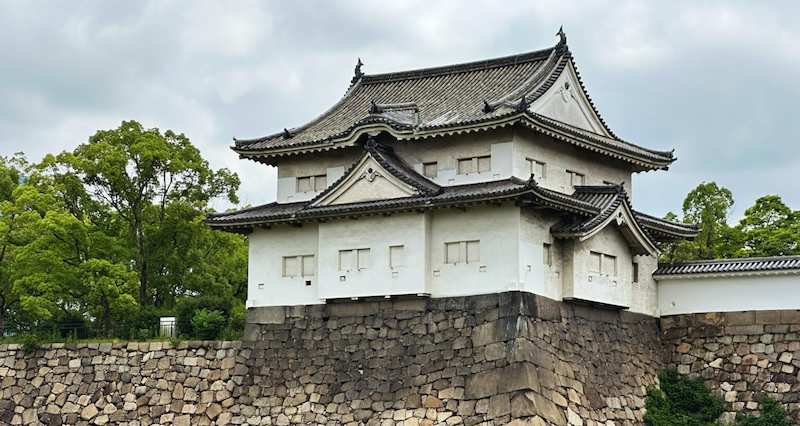
Sengan Yagura is a two-story corner turret built in 1620 — one of the oldest surviving structures at Osaka Castle. It was disassembled and repaired in 1961. Its name is traditionally said to come from a saying that a turret this formidable would be worth a thousand kanmon (an old unit of currency) to capture. The striking black-and-white facade — white plaster walls under black tiled roofs — exemplifies Tokugawa-era castle aesthetics.
| Year Built | 1620 (Edo period) |
|---|---|
| Repairs | Disassembled and repaired in 1961 |
| Cultural Property | Important Cultural Property |
| Interior | Open only during special exhibitions |
| Suggested Time | About 15–20 min |
- Architectural illusion: Seen from a distance, the roofline can look layered despite the compact two-story form.
- Historic role: It guarded the Otemon Gate side of the castle and ranks among the oldest surviving Osaka Castle structures.
- Black-and-white facade: White plaster walls and dark roof tiles stand out vividly against spring cherry blossoms.
3. Nishinomaru Garden (Lawn & Cherry Trees)
Traditionally linked to Nene — one of Osaka’s finest cherry blossom gardens, with the castle tower as backdrop

Nishinomaru Garden is traditionally associated with Kita-no-Mandokoro (Nene), wife of Toyotomi Hideyoshi. Today it is a 6.5-hectare lawn garden that opened in 1965 and is one of Osaka’s premier cherry blossom spots — around 300 Somei Yoshino trees bloom together each spring. The garden also contains the Osaka Geihinkan (Osaka Guest House), a modern reception facility used for special events.
| Admission | ¥300 standard · ¥350 during the Kanō Naitā illumination period (2026: Mar 20–Apr 12) · closed Mondays (Tuesday if Monday is a holiday) and Dec 28–Jan 4 |
|---|---|
| Hours | March–October 9:00–17:00 / November–February 9:00–16:30 |
| Area | 6.5 hectares · around 300 cherry trees |
| Official Site | osakacastlepark.jp |
| Suggested Time | About 20–40 min |
- Around 300 Somei Yoshino: Night illumination runs during peak bloom, making this one of Osaka’s leading hanami (cherry blossom viewing) spots.
- Osaka Geihinkan: A modern guest house within the garden, used for special events.
- Classic photo angle: One of the best places in Osaka Castle Park to frame the Main Tower together with cherry blossoms.
4. Hitsujisaru Yagura Remains
Southwest corner turret destroyed in WWII — only the stone base survives
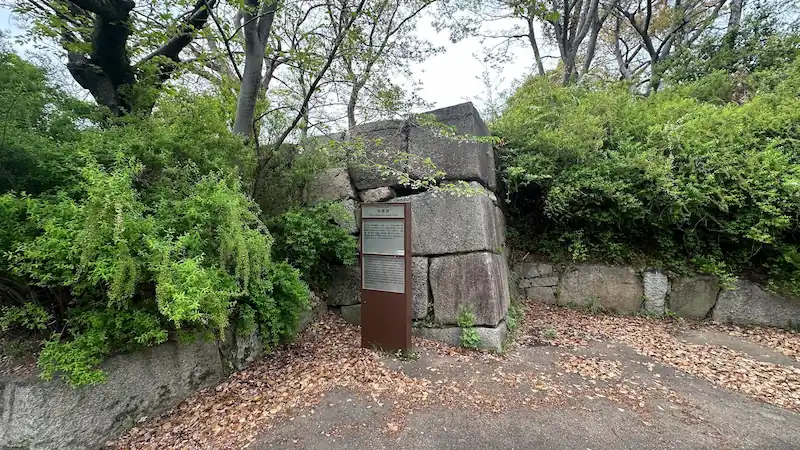
The Hitsujisaru Yagura Remains mark the former site of a corner turret at the southwest (hitsujisaru) corner of the Ninomaru — a traditional direction name using the old zodiac-based compass system. The turret itself no longer survives; only the stone base remains, still bearing kokuinseki — carved marks left by the stonemasons who built the castle, resembling a craftsman’s signature.
| Era | Edo period |
|---|---|
| Current Status | Stone base only |
| Admission | Included with Nishinomaru Garden admission |
| Suggested Time | About 5–10 min |
- Southwest corner: The remains mark one of the former defensive points along the outer edge of the Ninomaru.
- Stone base: The surviving foundation gives a sense of the turret’s former footprint.
- Kokuinseki: Marks left by the Edo-period stonemasons who built the wall are still visible today.
5. Inui Yagura
A rare L-shaped two-story turret — an Important Cultural Property at the northwest corner
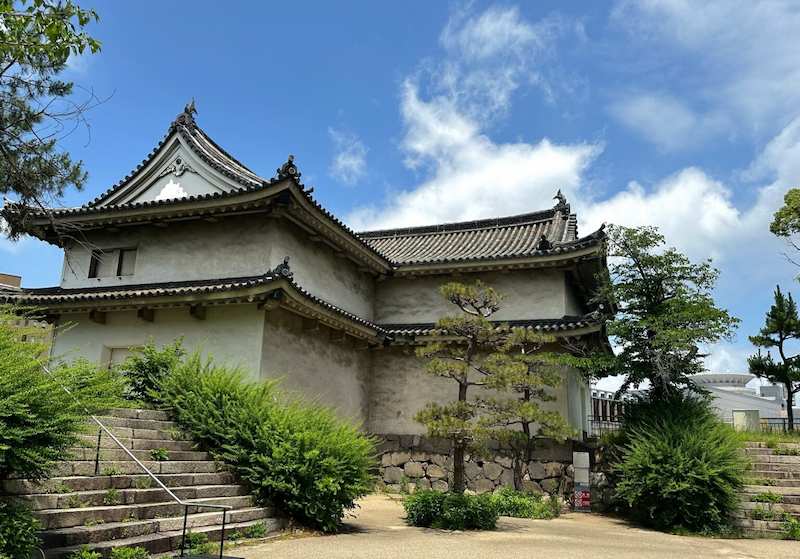
Inui Yagura stands at the northwest corner of Nishinomaru. “Inui” (乾) means northwest — considered in traditional Japanese geomancy (onmyōdō) the “ura kimon,” or back demon gate, a direction believed vulnerable to evil spirits. Built in 1620, it ranks alongside Sengan Yagura among the oldest structures in the castle. Its rare L-shaped, two-story design — with both floors nearly equal in area — is extremely uncommon in Japanese castle architecture. It was restored in 1959.
| Year Built | 1620 (Edo period) |
|---|---|
| Cultural Property | Important Cultural Property |
| Feature | Rare L-shaped design with nearly equal-sized floors |
| Interior | Open only during special exhibitions |
| Suggested Time | About 15–20 min |
- L-shape widens the field of fire: A rare feature at Osaka Castle, allowing overlapping defensive coverage in two directions at once.
- Ura kimon: Its northwest position gave the turret an important defensive role at the edge of the garden.
- Nearly equal floors: Both stories are close to the same size — an unusual layout reflecting the refinement of Edo-period architecture.
6. Enshōgura (Gunpowder Storehouse)
Japan’s only surviving stone gunpowder storehouse — an Important Cultural Property from 1685
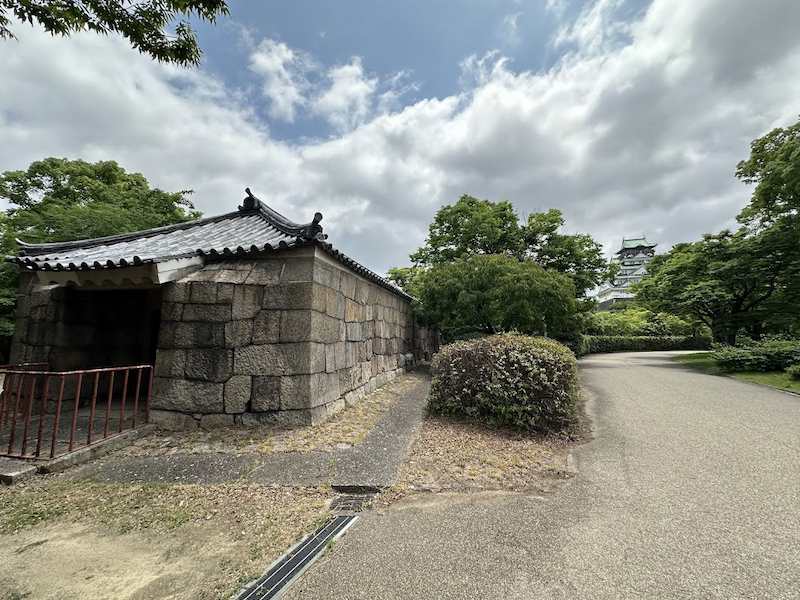
Enshōgura is the only surviving stone gunpowder storehouse in Japan. Built in 1685, its walls, floor, and ceiling are entirely of precisely cut granite, sealed airtight with plaster. This design emerged after a predecessor structure exploded following a lightning strike in 1660. Dismantled and restored in 1960, it stands as Japan’s most sophisticated surviving example of Edo-period explosion-proof engineering.
| Year Built | 1685 (Edo period) |
|---|---|
| Cultural Property | Important Cultural Property |
| Wall Thickness | 2.4-metre granite — completely airtight |
| Predecessor | Exploded after a lightning strike, 1660 |
| Suggested Time | About 10–15 min |
- Stone construction: Walls, floor, and ceiling built of cut granite and plaster to reduce fire risk.
- Only survivor in Japan: Enshōgura is the only surviving stone gunpowder storehouse of its kind in the country.
- A later Edo-period addition: Documentary research confirms the structure was built in 1685.
7. Rokuban Yagura (Sixth Turret)
One of only two survivors from the original seven turrets along the southern outer moat
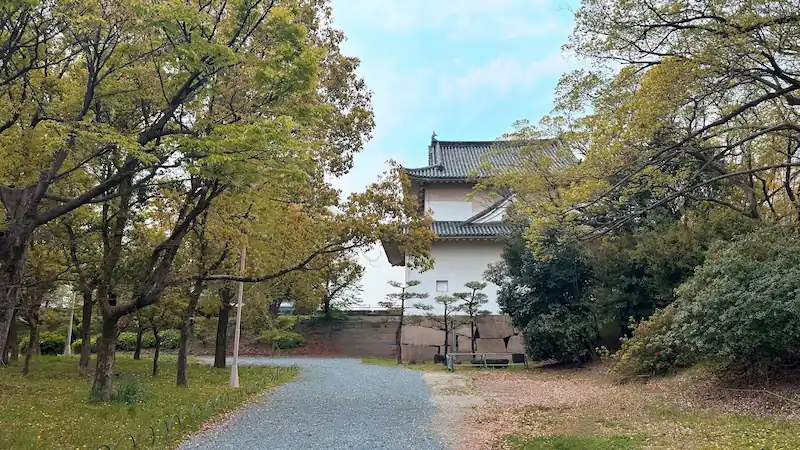
Rokuban Yagura (Sixth Turret) is one of only two surviving turrets from the original seven that once lined the southern outer moat. Built in 1628, it shows stylistic and technical differences from Osaka Castle’s earlier turrets. Its roofline, chidori hafu (a triangular gable), and wall treatment reflect the later phase of the Tokugawa-era rebuilding. It was disassembled and repaired in 1966.
| Year Built | 1628 (Edo period) |
|---|---|
| Cultural Property | Important Cultural Property |
| Repairs | Disassembled and repaired in 1966 |
| Access | Viewed from the moat path outside the garden |
| Suggested Time | About 10–15 min |
- Chidori hafu: The triangular gable is one of the turret’s most eye-catching decorative features.
- One of two survivors: Only Rokuban Yagura and Ichiban Yagura remain from the original seven southern turrets.
- Architectural evolution: Its 1628 construction date reflects the later phase of the Tokugawa rebuilding of Osaka Castle.
8. Toyokuni Shrine
Dedicated to Hideyoshi, Hideyori, and Hidenaga — a popular stop with a 5.2m bronze statue
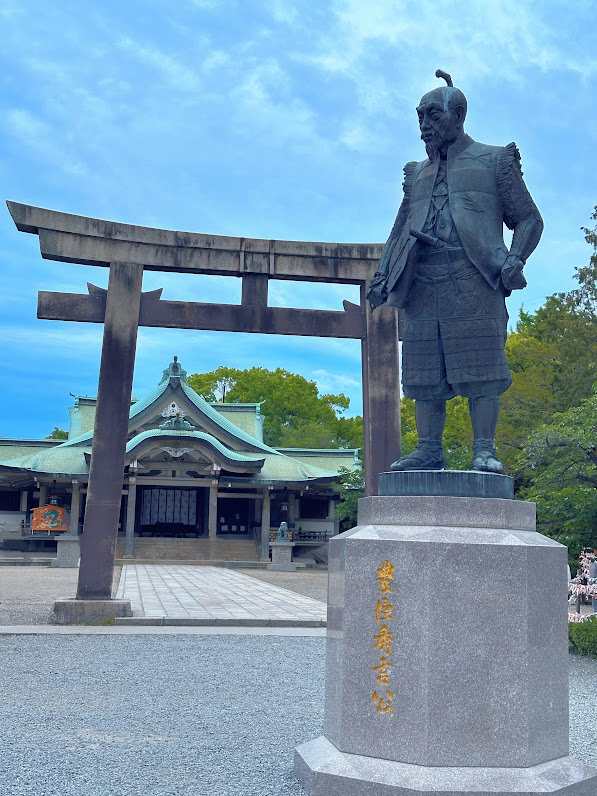
Toyokuni Shrine enshrines Toyotomi Hideyoshi, his son Hideyori, and his brother Hidenaga. The present shrine building was rebuilt in 1879 and relocated to its current site within Osaka Castle Park in 1961. A striking 5.2-metre bronze statue of Hideyoshi in military attire stands on the grounds. The shrine is popular as a spot associated with career advancement, academic success, and business prosperity.
| Rebuilt / Relocated | 1879 (Meiji era) rebuild · 1961 relocation to current site |
|---|---|
| Admission | Free (goshuin around ¥500) |
| Address | 2-1 Osakajo, Chuo-ku, Osaka |
| Official Site | osakacastlepark.jp |
| Suggested Time | About 20–30 min |
- 5.2m bronze statue: Hideyoshi in jinbaori (a military coat) holding a war fan — an excellent photo opportunity.
- Shrine history: The present shrine building was rebuilt in the Meiji era and later relocated to Osaka Castle Park in 1961.
- Shinji Pond: A quiet pond on the south side of the grounds, thought to be a remnant of an earlier garden.
9. Ichiban Yagura (First Turret)
Easternmost of the original seven southern turrets — flanking defense for Tamatsukuri Gate
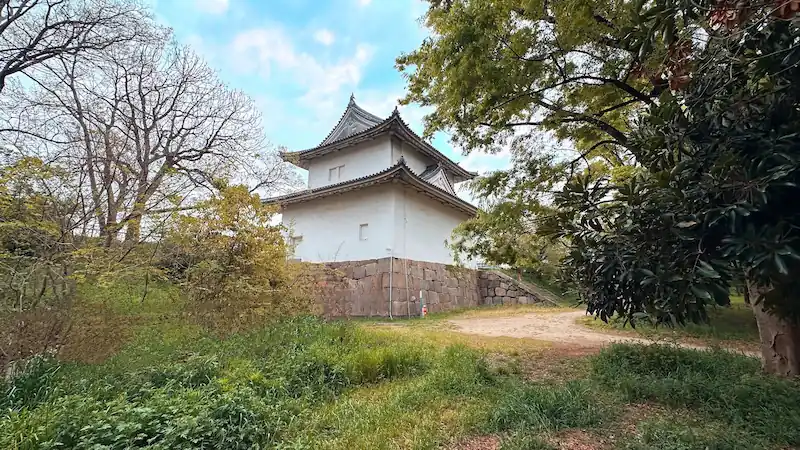
Ichiban Yagura (First Turret) is the easternmost of the seven corner turrets that once lined the south side of the Ninomaru. It helped defend nearby Tamatsukuri Gate, another of Osaka Castle’s historic gates, from the flank. A major renovation in 1668 gave it the form seen today, and it was disassembled and repaired in 1965.
| Current Form | Major renovation in 1668; disassembled and repaired in 1965 |
|---|---|
| Cultural Property | Important Cultural Property |
| Access | Viewed from the path outside the garden area |
| Suggested Time | About 10–15 min |
- Named by position: Called Ichiban Yagura because it stands at the eastern end of the seven southern turrets.
- 1668 renovation: The Kanbun 8 (1668) renovation gave the turret its present form.
- Stonemason marks: Kokuinseki are still visible in the stone base — the signatures of the Edo-period craftsmen who built it.
Osaka Castle: Full Area Map
Frequently Asked Questions (Nishinomaru Garden Area)
Garden admission is ¥300 standard. During the “Kanō Naitā” cherry-blossom illumination period (2026: March 20 – April 12), it rises to ¥350. Because the illumination dates vary from year to year, check the official Osaka Castle Park website before your visit. The garden is closed on Mondays (Tuesday if Monday is a public holiday) and from December 28 to January 4. Hours: March–October 9:00–17:00; November–February 9:00–16:30.
Yes. The paid garden area contains three Important Cultural Properties — Sengan Yagura, Inui Yagura, and Enshōgura — and offers one of Osaka Castle’s finest views of the main tower framed by cherry blossoms in spring. Even outside cherry blossom season, the quiet garden and its historic structures make it worth a visit.
There are three: Sengan Yagura (1620), Inui Yagura (1620), and Enshōgura (1685) — Japan’s only surviving stone gunpowder storehouse.
Enshōgura is the only surviving stone gunpowder storehouse in Japan. Its walls, floor, and ceiling are entirely built of cut granite, sealed airtight with plaster. This design emerged after a predecessor structure exploded following a lightning strike in 1660. It stands as an exceptionally rare surviving example of Edo-period explosion-proof engineering.
Peak bloom is typically late March to early April. Around 300 Somei Yoshino cherry trees bloom at once, making this one of Osaka’s premier hanami (cherry blossom viewing) spots, with night illumination during peak bloom. Arriving right at the 9:00 AM opening on a weekday gives a relatively calm experience — the garden tends to fill up from the morning onward on weekends.
Sengan Yagura is a two-story corner turret built in 1620. It is one of the oldest surviving structures at Osaka Castle and is designated an Important Cultural Property. Its name is traditionally said to come from a saying that a turret this formidable would be worth a thousand kanmon (an old unit of currency) to capture. The interior is open to visitors only during special exhibitions.
Kita-no-Mandokoro (Nene), the lawful wife of Toyotomi Hideyoshi, is traditionally said to have had her residence in the Nishinomaru area.
Continue Exploring
Back to the Osaka Castle Index Page
Back to the Main Page

☕ Support This Site
Following the Shogun is built on original fieldwork and on-site research.
If you found this guide useful, your support helps keep it going.

You can also support via QR code


comment