


Higashi Chaya & Kazuemachi Teahouse Districts
The Higashi Chaya and Kazuemachi geisha districts lining the Asano River, Utasu Shrine guarding the castle’s “demon gate,” and Toyokuni Shrine linked to Hideyoshi Toyotomi — explore 4 spots in the Higashiyama & Kazuemachi area with 360° panoramas.
Lining the banks of the Asano River, Higashi Chaya and Kazuemachi Chaya are two of Kanazawa’s most celebrated streetscapes, where geisha culture and everyday townhouse life still linger in the shadows cast by latticed facades and cobblestone lanes. Behind them stand Utasu Shrine, which once guarded the castle’s “demon gate,” and Toyokuni Shrine, which keeps alive a link to Hideyoshi Toyotomi — here, the faith history of the Maeda family and the refined culture of the teahouse district meet on the same stretch of land. This page guides you through the area with 360° photography that captures the light reflected on the river, the fine detail of the latticework, and the quiet of the back alleys — covering the daytime beauty of the townhouses, the glow of evening lanterns, and each season’s character, along with the best times to visit, viewpoints, and a suggested route linking the shrines and teahouse districts.
Kazuemachi Chaya District
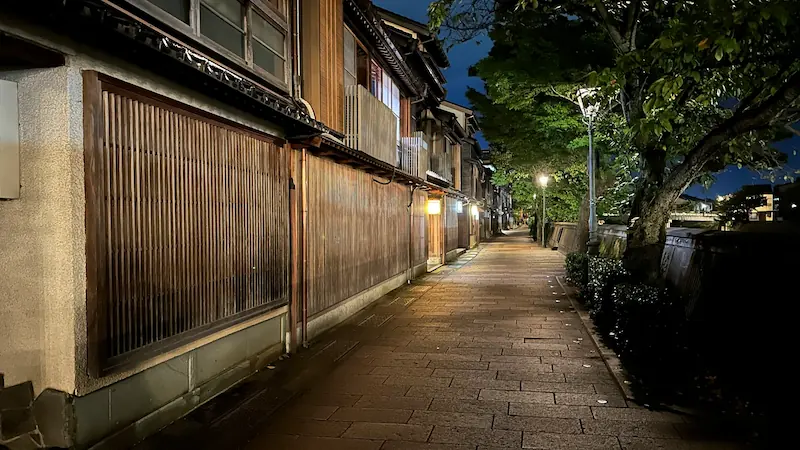
The Kazuemachi Chaya District is an atmospheric geisha entertainment quarter running along the south bank of the Asano River, counted among Kanazawa’s three historic chaya districts (Higashi, Nishi, and Kazuemachi). Formed in the early Meiji era, it sits directly across the river from Higashi Chaya, yet preserves a noticeably quieter, more subdued atmosphere. Most of its teahouses are two-story wooden buildings, and the light spilling from their riverside latticed windows at night has earned the district a reputation as one of the city’s most beautiful evening views. The district takes its name from Kazue-no-kami, a senior retainer of Yukinoshin Sugiura, a Kaga Domain samurai who once kept a residence here.
- Naka-no-hashi Bridge: A small bridge linking the district to Higashi Chaya, its vermillion railings and the flow of the Asano River making it a popular photo spot.
- Kuboichi Otsurugi Shrine: A local guardian shrine, worshipped as a protective deity by the district’s geisha community.
- Kazuemachi Ryokusuien Garden: A small riverside garden; in cherry-blossom season, petals drifting onto the Asano River create an especially dreamlike scene.
- Seasonal Character: Cherry blossoms in spring, riverside dining platforms in summer, autumn foliage, and snow-dusted scenery in winter each give the district a different mood.
⏳ Visiting Time: A quick stroll: about 15–20 minutes / Including the evening view and bridge area: about 40 minutes
🗺 Address: Kazuemachi, Kanazawa, Ishikawa
🚶 Access: About 15 minutes from Kanazawa Station by Hokuriku Railroad bus, then a 5-minute walk from the “Hashiba-cho” stop.
⭐ Recommendation: Historical Value ★★★ / Visual Appeal ★★★ / Experiential Value ★★
| Established | Early Meiji era (around the 1870s) |
|---|---|
| Name Origin | Named after Kazue-no-kami, a Kaga Domain samurai official |
| Building Style | Two-story wooden teahouses lining the Asano River, with latticed windows and cobblestone paving |
| Key Sites | Naka-no-hashi Bridge, Kazuemachi Ryokusuien Garden, Kuboichi Otsurugi Shrine |
| Condition | Well preserved; teahouses remain in active operation |
| Cultural Designation | Designated a Kanazawa City preservation district (traditional buildings group) |
| Notes | Alongside Higashi Chaya, a district balancing tourism with the preservation of traditional performing arts |
A Link to Novelist Kyoka Izumi: Kazuemachi is also where the celebrated novelist Kyoka Izumi spent his childhood, and the Kyoka Izumi Memorial Museum stands nearby.
A Quiet Spot for Night Views: With fewer tourists after dark, the light spilling through the latticework and reflecting on the river creates an especially dreamlike scene.
A Living Geisha Tradition: A small number of geisha remain active here today, keeping the district functioning as a venue for traditional performing arts.
Higashi Chaya District (Higashiyama Higashi Preservation District)
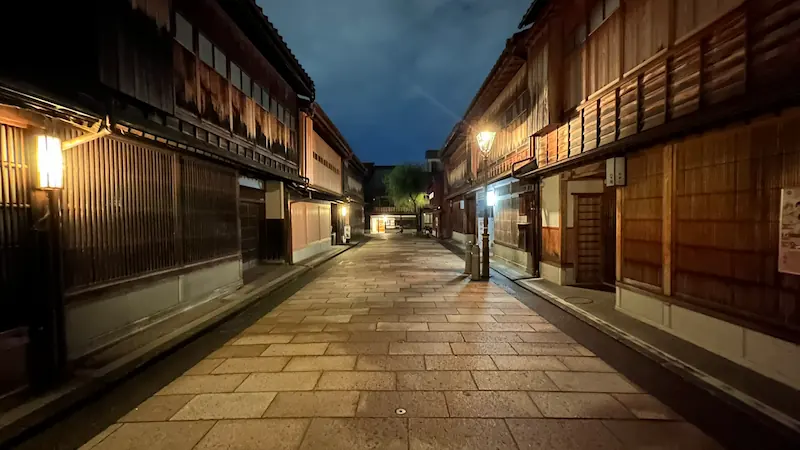
Located on the east bank of the Asano River, the Higashi Chaya District is Kanazawa’s best-known geisha entertainment quarter, preserving the flavor of Edo-period culture and pleasure districts. In 1820, the Kaga Domain consolidated teahouses that had been scattered throughout the castle town into a single zone known as the “Eastern Enclosure,” nurturing a refined teahouse culture from that point on. Today it is designated a nationally Important Preservation District for Groups of Traditional Buildings, with its cobblestone streets, latticed degoshi facades, and traditional wooden townhouses carefully preserved, conveying an atmosphere that feels untouched by time.
- Shima Teahouse: Designated a National Important Cultural Property on December 25, 2003. Originally a high-ranking teahouse of the licensed quarter; visitors can enjoy matcha overlooking its garden.
- Kaikaro Teahouse: A former merchant’s teahouse, open to the public by day, notable for its gold-leafed tatami room, Kaga-yuzen dyed fabrics, and lacquered staircase.
- Latticed & “Kimusuko” Townhouse Architecture: Fine latticework on the ground floor and transom windows above — the district shows off the full range of teahouse-style townhouse features.
- Cobblestone Streets: The paving stones, laid with a subtle slope, add to the atmosphere the more you walk.
- Evening Light and Illumination: As eaves-lanterns and streetlights come on in the evening, the sound of shamisen, flutes, and koto drifting from a distance creates an exceptional atmosphere.
- Traditional Crafts, Gold-Leaf Experiences, and Workshops: Gold-leaf craft experiences, boutique craft shops, and sweets and matcha cafes line the street, easy to drop into while strolling.
- “Hiromi” Viewpoints: Several open sightline points along the district offer both street-level and elevated views of the teahouse district.
⏳ Visiting Time: Strolling and viewing the exteriors: 30–45 minutes / Including a teahouse tour: 60 minutes or more
🗺 Address: Higashiyama, Kanazawa, Ishikawa
🚶 Access: A 3-minute walk (about 200 m) from the Kazuemachi Chaya District.
⭐ Recommendation: Historical Value ★★★ / Visual Appeal ★★★ / Experiential Value ★★★
| Established | 1820 (Bunsei 3) |
|---|---|
| Established By | The Kaga Domain, under 12th lord Nariyoshi Maeda |
| Building Style | Wooden teahouse-style townhouses with latticed degoshi facades, second-floor reception rooms, cobblestone lanes, and coordinated streetscape controls |
| Preservation Designation | Designated nationally as the “Higashiyama Higashi Preservation District for Groups of Traditional Buildings” on November 14, 2001 (Heisei 13) |
| Area & Scale | About 1.8 hectares, roughly 130 m north-south and 180 m east-west. About 140 buildings within the preservation zone, roughly 60% of them traditional structures. |
| Historical Changes | Temporarily shut down amid concerns over public morals, then officially reopened in 1867 (Keio 3). Having escaped wartime destruction, many buildings retain their original form. In recent years, a streetscape restoration plan has advanced the recovery of traditional facades. |
| Current Condition | Well preserved; in use as restaurants, souvenir shops, and teahouses open for tours. |
| Notes | The teahouse “Shima” is a National Important Cultural Property. Free daytime viewing; nighttime visits are reserved for exclusive high-tier settings. Teahouses such as Kaikaro can be toured. |
Origins as the “Eastern and Western Enclosures”: Teahouses scattered through the castle town were originally consolidated into two zones, called “enclosures,” as a way to manage public morals and domain control — Higashi (east) and Nishi (west).
An Escape from Wartime Destruction: Because Kanazawa was spared from air raids during World War II, many of the era’s teahouse buildings survive today.
Three Districts: Higashi, Nishi, and Kazuemachi: Kanazawa has three historic chaya districts, and Higashi Chaya is considered the largest and most prestigious of the three.
Utasu Shrine
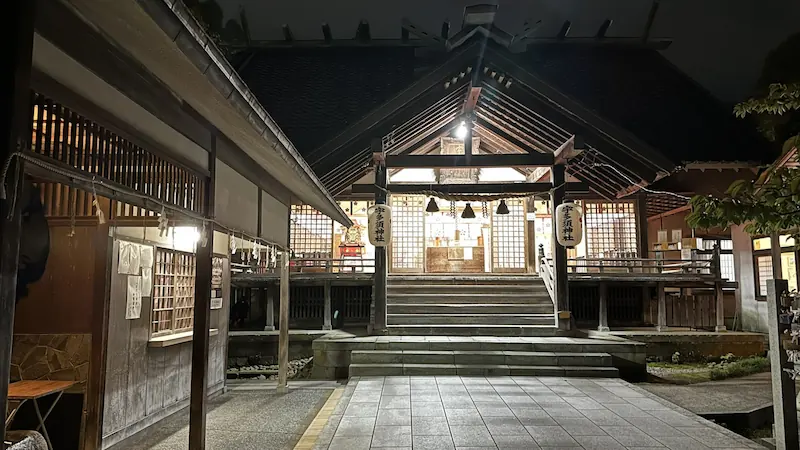
Set on a small rise overlooking the Asano River behind the Higashi Chaya District, Utasu Shrine traces its founding to 718 (Yoro 2) in the Nara period, when it was established as Usatsu Haruta Tamonten Shrine. In the early Edo period, Utatsu Hachimangu — enshrining the spirit of founding lord Toshiie Maeda — was built within its grounds, and the shrine came to be revered as a guardian of the Kaga Domain, protecting the castle’s northeast “demon gate” direction. It took its present name after the Meiji-era separation of Shinto and Buddhism. Tradition surrounding the “Well of Lord Toshitsune’s Sake Bath” also survives on the grounds — a quiet memory of the Maeda family, set just behind the bustle of the chaya district.
- Ties to Utatsu Hachimangu: The site of a domain shrine enshrining Toshiie’s spirit — a tangible sense of its role as Kaga Domain guardian.
- Well of Lord Toshitsune’s Sake Bath: A sacred well tied to a tradition of healing, quietly preserved at the rear of the shrine buildings.
- Komainu Guardian Statues and Shrine Design: The stone steps and the dignified worship hall, framed by a tranquil sacred grove, make for a photogenic scene.
- Seasonal Character: Cherry blossoms in spring, fresh greenery in summer, and evening or nighttime visits during the lantern-lit Setsubun season all carry their own atmosphere.
⏳ Visiting Time: Main highlights: about 10–15 minutes / A closer look at the stone steps, shrine buildings, and well: about 30 minutes
🗺 Address: 1-30-8 Higashiyama, Kanazawa, Ishikawa
🚶 Access: A 3-minute walk (180 m) from the Higashi Chaya District.
⭐ Recommendation: Historical Value ★★★ / Visual Appeal ★★★ / Experiential Value ★★
| Founded | Traditionally founded in 718 (Yoro 2); Utatsu Hachimangu founded in 1599 (Keicho 4) |
|---|---|
| Founded By | Originally enshrined as Usatsu Haruta Tamonten Shrine; Utatsu Hachimangu was established when Toshinaga Maeda enshrined his father Toshiie there |
| Structure & Features | A shrine complex of worship hall, main hall, and administrative office, a stone-step approach, and the “Well of Lord Toshitsune’s Sake Bath” on the grounds |
| Restoration History | Renamed during the Meiji era (Takamimusubi Shrine → Usatsu Shrine → Utasu Shrine) and elevated to prefectural shrine status, with ongoing preservation repairs since |
| Current Condition | Well preserved; grounds open for free worship |
| Losses | None specifically on record (some facilities undergo periodic repair) |
| Cultural Designation | No specific designation (one of the “Five Great Shrines of Kanazawa”) |
| Notes | A shrine protecting the castle’s northeast “demon gate” direction; during the Setsubun festival, geisha from Higashi Chaya perform a dedicatory dance and bean-scattering ceremony |
A Mirror Legend: An old mirror unearthed along the Asano River bore the characters for “u” and “tatsu” on its reverse side, said to be the origin of enshrining the deity Utatsu here.
A History of Renaming: The shrine was renamed Takamimusubi Shrine in Meiji 2, Usatsu Shrine in Meiji 5, and Utasu Shrine in Meiji 33, before being elevated to prefectural shrine status in Meiji 35.
One of the Five Great Shrines of Kanazawa: Utasu Shrine is cherished by locals as one of the “Five Great Shrines of Kanazawa,” alongside Tsubakihara Tenmangu, Kosaka Shrine, Shinmei-gu, and Yasue Hachimangu.
Toyokuni Shrine 🎥 360°
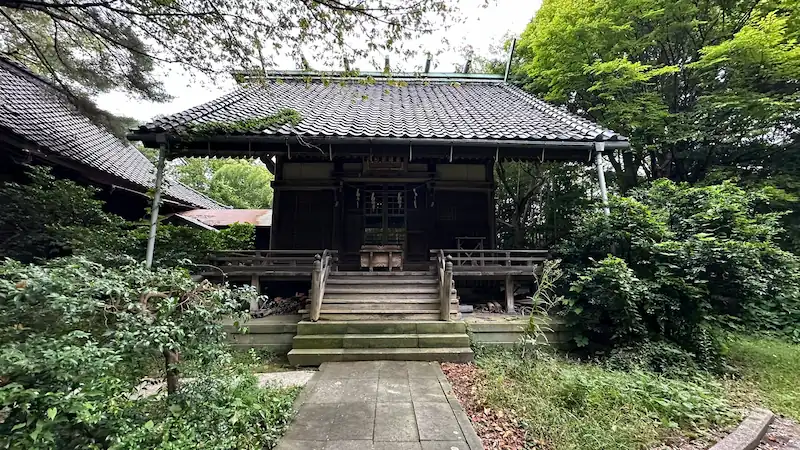
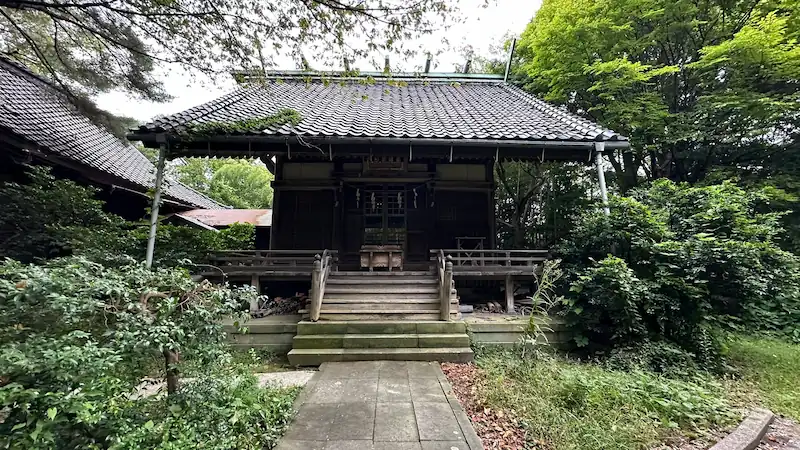
Toyokuni Shrine enshrines Hideyoshi Toyotomi, and branch shrines by this name exist across Japan. Kanazawa’s Toyokuni Shrine sits on a hillside within Utatsuyama Park, and has drawn devotion as one of the sites connected to the close relationship between Hideyoshi and Toshiie Maeda, founding lord of the Kaga Domain. Openly worshipping Hideyoshi was difficult under Tokugawa shogunate rule during the Edo period, but tradition holds the shrine was revived and (re-)founded from the Meiji era onward as a symbol of that historical relationship. Set in a quiet, richly wooded environment, it offers a place to reflect on the deep ties between Hideyoshi and the Kaga Domain.
- Worship Hall and Main Hall: A relatively simple but historically grounded shrine dedicated to Hideyoshi Toyotomi.
- Festival Observances: Local residents sometimes take part in Shinto rites held on the shrine’s festival days.
- Sacred Grove and Approach: Surrounded by abundant greenery, the quiet approach and grove lend the site a calming atmosphere.
⏳ Visiting Time: About 10–15 minutes to see the worship hall and grounds
🗺 Address: Suehiro-zaka, Kanazawa, Ishikawa (within Utatsuyama Park)
🚶 Access: About 20 minutes from Kanazawa Station by Hokuriku Railroad bus (bound for Utatsuyama), then about a 10-minute walk from the “Suehiro-zaka” or “Utatsuyama Koenguchi” stop.
⭐ Recommendation: Historical Value ★★★ / Visual Appeal ★★★ / Experiential Value ★★
| Year Founded | First enshrined in the Genna era (traditionally dated 1616); relocated and revived in the Meiji era, with the current site dating to 1907 (Meiji 40) |
|---|---|
| Structure & Features | A conventional shrine layout with worship hall, main hall, and shrine gate |
| Restoration & Relocation History | Repaired across various eras; rebuilt following wartime and natural-disaster damage on record |
| Current Condition | Survives as a small-scale shrine |
| Cultural Designation | None on record |
| Notes | Continues to host local worship and festival observances |
The Story Behind Its Revival: Toyokuni shrines were built across Japan after Hideyoshi’s death, but tradition holds that Kanazawa’s shrine passed through an era when it could not be openly worshipped under Tokugawa rule, before being revived and (re-)founded from the Meiji era onward.
A Link to the Maeda Family: Kanazawa’s Toyokuni Shrine carries local tradition regarding its symbolic ties to the relationship between Toshiie and Toshinaga Maeda and the Tokugawa shogunate era.
Based on multiple personal visits — this is the author’s own priority order, not an official recommendation for the Higashiyama & Kazuemachi area.
A nationally designated Important Preservation District, and the largest and most prestigious of Kanazawa’s three historic chaya districts. Several teahouses, including Shima and Kaikaro, are open for touring, making this the anchor of the area.
Quieter and more subdued than Higashi Chaya. The riverside light at night is especially beautiful, and it’s only a few minutes’ walk away.
Enshrines the spirit of Toshiie Maeda and once guarded the castle’s “demon gate.” Just a 3-minute walk from Higashi Chaya, making it easy to combine with a visit there.
Set within Utatsuyama Park, a bit further afield, but a quiet shrine that speaks to the relationship between Hideyoshi Toyotomi and the Kaga Domain. Worth a visit if time allows.
Higashiyama & Kazuemachi Area Map
| Nearest Station | JR Kanazawa Station |
|---|---|
| From the Station | About 15 minutes by Hokuriku Railroad bus from Kanazawa Station, then a 5-minute walk from the “Hashiba-cho” stop to Kazuemachi Chaya. Toyokuni Shrine instead uses the “Suehiro-zaka” or “Utatsuyama Koenguchi” stop (general public info, unverified on-site) |
| Useful Shinkansen Station | JR Kanazawa Station (Hokuriku Shinkansen) |
| From Tokyo | About 2 hours 30 minutes via the Hokuriku Shinkansen “Kagayaki” (general public info, unverified on-site) |
| From Osaka | Limited Express Thunderbird to Tsuruga, transfer to the Hokuriku Shinkansen; about 2 hours 20 minutes total (general public info, unverified on-site) |
| From Kyoto | Limited Express Thunderbird to Tsuruga, transfer to the Hokuriku Shinkansen; about 2 hours total (general public info, unverified on-site) |
| From Nagoya | Limited Express Shirasagi to Tsuruga, transfer to the Hokuriku Shinkansen; about 3 hours total (general public info, unverified on-site) |
| Getting Around Locally | Kazuemachi, Higashi Chaya, and Utasu Shrine are all within a 3–5-minute walk of one another, but Toyokuni Shrine sits within Utatsuyama Park and requires an additional 10-minute walk up a slope |
| Recommended Transport | Local buses from Kanazawa Station are the main way in; walking is the most practical way to move between the three chaya/shrine spots |
| Parking | Paid parking is available nearby (capacity and rates unconfirmed) |
| Notes | Evening visits to Higashi Chaya teahouses may be limited to exclusive, high-tier settings only; check opening hours in advance for interior visits to Shima or Kaikaro |
※ Shinkansen times, fares, and bus details above are general estimates based on publicly available information, not figures verified on-site by this website. Please check official sources such as JR West / JR East for the latest information.
Explore More Toshiie Maeda Heritage Sites
Frequently Asked Questions
Adding up the visiting-time estimates for each spot, a quick tour takes about 1–1.5 hours in total, while a leisurely visit takes about 2.5–3 hours. If you also want to enjoy the chaya districts lit up in the evening, it’s worth allowing extra time.
As noted above, teahouses such as Shima and Kaikaro are open for public viewing during the day, but evenings are generally reserved for exclusive, invitation-only settings. Evening visits are best spent enjoying the streetscape itself.
Based on the on-the-ground judgment in this guide, Higashi Chaya — larger in scale and higher in prestige — comes first. That said, Kazuemachi is only a 3-minute walk away, so if you prefer a quieter atmosphere, visiting both is worthwhile.
Toyokuni Shrine enshrines Hideyoshi Toyotomi, and tradition holds that it drew devotion in Kanazawa in part because Toshiie Maeda, founding lord of the Kaga Domain, had a close relationship with Hideyoshi. See the Toyokuni Shrine section above for details.
Utasu Shrine. In the early Edo period, Utatsu Hachimangu — enshrining the spirit of founding lord Toshiie Maeda — was built within its grounds, and it was revered as a guardian shrine protecting the castle’s northeast “demon gate” direction. See the Utasu Shrine section above for details.
☕ Support This Site
Following the Shogun is built on first-hand, on-site research.
If this article helped you, your support keeps this project going.

You can also scan the QR code to support this site
Previous Page
Back to the Toshiie Maeda Heritage Index
Back to the Homepage



comment