


Arima Onsen and Hideyoshi: Taiko no Yudonokan, the Yuyama Palace Remains and How to Get There
Arima Onsen, a hot spring town in the hills north of Kobe, has a museum built over the excavated baths of a palace that Toyotomi Hideyoshi had built there. The palace itself is gone. What you can see is the steam-bath and rock-bath remains, a recreated garden, and a bridge and statues near the station. This guide covers the sites, how to reach Arima from Osaka, Kobe, Kyoto and Himeji, and how to check the bus timetables.
On this page
Walking Hideyoshi's Arima Onsen: what to see and how long it takes
Arima Onsen is a long-established hot spring town in the mountains just north of Kobe. It is about 30 minutes by train from Sannomiya in central Kobe and roughly an hour from Osaka, so it fits easily into a Kansai itinerary between Osaka, Kobe and Himeji. Kobe City describes Toyotomi Hideyoshi, the warlord who unified Japan in the late 1500s, as a frequent visitor who helped rebuild the town.
The palace he built here, the Yuyama Palace (湯山御殿), no longer stands. In 1995 the Great Hanshin-Awaji Earthquake damaged the living quarters of Gokurakuji Temple, and rebuilding work led to the discovery of the palace remains. The excavated baths are now preserved at Kobe City Taiko no Yudonokan (太閤の湯殿館). The museum, two temples, a bridge and several statues are all within walking distance of the station, so you can follow Hideyoshi's trail without taking a bath at all.
Four kinds of things stand side by side here, and they are easy to mix up: remains that were excavated, displays reconstructed from them, modern memorials, and temples and springs with legends attached. This guide labels each one as it goes. Arima can be reached in several ways, so the access section also covers each starting point and how to read the bus timetables.
Remains and finds
Steam-bath and rock-bath remains
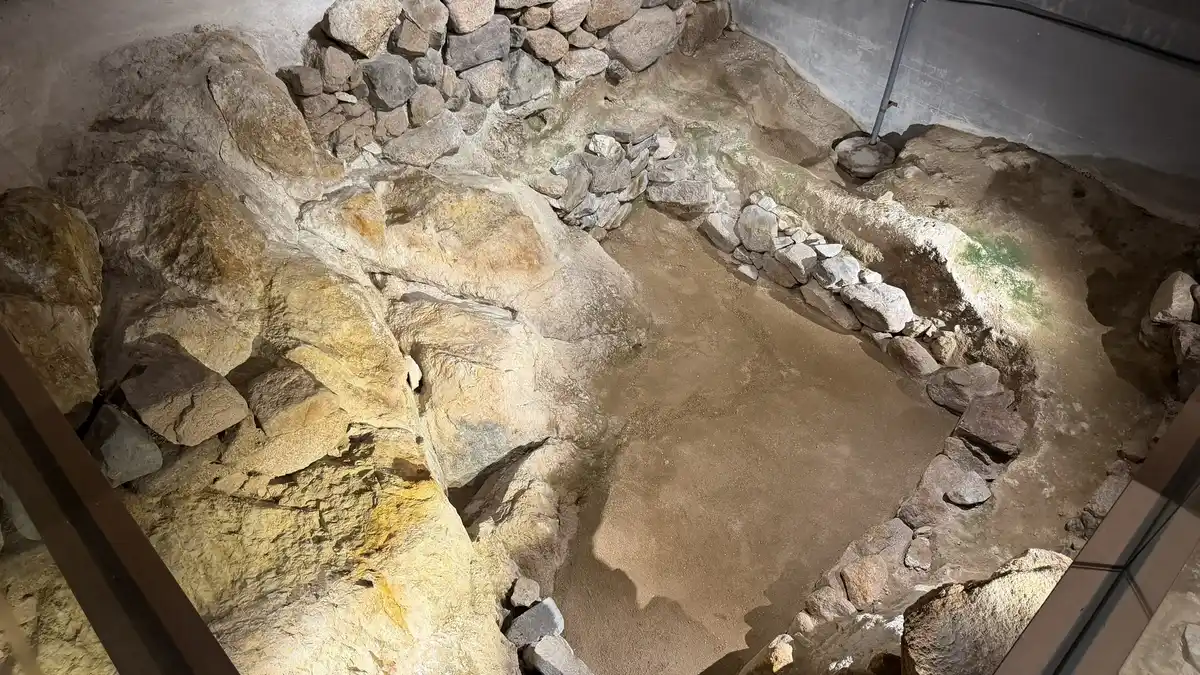
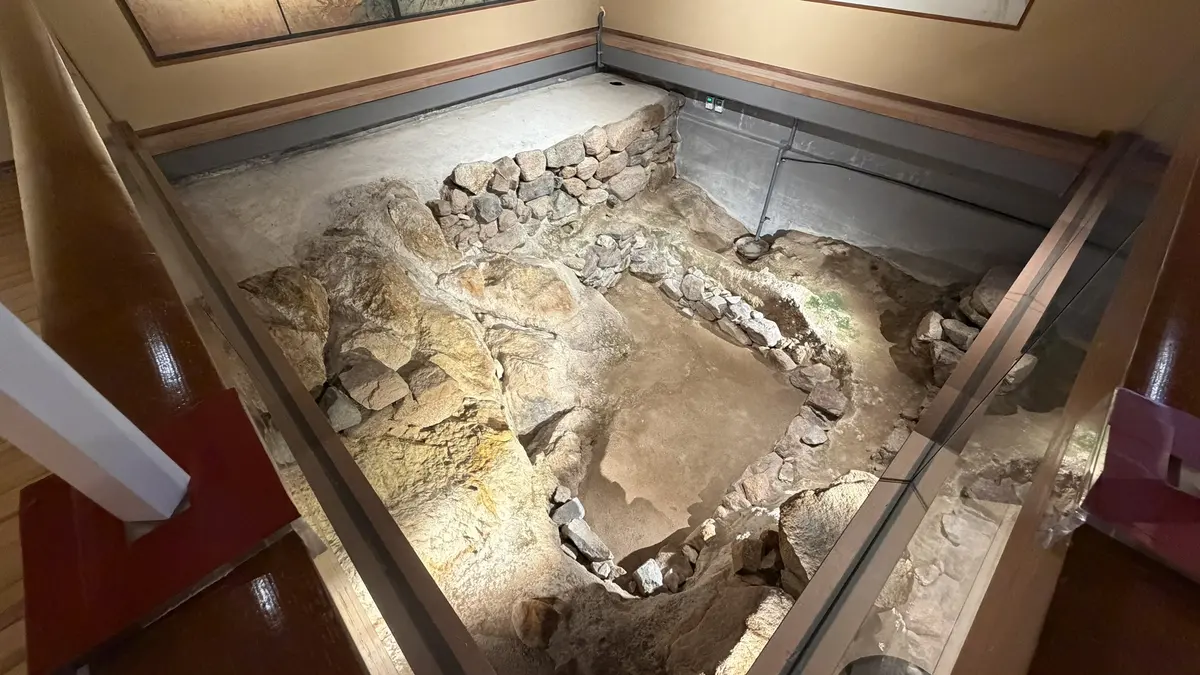
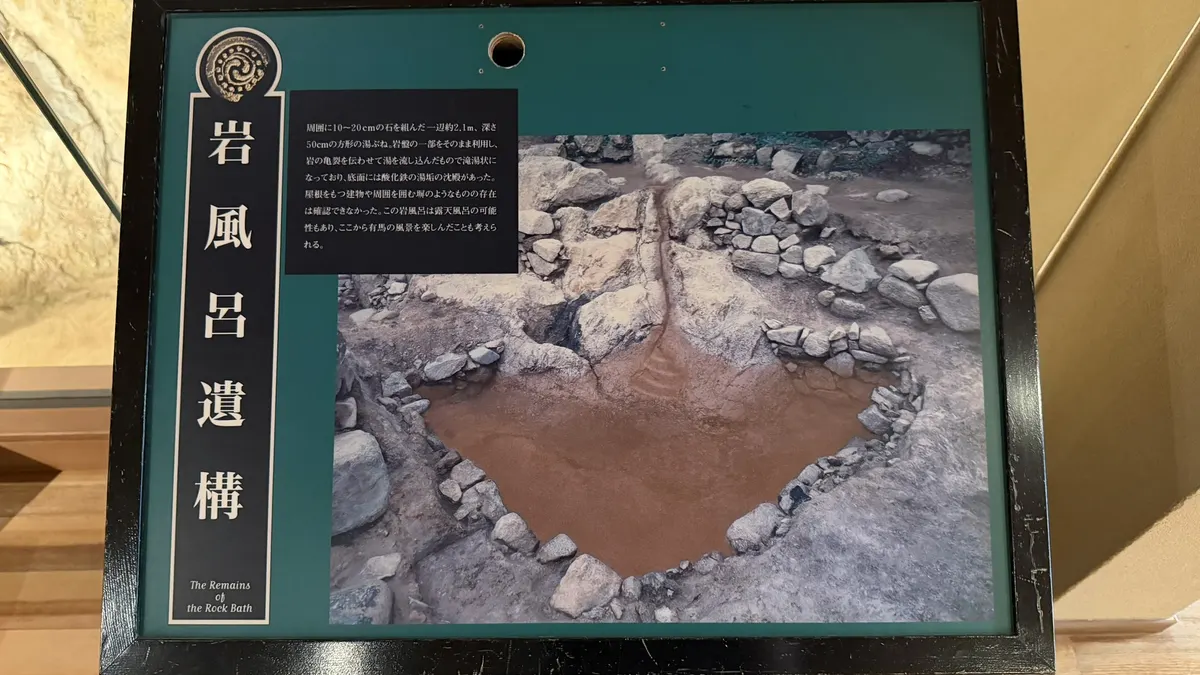
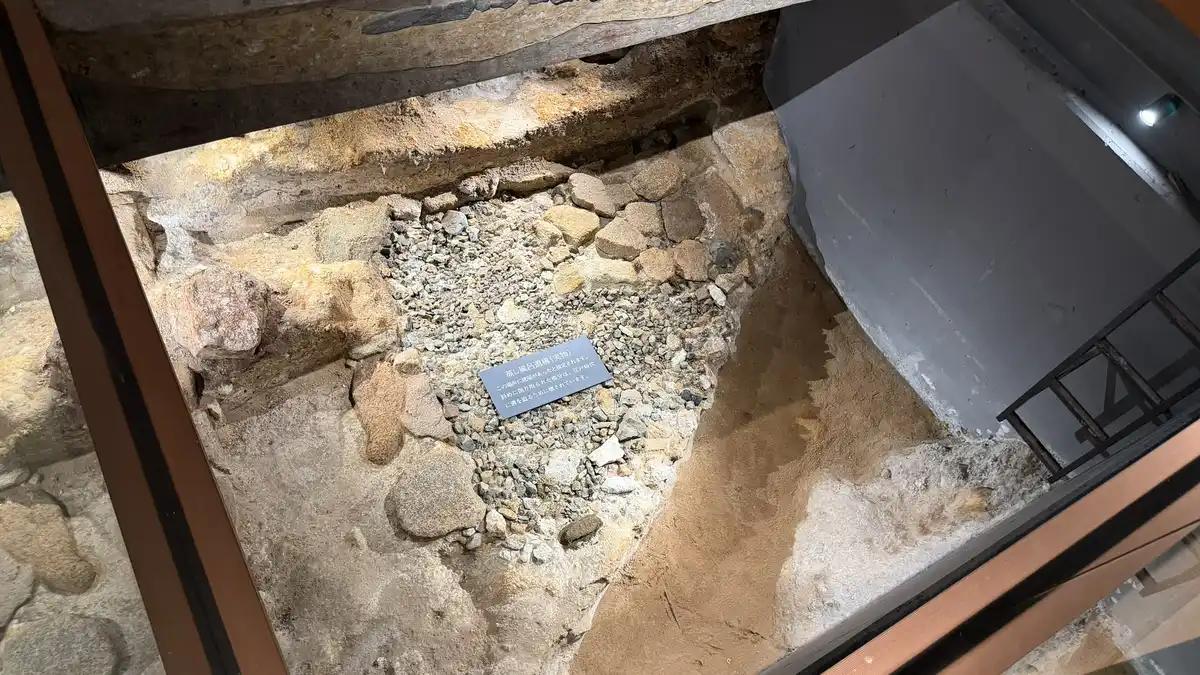
At Taiko no Yudonokan you look at two kinds of bath remains, kept as they were excavated. The palace buildings were demolished; the baths survived underground.
Reconstructions
Model, garden and roof tile
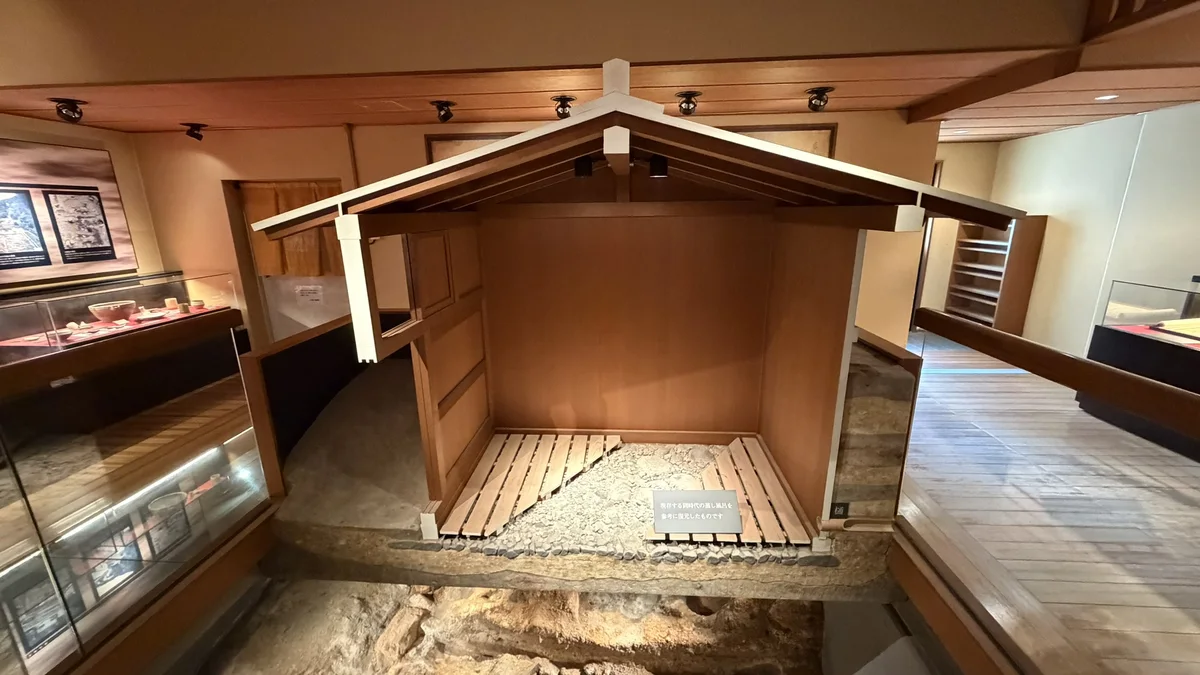
The wooden model above the steam-bath remains, the garden laid over the buried remains and the dragon-crest ridge tile are all reconstructions based on excavated material.
Modern memorials
Taiko Bridge, statues, Nene Bridge
The bridges and statues at the town entrance were put up in modern times in memory of Hideyoshi and his wife Nene.
Temples, springs, legends
Gokurakuji to Zuiho-ji Park
The temple histories, springs and park anecdotes come from temple tradition and the Arima Onsen Tourist Association.
How long you need depends on whether you add Zuiho-ji Park or stop to bathe. The table shows what I did in July 2026; times that include baths are marked.
| Taiko no Yudonokan | About 20 minutes. I went through the panels, the remains and the garden once (morning of 18 July 2026). |
|---|---|
| The whole morning | I started at Zuiho-ji Park at about 7:40, bathed twice along the way and left Arima at 11:00. That is about 3 hours 20 minutes including the baths. |
| Zuiho-ji Park | About 20 minutes on foot from Arima-onsen Station, according to Kobe City. It lies in a different direction from the temples, bridges and museum, so allow extra time for the round trip. |
| Kobe City Taiko no Yudonokan (太閤の湯殿館) | Museum. Bath remains, excavated finds and reconstructed displays. 1642 Arima-cho, Kita Ward, Kobe. Admission ¥200 for adults, ¥100 for children and students. |
|---|---|
| Taiko no Yu (太閤の湯) | Bathing facility. 292-2 Ikenojiri, Arima-cho, Kita Ward, Kobe. Open 10:00–22:00 (last entry 21:00). Details are in the Taiko no Yu section below. |
Getting to Arima Onsen from Osaka, Kobe, Kyoto and Himeji
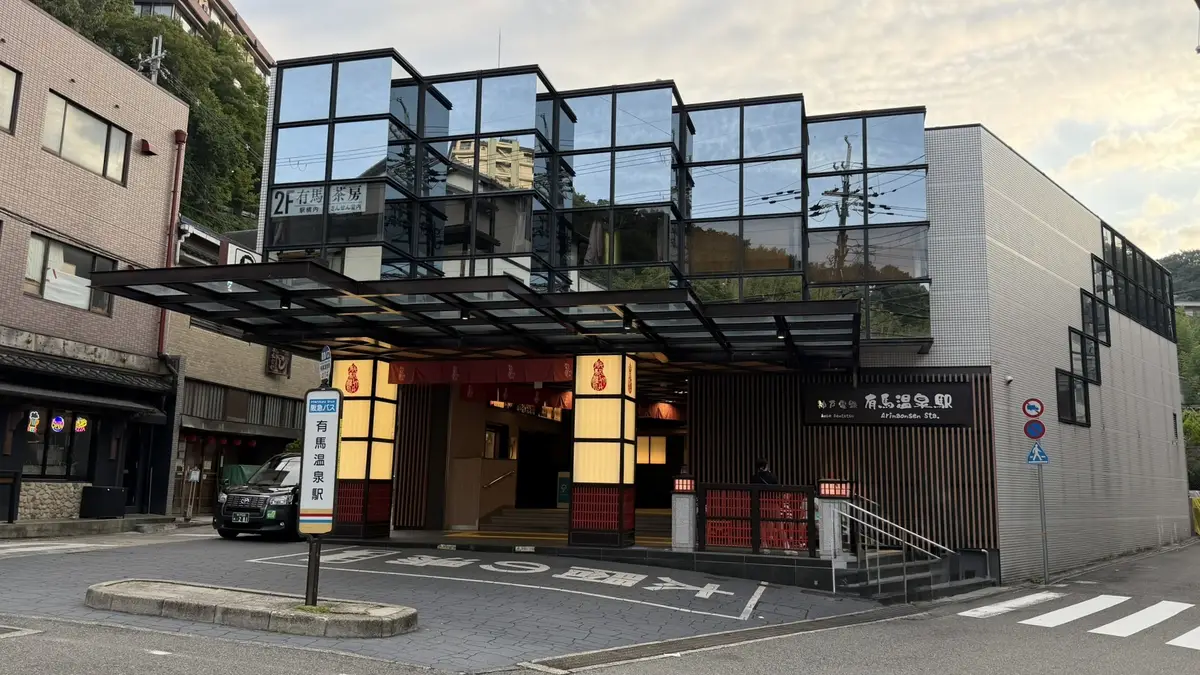
Arima Onsen has no single easy way in. From Sannomiya and Shin-Kobe, trains reach Arima-onsen Station (有馬温泉駅) on the Kobe Electric Railway, with changes at Tanigami (谷上) and Arimaguchi (有馬口). From Osaka, Kyoto and Himeji there are direct express buses, but each company has its own boarding point, its own reservation rules and a different number of departures. The sections below go starting point by starting point.
From Osaka
| Express bus (Hankyu Tourist Bus) | Runs directly to Arima Onsen from Umeda (Hankyu Sanbangai), Shin-Osaka, Senri New Town and Osaka International Airport. Published departure and arrival times put the trip at about 55–60 minutes. One way: ¥1,400 from Umeda, ¥1,250 from Shin-Osaka and ¥1,100 from Senri New Town. All seats are reserved, and only some buses stop at Shin-Osaka. |
|---|---|
| Train from JR Osaka Station | Take the JR Kobe Line to Sannomiya, the Kobe Municipal Subway to Tanigami, then the Kobe Electric Railway via Arimaguchi to Arima-onsen Station. The Arima Onsen Tourist Association gives about 1 hour. (The JR station is written 三ノ宮 on signs; the subway and private-railway stations are 三宮.) |
| Train from Umeda (Hankyu or Hanshin) | Change at Shinkaichi (新開地) to continue on the Kobe Rapid Railway, the subway and the Kobe Electric Railway. The tourist association gives about 1 hour 20 minutes. Some trains run straight through from Shinkaichi to Arima Onsen in the morning and evening. |
| Bus from Takarazuka (how I went) | Take the JR Takarazuka Line from Osaka Station, or the Hankyu Takarazuka Line from Umeda, to Takarazuka. Then board a Hankyu Bus (a different company from Hankyu Tourist Bus) bound for Arima Onsen (有馬温泉) from the stop outside the station. A route-search site shows about 1 hour for the direct bus; depending on departure time, the suggested route may instead change to the Kobe Electric Railway at Okaba (岡場), which takes about 1 hour 40 minutes. Bus fares have been revised, so check the Hankyu Bus fare table before you board, and confirm the departure time at the Takarazuka stop. |
From Kobe (Sannomiya, Shin-Kobe, Kobe Airport)
| Train from Sannomiya | Take the Kobe Municipal Subway to Tanigami, then the Kobe Electric Railway via Arimaguchi to Arima-onsen Station. The tourist association gives about 30 minutes, which varies with connection waits. |
|---|---|
| Train from Shin-Kobe | Take the subway to Tanigami and change to the Kobe Electric Railway; about 30 minutes. If you arrive by Shinkansen, Shin-Kobe is the closest station. |
| Express bus (Shinki Bus) | Runs from Kobe Airport (Terminals 1 and 2), Kobe Sannomiya and Shin-Kobe to Arima Onsen (Taiko-bashi). No reservation is needed, but there are only as many places as seats. Fares: ¥600 from Sannomiya and ¥810 from Kobe Airport (fare table revised 1 December 2023). IC cards are accepted. |
| Express bus (JR Bus “Arima Express”) | Runs from Shin-Kobe Station and the Sannomiya Bus Terminal (ground floor of Mint Kobe) to Arima Onsen in about 45 minutes. Reservations are made only through Kosoku Bus Net (高速バスネット). |
From Kyoto
| Express bus (Hankyu Tourist Bus and Keihan Bus) | The Kyoto–Arima line runs between the Hachijo exit of Kyoto Station (京都駅八条口) and Arima Onsen. It takes about 1 hour 15 minutes and costs ¥2,000 one way. Reservations take priority. The Hankyu Tourist Bus timetable (checked 6 October 2026) lists departures from Kyoto at 9:30 and 15:10 and from Arima at 11:30 and 17:20, two round trips a day. Keihan Bus says some trips are currently suspended, so check the latest status before you book. |
|---|
From Himeji and the west
| Express bus (Shinki Bus “Taiko Liner”) | Runs from Himeji Station and Himeji Castle Otemae (姫路城大手門前) to Arima Onsen (Taiko-bashi) without a change. It takes about 1 hour 20 minutes. The adult fare is ¥1,500 one way (half for children), no reservation is needed and IC cards are accepted. Departures are limited. You cannot ride the bus only between Himeji Station and Otemae. |
|---|---|
| Train from JR Himeji Station | Take the JR Kobe Line to Sannomiya, then go via Tanigami to Arima-onsen Station. The tourist association gives about 1 hour 30 minutes. |
| Train from Sanyo Himeji Station | Sanyo Himeji Station (山陽姫路駅) is a separate private-railway station. The tourist association gives about 1 hour 40 minutes. In the morning and evening some trains run direct from Shinkaichi to Arima Onsen. |
From Tokyo and farther away, from the airports, and by car
| By Shinkansen | Get off at Shin-Kobe Station (新神戸駅), the closest Shinkansen stop. From there it is about 30 minutes by train, or you can take a Shinki Bus or JR Bus express. |
|---|---|
| From the airports | Shinki Bus runs directly from Kobe Airport for ¥810. From Osaka International Airport (Itami), Hankyu Tourist Bus buses on the Umeda line also serve Arima. From Kansai International Airport, connect through Osaka or Sannomiya. |
| By car | There are three main car parks (fees as listed by the tourist association on 6 October 2026; they may change without notice). Arima Onsen Car Park costs ¥500 for 2 hours on weekdays and ¥600 on weekends and holidays, then ¥200 per extra hour, and ¥2,000 from 17:00 to 9:00. The Ropeway Car Park takes cars only: ¥100 per 20 minutes on weekdays (maximum ¥1,200), ¥200 per 30 minutes on weekends and holidays (maximum ¥1,600), and ¥300 per 30 minutes in November (maximum ¥2,000). Ikenobo Paid Car Park is open 24 hours: ¥300 per hour on weekdays (maximum ¥1,200) and ¥400 per hour on weekends and holidays (maximum ¥2,000). Taiko no Yudonokan has no car park of its own. Vehicle access around Zuiho-ji Park is restricted in November. |
Which route suits you
| Direct from Umeda | Hankyu Tourist Bus. Every seat is reserved, so book ahead; once the bus is full, you cannot board. |
|---|---|
| No booking, flexible plans | The train via Sannomiya, Tanigami and Arimaguchi. If you miss one train, the next one is not far behind. |
| From Sannomiya or Shin-Kobe | The train, or Shinki Bus, which needs no reservation. The bus costs ¥600 from Sannomiya. |
| From the Hanshin area or Takarazuka | Hankyu Bus from Takarazuka. I used this route on the way in. Check the departure time at the stop. |
| From Kyoto | The direct bus runs twice a day each way. If the timetable works, you arrive in the morning and return in the late afternoon. |
| Heading to Himeji or farther west | Shinki Bus's Taiko Liner. I took it on the way back and reached Himeji Station without changing. |
Access to Arima Onsen (Taiko no Yudonokan)
| Nearest station | Arima-onsen Station (有馬温泉駅), Kobe Electric Railway (station number KB16) |
|---|---|
| Closest Shinkansen station | Shin-Kobe Station |
| Travel time from major cities | Osaka (Umeda): bus about 55–60 min, train about 1 hr to 1 hr 20 min. Sannomiya (Kobe): train about 30 min. Kyoto: bus about 1 hr 15 min. Himeji: bus about 1 hr 20 min, train about 1 hr 30 min. All are estimates and vary with connection waits and traffic. |
| Station to Taiko no Yudonokan | About 10 minutes on foot (Kobe City). The museum has no car park. |
| Getting around on foot | The town centre can be covered on foot. There are slopes and steps; on my July 2026 visit the stepped approach to Yusen Shrine was the hardest part. Zuiho-ji Park is about 20 minutes on foot from the station. |
| Recommended transport | Public transport and walking. If you come by bus, check the timetable for both directions before you leave. |
| Taiko no Yudonokan hours | 9:00–17:00 (last entry 16:30). Closed on the second Wednesday of the month, and occasionally at other times. |
| Note | The route map starts at Arima-onsen Station. Bus stops differ by company; Shinki Bus stops at 有馬温泉〔太閤橋〕 (Arima Onsen, Taiko-bashi). |
Bus timetables and service status
Hideyoshi and Arima: from reconstruction to excavation
Arima has been known as a hot spring for a very long time. The priest Gyoki is said to have founded Onsen-ji Temple in 724 (the first year of Jinki), according to the temple. Kobe City introduces Hideyoshi as a man who helped restore the town.
Late in Hideyoshi's life, the Yuyama Palace was built at Arima. Osaka Castle Museum notes that roof tiles of the same design have been excavated at both Osaka and the Yuyama Palace site. Where the tiles were made and how they were carried has not been settled, and sources differ on the year the palace was built and when it was finished.
The palace was later pulled down and Gokurakuji Temple was built on the site. The soil-layer display at Taiko no Yudonokan explains that the temple was founded after the demolition and burned down in the Edo period. The excavation began when Gokurakuji's living quarters, damaged in the earthquake, had to be rebuilt. Work started in December 1996 and ran over several seasons. How far the palace grounds extended is not known, and the museum presents its layout as an estimate.
Walking route: the order I followed, and a plan built around the museum
I arrived at Arima-onsen Station on 17 July 2026 and walked the historic sites on the morning of the 18th. This is the order I followed.
On the way from the station to my inn I crossed Taiko Bridge and saw the statues of Hideyoshi and Nene in Yukemuri Square. After dropping my bags I went to the bathing facility Taiko no Yu, then walked past Nene Bridge and the square again at night.
I looked at the old Zuiho-ji gate, then headed for the carbonated spring.
The mountain path to Yusen Shrine has a long flight of steps. It was the hardest stretch of the whole walk.
I spent about 20 minutes in the museum. I walked past the entrance to the spring once and had to turn back with a map app.
I bathed twice during the morning. I caught the express bus to Himeji Station from the Taiko Bridge stop.
Where the sites are
A look at the map first will help you choose an order. The map below is a walking route from Arima-onsen Station through Taiko Bridge to Zuiho-ji Park. Nenbutsuji and Gokurakuji are next to the museum, and Nene Bridge is just downstream of Taiko Bridge, so those stops nearly overlap on the map.
Hideyoshi sites in Arima Onsen: how they relate
| Taiko Bridge and Yukemuri Square | Just outside the station. Yukemuri Square is on your right as you leave the station (Arima Onsen Tourist Association). |
|---|---|
| Nene Bridge | Downstream from Taiko Bridge along the Arima River, facing the Hideyoshi statue in Yukemuri Square (Kobe City). |
| Onsen-ji Temple and Yusen Shrine | On higher ground south of the town centre. The shrine is up a long flight of steps. |
| Nenbutsuji, Gokurakuji, Taiko no Yudonokan | South-east of the centre. The three stand next to each other. The museum is about 10 minutes on foot from the station (Kobe City). |
| Tansan Spring Park | Described as about 10 minutes uphill from the town centre. |
| Zuiho-ji Park | In the hills east of the centre, about 20 minutes on foot from the station (Arima Onsen Tourist Association). |
If you are short on time, the centre alone is enough: Taiko Bridge and Yukemuri Square, the museum and Gokurakuji. Zuiho-ji Park and Onsen-ji Temple with Yusen Shrine add steps and slopes. I covered both, with two baths in between, in about 3 hours 20 minutes on the morning.
1 and 2: Remains, finds and reconstructions at Taiko no Yudonokan
Kobe City Taiko no Yudonokan (太閤の湯殿館, the Yuyama Palace remains)
The palace is gone, but you can look down on its baths underground
Taiko no Yudonokan is a Kobe City museum that preserves and displays the excavated remains of the Yuyama Palace, which Hideyoshi had built at Arima. You cannot bathe here. You look at the remains and the exhibits. It stands right beside Gokurakuji Temple, with a recreated garden outside.
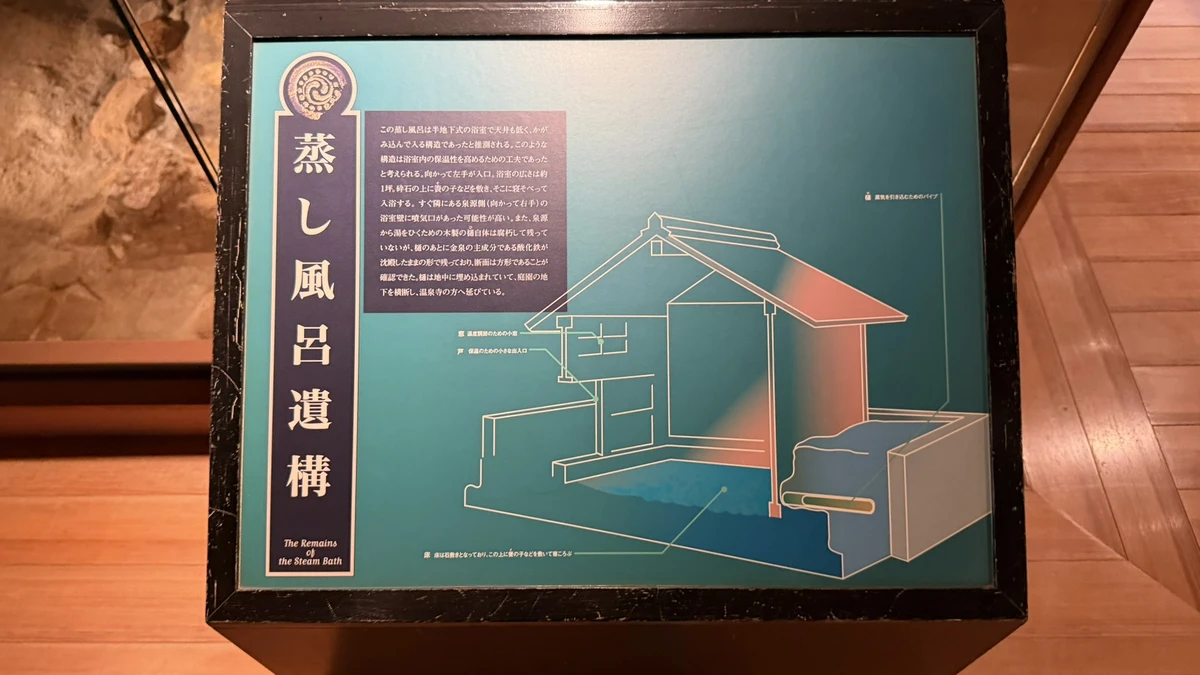
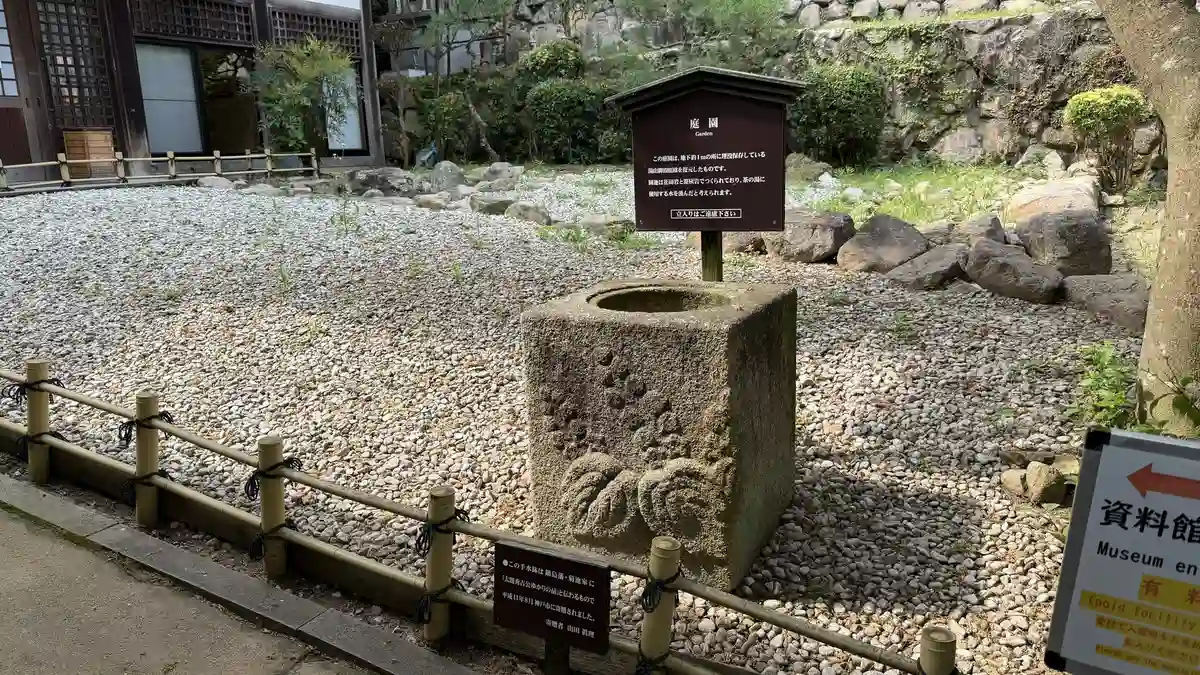
The core of the museum is the steam bath and the rock bath, kept as they were found. A wooden reconstruction of the steam bath sits directly over its remains, so the remains are below the floor and the model is on top. The garden is laid over the buried remains, which lie about 1 m down.
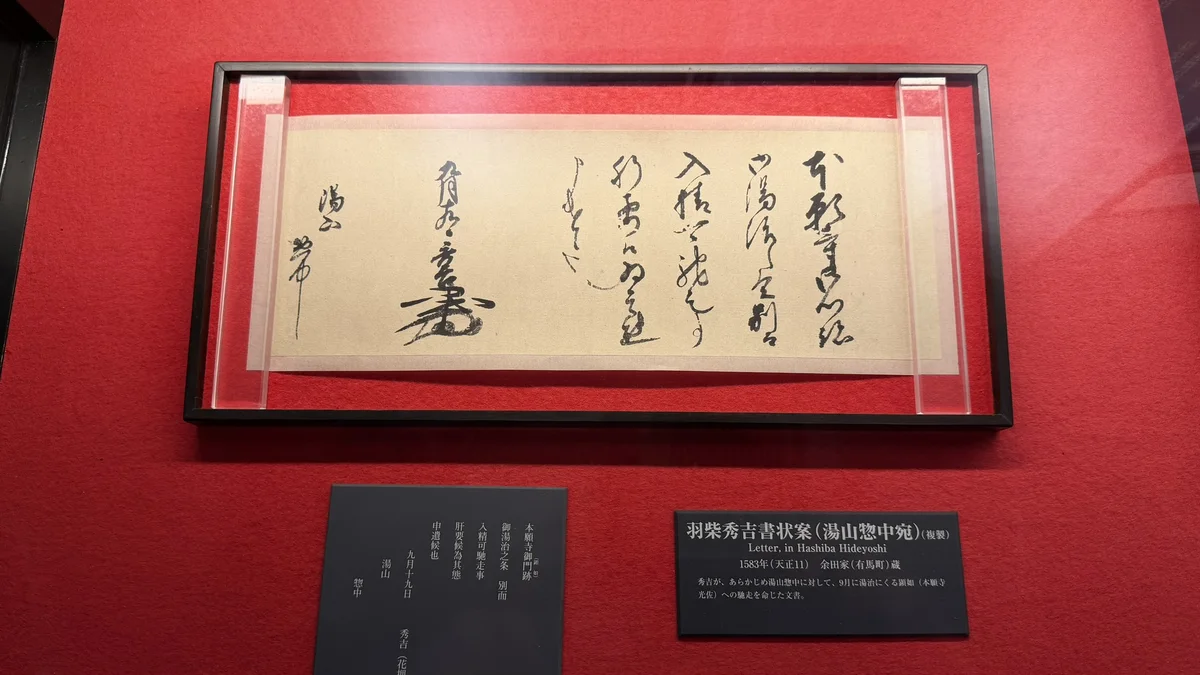
On the morning of 18 July 2026 it took me about 20 minutes to go round. Most of the old documents are copies, but they were so well made that I could not tell them from the originals.
Highlights
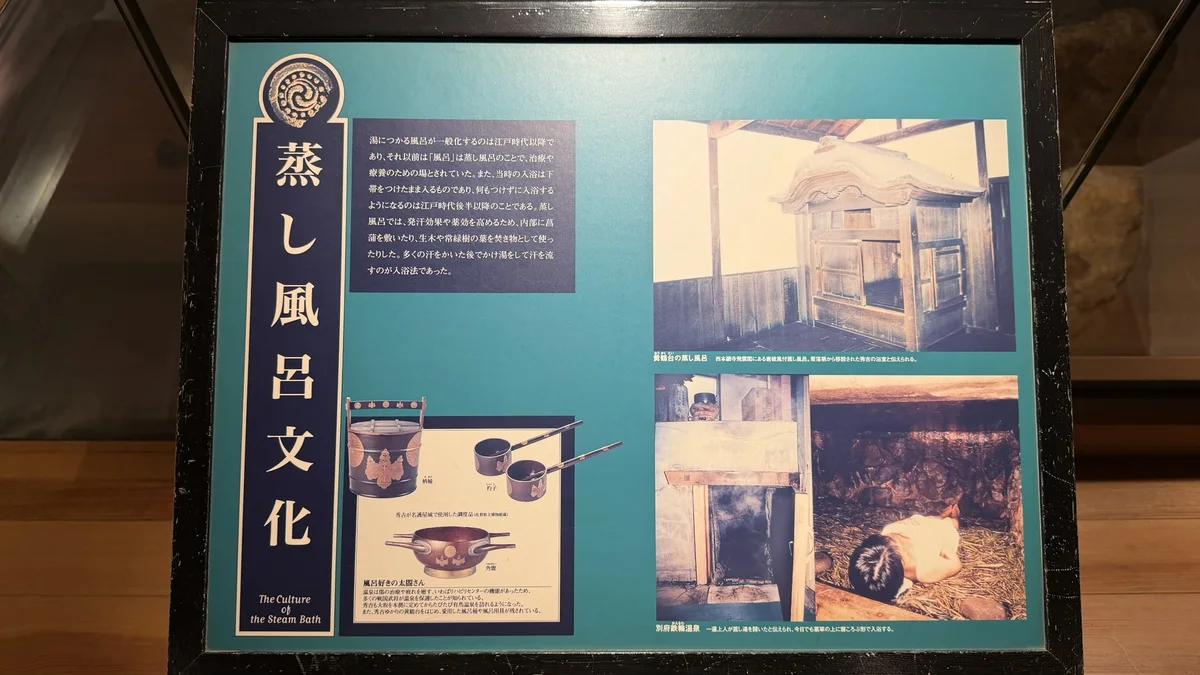
- Steam-bath remains, shown as excavated. A reconstructed model stands directly above them, and the two are different things.
- Rock-bath remains, shown as excavated. Thought to be part of the Yuyama Palace linked to Hideyoshi.
- Garden, recreated above the remains that lie about 1 m underground (museum leaflet).
- Dragon-crest ridge tile, a reconstruction based on part of an excavated dragon.
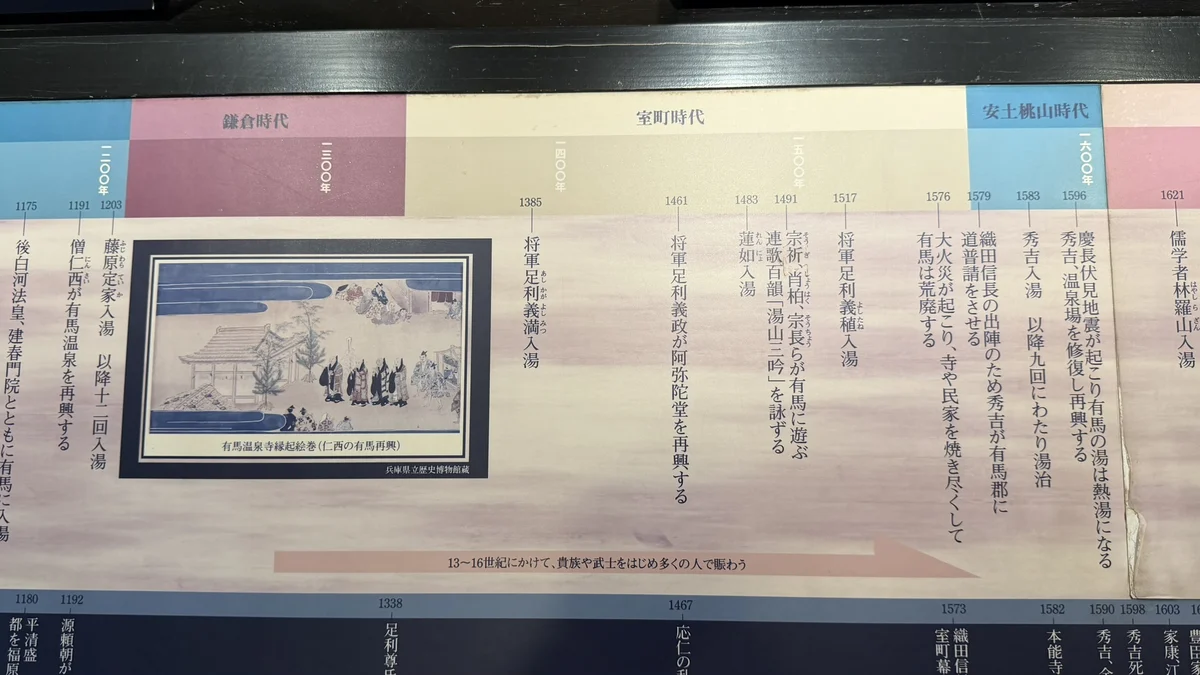
- Photo panels of the dig, a timeline of the palace, and copies of documents connected with Hideyoshi.
Remains, reconstruction or copy?
| Steam bath | Remains, as excavated. The wooden model above it is a reconstruction. |
|---|---|
| Rock bath | Remains, as excavated. |
| Garden | Recreation. The remains are about 1 m underground. |
| Dragon-crest ridge tile | Reconstruction, made from part of the excavated dragon. |
| Old documents | Mostly copies. On my July 2026 visit they were so well made that I could not tell them from originals. |
Photos
Tap any photo to enlarge
Visiting details
| Address | 1642 Arima-cho, Kita Ward, Kobe (神戸市北区有馬町1642) |
|---|---|
| Hours | 9:00–17:00 (last entry 16:30) |
| Closed | Second Wednesday of the month, plus occasional temporary closures |
| Admission | ¥200 for adults, ¥100 for children and students. Free for people with a disability certificate and their carer, and for high school students living in Kobe (Kobe City). |
| From the station | About 10 minutes on foot. There is no car park. |
| Time needed | About 20 minutes (my visit, morning of 18 July 2026) |
| English | On my July 2026 visit the exhibit titles had English, but I did not find English explanatory text (as far as I could check). |
Map
3: Modern memorials: Taiko Bridge, Yukemuri Square and Nene Bridge
Near the entrance to the hot spring town there are bridges and statues set up in memory of Hideyoshi and Nene. None of them dates from the Sengoku period; they are modern memorials. They are easy to reach from the station on foot and make a good warm-up before you see the remains.
Taiko Bridge and the Hideyoshi statue in Yukemuri Square
A tribute to Hideyoshi at the entrance to the town
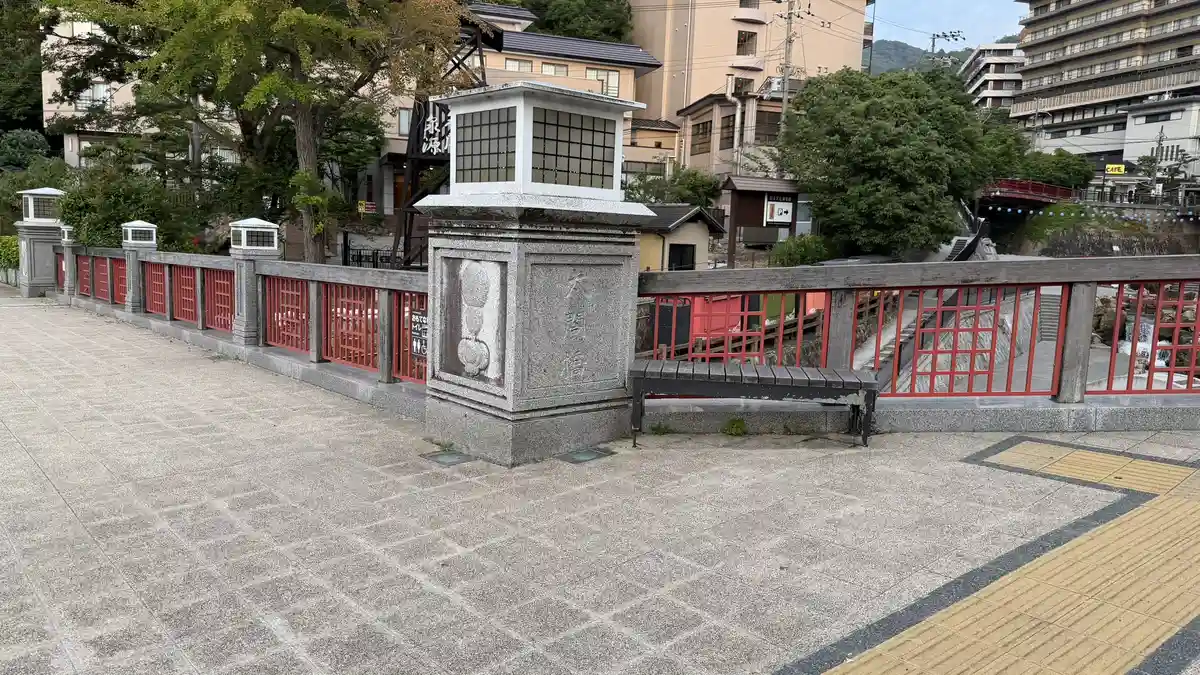
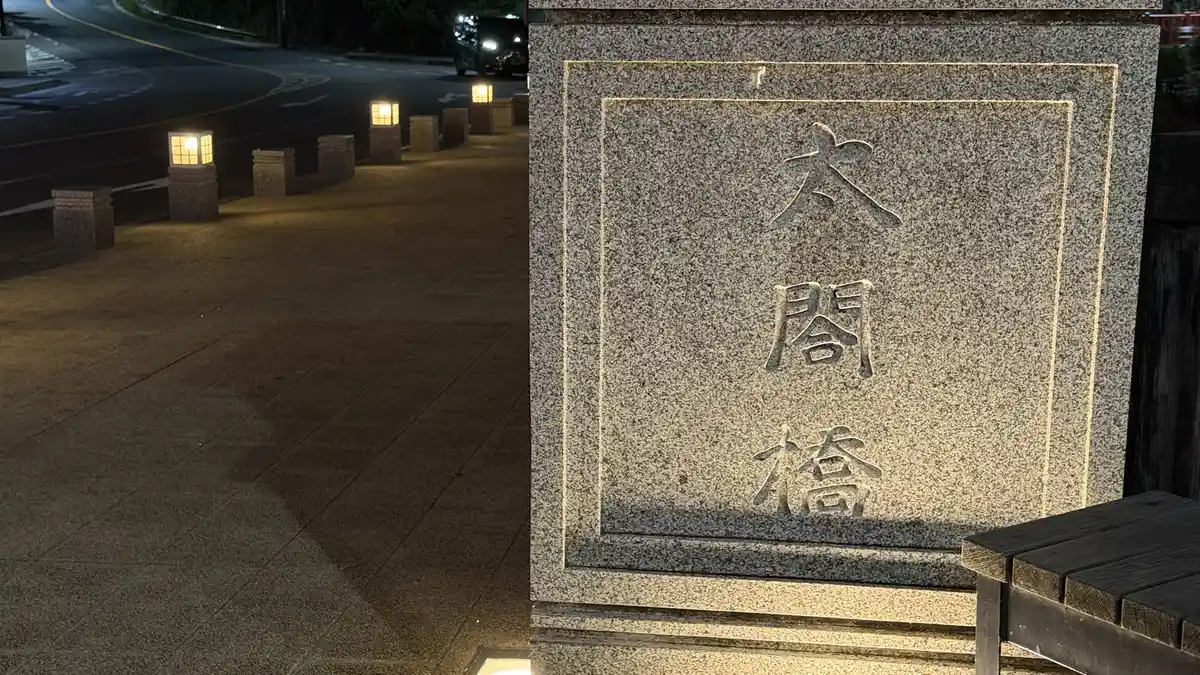
Taiko Bridge crosses the Arima River. A stone pillar inscribed with its name and red railings mark it. It was named after Hideyoshi (Taiko is a title for a retired regent) and stands at the entrance to the town. The bridge itself is modern.
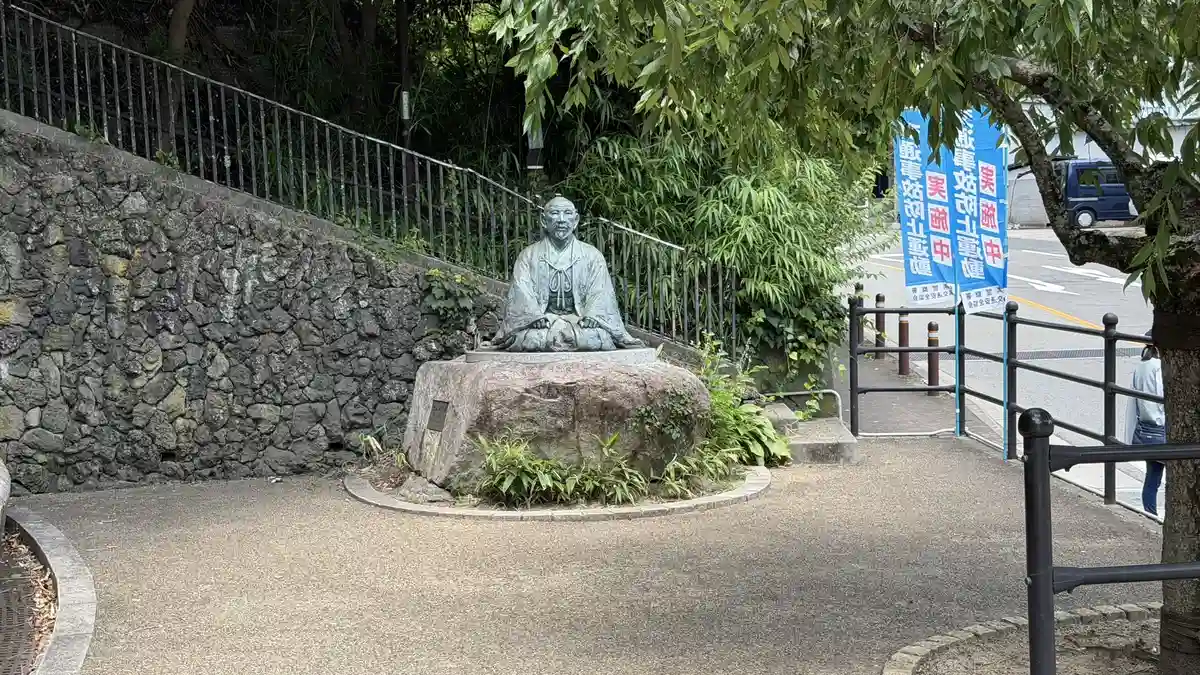
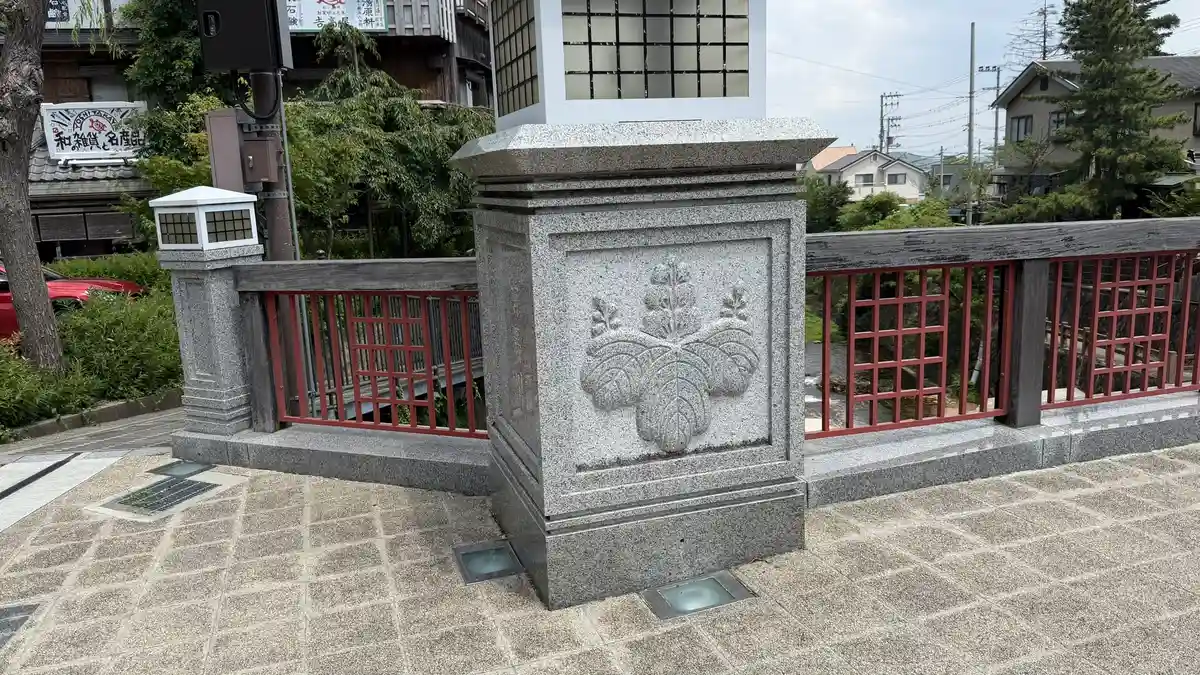
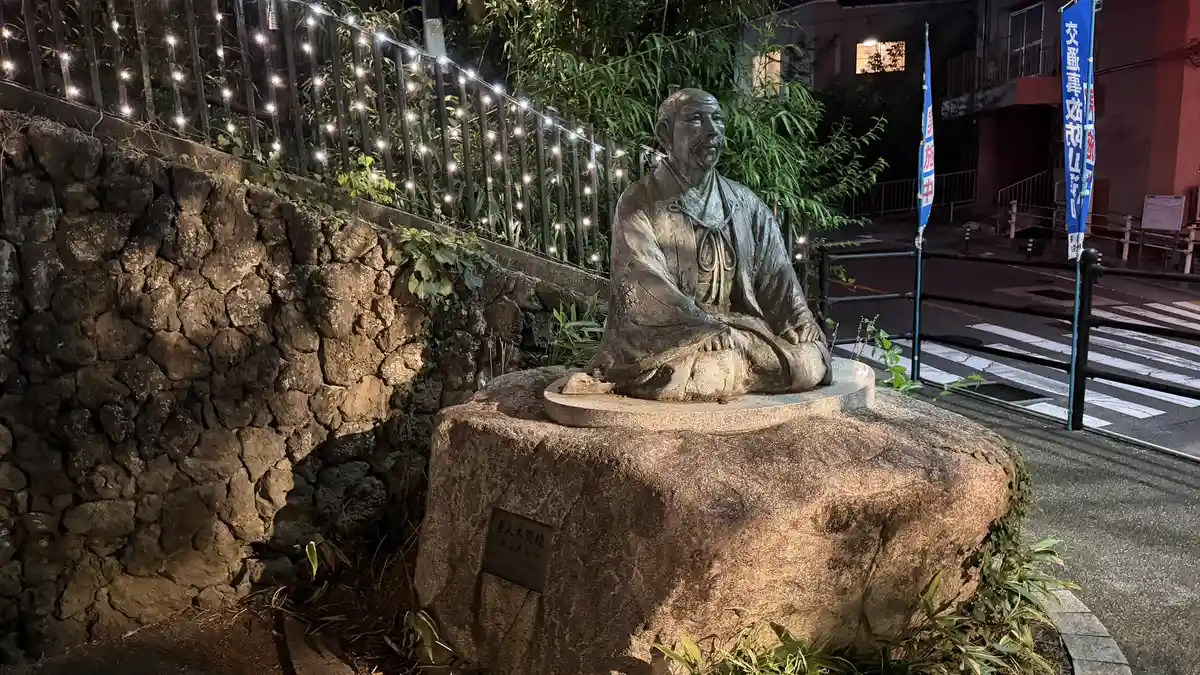
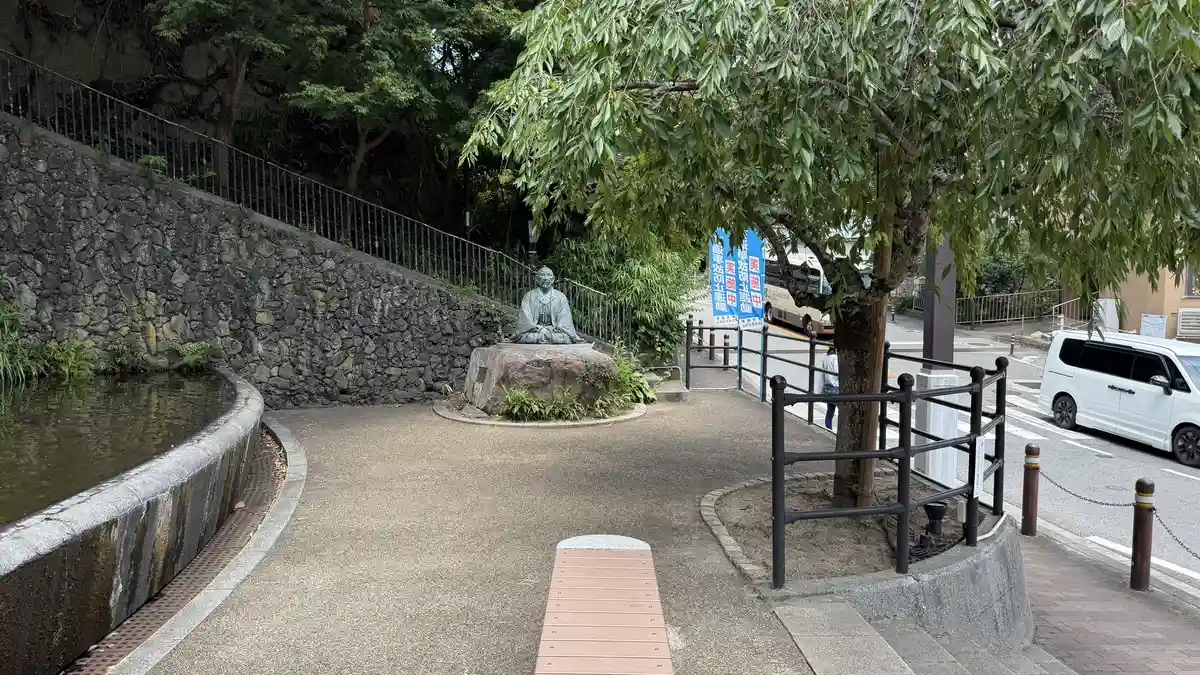
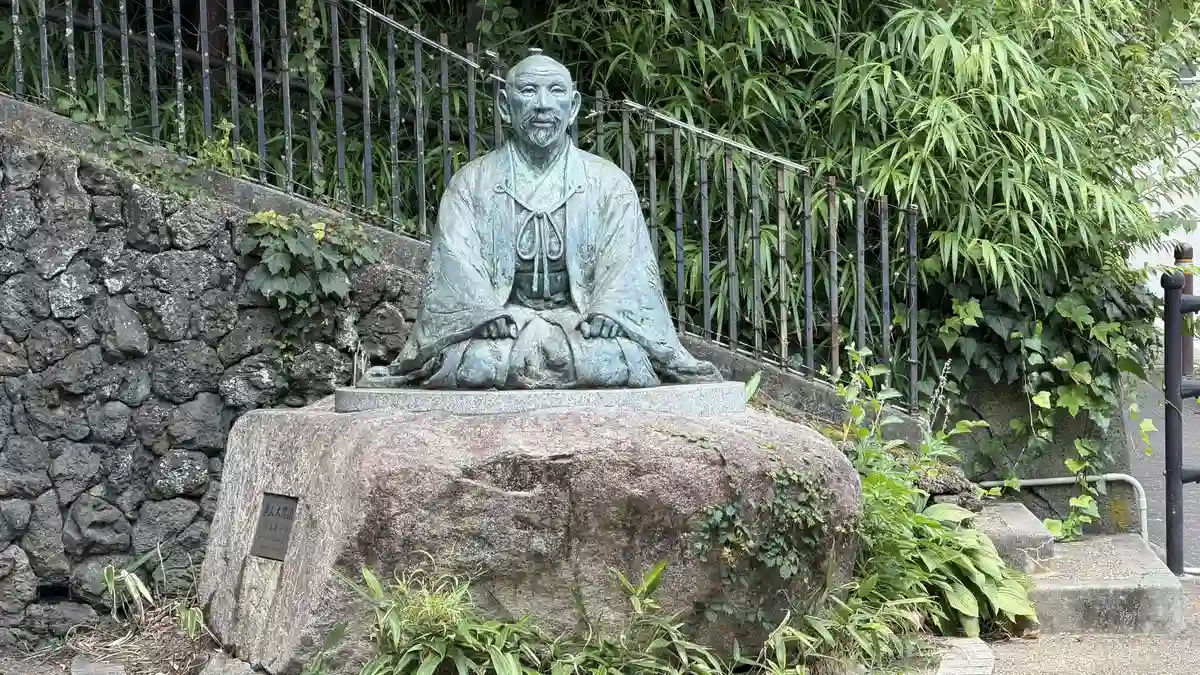
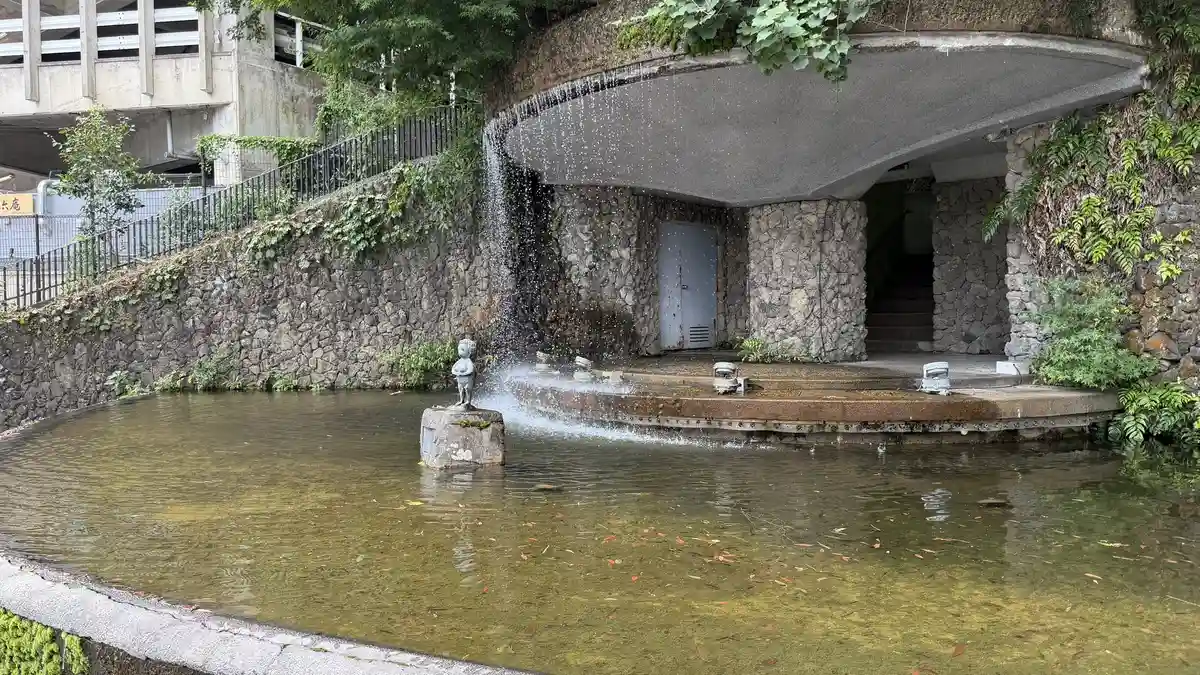
Yukemuri Square, on your right as you leave Arima-onsen Station, has a seated statue of Hideyoshi, who loved Arima. A waterfall styled after rising steam stands in the middle, and the tourist association presents the square as a symbol of the town. On the evening of 17 July 2026 I passed Taiko Bridge on my way to the inn and saw the statue. I came back at night and saw the Toyotomi crest on the lit pillar.
Highlights
- The stone pillar inscribed 太閤橋 (Taiko Bridge) and the red railings
- The Toyotomi crest carved on the pillar (on the night of 17 July 2026 the pillar was lit)
- The Hideyoshi statue in Yukemuri Square, seated on a rock base (sculptor: Eiko Shintani)
- A waterfall and pond styled after rising steam
Photos
Tap any photo to enlarge
Visiting details
| Where | In the centre of Arima Onsen. Yukemuri Square is on your right as you leave the station (Arima Onsen Tourist Association). |
|---|---|
| Access | Outdoors, no ticket or opening hours. |
| Origin | The bridge and the statue are both modern memorials. |
Map
Nene Bridge and the Nene statue
Nene's bridge, facing Hideyoshi's statue
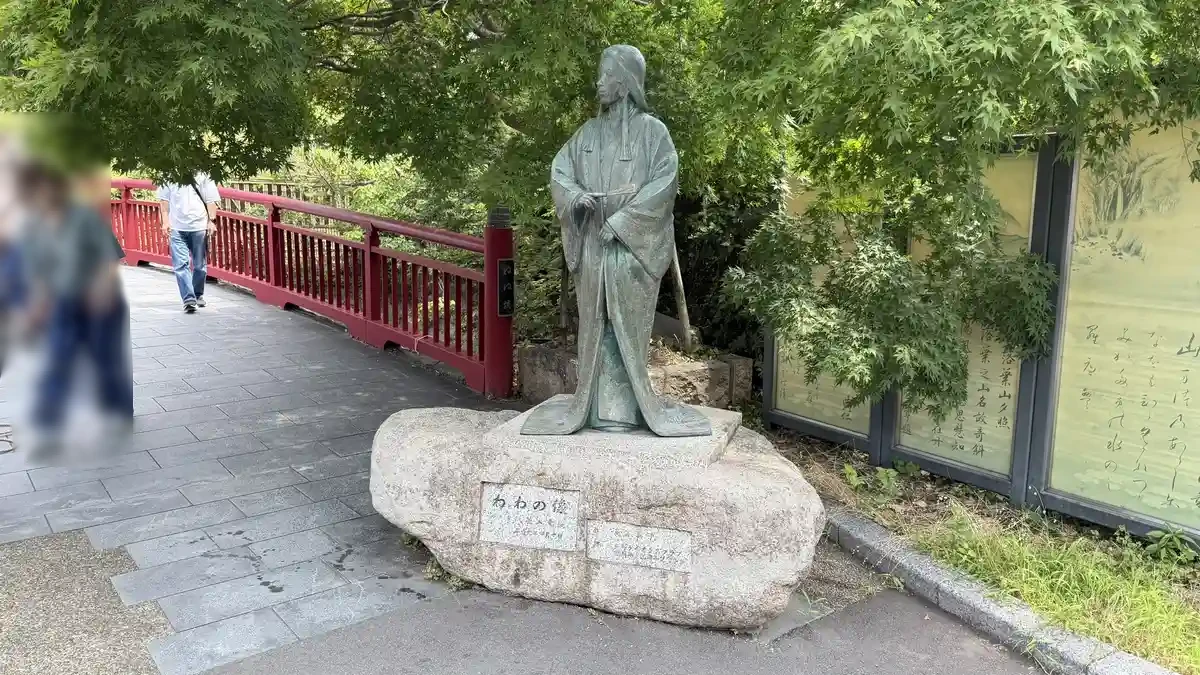
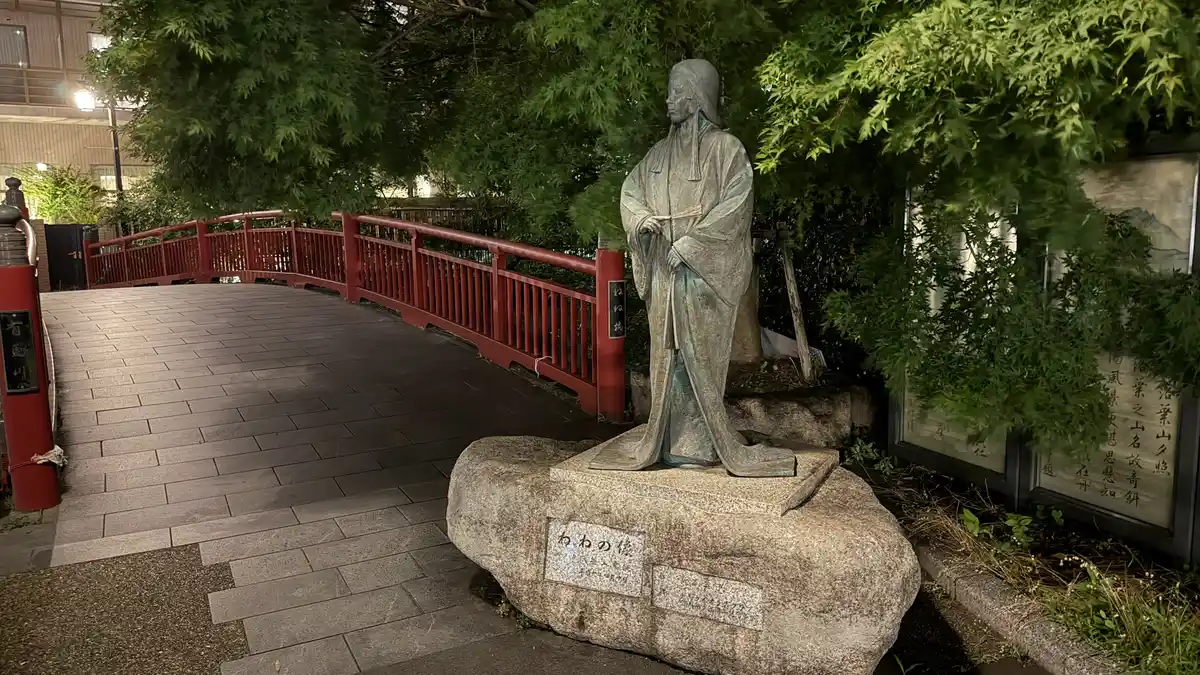
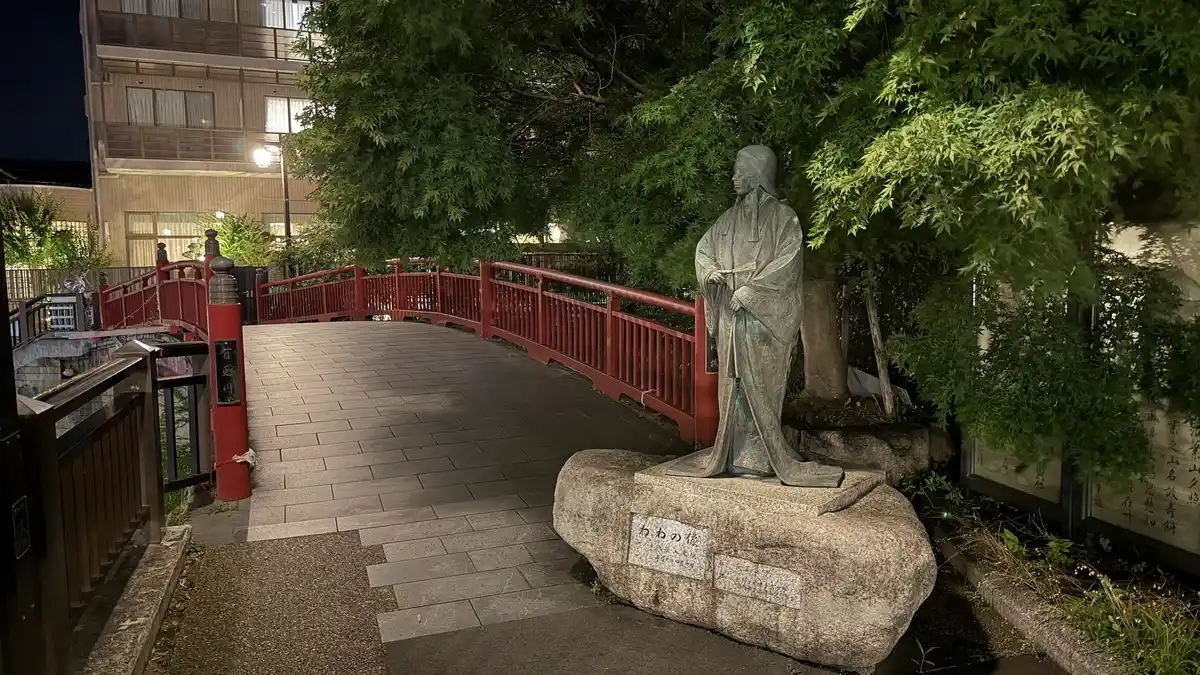
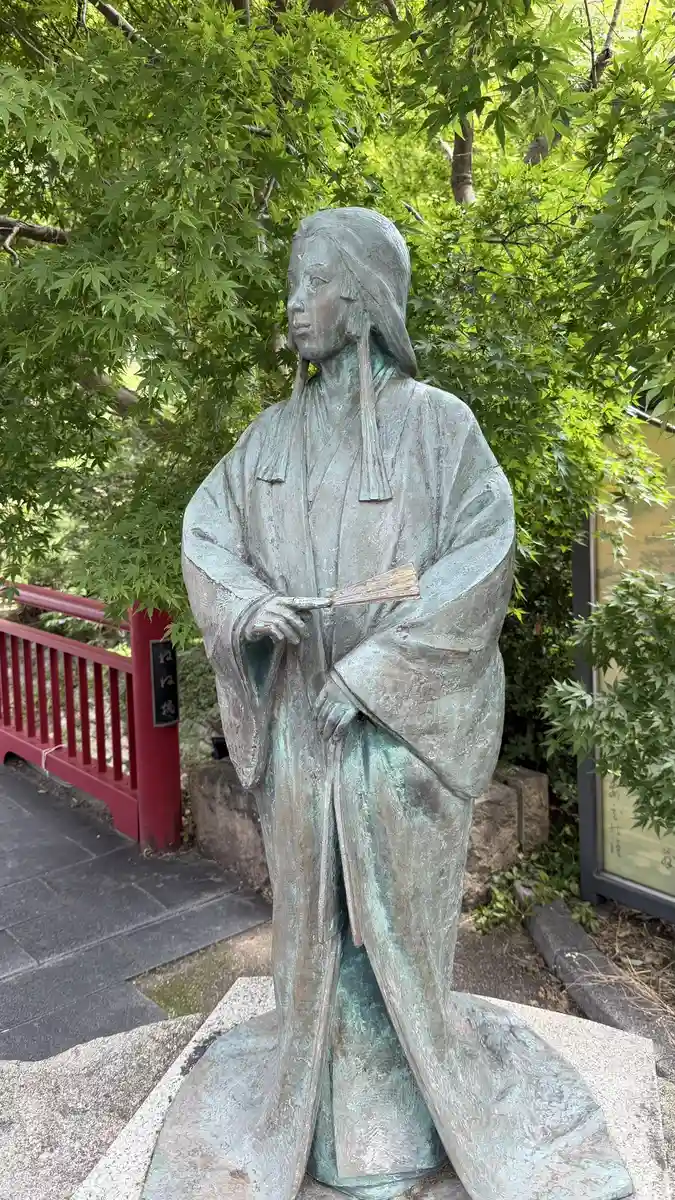
Nene Bridge is named after Nene, also known as Kitanomandokoro, Hideyoshi's wife. The Arima Onsen Tourist Association says that Nene built a villa at Arima and bathed there with Hideyoshi, forgetting the noise of war. A statue of her stands beside the bridge, and Kobe City says it faces the Hideyoshi statue.
Both bridge and statue were put up in modern times in memory of the couple. On the night of 17 July 2026 the red bridge and the statue were lit, and it was one of the best views of the trip. I passed again on the morning of the 18th, at the end of my walk, along with Taiko Bridge.
Highlights
- The red-railed Nene Bridge and the Nene statue beside it (sculptor: Eiko Shintani)
- Placed to face the Hideyoshi statue in Yukemuri Square (Kobe City)
- On the night of 17 July 2026 the bridge and statue were lit
Photos
Tap any photo to enlarge
Visiting details
| Where | In the centre of Arima Onsen (the tourist association says “the middle of the hot spring town”). |
|---|---|
| Access | Outdoors, no ticket or opening hours. |
| Origin | The bridge and statue are modern memorials. The story that Nene had a villa here is a separate tradition, kept at Nenbutsuji Temple. |
Map
4: Temples, springs and legends: Gokurakuji to Zuiho-ji Park
The histories of the temples and shrine, the springs and the park stories come from temple tradition and the Arima Onsen Tourist Association. The source is given for each.
Gokurakuji Temple and Gokuraku Spring
The temple that led to the excavation, and the spring said to have fed Hideyoshi's baths
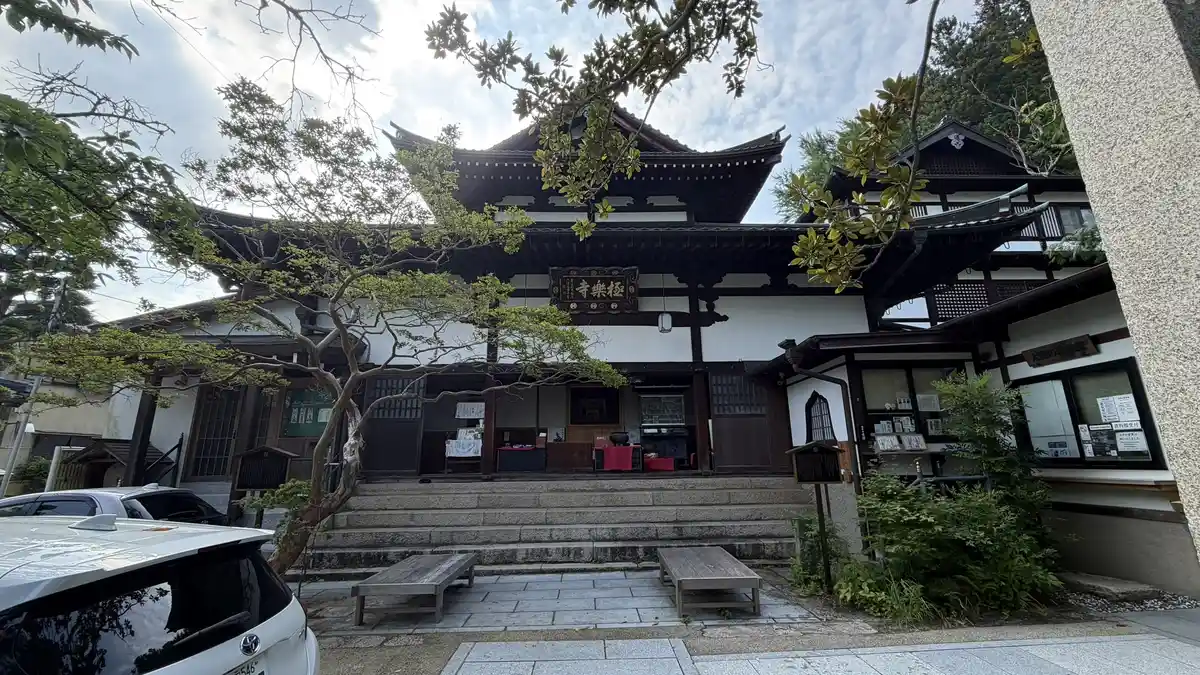
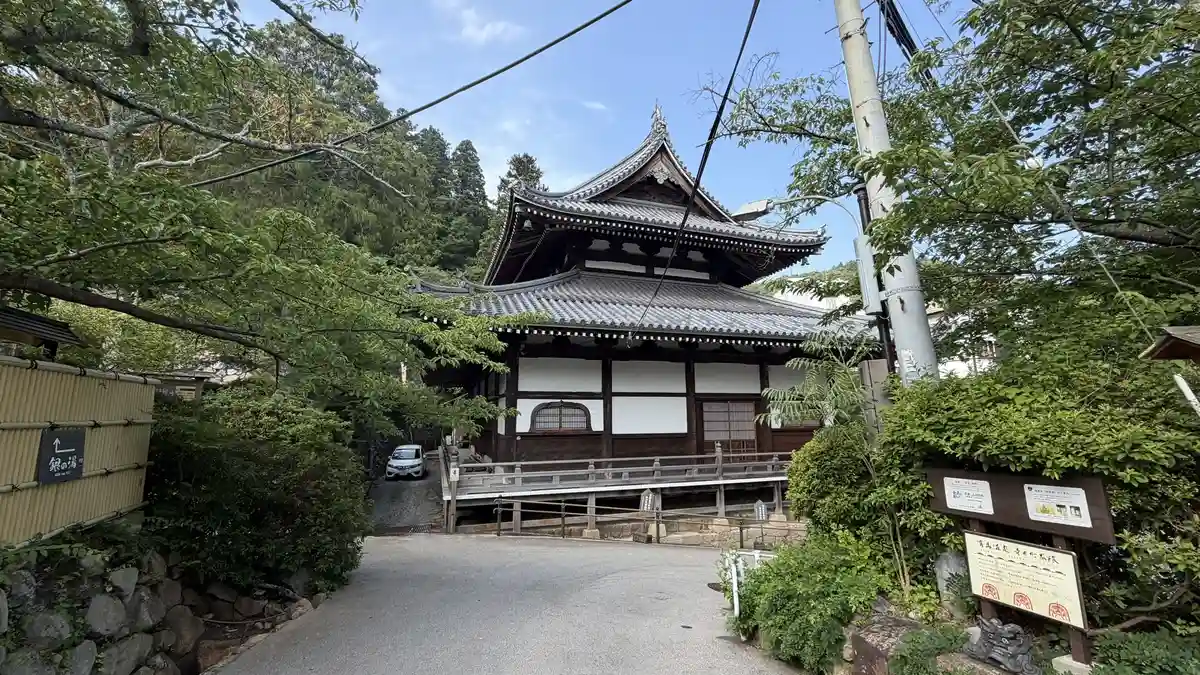
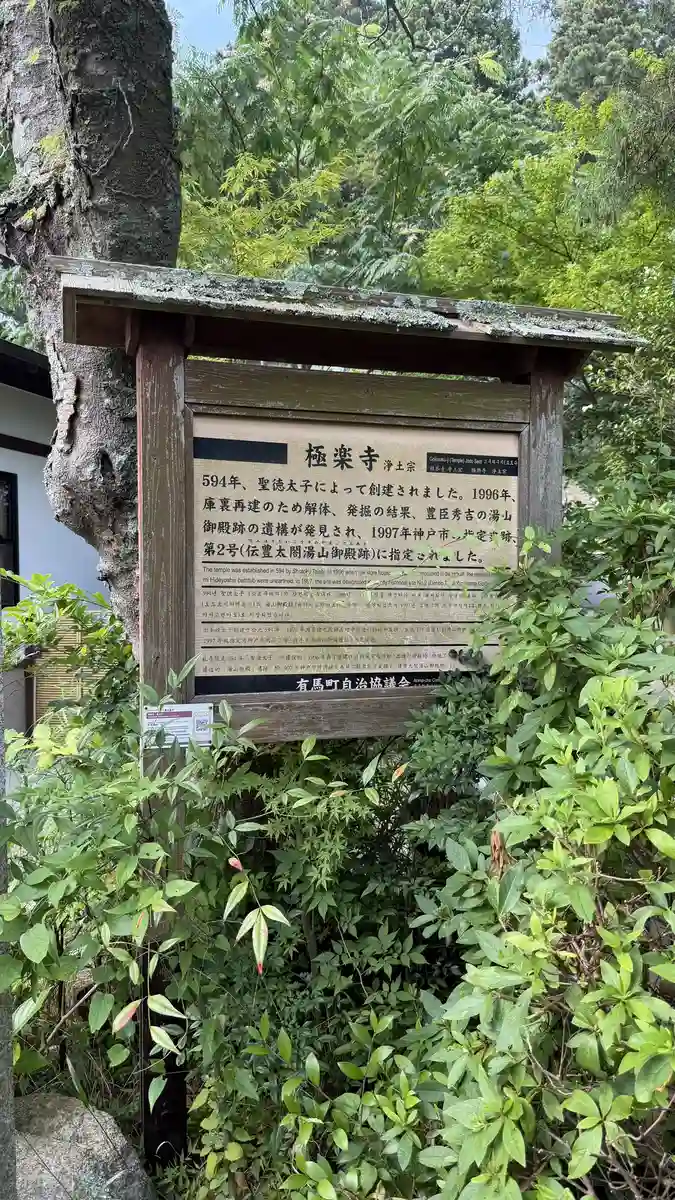
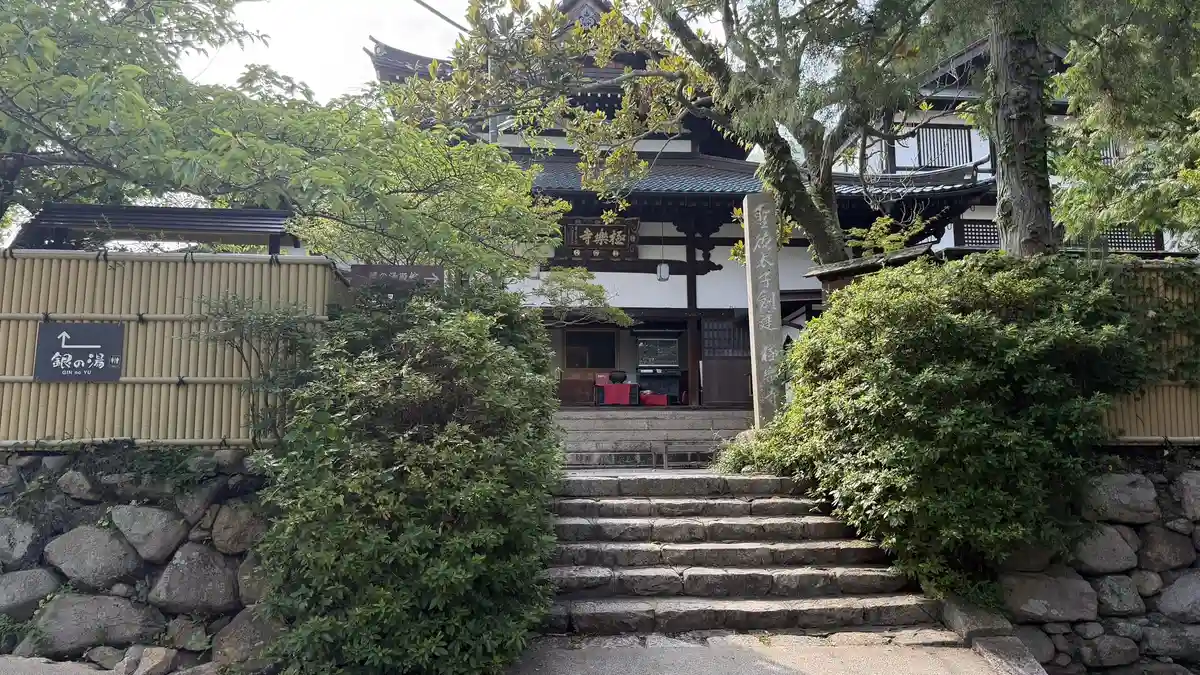
Gokurakuji stands right next to Taiko no Yudonokan. When its living quarters, damaged in the Great Hanshin-Awaji Earthquake, were being rebuilt, the remains of Hideyoshi's Yuyama Palace came to light. The Arima Onsen Tourist Association says that Gokurakuji and Nenbutsuji were built on the palace site. So the temple that triggered the dig and the museum that shows its results are neighbours.
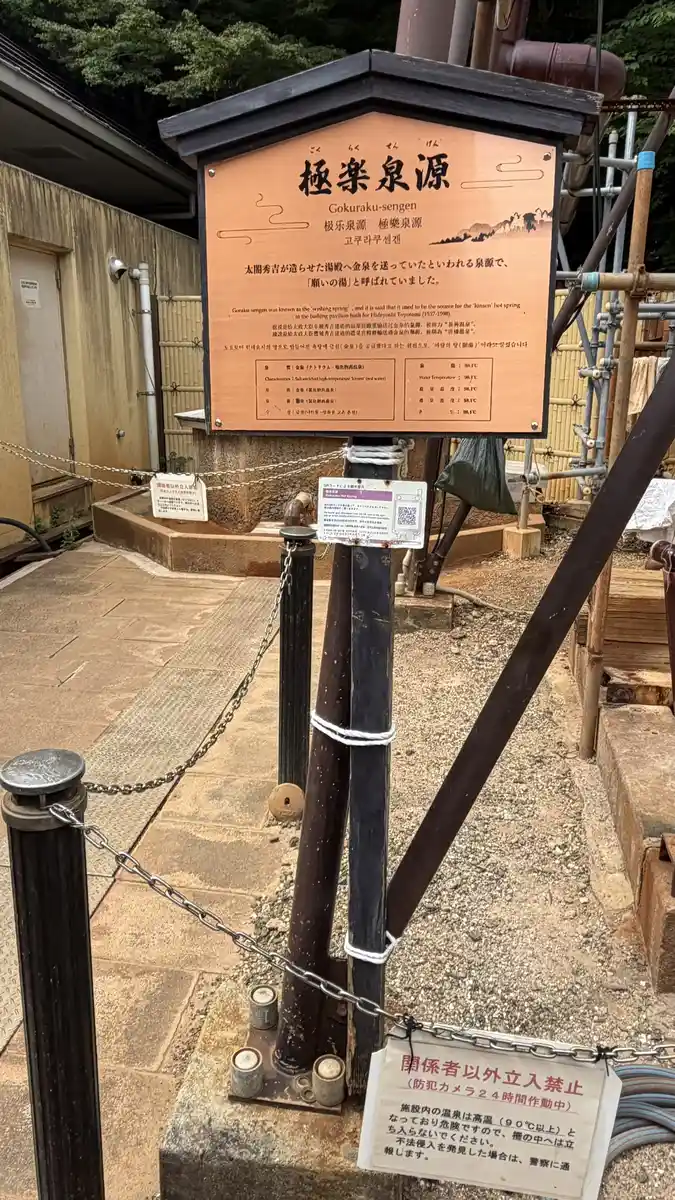
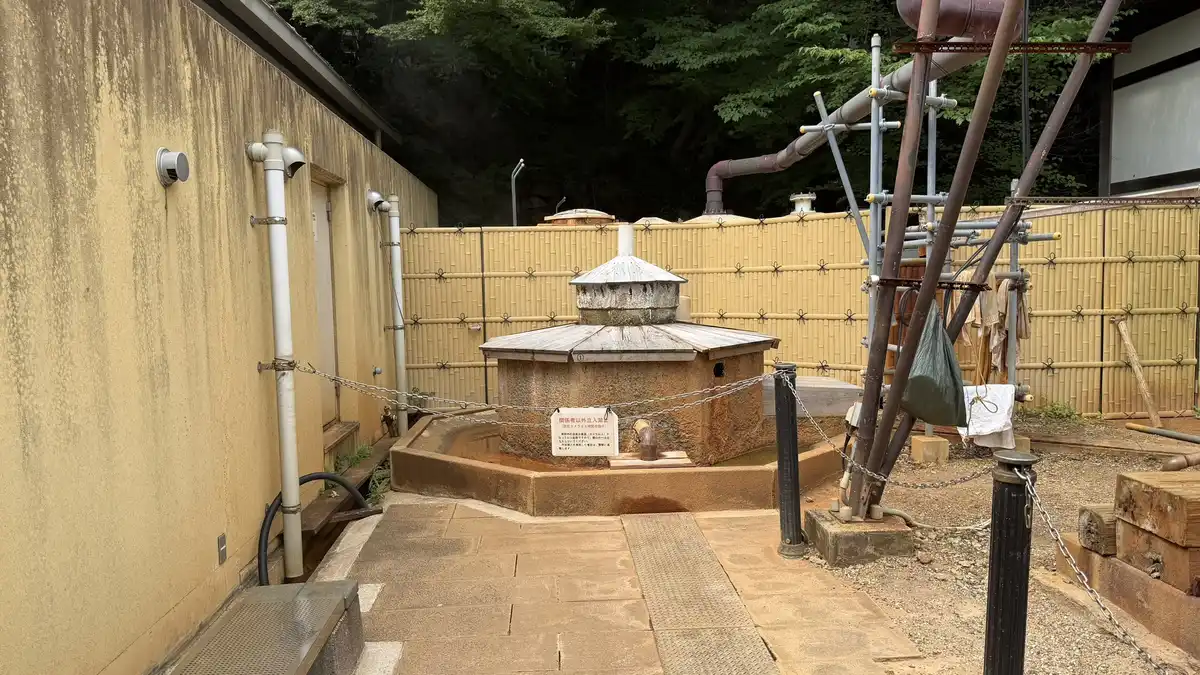
Kobe City says Gokuraku Spring supplied gold-spring water to Hideyoshi's bath. That is tradition, and the equipment you see today is modern. The entrance is hard to find; I walked past it once and went back with a map app.
Highlights
- The grounds of Gokurakuji, and a sign about the Yuyama Palace site
- Gokuraku Spring, said to have fed Hideyoshi's baths (Kobe City)
- A sign about the spring and the equipment behind the fence (modern equipment)
Photos
Tap any photo to enlarge
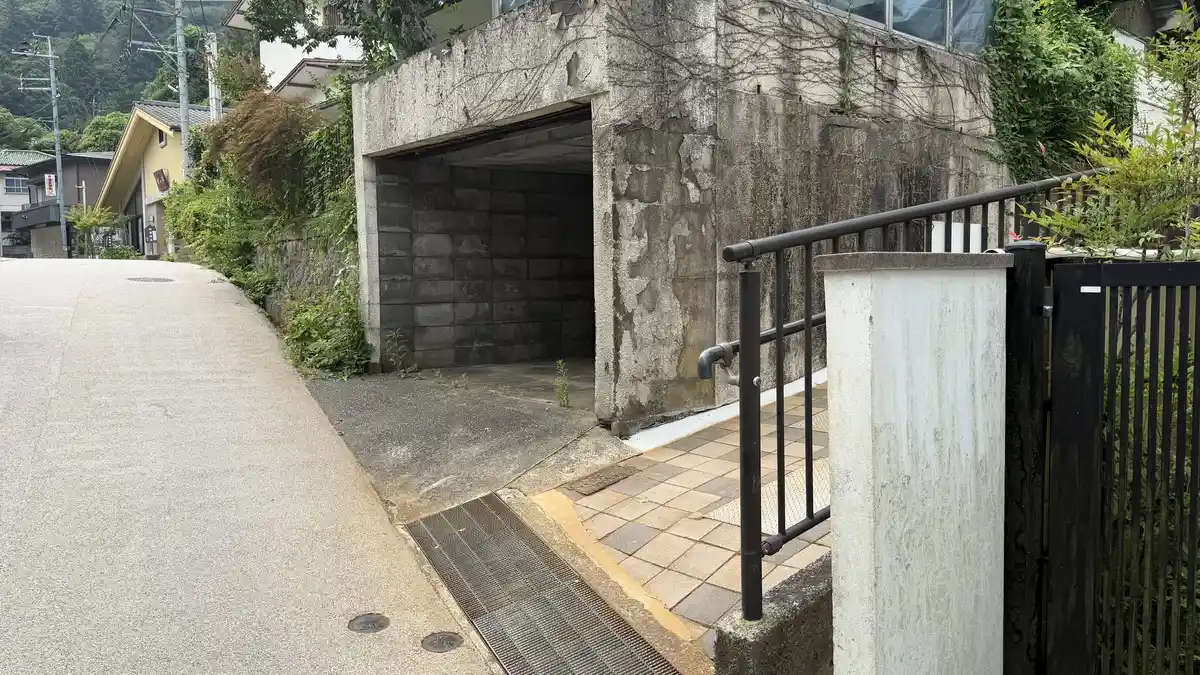
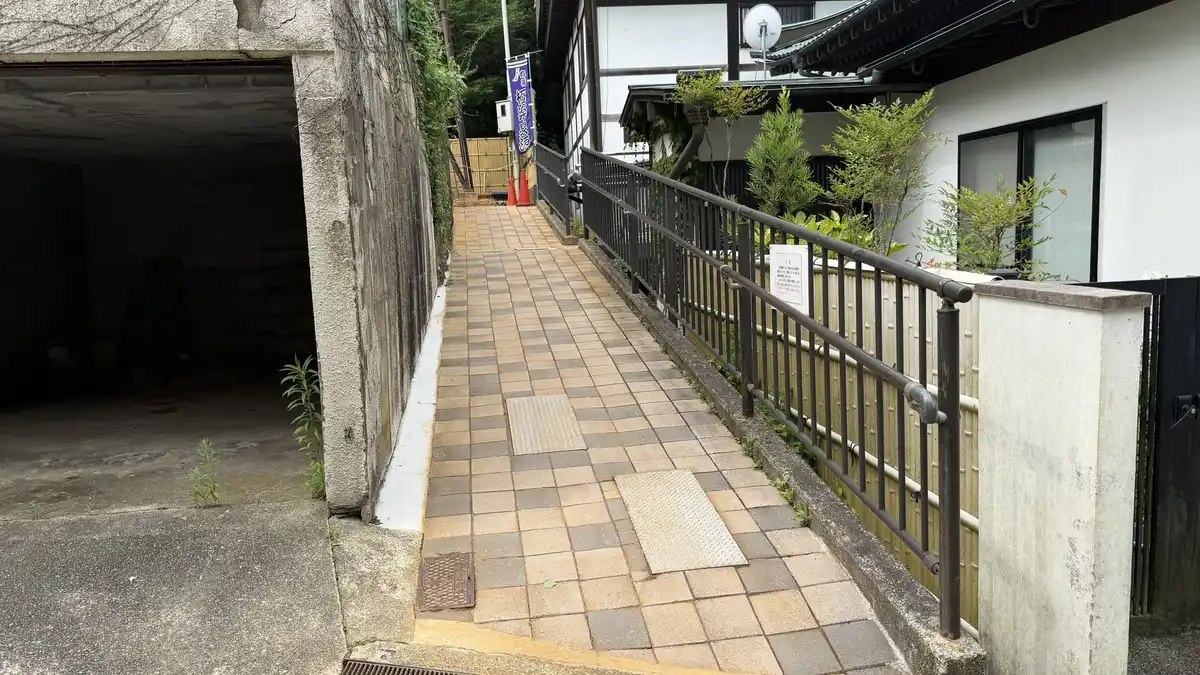
Finding the spring entrance
The entrance to the spring is easy to miss. I walked past it once and went back with a map app. These two photos show the approach.
Tap any photo to enlarge
Visiting details
| Location | Right beside Taiko no Yudonokan. You can walk from one to the other. |
|---|---|
| Spring entrance | Hard to spot. Check the photos above and a map app before you go. |
| What you can see | I could see the grounds, the signs and the spring's information board from outside. The spring equipment can only be seen from outside the fence. |
Map
Nenbutsuji Temple
A temple near the museum, said to stand on Nene's villa site
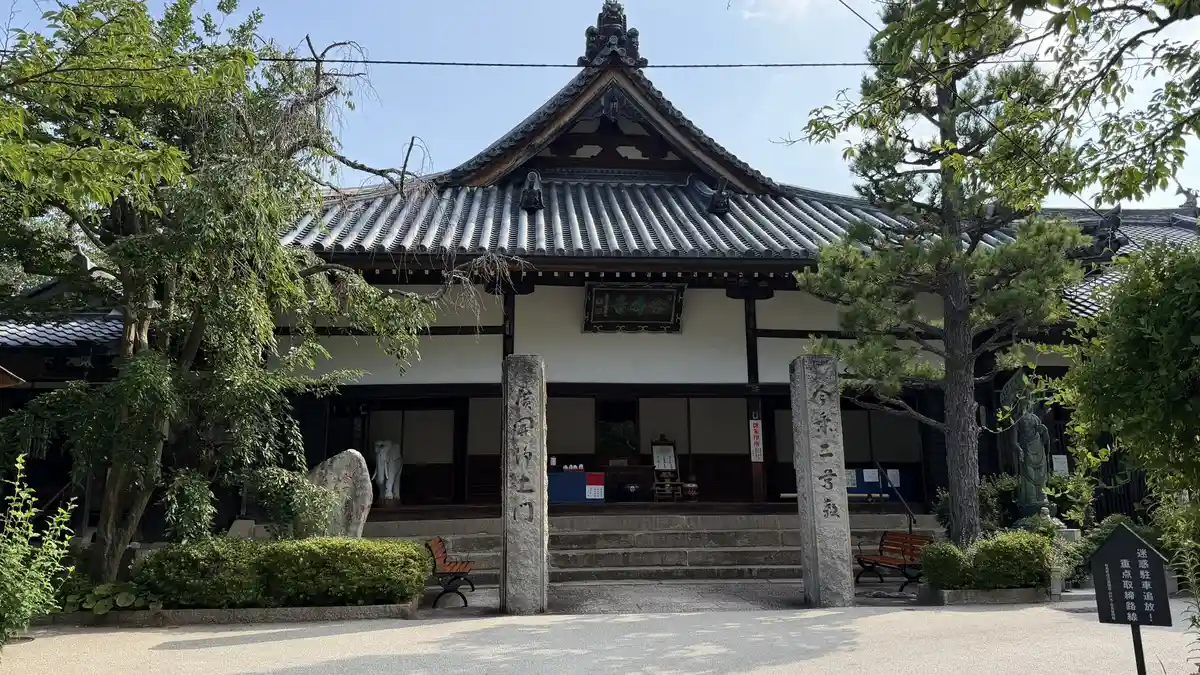
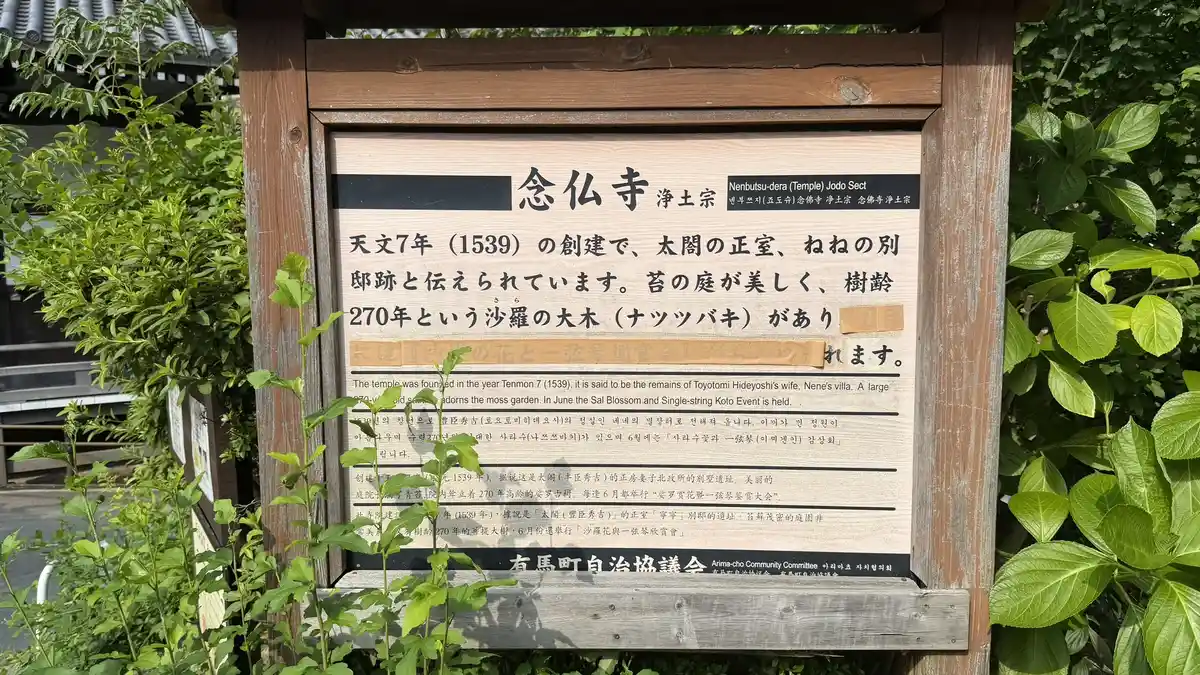
Nenbutsuji is a Jodo sect temple, said to stand on the site of the villa of Nene, Hideyoshi's wife. This is a story passed on by the temple and the tourist association.
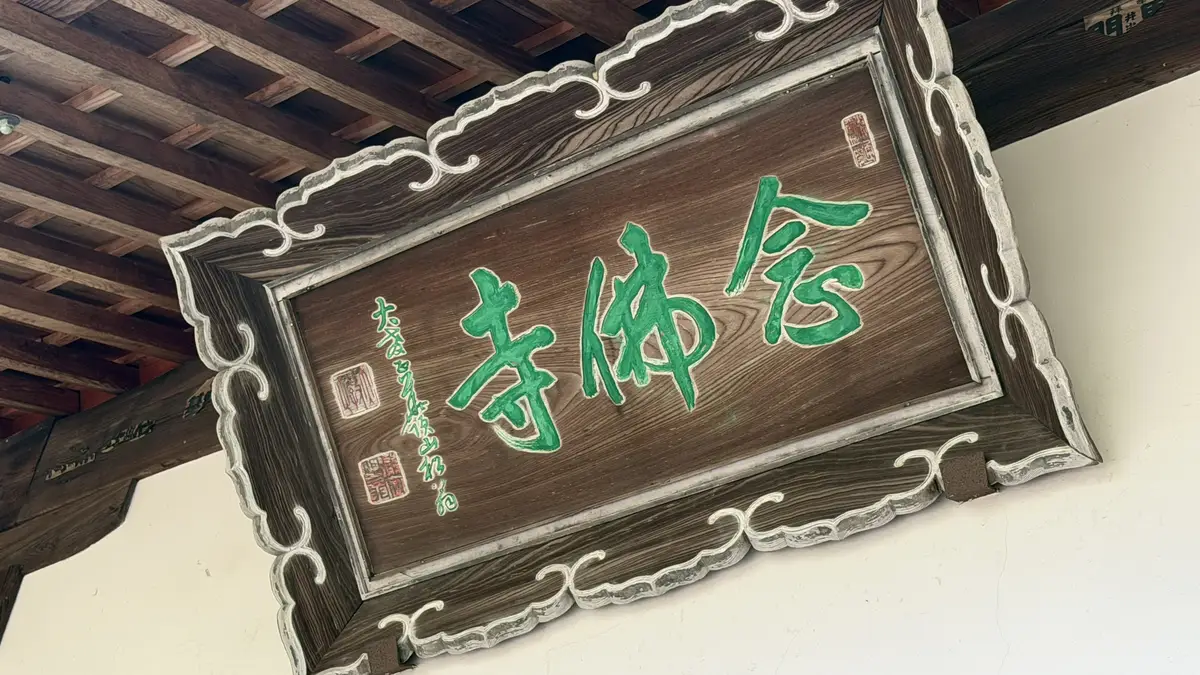
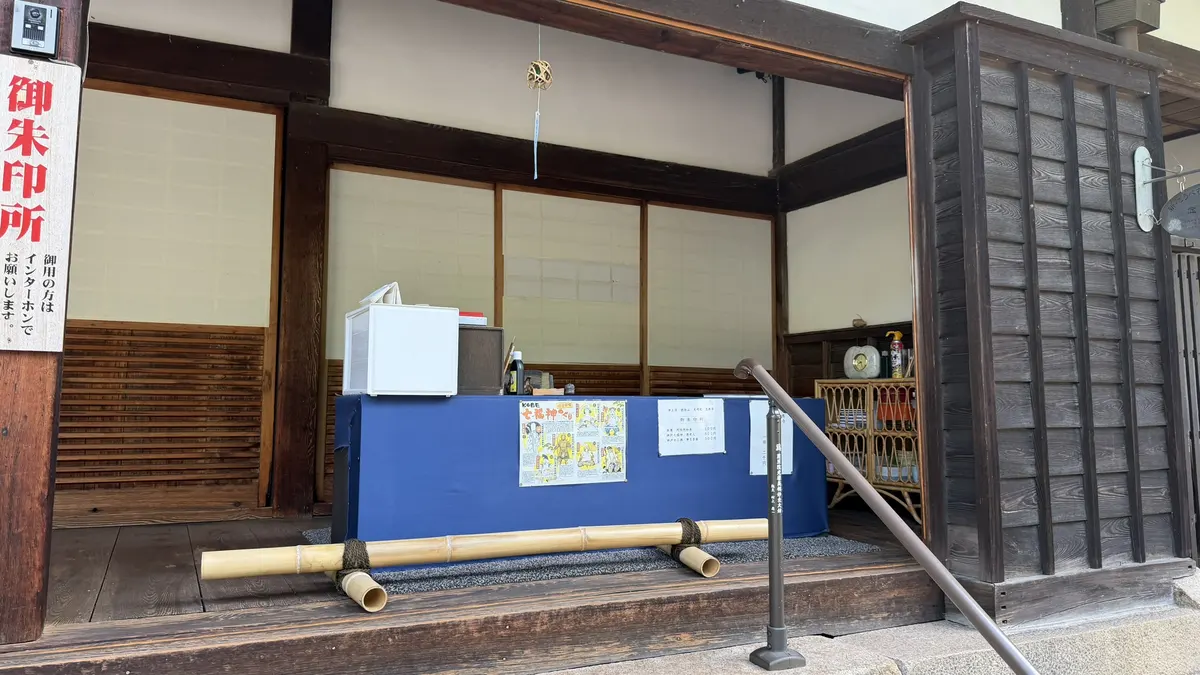
It is near Taiko no Yudonokan and easy to visit on the same walk. On the morning of 18 July 2026 I saw the sign, the main hall and the plaque under the eaves. There was a goshuin counter at the entrance.
Highlights
- A sign about the temple's history, and the plaque under the eaves
- The goshuin (temple stamp) counter at the entrance (seen on my July 2026 visit)
- The tradition that this was Nene's villa site
Photos
Tap any photo to enlarge
Visiting details
| Address | 1641 Arima-cho, Kita Ward, Kobe |
|---|---|
| History | Jodo sect. Said to stand on the site of the villa of Kitanomandokoro (Nene), Hideyoshi's wife (Arima Onsen Tourist Association). |
| Status of the tradition | That this was Nene's villa is a story passed on by the temple and the tourist association. |
Map
Onsen-ji Temple and Yusen Shrine (湯泉神社)
Where the story of Arima's beginnings is told, up a flight of steps
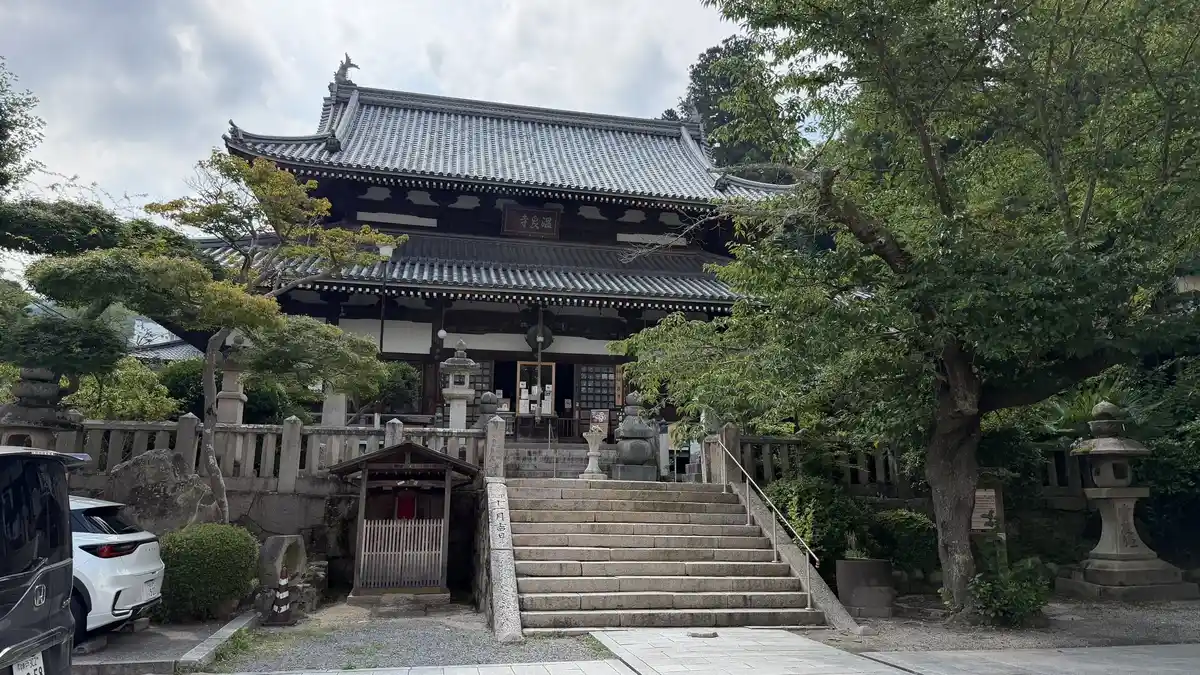
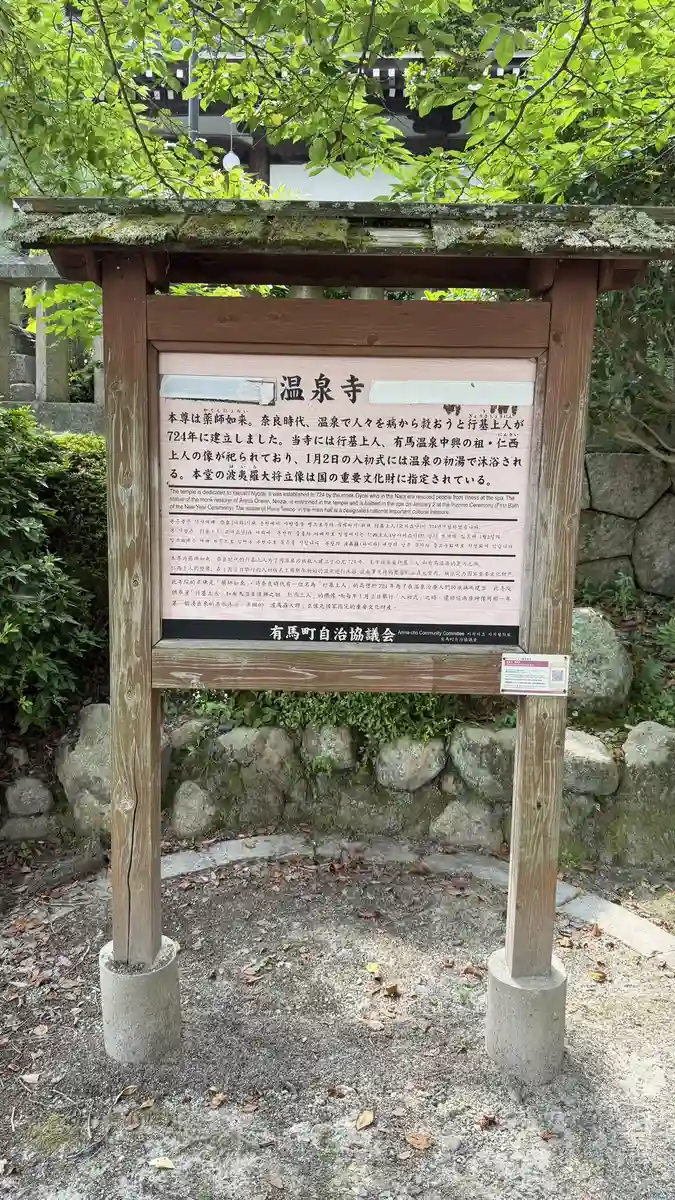
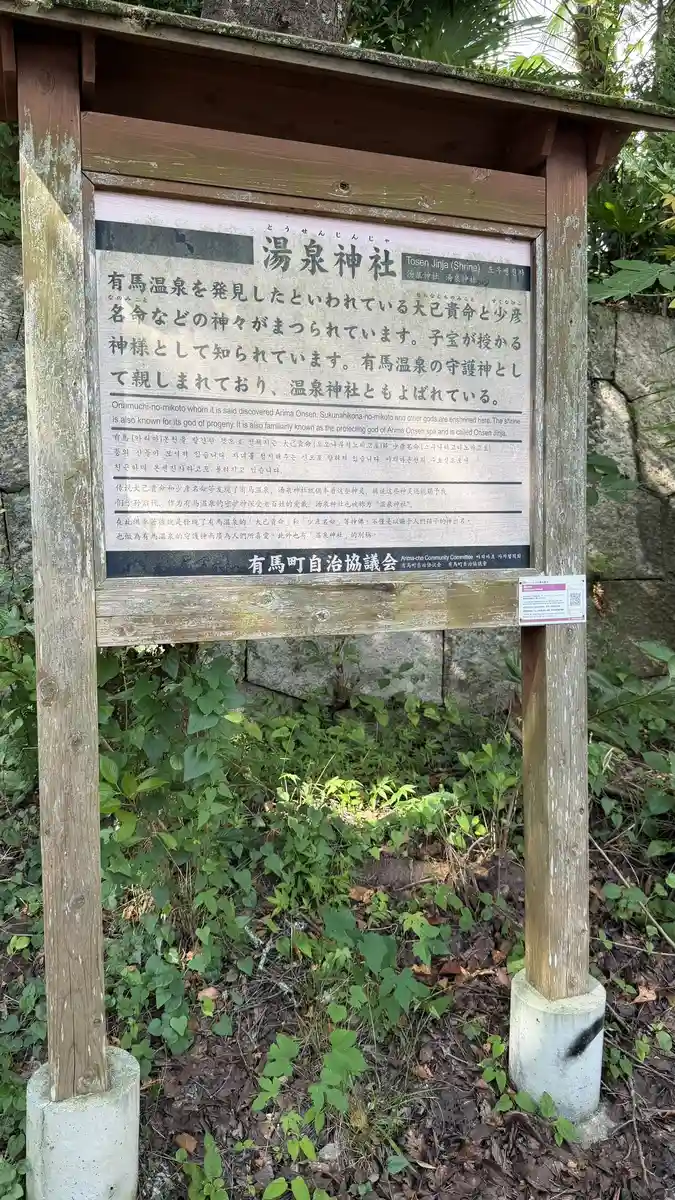
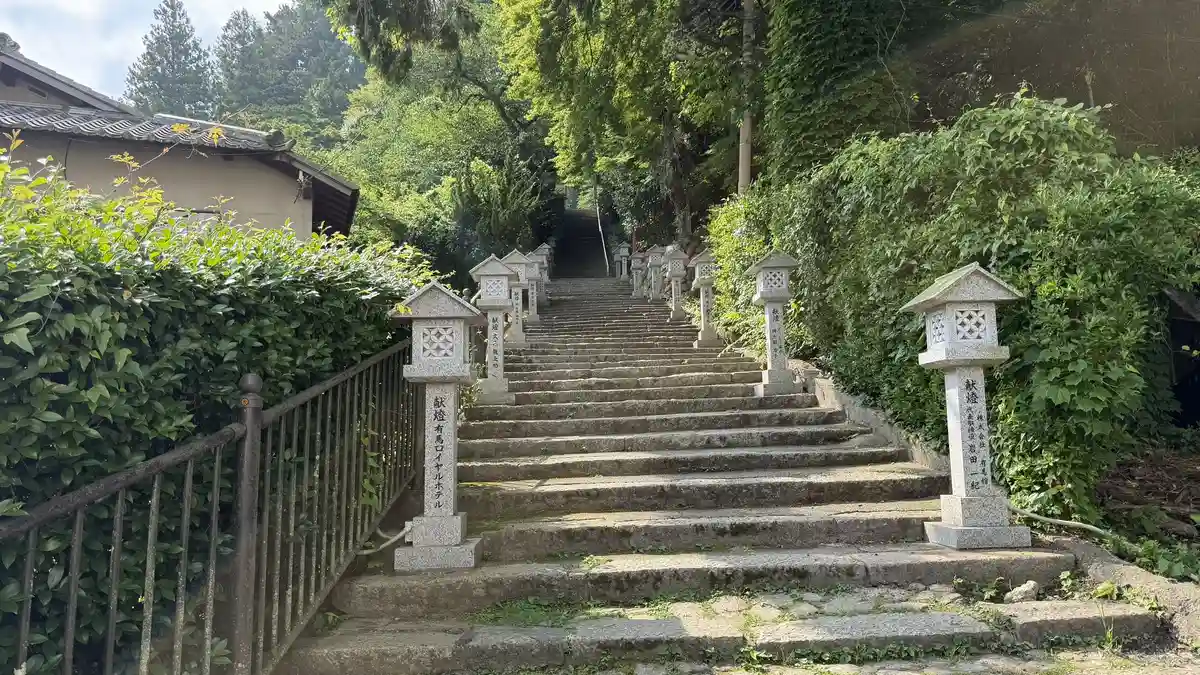
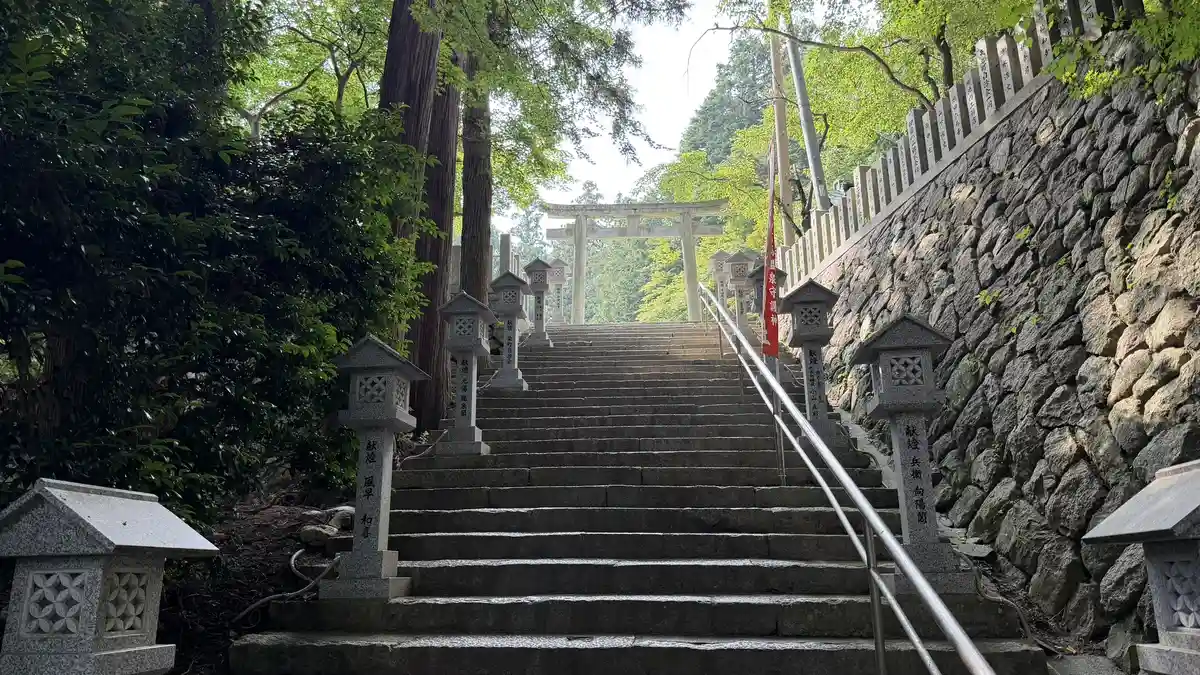
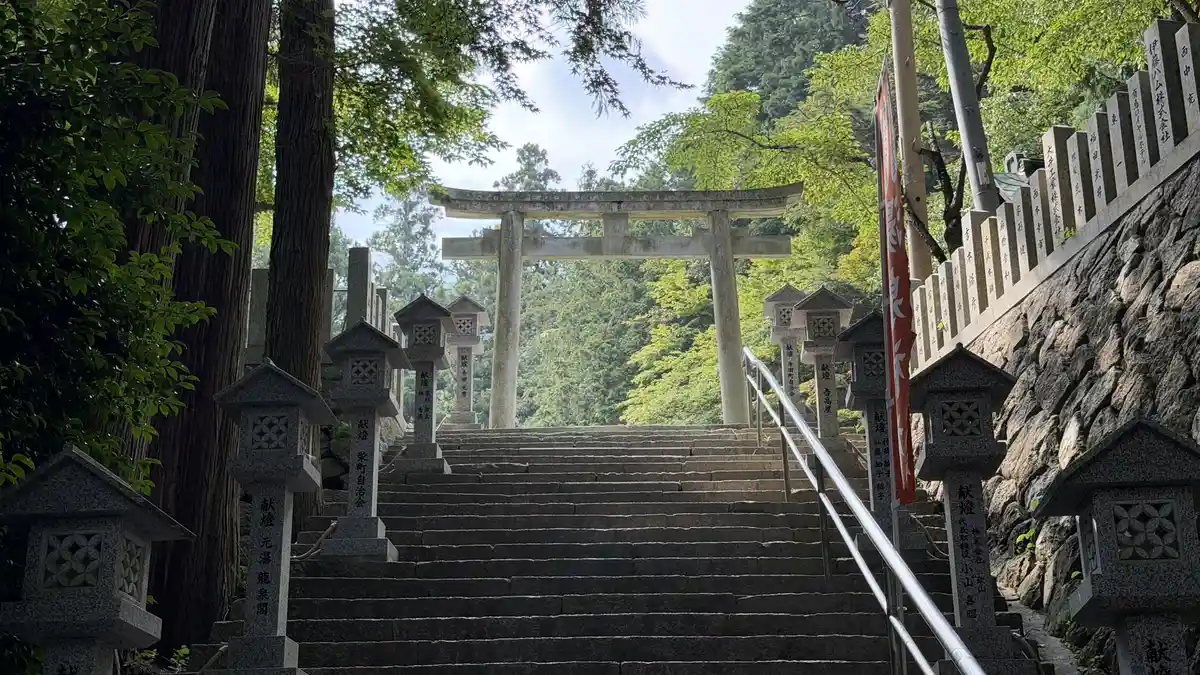
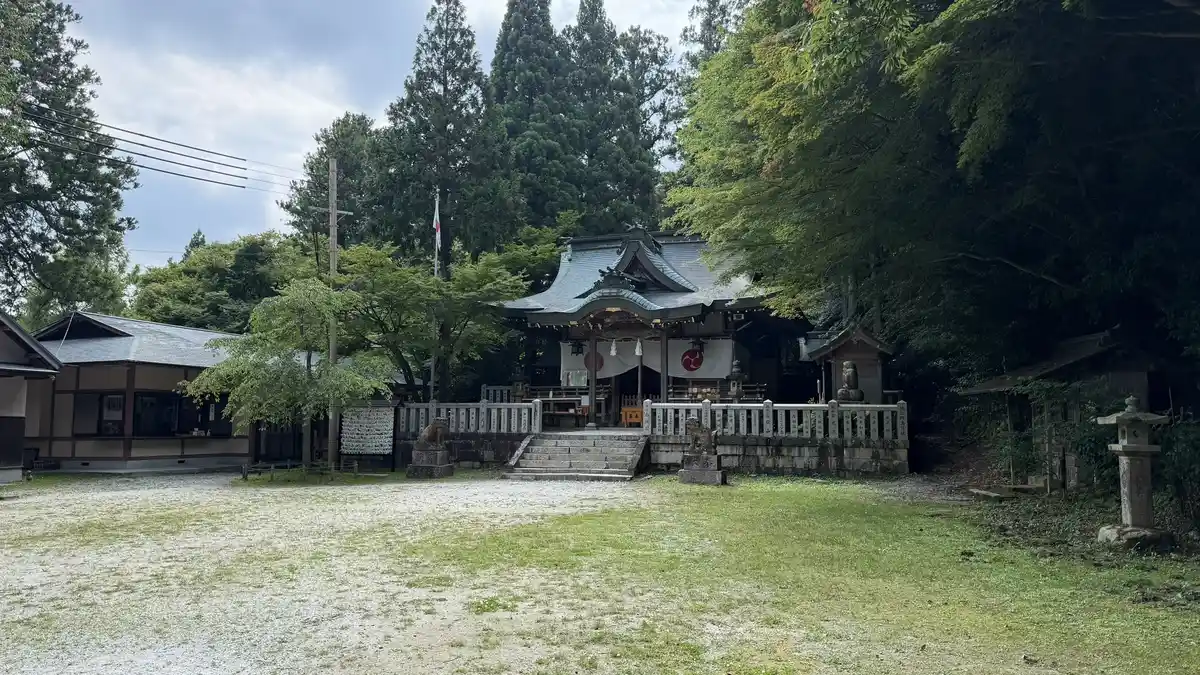
Onsen-ji is said to have been founded in 724 by Gyoki, who came to Arima guided by Yakushi Nyorai, the healing Buddha. Yusen Shrine enshrines Onamuchi-no-mikoto and others as guardians of the hot spring; Onamuchi is said to have discovered it. Both predate Hideyoshi and tell the town's older story.
The approach to Yusen Shrine is a long flight of steps, and on the morning of 18 July 2026 it was the toughest section of my walk.
Highlights
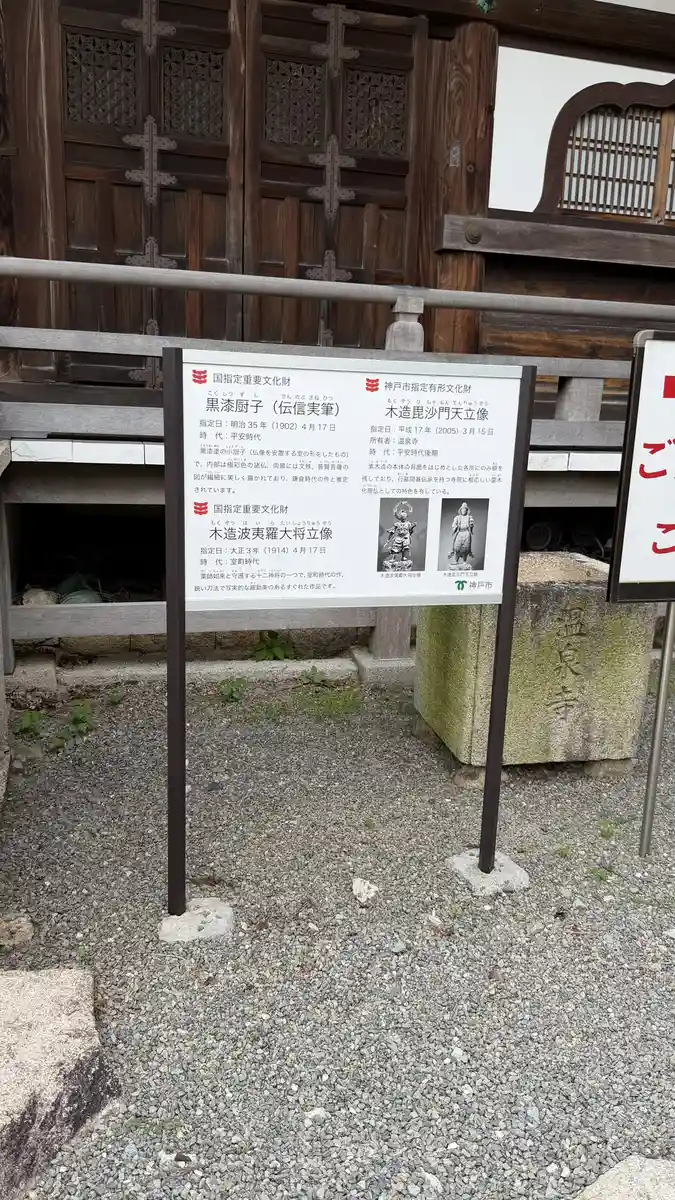
- Onsen-ji Temple: said to have been founded by Gyoki in 724 (the first year of Jinki). The main hall holds treasures including a statue of Vikarala, a general of the Twelve Heavenly Generals, designated an Important Cultural Property (Arima Onsen Tourist Association).
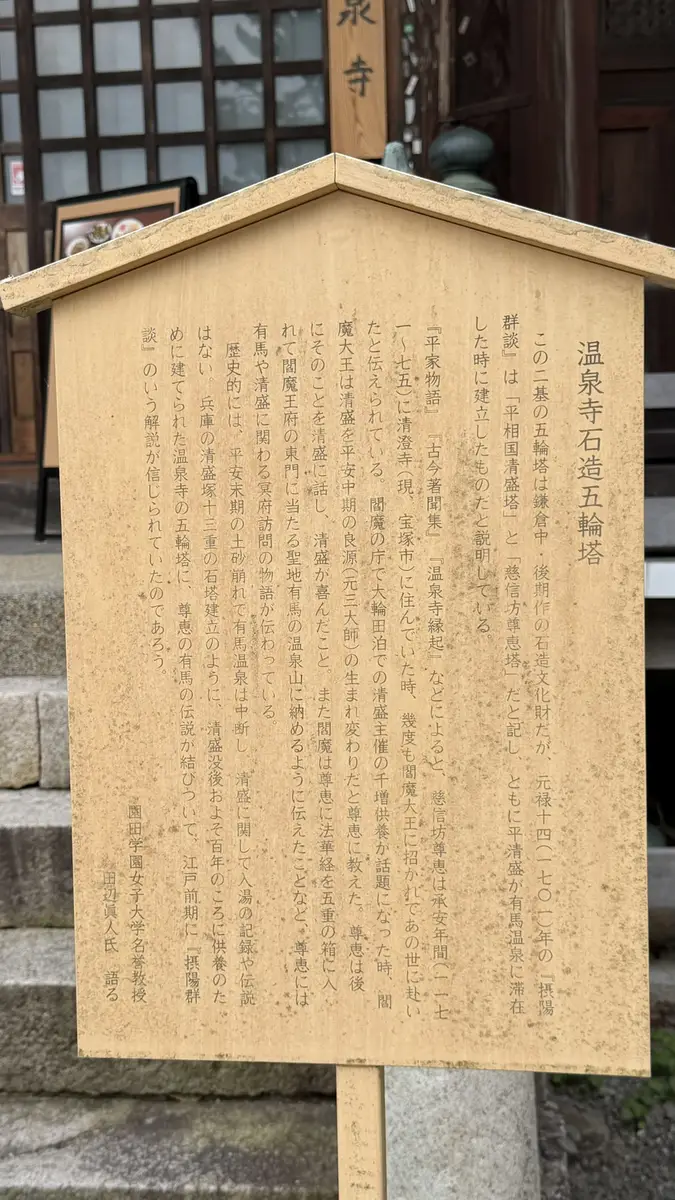
- Signs on the temple's cultural properties and history
- Yusen Shrine: enshrines Onamuchi-no-mikoto, Sukunahikona-no-mikoto and Kumano-kusumi-no-mikoto. Onamuchi is said to have discovered the Arima hot spring.
- A long stepped approach and a torii gate
Photos
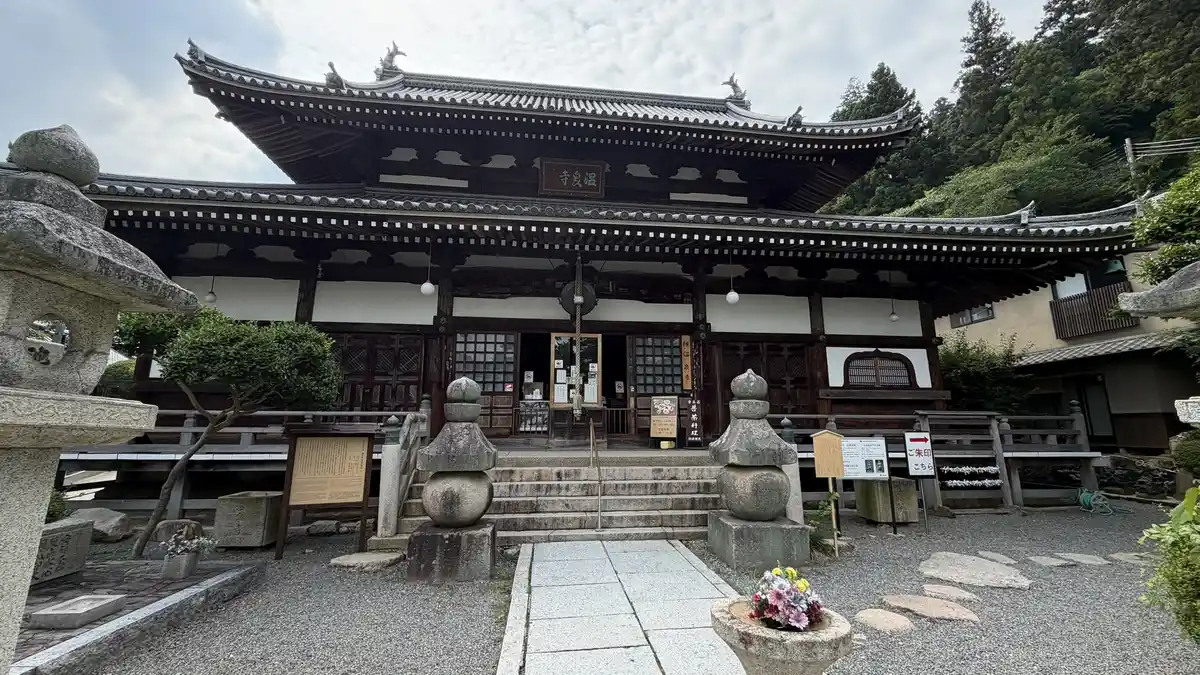
Tap any photo to enlarge
Visiting details
| Address | Onsen-ji: 1643 Arima-cho, Kita Ward, Kobe. Yusen Shrine: 1908 Arima-cho, Kita Ward, Kobe. |
|---|---|
| Effort | The mountain path to Yusen Shrine has a long flight of steps, and on my July 2026 visit it was the hardest part of the walk. |
| Status of the stories | Gyoki's founding of the temple and Onamuchi's discovery of the spring come from temple tradition and the shrine's own account. |
Map
Zuiho-ji Park
A walk out from the centre to a gate said to come from Fushimi Castle
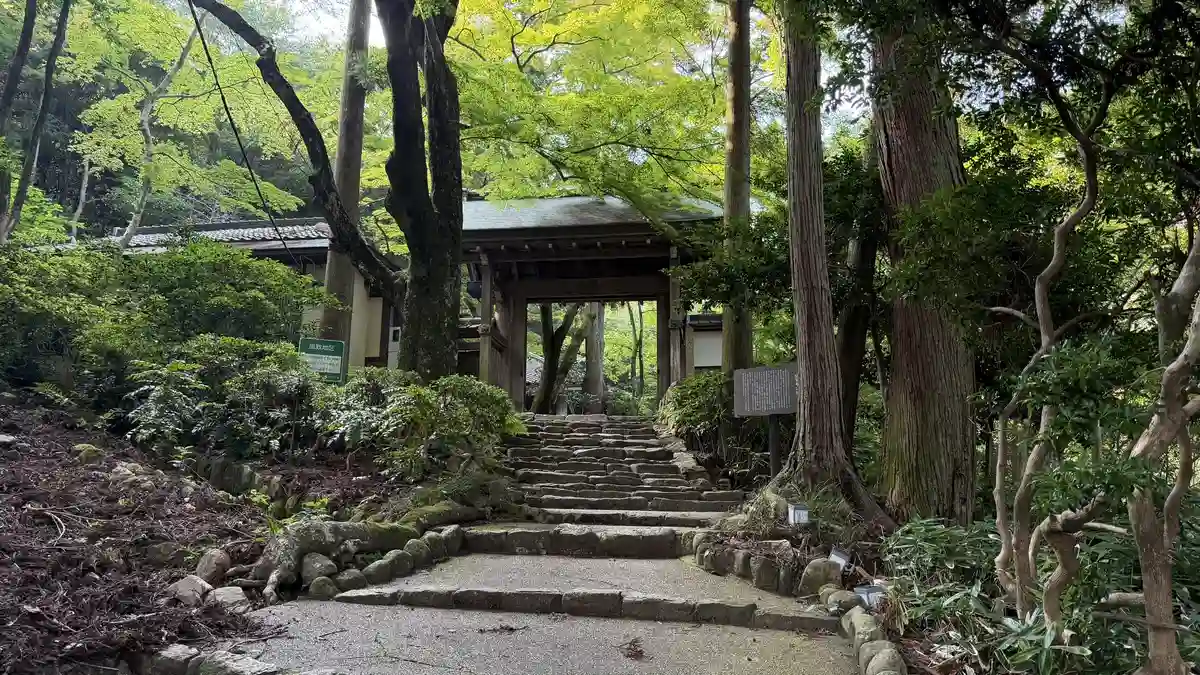
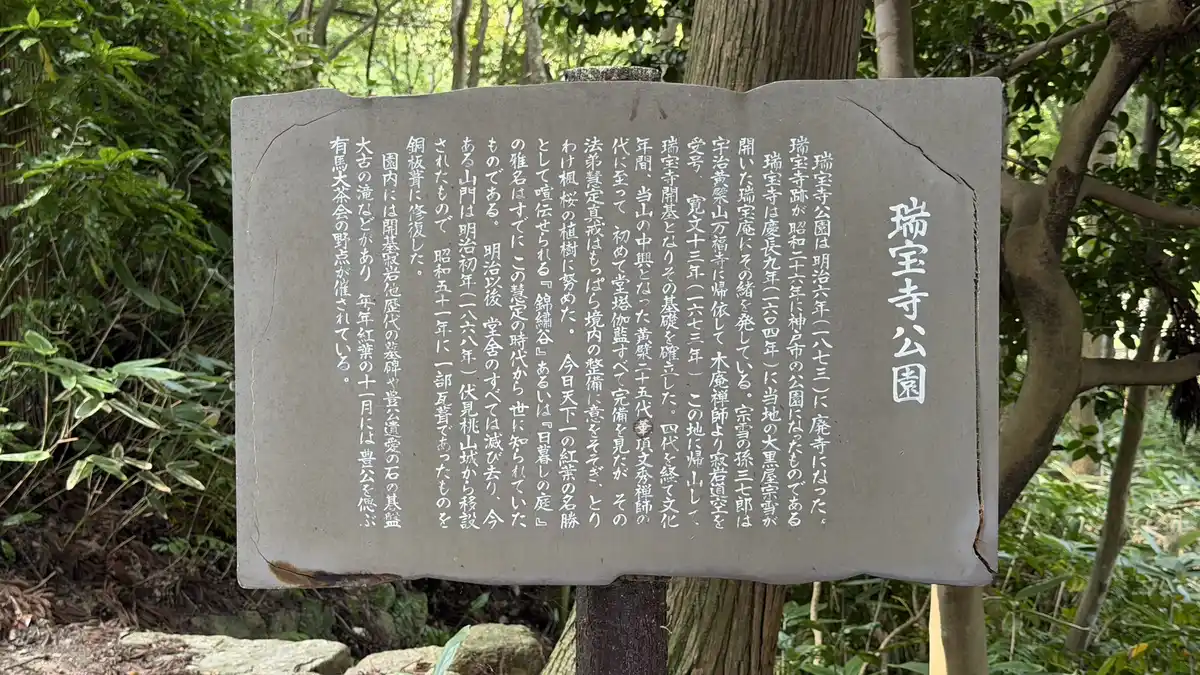
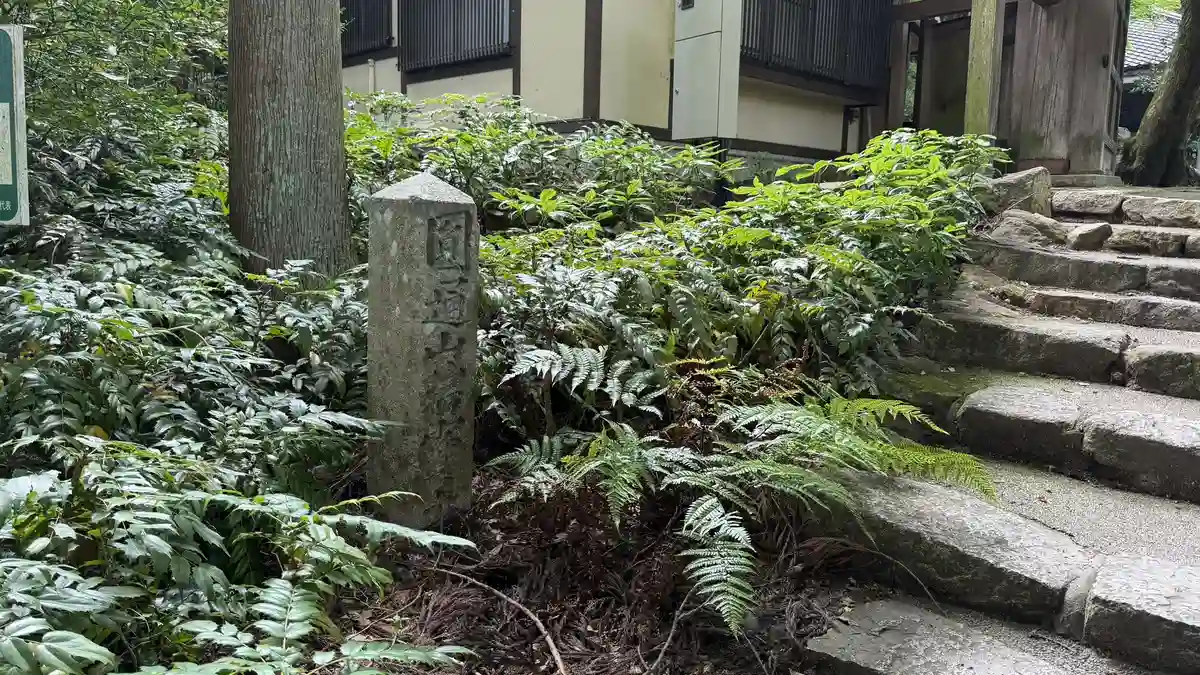
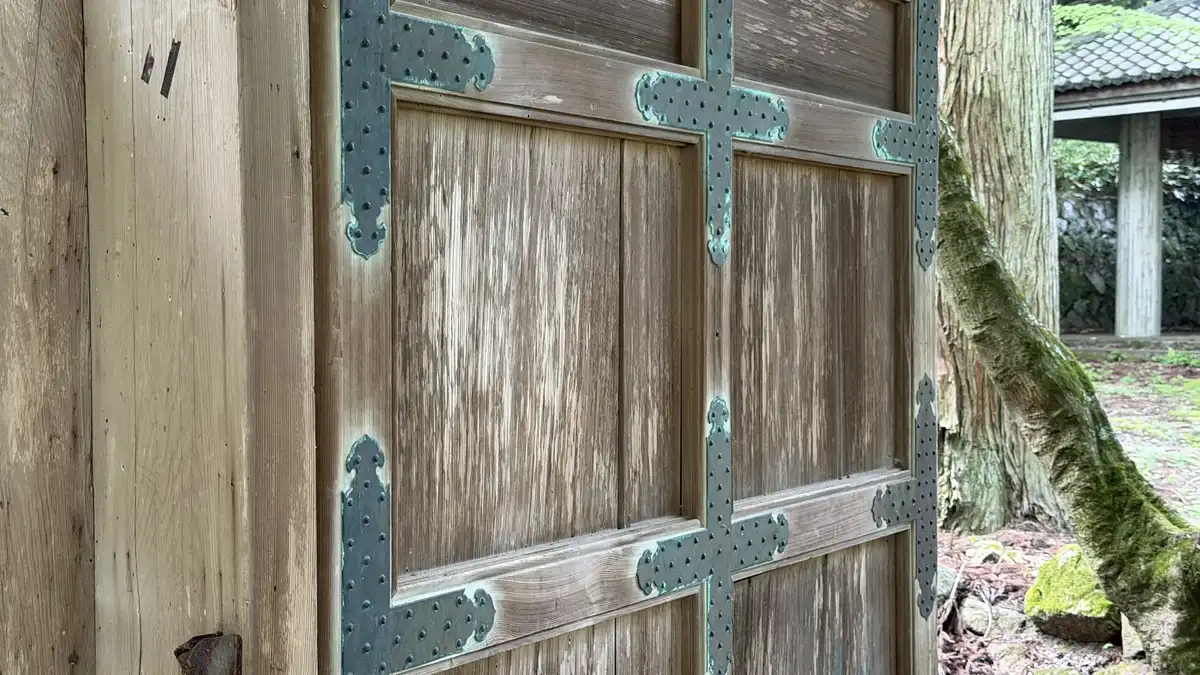
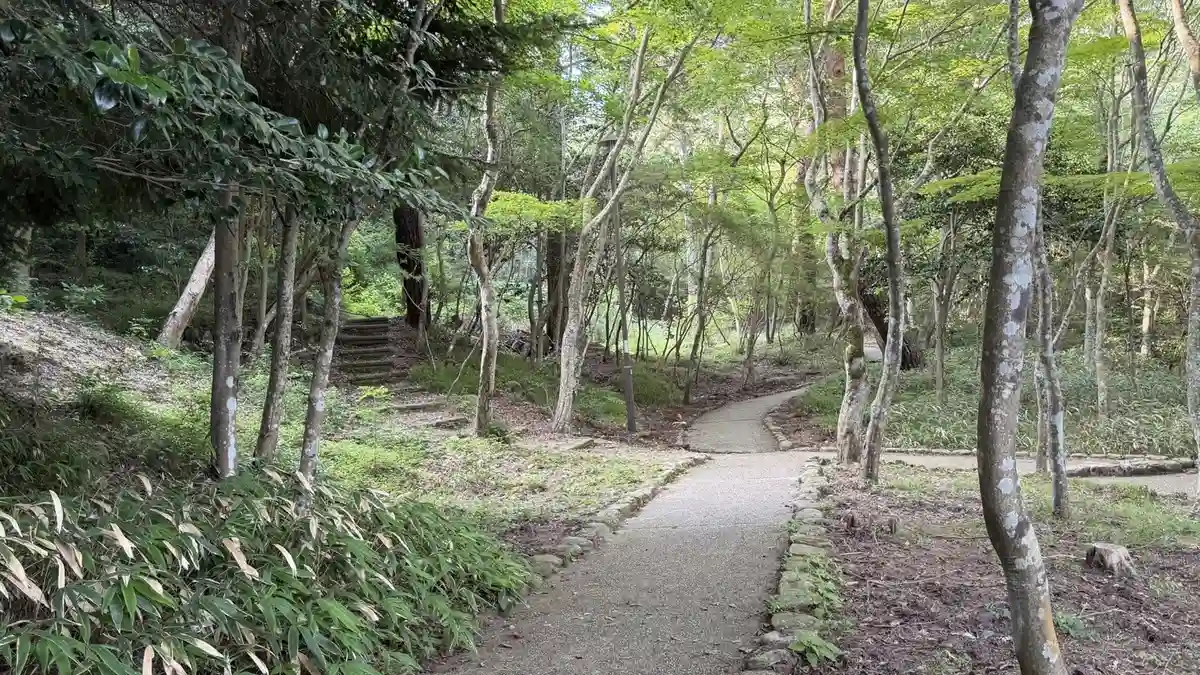
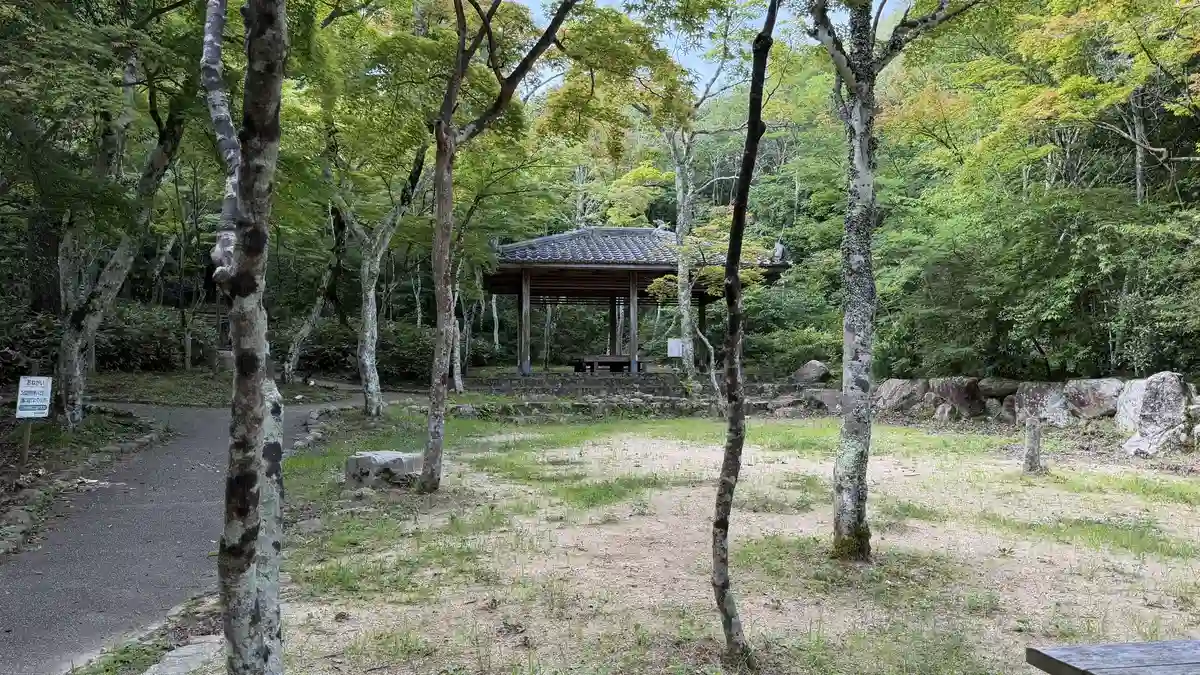
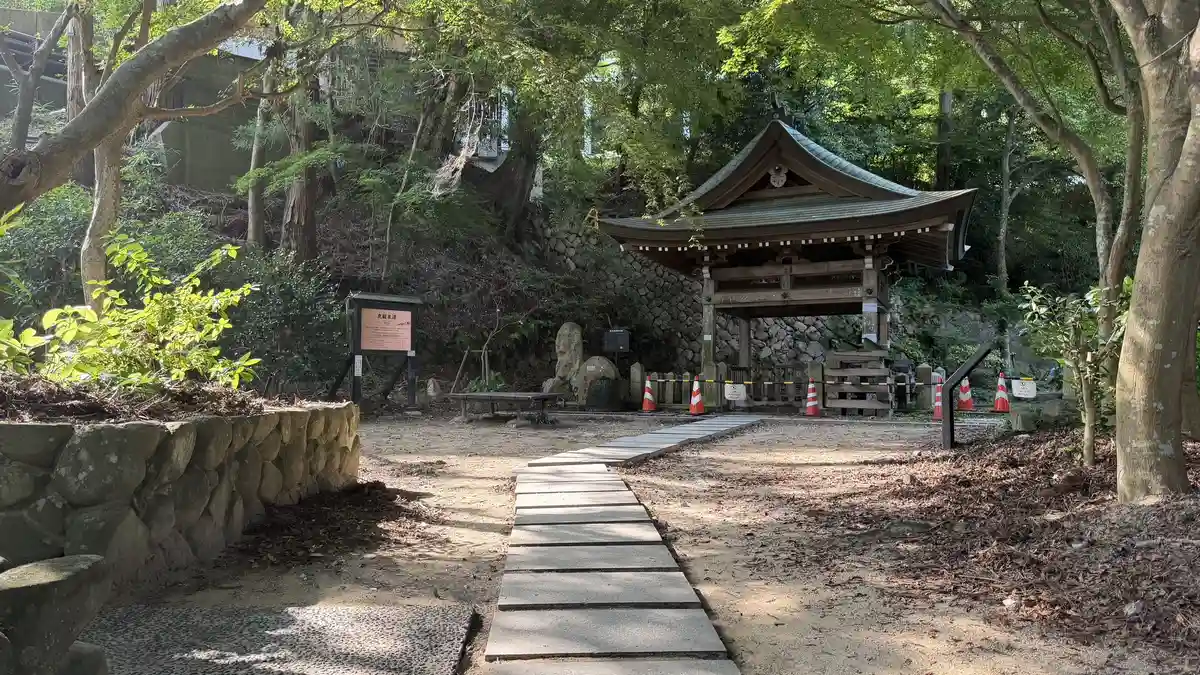
Zuiho-ji Park is a Kobe City park laid out on the site of a temple that was abandoned in the early Meiji period. The gate in the park is the former Zuiho-ji gate, said to have been moved from Fushimi Castle. On my July 2026 visit a sign on site described it as a relocated castle gate. Which period of Fushimi Castle it came from is not known.
Some stories about Hideyoshi attach to the park. The tourist association passes on the tales that he called the garden one he never tired of looking at, hence the name Higurashi no Niwa, and that he used the stone go board. On 18 July 2026 I started my walk here at about 7:40. The park lies away from the centre in the other direction, so allow separate time for the round trip.
Highlights
- The former Zuiho-ji gate, said to have been moved from Fushimi Castle (described on site as a relocated castle gate)
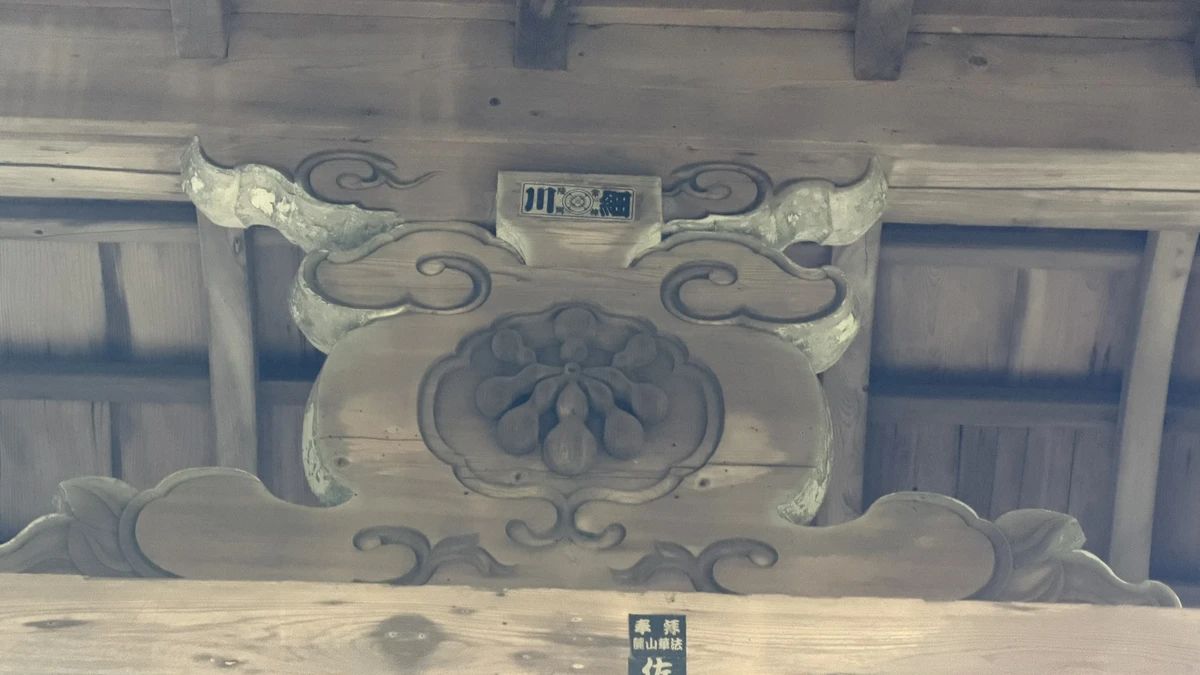
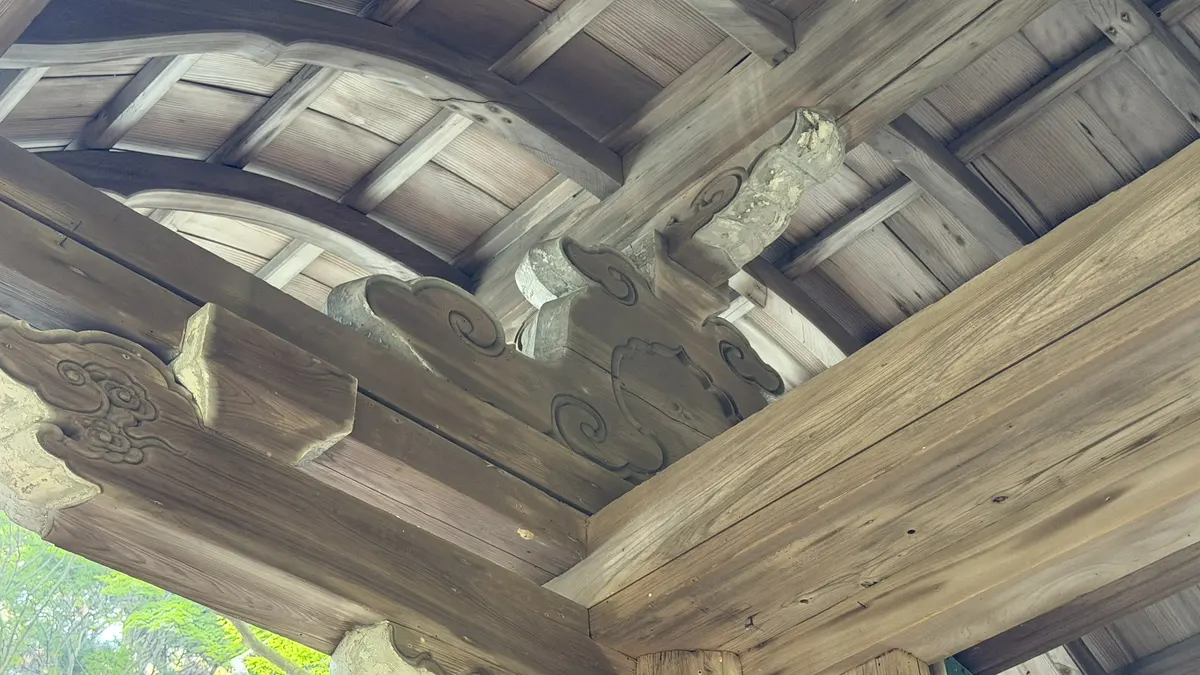
- Wood carvings on the gate, thick beams under the eaves, and doors with metal fittings
- The garden Hideyoshi is said to have praised as one he never tired of looking at (the origin of the name Higurashi no Niwa, “all-day garden”), and a stone go board he is said to have used
- Autumn leaves in November (the park is also known as “Kinshu-dani”, brocade valley)
Photos
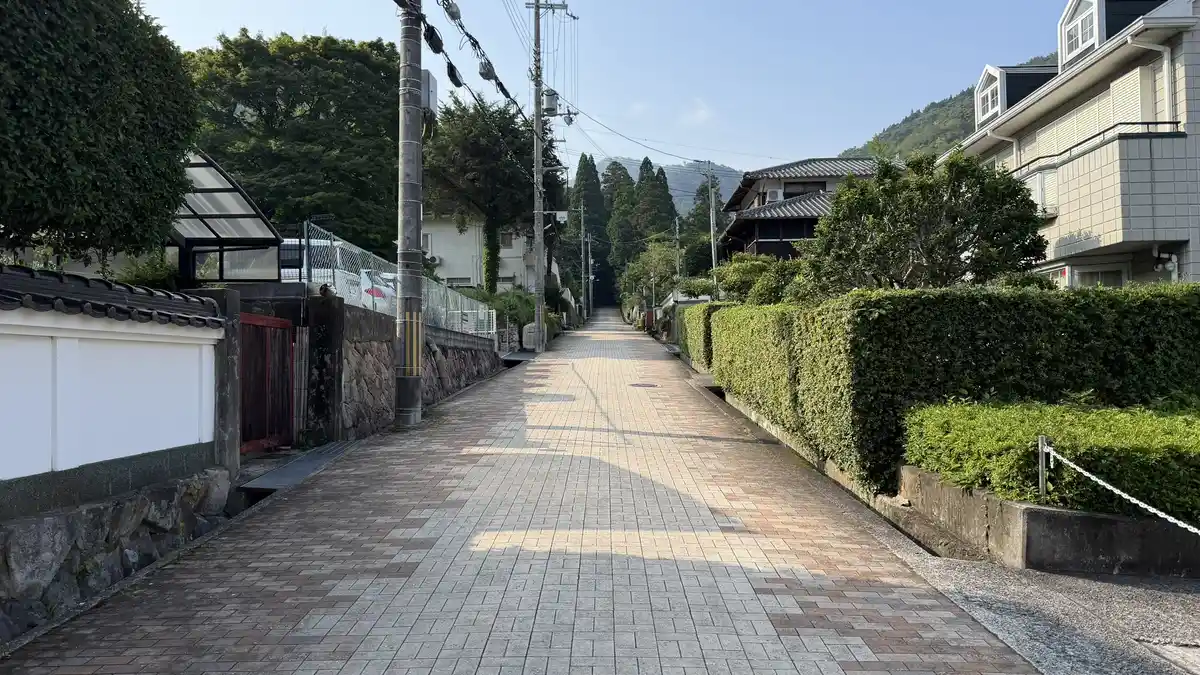
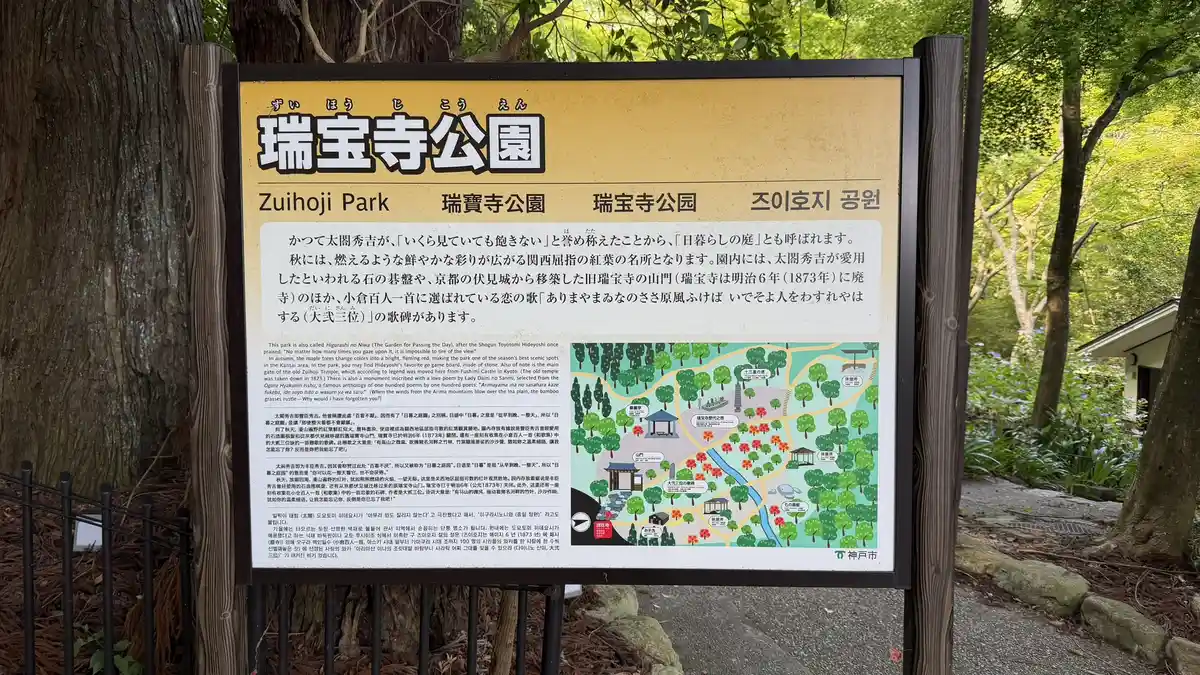
Tap any photo to enlarge
Visiting details
| From the station | About 20 minutes on foot from Arima-onsen Station (Arima Onsen Tourist Association). There is no car park in the park. |
|---|---|
| Admission and hours | Not stated on the tourist association page. Check on site. |
| Autumn colour | Best in November. Vehicle access around Zuiho-ji Park is restricted in November. |
| Status of the stories | The gate's origin, the garden's name and the go board come from tradition and the tourist association. |
Map
Baths and the carbonated spring: between the history stops
These are the bathing facilities and springs you can fit in between the historic sites. I went into Taiko no Yu myself, so it gets the full details on prices and rules.
Arima Onsen Taiko no Yu (太閤の湯)
To me it felt like a super sento, with a food court
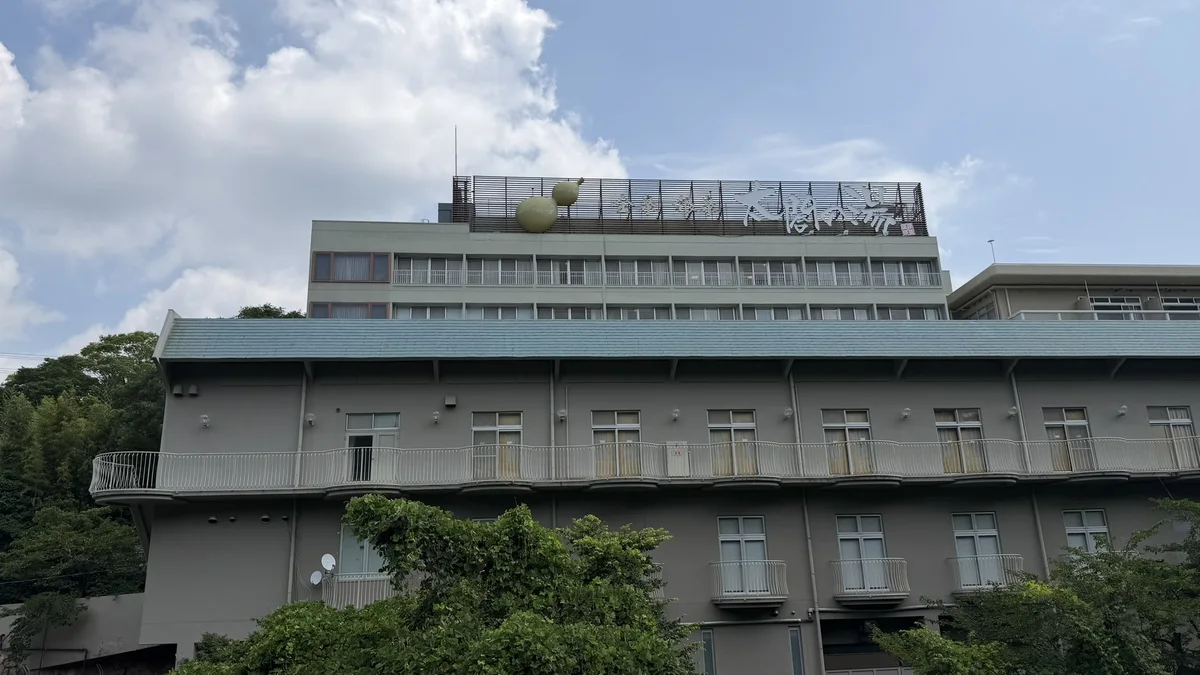
Taiko no Yu is a day-use bathing facility in Arima Onsen. Its official site calls it a “hot spring theme park”, with 26 kinds of bath, saunas, a stone-bed sauna and a food court. It is a different place from Taiko no Yudonokan, the museum of excavated remains.
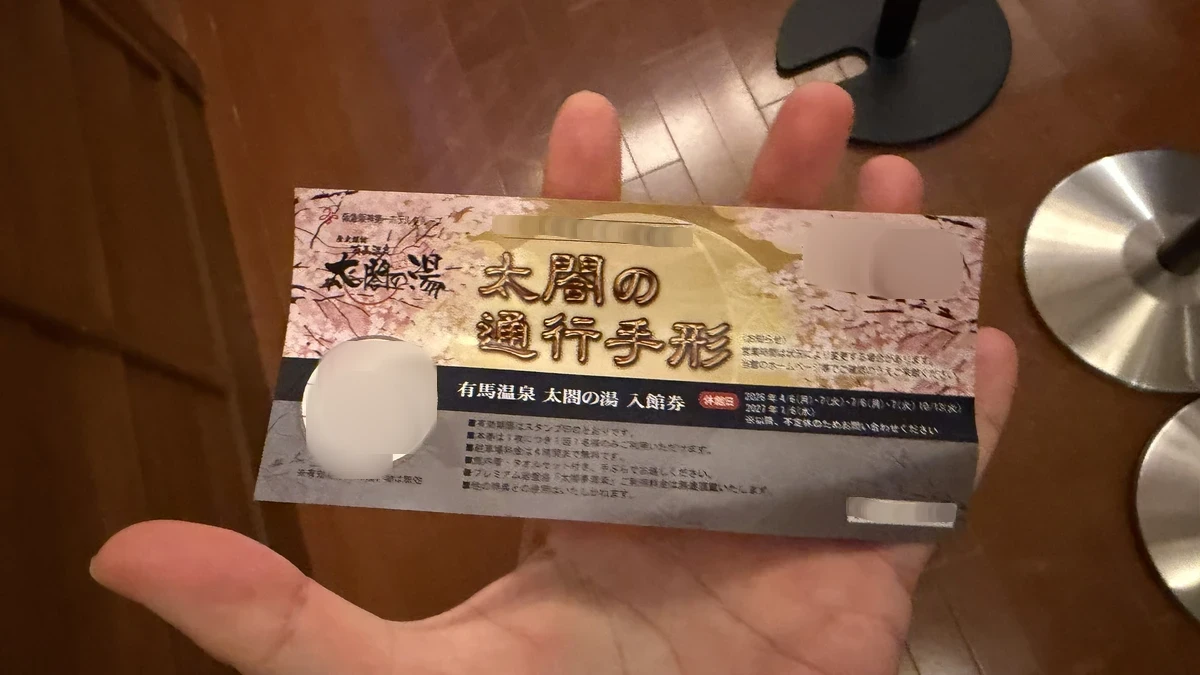
I went in on the night of Friday 17 July 2026. It was not very crowded, and I ate at the food court. It felt like a big super sento to me. You can buy tickets from the Taiko no Yu official website.
Highlights
- According to the official site there are 26 kinds of bath, plus saunas, a stone-bed sauna (ganbanyoku), a food court and a relaxation area.
- Taiko no Iwaburo (rock bath): I saw it there. If you visit the remains at Taiko no Yudonokan first, you will understand what this bath is modelled on.
- A robe, a small towel and a bath towel are included in the entry fee (one set per person), so you can arrive with nothing.
- “Taiko no Yudono” is free to use, in 30-minute sessions on a rotating basis. It is closed to elementary school children and younger. The extension fee is given differently on different pages of the official site, so check the latest notice when you go.
- “Taiko no Yumushiraku” and “Hyotan Yumushiraku” cost extra.
Food inside
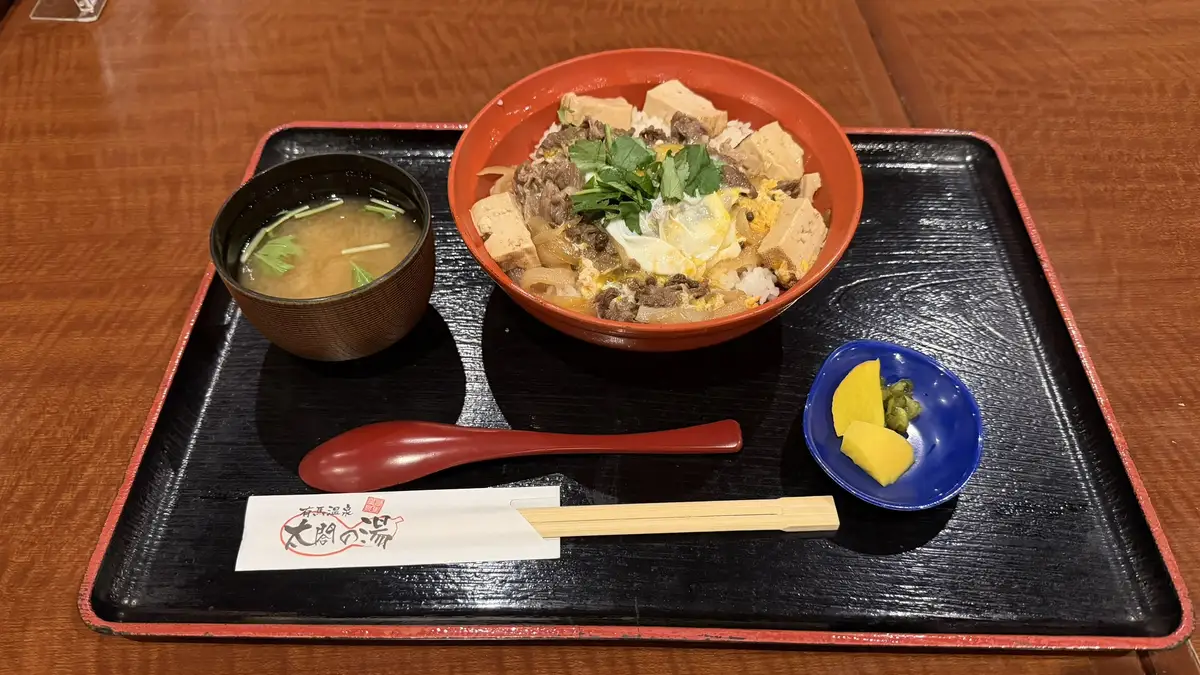
I ate at the food court: kokusan-gyu to Awaji-san tamanegi no tamagotoji (domestic beef and Awaji onion simmered in egg), ¥1,380 on my July 2026 visit. It was like a sukiyaki rice bowl, with tender beef and a sweet-salty sauce, and I enjoyed it.
Prices (checked on the official site on 6 October 2026)
| Regular entry, weekdays | Adults (full time) ¥2,750; adults (night time, entering after 19:30) ¥1,980; elementary school ¥1,239; infants (3–5) ¥440. |
|---|---|
| Regular entry, weekends and holidays | Adults (full time) ¥2,970; adults (night time) ¥2,090; elementary school ¥1,430; infants ¥550. |
| Peak days | New Year (26 Dec–3 Jan), Golden Week (3–5 May) and Obon (11–15 Aug): adults ¥3,300, elementary school ¥1,430, infants ¥550. |
| Bathing tax | The regular prices above include consumption tax but not the bathing tax. Kobe City charges ¥75 per person on top. Children aged 6 and under, and elementary school children on weekdays, are exempt. |
| Online tickets | Tickets bought on the official site include the bathing tax (adult means age 13 and over). Adult tickets without a soft drink: full time ¥2,500 on weekdays and ¥2,700 on weekends and holidays; morning time (enter by 11:00, stay until 14:00) ¥2,200 on weekdays and ¥2,300 on weekends and holidays; night time (enter after 19:30) ¥1,850 on weekdays and ¥1,950 on weekends and holidays. |
| Tickets with a drink | Adult tickets with a soft drink: full time ¥2,750 on weekdays and ¥2,970 on weekends and holidays; morning time ¥2,420 and ¥2,530; night time ¥1,980 and ¥2,090. |
| Payment | Credit cards (Visa, JCB and others), PayPay and iD are accepted. |
| Groups and members | Groups of 10 or more get 10% off the general price (only if they enter together). There is also a membership scheme, Hyotan Club. |
Hours and tickets
| Hours | 10:00–22:00 (last entry 21:00). Check the official site for changes in hours and for closing days. |
|---|---|
| How to buy tickets | Buy from the Taiko no Yu official website. Booking pages by plan: full time, morning time and night time. |
| Address | 292-2 Ikenojiri, Arima-cho, Kita Ward, Kobe (神戸市北区有馬町池の尻292-2) |
Rules
- People with tattoos and people who are heavily intoxicated cannot enter.
- You cannot re-enter once you have left.
- You cannot use the facility only to eat, and you cannot bring food or drink in.
- Pets are not allowed.
Parking
| Fees | Free for 4 hours after entering the car park (take the parking ticket to the front desk). Each ¥2,000 (tax included) spent inside gives one more free hour, up to 7 hours in total. After that it is ¥500 per hour (¥600 on weekends, holidays and peak days). Motorbikes are free. For buses, ask the facility. |
|---|
Photos
Tap any photo to enlarge
Map
Kin-no-Yu, Gin-no-Yu and Tansan Spring Park
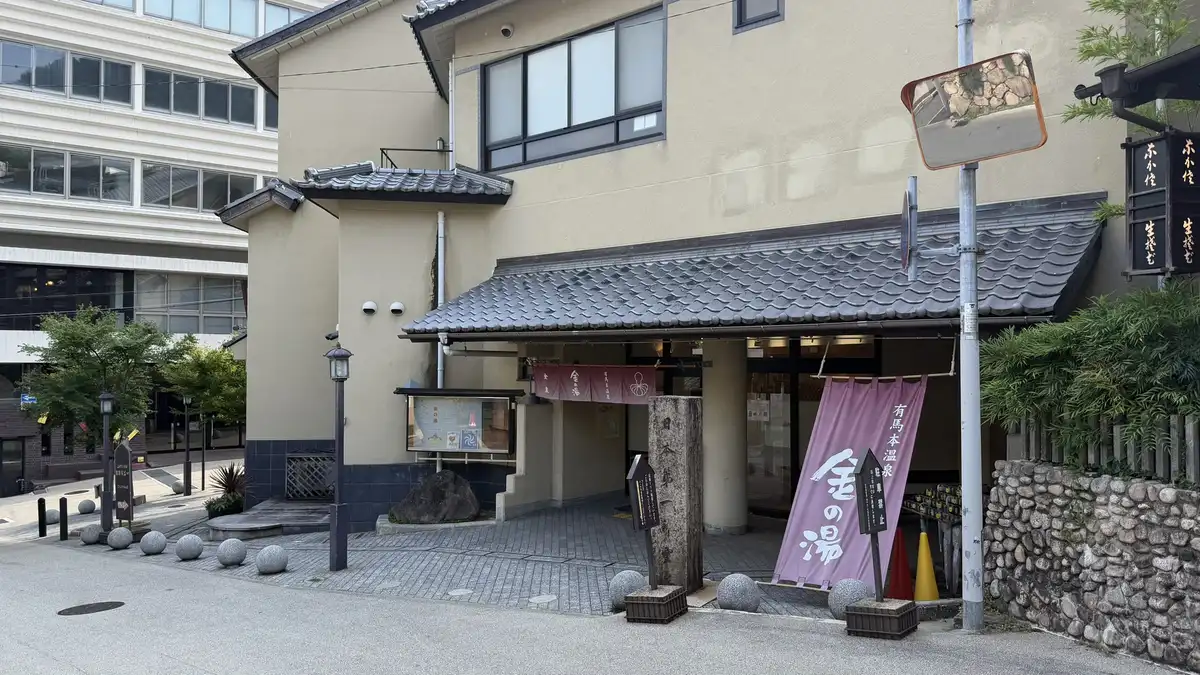
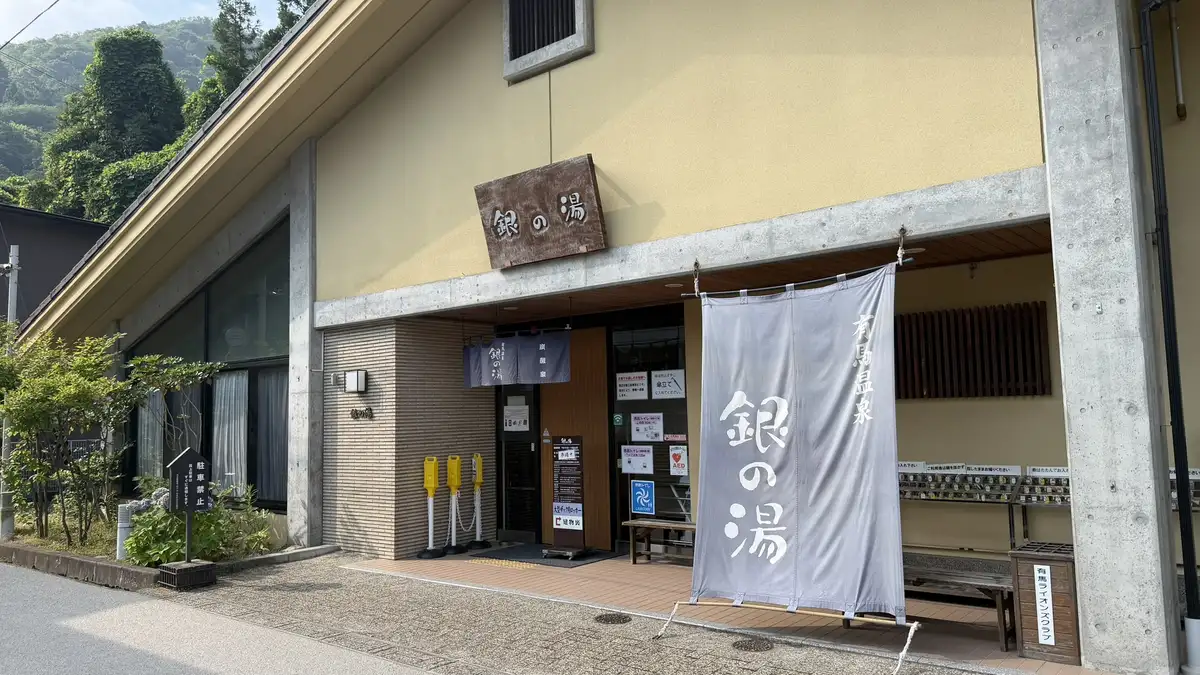
Kin-no-Yu and Gin-no-Yu are Arima's two public bathhouses. Prices, hours and spring quality are from the official website (checked 6 October 2026).
| Kin-no-Yu: prices | Adults ¥800 (¥650 on weekdays), children (elementary and junior high) ¥350, infants free. Weekday prices apply except on busy days such as New Year, Golden Week and Obon. |
|---|---|
| Kin-no-Yu: hours | 8:00–22:00 (last admission 21:30). Closed on the second and fourth Tuesday of the month and on 1 January (if the day is a public holiday it opens, and closes the next day). |
| Kin-no-Yu: water | Gold spring (kinsen): an iron-bearing sodium chloride spring, strongly saline and hot. It is clear when it comes out, then turns brown quickly. It has no smell, a strong salty and bitter taste, and an iron flavour. |
| Kin-no-Yu: indications | Neuralgia, muscle pain, joint pain, frozen shoulder, motor paralysis, stiff joints, bruises, sprains, chronic digestive disorders, haemorrhoids, sensitivity to cold, recovery from illness, fatigue recovery and general health. Additional indications for the spring type: cuts, burns, chronic skin disease, weak children, chronic women's disorders and menstrual disorders. For drinking: chronic digestive disorders, chronic constipation and anaemia (official site). |
| Gin-no-Yu: prices | Adults ¥700 (¥550 on weekdays), children (elementary and junior high) ¥300, infants free. Weekday prices apply except on busy days such as New Year, Golden Week and Obon. |
| Gin-no-Yu: hours | 9:00–21:00 (last admission 20:30). Closed on the first and third Tuesday of the month and on 1 January (if the day is a public holiday it opens, and closes the next day). |
| Gin-no-Yu: water | Carbonated and radium spring (simple carbon dioxide cold spring, simple radioactive spring). |
| Gin-no-Yu: indications | Neuralgia, muscle pain, joint pain, frozen shoulder, motor paralysis, stiff joints, bruises, sprains, chronic digestive disorders, haemorrhoids, sensitivity to cold, recovery from illness, fatigue recovery, general health, high blood pressure, arteriosclerosis, gout, chronic cholecystitis, gallstones, chronic skin disease, chronic women's disorders, cuts and burns. On the official site, high blood pressure and arteriosclerosis are marked with an asterisk. |
| Two-bath ticket | A ticket for both Kin-no-Yu and Gin-no-Yu costs ¥1,200. A version with a towel is sold on weekdays only. |
| My visit | I bathed in the morning of 18 July 2026, between stops. |
| Tansan Spring Park | The park is built around the spring that is known as the root of Arima's cider and carbonated crackers. Entry is free, and you can drink the carbonated water at a fountain. It is described as about 10 minutes on foot from the centre, uphill. I went there after Zuiho-ji Park. |
Tap any photo to enlarge
Special exhibition until 10 November 2026, and further reading
Taiko no Yudonokan is holding a special exhibition from 19 March to 10 November 2026. Timed with the NHK taiga drama Toyotomi Brothers!, it has panels about the excavation and a display of finds from the Yuyama site. Admission is the same as for the permanent exhibits: ¥200 for adults and ¥100 for children and students. The displays change when the exhibition ends, so check Kobe City's notice before you go. The drama and the historical record are not the same thing; the dates and people in this guide follow the explanations of Kobe City and the museums.
Frequently asked questions
The buildings are gone. What survives are the excavated steam-bath and rock-bath remains, preserved and shown at Taiko no Yudonokan. The model over the steam-bath remains and the garden recreated over the buried remains are both reconstructions based on the finds.
No. Taiko no Yudonokan is a Kobe City museum of the excavated remains, and you cannot bathe there. Taiko no Yu is a bathing facility at a different address. On a map app, search for the museum by its full name, 太閤の湯殿館.
No. They are modern bridges named after Hideyoshi and Nene, and the statues beside them are memorials too. The Sengoku-period remains are at Taiko no Yudonokan.
Yes. On 17 July 2026 I went from Osaka to Takarazuka Station and took the bus to Arima-onsen Station. A route-search site shows both a direct Hankyu Bus (about 1 hour) and a route that changes to the Kobe Electric Railway at Okaba. It depends on the departure time, so confirm the time at the Takarazuka stop.
Yes, Shinki Bus's Taiko Liner. On 18 July 2026 I left Arima at 11:00 from the Taiko Bridge stop and reached Himeji Station without changing. It takes about 1 hour 20 minutes, costs ¥1,500 for adults one way, and needs no reservation. There are not many departures, so pick your bus from the Shinki Bus timetable first and plan the walk around it.
Use each company's official timetable for the day you travel. Hankyu Tourist Bus services from Umeda and Kyoto are reservation-only, and tickets go on sale at 9:00 a.m. on the same date of the previous month. The Kyoto line runs two round trips a day, and Keihan Bus says some trips are suspended. Shinki Bus changed its Arima departure times on 14 October 2025. The links are at the end of the access section.
Yes, on the official website. Online tickets, which include the bathing tax, come in three types: full time, morning time and night time. As of 6 October 2026 an adult full-time ticket was ¥2,500 on weekdays and ¥2,700 on weekends and holidays. On the Friday night I went, it was not very crowded.
I took about 20 minutes. Admission is ¥200 for adults and ¥100 for children and students. It is open 9:00–17:00 (last entry 16:30) and closed on the second Wednesday of the month. It may also close temporarily, so check before you go.
Yes. On the morning of 18 July 2026 I walked from about 7:40 to 11:00, around 3 hours 20 minutes including two baths, and covered Zuiho-ji Park, the temples, the museum, and the bridges and statues. Fix your return bus first, then work out when you need to finish.
It is about 20 minutes on foot from the station and in a different direction from the centre. You can see up close the gate said to have been moved from Fushimi Castle. November is the autumn-leaf season, when vehicle access around the park is restricted.
On my July 2026 visit, the exhibit titles had English, but I did not find English explanatory text (as far as I could check). If you visit with someone who does not read Japanese, tell them beforehand which items are excavated remains and which are reconstructions.


comment