


Explore Sokenji’s Nio Gate and Buddha’s Footprint Stone in 360°
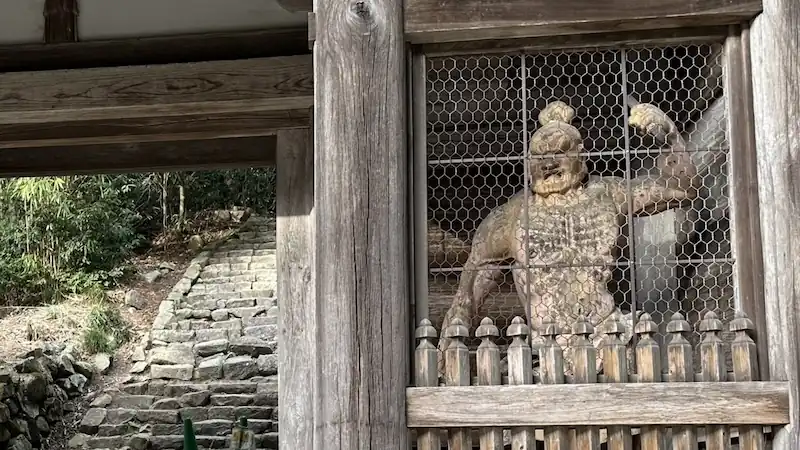
The ridge beam of Sōken-ji’s Nio Gate still bears an inscription dating its construction to 1571 (Genki 2). This page takes you around it from five vantage points — the approach path, the front, right at the threshold, the far side, and a wider view — a gate said to have been moved here from Kōka by Nobunaga himself. It’s one of only two Important Cultural Property structures still standing at the former Sōken-ji site, and worth exploring on your phone or computer before you visit. Two more panoramas cover the Buddha’s Footprint Stone (Bussokuishi), a medieval stone carved with the Buddha’s footprints.
- Looking around: On desktop, click and drag; on a smartphone or tablet, swipe with your finger.
- Loading: These images can take a moment to load — a strong connection will make for a smoother experience.
The Nio Gate (Sōken-ji’s Nio Gate)
The Buddha’s Footprint Stone (Bussokuishi)
More 360° Panorama Pages
Frequently Asked Questions (FAQ)
On desktop, click and drag with your mouse; on a smartphone or tablet, swipe with your finger. These images can take a moment to load — a strong connection will make for a smoother experience.
Yes — the Nio Gate sits right on the walking path, so you pass through it as part of the visit. You can’t climb up into the gate itself or step behind the lattice, but the wooden Kongō Rikishi guardian statues inside are visible through it. Please don’t touch the lattice or reach in toward the statues, to help keep both the gate and the statues intact.
The ridge beam of the Nio Gate carries an inscription dating its construction to 1571 (Genki 2), while the Kongō Rikishi guardian statues inside are inscribed with an even earlier date, 1467 (Ōnin 1) — meaning the statues actually predate the gate that now houses them. Both the gate and the statues are separately designated National Important Cultural Properties. Local tradition holds that Nobunaga had the gate relocated here from Kōka, and together with the statues it’s one of the clearest physical links to the history of the former Sōken-ji Temple.
The Buddha’s Footprint Stone is located near the Ninomaru (second bailey). This page’s “Buddha’s Footprint Stone” section (photos 6 and 7) includes two 360° panoramas — a close-up of the carved footprints and a wider view from a short distance away. The stone, carved with an impression of the Buddha’s footprints, was found near the Ninomaru and is thought to have been used as building material in a stone wall when the castle was constructed.
Copyright for the 360° images belongs to the photographer. Please do not reproduce or reuse them without permission.
Back to the Azuchi Castle Ruins Guide
☕ Support This Site
Following the Shogun is built on firsthand, on-site research.
If this article helped you, your support would mean a lot.

You can also support via the QR code
Information on this site is current as of August 2026. Copyright for the 360° images belongs to the photographer; please do not reproduce or reuse them without permission. For the latest visiting hours and admission fees, check the official Sokenji Temple website.
Back to the Home Page



comment