


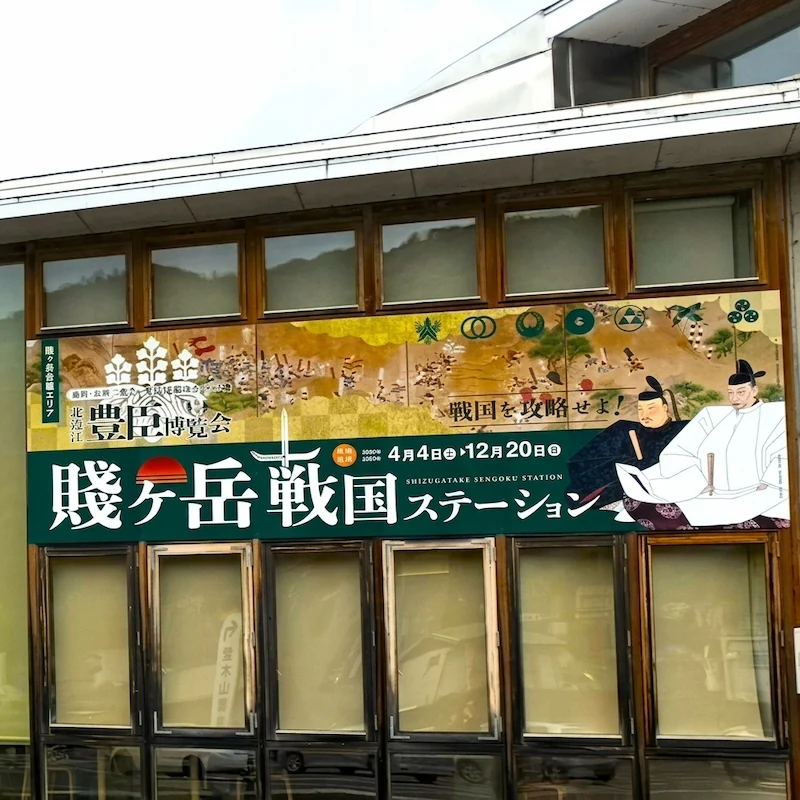
Shizugatake Sengoku Station: The Complete Guide
Shizugatake Sengoku Station is a free-admission history exhibition hall that opened on April 4, 2026, in Yogo, a district of Nagahama City in Shiga Prefecture, on the northern shore of Lake Biwa. It’s one of the venues of the “Kita-Omi Toyotomi Expo” — Kita-Omi meaning “northern Omi,” since Omi Province once covered roughly today’s Shiga Prefecture — held by the expo’s organizing committee to coincide with the NHK taiga drama Toyotomi Kyodai! (“Toyotomi Brothers!”). The hall occupies the former Hagoromo Hall, about a 25-minute walk from JR Yogo Station (余呉駅).
On this page
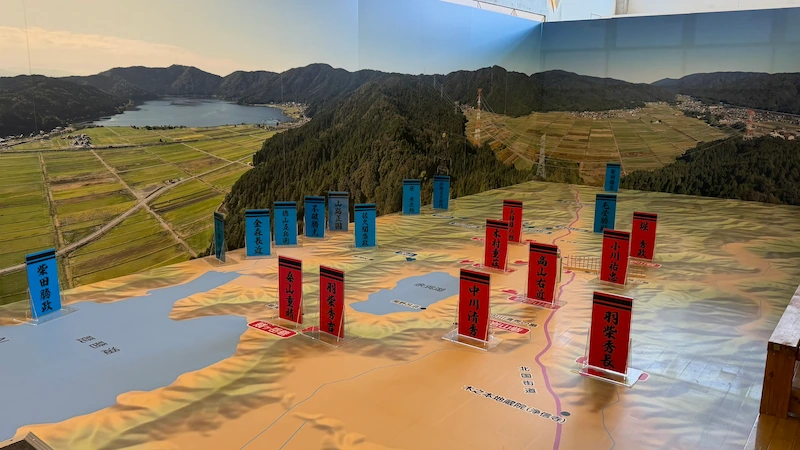
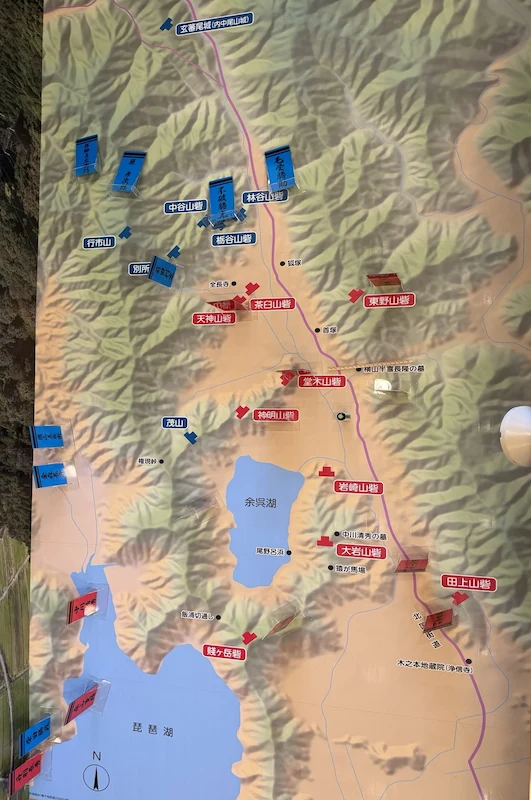
The centerpiece of the exhibit is a single battle map for the Battle of Shizugatake that wraps across the floor and the walls of the hall. Wooden markers for the generals stand at their historical positions — red for Hashiba Hideyoshi’s forces, blue for Shibata Katsuie’s — around Lake Yogo (余呉湖), the surrounding forts, and the old Hokkoku Kaido highway, so the whole layout of the battle is visible at a glance. Unlike the costume displays at the Taiga Drama Museum, this hall is built specifically to help visitors understand how the decisions made by Hideyoshi, Katsuie, and Maeda Toshiie played out across the terrain. This guide covers the exhibits, access, how long to budget, and how to combine a visit with the surrounding battlefield sites.
| Facility | Shizugatake Sengoku Station (賤ヶ岳戦国ステーション), officially SHIZUGATAKE SENGOKU STATION |
|---|---|
| Dates | Saturday, April 4 – Sunday, December 20, 2026 |
| Hours | 10:00 AM–4:00 PM (last admission 3:30 PM) |
| Admission | Free |
| Closed | Open daily in principle (occasional closures at the organizer’s discretion) |
| Venue | 2434 Nakanogo, Yogo-cho, Nagahama City, Shiga Prefecture (former Yogo Culture Hall, “Hagoromo Hall”) |
| Nearest station | About 25 min on foot from JR Yogo Station |
| Parking | Adjacent Yogo Community Center lot (free, roughly 20–30 spaces) |
| Official site | nagahama-sengoku.jp/sengokustation/ (Japanese) |
Its Connection to the Kita-Omi Toyotomi Expo and the Taiga Drama Toyotomi Kyodai!
To coincide with the 2026 NHK taiga drama Toyotomi Kyodai! (“Toyotomi Brothers!”), Nagahama City in Shiga Prefecture is hosting the Kita-Omi Toyotomi Expo. Shizugatake Sengoku Station is one of its venues, built to dig into the historical background of the Battle of Shizugatake (1583) — a pivotal moment in the Toyotomi brothers’ rise to power.
Main venues of the Kita-Omi Toyotomi Expo (2026)
At Nagahama Betsuin Daitsuji Temple’s assembly hall, in central Nagahama.
In central Nagahama. Covers the Azai clan, the three Azai sisters, and the battles of Anegawa and Odani Castle.
Near JR Kinomoto Station. Covers the Shizugatake battlefield area and Hideyoshi’s forced march, the “Great Return.”
In Yogo. Covers the battlefield terrain and the network of mountain forts.
Each venue plays a different role. If you want to experience the drama’s world, visit the Taiga Drama Museum. If you want to understand the historical background, this is the venue for that.
How It Differs from the Taiga Drama Museum — What’s Actually on Display
A common misconception before visiting is assuming this is the same kind of facility as the Taiga Drama Museum. Shizugatake Sengoku Station is not a costume-and-prop exhibit like the drama museum. Its focus is the terrain, maps, and historical panels needed to understand the Battle of Shizugatake itself.
| Comparison | Taiga Drama Museum, “Toyotomi Kyodai!” | Shizugatake Sengoku Station |
|---|---|---|
| Location | Central Nagahama (Nagahama Betsuin Daitsuji Temple assembly hall) | Yogo (former Hagoromo Hall) |
| On display | Costumes, props, and cast-related material | Battlefield relief maps, dioramas, fort explanations |
| Admission | Paid | Free |
| Best for | Fans of the drama’s world and cast | Visitors who want the terrain, history, and generals’ decisions |
| Time needed | About 60–90 minutes | 15–50 minutes (guided tour or not) |
Main Exhibits
Drive along National Route 365 and a large green sign and banners for Shizugatake Sengoku Station are hard to miss. The building itself, though, is more of an ordinary community hall than a tourist attraction — if you’re picturing a flashy, castle-themed display, it may come as a mild surprise.
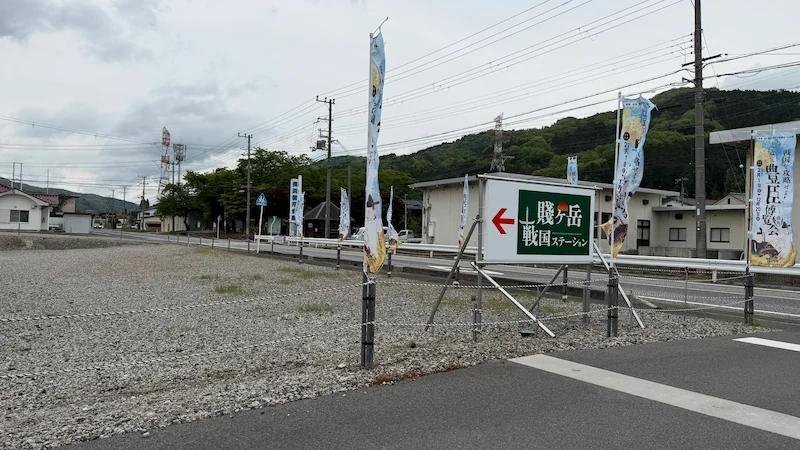
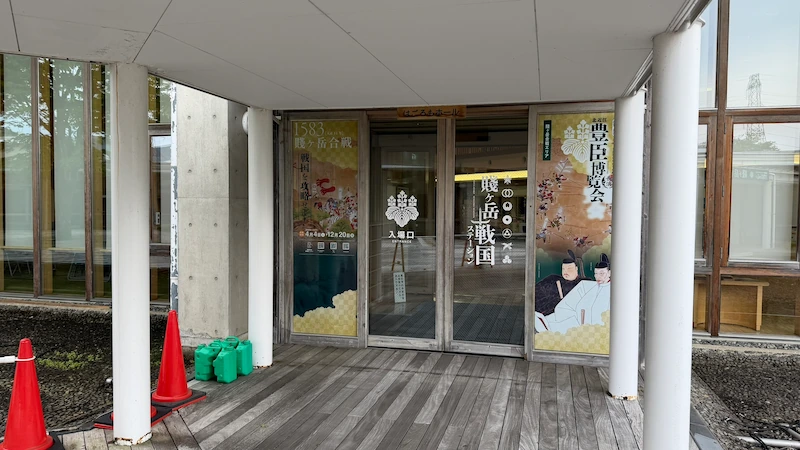
Walk further in and there’s a moment where the space changes entirely. Large photo panels of the mountains around Lake Yogo cover the walls, and a map of the lake, the forts, and the old Hokkoku Kaido highway spreads across the floor. Wooden markers for the generals — red for Hashiba Hideyoshi’s army, blue for Shibata Katsuie’s — stand at their actual troop positions, bringing the 1583 battlefield to life in three dimensions.
The Floor-and-Wall Battle Map (Main Exhibit)
A panoramic photograph of the mountains around Lake Yogo covers the wall and continues into a floor map of the lake, forts, roads, and generals’ positions. Being surrounded by the display creates a very different sense of the terrain than a flat map ever could. During the guided tour, the guide moves the red and blue markers while narrating, so you can visually follow how the battle unfolded.
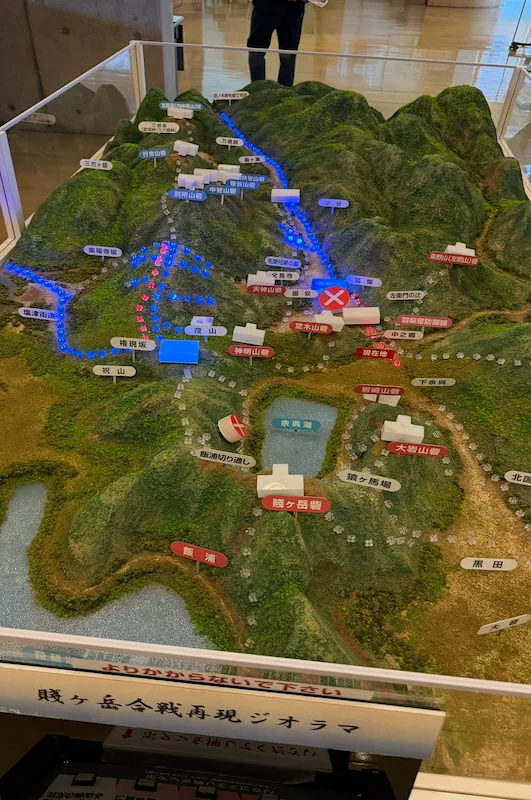
Diorama Recreation of the Battle
A detailed physical diorama recreates the mountains, Lake Yogo, and the forts. Hideyoshi’s forced-march route (marked in blue LEDs) and the position of each fort are visible at a glance, giving a real sense of scale for the roughly 52-kilometer march.
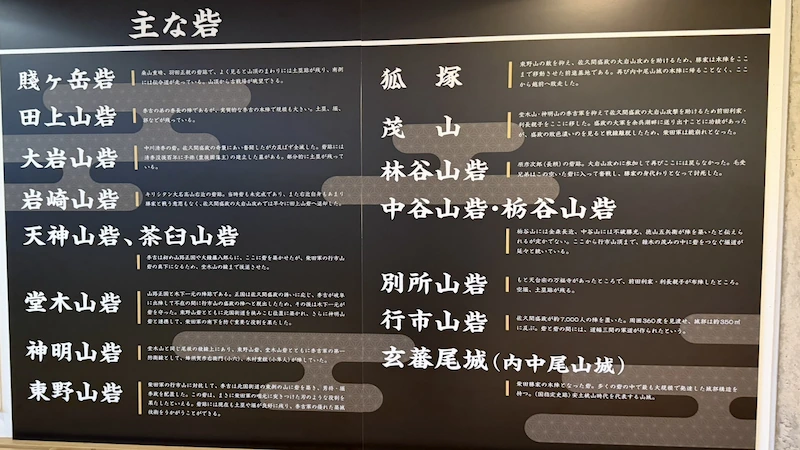
Fort Network Panel: “The Main Forts”
An overview panel covers the main forts involved in the battle — Shizugatake Fort, Tagamiyama Fort, Oiwayama Fort, Gyoichiyama Fort (also known as Genbao Castle), and others — with a concise summary of each fort’s role, commander, and the current state of its remains. It’s genuinely useful homework before heading out to the battlefield.
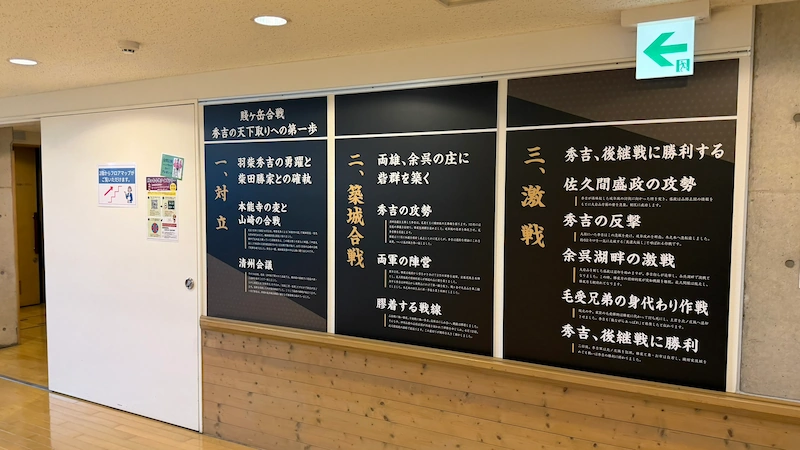
Battle Timeline Panel: “The Battle of Shizugatake — Hideyoshi’s First Step Toward Ruling Japan”
A three-part timeline — “Conflict,” “the Fort-Building Race,” and “the Decisive Battle” — lays out the sequence of events: the Honnoji Incident (1582), the Kiyosu Conference that followed (where Nobunaga’s chief vassals met after his death to settle who would lead the Oda clan and divide its territory), the race to build forts, Sakuma Morimasa’s offensive, Hideyoshi’s counterattack, the fierce fighting around Lake Yogo, and the Menju brothers’ sacrifice.
Feature Panels: Genbao Castle’s Name, the Menju Brothers’ Loyalty, and Where “Shizugatake” Comes From
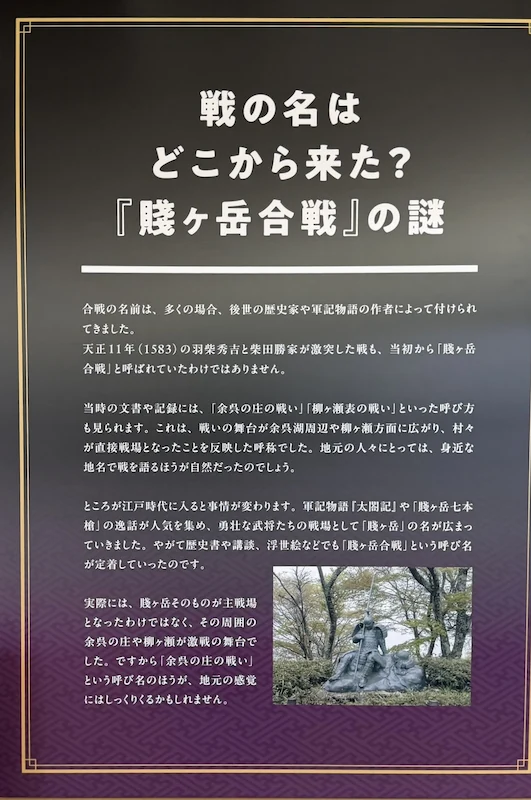
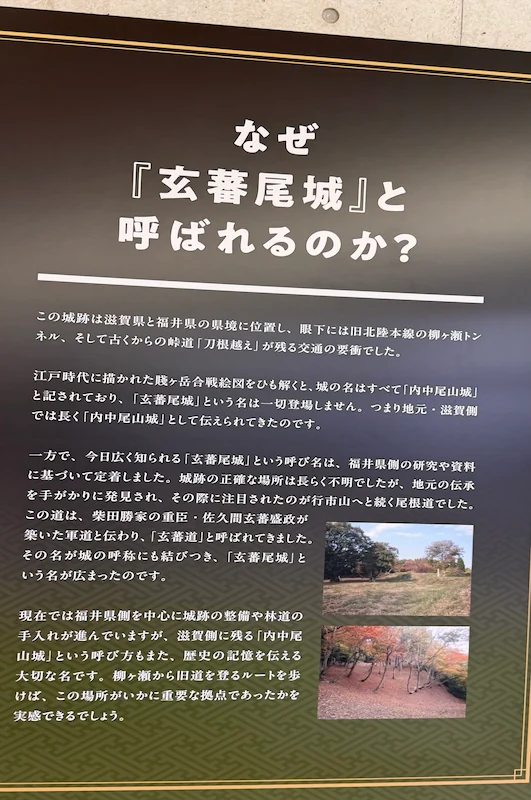
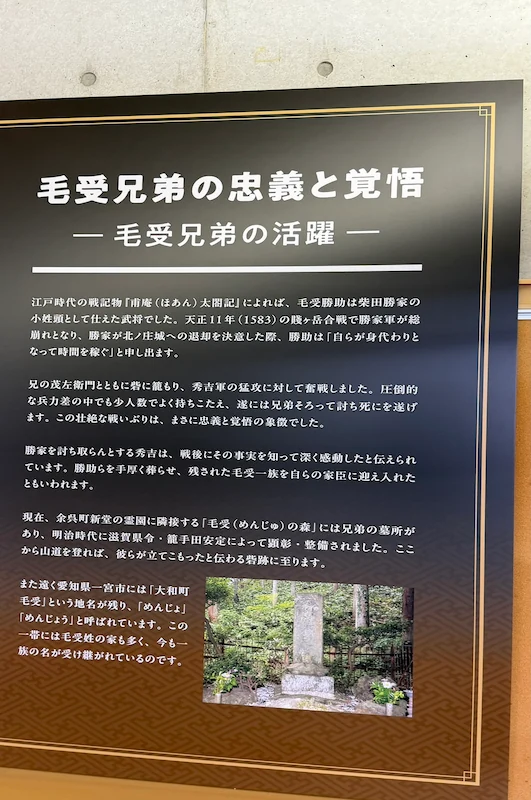
Three deep-dive panels explore “Why Is It Called Genbao Castle?”, “The Menju Brothers’ Loyalty and Resolve,” and “Where Does the Battle’s Name Come From?” They cover details you won’t find at other venues, including how the castle’s name relates to the “Genba Road” military route built by Sakuma Morimasa.
Life-Size General Panels and the Gift Shop
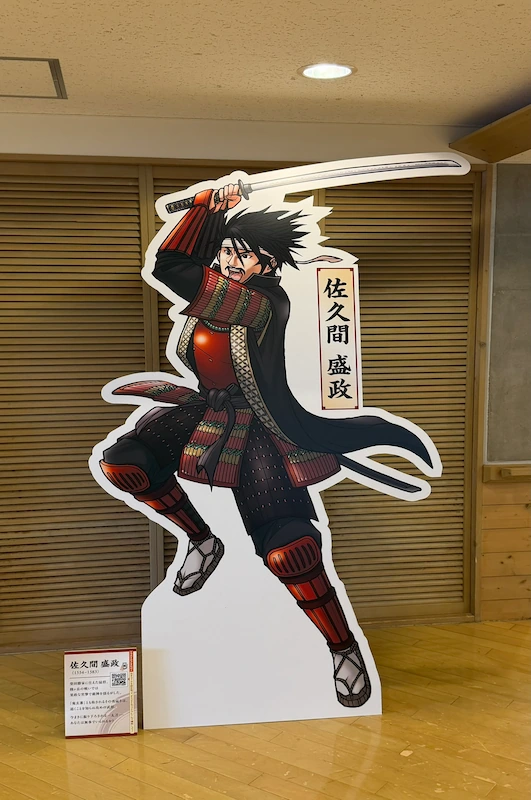
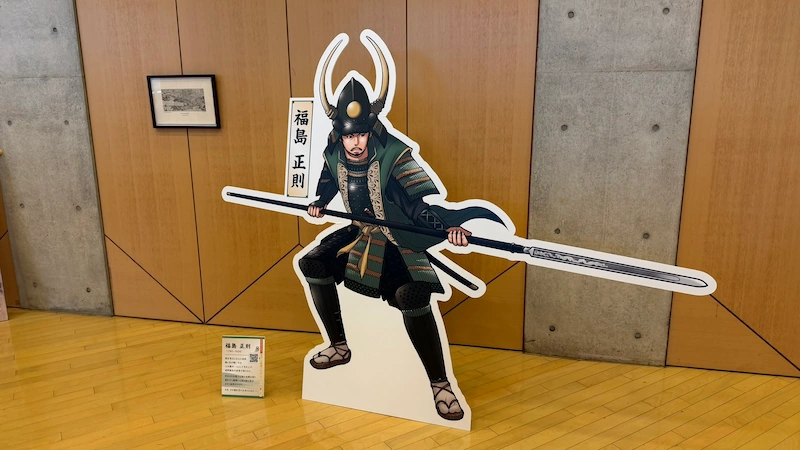
Illustrated, life-size panels of generals such as Sakuma Morimasa and Fukushima Masanori are placed around the hall, with profile cards and QR codes at their feet for more detail. A gift shop near the exit sells goods related to the Kita-Omi Toyotomi Expo and the Battle of Shizugatake.
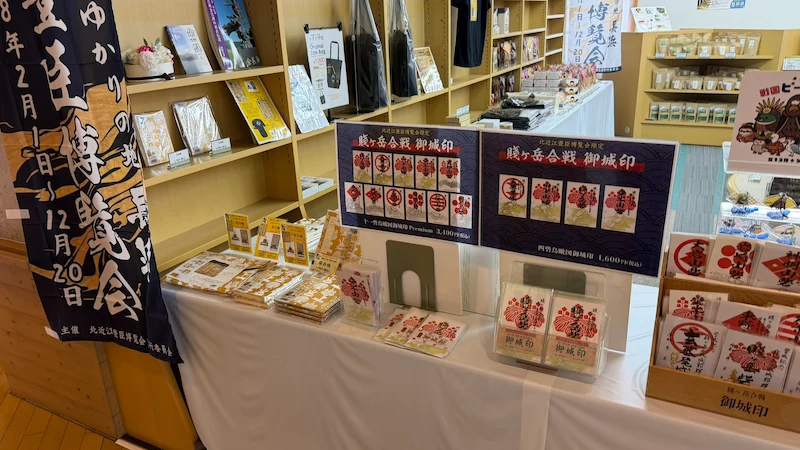
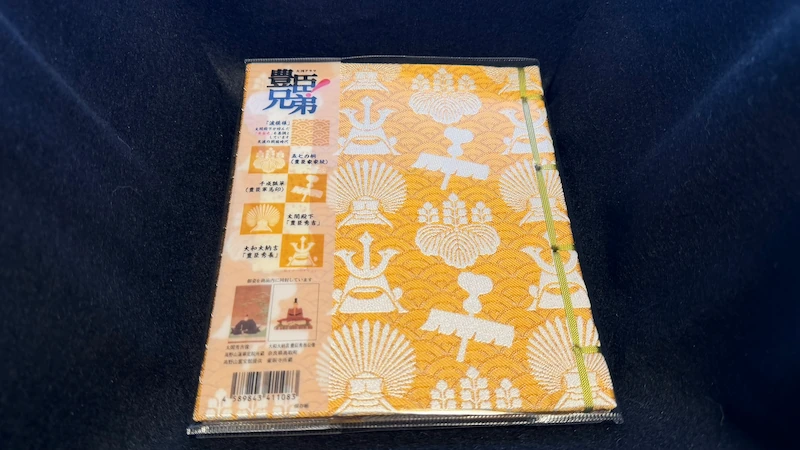
Goshuin Stamps and Stamp Books
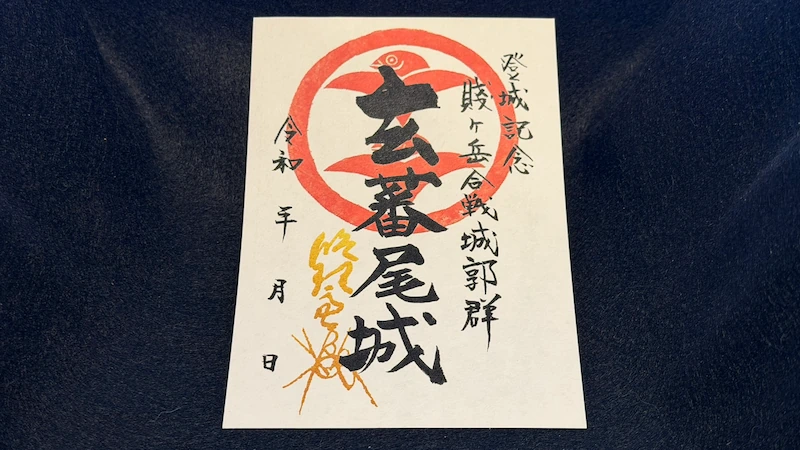
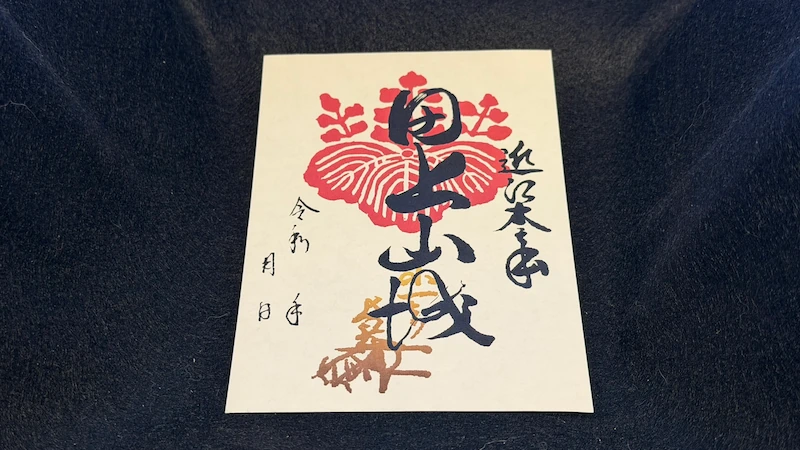
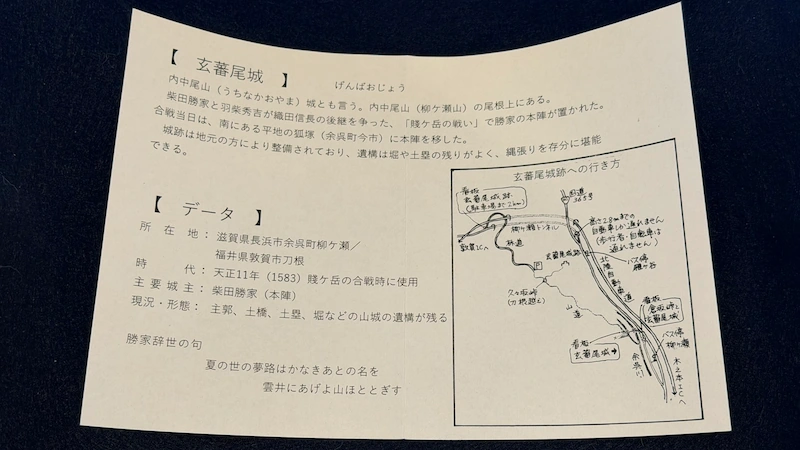
Each Goshuin Comes with Its Own Guide Card
Every goshuin comes with a dedicated guide card describing the castle’s history, era, key commanders, the current state of its remains, and an access map. The Genbao Castle card even includes Shibata Katsuie’s death poem — genuinely useful reading before a battlefield visit.
The Battle, as Explained by the Guide — A Story of Timing and Loyalty
The local guide’s explanation on-site added a great deal to this facility. Standing at the map, the guide moves the wooden markers to show how the battle developed. What had been a list of names and dates turns into a story of terrain and human judgment.
Understanding the Battle of Shizugatake (Tensho 11 / 1583)
The year after the Honnoji Incident (1582) — in which Oda Nobunaga was killed by his own general, Akechi Mitsuhide — Hashiba Hideyoshi, as he was still known at the time (he wouldn’t take the Toyotomi surname until 1586), and Shibata Katsuie faced off across the mountains around Lake Yogo, each side building forts as they vied for control of the Oda clan after Nobunaga’s death. At the time, Katsuie was in his 60s; Hideyoshi and Maeda Toshiie were in their 40s; and the young men later known as the “Seven Spears of Shizugatake” were around 20. This wasn’t simply a battle of numbers — the loyalty of individual commanders, and the question of who to follow next, shaped the outcome as much as troop strength did. After a tense standoff through a heavy winter snowfall, the fighting began in earnest once the snow melted.
He captured Oiwayama Fort but was slow to decide when to withdraw — the guide’s point was that knowing when to retreat is hardest exactly when you’re winning.
The roughly 52-kilometer forced march from Ogaki to Shizugatake wasn’t just about speed. According to the guide, Hideyoshi lightened his troops’ load and shipped their gear separately, splitting the flow of people and supplies to move faster.
Caught between his debt to Katsuie, his old friendship with Hideyoshi, and the future of his own clan, Toshiie’s wavering is a story the guide tells at length.
As Katsuie retreated, the brothers took on his golden ceremonial staff and died in his place as decoys. Hideyoshi is said to have been moved by their loyalty and given them an honorable burial.
The Taiga Drama Toyotomi Kyodai! and the Battle of Shizugatake — What Viewers Can See on Site
The 2026 taiga drama Toyotomi Kyodai! centers on the relationship between Hideyoshi and his younger brother, Hidenaga. The Battle of Shizugatake, expected to feature prominently later in the broadcast, is one of the drama’s key turning points. The exhibits let viewers see, on the actual terrain, where the characters they’ll recognize from the show really were and what they were doing.
What Drama Viewers Can Confirm Through the Exhibits
The roughly 52 km route from Ogaki to Kinomoto, among other details of the march.
How Toshiie, positioned with Shibata’s forces near Bessho-yama, left the battlefield at the decisive moment — shown on the actual terrain.
His position after taking Oiwayama Fort, and how he was surrounded.
The fierce fighting around the shores of Lake Yogo, mapped out.
Worth More Than a Single Stop — Combining It with the Battlefield and Forts
Shizugatake Sengoku Station works best not as a destination in itself, but as a place to prepare before heading out to the battlefield. Once the fort positions from the floor map are in your head, the mountains and roads look completely different in person. Below is the rough route followed on an actual visit in May 2026.
Budget about 1 hour on foot for the visit.
About a 30-minute drive from the Genbao Castle ruins. Budget 15–20 minutes for the exhibits alone, or about 50 minutes including the guided tour.
Easy to add on by car after visiting the station.
(These times are rough estimates from a visit in May 2026. They’ll vary with road conditions, season, and how long you linger.)
Visit Data
| Time needed | Exhibits only: 15–20 min / with guided tour: about 50 min |
|---|---|
| Guide | Local guide available (about 30 minutes, timing-dependent) |
| Visitors | All ages, from history fans to families |
| Crowds | About 10 visitors around 1 PM on a May 2026 visit — no issues seeing the exhibits (this can vary by season and time of day) |
| Facilities | Restroom and rest area inside |
| Best for | Sengoku history fans / anyone wanting the terrain in mind before a battlefield visit / fans tracing sites tied to the taiga drama Toyotomi Kyodai! |
| Note | Not a costume-and-prop exhibit like the Taiga Drama Museum |
Access & Parking
Shizugatake Sengoku Station Access
| Address | 2434 Nakanogo, Yogo-cho, Nagahama City, Shiga Prefecture (former Yogo Culture Hall, “Hagoromo Hall”) |
|---|---|
| By train | About 25 min on foot from JR Yogo Station (余呉駅), JR Hokuriku Main Line |
| By car | About 15 min from the Kinomoto Interchange (IC) on the Hokuriku Expressway / on National Route 365, with roadside signage |
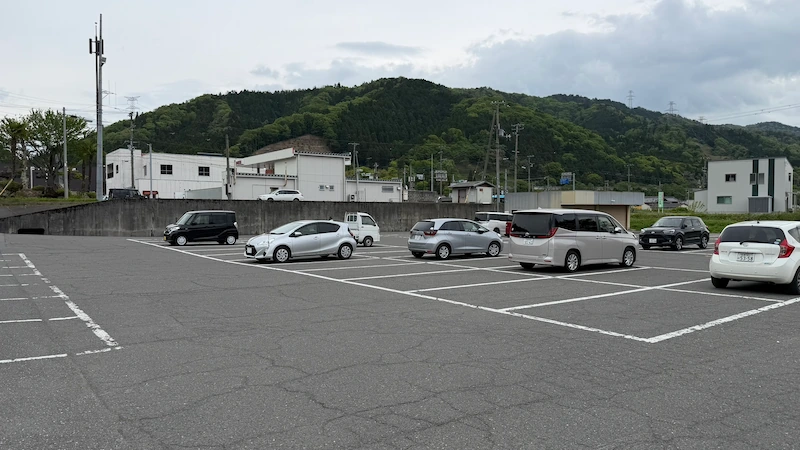
| Parking | Adjacent Yogo Community Center lot (free, roughly 20–30 spaces, as of a May 2026 visit) |
Related Spots & Other Kita-Omi Toyotomi Expo Venues
FAQ
It’s free. Anyone can visit at no charge.
It’s open Saturday, April 4 through Sunday, December 20, 2026, 10:00 AM–4:00 PM (last admission 3:30 PM). It’s open daily in principle, though there may be occasional closures at the organizer’s discretion.
It’s about a 25-minute walk from JR Yogo Station. There’s a large roadside sign on National Route 365. By car, it’s about 15 minutes from the Kinomoto Interchange on the Hokuriku Expressway. You can use the adjacent Yogo Community Center parking lot (free), which has space for roughly 20–30 cars (as of a May 2026 visit).
If the timing works out, you can join a roughly 30-minute talk from a local guide. Exhibits alone take 15–20 minutes; with the guided tour, budget about 50 minutes.
During our site visit (May 2026, around 1 PM), there were about 10 visitors — not enough to interfere with viewing the exhibits. That said, this can vary by season and time of day, so treat it as a rough guide only.
Yes, there’s a restroom and a rest area inside, so it’s comfortable to visit with small children or elderly family members.
Shizugatake Sengoku Station isn’t a costume-and-prop exhibit. It explains the history, terrain, and fort network of the Battle of Shizugatake through maps, dioramas, and panels — better suited to visitors who want a three-dimensional understanding of the historical background.
There’s a gift shop near the exit selling books and goods related to the Battle of Shizugatake and the Kita-Omi Toyotomi Expo. Goshuin stamps vary in type and stock, so check the official website or on-site for the latest availability.
As of this visit, goshuin for Genbao Castle and Tagamiyama Castle were available. Each comes with a dedicated guide card featuring the castle’s history and an access map — useful before or after a battlefield visit. A goshuincho stamp book in the “Toyotomi Kyodai!” design was also available. Stock and selection change, so check locally for the latest information.
Definitely — it’s a great combination. Based on an actual visit in May 2026: budget about 1 hour on foot for the Genbao Castle ruins, then about a 30-minute drive to Shizugatake Sengoku Station. After visiting the station, the Shizugatake Battlefield Observation Deck is an easy add-on by car. Getting the fort layout in your head here first makes a real difference in how the mountains and roads read once you’re there.
It’s a 2026 Sengoku-era event centered on Nagahama City, Shiga Prefecture, timed to the NHK taiga drama Toyotomi Kyodai! (“Toyotomi Brothers!”). It includes several venues, such as the Taiga Drama Museum (Nagahama), Gi to Kizuna Hall (Nagahama), and Shizugatake Sengoku Station (Yogo).
Yes. The floor-and-wall battle map is visually easy to follow, and the local guide’s explanation is straightforward. Elementary-school-age children and up can enjoy it comfortably. Many visitors who only knew the battle by names and dates come away able to picture how it actually unfolded.
☕ Support This Site
Following the Shogun is built on original fieldwork and on-site research.
If you found this guide useful, your support helps keep it going.

You can also support via QR code
Related Reading



comment