


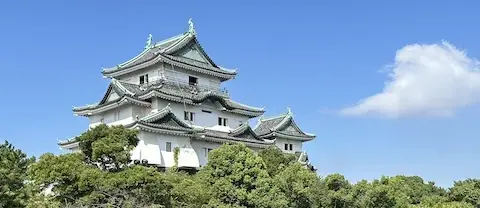
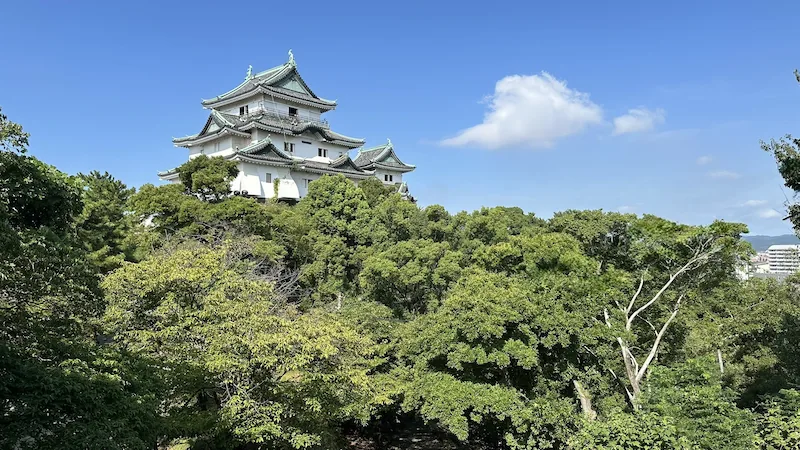
Wakayama Castle sits about 10 minutes by bus from JR Wakayama Station, with keep admission running ¥410. It’s an easy 60 minutes from Osaka on the Limited Express Kuroshio, close enough to fold into a day trip alongside Osaka sightseeing.
Three heritage-grade landmarks — the Important Cultural Property Okaguchi Gate, the linked-keep complex, and the nationally designated Momijidani Garden — sit within a single compact site you can cover, all 21 spots across three areas, in two to three hours. The castle dates to 1585 (Tenshō 13), when Toyotomi Hideyoshi ordered his brother Toyotomi Hidenaga to build it. As lordship passed from the Asano family to the Kishū Tokugawa family — the line that produced shogun Tokugawa Yoshimune — each era left its own layer in the stone walls, the keep, and the garden.
Osaka Castle vs. Wakayama Castle: What Sets Them Apart
If you live in Kansai or you’re visiting Osaka, the obvious question is how Wakayama Castle stacks up against Osaka Castle. Here’s what I noticed having walked both.
🏰 Osaka Castle vs. Wakayama Castle: A Side-by-Side from the Ground
- Flatland castle, built on open ground
- The keep stands alone as the icon, surrounded by parkland
- Very heavy tourist traffic
- Elevator access inside the keep
- Takes longer to walk the full grounds
- Hilltop castle, with layered, three-dimensional views
- Keep and turrets fused into one unified mass
- Compact and easy to walk end to end
- Tree-framed views that photograph beautifully
- A free, nationally designated garden right next door
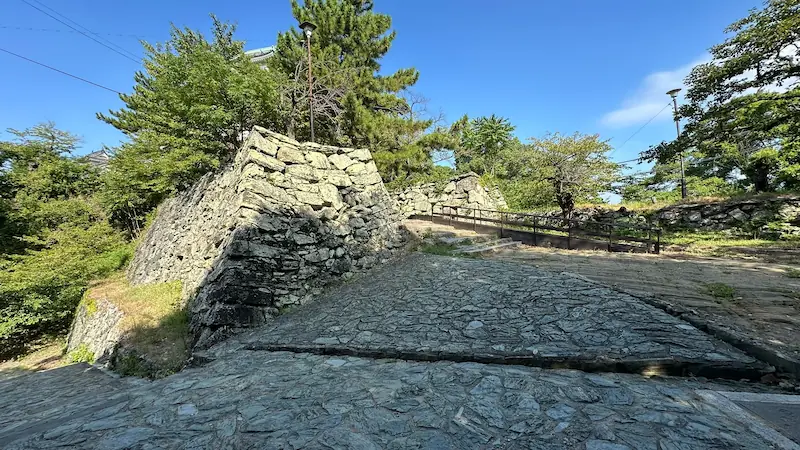
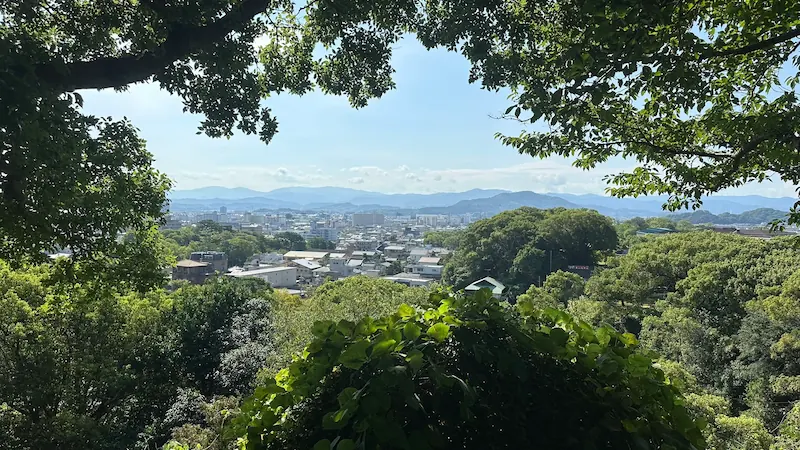
What sets Wakayama Castle apart most is its renritsu-style keep, in which the main keep, secondary keep, Kusu Gate, Ni-no-mon Turret, and Inui Turret are all joined by connecting corridors rather than standing as separate buildings. The result is a single mass rising from the hilltop — a very different kind of presence from Osaka Castle. And because it sits on a hill rather than open ground, the terrain keeps shifting the view as you walk, part of what makes a hilltop castle like this one so engaging to explore.
Essential Info, Access, and Admission
🏯 Wakayama Castle at a Glance
| Location | 3 Ichibancho, Wakayama City, Wakayama Prefecture |
|---|---|
| Access (from Osaka) | About 60 minutes from Shin-Osaka or Tennōji to Wakayama Station via the JR Limited Express Kuroshio |
| Access (from Wakayama Station) | About 10 minutes by bus from JR Wakayama Station, or a 10–15 minute walk from Nankai Wakayamashi Station |
| Heritage designation | National Historic Site / Okaguchi Gate (with its attached earthen wall): Important Cultural Property / Momijidani Garden: Nationally Designated Place of Scenic Beauty |
| Japan’s 100 Fine Castles | No. 62 |
| Official site | Wakayama Castle Historic Site (official) |
💴 Admission, Hours, and Official Links by Facility
| The Keep |
Adults (including high school students) ¥410 / Elementary and junior high school students ¥200 Open: 9:00 a.m.–5:30 p.m. (last entry 5:00 p.m.) Closed: December 29–31 ▶ Official visitor information page |
|---|---|
| Wakayama History Museum (2nd-floor exhibits) |
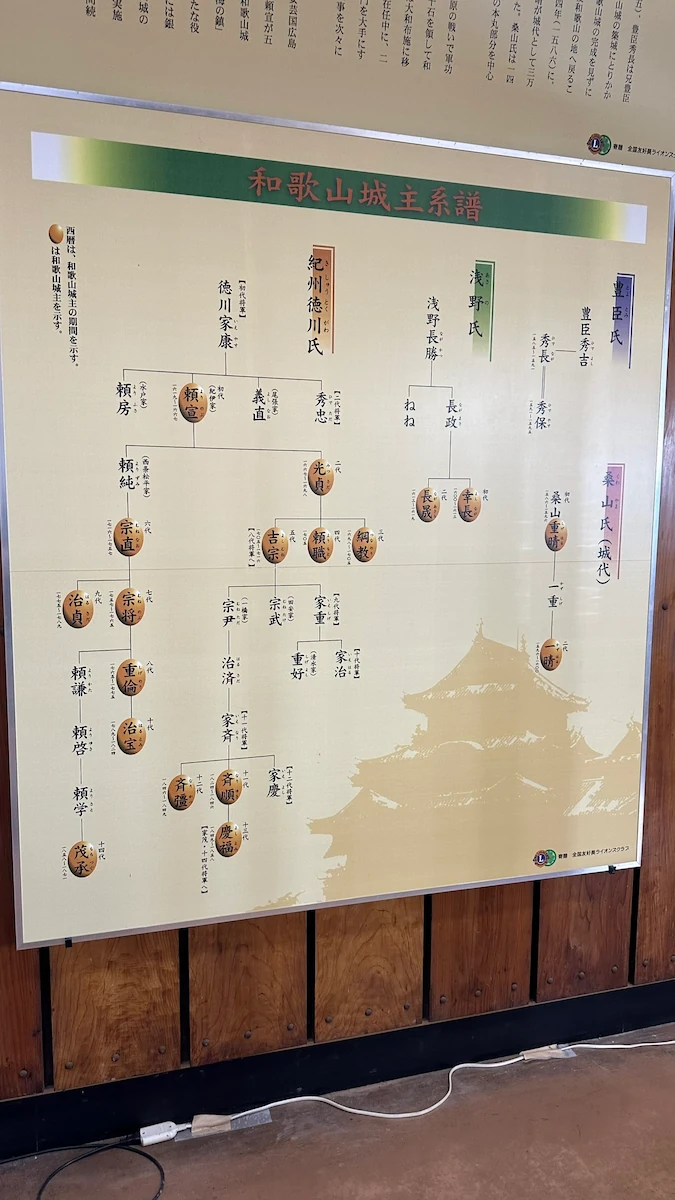
Adults ¥100 / Elementary and junior high school students free *A combined ticket with the keep is available Open: 9:00 a.m.–5:30 p.m. (last entry 5:00 p.m.) Closed: December 29–31 Exhibits include the VR feature “Wakayama Castle Reborn,” campaign coats, armor, and a genealogy of the castle’s lords ▶ Official Wakayama History Museum page |
| Momijidani Garden (Nishi-no-maru Garden) |
Free admission Open: 9:00 a.m.–5:00 p.m. (last entry 4:45 p.m.) Closed: December 29–31 A fee applies for tea service at the Kōshōan tea house. Maple leaves typically peak from late November into early December. ▶ Momijidani Garden page, official Wakayama Castle site |
| Onbashi Corridor Bridge |
Free (remove your shoes to cross) A covered bridge on a diagonal span connecting the ninomaru and nishinomaru — a rare design nationwide, and one you can walk through. ▶ Onbashi Corridor Bridge page, official Wakayama Prefecture tourism site |
| Oimawashi Gate and Castle Park |
Free (always open) The vermilion-lacquered Oimawashi Gate is an original structure, designated a Wakayama City Cultural Property. |
*Hours and admission are subject to change. Check the official sites before you visit.
How to Walk the Three Areas: Timing and Choosing Your Route
Wakayama Castle’s 21 spots fall into three areas, laid out in walking order. Entering through the Ichi-no-hashi Bridge and Main Gate and moving from the outer bailey to the honmaru and then the nishinomaru follows the historical approach to the castle, and it’s the most natural sequence to walk. Each area page includes 360° panoramic photos and a detailed step-by-step route.
The Outer Bailey
Ichi-no-hashi Bridge to the Omote Slope
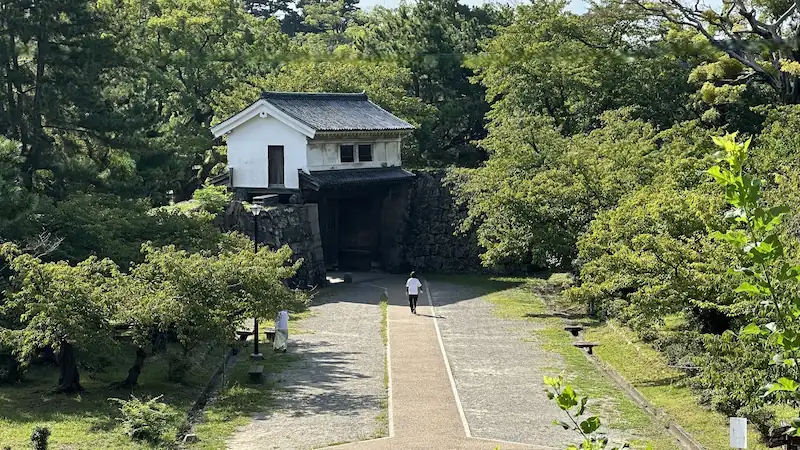
The highlights here are the Important Cultural Property Okaguchi Gate and the Matsu-no-maru stone wall, which rises as high as 14 meters. From the Toyotomi-era main gate site to Edo-period stonework, you can read the castle’s history in its walls.
📍 11 spots / 1 panorama See the Outer Bailey Area →
The Honmaru and Keep
Shichifuku Garden to the Keep
This is where the renritsu-style keep complex comes together as one imposing mass. Only from the top floor of the keep, looking down over the turrets, does the whole “linked” structure really click into place. Admission ¥410.
📍 6 spots / 7 panoramas See the Honmaru and Keep Area →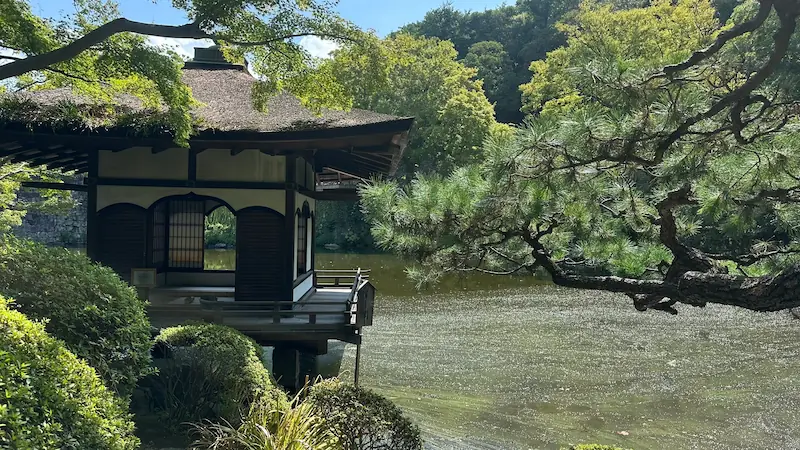
The Nishinomaru and Momijidani Garden
Oimawashi Gate to the Onbashi Corridor Bridge
Home to the free, nationally designated Momijidani Garden and the Onbashi Corridor Bridge, a design you won’t find at other castle sites. Maple leaves peak from late November into early December.
📍 4 spots / 4 panoramas See the Nishinomaru and Garden Area →Inside the Keep: Two Family Crests, Toyotomi and Tokugawa
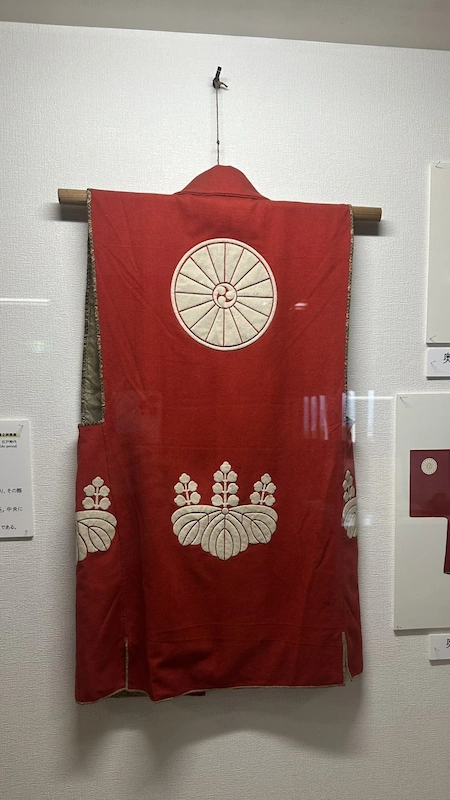
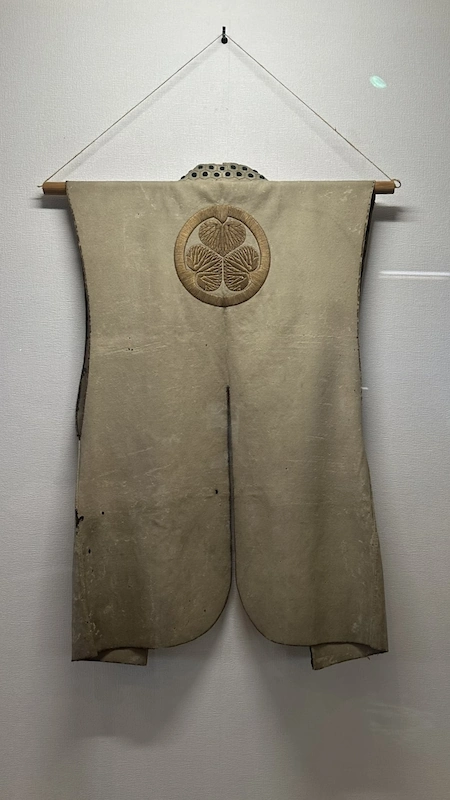
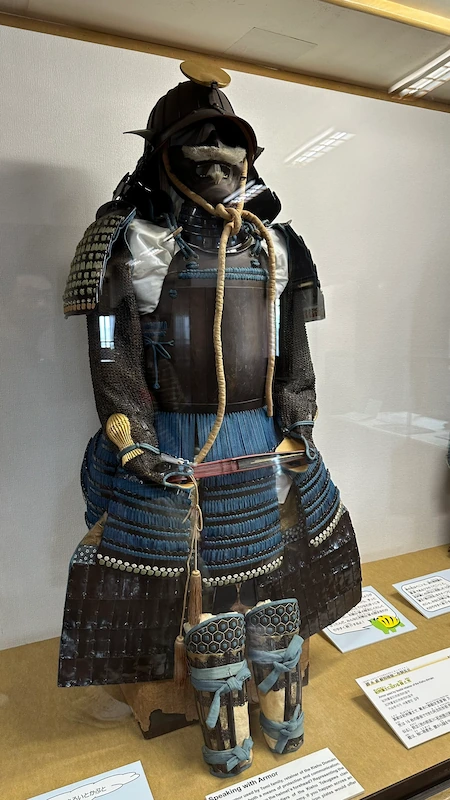
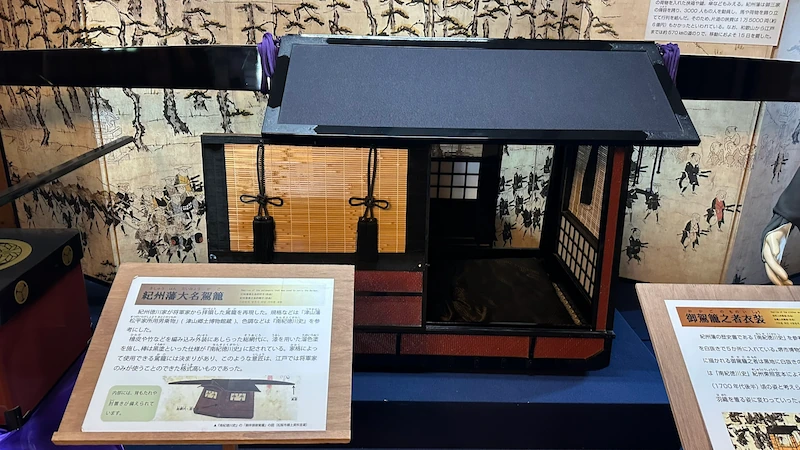
Inside the keep, the exhibits trace the castle’s turning points. What stands out most is a red campaign coat bearing the Toyotomi crest, displayed alongside one bearing the crest of the Kishū Tokugawa family. A castle that began under Toyotomi rule in 1585 and passed into Tokugawa hands — the real armor and coats on display make that shift tangible. For more on the keep, see the Honmaru and Keep area guide; for the Wakayama History Museum, see the Nishinomaru and Garden area guide.
The History of Wakayama Castle: From Toyotomi to Tokugawa
Wakayama Castle took shape across three distinct eras — Toyotomi, Asano, and Tokugawa — each adding its own layer to the site. The way the stone walls are laid and the buildings are styled records those eras in turn, so simply walking the grounds lets you trace the castle’s history firsthand.
-
1585 (Tenshō 13)
Toyotomi Hideyoshi subdued the Kii region and ordered his brother Hidenaga to build a castle. Construction began on Torafusu Hill under the supervision of Tōdō Takatora and other building magistrates. Since Hidenaga’s own base remained at Yamato-Kōriyama, his retainer Kuwayama Shigeharu governed the castle in his place.
→ See Okaguchi Gate, the site of the castle’s earliest main gate -
1600 (Keichō 5)
After the Battle of Sekigahara, Asano Yoshinaga took the castle with a domain assessed at 376,000 koku. He built the renritsu-style keep and carried out a major overhaul of the fortifications, relocating the main gate from Okaguchi to Ichi-no-hashi and developing the surrounding castle town.
→ See the linked-keep complex built under Asano rule -
1619 (Genna 5)
Tokugawa Yorinobu, Ieyasu’s tenth son, took possession of the domain at 555,000 koku, founding the Kishū Tokugawa family as one of the three principal Tokugawa branch houses. From 1621 (Genna 7) he undertook a large-scale rebuilding of both the castle and its town. The castle remained the Kii Tokugawa family’s seat until the Meiji Restoration.
→ See Momijidani Garden, said to have been laid out under Yorinobu -
1684 (Jōkyō 1)
The future eighth shogun, Tokugawa Yoshimune, was born in Kishū Wakayama. He would go on to serve as lord of Kishū domain before becoming shogun and driving through the Kyōhō Reforms.
→ See the keep, home of the castle that produced Yoshimune - 1945 (Shōwa 20) Air raids late in the Pacific War destroyed the keep and most of the castle’s other major structures. Only Okaguchi Gate and Oimawashi Gate survived.
-
1958 (Shōwa 33)
With support from local residents, the keep was rebuilt in reinforced concrete to its original exterior appearance. The year before, in 1957 (Shōwa 32), Okaguchi Gate and its attached earthen wall had been designated an Important Cultural Property.
→ See the surviving Okaguchi Gate (Important Cultural Property) -
1985 (Shōwa 60)
Momijidani Garden (the Nishi-no-maru Garden) was designated a nationally recognized Place of Scenic Beauty.
→ See the nationally designated Momijidani Garden -
2006 (Heisei 18)
The Onbashi Corridor Bridge was rebuilt in wood based on archaeological findings, and the castle was named No. 62 on the list of Japan’s 100 Fine Castles.
→ See the reconstructed Onbashi Corridor Bridge
The Full List: All 21 Spots
Here’s every one of Wakayama Castle’s 21 spots, listed in walking order. See the area pages for details on each one.
| # | Spot | Area | Highlights |
|---|---|---|---|
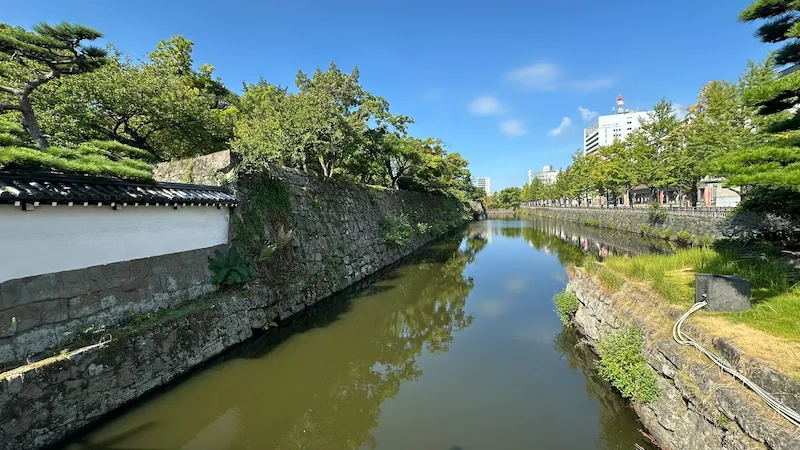
| 1 | Ichi-no-hashi Bridge and Main Gate | Outer Bailey | The main entrance from the Asano era onward — a photogenic spot where the moat mirrors the scene. |
| 2 | The Well House | Outer Bailey | A surviving structure from the domain era |
| 3 | Site of Icchū Gate | Outer Bailey | Defensive remains, including a masugata (box-shaped) entrance and a “mirror stone” |
| 4 | Crouching Tiger Statue | Outer Bailey | The castle’s emblem, embodying its nickname Torafusu-jō |
| 5 | Site of Okura-no-maru | Outer Bailey | Once the domain’s rice storehouses and supply grounds |
| 6 | Site of Okanaka Gate | Outer Bailey | Remains of a masugata entrance and stone walls |
| 7 | Matsu-no-maru Turret Platform Wall | Outer Bailey | A defensive stone wall rising as high as roughly 14 meters |
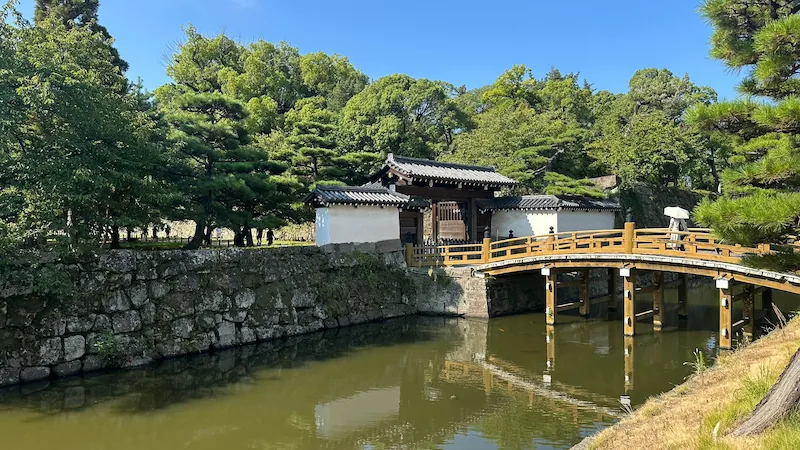
| 8 | Okaguchi Gate (Important Cultural Property) | Outer Bailey | Important Cultural Property An original gate built in 1621 (Genna 7) |
| 9 | Omote Slope | Outer Bailey | A broad, imposing stone stairway of Kishū blue stone — a design unlike any other castle’s |
| 10 | Site of Matsu-no-maru | Outer Bailey | An intermediate bailey with walls 10–14 meters high |
| 11 | The Omote Slope Camphor Tree | Outer Bailey | The castle’s second-thickest tree by trunk girth |
| 12 | Shichifuku Garden | Honmaru | A rock garden shaped like a treasure ship, laid out under Yorinobu and preserved after relocation |
| 13 | Site of the Honmaru Palace | Honmaru | A prime viewpoint looking straight at the keep 🔭 |
| 14 | Kusu Gate | Honmaru | A reconstructed wooden gate, built entirely of camphor wood, leading to the keep 🔭 |
| 15 | Ni-no-mon Turret | Honmaru | A reconstructed turret forming part of the linked-keep complex 🔭 |
| 16 | Inui Turret | Honmaru | A reconstructed turret guarding the northwest of the keep complex 🔭 |
| 17 | The Keep (One of Japan’s Three Great Linked-Keep Complexes) | Honmaru | A reinforced-concrete reconstruction, ranked among Japan’s three great linked-keep complexes 🔭🔭🔭 |
| 18 | Oimawashi Gate | Nishinomaru | The castle’s only surviving vermilion-lacquered gate, a Wakayama City Cultural Property |
| 19 | Wakayama History Museum | Nishinomaru | Experience the Edo-period castle in VR, alongside genuine campaign coats and other artifacts |
| 20 | Momijidani Garden (Nationally Designated Scenic Spot, Free) | Nishinomaru | Nationally Designated Scenic Spot A strolling pond garden built for a daimyo — free admission, with plenty of photo spots 🔭🔭 |
| 21 | Onbashi Corridor Bridge | Nishinomaru | A rare covered bridge you won’t find at other castle sites — walk right through it. Free 🔭🔭 |
🔭 = 360° panoramic photo available (12 total)
Frequently Asked Questions
The JR Limited Express Kuroshio takes about 60 minutes from Shin-Osaka or Tennōji to Wakayama Station, and it’s roughly a 10-minute bus ride from there. It’s close enough to build a full day trip around, paired with Osaka Castle.
Osaka Castle sits on flat ground, while Wakayama Castle occupies a hilltop. Wakayama is smaller, but its “renritsu-style keep” — the main keep, secondary keep, and several turrets joined by covered corridors — rises from the hill as one imposing mass. Its layered, tree-framed setting and the free, nationally designated Momijidani Garden give it a character all its own.
The easiest route is a roughly 10-minute bus ride from JR Wakayama Station. From Nankai Wakayamashi Station, it’s a 10–15 minute walk. From Osaka, the Limited Express Kuroshio takes about 60 minutes.
Admission to the keep is ¥410 for adults (including high school students) and ¥200 for elementary and junior high school students. A combined ticket with the Wakayama History Museum is available too. Momijidani Garden, the Onbashi Corridor Bridge, and the castle park are all free to explore. → Keep details / Momijidani Garden details
Plan on 30–40 minutes for the keep alone, or two to three hours to see all three areas. I got through all 21 spots myself in about two hours. It’s a compact hilltop castle, easy enough to cover in full without wearing yourself out.
Enter through the Ichi-no-hashi Bridge and Main Gate, move through the outer bailey (Okaguchi Gate and the Matsu-no-maru walls), climb the Omote Slope to the honmaru and keep, then finish at the nishinomaru and Momijidani Garden. Seeing the keep first and saving the garden for a slower pace afterward is the easiest sequence on your legs. → Outer bailey area guide / Honmaru and keep area guide / Nishinomaru and garden area guide
Tokugawa Yoshimune came from the Kishū Tokugawa family and served as the fifth lord of Kishū domain, ruling from Wakayama Castle. When the main Tokugawa line ran out of heirs, he was summoned from Kishū to Edo and became the eighth shogun. He’s remembered for driving through the Kyōhō Reforms. → See the keep linked to Yoshimune
Toyotomi Hidenaga, the central figure of NHK’s 2026 taiga drama Toyotomi Brothers!, oversaw the founding of Wakayama Castle in 1585 (Tenshō 13) on his brother Hideyoshi’s orders. Hidenaga’s own base remained at Yamato-Kōriyama, but the area around today’s Okaguchi Gate is believed to mark the castle’s earliest main gate. → See Okaguchi Gate, linked to Hidenaga
Several paid parking lots surround Wakayama Castle Park. If you’re using public transit, buses from JR Wakayama Station or Nankai Wakayamashi Station are the easiest option. For current parking details, check the Wakayama City Tourism Association or the castle’s official site.


comment