



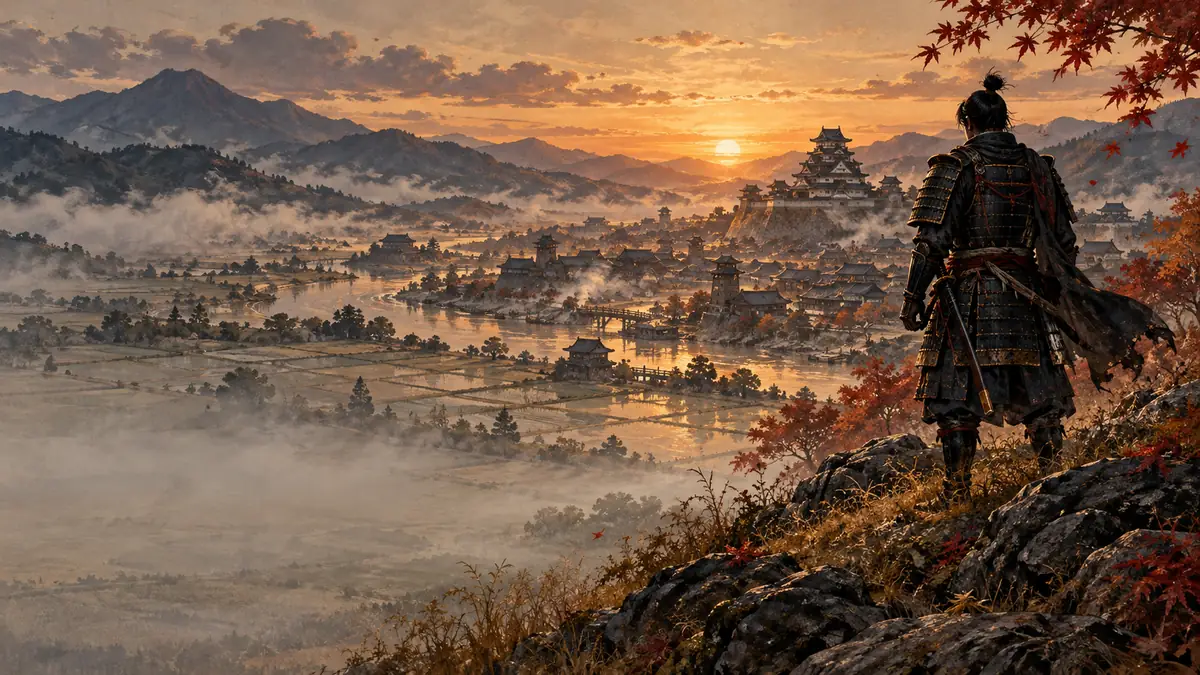
Gunshi Kanbee (2014 Taiga Drama) Review: Impressions and Historical Accuracy
A verdict after all 50 episodes, the highlights, and how the drama compares with the historical record.
Gunshi Kanbee (軍師官兵衛) is NHK’s 2014 taiga drama, the name for the broadcaster’s yearlong historical series. Gunshi means military strategist, and the title character is Kuroda Kanbee, the adviser who helped Toyotomi Hideyoshi win Japan. Across 50 episodes it follows him from his youth as a minor retainer in Harima, now part of Hyōgo Prefecture, to the campaigns that decided the country’s future. I watched every episode on NHK On Demand, and this review covers my verdict, the highlights, and how the drama compares with the historical record. Spoilers are flagged before they appear.
Verdict: Five Stars If You Love the Sengoku Period
| Rating | ★★★★★ for viewers who love the Sengoku period, Japan’s era of warring states, and its three unifiers: Oda Nobunaga, Toyotomi Hideyoshi, and Tokugawa Ieyasu |
|---|---|
| Best for | Anyone who wants the Sengoku period from a strategist’s seat rather than a warlord’s |
| Highlights | Junichi Okada’s two versions of Kanbee, Naoto Takenaka’s Hideyoshi, and the Arioka Castle arc |
| How I watched | All 50 episodes on NHK On Demand |
Kuroda Kanbee dealt with all three unifiers. A lord who betrayed him, nearly a year in a dungeon, the water siege of Takamatsu Castle, the Kyushu campaign, Sekigahara: he lived through most of the second half of the Sengoku period. Watch this one series and the events and people in other Sengoku stories start to line up.
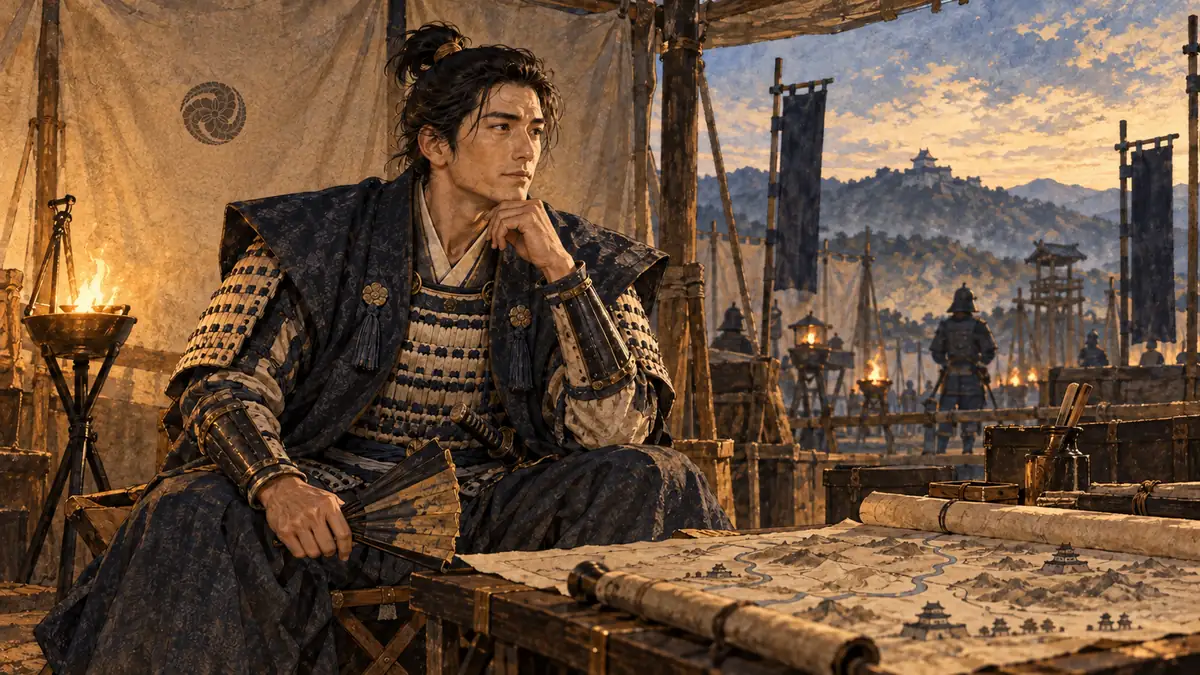
What Is Gunshi Kanbee?
Where most taiga dramas center on Nobunaga, Hideyoshi, or Ieyasu, this one tells the period from the side of the man who advised them. Junichi Okada plays Kanbee from his twenties to his last years.
| Title | Gunshi Kanbee (軍師官兵衛) |
|---|---|
| Broadcaster | NHK, 53rd taiga drama |
| Aired | January 5 to December 21, 2014 |
| Episodes | 50 |
| Lead | Junichi Okada (Kuroda Kanbee) |
| Writer | Yoichi Maekawa (前川洋一) |
| Music | Yugo Kanno (菅野祐悟) |
| Narration | Shiho Fujimura, replaced after episode 6 by Shuko Hirose |
| Average rating | 15.8% (Kanto region; the average across all 50 episodes, per the Japanese Wikipedia article) |
The change of narrator came after Shiho Fujimura was injured. The voice changes partway through the run, which is noticeable if you watch the series straight through.
Main Characters and Cast
The main characters and cast are below. Some roles, Nagamasa among them, were played by other actors as children; the table lists the adult roles.
| Kuroda Kanbee | Junichi Okada. The lead. A retainer of the Kodera clan in Harima who becomes Hideyoshi’s strategist. |
|---|---|
| Teru (光) | Miki Nakatani. Kanbee’s wife. She understands his thinking and pushes back when she disagrees. |
| Kuroda Mototaka | Kyohei Shibata. Kanbee’s father. |
| Kuroda Nagamasa | Tori Matsuzaka. Kanbee’s eldest son, sent to Hideyoshi as a hostage as a boy. |
| Ito (糸) | Mitsuki Takahata. Nagamasa’s wife. |
| Oda Nobunaga | Yosuke Eguchi. The warlord Kanbee chooses to serve. |
| Hashiba Hideyoshi | Naoto Takenaka. The lord Kanbee serves, later known as Toyotomi Hideyoshi and ruler of Japan. |
| Takenaka Hanbee | Shosuke Tanihara. Hideyoshi’s other strategist, named alongside Kanbee. |
| Kodera Masamoto | Tsurutaro Kataoka. Kanbee’s lord, who later turns on him. |
| Araki Murashige | Tetsushi Tanaka. A lord of Settsu who rebels against Nobunaga and imprisons Kanbee at Arioka Castle. |
| Dashi | Mirei Kiritani. Araki Murashige’s wife. |
| Kuriyama Zensuke | Gaku Hamada. A Kuroda retainer. |
| Mori Tahee | Mokomichi Hayami. A Kuroda retainer. |
| Inoue Kuroemon | Issei Takahashi. A Kuroda retainer. |
| Ishida Mitsunari | Kei Tanaka. One of Hideyoshi’s senior officials, later at odds with Kanbee and Nagamasa. |
| Tokugawa Ieyasu | Akira Terao. The daimyo, or feudal lord, who gains power after Hideyoshi’s death. |
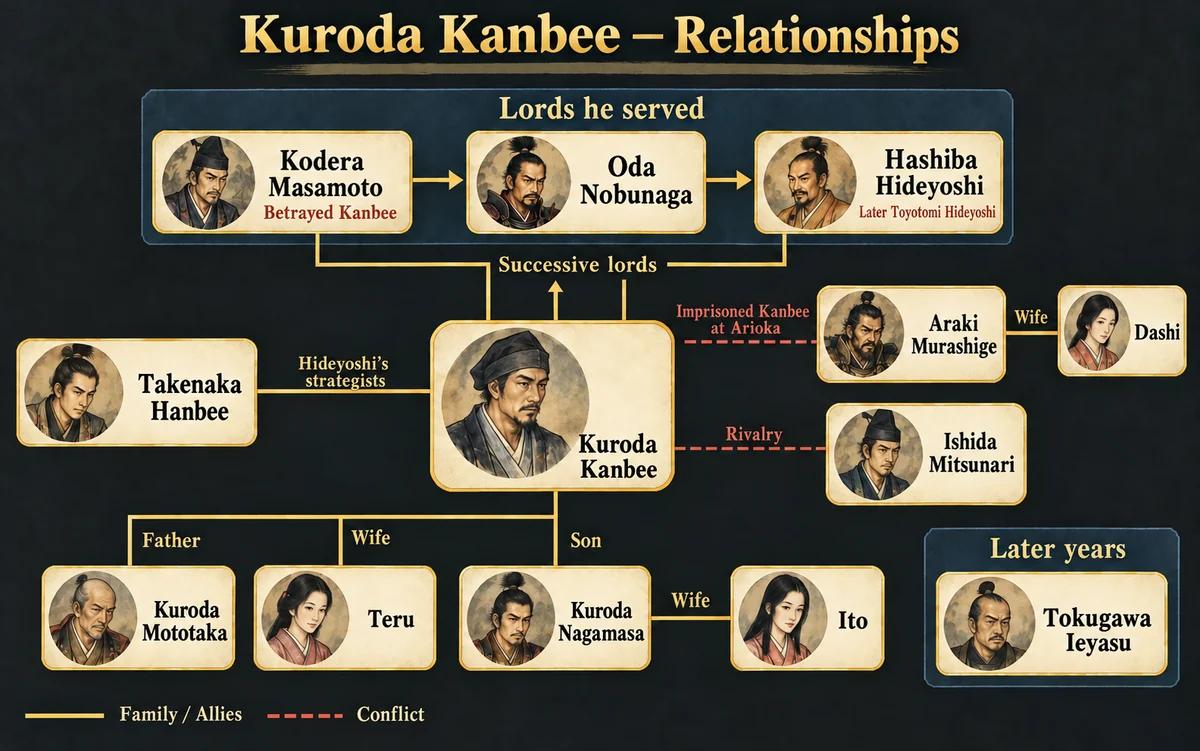
Three relationships carry the story. The first is Kanbee and the lords he serves: Kodera Masamoto, then Nobunaga, then Hideyoshi, with a betrayal along the way. The second is his standing beside Takenaka Hanbee, the other strategist in Hideyoshi’s camp. The third is the Kuroda household itself, his wife Teru and his son Nagamasa, which the politics of hostages and marriages keep pulling into the plot.
For the three unifiers, see the profiles of Nobunaga, Hideyoshi, and Ieyasu.
Plot by Era (No Spoilers)
The story opens with the young Kanbee serving the Kodera clan in Harima. Here is how it unfolds, era by era, without giving away the ending.
A retainer in Harima (to 1578)
Kanbee was born in Harima in 1546. His family served the Kodera clan and held no high rank, yet he tried to steer those around him with argument and good sense, and his ability drew resentment instead of thanks. He eventually chose to side with Oda Nobunaga, and through that choice he met Hashiba Hideyoshi. His eldest son, Nagamasa, was handed over to Hideyoshi as a hostage.
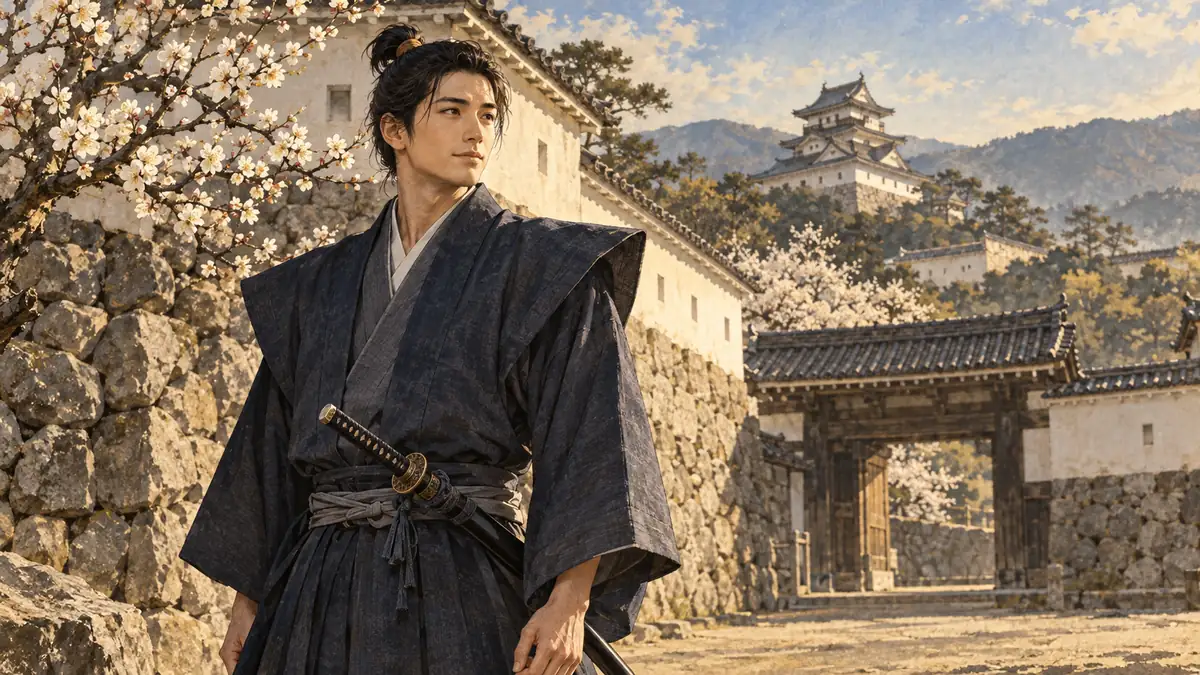
The Arioka Castle dungeon (1578–1579)
In 1578 Araki Murashige, a lord of Settsu, rebelled against Nobunaga. Kanbee went to Arioka Castle to talk him out of it and was imprisoned there instead. According to the account of the Battle of Arioka Castle, he entered the castle alone in November 1578, and the castle fell on November 19, 1579. He was held for close to a year.
Hideyoshi’s rise and Kyushu (1580–1598)
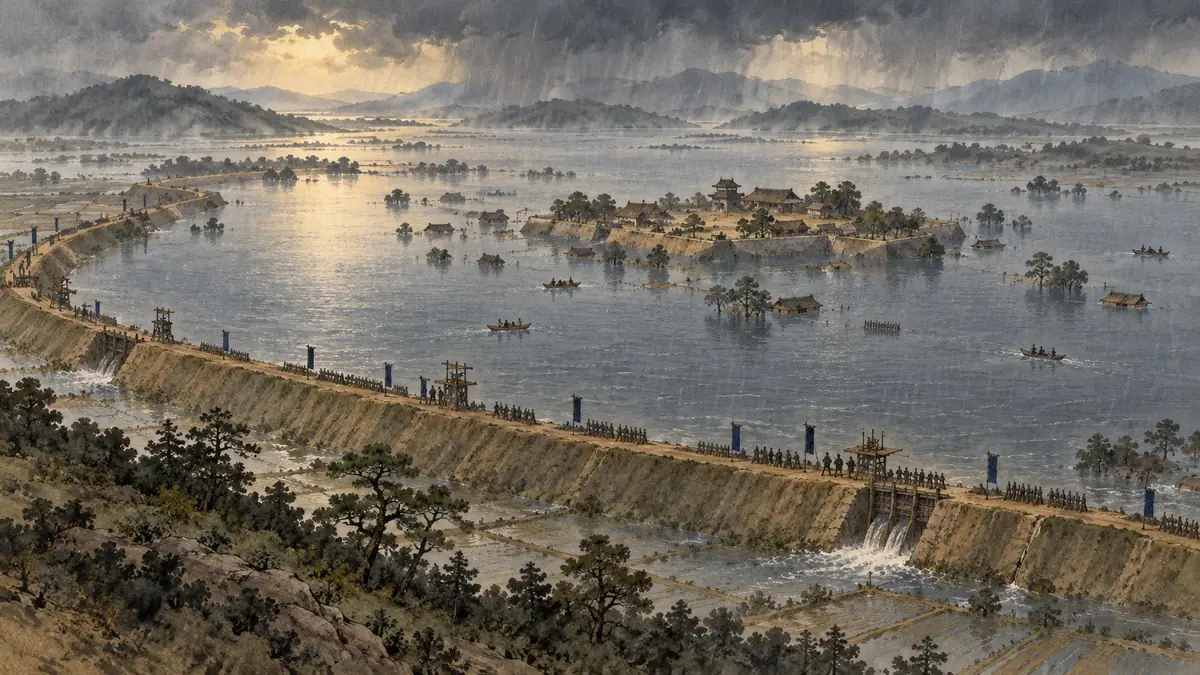
Released, Kanbee served as Hideyoshi’s strategist in the campaigns through western Japan. At Takamatsu Castle in Bitchu in 1582, Okayama City says a dyke was built on Kanbee’s advice to dam the Ashimori River, and the castle’s lord, Shimizu Muneharu, took his own life to spare the garrison. It was during this siege that Nobunaga was killed by his general Akechi Mitsuhide in the Honnō-ji Incident in Kyoto. Hideyoshi made peace with the Mori, raced his army back east, and defeated Mitsuhide.
After the Kyushu campaign of 1587, Kanbee was given six districts of Buzen, in northern Kyushu, and settled at Nakatsu, with a holding of about 120,000 koku. A koku was a unit of rice, roughly a year’s supply for one person, and it was how a lord’s rank was measured. That same year in Higo, the neighboring province, local lords rose against Hideyoshi’s land survey, and Sassa Narimasa, who had been given the province, was held to blame. Hideyoshi’s invasions of Korea followed, and Kanbee’s rift with Ishida Mitsunari deepened.
What I Thought: The Highlights
Junichi Okada’s two versions of Kanbee
The spine of this series is how Kanbee changes. Early on he is soft-spoken and easy in his manner, but there is a stubbornness about his ideals behind the smile, and you can see the conviction in him long before anyone calls him a strategist.
The man who comes out of Arioka Castle is someone else. The face is thinner, the eyes are hard, and the voice and the walk have changed with them. It is difficult to believe the same actor is playing both, and that was the single best thing in the series for me.
Naoto Takenaka’s Hideyoshi, eighteen years on
The story picks up speed when Kanbee meets Hashiba Hideyoshi, played by Naoto Takenaka, who had taken the lead role as Hideyoshi in the 1996 taiga drama Hideyoshi. Seeing him turn up in the same part eighteen years later felt like a thread of history being tied back together.
The disarming smile, the ambition with no floor to it, the humanity you cannot dislike. Kanbee sees all of it and still chooses to walk with him.
A quiet bond with Takenaka Hanbee
The other man who changes how Kanbee sees things is Takenaka Hanbee: cool, calculating, and cold enough on the surface that only Kanbee seems to notice the kindness underneath. In the scene where they first face each other, the silence carries more than the dialogue does.
Hanbee also protects Nagamasa, the son handed to Hideyoshi as a hostage. That is part of why Kanbee goes on believing in people.
Kindness in the dark: Dashi and Araki Murashige
The Arioka arc is the heaviest stretch of the 50 episodes. Kanbee spends close to a year in a damp earthen cell in torn clothes, and the person who looks out for him there is Murashige’s wife, Dashi, who brings him food in secret. Her care for a man her husband had written off is the human warmth the war has not burned out.
Murashige himself stays with you too. Having lost his family and survived, he treats staying alive as his own defiance of Nobunaga and calls himself a monster the Sengoku period made. Set beside Yodo-dono, who became Hideyoshi’s concubine after he destroyed her parents, the weight of choosing to survive comes through.
Family and retainers
Teru is not a wife kept in the background. She follows her husband’s reasoning and tells him calmly when she thinks he is wrong, which makes her something close to a second strategist. Around the growing Nagamasa stand the retainers Kuriyama Zensuke, Mori Tahee, and Inoue Kuroemon, and their loyalty gives the series warmth in the middle of a hard period.
Who it suits
The lead is not one of the three unifiers but the man who advised them, so the series puts its weight on negotiation and judgment rather than spectacle on the battlefield. It runs 50 episodes, and the Arioka arc is bleak for a long stretch, so it is not the series to pick for something light. For anyone who wants the Sengoku period from the strategist’s seat, or Hideyoshi’s rise from a different angle, it is worth the time.
The Ending (Spoilers): Sekigahara and Kanbee’s Last Years
This section and the next reveal how the story ends and what became of Kanbee. If you have not seen the drama, skip ahead to Places to Visit.
When the Battle of Sekigahara was fought in 1600, Kanbee, by then known as Josui, was in Kyushu. According to standard Japanese reference works, he sided with Tokugawa Ieyasu, defeated Otomo Yoshimune in Bungo, attacked Mori Katsunobu in Buzen, and advanced toward Shimazu territory. His son Nagamasa fought in the main battle on Ieyasu’s side. After the war the Kuroda were given Chikuzen, in northern Kyushu.
The last episode of the main run is episode 50, “Ransei Koko ni Owaru” (乱世ここに終わる), roughly “here the age of war ends”; episodes 51 and 52 are digest editions. Kanbee died on the twentieth day of the third month of Keichō 9, in 1604, at Fushimi in Kyoto.
History vs. Drama: What the Sources Confirm
Dialogue and feelings in a drama come from the script. For each point below, how the drama shows it is kept separate from what the sources confirm.
Was Kanbee aiming for the country himself?
| The popular reading | That behind Sekigahara, Kanbee meant to take Kyushu and then the country. |
|---|---|
| What the sources confirm | That he fought in Kyushu on Ieyasu’s side, beat Otomo Yoshimune, and moved toward Shimazu territory, and that Nagamasa fought in the main battle for Ieyasu. |
| What cannot be said | His motive. The reference works I checked record only that he fought as Ieyasu’s ally; none of them say he was aiming to take the country. |
Was the water siege of Takamatsu Castle Kanbee’s idea?
| What the sources confirm | Okayama City states that at Takamatsu Castle in 1582 the dyke damming the Ashimori River was built on Kuroda Kanbee’s advice, and that the castle’s lord, Shimizu Muneharu, took his own life. |
|---|---|
| A note | The siege itself is recorded in several sources. Crediting the plan to Kanbee follows the city’s own account. |
Did Dashi help Kanbee in the dungeon?
| In the drama | Dashi, Araki Murashige’s wife, secretly brings food to the imprisoned Kanbee. |
|---|---|
| What the sources confirm | The account of the Battle of Arioka Castle records that after the castle fell in November 1579, 36 members of the Araki family and its senior retainers, Murashige’s wife among them, were paraded through Kyoto and executed at the Rokujō riverbank. |
| What cannot be said | Whether Dashi brought Kanbee food. The sources I checked do not mention it, so the dungeon scenes are best read as the writers’ portrayal. |
Dramatic license
Conversations, and the scenes that show what a character is feeling, are mostly beyond the record and are the writers’ invention. The lack of a record does not prove a scene never happened, and an invented scene can still work as drama.
Places to Visit After Watching
These are places tied to Kanbee’s history, not filming locations. Some are not Sengoku-era sites.
| Himeji Castle (Hyōgo Prefecture) | The castle site at the center of Kanbee’s early career. The main keep you see today was built by Ikeda Terumasa after Sekigahara, so it is not the castle Kanbee knew. → Himeji Castle overview, complete guide contents, 7 best spots |
|---|---|
| Arioka Castle ruins (Itami, Hyōgo Prefecture) | Where Kanbee was held for close to a year. Stone walls remain in front of JR Itami Station. → Arioka Castle Ruins: a half-day walk in Itami |
| Nakatsu Castle (Oita Prefecture) | Kanbee’s seat after he was given six districts of Buzen following the Kyushu campaign. The present keep is a later building. |
| Bitchu Takamatsu Castle ruins (Okayama Prefecture) | The site of the 1582 water siege, kept as the place where Shimizu Muneharu took his own life. |
Where to Watch Gunshi Kanbee
I watched all 50 episodes on NHK On Demand, which is in Japanese. Availability, covered episodes, and pricing change over time, and the main run and the digest editions may be handled differently. I could not confirm an official English-subtitled release or whether the service can be used outside Japan, so check the NHK On Demand page for the current status.
Frequently Asked Questions
If you love the Sengoku period and its three unifiers, I give it five stars. The lead is a strategist, so the weight falls on negotiation and judgment rather than battlefield spectacle. It runs 50 episodes, and the Arioka Castle arc is bleak for a long stretch.
Anyone who wants the Sengoku period from a strategist’s seat rather than a warlord’s. Kanbee dealt with Nobunaga, Hideyoshi, and Ieyasu, so following him helps when you watch other dramas about the period.
It aired from January 5 to December 21, 2014, as NHK’s 53rd taiga drama. There are 50 episodes, with Junichi Okada as Kuroda Kanbee. The last episode of the main run is episode 50, “Ransei Koko ni Owaru”; episodes 51 and 52 are digest editions.
A samurai born in Harima in 1546, formally named Kuroda Yoshitaka and known in his last years as Josui. He rose from service to the Kodera clan to side with Oda Nobunaga, then advised Hashiba Hideyoshi through the water siege of Takamatsu Castle and the Kyushu campaign. He died in 1604 at Fushimi in Kyoto.
The conversations and the inner lives come from the script. The imprisonment at Arioka Castle and the water siege of Takamatsu Castle are historical, but the reading that Kanbee was aiming to take the country at Sekigahara is not supported by the sources I checked, and nor is the idea that Murashige’s wife Dashi helped him in the dungeon.
I watched it on NHK On Demand. I could not confirm an official English-subtitled release or whether the service works outside Japan, so check the official NHK On Demand page for the current status.
Sources
- Gunshi Kanbee: broadcast data, cast and average rating (Japanese Wikipedia)
- WEB The Television: Gunshi Kanbee episode titles and cast (Japanese)
- Kotobank: Kuroda Yoshitaka, from Nipponica and Britannica International (Japanese)
- The Battle of Arioka Castle: the imprisonment and the fall of the castle (Japanese)
- Okayama City: the water siege of Bitchu Takamatsu Castle (Japanese)
- Kotobank: Sassa Narimasa and the Higo uprising (Japanese)
- Naoto Takenaka: lead role in the 1996 taiga drama Hideyoshi (Japanese)
Related Pages
☕ Support This Site
Following the Shogun is built on original fieldwork and on-site research.
If you found this guide useful, your support helps keep it going.

You can also support via QR code


comment