



Beyond Kaminarimon: The Edo-Period Buildings Most Visitors Miss at Sensō-ji
Most of Sensō-ji's famous landmarks — Kaminarimon, the Main Hall, the Five-Storied Pagoda — are 20th-century reconstructions. Only two structures here genuinely survive from the Edo period: Nitenmon Gate and the shrine buildings of Asakusa Shrine, both built in 1649 and now Important Cultural Properties of Japan.
Most of Sensō-ji's famous landmarks — Kaminarimon, the Main Hall, the Five-Storied Pagoda — are 20th-century reconstructions. To experience the real sensoji edo period heritage, only two structures here genuinely survive: Nitenmon Gate and the shrine buildings of Asakusa Shrine, both built in 1649 and now Important Cultural Properties of Japan. Traces of the vanished Asakusa Tōshōgū also remain in a single stone bridge. This guide organizes all 11 Tokugawa-related sites in the precincts by surviving structure, reconstruction, and remnant, while covering access, suggested visit times, and goshuin.
Sensō-ji is one of the few places in central Tokyo where genuine Edo-period architecture from the age of the Tokugawa shoguns can still be seen in person. Nitenmon Gate and the shrine buildings of Asakusa Shrine — both built in 1649 under the third shogun Iemitsu — survived the 1923 earthquake and the 1945 air raids, and are designated Important Cultural Properties of Japan. The precinct is free to enter and is about 20–30 minutes from Tokyo Station.
Visitors interested in samurai history, Edo-period architecture, Tokugawa patronage, or Japanese shrine and temple culture. Also accessible and rewarding for first-time visitors to Tokyo — the visual impact of Kaminarimon, Nakamise, and the Main Hall is immediate even without the historical background.
Kaminarimon, Hōzōmon, the Main Hall, and the Five-Storied Pagoda are all postwar reconstructions. To see the surviving Edo-period structures, walk to Nitenmon and Asakusa Shrine beyond the Main Hall — these are covered in this guide.
- What Remains Today: Surviving Structures, Reconstructions, and Remnants
- Access and Basic Information
- Sensō-ji and the Tokugawa Shoguns: Why It Became a Shogunate Prayer Temple
- Walk the 11 Sites Connected with the Tokugawa Shoguns
- Kaminarimon (Fūraijinmon Gate)
- Nakamise-dori — A Temple-Town Street Linked to the Tokugawa Shoguns
- Hōzōmon Gate
- Sensō-ji Main Hall (Kannondō)
- Asakusa Tōshōgū Nitenmon — An Important Early-Edo Structure Preserving the Tokugawa Connection
- Asakusa Shrine — Shrine Buildings Donated by Iemitsu, with the Tokugawa Hollyhock Crest Still Visible
- Rokkakudō
- Five-Storied Pagoda
- Site of Asakusa Tōshōgū — A Place Linked to Ieyasu Where Only the Stone Bridge Remains
- Denbōin: Usually Closed to the Public
- Matsuchiyama Shōden (Honryūin)
- Frequently Asked Questions
- Explore Further: Tokugawa History in Tokyo and Beyond
What Remains Today: Surviving Structures, Reconstructions, and Remnants
Sensō-ji's best-known landmarks — Kaminarimon, Hōzōmon, the Main Hall, and the Five-Storied Pagoda — are postwar reconstructions. By contrast, Nitenmon Gate and the shrine buildings of Asakusa Shrine are especially important surviving early-Edo structures where the Tokugawa connection is still vivid. You can also find sites such as Rokkakudō and Denbōin, where pre-Edo to Edo-period architecture and garden heritage remain.
| Site | Category | Current structure | Cultural property status |
|---|---|---|---|
| Nitenmon Gate | Surviving | Built in 1649 | Important Cultural Property of Japan |
| Asakusa Shrine | Surviving | Built in 1649 | Important Cultural Property of Japan |
| Rokkakudō | Surviving | Estimated late Muromachi to early Edo period | Tokyo-designated Tangible Cultural Property |
| Denbōin | Surviving | Reception hall: late Edo period / garden: traditionally early Edo period | Important Cultural Property of Japan / National Place of Scenic Beauty, garden |
| Site of Asakusa Tōshōgū (Stone Bridge) | Remnant | Only the stone bridge survives, built in 1618 | — |
| Kaminarimon (Fūraijinmon Gate) | Reconstructed | Rebuilt in 1960, reinforced concrete | — |
| Nakamise-dori Street | Reconstructed | Modernized from 1885 onward | — |
| Hōzōmon Gate | Reconstructed | Rebuilt in 1964, reinforced concrete | — |
| Main Hall (Kannondō) | Reconstructed | Rebuilt in 1958, reinforced concrete | — |
| Five-Storied Pagoda | Reconstructed | Rebuilt in 1973, reinforced concrete | — |
| Matsuchiyama Shōden | Reconstructed | Rebuilt after the early modern period | — |
Access and Basic Information
The nearest stations are Asakusa Station (G19/A18/TS01) on the Tokyo Metro Ginza Line, Toei Asakusa Line, and Tobu Skytree Line. Official guidance places Sensō-ji about a five-minute walk from Tokyo Metro Ginza Line Asakusa Station (G19). In practice, Kaminarimon is usually about one to two minutes on foot from Ginza Line Exit 1. From Haneda Airport, the direct Keikyu Line route takes about 40–50 minutes and costs ¥635. From Tokyo Station (JY01/JK26), take JR to Kanda Station (JY02/JK27/G13) and transfer to the Tokyo Metro Ginza Line; the trip takes about 20–30 minutes. Fares are roughly ¥333 using an IC card or around ¥340 by paper ticket, though fares may change.
Quick Access Guide to Sensō-ji
| Nearest station | Asakusa Station (G19/A18/TS01) on the Tokyo Metro Ginza Line, Toei Asakusa Line, and Tobu Skytree Line |
|---|---|
| To Kaminarimon | About one minute on foot from Ginza Line Exit 1 / If unsure, follow station signs for "Kaminarimon / Sensō-ji" |
| Temple visit | Free admission / Main Hall hours: 6:00–17:00, opening at 6:30 from October to March / Goshuin: Yōgōdō, west of the Main Hall, 8:00–16:30 |
| Suggested time | Main precincts only: about 60 minutes / Including goshuin, Asakusa Shrine, and nearby sites: about 90–120 minutes |
| Busiest hours | Nakamise is busiest between 10:00 a.m. and 3:00 p.m. on weekends. Arrive before 9:00 a.m. for a quieter walk. |
From Haneda Airport (HND):
Keikyu Airport Line, through service to the Toei Asakusa Line → Asakusa Station (A18) → walk toward Kaminarimon and Sensō-ji
Estimated travel time: about 40–50 minutes / Fare: ¥635
From Tokyo Station (JY01/JK26):
JR Yamanote Line or Keihin-Tōhoku Line → transfer at Kanda Station (JY02/JK27/G13) → Tokyo Metro Ginza Line → Asakusa Station (G19) → walk toward Kaminarimon and Sensō-ji
Estimated travel time: about 20–30 minutes / Fare: about ¥333 by IC card / around ¥340 by paper ticket
Shortest and easiest route from the station
Shortest: Tokyo Metro Ginza Line Asakusa Station (G19) Exit 1 → Kaminarimon, about one minute
Easier when crowded: avoid Nakamise at peak times, enter from the Kaminarimon-dori side, and join the flow toward Hōzōmon.
Where visitors get confused: "Asakusa Station (G19/A18/TS01)" is served by multiple lines with separate gates and exits, so prioritize signs for "Kaminarimon / Sensō-ji."
Rainy days: the stone pavement can be slippery and puddles may form. Comfortable walking shoes are recommended.
Sensō-ji and the Tokugawa Shoguns: Why It Became a Shogunate Prayer Temple
When Tokugawa Ieyasu entered Edo in 1590, Sensō-ji was already flourishing as a center of popular devotion. Ieyasu designated the temple as a prayer temple for the shogunate and granted it temple lands. Sensō-ji's connection to Ieyasu predates the more famous Tōshōgū shrines at Nikkō and Ueno, making it one of the earliest places in Tokyo where his patronage is visible. During the era of the third shogun, Iemitsu, the Main Hall, Hōzōmon, Five-Storied Pagoda, Nitenmon, and Asakusa Shrine were developed in a sweeping program that formed the basic shape of the present precincts. In 1618, Asakusa Tōshōgū, dedicated to Ieyasu, was founded within the grounds, but it later burned down. Today, only the stone bridge and the former Zuishinmon Gate, now Nitenmon, remain as traces of it.
The Tokugawa Shoguns and Sensō-ji: A Brief Timeline
The age of Ieyasu, from 1590 onward: Sensō-ji was designated as a prayer temple for the shogunate and received temple lands, helping lay the foundation for Asakusa's growth.
The age of Hidetada and Iemitsu: Asakusa Tōshōgū was founded within the precincts, later burning down and disappearing. Iemitsu developed the Main Hall, Hōzōmon, Five-Storied Pagoda, Asakusa Shrine buildings, and Nitenmon, establishing the prototype of the present temple layout.
The age from Tsunayoshi to Yoshimune: Even as Sensō-ji came under Kan'ei-ji's authority, it grew even livelier as a center of popular culture and entertainment.
Late Edo to the end of the shogunate: Rather than serving as a Tokugawa family temple, it developed as a center of popular devotion and culture.
The age of Ieyasu — The beginning of Edo patronage
After Tokugawa Ieyasu entered Edo in 1590, Sensō-ji came under the protection of the shogunate. Ieyasu's own family temple and prayer temple was Zōjō-ji of the Jōdo school, but Sensō-ji, already renowned as a sacred Kannon site, was also valued as a center of faith in Edo and received temple lands. This helped Asakusa develop into an important pilgrimage destination for the townspeople of Edo.
The age of Hidetada and Iemitsu — The founding and flourishing of Asakusa Tōshōgū
After Ieyasu's death, Tōshōgū shrines with Nikkō Tōshōgū as their head shrine were established across Japan during the eras of the second shogun Hidetada and the third shogun Iemitsu. One of them, Asakusa Tōshōgū, was founded within the Sensō-ji precincts. Because the Tōshōgū shrines at Shiba Zōjō-ji and Ueno Kan'ei-ji belonged to Tokugawa family temples, they were not easy for ordinary people to visit. By contrast, placing a Tōshōgū within Sensō-ji, a temple beloved by commoners, effectively positioned a place to remember Ieyasu within the everyday route of worship. Asakusa Tōshōgū later burned down and was never rebuilt. No buildings survive today, but a stone bridge remains in the precincts, quietly telling the story of Sensō-ji's history.
The founding of Kan'ei-ji and the division of roles
During the era of the third shogun Iemitsu, Kan'ei-ji was founded in Ueno at the recommendation of the monk Tenkai. It became a temple protecting the northeastern "demon gate" of Edo Castle and, alongside Zōjō-ji, one of the Tokugawa family temples. Sensō-ji differed from these shogunate-controlled family temples: it continued as an independent temple and flourished as a center of popular devotion. Iemitsu himself also advanced the development of Sensō-ji's temple complex, including the reconstruction of the Main Hall and Five-Storied Pagoda.
The age of Tsunayoshi — The Edict on Compassion for Living Things and Sensō-ji
When discussing the era of the fifth shogun Tokugawa Tsunayoshi, Sensō-ji is sometimes mentioned in connection with the Edict on Compassion for Living Things. Sensō-ji's official account explains that in 1685, the temple's bettō, or administrator, incurred Tsunayoshi's displeasure and left the temple. Afterward, Sensō-ji was placed under the authority of Kan'ei-ji and came to be managed through a system of acting bettō administrators.
The age of Yoshimune — Toward the entertainment heart of Edo
Although the frugality policies of the Kyōhō Reforms were implemented under the eighth shogun Yoshimune, there is no firm evidence that Nakamise was drastically reduced at that time. Rather, from around this period, theaters and sideshow venues gathered near the temple gate, and Asakusa became even more vibrant as a center of popular culture and entertainment.
Late Edo to the end of the shogunate — A temple sustained by the people
By the late Edo period, Sensō-ji had grown not as a prayer temple or family temple of the shoguns, but as a center of ordinary people's faith and culture. Shinmon Tatsugorō, the famous head of a fire brigade, also had ties to Asakusa and is known for his work in maintaining local order. Kabuki and popular entertainments gathered here as well, making Asakusa famous nationwide as one of Edo's greatest temple towns.
Walk the 11 Sites Connected with the Tokugawa Shoguns
Recommended route: Kaminarimon → Nakamise → Hōzōmon → Main Hall → Nitenmon → Yōgōdō area and the stone bridge → Asakusa Shrine. See the quick guide above for each site's category: surviving structure, reconstruction, or remnant.
Kaminarimon (Fūraijinmon Gate)
Sensō-ji's main gate. After a 95-year absence, this grand vermilion gate was revived in 1960 through a donation from Matsushita Kōnosuke.
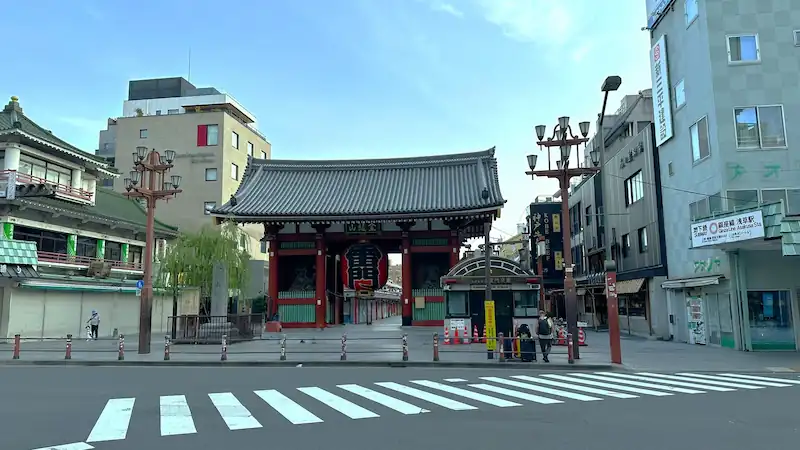
Sensō-ji's main gate, Kaminarimon — formally Fūraijinmon — is said to have been founded by Taira no Kinmasa in 942. It later became closely tied to the Edo shogunate, including a reconstruction by Tokugawa Iemitsu in 1649, but it burned down in 1865. For 95 years it remained unrebuilt, until Matsushita Kōnosuke's donation restored it to its present form in 1960. Highlights include the enormous red lantern at the center, 3.9 meters high and weighing about 700 kilograms, the statues of Fūjin and Raijin on either side, and the Tenryū and Kinryū dragon sculptures on the rear.
| Date built | 942, according to tradition |
|---|---|
| Builder | Taira no Kinmasa; traditionally said to have built it upon becoming governor of Musashi |
| Structure and features | A gabled eight-legged gate, formally called Fūraijinmon. It features a giant red lantern at the center, Fūjin and Raijin statues on either side, and Tenryū and Kinryū dragon sculptures on the rear. |
| Repair and reconstruction history | Built in 1635 → burned in 1642 → rebuilt in 1649 → burned in 1767 → rebuilt in 1795 → burned in 1865 → rebuilt in 1960 through a donation from Matsushita Kōnosuke |
| Current status | Existing structure, rebuilt in 1960 in reinforced concrete |
| Loss and damage | Destroyed by fire multiple times |
| Cultural-property designation | Recognized as an element of the historic landscape of the Sensō-ji precincts |
| Notes | The great lantern, about 3.9 meters high, 3.3 meters wide, and roughly 700 kilograms, is the gate's defining symbol. A dragon is carved into its base, and the nighttime illumination is especially majestic. |
- Giant red lantern: A commanding presence. The nighttime illumination is also worth seeing.
- Fūjin and Raijin statues: Placed on either side, they are guardian figures protecting Sensō-ji from floods and fires.
- Rear dragon carvings: Tenryū and Kinryū: An easy-to-miss detail after passing through the gate, offering another layer of protection.
- Nakamise-dori Street: The stalls along the approach are said to have developed in connection with services such as cleaning the temple precincts, beginning around the Genroku to Kyōhō eras.
- Kaminarimon as an Edo landmark: Depicted by many ukiyo-e artists, it became a beloved symbol of Edo culture.
- The 95-year absence: After the 1865 fire, the gate remained unrebuilt until the present Kaminarimon finally returned 95 years later in 1960, thanks to Matsushita Kōnosuke's donation.
Address
2-3-1 Asakusa, Taito City, Tokyo, Sensō-ji Kaminarimon
Access
About one minute on foot from Tokyo Metro Ginza Line Asakusa Station (G19) Exit 1
Suggested visit time
Quick visit: about 5 minutes / unhurried visit: about 10 minutes
Admission
Free, temple precincts
Open the map to check the route from the station.
Panoramic photo: Kaminarimon

Nakamise-dori — A Temple-Town Street Linked to the Tokugawa Shoguns
A historic temple-front shopping street with Edo-period roots, where around 89 shops line a roughly 250-meter approach. Its bustle still carries the spirit of the Genroku to Kyōhō eras.
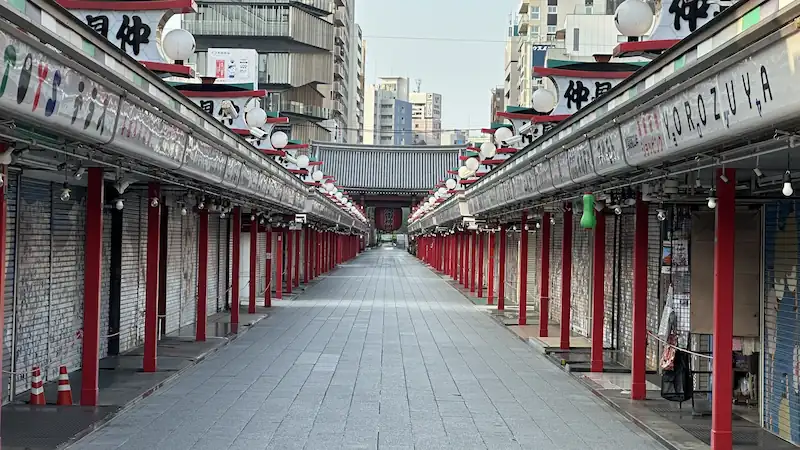
Nakamise-dori, the approach to Sensō-ji, grew out of the surge in worshippers after Tokugawa Ieyasu designated the temple as a shogunate prayer temple. Local residents who performed duties such as cleaning the precincts were allowed to run stalls along the approach, and its origins are generally traced to the Genroku to Kyōhō eras. In the Meiji period, the old shops were ordered to be removed, but brick-built modern shops were completed in the same year, creating the prototype of today's Nakamise-dori, officially opened on December 27, 1885. Walking toward Hōzōmon while tasting Edo-style treats such as ningyō-yaki, age-manjū, and kaminari-okoshi is at the heart of the Asakusa experience.
| Period of origin | Generally said to date from the Genroku to Kyōhō eras |
|---|---|
| Origin | Permission to set up stalls along the approach in exchange for duties such as cleaning the Sensō-ji precincts |
| Structure and features | Around 89 shops line both sides of the roughly 250-meter stone-paved approach, 54 on the east side and 35 on the west. |
| Modern development | December 1885: reorganized as new brick-built shops |
| War damage and recovery | Destroyed in the Great Kantō Earthquake and wartime damage, then rebuilt, including reconstruction around 1925 and again after the war |
| Current status | Still active and bustling as a major sightseeing destination |
| Notes | The word "Nakamise" is a general term for shops lining the approach to a temple or shrine. |
- The stone-paved approach and shopfronts: Enjoy the historic atmosphere while walking this traditional temple approach.
- Classic local snacks: Try ningyō-yaki, age-manjū, dango, kaminari-okoshi, and other tastes of old Edo.
- Traditional crafts: Edo kiriko glass, wind chimes, folding fans, and other souvenirs are widely available.
- The atmosphere after dark: The nighttime lighting and the "Asakusa Emaki" paintings on the shop shutters create a richly atmospheric scene.
- Tokugawa patronage: When Tokugawa Ieyasu designated Sensō-ji as a shogunate prayer temple, it helped lay the foundation for the temple town and Nakamise-dori.
- The origin of the word "Nakamise": It refers generally to shops along a temple or shrine approach, a format already familiar to worshippers in earlier periods.
- Nakamise Anniversary Day: December 27, 1885, when the modern shops were completed, is still known as Nakamise Anniversary Day.
Address
1-2-3 Asakusa, Taito City, Tokyo, Nakamise-dori approach to Sensō-ji
Access
Immediately after passing through Kaminarimon
Suggested visit time
Quick visit: about 20 minutes / unhurried visit: about 1–2 hours
Admission
Free; food and purchases at shops cost extra
Open the map to check the route from Kaminarimon to Hōzōmon.
Panoramic photo: Nakamise-dori

Hōzōmon Gate
The Niōmon Gate rebuilt under Iemitsu was destroyed in the Tokyo air raids. This vermilion two-story gate was rebuilt in 1964 through public donations.
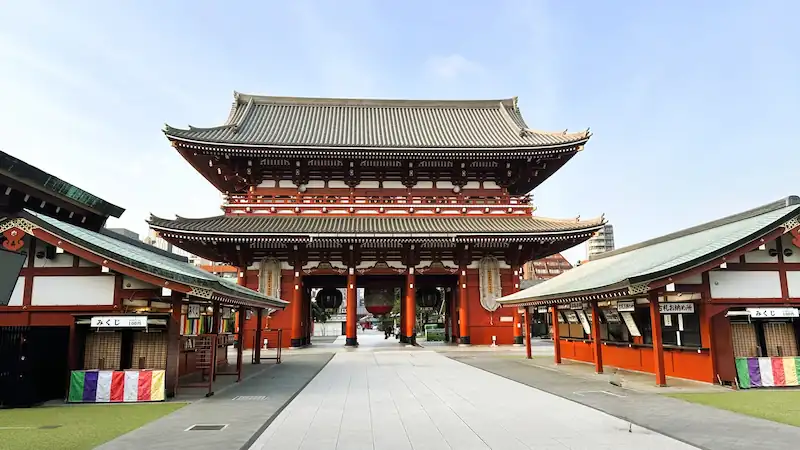
Hōzōmon is the two-story gate beyond Nakamise and was originally known as Niōmon. In the Edo period, it was completed in 1649 through the patronage of the third shogun, Tokugawa Iemitsu, but it was destroyed in the 1945 Tokyo air raids. The present reinforced-concrete gate was rebuilt in 1964 through donations from businessman Ōtani Yonetarō and his wife, and at that time it was renamed Hōzōmon. Highlights include the Niō, or Kongō Rikishi, statues on the lower level and the temple treasures housed above.
| Date built | 942, according to tradition |
|---|---|
| Builder | Taira no Kinmasa, according to tradition |
| Structure and features | A vermilion two-story gate, with Niō statues on the lower level and a sutra and temple-treasure repository above |
| Repair and reconstruction history | Rebuilt in 1649 by Tokugawa Iemitsu; the present gate was rebuilt in 1964 through donations from the Ōtani family |
| Current status | Existing structure, rebuilt in 1964 in reinforced concrete |
| Loss and damage | Destroyed in the 1945 Tokyo air raids |
| Cultural-property designation | Valued as part of the historic landscape of the Sensō-ji precincts |
| Notes | The name Hōzōmon was adopted at the time of the reconstruction, emphasizing its function as a storehouse for temple treasures. |
- Vermilion two-story gate: Its imposing structure conveys historic dignity and is highly photogenic.
- Niō statues: The paired Niō, or Kongō Rikishi, statues on the lower level are strikingly powerful.
- Temple-treasure storage: The upper level serves as a repository for scriptures and cultural properties.
- Symbol of recovery after the air raids: It is moving to see how a cultural landmark lost in war was rebuilt through the support of citizens and devotees.
- A changing name: Long known as Niōmon, it was renamed Hōzōmon when it was rebuilt in 1964.
Address
2-3 Asakusa, Taito City, Tokyo, Sensō-ji Hōzōmon
Access
Immediately after passing through Nakamise-dori
Suggested visit time
Quick visit: about 5 minutes / unhurried visit: about 15 minutes
Admission
Free
Open the map to check the route from Nakamise.
Panoramic photo: Hōzōmon and the Main Hall direction

Sensō-ji Main Hall (Kannondō)
Rebuilt in 1649 under the third shogun Iemitsu, lost in wartime bombing, and restored in 1958, this is the devotional heart of Sensō-ji.
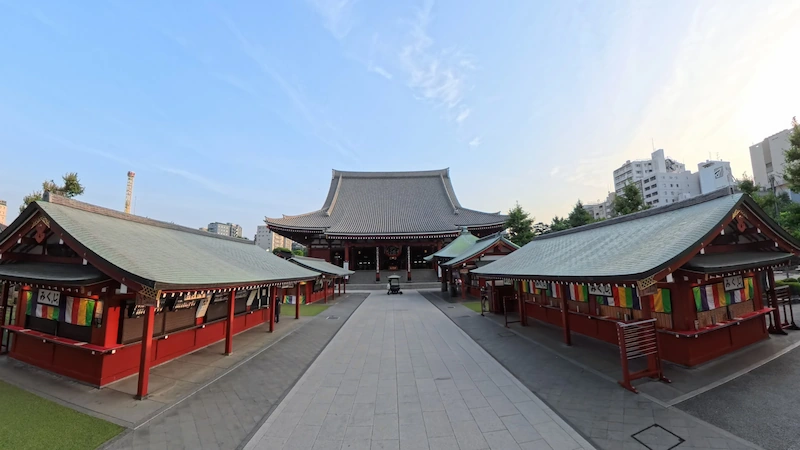
Sensō-ji's Main Hall follows the form of the earlier hall rebuilt in 1649 by Tokugawa Iemitsu, the third shogun of the Edo shogunate. That earlier hall served as the center of Kannon devotion for roughly 300 years and survived the 1923 Great Kantō Earthquake, but it was destroyed in the 1945 Tokyo air raids. The present Main Hall was rebuilt between 1951 and 1958 through donations from devotees across Japan. Its irimoya-style roof preserves the design of the earlier hall, and in 2010 it was reroofed with titanium tiles. Goshuin are available at Yōgōdō, west of the Main Hall, from 8:00 to 16:30.
| Foundation / reconstruction date | Rebuilt in 1649 by Tokugawa Iemitsu |
|---|---|
| Earlier history before reconstruction | Rebuilt in 1635 → destroyed by fire in 1642 |
| Structure and features | Irimoya-style roof with a steep, prominent roofline visible from a distance |
| War damage and reconstruction | Survived the 1923 earthquake but burned in the 1945 air raids. Rebuilt from 1951 to 1958. |
| Modern renovation | Roof renovated with titanium tiles in 2010 |
| Cultural-property designation | The former Main Hall burned in 1945. The present hall was rebuilt in 1958 and is not designated as a cultural property. |
| Tokugawa connection | A symbol of shogunate patronage and a central place of faith in Edo, rebuilt under Iemitsu |
- Majestic roof and eaves: The traditional irimoya-style great roof gives the hall a powerful presence.
- Inner sanctuary dedicated to Kannon: Devotion to the hidden principal image continues to this day.
- A symbol of Iemitsu's reconstruction: It is the historic core of worship and a reminder of Edo-shogunate patronage.
- Postwar reconstruction: Rebuilt through the donations of devotees after wartime destruction, it stands as a witness to recovery.
- The former Main Hall lost in wartime bombing: The former hall burned in the 1945 air raids; the current hall was rebuilt in 1958.
- Tokugawa votive tablets: Many votive tablets donated by Tokugawa Hidetada and Iemitsu survive, and those that escaped wartime destruction are preserved in the Five-Storied Pagoda compound.
- Symbol of postwar reconstruction: The rebuilding of the Main Hall was a symbolic project in the postwar recovery of Tokyo and Japan.
Address
2-3-1 Asakusa, Taito City, Tokyo
Access
One minute on foot from Hōzōmon
Goshuin
Yōgōdō, west of the Main Hall / 8:00–16:30
Suggested visit time
Quick visit: about 10 minutes / unhurried visit: about 30 minutes
Admission
Free
Open the map to check the route from Hōzōmon to the Main Hall.
Panoramic photo: Sensō-ji Main Hall

Asakusa Tōshōgū Nitenmon — An Important Early-Edo Structure Preserving the Tokugawa Connection
An Important Cultural Property said to have been built in 1649. This rare gate preserves traces of the vanished Asakusa Tōshōgū.
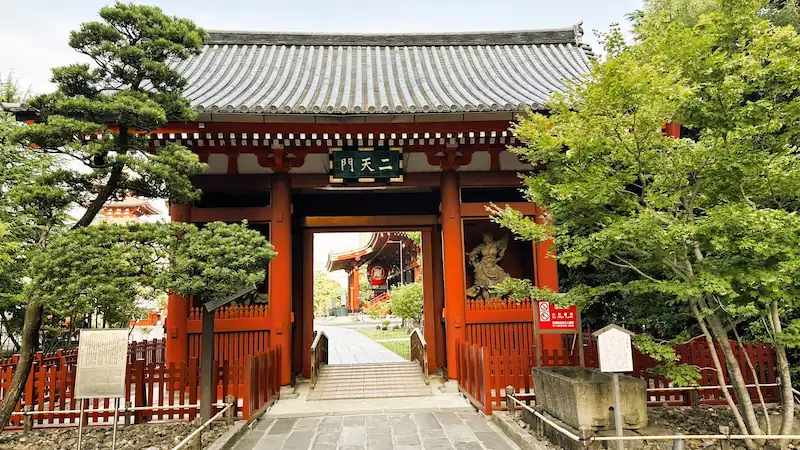
Nitenmon stands east of Sensō-ji's Main Hall and is designated an Important Cultural Property of Japan. The current gate is commonly described as having been built in 1649, though another account holds that it was built in 1618 as the Zuishinmon gate of Asakusa Tōshōgū, so its exact construction date is interpreted in more than one way. In either case, it is a rare early-Edo gate that carries the memory of Asakusa Tōshōgū into the present. After fires in the Kan'ei era, Asakusa Tōshōgū was not rebuilt within Sensō-ji and is described as having been transferred to Momijiyama inside Edo Castle. Nitenmon, derived from its Zuishinmon gate, survived wartime destruction and was restored in 2010. As a surviving early-Edo structure where the Tokugawa connection is easy to feel, it is one of the most important places in the precincts. The rarity of this gate becomes especially clear when you remember that Kaminarimon, the Main Hall, and the Five-Storied Pagoda are all postwar reconstructions.
| Date built | Commonly described as built in 1649, though some accounts date it to 1618; its exact construction date has multiple interpretations. |
|---|---|
| Structure and form | An east-facing, vermilion, gabled eight-legged gate that functions as Sensō-ji's eastern gate. |
| Origin | Traditionally derived from the Zuishinmon gate of Asakusa Tōshōgū, a Tōshōgū shrine dedicated to Tokugawa Ieyasu. It was originally called Zuishinmon. |
| Renaming and statue changes, part 1 | In 1884, following the separation of Shinto and Buddhism, the Zuishin statues were moved to Asakusa Shrine. After Kōmokuten and Jikokuten statues were donated from Tsurugaoka Hachimangū, the gate was renamed Nitenmon. |
| Renaming and statue changes, part 2 | The donated Kōmokuten and Jikokuten statues were lost in 1945 while away for repairs, when they were caught in wartime destruction. |
| Currently enshrined statues | Jikokuten and Zōjōten, received in 1957 from Gen'yū-in at Ueno Kan'ei-ji, the mausoleum of the fourth shogun Tokugawa Ietsuna. These early-Edo statues are attributed to Yoshida Hyōbu Fujifusa and designated Tangible Cultural Properties by Tokyo. |
| Preservation status | Survived the flames of World War II and remains a significant early-Edo structure where the Tokugawa connection can be felt. |
| Cultural-property designation | Important Cultural Property of Japan |
| Restoration | Restoration work aimed at recovering its original vivid appearance was completed in 2010. |
- East-facing gabled eight-legged gate: Its vermilion color and formal eight-post structure reveal the weight of early-Edo architecture.
- Niten statues: Jikokuten and Zōjōten: These statues came from the mausoleum of the fourth shogun Tokugawa Ietsuna, adding depth to the viewing experience.
- A building that escaped the flames of war: In a precinct where many buildings are postwar reconstructions, it has special value as a surviving Edo-period structure.
- Connection with Tōshōgū: As a trace of the lost Asakusa Tōshōgū, it is one of the places in the precincts where the weight of history feels strongest.
- Shogunal prayer culture and the gate's origin: It originated as a Zuishinmon gate on the approach to Tōshōgū and formed part of the temple complex developed by Iemitsu.
- The Buddhist statues changed twice: The sequence moved from the original Zuishin statues to Kōmokuten and Jikokuten from Tsurugaoka Hachimangū, then to the present Jikokuten and Zōjōten from Gen'yū-in.
- The gate's changing name: The shift from Zuishinmon to Nitenmon symbolizes the historical change brought by the Meiji separation of Shinto and Buddhism.
Address
2-3-1 Asakusa, Taito City, Tokyo, Sensō-ji Nitenmon
Access
One minute on foot from the Main Hall, Kannondō
Suggested visit time
Quick visit: about 5 minutes / unhurried visit: about 15 minutes
Admission
Free
Open the map to check the route from the Main Hall to Nitenmon.
Panoramic photo: Nitenmon

Asakusa Shrine — Shrine Buildings Donated by Iemitsu, with the Tokugawa Hollyhock Crest Still Visible
A must-see early-Edo structure near Sensō-ji, where gongen-zukuri shrine buildings donated by Iemitsu still survive. Roof tiles bearing the Tokugawa hollyhock crest preserve the bond with the shogunate.
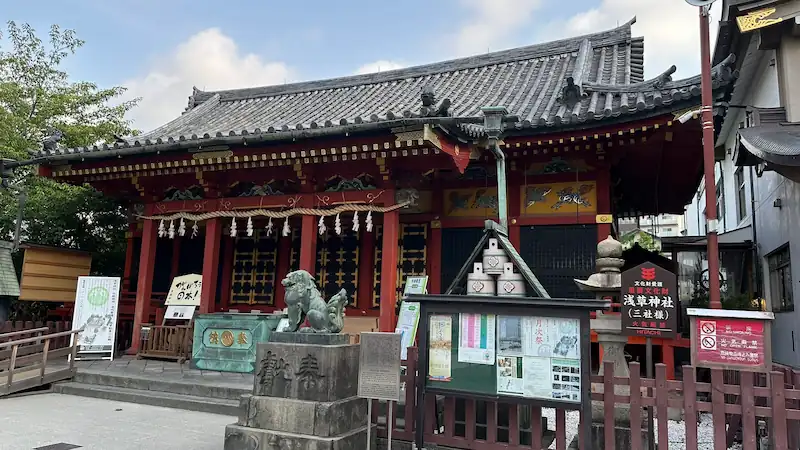
Asakusa Shrine enshrines the three figures associated with the discovery of Sensō-ji's principal image — Hinokuma Hamanari no Mikoto, Hinokuma Takenari no Mikoto, and Haji no Nakatomo no Mikoto — and is affectionately known locally as Sanja-sama. Its gongen-zukuri shrine buildings were erected in 1649 by Tokugawa Iemitsu, the third shogun, and miraculously survived both the Great Kantō Earthquake and the Tokyo air raids. They were designated Important Cultural Properties of Japan in 1951. The Tokugawa hollyhock crest carved into the central ridge of the roof can still be seen as proof of the shrine's deep connection with the shogunate. Stand in front of the shrine and look up toward the center of the roof to find it.
| Date built | 1649 |
|---|---|
| Builder | Tokugawa Iemitsu, third shogun |
| Structure and features | Gongen-zukuri structure, with the main sanctuary, offering hall, and worship hall connected through the heiden |
| Preservation status | Survived the Great Kantō Earthquake and wartime destruction |
| Cultural-property designation | 1951: designated an Important Cultural Property of Japan |
| Notes | Ieyasu is enshrined together with the three founding figures as Sanja Daigongen; the shrine is beloved by ordinary people as Sanja-sama. Tokugawa hollyhock crests appear on the roof tiles. |
- Gongen-zukuri shrine buildings: Early-Edo architecture donated by Tokugawa Iemitsu, combining prestige and beauty.
- Roof tiles with the hollyhock crest: The Tokugawa hollyhock crest is carved into the central ridge of the shrine roof.
- Sanja worship route: A traditional visit pairs Sensō-ji with Sanja-sama.
- Sanja Matsuri: One of Edo-Tokyo's great festivals, held in May, when three major mikoshi are carried through the streets.
- Enshrinement of Tokugawa Ieyasu: A sign that shogunate patronage and faith extended to the shrine as well.
- Sanja Daigongen: The shrine enshrines the three founding figures together with Tokugawa Ieyasu, reflecting the connection between local devotion and the shogunate.
- Miraculous survival from wartime destruction: While many Sensō-ji buildings burned in the war, Asakusa Shrine and neighboring Nitenmon survived and preserve their historic appearance.
- The appeal of Sanja Matsuri: Highlights include the procession of nearly 100 neighborhood mikoshi and the binzasara dance, making it one of Japan's largest festivals.
Address
2-3-1 Asakusa, Taito City, Tokyo
Access
One minute on foot from the Main Hall, Kannondō
Suggested visit time
Quick visit: about 10 minutes / unhurried visit: about 20 minutes
Admission
Free
Open the map to check the route from the Main Hall to Asakusa Shrine.
Panoramic photo: Asakusa Shrine

Rokkakudō
A quiet hexagonal hall in the precincts, believed to date from the Muromachi to early Edo period. It remains a serene sacred space where folk devotion to Higiri Jizō continues.
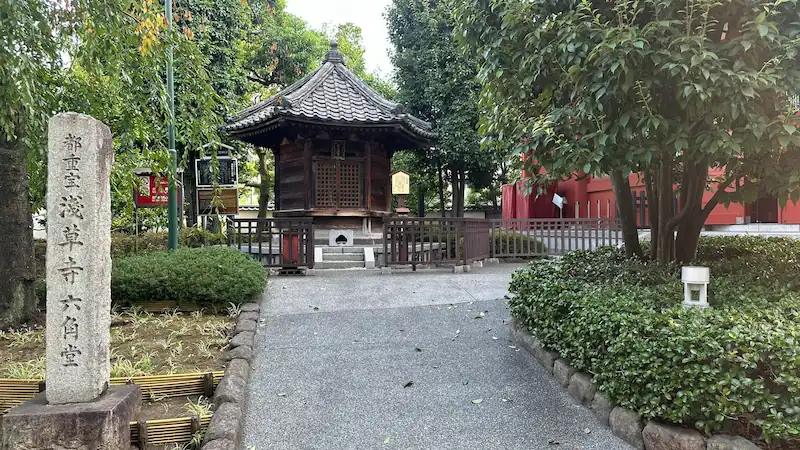
Rokkakudō, standing quietly within the Sensō-ji precincts, is one of Tokyo's older wooden structures and is sometimes said to date from the Muromachi period. Its principal image is Higiri Jizō, a Jizō believed to answer prayers by a specified date, and it has long attracted local devotion. It is a hidden gem that has quietly watched over the precincts since the era when temple development advanced after Tokugawa Ieyasu designated Sensō-ji as a shogunate prayer temple.
| Period built | Estimated late Muromachi to early Edo period |
|---|---|
| Structure and features | A small hexagonal wooden hall with a hipped roof, enshrining Higiri Jizō inside |
| Preservation status | Surviving structure, often introduced as an old wooden hall |
| Cultural-property designation | Tokyo-designated Tangible Cultural Property |
| Tokugawa connection | Preserved as part of the precinct's historic built environment within the broader context of Ieyasu's designation of Sensō-ji as a shogunate prayer temple |
| Notes | A quiet, contemplative spot with fewer visitors |
- Hexagonal architectural beauty: A small six-sided hall is rare and architecturally valuable.
- Higiri Jizō: A folk object of devotion believed to grant wishes when prayers are made by a specified date.
- One of Tokyo's older atmospheres: A quiet reminder of history that survived disasters and war.
- Tokugawa-period background: Part of the historic precinct space carried forward within the currents of shogunate patronage.
- A serene place of prayer: While many of Sensō-ji's main structures are known for grandeur, Rokkakudō has a quiet, almost otherworldly presence.
- Beside Yōgōdō: Together with neighboring Yōgōdō, it forms one of the older architectural clusters within the precincts.
- Maps and relocation history: Old maps suggest that Rokkakudō may have been moved from behind the Main Hall to its present location near Yōgōdō northwest of the hall.
Address
2-3-1 Asakusa, Taito City, Tokyo, within Sensō-ji precincts
Access
About two minutes on foot from the Main Hall, Kannondō
Suggested visit time
Quick visit: about 5 minutes / unhurried visit: about 10 minutes
Admission
Free
Open the map to check the route from the Main Hall to the Rokkakudō and Yōgōdō area.
Five-Storied Pagoda
An Edo landmark built by Iemitsu in 1648. After burning in 1945, it was revived in 1973 at a height of about 48 meters.
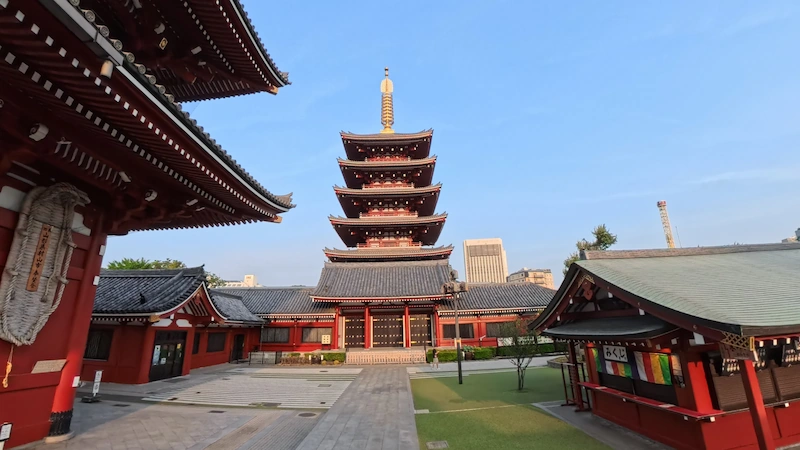
Sensō-ji's Five-Storied Pagoda is said to have been founded by Taira no Kinmasa in 942, during the Heian period, and was rebuilt in 1648 by Tokugawa Iemitsu, the third shogun. The earlier tower burned in the 1945 Tokyo air raids, but the present pagoda, built with steel and reinforced concrete while recreating the traditional appearance, was completed in 1973 at a height of about 48 meters. The top story enshrines Buddhist relics donated by Isurumuniya Temple in Sri Lanka, and the pagoda has long been a symbol of Asakusa, counted among the Four Edo Pagodas and depicted in ukiyo-e.
| Foundation date | 942, according to tradition |
|---|---|
| Edo-period reconstruction | Built in 1648 by Tokugawa Iemitsu |
| Structure and features | Vermilion five-storied pagoda recreating a traditional appearance; postwar structure uses reinforced concrete and steel |
| Height of the current pagoda | About 48 meters for the pagoda itself / 53.32 meters from ground level according to guidance |
| Buddhist relics | Received from Isurumuniya Temple in Sri Lanka in 1966 and enshrined on the top story |
| Destruction and reconstruction | Destroyed in the 1945 Tokyo air raids → rebuilt in 1973 |
| Cultural significance | One of the Four Edo Pagodas and a symbolic motif in ukiyo-e |
- Majestic pagoda form: Its vermilion color and five-tiered silhouette are striking and highly photogenic.
- Enshrined Buddhist relics: The top story contains relics of the Buddha, giving the pagoda deep religious meaning.
- A symbol of Edo: After Iemitsu's reconstruction, it appeared repeatedly in ukiyo-e and paintings as a defining Asakusa landmark.
- Symbol of postwar revival: It also has value as a structure that restored culture lost in wartime destruction.
- One of the Four Edo Pagodas: Sensō-ji's pagoda was counted alongside those of Ueno Kan'ei-ji, Shiba Zōjō-ji, and Yanaka Tennō-ji.
- The former pagoda site: A stone marker stands at the earlier eastern location of the old Five-Storied Pagoda.
- Tokugawa faith and cultural patronage: Iemitsu's construction helped shape Sensō-ji's temple layout and influenced the formation of Edo culture.
Address
2-3-1 Asakusa, Taito City, Tokyo, within Sensō-ji precincts
Access
One minute on foot from the Main Hall, Kannondō
Suggested visit time
Quick visit: about 5 minutes / unhurried visit: about 10 minutes
Admission
Free
Open the map to check the route from the Main Hall to the Five-Storied Pagoda.
Panoramic photo: Five-Storied Pagoda

Site of Asakusa Tōshōgū — A Place Linked to Ieyasu Where Only the Stone Bridge Remains
A Tōshōgū shrine founded in 1618 to enshrine Tokugawa Ieyasu. Its buildings are gone, leaving only the stone bridge and gate, now Nitenmon, as clues to its past.
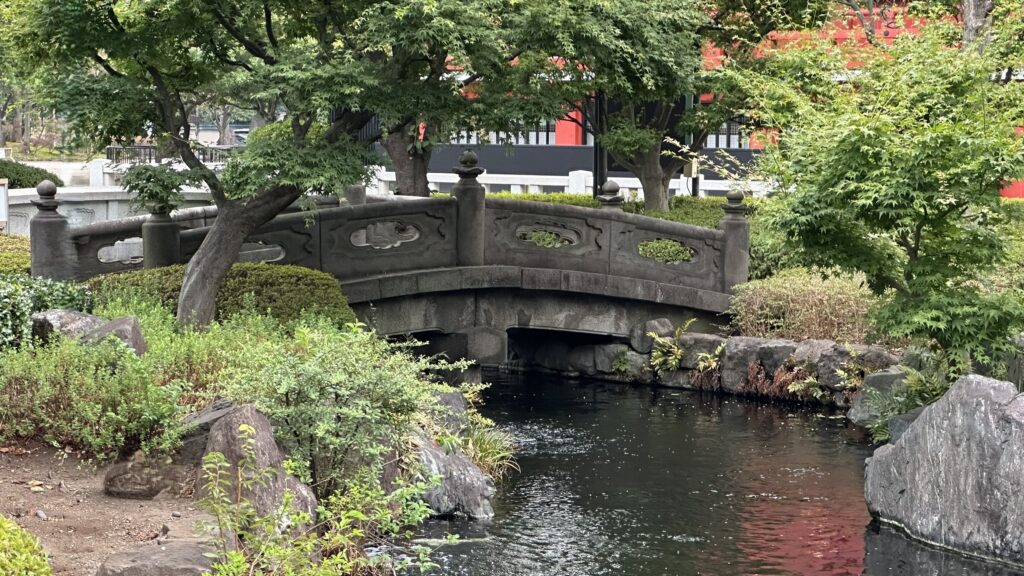
Asakusa Tōshōgū was established within the Sensō-ji precincts in 1618 to enshrine Tokugawa Ieyasu as the deified Tōshō Daigongen. It stood northwest of Sensō-ji's Main Hall, around today's Yōgōdō area, and was developed as a place where anyone, including common townspeople, could worship Ieyasu. The Tōshōgū main sanctuary later disappeared without being rebuilt, but the stone bridge in front of Yōgōdō, built in 1618, and the former Zuishinmon gate, now Nitenmon, remain in the precincts as rare clues to its former presence. Considering that major precinct buildings such as Kaminarimon and the Main Hall are postwar reconstructions, this small stone bridge is one of the oldest surviving remnants linking Sensō-ji with Ieyasu.
| Year founded | 1618 |
|---|---|
| Original location | Behind Sensō-ji's Main Hall, around today's Yōgōdō and Rokkakudō area |
| Related remnants | Stone bridge for worshippers, surviving; Zuishinmon → present Nitenmon |
| Destruction and later history | Burned in 1642 and was not rebuilt thereafter |
| Changes after the separation of Shinto and Buddhism | Kōmokuten and Jikokuten were installed at Nitenmon, and the gate's name changed. |
| Current devotional context | Sources differ in how they describe the ritual status of Asakusa Tōshōgū. This article focuses on the stone bridge and Nitenmon as traces of the former Tōshōgū. |
- Stone bridge, remnant of the approach: The bridge in front of Yōgōdō is said to have been built in 1618 and is introduced as one of the older remnants in the precincts.
- Nitenmon, former Zuishinmon: The vermilion eight-legged gate founded as the Zuishinmon of Tōshōgū survives and is designated an Important Cultural Property of Japan.
- Connection with Asakusa Shrine: The shrine buildings donated by Tokugawa Iemitsu in 1649 still convey the deep relationship with the Tokugawa family.
- Designed for commoner worship: Unlike Nikkō or the Tōshōgū at Shiba Zōjō-ji, this shrine within Sensō-ji made worship of Ieyasu accessible to ordinary people.
- Nitenmon's changing statues: The Meiji separation of Shinto and Buddhism moved the Zuishin statues and brought in Buddhist guardian statues, changing the gate's identity.
- Remnants of Tōshōgū: Because so little remains, the surviving bridge and gate make the loss of the former Tōshōgū feel especially vivid.
Approximate surviving trace location
Around today's Yōgōdō and Rokkakudō area, north behind the Main Hall
Access
Two to three minutes on foot from the Main Hall. The stone bridge by the pond in front of Yōgōdō is the surviving remnant.
Suggested visit time
Stone bridge and surroundings: about 5–10 minutes
Admission
Free
Open the map to check the area around Yōgōdō.
Denbōin: Usually Closed to the Public
Sensō-ji's main priestly residence, known for a strolling garden traditionally attributed to Kobori Enshū and a reception hall that reflects its ties with the Tokugawa shogunal family. It is usually viewable only during special openings.
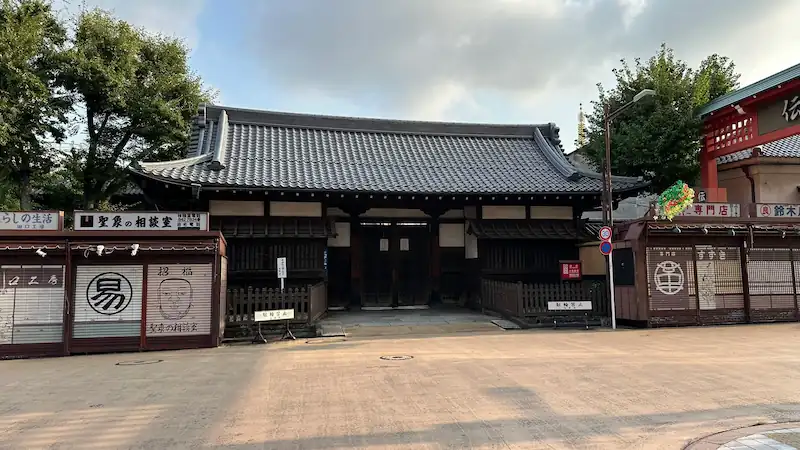
Denbōin is Sensō-ji's main priestly residence. It was originally known as Kannon-in and Chiraku-in, but around 1690 it came to be called Denbōin after the posthumous title of the fourth restorer, Senson Sōjō. Its strolling garden, traditionally attributed to the early-Edo garden master Kobori Enshū, was designated a National Place of Scenic Beauty in 2011. In the reception hall, mortuary tablets of successive Tokugawa shoguns are enshrined together with an Amida Triad, making the space a powerful symbol of the close relationship between the shogunate and the temple. It is normally closed to the public, but may be visited during special openings or tea events; visitors can also glimpse part of the garden through the fence from Chingodō, a small shrine in the precincts dedicated to tanuki.
| Date and origin of the name | Around 1690, named after the title of Senson Sōjō |
|---|---|
| Main components | Reception hall and entrance rebuilt in 1777, shoin rooms, kitchen areas developed from the Meiji to Taishō periods, and a garden traditionally attributed to Kobori Enshū |
| Connection with Tokugawa shoguns | Mortuary tablets of successive Tokugawa shoguns are enshrined in the reception hall |
| Preservation status | Existing structure, normally closed but sometimes opened specially |
| Cultural-property designation | Reception hall: Important Cultural Property of Japan / garden: National Place of Scenic Beauty |
| Notes | The strolling garden quietly preserves layers of history and design. |
- Strolling garden, during special openings and tea events: Traditionally attributed to Kobori Enshū, the garden reveals a varied landscape within a tranquil setting.
- Garden glimpsed through the fence, year-round: From beside Chingodō, visitors can glimpse part of the garden even when Denbōin itself is closed.
- Reception-hall altar and shogunal tablets: The Amida Triad and Tokugawa mortuary tablets visibly express the temple's connection with the shogunate.
- Prestigious architectural complex: From the late-Edo reception hall and entrance to Meiji–Taishō shoin rooms, the buildings preserve the dignity of a major temple residence.
- Origin of the name Denbōin: Around 1690, the residence was named after Senson Sōjō, the fourth restorer of Sensō-ji. Before that, it was called Kannon-in and Chiraku-in.
- A hidden garden: It is said to have originally been a garden for an imperial prince-monk and was long regarded as a hidden garden.
- A tanuki guardian!: Chingodō, standing along Denbōin-dori, enshrines a tanuki and is associated with a legend that it protects Denbōin from fire.
- A rare architectural composition: The complex includes a hōjō-style hall, large and new shoin reception rooms, and other structures that preserve the dignity of a major Edo-period temple residence.
Address
2-3-1 Asakusa, Taito City, Tokyo, Sensō-ji Denbōin
Access
Four minutes on foot from Hōzōmon
Suggested visit time
About 5 minutes; since it is normally closed, only the gate can be viewed
Admission
Usually closed to the public / special openings: check in advance
Open the map to check the route from Hōzōmon to Denbōin.
Matsuchiyama Shōden (Honryūin)
A branch temple of Sensō-ji that, according to its origin story, began in the age of Empress Suiko. It is known for powerful blessings said to have inspired Ieyasu's devotion, and for its distinctive symbols of daikon radish and money pouch.
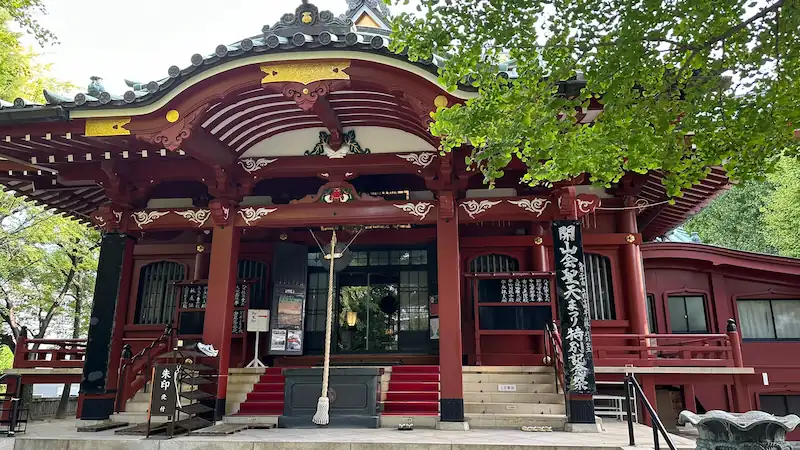
Honryūin, better known as Matsuchiyama Shōden, is a branch temple of Sensō-ji said to have been founded in the seventh century, during the age of Empress Suiko. It is known for devotion to Shōden, or Daishō Kangiten, and stories say that Toyotomi Hideyoshi and Tokugawa Ieyasu both worshipped here with deep faith. In the Edo period, it is also said to have been developed as a protective temple for this area when Ieyasu built Edo Castle. The temple's symbols are the white daikon radish and the money pouch: the radish represents bodily health and harmony at home, while the pouch symbolizes prosperity in business. About ten minutes on foot from Asakusa Station (G19/A18/TS01), it is a rewarding hidden spot.
| Foundation date | Traditionally said to date from the age of Empress Suiko, around the seventh century |
|---|---|
| Composition | A branch temple of Sensō-ji with Shōden, or Kangiten, as its principal object of worship |
| Tokugawa connection | Traditionally said to have been developed as a protective temple by Ieyasu in the early Edo period |
| Distinctive symbols | Daikon radish for health and harmony; money pouch for business prosperity |
| Blessings | Bodily health, marital harmony, business prosperity, and more |
| Cultural background | Depicted in ukiyo-e as a famous Edo site and known for the saying that one can receive seven generations of happiness in a single lifetime |
| Notes | A legend says that Ieyasu spread the rumor of a "fearsome deity" to prevent people from monopolizing the temple's powerful blessings. |
- Kangiten, or Shōden-sama: The principal deity is worshipped as a secret elephant-headed figure sometimes associated with Ganesha.
- Daikon and money-pouch motifs, plus offerings to take home: The white radish and money-pouch symbols appear throughout the precincts, and offered daikon may sometimes be taken home as blessed offerings.
- The atmosphere of a famous Edo site: Many ukiyo-e depict the Sumida River and Matsuchiyama, preserving the memory of this historic setting.
- Modern devotional culture: It is also popular among younger visitors as a photogenic spiritual-benefit spot.
- A rumored "ultimate power spot": One story says that because its blessings were too powerful, Tokugawa Ieyasu spread rumors of a fearsome deity to keep people away.
- Seven generations of happiness in one lifetime: The temple has long been associated with the belief that one person can receive the happiness of seven generations.
- Appears in ukiyo-e: It has been depicted as a scenic place since the Edo period.
Address
7-4-1 Asakusa, Taito City, Tokyo
Access
About ten minutes on foot from Asakusa Station (G19/A18/TS01) on the subway or Tobu lines, reached through quiet side streets
Suggested visit time
Quick visit: about 10 minutes / unhurried visit: about 30 minutes
Admission
Free
Open the map to check the route to Matsuchiyama Shōden.
Frequently Asked Questions
Sensō-ji is one of the few places in central Tokyo where genuine Edo-period architecture from the age of the Tokugawa shoguns can still be seen in person. Nitenmon Gate and the shrine buildings of Asakusa Shrine — both built in 1649 under the third shogun Iemitsu — survived the 1923 earthquake and the 1945 air raids, and are designated Important Cultural Properties of Japan. For visitors interested in samurai history, shogunate patronage, or the built heritage of Edo, these two structures alone make the visit worthwhile. The precinct is free to enter and is about 20–30 minutes from Tokyo Station. The famous landmarks — Kaminarimon, Hōzōmon, the Main Hall — are postwar reconstructions, and this guide tells you exactly which is which.
Yes. Because "Asakusa Station (G19/A18/TS01)" is used by multiple train lines in separate locations, the easiest way to avoid confusion is to set your destination as Kaminarimon. From both the Toei Asakusa Line and the Tokyo Metro Ginza Line, follow station signs for "Kaminarimon / Sensō-ji." Tokyo Metro Ginza Line Asakusa Station (G19) Exit 1 is the closest; once you reach street level, simply walk straight along Kaminarimon-dori. When the large red lantern gate comes into view, you have arrived.
As a general guide, allow about 60 minutes if you focus on the main precinct route: Kaminarimon → Nakamise → Hōzōmon → Main Hall → Nitenmon → the Yōgōdō area. If you want to take your time with goshuin, photography, Asakusa Shrine, and Matsuchiyama Shōden, plan for about 90 to 120 minutes. Nakamise can become very crowded and slow to walk through, so it is wise to give yourself extra time.
Focus on Nitenmon Gate and Asakusa Shrine, both genuine 1649 Edo-period structures, then take a quick look at the Main Hall on your way. This covers the historical core of the precincts without needing the full 60 to 120-minute route described above.
Yes. Just keep a few things in mind. On rainy days, the stone paving and approach roads can become slippery, so comfortable shoes with good grip are recommended. Parts of Nakamise are covered, but pedestrian flow can bottleneck when many people are carrying umbrellas. If you are visiting for photos, the rain can make the lanterns and vermilion gates look beautifully atmospheric, but be considerate about where you stop. Main Hall worship and goshuin are usually still available in rainy weather, though goshuin hours may vary by date, so follow the on-site guidance for the day.
Sensō-ji goshuin are available at Yōgōdō, west of the Main Hall, on the left when facing the hall. The usual hours are about 8:00 a.m. to 4:30 p.m., though special hours may apply during New Year and Shimanrokusen-nichi. Goshuin books are also available at Yōgōdō. Because waits can occur when it is crowded, visiting earlier in the day is usually smoother.
In brief, the sites can be organized as follows.
Surviving early-Edo architecture: Nitenmon, built in 1649 and designated an Important Cultural Property of Japan; and the shrine buildings of Asakusa Shrine, also built in 1649 and designated Important Cultural Properties of Japan.
Postwar / modern reconstructions: Kaminarimon, 1960; Hōzōmon, 1964; Main Hall, 1958; Five-Storied Pagoda, 1973.
Remnant: The stone bridge in front of Yōgōdō, built in 1618, remains in the precincts as a trace of the vanished Asakusa Tōshōgū.
Many of the precincts' major landmarks are postwar reconstructions. To see authentic Edo-period architecture, make a point of visiting Nitenmon and Asakusa Shrine.
Yes. A few simple choices make the visit easier. To avoid crowds, skip Nakamise's busiest hours, especially 10:00 a.m. to 3:00 p.m. on weekends, and visit early in the morning or later in the afternoon. For breaks, the precincts have several places where it is easy to pause, so divide your visit around Hōzōmon and the Main Hall. If you are using a stroller or have mobility concerns, check elevator-equipped station exits and barrier-free station maps in advance. On rainy days, the stone pavement can be especially slippery, so move slowly and follow the flow of pedestrians.
Asakusa Shrine is an independent shrine adjoining the Sensō-ji precincts. It is about one minute on foot from the Main Hall, so you can visit both while walking through the same temple area. Its gongen-zukuri shrine buildings, erected in 1649 by the third shogun Tokugawa Iemitsu, survived both the Great Kantō Earthquake and the Tokyo air raids and are designated Important Cultural Properties of Japan. It is well worth visiting after Sensō-ji. Look up at the shrine roof and you can see tiles bearing the Tokugawa hollyhock crest.
Asakusa Tōshōgū is said to have been founded within the Sensō-ji precincts in 1618 to enshrine Tokugawa Ieyasu as Tōshō Daigongen. After fires in the Kan'ei era, it was not rebuilt within Sensō-ji and is described as having been transferred to Momijiyama inside Edo Castle. No Tōshōgū buildings remain in the Sensō-ji precincts today. Two clues can still be seen: the stone bridge in front of Yōgōdō, a remnant built in 1618, and Nitenmon, originally built as a Zuishinmon gate and now an Important Cultural Property of Japan. Keeping these traces of the lost Tōshōgū in mind as you walk through the precincts adds depth to the visit.
Sensō-ji's Tokugawa connection comes slightly after the events shown in "Toyotomi Brothers," but the temple's later development under Ieyasu and his successors makes it a natural next stop for viewers exploring Edo-period history in Tokyo. Ieyasu designated Sensō-ji as a shogunate prayer temple after entering Edo in 1590, and his grandson Iemitsu later shaped the precincts visitors see today.
Nikkō Tōshōgū is the head shrine built specifically to enshrine Tokugawa Ieyasu as a deity, located in the mountains north of Tokyo. Sensō-ji is a much older Buddhist temple that became closely tied to the Tokugawa shoguns through patronage, and once hosted its own branch Tōshōgū, Asakusa Tōshōgū, within its precincts. Only traces of that branch shrine survive today, while Nikkō Tōshōgū remains intact and is one of Japan's most famous mausoleum complexes.
Yes. Edo Castle, the former seat of the Tokugawa shogunate, and other Tokyo-area Tokugawa sites are within reach by train. Visitors building a Tokugawa-themed day in Tokyo often pair a Sensō-ji visit with Edo Castle or other shogunate-linked locations covered elsewhere on this site.
Explore Further: Tokugawa History in Tokyo and Beyond
For more on the historical figures and sites behind this guide, see the pages below. The Tokugawa overview covers Ieyasu and the shogunate's connections across Japan; Edo Castle was the seat of shogunate power itself; and the Tokyo Area page collects related historic sites in the capital.
Tokugawa Ieyasu: Historic Sites Across Japan
Edo Castle: Where the Tokugawa Shoguns Actually Lived
The historic-site data, access information, and suggested visit times in this article are based on official Sensō-ji information and on-site checks, but details may change. Please confirm the latest information before visiting.
☕ このサイトを応援する
Following the Shogunは現地取材をもとに制作しています。
記事が役に立ったと感じていただけたら、サポートいただけると励みになります。

QRコードからもサポートできます


comment