

Toyotomi Hidenaga: The Brother Who Made the Regime Work
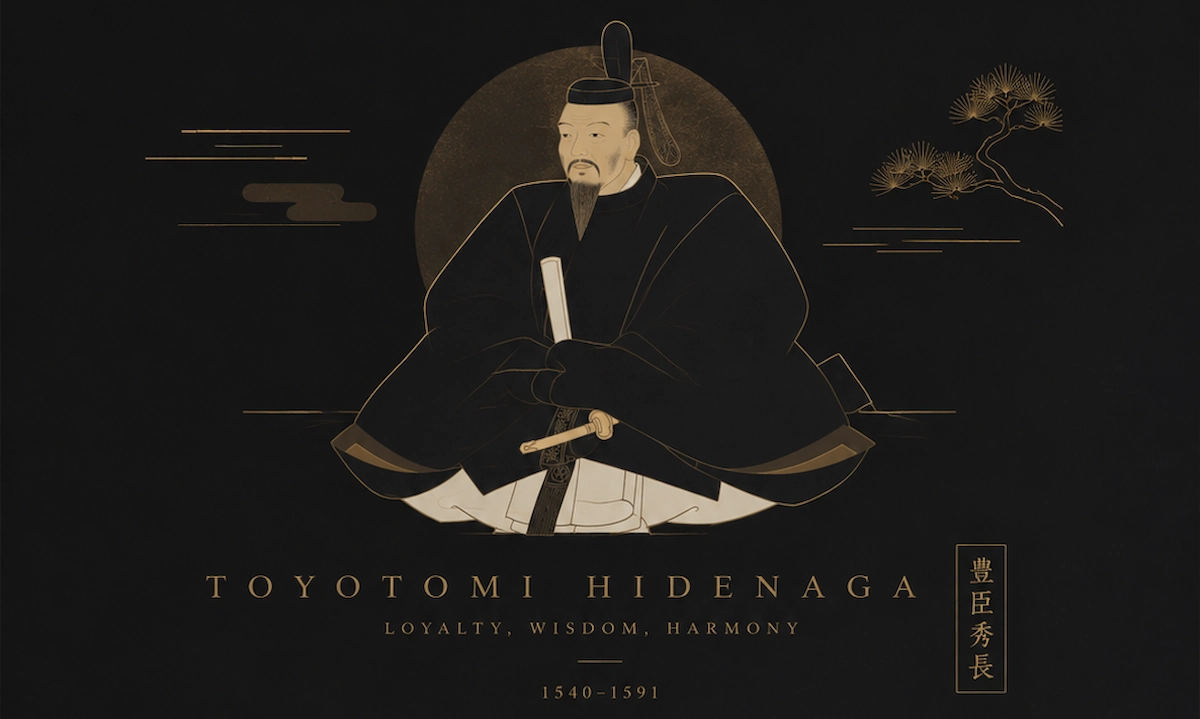
Toyotomi Hidenaga (1540-1591) was the younger brother of Toyotomi Hideyoshi, the warlord who unified Japan in the late 1500s. Hidenaga commanded armies, governed roughly a million koku of land from Yamato Koriyama Castle near Nara, and kept the Toyotomi regime functioning from behind his brother. This page covers his life and a dated timeline, and points you to the guides for the places in it.
Short answer: Toyotomi Hidenaga was the younger brother of Toyotomi Hideyoshi, and the person who turned Hideyoshi's conquests into a working government. He led armies when campaigns required it - including as commander-in-chief in Shikoku - governed three provinces from Yamato Koriyama Castle, and mediated between the warlords who served his brother. When he died in 1591, the regime lost the one man who could reliably slow Hideyoshi down.
If you are new to this period: Japan in the 1500s was divided among regional warlords (daimyo) in a century of civil war known as the Sengoku period. Oda Nobunaga began reunifying the country, Hideyoshi completed it after Nobunaga's death in 1582, and Tokugawa Ieyasu took over afterwards. Hidenaga belongs to the middle of that story - and unlike his brother, he is barely known outside Japan.
Toyotomi Hidenaga at a glance
| Lived | 1540 - 15 February 1591 (Tensho 19, 1st month, 22nd day); aged 52 by traditional Japanese count |
|---|---|
| Relation to Hideyoshi | Younger brother. Most historians treat them as half-brothers sharing a mother; a minority view holds they shared both parents |
| Born | Nakamura village, Owari Province - today the Nakamura ward of Nagoya, in western Aichi Prefecture |
| Also known as | Koichiro (his everyday name), Hashiba Hidenaga, and "Yamato Dainagon" |
| Major commands | Pacification of Tajima and the San'in region; commander-in-chief of the Shikoku campaign; commander of the Hyuga front in the Kyushu campaign |
| Domain at his peak | Yamato, Kii and Izumi plus part of Kawachi - a nominal 1 million koku (a later Bunroku-era survey put the real yield at 734,000 koku) |
| Main base | Yamato Koriyama Castle (大和郡山城), Yamato Koriyama City, Nara Prefecture |
| Court rank | Junior Second Rank and Provisional Grand Counselor (Gon-Dainagon), granted 8 August 1587 |
| Grave | Dainagon-zuka (大納言塚), 14 Minoyama-cho, Yamato Koriyama City - open to visitors, no admission fee |
| On television | Lead character of the 2026 NHK Taiga Drama Toyotomi Kyodai! ("Toyotomi Brothers!") |
From a farming village to Hideyoshi's right hand
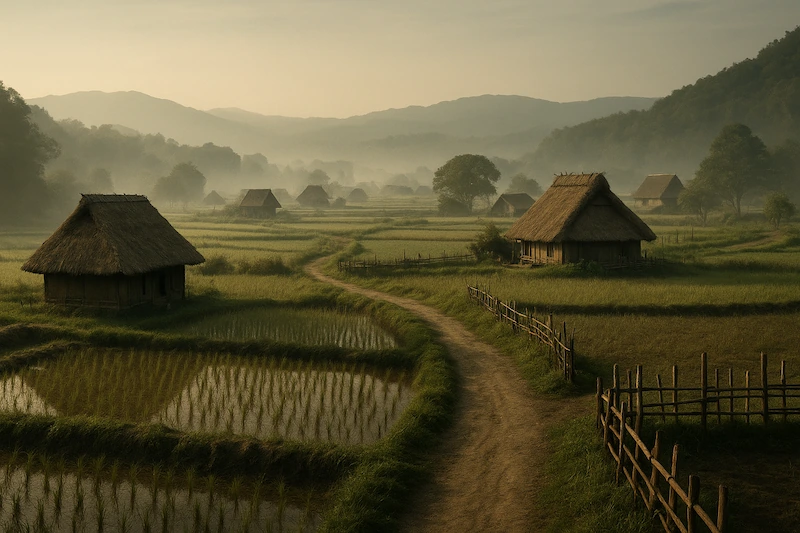
Hidenaga was born in 1540 in Nakamura, a farming village in Owari Province - the area that is now the Nakamura ward of Nagoya, in western Aichi Prefecture. It was the same village his brother came from. He is usually referred to in this period as Koichiro. When Hideyoshi entered service with the Oda clan and took the name Kinoshita Tokichiro, Hidenaga followed him out of the fields and into the warrior class.
From early on he was described as quick-witted, even-tempered and clear-headed - qualities that made him a useful counterweight to a brother known for acting on impulse. When Hideyoshi became lord of Nagahama Castle on the eastern shore of Lake Biwa (Shiga Prefecture), Hidenaga ran the castle and the domain's administration, and showed a real talent for the unglamorous work of government.
He was trusted with independent commands early. In 1574 he went out as Hideyoshi's deputy against the Nagashima Ikko-ikki, a militant Buddhist league that had fortified the river delta in what is now Mie Prefecture. Between 1577 and 1580 he was given charge of subduing Tajima Province and the wider San'in region along the Japan Sea coast, taking mountain strongholds including Izushi Castle and Takeda Castle. Those campaigns secured the flank of his brother's advance west - and they are the foundation of everything that came later.
Takeda Castle, in Asago City in northern Hyogo Prefecture, is the one site from this phase that is genuinely worth a detour today: see our complete guide to Takeda Castle Ruins, Japan's "Castle in the Sky". The dramatic stone walls visitors photograph there date from a later period than Hidenaga's involvement.
The western campaigns, Yamazaki and Shizugatake
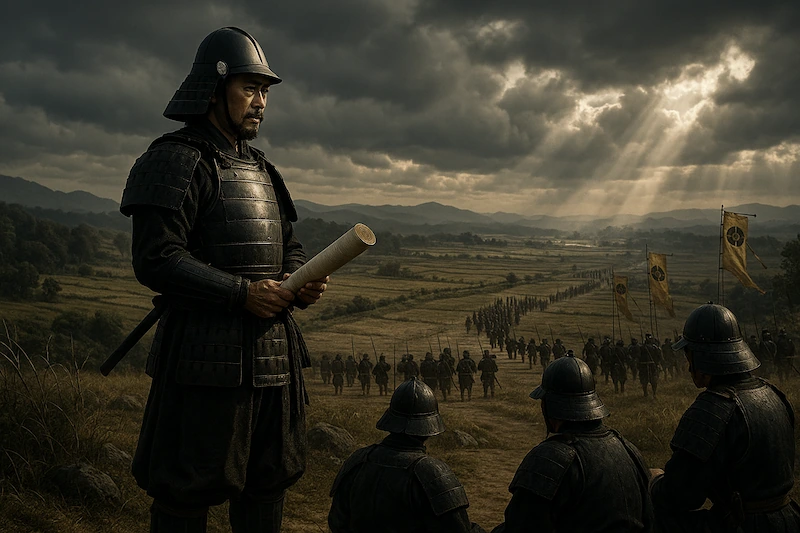
In the late 1570s Oda Nobunaga ordered Hideyoshi west against the Mori clan - the campaign Japanese sources call the Chugoku offensive, after the Chugoku region at the western end of Japan's main island. Hidenaga held the northern flank in Tajima and the San'in. During the long sieges of Miki Castle and Tottori Castle he was responsible for supply lines and for negotiating with the local powers along the route: the work that decides whether a siege holds together.
In 1582 Nobunaga was killed in Kyoto by one of his own generals, Akechi Mitsuhide, in the coup known as the Honno-ji Incident. Hideyoshi broke off the western campaign and marched his army back toward Kyoto at extraordinary speed - the "Great Return from Chugoku" - and defeated Mitsuhide at the Battle of Yamazaki. Hidenaga handled troop coordination and rear-line support throughout that reversal. He played a comparable role at the Battle of Shizugatake in 1583, when Hideyoshi fought Shibata Katsuie, his main rival for Nobunaga's position.
At Shizugatake, Hidenaga held the fort on Mount Tagami above Kinomoto, in northern Shiga Prefecture - a position paired with Hideyoshi's own headquarters. Both are walkable today: see Tagamiyama Fort Ruins and Kinomoto Jizo-in for the two brothers' camps, and Shizugatake: the chairlift, the summit walk and the 1583 battle for the battlefield itself.
In 1584, during the standoff with Tokugawa Ieyasu and Oda Nobukatsu at Komaki and Nagakute, Hidenaga marched into Nobukatsu's territory in Ise (modern Mie Prefecture) and took Matsugashima Castle. He then went in person as Hideyoshi's representative to negotiate the peace with Nobukatsu. Settling a war by talking rather than by force was, repeatedly, how Hidenaga worked.
Shikoku, and a domain of a million koku
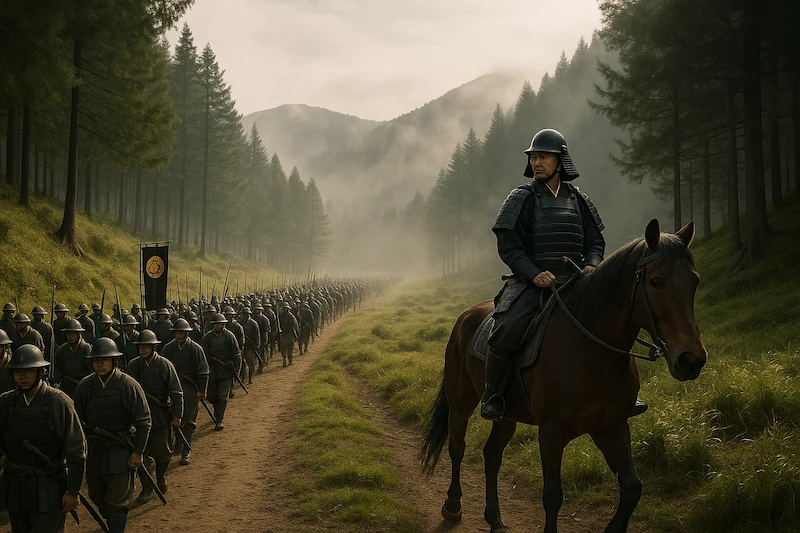
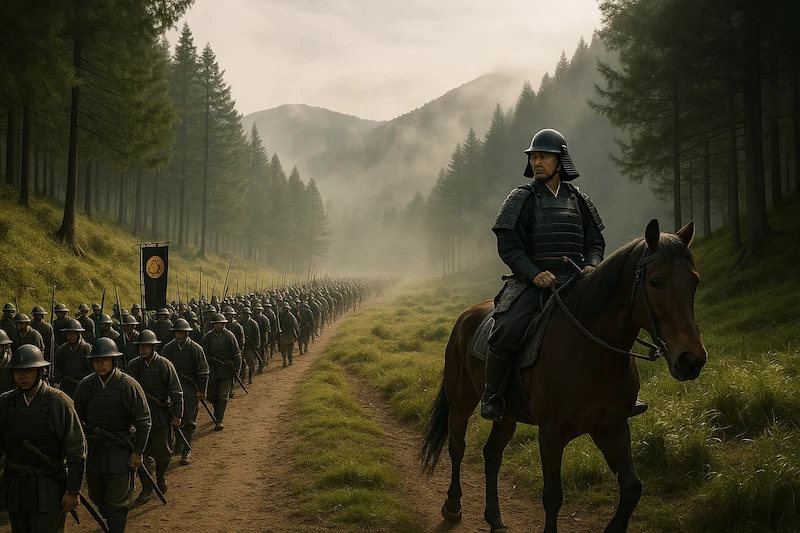
In 1585 Hidenaga was rewarded for the subjugation of Kishu - roughly present-day Wakayama Prefecture - with Kii and Izumi provinces, some 640,000 koku. Later that year Hideyoshi fell ill and could not take the field for the invasion of Shikoku, the smallest of Japan's four main islands. Hidenaga went in his place as commander-in-chief of a force of more than 100,000 men, and brought Chosokabe Motochika to terms rather than fighting the campaign to its bloodiest conclusion.
For that, on the 18th day of the intercalary eighth month of 1585, Yamato Province was added to his holdings, bringing him to roughly a million koku, and he took possession of Yamato Koriyama Castle. A land survey in the following Bunroku era assessed the actual yield at 734,000 koku - still an enormous domain.
Kii Province was governed from Wakayama Castle, whose construction was overseen by Todo Takatora, one of Hidenaga's retainers and later one of the most celebrated castle-builders in Japanese history. For the castle as it stands today, see our Wakayama Castle visitor guide, covering all three areas and 21 spots with access and admission.
Kyushu, and the title "Yamato Dainagon"
In 1587 Hideyoshi invaded Kyushu, the southernmost of Japan's main islands, to break the Shimazu clan. The army advanced in two columns: Hideyoshi took the western route through Higo, while Hidenaga commanded the eastern column down the Hyuga front, in what is now Miyazaki Prefecture. After the fighting he helped redistribute territory among the surviving Kyushu lords - a job that needed political judgement as much as military authority.
On 8 August that year the imperial court granted him Junior Second Rank and the office of Provisional Grand Counselor, or Gon-Dainagon. He held that rank for the rest of his life, and it gave him the name he is still known by in Japan: the Yamato Dainagon - the Grand Counselor of Yamato. Hideyoshi was the visible ruler; Hidenaga did much of the actual governing.
Yamato Koriyama Castle and how he governed
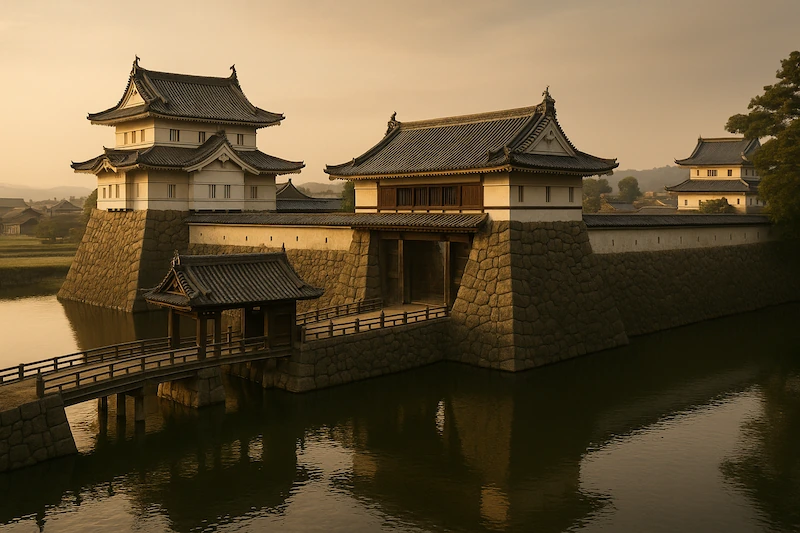
Yamato Koriyama Castle sits in Yamato Koriyama City, in Nara Prefecture just south of the city of Nara. Construction had begun in 1580 under an earlier lord, Tsutsui Junkei. After Hidenaga moved in, the castle was enlarged to a scale befitting a million-koku domain, and the city's own account is that its layout was essentially completed during his time there, with repeated rounds of moat construction.
Yamato has little good building stone, so material was collected from temples in the surrounding area. On the north face of the keep's stone platform you can still see a stone Buddha built into the wall upside down - known locally as the sakasa jizo, the inverted Jizo - a reminder of how quickly the work was pushed through. In 2017 the castle ruins were selected as one of the "Continued Top 100 Japanese Castles."
What defined Hidenaga as a ruler, though, was less the scale of his building than the way he governed. Yamato, Kii and Izumi all had deeply entrenched temple and shrine institutions and stubborn local landholders - provinces that did not simply submit to outside authority. Hidenaga balanced force against negotiation, and worked the Toyotomi order into place without provoking the backlash a heavier hand would have caused.
He also mediated disputes between rival lords and, by many accounts, acted as a brake on his brother's more impulsive decisions. He fought at the front when a campaign demanded it and stepped back into an organising role when government did. That combination - field commander and working administrator - is what made him difficult to replace.
For the site itself, see Yamato Koriyama Castle Ruins: walking Hidenaga's castle, and for a full day in the castle town, Yamato Koriyama and Hidenaga - the complete walking guide.
Illness and death, 1591
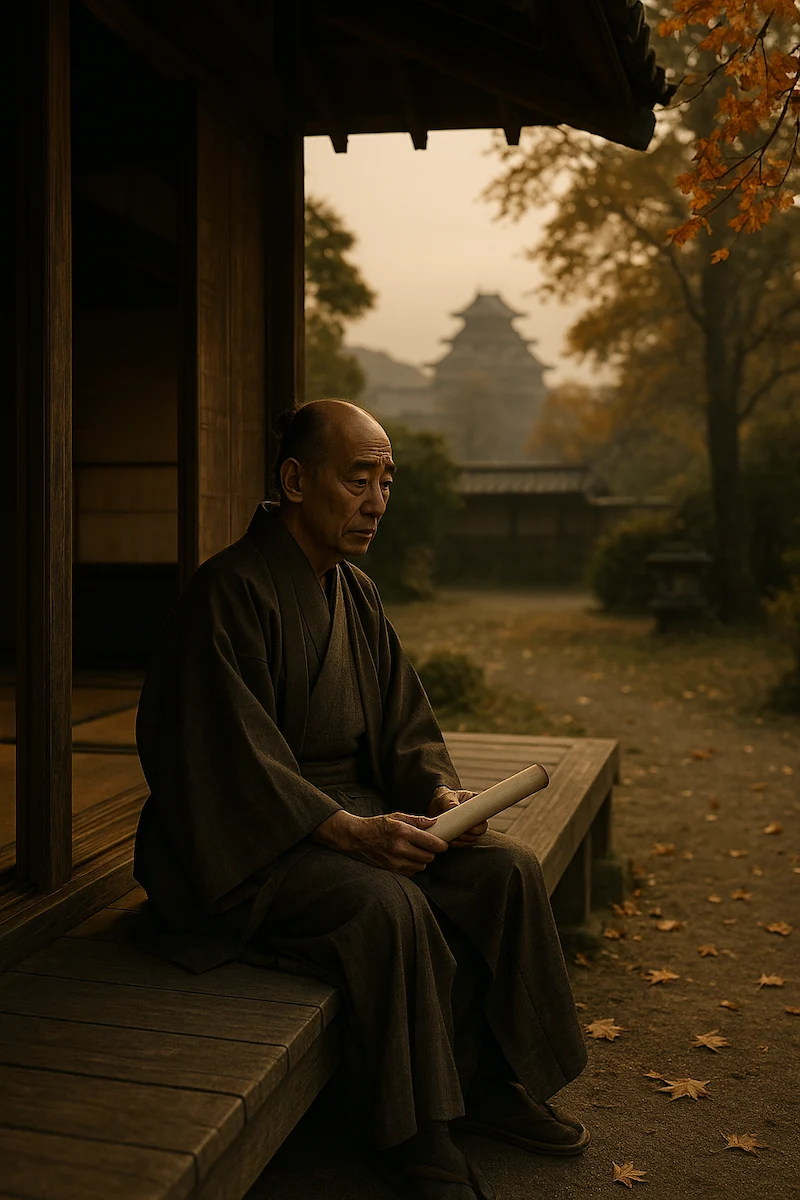
Through the late 1580s Hidenaga's health declined. In the second month of 1586 he went to the hot springs at Arima, in what is now Kobe, Hyogo Prefecture, to convalesce - the first of several such stays. The Toyotomi regime was approaching its height under Hideyoshi, who had been appointed imperial regent; the man doing much of the work to hold it together was quietly failing.
He died inside Yamato Koriyama Castle on the 22nd day of the first month of Tensho 19 - 15 February 1591 - at 52 by the traditional Japanese count. For the Toyotomi clan the loss went well beyond the death of one powerful lord.
He is buried at Dainagon-zuka, a memorial mound at 14 Minoyama-cho in Yamato Koriyama City, a short walk south of the castle ruins. It is freely accessible and easily combined with a visit to the castle.
What happened after he died
Hidenaga was succeeded by his nephew Toyotomi Hideyasu (豊臣秀保), whom he had adopted as his heir. Hideyasu was presented as heir in the first month of 1591, while Hidenaga lay dying, married Hidenaga's daughter at the age of 13, and inherited Yamato Koriyama Castle along with the provinces of Yamato and Kii. On 16 April 1595 he died suddenly at 17, and the Yamato branch of the Toyotomi family ended with him.
Within the regime itself, the balance of power began to break down after 1591. The forced death of Hideyoshi's nephew and designated successor Hidetsugu, and the long, grinding invasions of Korea, followed in the years after - the kind of decisions that, while Hidenaga was alive, someone had been able to argue against.
The Sengoku period was an era in which brothers killed brothers when their interests diverged. Against that background, Hidenaga's lifelong loyalty to Hideyoshi - supporting him, advising him, and pushing back on him when it mattered - stands out. For the other half of the story, see our profile of Toyotomi Hideyoshi: from farmer to ruler of Japan.
Timeline
| 1540 | Born in Nakamura, Owari Province (now Nakamura ward, Nagoya), the younger brother of Hideyoshi |
|---|---|
| 1574 | Sent as Hideyoshi's deputy against the Nagashima Ikko-ikki |
| 1577-1580 | Given charge of pacifying Tajima Province and the San'in region; takes Izushi and Takeda castles |
| 1582 | Nobunaga killed in the Honno-ji Incident; Hidenaga manages coordination and rear-line support through the Great Return from Chugoku and the Battle of Yamazaki |
| 1583 | Battle of Shizugatake; holds the fort on Mount Tagami above Kinomoto |
| 1584 | Komaki-Nagakute campaign; takes Matsugashima Castle in Ise and negotiates the peace with Oda Nobukatsu as Hideyoshi's representative |
| 1585 | Granted Kii and Izumi (about 640,000 koku) after the Kishu campaign; leads the Shikoku campaign as commander-in-chief and takes Chosokabe Motochika's surrender; on the 18th day of the intercalary 8th month, receives Yamato and enters Yamato Koriyama Castle with roughly 1 million koku |
| 1586 | Travels to the hot springs at Arima (now Kobe) to convalesce |
| 1587 | Commands the Hyuga front in the Kyushu campaign; on 8 August is granted Junior Second Rank and made Provisional Grand Counselor - the "Yamato Dainagon" |
| 1591 | Dies inside Yamato Koriyama Castle on 15 February, aged 52 by Japanese count; buried at Dainagon-zuka |
| 1595 | His adopted heir and nephew Toyotomi Hideyasu dies at 17, and the Yamato branch of the Toyotomi family ends |
Where His Story Is Still Standing
If reading this makes you want to stand in the places themselves, start with Yamato Koriyama near Nara: his castle, his grave and his castle town are all within walking distance of each other, and nowhere else explains him as directly. The full national list, the castle chronology and how to plan a route are on our main Toyotomi Hidenaga guide. Below are only the individual guides for the places mentioned above.
Hidenaga and the 2026 NHK Taiga Drama
The 2026 NHK Taiga Drama Toyotomi Kyodai! ("Toyotomi Brothers!") puts Hidenaga at the centre of the story: two brothers born into a peasant household who clash, complement each other, and end up reshaping Japan. NHK's Taiga Drama is Japan's annual flagship historical series, broadcast weekly across a full year - the closest equivalent to a major BBC or HBO period production.
Several prefectures run temporary drama exhibition halls tied to the series, usually next to the historic sites themselves. Our complete venue guide to the Toyotomi Brothers! drama museums and related exhibitions covers where they are, how to reach them and what is inside.
Frequently asked questions
He was Toyotomi Hideyoshi's younger brother, and the commander and administrator who turned Hideyoshi's conquests into working government. He led the Shikoku campaign as commander-in-chief and governed roughly a million koku across Yamato, Kii and Izumi.
Hidenaga was certainly Hideyoshi's younger brother. Most historians treat them as half-brothers sharing a mother, though a minority view holds that they shared both parents. Both were born in Nakamura village in Owari Province, now part of Nagoya.
On 8 August 1587 the imperial court granted him Junior Second Rank and the office of Provisional Grand Counselor (Gon-Dainagon), and his domain was based in Yamato Province. He held that rank until his death, and the name stuck.
Yamato Koriyama Castle in Nara Prefecture. He took possession in 1585 and rebuilt it on a scale fitting a million-koku domain. The ruins were selected as one of Japan's "Continued Top 100 Castles" in 2017.
At Dainagon-zuka, a memorial mound at 14 Minoyama-cho in Yamato Koriyama City, Nara Prefecture, a short walk south of the castle ruins. It is freely accessible with no admission fee.
He died of illness inside Yamato Koriyama Castle on 15 February 1591 (the 22nd day of the first month of Tensho 19), at 52 by the traditional Japanese count.
His adopted heir, his nephew Toyotomi Hideyasu, inherited Yamato Koriyama Castle and the provinces of Yamato and Kii, but died suddenly at 17 on 16 April 1595. The Yamato branch of the Toyotomi family ended there.
That is an assessment made in hindsight rather than an established fact, and it cannot be tested. Historians do broadly agree that Hidenaga acted as the regime's stabilising force while he was alive.
The 2026 NHK Taiga Drama Toyotomi Kyodai! ("Toyotomi Brothers!") is built around Hidenaga as its lead character. Related exhibition venues are covered in our complete guide to the Toyotomi Brothers! drama museums.
Back to the Main Page

☕ Support This Site
Following the Shogun is built on original fieldwork and on-site research.
If you found this guide useful, your support helps keep it going.

You can also support via QR code

