

How to Visit Odani Castle Ruins: Access from Kawake Station, Trail Map & Highlights

Odani Castle Ruins is a mountain fortress that rewards careful planning. Whether you’re arriving on foot from Kawake Station, want to study the layout at the museum before making the climb, or simply need to know how long the trail takes, it helps to have the numbers in hand before you set out. From the Sengoku Guide Station at the base, count roughly 40 minutes to the Bansho checkpoint, another 30 minutes to the Honmaru (main keep), and 20 more to Sannoumaru — all one-way. There are no shops or restrooms on the mountain, and grip-soled footwear is non-negotiable. In winter, watch for snow and ice on the forest road; in peak tourist season, the road is sometimes closed to private vehicles when shuttle buses are running.

This is the castle where Oda Nobunaga’s younger sister, Oichi, came as a bride to the lord Azai Nagamasa, and where three daughters were born and raised. The eldest, Chacha (later known as Yodo-dono), would go on to bear Toyotomi Hideyori and face off against Tokugawa Ieyasu in the Siege of Osaka. The youngest, Go, became the wife of the second Tokugawa shogun, Hidetada, and the mother of the third, Iemitsu. And the man who finally stormed and took this castle? None other than Hashiba Hideyoshi — acting on Nobunaga’s direct orders, the very same Hideyoshi who would later become the most powerful man in Japan. The fate of three sisters, the future of an entire era — it all pivoted here.

What this article covers: walking times from Kawake Station to the museum and Sengoku Guide Station / how long it takes to reach the Honmaru, and what to expect if you push on to Sannoumaru / highlights at the Kuroganemon Gate ruins, Ohiroma, Honmaru, Kyogokumaru, and Sannoumaru / how to navigate the site on a rainy day, in winter, or when you’re not feeling at full strength.

Odani Castle: A Historical Timeline

Muromachi to Early Sengoku Period Late 15th – Early 16th Century
  • Azai Sukemasa constructs the castle on Mt. Odani
  • 1525: Conflict with the Rokkaku clan; reinforced by Asakura troops
  • 1533: Imai Hidenobu purged
Mid-Sengoku Period – The Castle at Its Height 1560s
  • Azai Nagamasa takes over as castle lord
  • Alliance with Oda Nobunaga; Oichi arrives as Nagamasa’s bride
  • Expansion of the main citadel and Shimizudani residential complex
Fall and Abandonment 1573 (Tenshō 1)
  • All-out assault by Nobunaga and Hideyoshi
  • Azai Hisamasa (Komaru) and Nagamasa (Akao Residence) die by their own hand
  • Castle abandoned after fall; later designated a National Historic Site

Choosing Your Route

SHORT

Base + Main Citadel Course (approx. 2–3 hours)

Museum or Sengoku Guide Station ↓ On foot Demaru / Kingomaru / Bansho ↓ On foot Ochaya / Oumaya / Sakurababa ↓ On foot Kuroganemon Gate ruins / Ohiroma / Honmaru
Turn back at the Honmaru. Sannoumaru is omitted.
FULL

Full Traverse Course (approx. 4–5 hours)

Museum / Sengoku Guide Station ↓ On foot Entire main citadel (Bansho through Honmaru and Akao Residence) ↓ On foot Great Moat / Nakamaru / Katanaarai Pond ↓ On foot Kyogokumaru / Komaru / Great Stone Wall / Sannoumaru
Recommended for those with ample time and energy. Non-slip footwear essential.

Site Guide

Base Area ── Museum & Visitor Hub
Related Facility

Odani Castle Sengoku History Museum

Essential prep stop before the climb. Get the Azai clan’s story and the castle’s layout firmly in your head.

Stopping here before the climb turned out to be the right call. The exhibits center on two themes: the three generations of the Azai clan, and the structure of Odani Castle itself. Excavated artifacts, historical maps, and reconstruction illustrations are all laid out clearly. Walking through this before heading up means you’ll actually know where the Ohiroma, Honmaru, and Kyogokumaru are when you reach them on the mountain — rather than staring at a sign and guessing. Note that photography and video are not permitted inside.

The first thing that grabs you is the Azai family chronology. The arc from Hisamasa to Nagamasa — two generations of a clan navigating an impossible political landscape — is laid out in detail, with panel explanations covering the Genki War (the conflict in which Nobunaga and the Azai faced off, 1570–1573). What textbooks reduce to a single sentence becomes, here, a story of strategic pressure and difficult choices.

The standout display is a letter in Nagamasa’s own hand. There’s something hard to describe about being this close to a document written by someone who died over 450 years ago — the distance between you and the past collapses unexpectedly. Also on display are a document issued by Hashiba Hideyoshi to local farmers after the castle fell, and a letter from Hashiba Hidekatsugu assigning cultivation duties to the people who remained in Odani — a rare look at what happened to the land and its people after the battle was over.

The map room features a historical plan of Odani Castle — the same type of document used in academic research on the site. Spending a few minutes with this before the climb will give you a genuine spatial sense of where everything sits, making the mountain feel far more legible once you’re on it. Among the artifacts, ceramic bowls and a bronze mirror serve as reminders that this was, above all, a place where people lived — not just a military installation.

The section on the three Azai daughters — Chacha, Hatsu, and Go — gives a clean summary of where each ended up after the castle fell. A gallery displaying portraits of Hisamasa, Oichi, Nagamasa, and Asakura Yoshikage works almost like a relationship map, clarifying each person’s position within the wider conflict at a glance.

A section titled “Number Two” frames Odani Castle’s place in history through an interesting lens: not as the seat of a ruler, but as the stronghold of those who resisted. That curatorial choice says something.

On the way out, I picked up a goshiro-in — a castle commemorative seal stamp, a popular tradition among Japanese history enthusiasts that functions something like a national park passport stamp. The museum’s original design makes it a worthwhile memento of the visit.

Hours: 9:00–17:00, last admission 16:30. Closed every Tuesday and over the New Year holiday; also closed for exhibition changes or when weather warnings are issued. Admission: ¥350 for high school students and above, ¥150 for junior high and elementary. Roughly 30 minutes on foot from Kawake Station (2.2 km). Parking is available in front of the museum.

  • Three Generations of the Azai Clan: A thorough chronology and account of the Genki War puts the reigns of Hisamasa and Nagamasa in clear perspective. Primary sources including Nagamasa’s own letters are on display.
  • Strong coverage of the aftermath: Documents from Hideyoshi and Hidekatsugu trace what happened to the Odani domain after the battle — a perspective you won’t find elsewhere.
  • Castle structure exhibits: Historical maps and reconstruction illustrations make the castle’s layout easy to absorb before (and after) the climb.
  • Seasonal appeal: Spring and autumn are ideal for pairing the museum with a mountain walk — the exhibits and the terrain reinforce each other beautifully at those times of year.
Entrance to the Odani Castle Sengoku History Museum

Quick visit: approx. 10 min / Thorough visit: approx. 40 min

🗺 Address: 139 Odanigujocho, Nagahama, Shiga
🚶 Getting there: Approximately 30 minutes on foot (2.1 km) from the nearest station, Kawake. By car, the Odani Castle Smart IC is straightforward, with a parking lot directly in front of the museum.

Recommended Rating
Historical Value: — / Visual Appeal: ★★ / Experiential Value: ★★★
Hours9:00–17:00 (last admission 16:30)
ClosedEvery Tuesday; New Year holiday (also closed for exhibition changes or weather warnings)
Admission¥350 for high school students and above; ¥150 for junior high and elementary
PhotographyPhotography and video not permitted inside
ParkingAvailable in front of the museum
Cultural Designation— (Related facility of Odani Castle Ruins)
Did You Know
  • The exhibits cover not just the castle’s physical remains but the daily life inside and the details of the final siege — making this the ideal place to prepare before heading up the mountain.
  • Photography and video are prohibited throughout the museum, so visitors can focus entirely on the exhibits without distraction.
Visitor Hub

Sengoku Guide Station (Azai Sandai no Sato)

Look for the giant helmet monument. Check conditions here before starting your climb.

This is the visitor hub at the base of Odani Castle Ruins. The oversized samurai helmet monument out front makes it easy to spot. It’s the right place to check trail conditions and route information before heading up, and during peak tourist season it sometimes serves as the departure point for shuttle buses.

Address: 757-1 Kohokucho Ibe, Nagahama, Shiga. About 30 minutes on foot from JR Kawake Station; roughly 3 minutes by car from the Odani Castle Smart IC, with parking for up to 20 passenger vehicles. The facility only opens for events, so check the official website before visiting.

  • Giant Helmet Monument: An easy-to-spot landmark at the trailhead, and a natural photo stop.
  • Pre-climb orientation: Confirming the order of the baileys and your intended route here will make navigating the ruins above much more intuitive.
  • Seasonal tip: In spring and autumn climbing season, this is also where to check shuttle bus schedules and any special guided programs.
Giant helmet monument at the Odani Castle Ruins Guide Hall, Azai Sandai no Sato
Giant Helmet Monument

Quick visit: approx. 10 min / Thorough visit: approx. 15 min

🗺 Address: 757-1 Kohokucho Ibe, Nagahama, Shiga
🚶 Getting there: Approximately 30 minutes on foot from JR Kawake Station. By car, it’s a short drive from the Odani Castle Smart IC, with parking on site.

Recommended Rating
Historical Value: — / Visual Appeal: ★★ / Experiential Value: ★
OpeningEvents only (check official website in advance)
ParkingUp to 20 passenger vehicles
AccessApprox. 3 minutes by car from Odani Castle Smart IC
Also known asAzai Sandai no Sato
Did You Know
  • The facility is currently listed under the name “Sengoku Guide Station” in tourist information, but city planning documents refer to it as the existing facility “Azai Sandai no Sato.”
  • Official tourism guidance describes this as an event-only venue rather than a full-time exhibition space.
Trailhead Area ── Demaru / Kingomaru / Bansho
National Historic Site Free

Demaru (Outer Bailey)

The farthest outpost on the main ridge — a forward strongpoint watching over the town below.

The Demaru is a freestanding fortlet at the southernmost tip of Odani Castle’s main ridge. Built on two terraced levels with earthen ramparts and a dry moat, it commanded views over the castle town, the main road, and the Shimizudani residential complex below. During the years of alliance between Nobunaga and the Azai, this was a quiet observation post. Once that alliance collapsed, even this small outpost would have been kept on constant alert.

  • Two-tiered bailey: The upper and lower levels are clearly preserved, and the logic of the Demaru as a self-contained fortlet is easy to read in the terrain.
  • The outer defensive line: Standing here, you can see where Odani Castle’s outer defenses began — on the ridge tip, overlooking the town and the approach road.
  • Seasonal tip: Spring cherry blossoms and fresh greenery, or autumn foliage, make the mountain terrain here especially vivid.
Demaru (Outer Bailey) at Odani Castle Ruins

Quick visit: approx. 10 min / Thorough visit: approx. 20 min

🗺 Address: Kohokucho Ibe, Nagahama, Shiga (Odani Castle Ruins – Demaru)
🚶 Getting there: Following the road up from the Sengoku Guide Station (Azai Sandai no Sato), the entrance appears on your right. There is space for about two cars nearby.

Recommended Rating
Historical Value: ★★ / Visual Appeal: ★ / Experiential Value: ★★
Date of ConstructionUnknown
BuilderUnknown
Structure & FeaturesFreestanding fortlet at the tip of the main ridge. Comprises upper and lower terraced baileys, earthen ramparts, and a dry moat.
Restoration HistoryOdani Castle as a whole underwent multiple phases of modification. No specific renovation or restoration history is recorded for the Demaru alone.
Current ConditionBaileys, earthen ramparts, and dry moat survive.
Loss / DamageAbandoned after the castle’s fall in 1573.
Cultural DesignationComponent ruin of the National Historic Site “Odani Castle Ruins”
NotesFrom the Demaru, a track known as the Ote-michi (main approach road) runs north through the Kingomaru and Bansho to the Honmaru.
Did You Know
  • The Demaru was more than a simple watchtower — it is thought to have functioned as a self-contained fortlet protecting both the ridge’s main citadel and the Shimizudani residential complex below. Whether it contained any buildings remains unknown.
  • A mid-Edo period pictorial map of Odani Castle shows the “Ote-michi” (main approach road) running north from the Demaru toward the Kingomaru, Bansho, and Honmaru.
National Historic Site Free

Kingomaru

The bailey that bears a general’s name — a defensive outpost anchoring the ridge approach.

The Kingomaru is a bailey projecting from the southwestern ridge of Odani Castle’s main citadel. Its name traces back to a 1525 siege: when the Rokkaku clan attacked Odani Castle, a general from the allied Asakura clan named Asakura Kingo Norikage reportedly stationed his forces here. No significant building remains survive, but the way the terrain controls the ridge tip reflects exactly the kind of defensive thinking that characterized Sengoku-period mountain castles.

  • Ridge-tip placement: Positioned to hold the ridge before the main citadel begins, this is where Odani Castle’s outer defensive line took shape.
  • The story behind the name: The name Kingomaru is a direct survival of the Asakura general’s presence here — one of the older military memories preserved anywhere in the castle.
  • Seasonal tip: Fresh greenery in spring makes the ridge contours easy to read; fallen leaves in autumn reveal the terrain outlines more clearly.

Quick visit: approx. 5 min / Thorough visit: approx. 10 min

🗺 Address: Kohokucho Ibe, Nagahama, Shiga (Odani Castle Ruins – near Kingomaru)
🚶 Getting there: Continue along the road past the Demaru parking area. A trailhead map will appear; the entrance steps are directly behind you as you face it.

Recommended Rating
Historical Value: ★★ / Visual Appeal: ★ / Experiential Value: ★★
Date of ConstructionUnknown (existed by 1525)
BuilderUnknown
Structure & FeaturesBailey on the southwestern ridge peak south of the Bansho. Controls the ridge approach as a defensive outpost.
Restoration HistoryOdani Castle was modified throughout the Azai clan’s three generations. No separate renovation record exists for the Kingomaru.
Current ConditionBailey terrain survives.
Loss / DamageAbandoned after the castle’s fall in 1573.
Cultural DesignationComponent ruin of the National Historic Site “Odani Castle Ruins.”
NotesOne of the oldest documented military episodes anywhere in the castle, preserving the name of an Asakura commander.
Did You Know
  • The name Kingomaru derives from the Asakura clan’s allied forces — not from the Azai family itself. It’s a rare instance where outside reinforcements left a permanent mark on the castle’s geography.
  • Easy to walk straight past in a hurry to reach the Honmaru, but pausing here gives you a clear picture of how Odani Castle was defended ridge by ridge.
National Historic Site Free

Bansho (Guardhouse)

Where the main approach road meets the mountain path. The gateway to the main citadel — and the first line of defense.

The Bansho is the point where the main approach road (Ote-michi) and the Toriga Valley path converge, marking the formal entrance to Odani Castle’s main citadel. In peacetime it functioned as a checkpoint for verifying visitors; in wartime it became the first hard line of defense. The fact that this checking point was built into the architecture — not added as an afterthought — makes clear that Odani Castle was designed for real combat, not just residence.

  • Gateway to the main citadel: Above this point, the major baileys begin in sequence. This is where Odani Castle’s serious defensive architecture starts.
  • Curved earthen rampart: The arc of the rampart controlling the valley approach is a particularly clear illustration of the Bansho’s military purpose.
  • Seasonal tip: In the bare months of winter, the outlines of the rampart and bailey are especially legible — a good time for terrain study.
Bansho (Guardhouse) at Odani Castle Ruins

Quick visit: approx. 3 min / Thorough visit: approx. 10 min

🗺 Address: Kohokucho Ibe, Nagahama, Shiga (Odani Castle Ruins – near Bansho)
🚶 Getting there: Approximately 2 minutes on foot from the previous stop, Kingomaru.

Recommended Rating
Historical Value: ★★ / Visual Appeal: ★ / Experiential Value: ★
Date of ConstructionUnknown
BuilderUnknown
Structure & FeaturesKey bailey at the junction of the Ote-michi and Toriga Valley path. Features a curved earthen rampart to the west and a gravel-packed rampart on the approach side.
Restoration HistoryLikely reinforced as part of broader castle modifications. A small copper gorintō (five-element stupa — a traditional Buddhist stone monument, typically used as a grave marker) was unearthed here during the 1970 environmental works.
Current ConditionBailey and earthen ramparts survive.
Loss / DamageAbandoned after the castle’s fall in 1573.
Cultural DesignationComponent ruin of the National Historic Site “Odani Castle Ruins.”
NotesCorresponds roughly to the current end of the forest road. The main citadel’s continuous defensive zone begins here.
Did You Know
  • Beyond acting as a checkpoint, the Bansho is thought to have served as the front-line security post during a siege.
  • A bronze gorintō (Buddhist ritual stupa) just 2 cm tall was excavated here during the 1970 site works.
Forward Citadel Area ── Ochaya / Oumaya / Umaraiba / Sakurababa
National Historic Site Free

Ochaya (Tea Pavilion)

A name that sounds peaceful, but its function was thoroughly military. Earth rampart through the center; garden stones at the back.

The Ochaya is the single-terraced bailey immediately above the Bansho. Despite a name that conjures images of tea ceremonies and courtly hospitality, this was in practice a military-priority zone forming the outermost face of the main citadel. A low earthen rampart divides the bailey down the middle, while garden stones at the far end hint at a space that balanced martial necessity with a degree of formal elegance.

  • The low central rampart: A gentle earthwork running through the wide bailey signals that this was no simple open courtyard.
  • Garden stone traces: The juxtaposition of a heavily military layout with what appear to be garden elements is one of this spot’s more intriguing qualities.
  • Seasonal tip: Early summer dappled light and autumn when the forest floor brightens both make it easier to appreciate the full width of the bailey.
Ochaya (Tea Pavilion) at Odani Castle Ruins

Quick visit: approx. 3 min / Thorough visit: approx. 10 min

🗺 Address: Kohokucho Ibe, Nagahama, Shiga (Odani Castle Ruins – near Ochaya)
🚶 Getting there: Approximately 2 minutes on foot from the previous stop, Bansho.

Recommended Rating
Historical Value: ★★ / Visual Appeal: ★ / Experiential Value: ★
Date of ConstructionUnknown
BuilderUnknown
Structure & FeaturesSingle-terraced bailey directly above the Bansho. A low earthen rampart bisects the center; garden stones are set at the far end.
Restoration HistoryLikely developed as part of broader castle modifications. No individual reconstruction of buildings.
Current ConditionBailey, earthen rampart, and garden stone features survive.
Loss / DamageAbandoned after the castle’s fall in 1573.
Cultural DesignationComponent ruin of the National Historic Site “Odani Castle Ruins.”
NotesOn-site trail markers indicate 160 m from the Bansho, 240 m to the Honmaru.
Did You Know
  • The name “Ochaya” (Tea Pavilion) is deceptively peaceful — in reality this was a military-priority zone at the outermost face of the main citadel.
  • Distance markers on site show 160 m from the Bansho and 240 m to the Honmaru, which helps orient visitors moving through the main citadel.
National Historic Site Free

Oumaya (Stable)

Three sides enclosed by tall earthen ramparts. The forward position guarding the Honmaru, with open views northwest over the plain.

The Oumaya is a bailey above the Ochaya, enclosed on three sides by tall earthen ramparts. The name suggests a stable or horse-related facility, but what strikes you first when you stand here is the height of those ramparts. This was a forward position protecting the Honmaru — in a prolonged siege, it would have served as the staging ground for troops, horses, and supplies moving up to and down from the main keep.

  • Three-sided high ramparts: The enclosing earthworks are noticeably more substantial than those below, making the defensive role of this position feel immediate.
  • Two fortified gateways (koguchi): Entry points at the northwest and northeast corners reflect the kind of deliberate routing control that defined Sengoku mountain castle design.
  • Seasonal tip: Clear winter days open up the view northwest over the Kohoku plain — a reminder of how much territory this castle commanded.
Oumaya (Stable) at Odani Castle Ruins

Quick visit: approx. 5 min / Thorough visit: approx. 10 min

🗺 Address: Kohokucho Ibe, Nagahama, Shiga (Odani Castle Ruins – near Oumaya)
🚶 Getting there: Approximately 3 minutes on foot from the previous stop, Ochaya (about 0.05 km).

Recommended Rating
Historical Value: ★★ / Visual Appeal: ★ / Experiential Value: ★
Date of ConstructionUnknown
BuilderUnknown
Structure & FeaturesBailey enclosed on three sides by ramparts approximately 2 m high. Fortified gateways (koguchi) at the northwest and northeast corners.
Restoration HistoryLikely developed under the Azai castle-building program. No reconstructed buildings.
Current ConditionBailey, high earthen ramparts, and gateway features survive.
Loss / DamageAbandoned after the castle’s fall in 1573.
Cultural DesignationComponent ruin of the National Historic Site “Odani Castle Ruins.”
NotesGood sightlines northwest over the plain from the top of the ramparts.
Did You Know
  • Despite the name “Oumaya” (Stable), the surviving remains are those of a strongly defensive bailey — suggesting its actual function was more than simply housing horses.
  • Nearby is the Umaraiba (Horse-Washing Pool), and viewing the two together makes it easier to understand how this zone handled both water supply and defense.
National Historic Site Free

Umaraiba (Horse-Washing Pool)

A stone-lined reservoir cut into bedrock. The water supply that made a prolonged siege possible.

The Umaraiba, known on site as the Horse-Washing Pool ruins, is a stone-lined reservoir facing the northeast gateway of the Oumaya. In practical terms it served as the castle’s water supply on the mountain — a critical resource during any siege. Without facilities like this, holding out for weeks or months would have been impossible.

  • Stone-lined pool construction: The fact that a reservoir this well-built exists on a mountain reflects how seriously Odani Castle’s designers took the question of long-term defense.
  • Internal stone partition: A stone-wall divider runs through the pool’s interior — clearly more than a simple catch basin.
  • Seasonal tip: During rainy periods, water tends to collect here, making the pool’s original form easier to visualize.
Horse-Washing Pool at Odani Castle Ruins

Quick visit: approx. 3 min / Thorough visit: approx. 10 min

🗺 Address: Kohokucho Ibe, Nagahama, Shiga (Odani Castle Ruins – near Umaraiba)
🚶 Getting there: Approximately 3 minutes on foot from the previous stop, Oumaya (about 0.04 km).

Recommended Rating
Historical Value: ★★ / Visual Appeal: ★ / Experiential Value: ★
Date of ConstructionUnknown
BuilderUnknown
Structure & FeaturesMoat-style reservoir facing the northeast gateway of the Oumaya. Measures approx. 9 m north–south by 6.6 m east–west; sides lined with small stones; stone-wall partition set toward the east-center.
Restoration HistoryConstructed as part of the castle’s development. Individual modification dates unknown.
Current ConditionPool outline and stone lining survive.
Loss / DamageAbandoned after the castle’s fall in 1573.
Cultural DesignationComponent ruin of the National Historic Site “Odani Castle Ruins.”
NotesKnown on site as the “Horse-Washing Pool ruins.” Thought to have functioned as domestic water supply as well as horse-related use.
Did You Know
  • The name implies horse care, but the pool is also believed to have served as the castle’s general water supply and siege reserve.
  • At 9 m × 6.6 m, this is one of the more precisely documented castle water features of its kind — the measurements have been formally recorded in the conservation management plan.
National Historic Site Free

Sakurababa (Cherry Blossom Riding Ground)

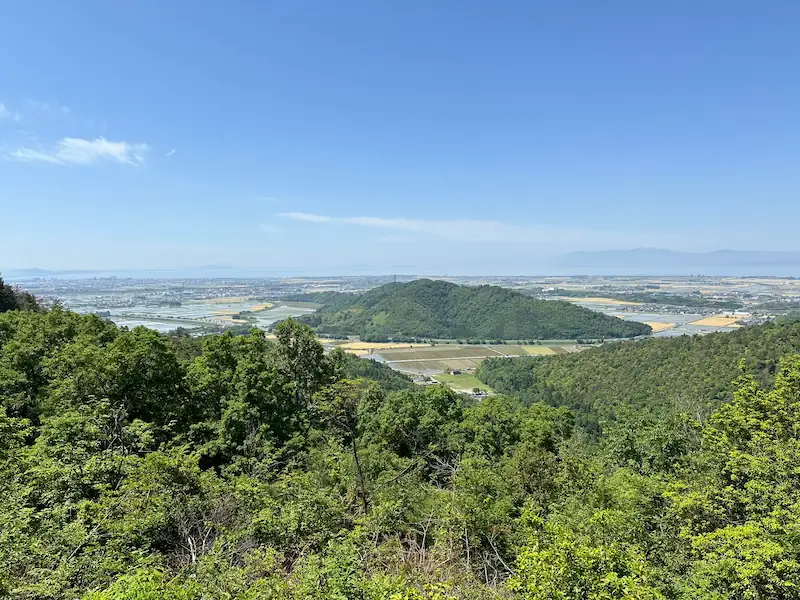
A two-tiered bailey before the Ohiroma. One of the best views on the mountain, overlooking the Kohoku plain and Lake Biwa.

The Sakurababa is a two-tiered bailey above the Oumaya, directly in front of the Ohiroma. Foundation stone traces have been confirmed on the western level, indicating that this was a zone of genuine importance rather than simply open ground. From the leading edge, the Kohoku plain and Lake Biwa spread out below — one of the finest views on the entire mountain. A memorial stone tower stands quietly here, and it’s easy to understand why visitors tend to pause.

  • Two-tiered layout: The difference in elevation between the two levels mirrors the increasing density of the main citadel just above.
  • Views over Kohoku: One of the few genuinely open vistas in the castle ruins — a vivid reminder of how much territory Odani once commanded.
  • Seasonal tip: Spring cherry blossoms live up to the name, and autumn foliage frames the wide view of the Kohoku plain beautifully.
Sakurababa at Odani Castle Ruins
Stone marker at Sakurababa, Odani Castle Ruins

Quick visit: approx. 3 min / Thorough visit: approx. 10 min

🗺 Address: Kohokucho Ibe, Nagahama, Shiga (Odani Castle Ruins – near Sakurababa)
🚶 Getting there: Approximately 5 minutes on foot from the previous stop, Umaraiba.

Recommended Rating
Historical Value: ★★ / Visual Appeal: ★★ / Experiential Value: ★
Date of ConstructionUnknown (established by early Sengoku period)
BuilderUnknown (developed by the Azai clan)
Structure & FeaturesTwo-level east–west bailey. Foundation stone traces confirmed on the western level; open views over the plain and Lake Biwa from the leading edge.
Restoration HistoryDeveloped as part of Azai-era modifications. No building reconstruction; conservation and landscape maintenance only.
Current ConditionTwo-tiered bailey, foundation stone traces, and memorial stone tower survive.
Loss / DamageAbandoned after the castle’s fall in 1573.
Cultural DesignationComponent ruin of the National Historic Site “Odani Castle Ruins.”
NotesKnown as one of the most scenic viewpoints within the ruins; memorial towers for the Azai clan and their retainers stand here.
Did You Know
  • Despite the evocative name, the western bailey’s confirmed foundation stones mark this as a key zone directly in front of the main citadel — not simply a scenic garden space.
  • Memorial towers for the Azai clan and their retainers stand here, giving the spot a commemorative dimension beyond its scenic appeal.
Main Citadel Entrance ── Kubisueishi / Kuroganemon Gate / Ohiroma
National Historic Site Free

Kubisueishi (Head-Display Stone)

A large boulder with a grim legend: in 1533, Azai Sukemasa displayed the head of a traitor here.

The Kubisueishi is a large boulder sitting just before the Kuroganemon Gate. According to tradition, in January 1533, Azai Sukemasa — the castle’s first lord — had the severed head of Imai Hidenobu displayed on this stone after Hidenobu was found to have conspired with the enemy. This predates the era of Nagamasa, and the story is a reminder that Odani Castle’s authority was built on a hard military order from the very beginning.

  • The boulder itself: The stone has a natural, commanding presence — you tend to stop in front of it before you’ve even read the sign.
  • Positioned before the gate: Just before the main citadel’s formal entrance, this placement was clearly deliberate — public punishment as a statement of power and order.
  • Seasonal tip: When the leaves fall, the surrounding terrain becomes easier to read, and the relationship between this stone and the Kuroganemon Gate becomes clearer.
Kubisueishi (Head-Display Stone) at Odani Castle Ruins

Quick visit: approx. 3 min / Thorough visit: approx. 10 min

🗺 Address: Kohokucho Ibe, Nagahama, Shiga (Odani Castle Ruins – near Kubisueishi)
🚶 Getting there: Approximately 2 minutes on foot from the previous stop, Umaraiba (about 0.03 km).

Recommended Rating
Historical Value: ★★ / Visual Appeal: ★ / Experiential Value: ★
Date of ConstructionUnknown
BuilderUnknown
Structure & FeaturesLarge boulder just before the Kuroganemon Gate. Associated by tradition with a public display of punishment.
Restoration HistoryNo individual modification or restoration record. Site features conservation maintenance and an interpretive panel only.
Current ConditionBoulder, stone marker, and interpretive panel survive.
Loss / DamageThe site has been preserved as a traditional landmark since the castle’s fall in 1573.
Cultural DesignationComponent ruin of the National Historic Site “Odani Castle Ruins.”
NotesOn-site interpretation identifies this as the traditional location where Imai Hidenobu’s head was displayed.
Did You Know
  • The legend of the Kubisueishi dates to the era of Azai Sukemasa — the first Azai lord — not to Nagamasa’s time.
  • Just to the right from here leads toward the Akao Residence ruins and the cluster of sites associated with the castle’s final hours.
National Historic Site Free

Kuroganemon Gate Ruins

Stone walls 3.5 m high and a stone staircase. The formal front entrance to the main citadel.

Known variously as the “Kuroganemon Gate ruins” or “Kurogane御門 ruins” in tourist materials, this is the formal front entrance to Odani Castle’s main citadel. Positioned at the top of the approach road, it opens directly into the Ohiroma. Stone steps and stone walls survive, with the flanking walls rising to approximately 3.5 meters — a striking statement of authority and defensive intent for a mountain castle gate.

  • Stone steps and gate ruins: After the long mountain trail, stone steps suddenly appear — a clear signal that you are entering the main citadel.
  • Flanking stone walls: The walls rising on both sides convey both the gate’s defensive strength and its ceremonial status.
  • Seasonal tip: When the leaves fall, the stone steps and walls stand out sharply, making the gate’s full dimensions easy to take in.
Kuroganemon Gate ruins at Odani Castle

Quick visit: approx. 3 min / Thorough visit: approx. 10 min

🗺 Address: Kohokucho Ibe, Nagahama, Shiga (Odani Castle Ruins – near Kuroganemon Gate; exact address unknown)
🚶 Getting there: Approximately 1 minute on foot from the previous stop, Kubisueishi (about 0.03 km).

Recommended Rating
Historical Value: ★★ / Visual Appeal: ★ / Experiential Value: ★
Date of ConstructionUnknown
BuilderUnknown
Structure & FeaturesGate ruins east of the Ohiroma, at the top of the approach road. Flanked by stone walls approximately 3.5 m high; about 7 stone steps lead up to the Ohiroma gateway.
Restoration HistorySubject to historic site preservation works in fiscal year 1970. No building reconstruction.
Current ConditionStone walls, stone steps, and gate ruin terrain survive.
Loss / DamageThe gate itself no longer exists. Abandoned after the castle’s fall in 1573.
Cultural DesignationComponent ruin of the National Historic Site “Odani Castle Ruins.”
NotesReferred to as “Kuroganemon ruins” in academic sources and “Kurogane御門 ruins” in some tourist materials.
Did You Know
  • This was not a side entrance — it was the formal front gate to the Ohiroma and the Honmaru: the main citadel’s principal threshold.
  • The name appears as “Kuroganemon ruins” in historical records and “Kurogane御門 ruins” in some visitor guides.
National Historic Site Free

Ohiroma (Great Hall / Senjōjiki)

35 m east–west by 85 m north–south. The political and ceremonial center where Azai Nagamasa governed and held council.

The Ohiroma — also known as the Senjōjiki, or “Thousand-Mat Floor” — is the vast, flat bailey that forms the heart of Odani Castle’s main citadel. It served as the site of Azai Nagamasa’s administrative work, military councils, retainer audiences, and formal ceremonies. Excavations have confirmed numerous building foundations and a range of artifacts across this expanse.

  • The sheer scale: Standing on a flat area this large at the top of a mountain makes Odani Castle’s political ambitions feel real and immediate.
  • Stone-lined features: A well, stone drainage channels, and a storehouse foundation have all been identified — evidence of a fully functioning administrative complex, not just an open field.
  • Seasonal tip: Spring to early summer, when the bailey is well-lit and open, is the best time to appreciate its full width and the stone walls that line it.
Ohiroma (Great Hall) at Odani Castle Ruins

Quick visit: approx. 5 min / Thorough visit: approx. 10 min

🗺 Address: Kohokucho Ibe, Nagahama, Shiga (Odani Castle Ruins – near Ohiroma; exact address unknown)
🚶 Getting there: Approximately 2 minutes on foot from the previous stop, Kuroganemon Gate ruins.

Recommended Rating
Historical Value: ★★ / Visual Appeal: ★ / Experiential Value: ★★
Date of ConstructionUnknown
BuilderUnknown (developed by the Azai clan)
Structure & FeaturesAlso known as “Senjōjiki” (Thousand-Mat Floor). Approx. 35 m east–west, 85 m north–south, approximately 3,000 m² of flat terrain. Building foundations, a stone-lined well, stone drainage channels, a storehouse foundation, and paved-stone features have been confirmed.
Restoration HistoryLandscaped in fiscal year 1971; turf planted in 1972. Wild boar disturbance has been an ongoing management concern in recent years.
Current ConditionExtensive flat bailey, stone walls, and ruin markers survive.
Loss / DamageNo buildings survive. Confirmed wild boar disturbance.
Cultural DesignationComponent ruin of the National Historic Site “Odani Castle Ruins.”
NotesThe largest flat area in the main citadel. Foundation stones are spaced at approximately 191 cm intervals.
Did You Know
  • Excavations yielded abundant building foundations and large quantities of artifacts — this was a densely occupied administrative zone, not simply a wide-open parade ground.
  • Foundation stones are spaced at approximately 191 cm intervals, indicating a consistent and deliberate building layout.
Akao Residence & Honmaru ── Where the Castle Fell
National Historic Site Free

Akao Residence Ruins

A three-tiered bailey east below the Honmaru. The traditional site of Azai Nagamasa’s final stand.

The Akao Residence Ruins are a three-tiered bailey east of and below the Honmaru, traditionally identified as the residence of Akao — a senior retainer of the Azai clan. This is the site where Azai Nagamasa is said to have made his final stand as Odani Castle fell. Oichi had already been escorted out of the castle before the end came; with Hashiba Hideyoshi pressing from the west and the castle’s defenses collapsing, Nagamasa faced the inevitable here.

  • Three-tiered layout: Even as a residential area, the terraced construction shows defensive awareness — the layers are well-preserved.
  • The weight of the place: A stone monument and an interpretive panel mark the site. It’s quiet enough here that you can actually take in what happened.
  • Seasonal tip: Late autumn and winter open up the views, making the terraced drops and the valley below easier to read.
Akao Residence ruins at Odani Castle

Quick visit: approx. 3 min / Thorough visit: approx. 10 min

🗺 Address: Kohokucho Ibe, Nagahama, Shiga (Odani Castle Ruins – near Akao Residence ruins; exact address unknown)
🚶 Getting there: Approximately 5 minutes on foot from the previous stop, Ohiroma (about 0.23 km).

Recommended Rating
Historical Value: ★★ / Visual Appeal: ★ / Experiential Value: ★
Date of ConstructionUnknown (established by early Sengoku period)
BuilderUnknown (developed as a retainer residential zone)
Structure & FeaturesThree-tiered bailey east below the Honmaru, approximately 180 m past the right-hand fork before the Kuroganemon Gate.
Restoration HistoryIncluded in the environmental improvement works of fiscal years 1970–1975.
Current ConditionBailey terrain, stone marker, and interpretive panel survive.
Loss / DamageNo buildings survive. Abandoned after the castle’s fall in 1573.
Cultural DesignationComponent ruin of the National Historic Site “Odani Castle Ruins.”
NotesTraditionally identified as the site where Azai Nagamasa took his own life.
Did You Know
  • This was not a remote outpost — the Akao Residence was a senior retainer’s compound positioned directly below the main keep, extremely close to the heart of power.
  • The conservation management plan records the site as approximately 180 m to the right past the fork before the Kuroganemon Gate.
National Historic Site Nagamasa’s End

Marker: Site of Lord Azai Nagamasa’s Death

The interpretive panel at the Akao Residence ruins. Where the fates of Nagamasa, Oichi, Nobunaga, and Hideyoshi each took a decisive turn.

This is the interpretive panel standing at the Akao Residence ruins — the site traditionally identified as where Azai Nagamasa died. Traffic is light here, which means you can actually read it without crowds. Oichi had been escorted out of the castle just before the end; Hashiba Hideyoshi had been pushing hard from the western side, tipping the balance, and Odani’s coherence finally broke. It’s easy to glance at the stone monument and keep walking, but reading the panel shows just how much was decided here — not only for Nagamasa, but for Oichi, Nobunaga, and the man who took the castle, Hideyoshi, too.

  • Panel and monument together: The stone marker is visible first, but the panel beside it fills in the context of the Akao Residence and what the location means.
  • The quiet of the place: Right next to the main citadel, yet rarely crowded — this is somewhere you can stand and think about how it all ended.
  • Seasonal tip: When the leaves fall, the whole bailey opens up, and you can trace the contours of the Akao Residence grounds more clearly.
Monument and interpretive panel marking the site of Azai Nagamasa's death, Akao Residence ruins

Quick visit: approx. 5 min / Thorough visit: approx. 10 min

🗺 Address: Kohokucho Ibe, Nagahama, Shiga (Odani Castle Ruins – near Akao Residence ruins)
🚶 Getting there: A short distance beyond the stone monument at the Akao Residence ruins. Visible from the monument itself.

Recommended Rating
Historical Value: ★★★ / Visual Appeal: ★ / Experiential Value: ★
Date of InstallationUnknown
Erected byUnknown
Structure & FeaturesInterpretive panel standing at the Akao Residence ruins, with a stone monument nearby, identifying this as the traditional site of Azai Nagamasa’s death.
Current ConditionBoth panel and monument survive.
Cultural DesignationDesignation status of the panel itself is unknown.
NotesOn-site interpretation identifies the location as the “Site of Azai Nagamasa’s death.”
Did You Know
  • The stone monument is what catches the eye, but the interpretive panel is individually noted in Nagahama City’s conservation management plan.
  • This site is along a branch path to the right before the Kuroganemon Gate — easy to miss if you stick to the main trail without looking for it.
National Historic Site Free

Honmaru (Main Keep)

The political and military core of Odani Castle, associated with Azai Nagamasa. Surrounded by stone walls, earthen ramparts, and the Great Moat.

The Honmaru is the political and military nucleus of Odani Castle. Positioned above and northeast of the Ohiroma, it is ringed by steep slopes, earthen ramparts, stone walls, and the Great Moat. Old pictorial maps label it “Tenshū tomo / Kanemaru tomo” — loosely, “also known as the keep / also known as the bell tower” — and it is the site most closely associated with Azai Nagamasa. What makes the Honmaru worth exploring in person is how the defenses, the scale, and the surrounding terrain all work together.

  • Elevated above the Ohiroma: The Honmaru sits one level higher than the great hall below — a physical expression of the lord’s authority.
  • Stone walls and earthen ramparts in combination: Relatively rare for a mountain castle of this period, this hybrid defensive system is one of the Honmaru’s most noteworthy features.
  • Seasonal tip: In winter, when the trees are bare, the Great Moat and adjacent baileys become far easier to read in relation to the Honmaru.
Honmaru (Main Keep) at Odani Castle Ruins

Quick visit: approx. 5 min / Thorough visit: approx. 10 min

🗺 Address: Kohokucho Ibe, Nagahama, Shiga (Odani Castle Ruins – near Honmaru; exact address unknown)
🚶 Getting there: Approximately 7 minutes on foot from the previous stop, Akao Residence ruins (about 0.25 km).

Recommended Rating
Historical Value: ★★ / Visual Appeal: ★★ / Experiential Value: ★★
Date of ConstructionUnknown
BuilderUnknown
Structure & FeaturesIrregular-shaped main keep above and northeast of the Ohiroma. Approx. 25 m east–west, 40 m north–south, on two levels. Stone walls along part of the base, a large earthen rampart on the eastern slope, and a stone-reinforced rampart on the northwest slope.
Restoration HistoryLandscape improvements at and below the Honmaru in fiscal year 1973. Some damage from typhoon-related fallen trees reported in recent years.
Current ConditionBailey terrain, stone walls, earthen ramparts, and interpretive panel survive.
Loss / DamageNo buildings survive. Abandoned after the castle’s fall.
Cultural DesignationComponent ruin of the National Historic Site “Odani Castle Ruins.”
NotesAlso referred to as “Kanemaru” in old pictorial maps.
Did You Know
  • The Honmaru’s strength lies not in its size but in its surrounding defenses — the combination of terrain, ramparts, and the Great Moat makes it a formidable position to read as a whole.
  • The “Kanemaru” (bell tower bailey) designation in old maps may point to a specific function or structure that once stood here.
Honmaru Perimeter ── Obikuruwa / Otsuboneyashiki / Great Moat
National Historic Site Free

Obikuruwa (Belt Bailey)

A narrow, elongated bailey running from the Oumaya to the Shimizudani side. The defensive flank protecting the Honmaru’s slope.

The Obikuruwa is a long, narrow bailey running from the Oumaya down through the slope below the Honmaru to the Shimizudani side. Odani Castle’s defenses didn’t stop at the ridge — they extended down the flanks as well, and the Obikuruwa is where that lateral thinking is most clearly visible. There are no striking building remains, but for anyone trying to understand how the castle held together as a defensive system, this corridor is indispensable.

  • Elongated belt construction: Rather than following the ridge, this bailey traces the slope — an unusually clear example of how mountain castle defense extended beyond the obvious axis.
  • Flanking the Honmaru: The defensive role of this corridor — protecting the main keep’s sides — is something you feel in the terrain itself.
  • Seasonal tip: In winter, when the undergrowth is bare, the slope’s contours open up and the full length of the Obikuruwa becomes easier to follow.
Obikuruwa (Belt Bailey) at Odani Castle Ruins

Quick visit: approx. 5 min / Thorough visit: approx. 10 min

🗺 Address: Kohokucho Ibe, Nagahama, Shiga (Odani Castle Ruins – near Obikuruwa; exact address unknown)
🚶 Getting there: Approximately 3 minutes on foot from the previous stop, Honmaru (about 0.08 km).

Recommended Rating
Historical Value: ★★ / Visual Appeal: ★ / Experiential Value: ★
Date of ConstructionUnknown
BuilderUnknown
Structure & FeaturesNarrow belt-shaped bailey, 3–5 m wide, running from the Oumaya ruins along the Shimizudani slope to near the back of the Honmaru and the Nakamaru. A stone wall approximately 5 m high has been noted near the Ohiroma.
Restoration HistoryIncluded in earlier site restoration works for ruin exposure and preservation.
Current ConditionBelt-shaped bailey terrain and traces of stone walls survive.
Loss / DamageThe vertical earthen cuts are noted as structurally fragile in the conservation management plan.
Cultural DesignationComponent ruin of the National Historic Site “Odani Castle Ruins.”
NotesConsidered part of the defensive corridor leading to the Otsuboneyashiki.
Did You Know
  • Odani Castle’s defenses extended well beyond the main ridge, with numerous defensive installations placed on the Shimizudani slope as well.
  • If you move directly from Oumaya to Honmaru without branching off, the Obikuruwa is easy to miss — it rewards those who explore deliberately.
National Historic Site Free

Otsuboneyashiki (Ladies’ Quarters)

A small residence on the Shimizudani side of the Nakamaru, traditionally associated with Oichi and the castle’s ladies-in-waiting.

The Otsuboneyashiki is a small residence ruin on the western, Shimizudani side of the Nakamaru. Quiet and slightly off the beaten path, it is traditionally associated with Oichi and the ladies-in-waiting of the castle household. There are few dramatic remains here, but the site offers a rare prompt to think about what daily life looked like within Odani’s walls — a dimension of the castle that the military installations don’t address.

  • Position west of the Honmaru and Nakamaru: Slightly outside the main defensive axis, this feels like residential space — easier to imagine as lived-in.
  • Connection to the Obikuruwa: Seen together with the belt bailey from the Oumaya, the circulation on the western side of the main citadel starts to make sense.
  • Seasonal tip: Autumn leaf-fall reveals the terrain outlines and makes the footprint of the residence easier to trace.
Interpretive signboard at the Otsuboneyashiki, Odani Castle Ruins

Quick visit: approx. 3 min / Thorough visit: approx. 10 min

🗺 Address: Kohokucho Ibe, Nagahama, Shiga (Odani Castle Ruins – near Otsuboneyashiki; exact address unknown)
🚶 Getting there: Approximately 5 minutes on foot from the previous stop, Obikuruwa (about 0.12 km).

Recommended Rating
Historical Value: ★★ / Visual Appeal: ★ / Experiential Value: ★
Date of ConstructionUnknown
BuilderUnknown
Structure & FeaturesSmall residence ruin on the Shimizudani side of the Nakamaru. Approx. 35 m north–south, 10 m east–west; connects to the belt bailey running from the Oumaya ruins.
Restoration HistoryIndividual modification dates unknown. Interpretive panel is installed on site.
Current ConditionBailey terrain, scattered stone, and interpretive panel survive.
Loss / DamageNo buildings survive. Abandoned after the castle’s fall in 1573.
Cultural DesignationComponent ruin of the National Historic Site “Odani Castle Ruins.”
NotesOral tradition associates this site with Oichi and the ladies-in-waiting.
Did You Know
  • In a castle defined almost entirely by military remains, this is one of the few sites that prompts you to think about the non-combatants who also called Odani home.
  • This spot is slightly off the main route between the Honmaru and the Nakamaru — worth a conscious detour to find it.
National Historic Site Free

Great Moat Ruins (Ōborikiriat)

A massive dry moat cutting across the ridge north of the Honmaru. The dividing line that Hideyoshi exploited — the point where the castle was split in two.

The Great Moat Ruins are a large-scale dry moat cut directly across the ridge just north of the Honmaru. Standing here, the way Odani Castle divides into a southern half and a northern half becomes unmistakably clear. In the final assault of 1573, Hashiba Hideyoshi pushed in hard from the direction of the Kyogokumaru, severing the connection between the Honmaru and the northern baileys — and this great moat marks precisely that fault line.

  • The scale of the cut: The ridge is broken sharply just north of the Honmaru — the defensive intent is immediately obvious.
  • The Honmaru–Kyogokumaru divide: Anyone thinking through how Nagamasa’s main keep related to the northern baileys needs to see this moat in person.
  • Seasonal tip: In winter, the bare trees reveal the moat’s depth and the slopes on both sides — the best time for terrain reading here.
View toward the Honmaru from near the Great Moat at Odani Castle Ruins

Quick visit: approx. 5 min / Thorough visit: approx. 10 min

🗺 Address: Kohokucho Ibe, Nagahama, Shiga (Odani Castle Ruins – near Great Moat)
🚶 Getting there: Approximately 3 minutes on foot from the previous stop, Otsuboneyashiki (about 0.05 km).

Recommended Rating
Historical Value: ★★★ / Visual Appeal: ★★ / Experiential Value: ★★
Date of ConstructionUnknown
BuilderUnknown
Structure & FeaturesLarge dry moat north of the Honmaru. Runs roughly level with the Ohiroma, dividing the southern citadel group (Honmaru and south) from the northern group (Nakamaru, Kyogokumaru, Komaru, Sannoumaru).
Restoration HistoryIndividual works date unknown. Landscape improvements were conducted at nearby Honmaru and Nakamaru in fiscal years 1973–1974.
Current ConditionDry moat terrain is clearly preserved.
Loss / DamageNo structures; the moat itself survives as a ruin.
Cultural DesignationComponent ruin of the National Historic Site “Odani Castle Ruins.”
NotesOften discussed in connection with Hideyoshi’s assault, though his specific role in breaching it is not directly documented.
Did You Know
  • Though the Great Moat sits at the “back” of the Honmaru, it functioned as a primary defensive line bisecting the core of the entire castle.
  • Because the moat runs roughly level with the Ohiroma, walking the full route makes the citadel’s layout — and how it was broken apart — easy to follow step by step.
Northern Bailey Group ── Nakamaru / Katanaarai Pond / Kyogokumaru / Komaru / Great Stone Wall / Sannoumaru
National Historic Site Free

Nakamaru (Middle Bailey)

North of the Great Moat: a three-tiered bailey with flanking fire positions and stone walls. The rear defensive zone of the main citadel.

The Nakamaru is a three-tiered bailey that begins just beyond the Great Moat, north of the Honmaru. Despite being positioned at the back of the main citadel, it was designed to defend against attacks from both directions — including the Honmaru side — making clear that Odani Castle’s planners didn’t think in terms of a single front. It’s a useful place to think through the tactical picture as Nobunaga’s forces closed in and the castle’s internal cohesion began to break down.

  • Three-tiered structure: Each level shifts the line of sight and movement, giving this rear zone a density you don’t expect for a position this far back.
  • Flanking fire positions: The middle tier includes lateral attack features — a sign that this was a genuinely engineered defensive position, not just a platform.
  • Seasonal tip: Autumn through winter, when stone walls and vertical earthen cuts are visible, is the best time for reading the terraced structure here.
Nakamaru (Middle Bailey) at Odani Castle Ruins

Quick visit: approx. 3 min / Thorough visit: approx. 10 min

🗺 Address: Kohokucho Ibe, Nagahama, Shiga (Odani Castle Ruins – near Nakamaru; exact address unknown)
🚶 Getting there: Approximately 5 minutes on foot from the previous stop, Great Moat (about 0.10 km).

Recommended Rating
Historical Value: ★★ / Visual Appeal: ★ / Experiential Value: ★
Date of ConstructionUnknown
BuilderUnknown
Structure & FeaturesThree-tiered bailey north of the Great Moat. Middle tier features flanking fire positions; stone walls visible on the slope.
Restoration HistoryLandscape improvements conducted in fiscal year 1974.
Current ConditionThree-tiered bailey terrain, stone walls, and interpretive panel survive.
Loss / DamageNo buildings survive. Some wild boar disturbance reported.
Cultural DesignationComponent ruin of the National Historic Site “Odani Castle Ruins.”
NotesNorth of here, the path continues to the Katanaarai Pond and Kyogokumaru.
Did You Know
  • Though positioned behind the Honmaru, the Nakamaru has its own independent gateway arrangement and defenses — it was not merely a corridor.
  • Beyond the Nakamaru, the Katanaarai Pond, Kyogokumaru, Komaru, and Sannoumaru come in sequence — the full depth of Odani Castle’s northern defensive zone.
National Historic Site Free

Katanaarai Pond (Sword-Washing Pool)

A bedrock-cut reservoir between the Nakamaru and Kyogokumaru. The water supply that Shincho Koki describes as the castle’s final lifeline.

The Katanaarai Pond — “Sword-Washing Pool” — is a small reservoir ruin on the left-hand side of the trail between the Nakamaru and the Kyogokumaru. The name evokes a scene from battle, but in the castle’s conservation management plan it is classified as a water supply installation, essentially one of the castle’s wells. Maintaining access to water during a siege was critical, and the chronicle Shincho Koki (a contemporary account of Oda Nobunaga’s campaigns) contains a passage about besieging forces cutting off the castle’s water supply — making this small pool a more significant piece of the story than it appears.

  • Bathtub-carved pool construction: The bedrock has been worked to collect water — this is crafted infrastructure, not a natural depression.
  • Stone lining traces: The remains of the pool’s stone-lined sides reinforce its character as a purpose-built water facility.
  • Seasonal tip: After rain or in damp weather, the pool retains water more visibly, making its original function easier to picture.
Katanaarai Pond ruins at Odani Castle

Quick visit: approx. 3 min / Thorough visit: approx. 10 min

🗺 Address: Kohokucho Ibe, Nagahama, Shiga (Odani Castle Ruins – near Katanaarai Pond)
🚶 Getting there: On the left-hand side of the trail from the previous stop, Nakamaru, as you head toward the Kyogokumaru.

Recommended Rating
Historical Value: ★★ / Visual Appeal: ★ / Experiential Value: ★
Date of ConstructionUnknown
BuilderUnknown
Structure & FeaturesWater reservoir on the left of the trail between the Nakamaru and Kyogokumaru. Bedrock carved in a bathtub shape; sides lined with stone approximately 50 cm high to collect seepage.
Restoration HistoryLandscape improvements carried out alongside the Nakamaru, Kyogokumaru, and Komaru in fiscal year 1974.
Current ConditionPool outline and partial stone lining survive.
Loss / DamageNo structures; the pool survives as a ruin.
Cultural DesignationComponent ruin of the National Historic Site “Odani Castle Ruins.”
NotesClassified in the conservation management plan as a water supply installation (“mizunote”); considered an important ruin for understanding the castle’s water management.
Did You Know
  • The evocative name “Sword-Washing Pool” belies its true role: this was a practical water supply and siege reserve, not a post-battle ceremonial site.
  • The conservation management plan classifies this as a “mizunote” — a critical water source — making it one of the more historically significant small ruins in the complex.
National Historic Site Free

Kyogokumaru & Kyogokumaru Gateway

The largest bailey group in the northern zone. The point where Hideyoshi broke through — and severed Nagamasa’s link to his father.

The Kyogokumaru is the sprawling bailey complex beyond the Katanaarai Pond, forming the strategic core of Odani Castle’s northern zone. Second only to the Ohiroma in sheer area, it features a high earthen rampart on the eastern side, a broad open bailey on the Shimizudani side, and a stone-walled gateway in the southwest. The name is said to derive from the Kyogoku clan — the Azai family’s former lords — whom Nagamasa is thought to have housed here as protected guests. In the final assault of 1573, Hashiba Hideyoshi drove in from this direction, seized the Kyogokumaru, and severed the connection between Nagamasa in the Honmaru and his father Hisamasa in the Komaru.

The Kyogokumaru gateway is the entrance ruin on the southwest side of the Kyogokumaru, facing the Shimizudani slope. Stone wall traces and vertical earthen cuts survive, and the positioning makes plain why this was a focal point of the final attack.

  • Expansive bailey: The scale here makes it easier to imagine the Kyogokumaru as both a combat zone and a troop concentration point.
  • Eastern earthen rampart: A long, well-preserved rampart runs along the east side — a clear demonstration of how seriously this northern zone was fortified.
  • Seasonal tip: In winter, when the undergrowth is bare, the ramparts and gateway outlines are most legible.
Kyogokumaru at Odani Castle Ruins
Kyogokumaru gateway ruins

Quick visit: approx. 5 min / Thorough visit: approx. 10 min

🗺 Address: Kohokucho Ibe, Nagahama, Shiga (Odani Castle Ruins – near Kyogokumaru; exact address unknown)
🚶 Getting there: Approximately 8 minutes on foot from the previous stop, Katanaarai Pond (about 0.20 km).

Recommended Rating
Historical Value: ★★ / Visual Appeal: ★ / Experiential Value: ★
Date of ConstructionUnknown
BuilderUnknown
Structure & FeaturesExtensive bailey group, second largest after the Ohiroma. Eastern side features a rampart approximately 3 m high; Shimizudani side has a wide open bailey; southwest has a stone-walled gateway and three-step earthen cut.
Restoration HistoryLandscape improvements conducted alongside the Nakamaru and Komaru in fiscal year 1974. Selective thinning and pruning have been flagged as ongoing needs.
Current ConditionBailey, earthen rampart, gateway, stone wall traces, and interpretive panel survive.
Loss / DamageNo buildings survive. Foundation stone scatter and disturbance confirmed.
Cultural DesignationComponent ruin of the National Historic Site “Odani Castle Ruins.”
NotesName said to derive from housing the father-son Kyogoku lords (Kyogoku Takakiyo) as protected guests.
Did You Know
  • The Kyogokumaru has one of the clearest origin stories of any bailey in the castle — the name directly records the Azai clan’s relationship with the Kyogoku, their former overlords.
  • The southwest gateway, reinforced with stone walls and facing the Shimizudani slope, is the feature that most vividly marks this as the focal point of the final battle’s decisive moment.
National Historic Site Free

Komaru (Small Bailey)

Azai Hisamasa’s retirement quarters — and where the Azai patriarch made his last stand. The father-son defense laid bare in the landscape.

The Komaru is the bailey above the Kyogokumaru, traditionally identified as the retirement quarters of Azai Hisamasa — Nagamasa’s father. The image of Nagamasa defending the Honmaru while his father held the Komaru to the north captures something essential about how Odani Castle was organized in its final days. As Hashiba Hideyoshi’s assault closed in, Hisamasa is said to have taken his own life here, slightly before his son. Small in area, but densely weighted with consequence.

  • Position above the Kyogokumaru: One level higher, with the northern rear of the castle in view — the logic of this as a senior reserve position reads clearly in the terrain.
  • Father and son at different ends of the castle: With the Komaru in mind, the father-son defense of Odani Castle becomes something you can see in the landscape rather than just read about.
  • Seasonal tip: Late autumn through winter, when the leaves are gone, makes the elevation difference between the Komaru and the Kyogokumaru below it easier to feel.
Komaru (Small Bailey) at Odani Castle Ruins

Quick visit: approx. 5 min / Thorough visit: approx. 10 min

🗺 Address: Kohokucho Ibe, Nagahama, Shiga (Odani Castle Ruins – near Komaru; exact address unknown)
🚶 Getting there: Approximately 3 minutes on foot from the previous stop, Kyogokumaru (about 0.08 km).

Recommended Rating
Historical Value: ★★ / Visual Appeal: ★ / Experiential Value: ★
Date of ConstructionUnknown
BuilderUnknown
Structure & FeaturesBailey above the Kyogokumaru. Approx. 25 m north–south, 30 m east–west; three-tiered layout (some sources describe it as two levels).
Restoration HistoryLandscape improvements conducted alongside the Nakamaru and Kyogokumaru in fiscal year 1974.
Current ConditionBailey terrain, stone marker, and interpretive panel survive.
Loss / DamageNo buildings survive. Scattered river stones possibly from original foundation use reported.
Cultural DesignationComponent ruin of the National Historic Site “Odani Castle Ruins.”
NotesTraditionally identified as Azai Hisamasa’s retirement quarters and the site where he took his own life.
Did You Know
  • The Komaru is modest in size, but its position in the story of the castle’s fall gives it an outsized historical weight.
  • The conservation management plan shows some inconsistency in describing the number of tiers — the main text says three, while a summary of the works describes two upper and lower levels.
National Historic Site Free

Great Stone Wall (Ōishigaki)

Massive boulders around the Sannoumaru — evidence of the technical ambition behind Odani Castle’s defenses.

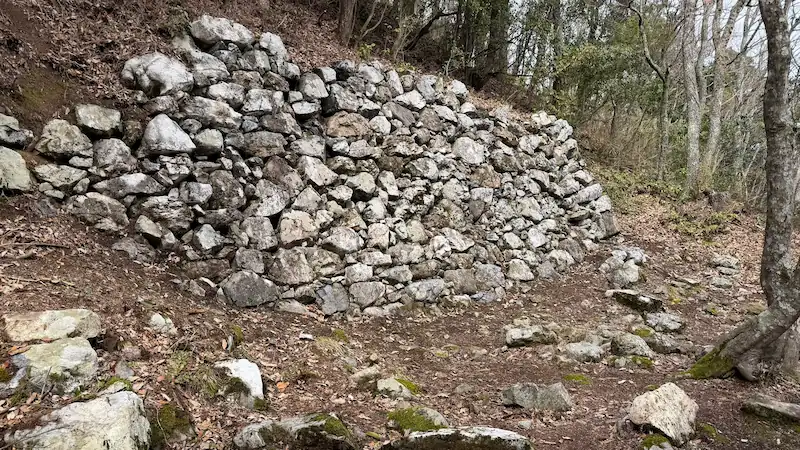
The Great Stone Wall refers to the massive boulder construction visible around the Sannoumaru. Tourist maps give it the standalone name “Ōishigaki,” but in the castle’s formal conservation records it is catalogued as part of the Sannoumaru’s stone wall system. Seen alongside the Sannoumaru, the defensive strength of this entire final zone comes into focus — this is one of the most visually impressive survivals anywhere in the castle.

  • Boulder scale and technique: Few surviving mountain castle ruins in Japan show stonework on this scale — and seeing it in person gives you a concrete sense of what Odani’s builders were capable of.
  • Integral to the Sannoumaru: Understood as the defensive skin of the innermost keep, the stone wall makes the Sannoumaru’s purpose much clearer.
  • Seasonal tip: During the green of new spring foliage or the color of autumn, the stone wall’s texture contrasts sharply with the vegetation — one of the better photographic moments in the ruins.
Great Stone Wall at Odani Castle Ruins

Quick visit: approx. 5 min / Thorough visit: approx. 15 min

🗺 Address: Kohokucho Ibe, Nagahama, Shiga (Odani Castle Ruins – near Great Stone Wall)
🚶 Getting there: From the Komaru, follow the trail toward the Sannoumaru; the wall appears on the right side as you go deeper.

Recommended Rating
Historical Value: ★★★ / Visual Appeal: ★★ / Experiential Value: ★
Date of ConstructionUnknown
BuilderUnknown
Structure & FeaturesBoulder stone wall construction around the Sannoumaru. The Sannoumaru comprises four terraced levels north–south; stone walls survive on the east, south, and north faces of the central bailey.
Restoration HistoryLandscape improvements at the Sannoumaru conducted in fiscal year 1975. Conservation and preservation-focused, not reconstruction.
Current ConditionStone wall survives.
Loss / DamageSome collapse and weathering visible; the main boulder stone wall grouping is intact.
Cultural DesignationComponent ruin of the National Historic Site “Odani Castle Ruins.”
NotesReferred to as “Ōishigaki” in tourist materials; classified as part of the Sannoumaru stone wall system in the conservation management plan.
Did You Know
  • Odani Castle was not built on earthen ramparts and moats alone — strategic use of stone walls at key points was integral to its design, and the Great Stone Wall is the clearest example.
  • The conservation management plan explicitly records that the Sannoumaru’s four tiers incorporate boulder stone wall construction — one of the more thoroughly documented structural features in the entire complex.
National Historic Site Free

Sannoumaru (Innermost Keep)

The castle’s last refuge — four terraced baileys dedicated to a Shinto deity, surrounded by massive stone walls.

The Sannoumaru is the innermost keep of Odani Castle. Its name comes from the Sanno Gongen (Mountain King) deity that was enshrined here — a common Shinto practice in Japanese castle construction during this era, where a tutelary deity was placed at the most protected point of the fortress. Set deepest within the northern bailey group and built on four terraced levels, it is ringed by the massive stone walls visible here. The Honmaru and the Akao Residence tend to dominate the narrative of Odani Castle’s fall, but the walk to the Sannoumaru is worth the effort for anyone who wants to fully gauge what this fortress was capable of.

  • Massive boulder stone walls: A different kind of intensity from the main citadel — memorable, and easy to photograph compellingly.
  • Four-tiered bailey construction: As the innermost keep, the stacked levels deepen as you move inward — defensive design taken to its logical end.
  • Seasonal tip: Spring foliage and autumn color both work well here, drawing out the texture of the stonework against the surrounding forest.
Stone walls at Sannoumaru, Odani Castle Ruins

Quick visit: approx. 5 min / Thorough visit: approx. 10 min

🗺 Address: Kohokucho Ibe, Nagahama, Shiga (Odani Castle Ruins – near Sannoumaru; exact address unknown)
🚶 Getting there: Approximately 3 minutes on foot from the previous stop, Great Stone Wall (about 0.04 km).

Recommended Rating
Historical Value: ★★ / Visual Appeal: ★ / Experiential Value: ★
Date of ConstructionUnknown
BuilderUnknown
Structure & FeaturesInnermost keep of Odani Castle. Approx. 35 m east–west, 70 m north–south; four terraced levels north–south; stone walls survive on the east, south, and north faces of the central bailey.
Restoration HistorySubject to landscape improvements in fiscal year 1975. Gateway partially collapsed; described as bearing traces of deliberate destruction after the castle fell.
Current ConditionBailey terrain, stone walls, gateway, and interpretive panel survive.
Loss / DamageSome stone wall collapse visible. No buildings survive.
Cultural DesignationComponent ruin of the National Historic Site “Odani Castle Ruins.”
NotesNamed after the Sanno Gongen (Mountain King) deity enshrined here.
Did You Know
  • Positioned deeper into the mountain than the Honmaru, the Sannoumaru served as the ultimate defensive fallback — and as a sacred site, anchoring the castle’s spiritual protection.
  • The gateway on the southern side is flanked by large boulder stone walls and faces toward the Komaru — a defensive orientation that speaks to how the castle’s final zone was conceived.

Frequently Asked Questions

From Kawake Station to the museum or Sengoku Guide Station at the base of the mountain, allow roughly 30–40 minutes on foot (about 2.1–2.2 km). Your easiest target is the museum or the Sengoku Guide Station (also known as Azai Sandai no Sato). If you’re driving, the Odani Castle Smart IC is the most convenient entry point, and parking is available at each facility.

From the Sengoku Guide Station to the Bansho takes about 40 minutes; from the Bansho to the Honmaru another 30 minutes; from the Honmaru to the Sannoumaru roughly 20 minutes — all one-way. If you turn back at the Honmaru, budget 2–3 hours in total. Including the Sannoumaru, allow 4–5 hours to be safe.

Exploring the castle ruins on the mountainside is free of charge. The only paid facility is the Odani Castle Sengoku History Museum (¥350 for high school students and above; ¥150 for junior high and elementary). The museum is well worth visiting before your climb: hours are 9:00–17:00, closed every Tuesday and over the New Year holiday.

Odani Castle Ruins is a nationally designated historic site, and the surviving earthworks are entirely original — the Honmaru, Ohiroma, Nakamaru, Kyogokumaru, Sannoumaru, Akao Residence, and others are all authentic. What you walk through are actual stone walls, earthen ramparts, dry moats, and terraced bailey formations from the Sengoku period. No buildings have been reconstructed; the focus has been on preservation and landscape maintenance.

The Akao Residence ruins are traditionally identified as the site where Azai Nagamasa took his own life. Located east below the Honmaru — about 180 meters past the right-hand fork before the Kuroganemon Gate — the site features a stone monument and an interpretive panel. Nagamasa’s father, Azai Hisamasa, is said to have died slightly earlier at the Komaru bailey.

Light rain is manageable, but mountain trails demand shoes with non-slip soles regardless. In heavy rain or rough conditions, swap the hike for a museum visit. If energy is limited, stick to the route from the Sengoku Guide Station through the Bansho, Ohiroma, and Honmaru — and leave the extension to the Sannoumaru for another day.

The Odani Castle goshiro-in (a castle commemorative seal stamp — popular among Japanese history enthusiasts as a souvenir, similar in concept to a national park passport stamp) is available at the Odani Castle Sengoku History Museum (139 Odanigujocho, Nagahama, Shiga). Visit during opening hours, with the reception desk closing at 16:30.

※ The information in this article is based on on-site research, Nagahama City conservation management documents, and other primary sources. Opening hours, admission fees, and shuttle bus schedules are subject to change. Please verify current details with the Nagahama City Tourism Bureau or the Odani Castle Sengoku History Museum before visiting. There are no shops or restrooms on the mountain. Come prepared with non-slip footwear, rain gear, and sufficient water.

Related Pages

Odani Castle Ruins — 360° Panorama Photos, Part 1

Odani Castle Ruins — 360° Panorama Photos, Part 2

comment